DRAINAGE PATTERNS
Hydrology and Fluvial Morphology
Mashrup Hasan | GEE | SUST
What is
Drainage Pattern?
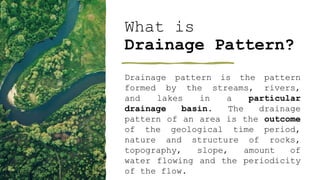
Drainage pattern is the pattern
formed by the streams, rivers,
and lakes in a particular
drainage basin. The drainage
pattern of an area is the outcome
of the geological time period,
nature and structure of rocks,
topography, slope, amount of
water flowing and the periodicity
of the flow.
How are
Drainage
Patterns formed?
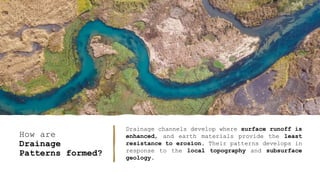
Drainage channels develop where surface runoff is
enhanced, and earth materials provide the least
resistance to erosion. Their patterns develops in
response to the local topography and subsurface
geology.
Types of Drainage
Pattern
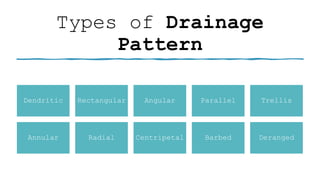
Dendritic Rectangular Angular Parallel Trellis
Annular Radial Centripetal Barbed Deranged
Dendritic pattern
A dendritic drainage pattern is
the most common form and looks
like the branching pattern of
tree roots. It develops in
regions underlain by homogeneous
material. That is, the
subsurface geology has a similar
resistance to weathering so
there is no apparent control
over the direction the
tributaries take.
Rectangular
pattern
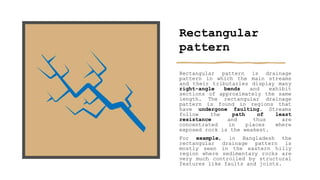
Rectangular pattern is drainage
pattern in which the main streams
and their tributaries display many
right-angle bends and exhibit
sections of approximately the same
length. The rectangular drainage
pattern is found in regions that
have undergone faulting. Streams
follow the path of least
resistance and thus are
concentrated in places where
exposed rock is the weakest.
For example, in Bangladesh the
rectangular drainage pattern is
mostly seen in the eastern hilly
region where sedimentary rocks are
very much controlled by structural
features like faults and joints.
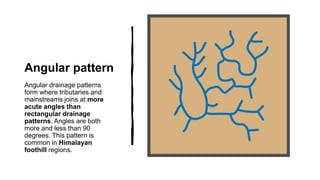
Angular drainage patterns
form where tributaries and
mainstreams joins at more
acute angles than
rectangular drainage
patterns. Angles are both
more and less than 90
degrees. This pattern is
common in Himalayan
foothill regions.
Angular pattern
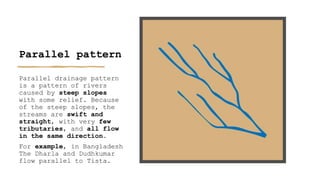
Parallel pattern
Parallel drainage pattern
is a pattern of rivers
caused by steep slopes
with some relief. Because
of the steep slopes, the
streams are swift and
straight, with very few
tributaries, and all flow
in the same direction.
For example, in Bangladesh
The Dharla and Dudhkumar
flow parallel to Tista.
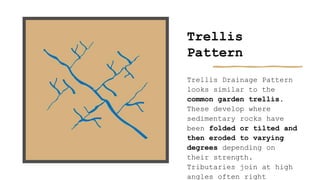
Trellis
Pattern
Trellis Drainage Pattern
looks similar to the
common garden trellis.
These develop where
sedimentary rocks have
been folded or tilted and
then eroded to varying
degrees depending on
their strength.
Tributaries join at high
angles often right
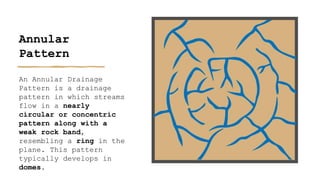
Annular
Pattern
An Annular Drainage
Pattern is a drainage
pattern in which streams
flow in a nearly
circular or concentric
pattern along with a
weak rock band,
resembling a ring in the
plane. This pattern
typically develops in
domes.
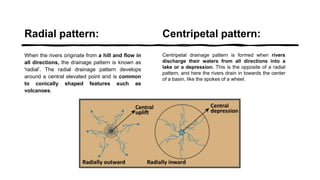
Radial pattern: Centripetal pattern:
When the rivers originate from a hill and flow in
all directions, the drainage pattern is known as
'radial’. The radial drainage pattern develops
around a central elevated point and is common
to conically shaped features such as
volcanoes.
Centripetal drainage pattern is formed when rivers
discharge their waters from all directions into a
lake or a depression. This is the opposite of a radial
pattern, and here the rivers drain in towards the center
of a basin, like the spokes of a wheel.
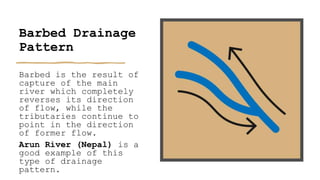
Barbed Drainage
Pattern
Barbed is the result of
capture of the main
river which completely
reverses its direction
of flow, while the
tributaries continue to
point in the direction
of former flow.
Arun River (Nepal) is a
good example of this
type of drainage
pattern.
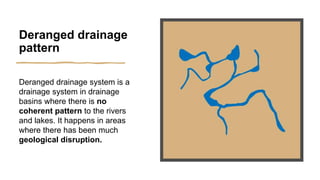
Deranged drainage
pattern
Deranged drainage system is a
drainage system in drainage
basins where there is no
coherent pattern to the rivers
and lakes. It happens in areas
where there has been much
geological disruption.
Why is
drainage
pattern
important?
The patterns which streams form are
determined by inequalities of surface slope
and rock resistance. This being true, it is
evident that drainage patterns may reflect
original slope and structure or the
successive episodes by which the surface
has been modified, including uplift,
depression, tilting, warping, folding,
faulting, and jointing, as well as
deposition by the sea, glaciers, volcanoes,
winds, and rivers.
Since drainage patterns are the reflection
of so many factors, it is evident that they
form one of the most immediate approaches
to an understanding of geologic structure.
Thank you.

Drainage pattern and types

  • 1.
  • 2.
    Mashrup Hasan |GEE | SUST
  • 3.
    What is Drainage Pattern? Drainagepattern is the pattern formed by the streams, rivers, and lakes in a particular drainage basin. The drainage pattern of an area is the outcome of the geological time period, nature and structure of rocks, topography, slope, amount of water flowing and the periodicity of the flow.
  • 4.
    How are Drainage Patterns formed? Drainagechannels develop where surface runoff is enhanced, and earth materials provide the least resistance to erosion. Their patterns develops in response to the local topography and subsurface geology.
  • 5.
    Types of Drainage Pattern DendriticRectangular Angular Parallel Trellis Annular Radial Centripetal Barbed Deranged
  • 6.
    Dendritic pattern A dendriticdrainage pattern is the most common form and looks like the branching pattern of tree roots. It develops in regions underlain by homogeneous material. That is, the subsurface geology has a similar resistance to weathering so there is no apparent control over the direction the tributaries take.
  • 7.
    Rectangular pattern Rectangular pattern isdrainage pattern in which the main streams and their tributaries display many right-angle bends and exhibit sections of approximately the same length. The rectangular drainage pattern is found in regions that have undergone faulting. Streams follow the path of least resistance and thus are concentrated in places where exposed rock is the weakest. For example, in Bangladesh the rectangular drainage pattern is mostly seen in the eastern hilly region where sedimentary rocks are very much controlled by structural features like faults and joints.
  • 8.
    Angular drainage patterns formwhere tributaries and mainstreams joins at more acute angles than rectangular drainage patterns. Angles are both more and less than 90 degrees. This pattern is common in Himalayan foothill regions. Angular pattern
  • 9.
    Parallel pattern Parallel drainagepattern is a pattern of rivers caused by steep slopes with some relief. Because of the steep slopes, the streams are swift and straight, with very few tributaries, and all flow in the same direction. For example, in Bangladesh The Dharla and Dudhkumar flow parallel to Tista.
  • 10.
    Trellis Pattern Trellis Drainage Pattern lookssimilar to the common garden trellis. These develop where sedimentary rocks have been folded or tilted and then eroded to varying degrees depending on their strength. Tributaries join at high angles often right
  • 12.
    Annular Pattern An Annular Drainage Patternis a drainage pattern in which streams flow in a nearly circular or concentric pattern along with a weak rock band, resembling a ring in the plane. This pattern typically develops in domes.
  • 13.
    Radial pattern: Centripetalpattern: When the rivers originate from a hill and flow in all directions, the drainage pattern is known as 'radial’. The radial drainage pattern develops around a central elevated point and is common to conically shaped features such as volcanoes. Centripetal drainage pattern is formed when rivers discharge their waters from all directions into a lake or a depression. This is the opposite of a radial pattern, and here the rivers drain in towards the center of a basin, like the spokes of a wheel.
  • 14.
    Barbed Drainage Pattern Barbed isthe result of capture of the main river which completely reverses its direction of flow, while the tributaries continue to point in the direction of former flow. Arun River (Nepal) is a good example of this type of drainage pattern.
  • 15.
    Deranged drainage pattern Deranged drainagesystem is a drainage system in drainage basins where there is no coherent pattern to the rivers and lakes. It happens in areas where there has been much geological disruption.
  • 16.
    Why is drainage pattern important? The patternswhich streams form are determined by inequalities of surface slope and rock resistance. This being true, it is evident that drainage patterns may reflect original slope and structure or the successive episodes by which the surface has been modified, including uplift, depression, tilting, warping, folding, faulting, and jointing, as well as deposition by the sea, glaciers, volcanoes, winds, and rivers. Since drainage patterns are the reflection of so many factors, it is evident that they form one of the most immediate approaches to an understanding of geologic structure.
  • 17.