Genitourinary system
Functions of urinary system
 Excretions of metabolic waste products
 Regulation of body fluid volume and osmolality
 Regulation of electrolytes
 Regulation of acid-base balance
 Production of erythropoietin, 1,25-
dihydroxycholecalciferol, renin and prostaglandins
 Metabolism of hormones
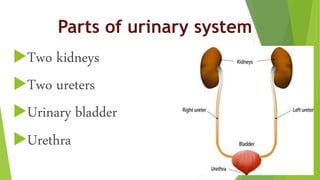
Parts of urinary system
Two kidneys
Two ureters
Urinary bladder
Urethra
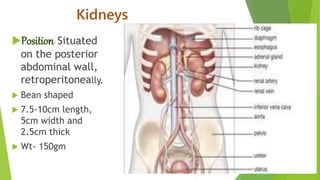
Kidneys
Position- Situated
on the posterior
abdominal wall,
retroperitoneally.
 Bean shaped
 7.5-10cm length,
5cm width and
2.5cm thick
 Wt- 150gm
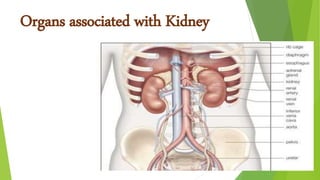
Organs associated with Kidney
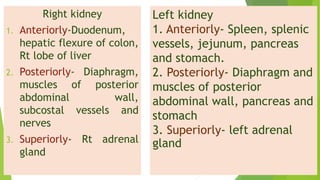
Left kidney
1. Anteriorly- Spleen, splenic
vessels, jejunum, pancreas
and stomach.
2. Posteriorly- Diaphragm and
muscles of posterior
abdominal wall, pancreas and
stomach
3. Superiorly- left adrenal
gland
Right kidney
1. Anteriorly-Duodenum,
hepatic flexure of colon,
Rt lobe of liver
2. Posteriorly- Diaphragm,
muscles of posterior
abdominal wall,
subcostal vessels and
nerves
3. Superiorly- Rt adrenal
gland
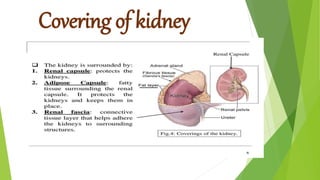
Covering of kidney
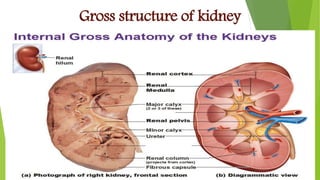
Gross structure of kidney
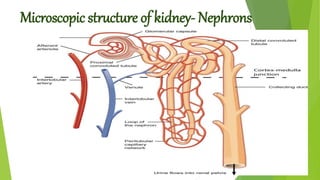
Microscopic structure of kidney- Nephrons
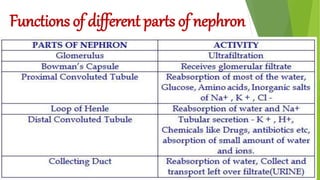
Functions of different parts of nephron
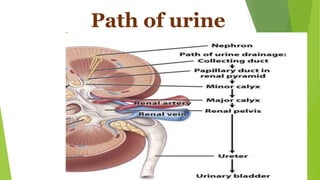
Path of urine
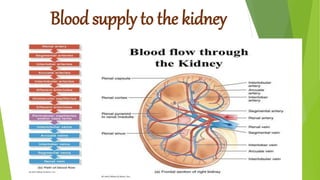
Blood supply to the kidney
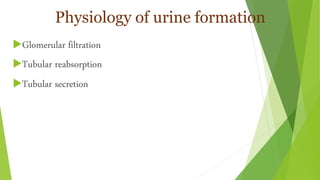
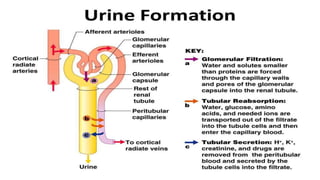
Physiology of urine formation
Glomerular filtration
Tubular reabsorption
Tubular secretion
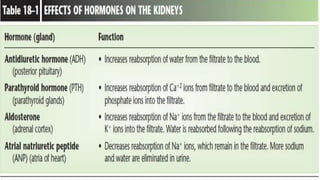
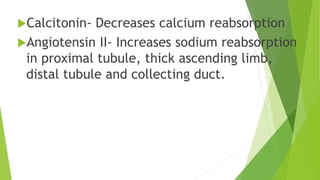
Calcitonin- Decreases calcium reabsorption
Angiotensin II- Increases sodium reabsorption
in proximal tubule, thick ascending limb,
distal tubule and collecting duct.
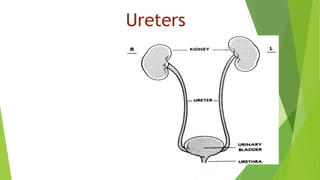
Ureters
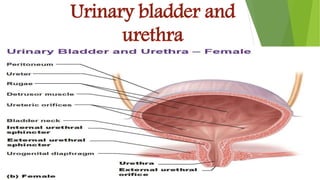
Urinary bladder and
urethra
Genitourinary system.pptx

Genitourinary system.pptx