VAGINAL DISCHARGE
OVERVIEW
• Introduction
• Differential diagnoses
• History taking
• Overview of each differential diagnosis
• Some case scenarios
INTRODUCTION
• Common presentation of women to the
STI clinic
• Can be physiological or pathological
• Related with some common STIs
VAGINAL
DISCHARGE
•Secretions produced
by the glands of
vaginal wall and
cervix that drain from
the vaginal opening
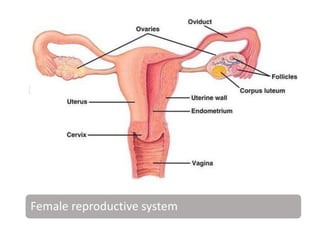
Female reproductive system
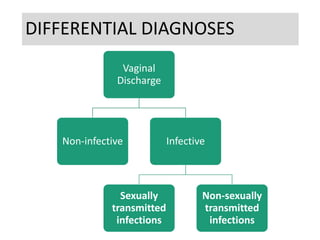
DIFFERENTIAL DIAGNOSES
Vaginal
Discharge
Non-infective Infective
Sexually
transmitted
infections
Non-sexually
transmitted
infections
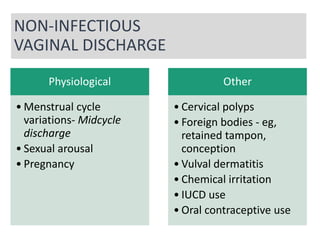
Physiological
• Menstrual cycle
variations- Midcycle
discharge
• Sexual arousal
• Pregnancy
Other
• Cervical polyps
• Foreign bodies - eg,
retained tampon,
conception
• Vulval dermatitis
• Chemical irritation
• IUCD use
• Oral contraceptive use
NON-INFECTIOUS
VAGINAL DISCHARGE
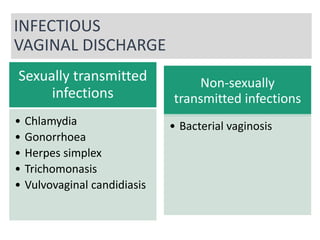
Sexually transmitted
infections
• Chlamydia
• Gonorrhoea
• Herpes simplex
• Trichomonasis
• Vulvovaginal candidiasis
Non-sexually
transmitted infections
• Bacterial vaginosis
INFECTIOUS
VAGINAL DISCHARGE
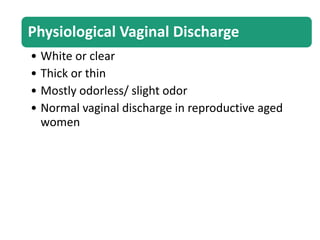
Physiological Vaginal Discharge
• White or clear
• Thick or thin
• Mostly odorless/ slight odor
• Normal vaginal discharge in reproductive aged
women
HISTORY TAKING
History of Presenting Complaint
•Color
•Odour
•Presence of blood
•Relationship to the menstrual cycle
•Associated symptoms
Past Medical History
Sexual History
Obstetric History
Gynaecological History
Contraceptive History
Menstrual History
Drug History
Family History
Social History
NATURE OF THE DISCHARGE
Physiological
Clear/ white
Gonnorrhoea, Pelvic inflammatory disease,
Chlamydia
Mucopurulent
Vulvovaginal candidiasis
Thick, curdy
Trichomonasis
Frothy, yellowish
green
Bacterial vaginosis
Greyish white
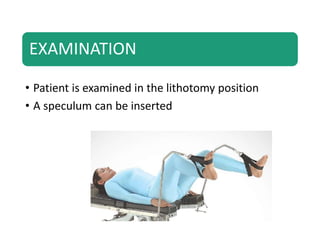
EXAMINATION
• Patient is examined in the lithotomy position
• A speculum can be inserted
OVERVIEW
OF
DIFFERENTIAL
DIAGNOSIS
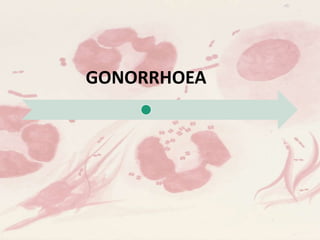
GONORRHOEA
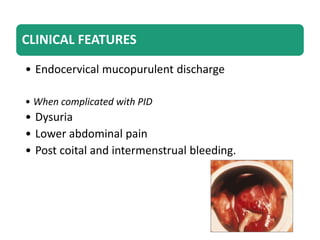
CLINICAL FEATURES
• Endocervical mucopurulent discharge
• When complicated with PID
• Dysuria
• Lower abdominal pain
• Post coital and intermenstrual bleeding.
GONOCOCCAL INFECTION
• Pathogen – Neisseria gonorrhoeae
• Intracellular Gram negative diplococci
• Mainly affect endocervix
• 50% of females are asymptomatic
• I.P. 2-7 days
• Common age of onset 15 - 24
COMPLICATIONS
• Bartholin’s abscess
• Pelvic inflammatory disease
• Due to ascending infection
• Disseminated gonococcal infections
• Fever,
• Septic arthritis,
• Blisters near small joints
• Perihepatitis, infertility
• Mother to child transmission
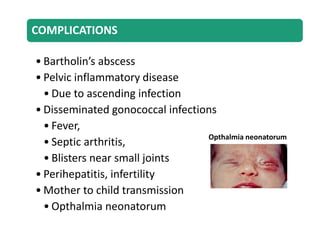
• Opthalmia neonatorum
Opthalmia neonatorum
•Endocervical
swab
•Vulvo-vaginal
swab (For NAAT and
of abused children)
SAMPLES
INVESTIGATIONS
Microscopy of Gram stained endocervical smear for Gonorrhea
• Gram negative intracellular diplococci
• Rapid diagnosis
Culture for Gonorrhea
• Thayer Martin medium- gray colonies
Nucleic acid amplification test (NAAT)
• Vulvovaginal swab is used
TREATMENT
•Cefexime 400mg stat
•IM Ceftriaxone 250mg
•Partner tracing and Epidemiological
treatment to the partner
•Avoid sexual relationships until both
partners complete treatments
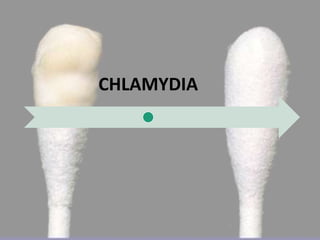
CHLAMYDIA
CLINICAL FEATURES
• Purulent, mucopurulent discharge
• When complicated with PID
• Dysuria
• Lower abdominal pain
• Post coital and inter-menstrual bleeding.
• Dyspareunia
Chlamydia trachomatis
• Serovars D to K
• Gram negative obligatory intracellular bacteria
• Nearly 70% of females are asymptomatic
COMPLICATIONS
• Pelvicinflammatory disease
• Cause ectopic pregnancy and infertilitty
• Perihepatitis
• Sexually acquired reactive arthritis
• In pregnancy
• Pre-term births,
• Post-partum infections,
• Opthalmia neonatarum
•Endocervical
swab
•Vulvo-vaginal
swab
SAMPLES
INVESTIGATIONS
• Microscopy (Not diagnostic nor confirmatory)
• Polymorphonuclear leukocytes > 30,
• under high power
• In absence of intracellular diplococci
• diagnosed as non gonococcal cervicitis
• Nuclear amplification test (Diagnostic)
TREATMENT
• Doxycyclin 100mg / bd for 7 days or
azithromycin 1g stat
• Azithromycin during pregnancy
• Partner tracing and Epidemiological
treatment to the partner
• Avoid sexual relationships until both
partners complete treatments
TRICHOMONASIS
CLINICAL FEATURES
• Profuse frothy yellow/gray discharge with foul odor
• Dysuria
• Abdominal discomfort
• Vulval itching
• Dyspareunia
• Rare – strawberry cervix (multiple hemorrhagic
areas in cervix )
Trichomonas vaginalis
• Cause trichomoniasis
• Most common STI worldwide
• Flagellated protozoa
• Mainly affects vagina, urethra and para urethral
glands.
• 10- 50% of females are asymptomatic.
• In pregnancy
• Preterm birth
• Low birth weight
COMPLICATIONS
• Secretions from the posterior fornix is
collected into the swab
• Observe under microscope
SAMPLES
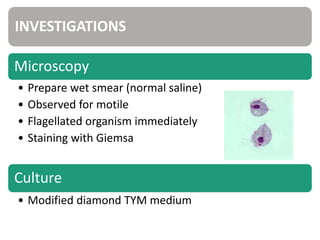
INVESTIGATIONS
Microscopy
• Prepare wet smear (normal saline)
• Observed for motile
• Flagellated organism immediately
• Staining with Giemsa
Culture
• Modified diamond TYM medium
TREATMENTS
• Metronidazole 400mg – 500 mg / bd for 7
days
• Partner tracing and epidemiological
treatment to the partner
• Avoid sexual relationships until both
partners complete treatments
Vulvovaginal Candidiasis
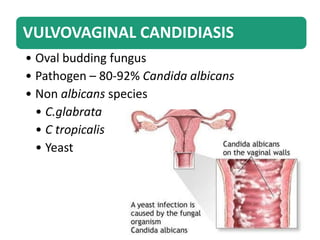
VULVOVAGINAL CANDIDIASIS
• Oval budding fungus
• Pathogen – 80-92% Candida albicans
• Non albicans species
• C.glabrata
• C tropicalis
• Yeast
CLINICAL FEATURES
• Thick white (curd like) non offensive vaginal
discharge
• Vulval itching
• Vulval soreness
• Superficial Dyspareunia (due to the vulval irritation)
• Signs –
• Erythema
• Fissuring
• Vulval oedema
PREDISPOSING FACTORS
• Diabetes mellitus
• Long term steroids
• Pregnancy
• Prolonged antibiotic use
• Immune suppression
SAMPLES
• Vaginal swabs from lateral fornix
INVESTIGATION
Microscopy of vaginal smear
•Gram stain or
•wet film examination (KOH)
•Hyphae and spores
Culture
• Sabouraud agar medium
TREATMENT
• Good hygiene
• Remove predisposing factors
• Oral Triazoles drugs- Fluconazole 150mg stat
or Itraconazole 200mg bd
• Topical applications- Clotrimazole,
Miconazole, Nystatin
• Pessaries and clotrimazole cream
intravaginally daily for 7-14 days
• No epidemiological treatment for partner
BACTERIAL VAGINOSIS
Bacterial vaginosis
• Non- sexually transmitted infection
• Frequent cause for vaginal discharge
• Anaerobic or facultative aerobic bacteria
• Normal vaginal flora of lactobacilli are replaced
by overgrowth of
• Gardenerella vaginalis
• Prevotella spp
• Mycoplasma hominis
• Mobiluncus spp
• Vaginal PH > 4.5
CLINICAL FEATURES
• Greyish white homogenous vaginal discharge
• Offensive fishy odor
• No vaginal inflammation
PREDISPOSING FACTORS
• Vaginal douching
• Oral sex
• Smoking
• Antibiotic use
• Recent change in sex partner
• IUCD
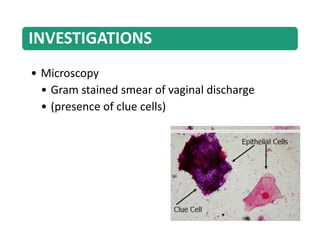
INVESTIGATIONS
• Microscopy
• Gram stained smear of vaginal discharge
• (presence of clue cells)
DIAGNOSTIC CRITERIA
• Presence of clue cells on microscopic examination
• clue cells are epithelial cells covered with bacteria giving
a characteristic stipped appearance on examination
• Yellowish grey discharge seen on naked eye
examination
• Vaginal pH more than 4.5
• Release of characteristic fishy odor on addition of
alkali
• 10% KOH
For diagnosis of bacterial vaginosis at least three criteria
should be present.
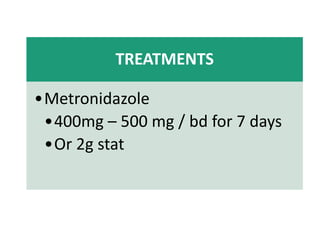
TREATMENTS
•Metronidazole
•400mg – 500 mg / bd for 7 days
•Or 2g stat
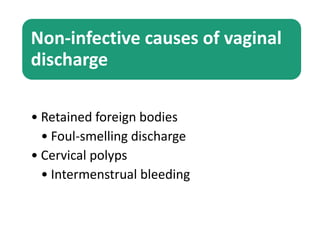
Non-infective causes of vaginal
discharge
• Retained foreign bodies
• Foul-smelling discharge
• Cervical polyps
• Intermenstrual bleeding
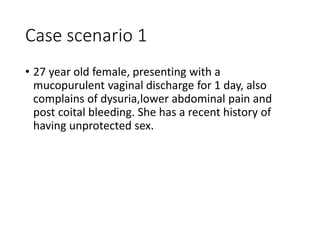
Case scenario 1
• 27 year old female, presenting with a
mucopurulent vaginal discharge for 1 day, also
complains of dysuria,lower abdominal pain and
post coital bleeding. She has a recent history of
having unprotected sex.
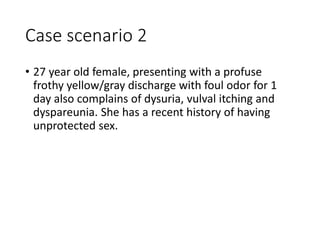
Case scenario 2
• 27 year old female, presenting with a profuse
frothy yellow/gray discharge with foul odor for 1
day also complains of dysuria, vulval itching and
dyspareunia. She has a recent history of having
unprotected sex.
Case scenario 3
• 25 year old female, presenting with a thick curdy
vaginal discharge for 1 day, also complains of
external dysuria, vulval itching & soreness.
Case scenario 5
• 33 year old female, presenting with a creamy
vaginal discharge with a fishy odor for 2 days, no
vulval itching or soreness.
REFERENCES
• Kumar and clark clinical medicine 9th edition
• Gynaecology byTen Teachers 19th edition
• Medical Microbilogy Greenwood 18th edition
• www.cdc.gov
Thank
you

Vaginal discharge

  • 1.
  • 2.
    OVERVIEW • Introduction • Differentialdiagnoses • History taking • Overview of each differential diagnosis • Some case scenarios
  • 3.
    INTRODUCTION • Common presentationof women to the STI clinic • Can be physiological or pathological • Related with some common STIs
  • 4.
    VAGINAL DISCHARGE •Secretions produced by theglands of vaginal wall and cervix that drain from the vaginal opening
  • 5.
  • 6.
  • 7.
    Physiological • Menstrual cycle variations-Midcycle discharge • Sexual arousal • Pregnancy Other • Cervical polyps • Foreign bodies - eg, retained tampon, conception • Vulval dermatitis • Chemical irritation • IUCD use • Oral contraceptive use NON-INFECTIOUS VAGINAL DISCHARGE
  • 8.
    Sexually transmitted infections • Chlamydia •Gonorrhoea • Herpes simplex • Trichomonasis • Vulvovaginal candidiasis Non-sexually transmitted infections • Bacterial vaginosis INFECTIOUS VAGINAL DISCHARGE
  • 9.
    Physiological Vaginal Discharge •White or clear • Thick or thin • Mostly odorless/ slight odor • Normal vaginal discharge in reproductive aged women
  • 10.
    HISTORY TAKING History ofPresenting Complaint •Color •Odour •Presence of blood •Relationship to the menstrual cycle •Associated symptoms
  • 11.
    Past Medical History SexualHistory Obstetric History Gynaecological History Contraceptive History Menstrual History Drug History Family History Social History
  • 12.
    NATURE OF THEDISCHARGE Physiological Clear/ white Gonnorrhoea, Pelvic inflammatory disease, Chlamydia Mucopurulent Vulvovaginal candidiasis Thick, curdy Trichomonasis Frothy, yellowish green Bacterial vaginosis Greyish white
  • 13.
    EXAMINATION • Patient isexamined in the lithotomy position • A speculum can be inserted
  • 14.
  • 15.
  • 16.
    CLINICAL FEATURES • Endocervicalmucopurulent discharge • When complicated with PID • Dysuria • Lower abdominal pain • Post coital and intermenstrual bleeding.
  • 17.
    GONOCOCCAL INFECTION • Pathogen– Neisseria gonorrhoeae • Intracellular Gram negative diplococci • Mainly affect endocervix • 50% of females are asymptomatic • I.P. 2-7 days • Common age of onset 15 - 24
  • 18.
    COMPLICATIONS • Bartholin’s abscess •Pelvic inflammatory disease • Due to ascending infection • Disseminated gonococcal infections • Fever, • Septic arthritis, • Blisters near small joints • Perihepatitis, infertility • Mother to child transmission • Opthalmia neonatorum Opthalmia neonatorum
  • 19.
  • 20.
    INVESTIGATIONS Microscopy of Gramstained endocervical smear for Gonorrhea • Gram negative intracellular diplococci • Rapid diagnosis Culture for Gonorrhea • Thayer Martin medium- gray colonies Nucleic acid amplification test (NAAT) • Vulvovaginal swab is used
  • 21.
    TREATMENT •Cefexime 400mg stat •IMCeftriaxone 250mg •Partner tracing and Epidemiological treatment to the partner •Avoid sexual relationships until both partners complete treatments
  • 22.
  • 23.
    CLINICAL FEATURES • Purulent,mucopurulent discharge • When complicated with PID • Dysuria • Lower abdominal pain • Post coital and inter-menstrual bleeding. • Dyspareunia
  • 24.
    Chlamydia trachomatis • SerovarsD to K • Gram negative obligatory intracellular bacteria • Nearly 70% of females are asymptomatic
  • 25.
    COMPLICATIONS • Pelvicinflammatory disease •Cause ectopic pregnancy and infertilitty • Perihepatitis • Sexually acquired reactive arthritis • In pregnancy • Pre-term births, • Post-partum infections, • Opthalmia neonatarum
  • 26.
  • 27.
    INVESTIGATIONS • Microscopy (Notdiagnostic nor confirmatory) • Polymorphonuclear leukocytes > 30, • under high power • In absence of intracellular diplococci • diagnosed as non gonococcal cervicitis • Nuclear amplification test (Diagnostic)
  • 28.
    TREATMENT • Doxycyclin 100mg/ bd for 7 days or azithromycin 1g stat • Azithromycin during pregnancy • Partner tracing and Epidemiological treatment to the partner • Avoid sexual relationships until both partners complete treatments
  • 29.
  • 30.
    CLINICAL FEATURES • Profusefrothy yellow/gray discharge with foul odor • Dysuria • Abdominal discomfort • Vulval itching • Dyspareunia • Rare – strawberry cervix (multiple hemorrhagic areas in cervix )
  • 31.
    Trichomonas vaginalis • Causetrichomoniasis • Most common STI worldwide • Flagellated protozoa • Mainly affects vagina, urethra and para urethral glands. • 10- 50% of females are asymptomatic.
  • 32.
    • In pregnancy •Preterm birth • Low birth weight COMPLICATIONS • Secretions from the posterior fornix is collected into the swab • Observe under microscope SAMPLES
  • 33.
    INVESTIGATIONS Microscopy • Prepare wetsmear (normal saline) • Observed for motile • Flagellated organism immediately • Staining with Giemsa Culture • Modified diamond TYM medium
  • 34.
    TREATMENTS • Metronidazole 400mg– 500 mg / bd for 7 days • Partner tracing and epidemiological treatment to the partner • Avoid sexual relationships until both partners complete treatments
  • 35.
  • 36.
    VULVOVAGINAL CANDIDIASIS • Ovalbudding fungus • Pathogen – 80-92% Candida albicans • Non albicans species • C.glabrata • C tropicalis • Yeast
  • 37.
    CLINICAL FEATURES • Thickwhite (curd like) non offensive vaginal discharge • Vulval itching • Vulval soreness • Superficial Dyspareunia (due to the vulval irritation) • Signs – • Erythema • Fissuring • Vulval oedema
  • 38.
    PREDISPOSING FACTORS • Diabetesmellitus • Long term steroids • Pregnancy • Prolonged antibiotic use • Immune suppression SAMPLES • Vaginal swabs from lateral fornix
  • 39.
    INVESTIGATION Microscopy of vaginalsmear •Gram stain or •wet film examination (KOH) •Hyphae and spores Culture • Sabouraud agar medium
  • 40.
    TREATMENT • Good hygiene •Remove predisposing factors • Oral Triazoles drugs- Fluconazole 150mg stat or Itraconazole 200mg bd • Topical applications- Clotrimazole, Miconazole, Nystatin • Pessaries and clotrimazole cream intravaginally daily for 7-14 days • No epidemiological treatment for partner
  • 41.
  • 42.
    Bacterial vaginosis • Non-sexually transmitted infection • Frequent cause for vaginal discharge • Anaerobic or facultative aerobic bacteria • Normal vaginal flora of lactobacilli are replaced by overgrowth of • Gardenerella vaginalis • Prevotella spp • Mycoplasma hominis • Mobiluncus spp • Vaginal PH > 4.5
  • 43.
    CLINICAL FEATURES • Greyishwhite homogenous vaginal discharge • Offensive fishy odor • No vaginal inflammation PREDISPOSING FACTORS • Vaginal douching • Oral sex • Smoking • Antibiotic use • Recent change in sex partner • IUCD
  • 44.
    INVESTIGATIONS • Microscopy • Gramstained smear of vaginal discharge • (presence of clue cells)
  • 45.
    DIAGNOSTIC CRITERIA • Presenceof clue cells on microscopic examination • clue cells are epithelial cells covered with bacteria giving a characteristic stipped appearance on examination • Yellowish grey discharge seen on naked eye examination • Vaginal pH more than 4.5 • Release of characteristic fishy odor on addition of alkali • 10% KOH For diagnosis of bacterial vaginosis at least three criteria should be present.
  • 46.
    TREATMENTS •Metronidazole •400mg – 500mg / bd for 7 days •Or 2g stat
  • 47.
    Non-infective causes ofvaginal discharge • Retained foreign bodies • Foul-smelling discharge • Cervical polyps • Intermenstrual bleeding
  • 48.
    Case scenario 1 •27 year old female, presenting with a mucopurulent vaginal discharge for 1 day, also complains of dysuria,lower abdominal pain and post coital bleeding. She has a recent history of having unprotected sex.
  • 49.
    Case scenario 2 •27 year old female, presenting with a profuse frothy yellow/gray discharge with foul odor for 1 day also complains of dysuria, vulval itching and dyspareunia. She has a recent history of having unprotected sex.
  • 50.
    Case scenario 3 •25 year old female, presenting with a thick curdy vaginal discharge for 1 day, also complains of external dysuria, vulval itching & soreness.
  • 51.
    Case scenario 5 •33 year old female, presenting with a creamy vaginal discharge with a fishy odor for 2 days, no vulval itching or soreness.
  • 52.
    REFERENCES • Kumar andclark clinical medicine 9th edition • Gynaecology byTen Teachers 19th edition • Medical Microbilogy Greenwood 18th edition • www.cdc.gov
  • 53.