Review of Human Traits
           GENETICS LEC 2G
Taghavi Komsari Esmaeil  Yusuf A.Meer
Review of Human Traits
Analyses of human traits offer genetic examples including dominance, incomplete
               dominance, co-dominance, and sex linkage and …

                                       What are Alleles?
Alleles are variations of a gene. A diploid organism gets one set of their alleles (genes) from
                one parent and the other set of alleles from the other parent.
                              Definition of genetic trait :
  A physical characteristic brought about by the expression of a gene or many
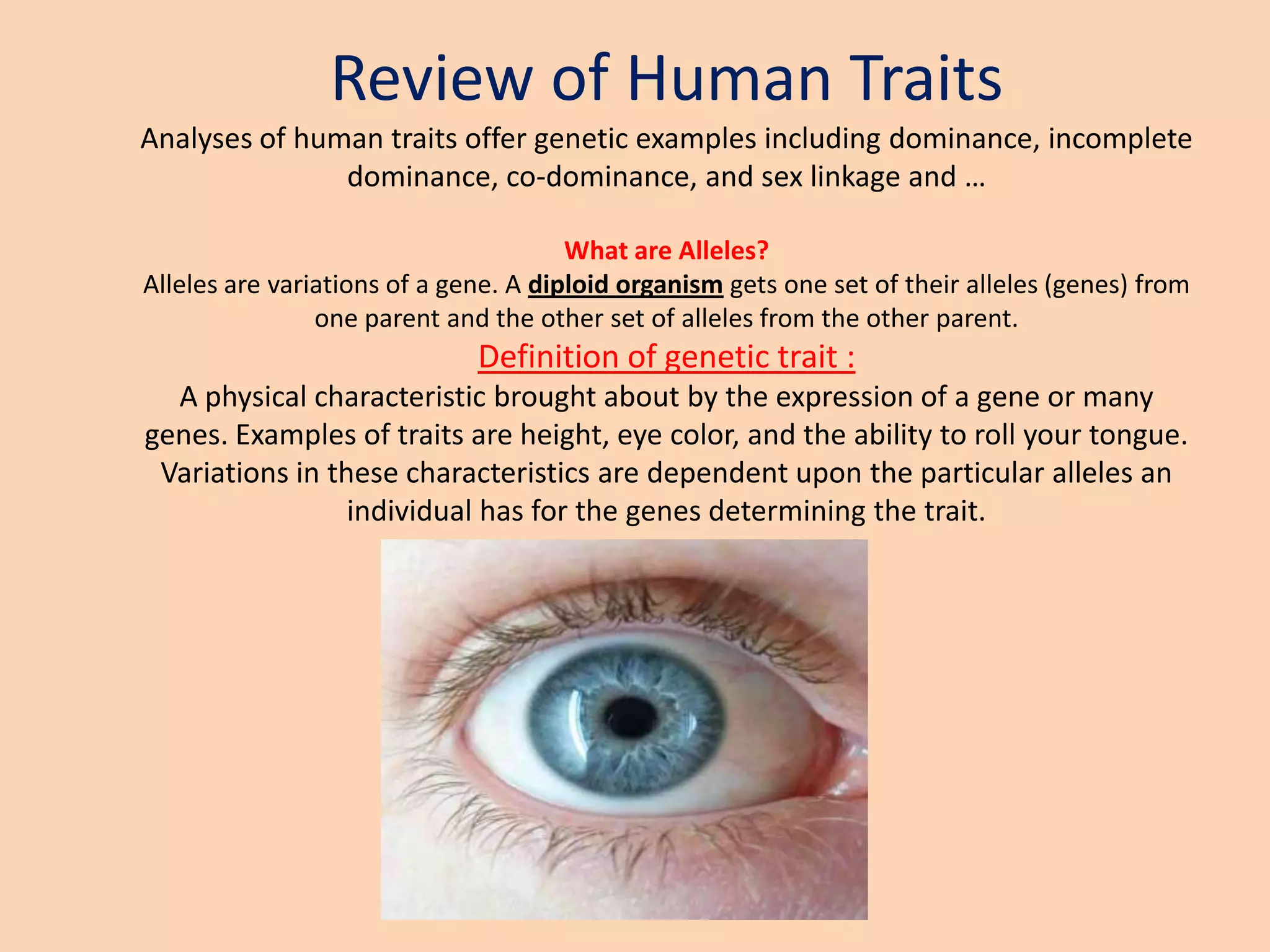
genes. Examples of traits are height, eye color, and the ability to roll your tongue.
 Variations in these characteristics are dependent upon the particular alleles an
                 individual has for the genes determining the trait.


                                             RRR
dominant trait
In genetics, a trait that will appear in the offspring if one of the
parents contributes it. (Compare recessive trait.)
In humans, dark hair is a dominant trait; if one parent
contributes a gene for dark hair and the other contributes a
gene for light hair, the child will have dark hair.

                                   ,
recessive trait
In genetics, a trait that must be contributed by both parents in
order to appear in the offspring. Recessive traits can be carried in
a person's genes without appearing in that person or In genetics, the term
"recessive gene" refers to an allele that causes a phenotype (visible or detectable
characteristic) that is only seen in a homozygous genotype (an organism that has
two copies of the same allele) and never in a heterozygous genotype.


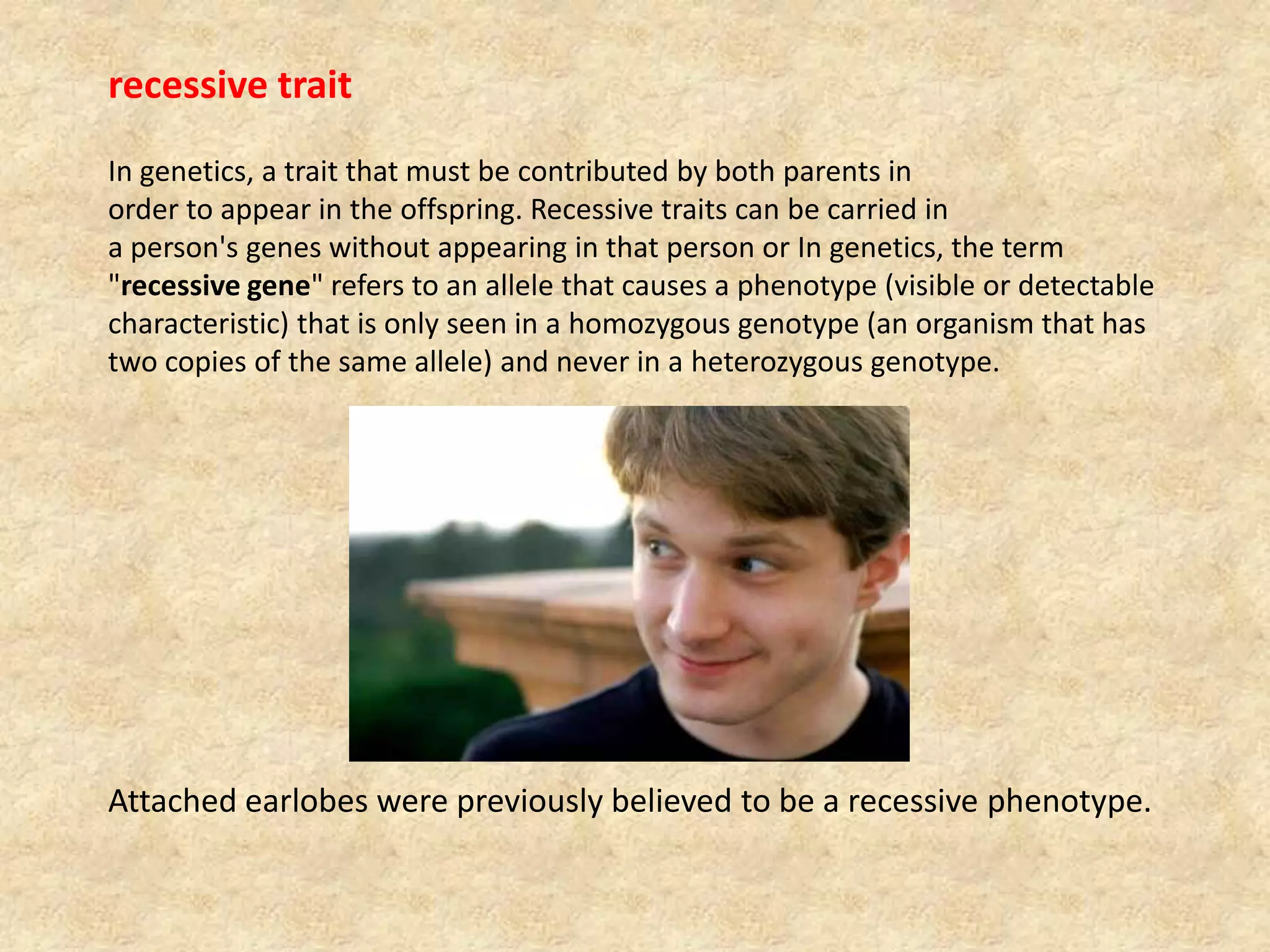
Attached earlobes were previously believed to be a recessive phenotype.
Co dominant Traits
A number of human traits are the result of 2 types of alleles that
are equally dominant. Such traits are said to be co dominant for that
trait. When an individual is heterozygous for such traits, the resulting
phenotype or expression of these two traits is a blending, because both
traits are expressed equally.
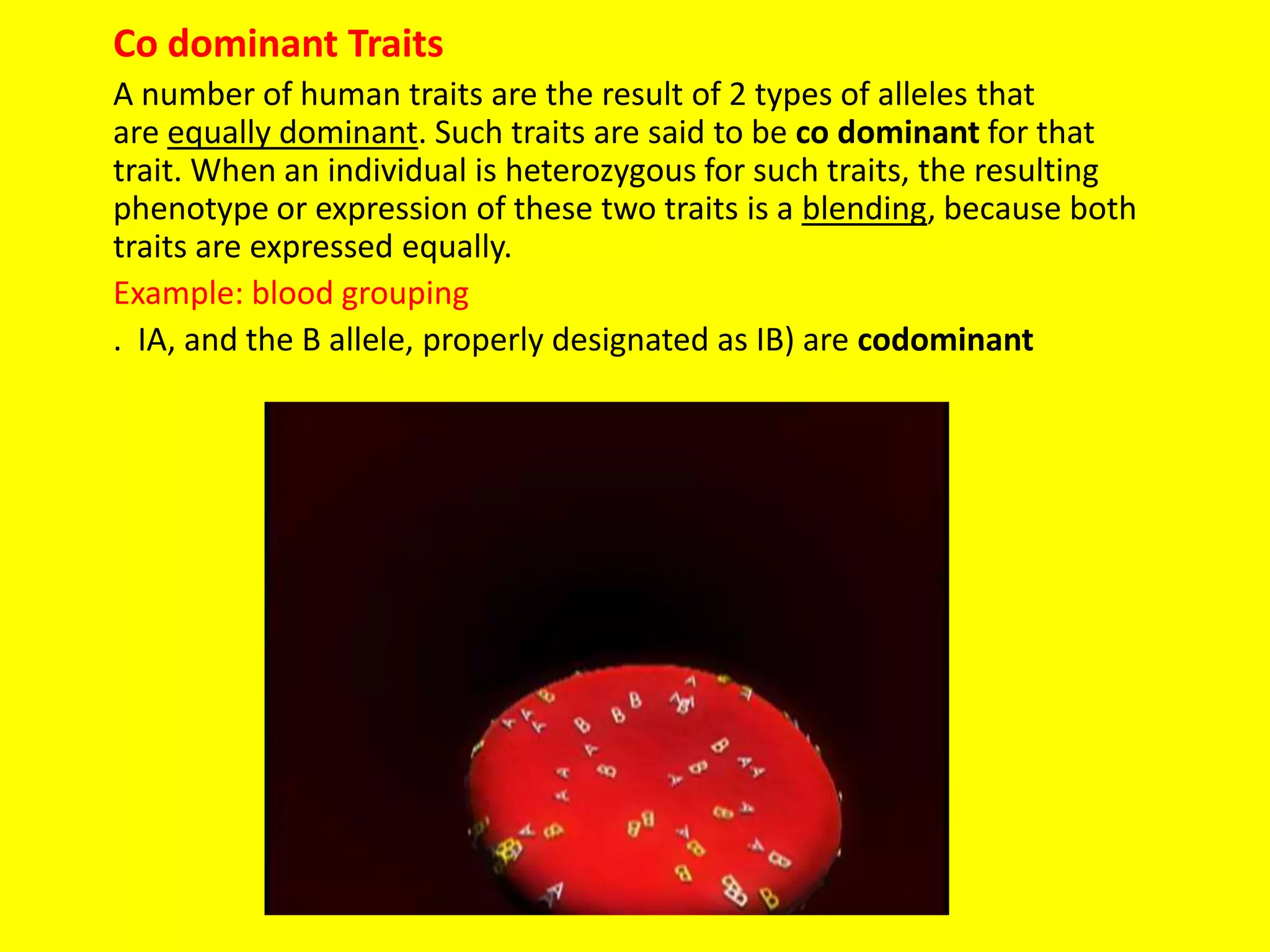
Example: blood grouping
. IA, and the B allele, properly designated as IB) are codominant


                                    .
Incomplete Dominance
Incomplete dominance is a form of intermediate inheritance in
which one allele for a specific trait is not completely dominant
over the other allele. This results in a combined phenotype.

The most well-studied example of incomplete dominance in humans occurs in the
genes for curly hair.
.Sex-linked trait :
.A trait genetically determined by an allele located on the sex chromosome .
. Sex-linked traits are most commonly found on the X chromosome and include
color blindness (both red and green types), hemophilia (types A and B), icthyosis
(a skin disorder causing large dark scales), and Duchenne muscular dystrophy.
There are very few Y-linked traits. Hairy ears, a relatively rare trait, is a Y-linked
trait.


.
X-linked trait
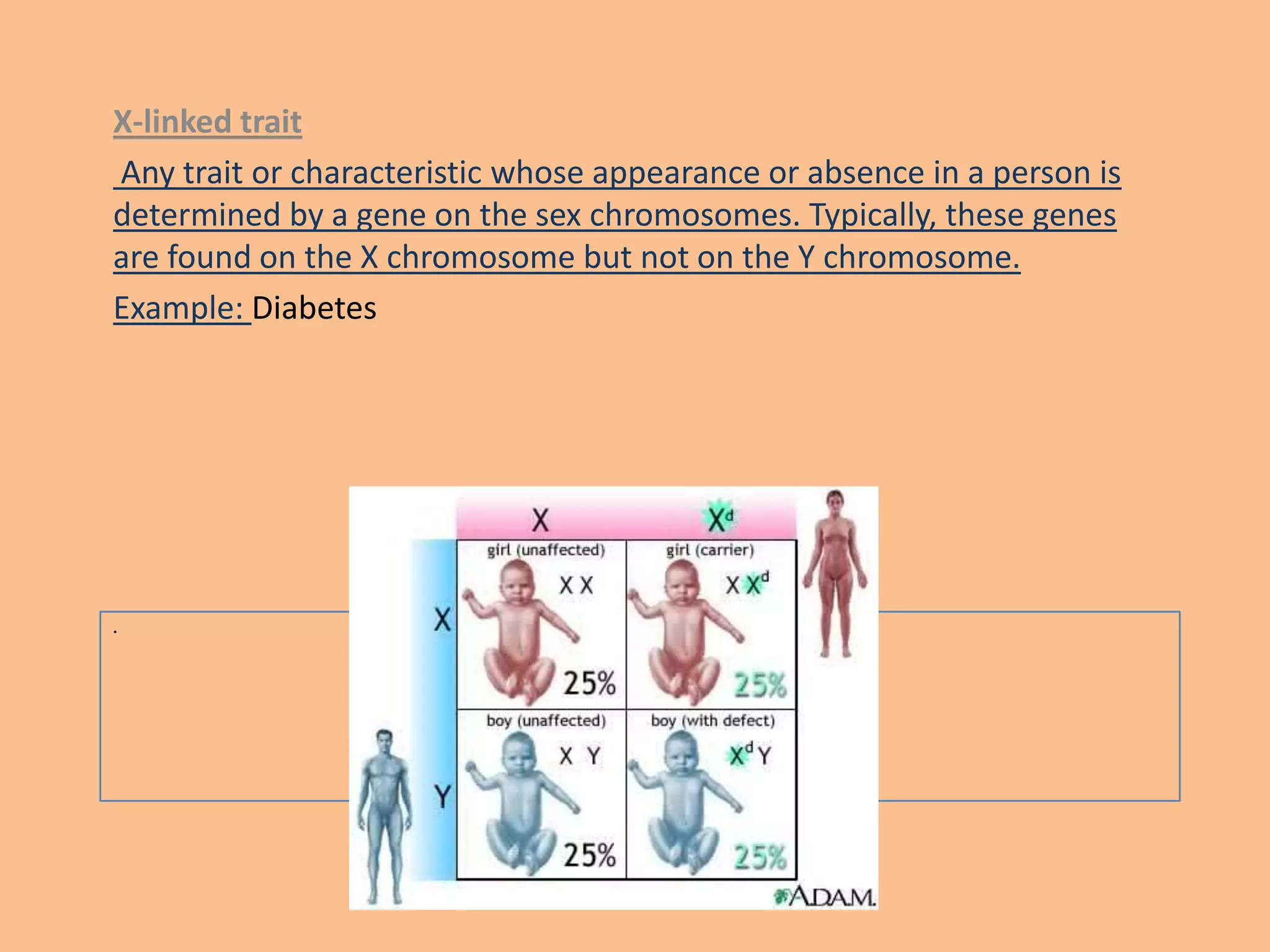
Any trait or characteristic whose appearance or absence in a person is
determined by a gene on the sex chromosomes. Typically, these genes
are found on the X chromosome but not on the Y chromosome.
Example: Diabetes


.
Y- linked trait
Y-linked traits are traits whose allele is carried
on the Y chromosome . Most Y linked
mutations lead to sterility , and can not be
inherited.
Example:
Hypertrichosis

.
Sex influenced
.sex-influenced traits are those that are expressed differently in the
two sexes. Such traits are autosomal, which means that the genes
responsible for their expression are not carried on the sex
chromosomes. An example of a sex-influenced trait is male-pattern
baldness.
The baldness allele, which causes hair loss, is influenced by the
hormones testosterone and dihydrotestosterone, but only when
levels of the two hormones are high. In general, males have much
higher levels of these hormones than females, so the baldness
allele has a stronger effect in males than in females.


.

Review of human traits

  • 1.
    Review of HumanTraits GENETICS LEC 2G Taghavi Komsari Esmaeil Yusuf A.Meer
  • 2.
    Review of HumanTraits Analyses of human traits offer genetic examples including dominance, incomplete dominance, co-dominance, and sex linkage and … What are Alleles? Alleles are variations of a gene. A diploid organism gets one set of their alleles (genes) from one parent and the other set of alleles from the other parent. Definition of genetic trait : A physical characteristic brought about by the expression of a gene or many genes. Examples of traits are height, eye color, and the ability to roll your tongue. Variations in these characteristics are dependent upon the particular alleles an individual has for the genes determining the trait. RRR
  • 3.
    dominant trait In genetics,a trait that will appear in the offspring if one of the parents contributes it. (Compare recessive trait.) In humans, dark hair is a dominant trait; if one parent contributes a gene for dark hair and the other contributes a gene for light hair, the child will have dark hair. ,
  • 4.
    recessive trait In genetics,a trait that must be contributed by both parents in order to appear in the offspring. Recessive traits can be carried in a person's genes without appearing in that person or In genetics, the term "recessive gene" refers to an allele that causes a phenotype (visible or detectable characteristic) that is only seen in a homozygous genotype (an organism that has two copies of the same allele) and never in a heterozygous genotype. Attached earlobes were previously believed to be a recessive phenotype.
  • 5.
    Co dominant Traits Anumber of human traits are the result of 2 types of alleles that are equally dominant. Such traits are said to be co dominant for that trait. When an individual is heterozygous for such traits, the resulting phenotype or expression of these two traits is a blending, because both traits are expressed equally. Example: blood grouping . IA, and the B allele, properly designated as IB) are codominant .
  • 6.
    Incomplete Dominance Incomplete dominanceis a form of intermediate inheritance in which one allele for a specific trait is not completely dominant over the other allele. This results in a combined phenotype. The most well-studied example of incomplete dominance in humans occurs in the genes for curly hair.
  • 7.
    .Sex-linked trait : .Atrait genetically determined by an allele located on the sex chromosome . . Sex-linked traits are most commonly found on the X chromosome and include color blindness (both red and green types), hemophilia (types A and B), icthyosis (a skin disorder causing large dark scales), and Duchenne muscular dystrophy. There are very few Y-linked traits. Hairy ears, a relatively rare trait, is a Y-linked trait. .
  • 8.
    X-linked trait Any traitor characteristic whose appearance or absence in a person is determined by a gene on the sex chromosomes. Typically, these genes are found on the X chromosome but not on the Y chromosome. Example: Diabetes .
  • 9.
    Y- linked trait Y-linkedtraits are traits whose allele is carried on the Y chromosome . Most Y linked mutations lead to sterility , and can not be inherited. Example: Hypertrichosis .
  • 10.
    Sex influenced .sex-influenced traitsare those that are expressed differently in the two sexes. Such traits are autosomal, which means that the genes responsible for their expression are not carried on the sex chromosomes. An example of a sex-influenced trait is male-pattern baldness. The baldness allele, which causes hair loss, is influenced by the hormones testosterone and dihydrotestosterone, but only when levels of the two hormones are high. In general, males have much higher levels of these hormones than females, so the baldness allele has a stronger effect in males than in females. .