Fundamentals of Genetics

        Chapter 9
Mendel’s Legacy
• Genetics is the study of how characteristics
  are transmitted from parents to offspring
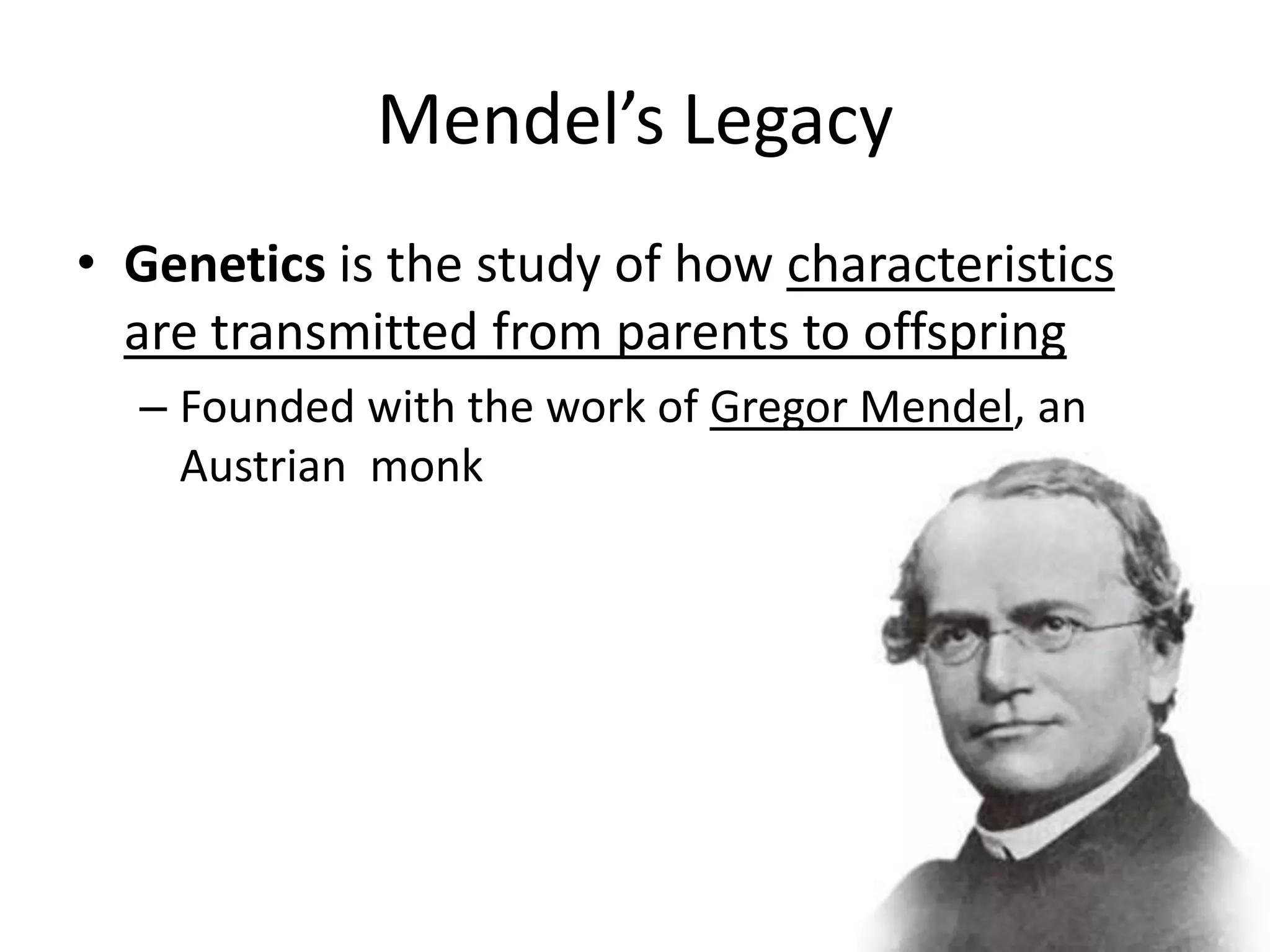
  – Founded with the work of Gregor Mendel, an
    Austrian monk
Gregor Mendel
• Mendel conducted experiments at the
  monastery with pea plants
• He researched heredity – the transmission of
  characteristics from parents to offspring
Mendel’s Garden Peas
• Mendel observed seven characteristics of pea
  plants
• Each characteristic occurred in two contrasting
  traits – genetically determined variants of a
  characteristic
Mendel’s Garden Peas
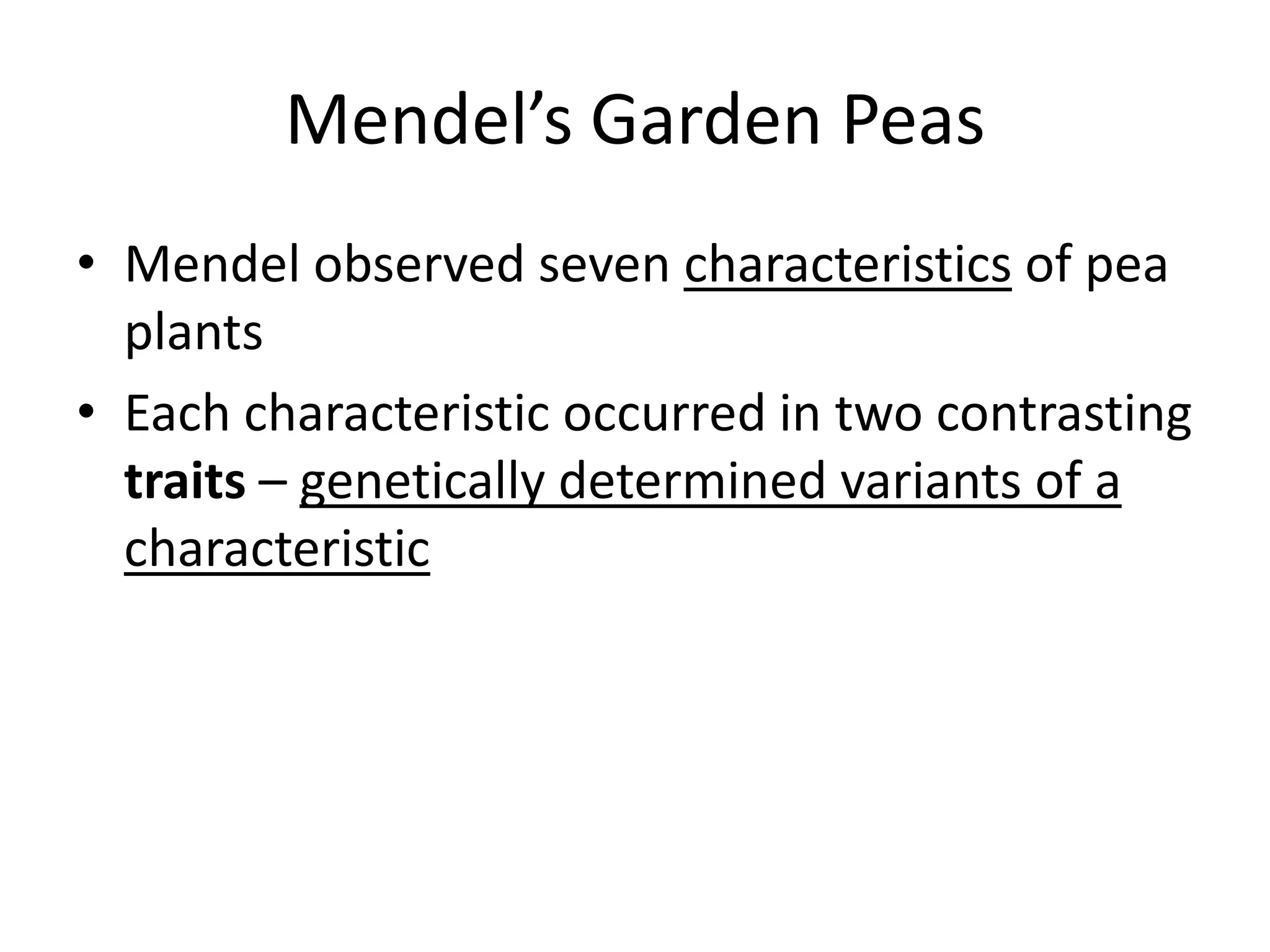
Characteristic                Trait
• Position of flowers along
  stem


• Height of plant
Mendel’s Garden Peas
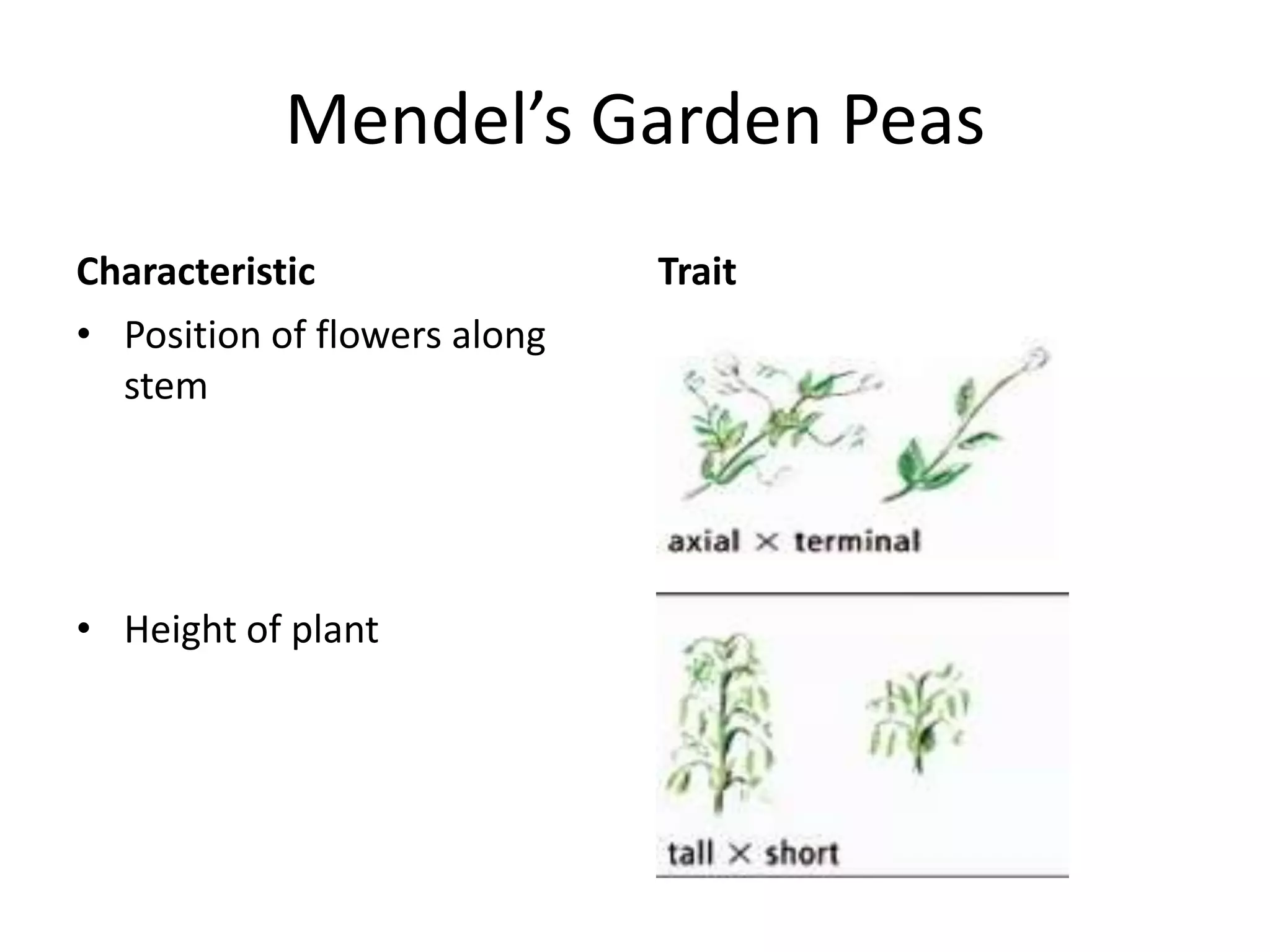
Characteristic      Trait
• Pod Appearance


• Pod color
Mendel’s Garden Peas
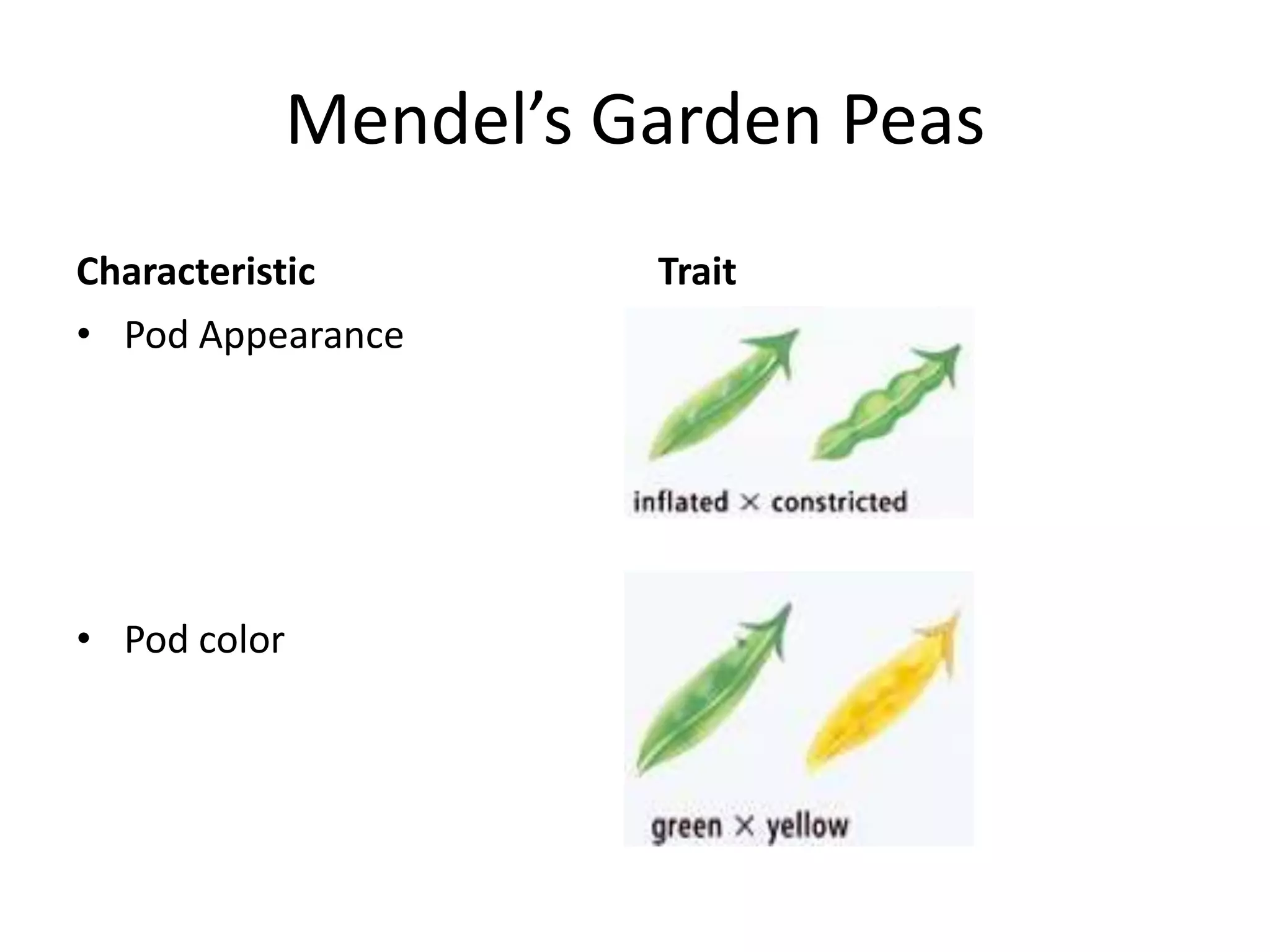
Characteristic       Trait
• Seed Texture


• Seed color


• Flower color
Mendel’s Methods
• Mendel controlled pollination
  – Self-pollination – pollen fertilizes egg cells on the
    same flower
  – Cross-pollination – pollen fertilizes egg cells on
    flowers of different plants
Mendel’s Experiments
• P generation – parent generation
• F1 (first filial) generation – offspring of the P
  generation
• F2 (second filial) generation – offspring of the
  F1 generation
Mendel’s Experiments
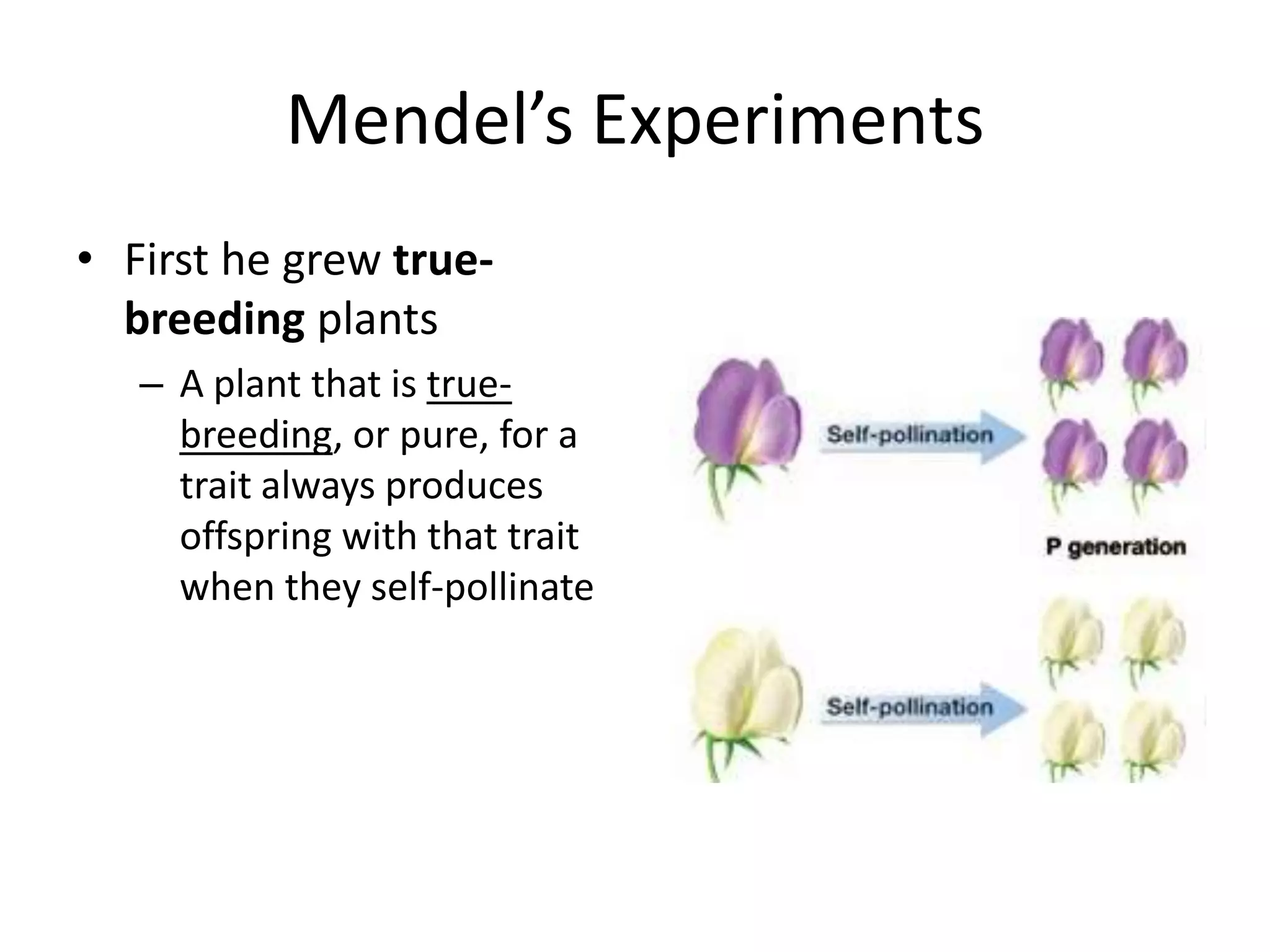
• First he grew true-
  breeding plants
   – A plant that is true-
     breeding, or pure, for a
     trait always produces
     offspring with that trait
     when they self-pollinate
Mendel’s Experiments
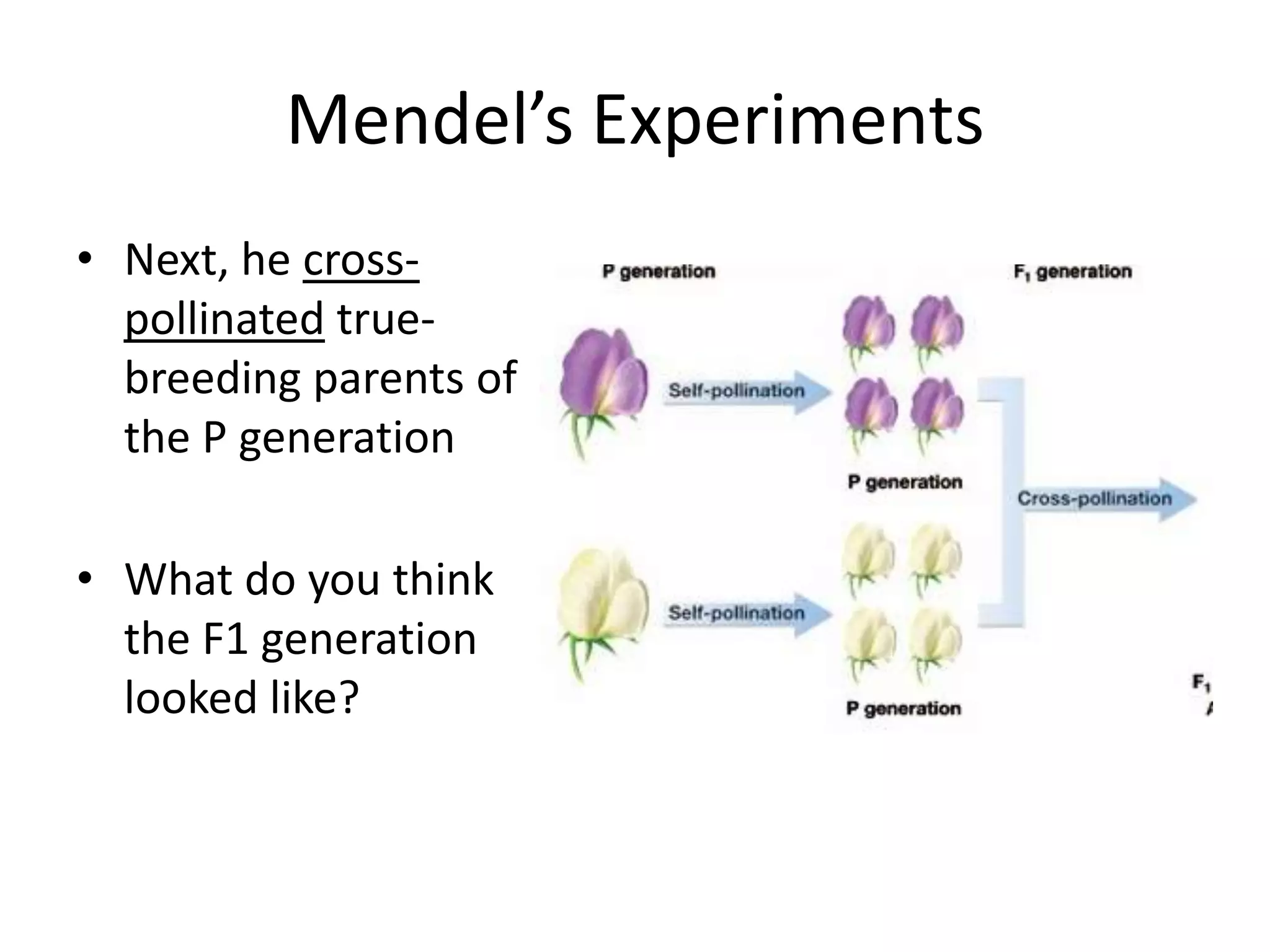
• Next, he cross-
  pollinated true-
  breeding parents of
  the P generation

• What do you think
  the F1 generation
  looked like?
Mendel’s Experiments
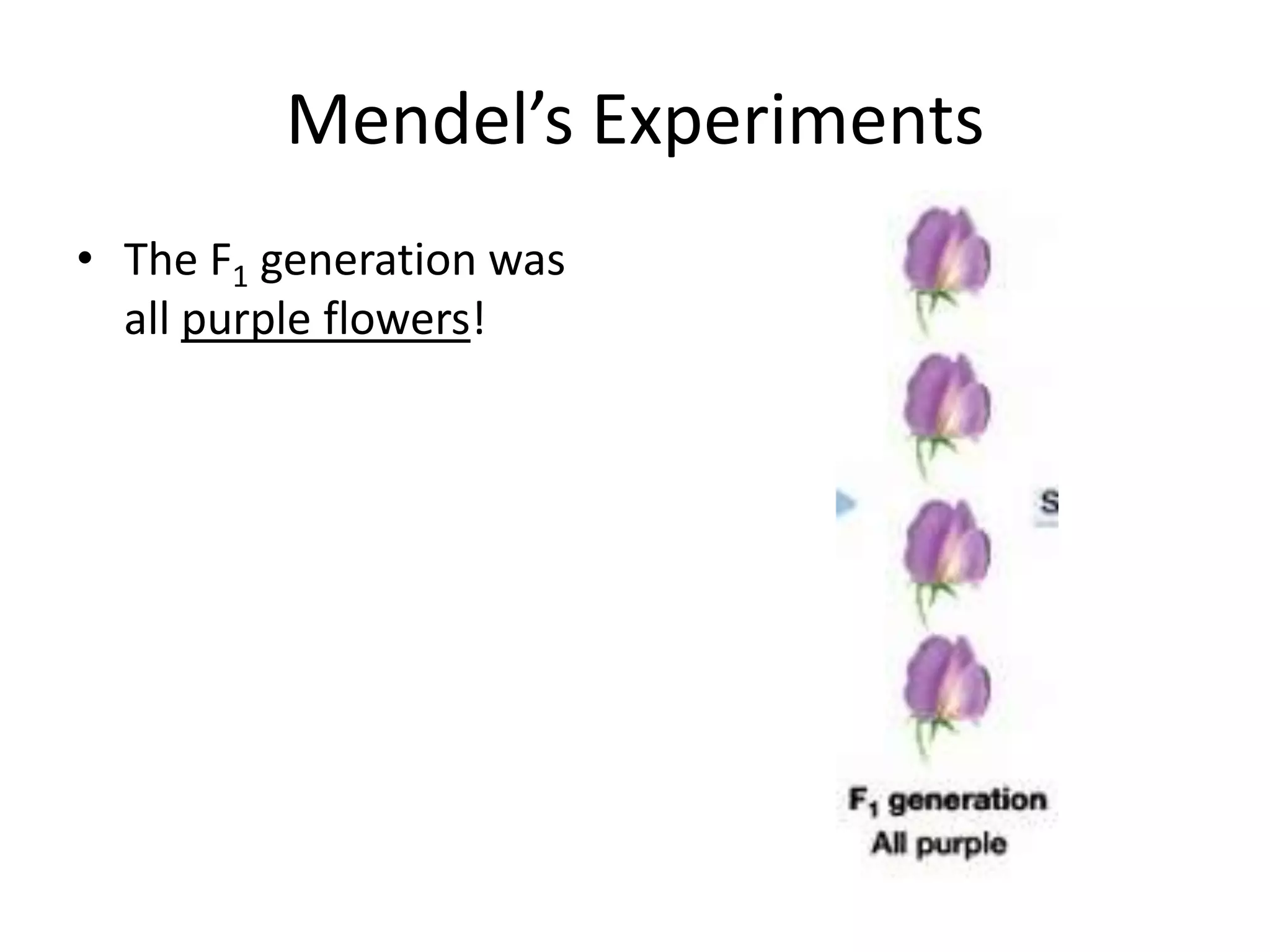
• The F1 generation was
  all purple flowers!
Mendel’s Experiments
• Next, he let the flowers from the F1 generation
  self-pollinate

• What do you think the F2 generation looked
  like?
Mendel’s Experiments
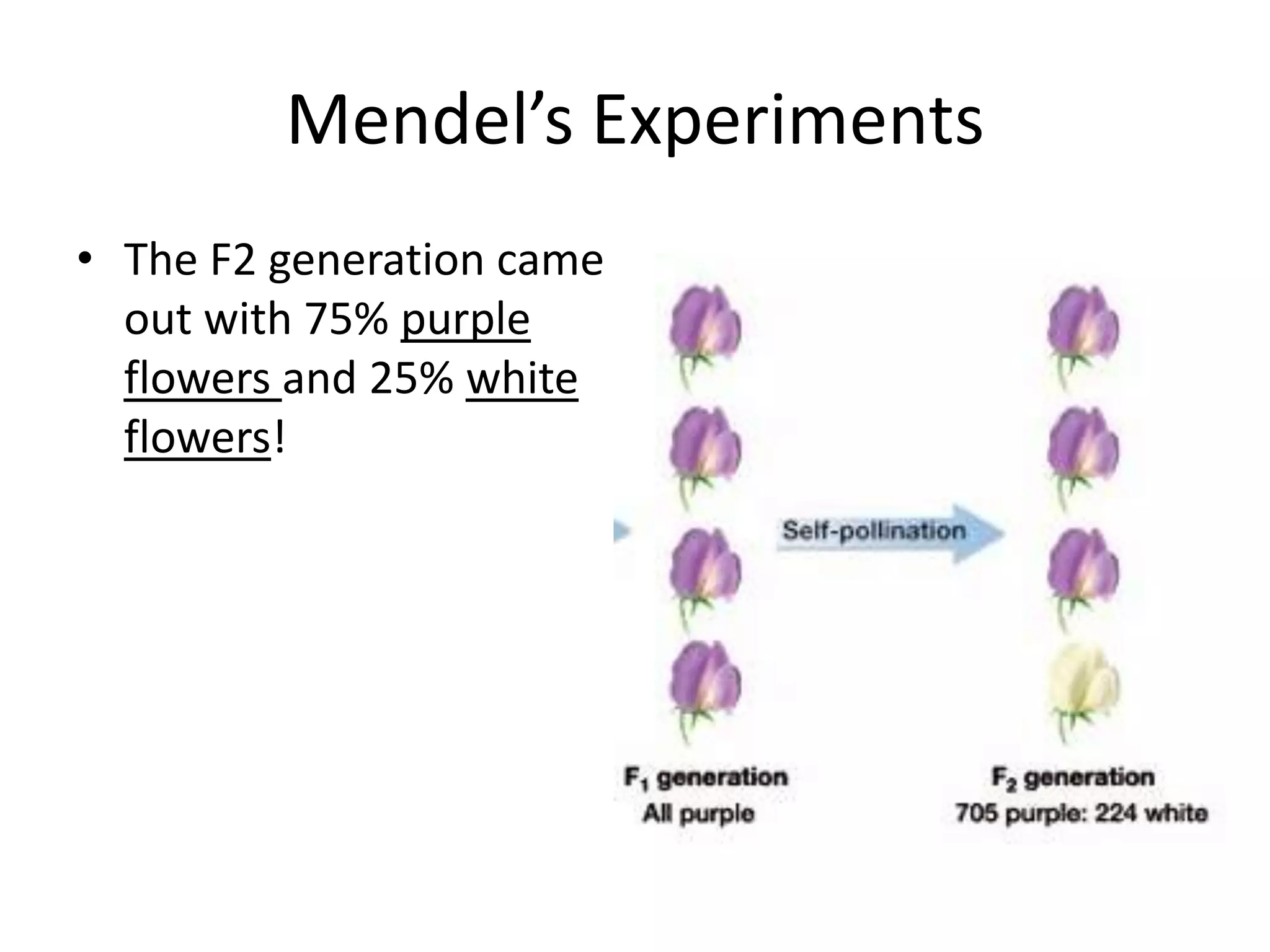
• The F2 generation came
  out with 75% purple
  flowers and 25% white
  flowers!
Mendel’s Results and Conclusions
• Mendel’s observations led him to hypothesize
  that something within the pea plants
  controlled the characteristics observed
  – He called these controls factors
• Because the characteristics had two
  alternative forms, he reasoned that a pair of
  factors must control each trait
Recessive and Dominant Traits
• Dominant – trait that masks the factor for the
  other trait
• Recessive – trait that is masked by the factor
  for the other trait
The Law of Segregation
• The law of segregation states that a pair of
  factors is segregated, or separated, during the
  formation of gametes
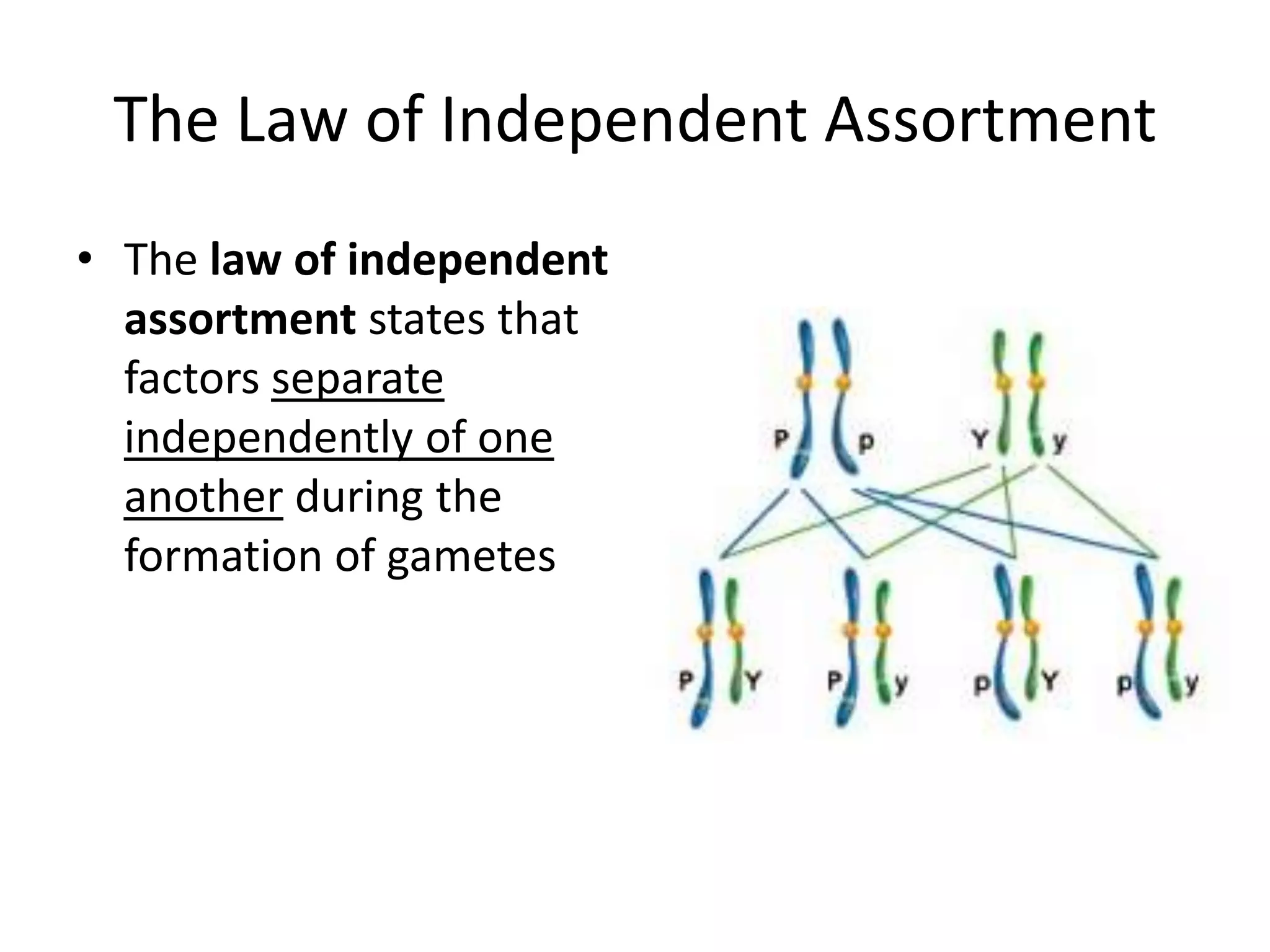
The Law of Independent Assortment
• The law of independent
  assortment states that
  factors separate
  independently of one
  another during the
  formation of gametes
Support for Mendel’s Conclusions
• A gene is a segment of a chromosome that
  controls a particular hereditary trait
• The different forms of a gene are called alleles
  – Capital letters are used to represent dominant
    alleles
  – Lowercased letters are used to represent recessive
    alleles
Section 2

GENETIC CROSSES
Genotype and Phenotype
• Genotype – an organism’s genetic makeup (PP,
  Pp, pp)

• Phenotype – an organism’s physical
  appearance (purple flower, white flower)
Genotype and Phenotype
• Homozygous – both alleles of a pair are alike
  (PP = homozygous dominant and
  pp = homozygous recessive)

• Heterozygous – two alleles are different (Pp)
Probability
• Probability – the likelihood that a specific
  event will occur
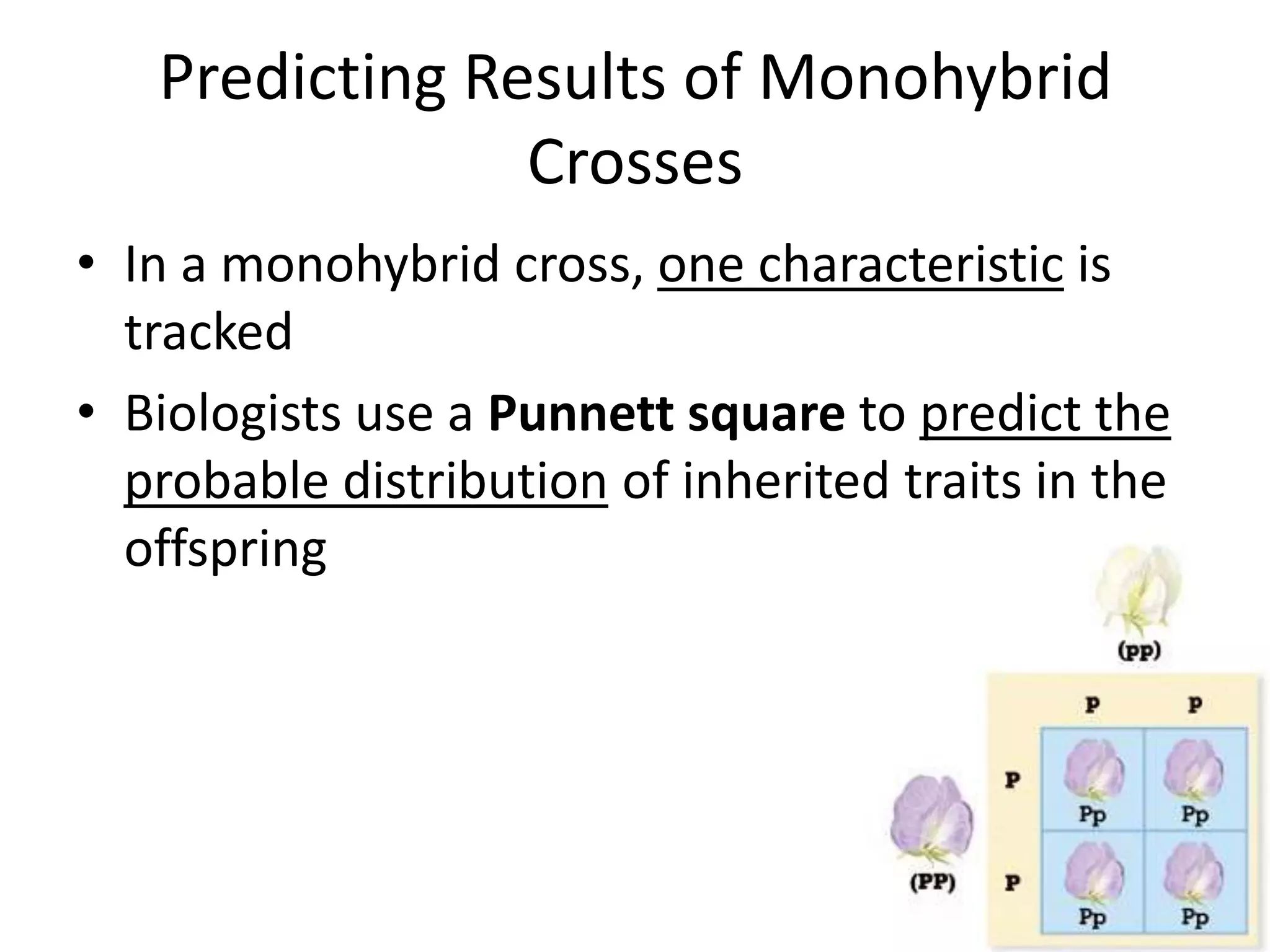
Predicting Results of Monohybrid
                Crosses
• In a monohybrid cross, one characteristic is
  tracked
• Biologists use a Punnett square to predict the
  probable distribution of inherited traits in the
  offspring
Ex 1: Homozygous X Homozygous
• TT x tt (T = tall, t =
  short)

• Possible Genotypes
   – 100% Tt


• Possible Phenotypes
   – 100% tall
Ex 2: Homozygous X Heterozygous
• BB X Bb (B = black hair,
  b = brown hair)

• Possible Genotypes
   – 50% BB, 50% Bb


• Possible Phenotypes
   – 100% black
Ex 3: Heterozygous X Heterozygous
• Bb X Bb(B = black hair,
  b = brown hair)

• Possible genotypes
   – 25% BB, 50%Bb, 25% bb


• Possible phenotypes
   – 75% black hair, 25%
     brown hair
Ex 4: Testcross
• How could you determine whether a black
  guinea pig is homozygous (BB) or
  heterozygous (Bb)?
• By completing a testcross – an individual with
  an unknown genotype is crossed with a
  homozygous recessive individual
Ex 5: Incomplete Dominance
• Incomplete dominance occurs when the
  phenotype of heterozygous individual is in
  between the two homozygous phenotypes
Ex 5: Incomplete Dominance
• RW X RW (R = red, W =
  white)

• Possible genotypes and
  phenotypes
  – 25% RR, red
  – 50% RW, pink
  – 25% WW, white
Ex 6: Codominance
• In codominance, both alleles contribute to the
  phenotype

• In some varieties of chicken, the allele for
  black feathers is codominant with the allele
  for white feathers
  – Heterozygous chickens are speckled with black
    and white feathers
Ex 6: Codominance
• F W FW X F B F B
  (F = feathers, B = black,
  W = white

• Possible genotypes and
  phenotypes
   – 100% FWFB, speckled
Predicting Results of Dihybrid Crosses
• A dihybrid cross is a cross in which two
  characteristics are tracked
• More complicated than monohybrid crosses
  because more combinations of alleles are
  possible
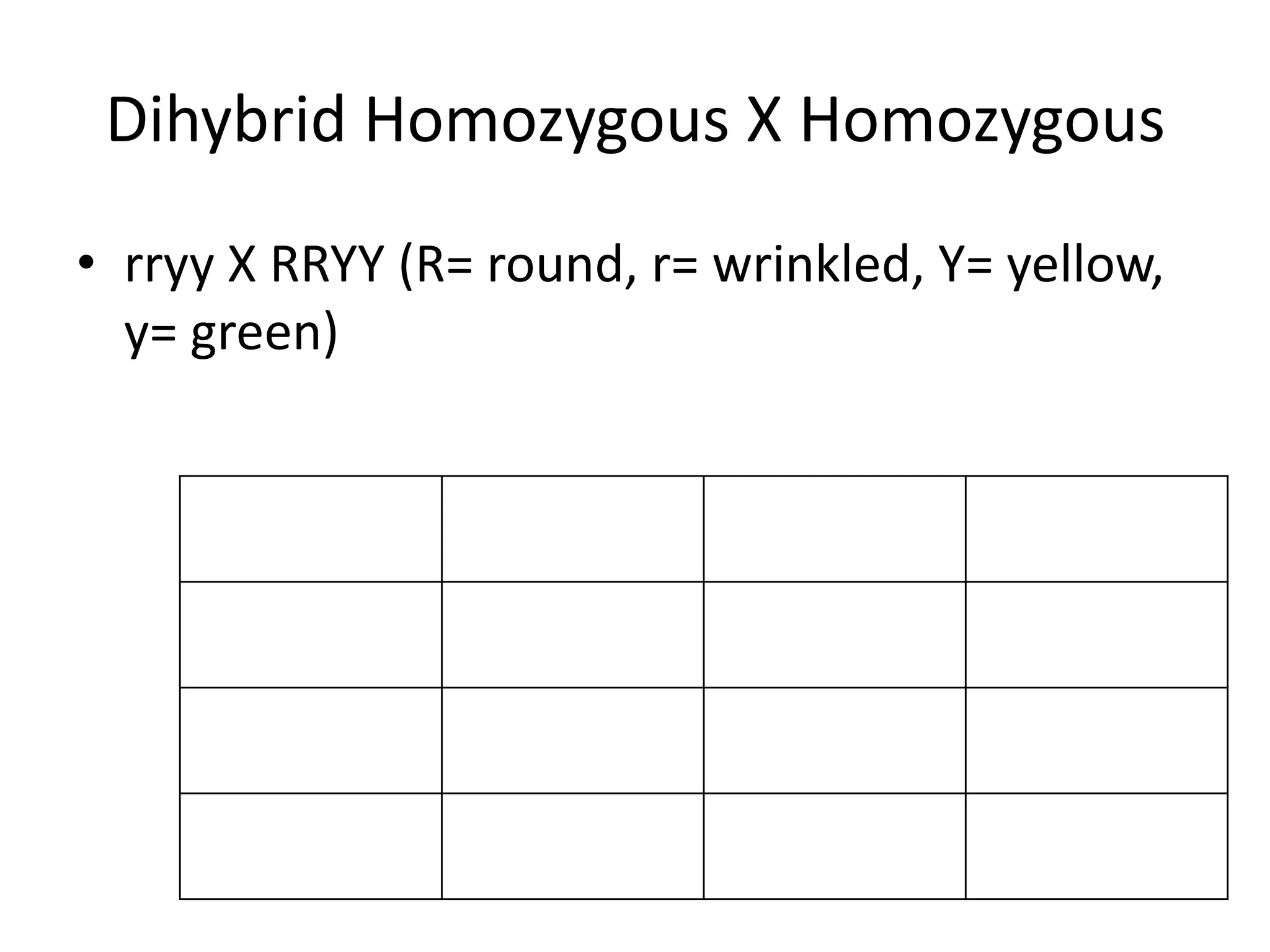
Dihybrid Homozygous X Homozygous
• rryy X RRYY (R= round, r= wrinkled, Y= yellow,
  y= green)
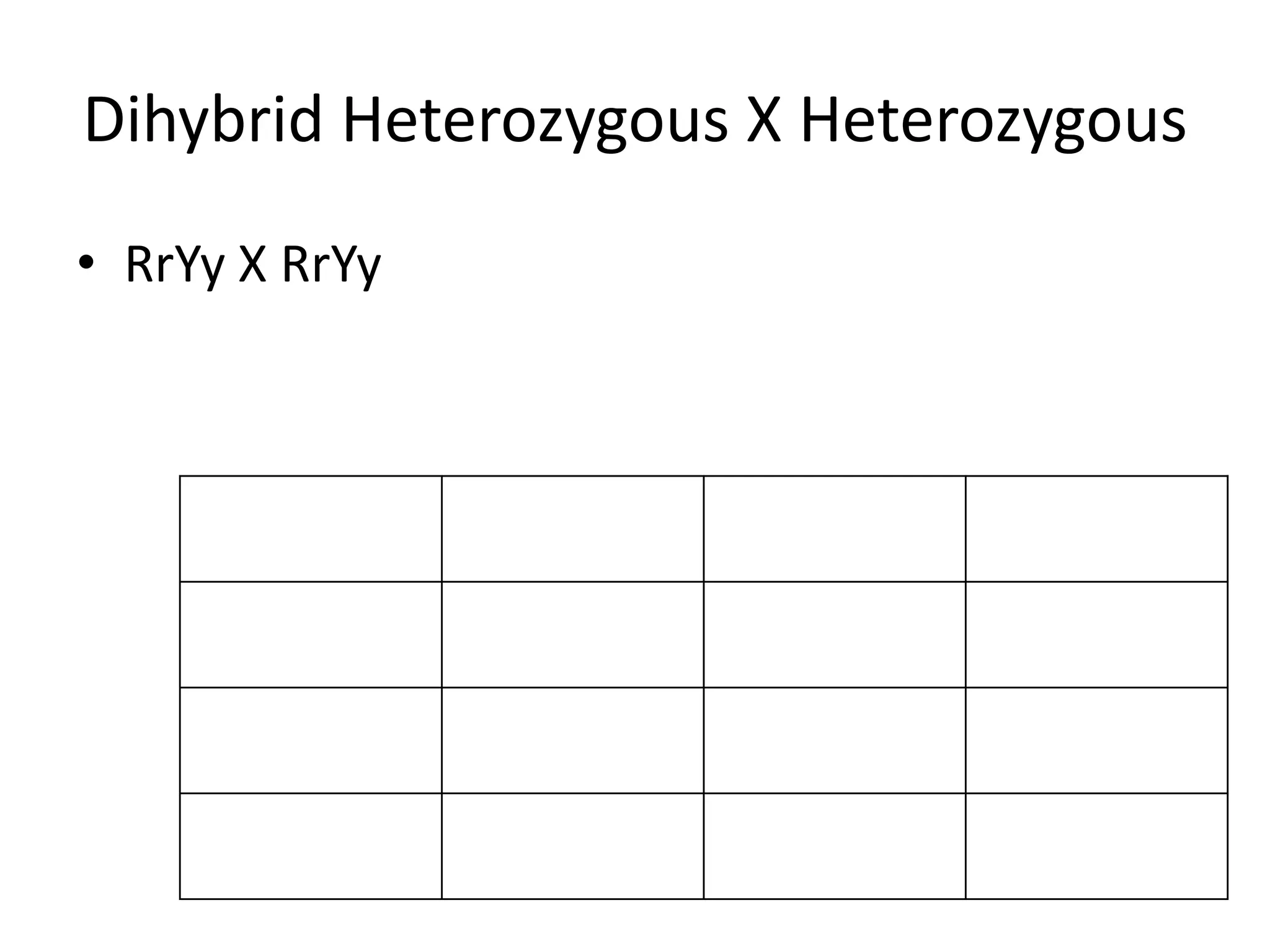
Dihybrid Heterozygous X Heterozygous
• RrYy X RrYy

Chapter 9 notes

  • 1.
  • 3.
    Mendel’s Legacy • Geneticsis the study of how characteristics are transmitted from parents to offspring – Founded with the work of Gregor Mendel, an Austrian monk
  • 4.
    Gregor Mendel • Mendelconducted experiments at the monastery with pea plants • He researched heredity – the transmission of characteristics from parents to offspring
  • 5.
    Mendel’s Garden Peas •Mendel observed seven characteristics of pea plants • Each characteristic occurred in two contrasting traits – genetically determined variants of a characteristic
  • 6.
    Mendel’s Garden Peas Characteristic Trait • Position of flowers along stem • Height of plant
  • 7.
    Mendel’s Garden Peas Characteristic Trait • Pod Appearance • Pod color
  • 8.
    Mendel’s Garden Peas Characteristic Trait • Seed Texture • Seed color • Flower color
  • 9.
    Mendel’s Methods • Mendelcontrolled pollination – Self-pollination – pollen fertilizes egg cells on the same flower – Cross-pollination – pollen fertilizes egg cells on flowers of different plants
  • 10.
    Mendel’s Experiments • Pgeneration – parent generation • F1 (first filial) generation – offspring of the P generation • F2 (second filial) generation – offspring of the F1 generation
  • 11.
    Mendel’s Experiments • Firsthe grew true- breeding plants – A plant that is true- breeding, or pure, for a trait always produces offspring with that trait when they self-pollinate
  • 12.
    Mendel’s Experiments • Next,he cross- pollinated true- breeding parents of the P generation • What do you think the F1 generation looked like?
  • 13.
    Mendel’s Experiments • TheF1 generation was all purple flowers!
  • 14.
    Mendel’s Experiments • Next,he let the flowers from the F1 generation self-pollinate • What do you think the F2 generation looked like?
  • 15.
    Mendel’s Experiments • TheF2 generation came out with 75% purple flowers and 25% white flowers!
  • 16.
    Mendel’s Results andConclusions • Mendel’s observations led him to hypothesize that something within the pea plants controlled the characteristics observed – He called these controls factors • Because the characteristics had two alternative forms, he reasoned that a pair of factors must control each trait
  • 17.
    Recessive and DominantTraits • Dominant – trait that masks the factor for the other trait • Recessive – trait that is masked by the factor for the other trait
  • 18.
    The Law ofSegregation • The law of segregation states that a pair of factors is segregated, or separated, during the formation of gametes
  • 19.
    The Law ofIndependent Assortment • The law of independent assortment states that factors separate independently of one another during the formation of gametes
  • 20.
    Support for Mendel’sConclusions • A gene is a segment of a chromosome that controls a particular hereditary trait • The different forms of a gene are called alleles – Capital letters are used to represent dominant alleles – Lowercased letters are used to represent recessive alleles
  • 21.
  • 22.
    Genotype and Phenotype •Genotype – an organism’s genetic makeup (PP, Pp, pp) • Phenotype – an organism’s physical appearance (purple flower, white flower)
  • 23.
    Genotype and Phenotype •Homozygous – both alleles of a pair are alike (PP = homozygous dominant and pp = homozygous recessive) • Heterozygous – two alleles are different (Pp)
  • 24.
    Probability • Probability –the likelihood that a specific event will occur
  • 25.
    Predicting Results ofMonohybrid Crosses • In a monohybrid cross, one characteristic is tracked • Biologists use a Punnett square to predict the probable distribution of inherited traits in the offspring
  • 26.
    Ex 1: HomozygousX Homozygous • TT x tt (T = tall, t = short) • Possible Genotypes – 100% Tt • Possible Phenotypes – 100% tall
  • 27.
    Ex 2: HomozygousX Heterozygous • BB X Bb (B = black hair, b = brown hair) • Possible Genotypes – 50% BB, 50% Bb • Possible Phenotypes – 100% black
  • 28.
    Ex 3: HeterozygousX Heterozygous • Bb X Bb(B = black hair, b = brown hair) • Possible genotypes – 25% BB, 50%Bb, 25% bb • Possible phenotypes – 75% black hair, 25% brown hair
  • 29.
    Ex 4: Testcross •How could you determine whether a black guinea pig is homozygous (BB) or heterozygous (Bb)? • By completing a testcross – an individual with an unknown genotype is crossed with a homozygous recessive individual
  • 30.
    Ex 5: IncompleteDominance • Incomplete dominance occurs when the phenotype of heterozygous individual is in between the two homozygous phenotypes
  • 31.
    Ex 5: IncompleteDominance • RW X RW (R = red, W = white) • Possible genotypes and phenotypes – 25% RR, red – 50% RW, pink – 25% WW, white
  • 32.
    Ex 6: Codominance •In codominance, both alleles contribute to the phenotype • In some varieties of chicken, the allele for black feathers is codominant with the allele for white feathers – Heterozygous chickens are speckled with black and white feathers
  • 33.
    Ex 6: Codominance •F W FW X F B F B (F = feathers, B = black, W = white • Possible genotypes and phenotypes – 100% FWFB, speckled
  • 34.
    Predicting Results ofDihybrid Crosses • A dihybrid cross is a cross in which two characteristics are tracked • More complicated than monohybrid crosses because more combinations of alleles are possible
  • 35.
    Dihybrid Homozygous XHomozygous • rryy X RRYY (R= round, r= wrinkled, Y= yellow, y= green)
  • 36.
    Dihybrid Heterozygous XHeterozygous • RrYy X RrYy