
Classical Genetics
Species characteristicsCharacteristics/traits shared by all individuals of a speciesE.g. Presence of eyes, nose, arms etc. Of humans
Individual characteristicsCharacteristics/traits that are unique/distinct to an individual of a speciesE.g skin color on humans
Factors that affect individualityTheory of blending inheritanceTraits manifested on ofsspring are a combination of the traits of the parentsHeredity (nature)Environment (nurture)
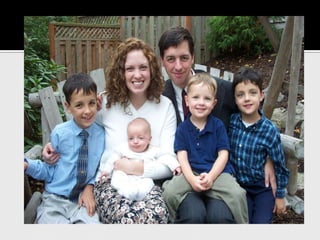
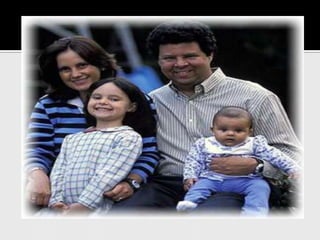
Nature-Nurture Controversy“Which is a more important factor in how your personality develops – nature or nurture?”What are the different factors that affect individuality?How does heredity bring about traits in every individual?How does environment affect an individual’s traits?
Objectivescite specific examples of each of the four types if hereditary charactersexplain inheritance based on Mendelian laws
Hereditary CharactersCharacters that are controlled by genesGenes factors of hereditytransmitted from one generation to the nextWhich do you inherit from your parents?, the genes or the characters?
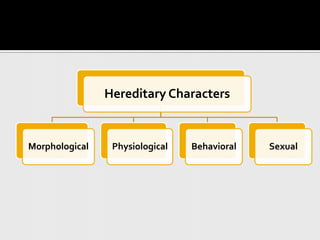
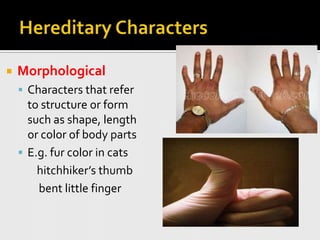
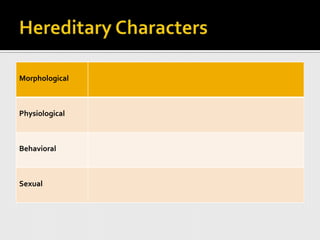
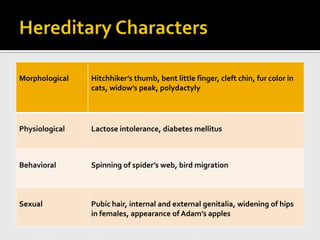
Hereditary CharactersMorphologicalCharacters that refer to structure or form such as shape, length or color of body partsE.g. fur color in catshitchhiker’s thumb    bent little finger
Hereditary CharactersPhysiological Characters that refer to the functions of parts e.g. lactose intolerance and diabetes mellitus
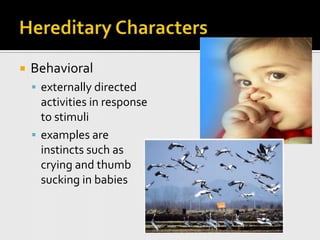
Hereditary CharactersBehavioralexternally directed activities in response to stimuliexamples are instincts such as crying and thumb sucking in babies
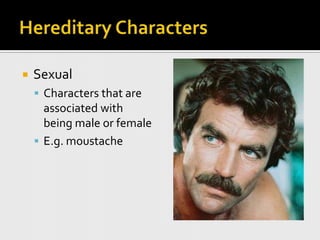
Hereditary CharactersSexualCharacters that are associated with being male or femaleE.g. moustache
Classifying Hereditary CharactersClassify the following and present your answer in tabulated form:Hitchhiker’s thumb	8.Internal and external genitaliaCleft chin 		9. Spinning of spider’s webBent little finger	10. Pubic hairLactose intolerance	11. Diabetes mellitusFur color in cats	12. Bird migrationWidow’s peak		13. widening of hips in femalesPolydactyly		14. appearance of Adam’s apples
Hereditary Characters
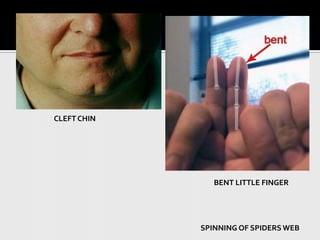
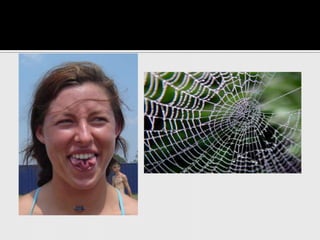
CLEFT CHINBENT LITTLE FINGERSPINNING OF SPIDERS WEB
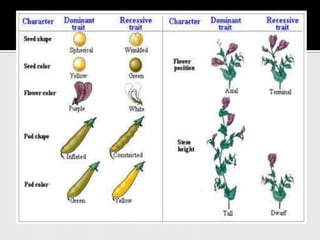
Mendel’s ExperimentsGregor Johann Mendel – Father of Classical GeneticsAustrian monk and a botanistJoined the Augustinian Monastery of St.Thomas at Brunn, Austria Spent 10 years in experimenting garden peas (Pisumsativum)Another 2 years in analyzing the results
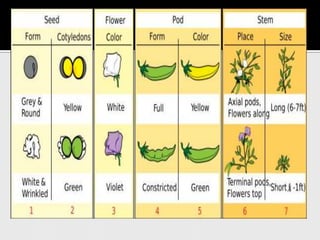
Why garden peas?The plant has several characters that exhibit two contrasting expressions or traits.The plant reproduces at a fast rate.Garden peas can produce enough offspring for study purposesGarden pea flowers are structurally adapted for self-pollinationPollination can be controlled in this group of plants with minimum work
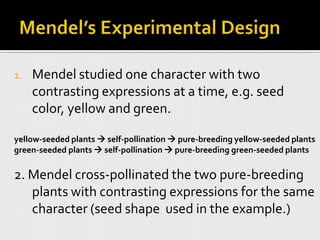
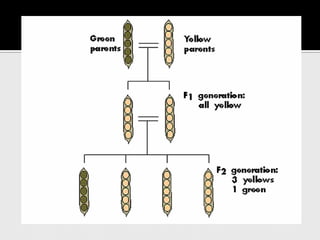
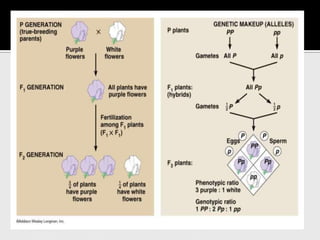
Mendel’s Experimental DesignMendel studied one character with two contrasting expressions at a time, e.g. seed color, yellow and green.yellow-seeded plants  self-pollination  pure-breeding yellow-seeded plantsgreen-seeded plants  self-pollination  pure-breeding green-seeded plants2. Mendel cross-pollinated the two pure-breeding plants with contrasting expressions for the same character (seed shape  used in the example.)
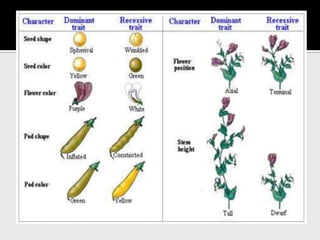
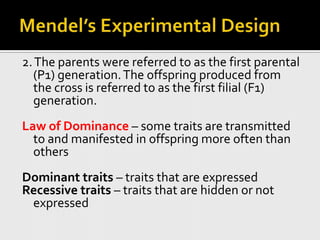
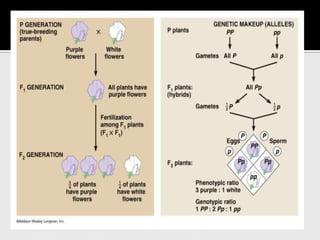
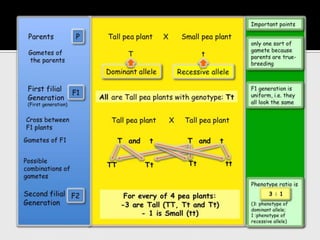
Mendel’s Experimental Design2. The parents were referred to as the first parental (P1) generation. The offspring produced from the cross is referred to as the first filial (F1) generation.Law of Dominance – some traits are transmitted to and manifested in offspring more often than othersDominant traits – traits that are expressedRecessive traits – traits that are hidden or not expressed
Mendel’s Experimental Design3. Mendel allowed the F1 plants to self-pollinate. He noted that some of the offspring expressed the recessive trait.
Two important observations:When the F1 plants that expressed only the domonant trait were self-pollinated, some of their offspring (f2) expressed the recessive trait.The ratio of the plants with dominant traits to the plants with recessive traits is almost 3:1
F1 plants have “unit determiners/characters”F1 plants with yellow seed color – two unit determiners: one for the yellow, one for the green seed colorMendel  unit determinersWalter Sutton (1902)  GENES
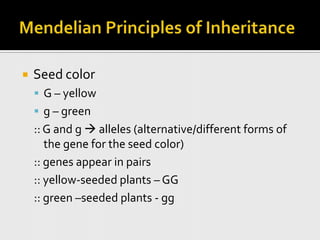
Mendelian Principles of InheritanceSeed colorG – yellowg – green:: G and g  alleles (alternative/different forms of the gene for the seed color):: genes appear in pairs :: yellow-seeded plants – GG:: green –seeded plants - gg
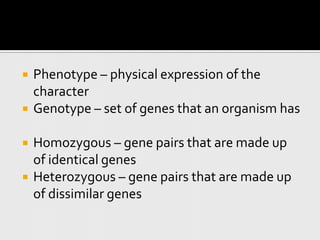
Phenotype – physical expression of the characterGenotype – set of genes that an organism hasHomozygous – gene pairs that are made up of identical genesHeterozygous – gene pairs that are made up of dissimilar genes
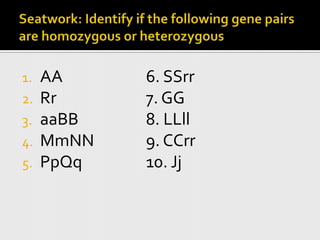
Seatwork: Identify if the following gene pairs are homozygous or heterozygousAA			6. SSrrRr			7. GGaaBB			8. LLllMmNN		9. CCrrPpQq		10. Jj
Classical genetics

Classical genetics

  • 1.
  • 2.
    Species characteristicsCharacteristics/traits sharedby all individuals of a speciesE.g. Presence of eyes, nose, arms etc. Of humans
  • 3.
    Individual characteristicsCharacteristics/traits thatare unique/distinct to an individual of a speciesE.g skin color on humans
  • 4.
    Factors that affectindividualityTheory of blending inheritanceTraits manifested on ofsspring are a combination of the traits of the parentsHeredity (nature)Environment (nurture)
  • 5.
    Nature-Nurture Controversy“Which isa more important factor in how your personality develops – nature or nurture?”What are the different factors that affect individuality?How does heredity bring about traits in every individual?How does environment affect an individual’s traits?
  • 8.
    Objectivescite specific examplesof each of the four types if hereditary charactersexplain inheritance based on Mendelian laws
  • 9.
    Hereditary CharactersCharacters thatare controlled by genesGenes factors of hereditytransmitted from one generation to the nextWhich do you inherit from your parents?, the genes or the characters?
  • 11.
    Hereditary CharactersMorphologicalCharacters thatrefer to structure or form such as shape, length or color of body partsE.g. fur color in catshitchhiker’s thumb bent little finger
  • 12.
    Hereditary CharactersPhysiological Charactersthat refer to the functions of parts e.g. lactose intolerance and diabetes mellitus
  • 13.
    Hereditary CharactersBehavioralexternally directedactivities in response to stimuliexamples are instincts such as crying and thumb sucking in babies
  • 14.
    Hereditary CharactersSexualCharacters thatare associated with being male or femaleE.g. moustache
  • 15.
    Classifying Hereditary CharactersClassifythe following and present your answer in tabulated form:Hitchhiker’s thumb 8.Internal and external genitaliaCleft chin 9. Spinning of spider’s webBent little finger 10. Pubic hairLactose intolerance 11. Diabetes mellitusFur color in cats 12. Bird migrationWidow’s peak 13. widening of hips in femalesPolydactyly 14. appearance of Adam’s apples
  • 16.
  • 17.
  • 18.
    CLEFT CHINBENT LITTLEFINGERSPINNING OF SPIDERS WEB
  • 20.
    Mendel’s ExperimentsGregor JohannMendel – Father of Classical GeneticsAustrian monk and a botanistJoined the Augustinian Monastery of St.Thomas at Brunn, Austria Spent 10 years in experimenting garden peas (Pisumsativum)Another 2 years in analyzing the results
  • 21.
    Why garden peas?Theplant has several characters that exhibit two contrasting expressions or traits.The plant reproduces at a fast rate.Garden peas can produce enough offspring for study purposesGarden pea flowers are structurally adapted for self-pollinationPollination can be controlled in this group of plants with minimum work
  • 24.
    Mendel’s Experimental DesignMendelstudied one character with two contrasting expressions at a time, e.g. seed color, yellow and green.yellow-seeded plants  self-pollination  pure-breeding yellow-seeded plantsgreen-seeded plants  self-pollination  pure-breeding green-seeded plants2. Mendel cross-pollinated the two pure-breeding plants with contrasting expressions for the same character (seed shape used in the example.)
  • 26.
    Mendel’s Experimental Design2.The parents were referred to as the first parental (P1) generation. The offspring produced from the cross is referred to as the first filial (F1) generation.Law of Dominance – some traits are transmitted to and manifested in offspring more often than othersDominant traits – traits that are expressedRecessive traits – traits that are hidden or not expressed
  • 28.
    Mendel’s Experimental Design3.Mendel allowed the F1 plants to self-pollinate. He noted that some of the offspring expressed the recessive trait.
  • 29.
    Two important observations:Whenthe F1 plants that expressed only the domonant trait were self-pollinated, some of their offspring (f2) expressed the recessive trait.The ratio of the plants with dominant traits to the plants with recessive traits is almost 3:1
  • 30.
    F1 plants have“unit determiners/characters”F1 plants with yellow seed color – two unit determiners: one for the yellow, one for the green seed colorMendel  unit determinersWalter Sutton (1902)  GENES
  • 34.
    Mendelian Principles ofInheritanceSeed colorG – yellowg – green:: G and g  alleles (alternative/different forms of the gene for the seed color):: genes appear in pairs :: yellow-seeded plants – GG:: green –seeded plants - gg
  • 35.
    Phenotype – physicalexpression of the characterGenotype – set of genes that an organism hasHomozygous – gene pairs that are made up of identical genesHeterozygous – gene pairs that are made up of dissimilar genes
  • 36.
    Seatwork: Identify ifthe following gene pairs are homozygous or heterozygousAA 6. SSrrRr 7. GGaaBB 8. LLllMmNN 9. CCrrPpQq 10. Jj