

Genetics Course: Mastering Medical Genetics Dr. Ahmed Elshebiny , MD Lecturer of Internal Medicine Faculty of Medicine, Menoufyia University Former Clinical Research Fellow, Joslin Diabetes Center, Harvard University
Course includes Basic Principles of Medical Genetics  Genetic basis of disease: How diseases could be inherited?  Medical Genetics in Clinical Practice : What is the impact of genetics on the present and future of Medicine? Let us start with this introductory video about genes
Medical Genetics Any application of genetic principles to medical practice.  “ Genetics  – study of individual genes   and their effects”
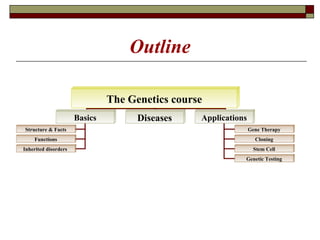
Outline The Genetics course Basics Diseases Applications Structure & Facts Functions Inherited disorders  Gene Therapy Cloning Stem Cell Genetic Testing
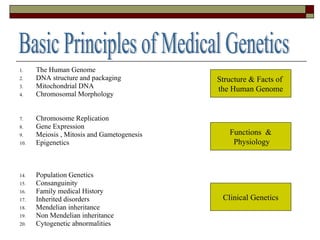
The Human Genome  DNA structure and packaging Mitochondrial DNA Chromosomal Morphology Chromosome Replication Gene Expression Meiosis , Mitosis and Gametogenesis Epigenetics Population Genetics Consanguinity Family medical History Inherited disorders Mendelian inheritance Non Mendelian inheritance Cytogenetic abnormalities Basic Principles of Medical Genetics Structure & Facts of  the Human Genome Functions  & Physiology Clinical Genetics
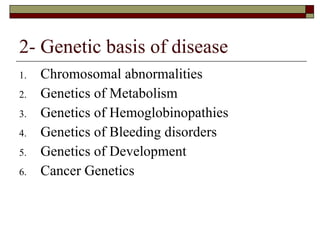
2- Genetic basis of disease Chromosomal abnormalities Genetics of Metabolism Genetics of Hemoglobinopathies Genetics of Bleeding disorders Genetics of Development Cancer Genetics
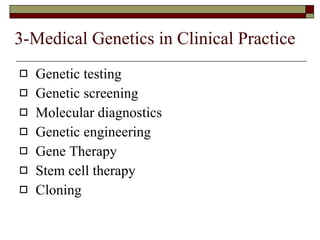
3-Medical Genetics in Clinical Practice Genetic testing Genetic screening Molecular diagnostics Genetic engineering Gene Therapy Stem cell therapy Cloning
Genetics Course (1): Mastering Medical Genetics Basic Principles of Medical Genetics
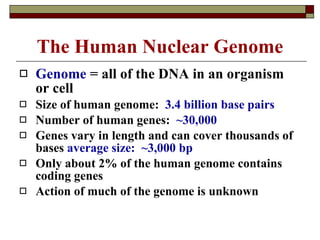
The Human Nuclear Genome Genome  = all of the DNA in an organism or cell Size of human genome:  3.4 billion base pairs Number of human genes:  ~30,000 Genes vary in length and can cover thousands of bases  average size:  ~3,000 bp Only about 2% of the human genome contains coding genes Action of much of the genome is unknown
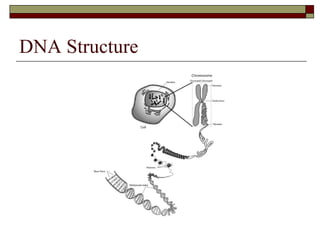
DNA Structure
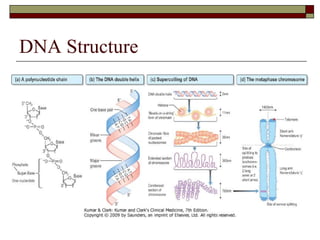
DNA Structure
Epigenetics Epigenetics  is the study of heritable changes in phenotype (appearance) or gene expression caused by mechanisms other than changes in the underlying DNA sequence, hence the name  epi-  (Greek:  επί - over, above)  -genetics .  These changes may remain through cell divisions for the remainder of the cell's life and may also last for multiple generations.
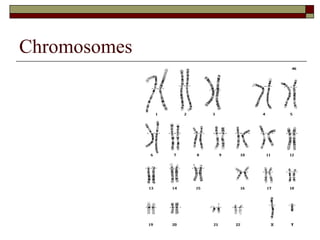
Chromosome Facts # of chromosomes per somatic cell:  22 pairs + 1 pair sex-determining chromosomes =  46 # of chromosomes per gamete (egg/sperm):  23 One chromosome of each pair donated from each parent’s egg or sperm Sex chromosomes:  XY  for males;  XX  for females Largest chromosome  #1 = ~263 million base pairs (bp) Smallest chromosome  Y = ~59 million bp
Chromosomal morphology methods Chromosomal staning FISH
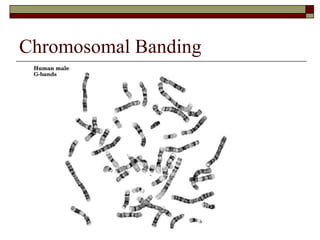
Chromosomal Banding
Chromosomes
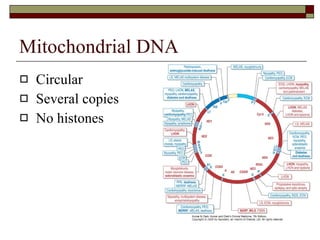
Mitochondrial DNA Circular Several copies No histones
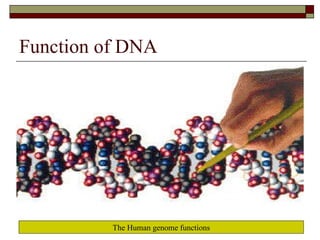
Function of DNA The Human genome functions
Gene Expression Transcription Translation
Meiosis , Mitosis and Gametogenesis Mitosis  is the process by which a cell separates its duplicated genome into two identical halves  Meiosis  is the process that transforms one diploid into four haploid cells. Where do your genes come from?
Genomic imprinting Most genes expressed equally from both alleles Small number of genes show differential expression dependent on parent of origin (mainly on chromosomes 6,7,11,14,15) ‘ Imprint’ is mediated by  methylation    transcriptional inactivation Imprint  persists through cell divisions in embryo Imprint removed at gametogenesis and then re-established according to sex of transmitting parent
Population Genetics Is the study of distributions of genes in populations Disease frequency Genotype frequencies from generation to generation Genetic Polymorphisms SNPs
Polymorphism  Occurrence of 2 or more alleles at aspecific genetic locus in frequencies greater than can be explained by mutations alone Single nucleotide polymorphisms  Restriction fragment length polymorphism (RFLP) Variable number tandem repeat polymorphism (VNTR)
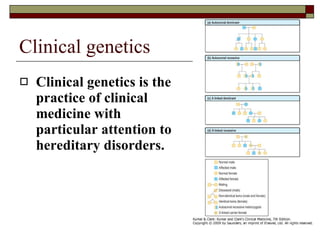
Clinical genetics Clinical genetics is the practice of clinical medicine with particular attention to hereditary disorders.
Inherited disorders Cytogenetic Single gene Polygenic Multifactorial
Clinical Genetics Genotype:   An individual’s genetic makeup -  forms of a particular gene at a given locus Phenotype:   The observable expression of a  genotype  Homozygous:   Identical forms of a particular gene Heterozygous:  Different forms of a gene– CARRIER if one normal and one abnormal Dominant:  Condition phenotypically expressed in someone carrying one copy of a mutant gene Recessive:  Condition phenotypic ally expressed only in someone with two copies of the mutant gene
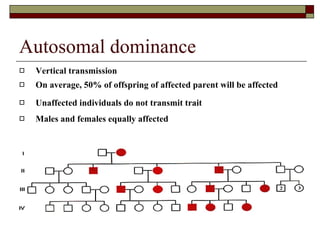
Autosomal dominance Vertical transmission On average, 50% of offspring of affected parent will be affected Unaffected individuals do not transmit trait Males and females equally affected
Autosomal Dominant Conditions Marfan Syndrome Achondroplasia Familial (early-onset) Alzheimer Disease  Huntington Disease Familial Hypercholesterolemia Familial Breast Cancer (BRCA1 or  BRCA2 mutations)
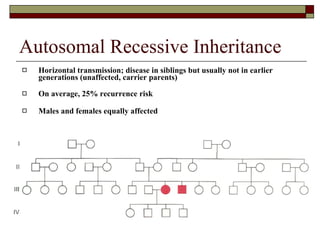
Autosomal Recessive Inheritance Horizontal transmission; disease in siblings but usually not in earlier generations (unaffected, carrier parents) On average, 25% recurrence risk Males and females equally affected Increased consanguinity (relatedness) seen
Autosomal Recessive Conditions Sickle cell disease  Cystic fibrosis Tay-Sachs disease Hemochromatosis  Phenylketonuria Thalassemias
X-linked recessive inheritance Incidence of trait is much higher in males than females No father-to-son transmission 100% of daughters of affected males are (unaffected) carriers  50% of sons of carrier females are affected and 50% of daughters are carriers Trait may be transmitted through series of carrier females
X-linked recessive conditions Haemophilia Duchenne and Becker muscular dystrophy Androgen insensitivity syndrome Hunter syndrome Glucose-6-phosphate-dehydrogenase deficiency Bruton agammaglobulinaemia
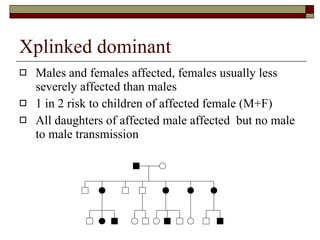
Xplinked dominant Males and females affected, females usually less severely affected than males 1 in 2 risk to children of affected female (M+F) All daughters of affected male affected  but no male to male transmission
X-linked dominant inheritance Males and females affected Vitamin D resistant rickets OTCD Fragile X syndrome Lethal in males Incontinentia pigmenti Rett syndrome XL chondrodysplasia punctata Goltz syndrome
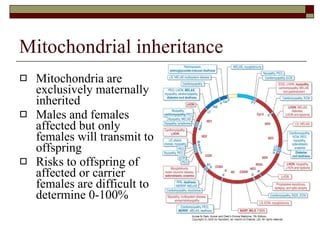
Mitochondrial inheritance Mitochondria are exclusively maternally inherited Males and females affected but only females will transmit to offspring Risks to offspring of affected or carrier females are difficult to determine 0-100%
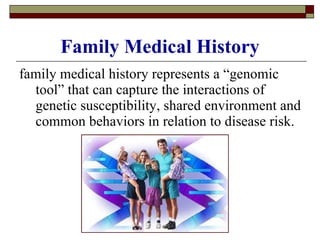
Family Medical History family medical history represents a “genomic tool” that can capture the interactions of genetic susceptibility, shared environment and common behaviors in relation to disease risk.
References Merck manual : online textbook E-medicine , online textbook ,  specialties,. BRS series : Genetics 2010 Lecture notes : Genetics (2006) Kumar & Klark : Clinical Medicine 2009 Other Web Resources & books
THANK  YOU
Genetics Course (2): Mastering Medical Genetics Genetic Basis of Disease

Genetics and Internal Medicine (1)

  • 1.
  • 2.
    Genetics Course: MasteringMedical Genetics Dr. Ahmed Elshebiny , MD Lecturer of Internal Medicine Faculty of Medicine, Menoufyia University Former Clinical Research Fellow, Joslin Diabetes Center, Harvard University
  • 3.
    Course includes BasicPrinciples of Medical Genetics Genetic basis of disease: How diseases could be inherited? Medical Genetics in Clinical Practice : What is the impact of genetics on the present and future of Medicine? Let us start with this introductory video about genes
  • 4.
    Medical Genetics Anyapplication of genetic principles to medical practice. “ Genetics – study of individual genes and their effects”
  • 5.
    Outline The Geneticscourse Basics Diseases Applications Structure & Facts Functions Inherited disorders Gene Therapy Cloning Stem Cell Genetic Testing
  • 6.
    The Human Genome DNA structure and packaging Mitochondrial DNA Chromosomal Morphology Chromosome Replication Gene Expression Meiosis , Mitosis and Gametogenesis Epigenetics Population Genetics Consanguinity Family medical History Inherited disorders Mendelian inheritance Non Mendelian inheritance Cytogenetic abnormalities Basic Principles of Medical Genetics Structure & Facts of the Human Genome Functions & Physiology Clinical Genetics
  • 7.
    2- Genetic basisof disease Chromosomal abnormalities Genetics of Metabolism Genetics of Hemoglobinopathies Genetics of Bleeding disorders Genetics of Development Cancer Genetics
  • 8.
    3-Medical Genetics inClinical Practice Genetic testing Genetic screening Molecular diagnostics Genetic engineering Gene Therapy Stem cell therapy Cloning
  • 9.
    Genetics Course (1):Mastering Medical Genetics Basic Principles of Medical Genetics
  • 10.
    The Human NuclearGenome Genome = all of the DNA in an organism or cell Size of human genome: 3.4 billion base pairs Number of human genes: ~30,000 Genes vary in length and can cover thousands of bases average size: ~3,000 bp Only about 2% of the human genome contains coding genes Action of much of the genome is unknown
  • 11.
  • 12.
  • 13.
    Epigenetics Epigenetics is the study of heritable changes in phenotype (appearance) or gene expression caused by mechanisms other than changes in the underlying DNA sequence, hence the name epi- (Greek: επί - over, above) -genetics . These changes may remain through cell divisions for the remainder of the cell's life and may also last for multiple generations.
  • 14.
    Chromosome Facts #of chromosomes per somatic cell: 22 pairs + 1 pair sex-determining chromosomes = 46 # of chromosomes per gamete (egg/sperm): 23 One chromosome of each pair donated from each parent’s egg or sperm Sex chromosomes: XY for males; XX for females Largest chromosome #1 = ~263 million base pairs (bp) Smallest chromosome Y = ~59 million bp
  • 15.
    Chromosomal morphology methodsChromosomal staning FISH
  • 16.
  • 17.
  • 18.
    Mitochondrial DNA CircularSeveral copies No histones
  • 19.
    Function of DNAThe Human genome functions
  • 20.
  • 21.
    Meiosis , Mitosisand Gametogenesis Mitosis is the process by which a cell separates its duplicated genome into two identical halves Meiosis is the process that transforms one diploid into four haploid cells. Where do your genes come from?
  • 22.
    Genomic imprinting Mostgenes expressed equally from both alleles Small number of genes show differential expression dependent on parent of origin (mainly on chromosomes 6,7,11,14,15) ‘ Imprint’ is mediated by methylation  transcriptional inactivation Imprint persists through cell divisions in embryo Imprint removed at gametogenesis and then re-established according to sex of transmitting parent
  • 23.
    Population Genetics Isthe study of distributions of genes in populations Disease frequency Genotype frequencies from generation to generation Genetic Polymorphisms SNPs
  • 24.
    Polymorphism Occurrenceof 2 or more alleles at aspecific genetic locus in frequencies greater than can be explained by mutations alone Single nucleotide polymorphisms Restriction fragment length polymorphism (RFLP) Variable number tandem repeat polymorphism (VNTR)
  • 25.
    Clinical genetics Clinicalgenetics is the practice of clinical medicine with particular attention to hereditary disorders.
  • 26.
    Inherited disorders CytogeneticSingle gene Polygenic Multifactorial
  • 27.
    Clinical Genetics Genotype: An individual’s genetic makeup - forms of a particular gene at a given locus Phenotype: The observable expression of a genotype Homozygous: Identical forms of a particular gene Heterozygous: Different forms of a gene– CARRIER if one normal and one abnormal Dominant: Condition phenotypically expressed in someone carrying one copy of a mutant gene Recessive: Condition phenotypic ally expressed only in someone with two copies of the mutant gene
  • 28.
    Autosomal dominance Verticaltransmission On average, 50% of offspring of affected parent will be affected Unaffected individuals do not transmit trait Males and females equally affected
  • 29.
    Autosomal Dominant ConditionsMarfan Syndrome Achondroplasia Familial (early-onset) Alzheimer Disease Huntington Disease Familial Hypercholesterolemia Familial Breast Cancer (BRCA1 or BRCA2 mutations)
  • 30.
    Autosomal Recessive InheritanceHorizontal transmission; disease in siblings but usually not in earlier generations (unaffected, carrier parents) On average, 25% recurrence risk Males and females equally affected Increased consanguinity (relatedness) seen
  • 31.
    Autosomal Recessive ConditionsSickle cell disease Cystic fibrosis Tay-Sachs disease Hemochromatosis Phenylketonuria Thalassemias
  • 32.
    X-linked recessive inheritanceIncidence of trait is much higher in males than females No father-to-son transmission 100% of daughters of affected males are (unaffected) carriers 50% of sons of carrier females are affected and 50% of daughters are carriers Trait may be transmitted through series of carrier females
  • 33.
    X-linked recessive conditionsHaemophilia Duchenne and Becker muscular dystrophy Androgen insensitivity syndrome Hunter syndrome Glucose-6-phosphate-dehydrogenase deficiency Bruton agammaglobulinaemia
  • 34.
    Xplinked dominant Malesand females affected, females usually less severely affected than males 1 in 2 risk to children of affected female (M+F) All daughters of affected male affected but no male to male transmission
  • 35.
    X-linked dominant inheritanceMales and females affected Vitamin D resistant rickets OTCD Fragile X syndrome Lethal in males Incontinentia pigmenti Rett syndrome XL chondrodysplasia punctata Goltz syndrome
  • 36.
    Mitochondrial inheritance Mitochondriaare exclusively maternally inherited Males and females affected but only females will transmit to offspring Risks to offspring of affected or carrier females are difficult to determine 0-100%
  • 37.
    Family Medical Historyfamily medical history represents a “genomic tool” that can capture the interactions of genetic susceptibility, shared environment and common behaviors in relation to disease risk.
  • 38.
    References Merck manual: online textbook E-medicine , online textbook , specialties,. BRS series : Genetics 2010 Lecture notes : Genetics (2006) Kumar & Klark : Clinical Medicine 2009 Other Web Resources & books
  • 39.
  • 40.
    Genetics Course (2):Mastering Medical Genetics Genetic Basis of Disease