DESMOSOMES &
HEMIDESMOSOMES
Submitted by,
AJAY DOMINIC.V
ROLL NO:251
 The plasma membranes of adjacent cells are usually
separated by a uniform intercellular space of about 100-
200 A.
 But at certain places the plasma membranes of adjacent
cells may come too close to each other the term CELL
JUNCTION.
 It refers to specialisations in the plasma membrane
formed at sites where two cells make contact.
 Cell junctions are different types : desmosomes, gap-
junctions, tight junctions & plasmodesmata….
DESMOSOMES(Adherent junctions)
 Desmosomes are essential adhesion structures in
most epithelia that link the intermediate filament
network of one cell to its neighbour, thereby
forming a strong bond.
 They are particularly numerous in tissues that are
subjected to mechanical stress, such as the skin
& uterine cervix.
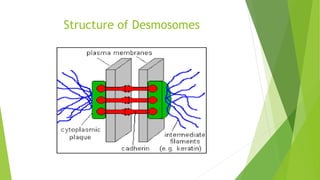
Structure of Desmosomes
Desmosome consists of three component
 The Transmembrane molecules
 The plaque molecules or cytoplasmic adaptor
protein
 Intermediate filament
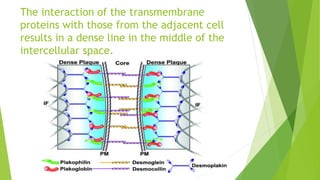
 Extracellularly , desmosomes are separated by a
25-30 nm space.
The interaction of the transmembrane
proteins with those from the adjacent cell
results in a dense line in the middle of the
intercellular space.
Function of Desmosomes
 Desmosomes create a transcellular network
throughout a tissue that resist forces of
mechanical stress. Hence found in
stratified squamous epithelia and
myocardium subjected to constant stress.
ASSOCIATED PATHOLOGY
 Desmosomes are adhesive intercellular junctions
prominent in the oral epithelium, skin & heart. Loss of
desmosome function is associated with severe congenital
& acquired disorders characterized by tissue fragility.
 Diseases associated are-
 Pemphigus
 Drug-induced pemphigus
PEMPHIGUS
 Mutations in genes encoding desmosomal
components & autoantibodies directed
against the desmosomal cadherins lead to
severe epidermal blistering disorders
termed pemphigus.
HEMIDESMOSOMES
 Hemidesmosomes are specialized junctional
complexes that contribute to the
attachment of epithelial cell to the
underlying basement membrane in
stratified & other complex epithelia.
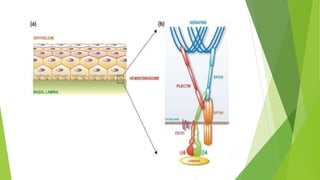
 Hemidesmosomes are very small stud or rivet like
structures on the inner basal surface of keratinocytes in
the epidermis of skin.
 While desmosomes link two cells together,
hemidesmosomes attach one cell to the extracellular
matrix.
 Hemidesmosomes use integrin cell adhesion proteins.
 Hemidesmosomes are asymmetrical & are found in
epithelial cells connecting the basal face to other cells.
 Function : maintenance of tissue structure.
DISORDERS
 AUTOIMMUNE DISEASES
 PEMPHIGOID
Term used to indicate a blistering disease in which epithelial separation
takes place at the level of the basement membrane.
Thank you

Desmosomes & hemidesmosomes

  • 1.
  • 2.
     The plasmamembranes of adjacent cells are usually separated by a uniform intercellular space of about 100- 200 A.  But at certain places the plasma membranes of adjacent cells may come too close to each other the term CELL JUNCTION.  It refers to specialisations in the plasma membrane formed at sites where two cells make contact.  Cell junctions are different types : desmosomes, gap- junctions, tight junctions & plasmodesmata….
  • 3.
    DESMOSOMES(Adherent junctions)  Desmosomesare essential adhesion structures in most epithelia that link the intermediate filament network of one cell to its neighbour, thereby forming a strong bond.  They are particularly numerous in tissues that are subjected to mechanical stress, such as the skin & uterine cervix.
  • 4.
  • 5.
    Desmosome consists ofthree component  The Transmembrane molecules  The plaque molecules or cytoplasmic adaptor protein  Intermediate filament  Extracellularly , desmosomes are separated by a 25-30 nm space.
  • 6.
    The interaction ofthe transmembrane proteins with those from the adjacent cell results in a dense line in the middle of the intercellular space.
  • 7.
    Function of Desmosomes Desmosomes create a transcellular network throughout a tissue that resist forces of mechanical stress. Hence found in stratified squamous epithelia and myocardium subjected to constant stress.
  • 8.
    ASSOCIATED PATHOLOGY  Desmosomesare adhesive intercellular junctions prominent in the oral epithelium, skin & heart. Loss of desmosome function is associated with severe congenital & acquired disorders characterized by tissue fragility.  Diseases associated are-  Pemphigus  Drug-induced pemphigus
  • 9.
    PEMPHIGUS  Mutations ingenes encoding desmosomal components & autoantibodies directed against the desmosomal cadherins lead to severe epidermal blistering disorders termed pemphigus.
  • 10.
    HEMIDESMOSOMES  Hemidesmosomes arespecialized junctional complexes that contribute to the attachment of epithelial cell to the underlying basement membrane in stratified & other complex epithelia.
  • 12.
     Hemidesmosomes arevery small stud or rivet like structures on the inner basal surface of keratinocytes in the epidermis of skin.  While desmosomes link two cells together, hemidesmosomes attach one cell to the extracellular matrix.  Hemidesmosomes use integrin cell adhesion proteins.  Hemidesmosomes are asymmetrical & are found in epithelial cells connecting the basal face to other cells.  Function : maintenance of tissue structure.
  • 13.
    DISORDERS  AUTOIMMUNE DISEASES PEMPHIGOID Term used to indicate a blistering disease in which epithelial separation takes place at the level of the basement membrane.
  • 14.