GM SEED
(Are we ready to re-establishing our relations with seeds?)
Kapil Shah
Member, National Taskforce on Organic and Chemical-fee agriculture
Govt. of India
National Secretary,
Organic Farming Association of India
Founder Trustee,
JATAN
Vinoba Ashram, Gotri, Vadodara
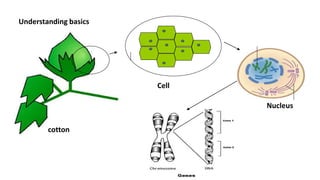
Understanding basics
cotton
Cell
Nucleus
Understanding basics
Mouse
Cell
Nucleus
The Engineering
Mouse cotton
Genetically Modified Animals
Cats with a gene from Fire-fly
Goat with a gene from spider
Size of the DNA of the all people of the world:
A Grain of chick pea
Length of the DNA of one person:
67 X 2 X Distance between Sun and Earth
7
Plant
Transformation
Plant productivity
(Tolerance to abiotic stress and
Herbicide)
Nutritional value
(Protein, Lipid, Amino acid)
Agronomic traits
(Seed dormancy, disease resistance,
nematode resistance)
Phytoremidiation
(Salt tolerance, pollution removal)
Pharmaceutical compounds
(Antibody, vaccine, therapeutic protein)
Metabolic pathway regulation
(Nutrient capture carbohydrate or
Plant oil production)
Novel traits
( Fruit ripening, flower colour)
Why alter plants?
Pesticide Producing (Bt)
Purpose
• Make plants resistant to a specific pest eg
bollworm for cotton
Short Term Benefits
• Decrease target pest and reduce loss of
crop to it
• Reduce insecticide use and cost initially
for main target pest
Long Term Consequences
• Resistance develops by target pest.
• Great increase in new insect pests eg
whiteflies & other sucking pests
• Farmers put on a costly technology treadmill
of buying new GM seeds each year
Other possible impacts
Herbicide Tolerating (HT)
Purpose
• Control weeds without damaging crops
Short Term Benefits
• Labour costs reduced for huge farms of
US, Brazil, Argentina etc
• Ease of spraying since all other plants
die, except the crop
Long Term Consequence
• Plant absorbs the herbicide and this enters
the human food system
• Herbicide Resistant weeds multiply
greatly result is more weedicide purchase
Other possible impacts
• Sickness by herbicides in air, water, food
• Pest controlling insects killed eg
Herbicide Is Sprayed Liberally
on Herbicide Tolerant (HT) Crops
183 Million Kg Increase in Pesticides
in USA in 16 Years was due to GM
GLYPHOSATE (HERBICIDE) USE INCREASED
BY 239 MILLION KG WHILE INSECTICIDES
DECREASED BY ONLY 56 MILLION KG
(Based on USDA data, 2003 ).
‘SUPERWEEDS’
Over 20 glyphosate
resistant weeds in USA.
Horseweed is one…..
 Grows huge
 Nightmare for
farmers
What do farmers do ?
 Spray more
glyphosate.
 Spray more toxic
herbicide cocktails.
 Cut by hand.
 Abandon field.
Constant Exposure to Glyphosate (herbicide) Results in
‘Superweeds’ Growing Rapidly. Over 33% of US Farmland Affected.
32.6
40.7
61.2
0
10
20
30
40
50
60
2010 2011 2012
Million
acres
Stratus AgriMarketing Report
0
0.2
0.4
0.6
0.8
1
1.2
0
200
400
600
800
1000
1200
1400
1600
2002 2003 2004 2005 2006 2007 2008 2009 2010 2011 2012 2013
ValueofInsecticidesinCrores
Insecticides used for Bollworms Insecticides used for Sucking pests Total insecticides on cotton
Source: Dr. K.R. Kranthi, Director , Central Institute of Cotton Research
DO GM Bt CROPS REDUCE INSECTICIDES ?
Value of Insecticides on cotton in India (2002-13)
Bollworm decreased with Bt . Other pests increased.
1965 1975 1980 1985 1990 1995 2005
 Changing pest scenario
5
BPH
Stem borer
Gall midge
GLH
WBPH
3
Stem borer
Gall midge
GLH
8
BPH
Stem borer
Gall midge
(3 biotypes)
GLH
WBPH
Cut worm
Gundhi bug
9
Stem borer
Gall midge
(biotype 4)
Leaf folder
BPH
WBPH
GLH
Cutworm
Gundhi bug
11
Stem borer
Gall midge
Leaf folder
GLH
BPH
WBPH
Cutworm
Gundhi bug
Hispa
Thrips
13
Stem borer
Gall midge
(Biotype 5)
Leaf folder
BPH
GLH
WBPH
Cut worm
Gundhi
bug
Hispa
Thrips
14
Stem borer
Gall midge
(Biotype 6)
Leaf folder
BPH
GLH
WBPH
Cut worm
Gundhi bug
Hispa
Thrips
Root weevil
Black bug
1965 1975 1980 1985 1990 1995 2005
Don’t Kill.. Manage
PINK BOLLWORM DEVELOPS RESISTANCE
Gujarat Farmers uprooting Bt Cotton crop
due to infestation of pink boll worm
Australia
Israel
Mexico
Turkey
Brazil
China
Venezuela
Syria
Tunisia
Bulgaria
Peru
Greece
SouthAfrica
Spain
USA
Colombia
Pakistan
Egypt
Kyrgyzstan
Azerbaijan
Uzbekistan
Myanmar
Ecuador
Korea
Bolivia
Bangladesh
Iran
Turkmenistan
Nicaragua
Angola
India
Cotton Yields in Kg per Ha (INDEX MUNDI 2014)
AFTER 14 YEARS OF Bt COTTON, INDIA RANKS 31 OUT OF 72
21 COUNTRIES AHEAD OF INDIA DO NOT GROW BT COTTON1
31
IN USA ESTIMATED 70% OF STORE FOOD HAS GM.
GM CORN SYRUP AND SOY OIL WIDELY USED
GM AND CHEMICALS TRANSMITTED TO FOETUS
OF 17 MOST DEVELOPED NATIONS, USA IS LEAST
HEALTHY. POST 1966 SHARP INCREASE IN USA OF :
Autism, ADHD, Alzheimers, Asthma, Autoimmune
diseases, Cancers, Diabetes, Infertility, Liver and Kidney
Damage, Obesity, Thyroid Disorders.
CLAIM THAT GM IS SAFE IS QUESTIONABLE SINCE….
LIKE TOBACCO, EFFECTS OF GM WILL TAKE LONG TO SHOW. DOCTORS REPORT
ARE GM FOODS SAFE ?
GM Approvals require 90 days studies on rodents ie < 12 human
years. Dr Seralini’s study showed organ damage, huge increase in
tumours and high mortality appearing after 90 days. Study attacked.
Publisher withdrew study. Hundreds of scientists protested this
Tumours in landmark Study of 2 Years…instead of 90 days
IN 2015, GLYPHOSATE
( USED IN MONSANTO’S ‘ROUND UP’
HERBICIDE & WITH IT’S HT SEEDS)
CLASSIFIED BY THE WHO AS
“PROBABLY CARCINOGENIC
TO HUMANS”
30,000 Doctors & Medical
Professionals Association in
Argentina called for ban on
GM soy as birth defects and
Economic Impacts of GM Crops
• IMPORTS REFUSED by countries which do not grow GM, if there is any GM
contamination or if GM crop of that variety .
• HUGE LOSSES TO US RICE & WHEAT FARMERS as loss of exports as traces
found from GM Field Trial crops, supposedly destroyed
• INDIA’S ORGANIC COTTON EXPORTS WERE DAMAGED BY GM contamination.
India had become the world’s largest exporter.
• FARMERS & INDIAN ECONOMY IMPACTED High cost of seeds & chemical
fertilisers = high debt & suicides OR Loan Waivers.
• SEED DIVERSITY AND SELF RELIANCE LOST as GM takes over.
Why Should GM Field Trials Stop ?
Lab or Greenhouse Trials are not risky. In Field Trials contamination
occurs by pollen flow, admixture. No deterrent liabilities exist.
TOP COMMITTEES’ FINDINGS
• India’s Joint Parliamentary Committee on Agriculture
unanimously found regulatory failures, high risks, poor benefits.
Called for moratorium on GM crops & GM Field Trials (2012)
• Supreme Court appointed Technical Expert Committee in 2013
has called for :
Ban on all Herbicide Tolerant GM Crops
Ban on crops where India is Centre of Origin
Over 400 peer reviewed
scientific studies on ‘ADVERSE
IMPACTS OF TRANSGENIC
CROPS/FOODS’ can be
accessed at :
www.indiagminfo.org
Latest edition of
‘GMO MYTHS AND TRUTHS’
Over 400 Scientific Studies on Hazards of GM Crops
Crops Pending for GM Approval in India
GM Mustard is the Start for More GM Crops
 Rice
 Wheat
 Jowar
 Corn
 Groundnut
 Mustard
 Potato
 Cabbage
 Cauliflower
 Brinjal
 Okra
 Papaya
 Watermelon
 Sugarcane
3
major
crops
30 ‘feed the world”
200 recorded in statistics
7,000 plant species utilised
30,000 plant species edible
300,000 plant species documented
400,000 plant species estimated world-wide
The Green Revolution has contributed to the narrowing of the genetic base of cultivated crops and
loss of on-farm diversity due to the intensification and simplification of agriculture.
Narrowingofspecies
diversity
PGR contributed to Green Revolution
Brinjal Diversity in India
(More than 3400 varieties)
US Patent No. : 57,23,765
Terminator Technology
Killing the basic Instinct of Survival
27
 LARGEST PESTICIDE Cos..
Bayer
Syngenta,
BASF
DOW
Monsanto
Dupont
 LARGEST GM SEED Cos….
Monsanto
Dupont (Pioneer)
Syngenta
DOW
BASF
Bayer
Herbicide Tolerant
GM Seeds tolerate use
of herbicides…..
But Result is…..
Increased use of herbicides.
GM MUSTARD
Mustard leaves, seeds and oil important food and medicine in India
Opposed by Farmer Unions, Beekeepers, State Govts, Scientists etc
If GM mustard approved, it will be first GM food crop in India
Will open door to other GM crops in pipeline
Has herbicide tolerant gene. Will lead to increased herbicide use.
HONEY BEES AND MUSTARD
• Mustard pollen major food for
honey bees.
• GM will contaminate honey
• Millions of bee & butterfly
Flaws in GM Mustard Approval
.
 Biosafety data not made available for independent
scrutiny. Bt brinjal showed up flaws when scrutinised.
 Herbicide use will occur, but not tested as HT crop
 Impact on Honey bees not fully studied.
 India is Centre of Diversity. Violates UN and TEC norms
1278
1474
1278
2010
2993
2563
1178
2708
1470
895
1380
3478
1338
0
500
1000
1500
2000
2500
3000
3500
4000
Average yield (Kg/ha) of Rapeseed-Mustard in Major Producing
Countries 2010-14
GM TOP YIELDERS ARE NON GM Source: FAO Statistics
WHAT IS THE VIEW ON GM
BY WORLD’S LARGEST AGRICULTURAL STUDY ?
IAASTD STUDY, done for World Bank and United
Nations, by 400 scientists from > 50 countries, says:
“such techniques as genetic engineering are no
solution for soaring food prices, hunger and poverty.”
“Agro Ecology done by small farmers is best approach
for removing hunger, poverty and inequity.”
FAO Study, by its Special Raconteur on Food, found:
“289 AGRO ECOLOGY projects in 57 countries increased
NON PESTICIDAL MANAGEMENT (NPM) IN ANDHRA
10,000 NPM villages with Govt support. Pesticide and
fertiliser use halved in AP. Village could save Rs 60 lakhs.
ASSOCHAM STUDY for West Bengal, says organic farming
over 5 years would result in :
 Increase in farmer incomes by 250%
 Exports worth Rs 5.5 billion
 Wealth accumulation of Rs 120 billion
 Increase in employment by 20 lakhs
SOME INDIAN EXAMPLES
ORGANIC DEMAND GROWING at > 25% pa globally.
India has 6,00,000 of world’s 16,00,000 organic farmers.
We became world’s largest organic cotton exporter
Largest organic soya supplier to USA….
A TRUE ‘MAKE IN INDIA’ OPPORTUNITY!
Govt Must Promote Better Options
Indian farmers can be highly innovative.
An Indian organic farmer broke world records for rice yields.
GM rice if it is approved will be a risk for India’s farming.
We can STOP use of DDT
We can STOP use of CFCs
We can recall exotic cattle breeds
We can NOT recall
GM seeds
CAN WE AFFORD REPEATING THE MISTAKE?
GM seeds are Irreversible
Best Technology ? Will INDIA be Left Behind ?
Since 1996: Only 6 Countries have 90% of World’s GM Area.
USA 40%
Brazil 23%
Argentina 14%
Canada 6%
India 6%
China 2%
Other 21 Countries
9%
Data sourced from FAO and ISAAA reports
STATUS AFTER 20 YEARS :
< 4% OF AGRIC LAND
• 17 OUT OF 20 MOST DEVELOPED COUNTRIES DON’T GROW GM:
Almost all countries in Europe, Japan, Russia, Israel, Singapore etc
• CHINA, ONE OF THE FIRST, IS NOW GOING SLOW ON GM
- Has cancelled field trials of GM rice and corn.
- Banned GM food for its army .
- Grows GM on only one third the area as India.
• IN 2015 8 COUNTRIES REDUCED GM AREA (Incl. USA, Canada, China).
16 COUNTRIES STAGNANT.
4 COUNTRIES INCREASED
Who is NOT Growing GM Crops ?

Genetically Modified seeds

  • 1.
    GM SEED (Are weready to re-establishing our relations with seeds?) Kapil Shah Member, National Taskforce on Organic and Chemical-fee agriculture Govt. of India National Secretary, Organic Farming Association of India Founder Trustee, JATAN Vinoba Ashram, Gotri, Vadodara
  • 2.
  • 3.
  • 4.
  • 5.
    Genetically Modified Animals Catswith a gene from Fire-fly Goat with a gene from spider
  • 6.
    Size of theDNA of the all people of the world: A Grain of chick pea Length of the DNA of one person: 67 X 2 X Distance between Sun and Earth
  • 7.
    7 Plant Transformation Plant productivity (Tolerance toabiotic stress and Herbicide) Nutritional value (Protein, Lipid, Amino acid) Agronomic traits (Seed dormancy, disease resistance, nematode resistance) Phytoremidiation (Salt tolerance, pollution removal) Pharmaceutical compounds (Antibody, vaccine, therapeutic protein) Metabolic pathway regulation (Nutrient capture carbohydrate or Plant oil production) Novel traits ( Fruit ripening, flower colour) Why alter plants?
  • 8.
    Pesticide Producing (Bt) Purpose •Make plants resistant to a specific pest eg bollworm for cotton Short Term Benefits • Decrease target pest and reduce loss of crop to it • Reduce insecticide use and cost initially for main target pest Long Term Consequences • Resistance develops by target pest. • Great increase in new insect pests eg whiteflies & other sucking pests • Farmers put on a costly technology treadmill of buying new GM seeds each year Other possible impacts Herbicide Tolerating (HT) Purpose • Control weeds without damaging crops Short Term Benefits • Labour costs reduced for huge farms of US, Brazil, Argentina etc • Ease of spraying since all other plants die, except the crop Long Term Consequence • Plant absorbs the herbicide and this enters the human food system • Herbicide Resistant weeds multiply greatly result is more weedicide purchase Other possible impacts • Sickness by herbicides in air, water, food • Pest controlling insects killed eg
  • 9.
    Herbicide Is SprayedLiberally on Herbicide Tolerant (HT) Crops 183 Million Kg Increase in Pesticides in USA in 16 Years was due to GM GLYPHOSATE (HERBICIDE) USE INCREASED BY 239 MILLION KG WHILE INSECTICIDES DECREASED BY ONLY 56 MILLION KG (Based on USDA data, 2003 ).
  • 10.
    ‘SUPERWEEDS’ Over 20 glyphosate resistantweeds in USA. Horseweed is one…..  Grows huge  Nightmare for farmers What do farmers do ?  Spray more glyphosate.  Spray more toxic herbicide cocktails.  Cut by hand.  Abandon field.
  • 11.
    Constant Exposure toGlyphosate (herbicide) Results in ‘Superweeds’ Growing Rapidly. Over 33% of US Farmland Affected. 32.6 40.7 61.2 0 10 20 30 40 50 60 2010 2011 2012 Million acres Stratus AgriMarketing Report
  • 12.
    0 0.2 0.4 0.6 0.8 1 1.2 0 200 400 600 800 1000 1200 1400 1600 2002 2003 20042005 2006 2007 2008 2009 2010 2011 2012 2013 ValueofInsecticidesinCrores Insecticides used for Bollworms Insecticides used for Sucking pests Total insecticides on cotton Source: Dr. K.R. Kranthi, Director , Central Institute of Cotton Research DO GM Bt CROPS REDUCE INSECTICIDES ? Value of Insecticides on cotton in India (2002-13) Bollworm decreased with Bt . Other pests increased.
  • 13.
    1965 1975 19801985 1990 1995 2005  Changing pest scenario 5 BPH Stem borer Gall midge GLH WBPH 3 Stem borer Gall midge GLH 8 BPH Stem borer Gall midge (3 biotypes) GLH WBPH Cut worm Gundhi bug 9 Stem borer Gall midge (biotype 4) Leaf folder BPH WBPH GLH Cutworm Gundhi bug 11 Stem borer Gall midge Leaf folder GLH BPH WBPH Cutworm Gundhi bug Hispa Thrips 13 Stem borer Gall midge (Biotype 5) Leaf folder BPH GLH WBPH Cut worm Gundhi bug Hispa Thrips 14 Stem borer Gall midge (Biotype 6) Leaf folder BPH GLH WBPH Cut worm Gundhi bug Hispa Thrips Root weevil Black bug 1965 1975 1980 1985 1990 1995 2005 Don’t Kill.. Manage
  • 14.
  • 15.
    Gujarat Farmers uprootingBt Cotton crop due to infestation of pink boll worm
  • 16.
  • 17.
    IN USA ESTIMATED70% OF STORE FOOD HAS GM. GM CORN SYRUP AND SOY OIL WIDELY USED GM AND CHEMICALS TRANSMITTED TO FOETUS OF 17 MOST DEVELOPED NATIONS, USA IS LEAST HEALTHY. POST 1966 SHARP INCREASE IN USA OF : Autism, ADHD, Alzheimers, Asthma, Autoimmune diseases, Cancers, Diabetes, Infertility, Liver and Kidney Damage, Obesity, Thyroid Disorders. CLAIM THAT GM IS SAFE IS QUESTIONABLE SINCE…. LIKE TOBACCO, EFFECTS OF GM WILL TAKE LONG TO SHOW. DOCTORS REPORT ARE GM FOODS SAFE ?
  • 18.
    GM Approvals require90 days studies on rodents ie < 12 human years. Dr Seralini’s study showed organ damage, huge increase in tumours and high mortality appearing after 90 days. Study attacked. Publisher withdrew study. Hundreds of scientists protested this Tumours in landmark Study of 2 Years…instead of 90 days
  • 19.
    IN 2015, GLYPHOSATE (USED IN MONSANTO’S ‘ROUND UP’ HERBICIDE & WITH IT’S HT SEEDS) CLASSIFIED BY THE WHO AS “PROBABLY CARCINOGENIC TO HUMANS” 30,000 Doctors & Medical Professionals Association in Argentina called for ban on GM soy as birth defects and
  • 20.
    Economic Impacts ofGM Crops • IMPORTS REFUSED by countries which do not grow GM, if there is any GM contamination or if GM crop of that variety . • HUGE LOSSES TO US RICE & WHEAT FARMERS as loss of exports as traces found from GM Field Trial crops, supposedly destroyed • INDIA’S ORGANIC COTTON EXPORTS WERE DAMAGED BY GM contamination. India had become the world’s largest exporter. • FARMERS & INDIAN ECONOMY IMPACTED High cost of seeds & chemical fertilisers = high debt & suicides OR Loan Waivers. • SEED DIVERSITY AND SELF RELIANCE LOST as GM takes over.
  • 21.
    Why Should GMField Trials Stop ? Lab or Greenhouse Trials are not risky. In Field Trials contamination occurs by pollen flow, admixture. No deterrent liabilities exist. TOP COMMITTEES’ FINDINGS • India’s Joint Parliamentary Committee on Agriculture unanimously found regulatory failures, high risks, poor benefits. Called for moratorium on GM crops & GM Field Trials (2012) • Supreme Court appointed Technical Expert Committee in 2013 has called for : Ban on all Herbicide Tolerant GM Crops Ban on crops where India is Centre of Origin
  • 22.
    Over 400 peerreviewed scientific studies on ‘ADVERSE IMPACTS OF TRANSGENIC CROPS/FOODS’ can be accessed at : www.indiagminfo.org Latest edition of ‘GMO MYTHS AND TRUTHS’ Over 400 Scientific Studies on Hazards of GM Crops
  • 23.
    Crops Pending forGM Approval in India GM Mustard is the Start for More GM Crops  Rice  Wheat  Jowar  Corn  Groundnut  Mustard  Potato  Cabbage  Cauliflower  Brinjal  Okra  Papaya  Watermelon  Sugarcane
  • 24.
    3 major crops 30 ‘feed theworld” 200 recorded in statistics 7,000 plant species utilised 30,000 plant species edible 300,000 plant species documented 400,000 plant species estimated world-wide The Green Revolution has contributed to the narrowing of the genetic base of cultivated crops and loss of on-farm diversity due to the intensification and simplification of agriculture. Narrowingofspecies diversity PGR contributed to Green Revolution
  • 25.
    Brinjal Diversity inIndia (More than 3400 varieties)
  • 26.
    US Patent No.: 57,23,765 Terminator Technology Killing the basic Instinct of Survival
  • 27.
    27  LARGEST PESTICIDECos.. Bayer Syngenta, BASF DOW Monsanto Dupont  LARGEST GM SEED Cos…. Monsanto Dupont (Pioneer) Syngenta DOW BASF Bayer Herbicide Tolerant GM Seeds tolerate use of herbicides….. But Result is….. Increased use of herbicides.
  • 28.
    GM MUSTARD Mustard leaves,seeds and oil important food and medicine in India Opposed by Farmer Unions, Beekeepers, State Govts, Scientists etc If GM mustard approved, it will be first GM food crop in India Will open door to other GM crops in pipeline Has herbicide tolerant gene. Will lead to increased herbicide use. HONEY BEES AND MUSTARD • Mustard pollen major food for honey bees. • GM will contaminate honey • Millions of bee & butterfly
  • 29.
    Flaws in GMMustard Approval .  Biosafety data not made available for independent scrutiny. Bt brinjal showed up flaws when scrutinised.  Herbicide use will occur, but not tested as HT crop  Impact on Honey bees not fully studied.  India is Centre of Diversity. Violates UN and TEC norms
  • 30.
    1278 1474 1278 2010 2993 2563 1178 2708 1470 895 1380 3478 1338 0 500 1000 1500 2000 2500 3000 3500 4000 Average yield (Kg/ha)of Rapeseed-Mustard in Major Producing Countries 2010-14 GM TOP YIELDERS ARE NON GM Source: FAO Statistics
  • 31.
    WHAT IS THEVIEW ON GM BY WORLD’S LARGEST AGRICULTURAL STUDY ? IAASTD STUDY, done for World Bank and United Nations, by 400 scientists from > 50 countries, says: “such techniques as genetic engineering are no solution for soaring food prices, hunger and poverty.” “Agro Ecology done by small farmers is best approach for removing hunger, poverty and inequity.” FAO Study, by its Special Raconteur on Food, found: “289 AGRO ECOLOGY projects in 57 countries increased
  • 32.
    NON PESTICIDAL MANAGEMENT(NPM) IN ANDHRA 10,000 NPM villages with Govt support. Pesticide and fertiliser use halved in AP. Village could save Rs 60 lakhs. ASSOCHAM STUDY for West Bengal, says organic farming over 5 years would result in :  Increase in farmer incomes by 250%  Exports worth Rs 5.5 billion  Wealth accumulation of Rs 120 billion  Increase in employment by 20 lakhs SOME INDIAN EXAMPLES
  • 33.
    ORGANIC DEMAND GROWINGat > 25% pa globally. India has 6,00,000 of world’s 16,00,000 organic farmers. We became world’s largest organic cotton exporter Largest organic soya supplier to USA…. A TRUE ‘MAKE IN INDIA’ OPPORTUNITY! Govt Must Promote Better Options
  • 34.
    Indian farmers canbe highly innovative. An Indian organic farmer broke world records for rice yields. GM rice if it is approved will be a risk for India’s farming.
  • 35.
    We can STOPuse of DDT We can STOP use of CFCs We can recall exotic cattle breeds We can NOT recall GM seeds CAN WE AFFORD REPEATING THE MISTAKE? GM seeds are Irreversible
  • 38.
    Best Technology ?Will INDIA be Left Behind ? Since 1996: Only 6 Countries have 90% of World’s GM Area. USA 40% Brazil 23% Argentina 14% Canada 6% India 6% China 2% Other 21 Countries 9% Data sourced from FAO and ISAAA reports STATUS AFTER 20 YEARS : < 4% OF AGRIC LAND
  • 39.
    • 17 OUTOF 20 MOST DEVELOPED COUNTRIES DON’T GROW GM: Almost all countries in Europe, Japan, Russia, Israel, Singapore etc • CHINA, ONE OF THE FIRST, IS NOW GOING SLOW ON GM - Has cancelled field trials of GM rice and corn. - Banned GM food for its army . - Grows GM on only one third the area as India. • IN 2015 8 COUNTRIES REDUCED GM AREA (Incl. USA, Canada, China). 16 COUNTRIES STAGNANT. 4 COUNTRIES INCREASED Who is NOT Growing GM Crops ?