ENVIRONMENTAL SENSITIVE
GENETIC MALE STERILITY
Presented by
GOKULAN D
Male Sterility
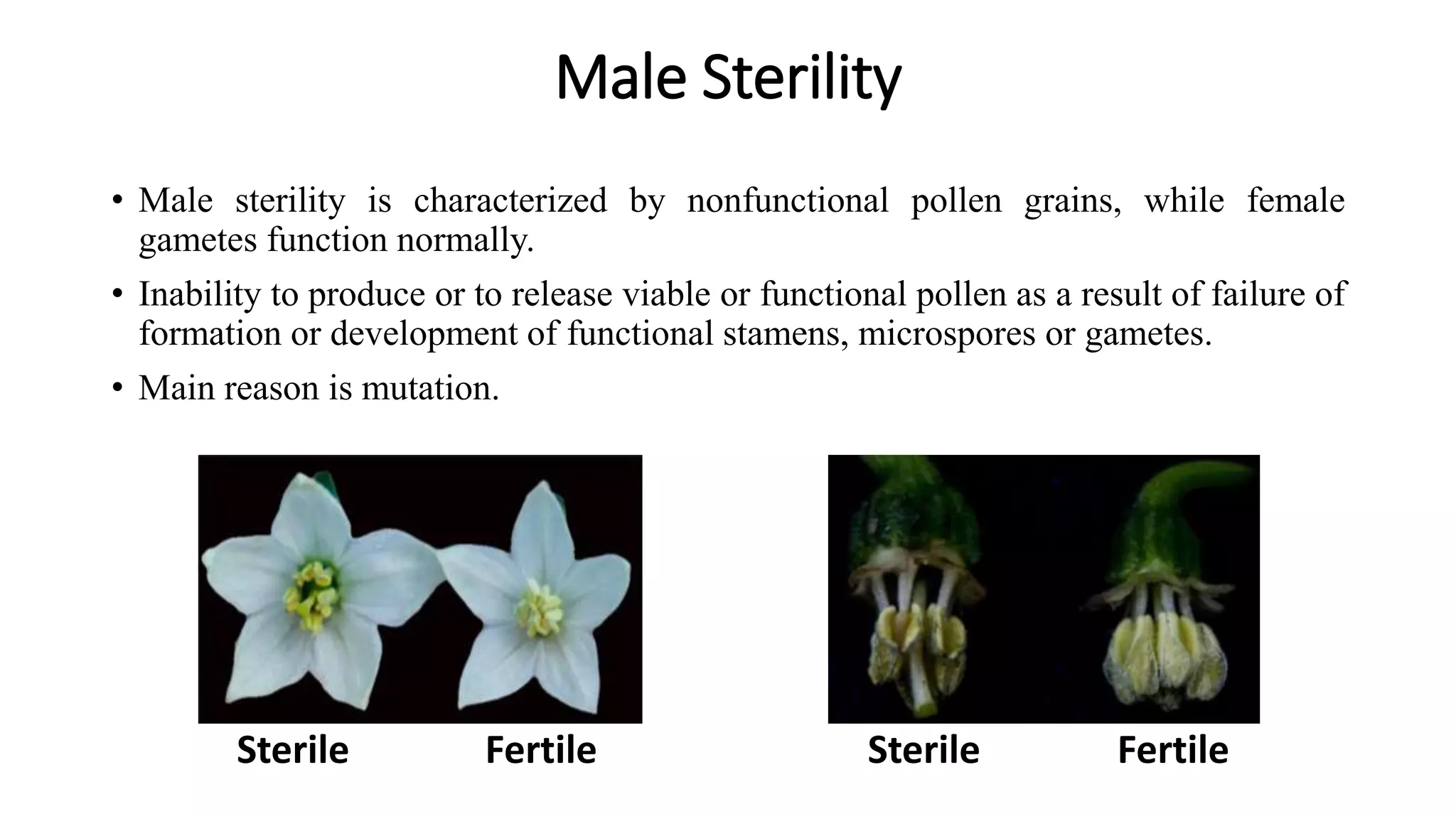
• Male sterility is characterized by nonfunctional pollen grains, while female
gametes function normally.
• Inability to produce or to release viable or functional pollen as a result of failure of
formation or development of functional stamens, microspores or gametes.
• Main reason is mutation.
Sterile Fertile Sterile Fertile
Manifestations of Male Sterility
• Absence or malformation of male organs.
• Failure to develop normal microsporogenous tissue- anther.
• Abnormal microsporogenesis (deformed or inviable pollen).
• Abnormal pollen maturation.
• Non dehiscent anthers but viable pollen.
History of Male Sterility
• J.K. Koelreuter (1763) observed anther abortion within species & species
hybrids.
• Genic male sterility has been reported in cabbage (Rundfeldt 1960), cauliflower
(Nieuwhof 1961)
• Male sterility systems have been also developed through genetic engineering
(Williams et al. 1997) and protoplast fusion (Pelletier et al. 1995)
• Male sterility were artificially induced through mutagenesis (Kaul 1988)
Why Male Sterility ???
• Reduced the cost of hybrid seed production.
• Production of large scale of F1 seeds.
• Avoids enormous manual work of emasculation and pollination.
• Speed up the hybridization programme.
• Commercial exploitation of hybrid vigour.
Creation of Male Sterility
• Spontaneous mutations
• Interspecific hybridization
• Mutation induction (EtBr)
• Genetic Engineering
• Chemically induced male sterility (CHAs)
Detection of Male Sterility system
• Whether a particular sterile genotype belongs to which MS system can be
detected by its progeny performance on crossing with a few normal genotypes.
• Trend-I- All progenies in all the rows may be sterile- CMS
• Trend-II- Some rows may consist all fertile
Some rows sterile and fertile in 1:1 ratio- GMS
• Trend-III- sterile plant produces all fertile progeny when crossed with restorer -
CGMS
Classification of Male Sterility
Kaul (1988) Classified Male Sterility in three major groups
1. Phenotypic Male Sterility (Morphological)
• Structural or Staminal Male Sterility
• Pollen Male Sterility
• Functional Male Sterility
2. Genotypic Male Sterility
• Genetic Male Sterility (GMS)
 Environmental Sensitive (EGMS)
a) Thermo sensitive genetic male sterility (TGMS)
b) Photoperiod sensitive genetic male sterility (PGMS)
 Environmental non-sensitive
• Cytoplasmic Male Sterility (CMS)
• Cytoplasmic Genetic Male Sterility (CGMS)
• Transgenic Male Sterility (TMS)
3. Chemically Induced Male Sterility (CHA)
Genetic Male Sterility (GMS)
• Also called as nuclear male sterility.
• Mostly governed by single recessive gene (ms) but dominant gene governing male
sterility (safflower).
• Origin: Spontaneous mutation or artificial mutations (Gamma rays, EMS) are
common.
• ‘ms’alleles may affect staminal initiation, stamen or anther sac development, PMC
formation, meiosis, pollen formation, maturation and dehiscence.
Types of GMS
• Environment insensitive GMS: ms gene expression is much less affected by the
environment.
• Environment sensitive GMS: ms gene expression occurs within a specified range
of temperature and /or photoperiod regimes (Rice, Tomato, Wheat etc.).
Thermo sensitive Genetic Male Sterility(TGMS)
• Sterility is at particular temperature e.g. In rice TGMS line (Pei- Ai645) at 23.3˚C
(China).
• TGMS at high temperature is due to failure of pairing of two chromosomes at
metaphase was evident.
• This abnormality led to abnormal meiosis, abnormal or sterile pollens.
• Anthers were shriveled and non-dehiscence-Male sterile.
• However, these lines produced normal fertile pollen at low temp.
Sensitive period : PMC formation to Meiosis
Photoperiod sensitive genetic male
sterility(PGMS)
• Governed by 2 recessive genes.
• Sterility is obtained in long day conditions while in short days, normal fertile
plant.
• Rice:- Sterile under Long day conditions (13 hr. 45 min + Temp. 23- 29˚C) but
fertile under short day conditions.
Sensitive period: Differentiation of secondary rachis branches to PMC formation
Procedure of utilization of TGMS/PGMS line
in Seed production
EGMS system in Rice hybrid seed production
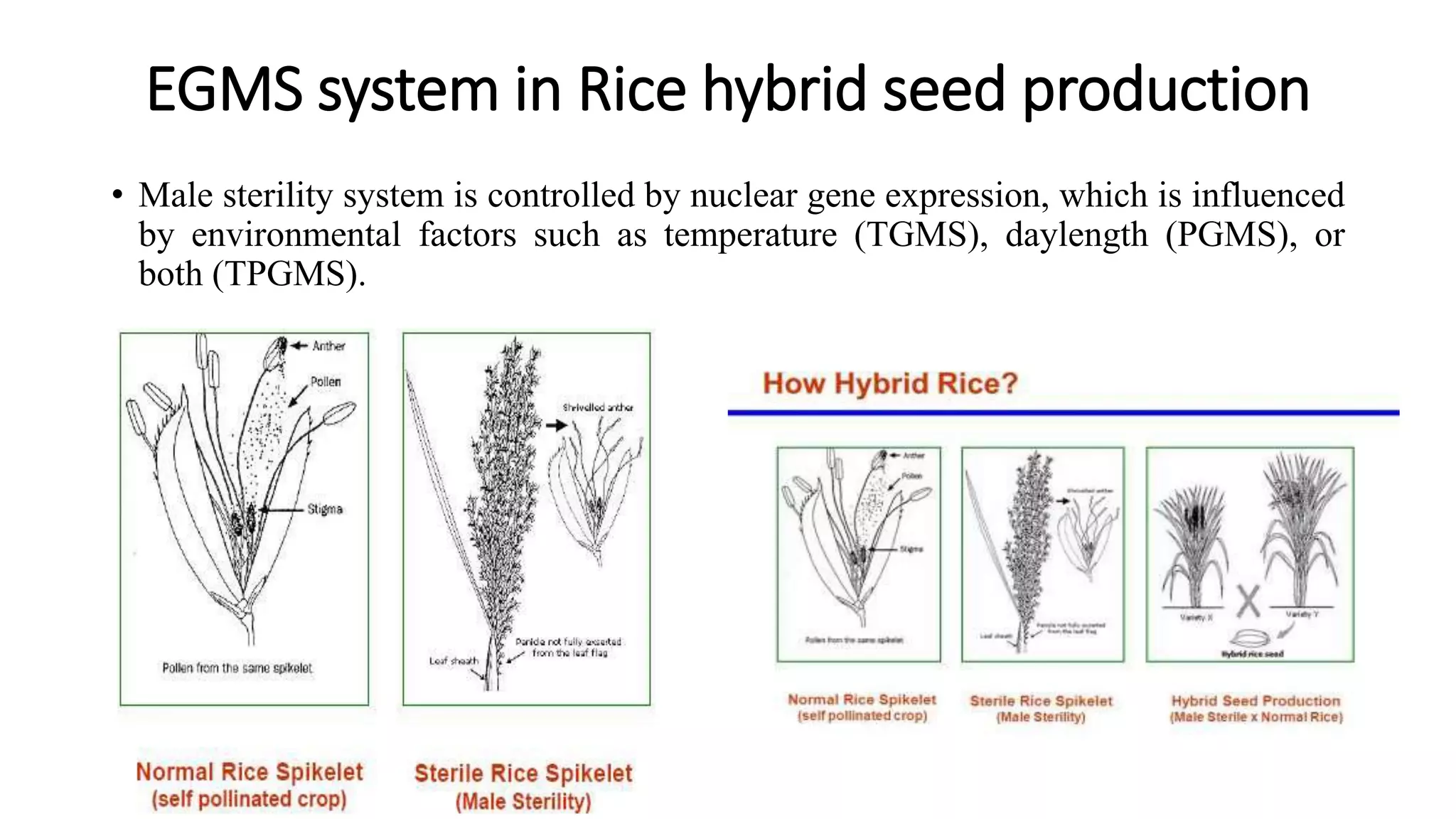
• Male sterility system is controlled by nuclear gene expression, which is influenced
by environmental factors such as temperature (TGMS), daylength (PGMS), or
both (TPGMS).
Advantage & Disadvantage of EGMS based
hybrid rice system
Advantages
• Simplified procedure of hybrid seed production
• Multiple and diverse germplasm available as parents
• Any line could be bred as female
97% (2-line) vs 5% (3-line) of germplasm as male
• Increased chance of developing desirable & heterotic hybrids
Disadvantages
• Environmental effect on sterility could cause seed purity problem
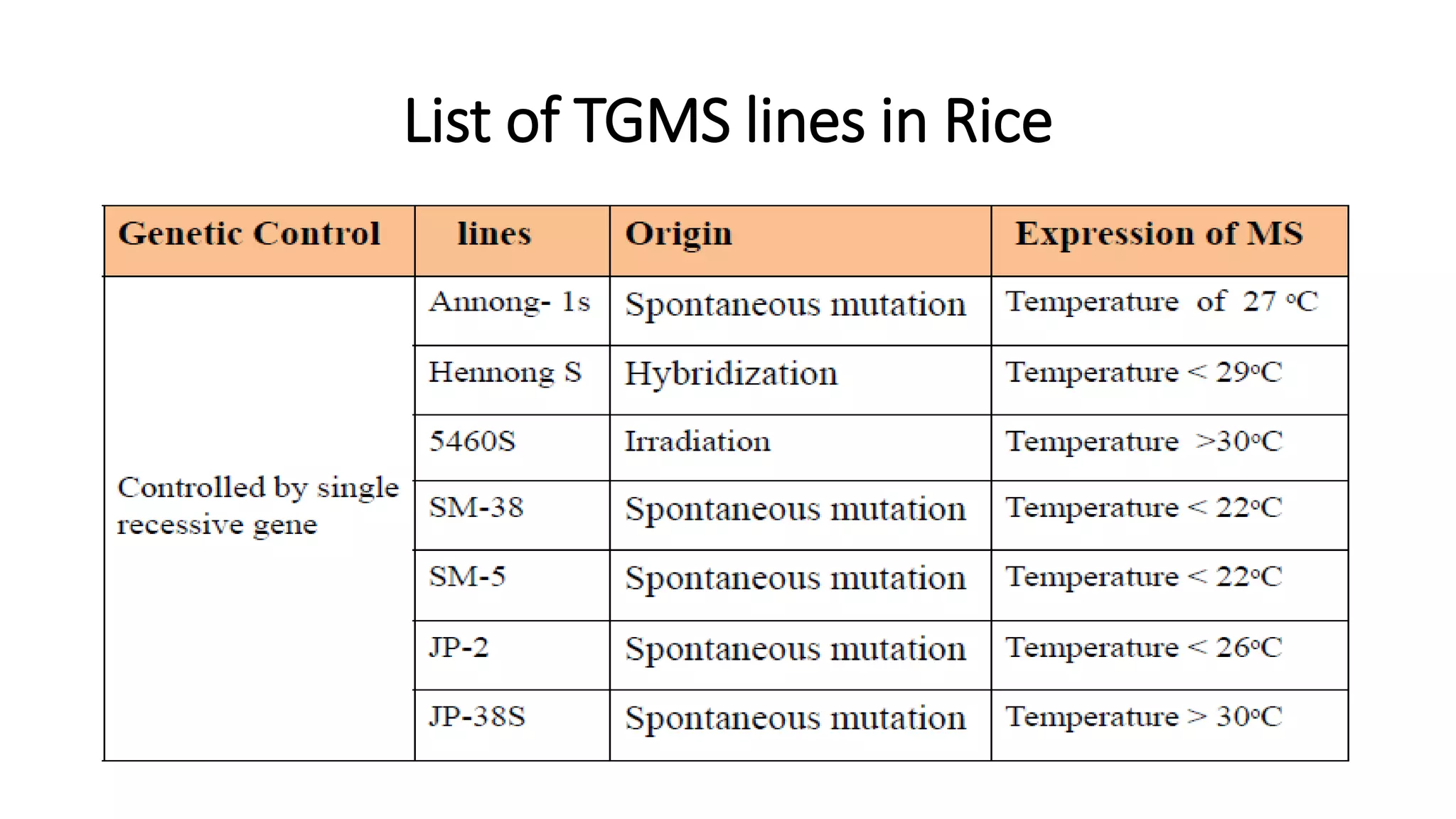
List of TGMS lines in Rice
List of PGMS lines in Rice
Reference
• Singh, B, D.(2012). Plant Breeding , Principles and Methods. Chapter 6,90.
• https://s3.amazonaws.com/ppt-download/sambhajiyamgar2
170807095824.pdf

Environmental sensitive genetic male sterility

  • 1.
    ENVIRONMENTAL SENSITIVE GENETIC MALESTERILITY Presented by GOKULAN D
  • 2.
    Male Sterility • Malesterility is characterized by nonfunctional pollen grains, while female gametes function normally. • Inability to produce or to release viable or functional pollen as a result of failure of formation or development of functional stamens, microspores or gametes. • Main reason is mutation. Sterile Fertile Sterile Fertile
  • 3.
    Manifestations of MaleSterility • Absence or malformation of male organs. • Failure to develop normal microsporogenous tissue- anther. • Abnormal microsporogenesis (deformed or inviable pollen). • Abnormal pollen maturation. • Non dehiscent anthers but viable pollen.
  • 4.
    History of MaleSterility • J.K. Koelreuter (1763) observed anther abortion within species & species hybrids. • Genic male sterility has been reported in cabbage (Rundfeldt 1960), cauliflower (Nieuwhof 1961) • Male sterility systems have been also developed through genetic engineering (Williams et al. 1997) and protoplast fusion (Pelletier et al. 1995) • Male sterility were artificially induced through mutagenesis (Kaul 1988)
  • 5.
    Why Male Sterility??? • Reduced the cost of hybrid seed production. • Production of large scale of F1 seeds. • Avoids enormous manual work of emasculation and pollination. • Speed up the hybridization programme. • Commercial exploitation of hybrid vigour.
  • 6.
    Creation of MaleSterility • Spontaneous mutations • Interspecific hybridization • Mutation induction (EtBr) • Genetic Engineering • Chemically induced male sterility (CHAs)
  • 7.
    Detection of MaleSterility system • Whether a particular sterile genotype belongs to which MS system can be detected by its progeny performance on crossing with a few normal genotypes. • Trend-I- All progenies in all the rows may be sterile- CMS • Trend-II- Some rows may consist all fertile Some rows sterile and fertile in 1:1 ratio- GMS • Trend-III- sterile plant produces all fertile progeny when crossed with restorer - CGMS
  • 8.
    Classification of MaleSterility Kaul (1988) Classified Male Sterility in three major groups 1. Phenotypic Male Sterility (Morphological) • Structural or Staminal Male Sterility • Pollen Male Sterility • Functional Male Sterility 2. Genotypic Male Sterility • Genetic Male Sterility (GMS)  Environmental Sensitive (EGMS) a) Thermo sensitive genetic male sterility (TGMS) b) Photoperiod sensitive genetic male sterility (PGMS)  Environmental non-sensitive • Cytoplasmic Male Sterility (CMS) • Cytoplasmic Genetic Male Sterility (CGMS) • Transgenic Male Sterility (TMS) 3. Chemically Induced Male Sterility (CHA)
  • 9.
    Genetic Male Sterility(GMS) • Also called as nuclear male sterility. • Mostly governed by single recessive gene (ms) but dominant gene governing male sterility (safflower). • Origin: Spontaneous mutation or artificial mutations (Gamma rays, EMS) are common. • ‘ms’alleles may affect staminal initiation, stamen or anther sac development, PMC formation, meiosis, pollen formation, maturation and dehiscence.
  • 10.
    Types of GMS •Environment insensitive GMS: ms gene expression is much less affected by the environment. • Environment sensitive GMS: ms gene expression occurs within a specified range of temperature and /or photoperiod regimes (Rice, Tomato, Wheat etc.).
  • 11.
    Thermo sensitive GeneticMale Sterility(TGMS) • Sterility is at particular temperature e.g. In rice TGMS line (Pei- Ai645) at 23.3˚C (China). • TGMS at high temperature is due to failure of pairing of two chromosomes at metaphase was evident. • This abnormality led to abnormal meiosis, abnormal or sterile pollens. • Anthers were shriveled and non-dehiscence-Male sterile. • However, these lines produced normal fertile pollen at low temp. Sensitive period : PMC formation to Meiosis
  • 12.
    Photoperiod sensitive geneticmale sterility(PGMS) • Governed by 2 recessive genes. • Sterility is obtained in long day conditions while in short days, normal fertile plant. • Rice:- Sterile under Long day conditions (13 hr. 45 min + Temp. 23- 29˚C) but fertile under short day conditions. Sensitive period: Differentiation of secondary rachis branches to PMC formation
  • 13.
    Procedure of utilizationof TGMS/PGMS line in Seed production
  • 14.
    EGMS system inRice hybrid seed production • Male sterility system is controlled by nuclear gene expression, which is influenced by environmental factors such as temperature (TGMS), daylength (PGMS), or both (TPGMS).
  • 15.
    Advantage & Disadvantageof EGMS based hybrid rice system Advantages • Simplified procedure of hybrid seed production • Multiple and diverse germplasm available as parents • Any line could be bred as female 97% (2-line) vs 5% (3-line) of germplasm as male • Increased chance of developing desirable & heterotic hybrids Disadvantages • Environmental effect on sterility could cause seed purity problem
  • 16.
    List of TGMSlines in Rice
  • 17.
    List of PGMSlines in Rice
  • 18.
    Reference • Singh, B,D.(2012). Plant Breeding , Principles and Methods. Chapter 6,90. • https://s3.amazonaws.com/ppt-download/sambhajiyamgar2 170807095824.pdf