INDIA DAIRY STORY
INDIA GROWTH STORY
2
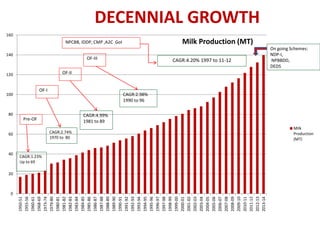
• World’s largest producer of milk since 1998
• 17 % of World Milk Production.
• Peak Production 182 MMT 2015-16
• Indian Growth Last Decade 4.2% (World 2.2% - FAO)
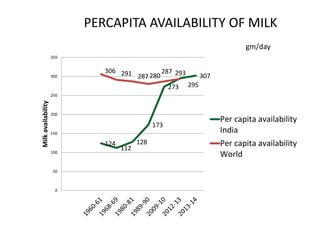
• Per capita availability of milk up from 130 gm per day (1950-51)
to 307 gm per day (2013-14)
• In-milk Bovine pop up 9%
• Domestic Demand for milk will increase to 210 MMT:
• Traditional Indian dietary preferences
• Increased population-young & elderly(longevity)
• Enhanced per capita income and affordability
• Export Potential
0
20
40
60
80
100
120
140
160
1950-51
1955-56
1960-61
1968-69
1973-74
1979-80
1980-81
1981-82
1982-83
1983-84
1984-85
1985-86
1986-87
1987-88
1988-89
1989-90
1990-91
1991-92
1992-93
1993-94
1994-95
1995-96
1996-97
1997-98
1998-99
1999-00
2000-01
2001-02
2002-03
2003-04
2004-05
2005-06
2006-07
2007-08
2008-09
2009-10
2010-11
2011-12
2012-13
2013-14
Milk Production (MT)
Milk
Production
(MT)
CAGR:1.23%
Up to 69
CAGR:2.74%
1970 to 80
CAGR:4.99%
1981 to 89
CAGR:2.98%
1990 to 96
CAGR:4.20% 1997 to 11-12
Pre-OF
OF-II
OF-I
OF-III
NPCBB, IDDP, CMP ,A2C GoI
On going Schemes:
NDP-I,
NPBBDD,
DEDS
DECENNIAL GROWTH
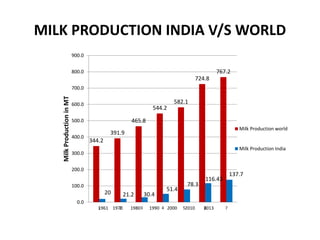
MILK PRODUCTION INDIA V/S WORLD
344.2
391.9
465.8
544.2
582.1
724.8
767.2
20 21.2 30.4
51.4
78.3
116.43
137.7
0.0
100.0
200.0
300.0
400.0
500.0
600.0
700.0
800.0
900.0
1 2 3 4 5 6 7
MilkProductioninMT
Milk Production world
Milk Production India
1961 1970 1980 1990 2000 2010 2013
PERCAPITA AVAILABILITY OF MILK
124
112
128
173
273 295
307
306 291 287280
287 293
0
50
100
150
200
250
300
350
Milkavailability
Per capita availability
India
Per capita availability
World
gm/day
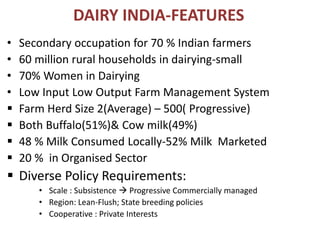
DAIRY INDIA-FEATURES
• Secondary occupation for 70 % Indian farmers
• 60 million rural households in dairying-small
• 70% Women in Dairying
• Low Input Low Output Farm Management System
 Farm Herd Size 2(Average) – 500( Progressive)
 Both Buffalo(51%)& Cow milk(49%)
 48 % Milk Consumed Locally-52% Milk Marketed
 20 % in Organised Sector
 Diverse Policy Requirements:
• Scale : Subsistence  Progressive Commercially managed
• Region: Lean-Flush; State breeding policies
• Cooperative : Private Interests
0
10
20
30
40
50
60
70
80
2008-09 2009-10 2010-11 2011-12 2012-13
milkproductioninMT
Crossbred
Cattle
Indigenous
Cattle
Buffalo
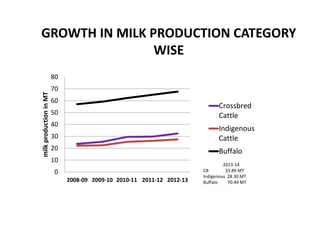
2013-14
CB 33.89 MT
Indigenous 28.30 MT
Buffalo 70.44 MT
GROWTH IN MILK PRODUCTION CATEGORY
WISE
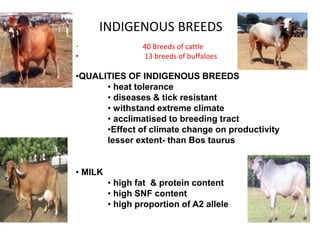
INDIGENOUS BREEDS
• 40 Breeds of cattle
• 13 breeds of buffaloes
•QUALITIES OF INDIGENOUS BREEDS
• heat tolerance
• diseases & tick resistant
• withstand extreme climate
• acclimatised to breeding tract
•Effect of climate change on productivity
lesser extent- than Bos taurus
• MILK
• high fat & protein content
• high SNF content
• high proportion of A2 allele
Bos Indicus: Indian Native Cow:
A Natural Resource For A2 Milk
178 million cattle population.
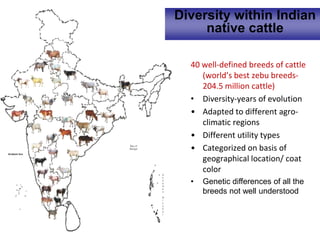
40 well-defined breeds of cattle
(world’s best zebu breeds-
204.5 million cattle)
• Diversity-years of evolution
• Adapted to different agro-
climatic regions
• Different utility types
• Categorized on basis of
geographical location/ coat
color
• Genetic differences of all the
breeds not well understood
Diversity within Indian
native cattle
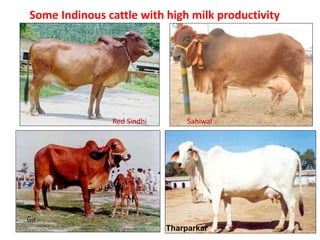
Some Indinous cattle with high milk productivity
Sahiwal
Hariana
Tharparkar
HarianaSahiwalRed Sindhi
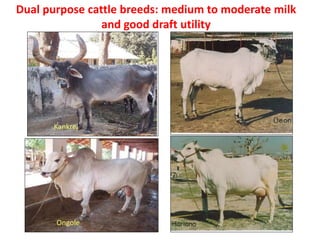
Kankrej
Kankrej
Ongole
Dual purpose cattle breeds: medium to moderate milk
and good draft utility
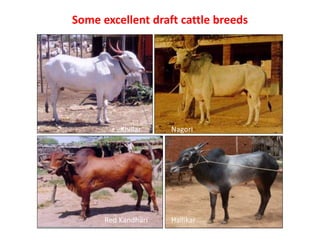
Some excellent draft cattle breeds
Khillar Nagori
Red Kandhari Hallikar
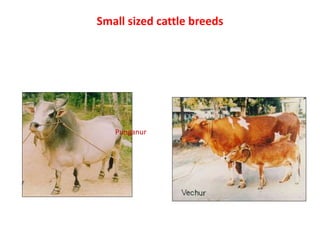
Small sized cattle breeds
Punganur
Malnad Gidda
© 2011 Taylor and Francis
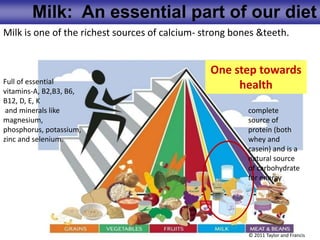
One step towards
health
Milk is one of the richest sources of calcium- strong bones &teeth.
Milk: An essential part of our diet
Full of essential
vitamins-A, B2,B3, B6,
B12, D, E, K
and minerals like
magnesium,
phosphorus, potassium,
zinc and selenium.
complete
source of
protein (both
whey and
casein) and is a
natural source
of carbohydrate
for energy
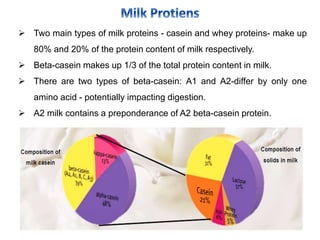
 Two main types of milk proteins - casein and whey proteins- make up
80% and 20% of the protein content of milk respectively.
 Beta-casein makes up 1/3 of the total protein content in milk.
 There are two types of beta-casein: A1 and A2-differ by only one
amino acid - potentially impacting digestion.
 A2 milk contains a preponderance of A2 beta-casein protein.
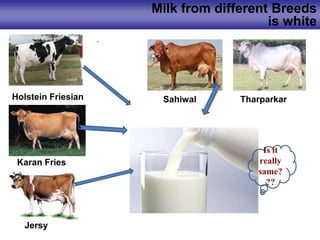
Milk from different Breeds
is white
.
Holstein Friesian
Jersy
Karan Fries
Sahiwal Tharparkar
Is it
really
same?
??
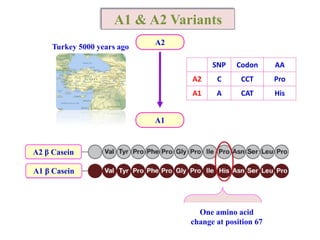
A2
A1
Turkey 5000 years ago
SNP Codon AA
A2 C CCT Pro
A1 A CAT His
A2 β Casein
A1 β Casein
One amino acid
change at position 67
A1 & A2 Variants
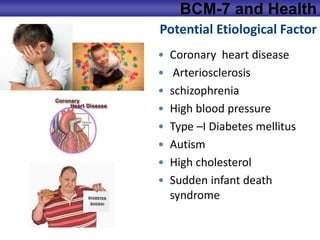
Potential Etiological Factor
• Coronary heart disease
• Arteriosclerosis
• schizophrenia
• High blood pressure
• Type –I Diabetes mellitus
• Autism
• High cholesterol
• Sudden infant death
syndrome
BCM-7 and Health
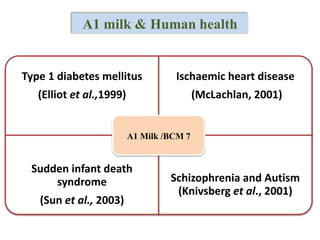
A1 milk & Human health
Type 1 diabetes mellitus
(Elliot et al.,1999)
Ischaemic heart disease
(McLachlan, 2001)
Sudden infant death
syndrome
(Sun et al., 2003)
Schizophrenia and Autism
(Knivsberg et al., 2001)
A1 Milk /BCM 7
International Market
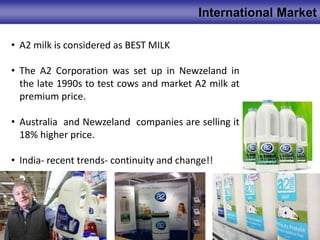
• A2 milk is considered as BEST MILK
• The A2 Corporation was set up in Newzeland in
the late 1990s to test cows and market A2 milk at
premium price.
• Australia and Newzeland companies are selling it
18% higher price.
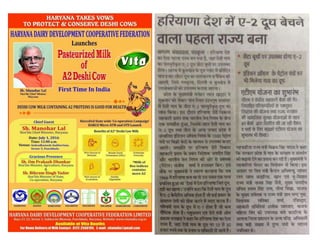
• India- recent trends- continuity and change!!
Thank you
 A2 is cows milk that contains only the A2 type of beta-casein protein
 All proteins are long chains of amino acid. Beta casein is a chain 229
amino acids in length.
 Cows who produce Beta casein in their milk with a proline at number
67 are called A2 cows, and are older breeds of cows
 But some 5,000 years ago, a mutation-both natural & due to human
intervention-occurred in this Proline amino acid and began converting
it to Histidine. Cows that have this mutated beta-casein are called A1
cows
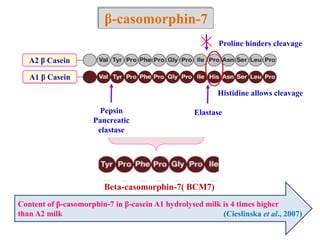
A2 β Casein
A1 β Casein
Proline hinders cleavage
Histidine allows cleavage
ElastasePepsin
Pancreatic
elastase
Beta-casomorphin-7( BCM7)
β-casomorphin-7
Content of β-casomorphin-7 in β-casein A1 hydrolysed milk is 4 times higher
than A2 milk (Cieslinska et al., 2007)
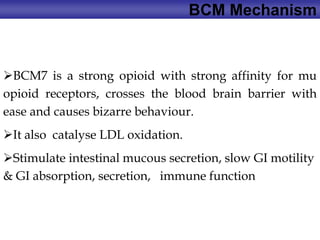
BCM Mechanism
BCM7 is a strong opioid with strong affinity for mu
opioid receptors, crosses the blood brain barrier with
ease and causes bizarre behaviour.
It also catalyse LDL oxidation.
Stimulate intestinal mucous secretion, slow GI motility
& GI absorption, secretion, immune function
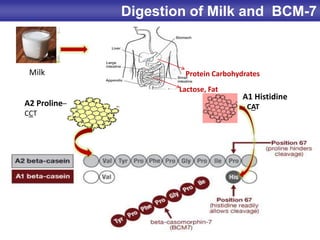
A1 Histidine
- CATA2 Proline–
CCT
Lactose, Fat
Protein CarbohydratesMilk
Digestion of Milk and BCM-7
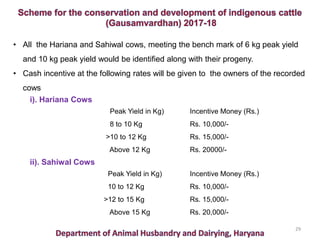
29
• All the Hariana and Sahiwal cows, meeting the bench mark of 6 kg peak yield
and 10 kg peak yield would be identified along with their progeny.
• Cash incentive at the following rates will be given to the owners of the recorded
cows
i). Hariana Cows
Peak Yield in Kg) Incentive Money (Rs.)
8 to 10 Kg Rs. 10,000/-
>10 to 12 Kg Rs. 15,000/-
Above 12 Kg Rs. 20000/-
ii). Sahiwal Cows
Peak Yield in Kg) Incentive Money (Rs.)
10 to 12 Kg Rs. 10,000/-
>12 to 15 Kg Rs. 15,000/-
Above 15 Kg Rs. 20,000/-
Strategies
 Screening of breeding bulls being used in breeding programmes
for their A1/A2 status and selection of A2 bulls will help in
transforming the herd to A2 producing ones
 It would be an effective measure to prevent the dissemination
of undesirable A1 allele in our existing A2 predominant cattle
populations
 All breeding bull used in cattle improvement programme
should have A2 allele for breeding.
 If there is demand from consumers for A2 milk as a matter of
choice, the Government of India and state governments should
come up with policy guidelines by designing sound breeding
policy for production of milk with desirable allele.

Indigenous breeds A2 milk production

  • 1.
  • 2.
    INDIA GROWTH STORY 2 •World’s largest producer of milk since 1998 • 17 % of World Milk Production. • Peak Production 182 MMT 2015-16 • Indian Growth Last Decade 4.2% (World 2.2% - FAO) • Per capita availability of milk up from 130 gm per day (1950-51) to 307 gm per day (2013-14) • In-milk Bovine pop up 9% • Domestic Demand for milk will increase to 210 MMT: • Traditional Indian dietary preferences • Increased population-young & elderly(longevity) • Enhanced per capita income and affordability • Export Potential
  • 3.
  • 4.
    MILK PRODUCTION INDIAV/S WORLD 344.2 391.9 465.8 544.2 582.1 724.8 767.2 20 21.2 30.4 51.4 78.3 116.43 137.7 0.0 100.0 200.0 300.0 400.0 500.0 600.0 700.0 800.0 900.0 1 2 3 4 5 6 7 MilkProductioninMT Milk Production world Milk Production India 1961 1970 1980 1990 2000 2010 2013
  • 5.
    PERCAPITA AVAILABILITY OFMILK 124 112 128 173 273 295 307 306 291 287280 287 293 0 50 100 150 200 250 300 350 Milkavailability Per capita availability India Per capita availability World gm/day
  • 6.
    DAIRY INDIA-FEATURES • Secondaryoccupation for 70 % Indian farmers • 60 million rural households in dairying-small • 70% Women in Dairying • Low Input Low Output Farm Management System  Farm Herd Size 2(Average) – 500( Progressive)  Both Buffalo(51%)& Cow milk(49%)  48 % Milk Consumed Locally-52% Milk Marketed  20 % in Organised Sector  Diverse Policy Requirements: • Scale : Subsistence  Progressive Commercially managed • Region: Lean-Flush; State breeding policies • Cooperative : Private Interests
  • 7.
    0 10 20 30 40 50 60 70 80 2008-09 2009-10 2010-112011-12 2012-13 milkproductioninMT Crossbred Cattle Indigenous Cattle Buffalo 2013-14 CB 33.89 MT Indigenous 28.30 MT Buffalo 70.44 MT GROWTH IN MILK PRODUCTION CATEGORY WISE
  • 8.
    INDIGENOUS BREEDS • 40Breeds of cattle • 13 breeds of buffaloes •QUALITIES OF INDIGENOUS BREEDS • heat tolerance • diseases & tick resistant • withstand extreme climate • acclimatised to breeding tract •Effect of climate change on productivity lesser extent- than Bos taurus • MILK • high fat & protein content • high SNF content • high proportion of A2 allele
  • 9.
    Bos Indicus: IndianNative Cow: A Natural Resource For A2 Milk 178 million cattle population.
  • 10.
    40 well-defined breedsof cattle (world’s best zebu breeds- 204.5 million cattle) • Diversity-years of evolution • Adapted to different agro- climatic regions • Different utility types • Categorized on basis of geographical location/ coat color • Genetic differences of all the breeds not well understood Diversity within Indian native cattle
  • 11.
    Some Indinous cattlewith high milk productivity Sahiwal Hariana Tharparkar HarianaSahiwalRed Sindhi
  • 12.
    Kankrej Kankrej Ongole Dual purpose cattlebreeds: medium to moderate milk and good draft utility
  • 13.
    Some excellent draftcattle breeds Khillar Nagori Red Kandhari Hallikar
  • 14.
    Small sized cattlebreeds Punganur Malnad Gidda
  • 15.
    © 2011 Taylorand Francis One step towards health Milk is one of the richest sources of calcium- strong bones &teeth. Milk: An essential part of our diet Full of essential vitamins-A, B2,B3, B6, B12, D, E, K and minerals like magnesium, phosphorus, potassium, zinc and selenium. complete source of protein (both whey and casein) and is a natural source of carbohydrate for energy
  • 16.
     Two maintypes of milk proteins - casein and whey proteins- make up 80% and 20% of the protein content of milk respectively.  Beta-casein makes up 1/3 of the total protein content in milk.  There are two types of beta-casein: A1 and A2-differ by only one amino acid - potentially impacting digestion.  A2 milk contains a preponderance of A2 beta-casein protein.
  • 17.
    Milk from differentBreeds is white . Holstein Friesian Jersy Karan Fries Sahiwal Tharparkar Is it really same? ??
  • 18.
    A2 A1 Turkey 5000 yearsago SNP Codon AA A2 C CCT Pro A1 A CAT His A2 β Casein A1 β Casein One amino acid change at position 67 A1 & A2 Variants
  • 19.
    Potential Etiological Factor •Coronary heart disease • Arteriosclerosis • schizophrenia • High blood pressure • Type –I Diabetes mellitus • Autism • High cholesterol • Sudden infant death syndrome BCM-7 and Health
  • 20.
    A1 milk &Human health Type 1 diabetes mellitus (Elliot et al.,1999) Ischaemic heart disease (McLachlan, 2001) Sudden infant death syndrome (Sun et al., 2003) Schizophrenia and Autism (Knivsberg et al., 2001) A1 Milk /BCM 7
  • 21.
    International Market • A2milk is considered as BEST MILK • The A2 Corporation was set up in Newzeland in the late 1990s to test cows and market A2 milk at premium price. • Australia and Newzeland companies are selling it 18% higher price. • India- recent trends- continuity and change!!
  • 24.
  • 25.
     A2 iscows milk that contains only the A2 type of beta-casein protein  All proteins are long chains of amino acid. Beta casein is a chain 229 amino acids in length.  Cows who produce Beta casein in their milk with a proline at number 67 are called A2 cows, and are older breeds of cows  But some 5,000 years ago, a mutation-both natural & due to human intervention-occurred in this Proline amino acid and began converting it to Histidine. Cows that have this mutated beta-casein are called A1 cows
  • 26.
    A2 β Casein A1β Casein Proline hinders cleavage Histidine allows cleavage ElastasePepsin Pancreatic elastase Beta-casomorphin-7( BCM7) β-casomorphin-7 Content of β-casomorphin-7 in β-casein A1 hydrolysed milk is 4 times higher than A2 milk (Cieslinska et al., 2007)
  • 27.
    BCM Mechanism BCM7 isa strong opioid with strong affinity for mu opioid receptors, crosses the blood brain barrier with ease and causes bizarre behaviour. It also catalyse LDL oxidation. Stimulate intestinal mucous secretion, slow GI motility & GI absorption, secretion, immune function
  • 28.
    A1 Histidine - CATA2Proline– CCT Lactose, Fat Protein CarbohydratesMilk Digestion of Milk and BCM-7
  • 29.
    29 • All theHariana and Sahiwal cows, meeting the bench mark of 6 kg peak yield and 10 kg peak yield would be identified along with their progeny. • Cash incentive at the following rates will be given to the owners of the recorded cows i). Hariana Cows Peak Yield in Kg) Incentive Money (Rs.) 8 to 10 Kg Rs. 10,000/- >10 to 12 Kg Rs. 15,000/- Above 12 Kg Rs. 20000/- ii). Sahiwal Cows Peak Yield in Kg) Incentive Money (Rs.) 10 to 12 Kg Rs. 10,000/- >12 to 15 Kg Rs. 15,000/- Above 15 Kg Rs. 20,000/-
  • 30.
    Strategies  Screening ofbreeding bulls being used in breeding programmes for their A1/A2 status and selection of A2 bulls will help in transforming the herd to A2 producing ones  It would be an effective measure to prevent the dissemination of undesirable A1 allele in our existing A2 predominant cattle populations  All breeding bull used in cattle improvement programme should have A2 allele for breeding.  If there is demand from consumers for A2 milk as a matter of choice, the Government of India and state governments should come up with policy guidelines by designing sound breeding policy for production of milk with desirable allele.