GENETICALLY MODIFIED FOOD
controversies
Course Name: Food Biotechnology
Course code: GEB 317
Submitted By -
2014431031
2014431032
2014431033
2014431034
2014431035
Definition of GM food
Necessity of GM food
Achievements of GM food
Limitations of GM food
Why should we use GM food
What is GM food?
Genetically modified (GM) foods are foods
derived from organisms whose genetic
material (DNA) has been modified in a way at
does not occur naturally, i.e. through the
introduction of a gene from a different
organism.
Why GM food?
There are like hundred reasons why we should
cultivate GM food but we can summarise
them in four point -
1. To get higher yield
2. To get better nutrient compound
3. To get extended shelf life
4. For efficient drug delivary
Why GM food in Bangladesh?
Bangladesh is an agricultural country and we have variety of
crops as our soil is so fertile. But nowadays we cannot meet
the needs because of increasing population and lack of
cultivable land. That’s why our scientists have developed new
varieties which are higher in yield and rich in nutritional value.
Though it is a controversial topic , we are dependent on this.
Bangladesh has successfully launched new variety of brinjal,
cotton and rice. BT brinjal is an important topic of bangladesh
considering GM food.
Evolutionary achievement of GM
food
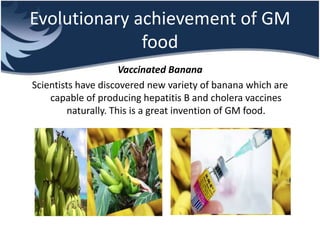
Vaccinated Banana
Scientists have discovered new variety of banana which are
capable of producing hepatitis B and cholera vaccines
naturally. This is a great invention of GM food.
Evolutionary achievement of GM
food
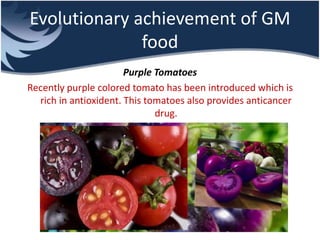
Purple Tomatoes
Recently purple colored tomato has been introduced which is
rich in antioxident. This tomatoes also provides anticancer
drug.
Evolutionary achievement of GM
food
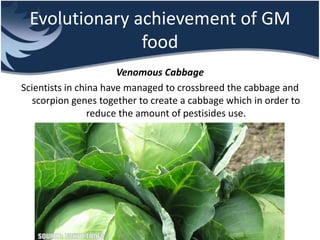
Venomous Cabbage
Scientists in china have managed to crossbreed the cabbage and
scorpion genes together to create a cabbage which in order to
reduce the amount of pestisides use.
Evolutionary achievement of GM
food
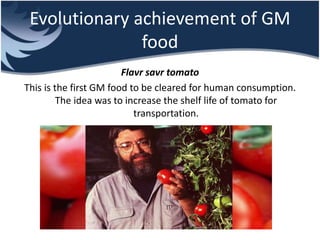
Flavr savr tomato
This is the first GM food to be cleared for human consumption.
The idea was to increase the shelf life of tomato for
transportation.
Evolutionary achievement of GM
food
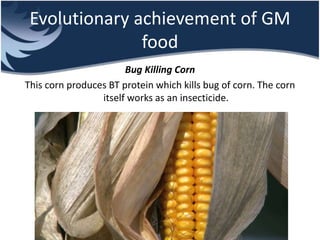
Bug Killing Corn
This corn produces BT protein which kills bug of corn. The corn
itself works as an insecticide.
Evolutionary achievement of GM
food
BT Brinjal
The Bt brinjal is a suite of transgenic brinjals (also known as an
eggplant or aubergine) created by inserting a crystal
protein gene (Cry1Ac) from the soil bacterium Bacillus
thuringiensis into the genome of various brinjal cultivars.
On October 30, 2013 with approvals from the ministries of
Environment and Forests (MoEF) and Agriculture (MoA), the
Bangladesh Agricultural Research Institute (BARI) received
permission to release four varieties of Bt brinjal.
As we can see GM
food have many
evolutionary
achievements then
why is it
controversial??...
Limitations of GM crops
Allergenicity
In India, hundreds of laborers picking cotton and working in
cotton ginning factories developed allergic reactions when
handling the BT cotton. This didn’t happen with the non-Bt
varieties. [Ashish Gupta et. al., “Impact of Bt Cotton on
Farmers’ Health (in Barwani and Dhar District of Madhya
Pradesh),” Investigation Report, Oct–Dec 2005]
Hospital records: “ Show that victims of itching have increased
massively this year, and all of them are related to BT cotton
farming.” [The Sunday Indian, 10/26/08]
Out-crossing
The movement of genes from GM plants into
conventional crops or related species in the
wild (referred to as “out crossing”), as well as
the mixing of crops derived from conventional
seeds with those grown using GM crops, may
have an indirect effect on food safety and food
security.
Super Weeds
Super Weeds :A wild plant that has been accidentally
pollinated by a genetically-modified plant and now
contains that plant's abilities to resist herbicides and
insects.
Glyphosate is the chemical name for an herbicide.
Certain invasive grasses and weeds have proven
themselves to be resistant to glyphosate, meaning
that the herbicide is no longer effective against these
plants.
Examples of weeds resistant to Glyphosate
• Common Ragweed
• Italian Ryegrass
GMOs are unhealthy
The American Academy of Environmental Medicine (AAEM)
urges doctors to prescribe non-GMO diets for all patients.
They cite animal studies showing organ damage,
gastrointestinal and immune system disorders, accelerated
aging, and infertility. Human studies show how genetically
modified (GM) food can leave material behind inside us,
possibly causing long-term problems. Genes inserted into GM
soy, for example, can transfer into the DNA of bacteria living
inside us, and that the toxic insecticide produced by GM corn
was found in the blood of pregnant women and their unborn
fetuses.
Genetic engineering creates
dangerous side effects.
By mixing genes from totally unrelated species,
genetic engineering unleashes a host of
unpredictable side effects. Moreover,
irrespective of the type of genes that are
inserted, the very process of creating a GM
plant can result in massive collateral damage
that produces new toxins, allergens,
carcinogens, and nutritional deficiencies.
GMOs harm the environment.
GM crops and their associated herbicides can harm birds,
insects, amphibians, marine ecosystems, and soil organisms.
They reduce bio-diversity, pollute water resources, and are
unsustainable. For example, GM crops are eliminating habitat
for monarch butterflies, whose populations are down 50% in
the US. Roundup herbicide has been shown to cause birth
defects in amphibians, embryonic deaths and endocrine
disruptions, and organ damage in animals even at very low
doses. GM canola has been found growing wild in North
Dakota and California, threatening to pass on its herbicide
tolerant genes on to weeds.
Then why GM food?
Research has already demonstrated the potential to develop crops with increased
nutrient-use efficiency, greater drought and flooding resistance, stronger disease
and insect resistance and higher nutritional content and yield. Why should human
society not use this ability to improve crops in order to feed all of our still-growing
population while striving to minimize the impact of food production on the global
environment? The current crops and practices are not adequate to meet the
challenges of the future, and going back to methods of the past that were unable
to feed even half of the current human population is not the answer. What
technologies that were controversial when first introduced would we be willing to
give up now: vaccines, antibiotics, vitamins, organ transplants, water treatment,
sanitation, telephones, Internet, etc.? These scientific discoveries and
technological advances have all contributed to the improved health and well-being
of human society, but there is nothing more fundamental to the future of
humanity than adequate and nutritious food. Given the challenges we are facing in
this century, both socially and environmentally, we urgently need to apply our best
science and technology to the most important thing that every human must do
every day eat.
Though GM food have limitations
but the current needs are
dependent on this technology. We
can only hope that one day we will
be able to overcome the
limitations and also can use the
technology with safety.
Thank you for your
patience
References:
http://responsibletechnology.org/10-reasons-
to-avoid-gmos/
https://www.youtube.com/watch?v=CIRyCjL_we
o
http://naturallysavvy.com/eat/whats-so-bad-
about-gmos-top-ten-reasons-to-avoid-them
http://www.who.int/foodsafety/areas_work/foo
d-technology/faq-genetically-modified-
food/en/

Genetically modified food controversies

  • 1.
    GENETICALLY MODIFIED FOOD controversies CourseName: Food Biotechnology Course code: GEB 317
  • 2.
  • 3.
    Definition of GMfood Necessity of GM food Achievements of GM food Limitations of GM food Why should we use GM food
  • 4.
    What is GMfood? Genetically modified (GM) foods are foods derived from organisms whose genetic material (DNA) has been modified in a way at does not occur naturally, i.e. through the introduction of a gene from a different organism.
  • 5.
    Why GM food? Thereare like hundred reasons why we should cultivate GM food but we can summarise them in four point - 1. To get higher yield 2. To get better nutrient compound 3. To get extended shelf life 4. For efficient drug delivary
  • 6.
    Why GM foodin Bangladesh? Bangladesh is an agricultural country and we have variety of crops as our soil is so fertile. But nowadays we cannot meet the needs because of increasing population and lack of cultivable land. That’s why our scientists have developed new varieties which are higher in yield and rich in nutritional value. Though it is a controversial topic , we are dependent on this. Bangladesh has successfully launched new variety of brinjal, cotton and rice. BT brinjal is an important topic of bangladesh considering GM food.
  • 7.
    Evolutionary achievement ofGM food Vaccinated Banana Scientists have discovered new variety of banana which are capable of producing hepatitis B and cholera vaccines naturally. This is a great invention of GM food.
  • 8.
    Evolutionary achievement ofGM food Purple Tomatoes Recently purple colored tomato has been introduced which is rich in antioxident. This tomatoes also provides anticancer drug.
  • 9.
    Evolutionary achievement ofGM food Venomous Cabbage Scientists in china have managed to crossbreed the cabbage and scorpion genes together to create a cabbage which in order to reduce the amount of pestisides use.
  • 10.
    Evolutionary achievement ofGM food Flavr savr tomato This is the first GM food to be cleared for human consumption. The idea was to increase the shelf life of tomato for transportation.
  • 11.
    Evolutionary achievement ofGM food Bug Killing Corn This corn produces BT protein which kills bug of corn. The corn itself works as an insecticide.
  • 12.
    Evolutionary achievement ofGM food BT Brinjal The Bt brinjal is a suite of transgenic brinjals (also known as an eggplant or aubergine) created by inserting a crystal protein gene (Cry1Ac) from the soil bacterium Bacillus thuringiensis into the genome of various brinjal cultivars. On October 30, 2013 with approvals from the ministries of Environment and Forests (MoEF) and Agriculture (MoA), the Bangladesh Agricultural Research Institute (BARI) received permission to release four varieties of Bt brinjal.
  • 13.
    As we cansee GM food have many evolutionary achievements then why is it controversial??...
  • 14.
    Limitations of GMcrops Allergenicity In India, hundreds of laborers picking cotton and working in cotton ginning factories developed allergic reactions when handling the BT cotton. This didn’t happen with the non-Bt varieties. [Ashish Gupta et. al., “Impact of Bt Cotton on Farmers’ Health (in Barwani and Dhar District of Madhya Pradesh),” Investigation Report, Oct–Dec 2005] Hospital records: “ Show that victims of itching have increased massively this year, and all of them are related to BT cotton farming.” [The Sunday Indian, 10/26/08]
  • 15.
    Out-crossing The movement ofgenes from GM plants into conventional crops or related species in the wild (referred to as “out crossing”), as well as the mixing of crops derived from conventional seeds with those grown using GM crops, may have an indirect effect on food safety and food security.
  • 16.
    Super Weeds Super Weeds:A wild plant that has been accidentally pollinated by a genetically-modified plant and now contains that plant's abilities to resist herbicides and insects. Glyphosate is the chemical name for an herbicide. Certain invasive grasses and weeds have proven themselves to be resistant to glyphosate, meaning that the herbicide is no longer effective against these plants. Examples of weeds resistant to Glyphosate • Common Ragweed • Italian Ryegrass
  • 17.
    GMOs are unhealthy TheAmerican Academy of Environmental Medicine (AAEM) urges doctors to prescribe non-GMO diets for all patients. They cite animal studies showing organ damage, gastrointestinal and immune system disorders, accelerated aging, and infertility. Human studies show how genetically modified (GM) food can leave material behind inside us, possibly causing long-term problems. Genes inserted into GM soy, for example, can transfer into the DNA of bacteria living inside us, and that the toxic insecticide produced by GM corn was found in the blood of pregnant women and their unborn fetuses.
  • 18.
    Genetic engineering creates dangerousside effects. By mixing genes from totally unrelated species, genetic engineering unleashes a host of unpredictable side effects. Moreover, irrespective of the type of genes that are inserted, the very process of creating a GM plant can result in massive collateral damage that produces new toxins, allergens, carcinogens, and nutritional deficiencies.
  • 19.
    GMOs harm theenvironment. GM crops and their associated herbicides can harm birds, insects, amphibians, marine ecosystems, and soil organisms. They reduce bio-diversity, pollute water resources, and are unsustainable. For example, GM crops are eliminating habitat for monarch butterflies, whose populations are down 50% in the US. Roundup herbicide has been shown to cause birth defects in amphibians, embryonic deaths and endocrine disruptions, and organ damage in animals even at very low doses. GM canola has been found growing wild in North Dakota and California, threatening to pass on its herbicide tolerant genes on to weeds.
  • 20.
    Then why GMfood? Research has already demonstrated the potential to develop crops with increased nutrient-use efficiency, greater drought and flooding resistance, stronger disease and insect resistance and higher nutritional content and yield. Why should human society not use this ability to improve crops in order to feed all of our still-growing population while striving to minimize the impact of food production on the global environment? The current crops and practices are not adequate to meet the challenges of the future, and going back to methods of the past that were unable to feed even half of the current human population is not the answer. What technologies that were controversial when first introduced would we be willing to give up now: vaccines, antibiotics, vitamins, organ transplants, water treatment, sanitation, telephones, Internet, etc.? These scientific discoveries and technological advances have all contributed to the improved health and well-being of human society, but there is nothing more fundamental to the future of humanity than adequate and nutritious food. Given the challenges we are facing in this century, both socially and environmentally, we urgently need to apply our best science and technology to the most important thing that every human must do every day eat.
  • 21.
    Though GM foodhave limitations but the current needs are dependent on this technology. We can only hope that one day we will be able to overcome the limitations and also can use the technology with safety.
  • 22.
    Thank you foryour patience
  • 23.