“RISK MITIGATION IN AGRICULTURE
THROUGH
CROP INSURANCE”
SHARING EXPERIENCE
OF
CROP INSURANCE
IN INDIA
Dr. Ashish Kumar Bhutani
Joint Secretary
Department of Agriculture, Cooperation
& Farmers Welfare, Govt. of India
09th May, 20171
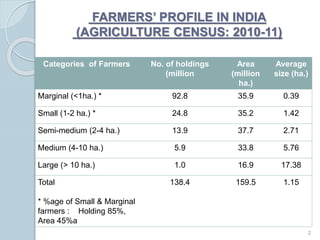
FARMERS’ PROFILE IN INDIA
(AGRICULTURE CENSUS: 2010-11)
Categories of Farmers No. of holdings
(million
Area
(million
ha.)
Average
size (ha.)
Marginal (<1ha.) * 92.8 35.9 0.39
Small (1-2 ha.) * 24.8 35.2 1.42
Semi-medium (2-4 ha.) 13.9 37.7 2.71
Medium (4-10 ha.) 5.9 33.8 5.76
Large (> 10 ha.) 1.0 16.9 17.38
Total
* %age of Small & Marginal
farmers : Holding 85%,
Area 45%a
138.4 159.5 1.15
2
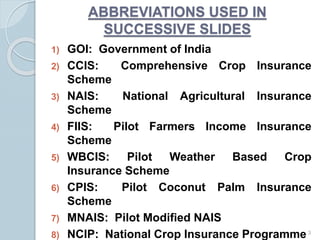
1) GOI: Government of India
2) CCIS: Comprehensive Crop Insurance
Scheme
3) NAIS: National Agricultural Insurance
Scheme
4) FIIS: Pilot Farmers Income Insurance
Scheme
5) WBCIS: Pilot Weather Based Crop
Insurance Scheme
6) CPIS: Pilot Coconut Palm Insurance
Scheme
7) MNAIS: Pilot Modified NAIS
8) NCIP: National Crop Insurance Programme3
ABBREVIATIONS USED IN
SUCCESSIVE SLIDES
9) PMFBY: Pradhan Mantri Fasal Bima Yojana
10) UPIS: Pilot Unified Package Insurance
Scheme
11) PMJJBY: Pradhan Mantri Jeewan Jyoti
Bima Yojana
12) PMSBY: Pradhan Mantri Suraksha Bima
Yojana
13) IL: Indemnity Level
14) CCE: Crop Cutting Experiment
15) RST: Remote Sensing Technology
16) AWS / ARG: Automatic Weather Station /
Automatic Rain Gauge
4
ABBREVIATIONS USED IN
SUCCESSIVE SLIDES Contd..
VARIOUS RISKS TO
INDIAN AGRICULTURE
5
 Vagaries of weather
- rainfall (drought / flood)
- temperature (high / low)
- humidity
- wind
- cyclone
- storm / hailstorm
 Pest & diseases
 Landslide
 Inundation
 Natural fire and lightening
 To mitigate the agricultural risks and to
provide financial support to farmers
against yield losses , GOI introduced a
CCIS in 1985 for the first time.
 Thereafter, efforts have been continuing
for development of more farmers’ friendly
products in terms of better services &
benefits through incorporating
improvements & modifications therein.
EVOLUTION OF CROP INSURANCE
IN INDIA
6
1) CCIS : 1985 to Summer 1999 (yield index).
2) NAIS : Winter 1999-2000 to Winter 2015-16 (yield
index).
3) FIIS : Summer 2003 to Winter 2003-04 (yield
index).
4) WBCIS : Summer 2007 to Summer 2013 (weather
index).
5) CPIS : 2009-10 to Summer 2013 (specific crop-
based).
6) MNAIS : Winter 2010-11 to Summer 2013 (yield
index).
7) NCIP : Winter 2013-14 to Winter 2015-16.
PAST COURSE OF CROP INSURANCE IN
INDIA
7
ONGOING CROP INSURANCE
SCHEMES FROM APRIL 2016
 Yield index scheme of Pradhan Mantri Fasal Bima
Yojana (PMFBY) has been introduced replacing NAIS
& MNAIS.
 Weather index scheme of WBCIS is continued with
change in premium structure & criteria of area
allocation - same as PMFBY.
 Pilot Unified Package Insurance Scheme (UPIS)
 CPIS continues as under NCIP
8
1) Initially from 1985 to 2006-07, Government
sponsored crop insurance schemes were
implemented by Public Sector insurance
companies only.
2) Then from 2007-08, GOI also allowed to private
insurance companies on pilot basis with intention
to increase farmers’ coverage & cost effective
better services / benefits of the crop insurance to
them.
3) Accordingly, 5 Public and 13 private sector
companies have so far been empanelled by GOI
for carrying out implementation of crop insurance
schemes.
4) Total cropped area insured has increased from 20
million ha to about 60 million ha (country’s Gross
PUBLIC PRIVATE PARTNERSHIP
9
FEATURES OF PMFBY
 Scheme provisions simplified for easy understanding
by the farmers.
 Farmers share of premium substantially reduced and
fixed at a maximum of 1.5% for Rabi crops and 2% for
Kharif crops, 5% for Annual Commercial and
Horticulture crop- One season one rate.
 Covers all Food crops, Oilseeds & Commercial /
Horticultural Crops
 Compulsory for Loanee & voluntary for non-loanee
 Individual farm level assessment for perils covered
under Localized and Post Harvest losses.
10
 Risks/perils covered are :-
- Area approach: all non-preventable natural risks
viz., drought, flood, hailstorm, landslide, cyclone,
pests & diseases etc.
- Prevented sowing/transplantation: all natural
preventable risks
- Localized perils: Hailstorm, landslide &
Inundation
- Post Harvest losses: Cyclone/Cyclonic rain &
Unseasonal rains (for crops in cut & spread
condition after harvesting)
 Calculation of Threshold yield which is the average
yield of last 7 years (Minus max of 2 calamity years)11
FEATURES OF PMFBY
Contd..
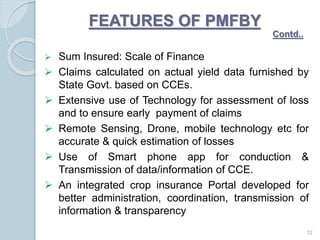
 Sum Insured: Scale of Finance
 Claims calculated on actual yield data furnished by
State Govt. based on CCEs.
 Extensive use of Technology for assessment of loss
and to ensure early payment of claims
 Remote Sensing, Drone, mobile technology etc for
accurate & quick estimation of losses
 Use of Smart phone app for conduction &
Transmission of data/information of CCE.
 An integrated crop insurance Portal developed for
better administration, coordination, transmission of
information & transparency
12
FEATURES OF PMFBY
Contd..
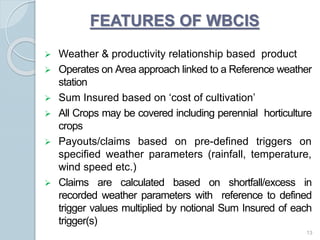
 Weather & productivity relationship based product
 Operates on Area approach linked to a Reference weather
station
 Sum Insured based on ‘cost of cultivation’
 All Crops may be covered including perennial horticulture
crops
 Payouts/claims based on pre-defined triggers on
specified weather parameters (rainfall, temperature,
wind speed etc.)
 Claims are calculated based on shortfall/excess in
recorded weather parameters with reference to defined
trigger values multiplied by notional Sum Insured of each
trigger(s)
13
FEATURES OF WBCIS
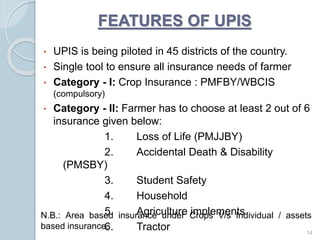
• UPIS is being piloted in 45 districts of the country.
• Single tool to ensure all insurance needs of farmer
• Category - I: Crop Insurance : PMFBY/WBCIS
(compulsory)
• Category - II: Farmer has to choose at least 2 out of 6
insurance given below:
1. Loss of Life (PMJJBY)
2. Accidental Death & Disability
(PMSBY)
3. Student Safety
4. Household
5. Agriculture implements
6. Tractor 14
N.B.: Area based insurance under Crops V/s Individual / assets
based insurance.
FEATURES OF UPIS
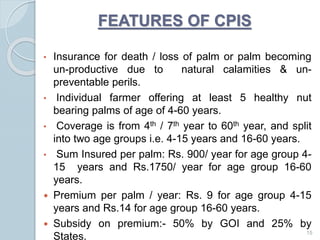
• Insurance for death / loss of palm or palm becoming
un-productive due to natural calamities & un-
preventable perils.
• Individual farmer offering at least 5 healthy nut
bearing palms of age of 4-60 years.
• Coverage is from 4th / 7th year to 60th year, and split
into two age groups i.e. 4-15 years and 16-60 years.
• Sum Insured per palm: Rs. 900/ year for age group 4-
15 years and Rs.1750/ year for age group 16-60
years.
 Premium per palm / year: Rs. 9 for age group 4-15
years and Rs.14 for age group 16-60 years.
 Subsidy on premium:- 50% by GOI and 25% by
States. 15
FEATURES OF CPIS
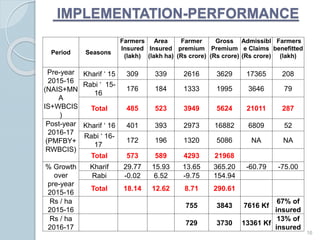
IMPLEMENTATION-PERFORMANCE
Period Seasons
Farmers
Insured
(lakh)
Area
Insured
(lakh ha)
Farmer
premium
(Rs crore)
Gross
Premium
(Rs crore)
Admissibl
e Claims
(Rs crore)
Farmers
benefitted
(lakh)
Pre-year
2015-16
(NAIS+MN
A
IS+WBCIS
)
Kharif ‘ 15 309 339 2616 3629 17365 208
Rabi ‘ 15-
16
176 184 1333 1995 3646 79
Total 485 523 3949 5624 21011 287
Post-year
2016-17
(PMFBY+
RWBCIS)
Kharif ‘ 16 401 393 2973 16882 6809 52
Rabi ‘ 16-
17
172 196 1320 5086 NA NA
Total 573 589 4293 21968
% Growth
over
pre-year
2015-16
Kharif 29.77 15.93 13.65 365.20 -60.79 -75.00
Rabi -0.02 6.52 -9.75 154.94
Total 18.14 12.62 8.71 290.61
Rs / ha
2015-16
755 3843 7616 Kf
67% of
insured
Rs / ha
2016-17
729 3730 13361 Kf
13% of
insured
16
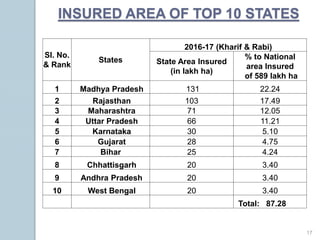
INSURED AREA OF TOP 10 STATES
Sl. No.
& Rank
States
2016-17 (Kharif & Rabi)
State Area Insured
(in lakh ha)
% to National
area Insured
of 589 lakh ha
1 Madhya Pradesh 131 22.24
2 Rajasthan 103 17.49
3 Maharashtra 71 12.05
4 Uttar Pradesh 66 11.21
5 Karnataka 30 5.10
6 Gujarat 28 4.75
7 Bihar 25 4.24
8 Chhattisgarh 20 3.40
9 Andhra Pradesh 20 3.40
10 West Bengal 20 3.40
Total: 87.28
17
 Planning & conducting requisite number of about 10
million CCEs under PMFBY is one of the most
challenging task due to use of time taking
cumbersome method of CCEs for estimating the yield.
 Under recent global climate changes, making
assessment and forecasting rains & other weather
conditions in most accurate manner has also become
a challenge, which in-turn affecting assessment of
yield losses and thereby payment of claims to farmers.
 Poor density of Govt. AWS/ARG and lack of trust
among farmers in private AWS/ARG.
 Formation of clusters – improper risk mixing of
different agro climatic districts/zones
18
CHALLENGES IN IMPLEMENTATION OF
PMFBY / WBCIS / UPIS
CHALLENGES IN IMPLEMENTATION OF
PMFBY / WBCIS / UPIS
 Provisioning of adequate resources for upfront
premium subsidy and timely release of the same.
 Dispute between States and Insurance Companies
over area discrepancy and application of ACF.
- Advance intimation of conduct of CCEs and
facilitating co-observation of CCEs by insurance
companies
- Non acceptance of proposals by insurance
companies due to late receipt.
 WBCIS: High basis risk due to poor density of
Automatic weather stations. There is weak correlation
between the yield and the weather indices.
19
Contd..
CHALLENGES IN IMPLEMENTATION OF
PMFBY / WBCIS / UPIS
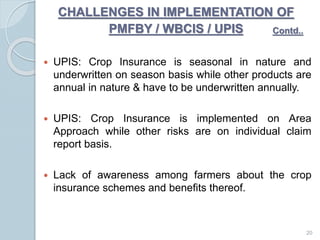
 UPIS: Crop Insurance is seasonal in nature and
underwritten on season basis while other products are
annual in nature & have to be underwritten annually.
 UPIS: Crop Insurance is implemented on Area
Approach while other risks are on individual claim
report basis.
 Lack of awareness among farmers about the crop
insurance schemes and benefits thereof.
20
Contd..
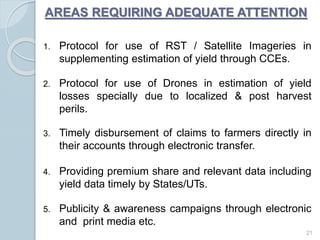
AREAS REQUIRING ADEQUATE ATTENTION
1. Protocol for use of RST / Satellite Imageries in
supplementing estimation of yield through CCEs.
2. Protocol for use of Drones in estimation of yield
losses specially due to localized & post harvest
perils.
3. Timely disbursement of claims to farmers directly in
their accounts through electronic transfer.
4. Providing premium share and relevant data including
yield data timely by States/UTs.
5. Publicity & awareness campaigns through electronic
and print media etc.
21
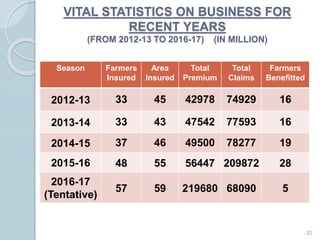
VITAL STATISTICS ON BUSINESS FOR
RECENT YEARS
(FROM 2012-13 TO 2016-17) (IN MILLION)
Season Farmers
Insured
Area
Insured
Total
Premium
Total
Claims
Farmers
Benefitted
2012-13 33 45 42978 74929 16
2013-14 33 43 47542 77593 16
2014-15 37 46 49500 78277 19
2015-16 48 55 56447 209872 28
2016-17
(Tentative)
57 59 219680 68090 5
22
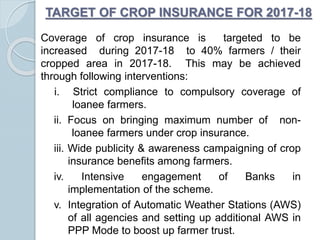
TARGET OF CROP INSURANCE FOR 2017-18
Coverage of crop insurance is targeted to be
increased during 2017-18 to 40% farmers / their
cropped area in 2017-18. This may be achieved
through following interventions:
i. Strict compliance to compulsory coverage of
loanee farmers.
ii. Focus on bringing maximum number of non-
loanee farmers under crop insurance.
iii. Wide publicity & awareness campaigning of crop
insurance benefits among farmers.
iv. Intensive engagement of Banks in
implementation of the scheme.
v. Integration of Automatic Weather Stations (AWS)
of all agencies and setting up additional AWS in
PPP Mode to boost up farmer trust.
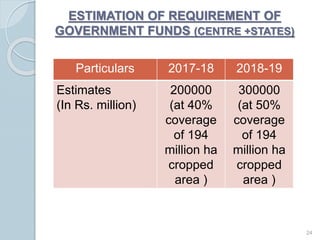
ESTIMATION OF REQUIREMENT OF
GOVERNMENT FUNDS (CENTRE +STATES)
Particulars 2017-18 2018-19
Estimates
(In Rs. million)
200000
(at 40%
coverage
of 194
million ha
cropped
area )
300000
(at 50%
coverage
of 194
million ha
cropped
area )
24
THANK YOU
25

Risk Mitigation In Agriculture

  • 1.
    “RISK MITIGATION INAGRICULTURE THROUGH CROP INSURANCE” SHARING EXPERIENCE OF CROP INSURANCE IN INDIA Dr. Ashish Kumar Bhutani Joint Secretary Department of Agriculture, Cooperation & Farmers Welfare, Govt. of India 09th May, 20171
  • 2.
    FARMERS’ PROFILE ININDIA (AGRICULTURE CENSUS: 2010-11) Categories of Farmers No. of holdings (million Area (million ha.) Average size (ha.) Marginal (<1ha.) * 92.8 35.9 0.39 Small (1-2 ha.) * 24.8 35.2 1.42 Semi-medium (2-4 ha.) 13.9 37.7 2.71 Medium (4-10 ha.) 5.9 33.8 5.76 Large (> 10 ha.) 1.0 16.9 17.38 Total * %age of Small & Marginal farmers : Holding 85%, Area 45%a 138.4 159.5 1.15 2
  • 3.
    1) GOI: Governmentof India 2) CCIS: Comprehensive Crop Insurance Scheme 3) NAIS: National Agricultural Insurance Scheme 4) FIIS: Pilot Farmers Income Insurance Scheme 5) WBCIS: Pilot Weather Based Crop Insurance Scheme 6) CPIS: Pilot Coconut Palm Insurance Scheme 7) MNAIS: Pilot Modified NAIS 8) NCIP: National Crop Insurance Programme3 ABBREVIATIONS USED IN SUCCESSIVE SLIDES
  • 4.
    9) PMFBY: PradhanMantri Fasal Bima Yojana 10) UPIS: Pilot Unified Package Insurance Scheme 11) PMJJBY: Pradhan Mantri Jeewan Jyoti Bima Yojana 12) PMSBY: Pradhan Mantri Suraksha Bima Yojana 13) IL: Indemnity Level 14) CCE: Crop Cutting Experiment 15) RST: Remote Sensing Technology 16) AWS / ARG: Automatic Weather Station / Automatic Rain Gauge 4 ABBREVIATIONS USED IN SUCCESSIVE SLIDES Contd..
  • 5.
    VARIOUS RISKS TO INDIANAGRICULTURE 5  Vagaries of weather - rainfall (drought / flood) - temperature (high / low) - humidity - wind - cyclone - storm / hailstorm  Pest & diseases  Landslide  Inundation  Natural fire and lightening
  • 6.
     To mitigatethe agricultural risks and to provide financial support to farmers against yield losses , GOI introduced a CCIS in 1985 for the first time.  Thereafter, efforts have been continuing for development of more farmers’ friendly products in terms of better services & benefits through incorporating improvements & modifications therein. EVOLUTION OF CROP INSURANCE IN INDIA 6
  • 7.
    1) CCIS :1985 to Summer 1999 (yield index). 2) NAIS : Winter 1999-2000 to Winter 2015-16 (yield index). 3) FIIS : Summer 2003 to Winter 2003-04 (yield index). 4) WBCIS : Summer 2007 to Summer 2013 (weather index). 5) CPIS : 2009-10 to Summer 2013 (specific crop- based). 6) MNAIS : Winter 2010-11 to Summer 2013 (yield index). 7) NCIP : Winter 2013-14 to Winter 2015-16. PAST COURSE OF CROP INSURANCE IN INDIA 7
  • 8.
    ONGOING CROP INSURANCE SCHEMESFROM APRIL 2016  Yield index scheme of Pradhan Mantri Fasal Bima Yojana (PMFBY) has been introduced replacing NAIS & MNAIS.  Weather index scheme of WBCIS is continued with change in premium structure & criteria of area allocation - same as PMFBY.  Pilot Unified Package Insurance Scheme (UPIS)  CPIS continues as under NCIP 8
  • 9.
    1) Initially from1985 to 2006-07, Government sponsored crop insurance schemes were implemented by Public Sector insurance companies only. 2) Then from 2007-08, GOI also allowed to private insurance companies on pilot basis with intention to increase farmers’ coverage & cost effective better services / benefits of the crop insurance to them. 3) Accordingly, 5 Public and 13 private sector companies have so far been empanelled by GOI for carrying out implementation of crop insurance schemes. 4) Total cropped area insured has increased from 20 million ha to about 60 million ha (country’s Gross PUBLIC PRIVATE PARTNERSHIP 9
  • 10.
    FEATURES OF PMFBY Scheme provisions simplified for easy understanding by the farmers.  Farmers share of premium substantially reduced and fixed at a maximum of 1.5% for Rabi crops and 2% for Kharif crops, 5% for Annual Commercial and Horticulture crop- One season one rate.  Covers all Food crops, Oilseeds & Commercial / Horticultural Crops  Compulsory for Loanee & voluntary for non-loanee  Individual farm level assessment for perils covered under Localized and Post Harvest losses. 10
  • 11.
     Risks/perils coveredare :- - Area approach: all non-preventable natural risks viz., drought, flood, hailstorm, landslide, cyclone, pests & diseases etc. - Prevented sowing/transplantation: all natural preventable risks - Localized perils: Hailstorm, landslide & Inundation - Post Harvest losses: Cyclone/Cyclonic rain & Unseasonal rains (for crops in cut & spread condition after harvesting)  Calculation of Threshold yield which is the average yield of last 7 years (Minus max of 2 calamity years)11 FEATURES OF PMFBY Contd..
  • 12.
     Sum Insured:Scale of Finance  Claims calculated on actual yield data furnished by State Govt. based on CCEs.  Extensive use of Technology for assessment of loss and to ensure early payment of claims  Remote Sensing, Drone, mobile technology etc for accurate & quick estimation of losses  Use of Smart phone app for conduction & Transmission of data/information of CCE.  An integrated crop insurance Portal developed for better administration, coordination, transmission of information & transparency 12 FEATURES OF PMFBY Contd..
  • 13.
     Weather &productivity relationship based product  Operates on Area approach linked to a Reference weather station  Sum Insured based on ‘cost of cultivation’  All Crops may be covered including perennial horticulture crops  Payouts/claims based on pre-defined triggers on specified weather parameters (rainfall, temperature, wind speed etc.)  Claims are calculated based on shortfall/excess in recorded weather parameters with reference to defined trigger values multiplied by notional Sum Insured of each trigger(s) 13 FEATURES OF WBCIS
  • 14.
    • UPIS isbeing piloted in 45 districts of the country. • Single tool to ensure all insurance needs of farmer • Category - I: Crop Insurance : PMFBY/WBCIS (compulsory) • Category - II: Farmer has to choose at least 2 out of 6 insurance given below: 1. Loss of Life (PMJJBY) 2. Accidental Death & Disability (PMSBY) 3. Student Safety 4. Household 5. Agriculture implements 6. Tractor 14 N.B.: Area based insurance under Crops V/s Individual / assets based insurance. FEATURES OF UPIS
  • 15.
    • Insurance fordeath / loss of palm or palm becoming un-productive due to natural calamities & un- preventable perils. • Individual farmer offering at least 5 healthy nut bearing palms of age of 4-60 years. • Coverage is from 4th / 7th year to 60th year, and split into two age groups i.e. 4-15 years and 16-60 years. • Sum Insured per palm: Rs. 900/ year for age group 4- 15 years and Rs.1750/ year for age group 16-60 years.  Premium per palm / year: Rs. 9 for age group 4-15 years and Rs.14 for age group 16-60 years.  Subsidy on premium:- 50% by GOI and 25% by States. 15 FEATURES OF CPIS
  • 16.
    IMPLEMENTATION-PERFORMANCE Period Seasons Farmers Insured (lakh) Area Insured (lakh ha) Farmer premium (Rscrore) Gross Premium (Rs crore) Admissibl e Claims (Rs crore) Farmers benefitted (lakh) Pre-year 2015-16 (NAIS+MN A IS+WBCIS ) Kharif ‘ 15 309 339 2616 3629 17365 208 Rabi ‘ 15- 16 176 184 1333 1995 3646 79 Total 485 523 3949 5624 21011 287 Post-year 2016-17 (PMFBY+ RWBCIS) Kharif ‘ 16 401 393 2973 16882 6809 52 Rabi ‘ 16- 17 172 196 1320 5086 NA NA Total 573 589 4293 21968 % Growth over pre-year 2015-16 Kharif 29.77 15.93 13.65 365.20 -60.79 -75.00 Rabi -0.02 6.52 -9.75 154.94 Total 18.14 12.62 8.71 290.61 Rs / ha 2015-16 755 3843 7616 Kf 67% of insured Rs / ha 2016-17 729 3730 13361 Kf 13% of insured 16
  • 17.
    INSURED AREA OFTOP 10 STATES Sl. No. & Rank States 2016-17 (Kharif & Rabi) State Area Insured (in lakh ha) % to National area Insured of 589 lakh ha 1 Madhya Pradesh 131 22.24 2 Rajasthan 103 17.49 3 Maharashtra 71 12.05 4 Uttar Pradesh 66 11.21 5 Karnataka 30 5.10 6 Gujarat 28 4.75 7 Bihar 25 4.24 8 Chhattisgarh 20 3.40 9 Andhra Pradesh 20 3.40 10 West Bengal 20 3.40 Total: 87.28 17
  • 18.
     Planning &conducting requisite number of about 10 million CCEs under PMFBY is one of the most challenging task due to use of time taking cumbersome method of CCEs for estimating the yield.  Under recent global climate changes, making assessment and forecasting rains & other weather conditions in most accurate manner has also become a challenge, which in-turn affecting assessment of yield losses and thereby payment of claims to farmers.  Poor density of Govt. AWS/ARG and lack of trust among farmers in private AWS/ARG.  Formation of clusters – improper risk mixing of different agro climatic districts/zones 18 CHALLENGES IN IMPLEMENTATION OF PMFBY / WBCIS / UPIS
  • 19.
    CHALLENGES IN IMPLEMENTATIONOF PMFBY / WBCIS / UPIS  Provisioning of adequate resources for upfront premium subsidy and timely release of the same.  Dispute between States and Insurance Companies over area discrepancy and application of ACF. - Advance intimation of conduct of CCEs and facilitating co-observation of CCEs by insurance companies - Non acceptance of proposals by insurance companies due to late receipt.  WBCIS: High basis risk due to poor density of Automatic weather stations. There is weak correlation between the yield and the weather indices. 19 Contd..
  • 20.
    CHALLENGES IN IMPLEMENTATIONOF PMFBY / WBCIS / UPIS  UPIS: Crop Insurance is seasonal in nature and underwritten on season basis while other products are annual in nature & have to be underwritten annually.  UPIS: Crop Insurance is implemented on Area Approach while other risks are on individual claim report basis.  Lack of awareness among farmers about the crop insurance schemes and benefits thereof. 20 Contd..
  • 21.
    AREAS REQUIRING ADEQUATEATTENTION 1. Protocol for use of RST / Satellite Imageries in supplementing estimation of yield through CCEs. 2. Protocol for use of Drones in estimation of yield losses specially due to localized & post harvest perils. 3. Timely disbursement of claims to farmers directly in their accounts through electronic transfer. 4. Providing premium share and relevant data including yield data timely by States/UTs. 5. Publicity & awareness campaigns through electronic and print media etc. 21
  • 22.
    VITAL STATISTICS ONBUSINESS FOR RECENT YEARS (FROM 2012-13 TO 2016-17) (IN MILLION) Season Farmers Insured Area Insured Total Premium Total Claims Farmers Benefitted 2012-13 33 45 42978 74929 16 2013-14 33 43 47542 77593 16 2014-15 37 46 49500 78277 19 2015-16 48 55 56447 209872 28 2016-17 (Tentative) 57 59 219680 68090 5 22
  • 23.
    TARGET OF CROPINSURANCE FOR 2017-18 Coverage of crop insurance is targeted to be increased during 2017-18 to 40% farmers / their cropped area in 2017-18. This may be achieved through following interventions: i. Strict compliance to compulsory coverage of loanee farmers. ii. Focus on bringing maximum number of non- loanee farmers under crop insurance. iii. Wide publicity & awareness campaigning of crop insurance benefits among farmers. iv. Intensive engagement of Banks in implementation of the scheme. v. Integration of Automatic Weather Stations (AWS) of all agencies and setting up additional AWS in PPP Mode to boost up farmer trust.
  • 24.
    ESTIMATION OF REQUIREMENTOF GOVERNMENT FUNDS (CENTRE +STATES) Particulars 2017-18 2018-19 Estimates (In Rs. million) 200000 (at 40% coverage of 194 million ha cropped area ) 300000 (at 50% coverage of 194 million ha cropped area ) 24
  • 25.