Genetically modified mosquitoes:
Demystified
Topical discussion for August
Overview
 Introduction
 Mosquito Life Cycle
 Transmission cycle forVector-borne diseases
 Overview ofVector Control
 Impair Pathogen Development
 Wolbachia infected mosquitoes
 Wolbachia and its ability to suppress DENV2 in mosquitoes
 Can Wolbachia control malaria
 Key safety concerns on the spread of Wolbachia to humans
 Release of Insects carrying a Dominant Lethal (RIDL) and
Sterile Insect Technique (SIT)
Introduction
 Mosquitoes are vectors of serious human infections
 Dengue
 Malaria
 Yellow Fever
 Vector control is crucial and important in the fight against
vector-borne diseases
 From 1950s to 1970s, there were optimistic views that such
diseases could be controlled using insecticides and drugs
 But there were increasing problems of:
 Increasing mosquito resistance to pesticides
 Parasite resistance to drugs
 Slow progress in vaccine development
 Genetic modification of mosquitoes was thus looked at since
1955
Mosquito life cycle
 Culex and Culiseta species,
the eggs are stuck together
in rafts of up to 200
 Anopheles, Ochlerotatus
and Aedes , as well as many
other genera, do not make
egg rafts, but lay their eggs
singly
 Culex, Culiseta, and
Anopheles lay their eggs
on the water surface while
many Aedes and
Ochlerotatus lay their eggs
on damp soil that will be
flooded by water.
Overview of transmission cycle for vector-
borne diseases
Mosquito lifecycle
(Egg to Adult)
Adult
Emerges
Find a mate
within 24-48
hours
Mating behaviour source: http://library.wur.nl/frontis/disease_vectors/17_takken.pdf
First blood meal
from infective host
Extrinsic Incubation
Period
Intrinsic Incubation
Period
Oviposition
within 48
hours
Onset of Disease
Bites naive host
Mosquito infective period
(remaining lifespan)
Next mating
cycle
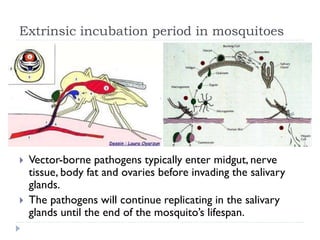
Extrinsic incubation period in mosquitoes
 Vector-borne pathogens typically enter midgut, nerve
tissue, body fat and ovaries before invading the salivary
glands.
 The pathogens will continue replicating in the salivary
glands until the end of the mosquito’s lifespan.
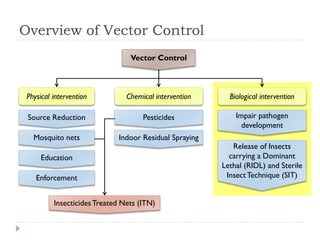
Overview of Vector Control
Vector Control
Physical intervention Chemical intervention Biological intervention
PesticidesSource Reduction
Mosquito nets
InsecticidesTreated Nets (ITN)
Release of Insects
carrying a Dominant
Lethal (RIDL) and Sterile
InsectTechnique (SIT)
Impair pathogen
development
Indoor Residual Spraying
Education
Enforcement
Process flow
Laboratory experiments to establish stable Wolbachia
infected Aedes aegypti mosquitoes
Find out the effectiveness and spread of Wolbachia
within native mosquito population
Find out the extent of
dengue virus suppression
in mosquitoes
Phenotypical features of
Wolbachia infected
mosquitoes
Transmission of
Wolbachia to humans
(safety concerns)
Ability of transgenic
mosquitoes to infect
humans with DENV
Impair pathogen development
 Impairing pathogen development (vector-borne pathogens)
was proposed by Laven H. et al as early as 1967
 The use of Wolbachia pipentis, a intracellular insect bacterium
which was isolated in 1924 in the ovaries of Culex pipens
 It confers 4 different phenotypes:
 Male killing: males are killed during larval development
 Feminization: infected males develop as either females or infertile
pseudo-females
 Parthenogenesis: reproduction of infected females without the
need for male
 Cytoplasmic incompatibility: inability of infected males to mate
with uninfected females or females who are infected with another
Wolbachia strain
Wolbachia-induced cytoplasmic
incompatibility in mosquitoes
 Wolbachia-infected
male mosquitoes
mates with an
uninfected female
mosquito
 Wolbachia-infected
females produce
infected progeny in
all matings allowing
the infection to
rapidly spread
through mosquito
population.Walker,T. and L.A. Moreira, Mem Inst Oswaldo
Cruz, 2011. 106 Suppl 1: p. 212-7
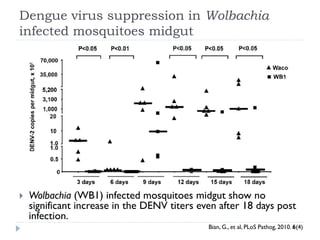
Dengue virus suppression in Wolbachia
infected mosquitoes midgut
 Wolbachia (WB1) infected mosquitoes midgut show no
significant increase in the DENV titers even after 18 days post
infection.
Bian, G., et al, PLoS Pathog, 2010. 6(4)
Dengue virus suppression in Wolbachia
infected mosquitoes thorax (salivary glands)
 Wolbachia (WB1) infected mosquitoes thorax show no significant
increase in the DENV titers even after 18 days post infection.
 Thorax is where the salivary glands are present.
Bian, G., et al, PLoS Pathog, 2010. 6(4)
Why was the previous 2 slides important?
Midgut
Salivary glands
If the dengue virus is unable to
transverse to the salivary glands,
passing on the virus to human host
would not be possible.
What are the factors leading to DENV
suppression?
 17-fold increase in
Defensin and 4.49-
fold increase in
Cecropin
 Other Toll pathway
genes in mosquito
fat body are
upregulated which
may represent a
potential
mechanism
underlying the
suppression of
dengue infection by
Wolbachia
Bian, G., et al, PLoS Pathog, 2010. 6(4)
Can Wolbachia be used to control malaria?
 In laboratory conditions, malaria infection is reduced in
Wolbachia infected Anopheles mosquitoes.
 As Anopheles mosquitoes are not natural hosts of
Wolbachia, it is hard to attain stable Wolbachia infected
mosquitoes to be released into the wild
 Due to the above limitation present, field trials are not
able to be performed.
Key safety concerns on the spread of
Wolbachia to humans
 PCR amplification of the
Wolbachia wsp gene or
mosquito apyrase has
shown only the presence
of Wolbachia in salivary
glands, but not in saliva.
 These results are
supported by the size of
the intracellular
Wolbachia (around 1mm
in diameter) and the
diameter of mosquito
salivary ducts (also about
1 mm)
 Wolbachia infected
mosquitoes are not
able to infect humans
with theWolbachia
bacterium
Moreira, L.A., et al., PLoS Negl Trop Dis, 2009. 3(12): p. e568.
wsp
apyrase
Uninfectedmosquito
Infectedmosquito
UninfectedSaliva
InfectedSaliva
Uninfectedsalivaryglands
Infectedsalivaryglands
Field trial to test the effectiveness and spread of
Wolbachia within native mosquito population
 Wolbachia
infected
mosquitoes
spread the
disease
relatively quickly
over a period of
18 weeks in 2
separate sites
(Ten releases
were made over
the monitoring
period)
Yorkey’sKnobGordonvale
Hoffmann,A.A., et al. Nature, 2011. 476(7361): p. 454-7
Field trial to test the effectiveness and spread of
Wolbachia within native mosquito population
 Proof of concept that stable Wolbachia infected mosquitoes can
introduce the infections to native mosquito population quickly.
Yorkey’sKnobGordonvale
Hoffmann,A.A., et al. Nature, 2011. 476(7361): p. 454-7
Conclusions on pathogen development
impairment
 Wolbachia infected mosquitoes are an interesting natural
biological concept to control the spread of vector borne
diseases
 Laboratory reared stableWolbachia infected mosquitoes
are able to effectively introduce and infect the native
mosquito population
 DENV-2 is observed to be inhibited in Wolbachia-infected
mosquitoes midgut and thorax.This proves to be
promising as DENV-2 does not seem to be able to spread
by Wolbachia-infected mosquitoes.
 StableWolbachia infected Anopheles have to be
developed before the suppression effectiveness of
Wolbachia on Plasmodium could be tested out.
Overview of Vector Control
Vector Control
Physical intervention Chemical intervention Biological intervention
PesticidesSource Reduction
Mosquito nets
InsecticidesTreated Nets (ITN)
Release of Insects
carrying a Dominant
Lethal (RIDL) and Sterile
InsectTechnique (SIT)
Impair pathogen
development
Indoor Residual Spraying
Education
Enforcement
Sterile Insect Technique (SIT)
 Invented by Edward F Kipling
 By releasing sterile males to mate with wild females,
reducing their reproductive potential and ultimately, if
enough sterile males are released, it would bring about
eradication of the pest population.
 Progeny of GM insects with wild-type insects are targeted
to possess the following traits:
 Reduced competition in mating
 Sterile progeny
 Progeny with development defects
 Reduced lifespan
 Flightless phenotypes etc
Sterile Insect Technique (SIT) continued…
 Traditional SIT involves mass rearing of mosquitoes to produce
equal numbers of the 2 sexes
 Females are generally separated and discarded before release
 they are not thought to help control efforts and may be detrimental.
 Various mechanical and genetic sexing methods were
employed but fairly yield single sex population
 Radiation induced translocations to theY chromosome as dominant
selectable markers
 Pupal mass sorting – females generally have larger mass
 Time of eclosion – females generally emerge later than males
 A better approach would be incorporating a transgene system
which lead to development of RIDL
Release of Insects carrying a Dominant
Lethal (RIDL®)
 Using a transgene system to induce repressible female
specific lethality without requiring sterilization by
irradiation
 Requires that a strain of the target organism carries a
conditional, dominant, sex-specific lethal trait,
where the permissive conditions can be created in the
laboratory or factory but will not be encountered in the
wild population.
Science behind RIDL
 Tetracycline-repressible lethal system coupled with a
marker to identify those which are genetically modified
 tTAV is a tetracycline-repressible transcriptional activator
which drives the over-expression of tTAV in absence of
tetracycline
 High levels of tTAV is toxic due to interaction with key
transcription factors
Gong P et al Nat Biotechnol. 2005 Apr
Science behind RIDL
 Oxitec uses a piggyBac transposon construct in their GM
mosquitoes which is as shown in the picture below
 piggyBac is a stable transposase system which is widely adopted in many
cancer and insect studies
 tTAV component is conjoined with a female specific sterility gene
[fs(1)K10] – to achieve single sex population
 fs(1)K10 is required in the dorsal-ventral patterning of the embryo
and over-expression will result in progeny having double dorsal
regions, and not surviving past the fourth –instar larval stage
LA513 construct Phuc Hk et al, BMC Biol. 2007 Mar 20; 5:11
Science behind RIDL
 2nd component is for marking of all GM mosquitoes
which will be released into the wild
 It is a constitutively expressed gene which can be
detected under fluorescence in the mosquitoes’
eyes
 Progeny of the GM males and wild type females will also
inherit the gene and can be detected upon capture
LA513 construct Phuc Hk et al, BMC Biol. 2007 Mar 20; 5:11
500G – GM mosquitoes made
Wild type female
GM males released
into wild
If there are
sufficient male GM
mozzies released
in the wild….
Various examples of GM mosquitoes
 Aedes aegypti OX513A
 Male sterile GM mosquitoes
 Aedes aegypti OX3604
 Female flightless phenotype
 Aedes albopictus OX3688
 Anopheles spp – arabiensis, albimanus, quadrimaculatus
 Malaria vector
 Culex spp – quinquefasciatus, pipens
 West Nile, Ross River, Murine Fever, Japanese Encephalitis, Rift
Valley, Bana
Dengue, Chikungunya,
Yellow Fever
Chikungunya
Tetracycline repressibility lethality in LA513
 Progeny of LA513/+ males withWT female survives better in
Tetracycline supplemented media
 Survivability of progeny of heterozygous crosses reduces in
tetracycline free media
Tetracycline
w/o
Tetracycline
Phuc Hk et al, BMC Biol. 2007 Mar 20; 5:11
Field trial of Aedes aegypti OX513A at
Cayman Islands
 OX513A males are released in a 10-ha area at an avg rate
of 465 males/ha/wk starting in Nov 16
 Before release, mosquitoes are screened again to prevent
accidental release of OX513A female mosquitoes
 Fluorescent larvae detected from ovitraps recovered
would suggest that they are progeny of the GM males
with a wild type female
 Mating outcomes was determined by ovitrapping
 Adult trapping was also done to find out the proportion
of GM males in the sample population
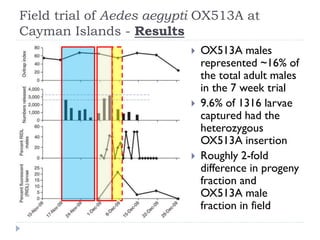
Field trial of Aedes aegypti OX513A at
Cayman Islands - Results
 OX513A males
represented ~16% of
the total adult males
in the 7 week trial
 9.6% of 1316 larvae
captured had the
heterozygous
OX513A insertion
 Roughly 2-fold
difference in progeny
fraction and
OX513A male
fraction in field
Field trial of Aedes aegypti OX513A at
Cayman Islands - Conclusions
 Limitations
 Can only sample eggs or larvae and it is difficult to estimate the
relationship between the eggs analyzed and the number of females
which they derive
 Moving forward
 The data allows researcher to estimate how many OX513A males
might need to be released in the area to suppress the population
 Based on models described in Phuc HK et al, mating fractions of 13-
57% is required for suppression
 Based on their data, a sustained release of ~1.4-12 times the release
rate for this experiment is required
 However, the release has to be combined with integrated vector
management to achieve maximal results.
Conclusions
 GM mosquitoes still has a long way to go before it could
be used as an effective means of vector control
 Wolbachia infected mosquitoes looks most promising and
there are a few studies that are going on in Australia
 Model studies on vector population dynamics should be
looked at closely before mass numbers of GM
mosquitoes are released into the wild
 On a final note, we need to bear in mind that this
technology will create a shift in the equilibrium of nature
and vector-borne diseases
References - Wolbachia
1) Bian, G., et al., The endosymbiotic bacteriumWolbachia induces resistance to
dengue virus in Aedes aegypti. PLoS Pathog, 2010. 6(4): p. e1000833.
2) Hoffmann,A.A., et al., Successful establishment ofWolbachia in Aedes
populations to suppress dengue transmission. Nature, 2011. 476(7361): p.
454-7.
3) Iturbe-Ormaetxe, I.,T.Walker, and O.N. SL, Wolbachia and the biological
control of mosquito-borne disease. EMBO Rep, 2011.12(6): p. 508-18.
4) Popovici, J., et al., Assessing key safety concerns of aWolbachia-based strategy
to control dengue transmission by Aedes mosquitoes. Mem Inst Oswaldo
Cruz, 2010. 105(8): p. 957-64.
5) Walker,T. and L.A. Moreira, CanWolbachia be used to control malaria? Mem
Inst Oswaldo Cruz, 2011. 106 Suppl 1: p. 212-7.
6) Laven, H., Eradication of Culex pipiens fatigans through cytoplasmic
incompatibility. Nature, 1967. 216(5113): p. 383-4
7) Moreira, L.A., et al., Human Probing Behavior of Aedes aegypti when Infected
with a Life-Shortening Strain ofWolbachia. PLoS Negl Trop Dis, 2009. 3(12):
p. e568.
References – Sterile Insect Technique
8. Alphey, L., Re-engineering the sterile insect technique. Insect Biochem Mol Biol, 2002.
32(10): p. 1243-7.
9. Benedict, M.Q. and A.S. Robinson, The first releases of transgenic mosquitoes: an
argument for the sterile insect technique. Trends Parasitol, 2003. 19(8): p. 349-55.
10. Fu, G., et al., Female-specific flightless phenotype for mosquito control. Proc Natl Acad
Sci U S A, 2010. 107(10): p. 4550-4.
11. Gong, P., et al., A dominant lethal genetic system for autocidal control of the
Mediterranean fruitfly. Nat Biotechnol, 2005. 23(4): p. 453-6.
12. Harris,A.F., et al., Field performance of engineered male mosquitoes. Nat Biotechnol,
2011. 29(11): p. 1034-7.
13. Heinrich, J.C. and M.J. Scott, A repressible female-specific lethal genetic system for
making transgenic insect strains suitable for a sterile-release program. Proc Natl Acad
Sci U S A, 2000. 97(15): p. 8229-32.
14. Horn, C., et al., piggyBac-based insertional mutagenesis and enhancer detection as a
tool for functional insect genomics. Genetics, 2003. 163(2): p. 647-61.
15. Labbe, G.M., D.D. Nimmo, and L.Alphey, piggybac- and PhiC31-mediated genetic
transformation of the Asian tiger mosquito,Aedes albopictus (Skuse). PLoS NeglTrop
Dis, 2010. 4(8): p. e788.
References – Sterile Insect Technique
15. Marrelli, M.T., et al., Mosquito transgenesis: what is the fitness cost? Trends Parasitol, 2006. 22(5): p.
197-202.
16. Marshall, J.M., The Cartagena Protocol and genetically modified mosquitoes. Nat Biotechnol, 2010.
28(9): p. 896-7.
17. Nolan,T., et al., Developing transgenic Anopheles mosquitoes for the sterile insect technique. Genetica,
2011. 139(1): p. 33-9.
18. Phuc, H.K., et al., Late-acting dominant lethal genetic systems and mosquito control. BMC Biol, 2007. 5:
p. 11.
19. Rad, R., et al., PiggyBac transposon mutagenesis: a tool for cancer gene discovery in mice. Science, 2010.
330(6007): p. 1104-7.
20. Subbaraman, N., Science snipes at Oxitec transgenic-mosquito trial. Nat Biotechnol, 2011. 29(1): p. 9-
11.
21. Thomas, M.C., et al., The biology and evolution of transposable elements in parasites. Trends Parasitol,
2010. 26(7): p. 350-62.
22. Tu, Z., InsectTransposable Elements. Insect Molecular Biology and Biochemistry, 2012. 2012: p. 57-
89.
23. Tu, Z. and C. Coates, Mosquito transposable elements. Insect Biochem Mol Biol, 2004. 34(7): p. 631-
44.
24. Venner, S., C. Feschotte, and C. Biemont, Dynamics of transposable elements: towards a community
ecology of the genome. Trends Genet, 2009. 25(7): p. 317-23.
25. Zayed, H., et al., Development of hyperactive sleeping beauty transposon vectors by mutational analysis.
Mol Ther, 2004. 9(2): p. 292-304.

Genetically modified mosquitoes

  • 1.
  • 2.
    Overview  Introduction  MosquitoLife Cycle  Transmission cycle forVector-borne diseases  Overview ofVector Control  Impair Pathogen Development  Wolbachia infected mosquitoes  Wolbachia and its ability to suppress DENV2 in mosquitoes  Can Wolbachia control malaria  Key safety concerns on the spread of Wolbachia to humans  Release of Insects carrying a Dominant Lethal (RIDL) and Sterile Insect Technique (SIT)
  • 3.
    Introduction  Mosquitoes arevectors of serious human infections  Dengue  Malaria  Yellow Fever  Vector control is crucial and important in the fight against vector-borne diseases  From 1950s to 1970s, there were optimistic views that such diseases could be controlled using insecticides and drugs  But there were increasing problems of:  Increasing mosquito resistance to pesticides  Parasite resistance to drugs  Slow progress in vaccine development  Genetic modification of mosquitoes was thus looked at since 1955
  • 4.
    Mosquito life cycle Culex and Culiseta species, the eggs are stuck together in rafts of up to 200  Anopheles, Ochlerotatus and Aedes , as well as many other genera, do not make egg rafts, but lay their eggs singly  Culex, Culiseta, and Anopheles lay their eggs on the water surface while many Aedes and Ochlerotatus lay their eggs on damp soil that will be flooded by water.
  • 5.
    Overview of transmissioncycle for vector- borne diseases Mosquito lifecycle (Egg to Adult) Adult Emerges Find a mate within 24-48 hours Mating behaviour source: http://library.wur.nl/frontis/disease_vectors/17_takken.pdf First blood meal from infective host Extrinsic Incubation Period Intrinsic Incubation Period Oviposition within 48 hours Onset of Disease Bites naive host Mosquito infective period (remaining lifespan) Next mating cycle
  • 6.
    Extrinsic incubation periodin mosquitoes  Vector-borne pathogens typically enter midgut, nerve tissue, body fat and ovaries before invading the salivary glands.  The pathogens will continue replicating in the salivary glands until the end of the mosquito’s lifespan.
  • 7.
    Overview of VectorControl Vector Control Physical intervention Chemical intervention Biological intervention PesticidesSource Reduction Mosquito nets InsecticidesTreated Nets (ITN) Release of Insects carrying a Dominant Lethal (RIDL) and Sterile InsectTechnique (SIT) Impair pathogen development Indoor Residual Spraying Education Enforcement
  • 8.
    Process flow Laboratory experimentsto establish stable Wolbachia infected Aedes aegypti mosquitoes Find out the effectiveness and spread of Wolbachia within native mosquito population Find out the extent of dengue virus suppression in mosquitoes Phenotypical features of Wolbachia infected mosquitoes Transmission of Wolbachia to humans (safety concerns) Ability of transgenic mosquitoes to infect humans with DENV
  • 9.
    Impair pathogen development Impairing pathogen development (vector-borne pathogens) was proposed by Laven H. et al as early as 1967  The use of Wolbachia pipentis, a intracellular insect bacterium which was isolated in 1924 in the ovaries of Culex pipens  It confers 4 different phenotypes:  Male killing: males are killed during larval development  Feminization: infected males develop as either females or infertile pseudo-females  Parthenogenesis: reproduction of infected females without the need for male  Cytoplasmic incompatibility: inability of infected males to mate with uninfected females or females who are infected with another Wolbachia strain
  • 10.
    Wolbachia-induced cytoplasmic incompatibility inmosquitoes  Wolbachia-infected male mosquitoes mates with an uninfected female mosquito  Wolbachia-infected females produce infected progeny in all matings allowing the infection to rapidly spread through mosquito population.Walker,T. and L.A. Moreira, Mem Inst Oswaldo Cruz, 2011. 106 Suppl 1: p. 212-7
  • 11.
    Dengue virus suppressionin Wolbachia infected mosquitoes midgut  Wolbachia (WB1) infected mosquitoes midgut show no significant increase in the DENV titers even after 18 days post infection. Bian, G., et al, PLoS Pathog, 2010. 6(4)
  • 12.
    Dengue virus suppressionin Wolbachia infected mosquitoes thorax (salivary glands)  Wolbachia (WB1) infected mosquitoes thorax show no significant increase in the DENV titers even after 18 days post infection.  Thorax is where the salivary glands are present. Bian, G., et al, PLoS Pathog, 2010. 6(4)
  • 13.
    Why was theprevious 2 slides important? Midgut Salivary glands If the dengue virus is unable to transverse to the salivary glands, passing on the virus to human host would not be possible.
  • 14.
    What are thefactors leading to DENV suppression?  17-fold increase in Defensin and 4.49- fold increase in Cecropin  Other Toll pathway genes in mosquito fat body are upregulated which may represent a potential mechanism underlying the suppression of dengue infection by Wolbachia Bian, G., et al, PLoS Pathog, 2010. 6(4)
  • 15.
    Can Wolbachia beused to control malaria?  In laboratory conditions, malaria infection is reduced in Wolbachia infected Anopheles mosquitoes.  As Anopheles mosquitoes are not natural hosts of Wolbachia, it is hard to attain stable Wolbachia infected mosquitoes to be released into the wild  Due to the above limitation present, field trials are not able to be performed.
  • 16.
    Key safety concernson the spread of Wolbachia to humans  PCR amplification of the Wolbachia wsp gene or mosquito apyrase has shown only the presence of Wolbachia in salivary glands, but not in saliva.  These results are supported by the size of the intracellular Wolbachia (around 1mm in diameter) and the diameter of mosquito salivary ducts (also about 1 mm)  Wolbachia infected mosquitoes are not able to infect humans with theWolbachia bacterium Moreira, L.A., et al., PLoS Negl Trop Dis, 2009. 3(12): p. e568. wsp apyrase Uninfectedmosquito Infectedmosquito UninfectedSaliva InfectedSaliva Uninfectedsalivaryglands Infectedsalivaryglands
  • 17.
    Field trial totest the effectiveness and spread of Wolbachia within native mosquito population  Wolbachia infected mosquitoes spread the disease relatively quickly over a period of 18 weeks in 2 separate sites (Ten releases were made over the monitoring period) Yorkey’sKnobGordonvale Hoffmann,A.A., et al. Nature, 2011. 476(7361): p. 454-7
  • 18.
    Field trial totest the effectiveness and spread of Wolbachia within native mosquito population  Proof of concept that stable Wolbachia infected mosquitoes can introduce the infections to native mosquito population quickly. Yorkey’sKnobGordonvale Hoffmann,A.A., et al. Nature, 2011. 476(7361): p. 454-7
  • 19.
    Conclusions on pathogendevelopment impairment  Wolbachia infected mosquitoes are an interesting natural biological concept to control the spread of vector borne diseases  Laboratory reared stableWolbachia infected mosquitoes are able to effectively introduce and infect the native mosquito population  DENV-2 is observed to be inhibited in Wolbachia-infected mosquitoes midgut and thorax.This proves to be promising as DENV-2 does not seem to be able to spread by Wolbachia-infected mosquitoes.  StableWolbachia infected Anopheles have to be developed before the suppression effectiveness of Wolbachia on Plasmodium could be tested out.
  • 20.
    Overview of VectorControl Vector Control Physical intervention Chemical intervention Biological intervention PesticidesSource Reduction Mosquito nets InsecticidesTreated Nets (ITN) Release of Insects carrying a Dominant Lethal (RIDL) and Sterile InsectTechnique (SIT) Impair pathogen development Indoor Residual Spraying Education Enforcement
  • 21.
    Sterile Insect Technique(SIT)  Invented by Edward F Kipling  By releasing sterile males to mate with wild females, reducing their reproductive potential and ultimately, if enough sterile males are released, it would bring about eradication of the pest population.  Progeny of GM insects with wild-type insects are targeted to possess the following traits:  Reduced competition in mating  Sterile progeny  Progeny with development defects  Reduced lifespan  Flightless phenotypes etc
  • 22.
    Sterile Insect Technique(SIT) continued…  Traditional SIT involves mass rearing of mosquitoes to produce equal numbers of the 2 sexes  Females are generally separated and discarded before release  they are not thought to help control efforts and may be detrimental.  Various mechanical and genetic sexing methods were employed but fairly yield single sex population  Radiation induced translocations to theY chromosome as dominant selectable markers  Pupal mass sorting – females generally have larger mass  Time of eclosion – females generally emerge later than males  A better approach would be incorporating a transgene system which lead to development of RIDL
  • 23.
    Release of Insectscarrying a Dominant Lethal (RIDL®)  Using a transgene system to induce repressible female specific lethality without requiring sterilization by irradiation  Requires that a strain of the target organism carries a conditional, dominant, sex-specific lethal trait, where the permissive conditions can be created in the laboratory or factory but will not be encountered in the wild population.
  • 24.
    Science behind RIDL Tetracycline-repressible lethal system coupled with a marker to identify those which are genetically modified  tTAV is a tetracycline-repressible transcriptional activator which drives the over-expression of tTAV in absence of tetracycline  High levels of tTAV is toxic due to interaction with key transcription factors Gong P et al Nat Biotechnol. 2005 Apr
  • 25.
    Science behind RIDL Oxitec uses a piggyBac transposon construct in their GM mosquitoes which is as shown in the picture below  piggyBac is a stable transposase system which is widely adopted in many cancer and insect studies  tTAV component is conjoined with a female specific sterility gene [fs(1)K10] – to achieve single sex population  fs(1)K10 is required in the dorsal-ventral patterning of the embryo and over-expression will result in progeny having double dorsal regions, and not surviving past the fourth –instar larval stage LA513 construct Phuc Hk et al, BMC Biol. 2007 Mar 20; 5:11
  • 26.
    Science behind RIDL 2nd component is for marking of all GM mosquitoes which will be released into the wild  It is a constitutively expressed gene which can be detected under fluorescence in the mosquitoes’ eyes  Progeny of the GM males and wild type females will also inherit the gene and can be detected upon capture LA513 construct Phuc Hk et al, BMC Biol. 2007 Mar 20; 5:11
  • 27.
    500G – GMmosquitoes made
  • 28.
    Wild type female GMmales released into wild If there are sufficient male GM mozzies released in the wild….
  • 29.
    Various examples ofGM mosquitoes  Aedes aegypti OX513A  Male sterile GM mosquitoes  Aedes aegypti OX3604  Female flightless phenotype  Aedes albopictus OX3688  Anopheles spp – arabiensis, albimanus, quadrimaculatus  Malaria vector  Culex spp – quinquefasciatus, pipens  West Nile, Ross River, Murine Fever, Japanese Encephalitis, Rift Valley, Bana Dengue, Chikungunya, Yellow Fever Chikungunya
  • 30.
    Tetracycline repressibility lethalityin LA513  Progeny of LA513/+ males withWT female survives better in Tetracycline supplemented media  Survivability of progeny of heterozygous crosses reduces in tetracycline free media Tetracycline w/o Tetracycline Phuc Hk et al, BMC Biol. 2007 Mar 20; 5:11
  • 31.
    Field trial ofAedes aegypti OX513A at Cayman Islands  OX513A males are released in a 10-ha area at an avg rate of 465 males/ha/wk starting in Nov 16  Before release, mosquitoes are screened again to prevent accidental release of OX513A female mosquitoes  Fluorescent larvae detected from ovitraps recovered would suggest that they are progeny of the GM males with a wild type female  Mating outcomes was determined by ovitrapping  Adult trapping was also done to find out the proportion of GM males in the sample population
  • 32.
    Field trial ofAedes aegypti OX513A at Cayman Islands - Results  OX513A males represented ~16% of the total adult males in the 7 week trial  9.6% of 1316 larvae captured had the heterozygous OX513A insertion  Roughly 2-fold difference in progeny fraction and OX513A male fraction in field
  • 33.
    Field trial ofAedes aegypti OX513A at Cayman Islands - Conclusions  Limitations  Can only sample eggs or larvae and it is difficult to estimate the relationship between the eggs analyzed and the number of females which they derive  Moving forward  The data allows researcher to estimate how many OX513A males might need to be released in the area to suppress the population  Based on models described in Phuc HK et al, mating fractions of 13- 57% is required for suppression  Based on their data, a sustained release of ~1.4-12 times the release rate for this experiment is required  However, the release has to be combined with integrated vector management to achieve maximal results.
  • 34.
    Conclusions  GM mosquitoesstill has a long way to go before it could be used as an effective means of vector control  Wolbachia infected mosquitoes looks most promising and there are a few studies that are going on in Australia  Model studies on vector population dynamics should be looked at closely before mass numbers of GM mosquitoes are released into the wild  On a final note, we need to bear in mind that this technology will create a shift in the equilibrium of nature and vector-borne diseases
  • 35.
    References - Wolbachia 1)Bian, G., et al., The endosymbiotic bacteriumWolbachia induces resistance to dengue virus in Aedes aegypti. PLoS Pathog, 2010. 6(4): p. e1000833. 2) Hoffmann,A.A., et al., Successful establishment ofWolbachia in Aedes populations to suppress dengue transmission. Nature, 2011. 476(7361): p. 454-7. 3) Iturbe-Ormaetxe, I.,T.Walker, and O.N. SL, Wolbachia and the biological control of mosquito-borne disease. EMBO Rep, 2011.12(6): p. 508-18. 4) Popovici, J., et al., Assessing key safety concerns of aWolbachia-based strategy to control dengue transmission by Aedes mosquitoes. Mem Inst Oswaldo Cruz, 2010. 105(8): p. 957-64. 5) Walker,T. and L.A. Moreira, CanWolbachia be used to control malaria? Mem Inst Oswaldo Cruz, 2011. 106 Suppl 1: p. 212-7. 6) Laven, H., Eradication of Culex pipiens fatigans through cytoplasmic incompatibility. Nature, 1967. 216(5113): p. 383-4 7) Moreira, L.A., et al., Human Probing Behavior of Aedes aegypti when Infected with a Life-Shortening Strain ofWolbachia. PLoS Negl Trop Dis, 2009. 3(12): p. e568.
  • 36.
    References – SterileInsect Technique 8. Alphey, L., Re-engineering the sterile insect technique. Insect Biochem Mol Biol, 2002. 32(10): p. 1243-7. 9. Benedict, M.Q. and A.S. Robinson, The first releases of transgenic mosquitoes: an argument for the sterile insect technique. Trends Parasitol, 2003. 19(8): p. 349-55. 10. Fu, G., et al., Female-specific flightless phenotype for mosquito control. Proc Natl Acad Sci U S A, 2010. 107(10): p. 4550-4. 11. Gong, P., et al., A dominant lethal genetic system for autocidal control of the Mediterranean fruitfly. Nat Biotechnol, 2005. 23(4): p. 453-6. 12. Harris,A.F., et al., Field performance of engineered male mosquitoes. Nat Biotechnol, 2011. 29(11): p. 1034-7. 13. Heinrich, J.C. and M.J. Scott, A repressible female-specific lethal genetic system for making transgenic insect strains suitable for a sterile-release program. Proc Natl Acad Sci U S A, 2000. 97(15): p. 8229-32. 14. Horn, C., et al., piggyBac-based insertional mutagenesis and enhancer detection as a tool for functional insect genomics. Genetics, 2003. 163(2): p. 647-61. 15. Labbe, G.M., D.D. Nimmo, and L.Alphey, piggybac- and PhiC31-mediated genetic transformation of the Asian tiger mosquito,Aedes albopictus (Skuse). PLoS NeglTrop Dis, 2010. 4(8): p. e788.
  • 37.
    References – SterileInsect Technique 15. Marrelli, M.T., et al., Mosquito transgenesis: what is the fitness cost? Trends Parasitol, 2006. 22(5): p. 197-202. 16. Marshall, J.M., The Cartagena Protocol and genetically modified mosquitoes. Nat Biotechnol, 2010. 28(9): p. 896-7. 17. Nolan,T., et al., Developing transgenic Anopheles mosquitoes for the sterile insect technique. Genetica, 2011. 139(1): p. 33-9. 18. Phuc, H.K., et al., Late-acting dominant lethal genetic systems and mosquito control. BMC Biol, 2007. 5: p. 11. 19. Rad, R., et al., PiggyBac transposon mutagenesis: a tool for cancer gene discovery in mice. Science, 2010. 330(6007): p. 1104-7. 20. Subbaraman, N., Science snipes at Oxitec transgenic-mosquito trial. Nat Biotechnol, 2011. 29(1): p. 9- 11. 21. Thomas, M.C., et al., The biology and evolution of transposable elements in parasites. Trends Parasitol, 2010. 26(7): p. 350-62. 22. Tu, Z., InsectTransposable Elements. Insect Molecular Biology and Biochemistry, 2012. 2012: p. 57- 89. 23. Tu, Z. and C. Coates, Mosquito transposable elements. Insect Biochem Mol Biol, 2004. 34(7): p. 631- 44. 24. Venner, S., C. Feschotte, and C. Biemont, Dynamics of transposable elements: towards a community ecology of the genome. Trends Genet, 2009. 25(7): p. 317-23. 25. Zayed, H., et al., Development of hyperactive sleeping beauty transposon vectors by mutational analysis. Mol Ther, 2004. 9(2): p. 292-304.