

Prolactin Screening in a Cohort of  Schizophrenia Patients in Small Heath, Birmingham Dr Imran Waheed Consultant in Adult Psychiatry 24 th  February 2009
Aims To establish the numerical prevalence and severity of raised prolactin levels in apparently asymptomatic patients. To make recommendations about the feasibility of routine prolactin screening.
Method All patients with a diagnosis of schizophrenia receiving antipsychotics had annual prolactin measurements. All outpatients or inpatients at Small Heath Health Centre were included. The patient cohort consisted of schizophrenia outpatients who either attend the CMHT or agreed to have a prolactin sample taken at their home and schizophrenia inpatients.  Prolactin samples were taken between 0900-1300. The Upper Limit of Normal (ULN) for prolactin as set by the hospital pathology service is 324 mIU/L (males) and 496 mIU/L (females).  The patient's name, age, unit number, ethnicity, details of current medication, recent changes to medication and symptoms of hyperprolactinaemia were recorded on the study proforma.
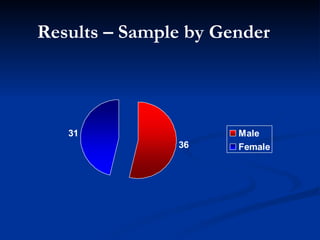
Results – Sample by Gender
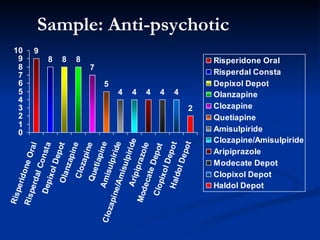
Sample: Anti-psychotic
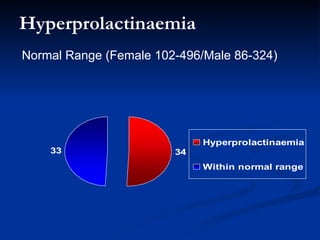
Hyperprolactinaemia Normal Range (Female 102-496/Male 86-324)
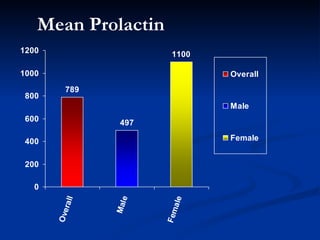
Mean Prolactin
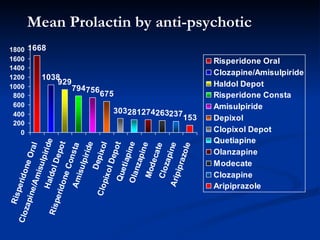
Mean Prolactin by anti-psychotic
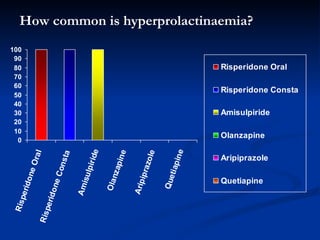
How common is hyperprolactinaemia?
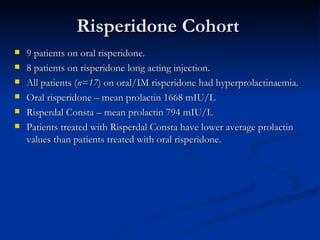
Risperidone Cohort 9 patients on oral risperidone.  8 patients on risperidone long acting injection.  All patients ( n=17 ) on oral/IM risperidone had hyperprolactinaemia. Oral risperidone – mean prolactin 1668 mIU/L Risperdal Consta – mean prolactin 794 mIU/L Patients treated with Risperdal Consta have lower average prolactin values than patients treated with oral risperidone.
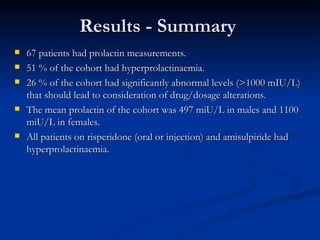
Results - Summary 67 patients had prolactin measurements.  51 % of the cohort had hyperprolactinaemia.  26 % of the cohort had significantly abnormal levels (>1000 mIU/L) that should lead to consideration of drug/dosage alterations. The mean prolactin of the cohort was 497 miU/L in males and 1100 miU/L in females.  All patients on risperidone (oral or injection) and amisulpiride had hyperprolactinaemia.
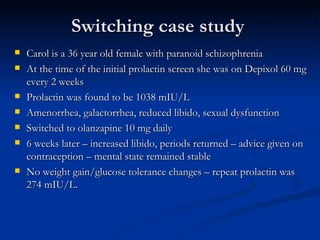
Switching case study Carol is a 36 year old female with paranoid schizophrenia At the time of the initial prolactin screen she was on Depixol 60 mg every 2 weeks Prolactin was found to be 1038 mIU/L Amenorrhea, galactorrhea, reduced libido, sexual dysfunction Switched to olanzapine 10 mg daily 6 weeks later – increased libido, periods returned – advice given on contraception – mental state remained stable No weight gain/glucose tolerance changes – repeat prolactin was 274 mIU/L.
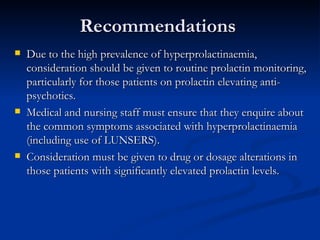
Recommendations Due to the high prevalence of hyperprolactinaemia, consideration should be given to routine prolactin monitoring, particularly for those patients on prolactin elevating anti-psychotics. Medical and nursing staff must ensure that they enquire about the common symptoms associated with hyperprolactinaemia (including use of LUNSERS). Consideration must be given to drug or dosage alterations in those patients with significantly elevated prolactin levels.
Prolactin Screening in a Cohort of  Schizophrenia Patients in Small Heath, Birmingham Dr Imran Waheed Consultant in Adult Psychiatry 24 th  February 2009

Prolactin Screening, Hyperprolactinaemia and Antipsychotics

  • 1.
    Prolactin Screening ina Cohort of Schizophrenia Patients in Small Heath, Birmingham Dr Imran Waheed Consultant in Adult Psychiatry 24 th February 2009
  • 2.
    Aims To establishthe numerical prevalence and severity of raised prolactin levels in apparently asymptomatic patients. To make recommendations about the feasibility of routine prolactin screening.
  • 3.
    Method All patientswith a diagnosis of schizophrenia receiving antipsychotics had annual prolactin measurements. All outpatients or inpatients at Small Heath Health Centre were included. The patient cohort consisted of schizophrenia outpatients who either attend the CMHT or agreed to have a prolactin sample taken at their home and schizophrenia inpatients. Prolactin samples were taken between 0900-1300. The Upper Limit of Normal (ULN) for prolactin as set by the hospital pathology service is 324 mIU/L (males) and 496 mIU/L (females). The patient's name, age, unit number, ethnicity, details of current medication, recent changes to medication and symptoms of hyperprolactinaemia were recorded on the study proforma.
  • 4.
  • 5.
  • 6.
    Hyperprolactinaemia Normal Range(Female 102-496/Male 86-324)
  • 7.
  • 8.
    Mean Prolactin byanti-psychotic
  • 9.
    How common ishyperprolactinaemia?
  • 10.
    Risperidone Cohort 9patients on oral risperidone. 8 patients on risperidone long acting injection. All patients ( n=17 ) on oral/IM risperidone had hyperprolactinaemia. Oral risperidone – mean prolactin 1668 mIU/L Risperdal Consta – mean prolactin 794 mIU/L Patients treated with Risperdal Consta have lower average prolactin values than patients treated with oral risperidone.
  • 11.
    Results - Summary67 patients had prolactin measurements. 51 % of the cohort had hyperprolactinaemia. 26 % of the cohort had significantly abnormal levels (>1000 mIU/L) that should lead to consideration of drug/dosage alterations. The mean prolactin of the cohort was 497 miU/L in males and 1100 miU/L in females. All patients on risperidone (oral or injection) and amisulpiride had hyperprolactinaemia.
  • 12.
    Switching case studyCarol is a 36 year old female with paranoid schizophrenia At the time of the initial prolactin screen she was on Depixol 60 mg every 2 weeks Prolactin was found to be 1038 mIU/L Amenorrhea, galactorrhea, reduced libido, sexual dysfunction Switched to olanzapine 10 mg daily 6 weeks later – increased libido, periods returned – advice given on contraception – mental state remained stable No weight gain/glucose tolerance changes – repeat prolactin was 274 mIU/L.
  • 13.
    Recommendations Due tothe high prevalence of hyperprolactinaemia, consideration should be given to routine prolactin monitoring, particularly for those patients on prolactin elevating anti-psychotics. Medical and nursing staff must ensure that they enquire about the common symptoms associated with hyperprolactinaemia (including use of LUNSERS). Consideration must be given to drug or dosage alterations in those patients with significantly elevated prolactin levels.
  • 14.
    Prolactin Screening ina Cohort of Schizophrenia Patients in Small Heath, Birmingham Dr Imran Waheed Consultant in Adult Psychiatry 24 th February 2009