HyperprolactinaemiaSide Effects: Antipsychotics
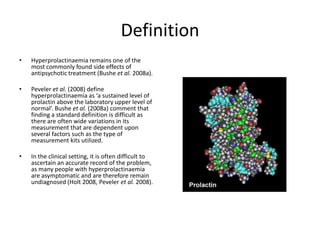
DefinitionHyperprolactinaemia remains one of the most commonly found side effects of antipsychotic treatment (Bushe et al. 2008a).Peveler et al. (2008) define hyperprolactinaemia as ‘a sustained level of prolactin above the laboratory upper level of normal’. Bushe et al. (2008a) comment that finding a standard definition is difficult as there are often wide variations in its measurement that are dependent upon several factors such as the type of measurement kits utilized.In the clinical setting, it is often difficult to ascertain an accurate record of the problem, as many people with hyperprolactinaemia are asymptomatic and are therefore remain undiagnosed (Holt 2008, Peveler et al. 2008).
Prolactin levelsProlactin is secreted in a pulsatile manner by the anteriorpituitary gland. There are 13 or 14 peaks per day, with aninterpulse interval of about 95 min. The mean pulse amplitudeabove the preceding nadir is on average about 20-30% of theupper normal value (Veldhuis & Johnson, 1988). Daytimelevels and peak amplitudes vary considerably between individuals,and in women levels are higher at the middle and during thesecond half of the menstrual cycle. Transient and mild increasesof prolactin secretion occur in response to meals, stress andsexual activity. The upper limit of unstimulated prolactinlevels in men and women varies between laboratories, rangingbetween 350 mU/l and 550 mU/l.
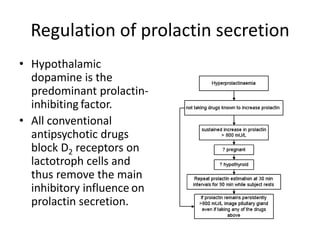
Regulation of prolactin secretionHypothalamic dopamine is the predominant prolactin-inhibitingfactor.All conventional antipsychotic drugs block D2 receptors on lactotroph cells and thus remove the main inhibitory influenceon prolactin secretion.
SymptomsHyperprolactinaemia can cause breast enlargement and galactorrhoea,ovarian dysfunction, infertility, reduced libido, atrophicchanges in the urethra and vaginal mucosa, reduced vaginallubrication and dyspareunia. Acne and mild hirsutism can develop,due to the relative increase of androgenic compared with oestrogenicactivity.
Hyperprolactinaemia and Breast CancerAll antipsychotic medication has the potential to increase prolactin levels (Bushe et al. 2008a); this is however more of a concern in regard to first-generation antipsychotics, and risperidone and amisulpride.One concerning side effect of hyperprolactinaemia that is gaining more attention is breast cancer. However, Bushe et al. (2008a) state the real risk of getting breast cancer is ‘quite small’. As a precautionary measure, in those who have a family history of breast cancer, great care should be taken and one should possibly consider monitoring prolactin levels.
Hyperprolactinaemia and OsteoporosisA recent study published in the British Journal of Psychiatry established that schizophrenia and prolactin-raising antipsychotic medication is associated with hip fractures (Howard et al. 2007).One in two women and one in eight men over the age of 50 years will have an osteoporosis-related fracture (Naidoo et al. 2003). One third of those who fracture their hip annually will die (Naidoo et al. 2003), a further 25% will need long-term care, and only 25% will return to full function (Hobson & Ealston 2001).
Hyperprolactinaemia and OsteoporosisA recent key study by Howard et al. (2007) established that hip fracture was associated with schizophrenia and more interestingly with prolactin-raising antipsychotic medication. The authors go on to report that the incidence of hip fracture in those receiving prolactin-raising antipsychotics was three times increased in the patients receiving prolactin-raising antipsychotics.
referencesBushe C.M., Shaw M. & Peveler R.C. (2008a) A review of the association between antipsychotic use and hyperprolactinaemia. Journal of Psychopharmacology 22, 46–55.Holt R.I.G. (2008) Medical causes and consequences of hyperprolactinaemia. A context for psychiatrists. Journal of Psychopharmacology 22, 28–37.Hobson E.E. & Ealston S.H. (2001) Role of genetic factors in the pathophysiology and management of osteoporosis. Clinical Endocrinology (Oxford) 54, 1–9.Howard L., Kirkwood G. & Leese M. (2007) Risk of hip fracture in patients with a history of schizophrenia. British Journal of Psychiatry 190, 129–134.Naidoo U., Goff D.C. & Klibanski A. (2003) Hyperprolactinaemia and bone mineral density: the potential impact of antipsychotic agents. Psychoneuroendocrinology 28, 97–108.Peveler R.C., Branford D., Citrome L., et al. (2008) Antipsychotics and hyperprolactinaemia: clinical recommendations. Journal of Psychopharmacology 22, 98–103.

Hyperprolactinaemia

  • 1.
  • 2.
    DefinitionHyperprolactinaemia remains oneof the most commonly found side effects of antipsychotic treatment (Bushe et al. 2008a).Peveler et al. (2008) define hyperprolactinaemia as ‘a sustained level of prolactin above the laboratory upper level of normal’. Bushe et al. (2008a) comment that finding a standard definition is difficult as there are often wide variations in its measurement that are dependent upon several factors such as the type of measurement kits utilized.In the clinical setting, it is often difficult to ascertain an accurate record of the problem, as many people with hyperprolactinaemia are asymptomatic and are therefore remain undiagnosed (Holt 2008, Peveler et al. 2008).
  • 3.
    Prolactin levelsProlactin issecreted in a pulsatile manner by the anteriorpituitary gland. There are 13 or 14 peaks per day, with aninterpulse interval of about 95 min. The mean pulse amplitudeabove the preceding nadir is on average about 20-30% of theupper normal value (Veldhuis & Johnson, 1988). Daytimelevels and peak amplitudes vary considerably between individuals,and in women levels are higher at the middle and during thesecond half of the menstrual cycle. Transient and mild increasesof prolactin secretion occur in response to meals, stress andsexual activity. The upper limit of unstimulated prolactinlevels in men and women varies between laboratories, rangingbetween 350 mU/l and 550 mU/l.
  • 4.
    Regulation of prolactinsecretionHypothalamic dopamine is the predominant prolactin-inhibitingfactor.All conventional antipsychotic drugs block D2 receptors on lactotroph cells and thus remove the main inhibitory influenceon prolactin secretion.
  • 5.
    SymptomsHyperprolactinaemia can causebreast enlargement and galactorrhoea,ovarian dysfunction, infertility, reduced libido, atrophicchanges in the urethra and vaginal mucosa, reduced vaginallubrication and dyspareunia. Acne and mild hirsutism can develop,due to the relative increase of androgenic compared with oestrogenicactivity.
  • 6.
    Hyperprolactinaemia and BreastCancerAll antipsychotic medication has the potential to increase prolactin levels (Bushe et al. 2008a); this is however more of a concern in regard to first-generation antipsychotics, and risperidone and amisulpride.One concerning side effect of hyperprolactinaemia that is gaining more attention is breast cancer. However, Bushe et al. (2008a) state the real risk of getting breast cancer is ‘quite small’. As a precautionary measure, in those who have a family history of breast cancer, great care should be taken and one should possibly consider monitoring prolactin levels.
  • 7.
    Hyperprolactinaemia and OsteoporosisArecent study published in the British Journal of Psychiatry established that schizophrenia and prolactin-raising antipsychotic medication is associated with hip fractures (Howard et al. 2007).One in two women and one in eight men over the age of 50 years will have an osteoporosis-related fracture (Naidoo et al. 2003). One third of those who fracture their hip annually will die (Naidoo et al. 2003), a further 25% will need long-term care, and only 25% will return to full function (Hobson & Ealston 2001).
  • 8.
    Hyperprolactinaemia and OsteoporosisArecent key study by Howard et al. (2007) established that hip fracture was associated with schizophrenia and more interestingly with prolactin-raising antipsychotic medication. The authors go on to report that the incidence of hip fracture in those receiving prolactin-raising antipsychotics was three times increased in the patients receiving prolactin-raising antipsychotics.
  • 9.
    referencesBushe C.M., ShawM. & Peveler R.C. (2008a) A review of the association between antipsychotic use and hyperprolactinaemia. Journal of Psychopharmacology 22, 46–55.Holt R.I.G. (2008) Medical causes and consequences of hyperprolactinaemia. A context for psychiatrists. Journal of Psychopharmacology 22, 28–37.Hobson E.E. & Ealston S.H. (2001) Role of genetic factors in the pathophysiology and management of osteoporosis. Clinical Endocrinology (Oxford) 54, 1–9.Howard L., Kirkwood G. & Leese M. (2007) Risk of hip fracture in patients with a history of schizophrenia. British Journal of Psychiatry 190, 129–134.Naidoo U., Goff D.C. & Klibanski A. (2003) Hyperprolactinaemia and bone mineral density: the potential impact of antipsychotic agents. Psychoneuroendocrinology 28, 97–108.Peveler R.C., Branford D., Citrome L., et al. (2008) Antipsychotics and hyperprolactinaemia: clinical recommendations. Journal of Psychopharmacology 22, 98–103.