GENETICALLY
MODIFIED ORGANISMS:
SCIENCE, HEALTH AND
POLITICS
PRESENTED BY:
Aira A. Pino
Merry Maybell M. Uy
Jullie Ann S. Paulino
Shienna Joy F. Orquin
Introduction:
o In 2001 Rosalie Ellasus, a former overseas Filipino worker in
Singapore turned farmer, attended the Integrated Pest
Management also known as Integrated Pest Control which is
a broad based approach that integrates practices for
economic control of pests.
o It is a farmer field school and was introduced to Bt corn, a
genetically modified com that is resistant to the destructive
Asian corn borer. Ms. Ellasus volunteered for demo-testing in
her field. Bt corn yielded 7.2 tons per acre as compared to a
regular yield of 4.2 tons per hectare. No insecticide spraying
was needed. This is one of the success stories of Genetically
Modified Organisms (GMOs) (Ongkiko 2016).
• Genetic engineering has been with the human society
since selective breeding was introduced to humankind and
when animals were domesticated. Yet, the process of the
genetic alteration is all but natural.
• It was in 1951 that the term genetic engineering was
coined by Jack Williamson, author of the science fiction
novel Dragon's Island (Stableford 2004). This was years
before actual research findings on the DNA's role in
heredity and its structure, the double-helix of Watson and
Crick, were published. Though continuous search for
development, genetic engineering no longer stayed in
science fiction novel. It became a reality.
Genetically Modified Organisms
• Genetically Modified Organism (GMO) is the term
used for an organism created through genetic
engineering. The World Health Organization (WHO)
defines GMO, as an "organism, either plant or animal
or microorganism in which the genetic material (DNA)
has been altered in a way that does not occur
naturally by mating or recombination."
• The development of GMOS was perceived to help in
the advancement of technology for the benefit of
humans in different industries like agriculture and
medicine
GMO IN FOOD
AND
AGRICULTURAL
INDUSTRIES
The Center for the Ecogenetics and Environmental
Health (CEEH,2013) identified the following roles of
GMOs in the food agricultural industries:
1. Pest resistance- genetically modified plants to resist
certain pests.
An example is Bt corn. The DNA (genome) of the Bt
Corn has been modified with the gene of bacillus
thuringiensis, a soil bacterium that produces proteins which
is toxic to corn borers (worms).
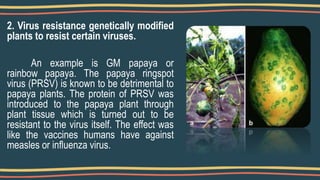
2. Virus resistance genetically modified
plants to resist certain viruses.
An example is GM papaya or
rainbow papaya. The papaya ringspot
virus (PRSV) is known to be detrimental to
papaya plants. The protein of PRSV was
introduced to the papaya plant through
plant tissue which is turned out to be
resistant to the virus itself. The effect was
like the vaccines humans have against
measles or influenza virus.
3. Herbicide tolerance - genetically modified plants to
tolerate herbicide.
An example is roundup ready soybean. glyphosate,
an herbicide for weeds, was introduced to soybeans making.
It tolerate to the herbicide itself. Farmers then can spray the
herbicide killing the weeds but not the soybean.
4. Fortification - genetically modified plants fortified
with certain minerals.
An example is Golden Rice. Beta-carotene, a
precursor of Vitamin A, was introduced through biosynthesis
a genes to the rice, making the rice grains fortified with
Vitamin A.
5. Cosmetics preservation - genetically modified plants
resist natural discoloration
An example is Arctic Apple. The apple variety was
genetically modified to suppress the browning of the apple
due to superficial damage.
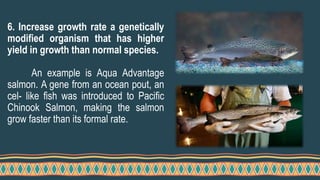
6. Increase growth rate a genetically
modified organism that has higher
yield in growth than normal species.
An example is Aqua Advantage
salmon. A gene from an ocean pout, an
cel- like fish was introduced to Pacific
Chinook Salmon, making the salmon
grow faster than its formal rate.
GMO IN
NON-FOOD CROPS
AND
MICROORGANISMS
Genetically modified organism (GMO's) In
non-food crops and some MICRO-ORGANISM
involve the following:
1. Flower production - GMOs in flower
production are seen in modified color and
extended vase life of flowers.
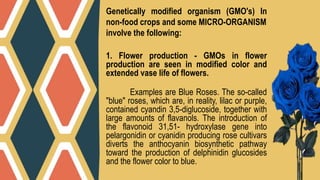
Examples are Blue Roses. The so-called
"blue" roses, which are, in reality, lilac or purple,
contained cyandin 3,5-diglucoside, together with
large amounts of flavanols. The introduction of
the flavonoid 31,51- hydroxylase gene into
pelargonidin or cyanidin producing rose cultivars
diverts the anthocyanin biosynthetic pathway
toward the production of delphinidin glucosides
and the flower color to blue.
2. Paper Production modified characteristics of trees
for higher yield of paper production.
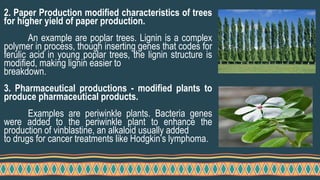
An example are poplar trees. Lignin is a complex
polymer in process, though inserting genes that codes for
ferulic acid in young poplar trees, the lignin structure is
modified, making lignin easier to
breakdown.
3. Pharmaceutical productions - modified plants to
produce pharmaceutical products.
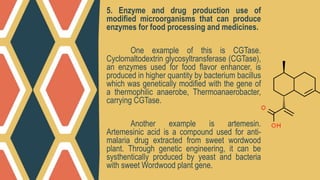
Examples are periwinkle plants. Bacteria genes
were added to the periwinkle plant to enhance the
production of vinblastine, an alkaloid usually added
to drugs for cancer treatments like Hodgkin’s lymphoma.
4. Bioremediation use of modified plants
that can assist the bioremediation of
polluted sites.
An example is shrub tobacco. Nicotiana
glauca, or shrub tobacco genetically modified
with phytochelatin tapPCII, is used for
bioremediation. It shows high level
accumulation of zinc, lead, cadmium, nickel
and boron and produces high biomass.
5. Enzyme and drug production use of
modified microorganisms that can produce
enzymes for food processing and medicines.
One example of this is CGTase.
Cyclomaltodextrin glycosyltransferase (CGTase),
an enzymes used for food flavor enhancer, is
produced in higher quantity by bacterium bacillus
which was genetically modified with the gene of
a thermophilic anaerobe, Thermoanaerobacter,
carrying CGTase.
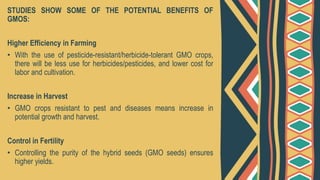
Another example is artemesin.
Artemesinic acid is a compound used for anti-
malaria drug extracted from sweet wordwood
plant. Through genetic engineering, it can be
systhentically produced by yeast and bacteria
with sweet Wordwood plant gene.
BENEFITS OF GMO
STUDIES SHOW SOME OF THE POTENTIAL BENEFITS OF
GMOS:
Higher Efficiency in Farming
• With the use of pesticide-resistant/herbicide-tolerant GMO crops,
there will be less use for herbicides/pesticides, and lower cost for
labor and cultivation.
Increase in Harvest
• GMO crops resistant to pest and diseases means increase in
potential growth and harvest.
Control in Fertility
• Controlling the purity of the hybrid seeds (GMO seeds) ensures
higher yields.
Increase in Food Processing
• altered characteristics of GMO crops help ease food processing.
Improvement of Desirable Characteristics
• GMOs offer longer shelf life, enhanced color and taste. enhanced
production or reduction of enzymes, and other modified characteristics
of plants, animals, and microorganisms.
Nutritional and Pharmaceutical Enhancement
• GMO crops like maize fortified with lysine and Golden Rice fortified
with vitamin A and iron. There are now edible vaccines for viral
diarrheal diseases.
• Reduce the use of fertilizers and pesticides.
POTENTIAL RISK
OF GMOs
Despite the promising claims of GMOs,
the opponents of GMOs claim otherwise
for example there are studies that show
a link in the adaption of pesticide
resistant GMO crops to significant
growth of super Innes IR tra Red weeds
that became pesticide resistant too.
OPPONENTS OF GMOS HAVE THE FOLLOWING
MAJOR CONCERNS:
1. Since genetic engineering is still a young branch
of science, there are inadequate studies on the effect
of GMOs to human and the environment.
2. Genetic engineering promotes mutation in
organism which the long term effects is still
unknown.
POTENTIAL
ENVIRONMENTAL
RISK CAUSED BY
GMOS
1. Risk in gene flow
2. Emergence of new forms of
resistance and secondary pest and
weed problem.
3. Recombination of Virus and bacteria
to procedure new pathogens
POTENTIAL HUMAN
HEALTH RISK
CAUSED BY GMOs
A major concern in the use and
consumption of GMOS is its effect on
human beings, primarily on human
health. Some potential human health
risk are identified (Akhter 2001), such
as:
• Consumption of GMOS may have
adverse effects since it is not naturally or
organically produced;
• Consumption of GMOs may alter the
balance of existing microorganisms in
the human digestive system; health and
Production of allergens may have adverse. effect to humans.
Worldwide, there are many groups that campaign against GMO food
consumption. They encourage people to boycott GMO products. In the
Philippines, the Supreme Court has ruled against the use of Bt eggplant,
another genetically modified crop (Ongkiko,2016)
Human Genome Project (HGP)
 Mapping of human genes to provide framework for research and
studies in the field of medicine.
GMOS IN THE
PHILIPIPPINES
CONTEXT
Mutation of genetically engineeredmicroorganisms
Genetically modified bacteria and viruses may mutate to become more resistant or
virulent that may cause more dreadful diseases for human beings.
Cloning
The asexual reproduction of an organism using parent cell through genetic
engineering.
Scientists and medical practitioners would definitely continue to search for ways to
preserve lives. Genetic engineering is perceived to be one of the keys to this venture.
Gene therapy and gene alteration are promising ways to improve human health
conditions.
The NCBP developed the guidelines on the
planned release of genetically manipulated
organisms (GMOs) and potentially harmful
exotic species in 1998. The Philippines was
marked to be the first country in Asia to
approved commercial Culturation of GMOs
when GM Corn planting was approved in 2002.
GMOs in our country created issues and controversies similar to other
countries with GMOs. There are of course, proponents and opponents of
these issues. The GMO started in the 1990s with the creation of the
National Committee on Biosafety of the Philippines (NCBP) through
Executive Order No. 430 of 1990.
Genetically Modified Organisms (GMO).pptx

Genetically Modified Organisms (GMO).pptx

  • 1.
    GENETICALLY MODIFIED ORGANISMS: SCIENCE, HEALTHAND POLITICS PRESENTED BY: Aira A. Pino Merry Maybell M. Uy Jullie Ann S. Paulino Shienna Joy F. Orquin
  • 2.
    Introduction: o In 2001Rosalie Ellasus, a former overseas Filipino worker in Singapore turned farmer, attended the Integrated Pest Management also known as Integrated Pest Control which is a broad based approach that integrates practices for economic control of pests. o It is a farmer field school and was introduced to Bt corn, a genetically modified com that is resistant to the destructive Asian corn borer. Ms. Ellasus volunteered for demo-testing in her field. Bt corn yielded 7.2 tons per acre as compared to a regular yield of 4.2 tons per hectare. No insecticide spraying was needed. This is one of the success stories of Genetically Modified Organisms (GMOs) (Ongkiko 2016).
  • 3.
    • Genetic engineeringhas been with the human society since selective breeding was introduced to humankind and when animals were domesticated. Yet, the process of the genetic alteration is all but natural. • It was in 1951 that the term genetic engineering was coined by Jack Williamson, author of the science fiction novel Dragon's Island (Stableford 2004). This was years before actual research findings on the DNA's role in heredity and its structure, the double-helix of Watson and Crick, were published. Though continuous search for development, genetic engineering no longer stayed in science fiction novel. It became a reality.
  • 4.
    Genetically Modified Organisms •Genetically Modified Organism (GMO) is the term used for an organism created through genetic engineering. The World Health Organization (WHO) defines GMO, as an "organism, either plant or animal or microorganism in which the genetic material (DNA) has been altered in a way that does not occur naturally by mating or recombination." • The development of GMOS was perceived to help in the advancement of technology for the benefit of humans in different industries like agriculture and medicine
  • 5.
  • 6.
    The Center forthe Ecogenetics and Environmental Health (CEEH,2013) identified the following roles of GMOs in the food agricultural industries: 1. Pest resistance- genetically modified plants to resist certain pests. An example is Bt corn. The DNA (genome) of the Bt Corn has been modified with the gene of bacillus thuringiensis, a soil bacterium that produces proteins which is toxic to corn borers (worms).
  • 7.
    2. Virus resistancegenetically modified plants to resist certain viruses. An example is GM papaya or rainbow papaya. The papaya ringspot virus (PRSV) is known to be detrimental to papaya plants. The protein of PRSV was introduced to the papaya plant through plant tissue which is turned out to be resistant to the virus itself. The effect was like the vaccines humans have against measles or influenza virus.
  • 8.
    3. Herbicide tolerance- genetically modified plants to tolerate herbicide. An example is roundup ready soybean. glyphosate, an herbicide for weeds, was introduced to soybeans making. It tolerate to the herbicide itself. Farmers then can spray the herbicide killing the weeds but not the soybean.
  • 9.
    4. Fortification -genetically modified plants fortified with certain minerals. An example is Golden Rice. Beta-carotene, a precursor of Vitamin A, was introduced through biosynthesis a genes to the rice, making the rice grains fortified with Vitamin A. 5. Cosmetics preservation - genetically modified plants resist natural discoloration An example is Arctic Apple. The apple variety was genetically modified to suppress the browning of the apple due to superficial damage.
  • 10.
    6. Increase growthrate a genetically modified organism that has higher yield in growth than normal species. An example is Aqua Advantage salmon. A gene from an ocean pout, an cel- like fish was introduced to Pacific Chinook Salmon, making the salmon grow faster than its formal rate.
  • 11.
  • 12.
    Genetically modified organism(GMO's) In non-food crops and some MICRO-ORGANISM involve the following: 1. Flower production - GMOs in flower production are seen in modified color and extended vase life of flowers. Examples are Blue Roses. The so-called "blue" roses, which are, in reality, lilac or purple, contained cyandin 3,5-diglucoside, together with large amounts of flavanols. The introduction of the flavonoid 31,51- hydroxylase gene into pelargonidin or cyanidin producing rose cultivars diverts the anthocyanin biosynthetic pathway toward the production of delphinidin glucosides and the flower color to blue.
  • 13.
    2. Paper Productionmodified characteristics of trees for higher yield of paper production. An example are poplar trees. Lignin is a complex polymer in process, though inserting genes that codes for ferulic acid in young poplar trees, the lignin structure is modified, making lignin easier to breakdown. 3. Pharmaceutical productions - modified plants to produce pharmaceutical products. Examples are periwinkle plants. Bacteria genes were added to the periwinkle plant to enhance the production of vinblastine, an alkaloid usually added to drugs for cancer treatments like Hodgkin’s lymphoma.
  • 14.
    4. Bioremediation useof modified plants that can assist the bioremediation of polluted sites. An example is shrub tobacco. Nicotiana glauca, or shrub tobacco genetically modified with phytochelatin tapPCII, is used for bioremediation. It shows high level accumulation of zinc, lead, cadmium, nickel and boron and produces high biomass.
  • 15.
    5. Enzyme anddrug production use of modified microorganisms that can produce enzymes for food processing and medicines. One example of this is CGTase. Cyclomaltodextrin glycosyltransferase (CGTase), an enzymes used for food flavor enhancer, is produced in higher quantity by bacterium bacillus which was genetically modified with the gene of a thermophilic anaerobe, Thermoanaerobacter, carrying CGTase. Another example is artemesin. Artemesinic acid is a compound used for anti- malaria drug extracted from sweet wordwood plant. Through genetic engineering, it can be systhentically produced by yeast and bacteria with sweet Wordwood plant gene.
  • 16.
  • 17.
    STUDIES SHOW SOMEOF THE POTENTIAL BENEFITS OF GMOS: Higher Efficiency in Farming • With the use of pesticide-resistant/herbicide-tolerant GMO crops, there will be less use for herbicides/pesticides, and lower cost for labor and cultivation. Increase in Harvest • GMO crops resistant to pest and diseases means increase in potential growth and harvest. Control in Fertility • Controlling the purity of the hybrid seeds (GMO seeds) ensures higher yields.
  • 18.
    Increase in FoodProcessing • altered characteristics of GMO crops help ease food processing. Improvement of Desirable Characteristics • GMOs offer longer shelf life, enhanced color and taste. enhanced production or reduction of enzymes, and other modified characteristics of plants, animals, and microorganisms. Nutritional and Pharmaceutical Enhancement • GMO crops like maize fortified with lysine and Golden Rice fortified with vitamin A and iron. There are now edible vaccines for viral diarrheal diseases. • Reduce the use of fertilizers and pesticides.
  • 19.
  • 20.
    Despite the promisingclaims of GMOs, the opponents of GMOs claim otherwise for example there are studies that show a link in the adaption of pesticide resistant GMO crops to significant growth of super Innes IR tra Red weeds that became pesticide resistant too.
  • 21.
    OPPONENTS OF GMOSHAVE THE FOLLOWING MAJOR CONCERNS: 1. Since genetic engineering is still a young branch of science, there are inadequate studies on the effect of GMOs to human and the environment. 2. Genetic engineering promotes mutation in organism which the long term effects is still unknown.
  • 22.
  • 23.
    1. Risk ingene flow 2. Emergence of new forms of resistance and secondary pest and weed problem. 3. Recombination of Virus and bacteria to procedure new pathogens
  • 24.
  • 25.
    A major concernin the use and consumption of GMOS is its effect on human beings, primarily on human health. Some potential human health risk are identified (Akhter 2001), such as: • Consumption of GMOS may have adverse effects since it is not naturally or organically produced; • Consumption of GMOs may alter the balance of existing microorganisms in the human digestive system; health and
  • 26.
    Production of allergensmay have adverse. effect to humans. Worldwide, there are many groups that campaign against GMO food consumption. They encourage people to boycott GMO products. In the Philippines, the Supreme Court has ruled against the use of Bt eggplant, another genetically modified crop (Ongkiko,2016) Human Genome Project (HGP)  Mapping of human genes to provide framework for research and studies in the field of medicine.
  • 27.
  • 28.
    Mutation of geneticallyengineeredmicroorganisms Genetically modified bacteria and viruses may mutate to become more resistant or virulent that may cause more dreadful diseases for human beings. Cloning The asexual reproduction of an organism using parent cell through genetic engineering. Scientists and medical practitioners would definitely continue to search for ways to preserve lives. Genetic engineering is perceived to be one of the keys to this venture. Gene therapy and gene alteration are promising ways to improve human health conditions.
  • 29.
    The NCBP developedthe guidelines on the planned release of genetically manipulated organisms (GMOs) and potentially harmful exotic species in 1998. The Philippines was marked to be the first country in Asia to approved commercial Culturation of GMOs when GM Corn planting was approved in 2002.
  • 30.
    GMOs in ourcountry created issues and controversies similar to other countries with GMOs. There are of course, proponents and opponents of these issues. The GMO started in the 1990s with the creation of the National Committee on Biosafety of the Philippines (NCBP) through Executive Order No. 430 of 1990.