GENERIC DRUG
PRODUCT DEVELOPMENT
PRESENTED BY :
GUDIVADA LAKSHMI PRIYA
B.PHARM Final year in NRI COLLEGE
OF PHARMACY.
UNDER THE GUIDANCE OF :
DR . P. APARNA Ph.D
Professor, Dept of Pharmaceutics
NRI COLLEGE OF PHARMACY ,
AGIRIPALLI, INDIA
GENERIC DRUGS :
Definition :
Generic drug product is essentially identical to the brand name drug development in terms
of active ingredient, dosage form , route of administration ,quality, safety, efficacy ,
Performance characteristics and therapeutic indication.
 Brand drugs are the drugs which are protected by the patent.
 Generic products growth is 19% in 1984 and 50% in 2004.
 Every year about 4 billions dollars business potential exists for next 4 years due to
patent expiry.
 Safety , efficacy and therapeutic equivalence of such products early compared to the
innovator or brand name drug product for obtaining marketing approval.
Formulation considerations for generic drugs include :
 The availability of raw materials ,chemical purity, polymorphic form.
 Particle size of the active pharmaceutical ingredient.
 Any patents that the innovator company has filed, including patents for the active
pharmaceutical ingredient and composition of the dosage form.
GENERIC DRUG DEVELOPMENT PROCESS:
 The FDA’S office of generic drugs is responsible for reviweing the ANDA and approving
the drugs products marketing.
 and it aslso decribes how FDA determines the quality ,safety and efficacy of generic drug
products prior to the approval for marketing.
The ANDA for generic drug product approval is based on bioequivalance to the brand
name product, appropriate and appropriate labelling.
 generic drug sponsors don’t have to perform non clinical and safety studies that are
included in the NDA.
 NDA is submitted to FDA for market approval of the brand name drug product.
 ANDA contains data which is submitted to FDA’s for drug evaluation & research for the
generic drugs .
 FDA approved generic drugs must meet the same rigid standards as the innoator drug.
 Be identical strength ,dosage form, route of adminstration, same indicatons ,bioequivalent
meet the batch requirements .
 FDA’s approved drug products with therapeutic equivalance evaluations & lists of the
approved products ,both innovator and generic are included in the orange book.
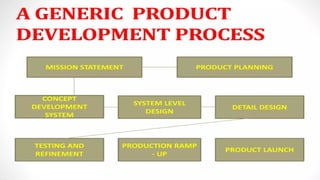
STEPS OF GENERIC DRUG PRODUCT DEVELOPMENT:
1. Concept development :
 the needs of the target market are identified ,alternative product concepts are generated and
evaluated and a single concept is selected for further development .
2. System level design :
 it includes the definition of the product into subsystem and components .
 the final assembly scheme for the product system is usually defined during this phase.
3. Detail Design:
 includes the complete specifications of the geometry materials and tolerance of ll the
unique parts in the product and the identificationb of all the standards parts to be
purchased from suppliers.
 A process plan is establish and tooling is designed for the each part to be fabricated
within thr production system.
4. testing and refinement:
 it involves the construction and evaluation of multiple pre-production vesion of the
product.
 early prototypes are usually built with production intent parts ( parts with same geometry
and material properities as intended for the production version of the product.)
 early prototypes are tested to determied whether the product will work as designed and
wheather it satisfies customer needs.
 the goal od prototypes are usually used to answer questions aboyt performance and
reliability in order to identify chnages for the final product.
5. Product ramp up :
 the purpose is to train the work force and to work out any remaining problems in the
production process.
 the artifacts produces during production ramp up are sometimes to the preffered customer
and are carefully evaluted to identify any remaining flaws .
HATCH WAXMAN ACT AND AMENDMENTS
 The “Drug price competition and patent term restoration Act of 1984” . also
known as the hatch -waxman amendments ,established the approval pathway for
generic drug products ,under wchich applicants can submit an abbreiated new
drug application (ANDA) under section 505(j) of the federal food ,drug and
cosmentic Act.
 In 1984 united states federal law which encourages the manufacture of generic
drugs by the pharmacuetical industry and established the modern system of govt
generic drug regulation in the united states.
In order to overcome the aboe problem an act was needed to promote generic drug
and innovators
In 1984 , two american politicians orrin grant hatch amd henry arnold waxman
sponsored the official act “The drug price competition and patent term restoration “
since then this act was informally known as Hatch -waxman Act .
OBJECTIVES OF THE ACT :
 Reduce the cost associated wth approval of generic drugs.
 allowing the early expermental use.
 motivating genric drugs manufactures.
PROVISION OF THE ACT
 Creation of section 505 (j) ( Abbreviated new drug applicaton [ANDA] )
Selection 505(j) established the ANDA approval process
The timing of an ANDA approval depends in part on patent protection for the innovator
drug .
NDA must include any patent that claims the drug or a method of using the drug for a
claim of patent infringement could reasonably be asserted .
On approval of NDA , FDA publishes patent information of drug in orange book.
An NDA applicant was submit the information for each patent :
a) patent no and date on which patent will expire
b) Type of patent,drug product ,method of use, name of the patent owner must be specified.
FOUR TYPES OF PATENT CERTIFICATIONS
When an applicant submit an ANDA to FDA , the applicant must certified
one of four things under section 505(j) A (vii)
Type 1 : The required patent information relating to such patent has not been filed .
Type 2 : That such patent has expired .
Type 3 :That the patent will expire on a particular date .
Type 4 : Such a patent is valid or will not be infringed by the drug , for which
approval is begin sought patent challenge .
BASIC REQUIREMENTS FOR A GENERIC DRUG / ANDA :
Same active ingredient (s)
Same route of administration
Same dosage from
Same strength
Same condition of use
In active ingredients already approved in a similar NDA .
GOAL OF ANDA :
 To reduce the price of the drug
 To reduce the time of development
 Increase the bioavailability of the drug in composition to references list drug .
LABELLING :
 Should include a copy of currently approved for listed drug an well as the proposed
labelling for ANDA a side by side comparision.
APPROVAL :
After all components of the application ae found to be acceptable an approval or
tentative approval letters are issued .
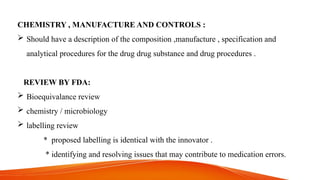
CHEMISTRY , MANUFACTURE AND CONTROLS :
 Should have a description of the composition ,manufacture , specification and
analytical procedures for the drug drug substance and drug procedures .
REVIEW BY FDA:
 Bioequivalance review
 chemistry / microbiology
 labelling review
* proposed labelling is identical with the innovator .
* identifying and resolving issues that may contribute to medication errors.
SIGNED 356H FDA:
IMPORTANCE OF ANDA / GENERIC DRUG :
1.Cost effectiveness: generic drugs were typically much cheaper than their brand name .
this is because generic manufactures do not have to invest in the initial reasearch and
development , marketing or adverstising costs that the original brand name drug
manufactureres . this leads to lower prices for consumers ,making medications more
affordable .
2.Access to medications : the lower cost of generics improves access to essential
medications particularly for people without comprehensive health insurance or those in
low - income setting . by reducing financial barriers generic drugs contribute to better
health outcomes.
3.Quality and safety : Generic drugs must meet the same rigorous standards set by
regulatory agencies like US FDA .they are required to have the same active ingredient
to have the same active ingredient ,dosage from , strength , adminintrqtion route as the
branded drugs and they are safe and effective.
4.Encourage competition : the availability of generic drugs encourages competiton in
the pharmacuetical market , leading to overall price reductions. this benefits not only
customers but also health care systems by reducing all overall spending on
medications .
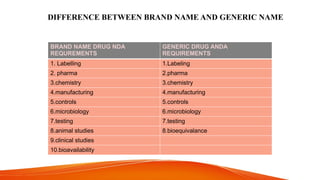
DIFFERENCE BETWEEN BRAND NAME AND GENERIC NAME
BRAND NAME DRUG
BRAND NAME DRUG NDA
REQUREMENTS
GENERIC DRUG ANDA
REQUIREMENTS
1. Labelling 1.Labeling
2. pharma 2.pharma
3.chemistry 3.chemistry
4.manufacturing 4.manufacturing
5.controls 5.controls
6.microbiology 6.microbiology
7.testing 7.testing
8.animal studies 8.bioequivalance
9.clinical studies
10.bioavailability
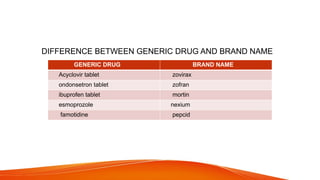
DIFFERENCE BETWEEN GENERIC DRUG AND BRAND NAME
GENERIC DRUG BRAND NAME
Acyclovir tablet zovirax
ondonsetron tablet zofran
ibuprofen tablet mortin
esmoprozole nexium
famotidine pepcid
THANK YOU

GENERIC DRUG PRODUCT DEVELOPMENT PROCESS

  • 1.
    GENERIC DRUG PRODUCT DEVELOPMENT PRESENTEDBY : GUDIVADA LAKSHMI PRIYA B.PHARM Final year in NRI COLLEGE OF PHARMACY. UNDER THE GUIDANCE OF : DR . P. APARNA Ph.D Professor, Dept of Pharmaceutics NRI COLLEGE OF PHARMACY , AGIRIPALLI, INDIA
  • 2.
    GENERIC DRUGS : Definition: Generic drug product is essentially identical to the brand name drug development in terms of active ingredient, dosage form , route of administration ,quality, safety, efficacy , Performance characteristics and therapeutic indication.  Brand drugs are the drugs which are protected by the patent.  Generic products growth is 19% in 1984 and 50% in 2004.  Every year about 4 billions dollars business potential exists for next 4 years due to patent expiry.  Safety , efficacy and therapeutic equivalence of such products early compared to the innovator or brand name drug product for obtaining marketing approval.
  • 3.
    Formulation considerations forgeneric drugs include :  The availability of raw materials ,chemical purity, polymorphic form.  Particle size of the active pharmaceutical ingredient.  Any patents that the innovator company has filed, including patents for the active pharmaceutical ingredient and composition of the dosage form. GENERIC DRUG DEVELOPMENT PROCESS:  The FDA’S office of generic drugs is responsible for reviweing the ANDA and approving the drugs products marketing.  and it aslso decribes how FDA determines the quality ,safety and efficacy of generic drug products prior to the approval for marketing.
  • 4.
    The ANDA forgeneric drug product approval is based on bioequivalance to the brand name product, appropriate and appropriate labelling.  generic drug sponsors don’t have to perform non clinical and safety studies that are included in the NDA.  NDA is submitted to FDA for market approval of the brand name drug product.  ANDA contains data which is submitted to FDA’s for drug evaluation & research for the generic drugs .  FDA approved generic drugs must meet the same rigid standards as the innoator drug.  Be identical strength ,dosage form, route of adminstration, same indicatons ,bioequivalent meet the batch requirements .  FDA’s approved drug products with therapeutic equivalance evaluations & lists of the approved products ,both innovator and generic are included in the orange book.
  • 5.
    STEPS OF GENERICDRUG PRODUCT DEVELOPMENT: 1. Concept development :  the needs of the target market are identified ,alternative product concepts are generated and evaluated and a single concept is selected for further development . 2. System level design :  it includes the definition of the product into subsystem and components .  the final assembly scheme for the product system is usually defined during this phase.
  • 6.
    3. Detail Design: includes the complete specifications of the geometry materials and tolerance of ll the unique parts in the product and the identificationb of all the standards parts to be purchased from suppliers.  A process plan is establish and tooling is designed for the each part to be fabricated within thr production system. 4. testing and refinement:  it involves the construction and evaluation of multiple pre-production vesion of the product.  early prototypes are usually built with production intent parts ( parts with same geometry and material properities as intended for the production version of the product.)
  • 7.
     early prototypesare tested to determied whether the product will work as designed and wheather it satisfies customer needs.  the goal od prototypes are usually used to answer questions aboyt performance and reliability in order to identify chnages for the final product. 5. Product ramp up :  the purpose is to train the work force and to work out any remaining problems in the production process.  the artifacts produces during production ramp up are sometimes to the preffered customer and are carefully evaluted to identify any remaining flaws .
  • 8.
    HATCH WAXMAN ACTAND AMENDMENTS  The “Drug price competition and patent term restoration Act of 1984” . also known as the hatch -waxman amendments ,established the approval pathway for generic drug products ,under wchich applicants can submit an abbreiated new drug application (ANDA) under section 505(j) of the federal food ,drug and cosmentic Act.  In 1984 united states federal law which encourages the manufacture of generic drugs by the pharmacuetical industry and established the modern system of govt generic drug regulation in the united states.
  • 9.
    In order toovercome the aboe problem an act was needed to promote generic drug and innovators In 1984 , two american politicians orrin grant hatch amd henry arnold waxman sponsored the official act “The drug price competition and patent term restoration “ since then this act was informally known as Hatch -waxman Act . OBJECTIVES OF THE ACT :  Reduce the cost associated wth approval of generic drugs.  allowing the early expermental use.  motivating genric drugs manufactures.
  • 10.
    PROVISION OF THEACT  Creation of section 505 (j) ( Abbreviated new drug applicaton [ANDA] ) Selection 505(j) established the ANDA approval process The timing of an ANDA approval depends in part on patent protection for the innovator drug . NDA must include any patent that claims the drug or a method of using the drug for a claim of patent infringement could reasonably be asserted . On approval of NDA , FDA publishes patent information of drug in orange book. An NDA applicant was submit the information for each patent : a) patent no and date on which patent will expire b) Type of patent,drug product ,method of use, name of the patent owner must be specified.
  • 11.
    FOUR TYPES OFPATENT CERTIFICATIONS When an applicant submit an ANDA to FDA , the applicant must certified one of four things under section 505(j) A (vii) Type 1 : The required patent information relating to such patent has not been filed . Type 2 : That such patent has expired . Type 3 :That the patent will expire on a particular date . Type 4 : Such a patent is valid or will not be infringed by the drug , for which approval is begin sought patent challenge .
  • 12.
    BASIC REQUIREMENTS FORA GENERIC DRUG / ANDA : Same active ingredient (s) Same route of administration Same dosage from Same strength Same condition of use In active ingredients already approved in a similar NDA .
  • 13.
    GOAL OF ANDA:  To reduce the price of the drug  To reduce the time of development  Increase the bioavailability of the drug in composition to references list drug . LABELLING :  Should include a copy of currently approved for listed drug an well as the proposed labelling for ANDA a side by side comparision. APPROVAL : After all components of the application ae found to be acceptable an approval or tentative approval letters are issued .
  • 14.
    CHEMISTRY , MANUFACTUREAND CONTROLS :  Should have a description of the composition ,manufacture , specification and analytical procedures for the drug drug substance and drug procedures . REVIEW BY FDA:  Bioequivalance review  chemistry / microbiology  labelling review * proposed labelling is identical with the innovator . * identifying and resolving issues that may contribute to medication errors.
  • 15.
  • 18.
    IMPORTANCE OF ANDA/ GENERIC DRUG : 1.Cost effectiveness: generic drugs were typically much cheaper than their brand name . this is because generic manufactures do not have to invest in the initial reasearch and development , marketing or adverstising costs that the original brand name drug manufactureres . this leads to lower prices for consumers ,making medications more affordable . 2.Access to medications : the lower cost of generics improves access to essential medications particularly for people without comprehensive health insurance or those in low - income setting . by reducing financial barriers generic drugs contribute to better health outcomes.
  • 19.
    3.Quality and safety: Generic drugs must meet the same rigorous standards set by regulatory agencies like US FDA .they are required to have the same active ingredient to have the same active ingredient ,dosage from , strength , adminintrqtion route as the branded drugs and they are safe and effective. 4.Encourage competition : the availability of generic drugs encourages competiton in the pharmacuetical market , leading to overall price reductions. this benefits not only customers but also health care systems by reducing all overall spending on medications .
  • 20.
    DIFFERENCE BETWEEN BRANDNAME AND GENERIC NAME BRAND NAME DRUG BRAND NAME DRUG NDA REQUREMENTS GENERIC DRUG ANDA REQUIREMENTS 1. Labelling 1.Labeling 2. pharma 2.pharma 3.chemistry 3.chemistry 4.manufacturing 4.manufacturing 5.controls 5.controls 6.microbiology 6.microbiology 7.testing 7.testing 8.animal studies 8.bioequivalance 9.clinical studies 10.bioavailability
  • 22.
    DIFFERENCE BETWEEN GENERICDRUG AND BRAND NAME GENERIC DRUG BRAND NAME Acyclovir tablet zovirax ondonsetron tablet zofran ibuprofen tablet mortin esmoprozole nexium famotidine pepcid
  • 23.