GENERIC DRUG DEVELOPMENT
Presented By:
DHIRAJ NITIN SONAWANE
M. PHARM
(DEPARTMENT OF PHARMACEUTICS)
ROLL NO: MPH16
R.C.PATEL INSTITUTE OF PHARMACEUTICAL
EDUCATION AND RESEARCH, SHIRPUR
1
Guided By:
DR. C. V. PARDESHI SIR
ASSOCIATE PROFESSOR
(DEPARTMENT OF PHARMACEUTICS)
1) Introduction to generic drugs.
2) Comparison Between Innovator Vs
Generic Drug Products (Similarities)
3) Comparison Between Innovator Vs Generic
Drug Products (Differences)
7) Generic Drug Development Process
6) Objectives Of The Act
5) Hatch-Waxman Act And Amendments
4) Price Comparison Between Generic drug
product and brand drug product
C
O
N
T
E
N
T
S:
2
8) Generic Drug approval Process
9) Conclusion
10) Reference
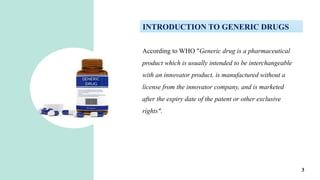
According to WHO "Generic drug is a pharmaceutical
product which is usually intended to be interchangeable
with an innovator product, is manufactured without a
license from the innovator company, and is marketed
after the expiry date of the patent or other exclusive
rights".
INTRODUCTION TO GENERIC DRUGS
3
EX- Phenytoin is the generic drug and Dilantin is the
brand name for the same drug.
 Brand drugs are the drugs which are protected by the
patent.
Generic products growth is 19% in 1984 and 50% in
2004.
INTRODUCTION TO GENERIC DRUGS
4
5
Attributes Innovator Generic
SIMILARITIES
Availability All licensed shops All licensed shops
cGMP Yes Yes
Test standards Yes Monographs
Stability Yes Yes
Safety Yes Yes
Regulatory compliance Yes Yes
Approval time More Short
Brand name Yes Yes
Cost of manufacturing Almost same Almost same
Fig.1.1. Comparison between innovator Vs generic drug products (similarities) 5
6
Attributes Innovator Generic
DIFFERENCES
Quality system Yes Personal Reference
Efficacy Yes Yes, but may not be
interchangeable
Manufacturing By innovator only By innovator or other than the
innovator
Composition Specific excipients Different excipients than the
innovator product
Price/value High Low
Packaging/ appearance Specific Different excipients than the
innovator product
Promotion responsibility Innovator Generic manufacturer and
government
Product development 12-14 Years 2-4 Years
Purity/size/strength Specific May slightly vary
Fig.1.2. Comparison between innovator Vs generic drug products (Differences)
6
7
Price Comparison between Generic drug product & Brand drug product :
7
HATCH-WAXMAN, 1984 ACT AND ITS
AMMENDMENTS
 It knows as “THE DRUG PRICE COMPETITION and PATENT RESTORATION ACT”
 Enacted in 1984
 Amended the patent laws
 Amended the federal food, drug and cosmetic act.
 Before 1962 new drug approval was based on safety alone.
 In 1962 proof of efficacy was made compulsory for marketing approval of a new drug.
8
OBJECTIVES OF THE ACT
Reduce the cost associated with approval of generic drugs.
Allowing the early experimental use.
Compensating the branded drugs manufactures for the time lost from the
patent term because of the regulatory approval formality.
 Motivating the generic drug manufactures.
9
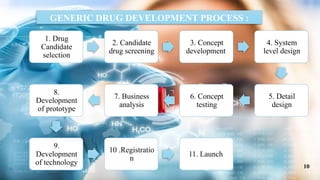
1 0
1. Drug
Candidate
selection
2. Candidate
drug screening
3. Concept
development
4. System
level design
5. Detail
design
6. Concept
testing
7. Business
analysis
8.
Development
of prototype
9.
Development
of technology
10 .Registratio
n
11. Launch
GENERIC DRUG DEVELOPMENT PROCESS :
10
1. Drug candidate selection: This phase covers
the broad selection of potential drug candidates.
2. Candidate drug screening : In this phase drug
candidates selected in the earlier phase is
carefully screened to roughly assess the potential
drug candidates.
3. Concept development: It is an exercise in
which the screened candidate drug is translated
into the product concept.
11
4. System-level design: This phase includes the definition of the product composition
and the division of the product into subsystems and components.
5. Detail design: A process plan is established within the production system. The output
of this phase is the control documentation for the product.
6. Concept testing: This phase is the laboratory development of a generic product. This
phase starts with experimental and accelerated stability study work, the development
based on a laboratory scale, including the (pilot) bio-equivalent-study and development
of the primary packaging.
Continue...
12
Fig1.3: Generic Drug Development Process
Continue...
13
Generic drug
Phase IV trials
Regulatory
review
Post-Marketing
surveillance
Generic ANDA
submission
Approval by regulator Marketing begins.
7. Production ramp up : The purpose is to train the work force and to look into any
remaining problems in production process.
8.Registration: Registration is
a phase of filing of registration
dossiers at regulatory
authorities, Fig. 1.3. It finishes
when the product is registered
and the registration
documentation and marketing
authorization is obtained.
9. Launch: The launch phase includes all final pre-launch activities such as the
ordering of materials, production of launch stock, ordering of raw materials,
packaging materials etc.
14
Continue...
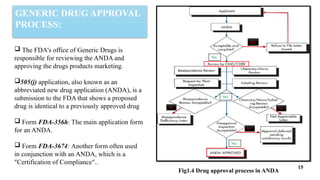
 The FDA's office of Generic Drugs is
responsible for reviewing the ANDA and
approving the drugs products marketing.
505(j) application, also known as an
abbreviated new drug application (ANDA), is a
submission to the FDA that shows a proposed
drug is identical to a previously approved drug
 Form FDA-356h: The main application form
for an ANDA.
 Form FDA-3674: Another form often used
in conjunction with an ANDA, which is a
"Certification of Compliance"..
GENERIC DRUG APPROVAL
PROCESS:
15
Fig1.4 Drug approval process in ANDA
Yes
Yes
Yes
No
No
No
No
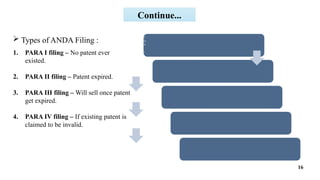
 Types of ANDA Filing :
16
Continue...
1. PARA I filing – No patent ever
existed.
2. PARA II filing – Patent expired.
3. PARA III filing – Will sell once patent
get expired.
4. PARA IV filing – If existing patent is
claimed to be invalid.
N
o
t
i
c
e
g
i
v
e
n
t
o
i
n
n
o
v
a
t
o
r
c
o
m
p
a
n
y
.
4
5
D
a
y
s
t
i
m
e
l
i
m
i
t
I
f
o
b
j
e
c
t
i
o
n
t
a
k
e
n
3
0
m
o
n
t
h
s
s
t
a
y
F
D
A
c
a
n
’
t
r
e
v
i
e
w
A
N
D
A
f
o
r
t
h
i
s
d
r
u
g
1 7
Conclusion
1. Affordable Healthcare: Generic drugs provide cost-effective
alternatives to brand-name medications, improving healthcare
affordability.
2. Quality and Safety: Strict regulatory frameworks ensure that
generics meet bioequivalence, safety, and efficacy standards.
3. Increased Access: They enhance access to essential
medications, especially in underserved regions.
4. Market Competition: Generics promote competition, driving
down overall drug prices.
5. Innovation Opportunities: Ongoing research and development
in generics help improve formulations and drug delivery
methods.
6. Economic Benefits: Generics contribute to significant
healthcare cost savings for both patients and healthcare
systems.
7. Global Reach: Expanding production and distribution
networks ensure better availability
17
REFERENCES :
1) Pharmaceutical regulatory science by Prof.(Dr.) R. Narayan Charyulu & Dr. Jobin Jose
published by Nirali Prakashan (Page no: 1.5-1.8)
2) Pharmaceutical regulatory science by Dr. Ashok A. Hajare published by Nirali
Prakashan (Page no: 1.24-1.35)
3) Mossinghoff, Gerald J. "Overview of the Hatch-Waxman Act and its impact on the drug
development process." Food & Drug LJ 54 (1999): 187.
4) Kanfer, Isadore, and Leon Shargel. "Generic Drug Product Development." DRUGS
AND THE PHARMACEUTICAL SCIENCES 201 (2010): 201.
18
19

Generic drug development process (MPH16) .pptx

  • 1.
    GENERIC DRUG DEVELOPMENT PresentedBy: DHIRAJ NITIN SONAWANE M. PHARM (DEPARTMENT OF PHARMACEUTICS) ROLL NO: MPH16 R.C.PATEL INSTITUTE OF PHARMACEUTICAL EDUCATION AND RESEARCH, SHIRPUR 1 Guided By: DR. C. V. PARDESHI SIR ASSOCIATE PROFESSOR (DEPARTMENT OF PHARMACEUTICS)
  • 2.
    1) Introduction togeneric drugs. 2) Comparison Between Innovator Vs Generic Drug Products (Similarities) 3) Comparison Between Innovator Vs Generic Drug Products (Differences) 7) Generic Drug Development Process 6) Objectives Of The Act 5) Hatch-Waxman Act And Amendments 4) Price Comparison Between Generic drug product and brand drug product C O N T E N T S: 2 8) Generic Drug approval Process 9) Conclusion 10) Reference
  • 3.
    According to WHO"Generic drug is a pharmaceutical product which is usually intended to be interchangeable with an innovator product, is manufactured without a license from the innovator company, and is marketed after the expiry date of the patent or other exclusive rights". INTRODUCTION TO GENERIC DRUGS 3
  • 4.
    EX- Phenytoin isthe generic drug and Dilantin is the brand name for the same drug.  Brand drugs are the drugs which are protected by the patent. Generic products growth is 19% in 1984 and 50% in 2004. INTRODUCTION TO GENERIC DRUGS 4
  • 5.
    5 Attributes Innovator Generic SIMILARITIES AvailabilityAll licensed shops All licensed shops cGMP Yes Yes Test standards Yes Monographs Stability Yes Yes Safety Yes Yes Regulatory compliance Yes Yes Approval time More Short Brand name Yes Yes Cost of manufacturing Almost same Almost same Fig.1.1. Comparison between innovator Vs generic drug products (similarities) 5
  • 6.
    6 Attributes Innovator Generic DIFFERENCES Qualitysystem Yes Personal Reference Efficacy Yes Yes, but may not be interchangeable Manufacturing By innovator only By innovator or other than the innovator Composition Specific excipients Different excipients than the innovator product Price/value High Low Packaging/ appearance Specific Different excipients than the innovator product Promotion responsibility Innovator Generic manufacturer and government Product development 12-14 Years 2-4 Years Purity/size/strength Specific May slightly vary Fig.1.2. Comparison between innovator Vs generic drug products (Differences) 6
  • 7.
    7 Price Comparison betweenGeneric drug product & Brand drug product : 7
  • 8.
    HATCH-WAXMAN, 1984 ACTAND ITS AMMENDMENTS  It knows as “THE DRUG PRICE COMPETITION and PATENT RESTORATION ACT”  Enacted in 1984  Amended the patent laws  Amended the federal food, drug and cosmetic act.  Before 1962 new drug approval was based on safety alone.  In 1962 proof of efficacy was made compulsory for marketing approval of a new drug. 8
  • 9.
    OBJECTIVES OF THEACT Reduce the cost associated with approval of generic drugs. Allowing the early experimental use. Compensating the branded drugs manufactures for the time lost from the patent term because of the regulatory approval formality.  Motivating the generic drug manufactures. 9
  • 10.
    1 0 1. Drug Candidate selection 2.Candidate drug screening 3. Concept development 4. System level design 5. Detail design 6. Concept testing 7. Business analysis 8. Development of prototype 9. Development of technology 10 .Registratio n 11. Launch GENERIC DRUG DEVELOPMENT PROCESS : 10
  • 11.
    1. Drug candidateselection: This phase covers the broad selection of potential drug candidates. 2. Candidate drug screening : In this phase drug candidates selected in the earlier phase is carefully screened to roughly assess the potential drug candidates. 3. Concept development: It is an exercise in which the screened candidate drug is translated into the product concept. 11
  • 12.
    4. System-level design:This phase includes the definition of the product composition and the division of the product into subsystems and components. 5. Detail design: A process plan is established within the production system. The output of this phase is the control documentation for the product. 6. Concept testing: This phase is the laboratory development of a generic product. This phase starts with experimental and accelerated stability study work, the development based on a laboratory scale, including the (pilot) bio-equivalent-study and development of the primary packaging. Continue... 12
  • 13.
    Fig1.3: Generic DrugDevelopment Process Continue... 13 Generic drug Phase IV trials Regulatory review Post-Marketing surveillance Generic ANDA submission Approval by regulator Marketing begins. 7. Production ramp up : The purpose is to train the work force and to look into any remaining problems in production process. 8.Registration: Registration is a phase of filing of registration dossiers at regulatory authorities, Fig. 1.3. It finishes when the product is registered and the registration documentation and marketing authorization is obtained.
  • 14.
    9. Launch: Thelaunch phase includes all final pre-launch activities such as the ordering of materials, production of launch stock, ordering of raw materials, packaging materials etc. 14 Continue...
  • 15.
     The FDA'soffice of Generic Drugs is responsible for reviewing the ANDA and approving the drugs products marketing. 505(j) application, also known as an abbreviated new drug application (ANDA), is a submission to the FDA that shows a proposed drug is identical to a previously approved drug  Form FDA-356h: The main application form for an ANDA.  Form FDA-3674: Another form often used in conjunction with an ANDA, which is a "Certification of Compliance".. GENERIC DRUG APPROVAL PROCESS: 15 Fig1.4 Drug approval process in ANDA Yes Yes Yes No No No No
  • 16.
     Types ofANDA Filing : 16 Continue... 1. PARA I filing – No patent ever existed. 2. PARA II filing – Patent expired. 3. PARA III filing – Will sell once patent get expired. 4. PARA IV filing – If existing patent is claimed to be invalid. N o t i c e g i v e n t o i n n o v a t o r c o m p a n y . 4 5 D a y s t i m e l i m i t I f o b j e c t i o n t a k e n 3 0 m o n t h s s t a y F D A c a n ’ t r e v i e w A N D A f o r t h i s d r u g
  • 17.
    1 7 Conclusion 1. AffordableHealthcare: Generic drugs provide cost-effective alternatives to brand-name medications, improving healthcare affordability. 2. Quality and Safety: Strict regulatory frameworks ensure that generics meet bioequivalence, safety, and efficacy standards. 3. Increased Access: They enhance access to essential medications, especially in underserved regions. 4. Market Competition: Generics promote competition, driving down overall drug prices. 5. Innovation Opportunities: Ongoing research and development in generics help improve formulations and drug delivery methods. 6. Economic Benefits: Generics contribute to significant healthcare cost savings for both patients and healthcare systems. 7. Global Reach: Expanding production and distribution networks ensure better availability 17
  • 18.
    REFERENCES : 1) Pharmaceuticalregulatory science by Prof.(Dr.) R. Narayan Charyulu & Dr. Jobin Jose published by Nirali Prakashan (Page no: 1.5-1.8) 2) Pharmaceutical regulatory science by Dr. Ashok A. Hajare published by Nirali Prakashan (Page no: 1.24-1.35) 3) Mossinghoff, Gerald J. "Overview of the Hatch-Waxman Act and its impact on the drug development process." Food & Drug LJ 54 (1999): 187. 4) Kanfer, Isadore, and Leon Shargel. "Generic Drug Product Development." DRUGS AND THE PHARMACEUTICAL SCIENCES 201 (2010): 201. 18
  • 19.