Machine Learning in Speech and Language Processing


                 Jeff A. Bilmes                   Patrick Haffner
                   Trutorial presented on March 19, 2005
                        ICASSP’05, PHILADEPHIA


                  2nd Half: Kernel and Margin Classifiers
                        Presented by Patrick Haffner


Bilmes/Haffner          Kernel and Margin-based Classifiers          0   1
2nd Half: Kernel and Margin Classifiers
  « Good classifiers for speech and language applications?
  « Huge range of approaches: focus on recent advances.
     Stronger emphasis on natural language applications:
          received a lot of recent attention from the Machine Learning
          community.
       Applications such as Neural Networks for Speech processing:
          Considered as an established technique
  « Key challenges:
     Beat the curse of dimensionality: good generalization to test
          data.
       Classifying structured objects.
       Scaling learning to very large corpora.

Bilmes/Haffner    Kernel and Margin-based Classifiers   Statistical learning theory   2
2nd Half: Outline
  « Statistical learning theory
  « Kernel Classifiers
     SVMs: Maximize the margin
     Making kernels, kernels for Structured Data
     String and Weighted Automata Kernels
  « Margin Classifiers
     Margin-based loss functions
     Generalize the concept of margin to a large class of classifier,
          including Boosting and Maxent.
       Large Scale Experiments
  « Software and References


Bilmes/Haffner   Kernel and Margin-based Classifiers   Statistical learning theory   3
Binary Classifiers


 Using training data (x1 , y1 ), . . . , (xm , ym ).
  « Associate output y to input x ∈ X
  « Most of our presentation assume binary classification:
    y ∈ {−1, 1} or {0, 1}.
 The following generalizations are usually possible:
  « Probability estimator y ∈ [0, 1].
  « Regression y ∈ R.
  « Multi-category classification y ∈ {1, . . . , l}.
  « Output codes y ∈ {−1, 1}l .
  « Graphical Models x is the set of variables y depends upon.


Bilmes/Haffner   Kernel and Margin-based Classifiers   Statistical learning theory   4
Statistical learning theory


  « Purpose:
     Techniques to predict the generalization error.
     Methods to minimize this error.
  « Model: we observe data generated by an unknown IID
      (Independent Identically Distributed) distribution.
  « Analysis of the learning problem
     What functions can the machine implement?
     Capacity of this class of function?


Bilmes/Haffner   Kernel and Margin-based Classifiers   Statistical learning theory   5
Empirical risk minimization

 Training examples (x1 , y1 ), . . . , (xm , ym ) drawn from P (x, y).
  « Learn f : X → {−1, +1}.
  « Minimize the expected risk on a test set drawn from the same
    P (x, y).
 Rexp [f ] =      L(f (x), y)dP (x, y) where L(f (x), y) = 2|f (x)−y|
 Problem:
  P is unknown
  Need an induction principle
 Find f ∈ F minimizing the Empirical Risk:
                                1
                      Rm [f ] =               L(f (xi ), yi )
                                m         m


Bilmes/Haffner   Kernel and Margin-based Classifiers   Statistical learning theory   6
Uniform convergence bounds

 Law of large numbers:Rm [f ] → Rexp [f ] when m → ∞.
 But convergence must be Uniform over all functions f ∈ F .


      lim P      sup (Rexp [f ] − Rm [f ])               = 0 for all  0
     m→∞         f ∈F

 Bounds to guarantee this convergence established by
 Vapnik (Vapnik, 1998) and others.
 They typically establish that with probability 1 − δ
                                              ˜
                                              O(h)
                        Rexp [f ] ≤ Rm [f ] +
                                              mα
 h is a measure of representation power of the function class F
 Example: VC dimension.


Bilmes/Haffner   Kernel and Margin-based Classifiers   Statistical learning theory   7
Putting bounds into practice


  « Worst case bounds are over-pessimistic:
     Huge number of examples required to guarantee good
          generalization
  « Most bounds are dimension free:
     they do not depend on the dimension of the sample space.
  « While they cannot be used for accurate predictions
     They suggest how to constrain the class of function to beat
          the curse of dimensionality
  « First success story: Support Vector Machines and Kernel
      methods.


Bilmes/Haffner   Kernel and Margin-based Classifiers   Statistical learning theory   8
2nd Half: Kernel Classifiers
  « Statistical learning theory
  « Kernel Classifiers
     SVMs: Maximize the margin
     Making kernels, kernels for Structured Data
     String and Weighted Automata Kernels
  « Margin Classifiers
     Margin-based loss functions
     Generalize the concept of margin to a large class of classifier,
          including Boosting and Maxent.
       Large Scale Experiments
  « Software and References


Bilmes/Haffner   Kernel and Margin-based Classifiers   Maximize the margin   9
Large-Margin Classifiers, Support Vector Machines


                      = sign(w · x + b).
 Classifiers of type f (x)
                                1 ˜ D2
  « Bound Rexp [f ] ≤ Rm [f ] + m O( M 2 )
 Separate classes with the maximum margin M :

                                                      Support Vectors


                                                       Diameter D of smallest sphere cont. data.


                                                                                                   Margin M


 Soft margin to allow training errors: described later.


Bilmes/Haffner   Kernel and Margin-based Classifiers           Maximize the margin                             10
Finding the maximum margin separation


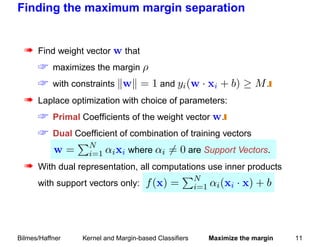
  « Find weight vector w that
     maximizes the margin ρ
     with constraints w = 1 and yi (w · xi + b) ≥ M .
  « Laplace optimization with choice of parameters:
     Primal Coefficients of the weight vector w.
     Dual Coefficient of combination of training vectors
                   N
           w=      i=1 αi xi where      αi = 0 are Support Vectors.
  « With dual representation, all computations use inner products
                                            N
    with support vectors only: f (x) =      i=1 αi (xi · x) + b


Bilmes/Haffner   Kernel and Margin-based Classifiers   Maximize the margin   11
Non-Linear SVMs

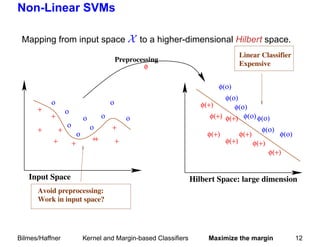
 Mapping from input space X to a higher-dimensional Hilbert space.
                                                                                       Linear Classifier
                                                Preprocessing
                                                        φ                              Expensive


                                                                            φ(ο)
                                                                               φ(ο)
           ο                                ο                          φ(+)
      +                                                                           φ(ο)
                   ο
           +                   ο        ο           ο                     φ(+) φ(+) φ(ο) φ(ο)
                   ο               ο        +
      +        +                                                                                φ(ο)
                           ο                                             φ(+)          φ(+)             φ(ο)
           +                       ++           +                               φ(+)
                       +                                                                      φ(+)
                                                                                                     φ(+)


   Input Space                                                      Hilbert Space: large dimension
      Avoid preprocessing:
      Work in input space?


Bilmes/Haffner                 Kernel and Margin-based Classifiers        Maximize the margin                   12
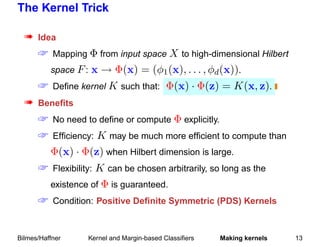
The Kernel Trick

  « Idea
     Mapping Φ from input space X to high-dimensional Hilbert
       space F : x → Φ(x) = (φ1 (x), . . . , φd (x)).
     Define kernel K such that: Φ(x) · Φ(z) = K(x, z).
  « Benefits
     No need to define or compute Φ explicitly.
     Efficiency: K may be much more efficient to compute than
      Φ(x) · Φ(z) when Hilbert dimension is large.
     Flexibility: K can be chosen arbitrarily, so long as the
      existence of Φ is guaranteed.
     Condition: Positive Definite Symmetric (PDS) Kernels


Bilmes/Haffner   Kernel and Margin-based Classifiers   Making kernels   13
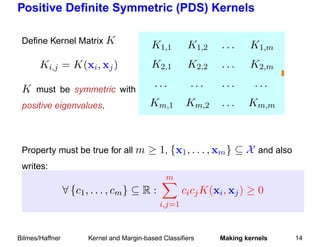
Positive Definite Symmetric (PDS) Kernels

 Define Kernel Matrix K
                                            K1,1       K1,2     ...    K1,m
       Ki,j = K(xi , xj )                   K2,1       K2,2     ...    K2,m
                                             ...        ...     ...      ...
 K must be symmetric with
 positive eigenvalues.                     Km,1        Km,2     ...    Km,m


 Property must be true for all m           ≥ 1, {x1 , . . . , xm } ⊆ X and also
 writes:
                                                m
                 ∀ {c1 , . . . , cm } ⊆ R :           ci cj K(xi , xj ) ≥ 0
                                              i,j=1


Bilmes/Haffner          Kernel and Margin-based Classifiers     Making kernels     14
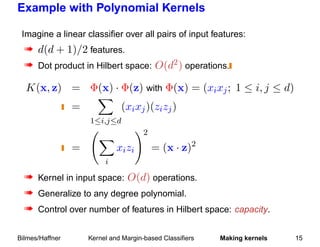
Example with Polynomial Kernels

 Imagine a linear classifier over all pairs of input features:
  « d(d + 1)/2 features.
  « Dot product in Hilbert space: O(d2 ) operations.

  K(x, z) = Φ(x) · Φ(z) with Φ(x) = (xi xj ; 1 ≤ i, j ≤ d)
                 =             (xi xj )(zi zj )
                     1≤i,j≤d
                                      2
                 =            xi zi       = (x · z)2
                          i

  « Kernel in input space: O(d) operations.
  « Generalize to any degree polynomial.
  « Control over number of features in Hilbert space: capacity.

Bilmes/Haffner       Kernel and Margin-based Classifiers   Making kernels   15
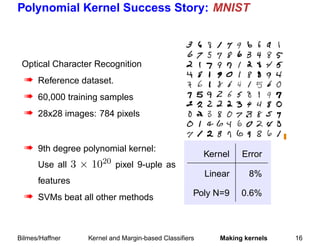
Polynomial Kernel Success Story: MNIST


 Optical Character Recognition
  « Reference dataset.
  « 60,000 training samples
  « 28x28 images: 784 pixels


  « 9th degree polynomial kernel:
                                                      Kernel   Error
    Use all 3 × 1020 pixel 9-uple as
                                                      Linear     8%
      features
  « SVMs beat all other methods                   Poly N=9     0.6%


Bilmes/Haffner   Kernel and Margin-based Classifiers      Making kernels   16
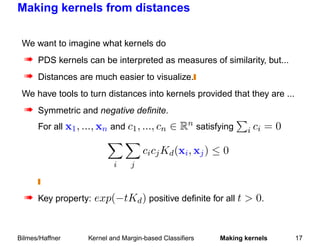
Making kernels from distances

 We want to imagine what kernels do
  « PDS kernels can be interpreted as measures of similarity, but...
  « Distances are much easier to visualize.
 We have tools to turn distances into kernels provided that they are ...
  « Symmetric and negative definite.
    For all x1 , ..., xn and c1 , ..., cn ∈ Rn satisfying      i ci   =0

                                   ci cj Kd (xi , xj ) ≤ 0
                          i    j


  « Key property: exp(−tKd ) positive definite for all t  0.


Bilmes/Haffner    Kernel and Margin-based Classifiers   Making kernels      17
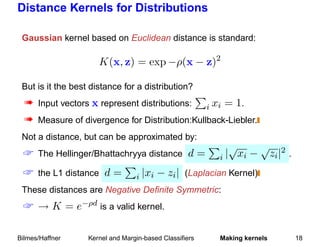
Distance Kernels for Distributions

 Gaussian kernel based on Euclidean distance is standard:

                      K(x, z) = exp −ρ(x − z)2

 But is it the best distance for a distribution?
  « Input vectors x represent distributions:            i xi   = 1.
  « Measure of divergence for Distribution:Kullback-Liebler.
 Not a distance, but can be approximated by:
                                                              √    √ 2
  The Hellinger/Bhattachryya distance d =                 i | xi − zi | .

  the L1 distance d =            i |xi   − zi | (Laplacian Kernel)
 These distances are Negative Definite Symmetric:
  → K = e−ρd is a valid kernel.

Bilmes/Haffner     Kernel and Margin-based Classifiers      Making kernels    18
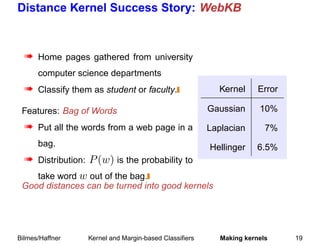
Distance Kernel Success Story: WebKB


  « Home pages gathered from university
      computer science departments
  « Classify them as student or faculty.                 Kernel      Error

 Features: Bag of Words                                Gaussian      10%

  « Put all the words from a web page in a             Laplacian       7%
      bag.                                             Hellinger     6.5%
  « Distribution: P (w) is the probability to
    take word w out of the bag.
 Good distances can be turned into good kernels


Bilmes/Haffner    Kernel and Margin-based Classifiers      Making kernels     19
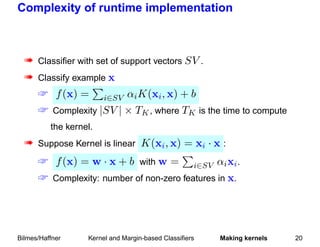
Complexity of runtime implementation


  « Classifier with set of support vectors SV .
  « Classify example x
     f (x) = i∈SV αi K(xi , x) + b
     Complexity |SV | × TK , where TK is the time to compute
          the kernel.
  « Suppose Kernel is linear K(xi , x) = xi · x :
       f (x) = w · x + b with w = i∈SV αi xi .
       Complexity: number of non-zero features in x.


Bilmes/Haffner     Kernel and Margin-based Classifiers   Making kernels   20
Classifying complex objects

  « Classification algorithms on flat fixed-size input vectors.
  « However, the world is more complex in areas such as:
     Spoken-dialog classification (strings, graphs)
     Text Categorization (strings)
     Parsing/reranking (trees)
     Part-of-speech tagging, named entity extraction (strings,
          trees)
  « Traditional method: feature extraction.
  « Kernels are a measure of similarity between objects, or a
      distance that:
       Avoid explicit computation a large-dimension feature space.
       By factorizing these computations.

Bilmes/Haffner     Kernel and Margin-based Classifiers   Kernels for Structured Data   21
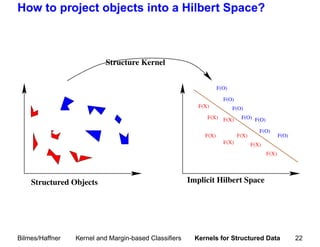
How to project objects into a Hilbert Space?


                          Structure Kernel


                                                                  F(O)

                                                                    F(O)
                                                         F(X)            F(O)
                                                            F(X) F(X)       F(O) F(O)

                                                                                     F(O)
                                                           F(X)            F(X)                 F(O)
                                                                    F(X)          F(X)
                                                                                         F(X)


    Structured Objects                                Implicit Hilbert Space


Bilmes/Haffner   Kernel and Margin-based Classifiers     Kernels for Structured Data                    22
Kernels for structured data


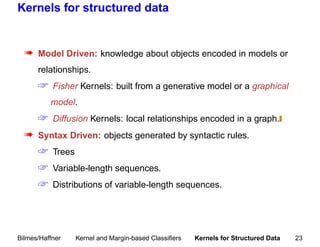
  « Model Driven: knowledge about objects encoded in models or
      relationships.
       Fisher Kernels: built from a generative model or a graphical
          model.
       Diffusion Kernels: local relationships encoded in a graph.
  « Syntax Driven: objects generated by syntactic rules.
     Trees
     Variable-length sequences.
     Distributions of variable-length sequences.


Bilmes/Haffner   Kernel and Margin-based Classifiers   Kernels for Structured Data   23
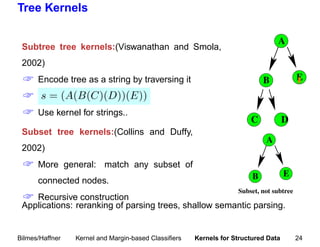
Tree Kernels

                                                                                A
 Subtree tree kernels:(Viswanathan and Smola,
 2002)
  Encode tree as a string by traversing it                                 B            E
  s = (A(B(C)(D))(E))
  Use kernel for strings..
                                                                       C            D
 Subset tree kernels:(Collins and Duffy,
                                                                            A
 2002)
  More general: match any subset of
                                                                        B           E
      connected nodes.
                                                                   Subset, not subtree
  Recursive construction
 Applications: reranking of parsing trees, shallow semantic parsing.


Bilmes/Haffner   Kernel and Margin-based Classifiers   Kernels for Structured Data        24
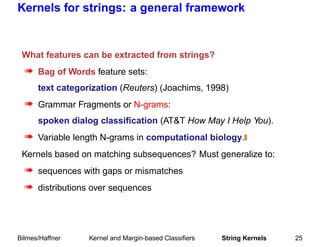
Kernels for strings: a general framework


 What features can be extracted from strings?
  « Bag of Words feature sets:
      text categorization (Reuters) (Joachims, 1998)
  « Grammar Fragments or N-grams:
      spoken dialog classification (ATT How May I Help You).
  « Variable length N-grams in computational biology.
 Kernels based on matching subsequences? Must generalize to:
  « sequences with gaps or mismatches
  « distributions over sequences


Bilmes/Haffner    Kernel and Margin-based Classifiers   String Kernels   25
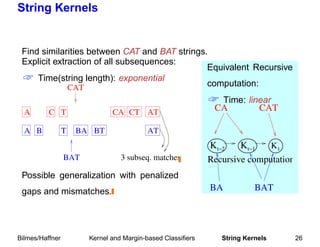
String Kernels


 Find similarities between CAT and BAT strings.
 Explicit extraction of all subsequences:
                                               Equivalent Recursive
  Time(string length): exponential            computation:
              CAT
                                                             Time: linear
  A       C T                 CA CT AT                       CA            CAT

  A B            T   BA BT               AT
                                                            Kt−2    Kt−1        Kt
                 BAT             3 subseq. matches          Recursive computation
 Possible generalization with penalized
 gaps and mismatches.                                       BA           BAT


Bilmes/Haffner         Kernel and Margin-based Classifiers      String Kernels        26
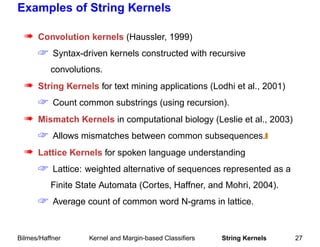
Examples of String Kernels

  « Convolution kernels (Haussler, 1999)
     Syntax-driven kernels constructed with recursive
          convolutions.
  « String Kernels for text mining applications (Lodhi et al., 2001)
     Count common substrings (using recursion).
  « Mismatch Kernels in computational biology (Leslie et al., 2003)
     Allows mismatches between common subsequences.
  « Lattice Kernels for spoken language understanding
     Lattice: weighted alternative of sequences represented as a
          Finite State Automata (Cortes, Haffner, and Mohri, 2004).
       Average count of common word N-grams in lattice.


Bilmes/Haffner     Kernel and Margin-based Classifiers   String Kernels   27
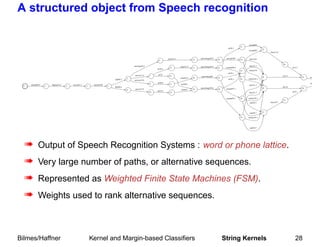
A structured object from Speech recognition

                                                                                                                                                                                                      around/81
                                                                                                                                                                                                 27
                                                                                                                                                                                     at/19.1
                                                                                                                                                                                                      around/83     32
                                                                                                                                                                                                                         nine/21.8


                                                                                                                            saint/51.2                     petersburg/83.6         around/107         nine/5.61
                                                                                                                   9                                  14                     19                  23

                                                                                                                                                                                                                                     36
                                                                                             arriving/45.2                               saint/51.9        petersburg/85.9                            nine/21.7
                                                                                                                              12                      17                     21    around/96.5                                                a/15.3
                                                                                                                  in/16.3
                                                                                                                                                                                                 25   ninety/18
                                                                                                                                                                                     at/16.1
                                                                                              arrive/17.4          at/23
                                                                                                             7                11                           petersburg/80                                                             a/15.3
                                                                                                                                         saint/49.4   18                     22                                     29                                 33   m/13.9
                                                                             and/49.7    5                                                                                           at/16.1     26   ninety/34.1
                                                                                             arrives/23.6
                                                                                                             8    at/20.9                                                                                                                                   m/12.5
     which/69.9       flights/53.1       leave/61.2        detroit/105                                                        13         saint/43                                                     nine/21.7
 0                1                  2                3                  4   that/60.1                                                                                                                                               a/9.34
                                                                                                                                                           petersburg/85.6         around/97.1                      30                                 34
                                                                                         6    arrive/12.8                                saint/43     16                     20
                                                                                                                  at/21.9                                                                                                                     a/14.1
                                                                                                             10               15                                                                      nine/21.7


                                                                                                                                                                                   around/97.1   28   ninety/34.1
                                                                                                                                                                                                                                     35
                                                                                                                                                                                                       and/18.7          nine/10.7


                                                                                                                                                                                                       and/18.7     31

                                                                                                                                                                                                 24   ninety/34.1


                                                                                                                                                                                                       and/18.7


  « Output of Speech Recognition Systems : word or phone lattice.
  « Very large number of paths, or alternative sequences.
  « Represented as Weighted Finite State Machines (FSM).
  « Weights used to rank alternative sequences.


Bilmes/Haffner                                            Kernel and Margin-based Classifiers                                                                                      String Kernels                                                 28
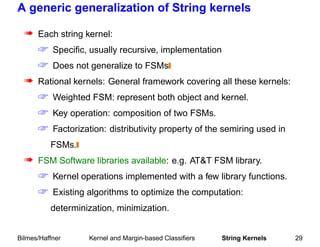
A generic generalization of String kernels

  « Each string kernel:
     Specific, usually recursive, implementation
     Does not generalize to FSMs
  « Rational kernels: General framework covering all these kernels:
     Weighted FSM: represent both object and kernel.
     Key operation: composition of two FSMs.
     Factorization: distributivity property of the semiring used in
          FSMs.
  « FSM Software libraries available: e.g. ATT FSM library.
     Kernel operations implemented with a few library functions.
     Existing algorithms to optimize the computation:
          determinization, minimization.


Bilmes/Haffner     Kernel and Margin-based Classifiers   String Kernels   29
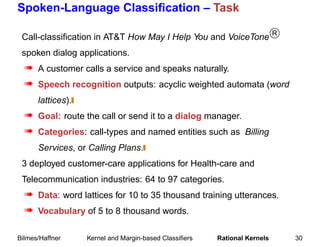
Spoken-Language Classification – Task

                                                                           R
 Call-classification in ATT How May I Help You and VoiceTone
 spoken dialog applications.
  « A customer calls a service and speaks naturally.
  « Speech recognition outputs: acyclic weighted automata (word
      lattices).
  « Goal: route the call or send it to a dialog manager.
  « Categories: call-types and named entities such as Billing
      Services, or Calling Plans.
 3 deployed customer-care applications for Health-care and
 Telecommunication industries: 64 to 97 categories.
  « Data: word lattices for 10 to 35 thousand training utterances.
  « Vocabulary of 5 to 8 thousand words.

Bilmes/Haffner     Kernel and Margin-based Classifiers   Rational Kernels       30
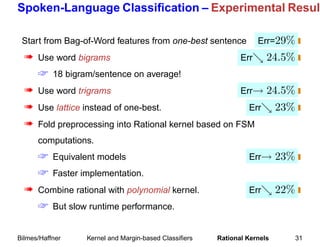
Spoken-Language Classification – Experimental Result

 Start from Bag-of-Word features from one-best sentence            Err=29%
  « Use word bigrams                                         Err     24.5%
     18 bigram/sentence on average!
  « Use word trigrams                                        Err→    24.5%
  « Use lattice instead of one-best.                           Err       23%
  « Fold preprocessing into Rational kernel based on FSM
      computations.
       Equivalent models                                      Err→      23%
       Faster implementation.
  « Combine rational with polynomial kernel.                   Err       22%
     But slow runtime performance.

Bilmes/Haffner   Kernel and Margin-based Classifiers   Rational Kernels         31
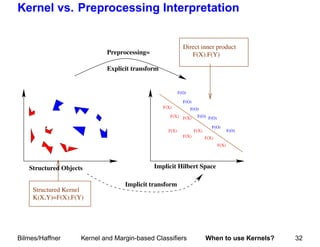
Kernel vs. Preprocessing Interpretation


                                                            Direct inner product
                            Preprocessing=                     F(X).F(Y)

                            Explicit transform


                                                          F(O)

                                                            F(O)
                                                 F(X)            F(O)
                                                    F(X) F(X)       F(O) F(O)

                                                                             F(O)
                                                   F(X)            F(X)                 F(O)
                                                            F(X)          F(X)
                                                                                 F(X)


   Structured Objects                        Implicit Hilbert Space

                                  Implicit transform
    Structured Kernel
    K(X,Y)=F(X).F(Y)


Bilmes/Haffner      Kernel and Margin-based Classifiers                    When to use Kernels?   32
Kernel vs. Preprocessing Alternative


 Structured kernels such as string, rational or tree kernels provide
  « Frameworks to understand what type of PDS kernels can be built
  « Efficient and generic implementations
 They avoid computing features whose number:
  « in theory, grow exponentially
  « in practice, number of non-zero features surprisingly small.
 When to prefer a combination of preprocessing and linear classifiers?
  « Sparsity of Features: attractive in Natural Language
      applications.
  « Much faster runtime implementation.


Bilmes/Haffner   Kernel and Margin-based Classifiers   When to use Kernels?   33
2nd Half: Margin Classifiers
  « Statistical learning theory
  « Kernel Classifiers
     SVMs: Maximize the margin
     Making kernels, kernels for Structured Data
     String and Weighted Automata Kernels
  « Margin Classifiers
     Margin-based linear classifiers
     Generalize the concept of margin to a large class of classfier,
          including Boosting and Maxent.
       Large Scale Experiments
  « Software and References


Bilmes/Haffner   Kernel and Margin-based Classifiers   When to use Kernels?   34
Classification for Natural Language Applications


  « Large number of training examples and classes.
  « Large number of possible features
  « Each example: small number of non zero features.
 Examples
  « Spoken Language Understanding
  « Text categorization.
  « Part-of-speech tagging: millions of examples.
  « Machine Translation:  100, 000 classes.


Bilmes/Haffner   Kernel and Margin-based Classifiers   When to use Kernels?   35
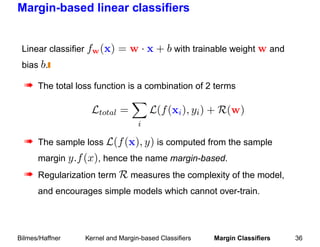
Margin-based linear classifiers


 Linear classifier fw (x)   = w · x + b with trainable weight w and
 bias b.

  « The total loss function is a combination of 2 terms

                  Ltotal =           L(f (xi ), yi ) + R(w)
                                 i

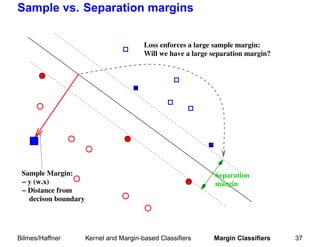
  « The sample loss L(f (x), y) is computed from the sample
    margin y.f (x), hence the name margin-based.
  « Regularization term R measures the complexity of the model,
      and encourages simple models which cannot over-train.


Bilmes/Haffner   Kernel and Margin-based Classifiers   Margin Classifiers   36
Sample vs. Separation margins


                                        Loss enforces a large sample margin:
                                        Will we have a large separation margin?


 Sample Margin:                                              Separation
 − y (w.x)                                                   margin
 − Distance from
   decison boundary


Bilmes/Haffner        Kernel and Margin-based Classifiers     Margin Classifiers    37
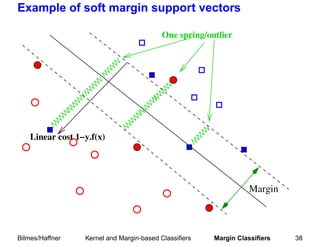
Example of soft margin support vectors

                                          One spring/outlier


    Linear cost 1−y.f(x)


                                                                 Margin


Bilmes/Haffner    Kernel and Margin-based Classifiers   Margin Classifiers   38
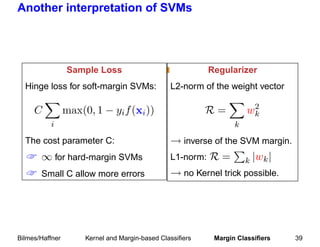
Another interpretation of SVMs


                  Sample Loss                              Regularizer
  Hinge loss for soft-margin SVMs:               L2-norm of the weight vector

     C           max(0, 1 − yi f (xi ))                    R=         w2
                                                                       k
          i                                                       k

  The cost parameter C:                          → inverse of the SVM margin.
   ∞ for hard-margin SVMs                       L1-norm: R =      k |w k |
   Small C allow more errors                    → no Kernel trick possible.


Bilmes/Haffner        Kernel and Margin-based Classifiers    Margin Classifiers   39
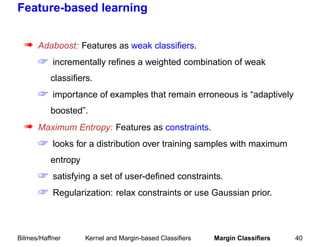
Feature-based learning


  « Adaboost: Features as weak classifiers.
     incrementally refines a weighted combination of weak
          classifiers.
       importance of examples that remain erroneous is “adaptively
          boosted”.
  « Maximum Entropy: Features as constraints.
     looks for a distribution over training samples with maximum
          entropy
       satisfying a set of user-defined constraints.
       Regularization: relax constraints or use Gaussian prior.


Bilmes/Haffner      Kernel and Margin-based Classifiers   Margin Classifiers   40
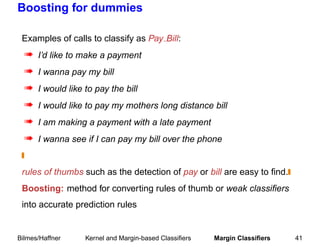
Boosting for dummies

 Examples of calls to classify as Pay Bill:
  « I’d like to make a payment
  « I wanna pay my bill
  « I would like to pay the bill
  « I would like to pay my mothers long distance bill
  « I am making a payment with a late payment
  « I wanna see if I can pay my bill over the phone

 rules of thumbs such as the detection of pay or bill are easy to find.
 Boosting: method for converting rules of thumb or weak classifiers
 into accurate prediction rules


Bilmes/Haffner    Kernel and Margin-based Classifiers   Margin Classifiers   41
The boosting family of algorithms

  « Training examples (x1 , y1 ), . . . , (xm , ym ) ∈ X × {−1, 1}.
  « for t = 1, . . . , T :
     update distribution Dt on examples {1, . . . , m}
     find weak hypotheses ht : X → {−1, 1}
     with small error t = PrDt [ht (xi ) = yi ]
  « Output final hypotheses Hf inal .
 Most famous member of the family: Adaboost (Freund and Schapire,
 1996)
                                            1         1−
  « Using weight-update factor α =          2   log    t
                                                           t


                   Dt (i)
  « Dt+1 (i) =      Zt      exp(−αt yi ht (xi ))
  « Hf inal (x) = sign(          t αt ht (x))


Bilmes/Haffner   Kernel and Margin-based Classifiers        Margin Classifiers   42
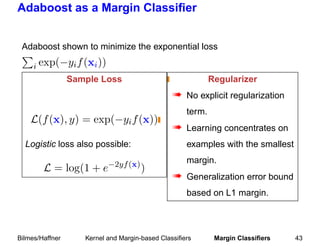
Adaboost as a Margin Classifier


 Adaboost shown to minimize the exponential loss

     i exp(−yi f (xi ))
                 Sample Loss                                Regularizer
                                                « No explicit regularization
                                                    term.
    L(f (x), y) = exp(−yi f (x))
                                                « Learning concentrates on
  Logistic loss also possible:                      examples with the smallest

                           −2yf (x)                 margin.
        L = log(1 + e                 )
                                                « Generalization error bound
                                                    based on L1 margin.


Bilmes/Haffner      Kernel and Margin-based Classifiers       Margin Classifiers   43
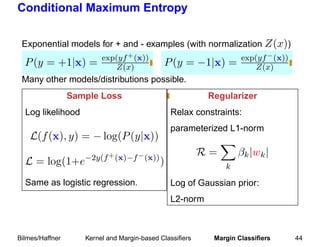
Conditional Maximum Entropy

 Exponential models for + and - examples (with normalization Z(x))
                         exp(yf + (x))                             exp(yf − (x))
  P (y = +1|x) =            Z(x)             P (y = −1|x) =            Z(x)
 Many other models/distributions possible.
                 Sample Loss                              Regularizer
  Log likelihood                                Relax constraints:
                                                parameterized L1-norm
    L(f (x), y) = − log(P (y|x))
                    −2y(f + (x)−f − (x))
                                                         R=       βk |wk |
  L = log(1+e                               )                 k

  Same as logistic regression.                  Log of Gaussian prior:
                                                L2-norm


Bilmes/Haffner      Kernel and Margin-based Classifiers     Margin Classifiers       44
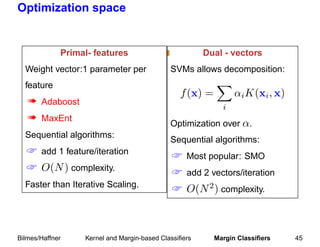
Optimization space


             Primal- features                          Dual - vectors
  Weight vector:1 parameter per              SVMs allows decomposition:
  feature
                                                f (x) =         αi K(xi , x)
   « Adaboost                                               i
   « MaxEnt                                  Optimization over α.
  Sequential algorithms:
                                             Sequential algorithms:
   add 1 feature/iteration                   Most popular: SMO
   O(N ) complexity.                         add 2 vectors/iteration
  Faster than Iterative Scaling.
                                              O(N 2 ) complexity.


Bilmes/Haffner    Kernel and Margin-based Classifiers      Margin Classifiers    45
Multiclass learning - Previous work


  « Large Margin Classifiers are by essence binary.
  « Many combination of binary classifiers are possible:
     1-vs-other: separate examples belonging to one class from all
          others (Rifkin and Klautau, 2004).
         1-vs-1: each classifier is trained to separate a pair of classes.
         ECOC: error correcting output codes. (Crammer and Singer, 2000)
         Hierarchical approaches have only been studied recently.
  « Problem with methods based on recombination of binary classifiers:
     Each classifier corresponds to a different optimization problem.
     Do not guarantee a global optimality.
  « Global optimization procedure possible but expensive:
    Often requires C times more time and memory.


Bilmes/Haffner     Kernel and Margin-based Classifiers   Margin Classifiers    46
Specific Multiclass Interpretations


 Definition of a multiclass sample margin:
  « Target class c: margin is fc (x) − supd=c fd (x).
  « Costly global optimization required, without improved results
     Adaboost.MR (Schapire and Singer, 2000).
     Several SVM formalizations.
 Probabilistic framework
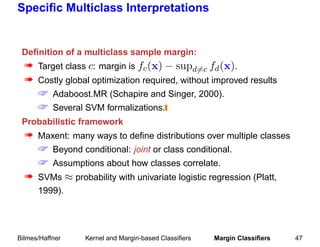
  « Maxent: many ways to define distributions over multiple classes
     Beyond conditional: joint or class conditional.
     Assumptions about how classes correlate.
  « SVMs ≈ probability with univariate logistic regression (Platt,
      1999).


Bilmes/Haffner   Kernel and Margin-based Classifiers   Margin Classifiers   47
Large Scale Experiments


                      R
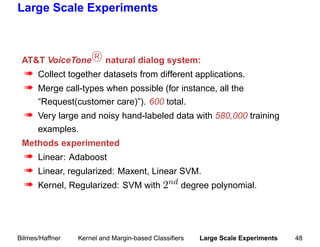
 ATT VoiceTone           natural dialog system:
  « Collect together datasets from different applications.
  « Merge call-types when possible (for instance, all the
      “Request(customer care)”). 600 total.
  « Very large and noisy hand-labeled data with 580,000 training
      examples.
 Methods experimented
  « Linear: Adaboost
  « Linear, regularized: Maxent, Linear SVM.
  « Kernel, Regularized: SVM with 2nd degree polynomial.


Bilmes/Haffner   Kernel and Margin-based Classifiers   Large Scale Experiments   48
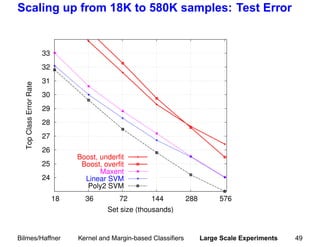
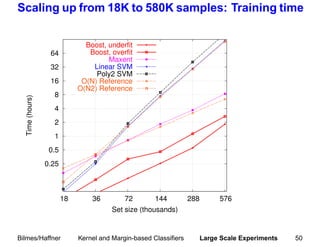
Scaling up from 18K to 580K samples: Test Error


                         33
                         32
                         31
  Top Class Error Rate


                         30
                         29
                         28
                         27
                         26
                                   Boost, underfit
                         25         Boost, overfit
                                          Maxent
                         24          Linear SVM
                                      Poly2 SVM
                              18     36         72        144           288        576
                                            Set size (thousands)


Bilmes/Haffner                     Kernel and Margin-based Classifiers         Large Scale Experiments   49
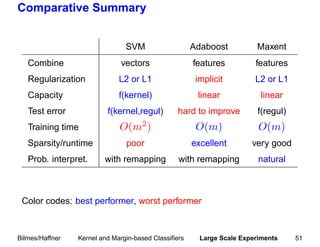
Scaling up from 18K to 580K samples: Training time


                               Boost, underfit
                  64            Boost, overfit
                                      Maxent
                  32             Linear SVM
                                  Poly2 SVM
                  16          O(N) Reference
                             O(N2) Reference
                   8
  Time (hours)


                   4
                   2
                   1
                  0.5
                 0.25


                        18       36        72        144          288        576
                                       Set size (thousands)


Bilmes/Haffner               Kernel and Margin-based Classifiers         Large Scale Experiments   50
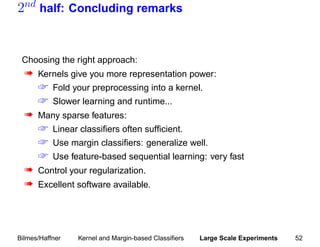
Comparative Summary


                                SVM                   Adaboost          Maxent
   Combine                    vectors                 features          features
   Regularization             L2 or L1                 implicit         L2 or L1
   Capacity                   f(kernel)                linear             linear
   Test error             f(kernel,regul)        hard to improve         f(regul)
   Training time              O(m2 )                   O(m)              O(m)
   Sparsity/runtime             poor                  excellent        very good
   Prob. interpret.      with remapping          with remapping          natural


 Color codes: best performer, worst performer


Bilmes/Haffner   Kernel and Margin-based Classifiers     Large Scale Experiments     51
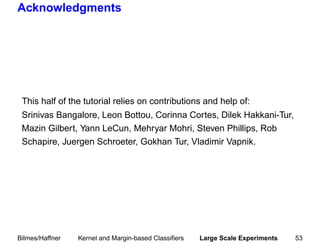
2nd half: Concluding remarks


 Choosing the right approach:
  « Kernels give you more representation power:
     Fold your preprocessing into a kernel.
     Slower learning and runtime...
  « Many sparse features:
     Linear classifiers often sufficient.
     Use margin classifiers: generalize well.
     Use feature-based sequential learning: very fast
  « Control your regularization.
  « Excellent software available.


Bilmes/Haffner   Kernel and Margin-based Classifiers   Large Scale Experiments   52
Acknowledgments


 This half of the tutorial relies on contributions and help of:
 Srinivas Bangalore, Leon Bottou, Corinna Cortes, Dilek Hakkani-Tur,
 Mazin Gilbert, Yann LeCun, Mehryar Mohri, Steven Phillips, Rob
 Schapire, Juergen Schroeter, Gokhan Tur, Vladimir Vapnik.


Bilmes/Haffner   Kernel and Margin-based Classifiers   Large Scale Experiments   53
Online References


  « SVM: http://www.kernel-machines.org/
  « Boosting:
     Website: http://www.boosting.org/
     Schapire’s publications:
       http://www.cs.princeton.edu/˜schapire/boost.ht
     Freund’s applet:
       http://www1.cs.columbia.edu/˜freund/adaboost/
  « Maxent:
    http://www-2.cs.cmu.edu/˜aberger/maxent.html


Bilmes/Haffner   Kernel and Margin-based Classifiers   Software and References   54
Software

  « FSM library
    http://www.research.att.com/sw/tools/fsm
  « SVM light http://svmlight.joachims.org/
     Ready to use implementation optimized for Natural Language
          applications. Can handle structured data.
  «    LIBSVM
      http://www.csie.ntu.edu.tw/˜cjlin/libsvm/
       An integrated tool implementing support vector classification,
        regression, and distribution estimation. C++ and Java sources
        available.
  «   SVM torch http://www.torch.ch/
       a modular library supporting SVMs, Adaboost and gradient based
        learning
  «   BoosTexter www.cs.princeton.edu/˜schapire/BoosTexter/
       a general purpose machine-learning program based on boosting for
        building a classifier from text and/or attribute-value data.


Bilmes/Haffner   Kernel and Margin-based Classifiers   Software and References   55
Books

  « Trevor Hastie, Robert Tibshirani and Jerome Friedman. The Elements
      of Statistical Learning: Data Mining, Inference, and Prediction.
      Springer, 2004
      Covers a broad range, from supervised learning, to unsupervised
      learning, including classification trees, neural networks, and support
      vector machines.
  «   John Shawe-Taylor and Nello Cristianini Kernel Methods for Pattern
      Analysis. Cambridge University Press, Cambridge, UK, 2004.
      An introduction to Kernel methods which is accessible in its description
      of the theoretical foundations of large margin algorithms (467 pages).
  «                   ¨
      Bernhard Scholkopf and Alex Smola Learning with Kernels. MIT Press,
      Cambridge, MA, 2002
      An introduction and overview over SVMs. (650 pages)
  «   Vladimir Vapnik Statistical Learning Theory. Wiley, NY, 1998.
      The comprehensive treatment of statistical learning theory, including a
      large amount of material on SVMs (768 pages,)


Bilmes/Haffner   Kernel and Margin-based Classifiers   Software and References   56
References
    C OLLINS , M ICHAEL AND N IGEL D UFFY. 2002. N EW R ANKING A LGORITHMS FOR PARSING
    AND TAGGING : K ERNELS OVER D ISCRETE S TRUCTURES , AND THE VOTED P ERCEPTRON .
    I N ACL.
    C ORTES , C ORINNA , PATRICK H AFFNER , AND M EHRYAR M OHRI . 2004. R ATIONAL
    K ERNELS : T HEORY AND A LGORITHMS . Journal of Machine Learning Research,
    5:1035–1062, AUGUST.
    C RAMMER , KOBY AND YORAM S INGER . 2000. O N THE L EARNABILITY AND D ESIGN OF
    O UTPUT C ODES FOR M ULTICLASS P ROBLEMS . I N Proceedings of COLT’00, PAGES
    35–46.
    F REUND, YOAV AND R OBERT E. S CHAPIRE . 1996. E XPERIMENTS WITH A N EW
    B OOSTING A LGORITHM . I N International Conference on Machine Learning, PAGES
    148–156.
    H AUSSLER , DAVID. 1999. C ONVOLUTION K ERNELS ON D ISCRETE S TRUCTURES .
    T ECHNICAL R EPORT UCSC-CRL-99-10, U NIVERSITY OF C ALIFORNIA AT S ANTA C RUZ .
    J OACHIMS , T HORSTEN . 1998. T EXT CATEGORIZATION WITH SUPPORT VECTOR
    MACHINES : LEARNING WITH MANY RELEVANT FEATURES . I N Proc. of ECML-98. S PRINGER
    V ERLAG .
    L ESLIE , C HRISTINA , E LEAZAR E SKIN , J ASON W ESTON , AND W ILLIAM S TAFFORD N OBLE .
    2003. M ISMATCH S TRING K ERNELS FOR SVM P ROTEIN C LASSIFICATION . I N Advances
    in Neural Information Processing Systems 15 (NIPS 2002), VANCOUVER , C ANADA ,
    M ARCH . MIT P RESS .
    L ODHI , H UMA , J OHN S HAWE -TAYLOR , N ELLO C RISTIANINI , AND C HRIS WATKINS . 2001.
    T EXT CLASSIFICATION USING STRING KERNELS . I N Advances in Neural Information
    Processing Systems 13 (NIPS 2000), PAGES 563–569. MIT P RESS .
    P LATT, J. 1999. P ROBABILISTIC OUTPUTS FOR SUPPORT VECTOR MACHINES AND
    COMPARISON TO REGULARIZED LIKELIHOOD METHODS . I N NIPS. MIT P RESS .
    R IFKIN , RYAN AND A LDEBARO K LAUTAU. 2004. I N DEFENSE OF ONE - VS - ALL
    CLASSIFICATION . Journal of Machine Learning Research, PAGES 101–141.
Bilmes/Haffner         Kernel and Margin-based Classifiers       Software and References       57
S CHAPIRE , R OBERT E.
                       AND YORAM S INGER . 2000. B OOSTEXTER : A BOOSTING - BASED
   SYSTEM FOR TEXT CATEGORIZATION . Machine Learning, 39(2/3):135–168.
   VAPNIK , V LADIMIR N. 1998. Statistical Learning Theory. J OHN W ILEY  S ONS ,
   N EW-YORK .
   V ISWANATHAN , S. V. N. AND A LEXANDER J. S MOLA . 2002. FAST KERNELS FOR         STRING
   AND TREE MATCHING . I N NIPS, PAGES 569–576.


Bilmes/Haffner     Kernel and Margin-based Classifiers       Software and References           58

Machine Learning in Speech and Language Processing

  • 1.
    Machine Learning inSpeech and Language Processing Jeff A. Bilmes Patrick Haffner Trutorial presented on March 19, 2005 ICASSP’05, PHILADEPHIA 2nd Half: Kernel and Margin Classifiers Presented by Patrick Haffner Bilmes/Haffner Kernel and Margin-based Classifiers 0 1
  • 2.
    2nd Half: Kerneland Margin Classifiers « Good classifiers for speech and language applications? « Huge range of approaches: focus on recent advances. Stronger emphasis on natural language applications: received a lot of recent attention from the Machine Learning community. Applications such as Neural Networks for Speech processing: Considered as an established technique « Key challenges: Beat the curse of dimensionality: good generalization to test data. Classifying structured objects. Scaling learning to very large corpora. Bilmes/Haffner Kernel and Margin-based Classifiers Statistical learning theory 2
  • 3.
    2nd Half: Outline « Statistical learning theory « Kernel Classifiers SVMs: Maximize the margin Making kernels, kernels for Structured Data String and Weighted Automata Kernels « Margin Classifiers Margin-based loss functions Generalize the concept of margin to a large class of classifier, including Boosting and Maxent. Large Scale Experiments « Software and References Bilmes/Haffner Kernel and Margin-based Classifiers Statistical learning theory 3
  • 4.
    Binary Classifiers Usingtraining data (x1 , y1 ), . . . , (xm , ym ). « Associate output y to input x ∈ X « Most of our presentation assume binary classification: y ∈ {−1, 1} or {0, 1}. The following generalizations are usually possible: « Probability estimator y ∈ [0, 1]. « Regression y ∈ R. « Multi-category classification y ∈ {1, . . . , l}. « Output codes y ∈ {−1, 1}l . « Graphical Models x is the set of variables y depends upon. Bilmes/Haffner Kernel and Margin-based Classifiers Statistical learning theory 4
  • 5.
    Statistical learning theory « Purpose: Techniques to predict the generalization error. Methods to minimize this error. « Model: we observe data generated by an unknown IID (Independent Identically Distributed) distribution. « Analysis of the learning problem What functions can the machine implement? Capacity of this class of function? Bilmes/Haffner Kernel and Margin-based Classifiers Statistical learning theory 5
  • 6.
    Empirical risk minimization Training examples (x1 , y1 ), . . . , (xm , ym ) drawn from P (x, y). « Learn f : X → {−1, +1}. « Minimize the expected risk on a test set drawn from the same P (x, y). Rexp [f ] = L(f (x), y)dP (x, y) where L(f (x), y) = 2|f (x)−y| Problem: P is unknown Need an induction principle Find f ∈ F minimizing the Empirical Risk: 1 Rm [f ] = L(f (xi ), yi ) m m Bilmes/Haffner Kernel and Margin-based Classifiers Statistical learning theory 6
  • 7.
    Uniform convergence bounds Law of large numbers:Rm [f ] → Rexp [f ] when m → ∞. But convergence must be Uniform over all functions f ∈ F . lim P sup (Rexp [f ] − Rm [f ]) = 0 for all 0 m→∞ f ∈F Bounds to guarantee this convergence established by Vapnik (Vapnik, 1998) and others. They typically establish that with probability 1 − δ ˜ O(h) Rexp [f ] ≤ Rm [f ] + mα h is a measure of representation power of the function class F Example: VC dimension. Bilmes/Haffner Kernel and Margin-based Classifiers Statistical learning theory 7
  • 8.
    Putting bounds intopractice « Worst case bounds are over-pessimistic: Huge number of examples required to guarantee good generalization « Most bounds are dimension free: they do not depend on the dimension of the sample space. « While they cannot be used for accurate predictions They suggest how to constrain the class of function to beat the curse of dimensionality « First success story: Support Vector Machines and Kernel methods. Bilmes/Haffner Kernel and Margin-based Classifiers Statistical learning theory 8
  • 9.
    2nd Half: KernelClassifiers « Statistical learning theory « Kernel Classifiers SVMs: Maximize the margin Making kernels, kernels for Structured Data String and Weighted Automata Kernels « Margin Classifiers Margin-based loss functions Generalize the concept of margin to a large class of classifier, including Boosting and Maxent. Large Scale Experiments « Software and References Bilmes/Haffner Kernel and Margin-based Classifiers Maximize the margin 9
  • 10.
    Large-Margin Classifiers, SupportVector Machines = sign(w · x + b). Classifiers of type f (x) 1 ˜ D2 « Bound Rexp [f ] ≤ Rm [f ] + m O( M 2 ) Separate classes with the maximum margin M : Support Vectors Diameter D of smallest sphere cont. data. Margin M Soft margin to allow training errors: described later. Bilmes/Haffner Kernel and Margin-based Classifiers Maximize the margin 10
  • 11.
    Finding the maximummargin separation « Find weight vector w that maximizes the margin ρ with constraints w = 1 and yi (w · xi + b) ≥ M . « Laplace optimization with choice of parameters: Primal Coefficients of the weight vector w. Dual Coefficient of combination of training vectors N w= i=1 αi xi where αi = 0 are Support Vectors. « With dual representation, all computations use inner products N with support vectors only: f (x) = i=1 αi (xi · x) + b Bilmes/Haffner Kernel and Margin-based Classifiers Maximize the margin 11
  • 12.
    Non-Linear SVMs Mappingfrom input space X to a higher-dimensional Hilbert space. Linear Classifier Preprocessing φ Expensive φ(ο) φ(ο) ο ο φ(+) + φ(ο) ο + ο ο ο φ(+) φ(+) φ(ο) φ(ο) ο ο + + + φ(ο) ο φ(+) φ(+) φ(ο) + ++ + φ(+) + φ(+) φ(+) Input Space Hilbert Space: large dimension Avoid preprocessing: Work in input space? Bilmes/Haffner Kernel and Margin-based Classifiers Maximize the margin 12
  • 13.
    The Kernel Trick « Idea Mapping Φ from input space X to high-dimensional Hilbert space F : x → Φ(x) = (φ1 (x), . . . , φd (x)). Define kernel K such that: Φ(x) · Φ(z) = K(x, z). « Benefits No need to define or compute Φ explicitly. Efficiency: K may be much more efficient to compute than Φ(x) · Φ(z) when Hilbert dimension is large. Flexibility: K can be chosen arbitrarily, so long as the existence of Φ is guaranteed. Condition: Positive Definite Symmetric (PDS) Kernels Bilmes/Haffner Kernel and Margin-based Classifiers Making kernels 13
  • 14.
    Positive Definite Symmetric(PDS) Kernels Define Kernel Matrix K K1,1 K1,2 ... K1,m Ki,j = K(xi , xj ) K2,1 K2,2 ... K2,m ... ... ... ... K must be symmetric with positive eigenvalues. Km,1 Km,2 ... Km,m Property must be true for all m ≥ 1, {x1 , . . . , xm } ⊆ X and also writes: m ∀ {c1 , . . . , cm } ⊆ R : ci cj K(xi , xj ) ≥ 0 i,j=1 Bilmes/Haffner Kernel and Margin-based Classifiers Making kernels 14
  • 15.
    Example with PolynomialKernels Imagine a linear classifier over all pairs of input features: « d(d + 1)/2 features. « Dot product in Hilbert space: O(d2 ) operations. K(x, z) = Φ(x) · Φ(z) with Φ(x) = (xi xj ; 1 ≤ i, j ≤ d) = (xi xj )(zi zj ) 1≤i,j≤d 2 = xi zi = (x · z)2 i « Kernel in input space: O(d) operations. « Generalize to any degree polynomial. « Control over number of features in Hilbert space: capacity. Bilmes/Haffner Kernel and Margin-based Classifiers Making kernels 15
  • 16.
    Polynomial Kernel SuccessStory: MNIST Optical Character Recognition « Reference dataset. « 60,000 training samples « 28x28 images: 784 pixels « 9th degree polynomial kernel: Kernel Error Use all 3 × 1020 pixel 9-uple as Linear 8% features « SVMs beat all other methods Poly N=9 0.6% Bilmes/Haffner Kernel and Margin-based Classifiers Making kernels 16
  • 17.
    Making kernels fromdistances We want to imagine what kernels do « PDS kernels can be interpreted as measures of similarity, but... « Distances are much easier to visualize. We have tools to turn distances into kernels provided that they are ... « Symmetric and negative definite. For all x1 , ..., xn and c1 , ..., cn ∈ Rn satisfying i ci =0 ci cj Kd (xi , xj ) ≤ 0 i j « Key property: exp(−tKd ) positive definite for all t 0. Bilmes/Haffner Kernel and Margin-based Classifiers Making kernels 17
  • 18.
    Distance Kernels forDistributions Gaussian kernel based on Euclidean distance is standard: K(x, z) = exp −ρ(x − z)2 But is it the best distance for a distribution? « Input vectors x represent distributions: i xi = 1. « Measure of divergence for Distribution:Kullback-Liebler. Not a distance, but can be approximated by: √ √ 2 The Hellinger/Bhattachryya distance d = i | xi − zi | . the L1 distance d = i |xi − zi | (Laplacian Kernel) These distances are Negative Definite Symmetric: → K = e−ρd is a valid kernel. Bilmes/Haffner Kernel and Margin-based Classifiers Making kernels 18
  • 19.
    Distance Kernel SuccessStory: WebKB « Home pages gathered from university computer science departments « Classify them as student or faculty. Kernel Error Features: Bag of Words Gaussian 10% « Put all the words from a web page in a Laplacian 7% bag. Hellinger 6.5% « Distribution: P (w) is the probability to take word w out of the bag. Good distances can be turned into good kernels Bilmes/Haffner Kernel and Margin-based Classifiers Making kernels 19
  • 20.
    Complexity of runtimeimplementation « Classifier with set of support vectors SV . « Classify example x f (x) = i∈SV αi K(xi , x) + b Complexity |SV | × TK , where TK is the time to compute the kernel. « Suppose Kernel is linear K(xi , x) = xi · x : f (x) = w · x + b with w = i∈SV αi xi . Complexity: number of non-zero features in x. Bilmes/Haffner Kernel and Margin-based Classifiers Making kernels 20
  • 21.
    Classifying complex objects « Classification algorithms on flat fixed-size input vectors. « However, the world is more complex in areas such as: Spoken-dialog classification (strings, graphs) Text Categorization (strings) Parsing/reranking (trees) Part-of-speech tagging, named entity extraction (strings, trees) « Traditional method: feature extraction. « Kernels are a measure of similarity between objects, or a distance that: Avoid explicit computation a large-dimension feature space. By factorizing these computations. Bilmes/Haffner Kernel and Margin-based Classifiers Kernels for Structured Data 21
  • 22.
    How to projectobjects into a Hilbert Space? Structure Kernel F(O) F(O) F(X) F(O) F(X) F(X) F(O) F(O) F(O) F(X) F(X) F(O) F(X) F(X) F(X) Structured Objects Implicit Hilbert Space Bilmes/Haffner Kernel and Margin-based Classifiers Kernels for Structured Data 22
  • 23.
    Kernels for structureddata « Model Driven: knowledge about objects encoded in models or relationships. Fisher Kernels: built from a generative model or a graphical model. Diffusion Kernels: local relationships encoded in a graph. « Syntax Driven: objects generated by syntactic rules. Trees Variable-length sequences. Distributions of variable-length sequences. Bilmes/Haffner Kernel and Margin-based Classifiers Kernels for Structured Data 23
  • 24.
    Tree Kernels A Subtree tree kernels:(Viswanathan and Smola, 2002) Encode tree as a string by traversing it B E s = (A(B(C)(D))(E)) Use kernel for strings.. C D Subset tree kernels:(Collins and Duffy, A 2002) More general: match any subset of B E connected nodes. Subset, not subtree Recursive construction Applications: reranking of parsing trees, shallow semantic parsing. Bilmes/Haffner Kernel and Margin-based Classifiers Kernels for Structured Data 24
  • 25.
    Kernels for strings:a general framework What features can be extracted from strings? « Bag of Words feature sets: text categorization (Reuters) (Joachims, 1998) « Grammar Fragments or N-grams: spoken dialog classification (ATT How May I Help You). « Variable length N-grams in computational biology. Kernels based on matching subsequences? Must generalize to: « sequences with gaps or mismatches « distributions over sequences Bilmes/Haffner Kernel and Margin-based Classifiers String Kernels 25
  • 26.
    String Kernels Findsimilarities between CAT and BAT strings. Explicit extraction of all subsequences: Equivalent Recursive Time(string length): exponential computation: CAT Time: linear A C T CA CT AT CA CAT A B T BA BT AT Kt−2 Kt−1 Kt BAT 3 subseq. matches Recursive computation Possible generalization with penalized gaps and mismatches. BA BAT Bilmes/Haffner Kernel and Margin-based Classifiers String Kernels 26
  • 27.
    Examples of StringKernels « Convolution kernels (Haussler, 1999) Syntax-driven kernels constructed with recursive convolutions. « String Kernels for text mining applications (Lodhi et al., 2001) Count common substrings (using recursion). « Mismatch Kernels in computational biology (Leslie et al., 2003) Allows mismatches between common subsequences. « Lattice Kernels for spoken language understanding Lattice: weighted alternative of sequences represented as a Finite State Automata (Cortes, Haffner, and Mohri, 2004). Average count of common word N-grams in lattice. Bilmes/Haffner Kernel and Margin-based Classifiers String Kernels 27
  • 28.
    A structured objectfrom Speech recognition around/81 27 at/19.1 around/83 32 nine/21.8 saint/51.2 petersburg/83.6 around/107 nine/5.61 9 14 19 23 36 arriving/45.2 saint/51.9 petersburg/85.9 nine/21.7 12 17 21 around/96.5 a/15.3 in/16.3 25 ninety/18 at/16.1 arrive/17.4 at/23 7 11 petersburg/80 a/15.3 saint/49.4 18 22 29 33 m/13.9 and/49.7 5 at/16.1 26 ninety/34.1 arrives/23.6 8 at/20.9 m/12.5 which/69.9 flights/53.1 leave/61.2 detroit/105 13 saint/43 nine/21.7 0 1 2 3 4 that/60.1 a/9.34 petersburg/85.6 around/97.1 30 34 6 arrive/12.8 saint/43 16 20 at/21.9 a/14.1 10 15 nine/21.7 around/97.1 28 ninety/34.1 35 and/18.7 nine/10.7 and/18.7 31 24 ninety/34.1 and/18.7 « Output of Speech Recognition Systems : word or phone lattice. « Very large number of paths, or alternative sequences. « Represented as Weighted Finite State Machines (FSM). « Weights used to rank alternative sequences. Bilmes/Haffner Kernel and Margin-based Classifiers String Kernels 28
  • 29.
    A generic generalizationof String kernels « Each string kernel: Specific, usually recursive, implementation Does not generalize to FSMs « Rational kernels: General framework covering all these kernels: Weighted FSM: represent both object and kernel. Key operation: composition of two FSMs. Factorization: distributivity property of the semiring used in FSMs. « FSM Software libraries available: e.g. ATT FSM library. Kernel operations implemented with a few library functions. Existing algorithms to optimize the computation: determinization, minimization. Bilmes/Haffner Kernel and Margin-based Classifiers String Kernels 29
  • 30.
    Spoken-Language Classification –Task R Call-classification in ATT How May I Help You and VoiceTone spoken dialog applications. « A customer calls a service and speaks naturally. « Speech recognition outputs: acyclic weighted automata (word lattices). « Goal: route the call or send it to a dialog manager. « Categories: call-types and named entities such as Billing Services, or Calling Plans. 3 deployed customer-care applications for Health-care and Telecommunication industries: 64 to 97 categories. « Data: word lattices for 10 to 35 thousand training utterances. « Vocabulary of 5 to 8 thousand words. Bilmes/Haffner Kernel and Margin-based Classifiers Rational Kernels 30
  • 31.
    Spoken-Language Classification –Experimental Result Start from Bag-of-Word features from one-best sentence Err=29% « Use word bigrams Err 24.5% 18 bigram/sentence on average! « Use word trigrams Err→ 24.5% « Use lattice instead of one-best. Err 23% « Fold preprocessing into Rational kernel based on FSM computations. Equivalent models Err→ 23% Faster implementation. « Combine rational with polynomial kernel. Err 22% But slow runtime performance. Bilmes/Haffner Kernel and Margin-based Classifiers Rational Kernels 31
  • 32.
    Kernel vs. PreprocessingInterpretation Direct inner product Preprocessing= F(X).F(Y) Explicit transform F(O) F(O) F(X) F(O) F(X) F(X) F(O) F(O) F(O) F(X) F(X) F(O) F(X) F(X) F(X) Structured Objects Implicit Hilbert Space Implicit transform Structured Kernel K(X,Y)=F(X).F(Y) Bilmes/Haffner Kernel and Margin-based Classifiers When to use Kernels? 32
  • 33.
    Kernel vs. PreprocessingAlternative Structured kernels such as string, rational or tree kernels provide « Frameworks to understand what type of PDS kernels can be built « Efficient and generic implementations They avoid computing features whose number: « in theory, grow exponentially « in practice, number of non-zero features surprisingly small. When to prefer a combination of preprocessing and linear classifiers? « Sparsity of Features: attractive in Natural Language applications. « Much faster runtime implementation. Bilmes/Haffner Kernel and Margin-based Classifiers When to use Kernels? 33
  • 34.
    2nd Half: MarginClassifiers « Statistical learning theory « Kernel Classifiers SVMs: Maximize the margin Making kernels, kernels for Structured Data String and Weighted Automata Kernels « Margin Classifiers Margin-based linear classifiers Generalize the concept of margin to a large class of classfier, including Boosting and Maxent. Large Scale Experiments « Software and References Bilmes/Haffner Kernel and Margin-based Classifiers When to use Kernels? 34
  • 35.
    Classification for NaturalLanguage Applications « Large number of training examples and classes. « Large number of possible features « Each example: small number of non zero features. Examples « Spoken Language Understanding « Text categorization. « Part-of-speech tagging: millions of examples. « Machine Translation: 100, 000 classes. Bilmes/Haffner Kernel and Margin-based Classifiers When to use Kernels? 35
  • 36.
    Margin-based linear classifiers Linear classifier fw (x) = w · x + b with trainable weight w and bias b. « The total loss function is a combination of 2 terms Ltotal = L(f (xi ), yi ) + R(w) i « The sample loss L(f (x), y) is computed from the sample margin y.f (x), hence the name margin-based. « Regularization term R measures the complexity of the model, and encourages simple models which cannot over-train. Bilmes/Haffner Kernel and Margin-based Classifiers Margin Classifiers 36
  • 37.
    Sample vs. Separationmargins Loss enforces a large sample margin: Will we have a large separation margin? Sample Margin: Separation − y (w.x) margin − Distance from decison boundary Bilmes/Haffner Kernel and Margin-based Classifiers Margin Classifiers 37
  • 38.
    Example of softmargin support vectors One spring/outlier Linear cost 1−y.f(x) Margin Bilmes/Haffner Kernel and Margin-based Classifiers Margin Classifiers 38
  • 39.
    Another interpretation ofSVMs Sample Loss Regularizer Hinge loss for soft-margin SVMs: L2-norm of the weight vector C max(0, 1 − yi f (xi )) R= w2 k i k The cost parameter C: → inverse of the SVM margin. ∞ for hard-margin SVMs L1-norm: R = k |w k | Small C allow more errors → no Kernel trick possible. Bilmes/Haffner Kernel and Margin-based Classifiers Margin Classifiers 39
  • 40.
    Feature-based learning « Adaboost: Features as weak classifiers. incrementally refines a weighted combination of weak classifiers. importance of examples that remain erroneous is “adaptively boosted”. « Maximum Entropy: Features as constraints. looks for a distribution over training samples with maximum entropy satisfying a set of user-defined constraints. Regularization: relax constraints or use Gaussian prior. Bilmes/Haffner Kernel and Margin-based Classifiers Margin Classifiers 40
  • 41.
    Boosting for dummies Examples of calls to classify as Pay Bill: « I’d like to make a payment « I wanna pay my bill « I would like to pay the bill « I would like to pay my mothers long distance bill « I am making a payment with a late payment « I wanna see if I can pay my bill over the phone rules of thumbs such as the detection of pay or bill are easy to find. Boosting: method for converting rules of thumb or weak classifiers into accurate prediction rules Bilmes/Haffner Kernel and Margin-based Classifiers Margin Classifiers 41
  • 42.
    The boosting familyof algorithms « Training examples (x1 , y1 ), . . . , (xm , ym ) ∈ X × {−1, 1}. « for t = 1, . . . , T : update distribution Dt on examples {1, . . . , m} find weak hypotheses ht : X → {−1, 1} with small error t = PrDt [ht (xi ) = yi ] « Output final hypotheses Hf inal . Most famous member of the family: Adaboost (Freund and Schapire, 1996) 1 1− « Using weight-update factor α = 2 log t t Dt (i) « Dt+1 (i) = Zt exp(−αt yi ht (xi )) « Hf inal (x) = sign( t αt ht (x)) Bilmes/Haffner Kernel and Margin-based Classifiers Margin Classifiers 42
  • 43.
    Adaboost as aMargin Classifier Adaboost shown to minimize the exponential loss i exp(−yi f (xi )) Sample Loss Regularizer « No explicit regularization term. L(f (x), y) = exp(−yi f (x)) « Learning concentrates on Logistic loss also possible: examples with the smallest −2yf (x) margin. L = log(1 + e ) « Generalization error bound based on L1 margin. Bilmes/Haffner Kernel and Margin-based Classifiers Margin Classifiers 43
  • 44.
    Conditional Maximum Entropy Exponential models for + and - examples (with normalization Z(x)) exp(yf + (x)) exp(yf − (x)) P (y = +1|x) = Z(x) P (y = −1|x) = Z(x) Many other models/distributions possible. Sample Loss Regularizer Log likelihood Relax constraints: parameterized L1-norm L(f (x), y) = − log(P (y|x)) −2y(f + (x)−f − (x)) R= βk |wk | L = log(1+e ) k Same as logistic regression. Log of Gaussian prior: L2-norm Bilmes/Haffner Kernel and Margin-based Classifiers Margin Classifiers 44
  • 45.
    Optimization space Primal- features Dual - vectors Weight vector:1 parameter per SVMs allows decomposition: feature f (x) = αi K(xi , x) « Adaboost i « MaxEnt Optimization over α. Sequential algorithms: Sequential algorithms: add 1 feature/iteration Most popular: SMO O(N ) complexity. add 2 vectors/iteration Faster than Iterative Scaling. O(N 2 ) complexity. Bilmes/Haffner Kernel and Margin-based Classifiers Margin Classifiers 45
  • 46.
    Multiclass learning -Previous work « Large Margin Classifiers are by essence binary. « Many combination of binary classifiers are possible: 1-vs-other: separate examples belonging to one class from all others (Rifkin and Klautau, 2004). 1-vs-1: each classifier is trained to separate a pair of classes. ECOC: error correcting output codes. (Crammer and Singer, 2000) Hierarchical approaches have only been studied recently. « Problem with methods based on recombination of binary classifiers: Each classifier corresponds to a different optimization problem. Do not guarantee a global optimality. « Global optimization procedure possible but expensive: Often requires C times more time and memory. Bilmes/Haffner Kernel and Margin-based Classifiers Margin Classifiers 46
  • 47.
    Specific Multiclass Interpretations Definition of a multiclass sample margin: « Target class c: margin is fc (x) − supd=c fd (x). « Costly global optimization required, without improved results Adaboost.MR (Schapire and Singer, 2000). Several SVM formalizations. Probabilistic framework « Maxent: many ways to define distributions over multiple classes Beyond conditional: joint or class conditional. Assumptions about how classes correlate. « SVMs ≈ probability with univariate logistic regression (Platt, 1999). Bilmes/Haffner Kernel and Margin-based Classifiers Margin Classifiers 47
  • 48.
    Large Scale Experiments R ATT VoiceTone natural dialog system: « Collect together datasets from different applications. « Merge call-types when possible (for instance, all the “Request(customer care)”). 600 total. « Very large and noisy hand-labeled data with 580,000 training examples. Methods experimented « Linear: Adaboost « Linear, regularized: Maxent, Linear SVM. « Kernel, Regularized: SVM with 2nd degree polynomial. Bilmes/Haffner Kernel and Margin-based Classifiers Large Scale Experiments 48
  • 49.
    Scaling up from18K to 580K samples: Test Error 33 32 31 Top Class Error Rate 30 29 28 27 26 Boost, underfit 25 Boost, overfit Maxent 24 Linear SVM Poly2 SVM 18 36 72 144 288 576 Set size (thousands) Bilmes/Haffner Kernel and Margin-based Classifiers Large Scale Experiments 49
  • 50.
    Scaling up from18K to 580K samples: Training time Boost, underfit 64 Boost, overfit Maxent 32 Linear SVM Poly2 SVM 16 O(N) Reference O(N2) Reference 8 Time (hours) 4 2 1 0.5 0.25 18 36 72 144 288 576 Set size (thousands) Bilmes/Haffner Kernel and Margin-based Classifiers Large Scale Experiments 50
  • 51.
    Comparative Summary SVM Adaboost Maxent Combine vectors features features Regularization L2 or L1 implicit L2 or L1 Capacity f(kernel) linear linear Test error f(kernel,regul) hard to improve f(regul) Training time O(m2 ) O(m) O(m) Sparsity/runtime poor excellent very good Prob. interpret. with remapping with remapping natural Color codes: best performer, worst performer Bilmes/Haffner Kernel and Margin-based Classifiers Large Scale Experiments 51
  • 52.
    2nd half: Concludingremarks Choosing the right approach: « Kernels give you more representation power: Fold your preprocessing into a kernel. Slower learning and runtime... « Many sparse features: Linear classifiers often sufficient. Use margin classifiers: generalize well. Use feature-based sequential learning: very fast « Control your regularization. « Excellent software available. Bilmes/Haffner Kernel and Margin-based Classifiers Large Scale Experiments 52
  • 53.
    Acknowledgments This halfof the tutorial relies on contributions and help of: Srinivas Bangalore, Leon Bottou, Corinna Cortes, Dilek Hakkani-Tur, Mazin Gilbert, Yann LeCun, Mehryar Mohri, Steven Phillips, Rob Schapire, Juergen Schroeter, Gokhan Tur, Vladimir Vapnik. Bilmes/Haffner Kernel and Margin-based Classifiers Large Scale Experiments 53
  • 54.
    Online References « SVM: http://www.kernel-machines.org/ « Boosting: Website: http://www.boosting.org/ Schapire’s publications: http://www.cs.princeton.edu/˜schapire/boost.ht Freund’s applet: http://www1.cs.columbia.edu/˜freund/adaboost/ « Maxent: http://www-2.cs.cmu.edu/˜aberger/maxent.html Bilmes/Haffner Kernel and Margin-based Classifiers Software and References 54
  • 55.
    Software «FSM library http://www.research.att.com/sw/tools/fsm « SVM light http://svmlight.joachims.org/ Ready to use implementation optimized for Natural Language applications. Can handle structured data. « LIBSVM http://www.csie.ntu.edu.tw/˜cjlin/libsvm/ An integrated tool implementing support vector classification, regression, and distribution estimation. C++ and Java sources available. « SVM torch http://www.torch.ch/ a modular library supporting SVMs, Adaboost and gradient based learning « BoosTexter www.cs.princeton.edu/˜schapire/BoosTexter/ a general purpose machine-learning program based on boosting for building a classifier from text and/or attribute-value data. Bilmes/Haffner Kernel and Margin-based Classifiers Software and References 55
  • 56.
    Books «Trevor Hastie, Robert Tibshirani and Jerome Friedman. The Elements of Statistical Learning: Data Mining, Inference, and Prediction. Springer, 2004 Covers a broad range, from supervised learning, to unsupervised learning, including classification trees, neural networks, and support vector machines. « John Shawe-Taylor and Nello Cristianini Kernel Methods for Pattern Analysis. Cambridge University Press, Cambridge, UK, 2004. An introduction to Kernel methods which is accessible in its description of the theoretical foundations of large margin algorithms (467 pages). « ¨ Bernhard Scholkopf and Alex Smola Learning with Kernels. MIT Press, Cambridge, MA, 2002 An introduction and overview over SVMs. (650 pages) « Vladimir Vapnik Statistical Learning Theory. Wiley, NY, 1998. The comprehensive treatment of statistical learning theory, including a large amount of material on SVMs (768 pages,) Bilmes/Haffner Kernel and Margin-based Classifiers Software and References 56
  • 57.
    References C OLLINS , M ICHAEL AND N IGEL D UFFY. 2002. N EW R ANKING A LGORITHMS FOR PARSING AND TAGGING : K ERNELS OVER D ISCRETE S TRUCTURES , AND THE VOTED P ERCEPTRON . I N ACL. C ORTES , C ORINNA , PATRICK H AFFNER , AND M EHRYAR M OHRI . 2004. R ATIONAL K ERNELS : T HEORY AND A LGORITHMS . Journal of Machine Learning Research, 5:1035–1062, AUGUST. C RAMMER , KOBY AND YORAM S INGER . 2000. O N THE L EARNABILITY AND D ESIGN OF O UTPUT C ODES FOR M ULTICLASS P ROBLEMS . I N Proceedings of COLT’00, PAGES 35–46. F REUND, YOAV AND R OBERT E. S CHAPIRE . 1996. E XPERIMENTS WITH A N EW B OOSTING A LGORITHM . I N International Conference on Machine Learning, PAGES 148–156. H AUSSLER , DAVID. 1999. C ONVOLUTION K ERNELS ON D ISCRETE S TRUCTURES . T ECHNICAL R EPORT UCSC-CRL-99-10, U NIVERSITY OF C ALIFORNIA AT S ANTA C RUZ . J OACHIMS , T HORSTEN . 1998. T EXT CATEGORIZATION WITH SUPPORT VECTOR MACHINES : LEARNING WITH MANY RELEVANT FEATURES . I N Proc. of ECML-98. S PRINGER V ERLAG . L ESLIE , C HRISTINA , E LEAZAR E SKIN , J ASON W ESTON , AND W ILLIAM S TAFFORD N OBLE . 2003. M ISMATCH S TRING K ERNELS FOR SVM P ROTEIN C LASSIFICATION . I N Advances in Neural Information Processing Systems 15 (NIPS 2002), VANCOUVER , C ANADA , M ARCH . MIT P RESS . L ODHI , H UMA , J OHN S HAWE -TAYLOR , N ELLO C RISTIANINI , AND C HRIS WATKINS . 2001. T EXT CLASSIFICATION USING STRING KERNELS . I N Advances in Neural Information Processing Systems 13 (NIPS 2000), PAGES 563–569. MIT P RESS . P LATT, J. 1999. P ROBABILISTIC OUTPUTS FOR SUPPORT VECTOR MACHINES AND COMPARISON TO REGULARIZED LIKELIHOOD METHODS . I N NIPS. MIT P RESS . R IFKIN , RYAN AND A LDEBARO K LAUTAU. 2004. I N DEFENSE OF ONE - VS - ALL CLASSIFICATION . Journal of Machine Learning Research, PAGES 101–141. Bilmes/Haffner Kernel and Margin-based Classifiers Software and References 57
  • 58.
    S CHAPIRE ,R OBERT E. AND YORAM S INGER . 2000. B OOSTEXTER : A BOOSTING - BASED SYSTEM FOR TEXT CATEGORIZATION . Machine Learning, 39(2/3):135–168. VAPNIK , V LADIMIR N. 1998. Statistical Learning Theory. J OHN W ILEY S ONS , N EW-YORK . V ISWANATHAN , S. V. N. AND A LEXANDER J. S MOLA . 2002. FAST KERNELS FOR STRING AND TREE MATCHING . I N NIPS, PAGES 569–576. Bilmes/Haffner Kernel and Margin-based Classifiers Software and References 58