HCMC UNIVERSITY OF TECHNOLOGY AND EDUCATION
Faculty of Foreign Languages
ELT METHODOLOGY 2
Nguyễn Thị Ly Hươn
Phạm Thị Xuân Nữ
Đỗ Trần Bích Ngọc
Nguyễn Văn Hiếu
Huỳnh Thị Thúy Nga
Teacher: Tran Thi Nhu Trang, M.A.
Contributors: GROUP 3
TEACHING GRAMMAR
1
2
3
4
5
OVERVIEW ABOUT GRAMMAR
WAYS OF PRESENTING GRAMMAR
DISCOVERING GRAMMAR
TYPES OF GRAMMAR PRACTICE
GRAMMAR BOOKS & GAMES
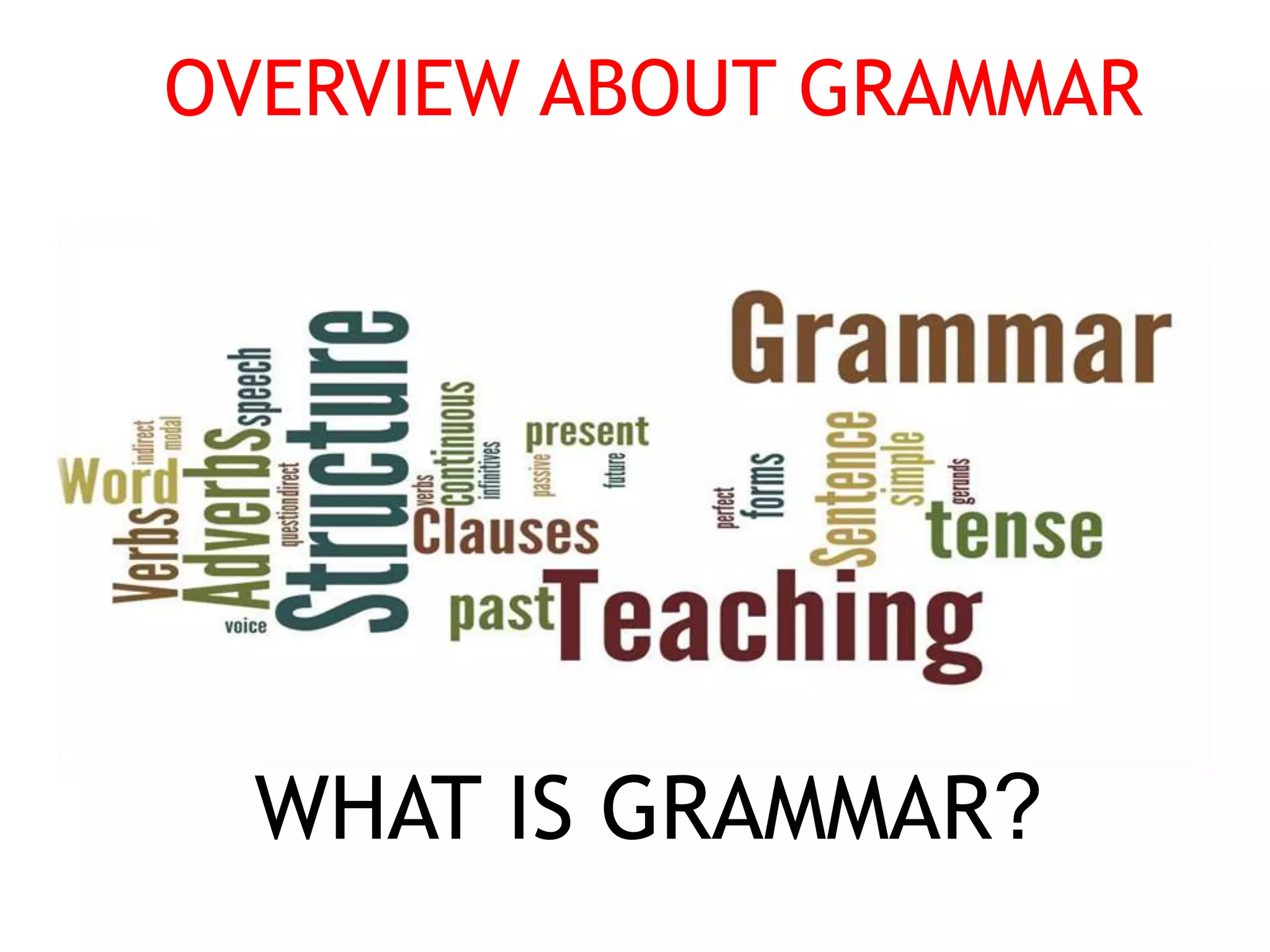
OVERVIEW ABOUT GRAMMAR
WHAT IS GRAMMAR?
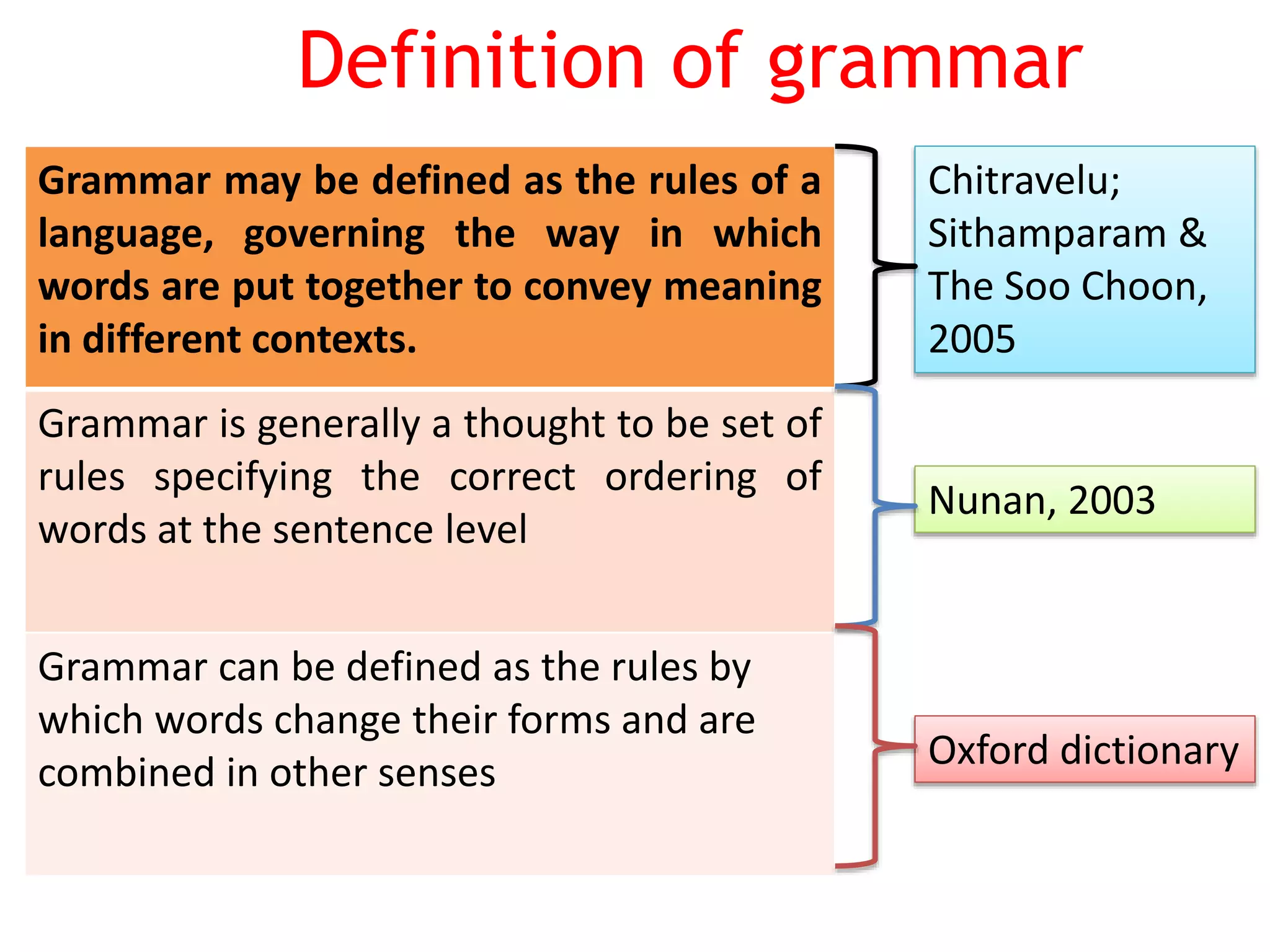
Definition of grammar
Grammar may be defined as the rules of a
language, governing the way in which words
are put together to convey meaning in
different contexts.
Grammar is generally a thought to be set of
rules specifying the correct ordering of
words at the sentence level
Grammar can be defined as the rules by which
words change their forms and are combined
in other senses
Definition of grammar
Grammar may be defined as the rules of a
language, governing the way in which
words are put together to convey meaning
in different contexts.
Grammar is generally a thought to be set of
rules specifying the correct ordering of
words at the sentence level
Grammar can be defined as the rules by
which words change their forms and are
combined in other senses
Chitravelu;
Sithamparam &
The Soo Choon,
2005
Nunan, 2003
Oxford dictionary
GRAMMAR IN GENERAL
GRAMMATICAL STRUCTURES
EXAMPLE(S)
I. INTRODUCING GRAMMAR
Principles for teaching
grammatical structures
• Teach structures implicitly: Give
examples of structure.

-> Students discover the meaning.
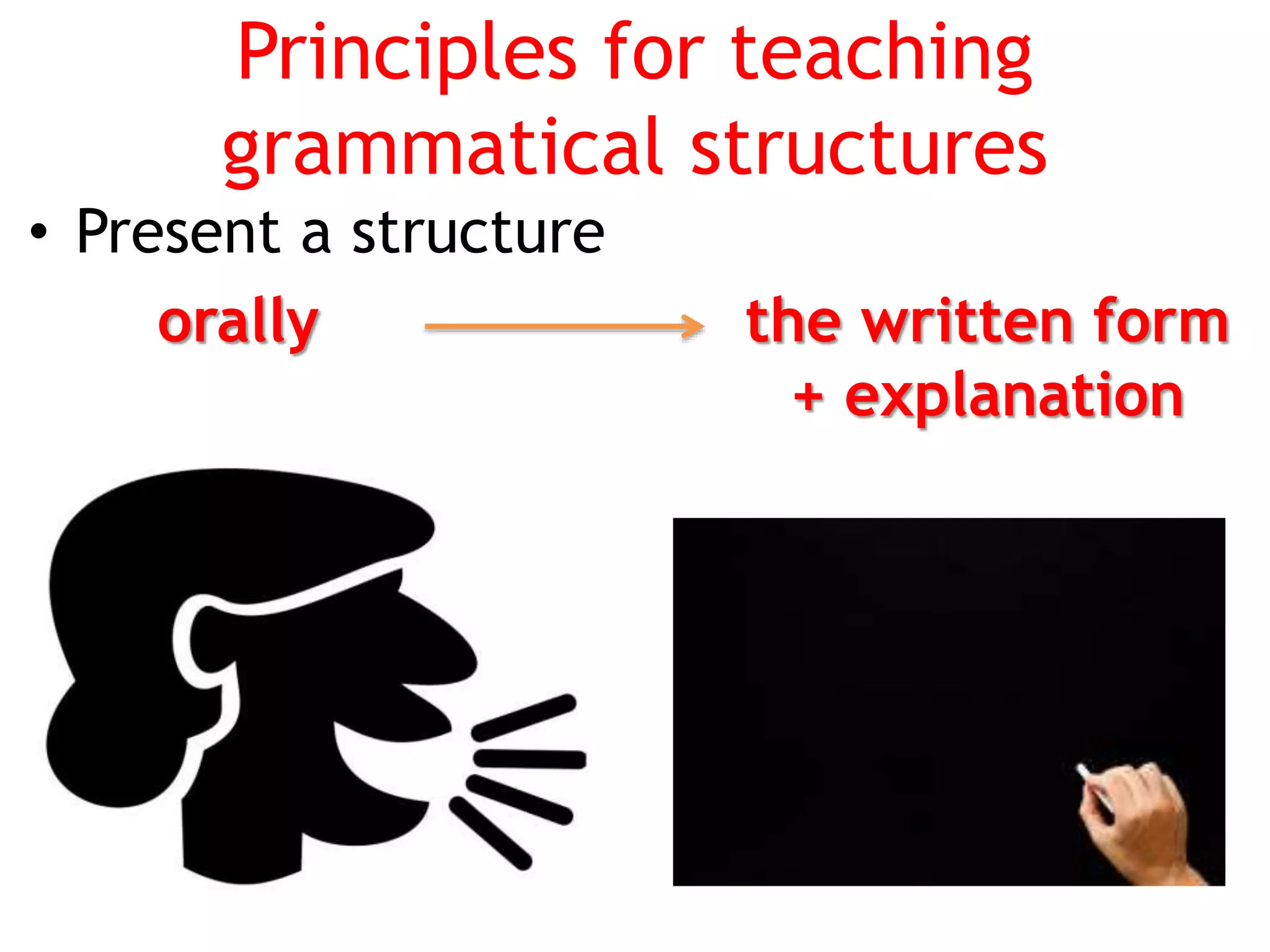
Principles for teaching
grammatical structures
• Present a structure
orally the written form
+ explanation
Principles for teaching
grammatical structures
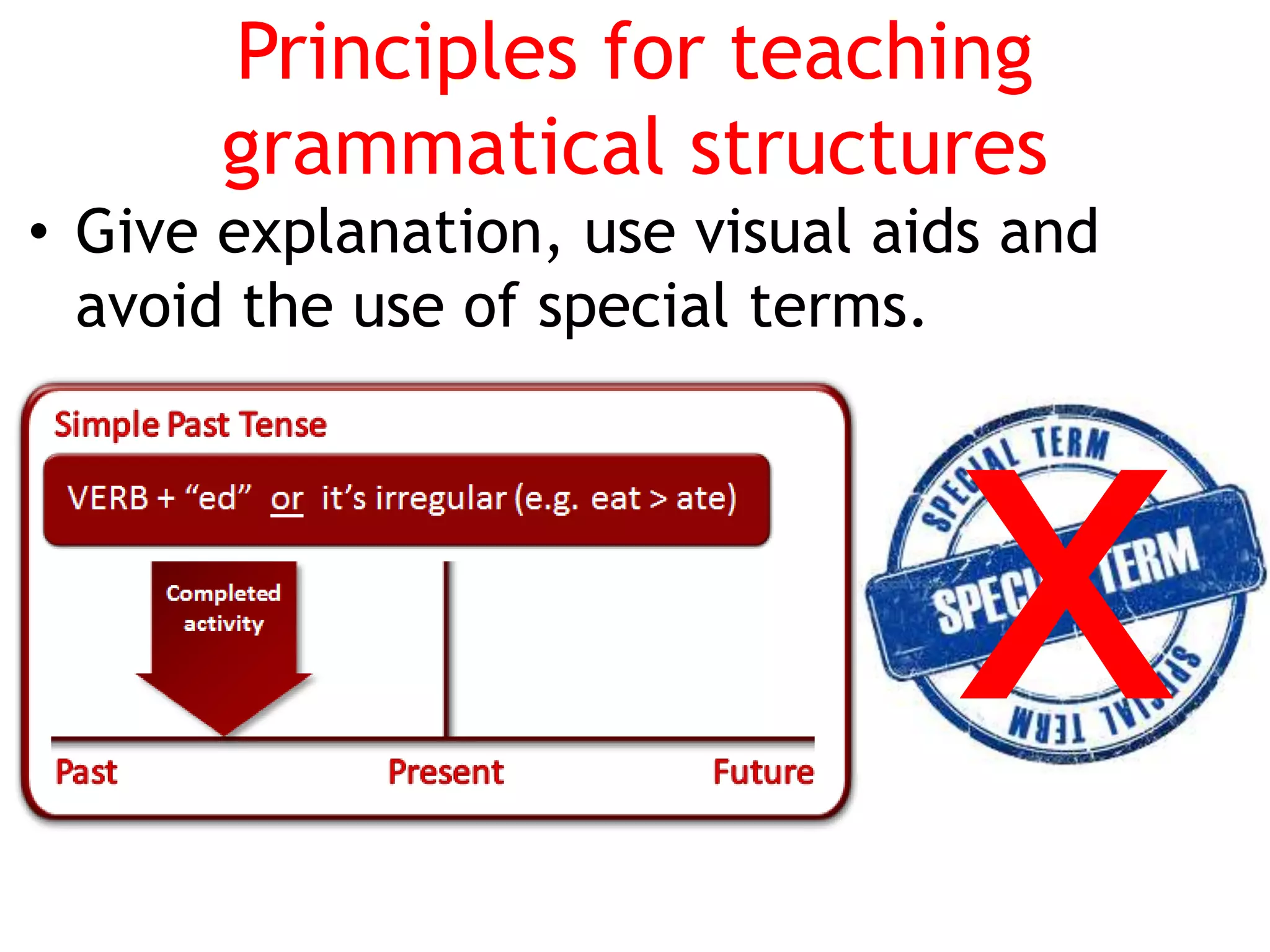
• Give explanation, use visual aids and
avoid the use of special terms.
Principles for teaching
grammatical structures
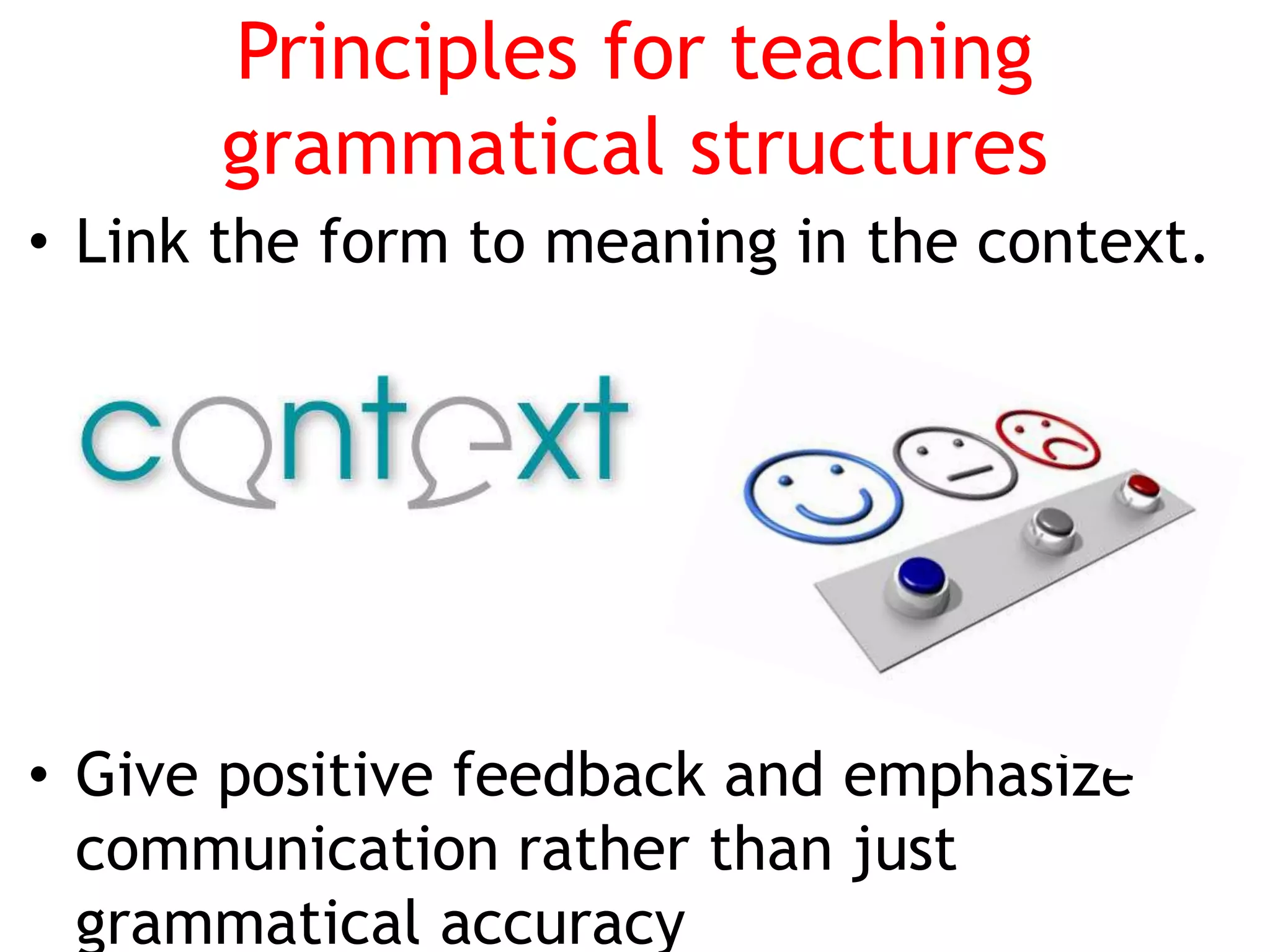
• Link the form to meaning in the context.
• Give positive feedback and emphasize
communication rather than just
grammatical accuracy
Principles for teaching
grammatical structures
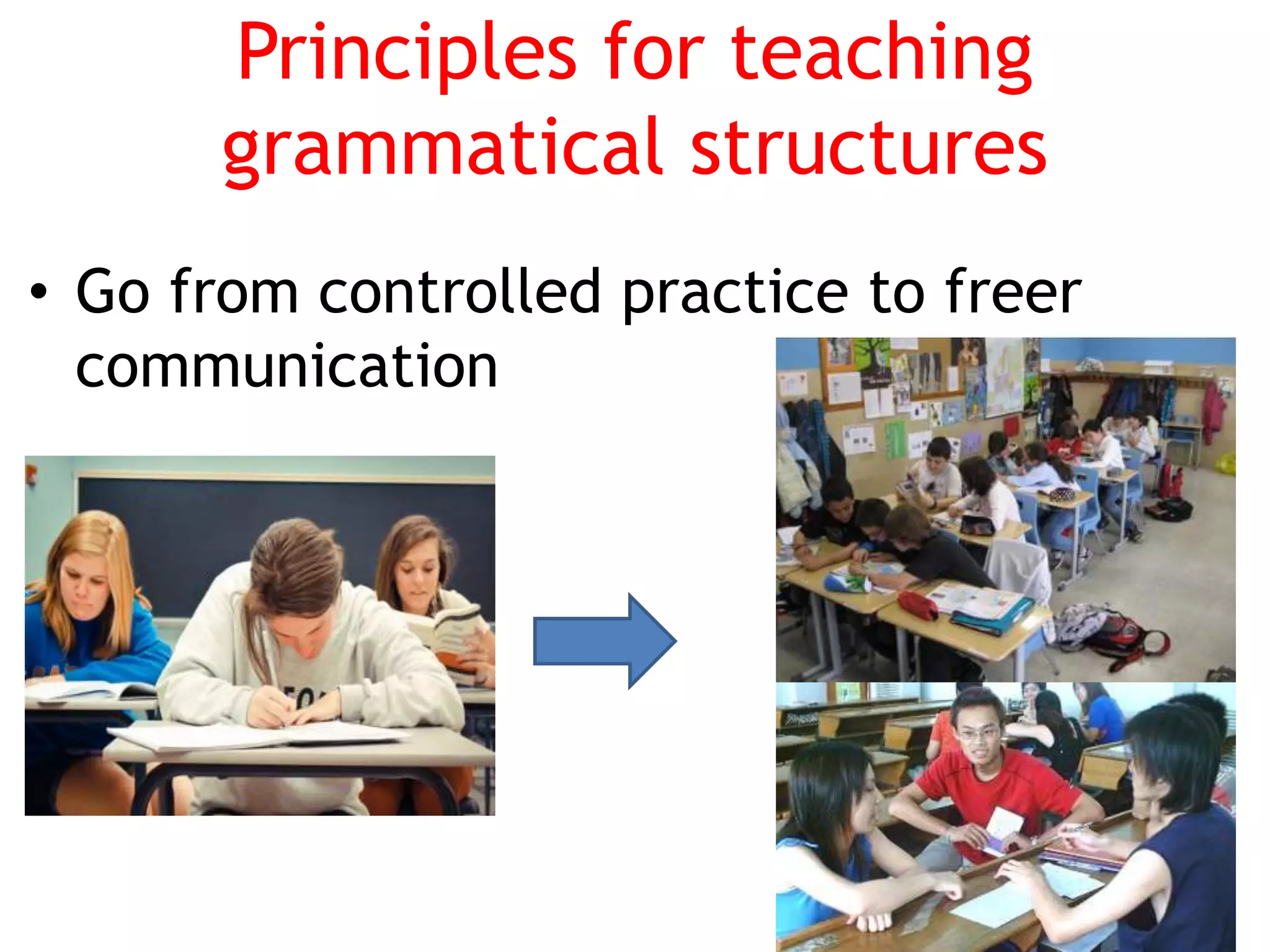
• Go from controlled practice to freer
communication
DIFFERENT WAYS OF
PRESENTING
GRAMMATICAL STRUCTURES
What to focus on when presenting
a new structure?
•Form
•Usage
•Meaning
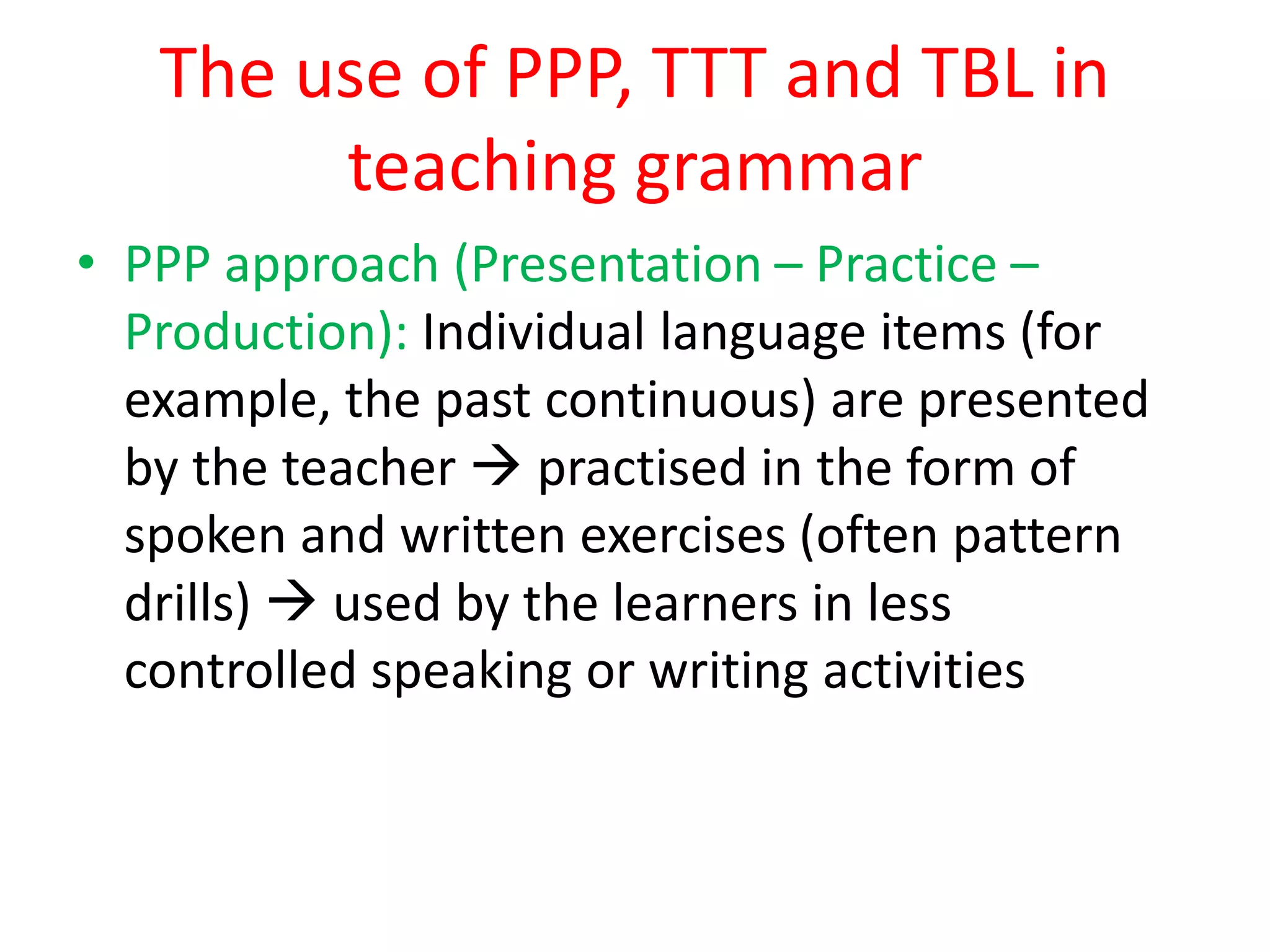
The use of PPP, TTT and TBL in
teaching grammar
• PPP approach (Presentation – Practice –
Production): Individual language items (for
example, the past continuous) are presented
by the teacher  practised in the form of
spoken and written exercises (often pattern
drills)  used by the learners in less
controlled speaking or writing activities
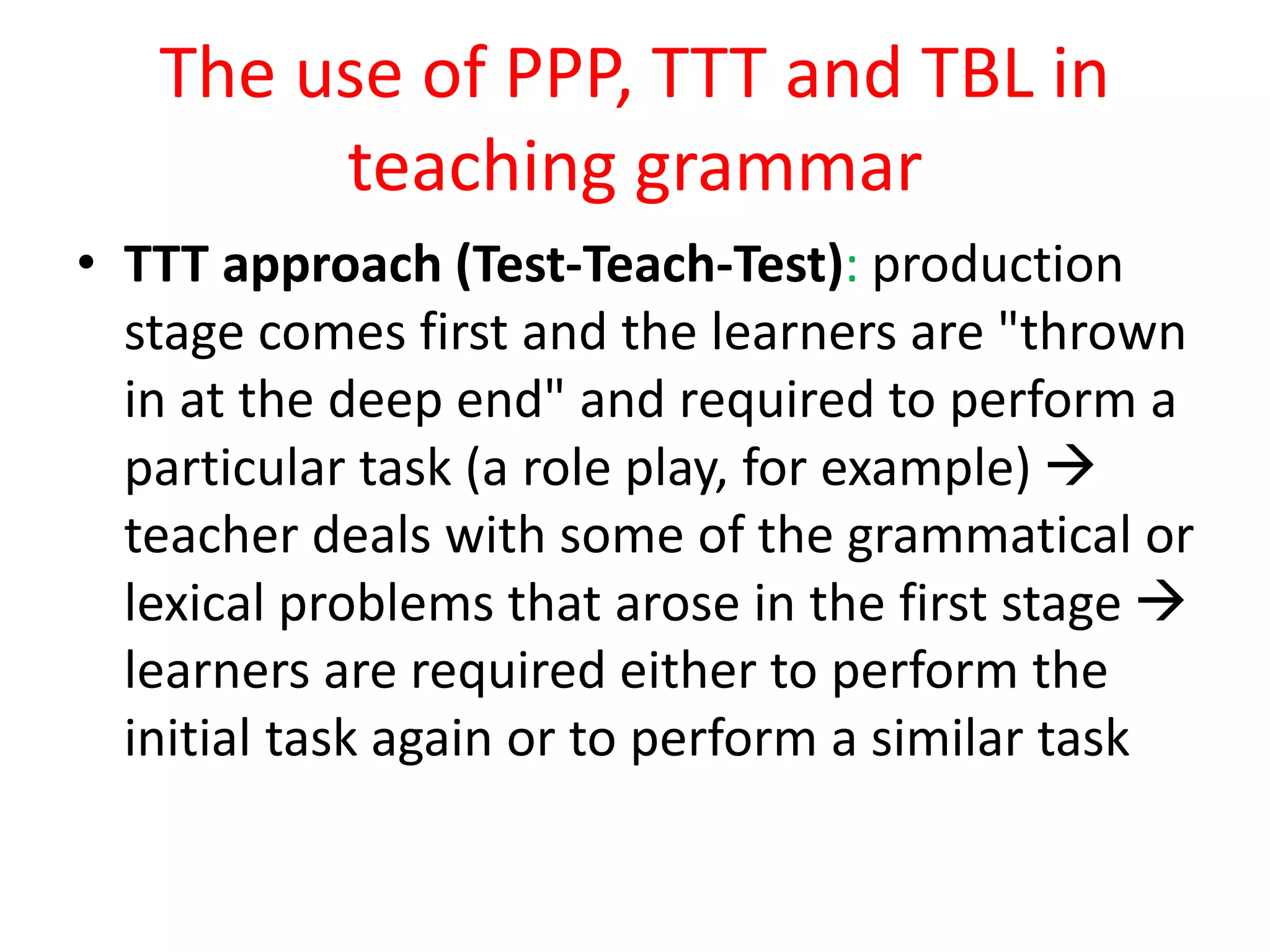
The use of PPP, TTT and TBL in
teaching grammar
• TTT approach (Test-Teach-Test): production
stage comes first and the learners are "thrown
in at the deep end" and required to perform a
particular task (a role play, for example) 
teacher deals with some of the grammatical or
lexical problems that arose in the first stage 
learners are required either to perform the
initial task again or to perform a similar task
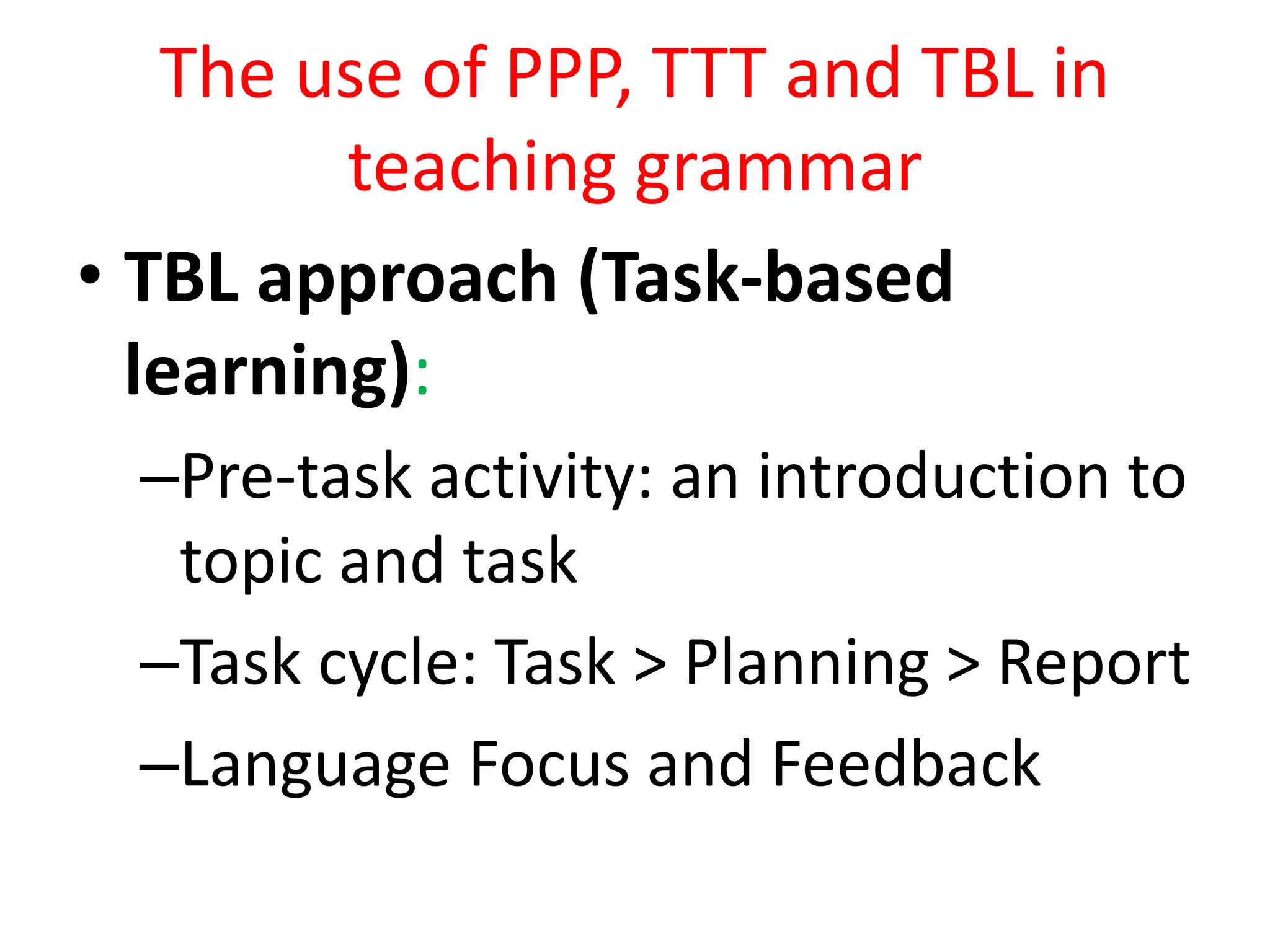
The use of PPP, TTT and TBL in
teaching grammar
• TBL approach (Task-based
learning):
–Pre-task activity: an introduction to
topic and task
–Task cycle: Task > Planning > Report
–Language Focus and Feedback
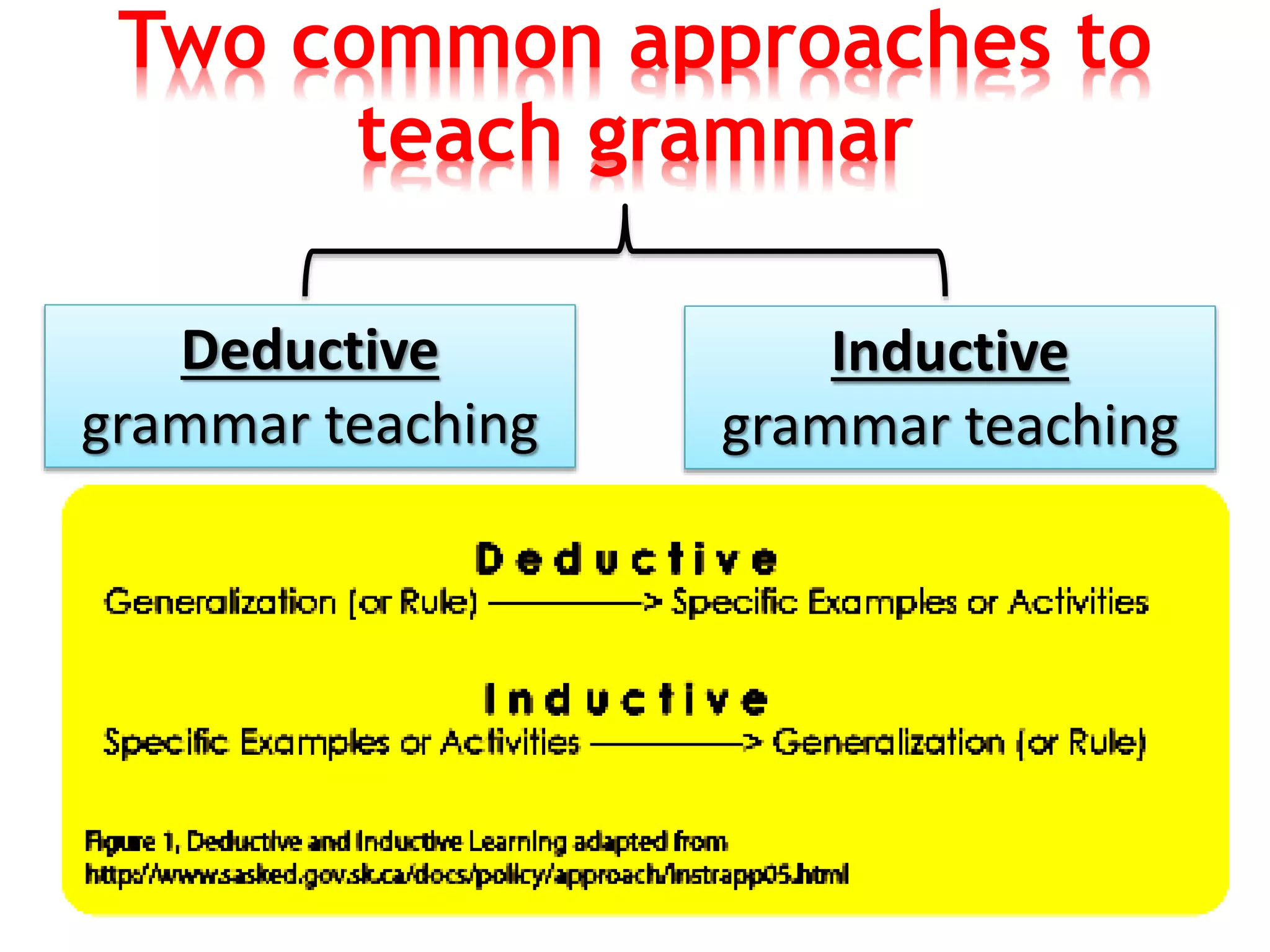
Two common approaches to
teach grammar
Deductive
grammar teaching
Inductive
grammar teaching
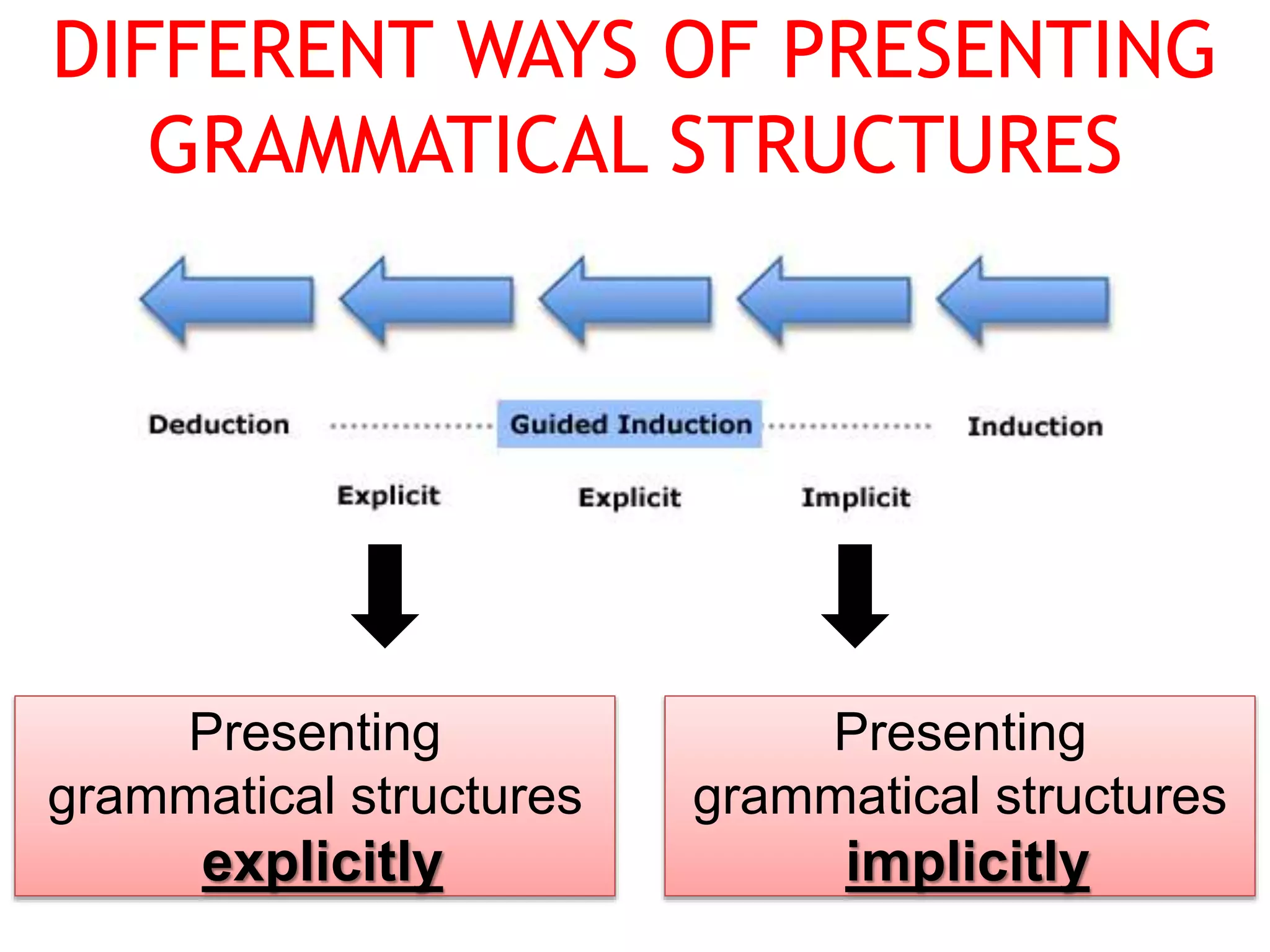
DIFFERENT WAYS OF PRESENTING
GRAMMATICAL STRUCTURES
Presenting
grammatical structures
implicitly
Presenting
grammatical structures
explicitly
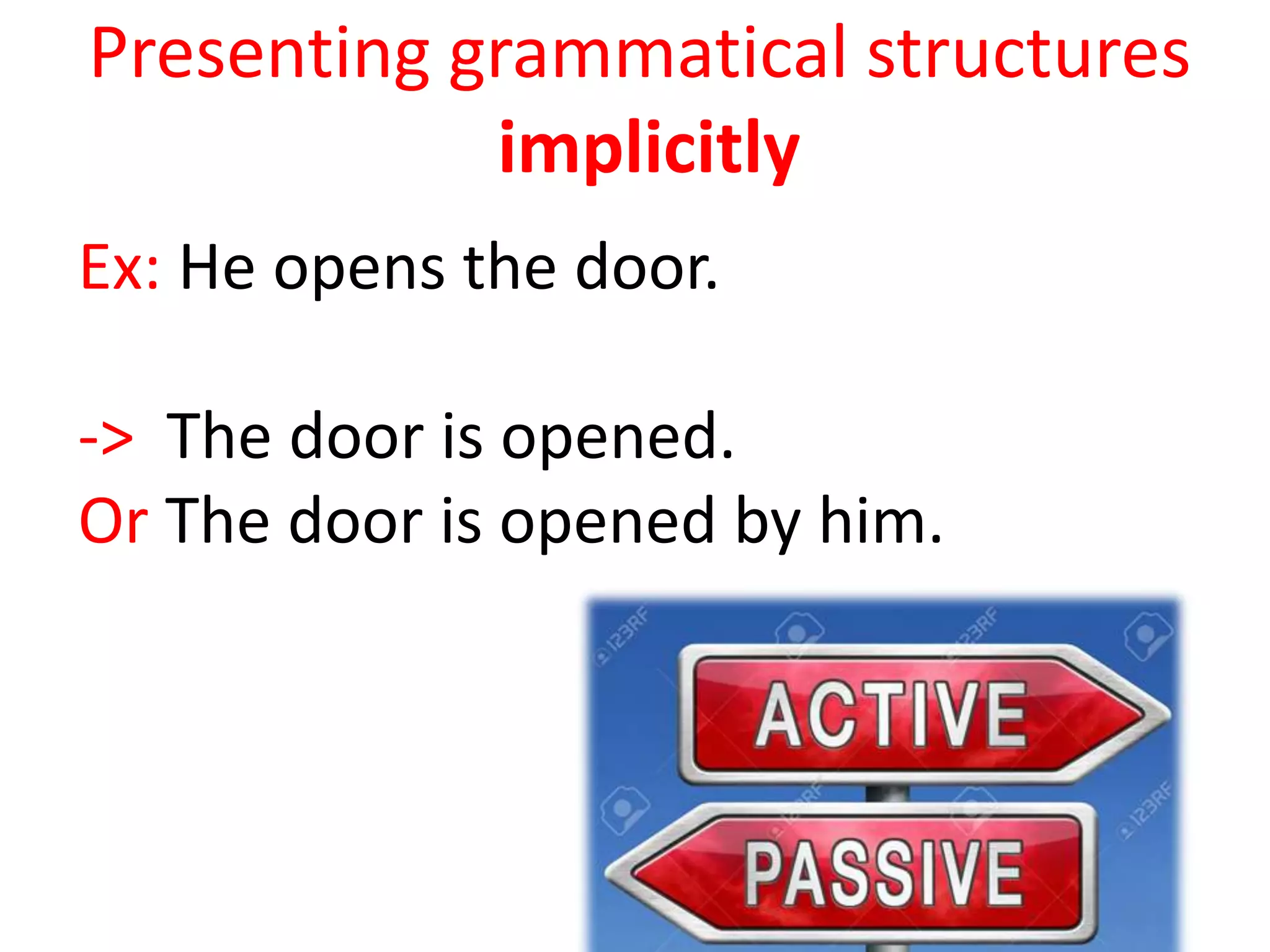
Presenting grammatical structures
implicitly
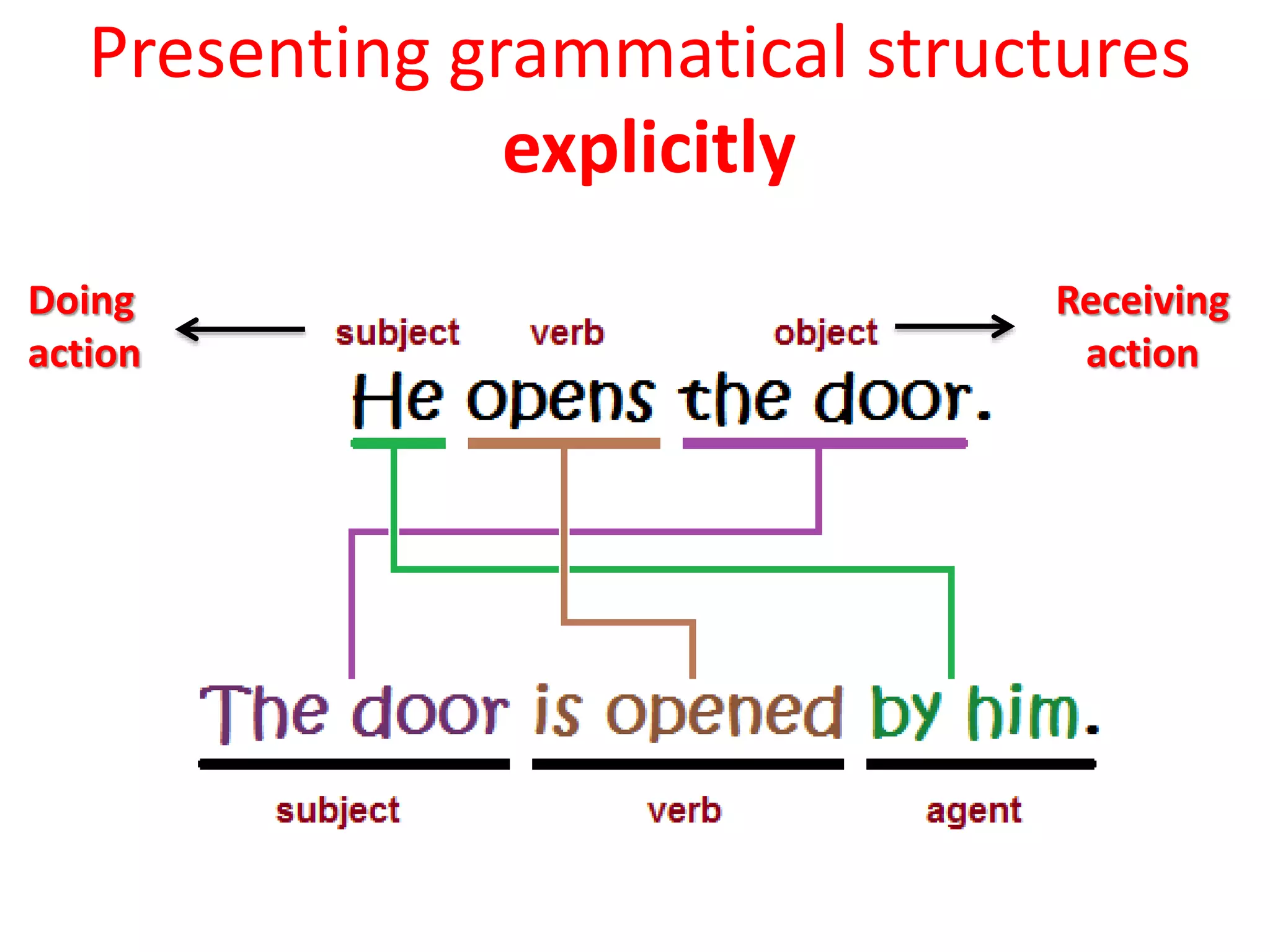
Ex: He opens the door.
-> The door is opened.
Or The door is opened by him.
Presenting grammatical structures
explicitly
Doing
action
Receiving
action
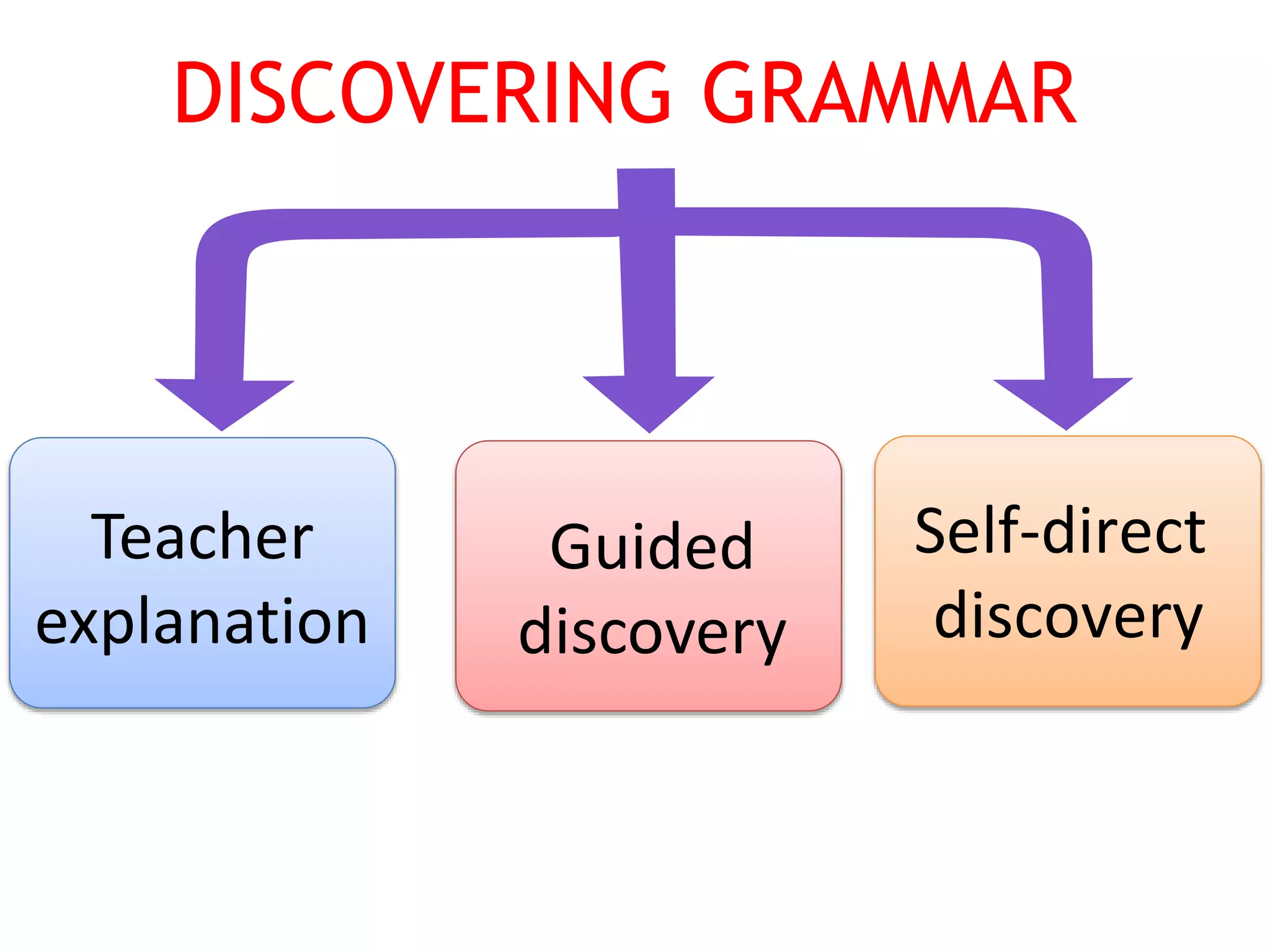
Discovering grammar
Self-direct
discovery
DISCOVERING GRAMMAR
Teacher
explanation
Guided
discovery
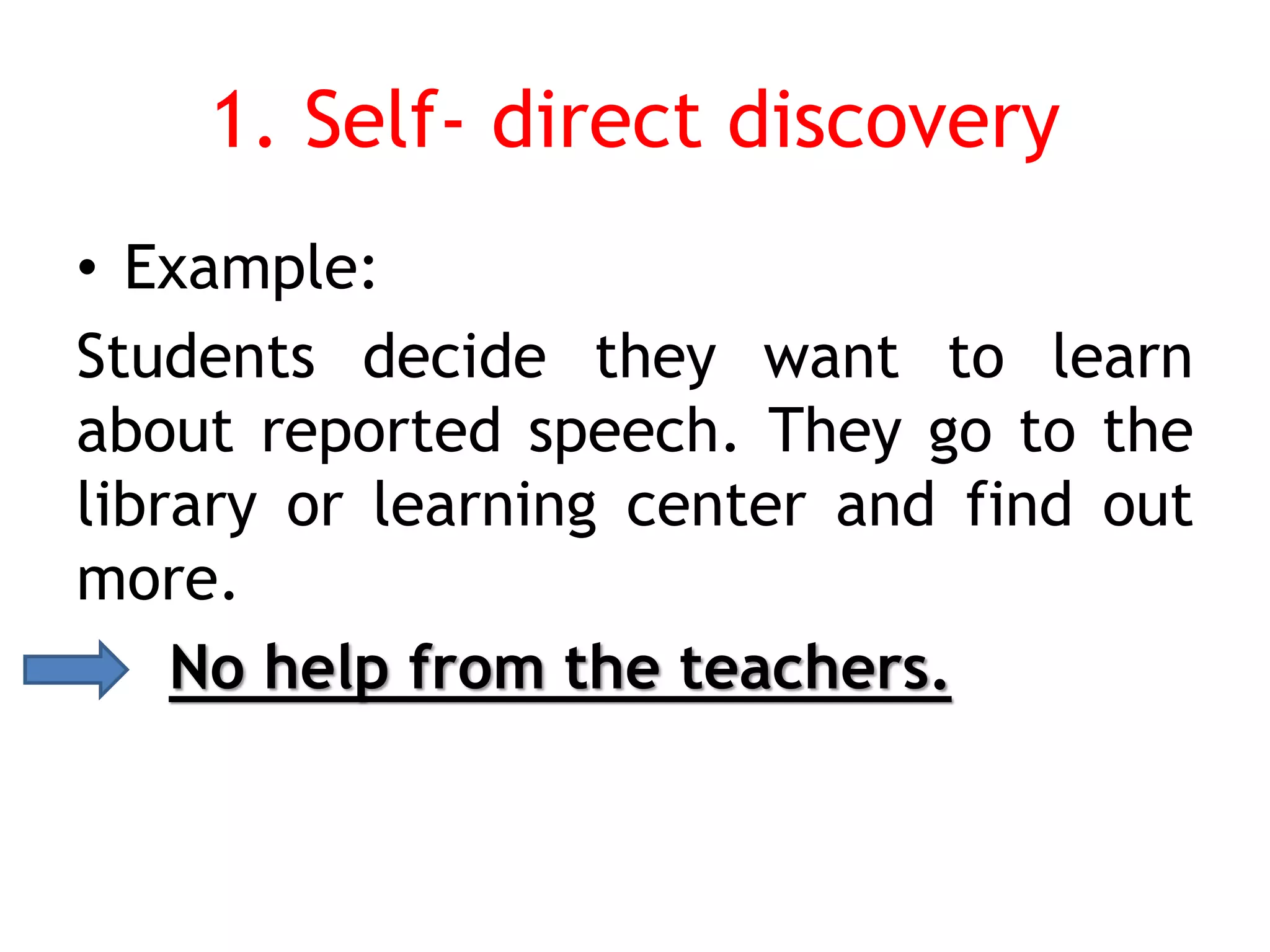
1. Self- direct discovery
• Example:
Students decide they want to learn
about reported speech. They go to the
library or learning center and find out
more.
No help from the teachers.
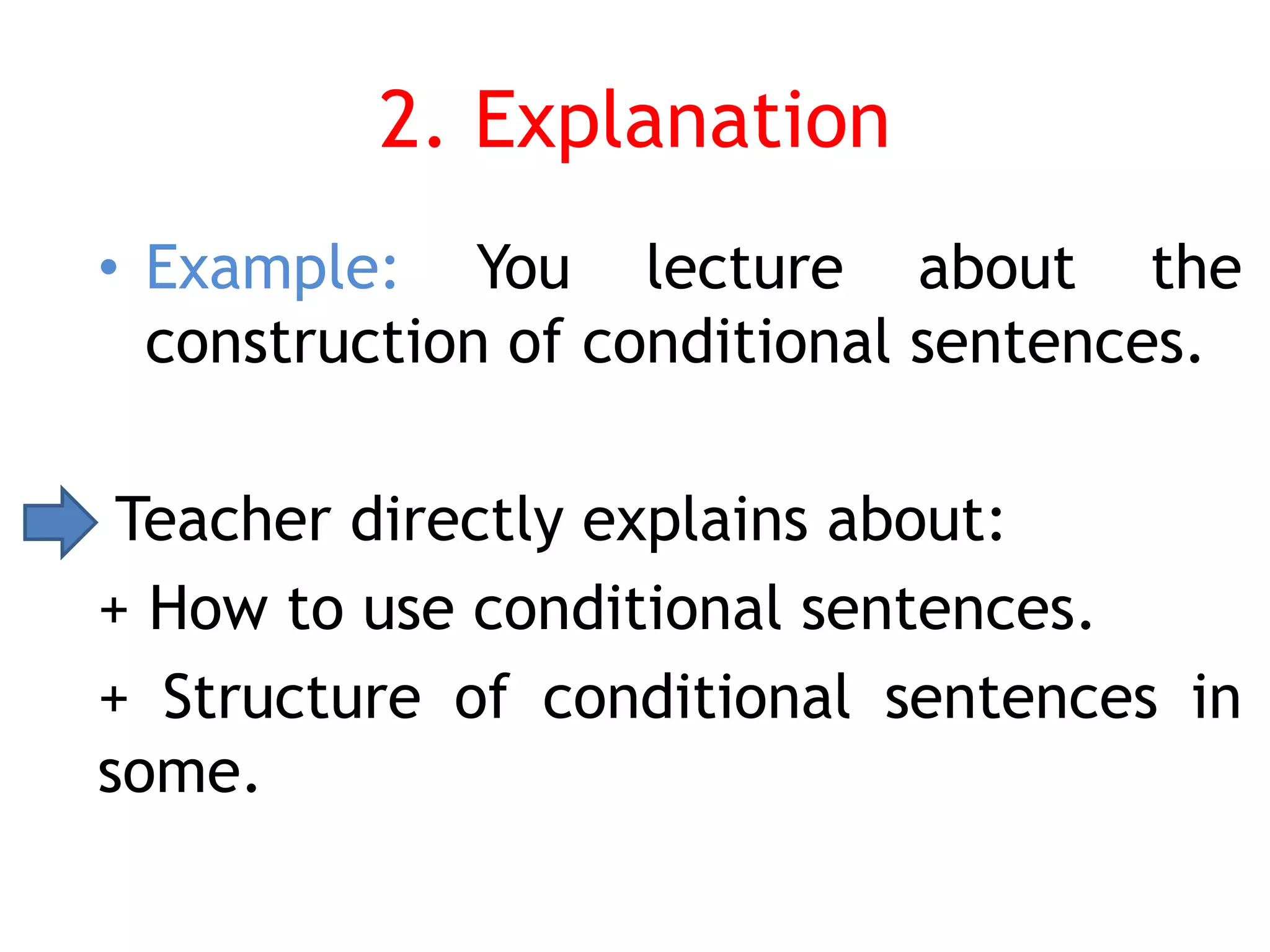
2. Explanation
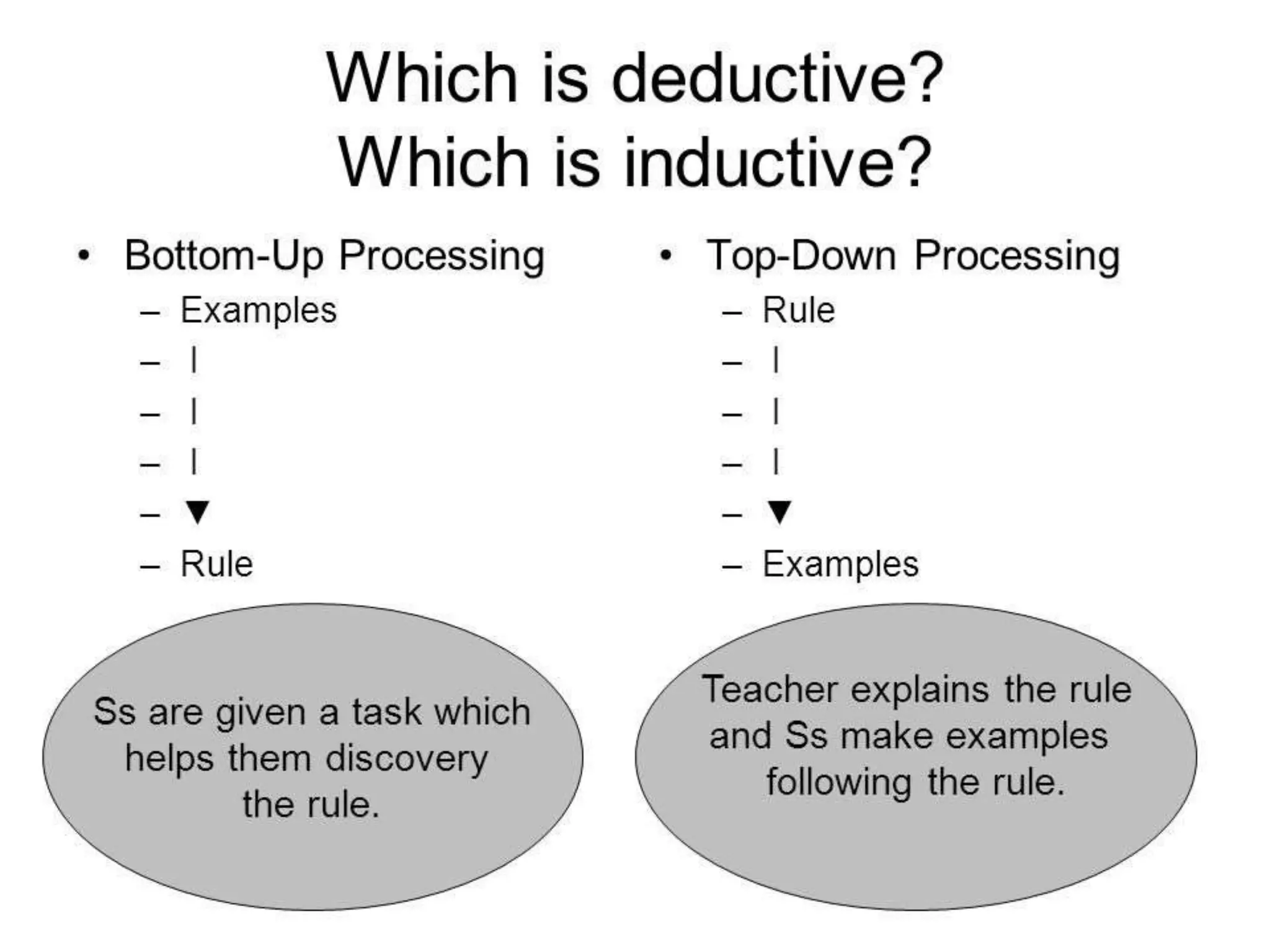
• Example: You lecture about the
construction of conditional sentences.
Teacher directly explains about:
+ How to use conditional sentences.
+ Structure of conditional sentences in
some.
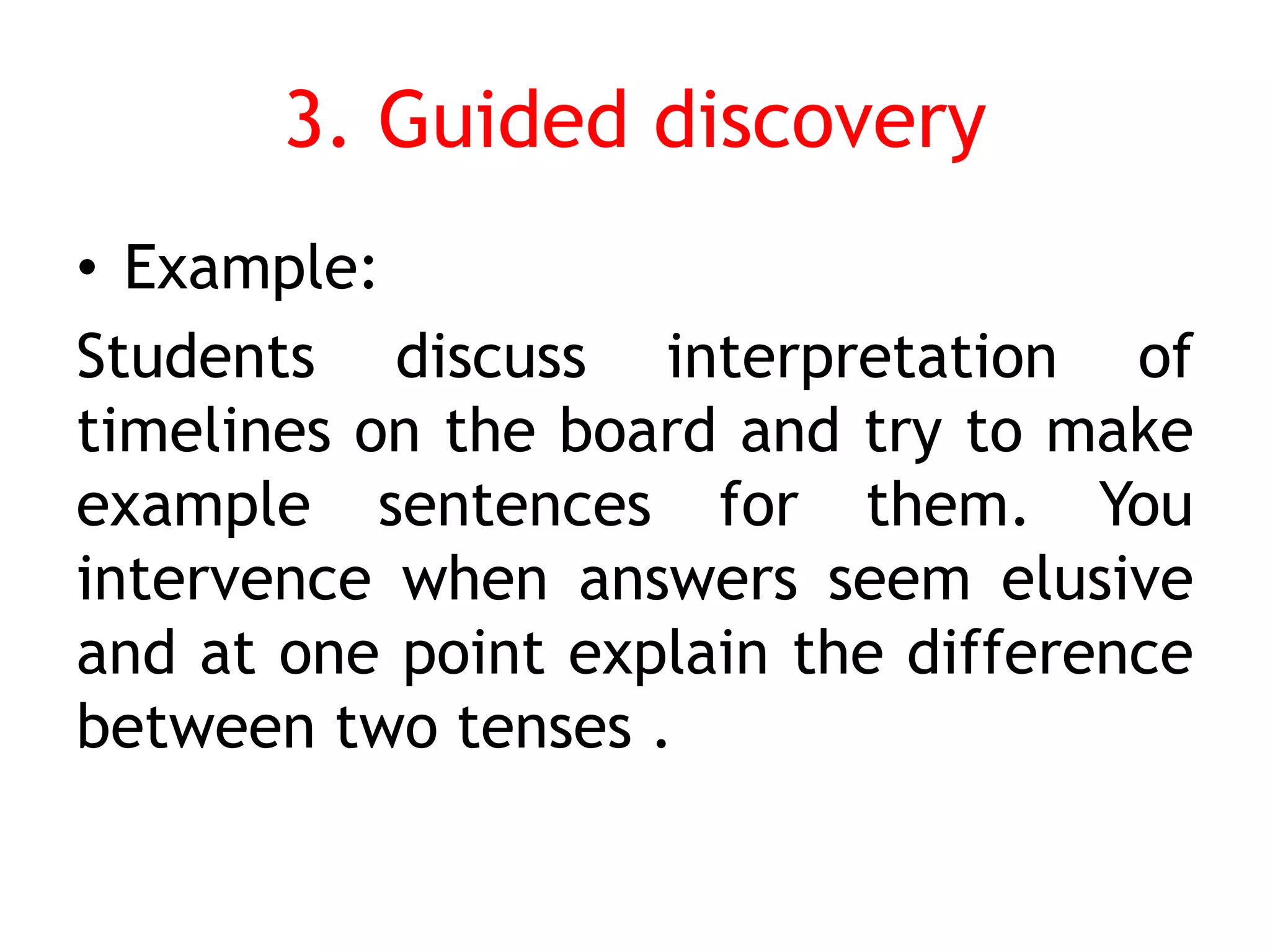
3. Guided discovery
• Example:
Students discuss interpretation of
timelines on the board and try to make
example sentences for them. You
intervence when answers seem elusive
and at one point explain the difference
between two tenses .
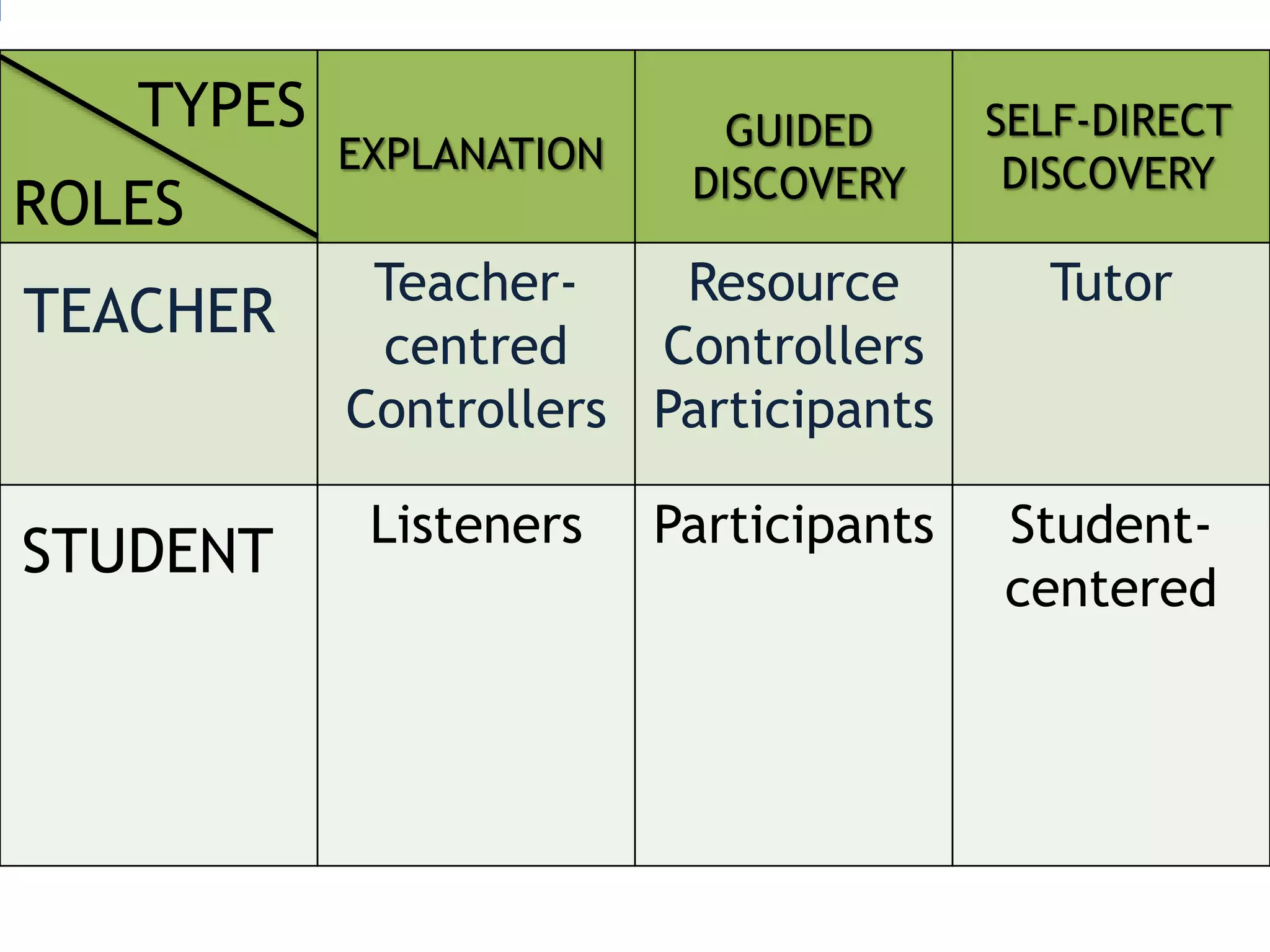
Teacher-
centred
Controllers
Resource
Controllers
Participants
Tutor
Listeners Participants Student-
centered
TYPES
ROLES
EXPLANATION
GUIDED
DISCOVERY
SELF-DIRECT
DISCOVERY
TEACHER
STUDENT
II. GRAMMAR PRACTICE
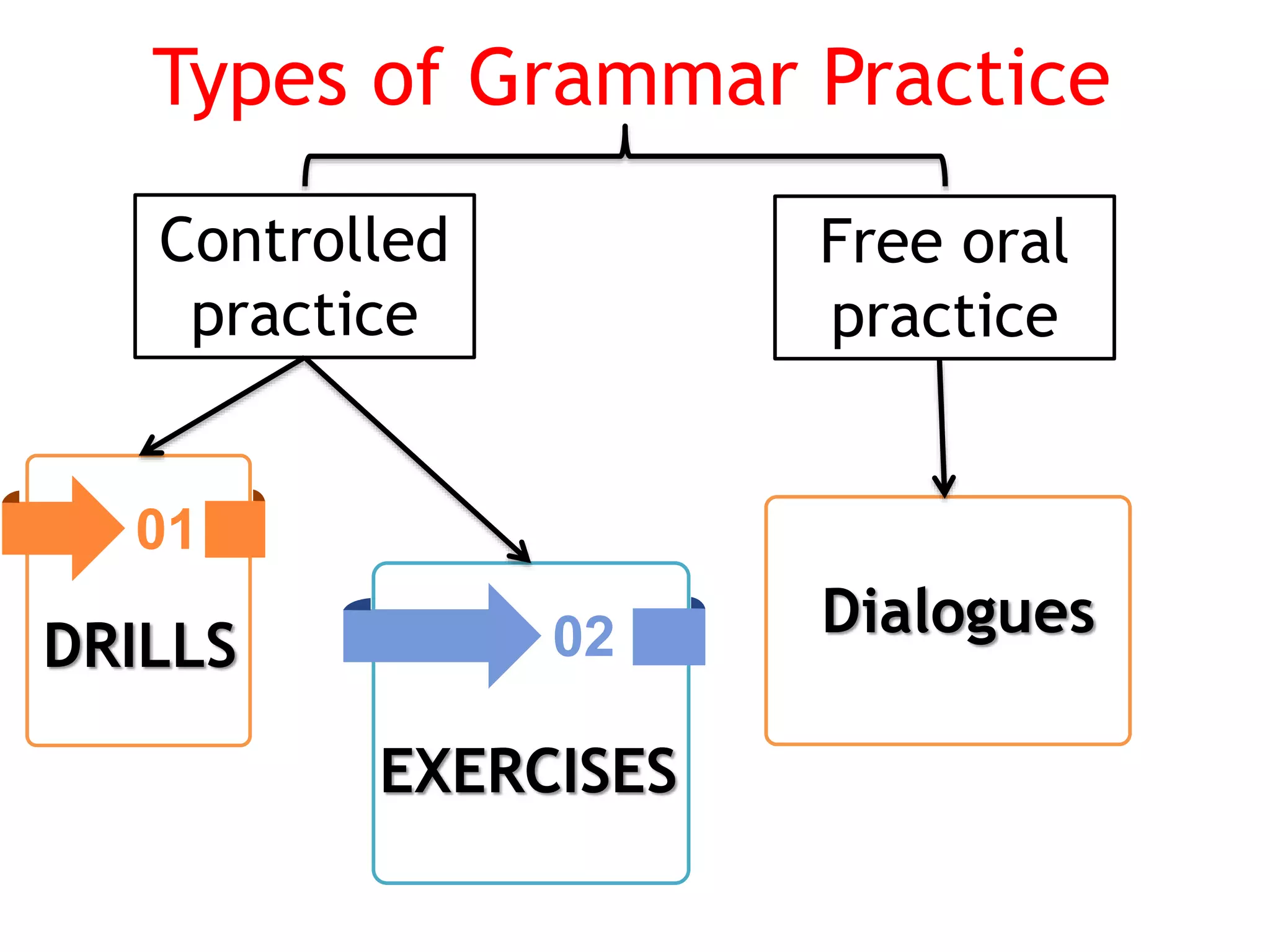
Types of Grammar Practice
02
01
DRILLS
EXERCISES
Controlled
practice
Free oral
practice
Dialogues
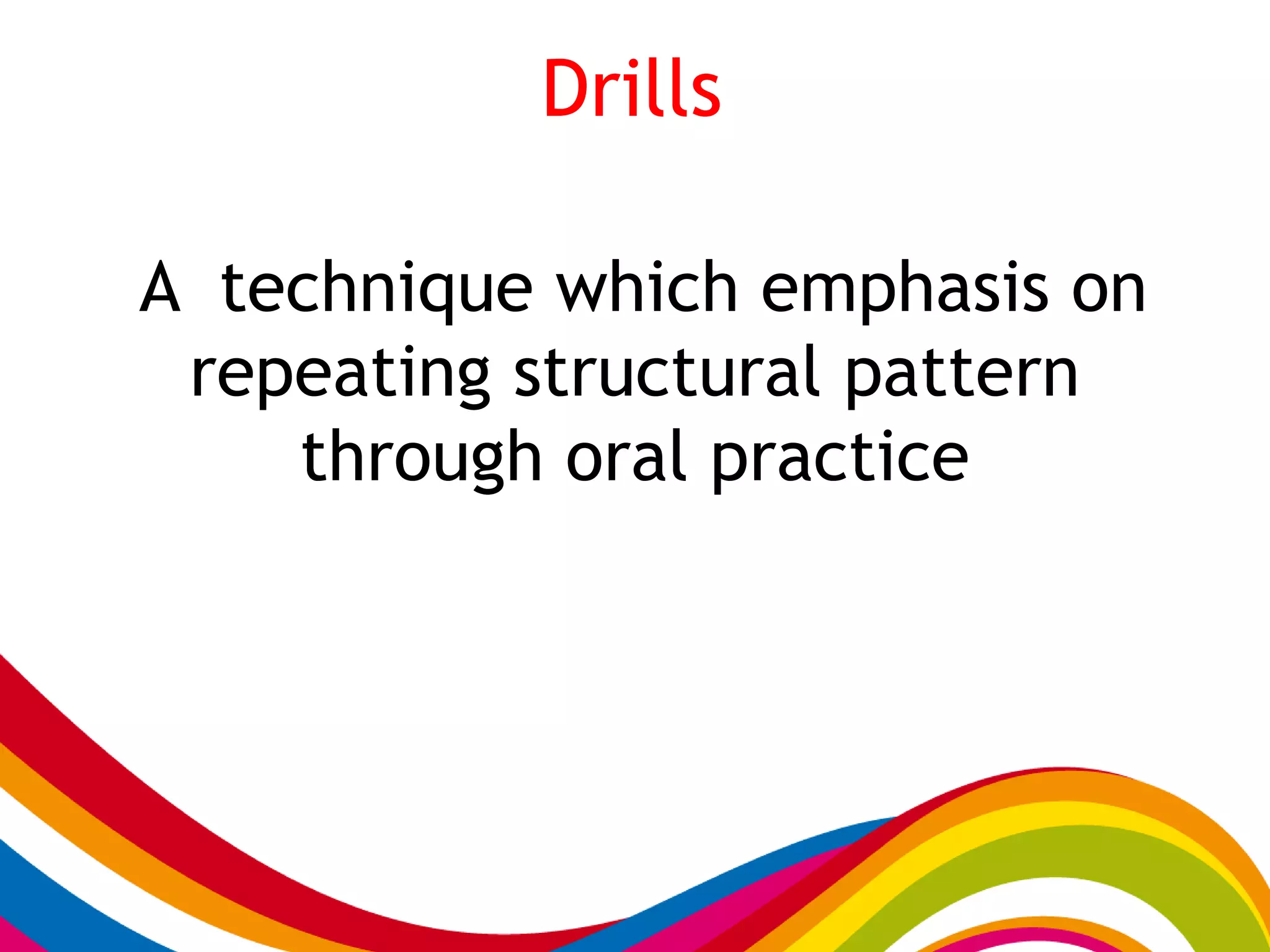
Drills
A technique which emphasis on
repeating structural pattern
through oral practice
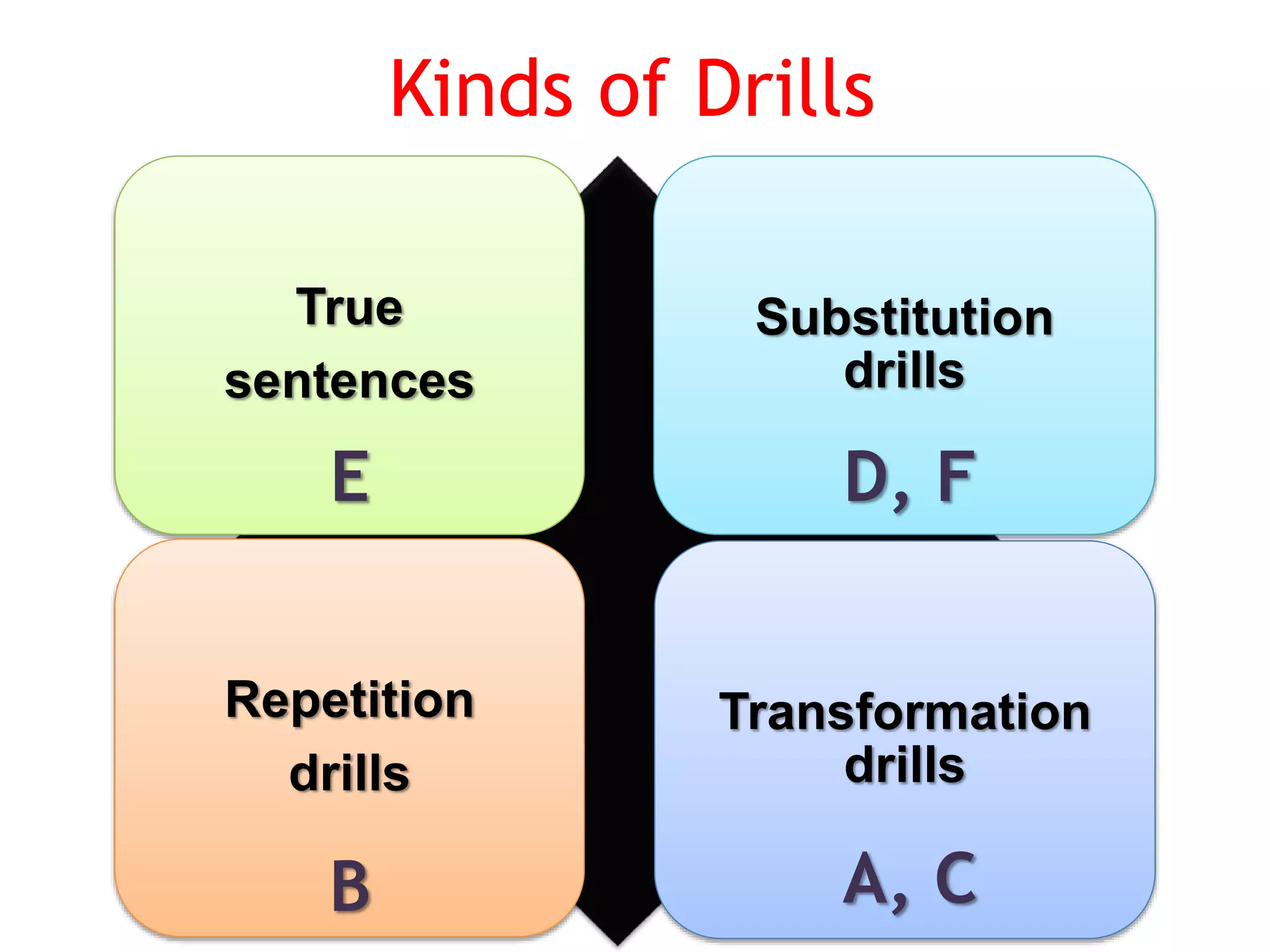
Kinds of Drills
True
sentences
Substitution
drills
Repetition
drills
Transformation
drills
B
E
A, C
D, F
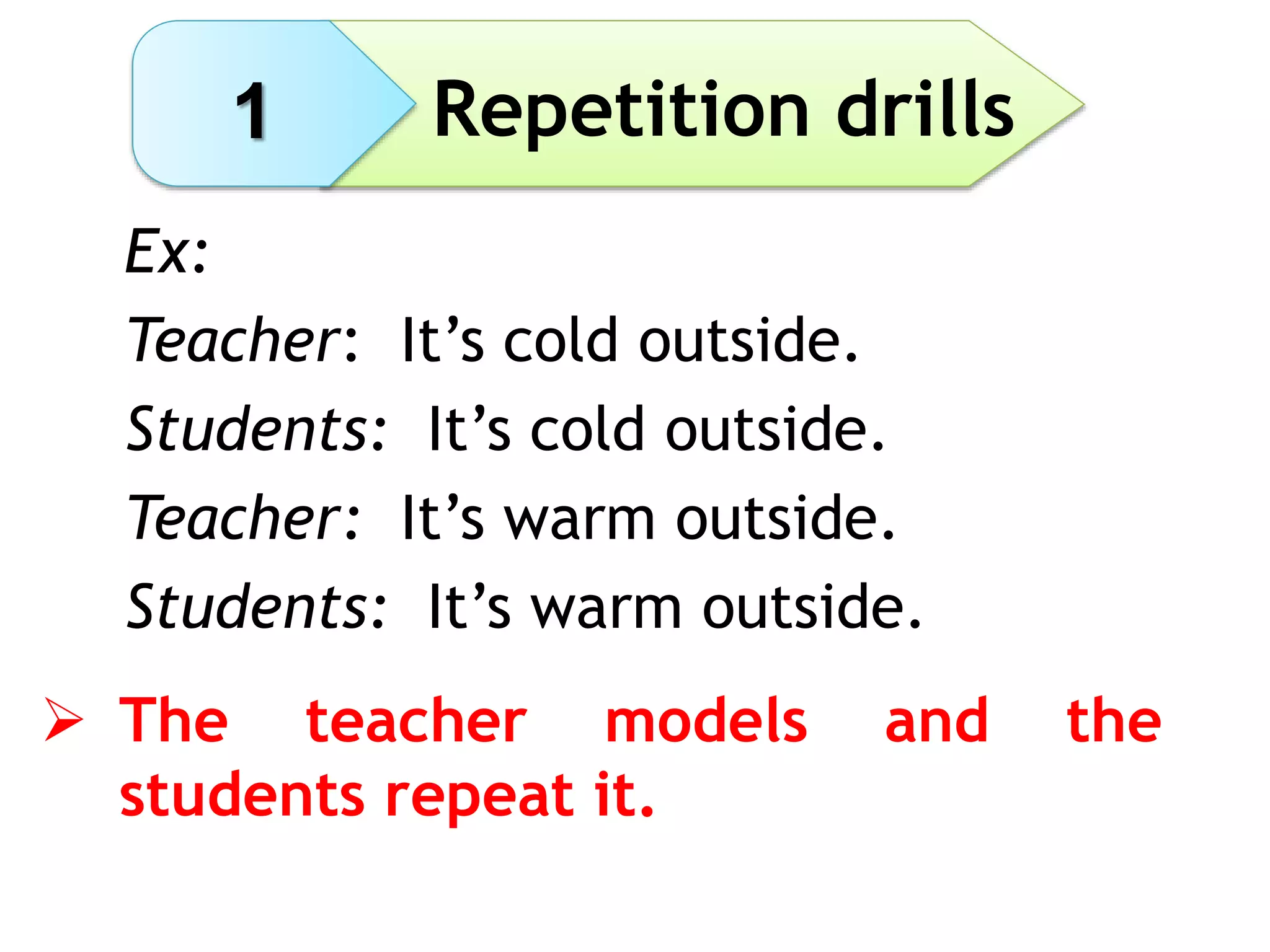
Repetition drills
Ex:
Teacher: It’s cold outside.
Students: It’s cold outside.
Teacher: It’s warm outside.
Students: It’s warm outside.
 The teacher models and the
students repeat it.
1
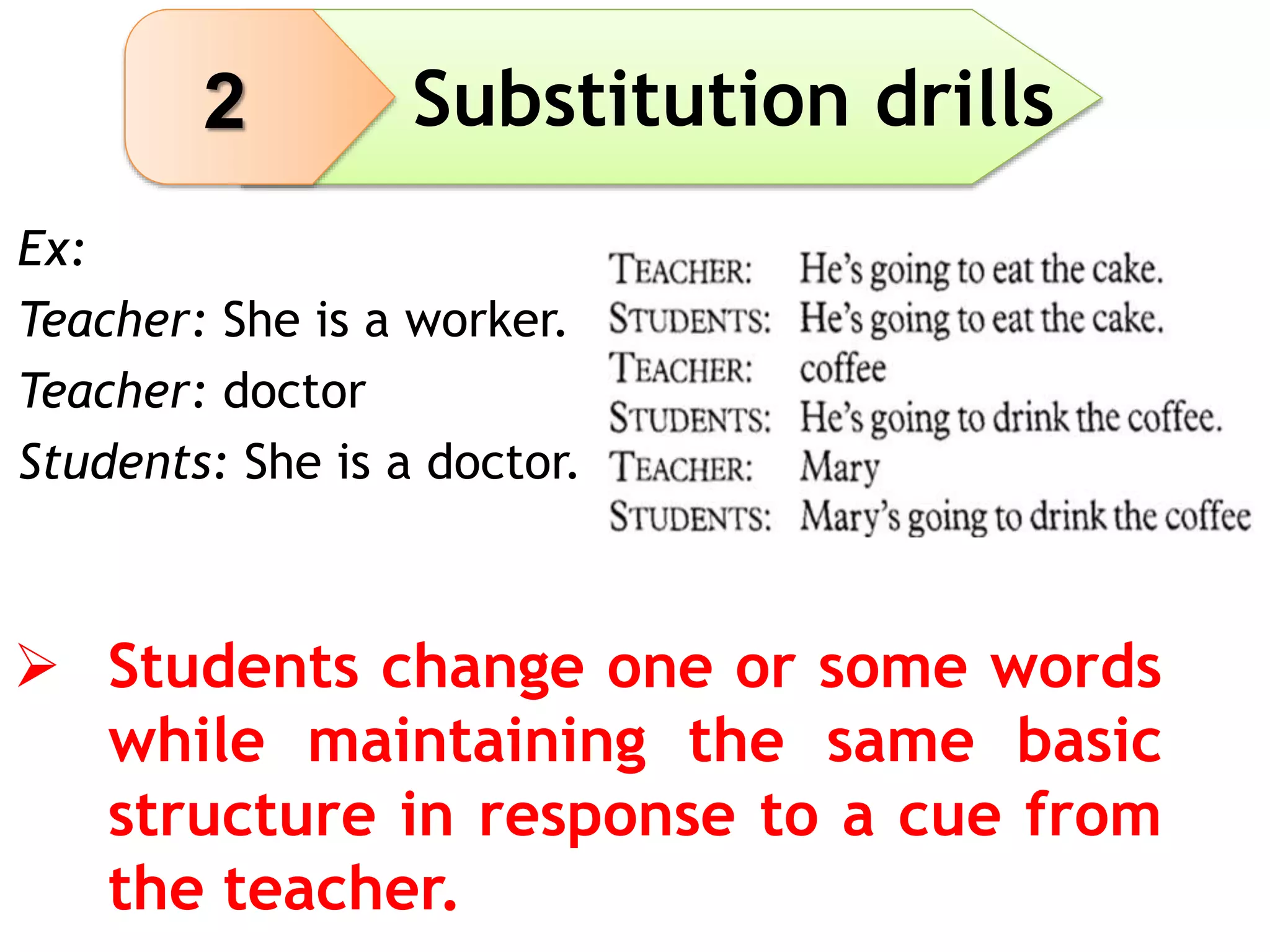
Substitution drills
Ex:
Teacher: She is a worker.
Teacher: doctor
Students: She is a doctor.
 Students change one or some words
while maintaining the same basic
structure in response to a cue from
the teacher.
2
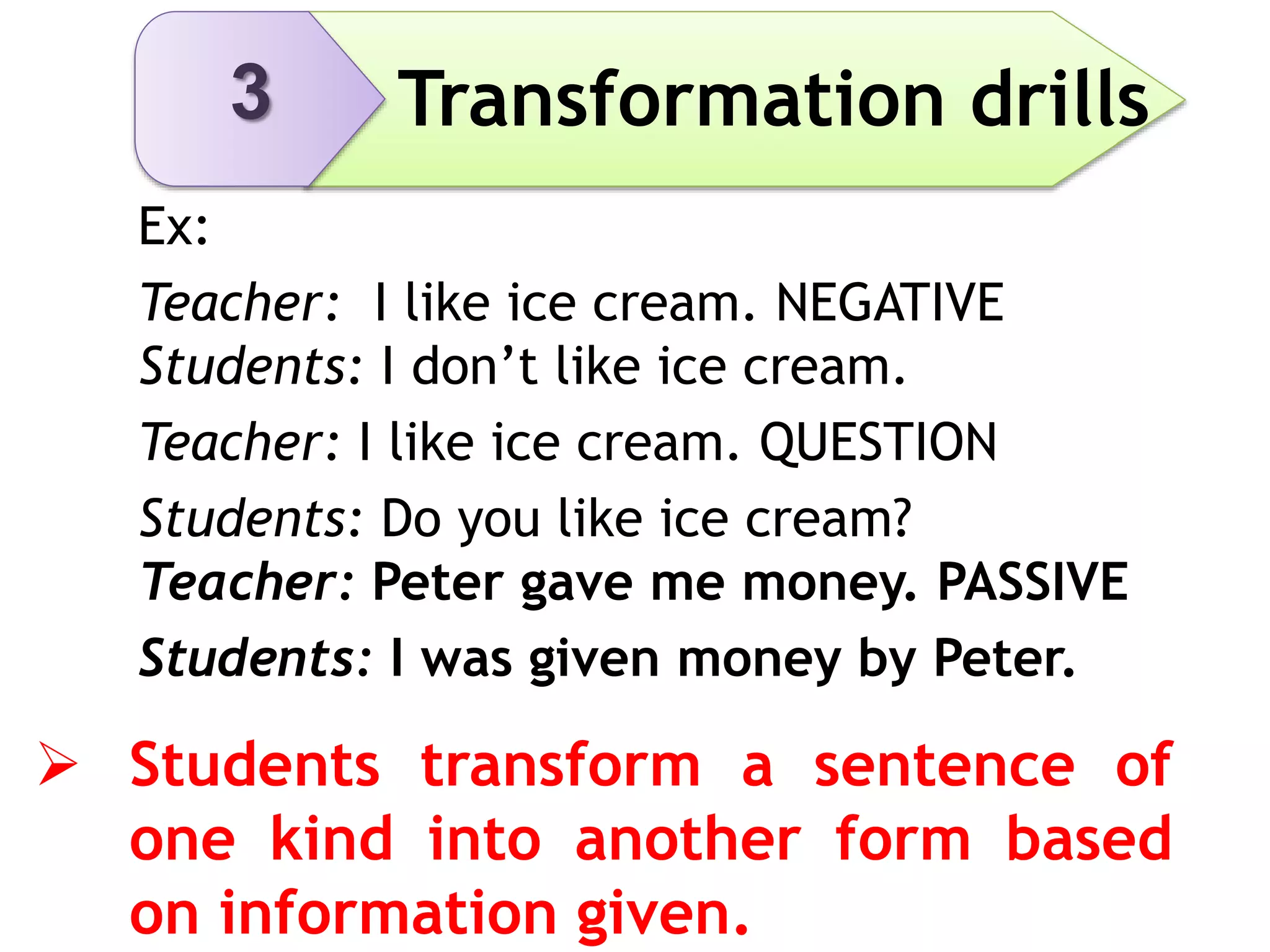
3 Transformation drills
Ex:
Teacher: I like ice cream. NEGATIVE
Students: I don’t like ice cream.
Teacher: I like ice cream. QUESTION
Students: Do you like ice cream?
Teacher: Peter gave me money. PASSIVE
Students: I was given money by Peter.
 Students transform a sentence of
one kind into another form based
on information given.
4 True sentences
 Students give real information in
their answers
Ex:
Teacher: What are you going to do after school?
Students: I’m going to play football.
Teacher: And tonight?
Students: I’m going to watch TV.
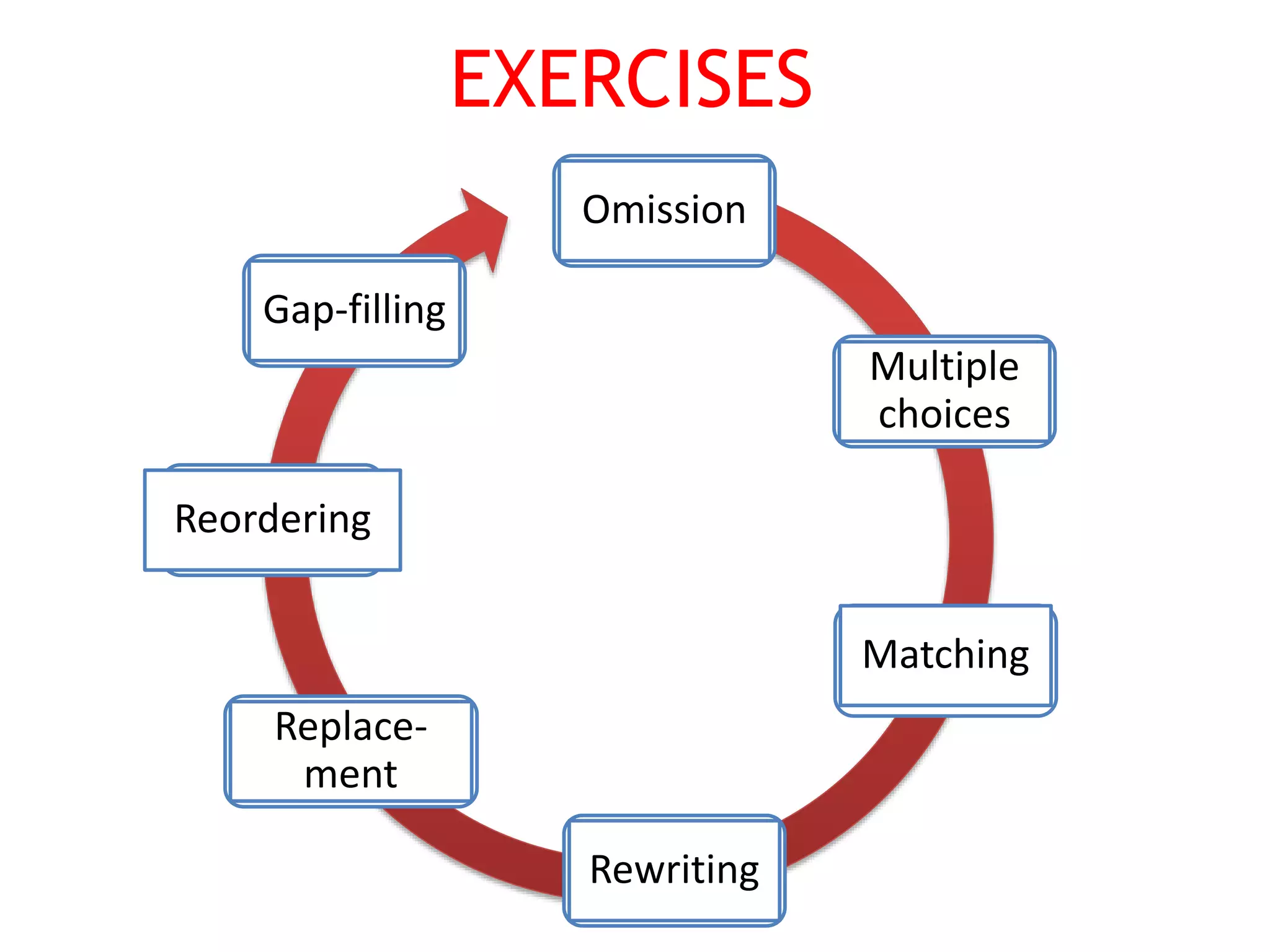
EXERCISES
The exercises are designed to help
students become more familiar
with the use of grammatical
points in English.
EXERCISES
EXERCISES
EXERCISES
EXERCISES
EXERCISES
EXERCISES
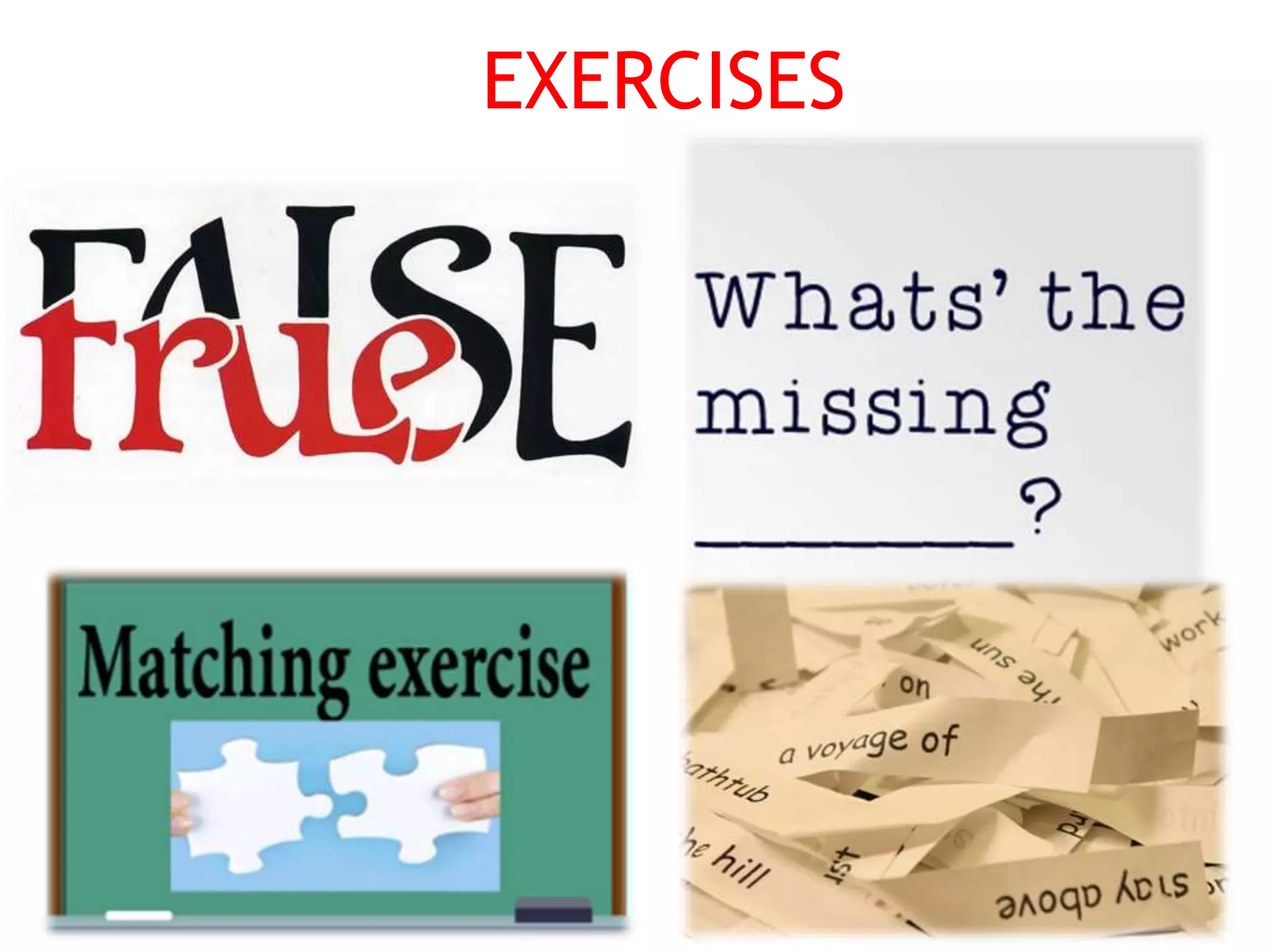
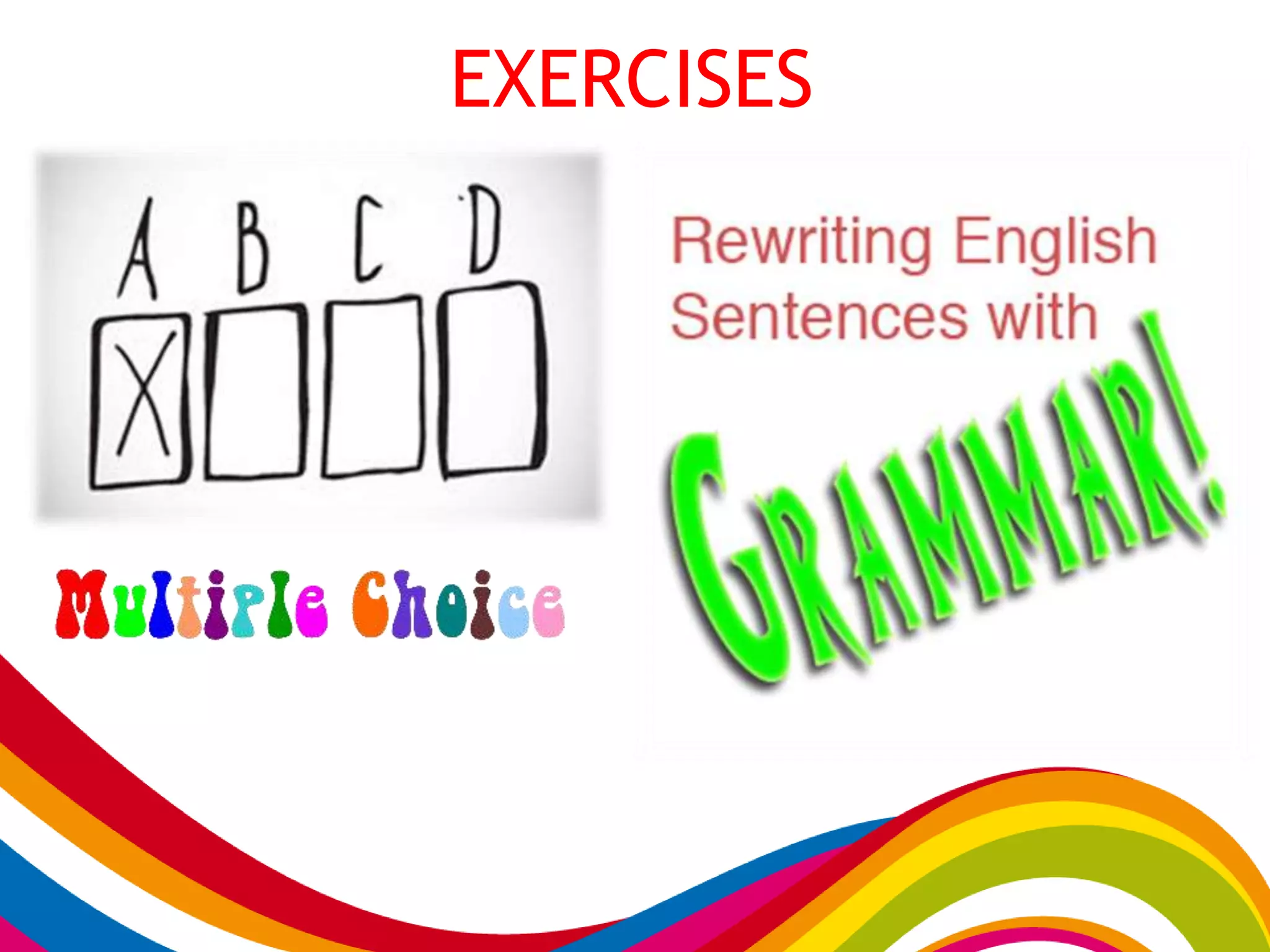
Omission
Multiple
choices
Matching
Rewriting
Replace-
ment
Reordering
Gap-filling
Free oral practice
(Communication)
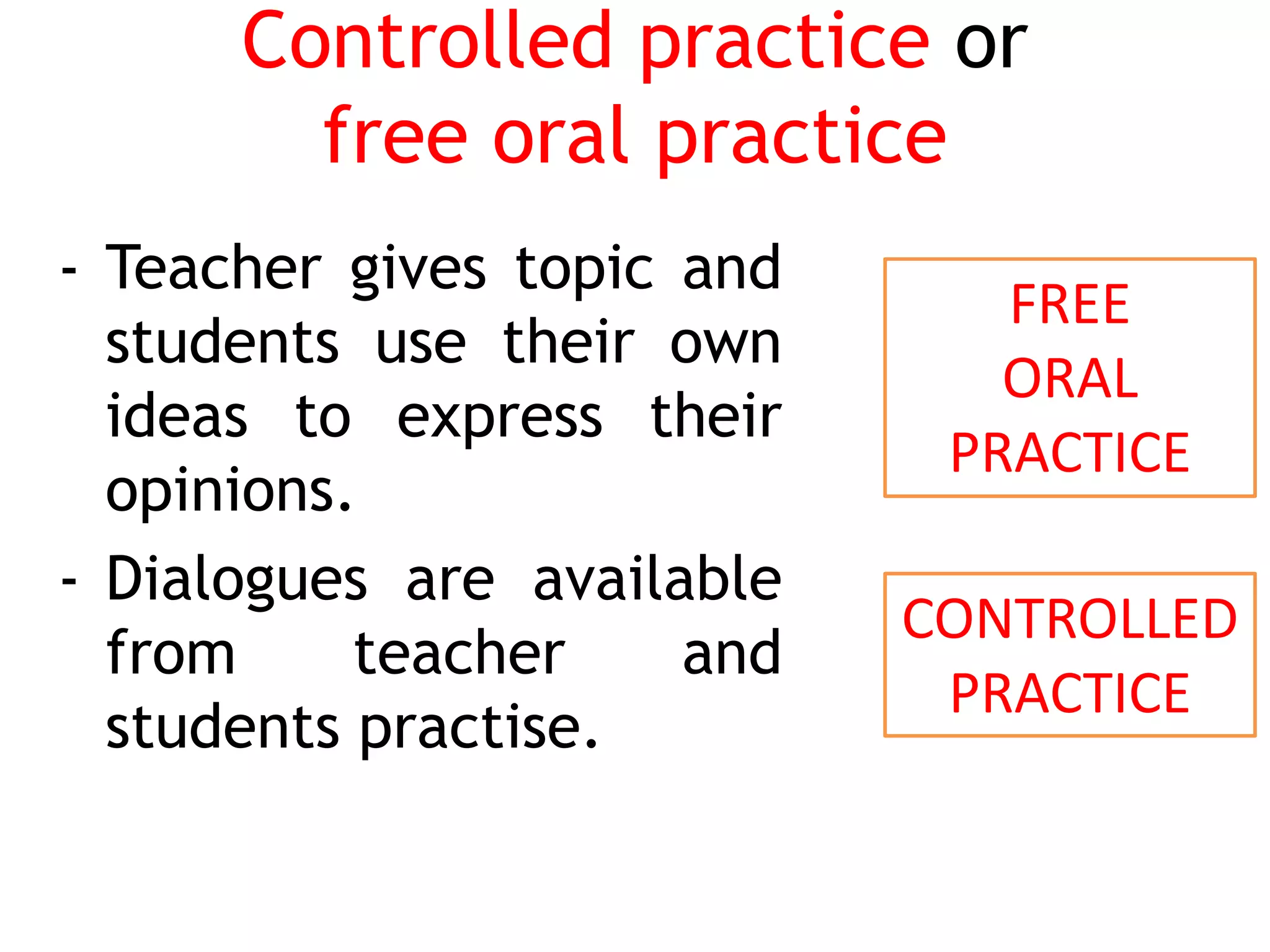
Controlled practice or
free oral practice
- Teacher gives topic and
students use their own
ideas to express their
opinions.
- Dialogues are available
from teacher and
students practise.
FREE
ORAL
PRACTICE
CONTROLLED
PRACTICE
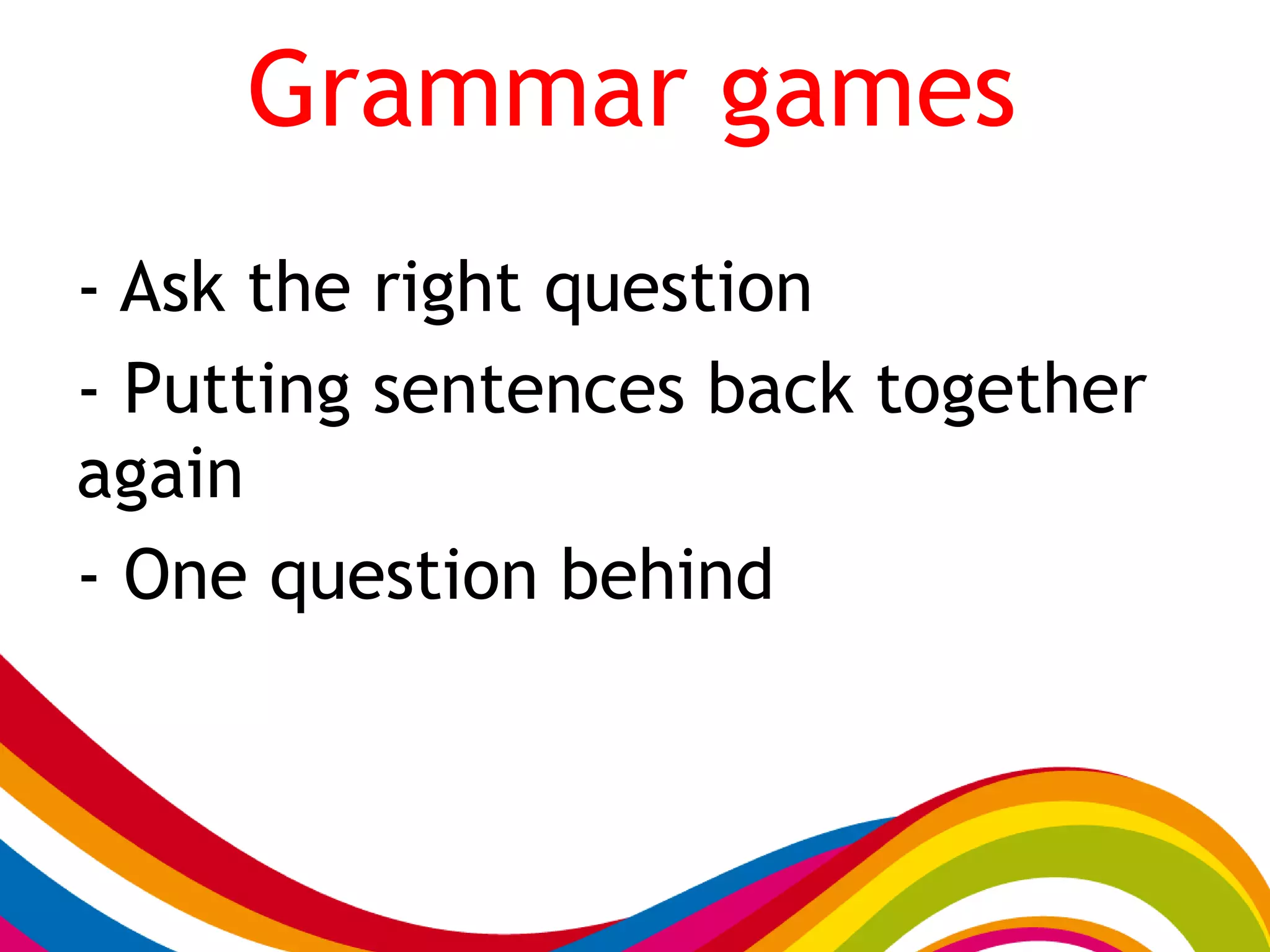
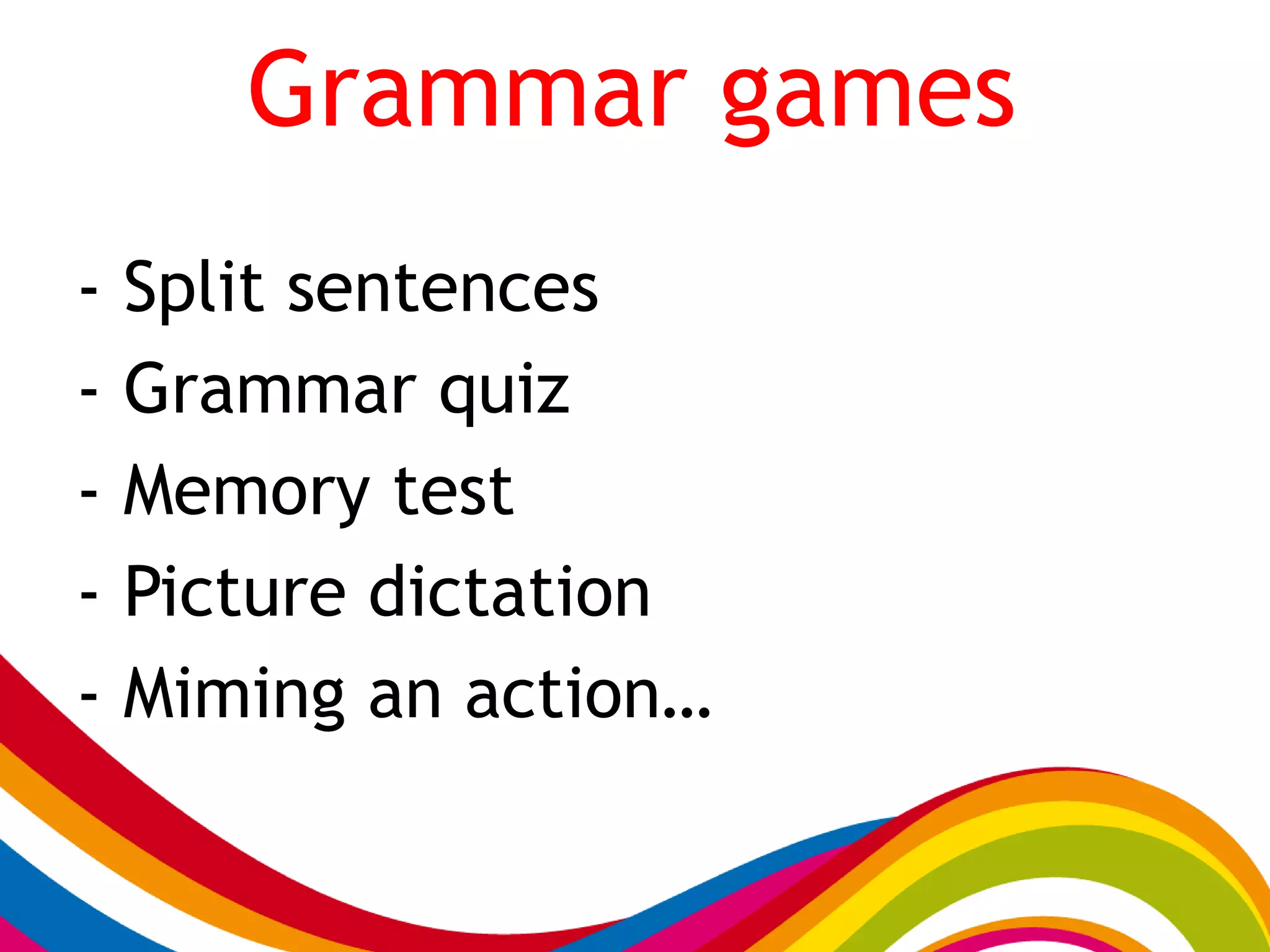
Grammar games
Grammar games
- Ask the right question
- Putting sentences back together
again
- One question behind
Grammar games
- Split sentences
- Grammar quiz
- Memory test
- Picture dictation
- Miming an action…
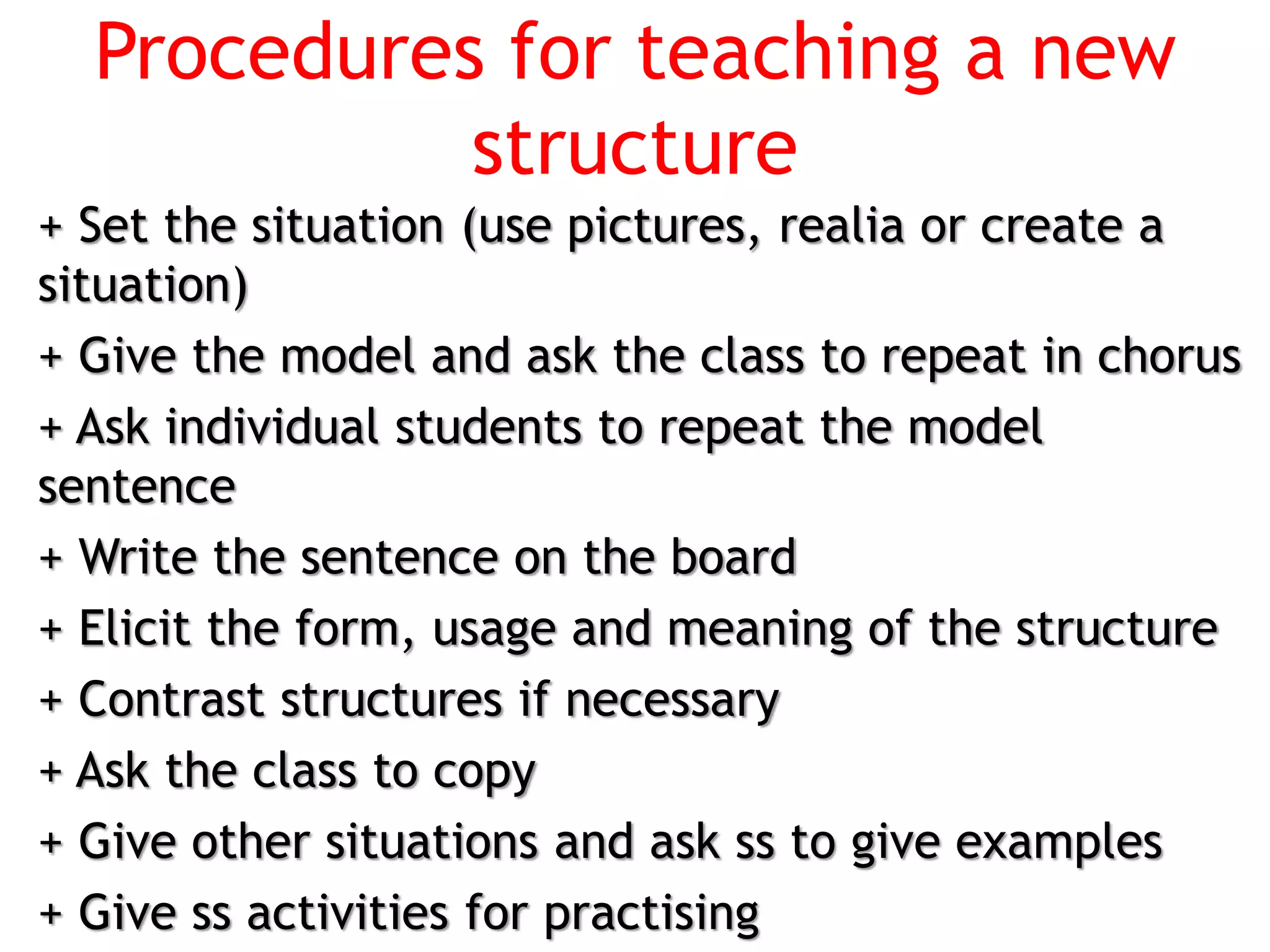
Procedures for teaching a new
structure
+ Set the situation (use pictures, realia or create a
situation)
+ Give the model and ask the class to repeat in chorus
+ Ask individual students to repeat the model
sentence
+ Write the sentence on the board
+ Elicit the form, usage and meaning of the structure
+ Contrast structures if necessary
+ Ask the class to copy
+ Give other situations and ask ss to give examples
+ Give ss activities for practising
Grammar books
How to choose a good grammar book?
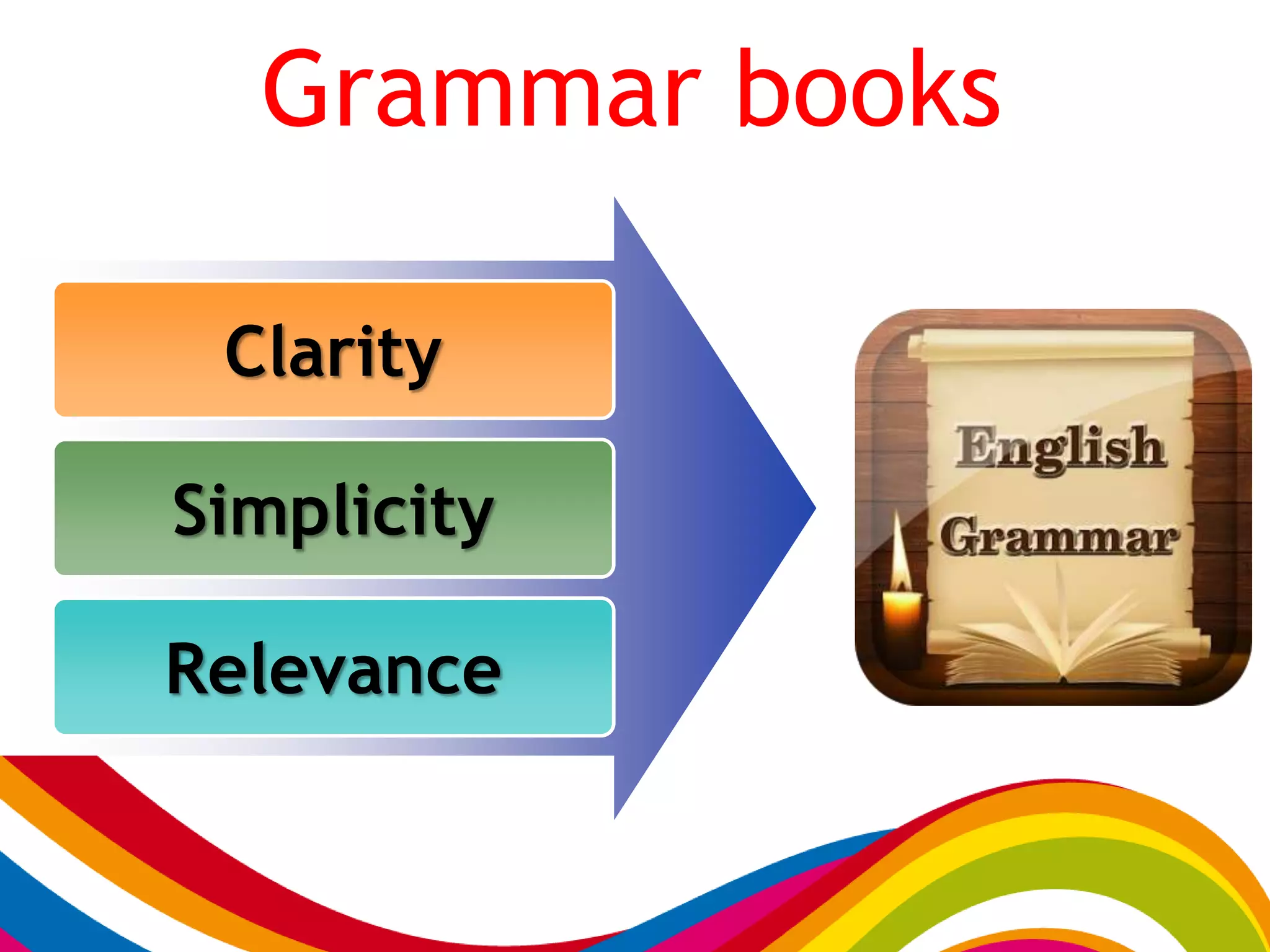
Grammar books
Clarity
Simplicity
Relevance
REFERENCES
• Harmer, J. (2007). The Practice of English Language
Teaching. 4th edition. Pearson Education.
• Luu Quy Khuong. (2006). A practical course for
teaching English as a foreign language. University of
Danang.
• Scrivener, J. (2005). Learning Teaching: A Guidebook
for English Language Teachers. 2nd edition.
Macmillan Education.
• Ur, P. (1999). A Course in Language Teaching.
Cambridge: Cambridge University Press
W6 lecture notes

W6 lecture notes