

WELCOME
Generations of
Programming Language
N.Lakshmi Kumari
I M.C.A
What is a programming
language?
English is a natural language. It has
words symbols etc…
A programming language also has
words, symbols and rules.
The rules are called as syntax.
Generations Programming Language
First (1940-56) Machine language
Second(1956-63) Assembly language
Third(1964-71) High-level language
Fourth(1971-Present) Object oriented programming
language
Fifth(Present and Beyond) Artificial intelligence
Generations of Programming languages
Machine Languages(1940-
56)
 Machine language is a collection of
binary digits or bits that the computers
reads and interprets.it is a machine
language.
 It is almost impossible to understand
for humans because they consist
entirely of numbers.
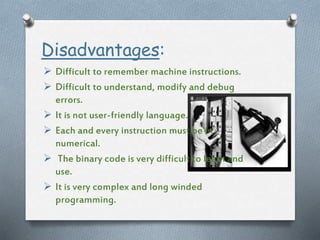
Disadvantages:
 Difficult to remember machine instructions.
 Difficult to understand, modify and debug
errors.
 It is not user-friendly language.
 Each and every instruction must be in
numerical.
 The binary code is very difficult to learn and
use.
 It is very complex and long winded
programming.
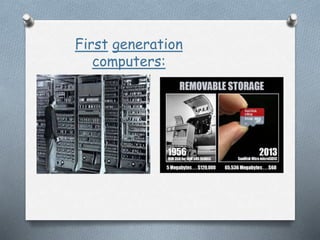
First generation
computers:
Assembly language(1956-63)
Assembly language is just one level
higher than machine language.it
consists of simple codes.
Each statement in assembly language
corresponds directly to a machine code
understood by the microprocessor.
We need an “assembler” to translate the
assembly language into machine
language.
Disadvantages:
It is a low level language.
programs are very large and difficult to
follow.
 Many instructions required to achieve
small task.
programs are machine dependent that
they are not executed if the hardware is
changed.
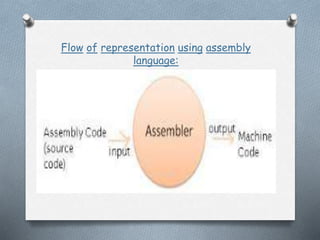
Flow of representation using assembly
language:
High-level language(1964-
71)
A programming language that provides
statements that are closer to the way the
humans solve problems than assembly
language.
 Examples : COBAL , PASCAL ,
FORTRAN, C, C++ Etc…
The source code must be compiling by
using ‘compiler’.
Advantages:
It is a user-friendly language.
These programs are machine
independent.
If a program written from one computer
we can also use by other computers.
They are easy to learn, easy to write and
easy to remember.
Disadvantages:
The programs will take more time to
run.
 Slower than low-level language, for
example
Assembler is faster than C.
Additional software i.e. compiler is
needed in order to use a high-level-
language.
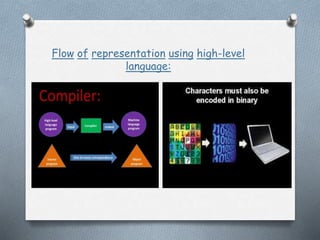
Flow of representation using high-level
language:
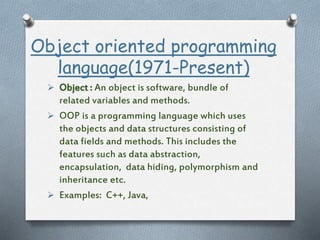
Object oriented programming
language(1971-Present)
 Object : An object is software, bundle of
related variables and methods.
 OOP is a programming language which uses
the objects and data structures consisting of
data fields and methods. This includes the
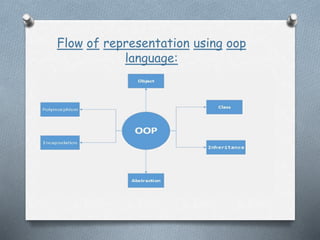
features such as data abstraction,
encapsulation, data hiding, polymorphism and
inheritance etc.
 Examples: C++, Java,
Advantages:
 It is a user-friendly language.
 We can reuse and recycle the code.
 Through the inheritance we can eliminate
redundant code.
 The principle of data hiding secures the
program.
 We can extend the use of existing classes.
 Software complexity can easily manage.
Disadvantages:
 The oop programs are designed trickily.
 To design an oop program we need to
do proper planning and proper design.
 To develop an oop program,
programmer needs proper skills such as
design skills, programming skills,
technical skills etc.
Flow of representation using oop
language:
Artificial Intelligence(present
and beyond)
 A.I is a science of designing and programming
computers to doing intelligent things and to
simulate human thought process.
 It is a high level language.
 It is a logic language which is done by less
programmer control.
 We need expert systems.
 Examples: Prolog.
Advantages:
 They are more accurate and speed than the
humans.
 We can use this in dangerous environments.
 We can access them 24/7. They don’t need sleep
or any breaks.
 It makes our life easy, safety and more
productivity.
 Duplication of them is very easy.
Disadvantages:
 They required high standard of
maintenance.
 Its programming is very complex and it
is very expensive to buy.
 It doesn’t have common sense; it can
understand only commands and not
situations.
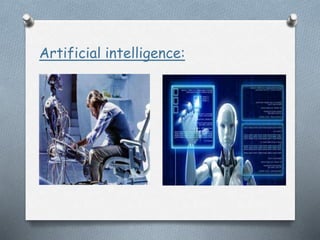
Artificial intelligence:
Generations of programming_language.kum_ari11-1-1-1

Generations of programming_language.kum_ari11-1-1-1

  • 1.
  • 2.
  • 3.
    What is aprogramming language? English is a natural language. It has words symbols etc… A programming language also has words, symbols and rules. The rules are called as syntax.
  • 4.
    Generations Programming Language First(1940-56) Machine language Second(1956-63) Assembly language Third(1964-71) High-level language Fourth(1971-Present) Object oriented programming language Fifth(Present and Beyond) Artificial intelligence Generations of Programming languages
  • 5.
    Machine Languages(1940- 56)  Machinelanguage is a collection of binary digits or bits that the computers reads and interprets.it is a machine language.  It is almost impossible to understand for humans because they consist entirely of numbers.
  • 6.
    Disadvantages:  Difficult toremember machine instructions.  Difficult to understand, modify and debug errors.  It is not user-friendly language.  Each and every instruction must be in numerical.  The binary code is very difficult to learn and use.  It is very complex and long winded programming.
  • 7.
  • 8.
    Assembly language(1956-63) Assembly languageis just one level higher than machine language.it consists of simple codes. Each statement in assembly language corresponds directly to a machine code understood by the microprocessor. We need an “assembler” to translate the assembly language into machine language.
  • 9.
    Disadvantages: It is alow level language. programs are very large and difficult to follow.  Many instructions required to achieve small task. programs are machine dependent that they are not executed if the hardware is changed.
  • 10.
    Flow of representationusing assembly language:
  • 11.
    High-level language(1964- 71) A programminglanguage that provides statements that are closer to the way the humans solve problems than assembly language.  Examples : COBAL , PASCAL , FORTRAN, C, C++ Etc… The source code must be compiling by using ‘compiler’.
  • 12.
    Advantages: It is auser-friendly language. These programs are machine independent. If a program written from one computer we can also use by other computers. They are easy to learn, easy to write and easy to remember.
  • 13.
    Disadvantages: The programs willtake more time to run.  Slower than low-level language, for example Assembler is faster than C. Additional software i.e. compiler is needed in order to use a high-level- language.
  • 14.
    Flow of representationusing high-level language:
  • 15.
    Object oriented programming language(1971-Present) Object : An object is software, bundle of related variables and methods.  OOP is a programming language which uses the objects and data structures consisting of data fields and methods. This includes the features such as data abstraction, encapsulation, data hiding, polymorphism and inheritance etc.  Examples: C++, Java,
  • 16.
    Advantages:  It isa user-friendly language.  We can reuse and recycle the code.  Through the inheritance we can eliminate redundant code.  The principle of data hiding secures the program.  We can extend the use of existing classes.  Software complexity can easily manage.
  • 17.
    Disadvantages:  The oopprograms are designed trickily.  To design an oop program we need to do proper planning and proper design.  To develop an oop program, programmer needs proper skills such as design skills, programming skills, technical skills etc.
  • 18.
    Flow of representationusing oop language:
  • 19.
    Artificial Intelligence(present and beyond) A.I is a science of designing and programming computers to doing intelligent things and to simulate human thought process.  It is a high level language.  It is a logic language which is done by less programmer control.  We need expert systems.  Examples: Prolog.
  • 20.
    Advantages:  They aremore accurate and speed than the humans.  We can use this in dangerous environments.  We can access them 24/7. They don’t need sleep or any breaks.  It makes our life easy, safety and more productivity.  Duplication of them is very easy.
  • 21.
    Disadvantages:  They requiredhigh standard of maintenance.  Its programming is very complex and it is very expensive to buy.  It doesn’t have common sense; it can understand only commands and not situations.
  • 22.