Generations
                of
Computer Languages
          Created By: Tarun Sharma
The Evolution of Programming
Languages
The Evolution of Programming Languages

To   build programs, people use languages that
  are similar to human language. The results are
  translated into machine code, which computers
  understand.
Programming languages fall into three broad
  categories:
• Machine languages
• Assembly languages
• Higher-level languages
The Evolution of Programming Languages

Machine    Language(First Generation)
  ◦ Machine languages (first-generation languages)
    are the most basic type of computer
    languages, consisting of strings of numbers the
    computer's hardware can use.
The Evolution of Programming Languages

Assembly        Language(Second Generation)
•   Assembly languages (second-generation languages) are
    only somewhat easier to work with than machine
    languages.
•   To create programs in assembly language, developers
    use cryptic English-like phrases to represent strings of
    numbers.
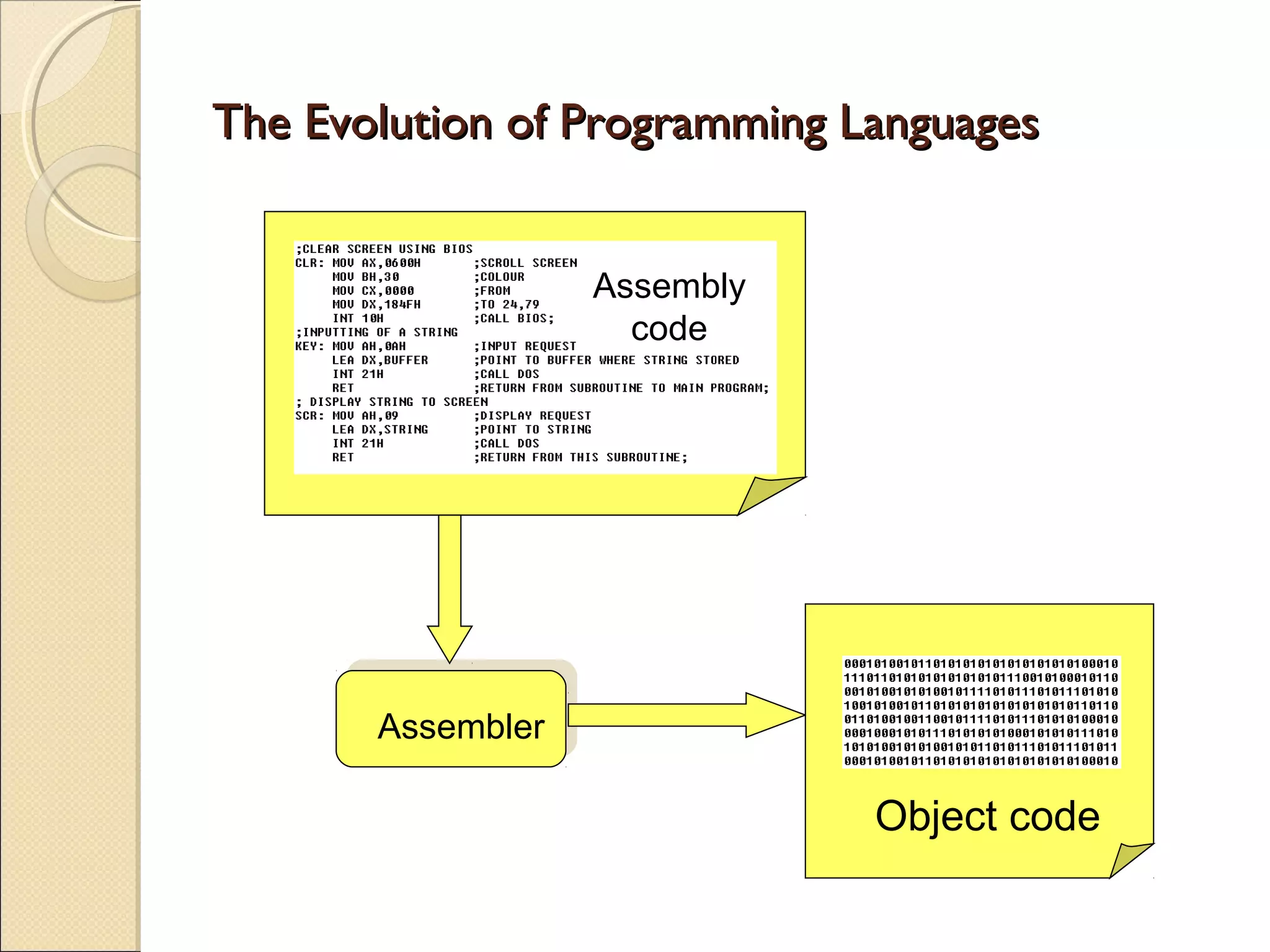
•   The code is then translated into object code, using a
    translator called an assembler.
The Evolution of Programming Languages


                   Assembly
                     code


       Assembler

                              Object code
The Evolution of Programming Languages

Higher-Level       Languages
 Higher-level languages are more powerful than
  assembly language and allow the programmer to work
  in a more English-like environment.
 Higher-level programming languages are divided into
  three "generations," each more powerful than the last:
• Third-generation languages
• Fourth-generation languages
• Fifth-generation languages
The Evolution of Programming Languages

Third    Generation Language
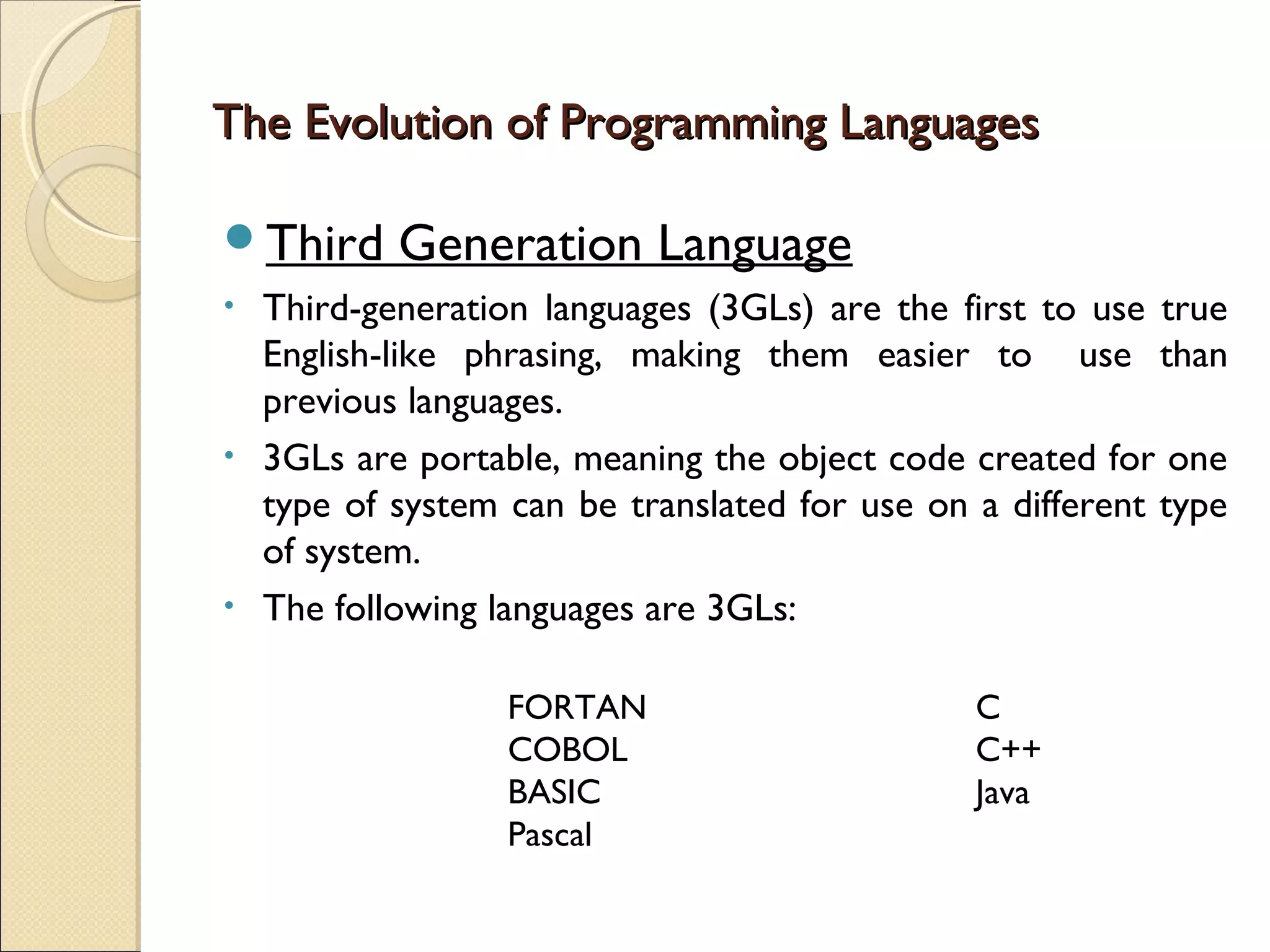
• Third-generation languages (3GLs) are the first to use true
  English-like phrasing, making them easier to use than
  previous languages.
• 3GLs are portable, meaning the object code created for one
  type of system can be translated for use on a different type
  of system.
• The following languages are 3GLs:


                 FORTAN                       C
                 COBOL                        C++
                 BASIC                        Java
                 Pascal
The Evolution of Programming Languages

Fourth      Generation Language
•   Fourth-generation languages (4GLs) are even easier to
    use than 3GLs.
•   4GLs may use a text-based environment (like a 3GL) or
    may allow the programmer to work in a visual
    environment, using graphical tools.
•   The following languages are 4GLs:
             Visual Basic (VB)
             Visual Age
The Evolution of Programming Languages

Fifth   Generation Language
  ◦ A fifth generation programming language is a
    programming language are designed to make
    the computer solve the problem of you.
  ◦ Fifth generation language are used mainly in
    artificial intelligence research.
  ◦ Prolog, OPS5 and Mercury are the best
    known          fifth     generation languages.
Thank You..

Generations of Programming Languages

  • 1.
    Generations of Computer Languages Created By: Tarun Sharma
  • 2.
    The Evolution ofProgramming Languages
  • 3.
    The Evolution ofProgramming Languages To build programs, people use languages that are similar to human language. The results are translated into machine code, which computers understand. Programming languages fall into three broad categories: • Machine languages • Assembly languages • Higher-level languages
  • 4.
    The Evolution ofProgramming Languages Machine Language(First Generation) ◦ Machine languages (first-generation languages) are the most basic type of computer languages, consisting of strings of numbers the computer's hardware can use.
  • 5.
    The Evolution ofProgramming Languages Assembly Language(Second Generation) • Assembly languages (second-generation languages) are only somewhat easier to work with than machine languages. • To create programs in assembly language, developers use cryptic English-like phrases to represent strings of numbers. • The code is then translated into object code, using a translator called an assembler.
  • 6.
    The Evolution ofProgramming Languages Assembly code Assembler Object code
  • 7.
    The Evolution ofProgramming Languages Higher-Level Languages  Higher-level languages are more powerful than assembly language and allow the programmer to work in a more English-like environment.  Higher-level programming languages are divided into three "generations," each more powerful than the last: • Third-generation languages • Fourth-generation languages • Fifth-generation languages
  • 8.
    The Evolution ofProgramming Languages Third Generation Language • Third-generation languages (3GLs) are the first to use true English-like phrasing, making them easier to use than previous languages. • 3GLs are portable, meaning the object code created for one type of system can be translated for use on a different type of system. • The following languages are 3GLs: FORTAN C COBOL C++ BASIC Java Pascal
  • 9.
    The Evolution ofProgramming Languages Fourth Generation Language • Fourth-generation languages (4GLs) are even easier to use than 3GLs. • 4GLs may use a text-based environment (like a 3GL) or may allow the programmer to work in a visual environment, using graphical tools. • The following languages are 4GLs:  Visual Basic (VB)  Visual Age
  • 10.
    The Evolution ofProgramming Languages Fifth Generation Language ◦ A fifth generation programming language is a programming language are designed to make the computer solve the problem of you. ◦ Fifth generation language are used mainly in artificial intelligence research. ◦ Prolog, OPS5 and Mercury are the best known fifth generation languages.
  • 11.