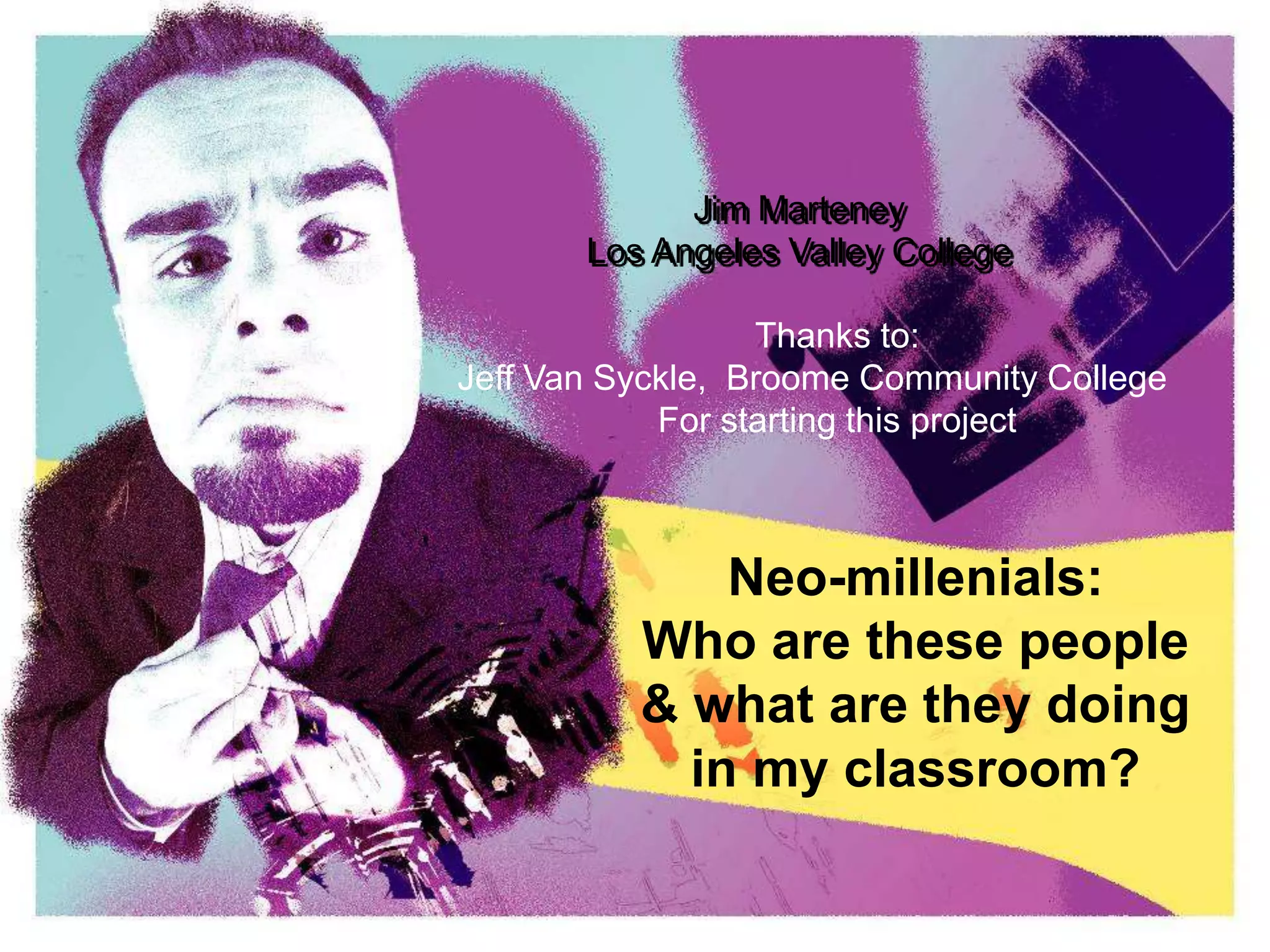


Neo-millenials:
Who are these people
& what are they doing
in my classroom?
Jim Marteney
Los Angeles Valley College
Thanks to:
Jeff Van Syckle, Broome Community College
For starting this project
neo-millenials
echo
boomersdigital nativesGeneration Y
The Net
Generation
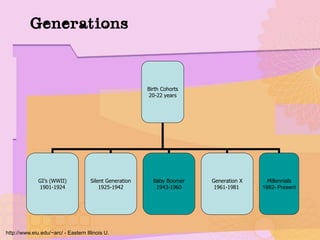
Generations
http://www.eiu.edu/~arc/ - Eastern Illinois U.
Birth Cohorts
20-22 years
GI’s (WWII)
1901-1924
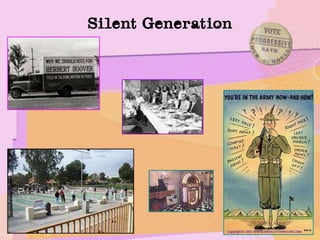
Silent Generation
1925-1942
Baby Boomer
1943-1960
Generation X
1961-1981
Millennials
1982- Present
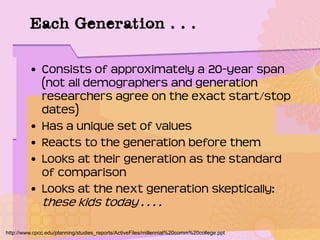
Each Generation . . .
• Consists of approximately a 20-year span
(not all demographers and generation
researchers agree on the exact start/stop
dates)
• Has a unique set of values
• Reacts to the generation before them
• Looks at their generation as the standard
of comparison
• Looks at the next generation skeptically:
these kids today . . . .
http://www.cpcc.edu/planning/studies_reports/ActiveFiles/millennial%20comm%20college.ppt
What generation?
• More likely to live in two-income household.
• Have children at home
• Have a basic feeling of security
• More likely than others to focus on
education
• Have the higher level of education
• 88.8% of this generation completed high
school
http://www.eiu.edu/~arc/ - Eastern Illinois U.
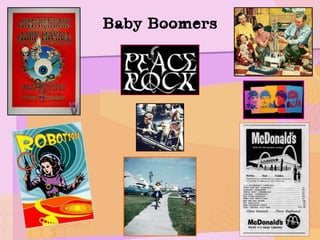
Baby Boomers
What generation?
• This group grew up during the post
Watergate era and the energy crisis.
• They were in many cases children of
divorce and nontraditional family units
• Many were latchkey kids who were
raised on electronic media (television,
Atari 2600s)
http://www.eiu.edu/~arc/ - Eastern Illinois U.
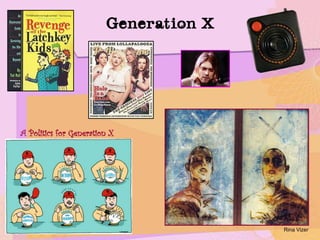
Generation X
Rina Vizer
A Politics for Generation X
What generation?
• This group was born at a time when it was
considered natural & appropriate for
families to have large numbers of children
• This generation wed early; started divorce
epidemic
• This generation are about 95% retired at
this point
• This group was born during an era of
depression and war
http://www.eiu.edu/~arc/ - Eastern Illinois U.
Silent Generation
What generation?
• Sheltered
• They have experienced a positive
economy while moving through their
school years
• This generation grew up on kid safety
rules, lockdown of public schools,
sweeping national youth safety
movement
• Technological sophistication
http://www.eiu.edu/~arc/ - Eastern Illinois U.
Millennials
Who are the Millennials?
• Born in or after 1982
• Presently 80 million (largest generation)
• The oldest entered college Fall of 2000
• Life expectancy of 75 years
• 3 most popular names
Males Females
Michael Jennifer
Jason Jessica
Christopher Ashley
http://www.eiu.edu/~arc/ - Eastern Illinois U.
Notable events . . .
• 9-11
• Columbine
• Oklahoma City Bombing
• Princess Di’s death
• Clinton Impeachment Trial
• O.J. Simpson Trial
• Rodney King riots
• Lewinsky scandal
The Millennial Generation:
The Next Generation in College Enrollment
• Research by Dr. Terri Manning, Bobbie
Everett & Cheryl Roberts of Central
Piedmont Community College
Two Responses to This Research
1. The Millennials are spoiled rotten brats
whose parents have given them
everything.
2. This generation is extremely talented
and will bring technology and
teamwork skills to the workforce.
Manning, Everett, & Roberts. Central Piedmont Community College.
Millennials
• This generation is civic-minded, much like
the GI Generation.
• They are collectively optimistic, long-term
planners, high achievers with lower rates of
violent crime, teen pregnancy, smoking and
alcohol use than ever before.
• This generation believes that they have the
potential to be great.
• We are looking to them to provide us with a
new definition of citizenship.
Manning, Everett, & Roberts. Central Piedmont Community College.
Millennials – Demographic
Trends
• The Baby Boomers chose to become older
parents in the 1980s while Gen X moms
reverted back to the earlier birth-age norm,
which meant that two generations were
having babies.
• In 1989, 29 percent of the 4.4 million live
births were to women aged 30 and older.
• Millennials have older largely Baby Boomer
parents: Average age of mothers
at birth at an all time high of 27
in 1997.
Manning, Everett, & Roberts. Central Piedmont Community College.
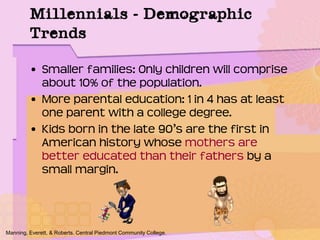
• Smaller families: Only children will comprise
about 10% of the population.
• More parental education: 1 in 4 has at least
one parent with a college degree.
• Kids born in the late 90’s are the first in
American history whose mothers are
better educated than their fathers by a
small margin.
Manning, Everett, & Roberts. Central Piedmont Community College.
Millennials – Demographic
Trends
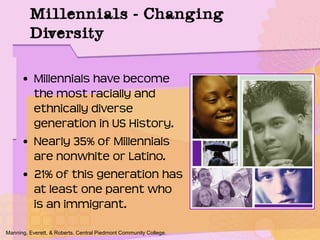
• Millennials have become
the most racially and
ethnically diverse
generation in US History.
• Nearly 35% of Millennials
are nonwhite or Latino.
• 21% of this generation has
at least one parent who
is an immigrant.
Manning, Everett, & Roberts. Central Piedmont Community College.
Millennials – Changing
Diversity
• Boomers rebelled against the parenting
practices of their parents.
• They made conscious decisions not to say
because I told you so or because I’m the
parent and you’re the child.
• Strict discipline was the order of the day
for boomers.
• Boomers became friends with their
children.
Manning, Everett, & Roberts. Central Piedmont Community College.
Baby Boomers as Parents
• They explained things to their children,
(actions, consequences, options, etc.) –
they wanted them to learn to make
informed decisions.
• They allowed their children to have input
into family decisions, educational options
and discipline issues.
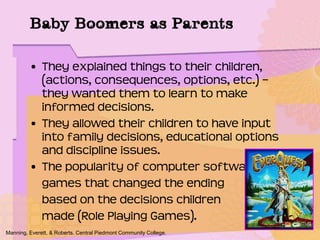
• The popularity of computer software/
games that changed the ending
based on the decisions children
made (Role Playing Games).
Manning, Everett, & Roberts. Central Piedmont Community College.
Baby Boomers as Parents
• Millennials have become a master set of
negotiators who are capable of rational
thought and decision-making skills at young
ages.
• They will negotiate with anyone including
their teachers; some call this arguing.
• More and more students challenge me and
the material. They either see it as opinion,
and nothing else, or they see it as …
propaganda. (Central Piedmont Community College Instructor)
Manning, Everett, & Roberts. Central Piedmont Community College.
The Result . . .
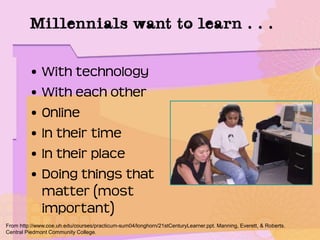
• With technology
• With each other
• Online
• In their time
• In their place
• Doing things that
matter (most
important)
From http://www.coe.uh.edu/courses/practicum-sum04/longhorn/21stCenturyLearner.ppt. Manning, Everett, & Roberts.
Central Piedmont Community College.
Millennials want to learn . . .
• They need to understand why they are
doing what they are doing – objectives of
classroom activities and projects.
• They want to have input into their
educational processes.
• They want to be involved in meaningful
activities, not mundane work.
• They think it is cool to be smart.
• They will respond well to programs like
learning communities and service learning.
Manning, Everett, & Roberts. Central Piedmont Community College.
In school . . .
• They are likely to appreciate clear
expectations, explicit syllabi, and well
structured assignments.
• They expect detailed instructions and
guidelines for completing assignments.
• They want to know what will be covered on
tests and what exactly must be done to
earn an A.
• Because of their high expectations of
themselves, students may become
demoralized by earning a B or C
in college.
Manning, Everett, & Roberts. Central Piedmont Community College.
High expectations . . .
• They function in an international world.
• This generation has been plugged in since
they were babies.
• They grew up with educational software
and computer games.
• They think technology should be free.
• They want and expect services 24/7.
• They do not live in an 8–5 world.
• They all have cell phones and expect
to be in contact 24/7.
Manning, Everett, & Roberts. Central Piedmont Community College.
High expectations . . .
technology
• Students are increasingly savvy when it
comes to technology.
• Students expect faculty to incorporate
technology into their teaching & be
proficient at it.
• At the very least: Communication via e-mail,
access to online resources, PowerPoint
presentations, Internet activities,
discussion boards, and electronic
classrooms are expected.
Manning, Everett, & Roberts. Central Piedmont Community College.
High expectations . . .
technology
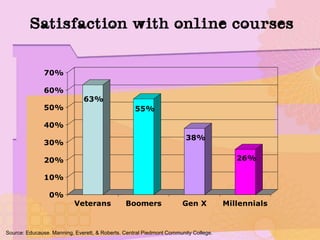
Source: Educause. Manning, Everett, & Roberts. Central Piedmont Community College.
Satisfaction with online courses
63%
55%
38%
26%
0%
10%
20%
30%
40%
50%
60%
70%
Veterans Boomers Gen X Millennials
Children under 6 years
– 48% have used a computer; 27% (4-6 year-
olds) use a computer daily
– 39% use a computer several times a
week
– 30% have played computer games
Manning,Everett,&Roberts.CentralPiedmontCommunityCollege.
Technology use
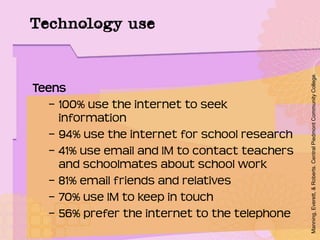
Teens
– 100% use the internet to seek
information
– 94% use the internet for school research
– 41% use email and IM to contact teachers
and schoolmates about school work
– 81% email friends and relatives
– 70% use IM to keep in touch
– 56% prefer the internet to the telephone
Manning,Everett,&Roberts.CentralPiedmontCommunityCollege.
Technology use
Digital Natives
• “native speakers” of the digital
language of computers, video games
and the internet
Digital Immigrants
• Those not born into the digital world
but later became fascinated by the
technology.
----Marc Prensky
Digital Natives, Digital Immigrants
Digital Natives
Today’s 21-year-olds
• Born, 1985 internet was 2 years old and
Mario launched Super Mario Brothers
• Grade school, World Wide Web invented
• Middle school, Palm Pilot launched
• High school, cell phones
• College, Napster and Blogger launched-1999
• College, iPod and early social networking
http://observer.guardian.co.uk/business/story/0,,1884740,00.html
Digital Natives
• Today’s students think and process
information fundamentally differently
from their predecessors.
Marc Prensky
• “Different kinds of experiences lead
to different brain structures.”
Dr. Bruce D. Berry, Baylor College of Medicine
• Students have never known life without the
computer. It is an assumed part of life.
• The Internet is a source of research,
interactivity, and socializing (they prefer it
over TV).
• Doing is more important than knowing.
• Staying “connected” is essential.
• There is zero tolerance for delays.
Manning, Everett, & Roberts. Central Piedmont Community College.
“Information Age” Mindset
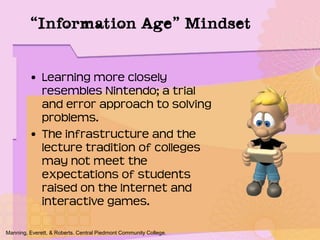
• Learning more closely
resembles Nintendo; a trial
and error approach to solving
problems.
• The infrastructure and the
lecture tradition of colleges
may not meet the
expectations of students
raised on the Internet and
interactive games.
Manning, Everett, & Roberts. Central Piedmont Community College.
“Information Age” Mindset
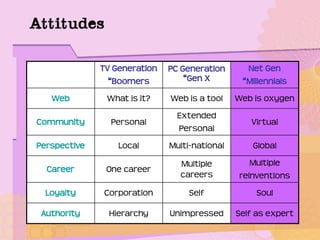
Attitudes
TV Generation
“Boomers
PC Generation
“Gen X
Net Gen
“Millennials
Web What is it? Web is a tool Web is oxygen
Community Personal
Extended
Personal
Virtual
Perspective Local Multi-national Global
Career One career
Multiple
careers
Multiple
reinventions
Loyalty Corporation Self Soul
Authority Hierarchy Unimpressed Self as expert
Ready for a change?
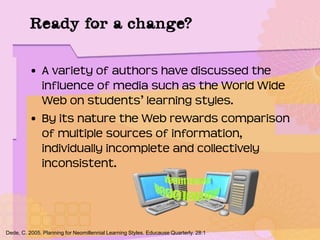
• A variety of authors have discussed the
influence of media such as the World Wide
Web on students’ learning styles.
• By its nature the Web rewards comparison
of multiple sources of information,
individually incomplete and collectively
inconsistent.
Dede, C. 2005. Planning for Neomillennial Learning Styles. Educause Quarterly. 28:1
Neomillennial Learning Styles
• Learning is based on seeking, sieving, and
synthesizing, rather than on assimilating a
single "validated" source of knowledge as
from books, television, or a professor’s
lectures.
• Also, digital media and interfaces
encourage multitasking.
• Superficial, easily distracted style of gaining
information or a sophisticated form of
synthesizing new insights?
Dede, C. 2005. Planning for Neomillennial Learning Styles. Educause Quarterly. 28:1
Neomillennial Learning Styles
• Napsterism - the recombining of others’
designs to individual, personally tailored
configurations.
• People of all ages have shifted from
purchasing music prepackaged into albums to
mixing/tailoring their own sequences of
artists and songs.
• Businesses data-mine the choices individuals
make, then provide customized services.
Dede, C. 2005. Planning for Neomillennial Learning Styles. Educause Quarterly. 28:1
Neomillennial Learning Styles
• Increasingly, people want educational
products and services tailored to their
individual needs rather than one-size-fits-all
courses of fixed length, content, and
pedagogy.
• Overall, the Internet-based learning styles
ascribed to "Millennial" students increasingly
apply for many people across a wide range
of ages, driven by the tools and media they
use every day.
• Neal Postman
Dede, C. 2005. Planning for Neomillennial Learning Styles. Educause Quarterly. 28:1
Psychological Immersion
• Over the next decade, 3 complementary
interfaces to information technology will
shape how people learn:
– The familiar "world to the desktop"
interface, providing access to distant
experts and archives and enabling
collaborations, mentoring relationships,
and virtual communities of practice. This
interface is evolving through initiatives
such as Internet 2.0
Dede, C. 2005. Planning for Neomillennial Learning Styles. Educause Quarterly. 28:1
Psychological Immersion
• Over the next decade, 3 complementary
interfaces to information technology will
shape how people learn:
– "Alice-in-Wonderland" multiuser virtual
environment (MUVE) interfaces, in which
participants’ avatars interact with
computer-based agents and digital
artifacts in virtual contexts.
– MMORPG’s
Dede, C. 2005. Planning for Neomillennial Learning Styles. Educause Quarterly. 28:1
Psychological Immersion
• Over the next decade, 3 complementary
interfaces to information technology will
shape how people learn:
– Interfaces for ubiquitous computing, in
which mobile wireless devices infuse
virtual resources as we move through
the real world.
Dede, C. 2005. Planning for Neomillennial Learning Styles. Educause Quarterly. 28:1
Psychological Immersion
• Ubiquitous computing names the third
wave in computing, just now beginning.
– First were mainframes, each shared by
lots of people.
– Now we are in the personal computing
era, person and machine staring uneasily
at each other across the desktop.
– Next comes ubiquitous computing, or the
age of calm technology, when technology
recedes into the background of our lives
http://www.ubiq.com/hypertext/weiser/UbiHome.html
Immersion in Educational
Augmented Realities
• MUVE: River City MUVE is centered on skills
of hypothesis formation and experimental
design, as well as on content related to
national standards and assessments in
biology and ecology
• Augmented reality simulations: Using GPS
links students role-play environmental
scientists investigating a rash of health
concerns on the MIT campus linked to the
release of toxins in the water supply.
http://www.ubiq.com/hypertext/weiser/UbiHome.html
Immersion in Educational
Augmented Realities
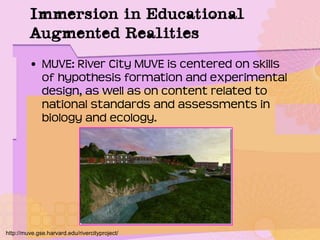
• MUVE: River City MUVE is centered on skills
of hypothesis formation and experimental
design, as well as on content related to
national standards and assessments in
biology and ecology.
http://muve.gse.harvard.edu/rivercityproject/
Immersion in Educational
Augmented Realities
• Augmented reality simulations: Embedding
students inside lifelike problem-solving
situations.
– "Environmental Detectives" augmented reality
simulation, for example, engages high school
and university students in a real-world
environmental consulting scenario not possible
to implement in a classroom setting.
– Students role-play environmental scientists
investigating a rash of health concerns on the
MIT campus linked to the release of toxins in the
water supply
http://www.ubiq.com/hypertext/weiser/UbiHome.html
Professional development
• Co-design: Developing learning experiences
students can personalize
• Co-instruction: Utilizing knowledge sharing among
students as a major source of content and
pedagogy
• Guided learning-by-doing pedagogies: Infusing
case-based participatory simulations into
presentational/ assimilative instruction
• Assessment beyond tests and papers: Evaluating
collaborative, nonlinear, associational webs of
representations; utilizing peer-developed and peer-
rated forms of assessment; using student-
initiated assessments to provide formative
feedback on faculty effectiveness
http://www.ubiq.com/hypertext/weiser/UbiHome.html
Professional development
• Some of these shifts are controversial for
many faculty, and all involve "unlearning"
almost unconscious beliefs, assumptions, and
values about the nature of teaching, learning,
and the academy.
• As the nature of students alters, instructors
must themselves experience mediated
immersion and develop neo-millennial learning
styles to continue effective teaching.
• The mission and structure of higher education
might change due to the influence of these
new interactive media.
http://www.ubiq.com/hypertext/weiser/UbiHome.html
Professional development
• Some of these shifts are controversial for
many faculty, and all involve "unlearning"
almost unconscious beliefs, assumptions, and
values about the nature of teaching, learning,
and the academy.
• As the nature of students alters, instructors
must themselves experience mediated
immersion and develop neo-millennial learning
styles to continue effective teaching.
• The mission and structure of higher education
might change due to the influence of these
new interactive media.
http://www.ubiq.com/hypertext/weiser/UbiHome.html
The Struggle
Digital Immigrant instructors, who speak an
outdated language (that of the pre-digital
age), are struggling to teach a population
that speaks an entirely new language.
“Everytime I go to school I have to power
down.” --complains a high school student
“www.hungry.com”
---recently stated by a kindergarten student at lunch
Games and Learning
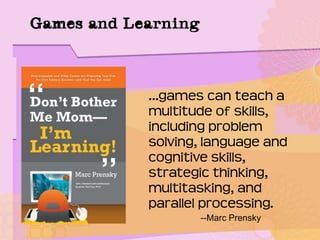
…games can teach a
multitude of skills,
including problem
solving, language and
cognitive skills,
strategic thinking,
multitasking, and
parallel processing.
--Marc Prensky
Games and Learning
• "The power of games is that they put
you inside a world," he said, "and you
see that world from an inside-out
perspective, and you have to solve
(games') problems from that
perspective.”
---James Gee
http://chronicle.com/free/v49/i49/49a03101.htm
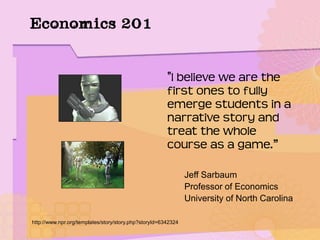
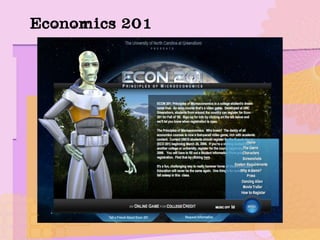
Economics 201
"I believe we are the
first ones to fully
emerge students in a
narrative story and
treat the whole
course as a game.”
Jeff Sarbaum
Professor of Economics
University of North Carolina
http://www.npr.org/templates/story/story.php?storyId=6342324
Economics 201
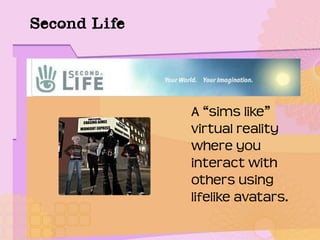
Second Life
A “sims like”
virtual reality
where you
interact with
others using
lifelike avatars.
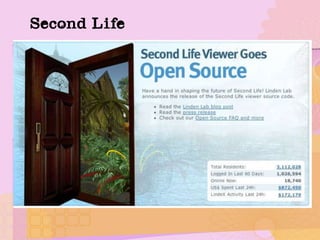
Second Life
Educators’ Goal
We should not be about
creating educational
content.
We should be be about
creating educational
experiences.

Generations

  • 1.
    Neo-millenials: Who are thesepeople & what are they doing in my classroom? Jim Marteney Los Angeles Valley College Thanks to: Jeff Van Syckle, Broome Community College For starting this project
  • 2.
  • 3.
    Generations http://www.eiu.edu/~arc/ - EasternIllinois U. Birth Cohorts 20-22 years GI’s (WWII) 1901-1924 Silent Generation 1925-1942 Baby Boomer 1943-1960 Generation X 1961-1981 Millennials 1982- Present
  • 4.
    Each Generation .. . • Consists of approximately a 20-year span (not all demographers and generation researchers agree on the exact start/stop dates) • Has a unique set of values • Reacts to the generation before them • Looks at their generation as the standard of comparison • Looks at the next generation skeptically: these kids today . . . . http://www.cpcc.edu/planning/studies_reports/ActiveFiles/millennial%20comm%20college.ppt
  • 5.
    What generation? • Morelikely to live in two-income household. • Have children at home • Have a basic feeling of security • More likely than others to focus on education • Have the higher level of education • 88.8% of this generation completed high school http://www.eiu.edu/~arc/ - Eastern Illinois U.
  • 6.
  • 7.
    What generation? • Thisgroup grew up during the post Watergate era and the energy crisis. • They were in many cases children of divorce and nontraditional family units • Many were latchkey kids who were raised on electronic media (television, Atari 2600s) http://www.eiu.edu/~arc/ - Eastern Illinois U.
  • 8.
    Generation X Rina Vizer APolitics for Generation X
  • 9.
    What generation? • Thisgroup was born at a time when it was considered natural & appropriate for families to have large numbers of children • This generation wed early; started divorce epidemic • This generation are about 95% retired at this point • This group was born during an era of depression and war http://www.eiu.edu/~arc/ - Eastern Illinois U.
  • 10.
  • 11.
    What generation? • Sheltered •They have experienced a positive economy while moving through their school years • This generation grew up on kid safety rules, lockdown of public schools, sweeping national youth safety movement • Technological sophistication http://www.eiu.edu/~arc/ - Eastern Illinois U.
  • 12.
  • 13.
    Who are theMillennials? • Born in or after 1982 • Presently 80 million (largest generation) • The oldest entered college Fall of 2000 • Life expectancy of 75 years • 3 most popular names Males Females Michael Jennifer Jason Jessica Christopher Ashley http://www.eiu.edu/~arc/ - Eastern Illinois U.
  • 14.
    Notable events .. . • 9-11 • Columbine • Oklahoma City Bombing • Princess Di’s death • Clinton Impeachment Trial • O.J. Simpson Trial • Rodney King riots • Lewinsky scandal
  • 15.
    The Millennial Generation: TheNext Generation in College Enrollment • Research by Dr. Terri Manning, Bobbie Everett & Cheryl Roberts of Central Piedmont Community College Two Responses to This Research 1. The Millennials are spoiled rotten brats whose parents have given them everything. 2. This generation is extremely talented and will bring technology and teamwork skills to the workforce. Manning, Everett, & Roberts. Central Piedmont Community College.
  • 16.
    Millennials • This generationis civic-minded, much like the GI Generation. • They are collectively optimistic, long-term planners, high achievers with lower rates of violent crime, teen pregnancy, smoking and alcohol use than ever before. • This generation believes that they have the potential to be great. • We are looking to them to provide us with a new definition of citizenship. Manning, Everett, & Roberts. Central Piedmont Community College.
  • 17.
    Millennials – Demographic Trends •The Baby Boomers chose to become older parents in the 1980s while Gen X moms reverted back to the earlier birth-age norm, which meant that two generations were having babies. • In 1989, 29 percent of the 4.4 million live births were to women aged 30 and older. • Millennials have older largely Baby Boomer parents: Average age of mothers at birth at an all time high of 27 in 1997. Manning, Everett, & Roberts. Central Piedmont Community College.
  • 18.
    • Smaller families:Only children will comprise about 10% of the population. • More parental education: 1 in 4 has at least one parent with a college degree. • Kids born in the late 90’s are the first in American history whose mothers are better educated than their fathers by a small margin. Manning, Everett, & Roberts. Central Piedmont Community College. Millennials – Demographic Trends
  • 19.
    • Millennials havebecome the most racially and ethnically diverse generation in US History. • Nearly 35% of Millennials are nonwhite or Latino. • 21% of this generation has at least one parent who is an immigrant. Manning, Everett, & Roberts. Central Piedmont Community College. Millennials – Changing Diversity
  • 20.
    • Boomers rebelledagainst the parenting practices of their parents. • They made conscious decisions not to say because I told you so or because I’m the parent and you’re the child. • Strict discipline was the order of the day for boomers. • Boomers became friends with their children. Manning, Everett, & Roberts. Central Piedmont Community College. Baby Boomers as Parents
  • 21.
    • They explainedthings to their children, (actions, consequences, options, etc.) – they wanted them to learn to make informed decisions. • They allowed their children to have input into family decisions, educational options and discipline issues. • The popularity of computer software/ games that changed the ending based on the decisions children made (Role Playing Games). Manning, Everett, & Roberts. Central Piedmont Community College. Baby Boomers as Parents
  • 22.
    • Millennials havebecome a master set of negotiators who are capable of rational thought and decision-making skills at young ages. • They will negotiate with anyone including their teachers; some call this arguing. • More and more students challenge me and the material. They either see it as opinion, and nothing else, or they see it as … propaganda. (Central Piedmont Community College Instructor) Manning, Everett, & Roberts. Central Piedmont Community College. The Result . . .
  • 23.
    • With technology •With each other • Online • In their time • In their place • Doing things that matter (most important) From http://www.coe.uh.edu/courses/practicum-sum04/longhorn/21stCenturyLearner.ppt. Manning, Everett, & Roberts. Central Piedmont Community College. Millennials want to learn . . .
  • 24.
    • They needto understand why they are doing what they are doing – objectives of classroom activities and projects. • They want to have input into their educational processes. • They want to be involved in meaningful activities, not mundane work. • They think it is cool to be smart. • They will respond well to programs like learning communities and service learning. Manning, Everett, & Roberts. Central Piedmont Community College. In school . . .
  • 25.
    • They arelikely to appreciate clear expectations, explicit syllabi, and well structured assignments. • They expect detailed instructions and guidelines for completing assignments. • They want to know what will be covered on tests and what exactly must be done to earn an A. • Because of their high expectations of themselves, students may become demoralized by earning a B or C in college. Manning, Everett, & Roberts. Central Piedmont Community College. High expectations . . .
  • 26.
    • They functionin an international world. • This generation has been plugged in since they were babies. • They grew up with educational software and computer games. • They think technology should be free. • They want and expect services 24/7. • They do not live in an 8–5 world. • They all have cell phones and expect to be in contact 24/7. Manning, Everett, & Roberts. Central Piedmont Community College. High expectations . . . technology
  • 27.
    • Students areincreasingly savvy when it comes to technology. • Students expect faculty to incorporate technology into their teaching & be proficient at it. • At the very least: Communication via e-mail, access to online resources, PowerPoint presentations, Internet activities, discussion boards, and electronic classrooms are expected. Manning, Everett, & Roberts. Central Piedmont Community College. High expectations . . . technology
  • 28.
    Source: Educause. Manning,Everett, & Roberts. Central Piedmont Community College. Satisfaction with online courses 63% 55% 38% 26% 0% 10% 20% 30% 40% 50% 60% 70% Veterans Boomers Gen X Millennials
  • 29.
    Children under 6years – 48% have used a computer; 27% (4-6 year- olds) use a computer daily – 39% use a computer several times a week – 30% have played computer games Manning,Everett,&Roberts.CentralPiedmontCommunityCollege. Technology use
  • 30.
    Teens – 100% usethe internet to seek information – 94% use the internet for school research – 41% use email and IM to contact teachers and schoolmates about school work – 81% email friends and relatives – 70% use IM to keep in touch – 56% prefer the internet to the telephone Manning,Everett,&Roberts.CentralPiedmontCommunityCollege. Technology use
  • 31.
    Digital Natives • “nativespeakers” of the digital language of computers, video games and the internet Digital Immigrants • Those not born into the digital world but later became fascinated by the technology. ----Marc Prensky Digital Natives, Digital Immigrants
  • 32.
    Digital Natives Today’s 21-year-olds •Born, 1985 internet was 2 years old and Mario launched Super Mario Brothers • Grade school, World Wide Web invented • Middle school, Palm Pilot launched • High school, cell phones • College, Napster and Blogger launched-1999 • College, iPod and early social networking http://observer.guardian.co.uk/business/story/0,,1884740,00.html
  • 33.
    Digital Natives • Today’sstudents think and process information fundamentally differently from their predecessors. Marc Prensky • “Different kinds of experiences lead to different brain structures.” Dr. Bruce D. Berry, Baylor College of Medicine
  • 34.
    • Students havenever known life without the computer. It is an assumed part of life. • The Internet is a source of research, interactivity, and socializing (they prefer it over TV). • Doing is more important than knowing. • Staying “connected” is essential. • There is zero tolerance for delays. Manning, Everett, & Roberts. Central Piedmont Community College. “Information Age” Mindset
  • 35.
    • Learning moreclosely resembles Nintendo; a trial and error approach to solving problems. • The infrastructure and the lecture tradition of colleges may not meet the expectations of students raised on the Internet and interactive games. Manning, Everett, & Roberts. Central Piedmont Community College. “Information Age” Mindset
  • 36.
    Attitudes TV Generation “Boomers PC Generation “GenX Net Gen “Millennials Web What is it? Web is a tool Web is oxygen Community Personal Extended Personal Virtual Perspective Local Multi-national Global Career One career Multiple careers Multiple reinventions Loyalty Corporation Self Soul Authority Hierarchy Unimpressed Self as expert
  • 37.
    Ready for achange? • A variety of authors have discussed the influence of media such as the World Wide Web on students’ learning styles. • By its nature the Web rewards comparison of multiple sources of information, individually incomplete and collectively inconsistent. Dede, C. 2005. Planning for Neomillennial Learning Styles. Educause Quarterly. 28:1
  • 38.
    Neomillennial Learning Styles •Learning is based on seeking, sieving, and synthesizing, rather than on assimilating a single "validated" source of knowledge as from books, television, or a professor’s lectures. • Also, digital media and interfaces encourage multitasking. • Superficial, easily distracted style of gaining information or a sophisticated form of synthesizing new insights? Dede, C. 2005. Planning for Neomillennial Learning Styles. Educause Quarterly. 28:1
  • 39.
    Neomillennial Learning Styles •Napsterism - the recombining of others’ designs to individual, personally tailored configurations. • People of all ages have shifted from purchasing music prepackaged into albums to mixing/tailoring their own sequences of artists and songs. • Businesses data-mine the choices individuals make, then provide customized services. Dede, C. 2005. Planning for Neomillennial Learning Styles. Educause Quarterly. 28:1
  • 40.
    Neomillennial Learning Styles •Increasingly, people want educational products and services tailored to their individual needs rather than one-size-fits-all courses of fixed length, content, and pedagogy. • Overall, the Internet-based learning styles ascribed to "Millennial" students increasingly apply for many people across a wide range of ages, driven by the tools and media they use every day. • Neal Postman Dede, C. 2005. Planning for Neomillennial Learning Styles. Educause Quarterly. 28:1
  • 41.
    Psychological Immersion • Overthe next decade, 3 complementary interfaces to information technology will shape how people learn: – The familiar "world to the desktop" interface, providing access to distant experts and archives and enabling collaborations, mentoring relationships, and virtual communities of practice. This interface is evolving through initiatives such as Internet 2.0 Dede, C. 2005. Planning for Neomillennial Learning Styles. Educause Quarterly. 28:1
  • 42.
    Psychological Immersion • Overthe next decade, 3 complementary interfaces to information technology will shape how people learn: – "Alice-in-Wonderland" multiuser virtual environment (MUVE) interfaces, in which participants’ avatars interact with computer-based agents and digital artifacts in virtual contexts. – MMORPG’s Dede, C. 2005. Planning for Neomillennial Learning Styles. Educause Quarterly. 28:1
  • 43.
    Psychological Immersion • Overthe next decade, 3 complementary interfaces to information technology will shape how people learn: – Interfaces for ubiquitous computing, in which mobile wireless devices infuse virtual resources as we move through the real world. Dede, C. 2005. Planning for Neomillennial Learning Styles. Educause Quarterly. 28:1
  • 44.
    Psychological Immersion • Ubiquitouscomputing names the third wave in computing, just now beginning. – First were mainframes, each shared by lots of people. – Now we are in the personal computing era, person and machine staring uneasily at each other across the desktop. – Next comes ubiquitous computing, or the age of calm technology, when technology recedes into the background of our lives http://www.ubiq.com/hypertext/weiser/UbiHome.html
  • 45.
    Immersion in Educational AugmentedRealities • MUVE: River City MUVE is centered on skills of hypothesis formation and experimental design, as well as on content related to national standards and assessments in biology and ecology • Augmented reality simulations: Using GPS links students role-play environmental scientists investigating a rash of health concerns on the MIT campus linked to the release of toxins in the water supply. http://www.ubiq.com/hypertext/weiser/UbiHome.html
  • 46.
    Immersion in Educational AugmentedRealities • MUVE: River City MUVE is centered on skills of hypothesis formation and experimental design, as well as on content related to national standards and assessments in biology and ecology. http://muve.gse.harvard.edu/rivercityproject/
  • 47.
    Immersion in Educational AugmentedRealities • Augmented reality simulations: Embedding students inside lifelike problem-solving situations. – "Environmental Detectives" augmented reality simulation, for example, engages high school and university students in a real-world environmental consulting scenario not possible to implement in a classroom setting. – Students role-play environmental scientists investigating a rash of health concerns on the MIT campus linked to the release of toxins in the water supply http://www.ubiq.com/hypertext/weiser/UbiHome.html
  • 48.
    Professional development • Co-design:Developing learning experiences students can personalize • Co-instruction: Utilizing knowledge sharing among students as a major source of content and pedagogy • Guided learning-by-doing pedagogies: Infusing case-based participatory simulations into presentational/ assimilative instruction • Assessment beyond tests and papers: Evaluating collaborative, nonlinear, associational webs of representations; utilizing peer-developed and peer- rated forms of assessment; using student- initiated assessments to provide formative feedback on faculty effectiveness http://www.ubiq.com/hypertext/weiser/UbiHome.html
  • 49.
    Professional development • Someof these shifts are controversial for many faculty, and all involve "unlearning" almost unconscious beliefs, assumptions, and values about the nature of teaching, learning, and the academy. • As the nature of students alters, instructors must themselves experience mediated immersion and develop neo-millennial learning styles to continue effective teaching. • The mission and structure of higher education might change due to the influence of these new interactive media. http://www.ubiq.com/hypertext/weiser/UbiHome.html
  • 50.
    Professional development • Someof these shifts are controversial for many faculty, and all involve "unlearning" almost unconscious beliefs, assumptions, and values about the nature of teaching, learning, and the academy. • As the nature of students alters, instructors must themselves experience mediated immersion and develop neo-millennial learning styles to continue effective teaching. • The mission and structure of higher education might change due to the influence of these new interactive media. http://www.ubiq.com/hypertext/weiser/UbiHome.html
  • 51.
    The Struggle Digital Immigrantinstructors, who speak an outdated language (that of the pre-digital age), are struggling to teach a population that speaks an entirely new language. “Everytime I go to school I have to power down.” --complains a high school student “www.hungry.com” ---recently stated by a kindergarten student at lunch
  • 52.
    Games and Learning …gamescan teach a multitude of skills, including problem solving, language and cognitive skills, strategic thinking, multitasking, and parallel processing. --Marc Prensky
  • 53.
    Games and Learning •"The power of games is that they put you inside a world," he said, "and you see that world from an inside-out perspective, and you have to solve (games') problems from that perspective.” ---James Gee http://chronicle.com/free/v49/i49/49a03101.htm
  • 54.
    Economics 201 "I believewe are the first ones to fully emerge students in a narrative story and treat the whole course as a game.” Jeff Sarbaum Professor of Economics University of North Carolina http://www.npr.org/templates/story/story.php?storyId=6342324
  • 55.
  • 56.
    Second Life A “simslike” virtual reality where you interact with others using lifelike avatars.
  • 57.
  • 58.
    Educators’ Goal We shouldnot be about creating educational content. We should be be about creating educational experiences.