So, What is STEM? STEM is  NOT  just curriculum integration. STEM is a new way of thinking about instruction.  It is shifting towards Problem-Based Learning and emphasizing 21 st  century learning skills.


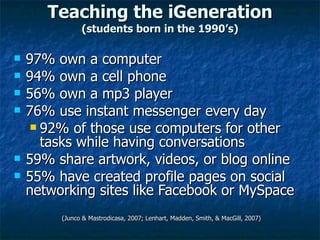
Teaching the iGeneration (students born in the 1990’s) 97% own a computer 94% own a cell phone 56% own a mp3 player 76% use instant messenger every day 92% of those use computers for other tasks while having conversations 59% share artwork, videos, or blog online 55% have created profile pages on social networking sites like Facebook or MySpace (Junco & Mastrodicasa, 2007; Lenhart, Madden, Smith, & MacGill, 2007)
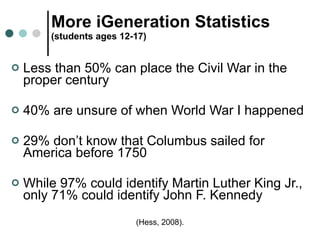
More iGeneration Statistics (students ages 12-17) Less than 50% can place the Civil War in the proper century 40% are unsure of when World War I happened 29% don’t know that Columbus sailed for America before 1750 While 97% could identify Martin Luther King Jr., only 71% could identify John F. Kennedy (Hess, 2008).
Meeting students where they are “They have never known a life without the Internet, let alone computers, and many don’t know a world without mobile phones.”  – Sarah Cornish, Total Girl magazine “We must merge content and skills with technology to create dispositions where students can learn in the 21 st  century.”  –  2010 National Teacher of the Year, Sara Brown Wessling
95% of teachers believe that technology improves student learning, but only 32% report using technology in their daily instruction. (National Education Association, 2008)
“ 21st-century schools need 21st-century technology” by  Marc  Prensky The typical process of technology adoption Dabbling.  Doing old things in old ways.  Doing old things in new ways.  Doing new things in new ways.
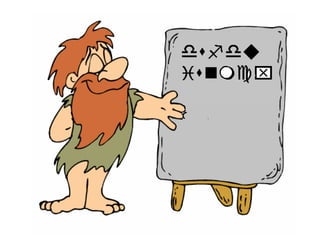
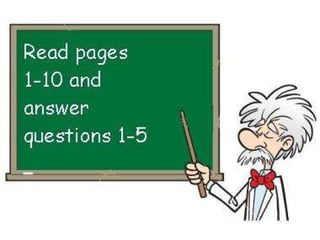
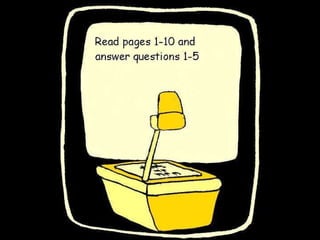
A History of Instructional Technology (Old Things in New Ways)


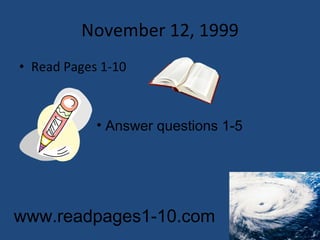
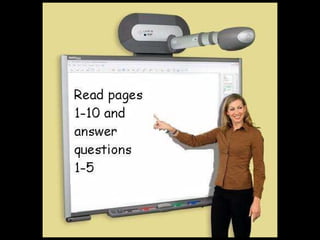
November 12, 1999 Read Pages 1-10 Answer questions 1-5 www.readpages1-10.com


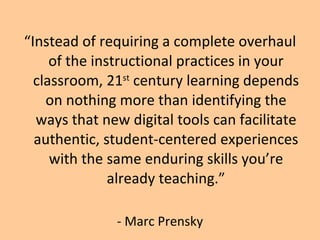
“ Instead of requiring a complete overhaul of the instructional practices in your classroom, 21 st  century learning depends on nothing more than identifying the ways that new digital tools can facilitate authentic, student-centered experiences with the same enduring skills you’re already teaching.” - Marc Prensky
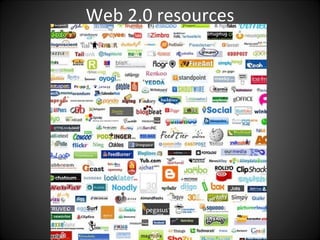
Web 2.0 resources
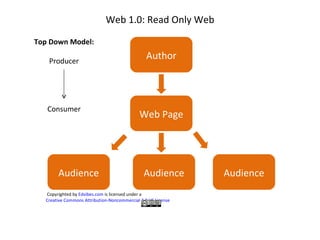
Web Page Web 1.0: Read Only Web Copyrighted by  Edvibes.com  is licensed under a  Creative Commons Attribution-Noncommercial 3.0 US License Author Audience Audience Audience Top Down Model: Producer Consumer
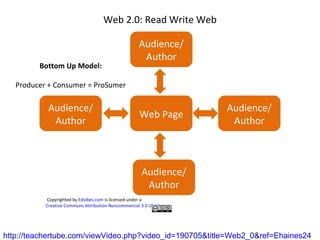
Web Page Web 2.0: Read Write Web Copyrighted by  Edvibes.com  is licensed under a  Creative Commons Attribution-Noncommercial 3.0 US License Audience/ Author Audience/ Author Audience/ Author Audience/ Author Bottom Up Model: Producer + Consumer = ProSumer http:// teachertube.com/viewVideo.php?video_id =190705&title=Web2_0&ref=Ehaines24


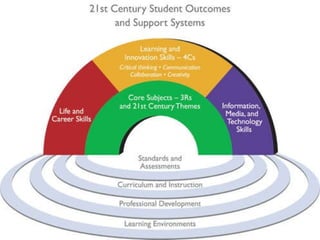
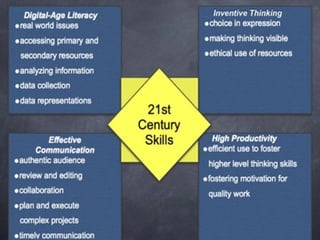
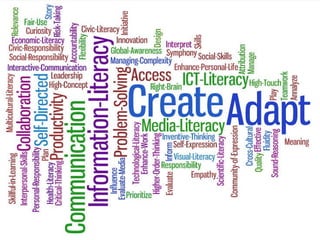
21st century learning skills

  • 1.
  • 2.
    So, What isSTEM? STEM is NOT just curriculum integration. STEM is a new way of thinking about instruction. It is shifting towards Problem-Based Learning and emphasizing 21 st century learning skills.
  • 3.
  • 4.
  • 5.
  • 6.
    Teaching the iGeneration(students born in the 1990’s) 97% own a computer 94% own a cell phone 56% own a mp3 player 76% use instant messenger every day 92% of those use computers for other tasks while having conversations 59% share artwork, videos, or blog online 55% have created profile pages on social networking sites like Facebook or MySpace (Junco & Mastrodicasa, 2007; Lenhart, Madden, Smith, & MacGill, 2007)
  • 7.
    More iGeneration Statistics(students ages 12-17) Less than 50% can place the Civil War in the proper century 40% are unsure of when World War I happened 29% don’t know that Columbus sailed for America before 1750 While 97% could identify Martin Luther King Jr., only 71% could identify John F. Kennedy (Hess, 2008).
  • 8.
    Meeting students wherethey are “They have never known a life without the Internet, let alone computers, and many don’t know a world without mobile phones.” – Sarah Cornish, Total Girl magazine “We must merge content and skills with technology to create dispositions where students can learn in the 21 st century.” – 2010 National Teacher of the Year, Sara Brown Wessling
  • 9.
    95% of teachersbelieve that technology improves student learning, but only 32% report using technology in their daily instruction. (National Education Association, 2008)
  • 10.
    “ 21st-century schoolsneed 21st-century technology” by Marc Prensky The typical process of technology adoption Dabbling. Doing old things in old ways. Doing old things in new ways. Doing new things in new ways.
  • 11.
    A History ofInstructional Technology (Old Things in New Ways)
  • 12.
  • 13.
  • 14.
  • 15.
    November 12, 1999Read Pages 1-10 Answer questions 1-5 www.readpages1-10.com
  • 16.
  • 17.
  • 18.
  • 19.
    “ Instead ofrequiring a complete overhaul of the instructional practices in your classroom, 21 st century learning depends on nothing more than identifying the ways that new digital tools can facilitate authentic, student-centered experiences with the same enduring skills you’re already teaching.” - Marc Prensky
  • 20.
  • 21.
    Web Page Web1.0: Read Only Web Copyrighted by Edvibes.com is licensed under a Creative Commons Attribution-Noncommercial 3.0 US License Author Audience Audience Audience Top Down Model: Producer Consumer
  • 22.
    Web Page Web2.0: Read Write Web Copyrighted by Edvibes.com is licensed under a Creative Commons Attribution-Noncommercial 3.0 US License Audience/ Author Audience/ Author Audience/ Author Audience/ Author Bottom Up Model: Producer + Consumer = ProSumer http:// teachertube.com/viewVideo.php?video_id =190705&title=Web2_0&ref=Ehaines24
  • 23.
  • 24.