Today’s Transfer Students –
Spanning Generations and Ages:
Characteristics Influencing Their
Patterns of Choice
AACRAO Annual Conference
San Diego, CA
April 18, 2006
Program Code: T3.152~Session ID: 152
Paula Hanley
Director of Advising & Placement Services
Brady Johnson
Associate Director of Marketing Communications
A Booming Appointment
Starring Paula Hanley &
Brady Johnson
Which Generation Do I Belong To?
Baby Boomer, Gen X or Millennial
• “You’re OK, I’m Perfect.”
Millennial
• “Drugs, Sex and Rock & Roll.”
Baby Boomer
• “Just Do It!”
Gen X
Generations in the News
Chicago Tribune:
• “Will Boomers bust up their small towns?” 11.28.04
• “Generation IOU.” 4.27.05
• “Generation excess: Young adults live life of luxury on little funds.” 7.31.05
• “Baby boomers battle wrinkles with flattering home lighting.” 8.13.05
• “Cutting The Cord 101. When did caring become control? Blame Boomers.
Let your college children go—and feel good about it.” 10.10.05
• “Generation Y bother?” 3.5.06
Newsweek:
• “Hitting 60: The Boomer Files.” 11.14.05
Parade:
• “Don’t Call Them Old, Call Them…” 3.19.06
New York Times:
• “A Generation Serves Notice: It’s a Moving Target.” 1.22.06
Today’s Objective
• Generational characteristics (similarities and differences)
• Needs of transgenerational transfer students
• Factors influencing their patterns of choice
• Challenges for Enrollment Management
• Strategies and best practices to enhance
the transfer process
American Generations
• 18 Generations in America’s History from 1584 to Present
• Each period is defined by Cycle, Generation,
Type and Birth Years
• The perfect generational line-up
Idealists, Reactive, Civic, Adaptive
• Today’s line-up:
Cycle=Millennial
Type=Boom (Idealist 1943-1960)
Thirteenth (Reactive 1961-1981)
Millennial (Civic ? 1982-2002)
Source: Strauss and Howe, Generations, 1991.
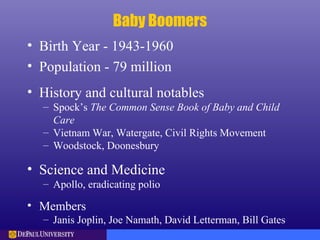
Baby Boomers
• Birth Year - 1943-1960
• Population - 79 million
• History and cultural notables
– Spock’s The Common Sense Book of Baby and Child
Care
– Vietnam War, Watergate, Civil Rights Movement
– Woodstock, Doonesbury
• Science and Medicine
– Apollo, eradicating polio
• Members
– Janis Joplin, Joe Namath, David Letterman, Bill Gates
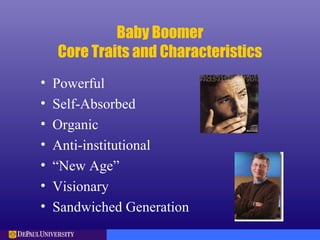
Baby Boomer
Core Traits and Characteristics
• Powerful
• Self-Absorbed
• Organic
• Anti-institutional
• “New Age”
• Visionary
• Sandwiched Generation
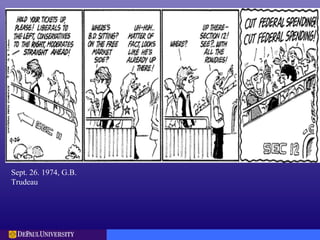
Sept. 26. 1974, G.B.
Trudeau
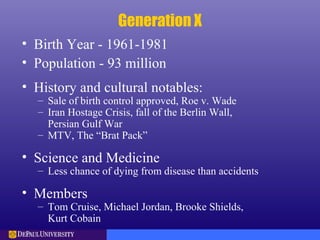
Generation X
• Birth Year - 1961-1981
• Population - 93 million
• History and cultural notables:
– Sale of birth control approved, Roe v. Wade
– Iran Hostage Crisis, fall of the Berlin Wall,
Persian Gulf War
– MTV, The “Brat Pack”
• Science and Medicine
– Less chance of dying from disease than accidents
• Members
– Tom Cruise, Michael Jordan, Brooke Shields,
Kurt Cobain
Gen X
Core Traits and Characteristics
• Narcissistic
• Alienated
• Apathetic
• Pragmatic
• Experimental
• Over-Looked
• “Win at All Cost”
Generation X
= Ultimate Gen Xer?
The Millennials
• Birth Year - 1982-2002
• Population - 76 million (by end of 2000)
• History and cultural notables:
– “Class of 2000”
– Jessica McClure, War in Iraq, 9/11
– Kinder, Gentler Family Values
– MP3s, DVDs
• Science and Medicine
– Space Shuttles, The Internet, Ritalin and Prozac
• Members
– LeBron James, Michael Phelps, Olsen twins, Bush twins
Millennial
Core Traits and Characteristics
• Special
• Sheltered
• Confident
• Team-Oriented
• Conventional
• Pressured
• Achieving
Source: Howe and Strauss, Millennials Go to College: Strategies for a New Generation on Campus., 2003.
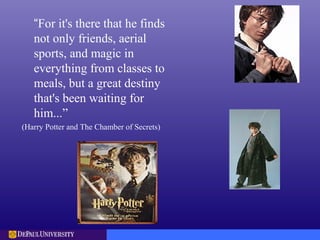
“For it's there that he finds
not only friends, aerial
sports, and magic in
everything from classes to
meals, but a great destiny
that's been waiting for
him...”
(Harry Potter and The Chamber of Secrets)
An X-cellent Appointment
Starring Paula Hanley &
Brady Johnson
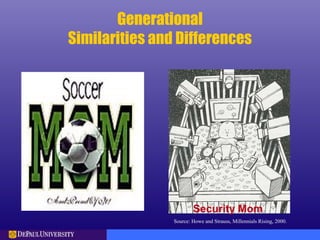
Generational
Similarities and Differences
Security Mom
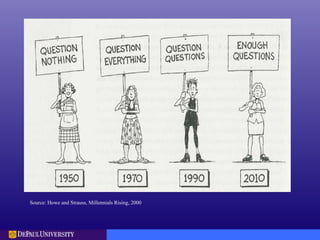
Source: Howe and Strauss, Millennials Rising, 2000.
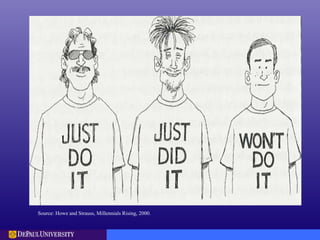
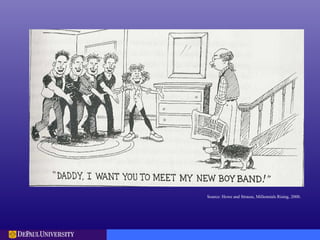
Source: Howe and Strauss, Millennials Rising, 2000
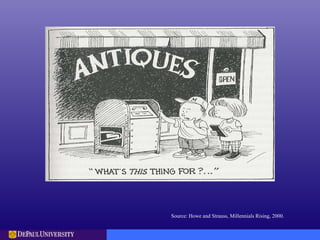
Source: Howe and Strauss, Millennials Rising, 2000.
The Needs of
All Transfer Students
• Transferable vs. Applicable
• Emotional and Academic Barriers
• Institutional Fit
• Balancing Prescriptive w/Developmental Advising
• “Retention before Matriculation”
• The Seamless Process
Source: The College Transfer Student in America, 2004.
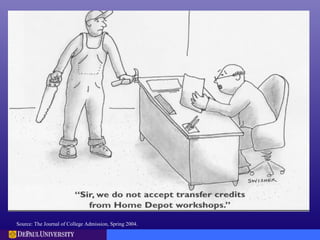
Source: The Journal of College Admission, Spring 2004.
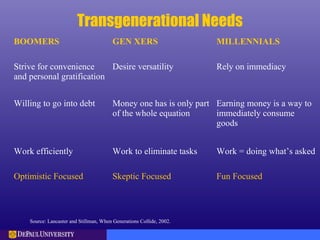
Transgenerational Needs
BOOMERS GEN XERS MILLENNIALS
Strive for convenience
and personal gratification
Desire versatility Rely on immediacy
Willing to go into debt Money one has is only part
of the whole equation
Earning money is a way to
immediately consume
goods
Work efficiently Work to eliminate tasks Work = doing what’s asked
Optimistic Focused Skeptic Focused Fun Focused
Source: Lancaster and Stillman, When Generations Collide, 2002.
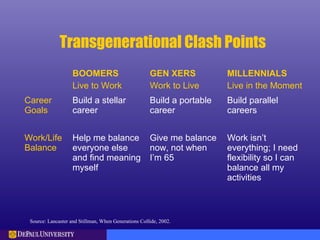
Transgenerational Clash Points
BOOMERS
Live to Work
GEN XERS
Work to Live
MILLENNIALS
Live in the Moment
Career
Goals
Build a stellar
career
Build a portable
career
Build parallel
careers
Work/Life
Balance
Help me balance
everyone else
and find meaning
myself
Give me balance
now, not when
I’m 65
Work isn’t
everything; I need
flexibility so I can
balance all my
activities
Source: Lancaster and Stillman, When Generations Collide, 2002.
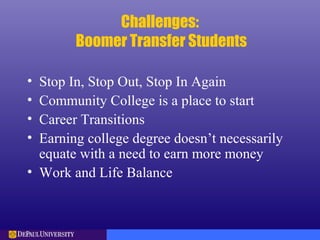
Challenges:
Boomer Transfer Students
• Stop In, Stop Out, Stop In Again
• Community College is a place to start
• Career Transitions
• Earning college degree doesn’t necessarily
equate with a need to earn more money
• Work and Life Balance
Challenges:
Gen X Transfer Students
• Gen Xers view themselves as consumers
• Consuming college should be convenient
• Varied educational backgrounds
• Desire delivery of on-line services
Challenges:
Millennial Transfer Students
• Attending college has always been a goal
• The emerging adulthood period is extended
• College and major choice is a team effort
• Seminar groups and Socratic teaching method is preferred
• Increase in children served under Individuals With
Disabilities Education Act
• Structure and collaboration are important (skills to manage
daily life)
• Many are undecided not only about major
but college choice
Sources: U.S. Department of Education, Office of Special Education and Rehabilitative Services, Annual Report to Congress on the
Implementation of the Individuals with Disabilities Education Act, various years, and unpublished tabulations (April 2002) and Newton, “The
New Student,” Change, 2000.
How Higher Ed Has Begun to
Adapt to the Millennials: Today’s Headlines
Minneapolis Star Tribune:
• “Millennial Students Changing Campus Climate.” 5.12.04
Chronicle of Higher Education:
• “The High Cost of College: an Increasingly Hard Sell.” 10.21.05
• “The Professor as Instant Messenger.” 2.7.06
Chicago Tribune:
• “Collegians ramp up the amps.” 12.20.03
• “This is not your parents’ kind of dorm room.” 11.1.03
• “Welcome to campus; have an iPod.” 4.26.05
Boston Globe:
• “Colleges Increasingly Accommodate Parents.” 11.30.04
USA Today:
• “Gadgets rule on college campuses.” 3.29.05
• “Duke’s free iPods will go just for classes.” 4.7.05
• “Colleges going cyber.” 3.2.06
Tag-teamed:
A Millennial Appointment
Starring Paula Hanley &
Brady Johnson
What Do These Transgenerational
Challenges Mean ?
• Transfers are different with unique needs
• The “One size fits all” model doesn’t always fit
• Generational differences and Age matter
• Generational stereo-types don’t always hold true
• What worked yesterday, may not work today
• Generational marketing identity is as important as
demographics, economics and other influencers
What Do They Mean
for Enrollment Planners?
• Generational marketing needs to part of the solution equation
• Brand Marketing communication requires reciprocity
• Marketing Mix today = 4Ps + 4Cs (costs, convenience, customers, and
communication)
• Current information/data on policies, programs, curricula both
internally & externally is required
• Involvement in all aspects of admission, articulation, orientation and
student services outreach
• Continually strive to clarify the transfer process
• Assessment of methods
Sources: Grites, Redefining the Role: Reflections and Directions, NACADA Monograph, 2004, Smith and Clurman, Rocking the Ages, 1997 and Whiteside, Student
Marketing for College and Universities, 2004.
Strategies to Enhance the
Transfer Process from the 2-yr to the 4-yr
• Top-level administrative support is needed to ensure success of
articulation agreements and transfer student success
• Faculty involvement at both 2-yr & 4-yr is critical for
articulation initiatives
• Concurrent enrollment, dual admission and degree programs
• Open communication and on on-going dialogue between the 2-yr
& 4-yr must exist (Partnerships with 4-yr academic advisors)
• Provide technology to support the process
• Delivering transfer and articulation information to students in timely,
efficient ways is necessary
• Ways to assess effectiveness should be addressed
Best Practices for Transfer Success
• Pre-Transfer Advising
• Office of Parent Relations
• Articulation Agreements
• Transfer Centers, Offices of Transfer Relations
• Transfer Student Organizations
• Transfer Orientations
• Distance Education, Online Learning, Weekend Classes,
Accelerated Degree-Completion Programs
• Programs for Non-traditional Learners
• “Intro to University” classes designed for transfers
• Peer Mentoring programs for transfers
• Transfer Scholarships
• Delivery of On-Line Advising Tools
Discussion and audience activity
• Think about a professional experience you have
had with a Baby Boomer, Gen X or Millennial
student. How did you handle the situation? In
light of what you have learned from this
presentation, what strategies or tactics would
have been helpful to you?
• If money were no object, what strategy or
program would you implement on your campus
tomorrow, for what generation and why?
¿¿¿ Questions ???
Sources
• Grites, T. (2004). Redefining the Role: Reflections and Directions, NACADA Monograph 12, 123-132.
• Howe, N. & Strauss, W. (1991). Generations. New York: William Morrow and Company, Inc.
• Howe, N. & Strauss, W. (2003). Millennials Go to College: Strategies for a New Generation on Campus. Washington, D.C.:
American Association of Collegiate Registrars and Admission Officers.
• Howe, N. & Strauss, W. (2000). Millennials Rising: The Next Great Generation. New York: Vintage Books.
• Howe, N. & Strauss, W. (1993). 13th Gen: Abort, Retry, Ignore, Fail? New York: Vintage Books.
• Jacobs, B. (2004). The College Transfer Student in America: The Forgotten Student. Washington, D.C.: American
Association of Collegiate Registrars and Admission Officers.
• Journal of College Admission. (2004). Alexandria, VA. :National Association for College Admission Counseling.
• Klosterman, Chuck. (2003). Sex, Drugs and Cocoa Puffs. New York: Scribner.
• Lancaster, L. & Stillman, D. (2002). When Generations Collide. New York: Harper Collins.
• Newton, F. (2000). The New Student. About Campus, November-December, 11-15.
• U.S. Department of Education, Office of Special Education and Rehabilitative Services. (April 2002). Annual Report to Congress
on the Implementation of the Individuals with Disabilities Education Act, various years, and unpublished
tabulations (April 2002).
• Walker Smith, J. & Clurman, A. (1997). Rocking the Ages, The Yankelovich Report on Generational Marketing. New York:
Harper Collins.
• Whiteside, R. (2004). Student Marketing for Colleges and Universities. Washington, D.C.: American Association of Collegiate
Registrars and Admission Officers.
Contact Information:
• Paula J. Hanley
phanley@depaul.edu
(312) 362-5209
• Brady Johnson
bjohns16@depaul.edu
(312) 362-8015

Power point spanning generations

  • 1.
    Today’s Transfer Students– Spanning Generations and Ages: Characteristics Influencing Their Patterns of Choice AACRAO Annual Conference San Diego, CA April 18, 2006 Program Code: T3.152~Session ID: 152
  • 2.
    Paula Hanley Director ofAdvising & Placement Services Brady Johnson Associate Director of Marketing Communications
  • 3.
    A Booming Appointment StarringPaula Hanley & Brady Johnson
  • 4.
    Which Generation DoI Belong To? Baby Boomer, Gen X or Millennial • “You’re OK, I’m Perfect.” Millennial • “Drugs, Sex and Rock & Roll.” Baby Boomer • “Just Do It!” Gen X
  • 5.
    Generations in theNews Chicago Tribune: • “Will Boomers bust up their small towns?” 11.28.04 • “Generation IOU.” 4.27.05 • “Generation excess: Young adults live life of luxury on little funds.” 7.31.05 • “Baby boomers battle wrinkles with flattering home lighting.” 8.13.05 • “Cutting The Cord 101. When did caring become control? Blame Boomers. Let your college children go—and feel good about it.” 10.10.05 • “Generation Y bother?” 3.5.06 Newsweek: • “Hitting 60: The Boomer Files.” 11.14.05 Parade: • “Don’t Call Them Old, Call Them…” 3.19.06 New York Times: • “A Generation Serves Notice: It’s a Moving Target.” 1.22.06
  • 6.
    Today’s Objective • Generationalcharacteristics (similarities and differences) • Needs of transgenerational transfer students • Factors influencing their patterns of choice • Challenges for Enrollment Management • Strategies and best practices to enhance the transfer process
  • 7.
    American Generations • 18Generations in America’s History from 1584 to Present • Each period is defined by Cycle, Generation, Type and Birth Years • The perfect generational line-up Idealists, Reactive, Civic, Adaptive • Today’s line-up: Cycle=Millennial Type=Boom (Idealist 1943-1960) Thirteenth (Reactive 1961-1981) Millennial (Civic ? 1982-2002) Source: Strauss and Howe, Generations, 1991.
  • 8.
    Baby Boomers • BirthYear - 1943-1960 • Population - 79 million • History and cultural notables – Spock’s The Common Sense Book of Baby and Child Care – Vietnam War, Watergate, Civil Rights Movement – Woodstock, Doonesbury • Science and Medicine – Apollo, eradicating polio • Members – Janis Joplin, Joe Namath, David Letterman, Bill Gates
  • 9.
    Baby Boomer Core Traitsand Characteristics • Powerful • Self-Absorbed • Organic • Anti-institutional • “New Age” • Visionary • Sandwiched Generation
  • 10.
    Sept. 26. 1974,G.B. Trudeau
  • 11.
    Generation X • BirthYear - 1961-1981 • Population - 93 million • History and cultural notables: – Sale of birth control approved, Roe v. Wade – Iran Hostage Crisis, fall of the Berlin Wall, Persian Gulf War – MTV, The “Brat Pack” • Science and Medicine – Less chance of dying from disease than accidents • Members – Tom Cruise, Michael Jordan, Brooke Shields, Kurt Cobain
  • 12.
    Gen X Core Traitsand Characteristics • Narcissistic • Alienated • Apathetic • Pragmatic • Experimental • Over-Looked • “Win at All Cost”
  • 13.
  • 14.
    The Millennials • BirthYear - 1982-2002 • Population - 76 million (by end of 2000) • History and cultural notables: – “Class of 2000” – Jessica McClure, War in Iraq, 9/11 – Kinder, Gentler Family Values – MP3s, DVDs • Science and Medicine – Space Shuttles, The Internet, Ritalin and Prozac • Members – LeBron James, Michael Phelps, Olsen twins, Bush twins
  • 15.
    Millennial Core Traits andCharacteristics • Special • Sheltered • Confident • Team-Oriented • Conventional • Pressured • Achieving Source: Howe and Strauss, Millennials Go to College: Strategies for a New Generation on Campus., 2003.
  • 16.
    “For it's therethat he finds not only friends, aerial sports, and magic in everything from classes to meals, but a great destiny that's been waiting for him...” (Harry Potter and The Chamber of Secrets)
  • 17.
    An X-cellent Appointment StarringPaula Hanley & Brady Johnson
  • 18.
    Generational Similarities and Differences SecurityMom Source: Howe and Strauss, Millennials Rising, 2000.
  • 19.
    Source: Howe andStrauss, Millennials Rising, 2000.
  • 20.
    Source: Howe andStrauss, Millennials Rising, 2000
  • 21.
    Source: Howe andStrauss, Millennials Rising, 2000.
  • 22.
    Source: Howe andStrauss, Millennials Rising, 2000.
  • 23.
    The Needs of AllTransfer Students • Transferable vs. Applicable • Emotional and Academic Barriers • Institutional Fit • Balancing Prescriptive w/Developmental Advising • “Retention before Matriculation” • The Seamless Process Source: The College Transfer Student in America, 2004.
  • 24.
    Source: The Journalof College Admission, Spring 2004.
  • 25.
    Transgenerational Needs BOOMERS GENXERS MILLENNIALS Strive for convenience and personal gratification Desire versatility Rely on immediacy Willing to go into debt Money one has is only part of the whole equation Earning money is a way to immediately consume goods Work efficiently Work to eliminate tasks Work = doing what’s asked Optimistic Focused Skeptic Focused Fun Focused Source: Lancaster and Stillman, When Generations Collide, 2002.
  • 26.
    Transgenerational Clash Points BOOMERS Liveto Work GEN XERS Work to Live MILLENNIALS Live in the Moment Career Goals Build a stellar career Build a portable career Build parallel careers Work/Life Balance Help me balance everyone else and find meaning myself Give me balance now, not when I’m 65 Work isn’t everything; I need flexibility so I can balance all my activities Source: Lancaster and Stillman, When Generations Collide, 2002.
  • 27.
    Challenges: Boomer Transfer Students •Stop In, Stop Out, Stop In Again • Community College is a place to start • Career Transitions • Earning college degree doesn’t necessarily equate with a need to earn more money • Work and Life Balance
  • 28.
    Challenges: Gen X TransferStudents • Gen Xers view themselves as consumers • Consuming college should be convenient • Varied educational backgrounds • Desire delivery of on-line services
  • 29.
    Challenges: Millennial Transfer Students •Attending college has always been a goal • The emerging adulthood period is extended • College and major choice is a team effort • Seminar groups and Socratic teaching method is preferred • Increase in children served under Individuals With Disabilities Education Act • Structure and collaboration are important (skills to manage daily life) • Many are undecided not only about major but college choice Sources: U.S. Department of Education, Office of Special Education and Rehabilitative Services, Annual Report to Congress on the Implementation of the Individuals with Disabilities Education Act, various years, and unpublished tabulations (April 2002) and Newton, “The New Student,” Change, 2000.
  • 30.
    How Higher EdHas Begun to Adapt to the Millennials: Today’s Headlines Minneapolis Star Tribune: • “Millennial Students Changing Campus Climate.” 5.12.04 Chronicle of Higher Education: • “The High Cost of College: an Increasingly Hard Sell.” 10.21.05 • “The Professor as Instant Messenger.” 2.7.06 Chicago Tribune: • “Collegians ramp up the amps.” 12.20.03 • “This is not your parents’ kind of dorm room.” 11.1.03 • “Welcome to campus; have an iPod.” 4.26.05 Boston Globe: • “Colleges Increasingly Accommodate Parents.” 11.30.04 USA Today: • “Gadgets rule on college campuses.” 3.29.05 • “Duke’s free iPods will go just for classes.” 4.7.05 • “Colleges going cyber.” 3.2.06
  • 31.
  • 32.
    What Do TheseTransgenerational Challenges Mean ? • Transfers are different with unique needs • The “One size fits all” model doesn’t always fit • Generational differences and Age matter • Generational stereo-types don’t always hold true • What worked yesterday, may not work today • Generational marketing identity is as important as demographics, economics and other influencers
  • 33.
    What Do TheyMean for Enrollment Planners? • Generational marketing needs to part of the solution equation • Brand Marketing communication requires reciprocity • Marketing Mix today = 4Ps + 4Cs (costs, convenience, customers, and communication) • Current information/data on policies, programs, curricula both internally & externally is required • Involvement in all aspects of admission, articulation, orientation and student services outreach • Continually strive to clarify the transfer process • Assessment of methods Sources: Grites, Redefining the Role: Reflections and Directions, NACADA Monograph, 2004, Smith and Clurman, Rocking the Ages, 1997 and Whiteside, Student Marketing for College and Universities, 2004.
  • 34.
    Strategies to Enhancethe Transfer Process from the 2-yr to the 4-yr • Top-level administrative support is needed to ensure success of articulation agreements and transfer student success • Faculty involvement at both 2-yr & 4-yr is critical for articulation initiatives • Concurrent enrollment, dual admission and degree programs • Open communication and on on-going dialogue between the 2-yr & 4-yr must exist (Partnerships with 4-yr academic advisors) • Provide technology to support the process • Delivering transfer and articulation information to students in timely, efficient ways is necessary • Ways to assess effectiveness should be addressed
  • 35.
    Best Practices forTransfer Success • Pre-Transfer Advising • Office of Parent Relations • Articulation Agreements • Transfer Centers, Offices of Transfer Relations • Transfer Student Organizations • Transfer Orientations • Distance Education, Online Learning, Weekend Classes, Accelerated Degree-Completion Programs • Programs for Non-traditional Learners • “Intro to University” classes designed for transfers • Peer Mentoring programs for transfers • Transfer Scholarships • Delivery of On-Line Advising Tools
  • 36.
    Discussion and audienceactivity • Think about a professional experience you have had with a Baby Boomer, Gen X or Millennial student. How did you handle the situation? In light of what you have learned from this presentation, what strategies or tactics would have been helpful to you? • If money were no object, what strategy or program would you implement on your campus tomorrow, for what generation and why?
  • 37.
  • 38.
    Sources • Grites, T.(2004). Redefining the Role: Reflections and Directions, NACADA Monograph 12, 123-132. • Howe, N. & Strauss, W. (1991). Generations. New York: William Morrow and Company, Inc. • Howe, N. & Strauss, W. (2003). Millennials Go to College: Strategies for a New Generation on Campus. Washington, D.C.: American Association of Collegiate Registrars and Admission Officers. • Howe, N. & Strauss, W. (2000). Millennials Rising: The Next Great Generation. New York: Vintage Books. • Howe, N. & Strauss, W. (1993). 13th Gen: Abort, Retry, Ignore, Fail? New York: Vintage Books. • Jacobs, B. (2004). The College Transfer Student in America: The Forgotten Student. Washington, D.C.: American Association of Collegiate Registrars and Admission Officers. • Journal of College Admission. (2004). Alexandria, VA. :National Association for College Admission Counseling. • Klosterman, Chuck. (2003). Sex, Drugs and Cocoa Puffs. New York: Scribner. • Lancaster, L. & Stillman, D. (2002). When Generations Collide. New York: Harper Collins. • Newton, F. (2000). The New Student. About Campus, November-December, 11-15. • U.S. Department of Education, Office of Special Education and Rehabilitative Services. (April 2002). Annual Report to Congress on the Implementation of the Individuals with Disabilities Education Act, various years, and unpublished tabulations (April 2002). • Walker Smith, J. & Clurman, A. (1997). Rocking the Ages, The Yankelovich Report on Generational Marketing. New York: Harper Collins. • Whiteside, R. (2004). Student Marketing for Colleges and Universities. Washington, D.C.: American Association of Collegiate Registrars and Admission Officers.
  • 39.
    Contact Information: • PaulaJ. Hanley phanley@depaul.edu (312) 362-5209 • Brady Johnson bjohns16@depaul.edu (312) 362-8015

Editor's Notes

  • #24 PAULA Transferable vs. Applicable Will my credits transfer for credit and what do I need to do to complete my degree? Emotional and Academic Barriers Transfer Shock and Transfer Ecstasy Swirling, Reverse Transfers
  • #29 BRADY Time is critical, consuming college should be convenient The virtual campus has appeal Varied educational backgrounds Reentry transitions Email, BlackBoard, Web Conferencing, Multi-media classrooms Automated Degree Audits
  • #30 College and major choice is a team effort Parents are influencers FERPA Increase in children served under Individuals With Disabilities Education Act (birth to 21): 2000-01: 6.3 million*