CHAPTER 7
Gravitation
UNIVERSAL GRAVITATION
   What is Newton’s Law of Universal Gravitation and
    how do I apply it?
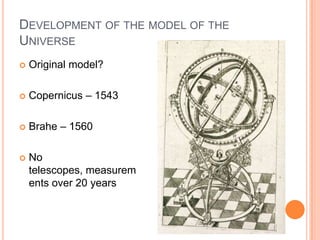
DEVELOPMENT OF THE MODEL OF THE
UNIVERSE
   Original model?

   Copernicus – 1543

   Brahe – 1560

   No
    telescopes, measurem
    ents over 20 years
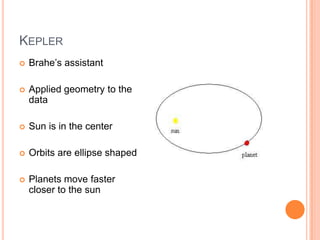
KEPLER
   Brahe’s assistant

   Applied geometry to the
    data

   Sun is in the center

   Orbits are ellipse shaped

   Planets move faster
    closer to the sun
NEWTON
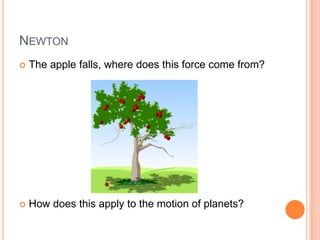
   The apple falls, where does this force come from?


   How does this apply to the motion of planets?
NEWTON
   Third Law

   Can be thought of as a force of attraction

   Directly proportional to the masses of the objects

   Can also be called gravitational force

   Newton’s Law of Universal Gravitation
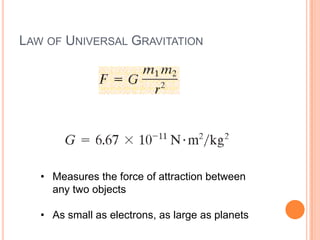
LAW OF UNIVERSAL GRAVITATION


   • Measures the force of attraction between
     any two objects

   • As small as electrons, as large as planets
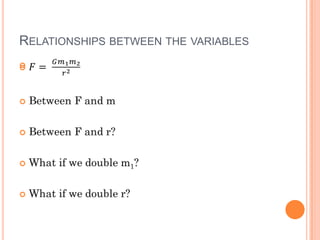
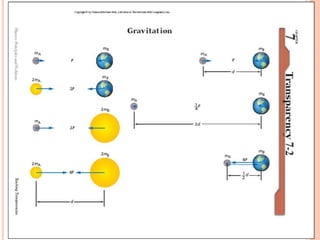
RELATIONSHIPS BETWEEN THE VARIABLES

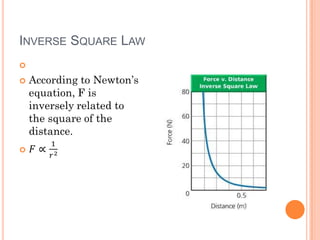
INVERSE SQUARE LAW

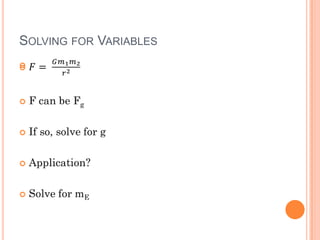
SOLVING FOR VARIABLES

EXAMPLE
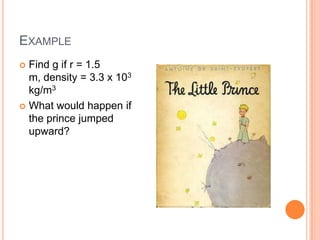
 Find g if r = 1.5
  m, density = 3.3 x 10³
  kg/m3
 What would happen if
  the prince jumped
  upward?
HOMEWORK
 Page 191
 # 55 – 60, 64
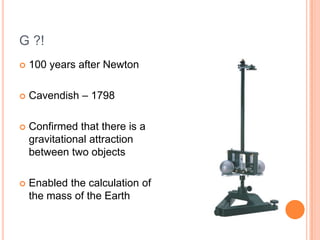
G ?!
   100 years after Newton

   Cavendish – 1798

   Confirmed that there is a
    gravitational attraction
    between two objects

   Enabled the calculation of
    the mass of the Earth
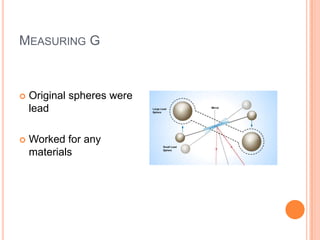
MEASURING G


   Original spheres were
    lead

   Worked for any
    materials
HOMEWORK
   Worksheet

General/Notes 7.1

  • 1.
  • 2.
    UNIVERSAL GRAVITATION  What is Newton’s Law of Universal Gravitation and how do I apply it?
  • 3.
    DEVELOPMENT OF THEMODEL OF THE UNIVERSE  Original model?  Copernicus – 1543  Brahe – 1560  No telescopes, measurem ents over 20 years
  • 4.
    KEPLER  Brahe’s assistant  Applied geometry to the data  Sun is in the center  Orbits are ellipse shaped  Planets move faster closer to the sun
  • 5.
    NEWTON  The apple falls, where does this force come from?  How does this apply to the motion of planets?
  • 6.
    NEWTON  Third Law  Can be thought of as a force of attraction  Directly proportional to the masses of the objects  Can also be called gravitational force  Newton’s Law of Universal Gravitation
  • 7.
    LAW OF UNIVERSALGRAVITATION • Measures the force of attraction between any two objects • As small as electrons, as large as planets
  • 8.
  • 9.
  • 11.
  • 12.
    EXAMPLE  Find gif r = 1.5 m, density = 3.3 x 10³ kg/m3  What would happen if the prince jumped upward?
  • 13.
  • 14.
    G ?!  100 years after Newton  Cavendish – 1798  Confirmed that there is a gravitational attraction between two objects  Enabled the calculation of the mass of the Earth
  • 15.
    MEASURING G  Original spheres were lead  Worked for any materials
  • 16.
    HOMEWORK  Worksheet