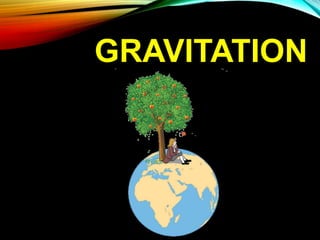
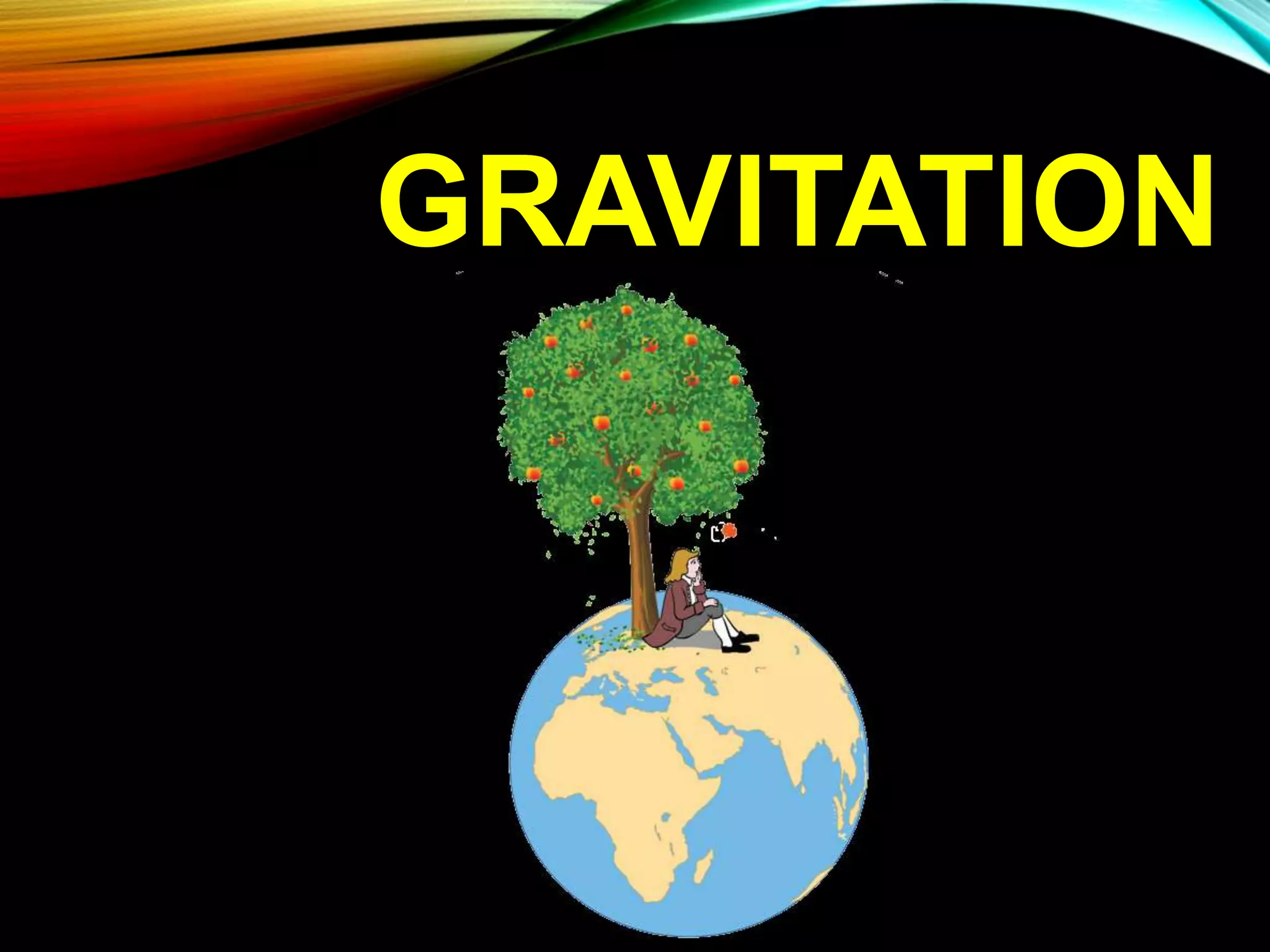
GRAVITATION
WHAT IS
GRAVITATION ?
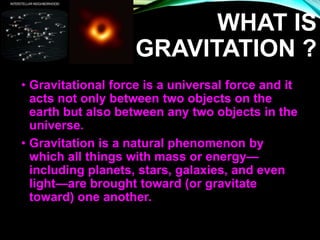
• Gravitational force is a universal force and it
acts not only between two objects on the
earth but also between any two objects in the
universe.
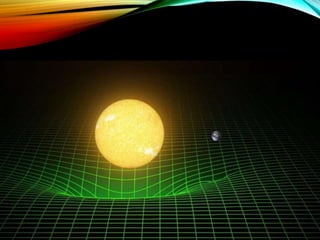
• Gravitation is a natural phenomenon by
which all things with mass or energy—
including planets, stars, galaxies, and even
light—are brought toward (or gravitate
toward) one another.
LAW OF GRAVITATION
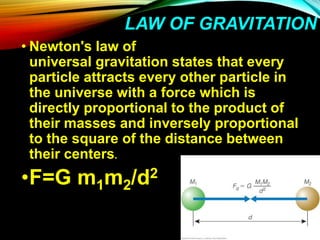
• Newton's law of
universal gravitation states that every
particle attracts every other particle in
the universe with a force which is
directly proportional to the product of
their masses and inversely proportional
to the square of the distance between
their centers.
•F=G m1m2/d2
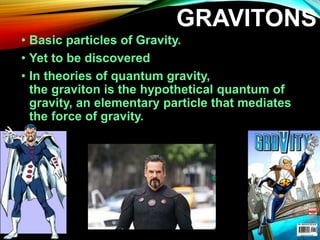
GRAVITONS
• Basic particles of Gravity.
• Yet to be discovered
• In theories of quantum gravity,
the graviton is the hypothetical quantum of
gravity, an elementary particle that mediates
the force of gravity.
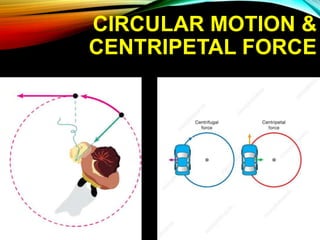
CIRCULAR MOTION &
CENTRIPETAL FORCE
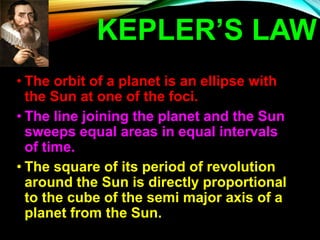
KEPLER’S LAW
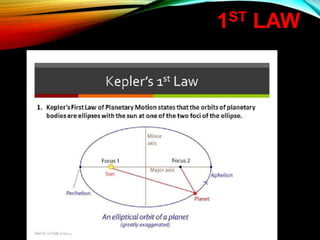
• The orbit of a planet is an ellipse with
the Sun at one of the foci.
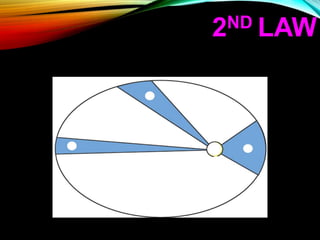
• The line joining the planet and the Sun
sweeps equal areas in equal intervals
of time.
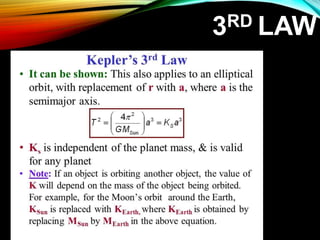
• The square of its period of revolution
around the Sun is directly proportional
to the cube of the semi major axis of a
planet from the Sun.
1ST LAW
2ND LAW
3RD LAW
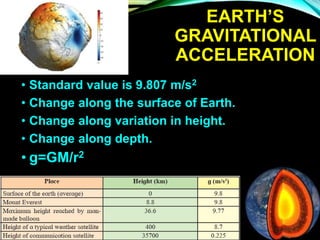
EARTH’S
GRAVITATIONAL
ACCELERATION
• Standard value is 9.807 m/s2
• Change along the surface of Earth.
• Change along variation in height.
• Change along depth.
• g=GM/r2
MASS VS WEIGHT
MASS
• Amount of matter
present in the
object.
• Value is same
everywhere.
• It is a scalar
quantity.
WEIGHT
• The force with which
the earth attracts the
object.
• Value changes with
respect to place on
Earth.
(F=W=ma=mg).
• It is a vector quantity
directed towards the
centre if Earth.
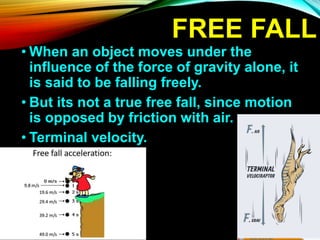
FREE FALL
• When an object moves under the
influence of the force of gravity alone, it
is said to be falling freely.
• But its not a true free fall, since motion
is opposed by friction with air.
• Terminal velocity.
GRAVITATIONAL
POTENTIAL
• The energy stored in an object because of its
position or state is called potential energy.
• For an object of mass m, at a height h from
the ground is mgh and on the ground it is
zero.
• For large value of h, value of g decreases
with increase in h.
• Gravitational potential energy is given by “-
GMm/(R=h)
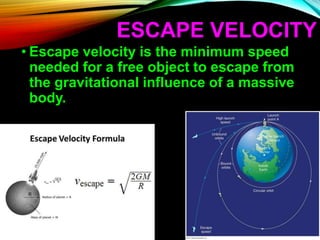
ESCAPE VELOCITY
• Escape velocity is the minimum speed
needed for a free object to escape from
the gravitational influence of a massive
body.
THANK YOU

Gravitation

  • 1.
  • 2.
    WHAT IS GRAVITATION ? •Gravitational force is a universal force and it acts not only between two objects on the earth but also between any two objects in the universe. • Gravitation is a natural phenomenon by which all things with mass or energy— including planets, stars, galaxies, and even light—are brought toward (or gravitate toward) one another.
  • 3.
    LAW OF GRAVITATION •Newton's law of universal gravitation states that every particle attracts every other particle in the universe with a force which is directly proportional to the product of their masses and inversely proportional to the square of the distance between their centers. •F=G m1m2/d2
  • 4.
    GRAVITONS • Basic particlesof Gravity. • Yet to be discovered • In theories of quantum gravity, the graviton is the hypothetical quantum of gravity, an elementary particle that mediates the force of gravity.
  • 6.
  • 7.
    KEPLER’S LAW • Theorbit of a planet is an ellipse with the Sun at one of the foci. • The line joining the planet and the Sun sweeps equal areas in equal intervals of time. • The square of its period of revolution around the Sun is directly proportional to the cube of the semi major axis of a planet from the Sun.
  • 8.
  • 9.
  • 10.
  • 11.
    EARTH’S GRAVITATIONAL ACCELERATION • Standard valueis 9.807 m/s2 • Change along the surface of Earth. • Change along variation in height. • Change along depth. • g=GM/r2
  • 12.
    MASS VS WEIGHT MASS •Amount of matter present in the object. • Value is same everywhere. • It is a scalar quantity. WEIGHT • The force with which the earth attracts the object. • Value changes with respect to place on Earth. (F=W=ma=mg). • It is a vector quantity directed towards the centre if Earth.
  • 13.
    FREE FALL • Whenan object moves under the influence of the force of gravity alone, it is said to be falling freely. • But its not a true free fall, since motion is opposed by friction with air. • Terminal velocity.
  • 14.
    GRAVITATIONAL POTENTIAL • The energystored in an object because of its position or state is called potential energy. • For an object of mass m, at a height h from the ground is mgh and on the ground it is zero. • For large value of h, value of g decreases with increase in h. • Gravitational potential energy is given by “- GMm/(R=h)
  • 15.
    ESCAPE VELOCITY • Escapevelocity is the minimum speed needed for a free object to escape from the gravitational influence of a massive body.
  • 16.