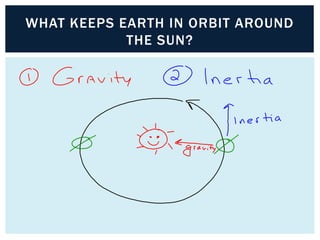
WHAT KEEPS EARTH IN ORBIT AROUND
THE SUN?
 What stops a body from streaming off into outer space?
 GRAVITY
 To understand gravity let’s take a look at the past…
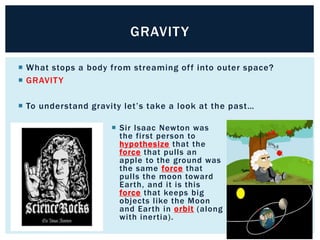
GRAVITY
 Sir Isaac Newton was
the first person to
hypothesize that the
force that pulls an
apple to the ground was
the same force that
pulls the moon toward
Earth, and it is this
force that keeps big
objects like the Moon
and Earth in orbit (along
with inertia).
Elegant Universe – Gravity’s Story!
But if gravity makes things fall or attracted to other objects…how
exactly does gravity work?
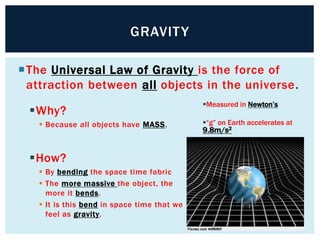
The Universal Law of Gravity is the force of
attraction between all objects in the universe.
GRAVITY
Why?
 Because all objects have MASS.
How?
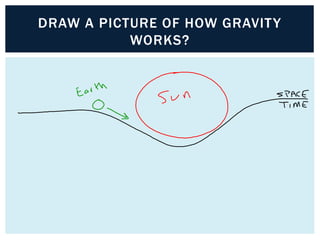
 By bending the space time fabric
 The more massive the object, the
more it bends.
 It is this bend in space time that we
feel as gravity.
Measured in Newton’s
“g” on Earth accelerates at
9.8m/s2
DRAW A PICTURE OF HOW GRAVITY
WORKS?
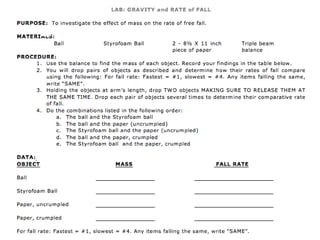
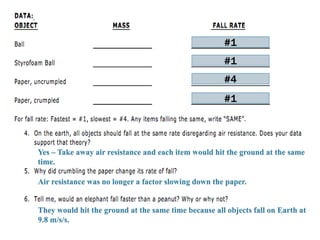
LAB – GRAVITY AND RATE OF FALL
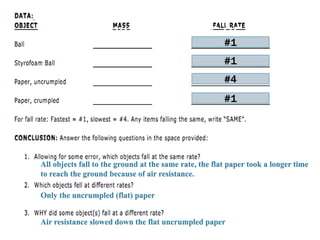
#1
#1
#1
#4
All objects fall to the ground at the same rate, the flat paper took a longer time
to reach the ground because of air resistance.
Only the uncrumpled (flat) paper
Air resistance slowed down the flat uncrumpled paper
Yes – Take away air resistance and each item would hit the ground at the same
time.
Air resistance was no longer a factor slowing down the paper.
They would hit the ground at the same time because all objects fall on Earth at
9.8 m/s/s.
#1
#1
#1
#4
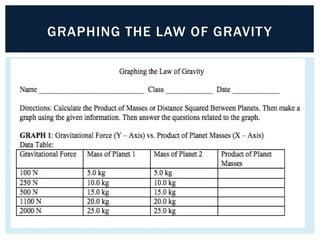
GRAPHING THE LAW OF GRAVITY
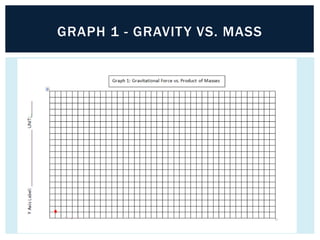
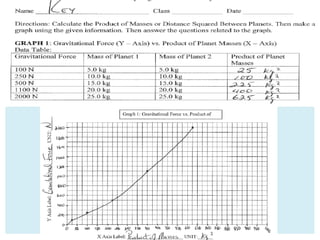
GRAPH 1 - GRAVITY VS. MASS
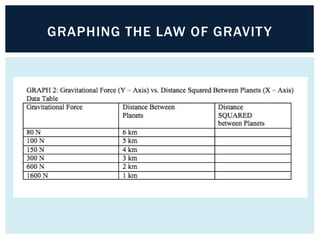
GRAPHING THE LAW OF GRAVITY
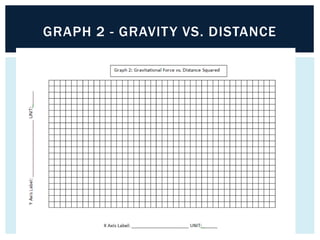
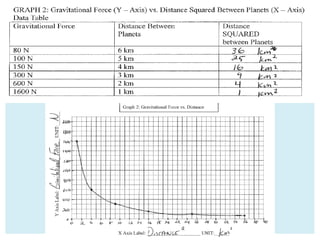
GRAPH 2 - GRAVITY VS. DISTANCE
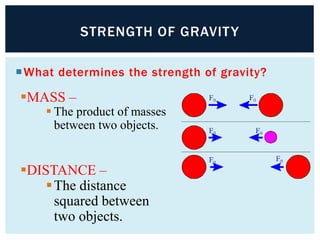
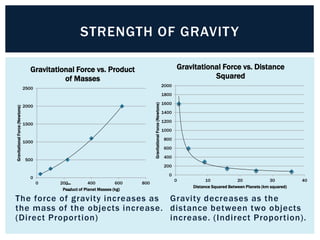
STRENGTH OF GRAVITY
What determines the strength of gravity?
MASS –
 The product of masses
between two objects.
DISTANCE –
The distance
squared between
two objects.
BRAINPOP - GRAVITY
STRENGTH OF GRAVITY
The force of gravity increases as
the mass of the objects increase.
(Direct Proportion)
0
200
400
600
800
1000
1200
1400
1600
1800
2000
0 10 20 30 40
GravitationalForce(Newtons)
Distance Squared Between Planets (km squared)
Gravitational Force vs. Distance
Squared
0
500
1000
1500
2000
2500
0 200 400 600 800
GravitationalForce(Newtons)
Product of Planet Masses (kg)
Gravitational Force vs. Product
of Masses
Gravity decreases as the
distance between two objects
increase. (Indirect Proportion).
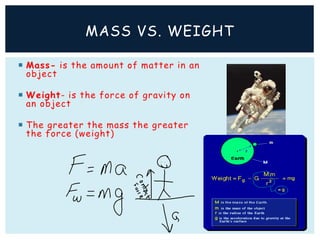
 Mass- is the amount of matter in an
object
 Weight- is the force of gravity on
an object
 The greater the mass the greater
the force (weight)
MASS VS. WEIGHT
FREE FALLING – NOW I’m Free
Falling
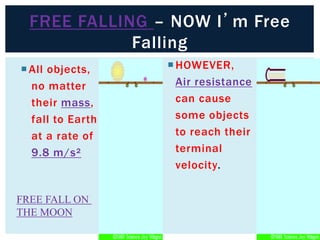
All objects,
no matter
their mass,
fall to Earth
at a rate of
9.8 m/s²
HOWEVER,
Air resistance
can cause
some objects
to reach their
terminal
velocity.
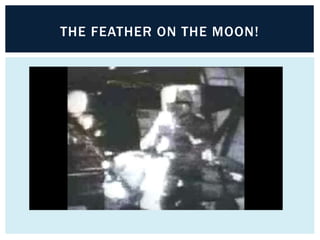
FREE FALL ON
THE MOON
THE FEATHER ON THE MOON!
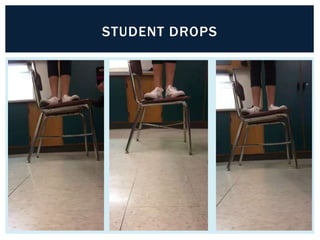
STUDENT DROPS
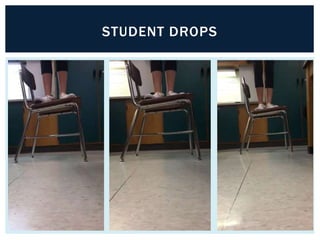
STUDENT DROPS

Gravity - Rate of Fall - Graphing Gravity

  • 2.
    WHAT KEEPS EARTHIN ORBIT AROUND THE SUN?
  • 3.
     What stopsa body from streaming off into outer space?  GRAVITY  To understand gravity let’s take a look at the past… GRAVITY  Sir Isaac Newton was the first person to hypothesize that the force that pulls an apple to the ground was the same force that pulls the moon toward Earth, and it is this force that keeps big objects like the Moon and Earth in orbit (along with inertia).
  • 4.
    Elegant Universe –Gravity’s Story! But if gravity makes things fall or attracted to other objects…how exactly does gravity work?
  • 5.
    The Universal Lawof Gravity is the force of attraction between all objects in the universe. GRAVITY Why?  Because all objects have MASS. How?  By bending the space time fabric  The more massive the object, the more it bends.  It is this bend in space time that we feel as gravity. Measured in Newton’s “g” on Earth accelerates at 9.8m/s2
  • 6.
    DRAW A PICTUREOF HOW GRAVITY WORKS?
  • 7.
    LAB – GRAVITYAND RATE OF FALL
  • 8.
    LAB – GRAVITYAND RATE OF FALL #1 #1 #1 #4 All objects fall to the ground at the same rate, the flat paper took a longer time to reach the ground because of air resistance. Only the uncrumpled (flat) paper Air resistance slowed down the flat uncrumpled paper
  • 9.
    Yes – Takeaway air resistance and each item would hit the ground at the same time. Air resistance was no longer a factor slowing down the paper. They would hit the ground at the same time because all objects fall on Earth at 9.8 m/s/s. #1 #1 #1 #4
  • 10.
    GRAPHING THE LAWOF GRAVITY
  • 11.
    GRAPH 1 -GRAVITY VS. MASS
  • 12.
    GRAPHING THE LAWOF GRAVITY
  • 13.
    GRAPH 2 -GRAVITY VS. DISTANCE
  • 16.
    STRENGTH OF GRAVITY Whatdetermines the strength of gravity? MASS –  The product of masses between two objects. DISTANCE – The distance squared between two objects.
  • 17.
  • 18.
    STRENGTH OF GRAVITY Theforce of gravity increases as the mass of the objects increase. (Direct Proportion) 0 200 400 600 800 1000 1200 1400 1600 1800 2000 0 10 20 30 40 GravitationalForce(Newtons) Distance Squared Between Planets (km squared) Gravitational Force vs. Distance Squared 0 500 1000 1500 2000 2500 0 200 400 600 800 GravitationalForce(Newtons) Product of Planet Masses (kg) Gravitational Force vs. Product of Masses Gravity decreases as the distance between two objects increase. (Indirect Proportion).
  • 19.
     Mass- isthe amount of matter in an object  Weight- is the force of gravity on an object  The greater the mass the greater the force (weight) MASS VS. WEIGHT
  • 20.
    FREE FALLING –NOW I’m Free Falling All objects, no matter their mass, fall to Earth at a rate of 9.8 m/s² HOWEVER, Air resistance can cause some objects to reach their terminal velocity. FREE FALL ON THE MOON
  • 21.
    THE FEATHER ONTHE MOON!
  • 22.
  • 23.