Use of Knowledge
Abstraction and Problem Solving
Edward (Ned) Blurock
Lecture: Abstraction and
Generalization
Abstraction
Knowledge Representation
Abstraction
You choose how to represent reality
The choice is not unique
It depends on what aspect of reality you want to represent and how
Lecture: Abstraction and
Generalization
Abstraction
Concept Abstraction
Organizing and making sense of the immense amount of
data/knowledge we have
Generalization
The ability of an algorithm to perform accurately on new, unseen
examples after having trained on a learning data set
Lecture: Abstraction and
Generalization
Abstraction
Generalization
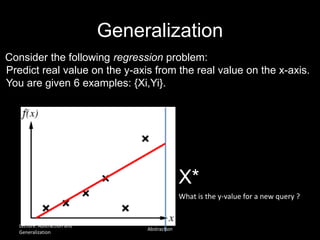
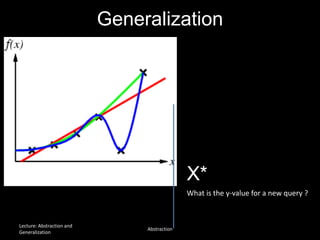
Consider the following regression problem:
Predict real value on the y-axis from the real value on the x-axis.
You are given 6 examples: {Xi,Yi}.
X*
What is the y-value for a new query ?
Lecture: Abstraction and
Generalization
Abstraction
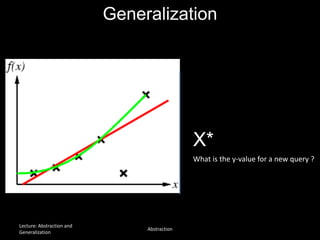
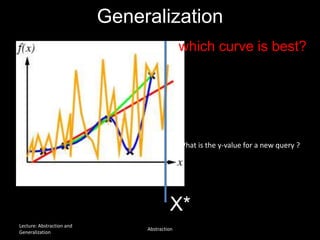
Generalization
X*
What is the y-value for a new query ?
Lecture: Abstraction and
Generalization
Abstraction
Generalization
X*
What is the y-value for a new query ?
Lecture: Abstraction and
Generalization
Abstraction
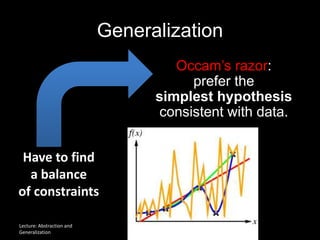
Generalization
which curve is best?
X*
What is the y-value for a new query ?
Lecture: Abstraction and
Generalization
Abstraction
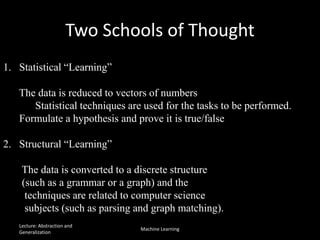
Generalization
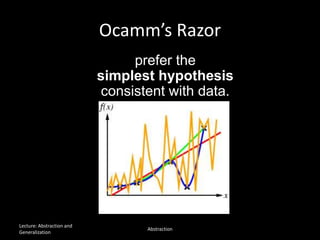
Occam’s razor:
prefer the
simplest hypothesis
consistent with data.
Have to find
a balance
of constraints
Lecture: Abstraction and
Generalization
Abstraction
Two Schools of Thought
1. Statistical “Learning”
The data is reduced to vectors of numbers
Statistical techniques are used for the tasks to be performed.
Formulate a hypothesis and prove it is true/false
2. Structural “Learning”
The data is converted to a discrete structure
(such as a grammar or a graph) and the
techniques are related to computer science
subjects (such as parsing and graph matching).
Lecture: Abstraction and
Generalization
Machine Learning
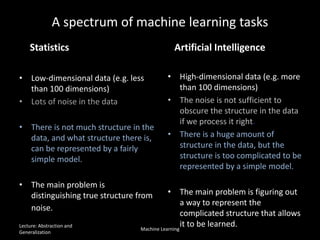
A spectrum of machine learning tasks
• High-dimensional data (e.g. more
than 100 dimensions)
• The noise is not sufficient to
obscure the structure in the data
if we process it right.
• There is a huge amount of
structure in the data, but the
structure is too complicated to be
represented by a simple model.
• The main problem is figuring out
a way to represent the
complicated structure that allows
it to be learned.
• Low-dimensional data (e.g. less
than 100 dimensions)
• Lots of noise in the data
• There is not much structure in the
data, and what structure there is,
can be represented by a fairly
simple model.
• The main problem is
distinguishing true structure from
noise.
Statistics Artificial Intelligence
Lecture: Abstraction and
Generalization
Machine Learning
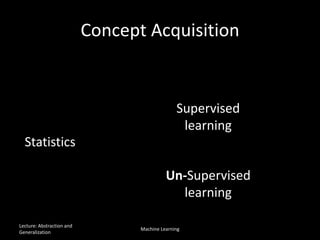
Supervised
learning
Un-Supervised
learning
Concept Acquisition
Statistics
Lecture: Abstraction and
Generalization
Machine Learning
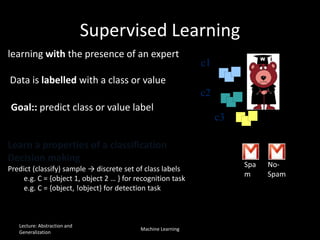
learning with the presence of an expert
Data is labelled with a class or value
Goal:: predict class or value label
c1
c2
c3
Supervised Learning
Learn a properties of a classification
Decision making
Predict (classify) sample → discrete set of class labels
e.g. C = {object 1, object 2 … } for recognition task
e.g. C = {object, !object} for detection task
Spa
m
No-
Spam
Lecture: Abstraction and
Generalization
Machine Learning
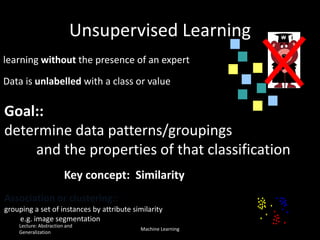
learning without the presence of an expert
Data is unlabelled with a class or value
Goal::
determine data patterns/groupings
and the properties of that classification
Unsupervised Learning
Association or clustering::
grouping a set of instances by attribute similarity
e.g. image segmentation
Key concept: Similarity
Lecture: Abstraction and
Generalization
Machine Learning
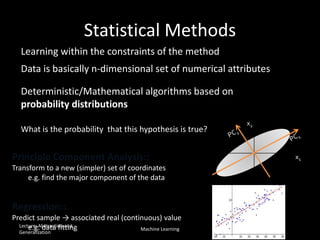
Statistical Methods
Regression::
Predict sample → associated real (continuous) value
e.g. data fitting
x1
x2
Learning within the constraints of the method
Data is basically n-dimensional set of numerical attributes
Deterministic/Mathematical algorithms based on
probability distributions
Principle Component Analysis::
Transform to a new (simpler) set of coordinates
e.g. find the major component of the data
What is the probability that this hypothesis is true?
Lecture: Abstraction and
Generalization
Machine Learning
Pattern Recognition
Another name for machine learning
• A pattern is an object, process or event that can be given a
name.
• A pattern class (or category) is a set of patterns sharing
common attributes and usually originating from the same
source.
• During recognition (or classification) given objects are
assigned to prescribed classes.
• A classifier is a machine which performs classification.
“The assignment of a physical object or event to one of several prespecified
categeries” -- Duda & Hart
Lecture: Abstraction and
Generalization
Machine Learning
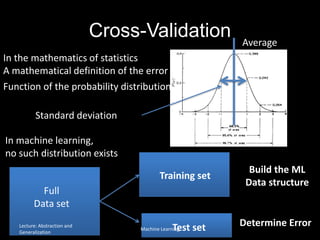
Cross-Validation
In the mathematics of statistics
A mathematical definition of the error
Function of the probability distribution
Average
Standard deviation
In machine learning,
no such distribution exists
Full
Data set
Training set
Test set
Build the ML
Data structure
Determine ErrorLecture: Abstraction and
Generalization
Machine Learning
Classification algorithms
– Fisher linear discriminant
– KNN
– Decision tree
– Neural networks
– SVM
– Naïve bayes
– Adaboost
– Many many more ….
– Each one has its properties with respect to:
bias, speed, accuracy, transparency…Lecture: Abstraction and
Generalization
Machine Learning
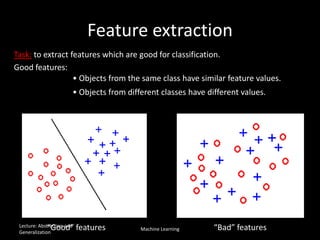
Feature extraction
Task: to extract features which are good for classification.
Good features:
• Objects from the same class have similar feature values.
• Objects from different classes have different values.
“Good” features “Bad” featuresLecture: Abstraction and
Generalization
Machine Learning
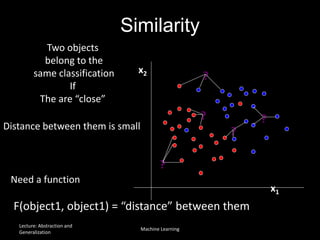
Similarity
Two objects
belong to the
same classification
If
The are “close”
x1
x2
?
?
?
?
?
Distance between them is small
Need a function
F(object1, object1) = “distance” between them
Lecture: Abstraction and
Generalization
Machine Learning
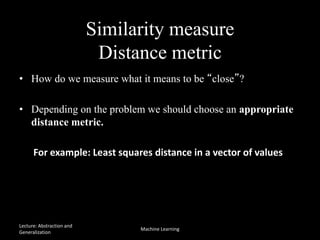
Similarity measure
Distance metric
• How do we measure what it means to be “close”?
• Depending on the problem we should choose an appropriate
distance metric.
For example: Least squares distance in a vector of values
f (a,b) = (ai -bi )2
i=1
n
å
Lecture: Abstraction and
Generalization
Machine Learning
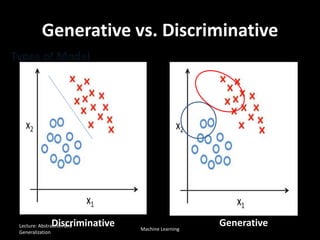
Types of Model
Discriminative Generative
Generative vs. Discriminative
Lecture: Abstraction and
Generalization
Machine Learning
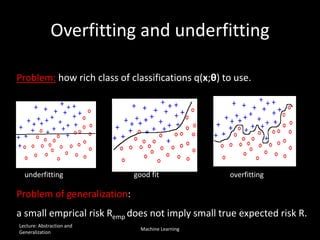
Overfitting and underfitting
Problem: how rich class of classifications q(x;θ) to use.
underfitting overfittinggood fit
Problem of generalization:
a small emprical risk Remp does not imply small true expected risk R.
Lecture: Abstraction and
Generalization
Machine Learning
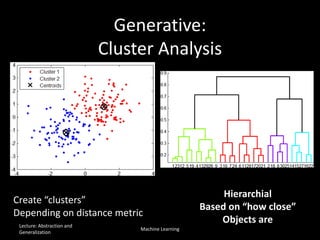
Generative:
Cluster Analysis
Create “clusters”
Depending on distance metric
Hierarchial
Based on “how close”
Objects areLecture: Abstraction and
Generalization
Machine Learning
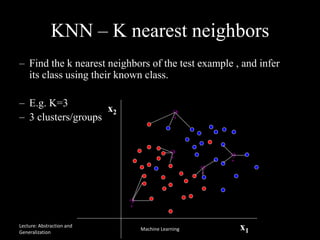
KNN – K nearest neighbors
x1
x2
?
?
?
?
– Find the k nearest neighbors of the test example , and infer
its class using their known class.
– E.g. K=3
– 3 clusters/groups
?
Lecture: Abstraction and
Generalization
Machine Learning
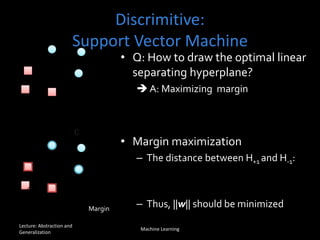
Discrimitive:
Support Vector Machine
• Q: How to draw the optimal linear
separating hyperplane?
 A: Maximizing margin
• Margin maximization
– The distance between H+1 and H-1:
– Thus, ||w|| should be minimizedMargin
Lecture: Abstraction and
Generalization
Machine Learning
PROBLEM SOLVING
Algorithms and Complexity
Lecture: Abstraction and
Generalization
Problem Solving
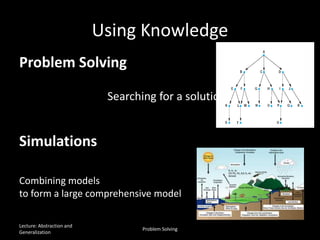
Using Knowledge
Problem Solving
Simulations
Searching for a solution
Combining models
to form a large comprehensive model
Lecture: Abstraction and
Generalization
Problem Solving
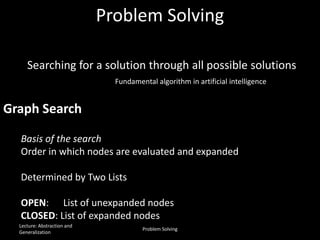
Problem Solving
Basis of the search
Order in which nodes are evaluated and expanded
Determined by Two Lists
OPEN: List of unexpanded nodes
CLOSED: List of expanded nodes
Searching for a solution through all possible solutions
Fundamental algorithm in artificial intelligence
Graph Search
Lecture: Abstraction and
Generalization
Problem Solving
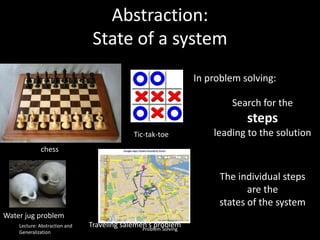
Abstraction:
State of a system
chess
Tic-tak-toe
Water jug problem
Traveling salemen’s problem
In problem solving:
Search for the
steps
leading to the solution
The individual steps
are the
states of the system
Lecture: Abstraction and
Generalization
Problem Solving
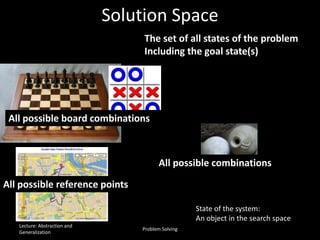
Solution Space
The set of all states of the problem
Including the goal state(s)
All possible board combinations
All possible reference points
All possible combinations
State of the system:
An object in the search space
Lecture: Abstraction and
Generalization
Problem Solving
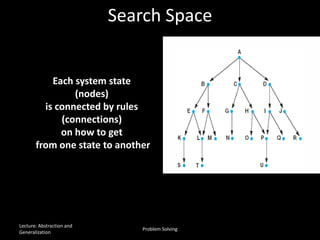
Search Space
Each system state
(nodes)
is connected by rules
(connections)
on how to get
from one state to another
Lecture: Abstraction and
Generalization
Problem Solving
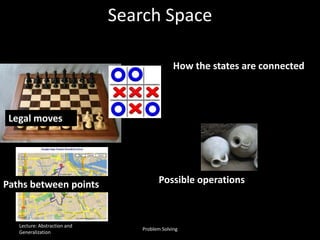
Search Space
How the states are connected
Legal moves
Paths between points Possible operations
Lecture: Abstraction and
Generalization
Problem Solving
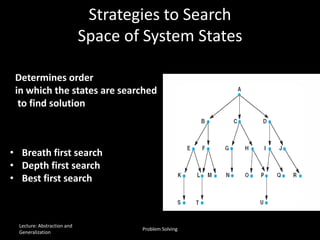
Strategies to Search
Space of System States
• Breath first search
• Depth first search
• Best first search
Determines order
in which the states are searched
to find solution
Lecture: Abstraction and
Generalization
Problem Solving
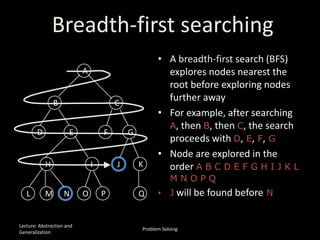
Breadth-first searching
• A breadth-first search (BFS)
explores nodes nearest the
root before exploring nodes
further away
• For example, after searching
A, then B, then C, the search
proceeds with D, E, F, G
• Node are explored in the
order A B C D E F G H I J K L
M N O P Q
• J will be found before NL M N O P
G
Q
H JI K
FED
B C
A
Lecture: Abstraction and
Generalization
Problem Solving
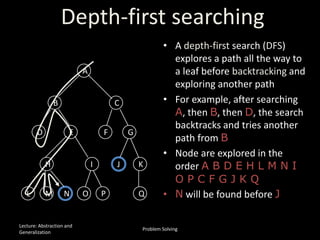
Depth-first searching
• A depth-first search (DFS)
explores a path all the way to
a leaf before backtracking and
exploring another path
• For example, after searching
A, then B, then D, the search
backtracks and tries another
path from B
• Node are explored in the
order A B D E H L M N I
O P C F G J K Q
• N will be found before JL M N O P
G
Q
H JI K
FED
B C
A
Lecture: Abstraction and
Generalization
Problem Solving
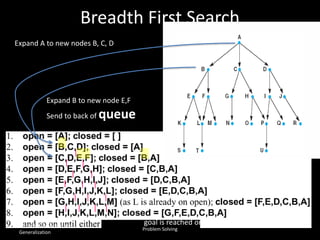
Breadth First Search
|
| |
||
| | |
| | |
||||
Items between red bars are siblings.
goal is reached or open is empty.
Expand A to new nodes B, C, D
Expand B to new node E,F
Send to back of queue
Queue: FILO
Lecture: Abstraction and
Generalization
Problem Solving
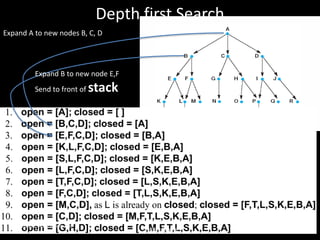
Depth first Search
Expand A to new nodes B, C, D
Expand B to new node E,F
Send to front of stack
Stack: FIFO
Lecture: Abstraction and
Generalization
Problem Solving
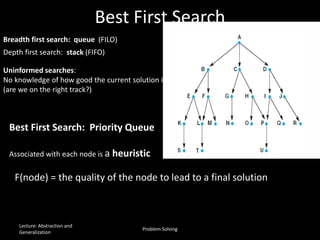
Best First Search
Breadth first search: queue (FILO)
Depth first search: stack (FIFO)
Uninformed searches:
No knowledge of how good the current solution is
(are we on the right track?)
Best First Search: Priority Queue
Associated with each node is a heuristic
F(node) = the quality of the node to lead to a final solution
Lecture: Abstraction and
Generalization
Problem Solving
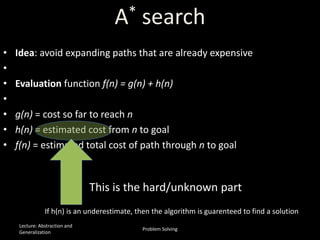
A* search
• Idea: avoid expanding paths that are already expensive
•
• Evaluation function f(n) = g(n) + h(n)
•
• g(n) = cost so far to reach n
• h(n) = estimated cost from n to goal
• f(n) = estimated total cost of path through n to goal
This is the hard/unknown part
If h(n) is an underestimate, then the algorithm is guarenteed to find a solution
Lecture: Abstraction and
Generalization
Problem Solving
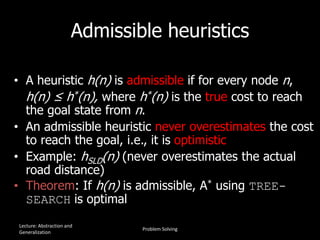
Admissible heuristics
• A heuristic h(n) is admissible if for every node n,
h(n) ≤ h*(n), where h*(n) is the true cost to reach
the goal state from n.
• An admissible heuristic never overestimates the cost
to reach the goal, i.e., it is optimistic
• Example: hSLD(n) (never overestimates the actual
road distance)
• Theorem: If h(n) is admissible, A* using TREE-
SEARCH is optimal
Lecture: Abstraction and
Generalization
Problem Solving
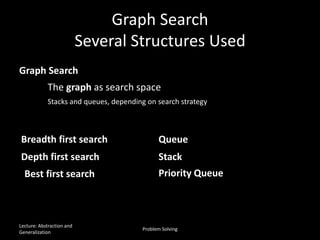
Graph Search
Several Structures Used
Graph Search
The graph as search space
Breadth first search Queue
Depth first search Stack
Best first search Priority Queue
Stacks and queues, depending on search strategy
Lecture: Abstraction and
Generalization
Problem Solving
Abstraction and Representation
Lecture: Abstraction and
Generalization
Abstraction
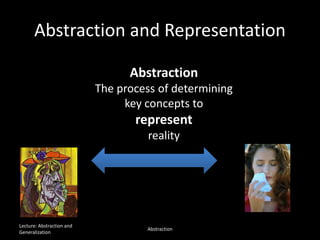
Abstraction
The process of determining
key concepts to
represent
reality
Sources of Abstraction
Lecture: Abstraction and
Generalization
Abstraction
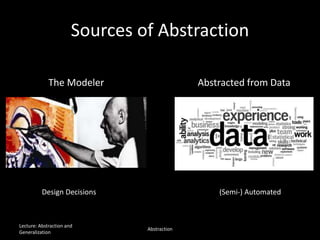
The Modeler Abstracted from Data
Design Decisions (Semi-) Automated
Generalization
Lecture: Abstraction and
Generalization
Abstraction
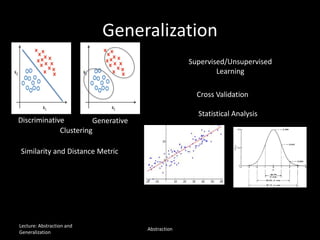
Statistical Analysis
Clustering
Discriminative Generative
Supervised/Unsupervised
Learning
Cross Validation
Similarity and Distance Metric
Ocamm’s Razor
Lecture: Abstraction and
Generalization
Abstraction
prefer the
simplest hypothesis
consistent with data.
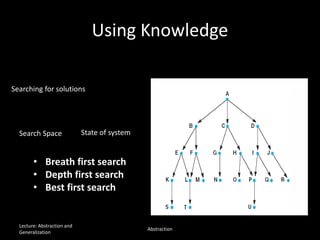
Using Knowledge
Lecture: Abstraction and
Generalization
Abstraction
• Breath first search
• Depth first search
• Best first search
Searching for solutions
Search Space State of system

Generalization abstraction

  • 1.
    Use of Knowledge Abstractionand Problem Solving Abstraction and Problem Solving Edward (Ned) Blurock Lecture: Abstraction and Generalization Abstraction
  • 2.
    Knowledge Representation Abstraction You choosehow to represent reality The choice is not unique It depends on what aspect of reality you want to represent and how Lecture: Abstraction and Generalization Abstraction
  • 3.
    Concept Abstraction Organizing andmaking sense of the immense amount of data/knowledge we have Generalization The ability of an algorithm to perform accurately on new, unseen examples after having trained on a learning data set Lecture: Abstraction and Generalization Abstraction
  • 4.
    Generalization Consider the followingregression problem: Predict real value on the y-axis from the real value on the x-axis. You are given 6 examples: {Xi,Yi}. X* What is the y-value for a new query ? Lecture: Abstraction and Generalization Abstraction
  • 5.
    Generalization X* What is they-value for a new query ? Lecture: Abstraction and Generalization Abstraction
  • 6.
    Generalization X* What is they-value for a new query ? Lecture: Abstraction and Generalization Abstraction
  • 7.
    Generalization which curve isbest? X* What is the y-value for a new query ? Lecture: Abstraction and Generalization Abstraction
  • 8.
    Generalization Occam’s razor: prefer the simplesthypothesis consistent with data. Have to find a balance of constraints Lecture: Abstraction and Generalization Abstraction
  • 9.
    Two Schools ofThought 1. Statistical “Learning” The data is reduced to vectors of numbers Statistical techniques are used for the tasks to be performed. Formulate a hypothesis and prove it is true/false 2. Structural “Learning” The data is converted to a discrete structure (such as a grammar or a graph) and the techniques are related to computer science subjects (such as parsing and graph matching). Lecture: Abstraction and Generalization Machine Learning
  • 10.
    A spectrum ofmachine learning tasks • High-dimensional data (e.g. more than 100 dimensions) • The noise is not sufficient to obscure the structure in the data if we process it right. • There is a huge amount of structure in the data, but the structure is too complicated to be represented by a simple model. • The main problem is figuring out a way to represent the complicated structure that allows it to be learned. • Low-dimensional data (e.g. less than 100 dimensions) • Lots of noise in the data • There is not much structure in the data, and what structure there is, can be represented by a fairly simple model. • The main problem is distinguishing true structure from noise. Statistics Artificial Intelligence Lecture: Abstraction and Generalization Machine Learning
  • 11.
  • 12.
    learning with thepresence of an expert Data is labelled with a class or value Goal:: predict class or value label c1 c2 c3 Supervised Learning Learn a properties of a classification Decision making Predict (classify) sample → discrete set of class labels e.g. C = {object 1, object 2 … } for recognition task e.g. C = {object, !object} for detection task Spa m No- Spam Lecture: Abstraction and Generalization Machine Learning
  • 13.
    learning without thepresence of an expert Data is unlabelled with a class or value Goal:: determine data patterns/groupings and the properties of that classification Unsupervised Learning Association or clustering:: grouping a set of instances by attribute similarity e.g. image segmentation Key concept: Similarity Lecture: Abstraction and Generalization Machine Learning
  • 14.
    Statistical Methods Regression:: Predict sample→ associated real (continuous) value e.g. data fitting x1 x2 Learning within the constraints of the method Data is basically n-dimensional set of numerical attributes Deterministic/Mathematical algorithms based on probability distributions Principle Component Analysis:: Transform to a new (simpler) set of coordinates e.g. find the major component of the data What is the probability that this hypothesis is true? Lecture: Abstraction and Generalization Machine Learning
  • 15.
    Pattern Recognition Another namefor machine learning • A pattern is an object, process or event that can be given a name. • A pattern class (or category) is a set of patterns sharing common attributes and usually originating from the same source. • During recognition (or classification) given objects are assigned to prescribed classes. • A classifier is a machine which performs classification. “The assignment of a physical object or event to one of several prespecified categeries” -- Duda & Hart Lecture: Abstraction and Generalization Machine Learning
  • 16.
    Cross-Validation In the mathematicsof statistics A mathematical definition of the error Function of the probability distribution Average Standard deviation In machine learning, no such distribution exists Full Data set Training set Test set Build the ML Data structure Determine ErrorLecture: Abstraction and Generalization Machine Learning
  • 17.
    Classification algorithms – Fisherlinear discriminant – KNN – Decision tree – Neural networks – SVM – Naïve bayes – Adaboost – Many many more …. – Each one has its properties with respect to: bias, speed, accuracy, transparency…Lecture: Abstraction and Generalization Machine Learning
  • 18.
    Feature extraction Task: toextract features which are good for classification. Good features: • Objects from the same class have similar feature values. • Objects from different classes have different values. “Good” features “Bad” featuresLecture: Abstraction and Generalization Machine Learning
  • 19.
    Similarity Two objects belong tothe same classification If The are “close” x1 x2 ? ? ? ? ? Distance between them is small Need a function F(object1, object1) = “distance” between them Lecture: Abstraction and Generalization Machine Learning
  • 20.
    Similarity measure Distance metric •How do we measure what it means to be “close”? • Depending on the problem we should choose an appropriate distance metric. For example: Least squares distance in a vector of values f (a,b) = (ai -bi )2 i=1 n å Lecture: Abstraction and Generalization Machine Learning
  • 21.
    Types of Model DiscriminativeGenerative Generative vs. Discriminative Lecture: Abstraction and Generalization Machine Learning
  • 22.
    Overfitting and underfitting Problem:how rich class of classifications q(x;θ) to use. underfitting overfittinggood fit Problem of generalization: a small emprical risk Remp does not imply small true expected risk R. Lecture: Abstraction and Generalization Machine Learning
  • 23.
    Generative: Cluster Analysis Create “clusters” Dependingon distance metric Hierarchial Based on “how close” Objects areLecture: Abstraction and Generalization Machine Learning
  • 24.
    KNN – Knearest neighbors x1 x2 ? ? ? ? – Find the k nearest neighbors of the test example , and infer its class using their known class. – E.g. K=3 – 3 clusters/groups ? Lecture: Abstraction and Generalization Machine Learning
  • 25.
    Discrimitive: Support Vector Machine •Q: How to draw the optimal linear separating hyperplane?  A: Maximizing margin • Margin maximization – The distance between H+1 and H-1: – Thus, ||w|| should be minimizedMargin Lecture: Abstraction and Generalization Machine Learning
  • 26.
    PROBLEM SOLVING Algorithms andComplexity Lecture: Abstraction and Generalization Problem Solving
  • 27.
    Using Knowledge Problem Solving Simulations Searchingfor a solution Combining models to form a large comprehensive model Lecture: Abstraction and Generalization Problem Solving
  • 28.
    Problem Solving Basis ofthe search Order in which nodes are evaluated and expanded Determined by Two Lists OPEN: List of unexpanded nodes CLOSED: List of expanded nodes Searching for a solution through all possible solutions Fundamental algorithm in artificial intelligence Graph Search Lecture: Abstraction and Generalization Problem Solving
  • 29.
    Abstraction: State of asystem chess Tic-tak-toe Water jug problem Traveling salemen’s problem In problem solving: Search for the steps leading to the solution The individual steps are the states of the system Lecture: Abstraction and Generalization Problem Solving
  • 30.
    Solution Space The setof all states of the problem Including the goal state(s) All possible board combinations All possible reference points All possible combinations State of the system: An object in the search space Lecture: Abstraction and Generalization Problem Solving
  • 31.
    Search Space Each systemstate (nodes) is connected by rules (connections) on how to get from one state to another Lecture: Abstraction and Generalization Problem Solving
  • 32.
    Search Space How thestates are connected Legal moves Paths between points Possible operations Lecture: Abstraction and Generalization Problem Solving
  • 33.
    Strategies to Search Spaceof System States • Breath first search • Depth first search • Best first search Determines order in which the states are searched to find solution Lecture: Abstraction and Generalization Problem Solving
  • 34.
    Breadth-first searching • Abreadth-first search (BFS) explores nodes nearest the root before exploring nodes further away • For example, after searching A, then B, then C, the search proceeds with D, E, F, G • Node are explored in the order A B C D E F G H I J K L M N O P Q • J will be found before NL M N O P G Q H JI K FED B C A Lecture: Abstraction and Generalization Problem Solving
  • 35.
    Depth-first searching • Adepth-first search (DFS) explores a path all the way to a leaf before backtracking and exploring another path • For example, after searching A, then B, then D, the search backtracks and tries another path from B • Node are explored in the order A B D E H L M N I O P C F G J K Q • N will be found before JL M N O P G Q H JI K FED B C A Lecture: Abstraction and Generalization Problem Solving
  • 36.
    Breadth First Search | || || | | | | | | |||| Items between red bars are siblings. goal is reached or open is empty. Expand A to new nodes B, C, D Expand B to new node E,F Send to back of queue Queue: FILO Lecture: Abstraction and Generalization Problem Solving
  • 37.
    Depth first Search ExpandA to new nodes B, C, D Expand B to new node E,F Send to front of stack Stack: FIFO Lecture: Abstraction and Generalization Problem Solving
  • 38.
    Best First Search Breadthfirst search: queue (FILO) Depth first search: stack (FIFO) Uninformed searches: No knowledge of how good the current solution is (are we on the right track?) Best First Search: Priority Queue Associated with each node is a heuristic F(node) = the quality of the node to lead to a final solution Lecture: Abstraction and Generalization Problem Solving
  • 39.
    A* search • Idea:avoid expanding paths that are already expensive • • Evaluation function f(n) = g(n) + h(n) • • g(n) = cost so far to reach n • h(n) = estimated cost from n to goal • f(n) = estimated total cost of path through n to goal This is the hard/unknown part If h(n) is an underestimate, then the algorithm is guarenteed to find a solution Lecture: Abstraction and Generalization Problem Solving
  • 40.
    Admissible heuristics • Aheuristic h(n) is admissible if for every node n, h(n) ≤ h*(n), where h*(n) is the true cost to reach the goal state from n. • An admissible heuristic never overestimates the cost to reach the goal, i.e., it is optimistic • Example: hSLD(n) (never overestimates the actual road distance) • Theorem: If h(n) is admissible, A* using TREE- SEARCH is optimal Lecture: Abstraction and Generalization Problem Solving
  • 41.
    Graph Search Several StructuresUsed Graph Search The graph as search space Breadth first search Queue Depth first search Stack Best first search Priority Queue Stacks and queues, depending on search strategy Lecture: Abstraction and Generalization Problem Solving
  • 42.
    Abstraction and Representation Lecture:Abstraction and Generalization Abstraction Abstraction The process of determining key concepts to represent reality
  • 43.
    Sources of Abstraction Lecture:Abstraction and Generalization Abstraction The Modeler Abstracted from Data Design Decisions (Semi-) Automated
  • 44.
    Generalization Lecture: Abstraction and Generalization Abstraction StatisticalAnalysis Clustering Discriminative Generative Supervised/Unsupervised Learning Cross Validation Similarity and Distance Metric
  • 45.
    Ocamm’s Razor Lecture: Abstractionand Generalization Abstraction prefer the simplest hypothesis consistent with data.
  • 46.
    Using Knowledge Lecture: Abstractionand Generalization Abstraction • Breath first search • Depth first search • Best first search Searching for solutions Search Space State of system