INTRODUCTION TO   Machine Learning ETHEM ALPAYDIN © The MIT Press, 2004 [email_address] http://www.cmpe.boun.edu.tr/~ethem/i2ml Lecture Slides for
CHAPTER 2:   Supervised Learning
Learning a Class from Examples Class  C  of a “family car” Prediction:  Is car  x  a family car? Knowledge extraction:  What do people expect from a family car? Output:  Positive (+) and negative (–) examples Input representation:  x 1 : price,  x 2  : engine power
Learn a clasifier x1 x2 x3 x4 y=f(x1,x2,x3,x4) Observations: Learn an approximation g (x1,x2,x3,x4) 0 1 0 1 0 7 0 0 0 1 1 6 0 0 1 1 0 5 1 1 0 0 1 4 1 1 1 0 0 3 0 0 0 1 0 2 0 0 1 0 0 1 y x4 x3 x2 x1 Example
Training set  X
Class  C
Hypothesis class  H Error of  h  on   H
 
S, G, and the Version Space most specific hypothesis,  S most general hypothesis,  G h     H , between  S  and  G  is consistent   and make up the  version space (Mitchell, 1997)
VC Dimension N  points can be labeled in 2 N   ways as +/– H   shatters   N  if there  exists  h     H  consistent  for any of these:  VC( H  ) =  N An axis-aligned rectangle shatters 4 points only !
How many training examples  N  should we have, such that with  probability at least  1 ‒ δ,  h  has  error at most  ε ? (Blumer et al., 1989) Each strip is at most ε/4 Pr that we miss a strip 1‒ ε/4 Pr that  N  instances miss a strip (1 ‒ ε/4) N Pr that  N  instances miss 4 strips 4(1 ‒  ε /4) N 4(1 ‒ ε/4) N  ≤ δ and (1 ‒ x)≤exp( ‒ x) 4exp(‒ ε N /4) ≤ δ  and  N  ≥ (4/ε)log(4/δ) Probably Approximately Correct (PAC) Learning
Use the simpler one because Simpler to use  (lower computational  complexity) Easier to train (lower  space complexity) Easier to explain  (more interpretable) Generalizes better (lower  variance - Occam’s razor) Noise and Model Complexity
Multiple Classes ,  C i  i=1,...,K Train hypotheses  h i ( x ),  i  =1,..., K :
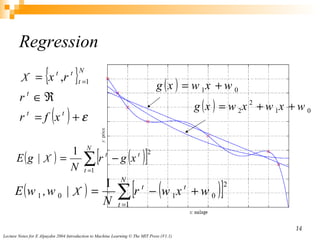
Regression
Model Selection & Generalization Learning is an  ill-posed problem;  data is not sufficient to find a unique solution The need for  inductive bias,   assumptions about  H Generalization:   How well a model performs on new data Overfitting:  H  more complex than  C  or  f  Underfitting:  H  less complex than  C  or  f
Triple Trade-Off There is a trade-off between three factors (Dietterich, 2003): Complexity of  H , c  ( H ), Training set size,  N,  Generalization error,  E , on new data As  N  E  As  c  ( H )  first  E  and then  E 
Cross-Validation To estimate generalization error, we need data unseen during training. We split the data as Training set (50%) Validation set (25%) Test (publication) set (25%) Resampling when there is few data
Dimensions of a Supervised Learner Model :  Loss function: Optimization procedure: 

Alpaydin - Chapter 2

  • 1.
    INTRODUCTION TO Machine Learning ETHEM ALPAYDIN © The MIT Press, 2004 [email_address] http://www.cmpe.boun.edu.tr/~ethem/i2ml Lecture Slides for
  • 2.
    CHAPTER 2: Supervised Learning
  • 3.
    Learning a Classfrom Examples Class C of a “family car” Prediction: Is car x a family car? Knowledge extraction: What do people expect from a family car? Output: Positive (+) and negative (–) examples Input representation: x 1 : price, x 2 : engine power
  • 4.
    Learn a clasifierx1 x2 x3 x4 y=f(x1,x2,x3,x4) Observations: Learn an approximation g (x1,x2,x3,x4) 0 1 0 1 0 7 0 0 0 1 1 6 0 0 1 1 0 5 1 1 0 0 1 4 1 1 1 0 0 3 0 0 0 1 0 2 0 0 1 0 0 1 y x4 x3 x2 x1 Example
  • 5.
  • 6.
  • 7.
    Hypothesis class H Error of h on H
  • 8.
  • 9.
    S, G, andthe Version Space most specific hypothesis, S most general hypothesis, G h  H , between S and G is consistent and make up the version space (Mitchell, 1997)
  • 10.
    VC Dimension N points can be labeled in 2 N ways as +/– H shatters N if there exists h  H consistent for any of these: VC( H ) = N An axis-aligned rectangle shatters 4 points only !
  • 11.
    How many trainingexamples N should we have, such that with probability at least 1 ‒ δ, h has error at most ε ? (Blumer et al., 1989) Each strip is at most ε/4 Pr that we miss a strip 1‒ ε/4 Pr that N instances miss a strip (1 ‒ ε/4) N Pr that N instances miss 4 strips 4(1 ‒ ε /4) N 4(1 ‒ ε/4) N ≤ δ and (1 ‒ x)≤exp( ‒ x) 4exp(‒ ε N /4) ≤ δ and N ≥ (4/ε)log(4/δ) Probably Approximately Correct (PAC) Learning
  • 12.
    Use the simplerone because Simpler to use (lower computational complexity) Easier to train (lower space complexity) Easier to explain (more interpretable) Generalizes better (lower variance - Occam’s razor) Noise and Model Complexity
  • 13.
    Multiple Classes , C i i=1,...,K Train hypotheses h i ( x ), i =1,..., K :
  • 14.
  • 15.
    Model Selection &Generalization Learning is an ill-posed problem; data is not sufficient to find a unique solution The need for inductive bias, assumptions about H Generalization: How well a model performs on new data Overfitting: H more complex than C or f Underfitting: H less complex than C or f
  • 16.
    Triple Trade-Off Thereis a trade-off between three factors (Dietterich, 2003): Complexity of H , c ( H ), Training set size, N, Generalization error, E , on new data As N  E  As c ( H )  first E  and then E 
  • 17.
    Cross-Validation To estimategeneralization error, we need data unseen during training. We split the data as Training set (50%) Validation set (25%) Test (publication) set (25%) Resampling when there is few data
  • 18.
    Dimensions of aSupervised Learner Model : Loss function: Optimization procedure: 