
Presentation
on
By
BHARAT BHUSHAN
Asst. Professor, Department of Computer Sc.
RLSY College, Ranchi
Buddha Science and Technical Institute, Ranchi
www.bharatsir.com
Production Systems in
Artificial Intelligence
www.bharatsir.com || Mo No : 09835376044 || WhtasApp : 09006365889
Artificial Intelligence
Production Systems
A production system is a kind of cognitive
architecture that is used to implement search
algorithms and replicate human problem-
solving skills. This problem-solving
knowledge is encoded in the system in the
form of little quanta popularly known as
productions.
It consists of two components:
rule and action.
www.bharatsir.com || Mo No : 09835376044 || WhtasApp : 09006365889
Artificial Intelligence
Rules recognize the condition, and the
actions part has the knowledge of how to
deal with the condition.
In simpler words, the production system in
AI contains a set of rules which are defined
by the left side and right side of the system.
The left side contains a set of things to watch
for (condition), and the right side contains
the things to do (action).
www.bharatsir.com || Mo No : 09835376044 || WhtasApp : 09006365889
Artificial Intelligence
Elements of a Production System
An AI production system has three main elements
which are as follows:
Global Database: The primary database which
contains all the information necessary to
successfully complete a task. It is further broken
down into two parts: temporary and permanent.
The temporary part contains information relevant
to the current situation only whereas the
permanent part contains information about the
fixed actions.
www.bharatsir.com || Mo No : 09835376044 || WhtasApp : 09006365889
Artificial Intelligence
A Set of Production Rules: A set of rules that
operates on the global database. Each rule consists
of a precondition and post condition that the
global database either meets or not. For example,
if a condition is met by the global database, then
the production rule is applied successfully.
Control System: A control system that acts as the
decision-maker, decides which production rule
should be applied. The Control system stops
computation or processing when a termination
condition is met on the database.
www.bharatsir.com || Mo No : 09835376044 || WhtasApp : 09006365889
Artificial Intelligence
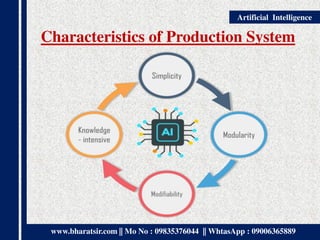
Characteristics of a Production System
A production system has the following features:
Simplicity: Due to the use of the IF-THEN
structure, each sentence is unique in the
production system. This uniqueness makes the
knowledge representation simple to enhance the
readability of the production rules.
Modularity: The knowledge available is coded in
discrete pieces by the production system, which
makes it easy to add, modify, or delete the
information without any side effects.
www.bharatsir.com || Mo No : 09835376044 || WhtasApp : 09006365889
Artificial Intelligence
Modifiability: This feature allows for the
modification of the production rules. The
rules are first defined in the skeletal form
and then modified to suit an application.
Knowledge-intensive: As the name
suggests, the system only stores knowledge.
All the rules are written in the English
language. This type of representation solves
the semantics problem.
www.bharatsir.com || Mo No : 09835376044 || WhtasApp : 09006365889
Artificial Intelligence
Characteristics of Production System
www.bharatsir.com || Mo No : 09835376044 || WhtasApp : 09006365889
Artificial Intelligence
Classes of a Production System?
A production system is classified into four main
classes which are:
Monotonic Production System: In a monotonic
production system, the use of one rule never
prevents the involvement of another rule when
both the rules are selected at the same time.
Hence, it enables the system to apply rules
simultaneously.
Partially Commutative Production System: In
this production system if a set of rules is used to
www.bharatsir.com || Mo No : 09835376044 || WhtasApp : 09006365889
Artificial Intelligence
change state A to state B then any allowable
combination of these rules will also produce the
same results (convert state A to state B).
Non-Monotonic Production System: This
production system increases the problem-solving
efficiency of the machine by not keeping a record
of the changes made in the previous search
process. These types of production systems are
useful from an implementation point of view as
they do not backtrack to the previous state when it
is found that an incorrect path was followed.
www.bharatsir.com || Mo No : 09835376044 || WhtasApp : 09006365889
Artificial Intelligence
Commutative Production System: These type of
production systems is used when the order of
operation is not important, and the changes are
reversible.
www.bharatsir.com || Mo No : 09835376044 || WhtasApp : 09006365889
Artificial Intelligence
Advantages of Production System in AI
 Offers modularity as all the rules can be added,
deleted, or modified individually.
 Separate control system and knowledge base.
 An excellent and feasible model that imitates
human problem-solving skills.
 Beneficial in real-time applications and
environment.
 Offers language independence.
Bharat Bhushan, Assistant Professor, RLSY College, Ranchi
Artificial Intelligence

Production System in AI

  • 1.
    Presentation on By BHARAT BHUSHAN Asst. Professor,Department of Computer Sc. RLSY College, Ranchi Buddha Science and Technical Institute, Ranchi www.bharatsir.com Production Systems in Artificial Intelligence
  • 2.
    www.bharatsir.com || MoNo : 09835376044 || WhtasApp : 09006365889 Artificial Intelligence Production Systems A production system is a kind of cognitive architecture that is used to implement search algorithms and replicate human problem- solving skills. This problem-solving knowledge is encoded in the system in the form of little quanta popularly known as productions. It consists of two components: rule and action.
  • 3.
    www.bharatsir.com || MoNo : 09835376044 || WhtasApp : 09006365889 Artificial Intelligence Rules recognize the condition, and the actions part has the knowledge of how to deal with the condition. In simpler words, the production system in AI contains a set of rules which are defined by the left side and right side of the system. The left side contains a set of things to watch for (condition), and the right side contains the things to do (action).
  • 4.
    www.bharatsir.com || MoNo : 09835376044 || WhtasApp : 09006365889 Artificial Intelligence Elements of a Production System An AI production system has three main elements which are as follows: Global Database: The primary database which contains all the information necessary to successfully complete a task. It is further broken down into two parts: temporary and permanent. The temporary part contains information relevant to the current situation only whereas the permanent part contains information about the fixed actions.
  • 5.
    www.bharatsir.com || MoNo : 09835376044 || WhtasApp : 09006365889 Artificial Intelligence A Set of Production Rules: A set of rules that operates on the global database. Each rule consists of a precondition and post condition that the global database either meets or not. For example, if a condition is met by the global database, then the production rule is applied successfully. Control System: A control system that acts as the decision-maker, decides which production rule should be applied. The Control system stops computation or processing when a termination condition is met on the database.
  • 6.
    www.bharatsir.com || MoNo : 09835376044 || WhtasApp : 09006365889 Artificial Intelligence Characteristics of a Production System A production system has the following features: Simplicity: Due to the use of the IF-THEN structure, each sentence is unique in the production system. This uniqueness makes the knowledge representation simple to enhance the readability of the production rules. Modularity: The knowledge available is coded in discrete pieces by the production system, which makes it easy to add, modify, or delete the information without any side effects.
  • 7.
    www.bharatsir.com || MoNo : 09835376044 || WhtasApp : 09006365889 Artificial Intelligence Modifiability: This feature allows for the modification of the production rules. The rules are first defined in the skeletal form and then modified to suit an application. Knowledge-intensive: As the name suggests, the system only stores knowledge. All the rules are written in the English language. This type of representation solves the semantics problem.
  • 8.
    www.bharatsir.com || MoNo : 09835376044 || WhtasApp : 09006365889 Artificial Intelligence Characteristics of Production System
  • 9.
    www.bharatsir.com || MoNo : 09835376044 || WhtasApp : 09006365889 Artificial Intelligence Classes of a Production System? A production system is classified into four main classes which are: Monotonic Production System: In a monotonic production system, the use of one rule never prevents the involvement of another rule when both the rules are selected at the same time. Hence, it enables the system to apply rules simultaneously. Partially Commutative Production System: In this production system if a set of rules is used to
  • 10.
    www.bharatsir.com || MoNo : 09835376044 || WhtasApp : 09006365889 Artificial Intelligence change state A to state B then any allowable combination of these rules will also produce the same results (convert state A to state B). Non-Monotonic Production System: This production system increases the problem-solving efficiency of the machine by not keeping a record of the changes made in the previous search process. These types of production systems are useful from an implementation point of view as they do not backtrack to the previous state when it is found that an incorrect path was followed.
  • 11.
    www.bharatsir.com || MoNo : 09835376044 || WhtasApp : 09006365889 Artificial Intelligence Commutative Production System: These type of production systems is used when the order of operation is not important, and the changes are reversible.
  • 12.
    www.bharatsir.com || MoNo : 09835376044 || WhtasApp : 09006365889 Artificial Intelligence Advantages of Production System in AI  Offers modularity as all the rules can be added, deleted, or modified individually.  Separate control system and knowledge base.  An excellent and feasible model that imitates human problem-solving skills.  Beneficial in real-time applications and environment.  Offers language independence.
  • 13.
    Bharat Bhushan, AssistantProfessor, RLSY College, Ranchi Artificial Intelligence