Programming Languages and
Paradigms
Functional Programming Background
(computability, turing machines, lambda calculus)
Edward (Ned) Blurock
Functional Programming Functional Programming
COMPUTABILITY
Will an algorithm be able to compute the task?
Is the task I want impossible?
Is it possible to formulate an impossible task?
What is the consequences for other algorithms
Functional Programming Computability
Computability vs Complexity
• Computability refers to whether of not in
principle it is possible to evaluate f(n) by
following a set of instructions.
• We are not for the moment worried if this
computation requires 1,000,000 or more
consecutive steps.
• The latter refers to complexity which we will
return to later.
Functional Programming Computability
Ensheidungsproblem
Decision problem
Hilbert 1928
The Entscheidungsproblem asks for
an algorithm
that takes as input a statement of a first-order logic
and
answers "Yes" or "No"
according to whether the statement is universally valid
(valid in every structure satisfying the axioms).
An algorithm to ask whether something is true
Is it computableFunctional Programming Computability
Ensheidungsproblem
Decision problem
Hilbert 1928
• Before the question could be answered, the
notion of "algorithm" had to be formally
defined.
– This was done by Alonzo Church in 1936 with the
concept of "effective calculability" based on his λ
calculus
– and by Alan Turing in the same year with his
concept of Turing machines.
– It was recognized immediately by Turing that
these are equivalent models of computation.
Functional Programming Computability
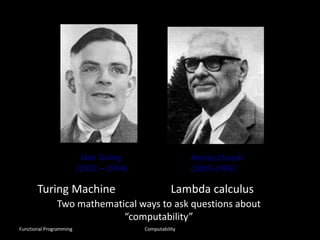
Alan Turing
(1912 – 1954)
Alonzo Church
(1903-1995)
Turing Machine Lambda calculus
Two mathematical ways to ask questions about
“computability”
Functional Programming Computability
Equivalent Computers
z z zz z z z
1
Start
HALT
), X, L
2:
look
for (
#, 1, -
), #, R
(, #, L
(, X, R
#, 0, -
Finite State Machine
...
Turing Machine

term = variable
| term term
| (term)
|  variable . term
y. M  v. (M [y v])
where v does not occur in M.
(x. M)N   M [ x N ]


Lambda Calculus
Functional Programming Computability
Alan Turing, 1936
• "On computable numbers, with an application
to the Entscheidungsproblem [decision
problem]”
• addressed a previously unsolved
mathematical problem posed by the German
mathematician David Hilbert in 1928:
Functional Programming Computability
Turing, 1936
Is there, in principal,
any definite mechanical method or process
by which
all mathematical questions
could be decided?
The Decision Problem
Functional Programming Computability
Turing, 1936
• To answer the question (in the negative),
• Turing proposed a simple abstract computing
machine,
• modeled after a mathematician with a pencil,
an eraser, and a stack of pieces of paper
• He asserted that any function is a computable
function if it is computable by one of these
abstract machines.
Functional Programming Computability
Turing, 1936
• He then investigated whether there were
some mathematical problems which could not
be solved by any such abstract machine.
• Such abstract computing machines are now
called "Turing machines".
• One particular Turing machine, called a
"Universal Turing Machine", served as the
model for designing actual programmable
computers.
Functional Programming Computability
Why a Turing Machine
Because Turing machines are very simple
compared with computers in practical use,
conceptually easier
to prove impossibility results
for Turing machines.
These impossibility results
apply as well to all known computers
Functional Programming Computability
Turing, 1936
• Startling result of Turing's 1936 paper
• assertion that there are well-defined
problems that cannot be solved by any
computational procedure.
Functional Programming Computability
What is Computable?
Computation is usually modelled as a mapping from inputs to outputs,
carried out by a formal “machine,” or program, which processes its
input in a sequence of steps.
An “effectively computable” function is one that can be computed in
a finite amount of time using finite resources.
…………
…………
…
input
yes
no
output
Effectively
computable
function
Functional Programming Computability
Unsolvable
• problems are formulated as functions
– unsolvable functions: noncomputable;
• Problems formulated as predicates
– Undecidable.
Using Turing's concept of the abstract machine,
we would say that a function is noncomputable
if there exists no Turing machine that could compute it.
Functional Programming Computability
TURING MACHINE
Computability
Functional Programming Turing Machine
............
Tape
Read-Write head
Control Unit
Functional Programming Turing Machine
Turing Machine
............
Read-Write head
No boundaries -- infinite length
The head moves Left or Right
The
tape
OR
Functional Programming
Turing Machine
............
Read-Write head
The head at each time step:
1. Reads a symbol
2. Writes a symbol
3. Moves Left or Right
Functional Programming
Turing Machine
............
Example:
Time 0
............
Time 1
a a cb
a b k c
1. Reads a
2. Writes k
3. Moves Left
a
Functional Programming
Turing Machine
............
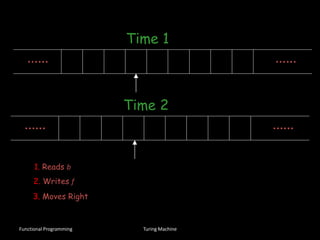
Time 1
a b k c
............
Time 2
a k cf
1. Reads b
2. Writes f
3. Moves Right
b
Functional Programming
Add 1 to a sequence of ones
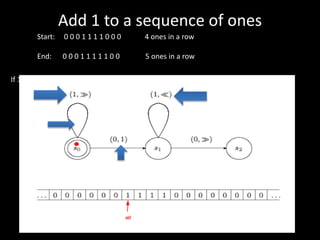
If 1, then move right If 1, then move left
Loop
If 0, replace with 1
Start: 0 0 0 1 1 1 1 0 0 0 4 ones in a row
End: 0 0 0 1 1 1 1 1 0 0 5 ones in a row
Functional Programming Turing Machine
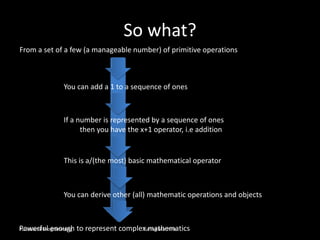
So what?
You can add a 1 to a sequence of ones
From a set of a few (a manageable number) of primitive operations
If a number is represented by a sequence of ones
then you have the x+1 operator, i.e addition
This is a/(the most) basic mathematical operator
Powerful enough to represent complex mathematics
You can derive other (all) mathematic operations and objects
Functional Programming Turing Machine
Powerful “language”
From a set of a few (a manageable number) of
primitive operations
Easier enough
To formulate
Proofs about algorithms
Powerful enough
To
represent complex
mathematics
All the ingredients are there Only have to deal with a few basic operations
Not worried about complexity…. Worried about, for example, “can” we compute?
Functional Programming Turing Machine
TURING MACHINE (PT 2)
Computability
Functional Programming Turing Machine (pt 2)
Turing Machine (pt 2)
The Input String
............    
Blank symbol
head
a b ca
Head starts at the leftmost position
of the input string
Input string
Functional Programming
Turing Machine (pt 2)
States & Transitions
1q 2qLba ,
Read Write Move Left
1q 2qRba ,
Move Right
Functional Programming
Turing Machine (pt 2)
Turing machine for the language }{ nn
ba
0q 1q 2q3q
Rxa ,
Raa ,
Ryy ,
Lyb ,
Laa ,
Lyy ,
Rxx ,
Ryy ,
Ryy ,
4q
L,
Functional Programming
Turing Machine (pt 2)
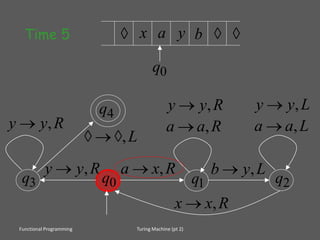
0q 1q 2q3q
Rxa ,
Raa ,
Ryy ,
Lyb ,
Laa ,
Lyy ,
Rxx ,
Ryy ,
Ryy ,
4q
L,
 ba
0q
a bTime 0 
Functional Programming
Turing Machine (pt 2)
0q 1q 2q3q
Rxa ,
Raa ,
Ryy ,
Lyb ,
Laa ,
Lyy ,
Rxx ,
Ryy ,
Ryy ,
4q
L,
 bx
1q
a b Time 1
Functional Programming
Turing Machine (pt 2)
0q 1q 2q3q
Rxa ,
Raa ,
Ryy ,
Lyb ,
Laa ,
Lyy ,
Rxx ,
Ryy ,
Ryy ,
4q
L,
 x
2q
a b Time 2 b
Functional Programming
Turing Machine (pt 2)
0q 1q 2q3q
Rxa ,
Raa ,
Ryy ,
Lyb ,
Laa ,
Lyy ,
Rxx ,
Ryy ,
Ryy ,
4q
L,
 yx
2q
a b Time 3
Functional Programming
Turing Machine (pt 2)
0q 1q 2q3q
Rxa ,
Raa ,
Ryy ,
Lyb ,
Laa ,
Lyy ,
Rxx ,
Ryy ,
Ryy ,
4q
L,
 yx
2q
a b Time 4
Functional Programming
Turing Machine (pt 2)
0q 1q 2q3q
Rxa ,
Raa ,
Ryy ,
Lyb ,
Laa ,
Lyy ,
Rxx ,
Ryy ,
Ryy ,
4q
L,
 yx
0q
a b Time 5
Functional Programming
Turing Machine (pt 2)
0q 1q 2q3q
Rxa ,
Raa ,
Ryy ,
Lyb ,
Laa ,
Lyy ,
Rxx ,
Ryy ,
Ryy ,
4q
L,
 yx
1q
x b Time 6
Functional Programming
Turing Machine (pt 2)
0q 1q 2q3q
Rxa ,
Raa ,
Ryy ,
Lyb ,
Laa ,
Lyy ,
Rxx ,
Ryy ,
Ryy ,
4q
L,
 yx
1q
x b Time 7
Functional Programming
Turing Machine (pt 2)
0q 1q 2q3q
Rxa ,
Raa ,
Ryy ,
Lyb ,
Laa ,
Lyy ,
Rxx ,
Ryy ,
Ryy ,
4q
L,
 yx x y
2q
Time 8
Functional Programming
Turing Machine (pt 2)
0q 1q 2q3q
Rxa ,
Raa ,
Ryy ,
Lyb ,
Laa ,
Lyy ,
Rxx ,
Ryy ,
Ryy ,
4q
L,
 yx x y
2q
Time 9
Functional Programming
Turing Machine (pt 2)
0q 1q 2q3q
Rxa ,
Raa ,
Ryy ,
Lyb ,
Laa ,
Lyy ,
Rxx ,
Ryy ,
Ryy ,
4q
L,
 yx
0q
x y Time 10
Functional Programming
Turing Machine (pt 2)
0q 1q 2q3q
Rxa ,
Raa ,
Ryy ,
Lyb ,
Laa ,
Lyy ,
Rxx ,
Ryy ,
Ryy ,
4q
L,
 yx
3q
x y Time 11
Functional Programming
Turing Machine (pt 2)
0q 1q 2q3q
Rxa ,
Raa ,
Ryy ,
Lyb ,
Laa ,
Lyy ,
Rxx ,
Ryy ,
Ryy ,
4q
L,
 yx
3q
x y Time 12
Functional Programming
Turing Machine (pt 2)
0q 1q 2q3q
Rxa ,
Raa ,
Ryy ,
Lyb ,
Laa ,
Lyy ,
Rxx ,
Ryy ,
Ryy ,
4q
L,
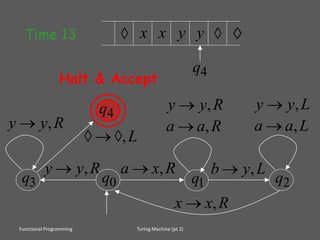
 yx
4q
x y 
Halt & Accept
Time 13
Functional Programming
LAMBDA CALCULUS
Computability
Functional Programming Lambda Calculus
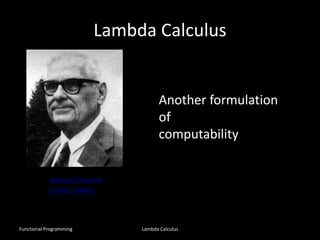
Lambda Calculus
Alonzo Church
(1903-1995)
Another formulation
of
computability
Functional Programming Lambda Calculus
Equivalent Computers
z z zz z z z ...
Turing Machine

term = variable
| term term
| (term)
|  variable . term
y. M  v. (M [y v])
where v does not occur in M.
(x. M)N   M [ x N ]


Lambda Calculus
Functional Programming Lambda Calculus
What is Calculus?
• In High School:
d/dx xn = nxn-1 [Power Rule]
d/dx (f + g) = d/dx f + d/dx g [Sum Rule]
Calculus
is a branch of mathematics
that deals with limits
and the differentiation and
integration of functions
of one or more variables...
Functional Programming Lambda Calculus
Real Definition
• A calculus is just a bunch of rules for
manipulating symbols.
• People can give meaning to those symbols,
but that’s not part of the calculus.
• Differential calculus is a bunch of rules for
manipulating symbols. There is an
interpretation of those symbols corresponds
with physics, slopes, etc.
Functional Programming Lambda Calculus
-calculus
Alonzo Church, 1940
term = variable
| term term
| (term)
|  variable . term
Functional Programming Lambda Calculus
-calculus
 variable . term
F(variable) = term
Functional Programming Lambda Calculus
Why?
• Once we have precise and formal rules for
manipulating symbols, we can use it to reason
with.
• Since we can interpret the symbols as
representing computations, we can use it to
reason about programs.
Functional Programming Lambda Calculus
Universal Computer
• Lambda Calculus can simulate a Turing Machine
– Everything a Turing Machine can compute, Lambda
Calculus can compute also
• Turing Machine can simulate Lambda Calculus
– Everything Lambda Calculus can compute, a Turing
Machine can compute also
• Church-Turing Thesis: this is true for any other
mechanical computer also
Functional Programming Lambda Calculus
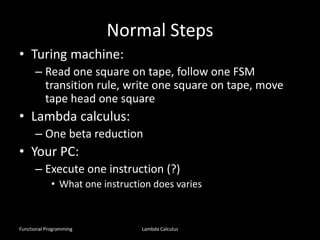
Normal Steps
• Turing machine:
– Read one square on tape, follow one FSM
transition rule, write one square on tape, move
tape head one square
• Lambda calculus:
– One beta reduction
• Your PC:
– Execute one instruction (?)
• What one instruction does varies
Functional Programming Lambda Calculus
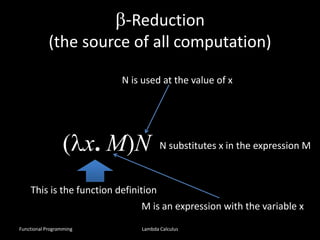
-Reduction
(the source of all computation)
(x. M)N
This is the function definition
M is an expression with the variable x
N is used at the value of x
N substitutes x in the expression M
Functional Programming Lambda Calculus
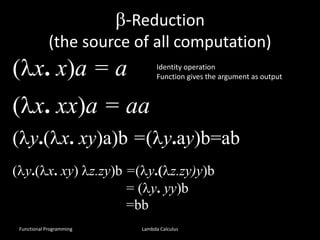
(x. x)a = a
-Reduction
(the source of all computation)
Identity operation
Function gives the argument as output
(x. xx)a = aa
(y.(x. xy)a)b =(y.ay)b=ab
(y.(x. xy) z.zy)b =(y.(z.zy)y)b
= (y. yy)b
=bb
Functional Programming Lambda Calculus
-calculus
Useful and expression enough that a programming
language was modeled after it
LISP
was developed from -calculus
not the other way round.)
This was the “first” general language of
Artificial intelligence
Also
The “first” functional programming language
Functional Programming Lambda Calculus
Expression Reductions
Functional Programming Lambda Calculus
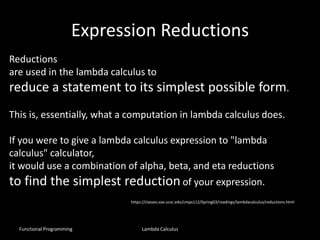
Reductions
are used in the lambda calculus to
reduce a statement to its simplest possible form.
This is, essentially, what a computation in lambda calculus does.
If you were to give a lambda calculus expression to "lambda
calculus" calculator,
it would use a combination of alpha, beta, and eta reductions
to find the simplest reduction of your expression.
https://classes.soe.ucsc.edu/cmps112/Spring03/readings/lambdacalculus/reductions.html
Expression Reduction
Functional Programming Lambda Calculus
(𝛌x. x x) (𝛌y. y)
--> x x [𝛌y. y / x]
== (𝛌y. y) (𝛌y. y)
--> y [𝛌y. y / y]
== 𝛌y. y
How the original expression is
evaluated
Is determined the
operational semantics
of lambda calculus
(there are many ways to evaluate expressions)
Operational Semantics: how the substitutions are made:
Key concepts:
specification of free variables
specification of bound variables
Β-reduction
a formalization of simple substitution
Name Capture
Functional Programming Lambda Calculus
Care must be taken
to avoid “name capture”
of bound variables.
For example, this reduction would be “wrong”:
(λx. (λy. x)) y ⇒ λy. y
because the outer y is presumably different
from the inner y bound by the lambda.
In cases like these, the bound variable is renamed to obtain the “correct” behavior:
(λx. (λy. x)) y ⇒ λz. y
http://www.cs.yale.edu/homes/hudak/CS201S08/lambda.pdf
Α-reduction is a formalization of renaming of variables
(without this, β-reduction can give the wrong answer)
EXAMPLES OF LAMBDA CALCULUS
Computability
Functional Programming Examples
syntax
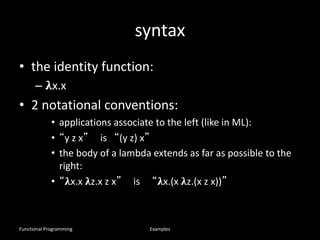
• the identity function:
– 𝛌x.x
• 2 notational conventions:
• applications associate to the left (like in ML):
• “y z x” is “(y z) x”
• the body of a lambda extends as far as possible to the
right:
• “𝛌x.x 𝛌z.x z x” is “𝛌x.(x 𝛌z.(x z x))”
Functional Programming Examples
terminology
• 𝛌x.t
• 𝛌x.x y
the scope of x is the term t
(this is the part of the expression
where x can be substituted)
x is bound in the term 𝛌x.x y
(x is one of the variables that can be substituted)
y is free in the term 𝛌x.x y
(y is free to be substituted
into the expression .. In this case x)
Functional Programming Examples
Example
(λx. x x) (𝛌y. y)
--> x x [𝛌y. y / x]
== (𝛌y. y) (𝛌y. y)
--> y [𝛌y. y / y]
== 𝛌y. y
Substitute (𝛌y. y) into x
Substituted
Substitute (𝛌y. y) into y
Substituted
Functional Programming Examples
Another example
(𝛌x. x x) (𝛌x. x x)
--> x x [𝛌x. x x/x]
== (𝛌x. x x) (𝛌x. x x)
In other words,
it is simple to write non terminating computations
in the lambda calculus
what else can we do?
Substitute 𝛌x. x x into every x
The result is the same as the beginning
Functional Programming Examples

Computability, turing machines and lambda calculus

  • 1.
    Programming Languages and Paradigms FunctionalProgramming Background (computability, turing machines, lambda calculus) Edward (Ned) Blurock Functional Programming Functional Programming
  • 2.
    COMPUTABILITY Will an algorithmbe able to compute the task? Is the task I want impossible? Is it possible to formulate an impossible task? What is the consequences for other algorithms Functional Programming Computability
  • 3.
    Computability vs Complexity •Computability refers to whether of not in principle it is possible to evaluate f(n) by following a set of instructions. • We are not for the moment worried if this computation requires 1,000,000 or more consecutive steps. • The latter refers to complexity which we will return to later. Functional Programming Computability
  • 4.
    Ensheidungsproblem Decision problem Hilbert 1928 TheEntscheidungsproblem asks for an algorithm that takes as input a statement of a first-order logic and answers "Yes" or "No" according to whether the statement is universally valid (valid in every structure satisfying the axioms). An algorithm to ask whether something is true Is it computableFunctional Programming Computability
  • 5.
    Ensheidungsproblem Decision problem Hilbert 1928 •Before the question could be answered, the notion of "algorithm" had to be formally defined. – This was done by Alonzo Church in 1936 with the concept of "effective calculability" based on his λ calculus – and by Alan Turing in the same year with his concept of Turing machines. – It was recognized immediately by Turing that these are equivalent models of computation. Functional Programming Computability
  • 6.
    Alan Turing (1912 –1954) Alonzo Church (1903-1995) Turing Machine Lambda calculus Two mathematical ways to ask questions about “computability” Functional Programming Computability
  • 7.
    Equivalent Computers z zzz z z z 1 Start HALT ), X, L 2: look for ( #, 1, - ), #, R (, #, L (, X, R #, 0, - Finite State Machine ... Turing Machine  term = variable | term term | (term) |  variable . term y. M  v. (M [y v]) where v does not occur in M. (x. M)N   M [ x N ]   Lambda Calculus Functional Programming Computability
  • 8.
    Alan Turing, 1936 •"On computable numbers, with an application to the Entscheidungsproblem [decision problem]” • addressed a previously unsolved mathematical problem posed by the German mathematician David Hilbert in 1928: Functional Programming Computability
  • 9.
    Turing, 1936 Is there,in principal, any definite mechanical method or process by which all mathematical questions could be decided? The Decision Problem Functional Programming Computability
  • 10.
    Turing, 1936 • Toanswer the question (in the negative), • Turing proposed a simple abstract computing machine, • modeled after a mathematician with a pencil, an eraser, and a stack of pieces of paper • He asserted that any function is a computable function if it is computable by one of these abstract machines. Functional Programming Computability
  • 11.
    Turing, 1936 • Hethen investigated whether there were some mathematical problems which could not be solved by any such abstract machine. • Such abstract computing machines are now called "Turing machines". • One particular Turing machine, called a "Universal Turing Machine", served as the model for designing actual programmable computers. Functional Programming Computability
  • 12.
    Why a TuringMachine Because Turing machines are very simple compared with computers in practical use, conceptually easier to prove impossibility results for Turing machines. These impossibility results apply as well to all known computers Functional Programming Computability
  • 13.
    Turing, 1936 • Startlingresult of Turing's 1936 paper • assertion that there are well-defined problems that cannot be solved by any computational procedure. Functional Programming Computability
  • 14.
    What is Computable? Computationis usually modelled as a mapping from inputs to outputs, carried out by a formal “machine,” or program, which processes its input in a sequence of steps. An “effectively computable” function is one that can be computed in a finite amount of time using finite resources. ………… ………… … input yes no output Effectively computable function Functional Programming Computability
  • 15.
    Unsolvable • problems areformulated as functions – unsolvable functions: noncomputable; • Problems formulated as predicates – Undecidable. Using Turing's concept of the abstract machine, we would say that a function is noncomputable if there exists no Turing machine that could compute it. Functional Programming Computability
  • 16.
  • 17.
  • 18.
    Turing Machine ............ Read-Write head Noboundaries -- infinite length The head moves Left or Right The tape OR Functional Programming
  • 19.
    Turing Machine ............ Read-Write head Thehead at each time step: 1. Reads a symbol 2. Writes a symbol 3. Moves Left or Right Functional Programming
  • 20.
    Turing Machine ............ Example: Time 0 ............ Time1 a a cb a b k c 1. Reads a 2. Writes k 3. Moves Left a Functional Programming
  • 21.
    Turing Machine ............ Time 1 ab k c ............ Time 2 a k cf 1. Reads b 2. Writes f 3. Moves Right b Functional Programming
  • 22.
    Add 1 toa sequence of ones If 1, then move right If 1, then move left Loop If 0, replace with 1 Start: 0 0 0 1 1 1 1 0 0 0 4 ones in a row End: 0 0 0 1 1 1 1 1 0 0 5 ones in a row Functional Programming Turing Machine
  • 23.
    So what? You canadd a 1 to a sequence of ones From a set of a few (a manageable number) of primitive operations If a number is represented by a sequence of ones then you have the x+1 operator, i.e addition This is a/(the most) basic mathematical operator Powerful enough to represent complex mathematics You can derive other (all) mathematic operations and objects Functional Programming Turing Machine
  • 24.
    Powerful “language” From aset of a few (a manageable number) of primitive operations Easier enough To formulate Proofs about algorithms Powerful enough To represent complex mathematics All the ingredients are there Only have to deal with a few basic operations Not worried about complexity…. Worried about, for example, “can” we compute? Functional Programming Turing Machine
  • 25.
    TURING MACHINE (PT2) Computability Functional Programming Turing Machine (pt 2)
  • 26.
    Turing Machine (pt2) The Input String ............     Blank symbol head a b ca Head starts at the leftmost position of the input string Input string Functional Programming
  • 27.
    Turing Machine (pt2) States & Transitions 1q 2qLba , Read Write Move Left 1q 2qRba , Move Right Functional Programming
  • 28.
    Turing Machine (pt2) Turing machine for the language }{ nn ba 0q 1q 2q3q Rxa , Raa , Ryy , Lyb , Laa , Lyy , Rxx , Ryy , Ryy , 4q L, Functional Programming
  • 29.
    Turing Machine (pt2) 0q 1q 2q3q Rxa , Raa , Ryy , Lyb , Laa , Lyy , Rxx , Ryy , Ryy , 4q L,  ba 0q a bTime 0  Functional Programming
  • 30.
    Turing Machine (pt2) 0q 1q 2q3q Rxa , Raa , Ryy , Lyb , Laa , Lyy , Rxx , Ryy , Ryy , 4q L,  bx 1q a b Time 1 Functional Programming
  • 31.
    Turing Machine (pt2) 0q 1q 2q3q Rxa , Raa , Ryy , Lyb , Laa , Lyy , Rxx , Ryy , Ryy , 4q L,  x 2q a b Time 2 b Functional Programming
  • 32.
    Turing Machine (pt2) 0q 1q 2q3q Rxa , Raa , Ryy , Lyb , Laa , Lyy , Rxx , Ryy , Ryy , 4q L,  yx 2q a b Time 3 Functional Programming
  • 33.
    Turing Machine (pt2) 0q 1q 2q3q Rxa , Raa , Ryy , Lyb , Laa , Lyy , Rxx , Ryy , Ryy , 4q L,  yx 2q a b Time 4 Functional Programming
  • 34.
    Turing Machine (pt2) 0q 1q 2q3q Rxa , Raa , Ryy , Lyb , Laa , Lyy , Rxx , Ryy , Ryy , 4q L,  yx 0q a b Time 5 Functional Programming
  • 35.
    Turing Machine (pt2) 0q 1q 2q3q Rxa , Raa , Ryy , Lyb , Laa , Lyy , Rxx , Ryy , Ryy , 4q L,  yx 1q x b Time 6 Functional Programming
  • 36.
    Turing Machine (pt2) 0q 1q 2q3q Rxa , Raa , Ryy , Lyb , Laa , Lyy , Rxx , Ryy , Ryy , 4q L,  yx 1q x b Time 7 Functional Programming
  • 37.
    Turing Machine (pt2) 0q 1q 2q3q Rxa , Raa , Ryy , Lyb , Laa , Lyy , Rxx , Ryy , Ryy , 4q L,  yx x y 2q Time 8 Functional Programming
  • 38.
    Turing Machine (pt2) 0q 1q 2q3q Rxa , Raa , Ryy , Lyb , Laa , Lyy , Rxx , Ryy , Ryy , 4q L,  yx x y 2q Time 9 Functional Programming
  • 39.
    Turing Machine (pt2) 0q 1q 2q3q Rxa , Raa , Ryy , Lyb , Laa , Lyy , Rxx , Ryy , Ryy , 4q L,  yx 0q x y Time 10 Functional Programming
  • 40.
    Turing Machine (pt2) 0q 1q 2q3q Rxa , Raa , Ryy , Lyb , Laa , Lyy , Rxx , Ryy , Ryy , 4q L,  yx 3q x y Time 11 Functional Programming
  • 41.
    Turing Machine (pt2) 0q 1q 2q3q Rxa , Raa , Ryy , Lyb , Laa , Lyy , Rxx , Ryy , Ryy , 4q L,  yx 3q x y Time 12 Functional Programming
  • 42.
    Turing Machine (pt2) 0q 1q 2q3q Rxa , Raa , Ryy , Lyb , Laa , Lyy , Rxx , Ryy , Ryy , 4q L,  yx 4q x y  Halt & Accept Time 13 Functional Programming
  • 43.
  • 44.
    Lambda Calculus Alonzo Church (1903-1995) Anotherformulation of computability Functional Programming Lambda Calculus
  • 45.
    Equivalent Computers z zzz z z z ... Turing Machine  term = variable | term term | (term) |  variable . term y. M  v. (M [y v]) where v does not occur in M. (x. M)N   M [ x N ]   Lambda Calculus Functional Programming Lambda Calculus
  • 46.
    What is Calculus? •In High School: d/dx xn = nxn-1 [Power Rule] d/dx (f + g) = d/dx f + d/dx g [Sum Rule] Calculus is a branch of mathematics that deals with limits and the differentiation and integration of functions of one or more variables... Functional Programming Lambda Calculus
  • 47.
    Real Definition • Acalculus is just a bunch of rules for manipulating symbols. • People can give meaning to those symbols, but that’s not part of the calculus. • Differential calculus is a bunch of rules for manipulating symbols. There is an interpretation of those symbols corresponds with physics, slopes, etc. Functional Programming Lambda Calculus
  • 48.
    -calculus Alonzo Church, 1940 term= variable | term term | (term) |  variable . term Functional Programming Lambda Calculus
  • 49.
    -calculus  variable .term F(variable) = term Functional Programming Lambda Calculus
  • 50.
    Why? • Once wehave precise and formal rules for manipulating symbols, we can use it to reason with. • Since we can interpret the symbols as representing computations, we can use it to reason about programs. Functional Programming Lambda Calculus
  • 51.
    Universal Computer • LambdaCalculus can simulate a Turing Machine – Everything a Turing Machine can compute, Lambda Calculus can compute also • Turing Machine can simulate Lambda Calculus – Everything Lambda Calculus can compute, a Turing Machine can compute also • Church-Turing Thesis: this is true for any other mechanical computer also Functional Programming Lambda Calculus
  • 52.
    Normal Steps • Turingmachine: – Read one square on tape, follow one FSM transition rule, write one square on tape, move tape head one square • Lambda calculus: – One beta reduction • Your PC: – Execute one instruction (?) • What one instruction does varies Functional Programming Lambda Calculus
  • 53.
    -Reduction (the source ofall computation) (x. M)N This is the function definition M is an expression with the variable x N is used at the value of x N substitutes x in the expression M Functional Programming Lambda Calculus
  • 54.
    (x. x)a =a -Reduction (the source of all computation) Identity operation Function gives the argument as output (x. xx)a = aa (y.(x. xy)a)b =(y.ay)b=ab (y.(x. xy) z.zy)b =(y.(z.zy)y)b = (y. yy)b =bb Functional Programming Lambda Calculus
  • 55.
    -calculus Useful and expressionenough that a programming language was modeled after it LISP was developed from -calculus not the other way round.) This was the “first” general language of Artificial intelligence Also The “first” functional programming language Functional Programming Lambda Calculus
  • 56.
    Expression Reductions Functional ProgrammingLambda Calculus Reductions are used in the lambda calculus to reduce a statement to its simplest possible form. This is, essentially, what a computation in lambda calculus does. If you were to give a lambda calculus expression to "lambda calculus" calculator, it would use a combination of alpha, beta, and eta reductions to find the simplest reduction of your expression. https://classes.soe.ucsc.edu/cmps112/Spring03/readings/lambdacalculus/reductions.html
  • 57.
    Expression Reduction Functional ProgrammingLambda Calculus (𝛌x. x x) (𝛌y. y) --> x x [𝛌y. y / x] == (𝛌y. y) (𝛌y. y) --> y [𝛌y. y / y] == 𝛌y. y How the original expression is evaluated Is determined the operational semantics of lambda calculus (there are many ways to evaluate expressions) Operational Semantics: how the substitutions are made: Key concepts: specification of free variables specification of bound variables Β-reduction a formalization of simple substitution
  • 58.
    Name Capture Functional ProgrammingLambda Calculus Care must be taken to avoid “name capture” of bound variables. For example, this reduction would be “wrong”: (λx. (λy. x)) y ⇒ λy. y because the outer y is presumably different from the inner y bound by the lambda. In cases like these, the bound variable is renamed to obtain the “correct” behavior: (λx. (λy. x)) y ⇒ λz. y http://www.cs.yale.edu/homes/hudak/CS201S08/lambda.pdf Α-reduction is a formalization of renaming of variables (without this, β-reduction can give the wrong answer)
  • 59.
    EXAMPLES OF LAMBDACALCULUS Computability Functional Programming Examples
  • 60.
    syntax • the identityfunction: – 𝛌x.x • 2 notational conventions: • applications associate to the left (like in ML): • “y z x” is “(y z) x” • the body of a lambda extends as far as possible to the right: • “𝛌x.x 𝛌z.x z x” is “𝛌x.(x 𝛌z.(x z x))” Functional Programming Examples
  • 61.
    terminology • 𝛌x.t • 𝛌x.xy the scope of x is the term t (this is the part of the expression where x can be substituted) x is bound in the term 𝛌x.x y (x is one of the variables that can be substituted) y is free in the term 𝛌x.x y (y is free to be substituted into the expression .. In this case x) Functional Programming Examples
  • 62.
    Example (λx. x x)(𝛌y. y) --> x x [𝛌y. y / x] == (𝛌y. y) (𝛌y. y) --> y [𝛌y. y / y] == 𝛌y. y Substitute (𝛌y. y) into x Substituted Substitute (𝛌y. y) into y Substituted Functional Programming Examples
  • 63.
    Another example (𝛌x. xx) (𝛌x. x x) --> x x [𝛌x. x x/x] == (𝛌x. x x) (𝛌x. x x) In other words, it is simple to write non terminating computations in the lambda calculus what else can we do? Substitute 𝛌x. x x into every x The result is the same as the beginning Functional Programming Examples