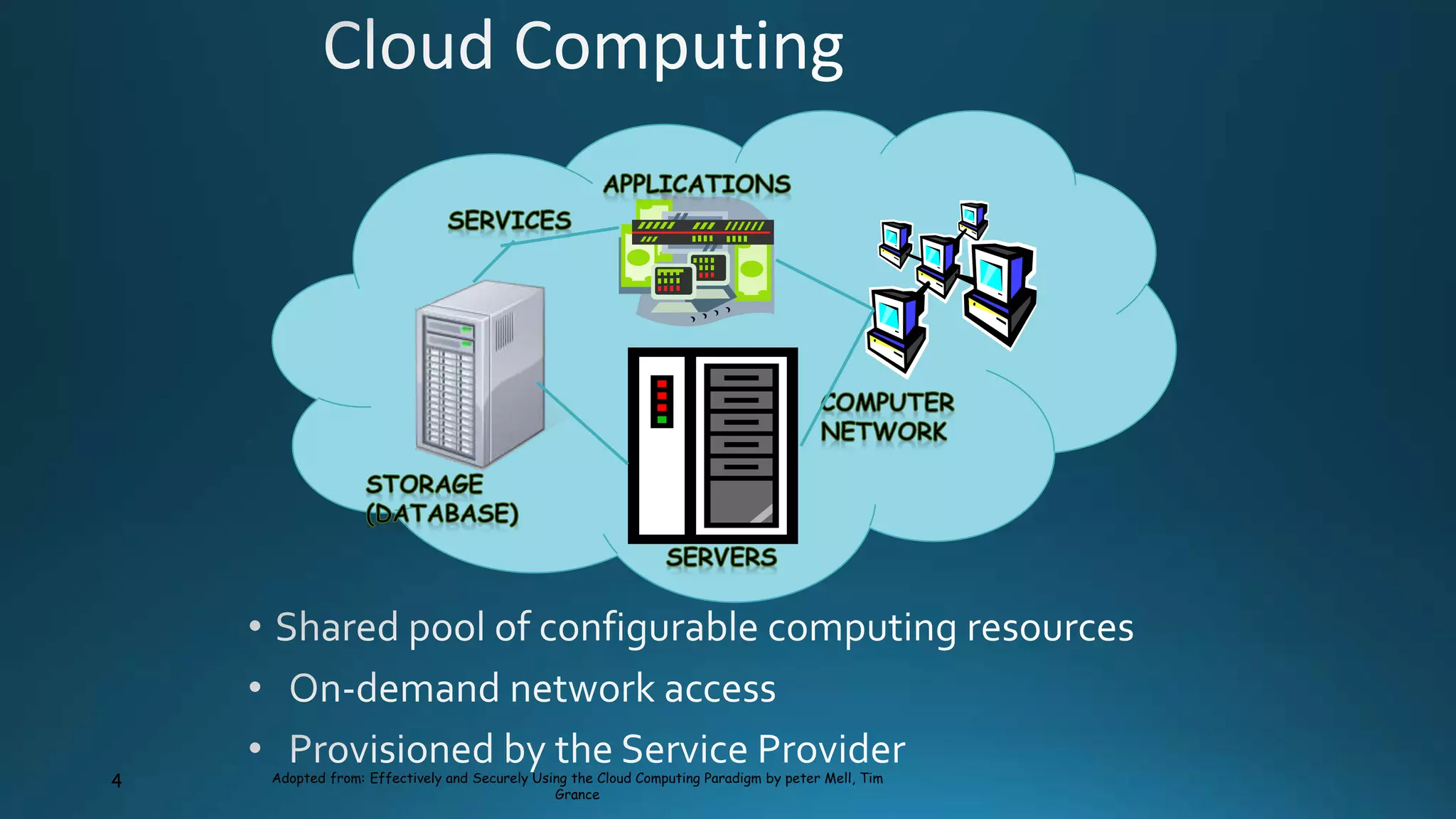
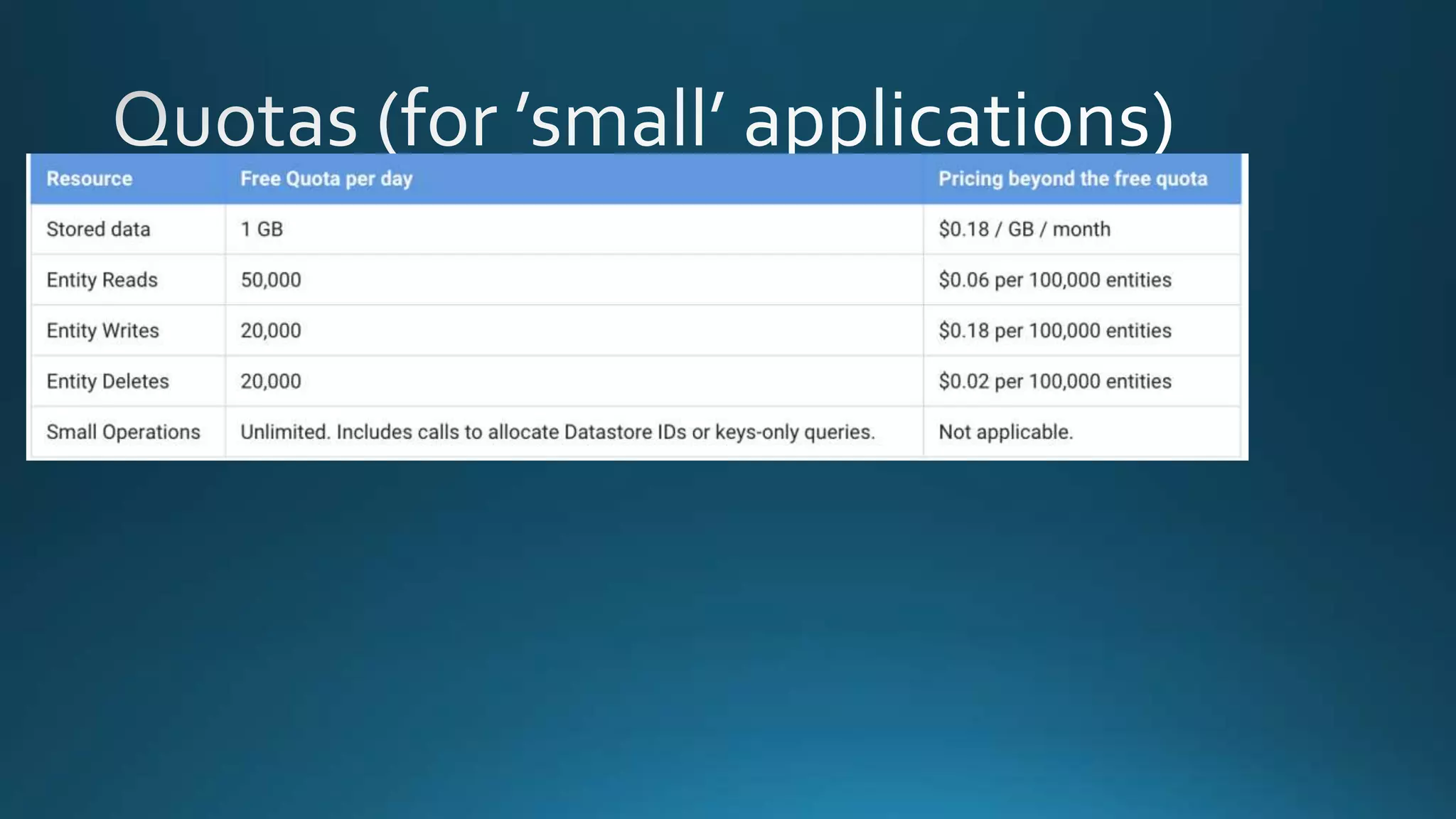
4 Adopted from: Effectively and Securely Using the Cloud Computing Paradigm by peter Mell, Tim
Grance
5
6
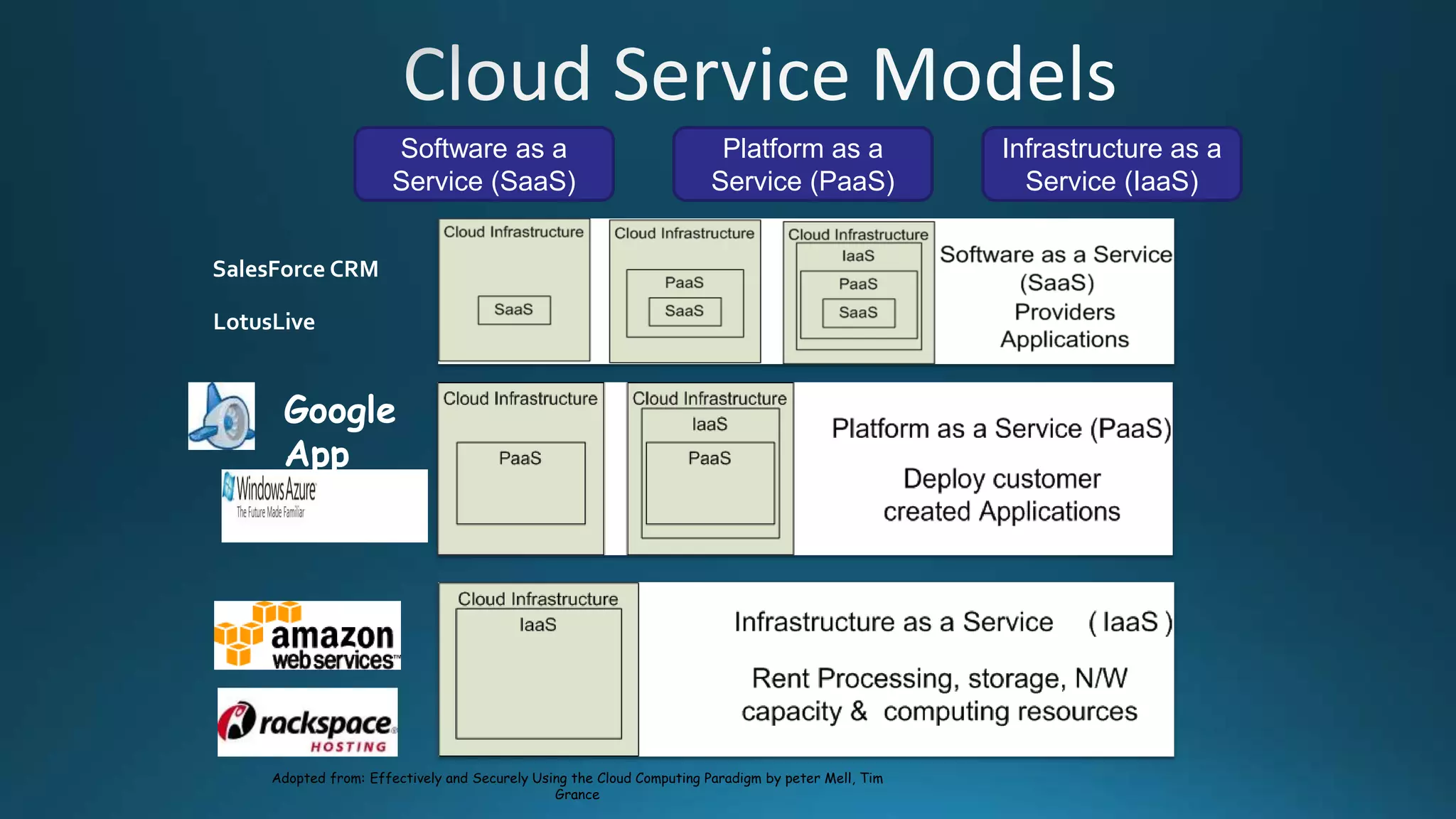
Software as a
Service (SaaS)
Platform as a
Service (PaaS)
Infrastructure as a
Service (IaaS)
Google
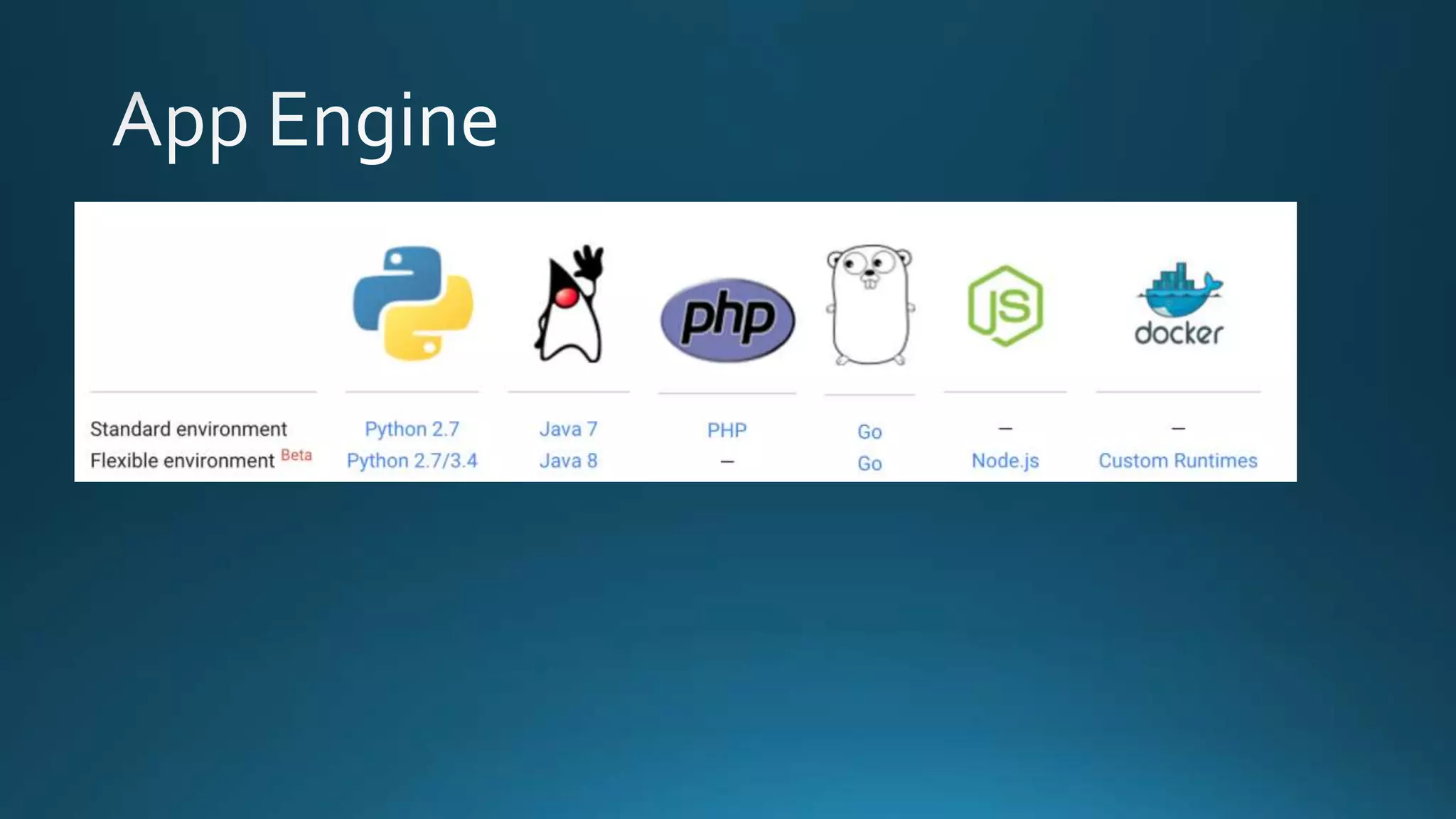
App
Engine
SalesForce CRM
LotusLive
Adopted from: Effectively and Securely Using the Cloud Computing Paradigm by peter Mell, Tim
Grance
10
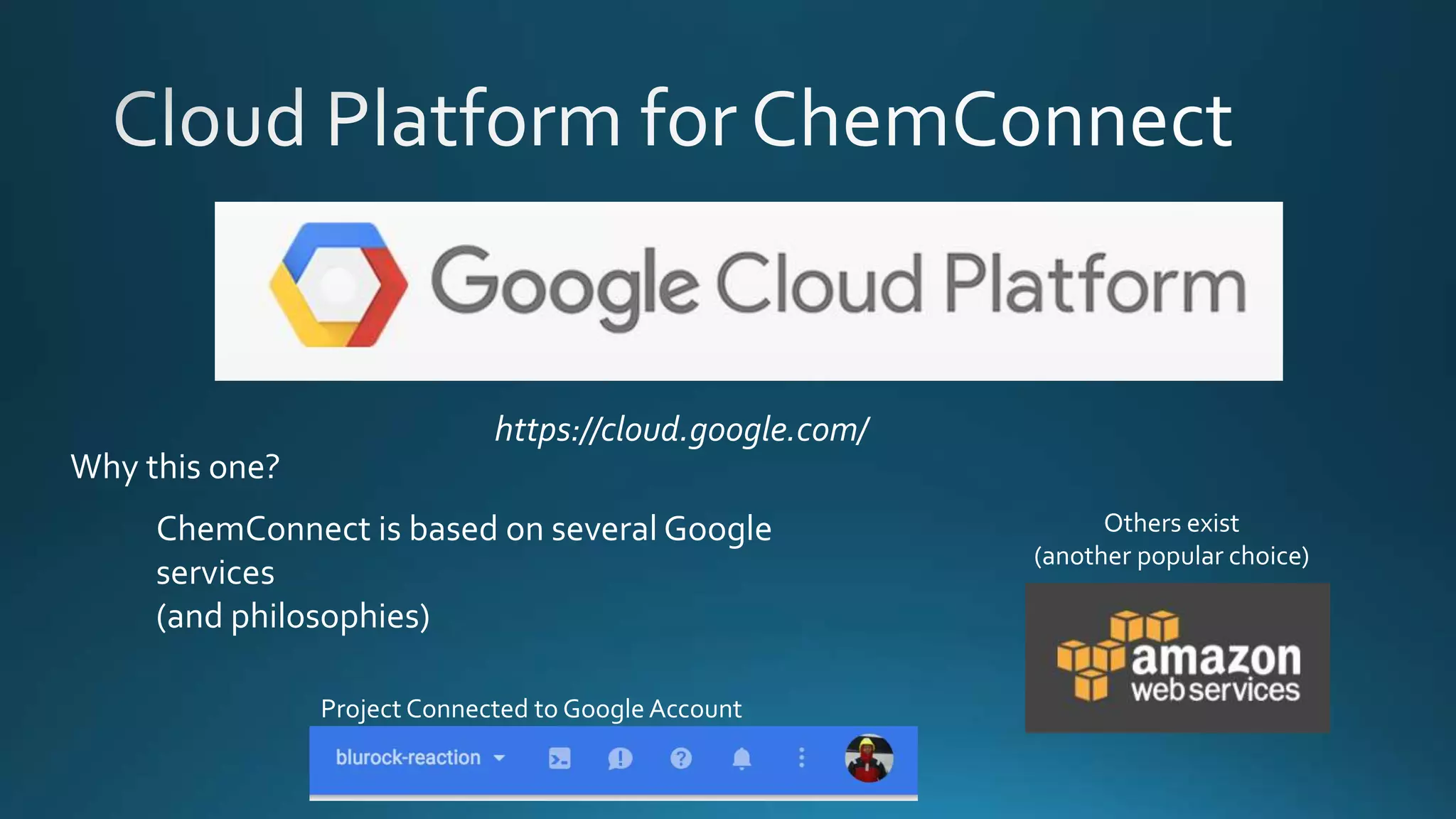
https://cloud.google.com/
Others exist
(another popular choice)
Why this one?
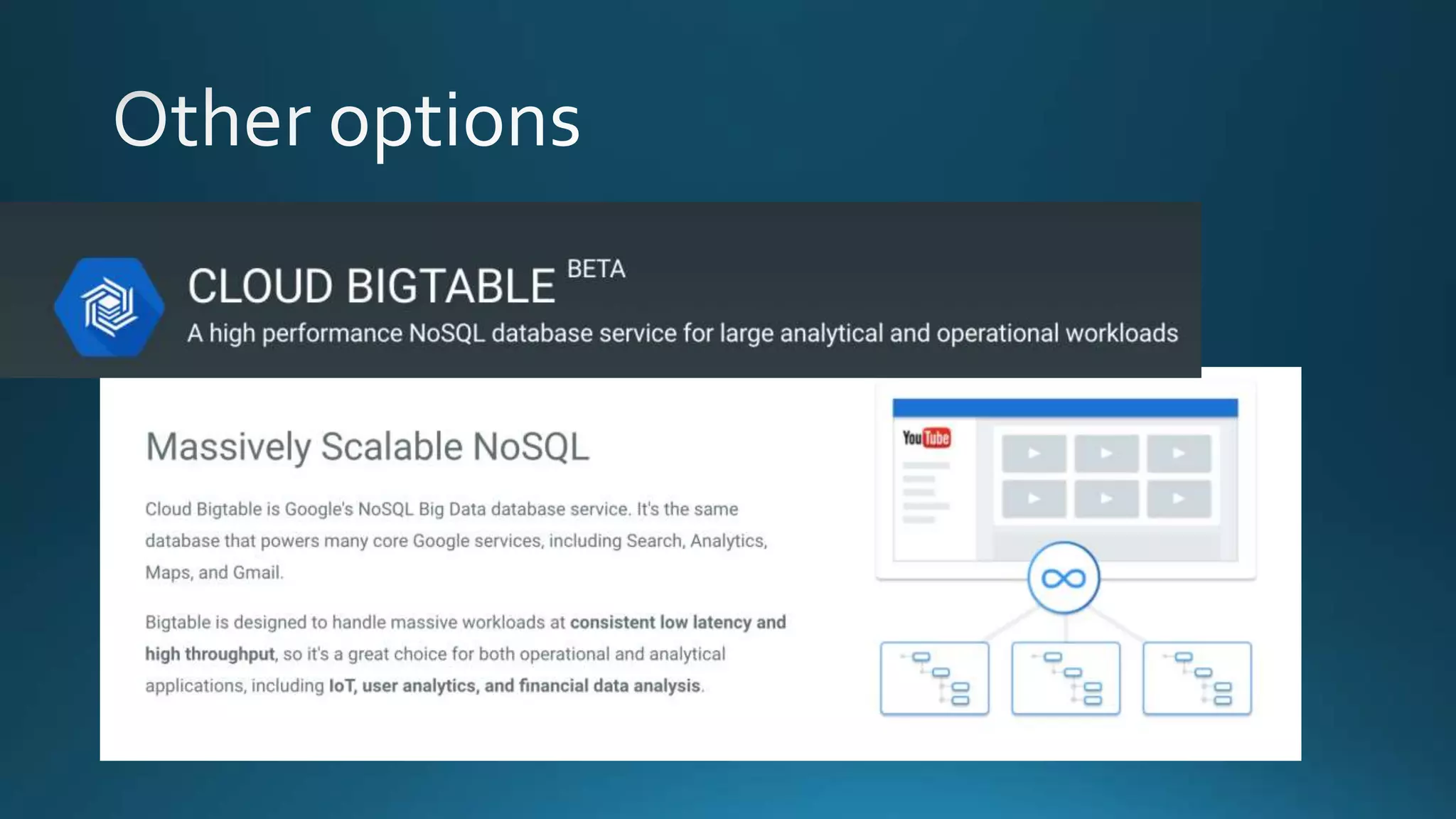
ChemConnect is based on several Google
services
(and philosophies)
Project Connected to Google Account
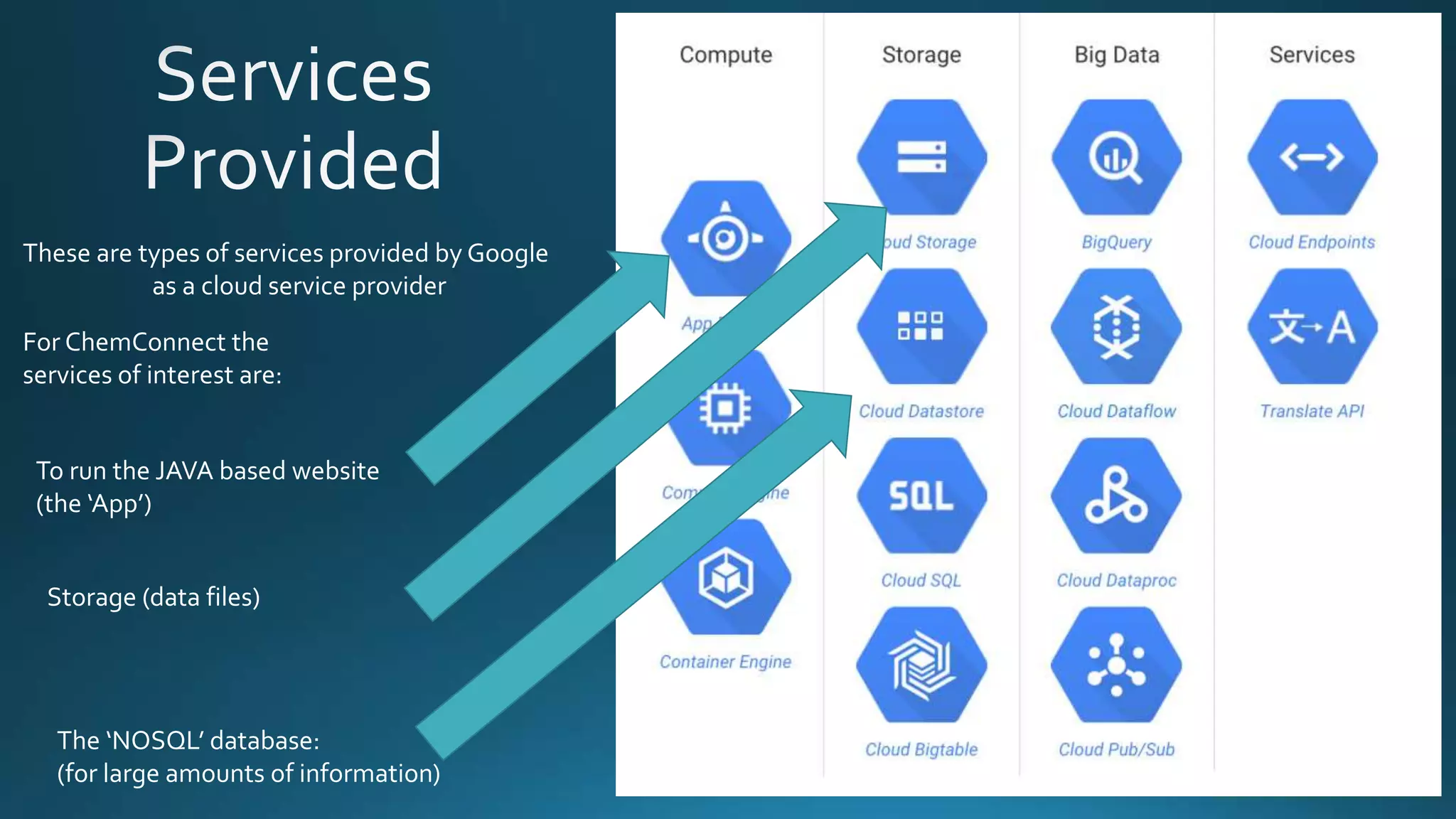
These are types of services provided by Google
as a cloud service provider
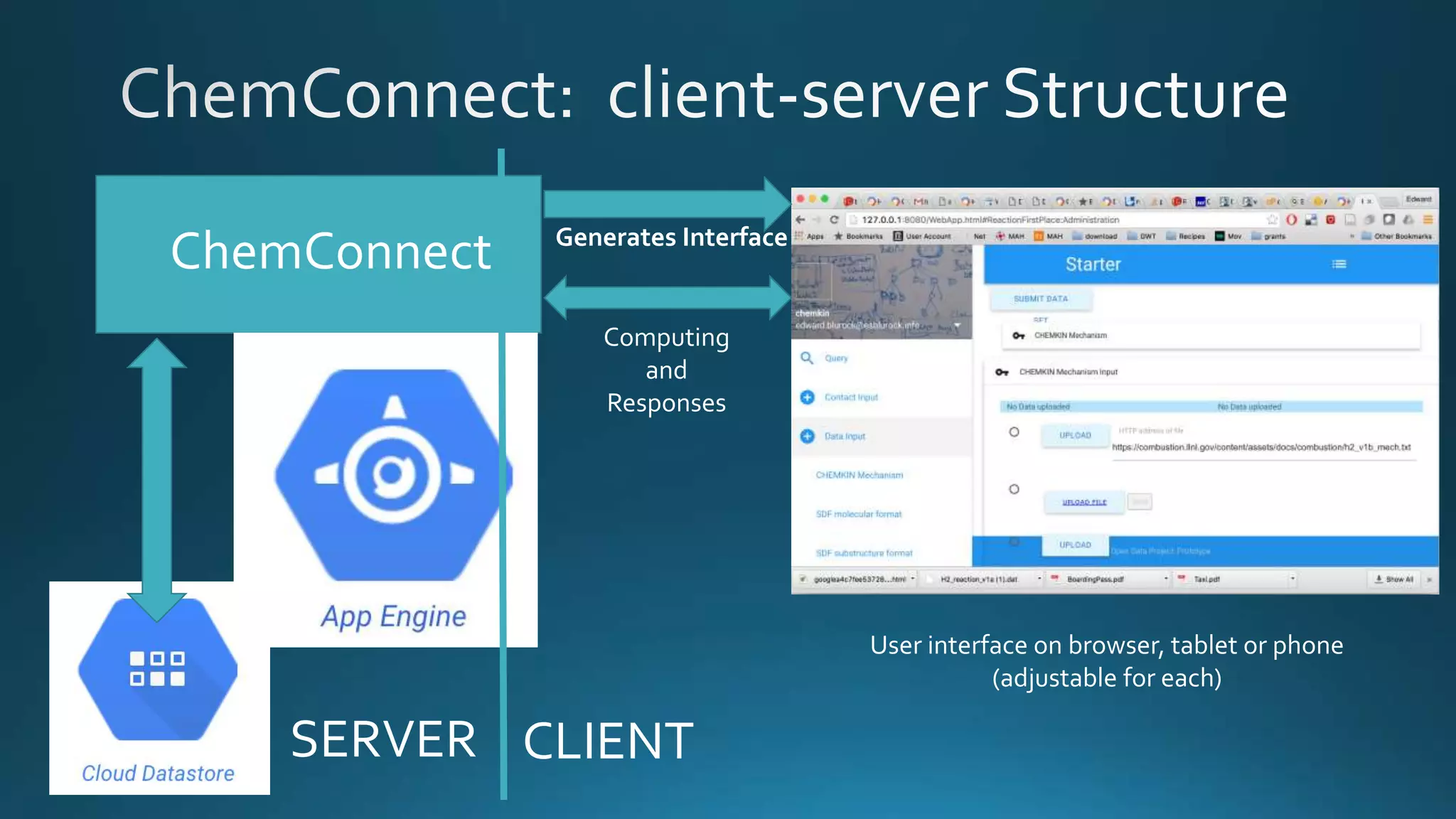
For ChemConnect the
services of interest are:
To run the JAVA based website
(the ‘App’)
The ‘NOSQL’ database:
(for large amounts of information)
Storage (data files)
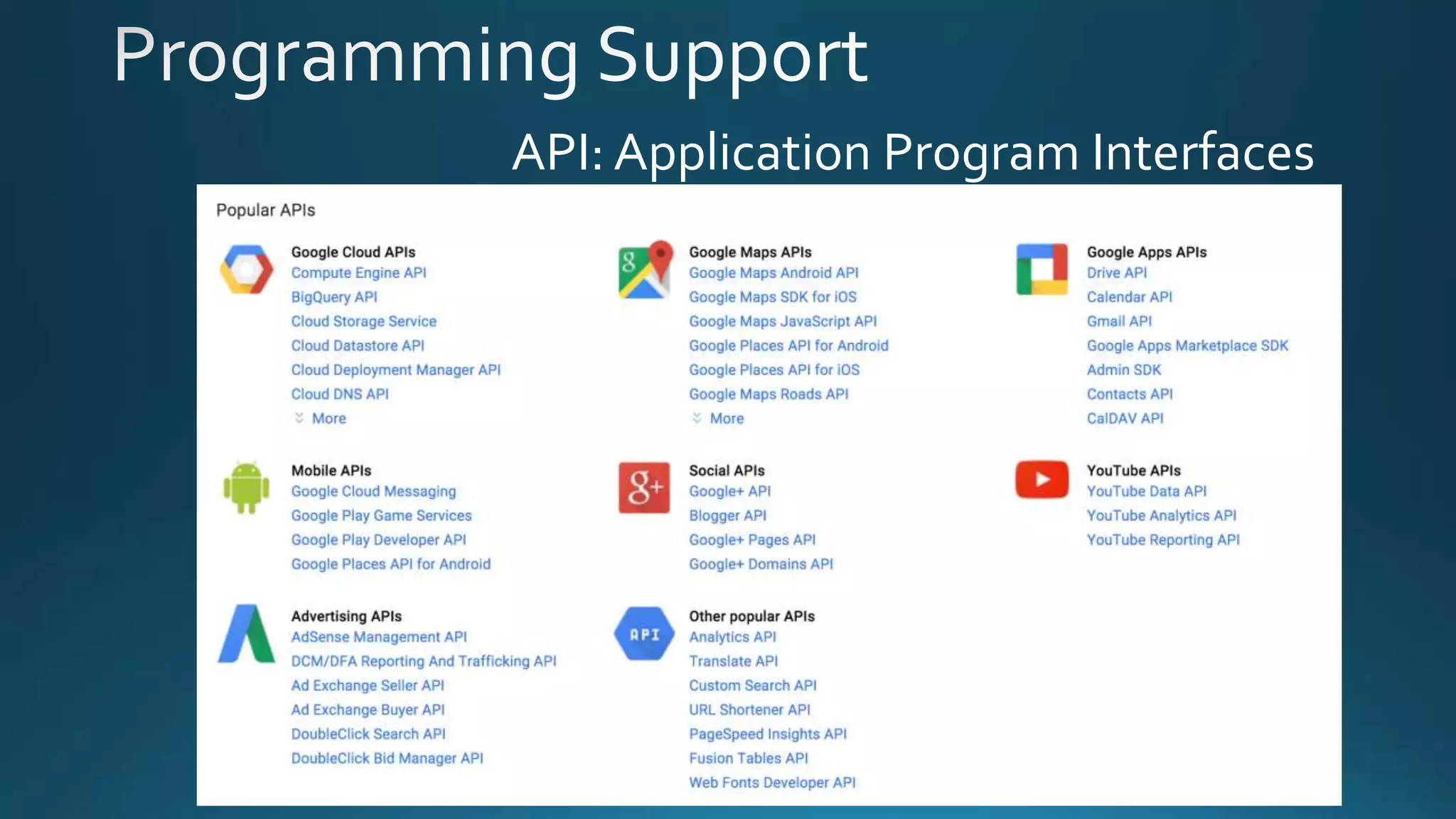
API: Application Program Interfaces
User interface on browser, tablet or phone
(adjustable for each)
Generates Interface
ChemConnect
Computing
and
Responses
SERVER CLIENT
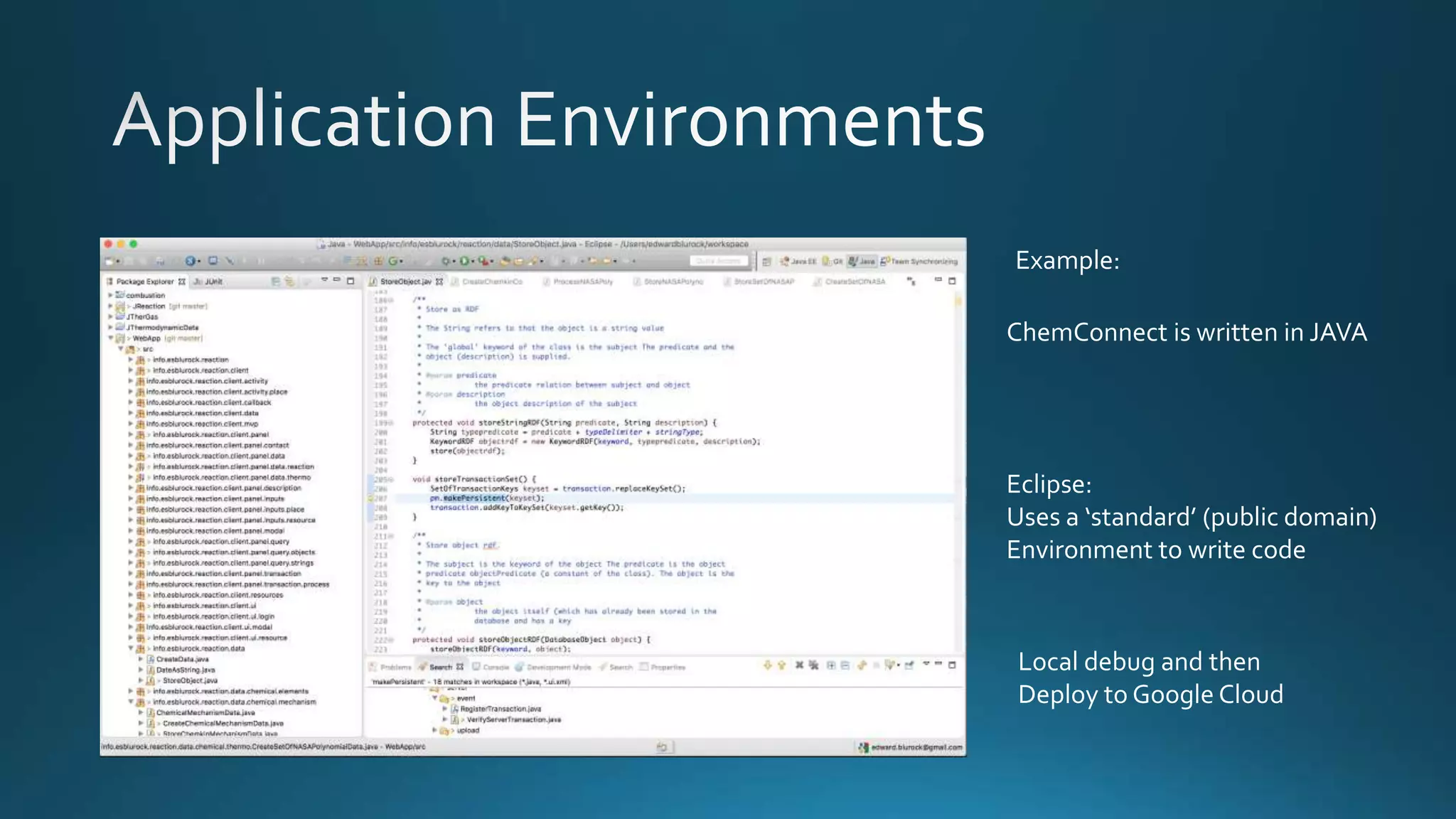
Example:
ChemConnect is written in JAVA
Eclipse:
Uses a ‘standard’ (public domain)
Environment to write code
Local debug and then
Deploy to Google Cloud
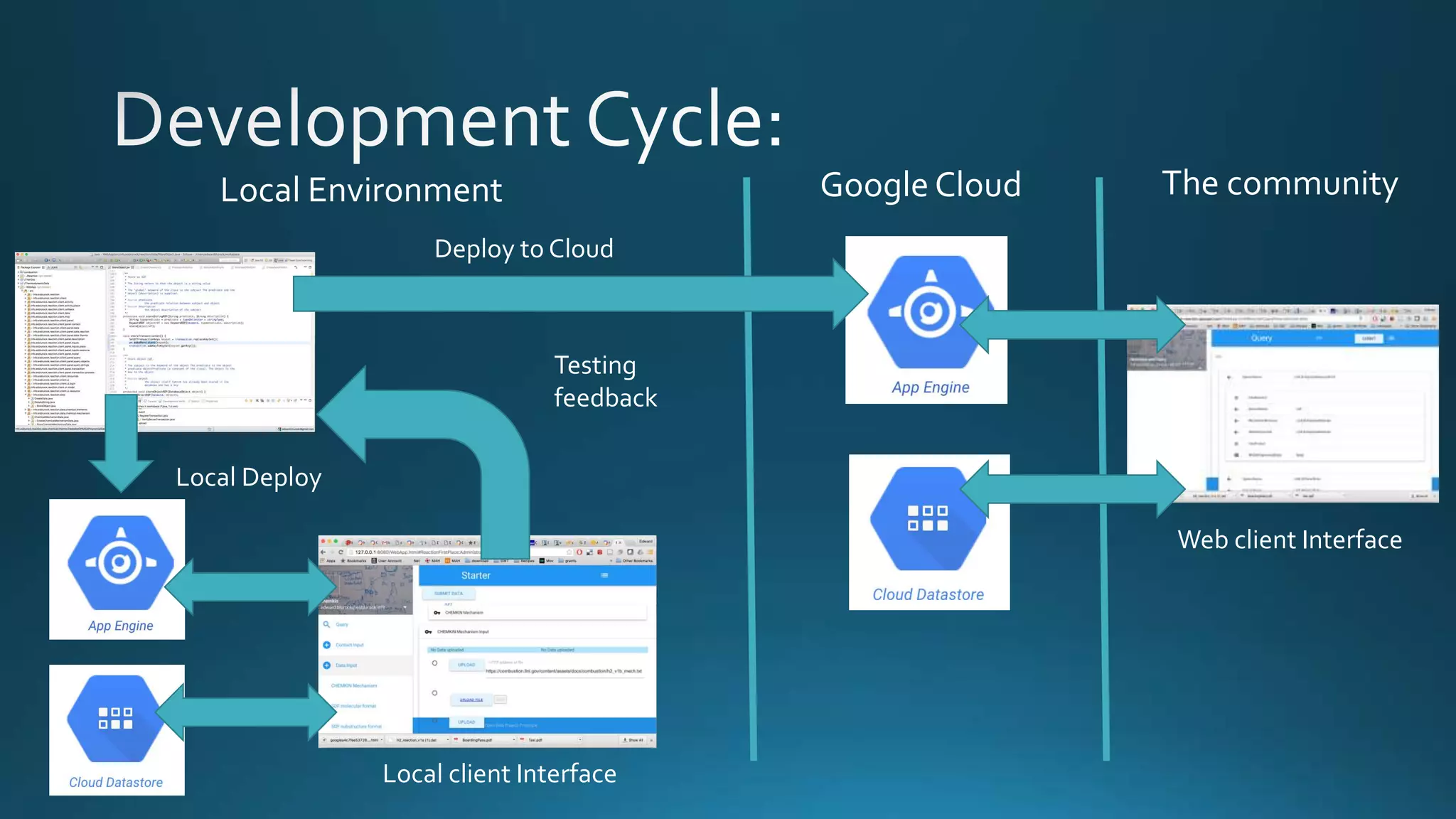
Google Cloud The communityLocal Environment
Testing
feedback
Local Deploy
Deploy to Cloud
Local client Interface
Web client Interface
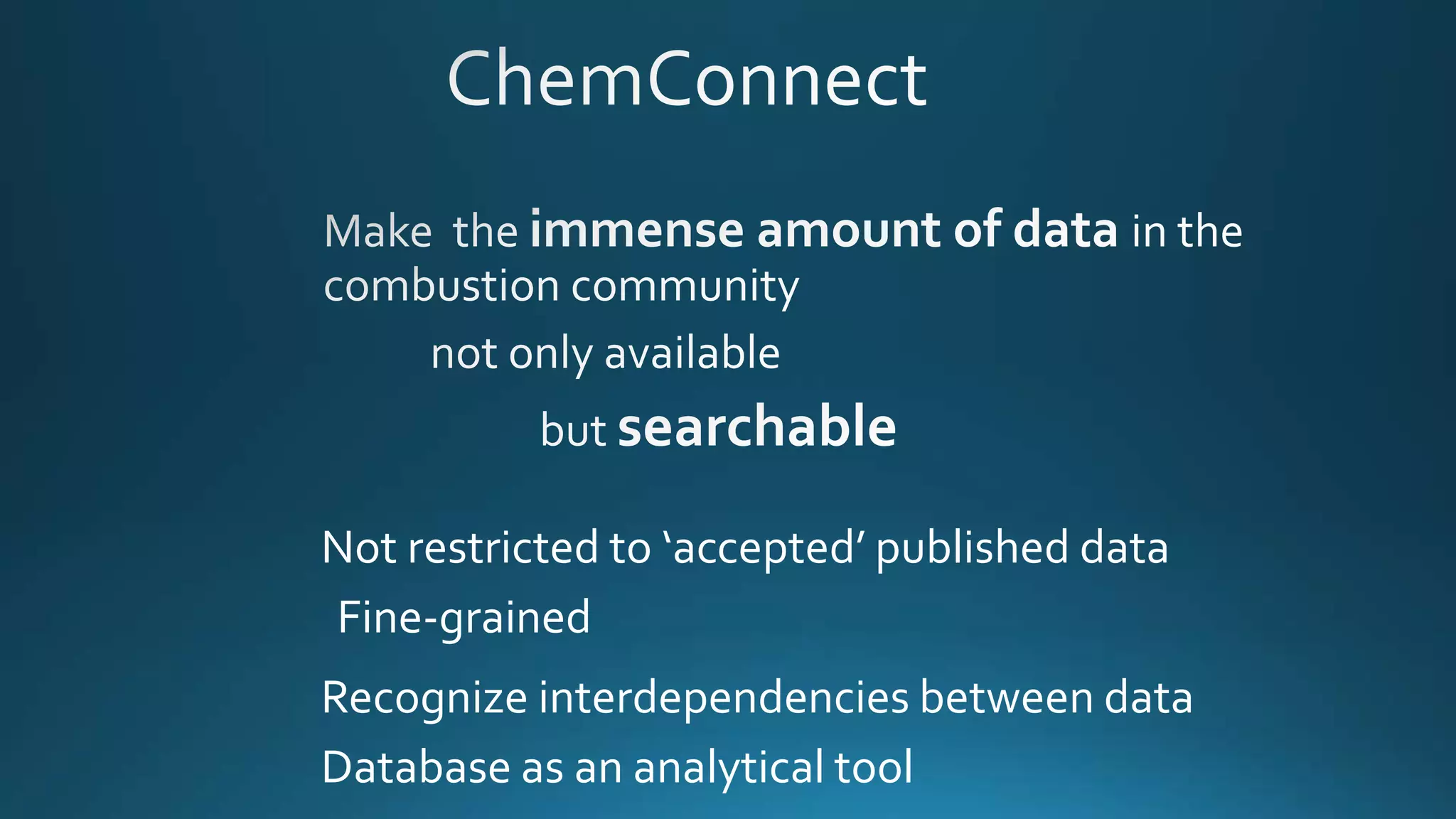
Not restricted to ‘accepted’ published data
Recognize interdependencies between data
Database as an analytical tool
Fine-grained
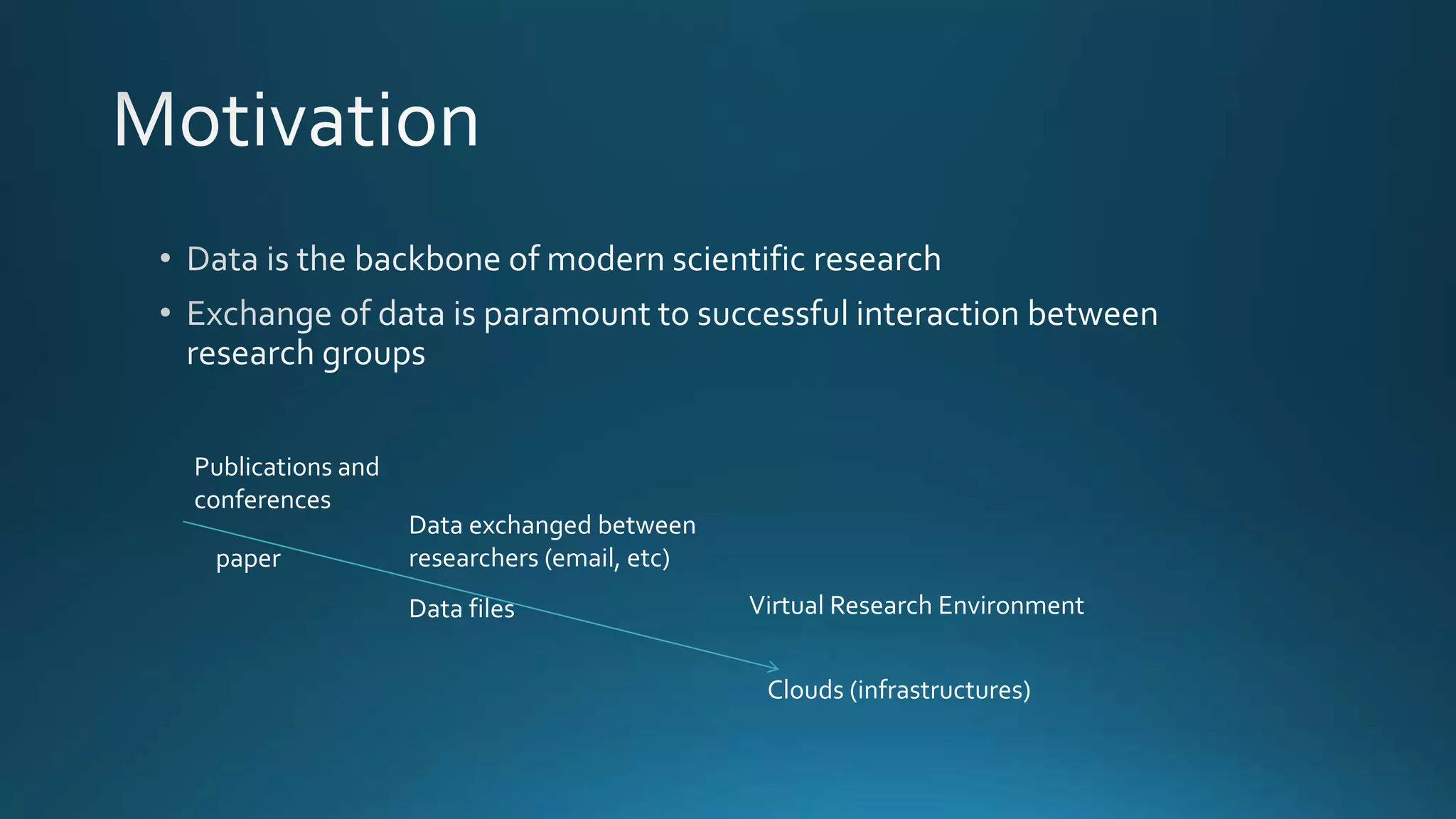
Publications and
conferences
Data exchanged between
researchers (email, etc)
Virtual Research Environment
paper
Data files
Clouds (infrastructures)
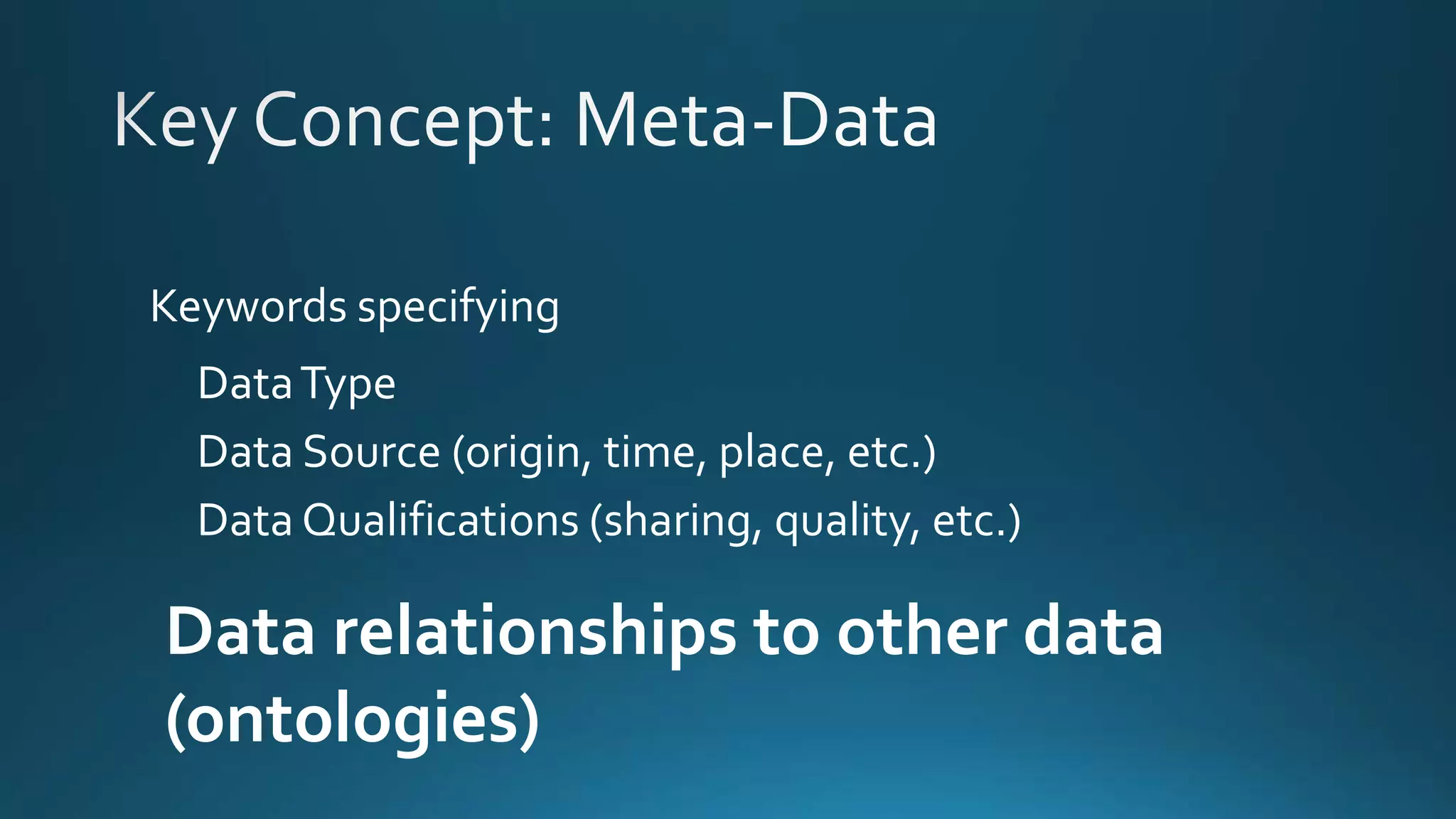
Keywords specifying
DataType
Data Source (origin, time, place, etc.)
Data Qualifications (sharing, quality, etc.)
Data relationships to other data
(ontologies)
Purpose:
Defining interrelationships between data objects
Source:
SemanticWeb Concepts
Motivation:
Large body of research in discovering relationships
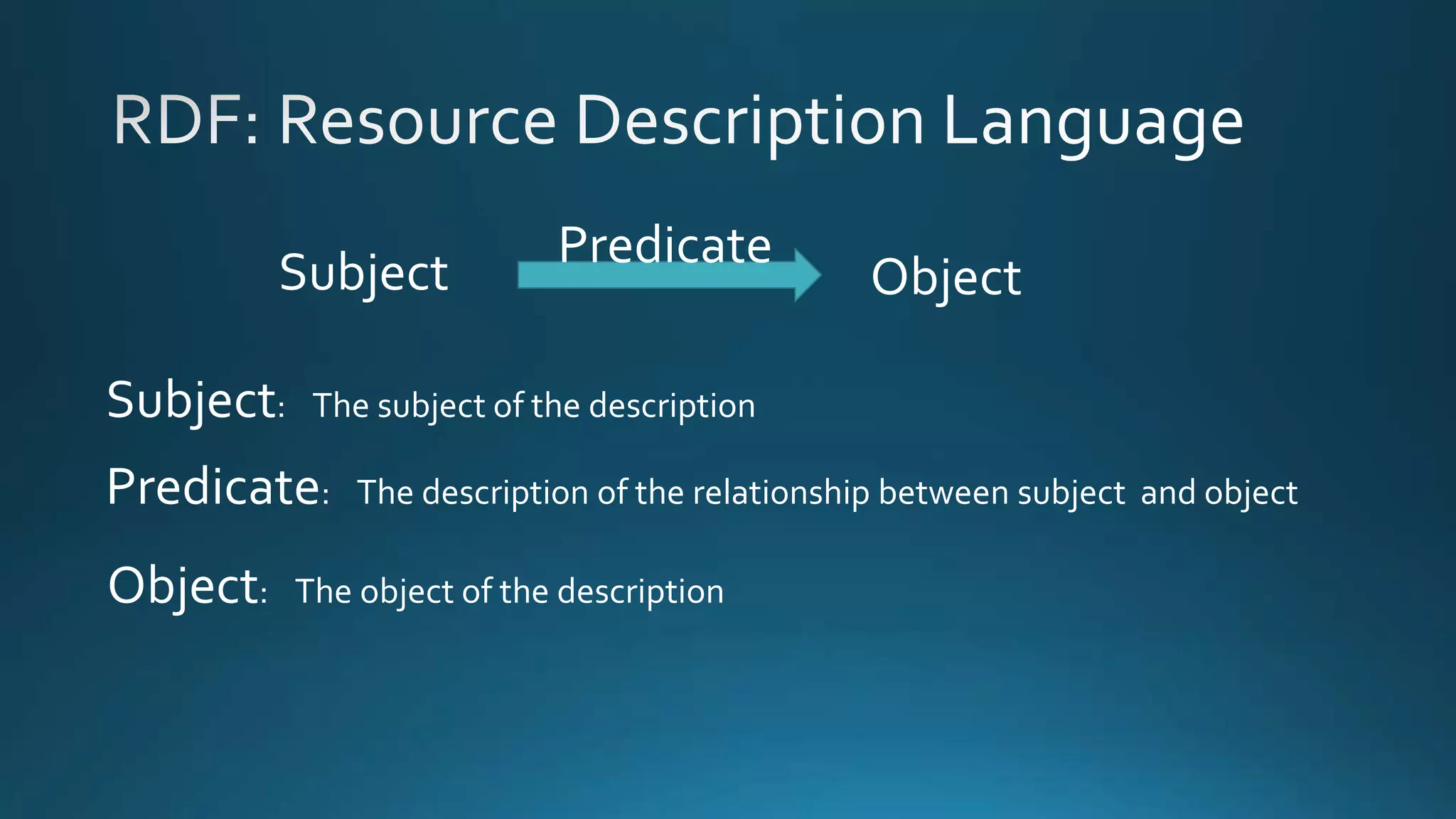
Subject: The subject of the description
Predicate: The description of the relationship between subject and object
Object: The object of the description
Subject Object
Predicate
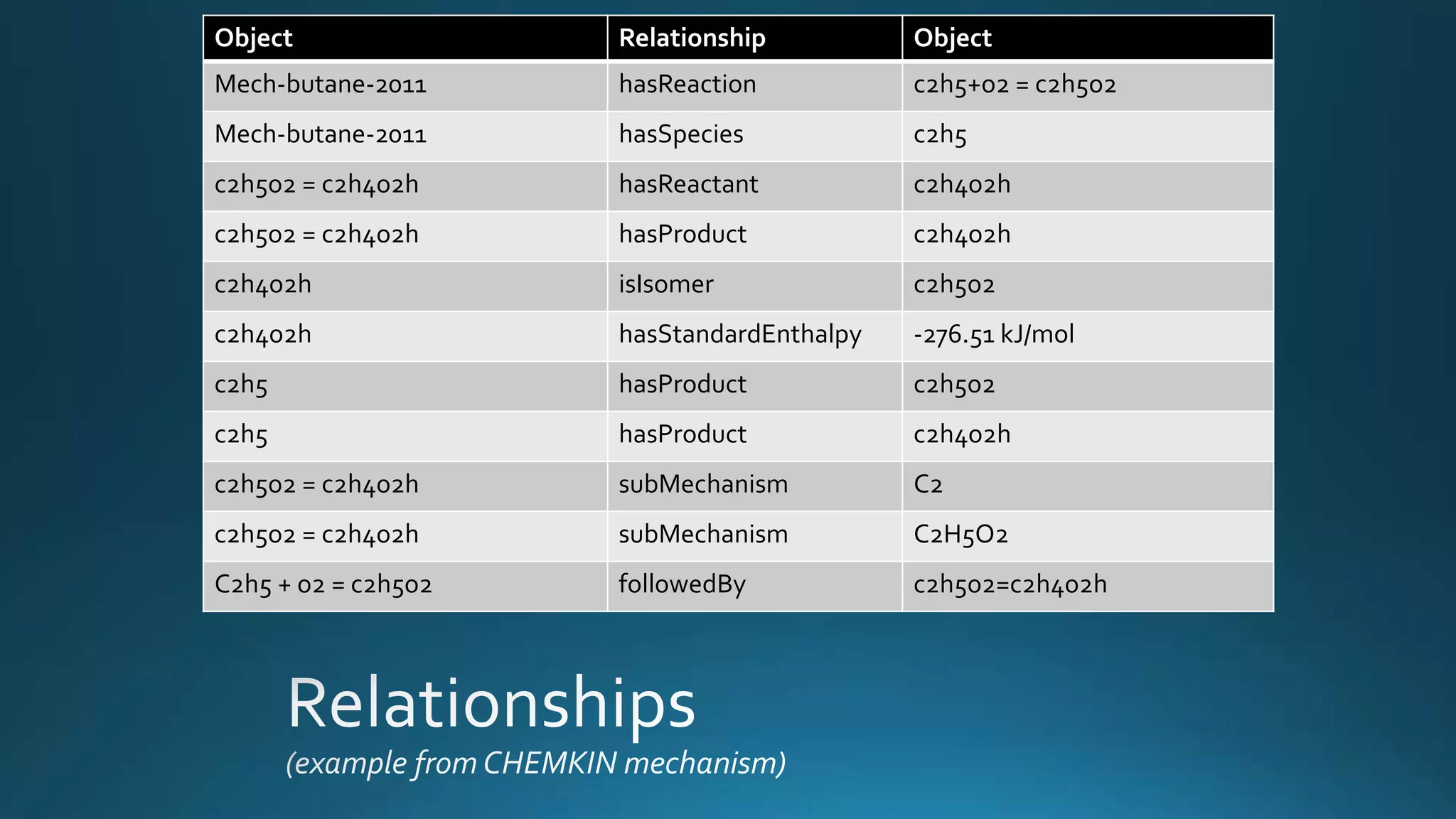
Object Relationship Object
Mech-butane-2011 hasReaction c2h5+o2 = c2h5o2
Mech-butane-2011 hasSpecies c2h5
c2h5o2 = c2h4o2h hasReactant c2h4o2h
c2h5o2 = c2h4o2h hasProduct c2h4o2h
c2h4o2h isIsomer c2h5o2
c2h4o2h hasStandardEnthalpy -276.51 kJ/mol
c2h5 hasProduct c2h5o2
c2h5 hasProduct c2h4o2h
c2h5o2 = c2h4o2h subMechanism C2
c2h5o2 = c2h4o2h subMechanism C2H5O2
C2h5 + o2 = c2h5o2 followedBy c2h5o2=c2h4o2h
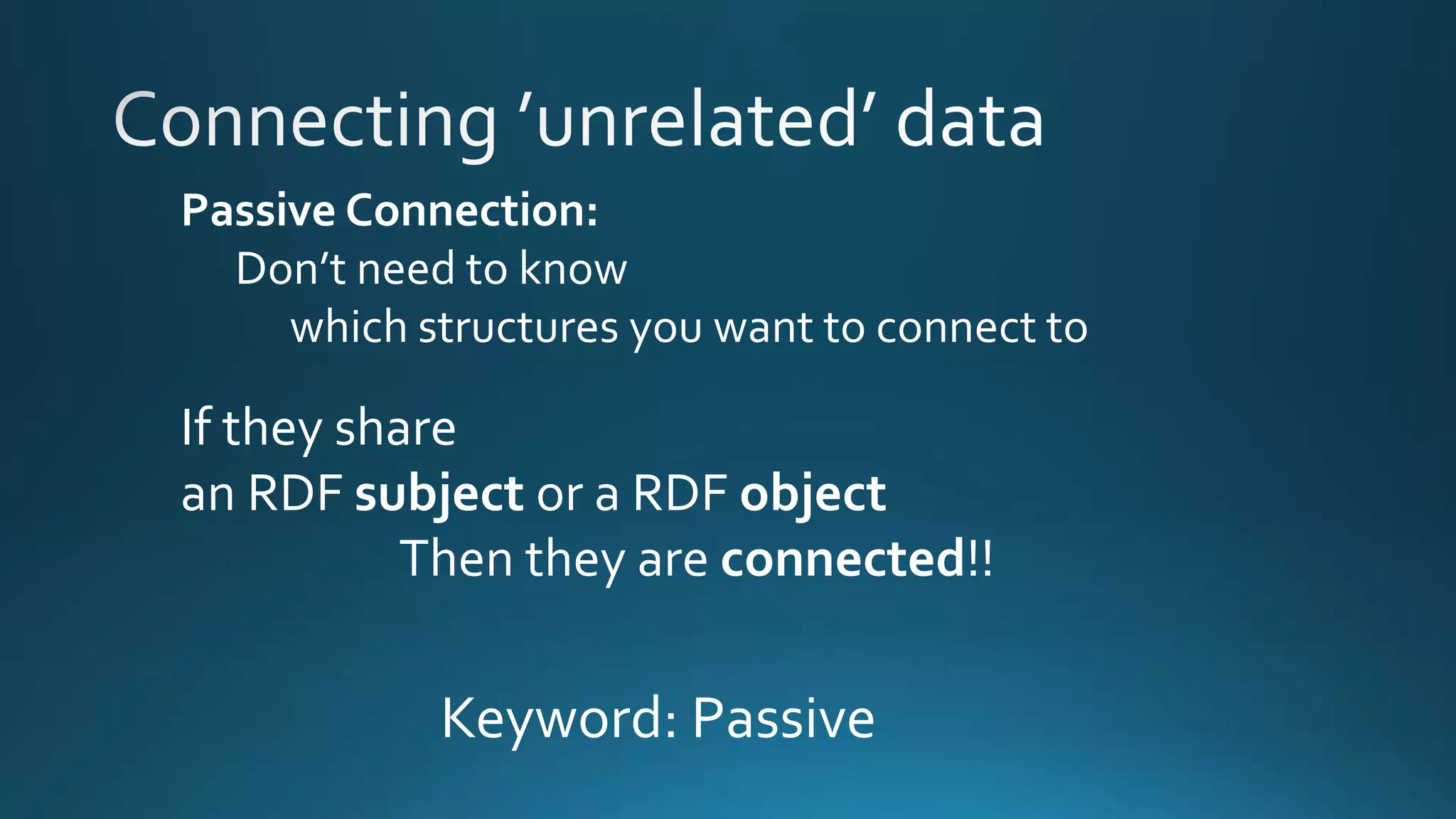
Passive Connection:
Don’t need to know
which structures you want to connect to
If they share
an RDF subject or a RDF object
Then they are connected!!
Keyword: Passive
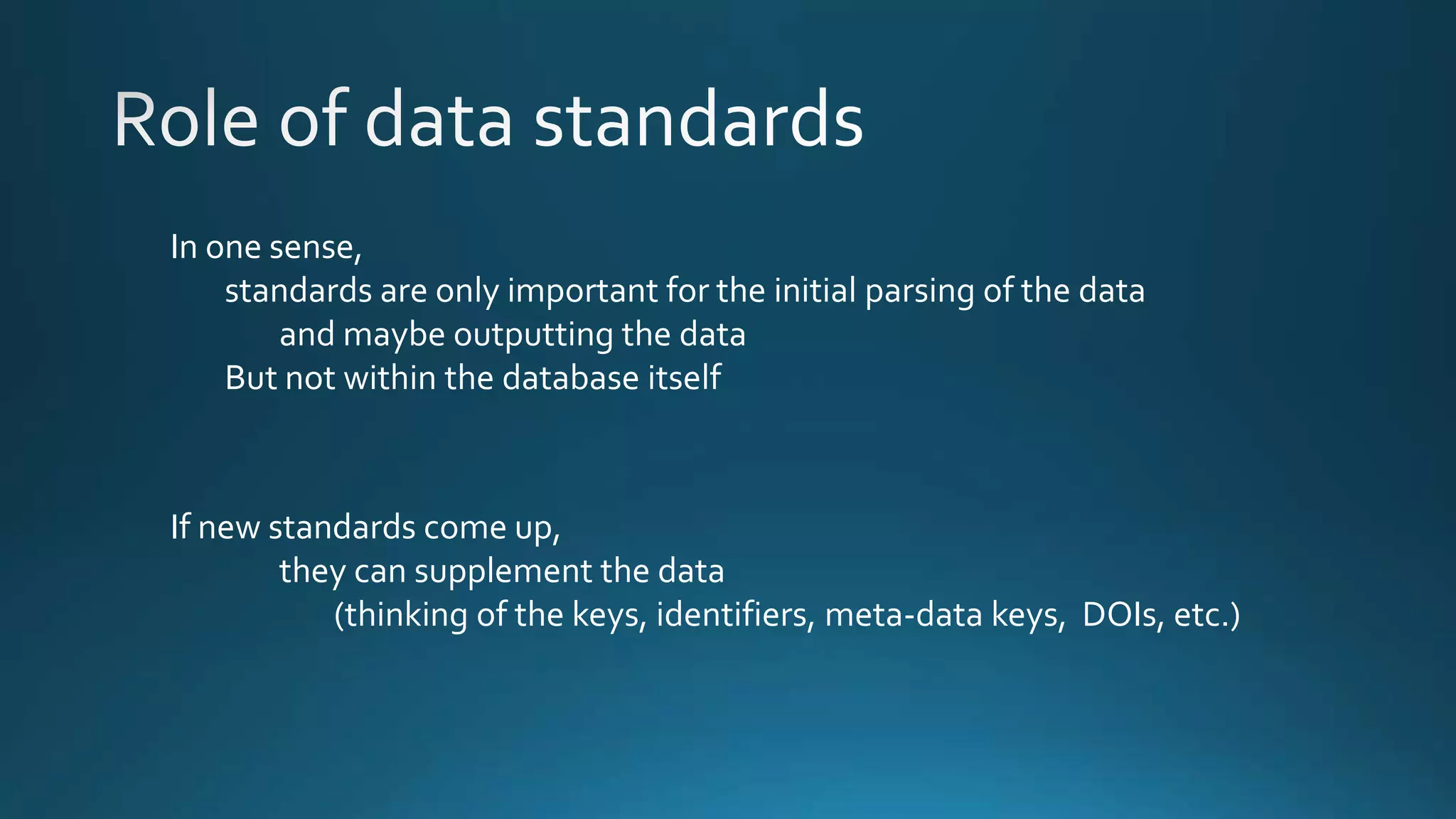
In one sense,
standards are only important for the initial parsing of the data
and maybe outputting the data
But not within the database itself
If new standards come up,
they can supplement the data
(thinking of the keys, identifiers, meta-data keys, DOIs, etc.)
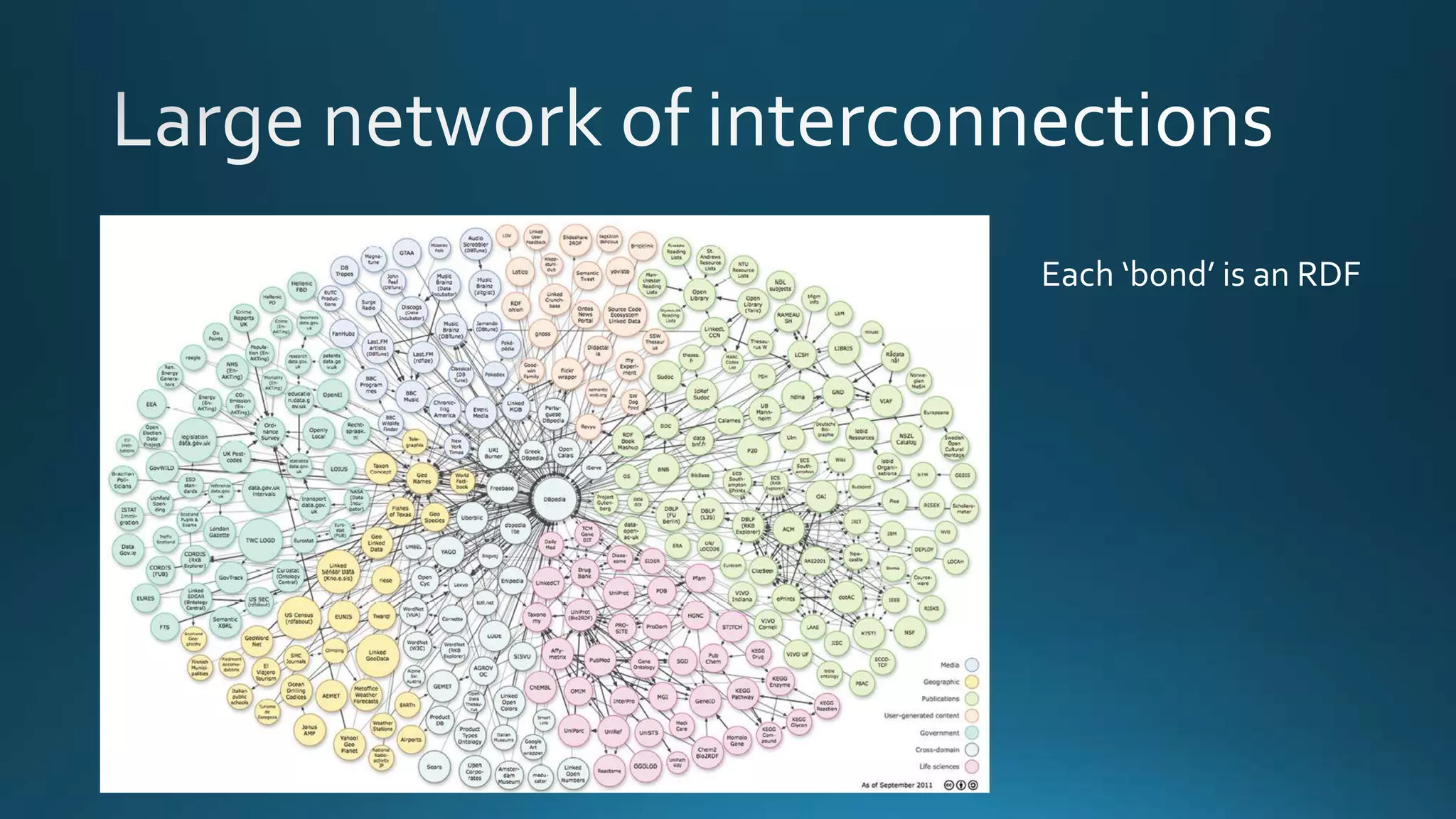
Each ‘bond’ is an RDF
Data
Data
Data
Data
Data
Data
Data
Data
Data
Data
Data
Data
Data Element
Data Element
Data Element
Data Element
Data Element
Data Element
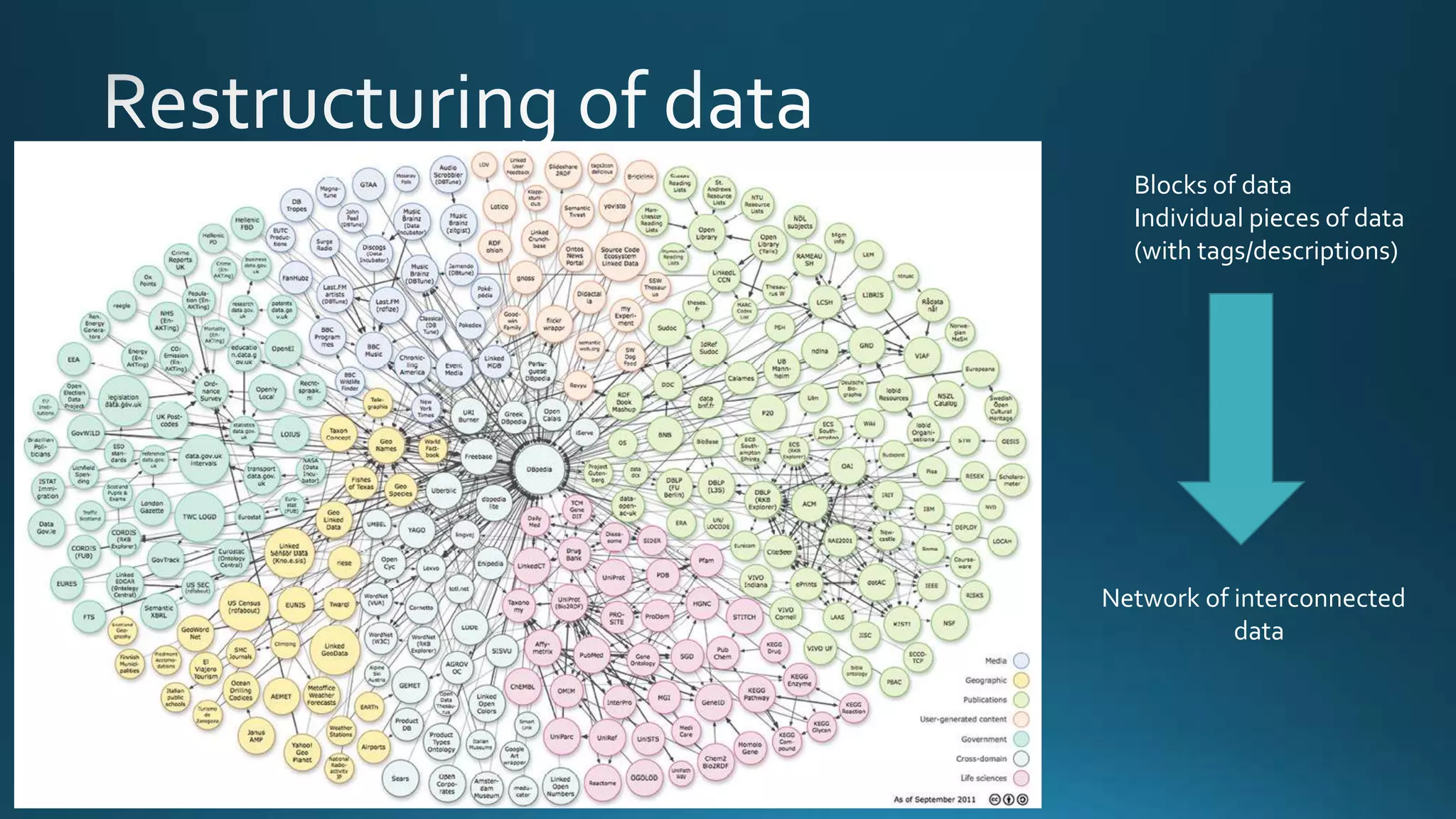
Data Element Blocks of data
Individual pieces of data
(with tags/descriptions)
Network of interconnected
data
Data
Data
Data
Data
Data
Data
Data
Data
Data
Data
Data
Data
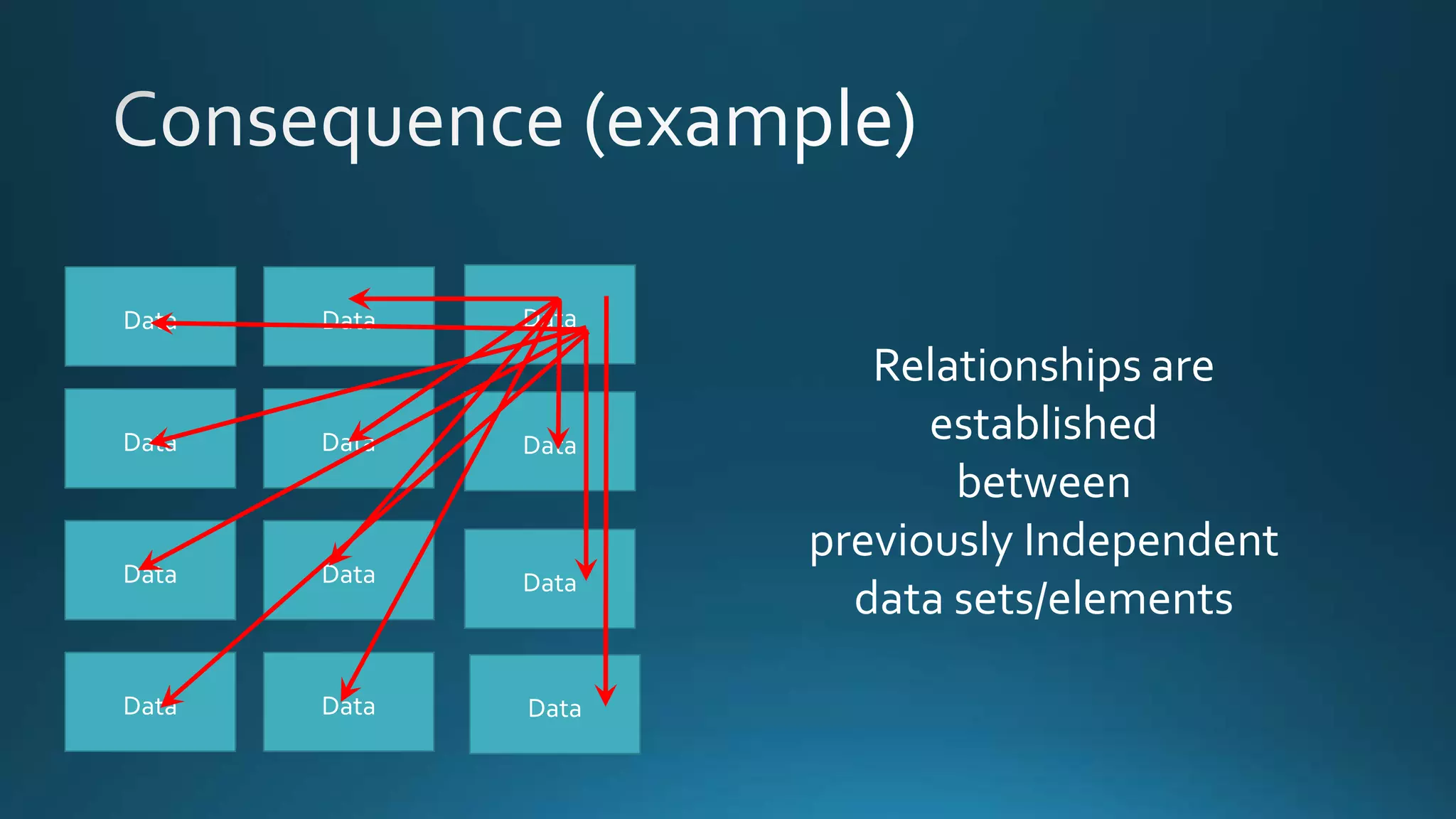
Relationships are
established
between
previously Independent
data sets/elements
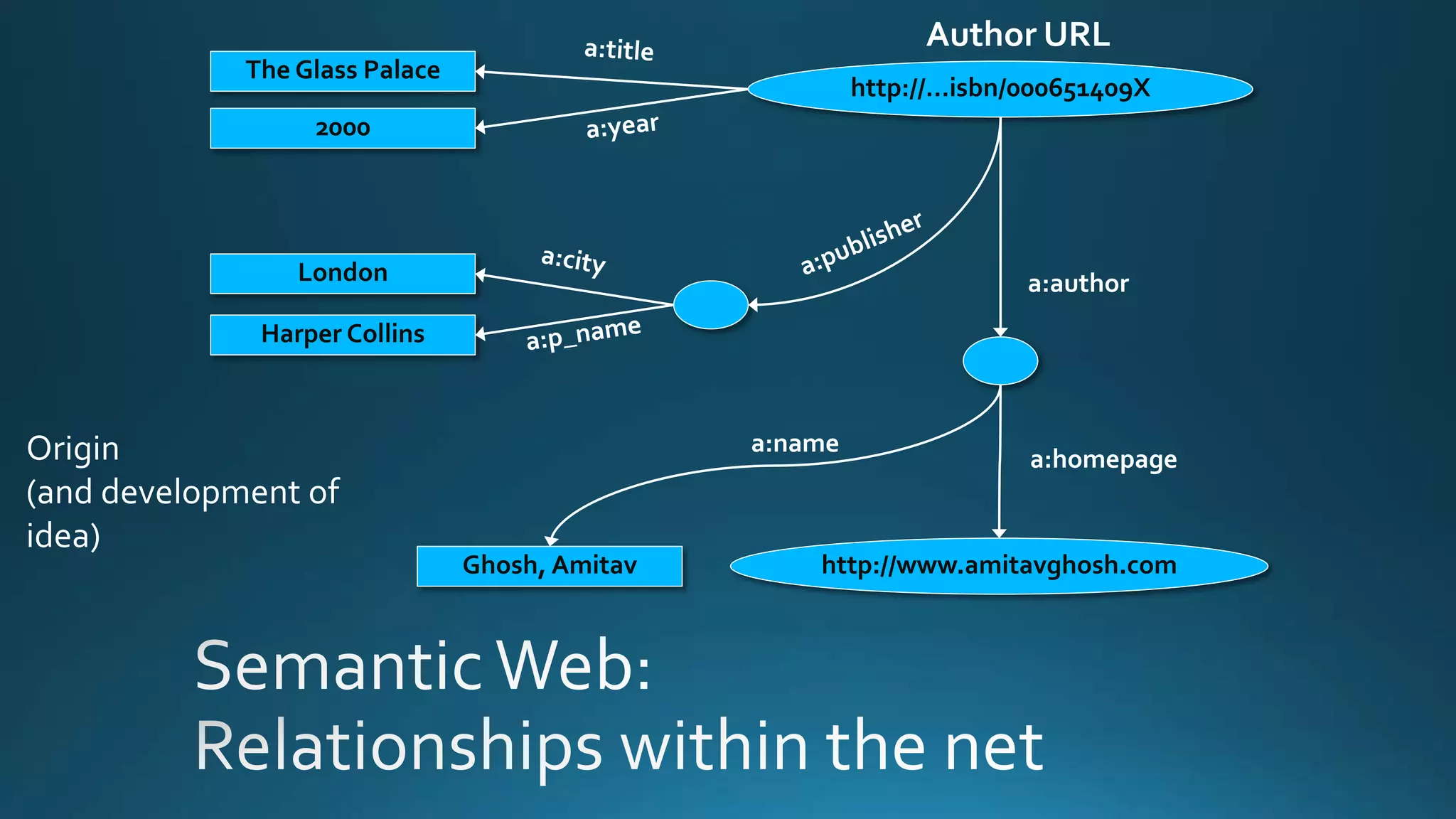
http://…isbn/000651409X
Ghosh, Amitav http://www.amitavghosh.com
The Glass Palace
2000
London
Harper Collins
a:name
a:homepage
a:author
Author URL
Origin
(and development of
idea)
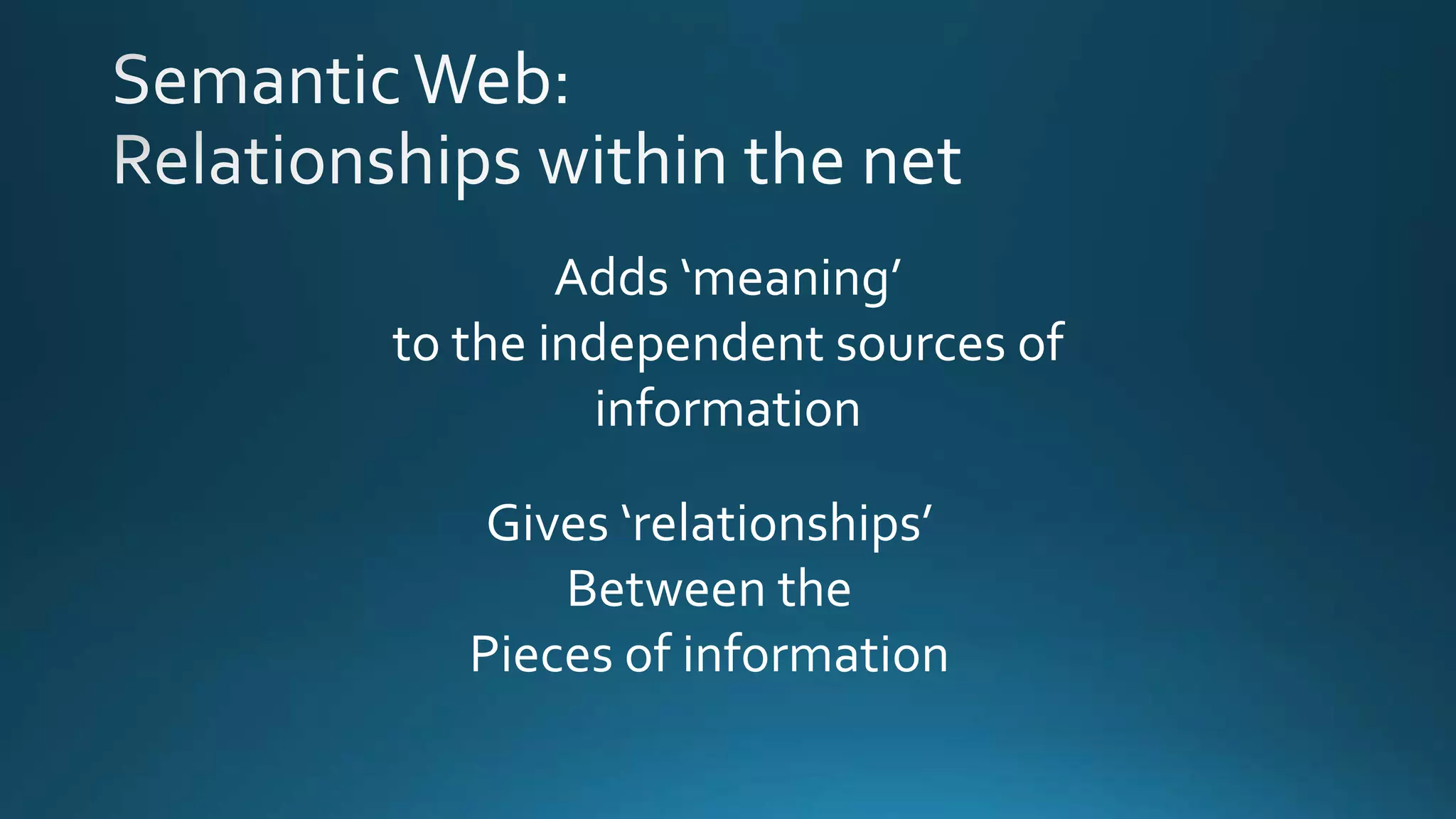
Adds ‘meaning’
to the independent sources of
information
Gives ‘relationships’
Between the
Pieces of information
http://…isbn/000651409X
Ghosh, Amitav
Besse, Christianne
Le palais des miroirs
f:nom
f:traducteur
f:auteur
http://…isbn/2020386682
f:nom
http://…isbn/000651409X
Ghosh, Amitav
http://www.amitavghosh.co
m
The Glass Palace
2000
London
Harper Collins
a:name
a:homepag
e
a:author
Common URL!
Connecting sets of
Concepts
French
Language
English
Language
Ghosh, Amitav
Besse, Christianne
Le palais des miroirs
f:original
f:no
m
f:traducteu
r
f:auteur
http://…isbn/2020386682
f:nom
Ghosh, Amitav
http://www.amitavghosh.com
The Glass Palace
2000
London
Harper Collins
a:nam
e a:homepage
a:autho
r
http://…isbn/000651409X
Two independent data sources
(who did not know about each other)
Become connected
Passive
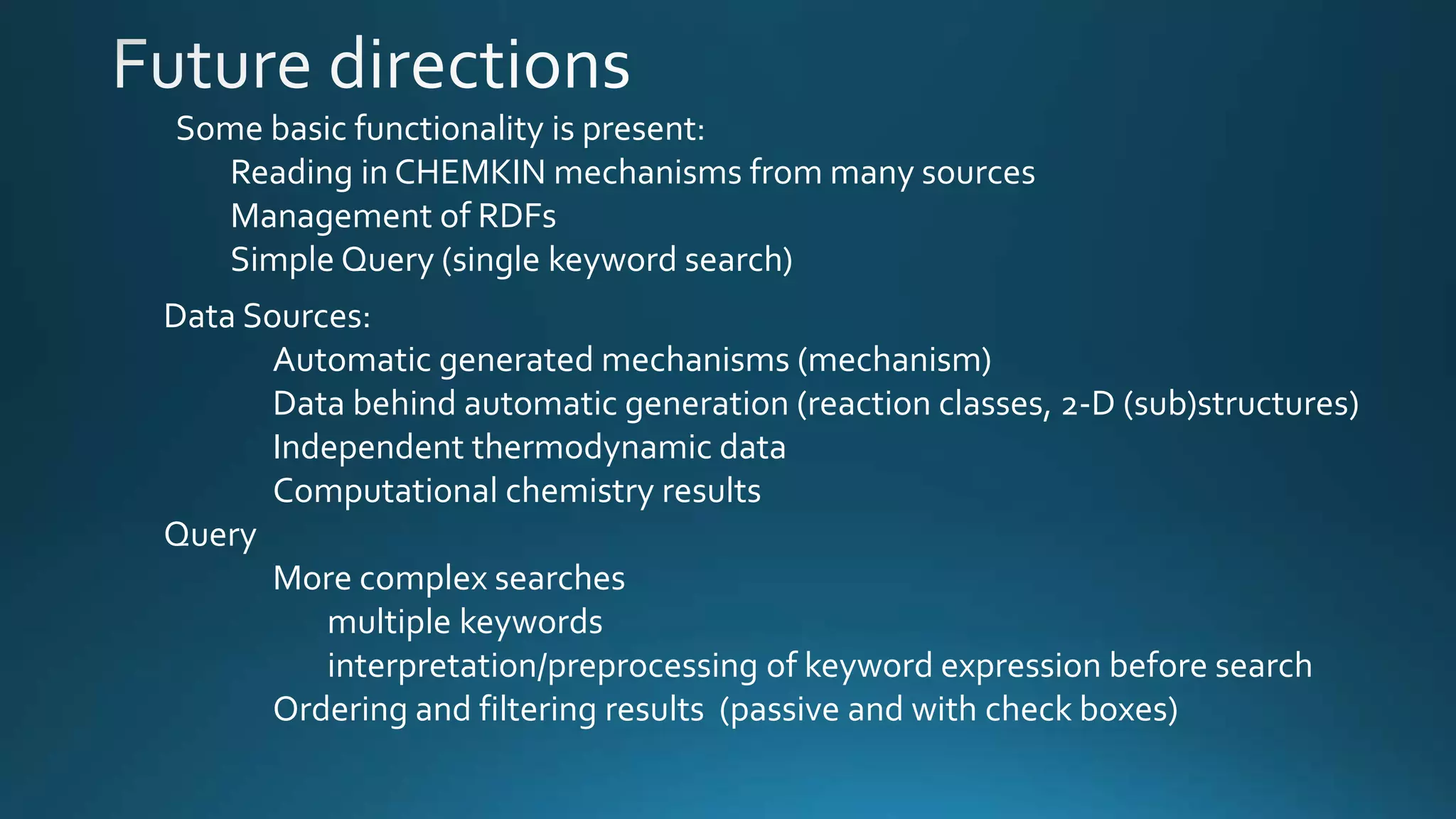
Extraction of all the bits of information within the data object
CHEMKIN model:
Extract set of molecules (with isomer,thermodynamic data)
Extract set of reactions (with ‘isomer’, kinetic data,
Extract relationships between
molecules and molecules (related through reactions)
molecules and reactions (reactants, products, etc.)
reactions and reactions (reaction network information)
Other Sources:
Automatic Generation:
Mechanism with the information as above, plus
2D-structure, reaction class information, substructure information
Thermodynamic Calculators: more thermodynamic information (plus 2d-structures)
Have to have database capacity to store
this immense amount of info
To be demonstrated
today
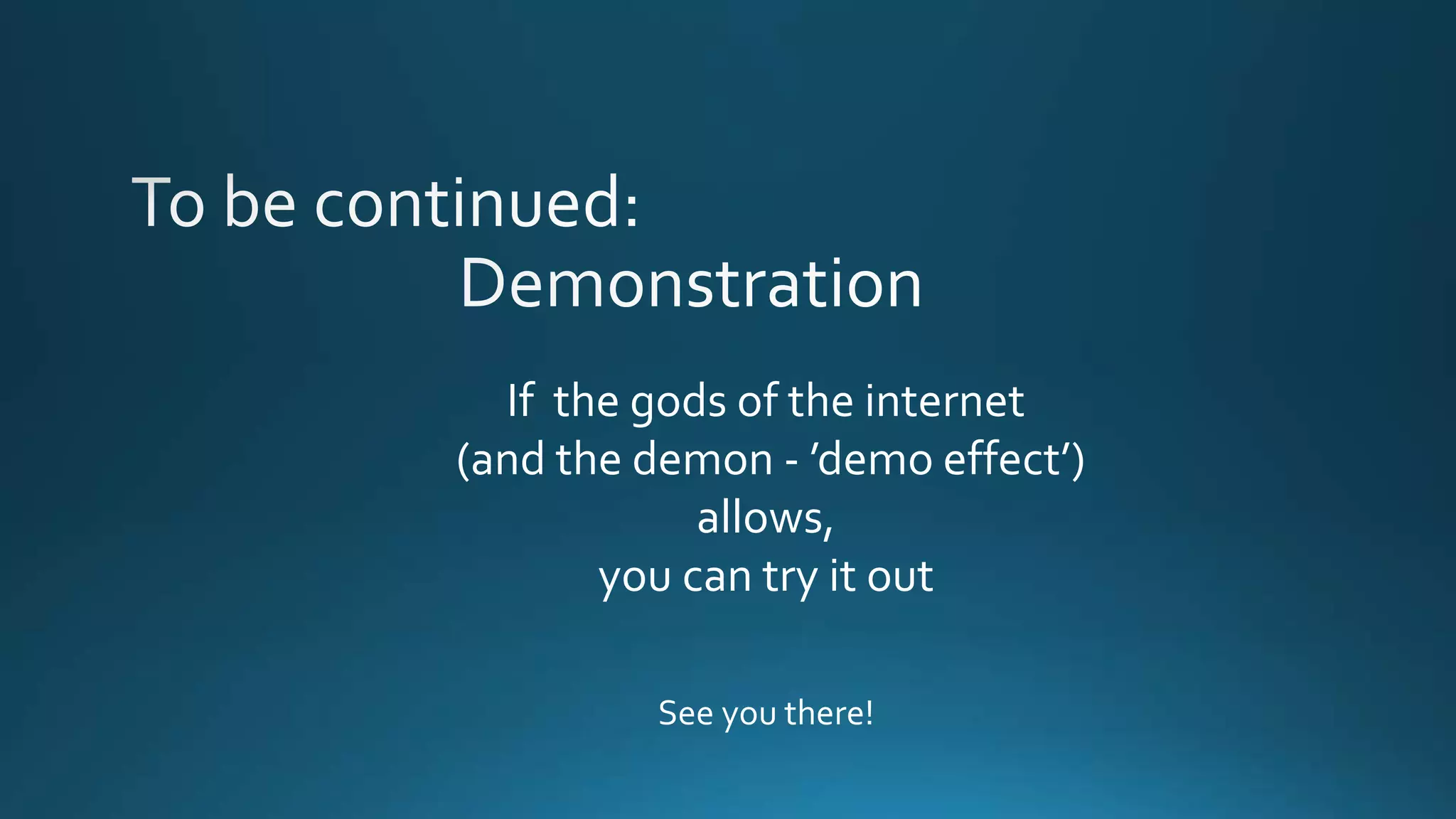
Chemkin
Model I
Chemkin
Model II
2-D Structure
Computational
Chemistry
Calculations
Automatically
Generated
CHEMKIN
Model
1-Butyl-3-hydroperoxide
C4H11O2
ch2ch2ch(ooh)ch31-c4hh8-3-ooh
hasSpecies
hasSpecies
hasSpecies
hasThermo
isIsomer isIsomer
isIsomer
Thermo
hasThermo
Thermo
hasThermo
Thermo
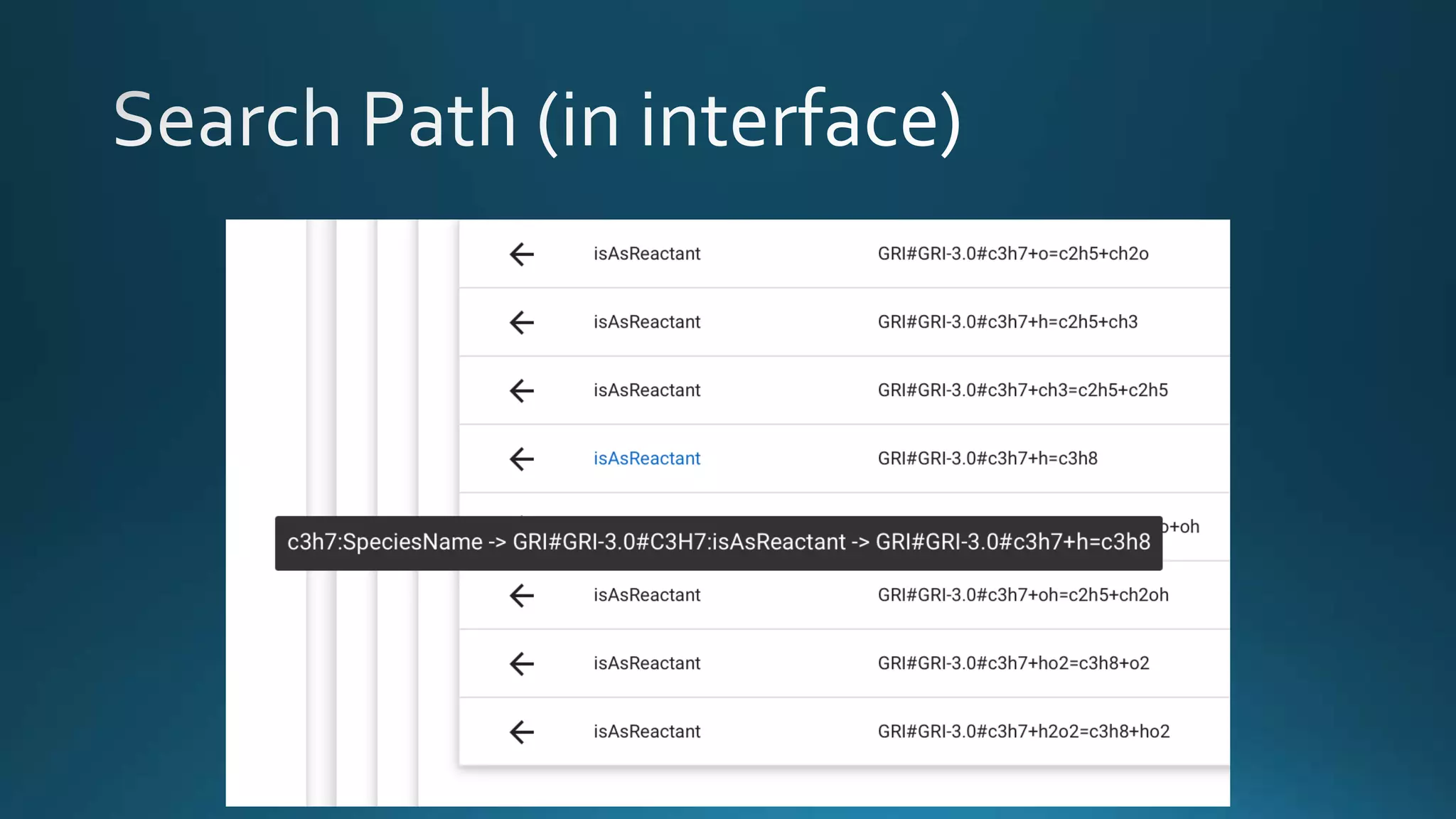
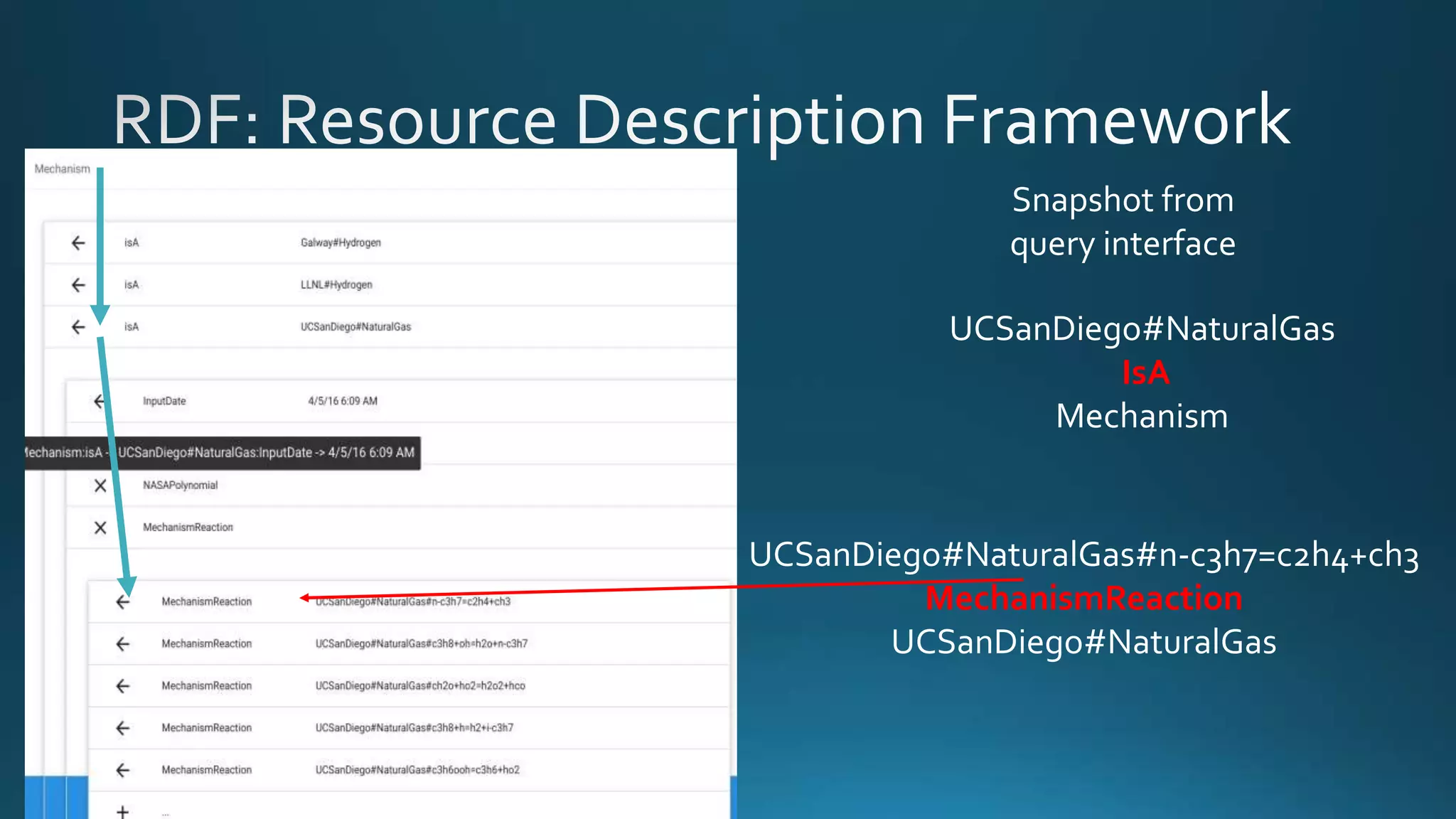
Snapshot from
query interface
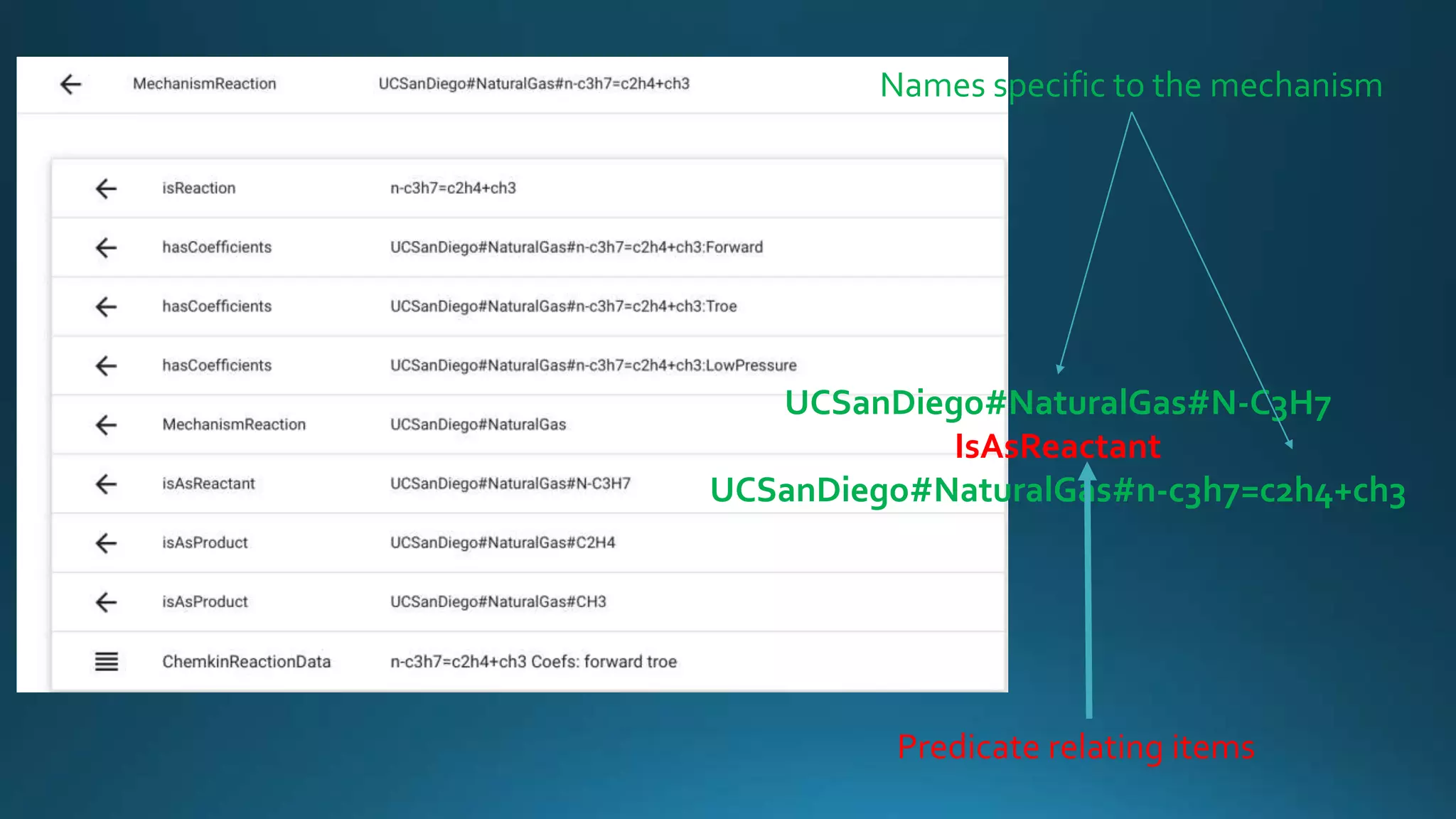
UCSanDiego#NaturalGas
IsA
Mechanism
UCSanDiego#NaturalGas#n-c3h7=c2h4+ch3
MechanismReaction
UCSanDiego#NaturalGas
UCSanDiego#NaturalGas#N-C3H7
IsAsReactant
UCSanDiego#NaturalGas#n-c3h7=c2h4+ch3
Names specific to the mechanism
Predicate relating items
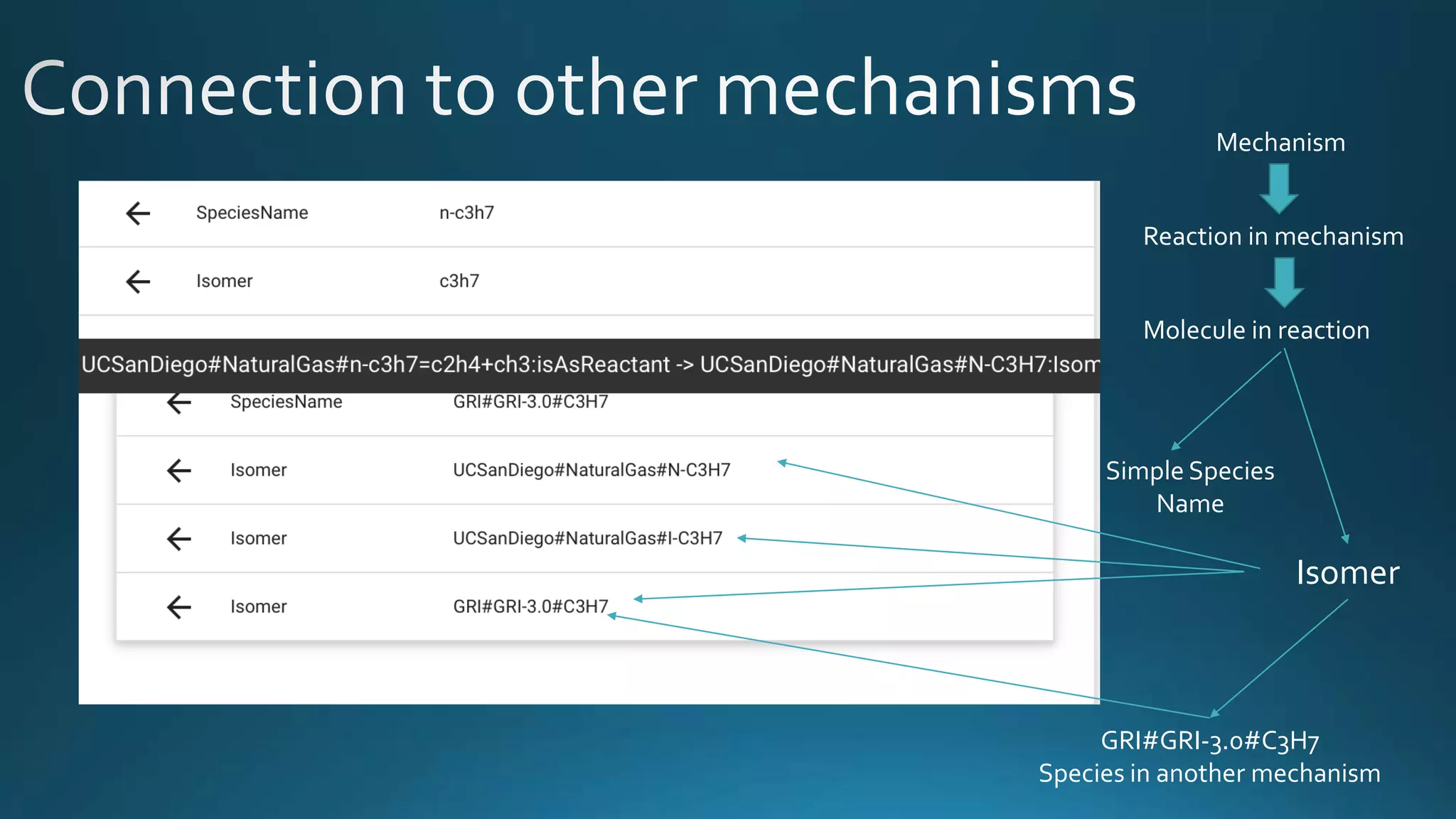
Mechanism
Reaction in mechanism
Molecule in reaction
Simple Species
Name
Isomer
GRI#GRI-3.0#C3H7
Species in another mechanism
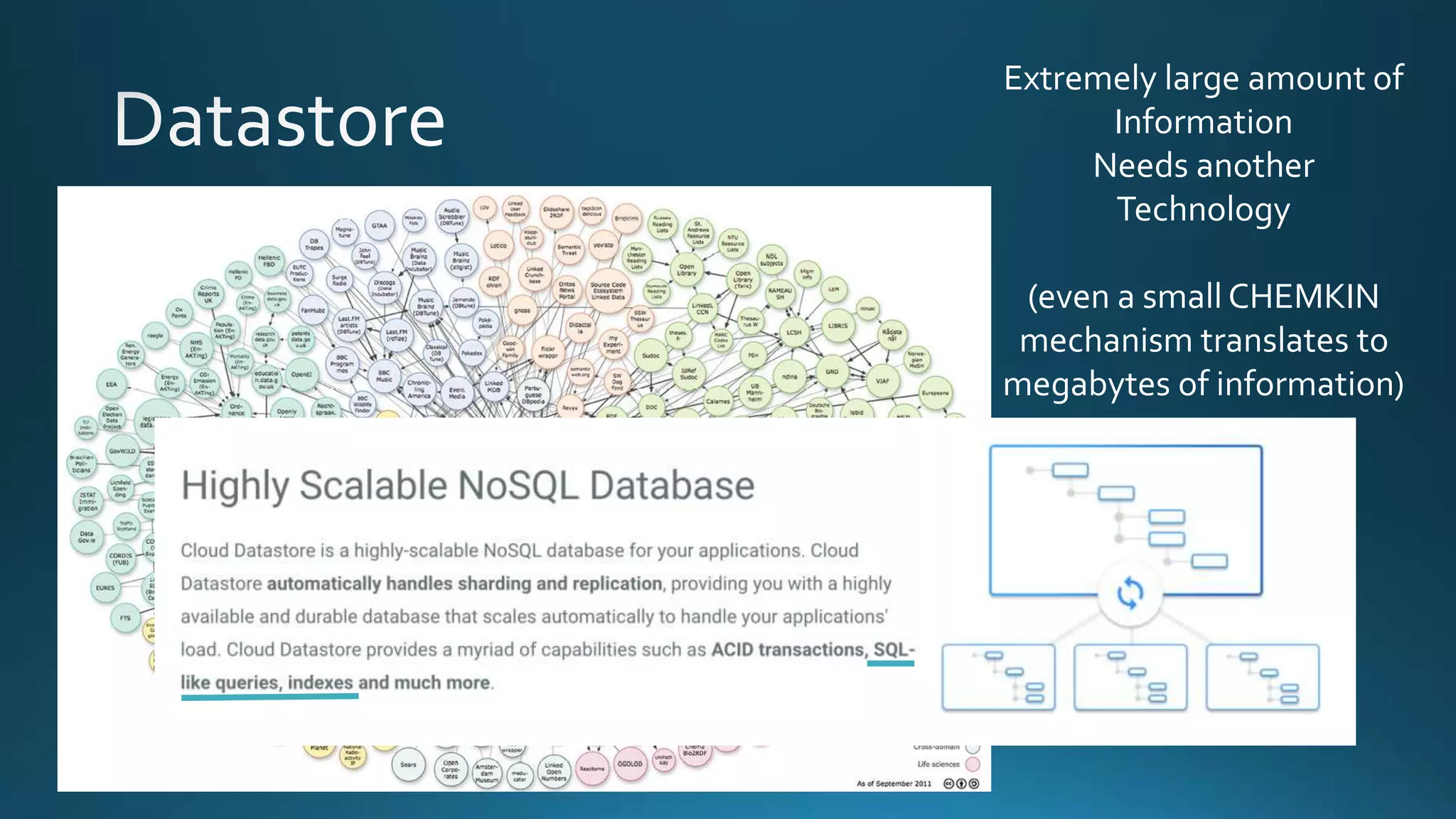
Extremely large amount of
Information
Needs another
Technology
(even a small CHEMKIN
mechanism translates to
megabytes of information)
Traversing through the network of information
is a tool
to ‘analyze’
and
extract more/new information
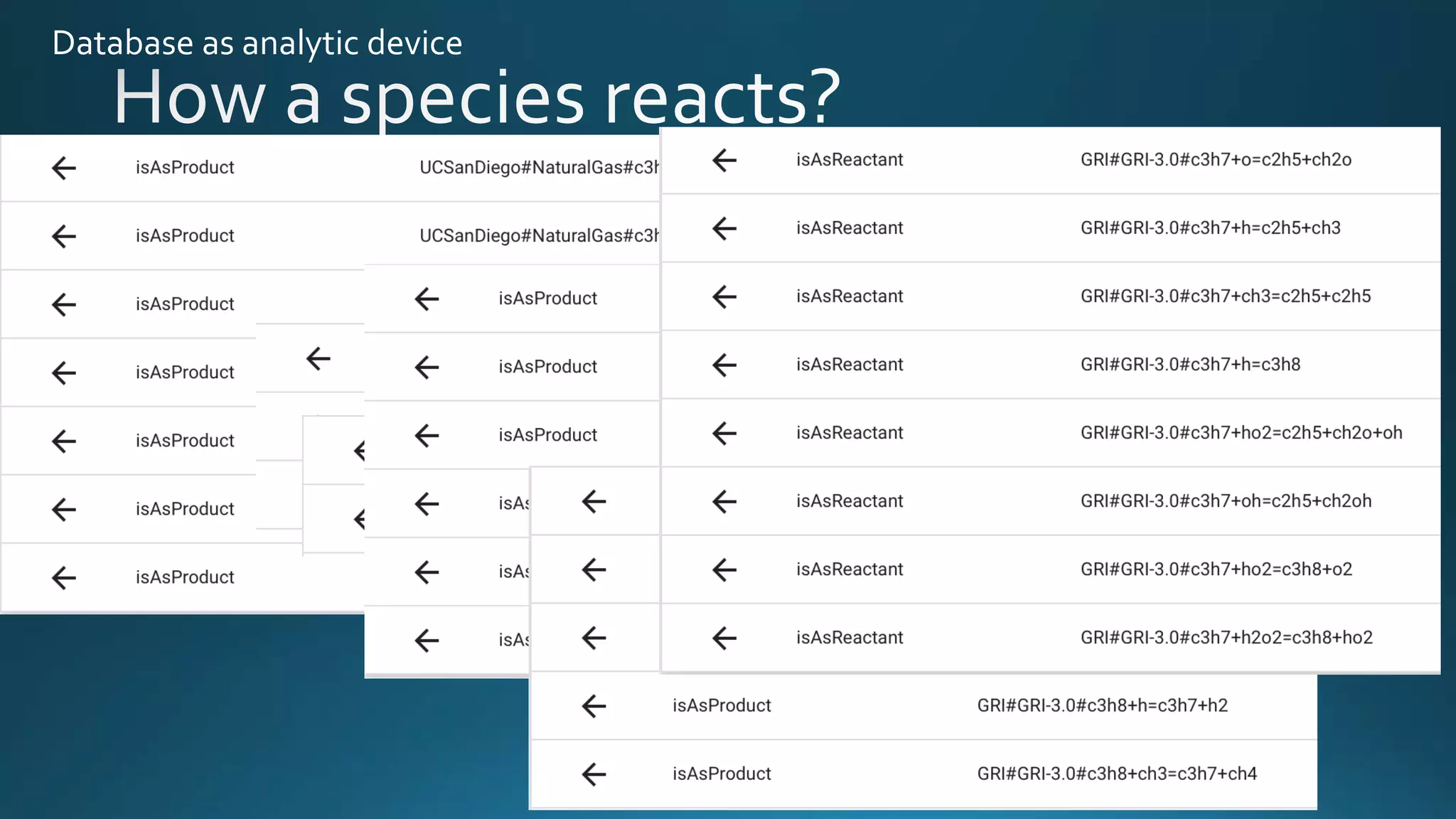
Species
(Isomer)
asReactant
asProduct
Set
Of
Reactions
Set
Of
Reactions
Not just from one
Mechanism,
but from all
cataloged
mechanisms
Database as analytic device
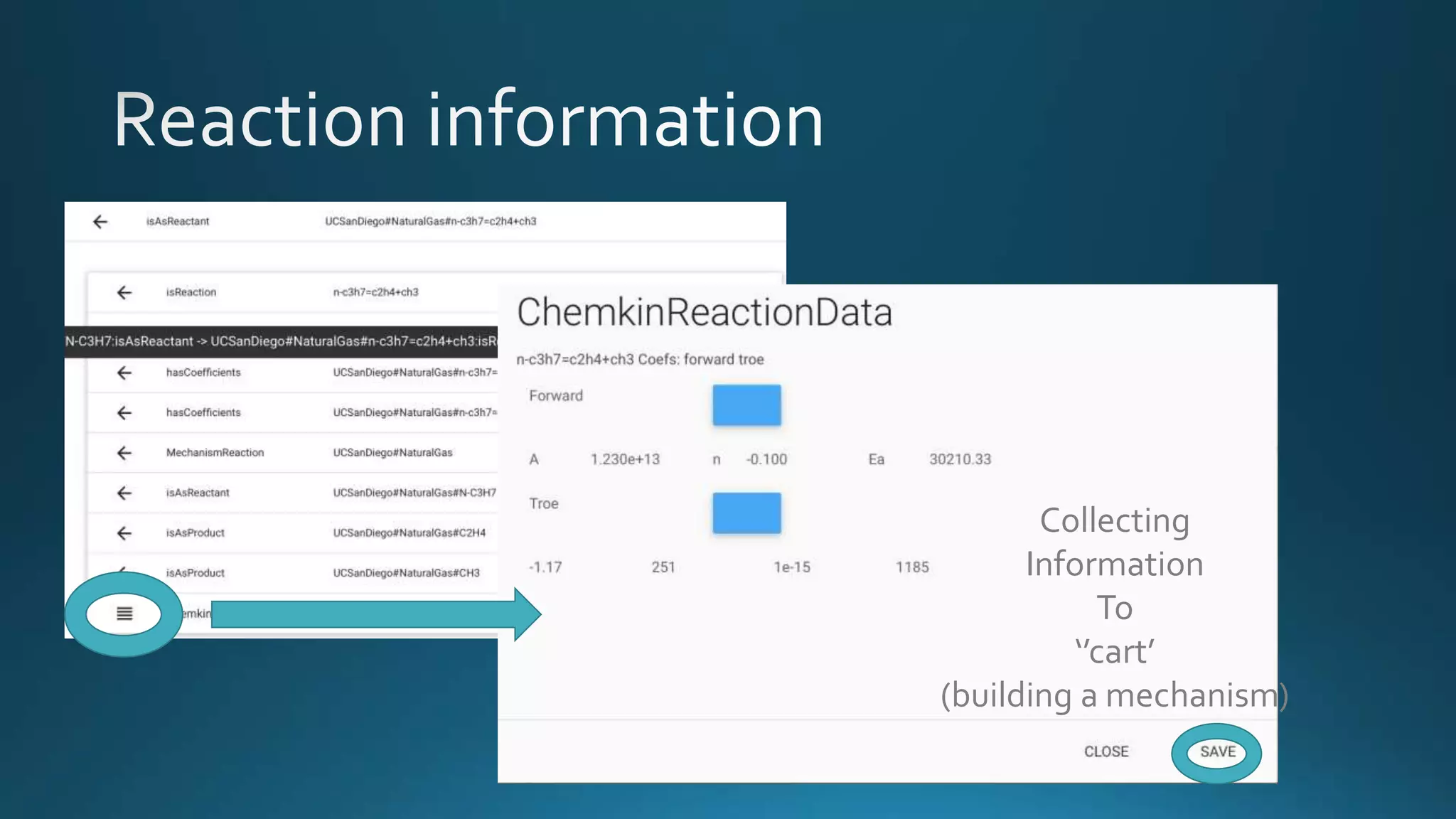
Collecting
Information
To
‘’cart’
(building a mechanism)
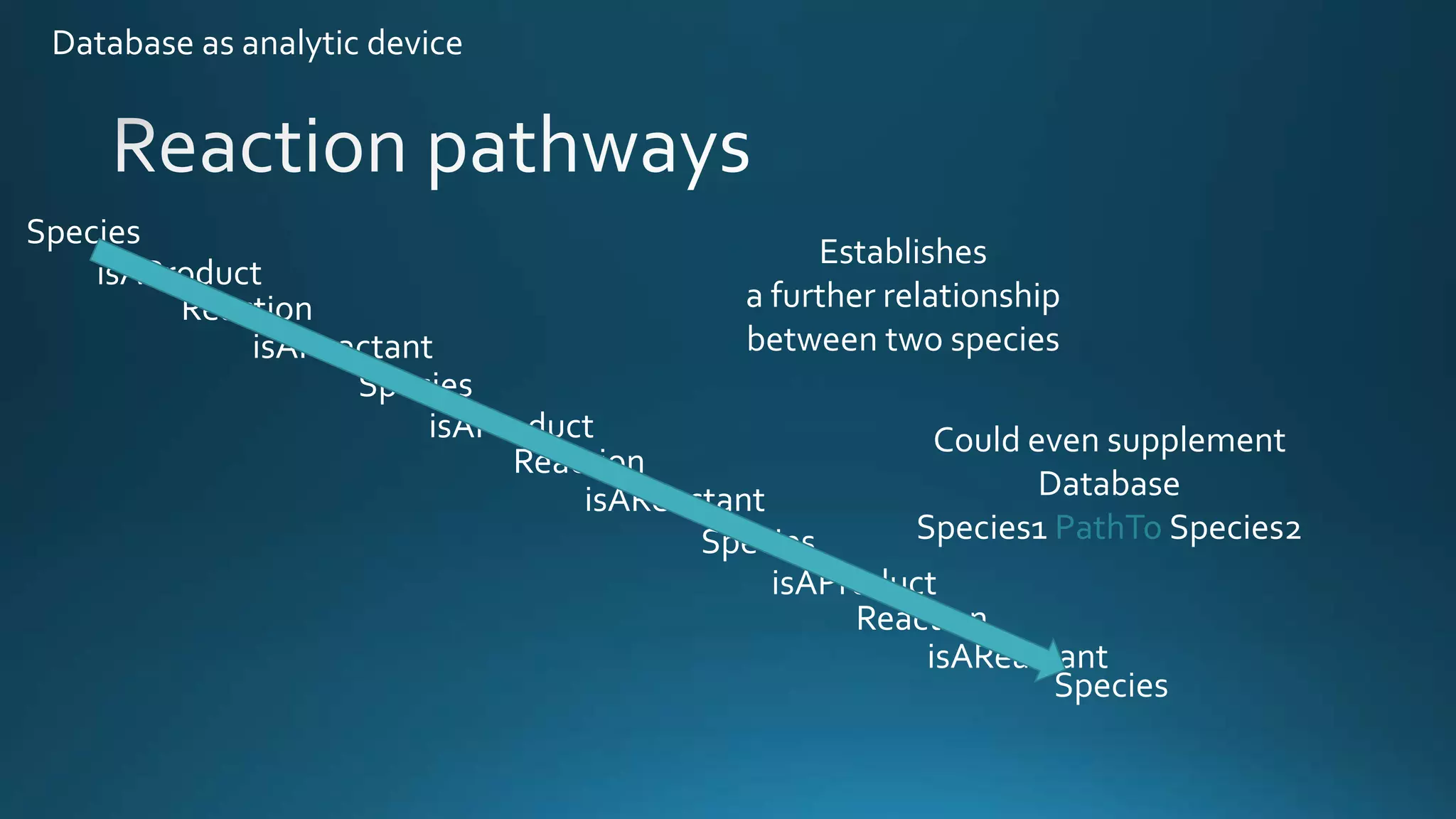
Database as analytic device
isAProduct
Species
isAReactant
Reaction
isAProduct
Species
isAReactant
Reaction
isAProduct
Species
isAReactant
Reaction
Species
Establishes
a further relationship
between two species
Could even supplement
Database
Species1 PathTo Species2
Database as analytic device
CHEMKIN
Mechanism
Species are labels:
Only know atomic composition
(NASA polynomial)
Not structure
CHEMKIN
Mechanism
C3H7
N-C3H7
i-C3H7
Reactions
(asProduct)
Reactions
(asReactant)
Reactions
(asProduct)
Reactions
(asReactant)
Reactions
(asProduct)
Reactions
(asReactant)
Compare
reactions
(species as isomers)
The set with the most similarities:
wins
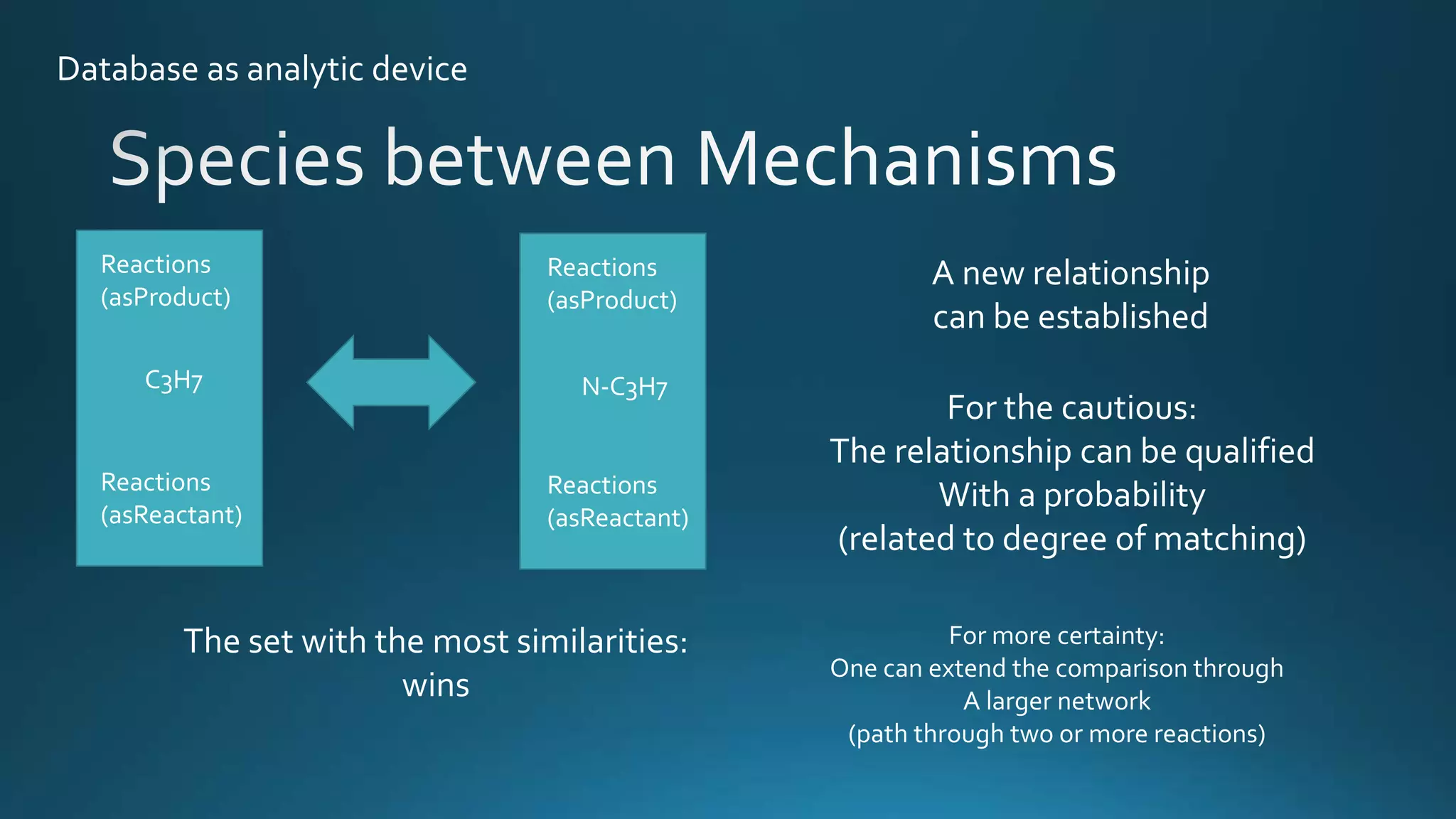
Database as analytic device
Reactions
(asProduct)
Reactions
(asReactant)
Reactions
(asProduct)
Reactions
(asReactant)
The set with the most similarities:
wins
C3H7 N-C3H7
A new relationship
can be established
For the cautious:
The relationship can be qualified
With a probability
(related to degree of matching)
For more certainty:
One can extend the comparison through
A larger network
(path through two or more reactions)
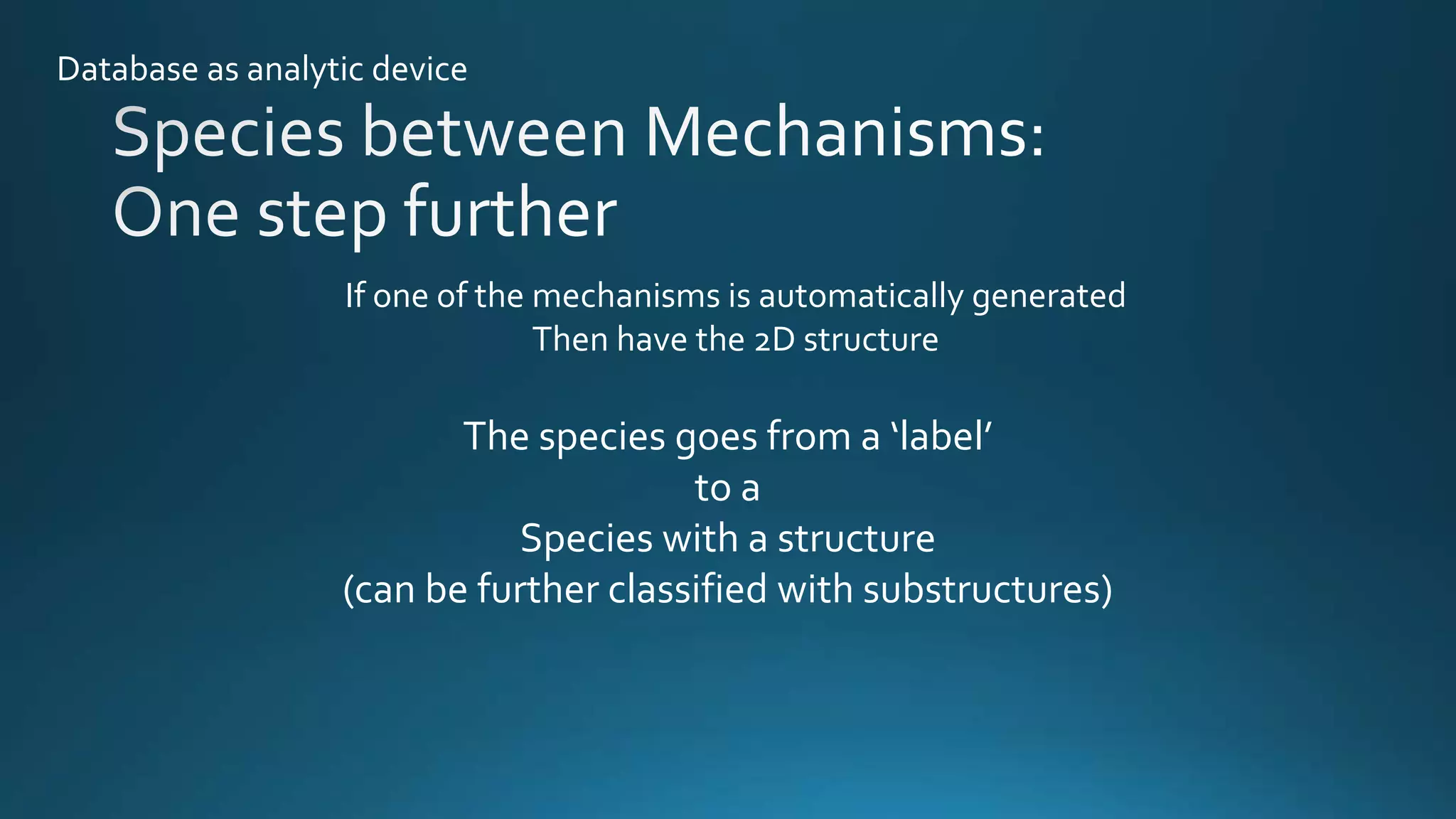
If one of the mechanisms is automatically generated
Then have the 2D structure
The species goes from a ‘label’
to a
Species with a structure
(can be further classified with substructures)
Database as analytic device
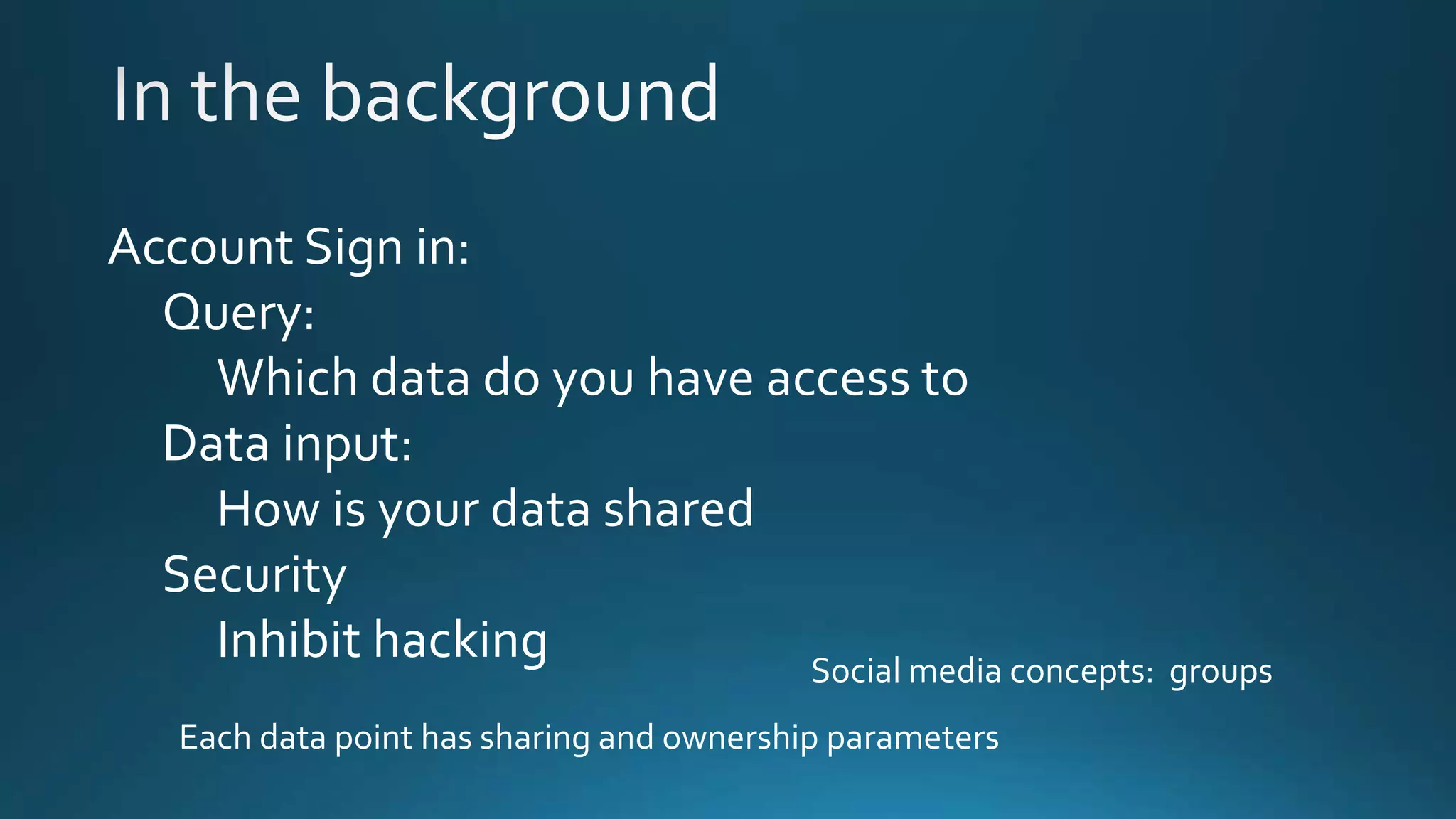
Account Sign in:
Query:
Which data do you have access to
Data input:
How is your data shared
Security
Inhibit hacking Social media concepts: groups
Each data point has sharing and ownership parameters
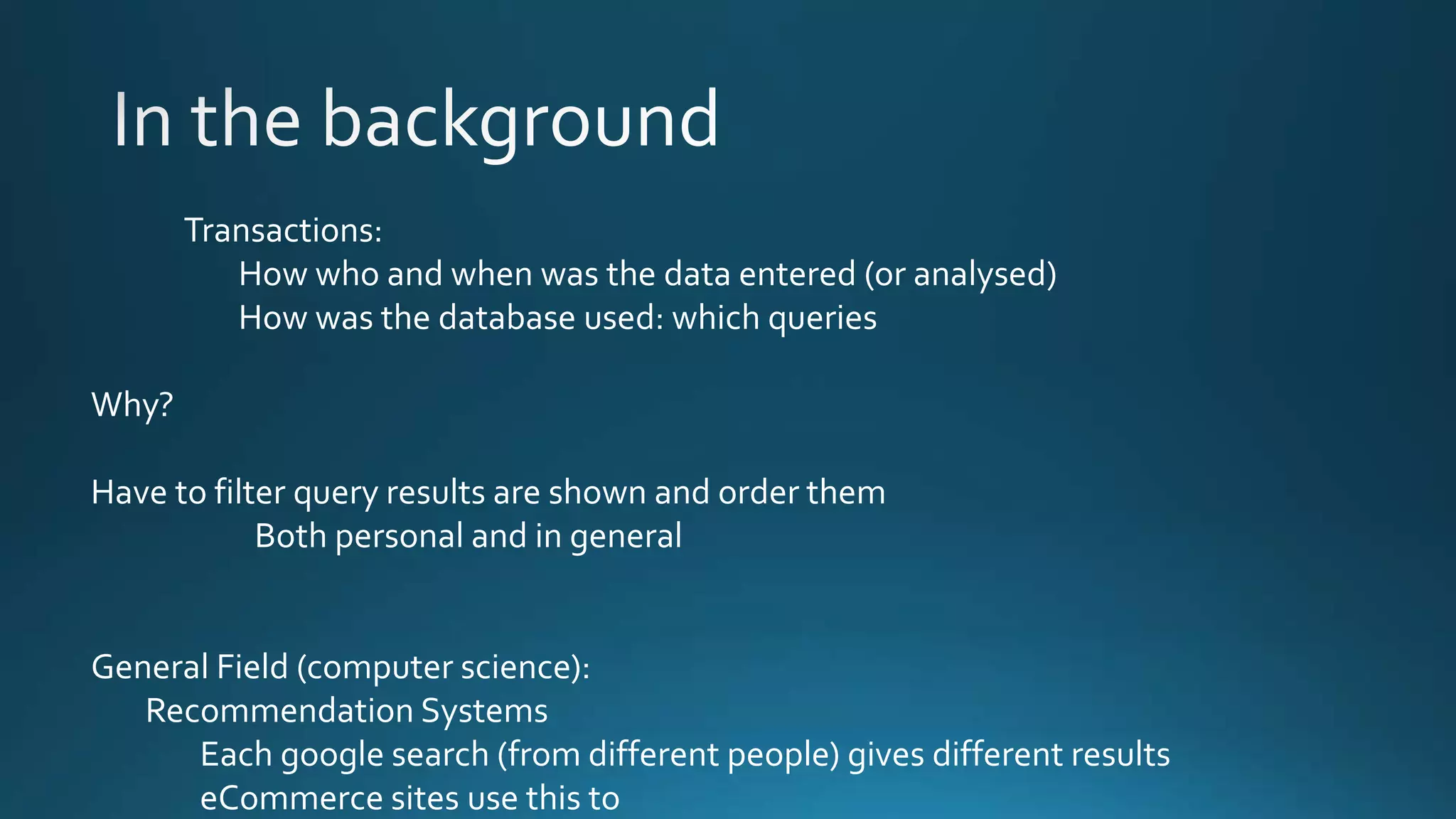
Transactions:
How who and when was the data entered (or analysed)
How was the database used: which queries
Why?
Have to filter query results are shown and order them
Both personal and in general
General Field (computer science):
Recommendation Systems
Each google search (from different people) gives different results
eCommerce sites use this to
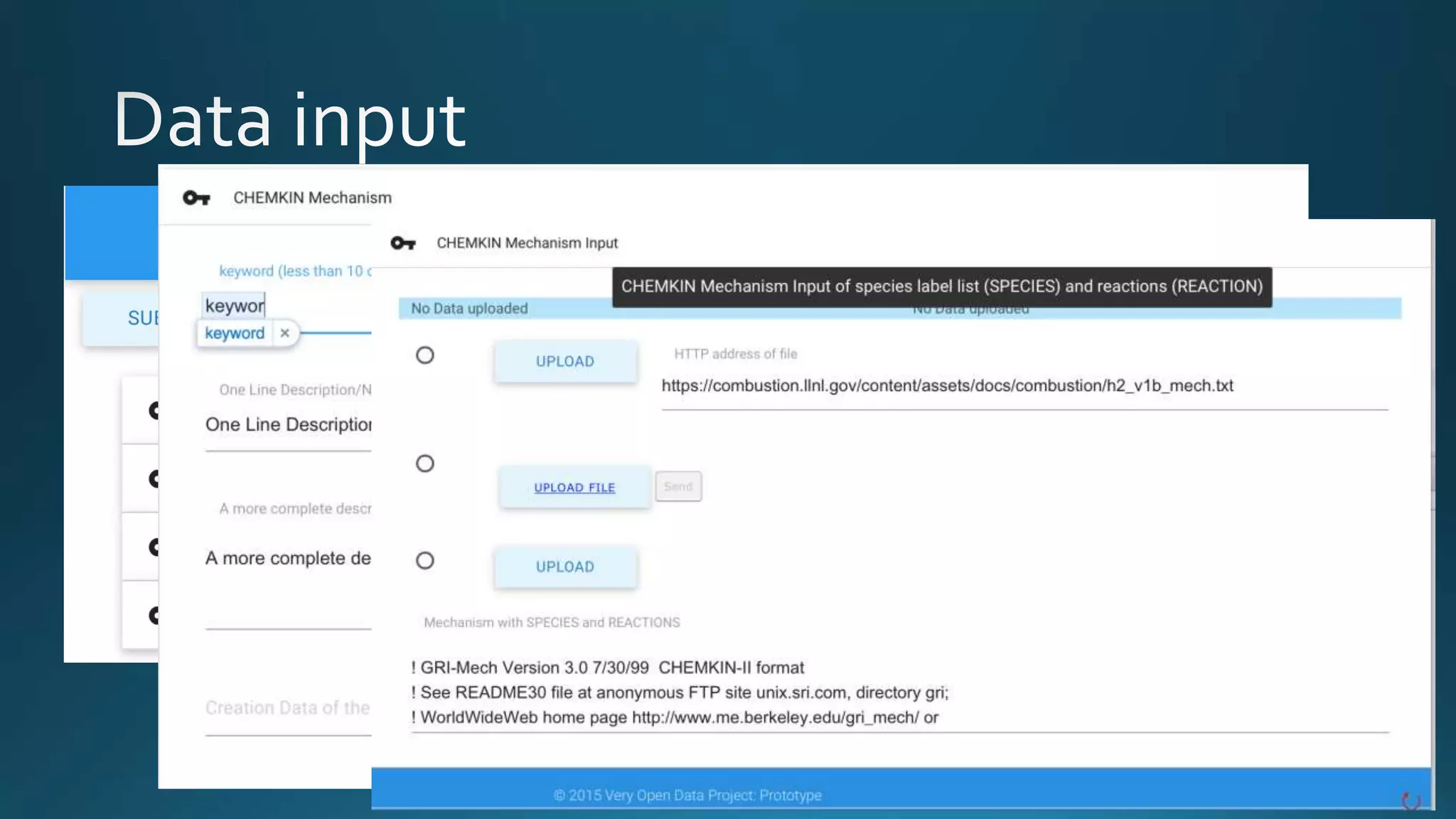
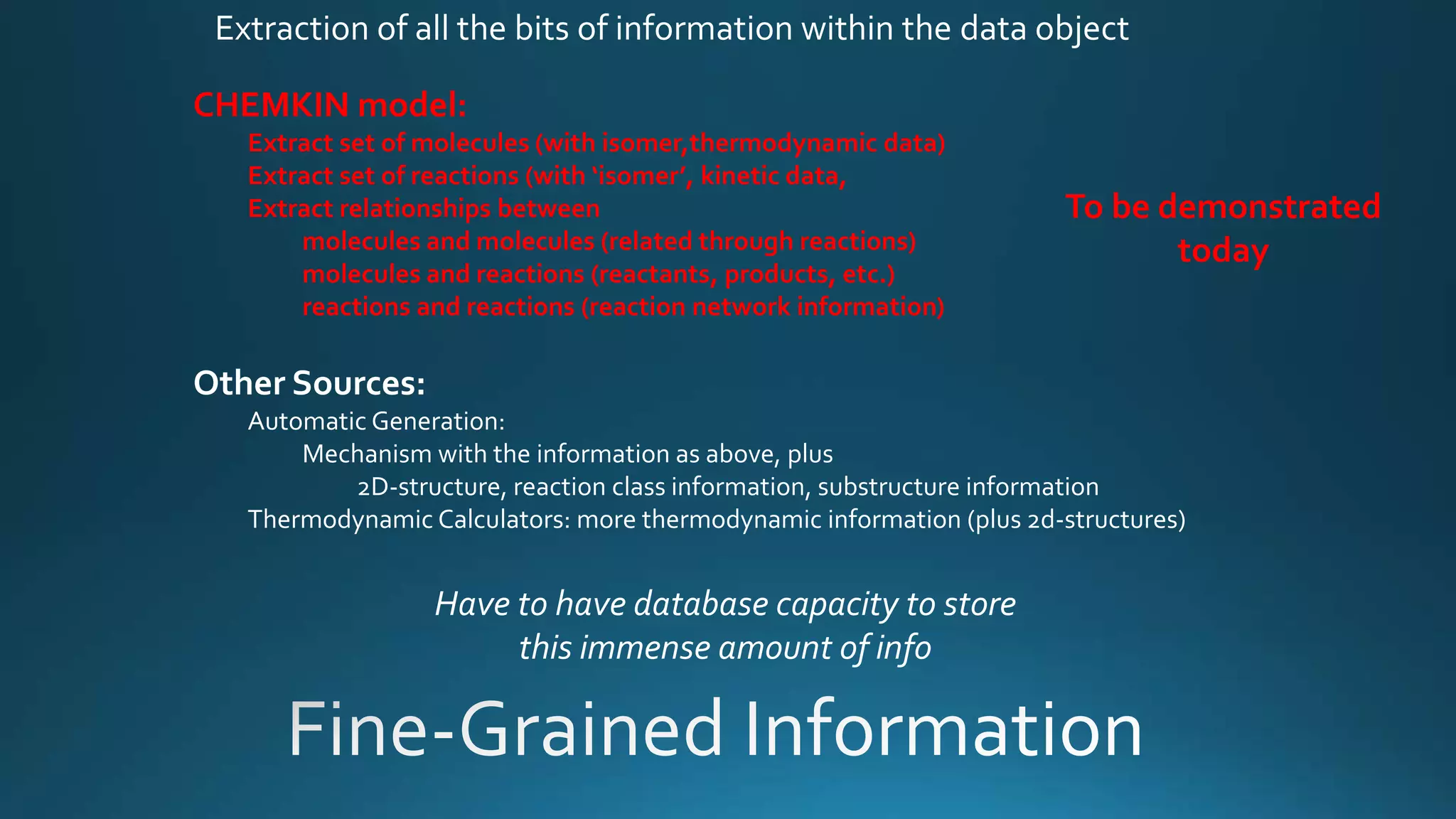
Some basic functionality is present:
Reading in CHEMKIN mechanisms from many sources
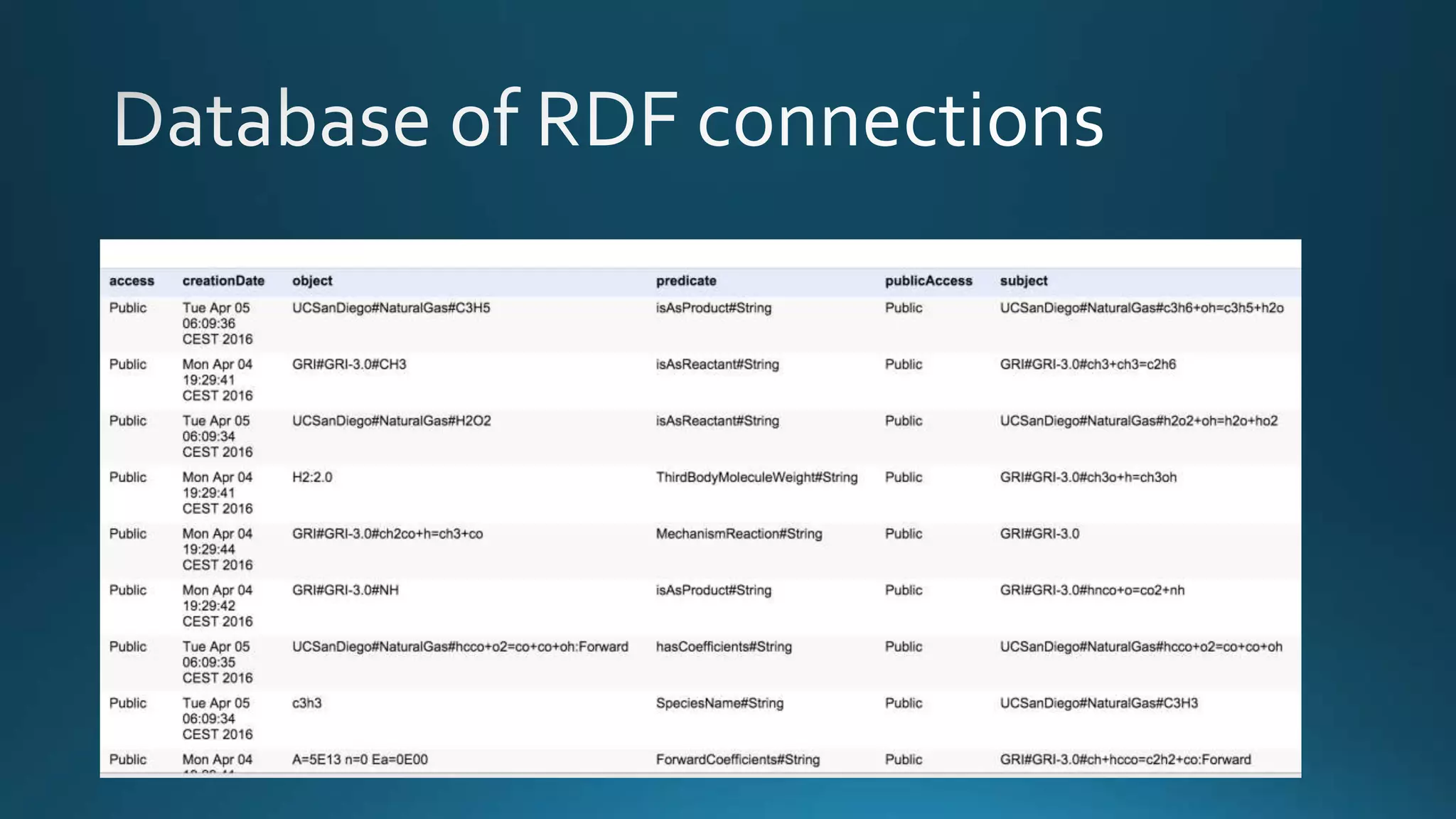
Management of RDFs
Simple Query (single keyword search)
Data Sources:
Automatic generated mechanisms (mechanism)
Data behind automatic generation (reaction classes, 2-D (sub)structures)
Independent thermodynamic data
Computational chemistry results
Query
More complex searches
multiple keywords
interpretation/preprocessing of keyword expression before search
Ordering and filtering results (passive and with check boxes)
See you there!
If the gods of the internet
(and the demon - ’demo effect’)
allows,
you can try it out

ChemConnect: Characterizing CombusAon KineAc Data with ontologies and meta-­‐data

  • 4.
    4 Adopted from:Effectively and Securely Using the Cloud Computing Paradigm by peter Mell, Tim Grance
  • 5.
  • 6.
  • 9.
    Software as a Service(SaaS) Platform as a Service (PaaS) Infrastructure as a Service (IaaS) Google App Engine SalesForce CRM LotusLive Adopted from: Effectively and Securely Using the Cloud Computing Paradigm by peter Mell, Tim Grance
  • 10.
  • 11.
    https://cloud.google.com/ Others exist (another popularchoice) Why this one? ChemConnect is based on several Google services (and philosophies) Project Connected to Google Account
  • 12.
    These are typesof services provided by Google as a cloud service provider For ChemConnect the services of interest are: To run the JAVA based website (the ‘App’) The ‘NOSQL’ database: (for large amounts of information) Storage (data files)
  • 14.
  • 17.
    User interface onbrowser, tablet or phone (adjustable for each) Generates Interface ChemConnect Computing and Responses SERVER CLIENT
  • 18.
    Example: ChemConnect is writtenin JAVA Eclipse: Uses a ‘standard’ (public domain) Environment to write code Local debug and then Deploy to Google Cloud
  • 19.
    Google Cloud ThecommunityLocal Environment Testing feedback Local Deploy Deploy to Cloud Local client Interface Web client Interface
  • 22.
    Not restricted to‘accepted’ published data Recognize interdependencies between data Database as an analytical tool Fine-grained
  • 23.
    Publications and conferences Data exchangedbetween researchers (email, etc) Virtual Research Environment paper Data files Clouds (infrastructures)
  • 24.
    Keywords specifying DataType Data Source(origin, time, place, etc.) Data Qualifications (sharing, quality, etc.) Data relationships to other data (ontologies)
  • 25.
    Purpose: Defining interrelationships betweendata objects Source: SemanticWeb Concepts Motivation: Large body of research in discovering relationships
  • 26.
    Subject: The subjectof the description Predicate: The description of the relationship between subject and object Object: The object of the description Subject Object Predicate
  • 27.
    Object Relationship Object Mech-butane-2011hasReaction c2h5+o2 = c2h5o2 Mech-butane-2011 hasSpecies c2h5 c2h5o2 = c2h4o2h hasReactant c2h4o2h c2h5o2 = c2h4o2h hasProduct c2h4o2h c2h4o2h isIsomer c2h5o2 c2h4o2h hasStandardEnthalpy -276.51 kJ/mol c2h5 hasProduct c2h5o2 c2h5 hasProduct c2h4o2h c2h5o2 = c2h4o2h subMechanism C2 c2h5o2 = c2h4o2h subMechanism C2H5O2 C2h5 + o2 = c2h5o2 followedBy c2h5o2=c2h4o2h
  • 28.
    Passive Connection: Don’t needto know which structures you want to connect to If they share an RDF subject or a RDF object Then they are connected!! Keyword: Passive
  • 29.
    In one sense, standardsare only important for the initial parsing of the data and maybe outputting the data But not within the database itself If new standards come up, they can supplement the data (thinking of the keys, identifiers, meta-data keys, DOIs, etc.)
  • 30.
  • 31.
    Data Data Data Data Data Data Data Data Data Data Data Data Data Element Data Element DataElement Data Element Data Element Data Element Data Element Blocks of data Individual pieces of data (with tags/descriptions) Network of interconnected data
  • 32.
  • 33.
    http://…isbn/000651409X Ghosh, Amitav http://www.amitavghosh.com TheGlass Palace 2000 London Harper Collins a:name a:homepage a:author Author URL Origin (and development of idea)
  • 34.
    Adds ‘meaning’ to theindependent sources of information Gives ‘relationships’ Between the Pieces of information
  • 35.
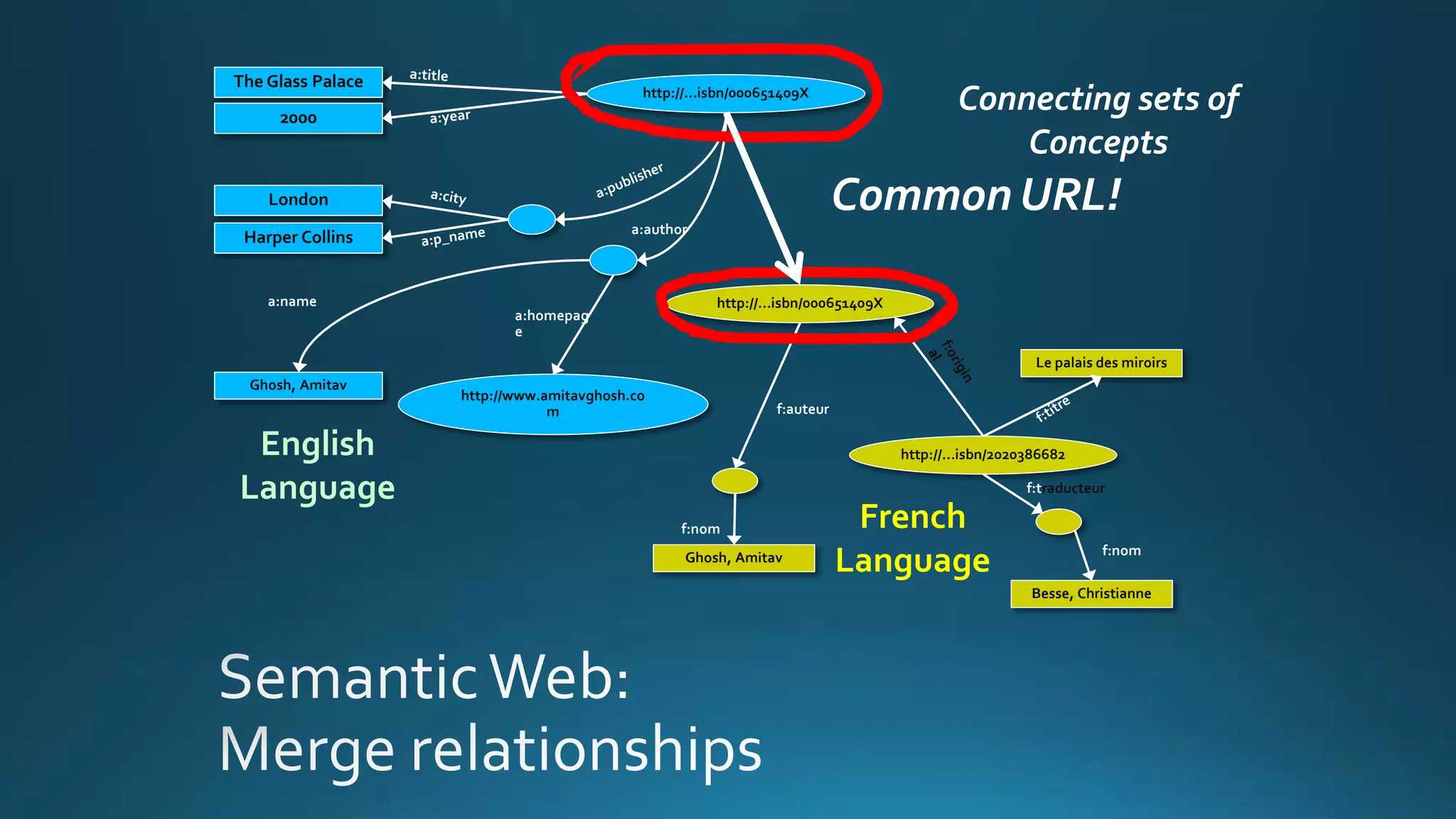
    http://…isbn/000651409X Ghosh, Amitav Besse, Christianne Lepalais des miroirs f:nom f:traducteur f:auteur http://…isbn/2020386682 f:nom http://…isbn/000651409X Ghosh, Amitav http://www.amitavghosh.co m The Glass Palace 2000 London Harper Collins a:name a:homepag e a:author Common URL! Connecting sets of Concepts French Language English Language
  • 36.
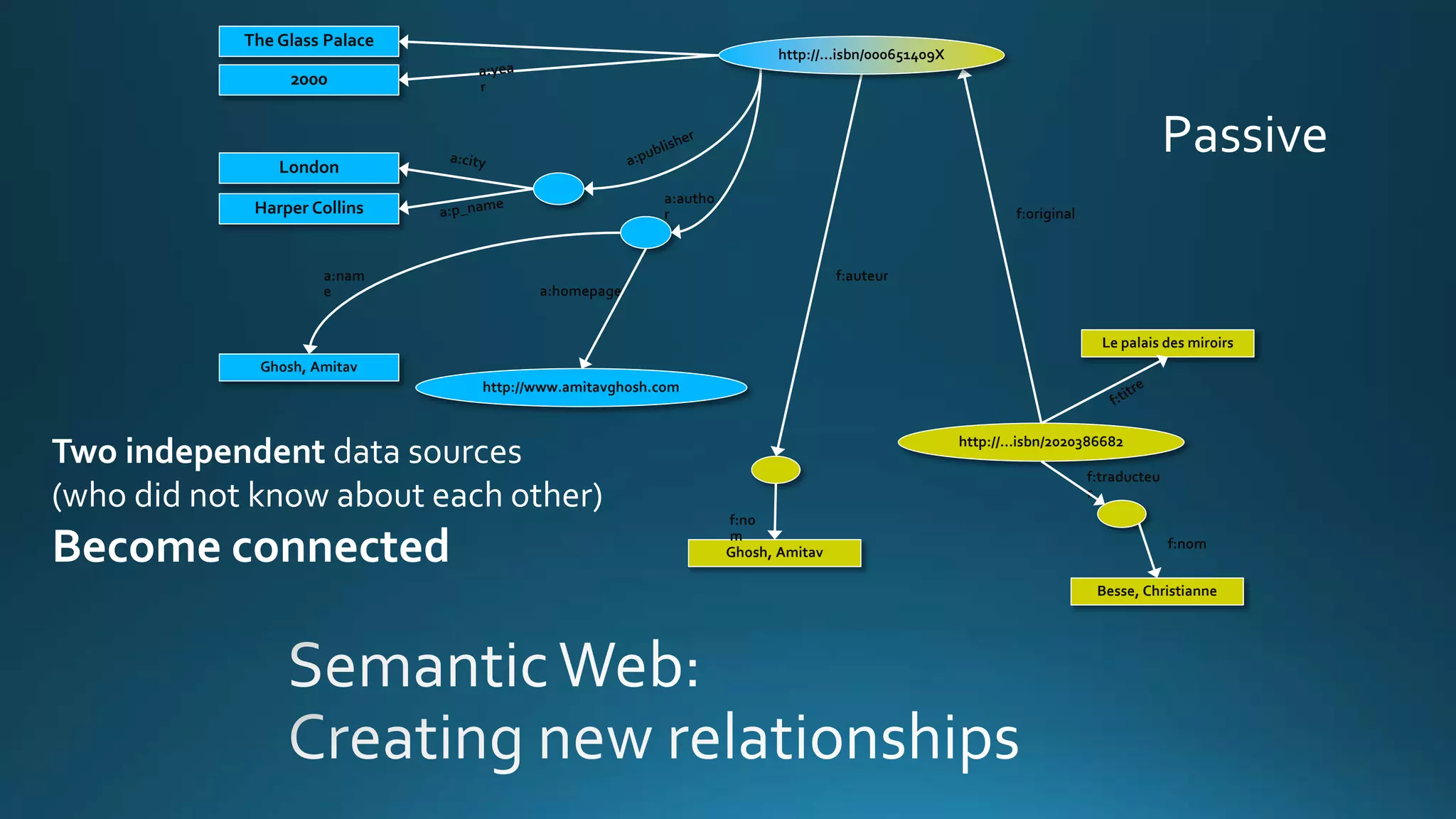
    Ghosh, Amitav Besse, Christianne Lepalais des miroirs f:original f:no m f:traducteu r f:auteur http://…isbn/2020386682 f:nom Ghosh, Amitav http://www.amitavghosh.com The Glass Palace 2000 London Harper Collins a:nam e a:homepage a:autho r http://…isbn/000651409X Two independent data sources (who did not know about each other) Become connected Passive
  • 37.
    Extraction of allthe bits of information within the data object CHEMKIN model: Extract set of molecules (with isomer,thermodynamic data) Extract set of reactions (with ‘isomer’, kinetic data, Extract relationships between molecules and molecules (related through reactions) molecules and reactions (reactants, products, etc.) reactions and reactions (reaction network information) Other Sources: Automatic Generation: Mechanism with the information as above, plus 2D-structure, reaction class information, substructure information Thermodynamic Calculators: more thermodynamic information (plus 2d-structures) Have to have database capacity to store this immense amount of info To be demonstrated today
  • 38.
    Chemkin Model I Chemkin Model II 2-DStructure Computational Chemistry Calculations Automatically Generated CHEMKIN Model 1-Butyl-3-hydroperoxide C4H11O2 ch2ch2ch(ooh)ch31-c4hh8-3-ooh hasSpecies hasSpecies hasSpecies hasThermo isIsomer isIsomer isIsomer Thermo hasThermo Thermo hasThermo Thermo
  • 39.
  • 40.
  • 41.
    Mechanism Reaction in mechanism Moleculein reaction Simple Species Name Isomer GRI#GRI-3.0#C3H7 Species in another mechanism
  • 43.
    Extremely large amountof Information Needs another Technology (even a small CHEMKIN mechanism translates to megabytes of information)
  • 45.
    Traversing through thenetwork of information is a tool to ‘analyze’ and extract more/new information
  • 46.
    Species (Isomer) asReactant asProduct Set Of Reactions Set Of Reactions Not just fromone Mechanism, but from all cataloged mechanisms Database as analytic device
  • 48.
  • 49.
    Database as analyticdevice isAProduct Species isAReactant Reaction isAProduct Species isAReactant Reaction isAProduct Species isAReactant Reaction Species Establishes a further relationship between two species Could even supplement Database Species1 PathTo Species2
  • 50.
    Database as analyticdevice CHEMKIN Mechanism Species are labels: Only know atomic composition (NASA polynomial) Not structure CHEMKIN Mechanism C3H7 N-C3H7 i-C3H7 Reactions (asProduct) Reactions (asReactant) Reactions (asProduct) Reactions (asReactant) Reactions (asProduct) Reactions (asReactant) Compare reactions (species as isomers) The set with the most similarities: wins
  • 51.
    Database as analyticdevice Reactions (asProduct) Reactions (asReactant) Reactions (asProduct) Reactions (asReactant) The set with the most similarities: wins C3H7 N-C3H7 A new relationship can be established For the cautious: The relationship can be qualified With a probability (related to degree of matching) For more certainty: One can extend the comparison through A larger network (path through two or more reactions)
  • 52.
    If one ofthe mechanisms is automatically generated Then have the 2D structure The species goes from a ‘label’ to a Species with a structure (can be further classified with substructures) Database as analytic device
  • 55.
    Account Sign in: Query: Whichdata do you have access to Data input: How is your data shared Security Inhibit hacking Social media concepts: groups Each data point has sharing and ownership parameters
  • 56.
    Transactions: How who andwhen was the data entered (or analysed) How was the database used: which queries Why? Have to filter query results are shown and order them Both personal and in general General Field (computer science): Recommendation Systems Each google search (from different people) gives different results eCommerce sites use this to
  • 57.
    Some basic functionalityis present: Reading in CHEMKIN mechanisms from many sources Management of RDFs Simple Query (single keyword search) Data Sources: Automatic generated mechanisms (mechanism) Data behind automatic generation (reaction classes, 2-D (sub)structures) Independent thermodynamic data Computational chemistry results Query More complex searches multiple keywords interpretation/preprocessing of keyword expression before search Ordering and filtering results (passive and with check boxes)
  • 58.
    See you there! Ifthe gods of the internet (and the demon - ’demo effect’) allows, you can try it out

Editor's Notes

  • #5 Cloud computing is a model for enabling convenient, on-demand network access to a shared pool of configurable computing resources (e.g., networks, servers, storage, applications, and services) that can be rapidly provisioned and released with minimal management effort or service provider interaction. cloud computing customers do not own the physical infrastructure. Cloud computing users avoid capital expenditure (CapEx) on hardware, software, and services when they pay a provider only for what they use. Low shared infrastructure and costs, low management overhead, and immediate access to a broad range of applications
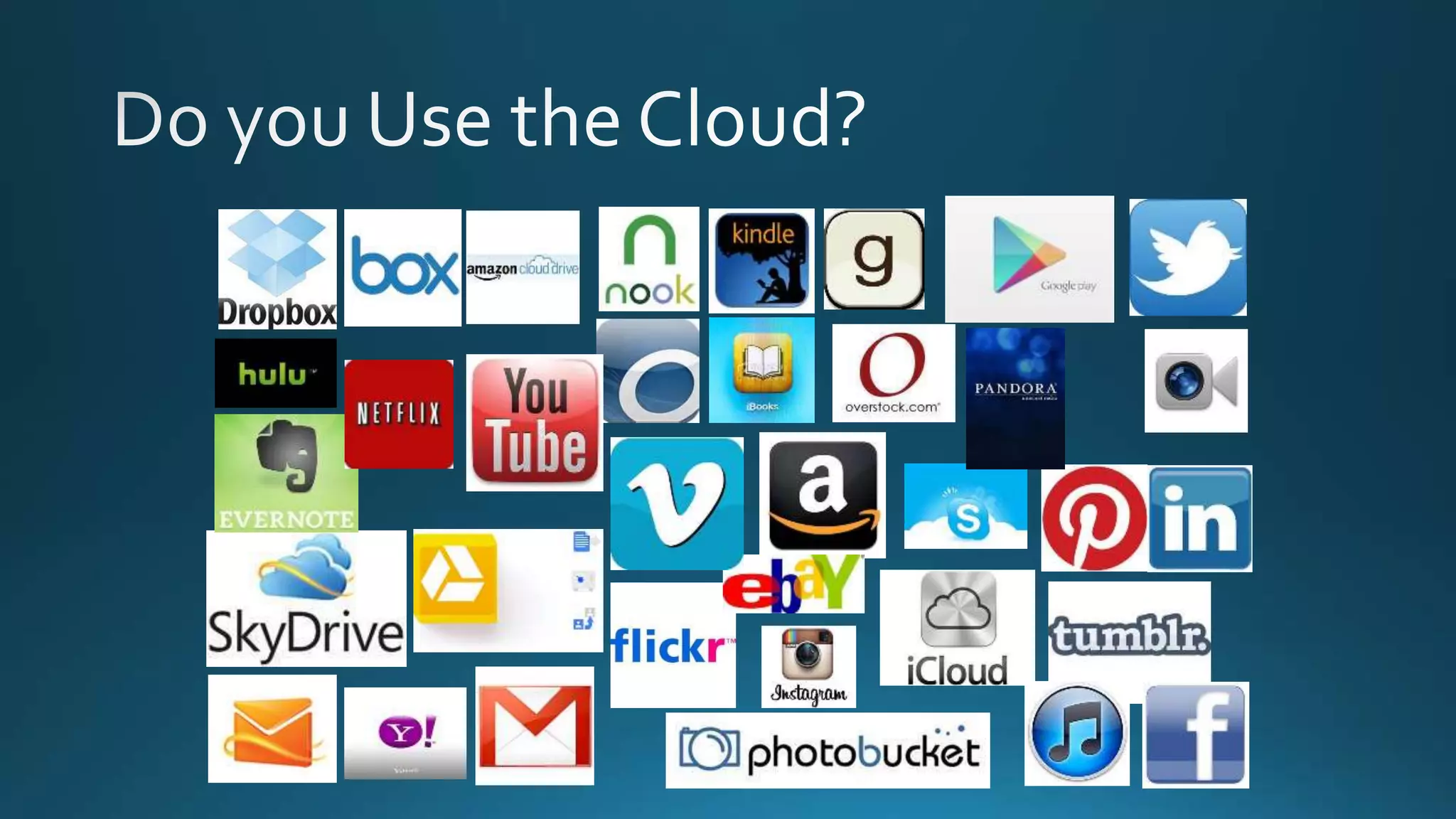
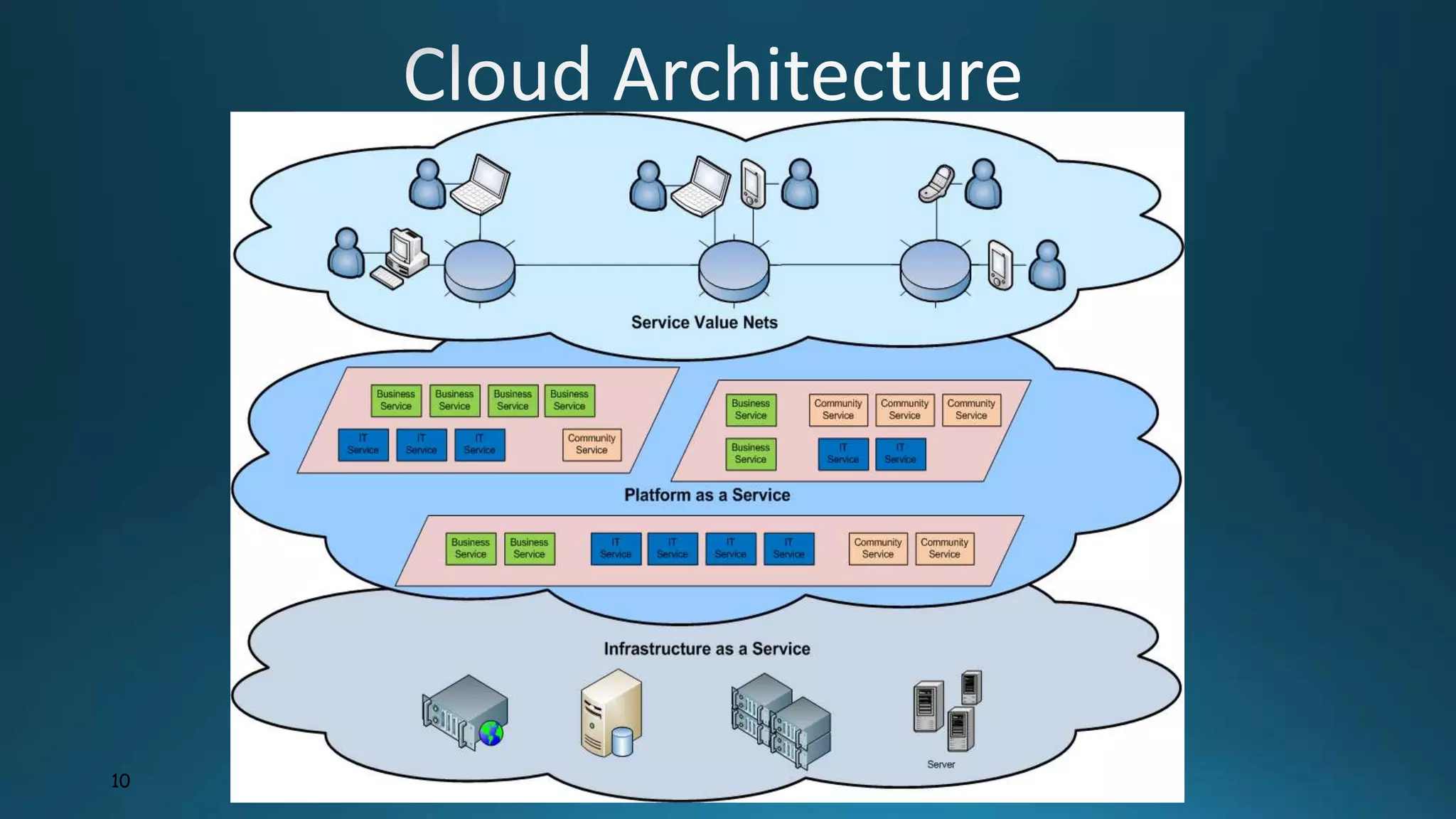
  • #8 Take the poll Have you used the cloud For one, two, three, or more of these services
  • #10 IaaSdelivers computer infrastructure, typically a platform virtualization environment, as a service. Rather than purchasing servers, software, data center space or network equipment, clients instead buy those resources as a fully outsourced service. PaaSdeliver a computing platform where the developers can develop their own applications. SaaSis a model of software deployment where the software applications are provided to the customers as a service.