RESEARCH POSTER PRESENTATION DESIGN © 2012
www.PosterPresentations.com
Goal	
  and	
  Challenges	
  
Ontologies	
  and	
  Metadata:	
  	
  
RelaAonships	
  between	
  the	
  data	
  
Interdependencies: A data point is not isolated
EvoluAon	
  of	
  data	
  exchange	
  
Degrees of Sharing and quality
Data	
  Use	
  and	
  QualificaAon	
  
Interdependecies within a model:
REACTION,	
  Lund,	
  Sweden	
  	
  	
  Blurock	
  Consul/ng	
  AB	
  
Edward	
  S.	
  Blurock	
  
The	
  Very	
  Open	
  Data	
  Project:	
  Characterizing	
  CombusAon	
  	
  
KineAc	
  Data	
  with	
  ontologies	
  and	
  meta-­‐data	
  
Derived	
  from	
  
Derived	
  from	
  
Used	
  in	
  
Complex	
  
Models	
  
Experiments	
  
Derived	
  from	
  
A	
  data	
  point	
  is	
  not	
  isolated	
  
When	
  the	
  other	
  data	
  changes,	


  It	
  effect	
  can	
  cascade	
  through	
  the	
  derived	
  data	
  
History: Models and data evolve
Time	
  History	
  
Proprietory	
  Public	
  
Shared	
  
Private	
  
Mechanism	
  
ReacAon	
  
Molecule	
  
Substructures	
  
Energy	
  
Energy	
  
ProperAes	
  
	
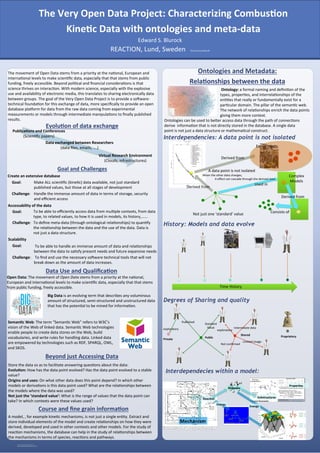
  Ontology:	
  a	
  formal	
  naming	
  and	
  defini/on	
  of	
  the	
  
types,	
  proper/es,	
  and	
  interrela/onships	
  of	
  the	
  
en//es	
  that	
  really	
  or	
  fundamentally	
  exist	
  for	
  a	
  
par/cular	
  domain.	
  The	
  pillar	
  of	
  the	
  seman/c	
  web.	
  
The	
  network	
  of	
  rela/onships	
  enrich	
  the	
  data	
  points	
  
giving	
  them	
  more	
  context.	
  
Open	
  Data:	
  The	
  movement	
  of	
  Open	
  Data	
  stems	
  from	
  a	
  priority	
  at	
  the	
  na/onal,	
  
European	
  and	
  interna/onal	
  levels	
  to	
  make	
  scien/fic	
  data,	
  especially	
  that	
  that	
  stems	
  
from	
  public	
  funding,	
  freely	
  accessible.	
  	
  
SemanAc	
  Web:	
  The	
  term	
  “Seman/c	
  Web”	
  refers	
  to	
  W3C’s	
  
vision	
  of	
  the	
  Web	
  of	
  linked	
  data.	
  Seman/c	
  Web	
  technologies	
  
enable	
  people	
  to	
  create	
  data	
  stores	
  on	
  the	
  Web,	
  build	
  
vocabularies,	
  and	
  write	
  rules	
  for	
  handling	
  data.	
  Linked	
  data	
  
are	
  empowered	
  by	
  technologies	
  such	
  as	
  RDF,	
  SPARQL,	
  OWL,	
  
and	
  SKOS.	
  
Big	
  Data	
  is	
  an	
  evolving	
  term	
  that	
  describes	
  any	
  voluminous	
  
amount	
  of	
  structured,	
  semi-­‐structured	
  and	
  unstructured	
  data	
  
that	
  has	
  the	
  poten/al	
  to	
  be	
  mined	
  for	
  informa/on.	
  
Beyond	
  just	
  Accessing	
  Data	
  
PublicaAons	
  and	
  Conferences	
  
(Scien/fic	
  papers)	
  
Data	
  exchanged	
  between	
  Researchers	
  
(data	
  files,	
  emails,	
  ….)	
  
Virtual	
  Research	
  Environment	
  
(Clouds,	
  infrastructures)	
  
Store	
  the	
  data	
  so	
  as	
  to	
  facilitate	
  answering	
  ques/ons	
  about	
  the	
  data:	
  
EvoluAon:	
  How	
  has	
  the	
  data	
  point	
  evolved?	
  Has	
  the	
  data	
  point	
  evolved	
  to	
  a	
  stable	
  
value?	
  
Origins	
  and	
  uses:	
  On	
  what	
  other	
  data	
  does	
  this	
  point	
  depend?	
  In	
  which	
  other	
  
models	
  or	
  deriva/ons	
  is	
  this	
  data	
  point	
  used?	
  What	
  are	
  the	
  rela/onships	
  between	
  
the	
  models	
  where	
  the	
  data	
  was	
  used?	
  
Not	
  just	
  the	
  ‘standard	
  value’:	
  What	
  is	
  the	
  range	
  of	
  values	
  that	
  the	
  data	
  point	
  can	
  
take?	
  In	
  which	
  contexts	
  were	
  these	
  values	
  used?	
  	
  
Intermdiate	
  data	
  
Published	
  
Standard	
  
Value	
  
Not	
  confirmed	
  
Limited	
  Usage	
  
exploratory	
   exploratory	
  
Not	
  just	
  one	
  ‘standard’	
  value	
  
Make	
  ALL	
  scien/fic	
  (kine/c)	
  data	
  available,	
  not	
  just	
  standard	
  
published	
  values,	
  but	
  those	
  at	
  all	
  stages	
  of	
  development	
  
Challenge:	
  
Goal:	
  
Create	
  an	
  extensive	
  database	
  
Handle	
  the	
  immense	
  amount	
  of	
  data	
  in	
  terms	
  of	
  storage,	
  security	
  
and	
  efficient	
  access	
  	
  
Challenge:	
  
Goal:	
  
Accessability	
  of	
  the	
  data	
  
To	
  define	
  meta-­‐data	
  (through	
  ontological	
  rela/onships)	
  to	
  quan/fy	
  
the	
  rela/onship	
  between	
  the	
  data	
  and	
  the	
  use	
  of	
  the	
  data.	
  Data	
  is	
  
not	
  just	
  a	
  data	
  structure.	
  
To	
  be	
  able	
  to	
  efficiently	
  access	
  data	
  from	
  mul/ple	
  contexts,	
  from	
  data	
  
type,	
  to	
  related	
  values,	
  to	
  how	
  it	
  is	
  used	
  in	
  models,	
  its	
  history,......	
  
The	
  movement	
  of	
  Open	
  Data	
  stems	
  from	
  a	
  priority	
  at	
  the	
  na/onal,	
  European	
  and	
  
interna/onal	
  levels	
  to	
  make	
  scien/fic	
  data,	
  especially	
  that	
  that	
  stems	
  from	
  public	
  
funding,	
  freely	
  accessible.	
  Beyond	
  poli/cal	
  and	
  financial	
  considera/ons	
  is	
  that	
  
science	
  thrives	
  on	
  interac/on.	
  With	
  modern	
  science,	
  especially	
  with	
  the	
  explosive	
  
use	
  and	
  availability	
  of	
  electronic	
  media,	
  this	
  translates	
  to	
  sharing	
  electronically	
  data	
  
between	
  groups.	
  The	
  goal	
  of	
  the	
  Very	
  Open	
  Data	
  Project	
  is	
  to	
  provide	
  a	
  soiware-­‐
technical	
  founda/on	
  for	
  this	
  exchange	
  of	
  data,	
  more	
  specifically	
  to	
  provide	
  an	
  open	
  
database	
  plajorm	
  for	
  data	
  from	
  the	
  raw	
  data	
  coming	
  from	
  experimental	
  
measurements	
  or	
  models	
  through	
  intermediate	
  manipula/ons	
  to	
  finally	
  published	
  
results.	
  	
  
Scalability	
  
Goal:	
  
Challenge:	
  
	
  To	
  be	
  able	
  to	
  handle	
  an	
  immense	
  amount	
  of	
  data	
  and	
  rela/onships	
  
between	
  the	
  data	
  to	
  sa/sfy	
  present	
  needs	
  and	
  future	
  expansive	
  needs	
  
	
  To	
  find	
  and	
  use	
  the	
  necessary	
  soiware	
  technical	
  tools	
  that	
  will	
  not	
  
break	
  down	
  as	
  the	
  amount	
  of	
  data	
  increases.	


Course	
  and	
  fine	
  grain	
  informaAon	
  
A	
  model,	
  ,	
  for	
  example	
  kine/c	
  mechanisms,	
  is	
  not	
  just	
  a	
  single	
  en/ty.	
  Extract	
  and	
  
store	
  individual	
  elements	
  of	
  the	
  model	
  and	
  create	
  rela/onships	
  on	
  how	
  they	
  were	
  
derived,	
  developed	
  and	
  used	
  in	
  other	
  contexts	
  and	
  other	
  models.	
  For	
  the	
  study	
  of	
  
reac/on	
  mechanisms,	
  the	
  database	
  can	
  help	
  in	
  the	
  study	
  of	
  rela/onships	
  between	
  
the	
  mechanisms	
  in	
  terms	
  of	
  species,	
  reac/ons	
  and	
  pathways.	
  	
  
Ontologies	
  can	
  be	
  used	
  to	
  beker	
  access	
  data	
  through	
  the	
  path	
  of	
  connec/ons	
  
derive	
  	
  informa/on	
  that	
  is	
  not	
  directly	
  stored	
  in	
  the	
  database.	
  A	
  single	
  data	
  
point	
  is	
  not	
  just	
  a	
  data	
  structure	
  or	
  mathema/cal	
  construct.	


Consists	
  of	
  

Poster: Very Open Data Project

  • 1.
    RESEARCH POSTER PRESENTATIONDESIGN © 2012 www.PosterPresentations.com Goal  and  Challenges   Ontologies  and  Metadata:     RelaAonships  between  the  data   Interdependencies: A data point is not isolated EvoluAon  of  data  exchange   Degrees of Sharing and quality Data  Use  and  QualificaAon   Interdependecies within a model: REACTION,  Lund,  Sweden      Blurock  Consul/ng  AB   Edward  S.  Blurock   The  Very  Open  Data  Project:  Characterizing  CombusAon     KineAc  Data  with  ontologies  and  meta-­‐data   Derived  from   Derived  from   Used  in   Complex   Models   Experiments   Derived  from   A  data  point  is  not  isolated   When  the  other  data  changes,                                      It  effect  can  cascade  through  the  derived  data   History: Models and data evolve Time  History   Proprietory  Public   Shared   Private   Mechanism   ReacAon   Molecule   Substructures   Energy   Energy   ProperAes    Ontology:  a  formal  naming  and  defini/on  of  the   types,  proper/es,  and  interrela/onships  of  the   en//es  that  really  or  fundamentally  exist  for  a   par/cular  domain.  The  pillar  of  the  seman/c  web.   The  network  of  rela/onships  enrich  the  data  points   giving  them  more  context.   Open  Data:  The  movement  of  Open  Data  stems  from  a  priority  at  the  na/onal,   European  and  interna/onal  levels  to  make  scien/fic  data,  especially  that  that  stems   from  public  funding,  freely  accessible.     SemanAc  Web:  The  term  “Seman/c  Web”  refers  to  W3C’s   vision  of  the  Web  of  linked  data.  Seman/c  Web  technologies   enable  people  to  create  data  stores  on  the  Web,  build   vocabularies,  and  write  rules  for  handling  data.  Linked  data   are  empowered  by  technologies  such  as  RDF,  SPARQL,  OWL,   and  SKOS.   Big  Data  is  an  evolving  term  that  describes  any  voluminous   amount  of  structured,  semi-­‐structured  and  unstructured  data   that  has  the  poten/al  to  be  mined  for  informa/on.   Beyond  just  Accessing  Data   PublicaAons  and  Conferences   (Scien/fic  papers)   Data  exchanged  between  Researchers   (data  files,  emails,  ….)   Virtual  Research  Environment   (Clouds,  infrastructures)   Store  the  data  so  as  to  facilitate  answering  ques/ons  about  the  data:   EvoluAon:  How  has  the  data  point  evolved?  Has  the  data  point  evolved  to  a  stable   value?   Origins  and  uses:  On  what  other  data  does  this  point  depend?  In  which  other   models  or  deriva/ons  is  this  data  point  used?  What  are  the  rela/onships  between   the  models  where  the  data  was  used?   Not  just  the  ‘standard  value’:  What  is  the  range  of  values  that  the  data  point  can   take?  In  which  contexts  were  these  values  used?     Intermdiate  data   Published   Standard   Value   Not  confirmed   Limited  Usage   exploratory   exploratory   Not  just  one  ‘standard’  value   Make  ALL  scien/fic  (kine/c)  data  available,  not  just  standard   published  values,  but  those  at  all  stages  of  development   Challenge:   Goal:   Create  an  extensive  database   Handle  the  immense  amount  of  data  in  terms  of  storage,  security   and  efficient  access     Challenge:   Goal:   Accessability  of  the  data   To  define  meta-­‐data  (through  ontological  rela/onships)  to  quan/fy   the  rela/onship  between  the  data  and  the  use  of  the  data.  Data  is   not  just  a  data  structure.   To  be  able  to  efficiently  access  data  from  mul/ple  contexts,  from  data   type,  to  related  values,  to  how  it  is  used  in  models,  its  history,......   The  movement  of  Open  Data  stems  from  a  priority  at  the  na/onal,  European  and   interna/onal  levels  to  make  scien/fic  data,  especially  that  that  stems  from  public   funding,  freely  accessible.  Beyond  poli/cal  and  financial  considera/ons  is  that   science  thrives  on  interac/on.  With  modern  science,  especially  with  the  explosive   use  and  availability  of  electronic  media,  this  translates  to  sharing  electronically  data   between  groups.  The  goal  of  the  Very  Open  Data  Project  is  to  provide  a  soiware-­‐ technical  founda/on  for  this  exchange  of  data,  more  specifically  to  provide  an  open   database  plajorm  for  data  from  the  raw  data  coming  from  experimental   measurements  or  models  through  intermediate  manipula/ons  to  finally  published   results.     Scalability   Goal:   Challenge:    To  be  able  to  handle  an  immense  amount  of  data  and  rela/onships   between  the  data  to  sa/sfy  present  needs  and  future  expansive  needs    To  find  and  use  the  necessary  soiware  technical  tools  that  will  not   break  down  as  the  amount  of  data  increases.       Course  and  fine  grain  informaAon   A  model,  ,  for  example  kine/c  mechanisms,  is  not  just  a  single  en/ty.  Extract  and   store  individual  elements  of  the  model  and  create  rela/onships  on  how  they  were   derived,  developed  and  used  in  other  contexts  and  other  models.  For  the  study  of   reac/on  mechanisms,  the  database  can  help  in  the  study  of  rela/onships  between   the  mechanisms  in  terms  of  species,  reac/ons  and  pathways.     Ontologies  can  be  used  to  beker  access  data  through  the  path  of  connec/ons   derive    informa/on  that  is  not  directly  stored  in  the  database.  A  single  data   point  is  not  just  a  data  structure  or  mathema/cal  construct.       Consists  of