Uninformed Search Algorithms
Uninformed search
• Uninformed search is a class of general-purpose search algorithms
• Which operates in brute force-way.
• Uninformed search algorithms do not have additional information about
state or search space other than how to traverse the tree, so it is also
called blind search.
1. Following are the various types of uninformed search algorithms:
2. Breadth-first Search
3. Depth-first Search
4. Depth-limited Search
5. Iterative deepening depth-first search
6. Uniform cost search
7. Bidirectional Search
1. Breadth-first Search:
• Breadth-first search is the most common search strategy for
traversing a tree or graph. This algorithm searches breadthwise in a
tree or graph, so it is called breadth-first search.
• BFS algorithm starts searching from the root node of the tree and
expands all successor node at the current level before moving to
nodes of next level.
• The breadth-first search algorithm is an example of a general-graph
search algorithm.
• Breadth-first search implemented using FIFO queue data structure.
Advantages:
• BFS will provide a solution if any solution exists.
• If there are more than one solutions for a given problem, then BFS
will provide the minimal solution which requires the least number of
steps.
Disadvantages:
• It requires lots of memory since each level of the tree must be saved
into memory to expand the next level.
• BFS needs lots of time if the solution is far away from the root node.
Example:
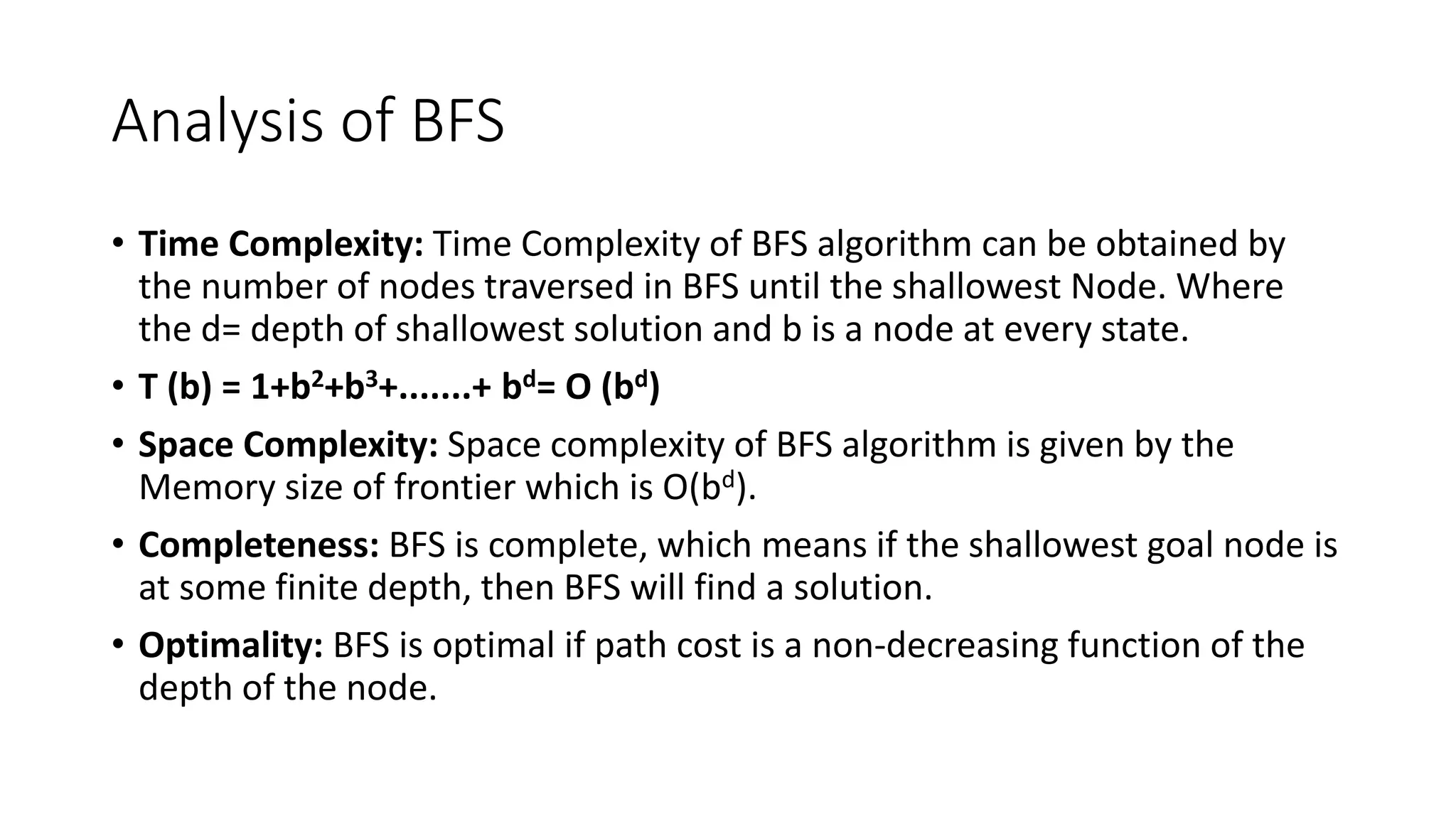
Analysis of BFS
• Time Complexity: Time Complexity of BFS algorithm can be obtained by
the number of nodes traversed in BFS until the shallowest Node. Where
the d= depth of shallowest solution and b is a node at every state.
• T (b) = 1+b2+b3+.......+ bd= O (bd)
• Space Complexity: Space complexity of BFS algorithm is given by the
Memory size of frontier which is O(bd).
• Completeness: BFS is complete, which means if the shallowest goal node is
at some finite depth, then BFS will find a solution.
• Optimality: BFS is optimal if path cost is a non-decreasing function of the
depth of the node.
2. Depth-first Search
• Depth-first search isa recursive algorithm for traversing a tree or
graph data structure.
• It is called the depth-first search because it starts from the root node
and follows each path to its greatest depth node before moving to the
next path.
• DFS uses a stack data structure for its implementation.
• The process of the DFS algorithm is similar to the BFS algorithm.
• Note: Backtracking is an algorithm technique for finding all possible
solutions using recursion.
Advantage:
• DFS requires very less memory as it only needs to store a stack of the
nodes on the path from root node to the current node.
• It takes less time to reach to the goal node than BFS algorithm (if it
traverses in the right path).
Disadvantage:
• There is the possibility that many states keep re-occurring, and there
is no guarantee of finding the solution.
• DFS algorithm goes for deep down searching and sometime it may go
to the infinite loop.
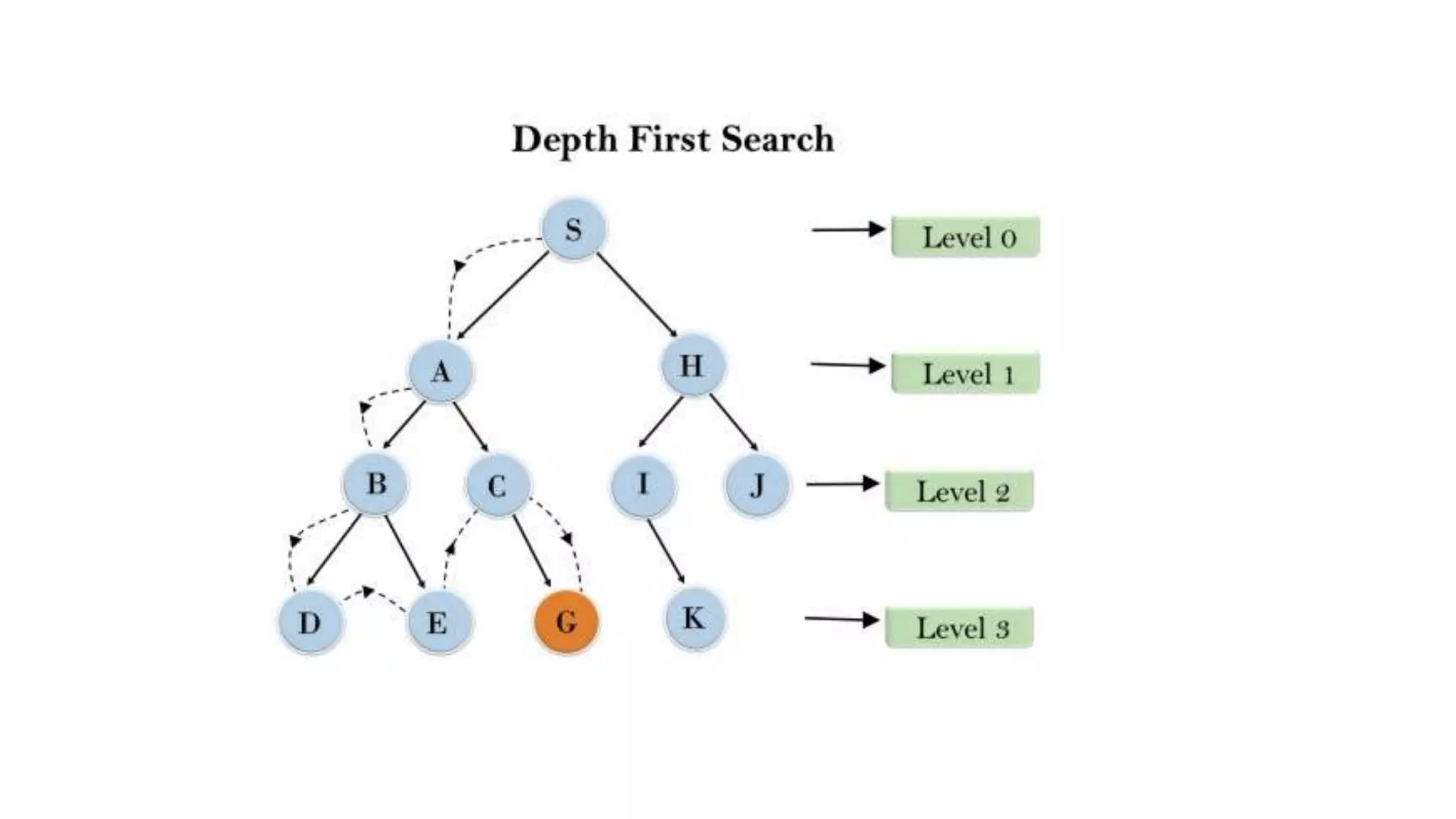
Example
• In the below search tree, we have shown the flow of depth-first
search, and it will follow the order as:
• Root node--->Left node ----> right node.
• It will start searching from root node S, and traverse A, then B, then D
and E, after traversing E, it will backtrack the tree as E has no other
successor and still goal node is not found. After backtracking it will
traverse node C and then G, and here it will terminate as it found goal
node.
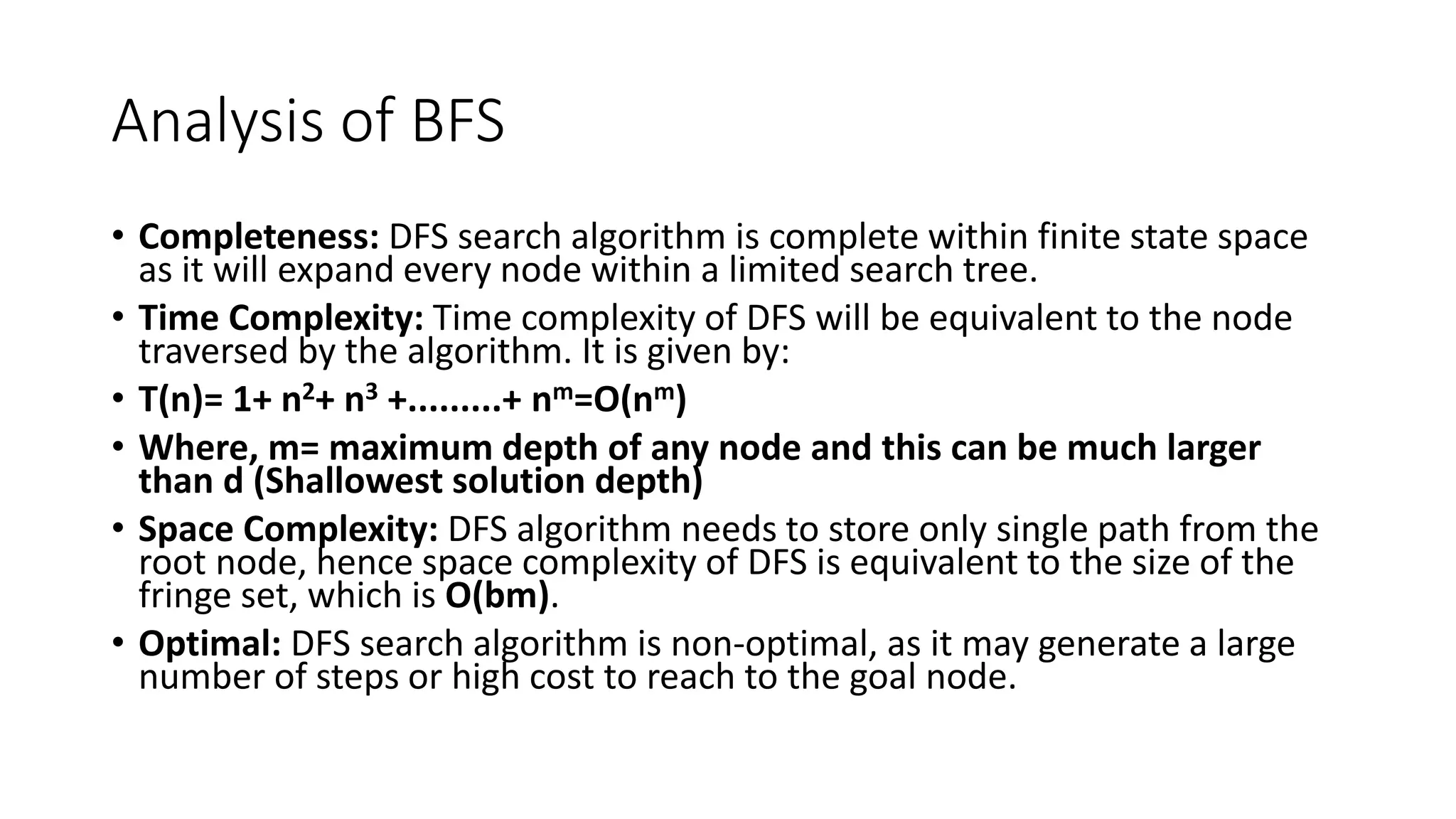
Analysis of BFS
• Completeness: DFS search algorithm is complete within finite state space
as it will expand every node within a limited search tree.
• Time Complexity: Time complexity of DFS will be equivalent to the node
traversed by the algorithm. It is given by:
• T(n)= 1+ n2+ n3 +.........+ nm=O(nm)
• Where, m= maximum depth of any node and this can be much larger
than d (Shallowest solution depth)
• Space Complexity: DFS algorithm needs to store only single path from the
root node, hence space complexity of DFS is equivalent to the size of the
fringe set, which is O(bm).
• Optimal: DFS search algorithm is non-optimal, as it may generate a large
number of steps or high cost to reach to the goal node.
3. Depth-Limited Search Algorithm:
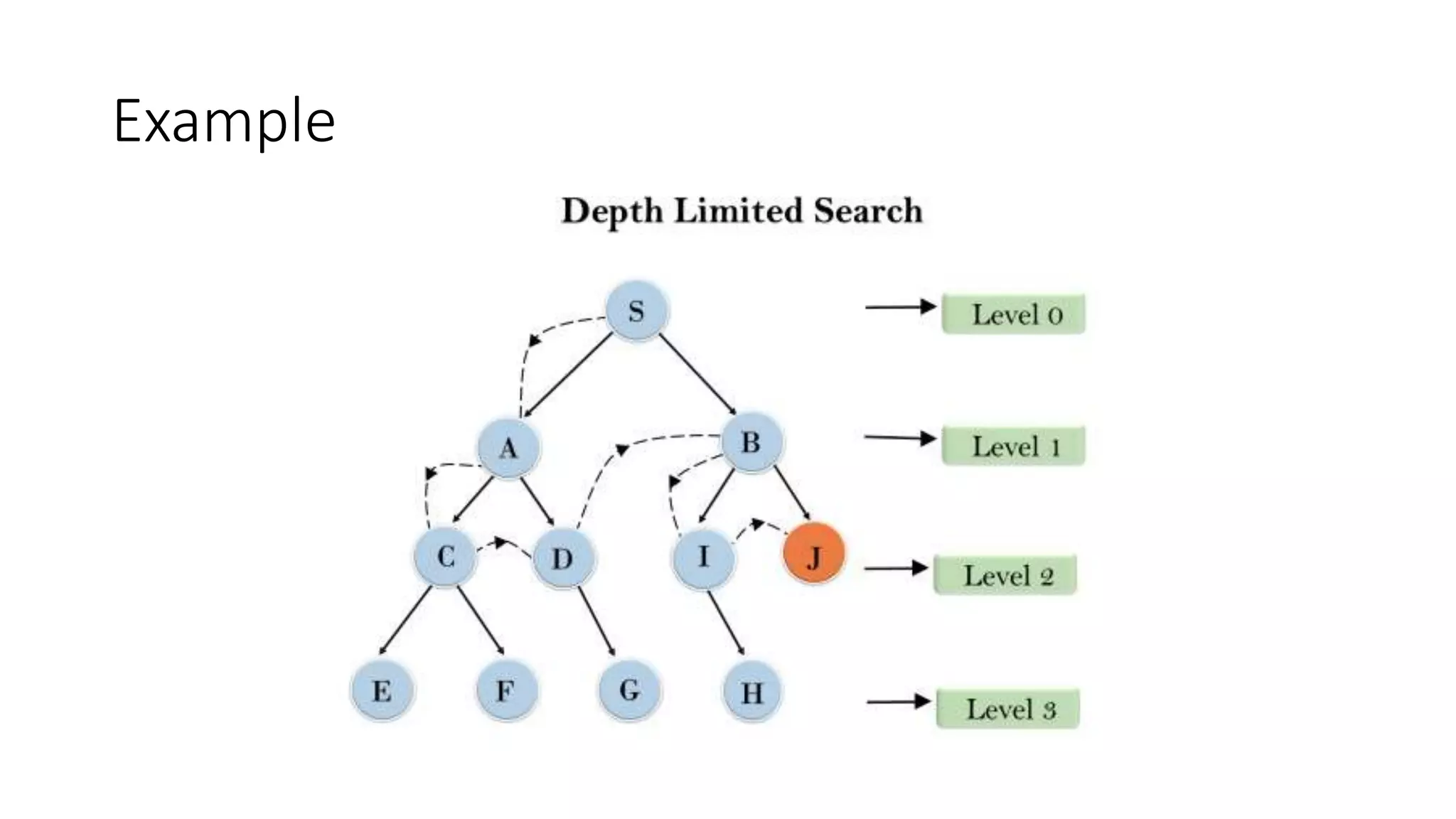
• A depth-limited search algorithm is similar to depth-first search with a
predetermined limit. Depth-limited search can solve the drawback of
the infinite path in the Depth-first search. In this algorithm, the node
at the depth limit will treat as it has no successor nodes further.
• Depth-limited search can be terminated with two Conditions of
failure:
• Standard failure value: It indicates that problem does not have any
solution.
• Cutoff failure value: It defines no solution for the problem within a
given depth limit.
Advantages
• Depth-limited search is Memory efficient.
Disadvantages:
• Depth-limited search also has a disadvantage of incompleteness.
• It may not be optimal if the problem has more than one solution.
Example
Analysis of DLS
• Completeness: DLS search algorithm is complete if the solution is
above the depth-limit.
• Time Complexity: Time complexity of DLS algorithm is O(bℓ).
• Space Complexity: Space complexity of DLS algorithm is O(b×ℓ).
• Optimal: Depth-limited search can be viewed as a special case of DFS,
and it is also not optimal even if ℓ>d.

uninformed search part 1.pptx

  • 1.
  • 2.
    Uninformed search • Uninformedsearch is a class of general-purpose search algorithms • Which operates in brute force-way. • Uninformed search algorithms do not have additional information about state or search space other than how to traverse the tree, so it is also called blind search. 1. Following are the various types of uninformed search algorithms: 2. Breadth-first Search 3. Depth-first Search 4. Depth-limited Search 5. Iterative deepening depth-first search 6. Uniform cost search 7. Bidirectional Search
  • 3.
    1. Breadth-first Search: •Breadth-first search is the most common search strategy for traversing a tree or graph. This algorithm searches breadthwise in a tree or graph, so it is called breadth-first search. • BFS algorithm starts searching from the root node of the tree and expands all successor node at the current level before moving to nodes of next level. • The breadth-first search algorithm is an example of a general-graph search algorithm. • Breadth-first search implemented using FIFO queue data structure.
  • 4.
    Advantages: • BFS willprovide a solution if any solution exists. • If there are more than one solutions for a given problem, then BFS will provide the minimal solution which requires the least number of steps.
  • 5.
    Disadvantages: • It requireslots of memory since each level of the tree must be saved into memory to expand the next level. • BFS needs lots of time if the solution is far away from the root node.
  • 6.
  • 7.
    Analysis of BFS •Time Complexity: Time Complexity of BFS algorithm can be obtained by the number of nodes traversed in BFS until the shallowest Node. Where the d= depth of shallowest solution and b is a node at every state. • T (b) = 1+b2+b3+.......+ bd= O (bd) • Space Complexity: Space complexity of BFS algorithm is given by the Memory size of frontier which is O(bd). • Completeness: BFS is complete, which means if the shallowest goal node is at some finite depth, then BFS will find a solution. • Optimality: BFS is optimal if path cost is a non-decreasing function of the depth of the node.
  • 8.
    2. Depth-first Search •Depth-first search isa recursive algorithm for traversing a tree or graph data structure. • It is called the depth-first search because it starts from the root node and follows each path to its greatest depth node before moving to the next path. • DFS uses a stack data structure for its implementation. • The process of the DFS algorithm is similar to the BFS algorithm. • Note: Backtracking is an algorithm technique for finding all possible solutions using recursion.
  • 9.
    Advantage: • DFS requiresvery less memory as it only needs to store a stack of the nodes on the path from root node to the current node. • It takes less time to reach to the goal node than BFS algorithm (if it traverses in the right path).
  • 10.
    Disadvantage: • There isthe possibility that many states keep re-occurring, and there is no guarantee of finding the solution. • DFS algorithm goes for deep down searching and sometime it may go to the infinite loop.
  • 11.
    Example • In thebelow search tree, we have shown the flow of depth-first search, and it will follow the order as: • Root node--->Left node ----> right node. • It will start searching from root node S, and traverse A, then B, then D and E, after traversing E, it will backtrack the tree as E has no other successor and still goal node is not found. After backtracking it will traverse node C and then G, and here it will terminate as it found goal node.
  • 13.
    Analysis of BFS •Completeness: DFS search algorithm is complete within finite state space as it will expand every node within a limited search tree. • Time Complexity: Time complexity of DFS will be equivalent to the node traversed by the algorithm. It is given by: • T(n)= 1+ n2+ n3 +.........+ nm=O(nm) • Where, m= maximum depth of any node and this can be much larger than d (Shallowest solution depth) • Space Complexity: DFS algorithm needs to store only single path from the root node, hence space complexity of DFS is equivalent to the size of the fringe set, which is O(bm). • Optimal: DFS search algorithm is non-optimal, as it may generate a large number of steps or high cost to reach to the goal node.
  • 14.
    3. Depth-Limited SearchAlgorithm: • A depth-limited search algorithm is similar to depth-first search with a predetermined limit. Depth-limited search can solve the drawback of the infinite path in the Depth-first search. In this algorithm, the node at the depth limit will treat as it has no successor nodes further. • Depth-limited search can be terminated with two Conditions of failure: • Standard failure value: It indicates that problem does not have any solution. • Cutoff failure value: It defines no solution for the problem within a given depth limit.
  • 15.
  • 16.
    Disadvantages: • Depth-limited searchalso has a disadvantage of incompleteness. • It may not be optimal if the problem has more than one solution.
  • 17.
  • 18.
    Analysis of DLS •Completeness: DLS search algorithm is complete if the solution is above the depth-limit. • Time Complexity: Time complexity of DLS algorithm is O(bℓ). • Space Complexity: Space complexity of DLS algorithm is O(b×ℓ). • Optimal: Depth-limited search can be viewed as a special case of DFS, and it is also not optimal even if ℓ>d.