FUNCTIONS
At the end of the session, the teacher-participants are expected to:
1. represents real-life situations using functions, including piece-wise
functions.
2. evaluates a function.
3. performs addition, subtraction, multiplication, division, and composition
of functions.
4. solves problems involving functions.
PRIMING ACTIVITY
I’m going to show you a series of graphs.
Determine whether or not these graphs are
functions.
You do not need to draw the graphs in your
notes.
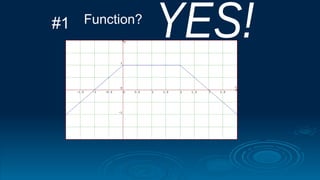
#1 Function?
Function?
#2
Function?
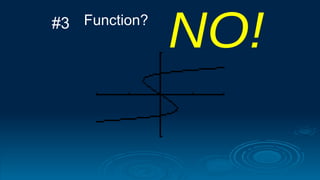
#3
Function?
#4
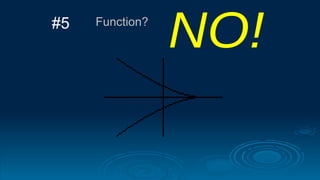
Function?
#5
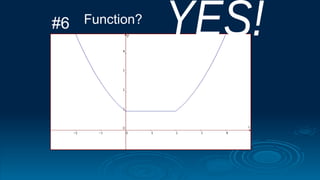
#6 Function?
Function?
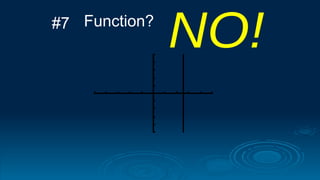
#7
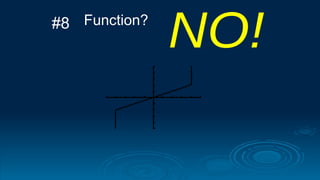
Function?
#8
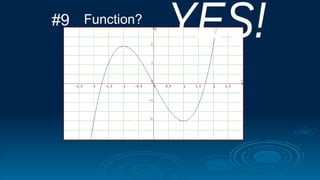
#9 Function?
Function?
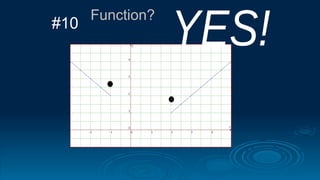
#10
Function?
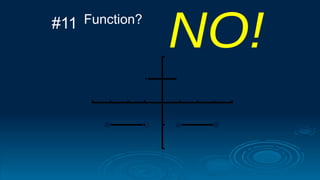
#11
Function?
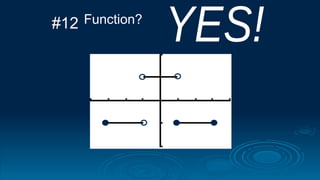
#12
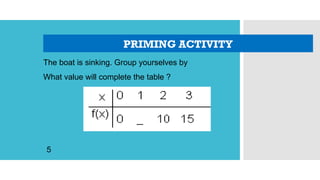
PRIMING ACTIVITY
The boat is sinking. Group yourselves by
What value will complete the table ?
5
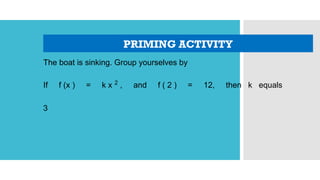
PRIMING ACTIVITY
The boat is sinking. Group yourselves by
If f (x ) = k x 2
, and f ( 2 ) = 12, then k equals
3
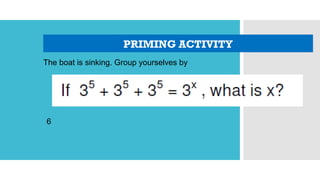
PRIMING ACTIVITY
The boat is sinking. Group yourselves by
6
MANUEL S. ENVERGA UNIVERSITY FOUNDATION
An Autonomous University
BASIC EDUCATION DEPARTMENT
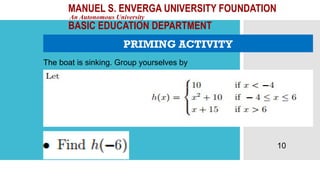
PRIMING ACTIVITY
10
The boat is sinking. Group yourselves by
MANUEL S. ENVERGA UNIVERSITY FOUNDATION
An Autonomous University
BASIC EDUCATION DEPARTMENT
ACTIVITY 1 (Group Work) (15 min)
1. You are given four graphs, four equations, four tables, and four rules.
2. Your task is to match each graph with an equation, a table and a rule.
3. Compare your results and describe their properties.
4. The team leaders of the groups report their conclusions to the whole
class.
Sorting Functions
MANUEL S. ENVERGA UNIVERSITY FOUNDATION
An Autonomous University
BASIC EDUCATION DEPARTMENT
ACTIVITY 1 (Group Work) (15 min)
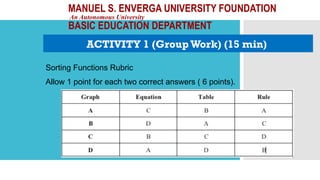
Allow 1 point for each two correct answers ( 6 points).
Sorting Functions Rubric
MANUEL S. ENVERGA UNIVERSITY FOUNDATION
An Autonomous University
BASIC EDUCATION DEPARTMENT
ACTIVITY 1 (Group Work) (15 min)
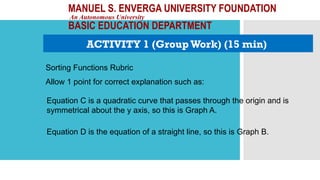
Allow 1 point for correct explanation such as:
Sorting Functions Rubric
Equation C is a quadratic curve that passes through the origin and is
symmetrical about the y axis, so this is Graph A.
Equation D is the equation of a straight line, so this is Graph B.
MANUEL S. ENVERGA UNIVERSITY FOUNDATION
An Autonomous University
BASIC EDUCATION DEPARTMENT
ACTIVITY 1 (Group Work) (15 min)
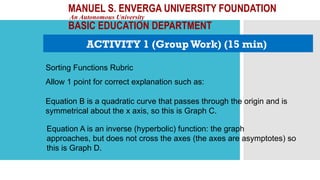
Allow 1 point for correct explanation such as:
Sorting Functions Rubric
Equation B is a quadratic curve that passes through the origin and is
symmetrical about the x axis, so this is Graph C.
Equation A is an inverse (hyperbolic) function: the graph
approaches, but does not cross the axes (the axes are asymptotes) so
this is Graph D.
MANUEL S. ENVERGA UNIVERSITY FOUNDATION
An Autonomous University
BASIC EDUCATION DEPARTMENT
ANALYSIS
1. How did you find the activity matching each graph with an equation, a
table or a rule?
2. What did you find difficult about this task?
3. Have you encountered any problem or difficulty in performing your
task? Cite them.
4. What are some common errors which students may commit? How can
we prevent such error? Feel free to offer a suggestion.
MANUEL S. ENVERGA UNIVERSITY FOUNDATION
An Autonomous University
BASIC EDUCATION DEPARTMENT
ABSTRACTION
LEARNING AREA STANDARD:
At the end of the course, the students must know how to solve problems
involving rational, exponential and logarithmic functions; to solve business-
related problems; and to apply logic to real-life situations.
CONTENT STANDARD:
The learner demonstrates understanding of key concepts of functions.
MANUEL S. ENVERGA UNIVERSITY FOUNDATION
An Autonomous University
BASIC EDUCATION DEPARTMENT
ABSTRACTION
PERFORMANCE STANDARD:
The learner is able to accurately construct mathematical models to
represent real-life situations using functions.
MANUEL S. ENVERGA UNIVERSITY FOUNDATION
An Autonomous University
BASIC EDUCATION DEPARTMENT
ABSTRACTION
LEARNING COMPETENCIES:
The learners ...
a. represents real-life situations using functions, including piece-wise
functions.
b. evaluates a function.
c. performs addition, subtraction, multiplication, division, and composition
of functions.
d. solves problems involving functions.
MANUEL S. ENVERGA UNIVERSITY FOUNDATION
An Autonomous University
BASIC EDUCATION DEPARTMENT
RELATIONS AND FUNCTIONS
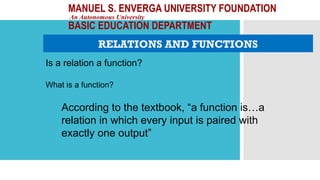
Is a relation a function?
According to the textbook, “a function is…a
relation in which every input is paired with
exactly one output”
What is a function?
MANUEL S. ENVERGA UNIVERSITY FOUNDATION
An Autonomous University
BASIC EDUCATION DEPARTMENT
RELATIONS AND FUNCTIONS
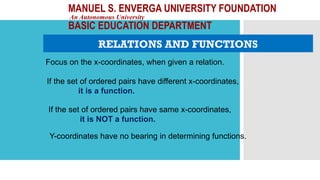
Focus on the x-coordinates, when given a relation.
If the set of ordered pairs have different x-coordinates,
it is a function.
Y-coordinates have no bearing in determining functions.
If the set of ordered pairs have same x-coordinates,
it is NOT a function.
MANUEL S. ENVERGA UNIVERSITY FOUNDATION
An Autonomous University
BASIC EDUCATION DEPARTMENT
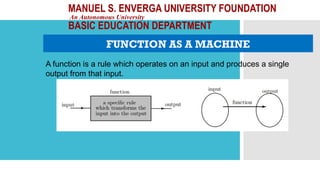
FUNCTION AS A MACHINE
A function is a rule which operates on an input and produces a single
output from that input.
MANUEL S. ENVERGA UNIVERSITY FOUNDATION
An Autonomous University
BASIC EDUCATION DEPARTMENT
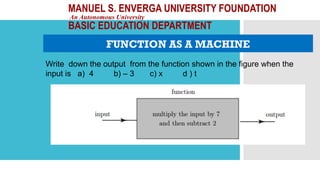
FUNCTION AS A MACHINE
Write down the output from the function shown in the figure when the
input is a) 4 b) – 3 c) x d ) t
MANUEL S. ENVERGA UNIVERSITY FOUNDATION
An Autonomous University
BASIC EDUCATION DEPARTMENT
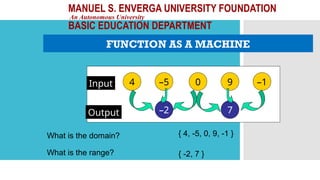
FUNCTION AS A MACHINE
What is the domain? { 4, -5, 0, 9, -1 }
What is the range? { -2, 7 }
Input 4 –5 0 9 –1
–2 7
Output
MANUEL S. ENVERGA UNIVERSITY FOUNDATION
An Autonomous University
BASIC EDUCATION DEPARTMENT
FUNCTIONS AND RELATIONS AS A SET OF
ORDERED PAIRS
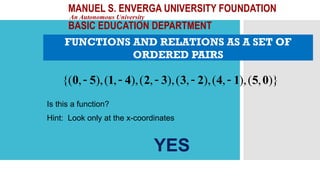
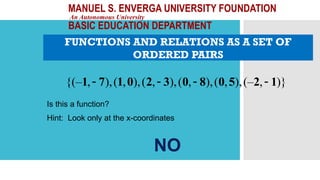
If a relation have the same first coordinate but different second
coordinates, then it is not a function
MANUEL S. ENVERGA UNIVERSITY FOUNDATION
An Autonomous University
BASIC EDUCATION DEPARTMENT
Is this a function?
Hint: Look only at the x-coordinates
YES
{( , ),( , ),( , ),( , ),( , ),( , )}
    
0 5 1 4 2 3 3 2 4 1 5 0
FUNCTIONS AND RELATIONS AS A SET OF
ORDERED PAIRS
MANUEL S. ENVERGA UNIVERSITY FOUNDATION
An Autonomous University
BASIC EDUCATION DEPARTMENT
Is this a function?
Hint: Look only at the x-coordinates
NO
{(– , ),( , ),( , ),( , ),( , ),(– , )}
   
1 7 1 0 2 3 0 8 0 5 2 1
FUNCTIONS AND RELATIONS AS A SET OF
ORDERED PAIRS
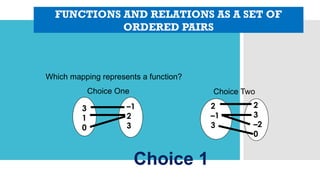
Which mapping represents a function?
Choice 1
Choice One
3
1
0
–1
2
3
Choice Two
2
–1
3
2
3
–2
0
FUNCTIONS AND RELATIONS AS A SET OF
ORDERED PAIRS
MANUEL S. ENVERGA UNIVERSITY FOUNDATION
An Autonomous University
BASIC EDUCATION DEPARTMENT
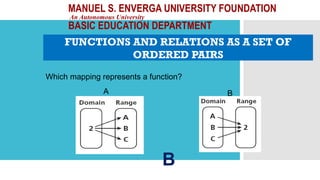
Which mapping represents a function?
B
A B
FUNCTIONS AND RELATIONS AS A SET OF
ORDERED PAIRS
MANUEL S. ENVERGA UNIVERSITY FOUNDATION
An Autonomous University
BASIC EDUCATION DEPARTMENT
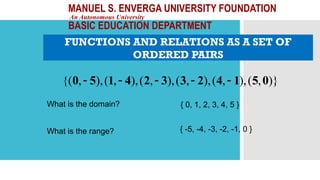
What is the domain?
{( , ),( , ),( , ),( , ),( , ),( , )}
    
0 5 1 4 2 3 3 2 4 1 5 0
{ 0, 1, 2, 3, 4, 5 }
What is the range? { -5, -4, -3, -2, -1, 0 }
FUNCTIONS AND RELATIONS AS A SET OF
ORDERED PAIRS
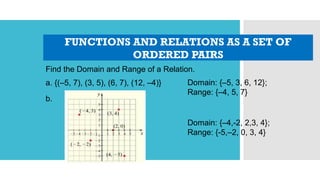
Find the Domain and Range of a Relation.
a. {(–5, 7), (3, 5), (6, 7), (12, –4)}
Domain: {–4,-2, 2,3, 4};
Range: {-5,–2, 0, 3, 4}
b.
Domain: {–5, 3, 6, 12};
Range: {–4, 5, 7}
FUNCTIONS AND RELATIONS AS A SET OF
ORDERED PAIRS
MANUEL S. ENVERGA UNIVERSITY FOUNDATION
An Autonomous University
BASIC EDUCATION DEPARTMENT
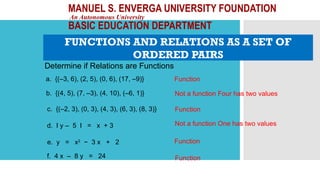
Determine if Relations are Functions
a. {(–3, 6), (2, 5), (0, 6), (17, –9)}
b. {(4, 5), (7, –3), (4, 10), (–6, 1)}
c. {(–2, 3), (0, 3), (4, 3), (6, 3), (8, 3)}
d. I y – 5 I = x + 3
e. y = x2
− 3 x + 2
f. 4 x – 8 y = 24
Function
Not a function Four has two values
Function
Not a function One has two values
Function
Function
FUNCTIONS AND RELATIONS AS A SET OF
ORDERED PAIRS
MANUEL S. ENVERGA UNIVERSITY FOUNDATION
An Autonomous University
BASIC EDUCATION DEPARTMENT
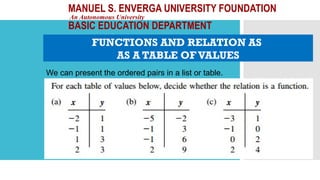
FUNCTIONS AND RELATION AS
AS A TABLE OFVALUES
We can present the ordered pairs in a list or table.
MANUEL S. ENVERGA UNIVERSITY FOUNDATION
An Autonomous University
BASIC EDUCATION DEPARTMENT
FUNCTIONS AS A GRAPH IN THE
CARTESIAN PLANE
We can use a graph to indicate the ordered pairs. The graph can show
distinct ordered pairs, or it can show all the ordered pairs on a line or
curve.
Find the Domain and Range of a Relation.
c.
Domain is { x | – 5 ≤ x ≤ 5 }
in set-builder notation
or [ – 5, 5 ] in interval notation
Range is { y | – 3 ≤ y ≤ 4}
in set-builder notation
or [ – 3, 4 ] in interval notation
FUNCTIONS AS A GRAPH IN THE
CARTESIAN PLANE
Find the Domain and Range of a Relation.
d.
Domain is { x | x ≤ 3 }
in set-builder notation
or (– ∞, 3] in interval notation
Range is in set-builder notation
ℝ
or ( – ∞, ∞ ) in interval notation
Domain is or ( – ∞, ∞ )
ℝ
Range is { y | y ≥ 0 } or ( 0, ∞ )
FUNCTIONS AS A GRAPH IN THE
CARTESIAN PLANE
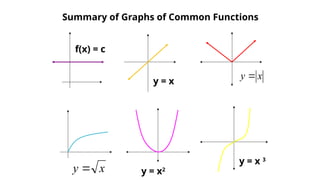
Summary of Graphs of Common Functions
f(x) = c
y = x
x
y 
x
y  y = x2
y = x 3
MANUEL S. ENVERGA UNIVERSITY FOUNDATION
An Autonomous University
BASIC EDUCATION DEPARTMENT
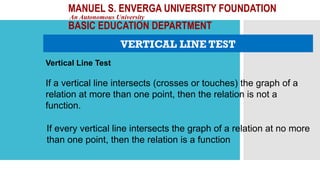
VERTICAL LINE TEST
Vertical Line Test
If a vertical line intersects (crosses or touches) the graph of a
relation at more than one point, then the relation is not a
function.
If every vertical line intersects the graph of a relation at no more
than one point, then the relation is a function
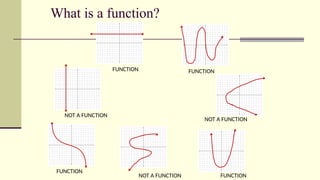
What is a function?
FUNCTION FUNCTION
NOT A FUNCTION
FUNCTION
FUNCTION
NOT A FUNCTION
NOT A FUNCTION
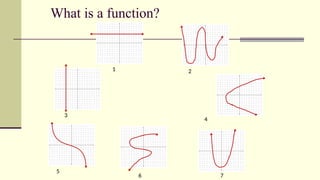
What is a function?
1 2
3
5
7
4
6
MANUEL S. ENVERGA UNIVERSITY FOUNDATION
An Autonomous University
BASIC EDUCATION DEPARTMENT
Functions in the real world
Money as a function of time. You never have more than one amount of
money at any time because you can always add everything to give one
total amount.
Temperature as a function of various factors. Temperature is a very
complicated function because it has so many inputs, including: the time of
day, the season, the amount of clouds in the sky, the strength of the wind,
where you are and many more.
Location as a function of time. You can never be in two places at the same
time.
FUNCTIONS AS REPRESENTATIONS
OF REAL LIFE SITUATIONS
MANUEL S. ENVERGA UNIVERSITY FOUNDATION
An Autonomous University
BASIC EDUCATION DEPARTMENT
Which situation represents a function?
a
a. The items in a store to their prices on a certain date
Solution:
b. Types of fruits to their colors
FUNCTIONS AS REPRESENTATIONS
OF REAL LIFE SITUATIONS
MANUEL S. ENVERGA UNIVERSITY FOUNDATION
An Autonomous University
BASIC EDUCATION DEPARTMENT
Real-life situation
Identify whether the relation that exists between each
of the following pairs indicates a functions or not.
1. A jeepney to its plate number.
2. A teacher to his/her cellular phone.
3. A pen to its ink color.
4. A student to his/her student number.
F
Not F
Not F
F
FUNCTIONS AS REPRESENTATIONS
OF REAL LIFE SITUATIONS
MANUEL S. ENVERGA UNIVERSITY FOUNDATION
An Autonomous University
BASIC EDUCATION DEPARTMENT
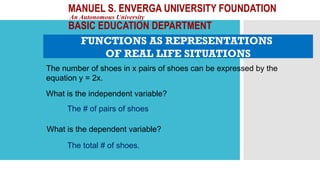
The number of shoes in x pairs of shoes can be expressed by the
equation y = 2x.
Whole numbers
What subset of the real numbers makes sense for the domain?
What would make sense for the range of the function?
Zero and the even numbers
FUNCTIONS AS REPRESENTATIONS
OF REAL LIFE SITUATIONS
MANUEL S. ENVERGA UNIVERSITY FOUNDATION
An Autonomous University
BASIC EDUCATION DEPARTMENT
The # of pairs of shoes
What is the independent variable?
What is the dependent variable?
The total # of shoes.
FUNCTIONS AS REPRESENTATIONS
OF REAL LIFE SITUATIONS
The number of shoes in x pairs of shoes can be expressed by the
equation y = 2x.
MANUEL S. ENVERGA UNIVERSITY FOUNDATION
An Autonomous University
BASIC EDUCATION DEPARTMENT
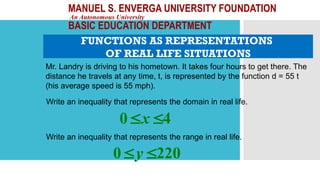
Mr. Landry is driving to his hometown. It takes four hours to get there. The
distance he travels at any time, t, is represented by the function d = 55 t
(his average speed is 55 mph).
Write an inequality that represents the domain in real life.
Write an inequality that represents the range in real life.
0 4
x
 
0 220
y
 
FUNCTIONS AS REPRESENTATIONS
OF REAL LIFE SITUATIONS
MANUEL S. ENVERGA UNIVERSITY FOUNDATION
An Autonomous University
BASIC EDUCATION DEPARTMENT
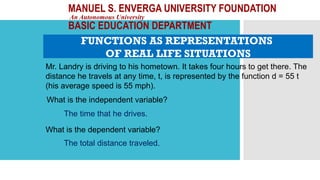
What is the independent variable?
What is the dependent variable?
The time that he drives.
The total distance traveled.
FUNCTIONS AS REPRESENTATIONS
OF REAL LIFE SITUATIONS
Mr. Landry is driving to his hometown. It takes four hours to get there. The
distance he travels at any time, t, is represented by the function d = 55 t
(his average speed is 55 mph).
MANUEL S. ENVERGA UNIVERSITY FOUNDATION
An Autonomous University
BASIC EDUCATION DEPARTMENT
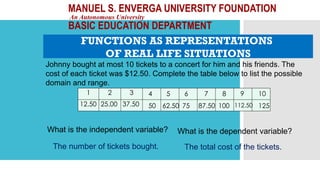
Johnny bought at most 10 tickets to a concert for him and his friends. The
cost of each ticket was $12.50. Complete the table below to list the possible
domain and range.
What is the independent variable? What is the dependent variable?
The number of tickets bought. The total cost of the tickets.
1 2 3
12.50 25.00 37.50
4
50
5
62.50
6 7 8 9 10
75 125
112.50
100
87.50
FUNCTIONS AS REPRESENTATIONS
OF REAL LIFE SITUATIONS
MANUEL S. ENVERGA UNIVERSITY FOUNDATION
An Autonomous University
BASIC EDUCATION DEPARTMENT
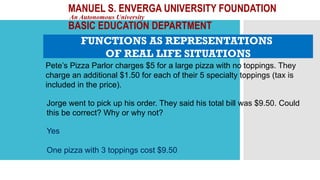
Pete’s Pizza Parlor charges $5 for a large pizza with no toppings. They
charge an additional $1.50 for each of their 5 specialty toppings (tax is
included in the price).
Jorge went to pick up his order. They said his total bill was $9.50. Could
this be correct? Why or why not?
Yes
One pizza with 3 toppings cost $9.50
FUNCTIONS AS REPRESENTATIONS
OF REAL LIFE SITUATIONS
MANUEL S. ENVERGA UNIVERSITY FOUNDATION
An Autonomous University
BASIC EDUCATION DEPARTMENT
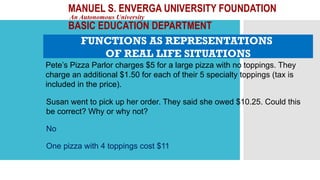
Pete’s Pizza Parlor charges $5 for a large pizza with no toppings. They
charge an additional $1.50 for each of their 5 specialty toppings (tax is
included in the price).
Susan went to pick up her order. They said she owed $10.25. Could this
be correct? Why or why not?
No
One pizza with 4 toppings cost $11
FUNCTIONS AS REPRESENTATIONS
OF REAL LIFE SITUATIONS
MANUEL S. ENVERGA UNIVERSITY FOUNDATION
An Autonomous University
BASIC EDUCATION DEPARTMENT
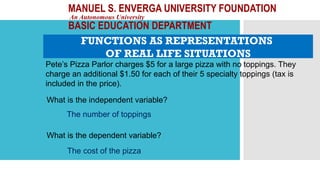
Pete’s Pizza Parlor charges $5 for a large pizza with no toppings. They
charge an additional $1.50 for each of their 5 specialty toppings (tax is
included in the price).
What is the independent variable?
The number of toppings
The cost of the pizza
What is the dependent variable?
FUNCTIONS AS REPRESENTATIONS
OF REAL LIFE SITUATIONS
MANUEL S. ENVERGA UNIVERSITY FOUNDATION
An Autonomous University
BASIC EDUCATION DEPARTMENT
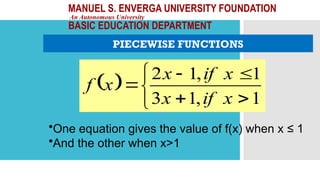
PIECEWISE FUNCTIONS
Up to now, we’ve been looking at functions represented by a
single equation.
In real life, however, functions are represented by a
combination of equations, each corresponding to a part of the
domain.
These are called piecewise functions.
MANUEL S. ENVERGA UNIVERSITY FOUNDATION
An Autonomous University
BASIC EDUCATION DEPARTMENT
PIECEWISE FUNCTIONS
 








1
,
1
3
1
,
1
2
x
if
x
x
if
x
x
f
•One equation gives the value of f(x) when x ≤ 1
•And the other when x>1
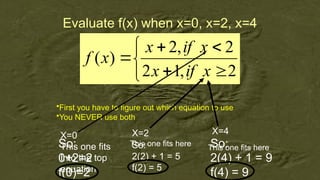
Evaluate f(x) when x=0, x=2, x=4








2
,
1
2
2
,
2
)
(
x
if
x
x
if
x
x
f
•First you have to figure out which equation to use
•You NEVER use both
X=0
This one fits
Into the top
equation
So:
0+2=2
f(0)=2
X=2
This one fits here
So:
2(2) + 1 = 5
f(2) = 5
X=4
This one fits here
So:
2(4) + 1 = 9
f(4) = 9
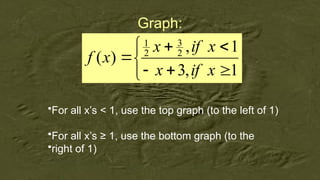
Graph:









1
,
3
1
,
)
( 2
3
2
1
x
if
x
x
if
x
x
f
•For all x’s < 1, use the top graph (to the left of 1)
•For all x’s ≥ 1, use the bottom graph (to the
•right of 1)
1
2
3
, 1
2
( )
3, 1
x if x
f x
x if x

 


  


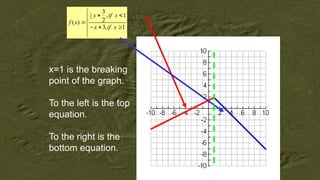
x=1 is the breaking
point of the graph.
To the left is the top
equation.
To the right is the
bottom equation.
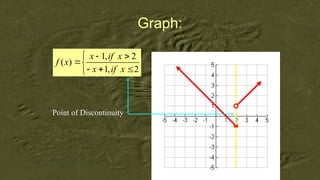
Graph:
1, 2
( )
1, 2
x if x
f x
x if x
  

  

Point of Discontinuity
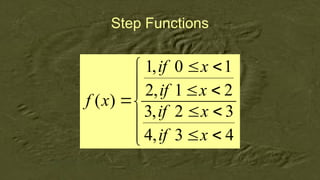
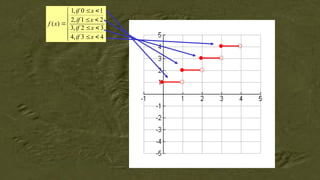
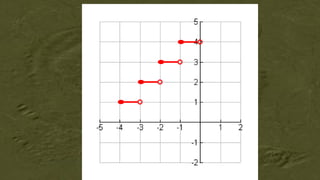
Step Functions
















4
3
,
4
3
2
,
3
2
1
,
2
1
0
,
1
)
(
x
if
x
if
x
if
x
if
x
f
















4
3
,
4
3
2
,
3
2
1
,
2
1
0
,
1
)
(
x
if
x
if
x
if
x
if
x
f
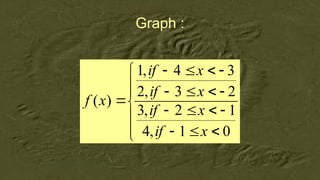
Graph :























0
1
,
4
1
2
,
3
2
3
,
2
3
4
,
1
)
(
x
if
x
if
x
if
x
if
x
f
Special Step Functions
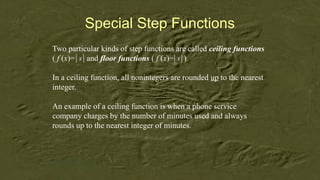
Two particular kinds of step functions are called ceiling functions
( f (x)= and floor functions ( f (x)= ).
In a ceiling function, all nonintegers are rounded up to the nearest
integer.
An example of a ceiling function is when a phone service
company charges by the number of minutes used and always
rounds up to the nearest integer of minutes.
x
 
  x
 
 
Special Step Functions
In a floor function, all nonintegers are rounded down to the
nearest integer.
The way we usually count our age is an example of a floor
function since we round our age down to the nearest year and do
not add a year to our age until we have passed our birthday.
The floor function is the same thing as the greatest integer
function which can be written as f (x)=[x].
MANUEL S. ENVERGA UNIVERSITY FOUNDATION
An Autonomous University
BASIC EDUCATION DEPARTMENT
Greatest integer function: f(x) = [x]
For example:
[2.1] = 2, i.e. greatest integer less than or equal to 2.1 is 2, similarly
[–2.1] = –3
[2] = 2
[3 . 9] = 3
[–3 . 9] = –4
PIECEWISE FUNCTIONS
MANUEL S. ENVERGA UNIVERSITY FOUNDATION
An Autonomous University
BASIC EDUCATION DEPARTMENT
PIECEWISE FUNCTIONS
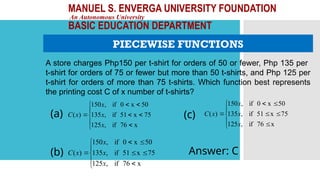
A store charges Php150 per t-shirt for orders of 50 or fewer, Php 135 per
t-shirt for orders of 75 or fewer but more than 50 t-shirts, and Php 125 per
t-shirt for orders of more than 75 t-shirts. Which function best represents
the printing cost C of x number of t-shirts?
(a)
(b) Answer: C
(c)











x
76
if
,
125
5
7
x
51
if
,
135
50
x
0
if
,
150
)
(
x
x
x
x
C











x
76
if
,
125
5
7
x
51
if
,
135
50
x
0
if
,
150
)
(
x
x
x
x
C











x
76
if
,
125
5
7
x
51
if
,
135
50
x
0
if
,
150
)
(
x
x
x
x
C
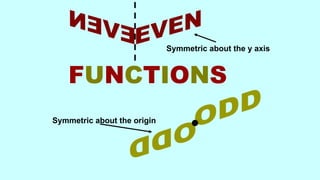
FUNCTIONS
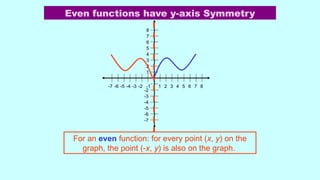
Symmetric about the y axis
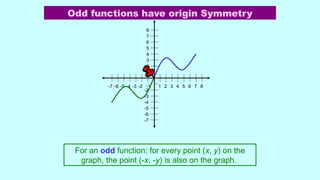
Symmetric about the origin
2
-7 -6 -5 -4 -3 -2 -1 1 5 7
3
0 4 6 8
7
1
2
3
4
5
6
8
-2
-3
-4
-5
-6
-7
For an even function: for every point (x, y) on the
graph, the point (-x, y) is also on the graph.
Even functions have y-axis Symmetry
2
-7 -6 -5 -4 -3 -2 -1 1 5 7
3
0 4 6 8
7
1
2
3
4
5
6
8
-2
-3
-4
-5
-6
-7
For an odd function: for every point (x, y) on the
graph, the point (-x, -y) is also on the graph.
Odd functions have origin Symmetry
2
-7 -6 -5 -4 -3 -2 -1 1 5 7
3
0 4 6 8
7
1
2
3
4
5
6
8
-2
-3
-4
-5
-6
-7
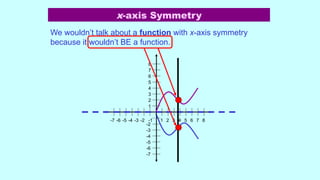
We wouldn’t talk about a function with x-axis symmetry
because it wouldn’t BE a function.
x-axis Symmetry
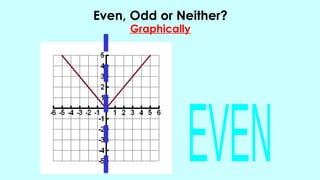
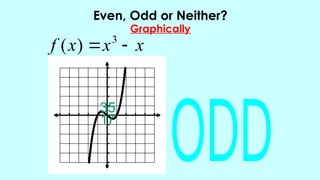
Even, Odd or Neither?
Graphically
f x x x
( )  
3
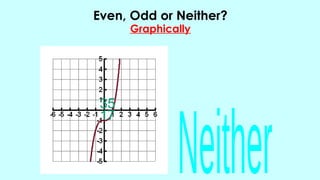
Even, Odd or Neither?
Graphically


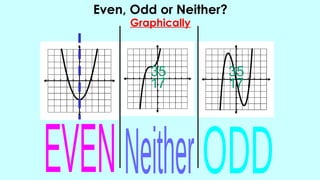
Even, Odd or Neither?
Graphically
 
Even, Odd or Neither?
Graphically
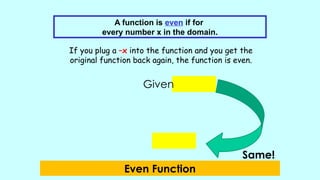
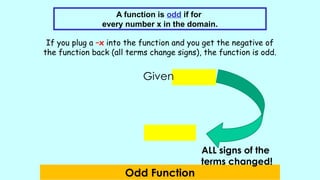
Given
A function is even if for
every number x in the domain.
If you plug a –x into the function and you get the
original function back again, the function is even.
Same!
Even Function
Given
A function is odd if for
every number x in the domain.
If you plug a –x into the function and you get the negative of
the function back (all terms change signs), the function is odd.
Odd Function
ALL signs of the
terms changed!
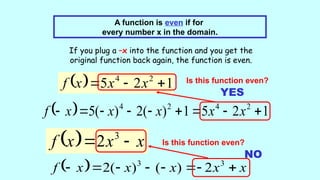
A function is even if for
every number x in the domain.
If you plug a –x into the function and you get the
original function back again, the function is even.
  1
2
5 2
4


 x
x
x
f Is this function even?
  1
2
5
1
)
(
2
)
(
5 2
4
2
4








 x
x
x
x
x
f
YES
  x
x
x
f 
 3
2 Is this function even?
  x
x
x
x
x
f 






 3
3
2
)
(
)
(
2
NO
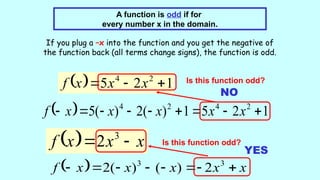
A function is odd if for
every number x in the domain.
If you plug a –x into the function and you get the negative of
the function back (all terms change signs), the function is odd.
  1
2
5 2
4


 x
x
x
f Is this function odd?
  1
2
5
1
)
(
2
)
(
5 2
4
2
4








 x
x
x
x
x
f
NO
  x
x
x
f 
 3
2 Is this function odd?
  x
x
x
x
x
f 






 3
3
2
)
(
)
(
2
YES
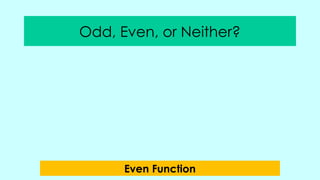
Odd, Even, or Neither?
Even Function
Odd, Even, or Neither?
Neither Odd or Even
Odd, Even, or Neither?
Odd Function
MANUEL S. ENVERGA UNIVERSITY FOUNDATION
An Autonomous University
BASIC EDUCATION DEPARTMENT
EVALUATING FUNCTIONS
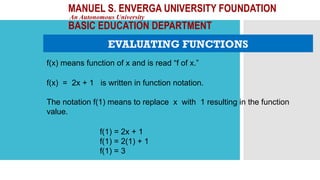
f(x) means function of x and is read “f of x.”
f(x) = 2x + 1 is written in function notation.
The notation f(1) means to replace x with 1 resulting in the function
value.
f(1) = 2x + 1
f(1) = 2(1) + 1
f(1) = 3
MANUEL S. ENVERGA UNIVERSITY FOUNDATION
An Autonomous University
BASIC EDUCATION DEPARTMENT
EVALUATING FUNCTIONS
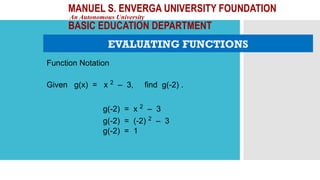
Function Notation
Given g(x) = x 2
– 3, find g(-2) .
g(-2) = x 2
– 3
g(-2) = (-2) 2
– 3
g(-2) = 1
MANUEL S. ENVERGA UNIVERSITY FOUNDATION
An Autonomous University
BASIC EDUCATION DEPARTMENT
EVALUATING FUNCTIONS
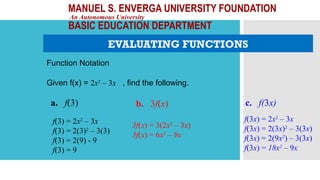
Function Notation
Given f(x) = 2x2
– 3x , find the following.
a. f(3) b. 3f(x) c. f(3x)
f(3) = 2x2
– 3x
f(3) = 2(3)2
– 3(3)
f(3) = 2(9) - 9
f(3) = 9
3f(x) = 3(2x2
– 3x)
3f(x) = 6x2
– 9x
f(3x) = 2x2
– 3x
f(3x) = 2(3x)2
– 3(3x)
f(3x) = 2(9x2
) – 3(3x)
f(3x) = 18x2
– 9x
MANUEL S. ENVERGA UNIVERSITY FOUNDATION
An Autonomous University
BASIC EDUCATION DEPARTMENT
EVALUATING FUNCTIONS
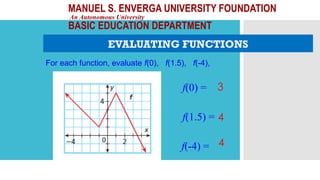
For each function, evaluate f(0), f(1.5), f(-4),
f(0) =
f(1.5) =
f(-4) =
3
4
4
MANUEL S. ENVERGA UNIVERSITY FOUNDATION
An Autonomous University
BASIC EDUCATION DEPARTMENT
EVALUATING FUNCTIONS
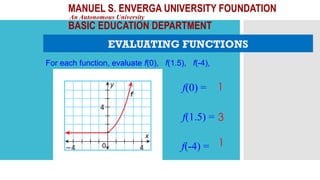
For each function, evaluate f(0), f(1.5), f(-4),
f(0) =
f(1.5) =
f(-4) =
1
3
1
MANUEL S. ENVERGA UNIVERSITY FOUNDATION
An Autonomous University
BASIC EDUCATION DEPARTMENT
EVALUATING FUNCTIONS
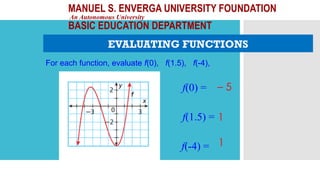
For each function, evaluate f(0), f(1.5), f(-4),
f(0) =
f(1.5) =
f(-4) =
– 5
1
1
MANUEL S. ENVERGA UNIVERSITY FOUNDATION
An Autonomous University
BASIC EDUCATION DEPARTMENT
EVALUATING FUNCTIONS
Given f(x) = x2
– 4x + 7 Find.
h
x
f
h
x
f )
(
)
( 

h
x
x
h
x
h
x ]
7
4
[
]
7
)
(
4
)
[( 2
2








h
x
x
h
x
h
xh
x 7
4
7
4
4
2 2
2
2









h
h
h
xh 4
2 2



h
h
x
h )
4
2
( 

 = 2x + h - 4
MANUEL S. ENVERGA UNIVERSITY FOUNDATION
An Autonomous University
BASIC EDUCATION DEPARTMENT
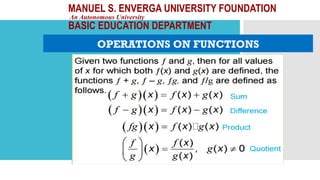
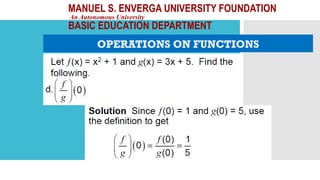
OPERATIONS ON FUNCTIONS
MANUEL S. ENVERGA UNIVERSITY FOUNDATION
An Autonomous University
BASIC EDUCATION DEPARTMENT
OPERATIONS ON FUNCTIONS
MANUEL S. ENVERGA UNIVERSITY FOUNDATION
An Autonomous University
BASIC EDUCATION DEPARTMENT
OPERATIONS ON FUNCTIONS
MANUEL S. ENVERGA UNIVERSITY FOUNDATION
An Autonomous University
BASIC EDUCATION DEPARTMENT
OPERATIONS ON FUNCTIONS
MANUEL S. ENVERGA UNIVERSITY FOUNDATION
An Autonomous University
BASIC EDUCATION DEPARTMENT
OPERATIONS ON FUNCTIONS
MANUEL S. ENVERGA UNIVERSITY FOUNDATION
An Autonomous University
BASIC EDUCATION DEPARTMENT
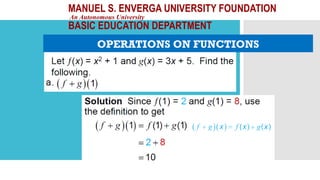
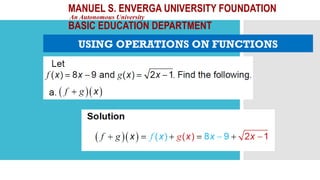
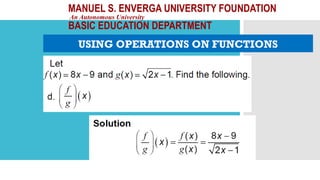
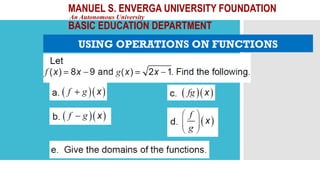
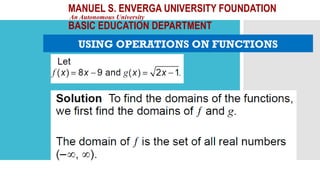
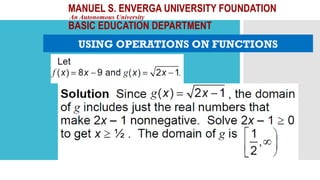
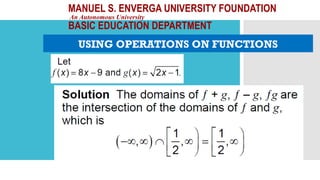
USING OPERATIONS ON FUNCTIONS
MANUEL S. ENVERGA UNIVERSITY FOUNDATION
An Autonomous University
BASIC EDUCATION DEPARTMENT
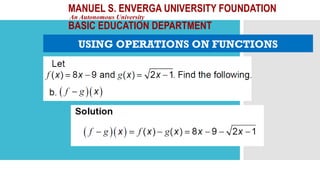
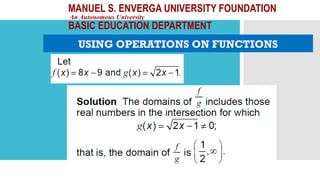
USING OPERATIONS ON FUNCTIONS
MANUEL S. ENVERGA UNIVERSITY FOUNDATION
An Autonomous University
BASIC EDUCATION DEPARTMENT
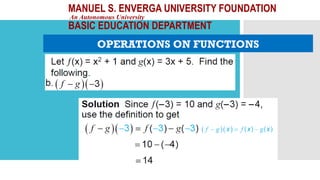
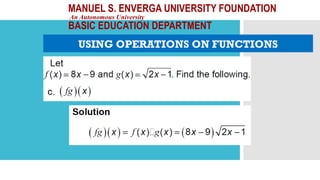
USING OPERATIONS ON FUNCTIONS
MANUEL S. ENVERGA UNIVERSITY FOUNDATION
An Autonomous University
BASIC EDUCATION DEPARTMENT
USING OPERATIONS ON FUNCTIONS
MANUEL S. ENVERGA UNIVERSITY FOUNDATION
An Autonomous University
BASIC EDUCATION DEPARTMENT
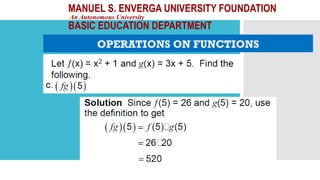
USING OPERATIONS ON FUNCTIONS
MANUEL S. ENVERGA UNIVERSITY FOUNDATION
An Autonomous University
BASIC EDUCATION DEPARTMENT
USING OPERATIONS ON FUNCTIONS
MANUEL S. ENVERGA UNIVERSITY FOUNDATION
An Autonomous University
BASIC EDUCATION DEPARTMENT
USING OPERATIONS ON FUNCTIONS
MANUEL S. ENVERGA UNIVERSITY FOUNDATION
An Autonomous University
BASIC EDUCATION DEPARTMENT
USING OPERATIONS ON FUNCTIONS
MANUEL S. ENVERGA UNIVERSITY FOUNDATION
An Autonomous University
BASIC EDUCATION DEPARTMENT
USING OPERATIONS ON FUNCTIONS
MANUEL S. ENVERGA UNIVERSITY FOUNDATION
An Autonomous University
BASIC EDUCATION DEPARTMENT
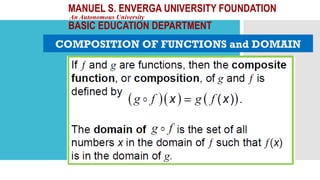
COMPOSITION OF FUNCTIONS and DOMAIN
MANUEL S. ENVERGA UNIVERSITY FOUNDATION
An Autonomous University
BASIC EDUCATION DEPARTMENT
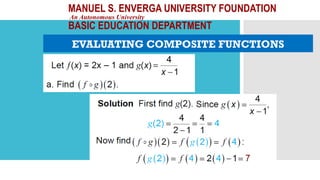
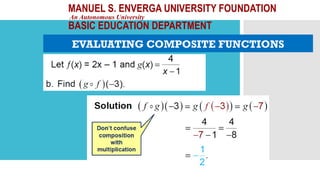
EVALUATING COMPOSITE FUNCTIONS
MANUEL S. ENVERGA UNIVERSITY FOUNDATION
An Autonomous University
BASIC EDUCATION DEPARTMENT
EVALUATING COMPOSITE FUNCTIONS
MANUEL S. ENVERGA UNIVERSITY FOUNDATION
An Autonomous University
BASIC EDUCATION DEPARTMENT
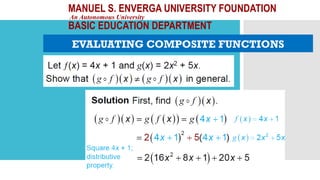
EVALUATING COMPOSITE FUNCTIONS
MANUEL S. ENVERGA UNIVERSITY FOUNDATION
An Autonomous University
BASIC EDUCATION DEPARTMENT
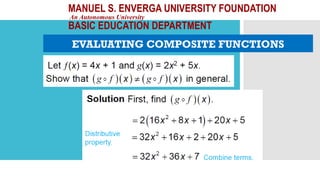
EVALUATING COMPOSITE FUNCTIONS
MANUEL S. ENVERGA UNIVERSITY FOUNDATION
An Autonomous University
BASIC EDUCATION DEPARTMENT
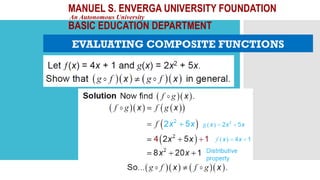
EVALUATING COMPOSITE FUNCTIONS
MANUEL S. ENVERGA UNIVERSITY FOUNDATION
An Autonomous University
BASIC EDUCATION DEPARTMENT
APPLICATION
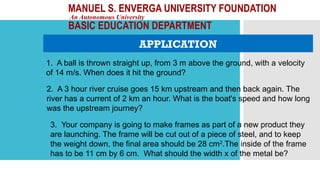
1. A ball is thrown straight up, from 3 m above the ground, with a velocity
of 14 m/s. When does it hit the ground?
2. A 3 hour river cruise goes 15 km upstream and then back again. The
river has a current of 2 km an hour. What is the boat's speed and how long
was the upstream journey?
3. Your company is going to make frames as part of a new product they
are launching. The frame will be cut out of a piece of steel, and to keep
the weight down, the final area should be 28 cm2
.The inside of the frame
has to be 11 cm by 6 cm. What should the width x of the metal be?
MANUEL S. ENVERGA UNIVERSITY FOUNDATION
An Autonomous University
BASIC EDUCATION DEPARTMENT
APPLICATION
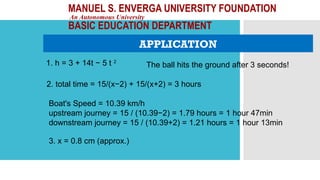
1. h = 3 + 14t − 5 t 2
2. total time = 15/(x−2) + 15/(x+2) = 3 hours
3. x = 0.8 cm (approx.)
The ball hits the ground after 3 seconds!
Boat's Speed = 10.39 km/h
upstream journey = 15 / (10.39−2) = 1.79 hours = 1 hour 47min
downstream journey = 15 / (10.39+2) = 1.21 hours = 1 hour 13min
TEACH is
TOUCH LIVES
EVER to an Individual
Learner.
Closure
MANUEL S. ENVERGA UNIVERSITY FOUNDATION
An Autonomous University
BASIC EDUCATION DEPARTMENT
MANUEL S. ENVERGA UNIVERSITY FOUNDATION
An Autonomous University
BASIC EDUCATION DEPARTMENT
Group 1 : Module 1
Group 2 : Module 2
Group 3 : Module 3
Group 4 : Module 4
Group 5 : Module 5

GENERAL MATHEMATICS FOR GRADE 11- FUNCTIONS.pptx

  • 1.
  • 2.
    At the endof the session, the teacher-participants are expected to: 1. represents real-life situations using functions, including piece-wise functions. 2. evaluates a function. 3. performs addition, subtraction, multiplication, division, and composition of functions. 4. solves problems involving functions.
  • 3.
    PRIMING ACTIVITY I’m goingto show you a series of graphs. Determine whether or not these graphs are functions. You do not need to draw the graphs in your notes.
  • 4.
  • 5.
  • 6.
  • 7.
  • 8.
  • 9.
  • 10.
  • 11.
  • 12.
  • 13.
  • 14.
  • 15.
  • 16.
    PRIMING ACTIVITY The boatis sinking. Group yourselves by What value will complete the table ? 5
  • 17.
    PRIMING ACTIVITY The boatis sinking. Group yourselves by If f (x ) = k x 2 , and f ( 2 ) = 12, then k equals 3
  • 18.
    PRIMING ACTIVITY The boatis sinking. Group yourselves by 6
  • 19.
    MANUEL S. ENVERGAUNIVERSITY FOUNDATION An Autonomous University BASIC EDUCATION DEPARTMENT PRIMING ACTIVITY 10 The boat is sinking. Group yourselves by
  • 20.
    MANUEL S. ENVERGAUNIVERSITY FOUNDATION An Autonomous University BASIC EDUCATION DEPARTMENT ACTIVITY 1 (Group Work) (15 min) 1. You are given four graphs, four equations, four tables, and four rules. 2. Your task is to match each graph with an equation, a table and a rule. 3. Compare your results and describe their properties. 4. The team leaders of the groups report their conclusions to the whole class. Sorting Functions
  • 21.
    MANUEL S. ENVERGAUNIVERSITY FOUNDATION An Autonomous University BASIC EDUCATION DEPARTMENT ACTIVITY 1 (Group Work) (15 min) Allow 1 point for each two correct answers ( 6 points). Sorting Functions Rubric
  • 22.
    MANUEL S. ENVERGAUNIVERSITY FOUNDATION An Autonomous University BASIC EDUCATION DEPARTMENT ACTIVITY 1 (Group Work) (15 min) Allow 1 point for correct explanation such as: Sorting Functions Rubric Equation C is a quadratic curve that passes through the origin and is symmetrical about the y axis, so this is Graph A. Equation D is the equation of a straight line, so this is Graph B.
  • 23.
    MANUEL S. ENVERGAUNIVERSITY FOUNDATION An Autonomous University BASIC EDUCATION DEPARTMENT ACTIVITY 1 (Group Work) (15 min) Allow 1 point for correct explanation such as: Sorting Functions Rubric Equation B is a quadratic curve that passes through the origin and is symmetrical about the x axis, so this is Graph C. Equation A is an inverse (hyperbolic) function: the graph approaches, but does not cross the axes (the axes are asymptotes) so this is Graph D.
  • 24.
    MANUEL S. ENVERGAUNIVERSITY FOUNDATION An Autonomous University BASIC EDUCATION DEPARTMENT ANALYSIS 1. How did you find the activity matching each graph with an equation, a table or a rule? 2. What did you find difficult about this task? 3. Have you encountered any problem or difficulty in performing your task? Cite them. 4. What are some common errors which students may commit? How can we prevent such error? Feel free to offer a suggestion.
  • 25.
    MANUEL S. ENVERGAUNIVERSITY FOUNDATION An Autonomous University BASIC EDUCATION DEPARTMENT ABSTRACTION LEARNING AREA STANDARD: At the end of the course, the students must know how to solve problems involving rational, exponential and logarithmic functions; to solve business- related problems; and to apply logic to real-life situations. CONTENT STANDARD: The learner demonstrates understanding of key concepts of functions.
  • 26.
    MANUEL S. ENVERGAUNIVERSITY FOUNDATION An Autonomous University BASIC EDUCATION DEPARTMENT ABSTRACTION PERFORMANCE STANDARD: The learner is able to accurately construct mathematical models to represent real-life situations using functions.
  • 27.
    MANUEL S. ENVERGAUNIVERSITY FOUNDATION An Autonomous University BASIC EDUCATION DEPARTMENT ABSTRACTION LEARNING COMPETENCIES: The learners ... a. represents real-life situations using functions, including piece-wise functions. b. evaluates a function. c. performs addition, subtraction, multiplication, division, and composition of functions. d. solves problems involving functions.
  • 28.
    MANUEL S. ENVERGAUNIVERSITY FOUNDATION An Autonomous University BASIC EDUCATION DEPARTMENT RELATIONS AND FUNCTIONS Is a relation a function? According to the textbook, “a function is…a relation in which every input is paired with exactly one output” What is a function?
  • 29.
    MANUEL S. ENVERGAUNIVERSITY FOUNDATION An Autonomous University BASIC EDUCATION DEPARTMENT RELATIONS AND FUNCTIONS Focus on the x-coordinates, when given a relation. If the set of ordered pairs have different x-coordinates, it is a function. Y-coordinates have no bearing in determining functions. If the set of ordered pairs have same x-coordinates, it is NOT a function.
  • 30.
    MANUEL S. ENVERGAUNIVERSITY FOUNDATION An Autonomous University BASIC EDUCATION DEPARTMENT FUNCTION AS A MACHINE A function is a rule which operates on an input and produces a single output from that input.
  • 31.
    MANUEL S. ENVERGAUNIVERSITY FOUNDATION An Autonomous University BASIC EDUCATION DEPARTMENT FUNCTION AS A MACHINE Write down the output from the function shown in the figure when the input is a) 4 b) – 3 c) x d ) t
  • 32.
    MANUEL S. ENVERGAUNIVERSITY FOUNDATION An Autonomous University BASIC EDUCATION DEPARTMENT FUNCTION AS A MACHINE What is the domain? { 4, -5, 0, 9, -1 } What is the range? { -2, 7 } Input 4 –5 0 9 –1 –2 7 Output
  • 33.
    MANUEL S. ENVERGAUNIVERSITY FOUNDATION An Autonomous University BASIC EDUCATION DEPARTMENT FUNCTIONS AND RELATIONS AS A SET OF ORDERED PAIRS If a relation have the same first coordinate but different second coordinates, then it is not a function
  • 34.
    MANUEL S. ENVERGAUNIVERSITY FOUNDATION An Autonomous University BASIC EDUCATION DEPARTMENT Is this a function? Hint: Look only at the x-coordinates YES {( , ),( , ),( , ),( , ),( , ),( , )}      0 5 1 4 2 3 3 2 4 1 5 0 FUNCTIONS AND RELATIONS AS A SET OF ORDERED PAIRS
  • 35.
    MANUEL S. ENVERGAUNIVERSITY FOUNDATION An Autonomous University BASIC EDUCATION DEPARTMENT Is this a function? Hint: Look only at the x-coordinates NO {(– , ),( , ),( , ),( , ),( , ),(– , )}     1 7 1 0 2 3 0 8 0 5 2 1 FUNCTIONS AND RELATIONS AS A SET OF ORDERED PAIRS
  • 36.
    Which mapping representsa function? Choice 1 Choice One 3 1 0 –1 2 3 Choice Two 2 –1 3 2 3 –2 0 FUNCTIONS AND RELATIONS AS A SET OF ORDERED PAIRS
  • 37.
    MANUEL S. ENVERGAUNIVERSITY FOUNDATION An Autonomous University BASIC EDUCATION DEPARTMENT Which mapping represents a function? B A B FUNCTIONS AND RELATIONS AS A SET OF ORDERED PAIRS
  • 38.
    MANUEL S. ENVERGAUNIVERSITY FOUNDATION An Autonomous University BASIC EDUCATION DEPARTMENT What is the domain? {( , ),( , ),( , ),( , ),( , ),( , )}      0 5 1 4 2 3 3 2 4 1 5 0 { 0, 1, 2, 3, 4, 5 } What is the range? { -5, -4, -3, -2, -1, 0 } FUNCTIONS AND RELATIONS AS A SET OF ORDERED PAIRS
  • 39.
    Find the Domainand Range of a Relation. a. {(–5, 7), (3, 5), (6, 7), (12, –4)} Domain: {–4,-2, 2,3, 4}; Range: {-5,–2, 0, 3, 4} b. Domain: {–5, 3, 6, 12}; Range: {–4, 5, 7} FUNCTIONS AND RELATIONS AS A SET OF ORDERED PAIRS
  • 40.
    MANUEL S. ENVERGAUNIVERSITY FOUNDATION An Autonomous University BASIC EDUCATION DEPARTMENT Determine if Relations are Functions a. {(–3, 6), (2, 5), (0, 6), (17, –9)} b. {(4, 5), (7, –3), (4, 10), (–6, 1)} c. {(–2, 3), (0, 3), (4, 3), (6, 3), (8, 3)} d. I y – 5 I = x + 3 e. y = x2 − 3 x + 2 f. 4 x – 8 y = 24 Function Not a function Four has two values Function Not a function One has two values Function Function FUNCTIONS AND RELATIONS AS A SET OF ORDERED PAIRS
  • 41.
    MANUEL S. ENVERGAUNIVERSITY FOUNDATION An Autonomous University BASIC EDUCATION DEPARTMENT FUNCTIONS AND RELATION AS AS A TABLE OFVALUES We can present the ordered pairs in a list or table.
  • 42.
    MANUEL S. ENVERGAUNIVERSITY FOUNDATION An Autonomous University BASIC EDUCATION DEPARTMENT FUNCTIONS AS A GRAPH IN THE CARTESIAN PLANE We can use a graph to indicate the ordered pairs. The graph can show distinct ordered pairs, or it can show all the ordered pairs on a line or curve.
  • 43.
    Find the Domainand Range of a Relation. c. Domain is { x | – 5 ≤ x ≤ 5 } in set-builder notation or [ – 5, 5 ] in interval notation Range is { y | – 3 ≤ y ≤ 4} in set-builder notation or [ – 3, 4 ] in interval notation FUNCTIONS AS A GRAPH IN THE CARTESIAN PLANE
  • 44.
    Find the Domainand Range of a Relation. d. Domain is { x | x ≤ 3 } in set-builder notation or (– ∞, 3] in interval notation Range is in set-builder notation ℝ or ( – ∞, ∞ ) in interval notation Domain is or ( – ∞, ∞ ) ℝ Range is { y | y ≥ 0 } or ( 0, ∞ ) FUNCTIONS AS A GRAPH IN THE CARTESIAN PLANE
  • 45.
    Summary of Graphsof Common Functions f(x) = c y = x x y  x y  y = x2 y = x 3
  • 46.
    MANUEL S. ENVERGAUNIVERSITY FOUNDATION An Autonomous University BASIC EDUCATION DEPARTMENT VERTICAL LINE TEST Vertical Line Test If a vertical line intersects (crosses or touches) the graph of a relation at more than one point, then the relation is not a function. If every vertical line intersects the graph of a relation at no more than one point, then the relation is a function
  • 47.
    What is afunction? FUNCTION FUNCTION NOT A FUNCTION FUNCTION FUNCTION NOT A FUNCTION NOT A FUNCTION
  • 48.
    What is afunction? 1 2 3 5 7 4 6
  • 49.
    MANUEL S. ENVERGAUNIVERSITY FOUNDATION An Autonomous University BASIC EDUCATION DEPARTMENT Functions in the real world Money as a function of time. You never have more than one amount of money at any time because you can always add everything to give one total amount. Temperature as a function of various factors. Temperature is a very complicated function because it has so many inputs, including: the time of day, the season, the amount of clouds in the sky, the strength of the wind, where you are and many more. Location as a function of time. You can never be in two places at the same time. FUNCTIONS AS REPRESENTATIONS OF REAL LIFE SITUATIONS
  • 50.
    MANUEL S. ENVERGAUNIVERSITY FOUNDATION An Autonomous University BASIC EDUCATION DEPARTMENT Which situation represents a function? a a. The items in a store to their prices on a certain date Solution: b. Types of fruits to their colors FUNCTIONS AS REPRESENTATIONS OF REAL LIFE SITUATIONS
  • 51.
    MANUEL S. ENVERGAUNIVERSITY FOUNDATION An Autonomous University BASIC EDUCATION DEPARTMENT Real-life situation Identify whether the relation that exists between each of the following pairs indicates a functions or not. 1. A jeepney to its plate number. 2. A teacher to his/her cellular phone. 3. A pen to its ink color. 4. A student to his/her student number. F Not F Not F F FUNCTIONS AS REPRESENTATIONS OF REAL LIFE SITUATIONS
  • 52.
    MANUEL S. ENVERGAUNIVERSITY FOUNDATION An Autonomous University BASIC EDUCATION DEPARTMENT The number of shoes in x pairs of shoes can be expressed by the equation y = 2x. Whole numbers What subset of the real numbers makes sense for the domain? What would make sense for the range of the function? Zero and the even numbers FUNCTIONS AS REPRESENTATIONS OF REAL LIFE SITUATIONS
  • 53.
    MANUEL S. ENVERGAUNIVERSITY FOUNDATION An Autonomous University BASIC EDUCATION DEPARTMENT The # of pairs of shoes What is the independent variable? What is the dependent variable? The total # of shoes. FUNCTIONS AS REPRESENTATIONS OF REAL LIFE SITUATIONS The number of shoes in x pairs of shoes can be expressed by the equation y = 2x.
  • 54.
    MANUEL S. ENVERGAUNIVERSITY FOUNDATION An Autonomous University BASIC EDUCATION DEPARTMENT Mr. Landry is driving to his hometown. It takes four hours to get there. The distance he travels at any time, t, is represented by the function d = 55 t (his average speed is 55 mph). Write an inequality that represents the domain in real life. Write an inequality that represents the range in real life. 0 4 x   0 220 y   FUNCTIONS AS REPRESENTATIONS OF REAL LIFE SITUATIONS
  • 55.
    MANUEL S. ENVERGAUNIVERSITY FOUNDATION An Autonomous University BASIC EDUCATION DEPARTMENT What is the independent variable? What is the dependent variable? The time that he drives. The total distance traveled. FUNCTIONS AS REPRESENTATIONS OF REAL LIFE SITUATIONS Mr. Landry is driving to his hometown. It takes four hours to get there. The distance he travels at any time, t, is represented by the function d = 55 t (his average speed is 55 mph).
  • 56.
    MANUEL S. ENVERGAUNIVERSITY FOUNDATION An Autonomous University BASIC EDUCATION DEPARTMENT Johnny bought at most 10 tickets to a concert for him and his friends. The cost of each ticket was $12.50. Complete the table below to list the possible domain and range. What is the independent variable? What is the dependent variable? The number of tickets bought. The total cost of the tickets. 1 2 3 12.50 25.00 37.50 4 50 5 62.50 6 7 8 9 10 75 125 112.50 100 87.50 FUNCTIONS AS REPRESENTATIONS OF REAL LIFE SITUATIONS
  • 57.
    MANUEL S. ENVERGAUNIVERSITY FOUNDATION An Autonomous University BASIC EDUCATION DEPARTMENT Pete’s Pizza Parlor charges $5 for a large pizza with no toppings. They charge an additional $1.50 for each of their 5 specialty toppings (tax is included in the price). Jorge went to pick up his order. They said his total bill was $9.50. Could this be correct? Why or why not? Yes One pizza with 3 toppings cost $9.50 FUNCTIONS AS REPRESENTATIONS OF REAL LIFE SITUATIONS
  • 58.
    MANUEL S. ENVERGAUNIVERSITY FOUNDATION An Autonomous University BASIC EDUCATION DEPARTMENT Pete’s Pizza Parlor charges $5 for a large pizza with no toppings. They charge an additional $1.50 for each of their 5 specialty toppings (tax is included in the price). Susan went to pick up her order. They said she owed $10.25. Could this be correct? Why or why not? No One pizza with 4 toppings cost $11 FUNCTIONS AS REPRESENTATIONS OF REAL LIFE SITUATIONS
  • 59.
    MANUEL S. ENVERGAUNIVERSITY FOUNDATION An Autonomous University BASIC EDUCATION DEPARTMENT Pete’s Pizza Parlor charges $5 for a large pizza with no toppings. They charge an additional $1.50 for each of their 5 specialty toppings (tax is included in the price). What is the independent variable? The number of toppings The cost of the pizza What is the dependent variable? FUNCTIONS AS REPRESENTATIONS OF REAL LIFE SITUATIONS
  • 60.
    MANUEL S. ENVERGAUNIVERSITY FOUNDATION An Autonomous University BASIC EDUCATION DEPARTMENT PIECEWISE FUNCTIONS Up to now, we’ve been looking at functions represented by a single equation. In real life, however, functions are represented by a combination of equations, each corresponding to a part of the domain. These are called piecewise functions.
  • 61.
    MANUEL S. ENVERGAUNIVERSITY FOUNDATION An Autonomous University BASIC EDUCATION DEPARTMENT PIECEWISE FUNCTIONS           1 , 1 3 1 , 1 2 x if x x if x x f •One equation gives the value of f(x) when x ≤ 1 •And the other when x>1
  • 62.
    Evaluate f(x) whenx=0, x=2, x=4         2 , 1 2 2 , 2 ) ( x if x x if x x f •First you have to figure out which equation to use •You NEVER use both X=0 This one fits Into the top equation So: 0+2=2 f(0)=2 X=2 This one fits here So: 2(2) + 1 = 5 f(2) = 5 X=4 This one fits here So: 2(4) + 1 = 9 f(4) = 9
  • 63.
    Graph:          1 , 3 1 , ) ( 2 3 2 1 x if x x if x x f •For allx’s < 1, use the top graph (to the left of 1) •For all x’s ≥ 1, use the bottom graph (to the •right of 1)
  • 64.
    1 2 3 , 1 2 ( ) 3,1 x if x f x x if x           x=1 is the breaking point of the graph. To the left is the top equation. To the right is the bottom equation.
  • 65.
    Graph: 1, 2 ( ) 1,2 x if x f x x if x         Point of Discontinuity
  • 66.
  • 67.
  • 68.
  • 70.
    Special Step Functions Twoparticular kinds of step functions are called ceiling functions ( f (x)= and floor functions ( f (x)= ). In a ceiling function, all nonintegers are rounded up to the nearest integer. An example of a ceiling function is when a phone service company charges by the number of minutes used and always rounds up to the nearest integer of minutes. x     x    
  • 71.
    Special Step Functions Ina floor function, all nonintegers are rounded down to the nearest integer. The way we usually count our age is an example of a floor function since we round our age down to the nearest year and do not add a year to our age until we have passed our birthday. The floor function is the same thing as the greatest integer function which can be written as f (x)=[x].
  • 72.
    MANUEL S. ENVERGAUNIVERSITY FOUNDATION An Autonomous University BASIC EDUCATION DEPARTMENT Greatest integer function: f(x) = [x] For example: [2.1] = 2, i.e. greatest integer less than or equal to 2.1 is 2, similarly [–2.1] = –3 [2] = 2 [3 . 9] = 3 [–3 . 9] = –4 PIECEWISE FUNCTIONS
  • 73.
    MANUEL S. ENVERGAUNIVERSITY FOUNDATION An Autonomous University BASIC EDUCATION DEPARTMENT PIECEWISE FUNCTIONS A store charges Php150 per t-shirt for orders of 50 or fewer, Php 135 per t-shirt for orders of 75 or fewer but more than 50 t-shirts, and Php 125 per t-shirt for orders of more than 75 t-shirts. Which function best represents the printing cost C of x number of t-shirts? (a) (b) Answer: C (c)            x 76 if , 125 5 7 x 51 if , 135 50 x 0 if , 150 ) ( x x x x C            x 76 if , 125 5 7 x 51 if , 135 50 x 0 if , 150 ) ( x x x x C            x 76 if , 125 5 7 x 51 if , 135 50 x 0 if , 150 ) ( x x x x C
  • 74.
    FUNCTIONS Symmetric about they axis Symmetric about the origin
  • 75.
    2 -7 -6 -5-4 -3 -2 -1 1 5 7 3 0 4 6 8 7 1 2 3 4 5 6 8 -2 -3 -4 -5 -6 -7 For an even function: for every point (x, y) on the graph, the point (-x, y) is also on the graph. Even functions have y-axis Symmetry
  • 76.
    2 -7 -6 -5-4 -3 -2 -1 1 5 7 3 0 4 6 8 7 1 2 3 4 5 6 8 -2 -3 -4 -5 -6 -7 For an odd function: for every point (x, y) on the graph, the point (-x, -y) is also on the graph. Odd functions have origin Symmetry
  • 77.
    2 -7 -6 -5-4 -3 -2 -1 1 5 7 3 0 4 6 8 7 1 2 3 4 5 6 8 -2 -3 -4 -5 -6 -7 We wouldn’t talk about a function with x-axis symmetry because it wouldn’t BE a function. x-axis Symmetry
  • 78.
    Even, Odd orNeither? Graphically
  • 79.
    f x xx ( )   3 Even, Odd or Neither? Graphically 
  • 80.
     Even, Odd orNeither? Graphically
  • 81.
      Even, Oddor Neither? Graphically
  • 82.
    Given A function iseven if for every number x in the domain. If you plug a –x into the function and you get the original function back again, the function is even. Same! Even Function
  • 83.
    Given A function isodd if for every number x in the domain. If you plug a –x into the function and you get the negative of the function back (all terms change signs), the function is odd. Odd Function ALL signs of the terms changed!
  • 84.
    A function iseven if for every number x in the domain. If you plug a –x into the function and you get the original function back again, the function is even.   1 2 5 2 4    x x x f Is this function even?   1 2 5 1 ) ( 2 ) ( 5 2 4 2 4          x x x x x f YES   x x x f   3 2 Is this function even?   x x x x x f         3 3 2 ) ( ) ( 2 NO
  • 85.
    A function isodd if for every number x in the domain. If you plug a –x into the function and you get the negative of the function back (all terms change signs), the function is odd.   1 2 5 2 4    x x x f Is this function odd?   1 2 5 1 ) ( 2 ) ( 5 2 4 2 4          x x x x x f NO   x x x f   3 2 Is this function odd?   x x x x x f         3 3 2 ) ( ) ( 2 YES
  • 86.
    Odd, Even, orNeither? Even Function
  • 87.
    Odd, Even, orNeither? Neither Odd or Even
  • 88.
    Odd, Even, orNeither? Odd Function
  • 89.
    MANUEL S. ENVERGAUNIVERSITY FOUNDATION An Autonomous University BASIC EDUCATION DEPARTMENT EVALUATING FUNCTIONS f(x) means function of x and is read “f of x.” f(x) = 2x + 1 is written in function notation. The notation f(1) means to replace x with 1 resulting in the function value. f(1) = 2x + 1 f(1) = 2(1) + 1 f(1) = 3
  • 90.
    MANUEL S. ENVERGAUNIVERSITY FOUNDATION An Autonomous University BASIC EDUCATION DEPARTMENT EVALUATING FUNCTIONS Function Notation Given g(x) = x 2 – 3, find g(-2) . g(-2) = x 2 – 3 g(-2) = (-2) 2 – 3 g(-2) = 1
  • 91.
    MANUEL S. ENVERGAUNIVERSITY FOUNDATION An Autonomous University BASIC EDUCATION DEPARTMENT EVALUATING FUNCTIONS Function Notation Given f(x) = 2x2 – 3x , find the following. a. f(3) b. 3f(x) c. f(3x) f(3) = 2x2 – 3x f(3) = 2(3)2 – 3(3) f(3) = 2(9) - 9 f(3) = 9 3f(x) = 3(2x2 – 3x) 3f(x) = 6x2 – 9x f(3x) = 2x2 – 3x f(3x) = 2(3x)2 – 3(3x) f(3x) = 2(9x2 ) – 3(3x) f(3x) = 18x2 – 9x
  • 92.
    MANUEL S. ENVERGAUNIVERSITY FOUNDATION An Autonomous University BASIC EDUCATION DEPARTMENT EVALUATING FUNCTIONS For each function, evaluate f(0), f(1.5), f(-4), f(0) = f(1.5) = f(-4) = 3 4 4
  • 93.
    MANUEL S. ENVERGAUNIVERSITY FOUNDATION An Autonomous University BASIC EDUCATION DEPARTMENT EVALUATING FUNCTIONS For each function, evaluate f(0), f(1.5), f(-4), f(0) = f(1.5) = f(-4) = 1 3 1
  • 94.
    MANUEL S. ENVERGAUNIVERSITY FOUNDATION An Autonomous University BASIC EDUCATION DEPARTMENT EVALUATING FUNCTIONS For each function, evaluate f(0), f(1.5), f(-4), f(0) = f(1.5) = f(-4) = – 5 1 1
  • 95.
    MANUEL S. ENVERGAUNIVERSITY FOUNDATION An Autonomous University BASIC EDUCATION DEPARTMENT EVALUATING FUNCTIONS Given f(x) = x2 – 4x + 7 Find. h x f h x f ) ( ) (   h x x h x h x ] 7 4 [ ] 7 ) ( 4 ) [( 2 2         h x x h x h xh x 7 4 7 4 4 2 2 2 2          h h h xh 4 2 2    h h x h ) 4 2 (    = 2x + h - 4
  • 96.
    MANUEL S. ENVERGAUNIVERSITY FOUNDATION An Autonomous University BASIC EDUCATION DEPARTMENT OPERATIONS ON FUNCTIONS
  • 97.
    MANUEL S. ENVERGAUNIVERSITY FOUNDATION An Autonomous University BASIC EDUCATION DEPARTMENT OPERATIONS ON FUNCTIONS
  • 98.
    MANUEL S. ENVERGAUNIVERSITY FOUNDATION An Autonomous University BASIC EDUCATION DEPARTMENT OPERATIONS ON FUNCTIONS
  • 99.
    MANUEL S. ENVERGAUNIVERSITY FOUNDATION An Autonomous University BASIC EDUCATION DEPARTMENT OPERATIONS ON FUNCTIONS
  • 100.
    MANUEL S. ENVERGAUNIVERSITY FOUNDATION An Autonomous University BASIC EDUCATION DEPARTMENT OPERATIONS ON FUNCTIONS
  • 101.
    MANUEL S. ENVERGAUNIVERSITY FOUNDATION An Autonomous University BASIC EDUCATION DEPARTMENT USING OPERATIONS ON FUNCTIONS
  • 102.
    MANUEL S. ENVERGAUNIVERSITY FOUNDATION An Autonomous University BASIC EDUCATION DEPARTMENT USING OPERATIONS ON FUNCTIONS
  • 103.
    MANUEL S. ENVERGAUNIVERSITY FOUNDATION An Autonomous University BASIC EDUCATION DEPARTMENT USING OPERATIONS ON FUNCTIONS
  • 104.
    MANUEL S. ENVERGAUNIVERSITY FOUNDATION An Autonomous University BASIC EDUCATION DEPARTMENT USING OPERATIONS ON FUNCTIONS
  • 105.
    MANUEL S. ENVERGAUNIVERSITY FOUNDATION An Autonomous University BASIC EDUCATION DEPARTMENT USING OPERATIONS ON FUNCTIONS
  • 106.
    MANUEL S. ENVERGAUNIVERSITY FOUNDATION An Autonomous University BASIC EDUCATION DEPARTMENT USING OPERATIONS ON FUNCTIONS
  • 107.
    MANUEL S. ENVERGAUNIVERSITY FOUNDATION An Autonomous University BASIC EDUCATION DEPARTMENT USING OPERATIONS ON FUNCTIONS
  • 108.
    MANUEL S. ENVERGAUNIVERSITY FOUNDATION An Autonomous University BASIC EDUCATION DEPARTMENT USING OPERATIONS ON FUNCTIONS
  • 109.
    MANUEL S. ENVERGAUNIVERSITY FOUNDATION An Autonomous University BASIC EDUCATION DEPARTMENT USING OPERATIONS ON FUNCTIONS
  • 110.
    MANUEL S. ENVERGAUNIVERSITY FOUNDATION An Autonomous University BASIC EDUCATION DEPARTMENT COMPOSITION OF FUNCTIONS and DOMAIN
  • 111.
    MANUEL S. ENVERGAUNIVERSITY FOUNDATION An Autonomous University BASIC EDUCATION DEPARTMENT EVALUATING COMPOSITE FUNCTIONS
  • 112.
    MANUEL S. ENVERGAUNIVERSITY FOUNDATION An Autonomous University BASIC EDUCATION DEPARTMENT EVALUATING COMPOSITE FUNCTIONS
  • 113.
    MANUEL S. ENVERGAUNIVERSITY FOUNDATION An Autonomous University BASIC EDUCATION DEPARTMENT EVALUATING COMPOSITE FUNCTIONS
  • 114.
    MANUEL S. ENVERGAUNIVERSITY FOUNDATION An Autonomous University BASIC EDUCATION DEPARTMENT EVALUATING COMPOSITE FUNCTIONS
  • 115.
    MANUEL S. ENVERGAUNIVERSITY FOUNDATION An Autonomous University BASIC EDUCATION DEPARTMENT EVALUATING COMPOSITE FUNCTIONS
  • 116.
    MANUEL S. ENVERGAUNIVERSITY FOUNDATION An Autonomous University BASIC EDUCATION DEPARTMENT APPLICATION 1. A ball is thrown straight up, from 3 m above the ground, with a velocity of 14 m/s. When does it hit the ground? 2. A 3 hour river cruise goes 15 km upstream and then back again. The river has a current of 2 km an hour. What is the boat's speed and how long was the upstream journey? 3. Your company is going to make frames as part of a new product they are launching. The frame will be cut out of a piece of steel, and to keep the weight down, the final area should be 28 cm2 .The inside of the frame has to be 11 cm by 6 cm. What should the width x of the metal be?
  • 117.
    MANUEL S. ENVERGAUNIVERSITY FOUNDATION An Autonomous University BASIC EDUCATION DEPARTMENT APPLICATION 1. h = 3 + 14t − 5 t 2 2. total time = 15/(x−2) + 15/(x+2) = 3 hours 3. x = 0.8 cm (approx.) The ball hits the ground after 3 seconds! Boat's Speed = 10.39 km/h upstream journey = 15 / (10.39−2) = 1.79 hours = 1 hour 47min downstream journey = 15 / (10.39+2) = 1.21 hours = 1 hour 13min
  • 118.
    TEACH is TOUCH LIVES EVERto an Individual Learner. Closure
  • 119.
    MANUEL S. ENVERGAUNIVERSITY FOUNDATION An Autonomous University BASIC EDUCATION DEPARTMENT
  • 120.
    MANUEL S. ENVERGAUNIVERSITY FOUNDATION An Autonomous University BASIC EDUCATION DEPARTMENT Group 1 : Module 1 Group 2 : Module 2 Group 3 : Module 3 Group 4 : Module 4 Group 5 : Module 5

Editor's Notes

  • #5 Y = 0.5x + 2 + 2sin(x) D: all reals R: all reals Another cool function: abs(x) + 2sin(x)
  • #6 Y = 0.5x + 2 + 2sin(x) D: all reals R: all reals Another cool function: abs(x) + 2sin(x)
  • #7 Y = 0.5x + 2 + 2sin(x) D: all reals R: all reals Another cool function: abs(x) + 2sin(x)
  • #9 This is a piecewise function
  • #10 D: all reals R: [0, 1] Another cool function: y = sin(abs(x)) Y = sin(x) * abs(x)
  • #11 Y = 0.5x + 2 + 2sin(x) D: all reals R: all reals Another cool function: abs(x) + 2sin(x)
  • #14 D: [-3, -1) U (-1, 3] R: {-1, 1}
  • #15 D: [-3, -1) U (-1, 3] R: {-1, 1}