Business mathematics to record and manage business operations. CTraining ppx
Business mathematics are mathematics used by commercial enterprises to record and manage business operations. Commercial organizations use mathematics in accounting, inventory management, marketing, sales forecasting, and financial analysis.
Business mathematics to record and manage business operations. CTraining ppx
1.
Jimma University
College ofAgriculture and Veterinary Medicine
Department of Agricultural Economics
Mathematics for Business
(4 Cr.hr)
2.
Brainstorming:
• What isEconomics and business ?
• What is the role of Mathematics in
economic problems?
3.
Why study mathematics?
•Economics is a social science. It does not just describe
what goes on in the economy.
• It attempts to explain how the economy operates and to
make predictions about what may happen to specified
economic variables if certain changes take place.
• What Is a Business?
• The term business refers to an organization or
enterprising entity engaged in commercial, industrial, or
professional activities. The purpose of a business is to
organize some sort of economic production (of goods or
services).
4.
Cont…
• Mathematics isfundamental to any serious application
of business to these areas. For example
a) Quantification : A firm needs to know How much
quantity sold is expected to change in response to a
price increase.
b) Simplification
• For example, the relationship between the quantity of
apples consumers wish to buy and the price of apples might
be expressed as it is much easier, however, to express this
mathematically as: q = 1,200−10p where q is the quantity
of apples demanded in kilograms and p is the price in pence
per kilogram of apples
5.
c) Scarcity andchoice
• Many problems dealt with in economics are
concerned with the most efficient way of
allocating limited resources. These are known as
‘optimization’ problems.
• For example, a firm may wish to maximize the
output it can produce within a fixed budget for
expenditure on inputs.
6.
CHAPTER One :Function
Unit learning Outcomes
• After the completion of this unit, the student will be able to
• Define what a is function
• Explain the different between functions and relations
• Identify different types of functions
• Describe functions in different forms
• Find equations of different functions.
• Apply the concept to mathematical and economic
problems.
7.
Brainstorming:
1. What isfunction?
2. What is relation?
3. What is the difference between function and
relation?
4. All function are relation (T or F)
5. All relation are function (T or F)
8.
CHAPTER ONE
What isfunction?
A function is a relation for which each value from the set of the first
components of the ordered pairs is associated with exactly one value
from the set of second components of the ordered pair.
It is an equation for which any independent variable that can be plugged
into the equation will yield exactly one dependent variable out of the
equation.
.
9.
Cont…
Rule that producesa correspondence
between domain and range.
Special type of relation in which no
two elements of the relation have the
same first coordinate.
10.
Cont...
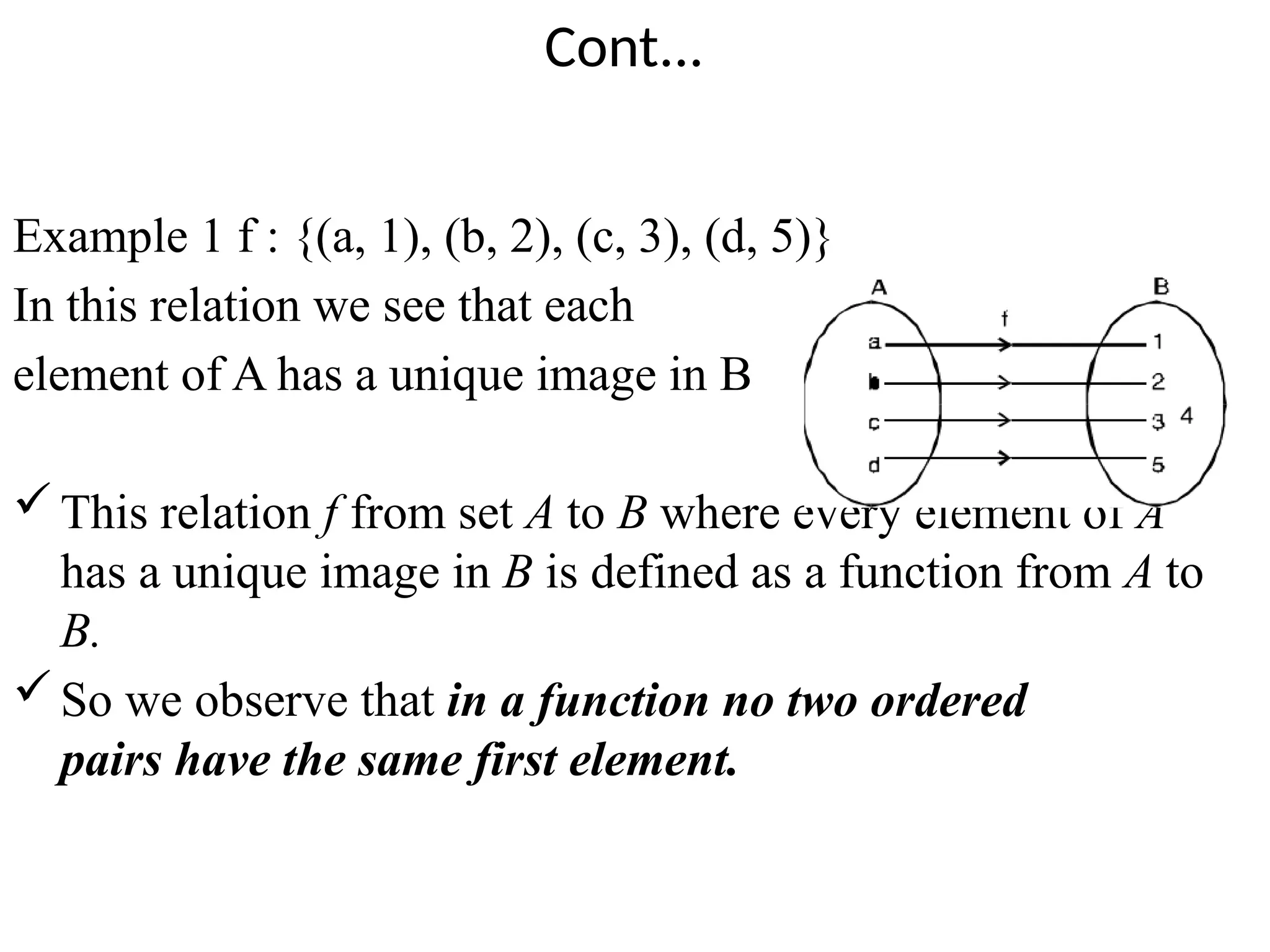
Example 1 f: {(a, 1), (b, 2), (c, 3), (d, 5)}
In this relation we see that each
element of A has a unique image in B
This relation f from set A to B where every element of A
has a unique image in B is defined as a function from A to
B.
So we observe that in a function no two ordered
pairs have the same first element.
11.
Func…
We also seethat an element of B. i.e., 4 which does not
have its preimage in A. Thus here:
(i) the set B will be termed as co-domain and
(ii) the set {1, 2, 3, 5} is called the range.
From the above we can conclude that range is a subset
of co-domain.
Func…
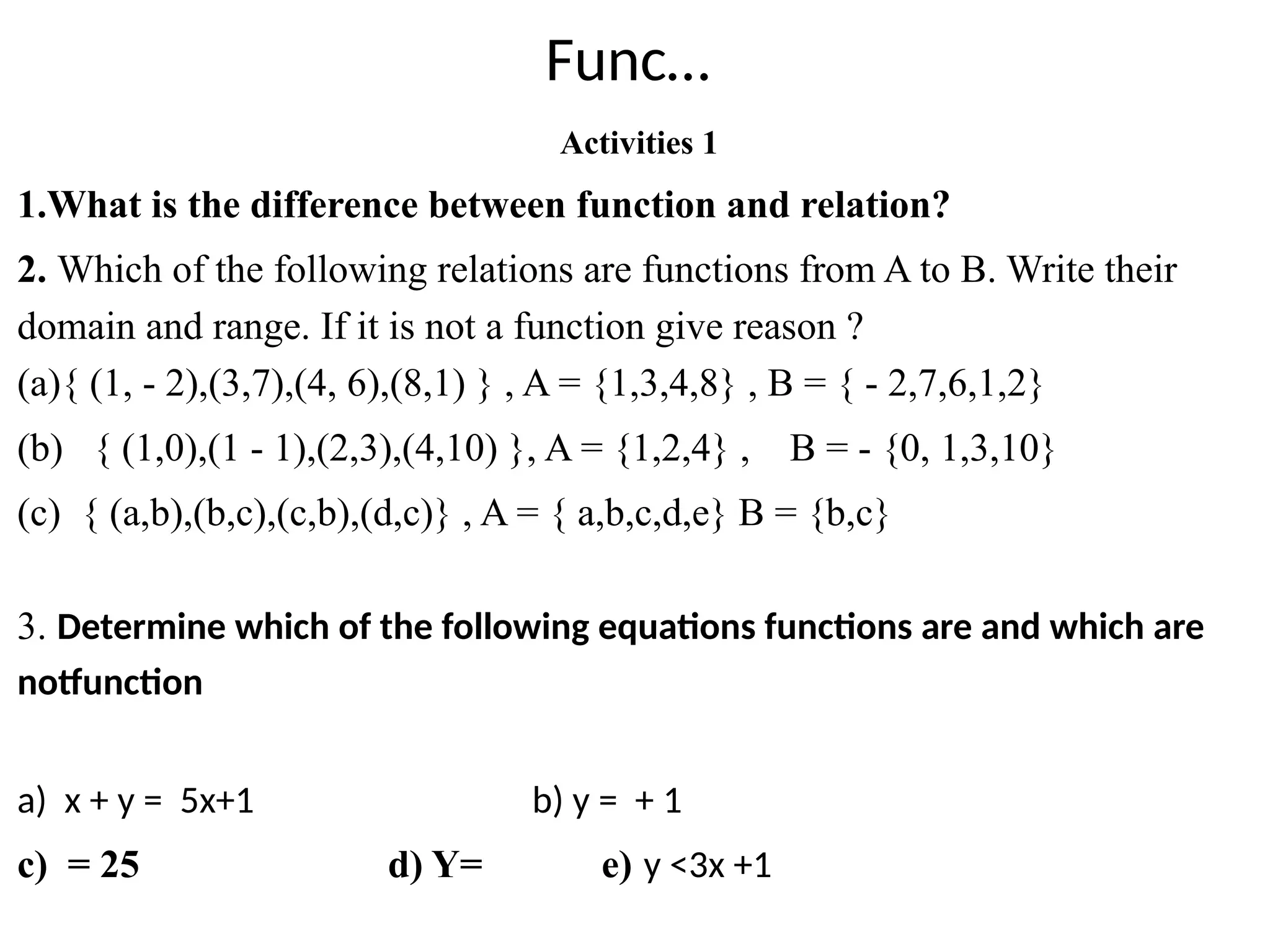
Activities 1
1.What isthe difference between function and relation?
2. Which of the following relations are functions from A to B. Write their
domain and range. If it is not a function give reason ?
(a){ (1, - 2),(3,7),(4, 6),(8,1) } , A = {1,3,4,8} , B = { - 2,7,6,1,2}
(b) { (1,0),(1 - 1),(2,3),(4,10) }, A = {1,2,4} , B = - {0, 1,3,10}
(c) { (a,b),(b,c),(c,b),(d,c)} , A = { a,b,c,d,e} B = {b,c}
3. Determine which of the following equations functions are and which are
notfunction
a) x + y = 5x+1 b) y = + 1
c) = 25 d) Y= e) y <3x +1
15.
Function presentation
There aremany ways to describe or represent
functions:
Formula
graph
arrows between objects
(diagrammatical)
set of order pairs
Table
16.
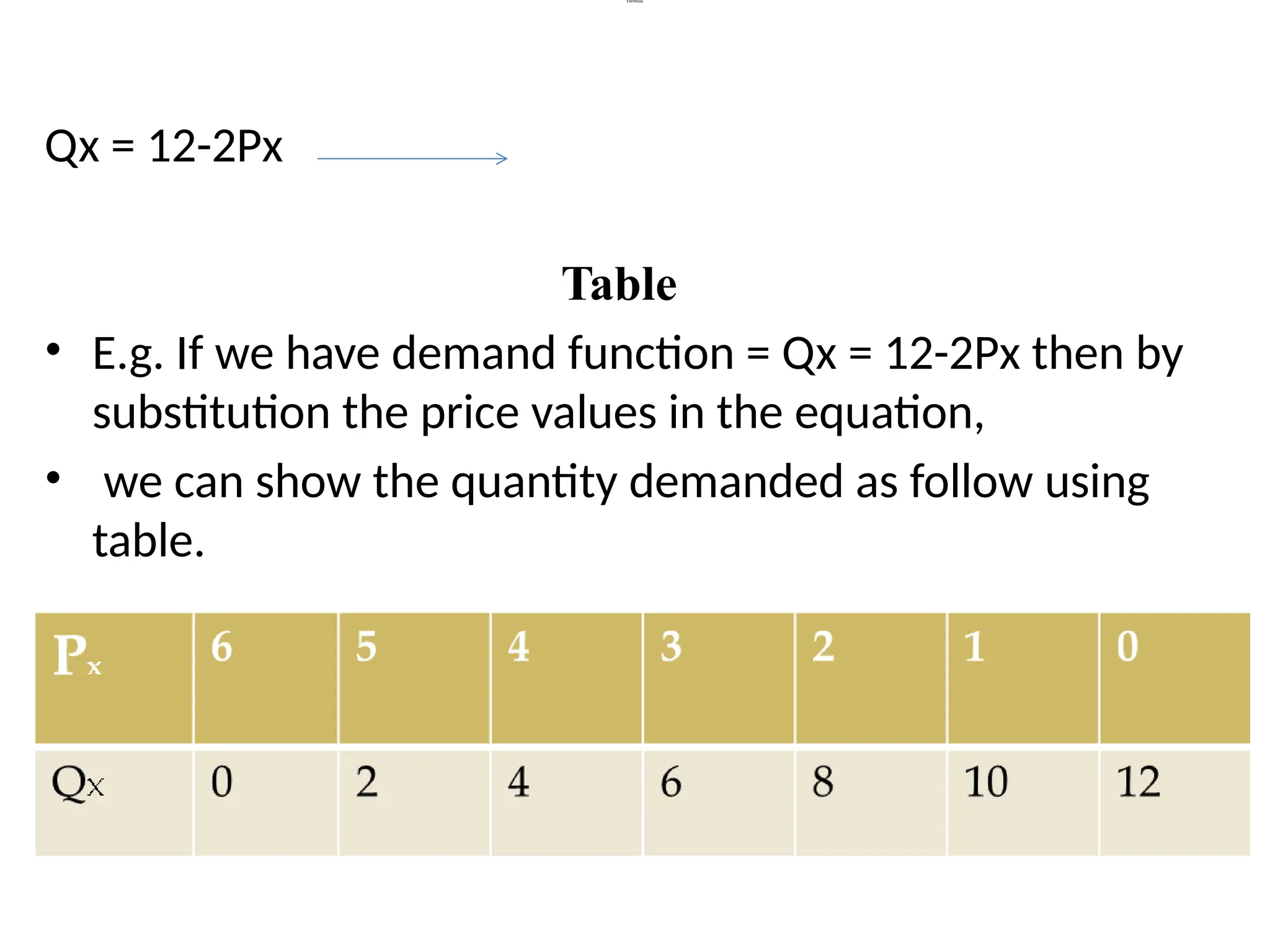
Formula
Qx = 12-2Px
Table
•E.g. If we have demand function = Qx = 12-2Px then by
substitution the price values in the equation,
• we can show the quantity demanded as follow using
table.
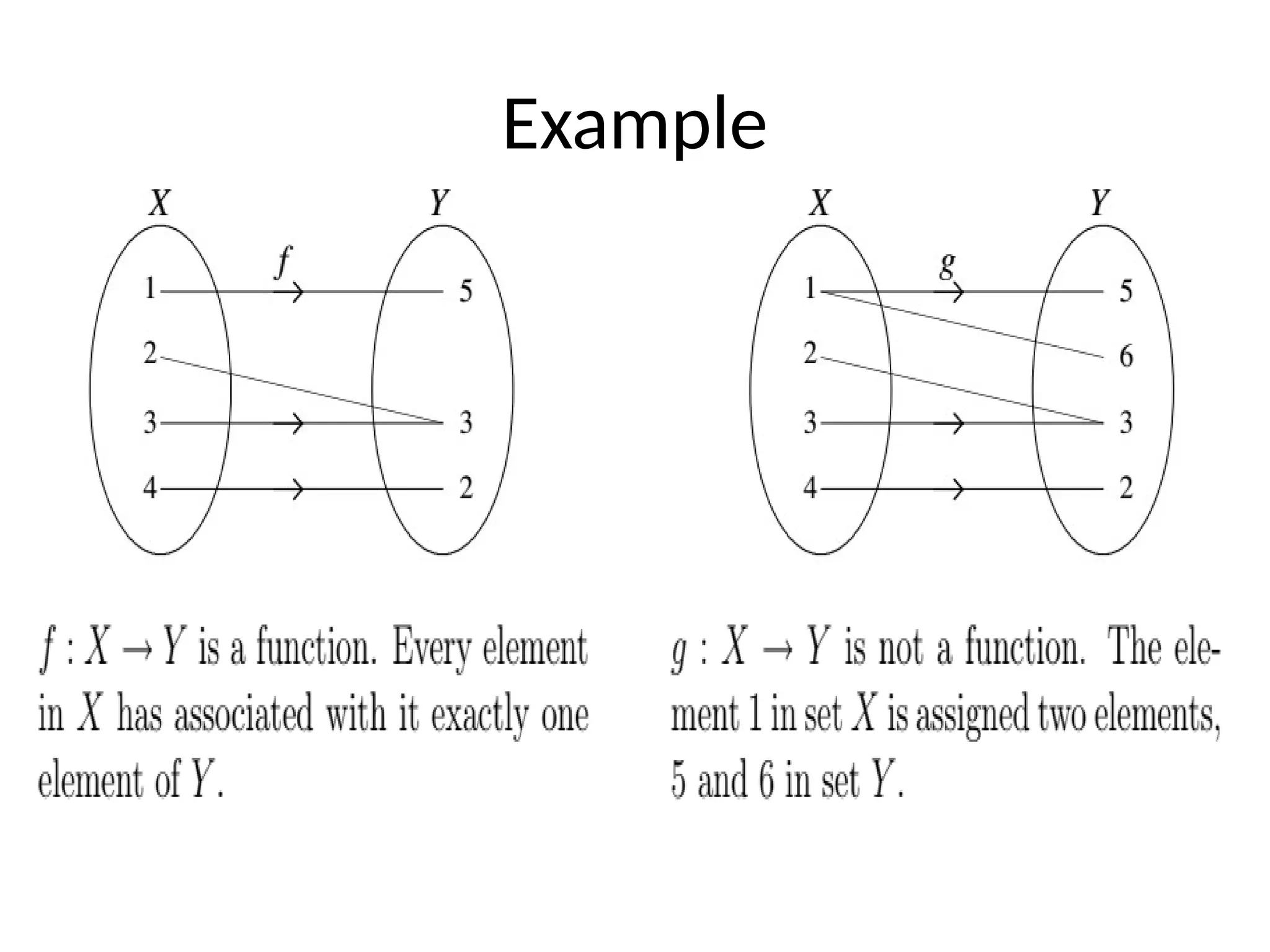
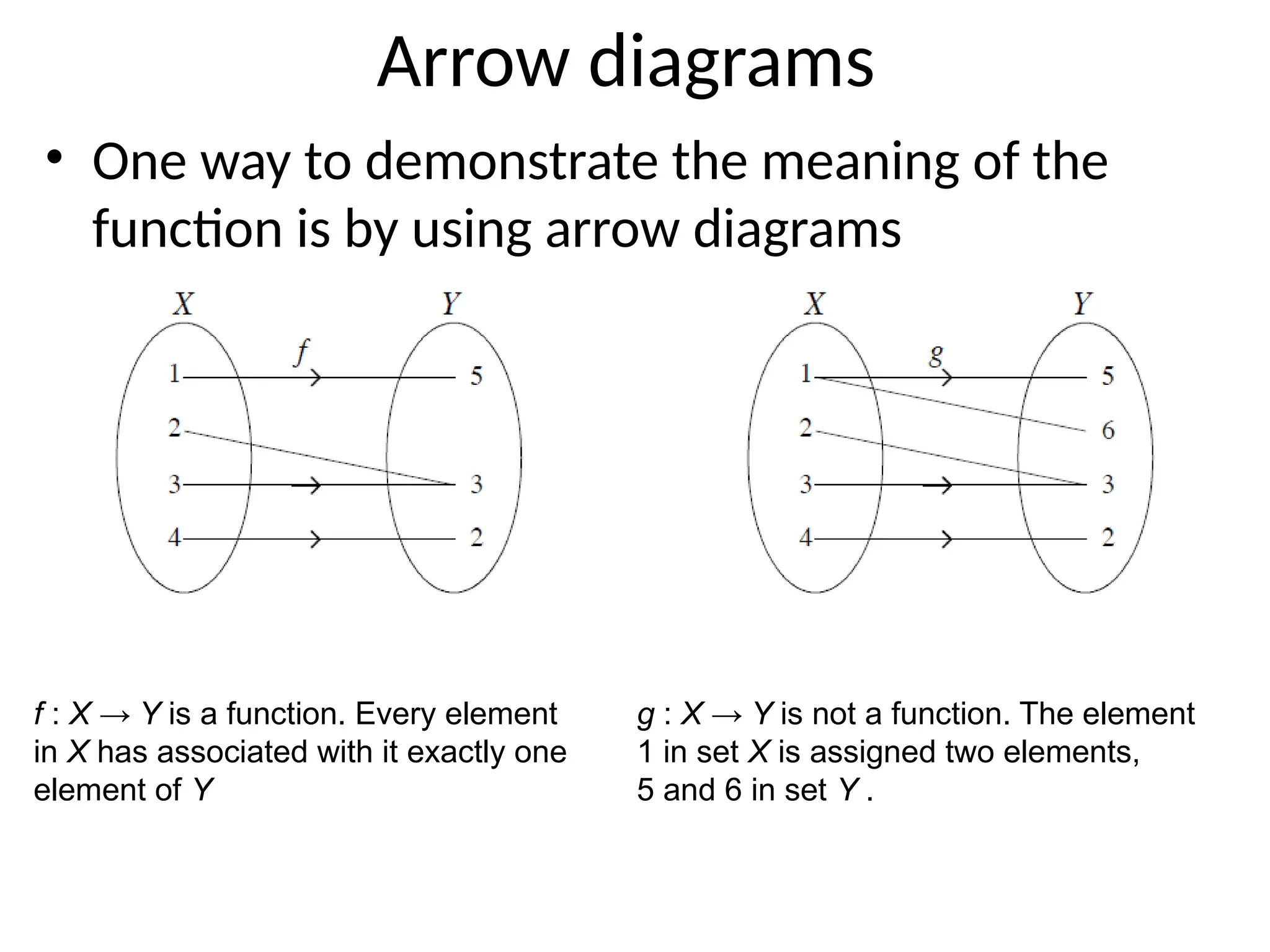
Arrow diagrams
• Oneway to demonstrate the meaning of the
function is by using arrow diagrams
f : X → Y is a function. Every element
in X has associated with it exactly one
element of Y
g : X → Y is not a function. The element
1 in set X is assigned two elements,
5 and 6 in set Y .
19.
set of orderedpairs
• A function can also be described as a set of
ordered pairs (x, y) such that for any x-value in
the set, there is only one y-value. This means that
there cannot be any repeated x-values different
y-values.
• The examples above can be described by the
following sets of ordered pairs.
• F = {(1,5),(3,3),(2,3),(4,2)} is a function.
• G = {(1,5),(4,2),(2,3),(3,3),(1,6)} is not
• a function
20.
Finding the Domainof a Function
The domain of an equation is the set of all x’s that we can
plug into the equation and get back a real number for y
whereas the range of an equation is the set of all y’s that we
can ever get out of the equation.
If only the rule y = f(x) is given, then the domain is
taken to be the set of all real x for which the
function is defined. For example, y = √x has domain;
all real x ≥ 0.
For a function f : X → Y the range of f is the set of y-values
such that y = f(x) for some x in X.
This corresponds to the set of y-values when we describe a
function as a set of ordered pairs (x, y). The function y = √x
has range; all real y ≥ 0
21.
Tips to findthe Domain of a function
Start with the domain as the set of real numbers.
If the equation has a denominator, exclude any
numbers that give a zero denominator.
If the equation has a radical of even index,
exclude any numbers that cause the expression
inside the radical to be negative.
22.
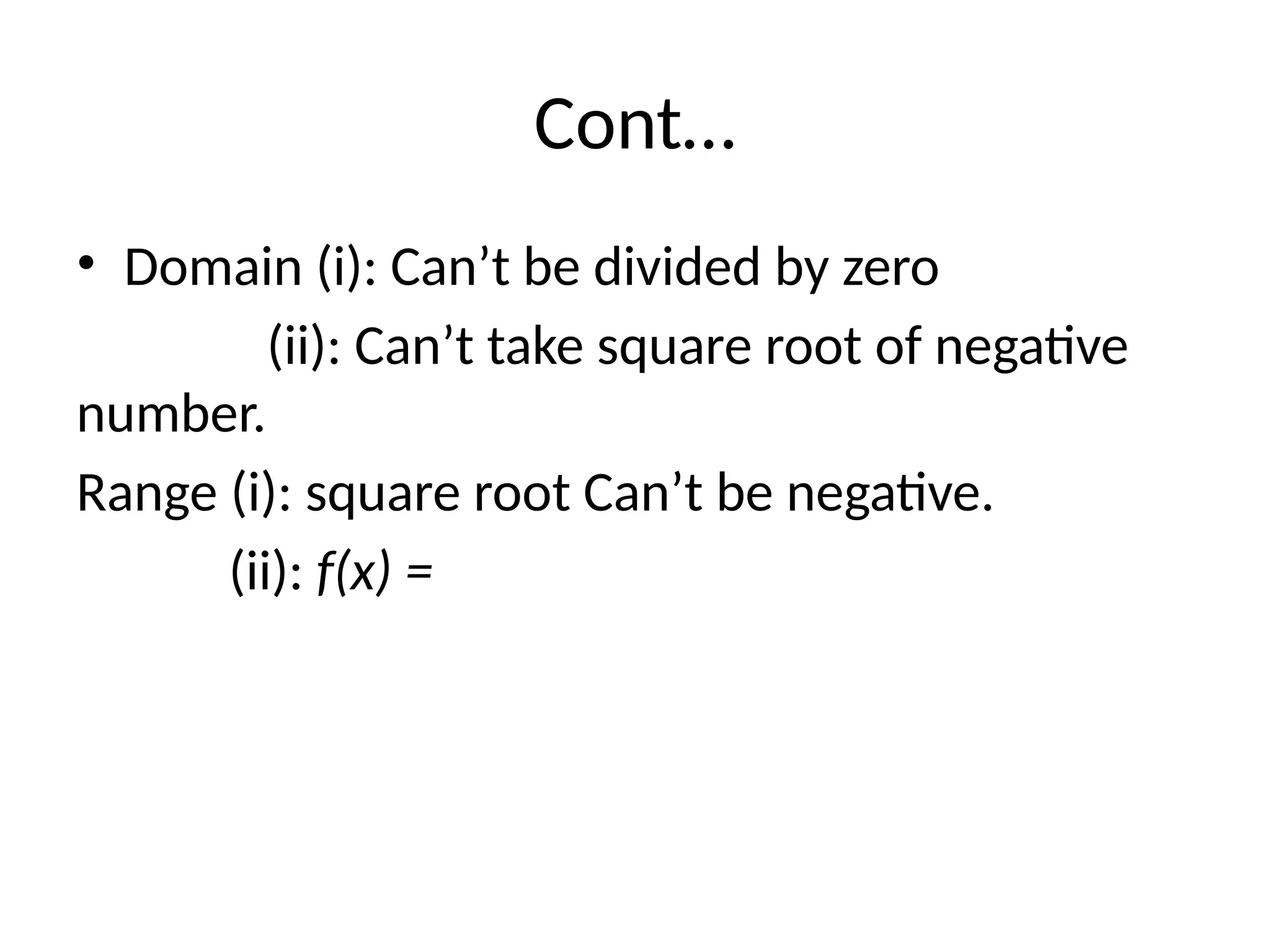
Cont…
• Domain (i):Can’t be divided by zero
(ii): Can’t take square root of negative
number.
Range (i): square root Can’t be negative.
(ii): f(x) =
23.
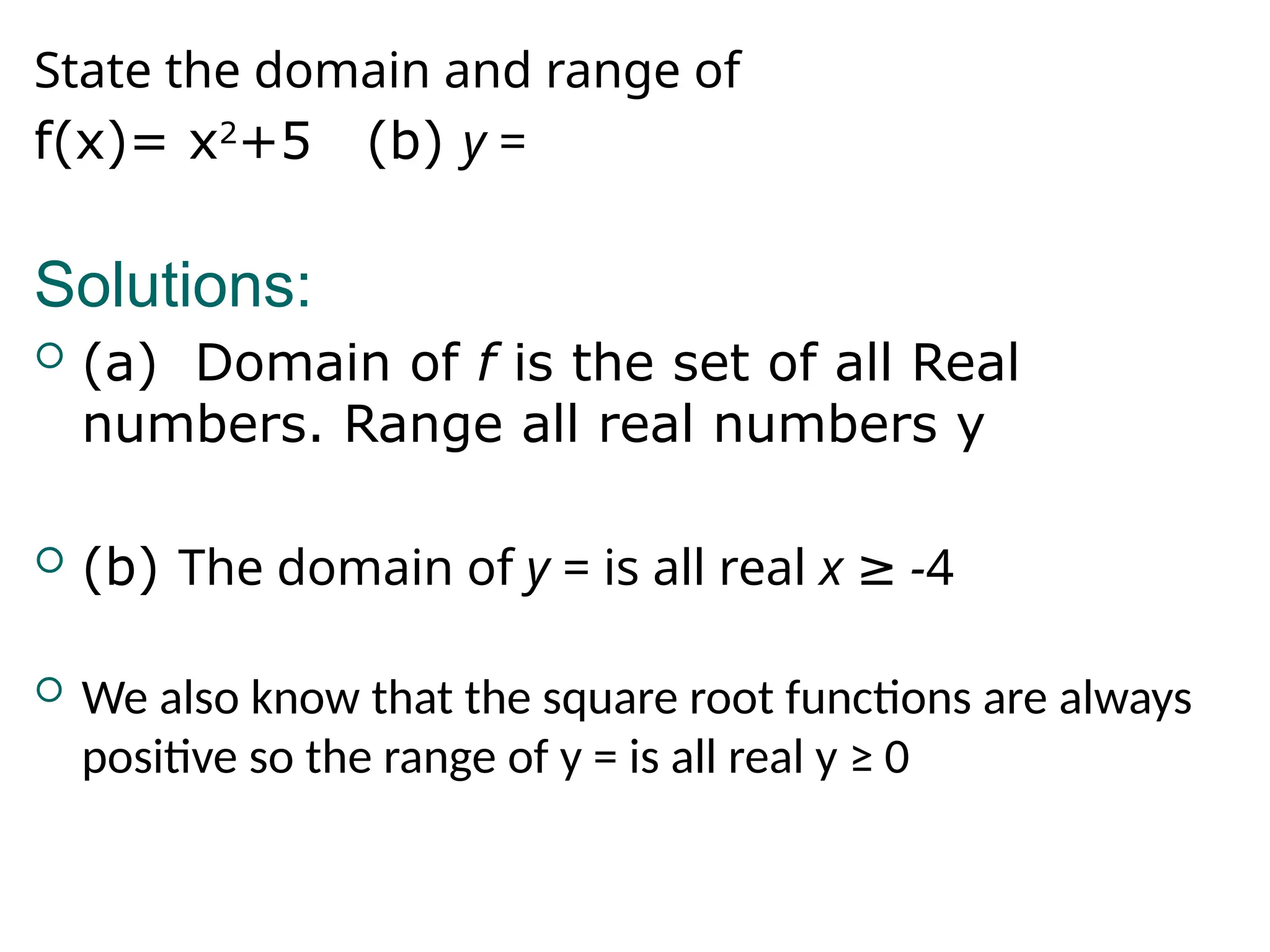
State the domainand range of
f(x)= x2
+5 (b) y =
Solutions:
(a) Domain of f is the set of all Real
numbers. Range all real numbers y
(b) The domain of y = is all real x -
≥ 4
We also know that the square root functions are always
positive so the range of y = is all real y ≥ 0
24.
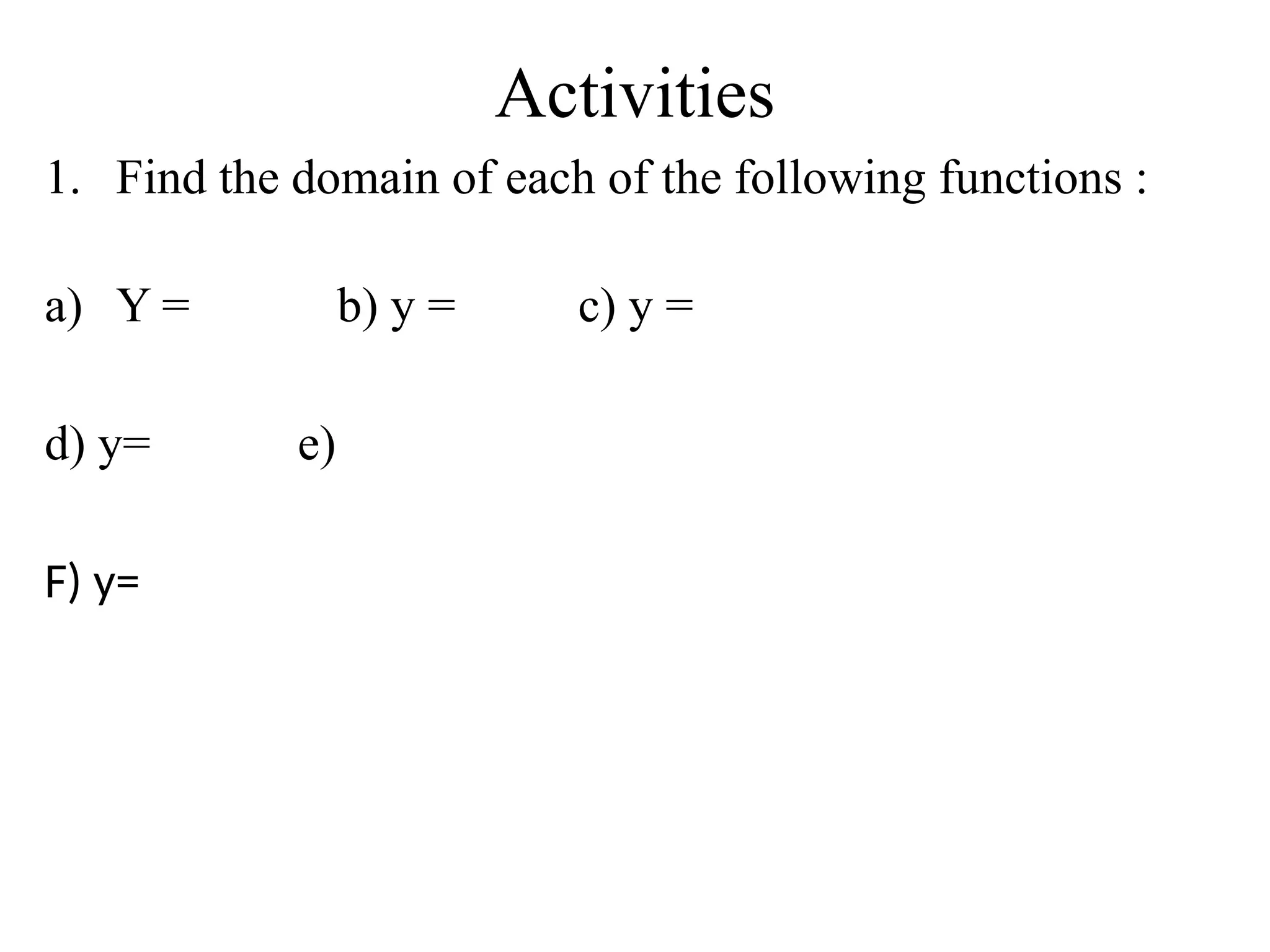
Activities
1. Find thedomain of each of the following functions :
a) Y = b) y = c) y =
d) y= e)
F) y=
25.
Functional Notation
We writef (x) to mean the function whose input
is x
Traditionally, functions are referred to by the
letter f, but f need not be the only letter used in
function names.
The following are but a few of the notations that
may be used to name a function:
f (x), g(x), h(a), A(t), ...
Multi and univariableof function
• Multivariable function
more than one independent variables
• Univariable Function
one independent and dependent variable
28.
Exogenous and EndogenousVariables
• The general form of production function:
Q = f(K,L), tells us that output (Q) depends on the values of
the two independent variables capital (K) and labour (L).
• Exogenous variables are the independent variables, the capital
and labour are the exogenous variables.
• Endogenous variables are dependent and are determined from
within.
• In the production function, the output level is dependent on the
number of units of capital and labour employed
29.
Types of functions
a)Polynomial functions
Any function defined in the form of a polynomial is
called a polynomial function.
• For example,
(i) f ( x ) = 3- 4x -2
(ii) f ( x ) = - 5- x+ 5,
Any quadratic function is a polynomial of degree 2.
− 8 is a polynomial of degree 4.
− 8 + 10 x + 6 is a polynomial of degree 5.
30.
Types of functions
b)Linear functions
• These are functions of the form: y = m x + b
• Graphs of these functions are straight lines.
• m is the slope and b is the y intercept. If m is positive then the line
rises to the right and if m is negative then the line falls to the right.
• A linear function takes a number x as input and returns the number
m x + b as output: f (x) = m x + b
31.
Graphs of linearfunctions
Example
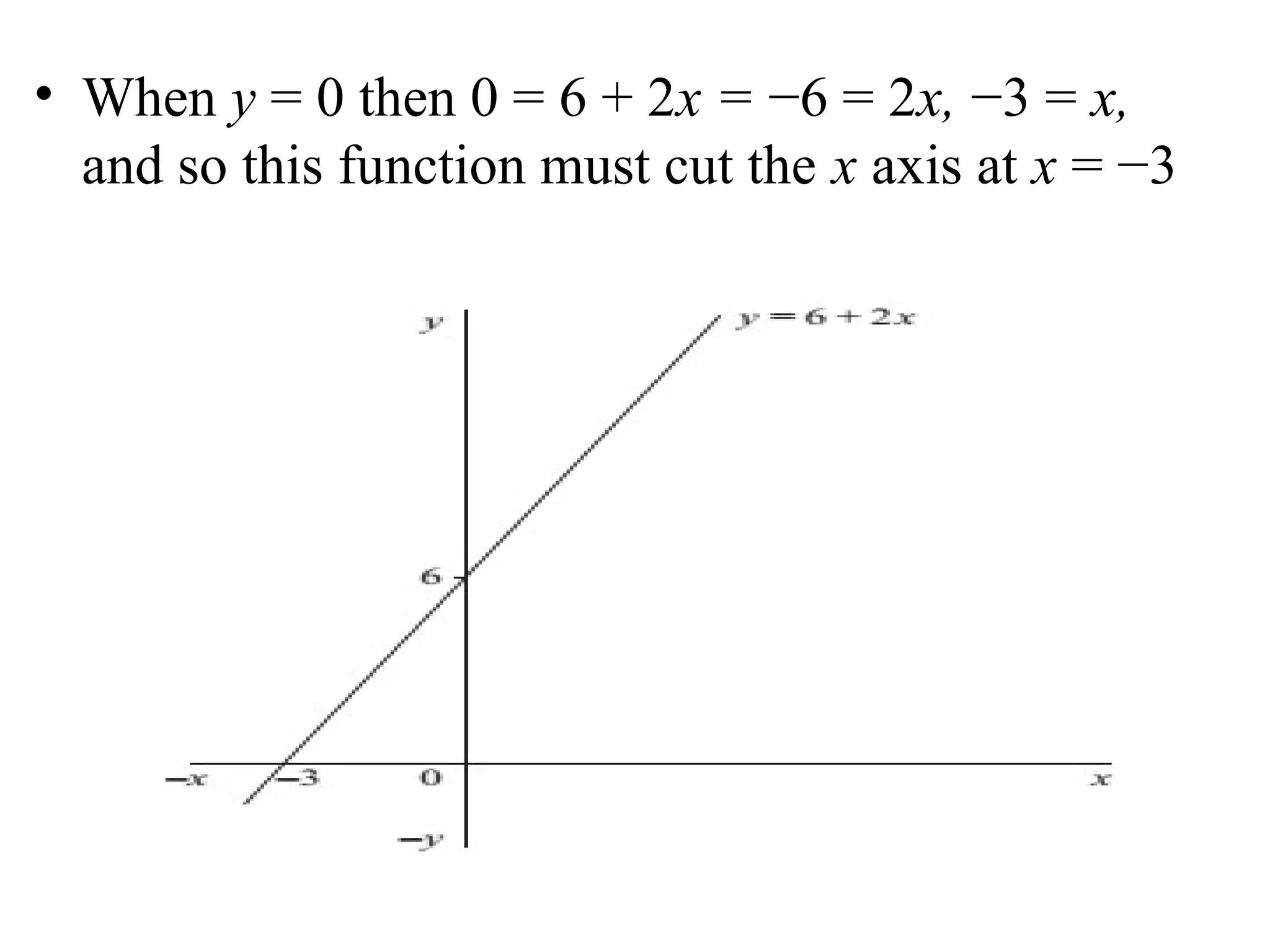
Plot the graph of the function, y = 6 + 2x
Solution
The y axis is a vertical line through the point
where x is zero.
When x = 0 then y = 6 and so this function must
cut the y axis at y =6. The x axis is a horizontal
line through the point where y is zero
32.
• When y= 0 then 0 = 6 + 2x = −6 = 2x, −3 = x,
and so this function must cut the x axis at x = −3
33.
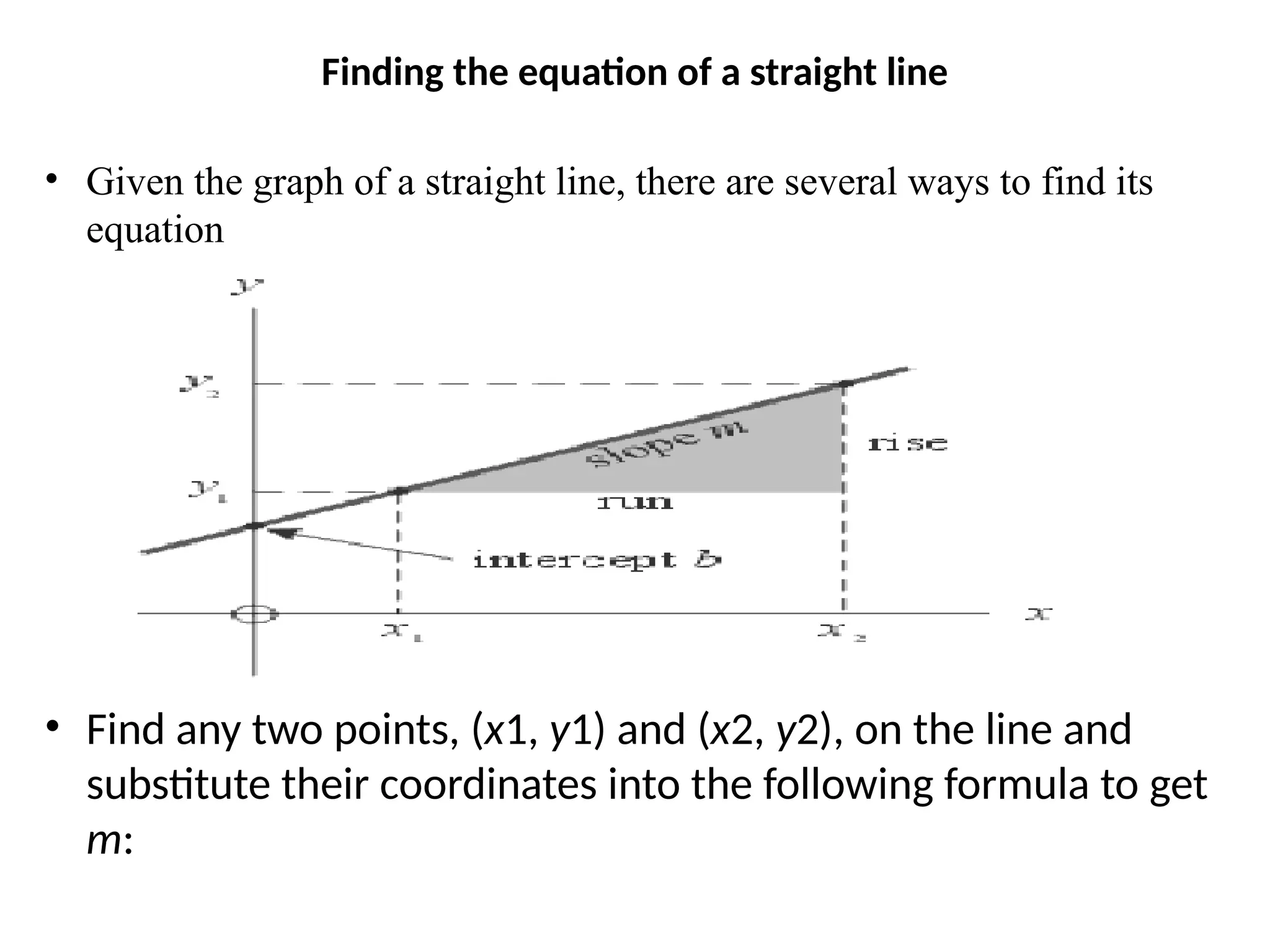
Finding the equationof a straight line
• Given the graph of a straight line, there are several ways to find its
equation
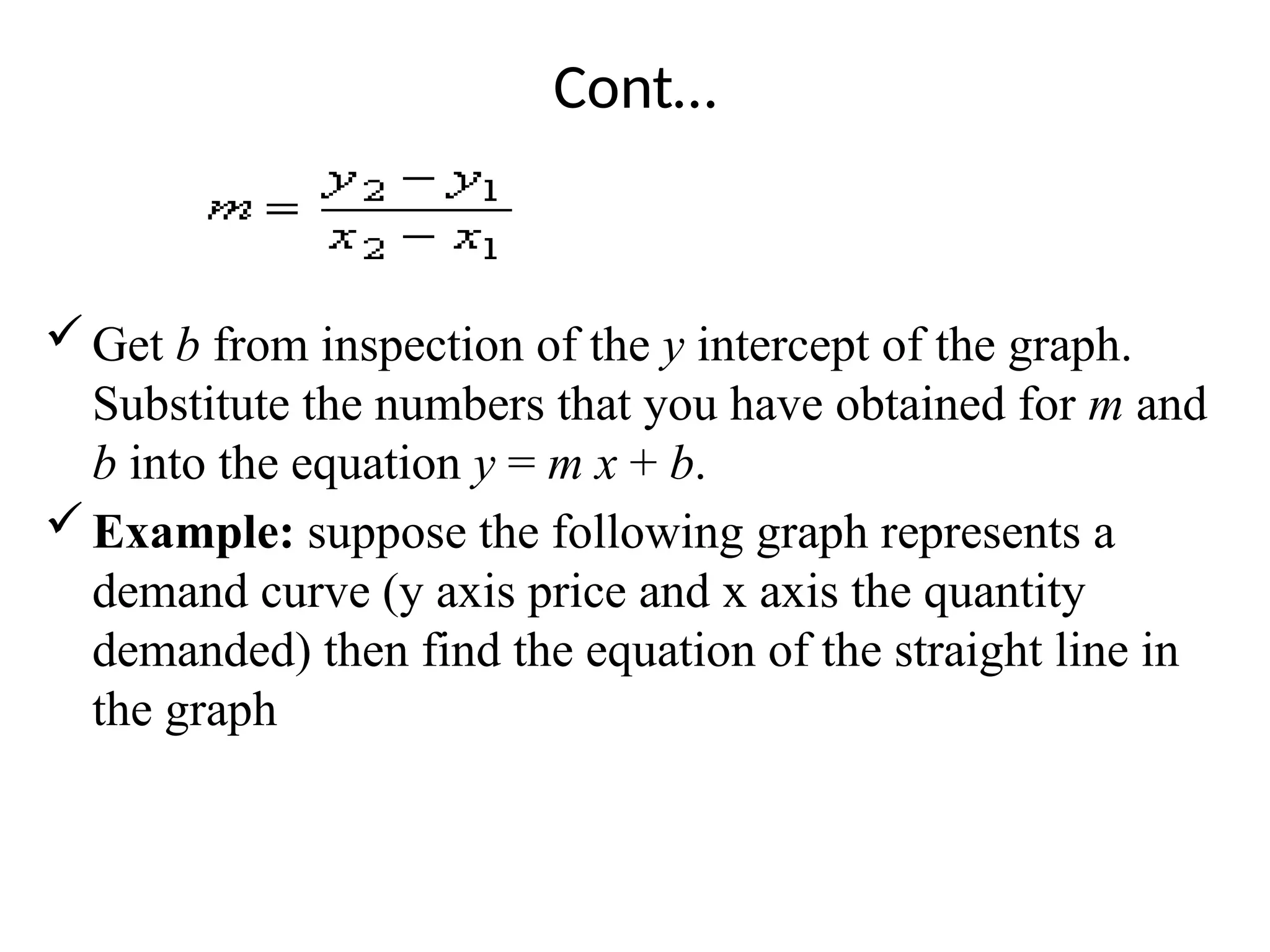
• Find any two points, (x1, y1) and (x2, y2), on the line and
substitute their coordinates into the following formula to get
m:
34.
Cont…
Get b frominspection of the y intercept of the graph.
Substitute the numbers that you have obtained for m and
b into the equation y = m x + b.
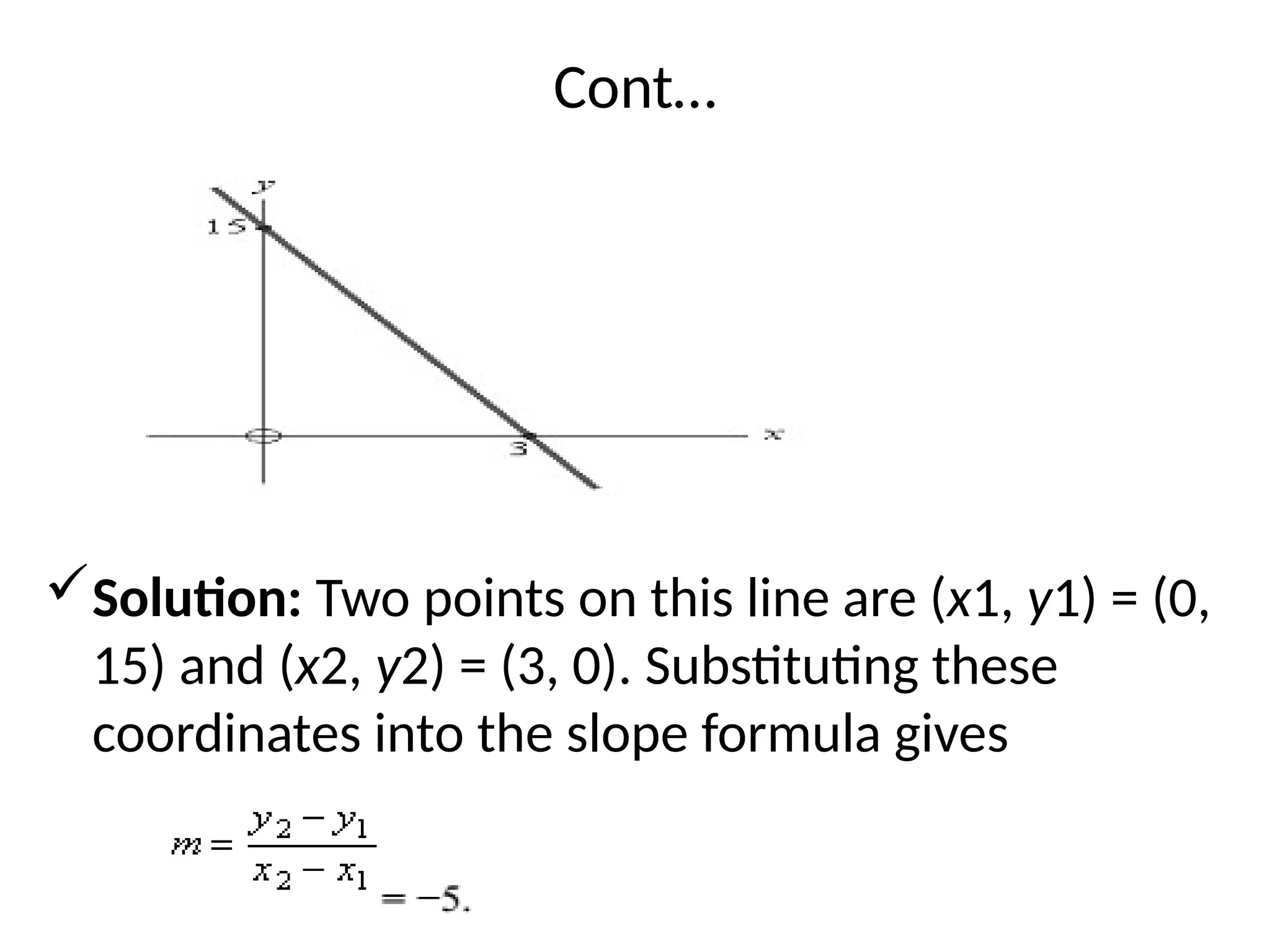
Example: suppose the following graph represents a
demand curve (y axis price and x axis the quantity
demanded) then find the equation of the straight line in
the graph
35.
Cont…
Solution: Two pointson this line are (x1, y1) = (0,
15) and (x2, y2) = (3, 0). Substituting these
coordinates into the slope formula gives
36.
Example: given twopoints of a straight line:
(7, 15) and (1, 3) find the equation of the line
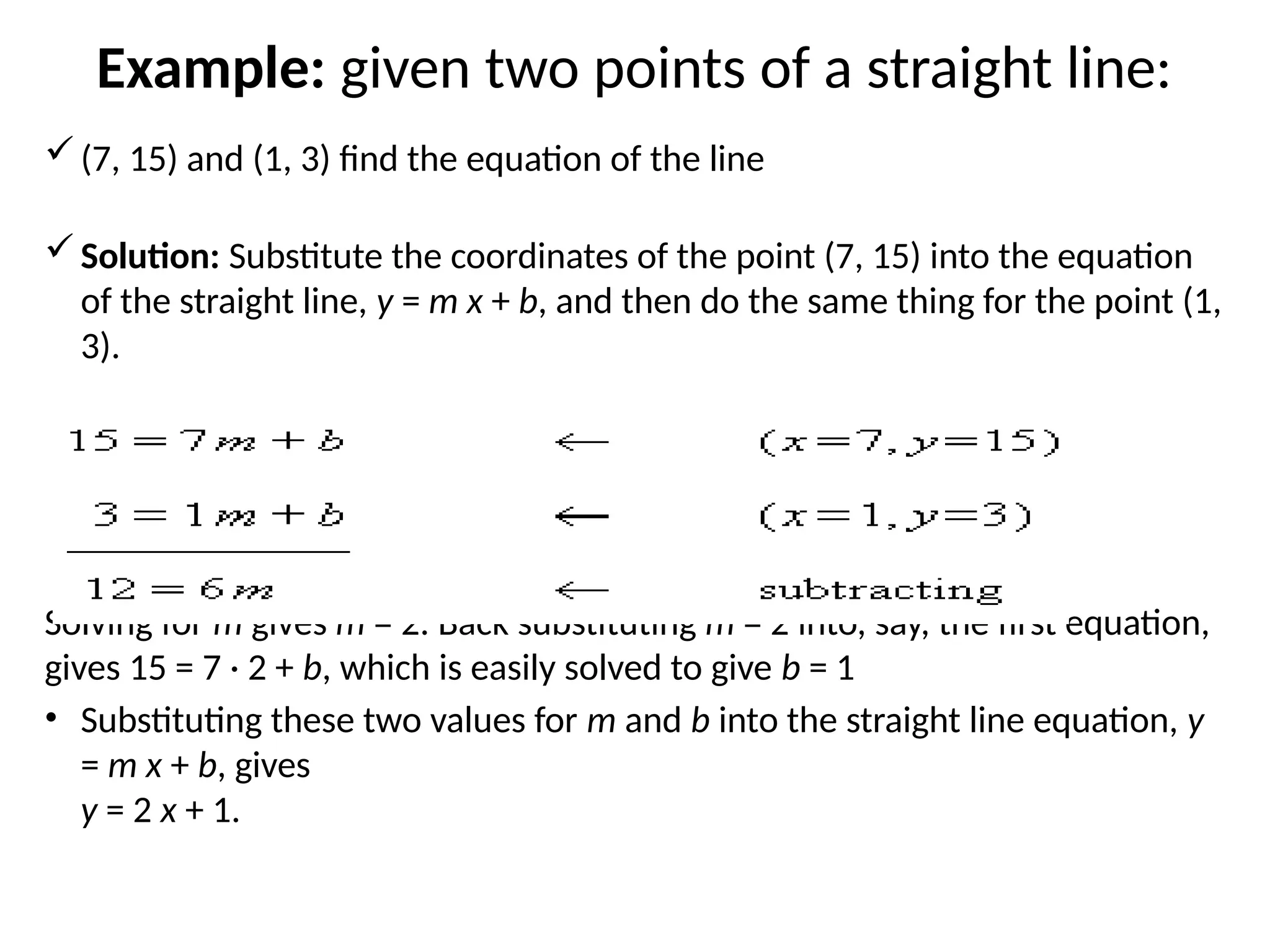
Solution: Substitute the coordinates of the point (7, 15) into the equation
of the straight line, y = m x + b, and then do the same thing for the point (1,
3).
Solving for m gives m = 2. Back substituting m = 2 into, say, the first equation,
gives 15 = 7 · 2 + b, which is easily solved to give b = 1
• Substituting these two values for m and b into the straight line equation, y
= m x + b, gives
y = 2 x + 1.
37.
Economical application ofFunction
• Supply and Demand equation
• Activities: Find the equation of the line relating
demand and supply
1) The supplier will produce 1000 units when the
selling price is $20 per unit and will produce
1500 units if the price is $25 per unit.
2) Consumers will demand 1500 units when the
selling price is $20 per unit but that the demand
will decrease by 10% if the price increases by
5%.
38.
Some Economic Applications
Activities:
1.A company manufactures and sells a TV. It was determined that
for a price of birr 88 each, the demand would be 2 thousand TVs,
and at birr 38 each, 12 thousand TVs. Assuming linear
relationships between price and demand find the function that
shows the relationship of price and demand in the form of p(x) =
mx+ b. what would be the price at a demand of 10 thousand TVs?
Exercise
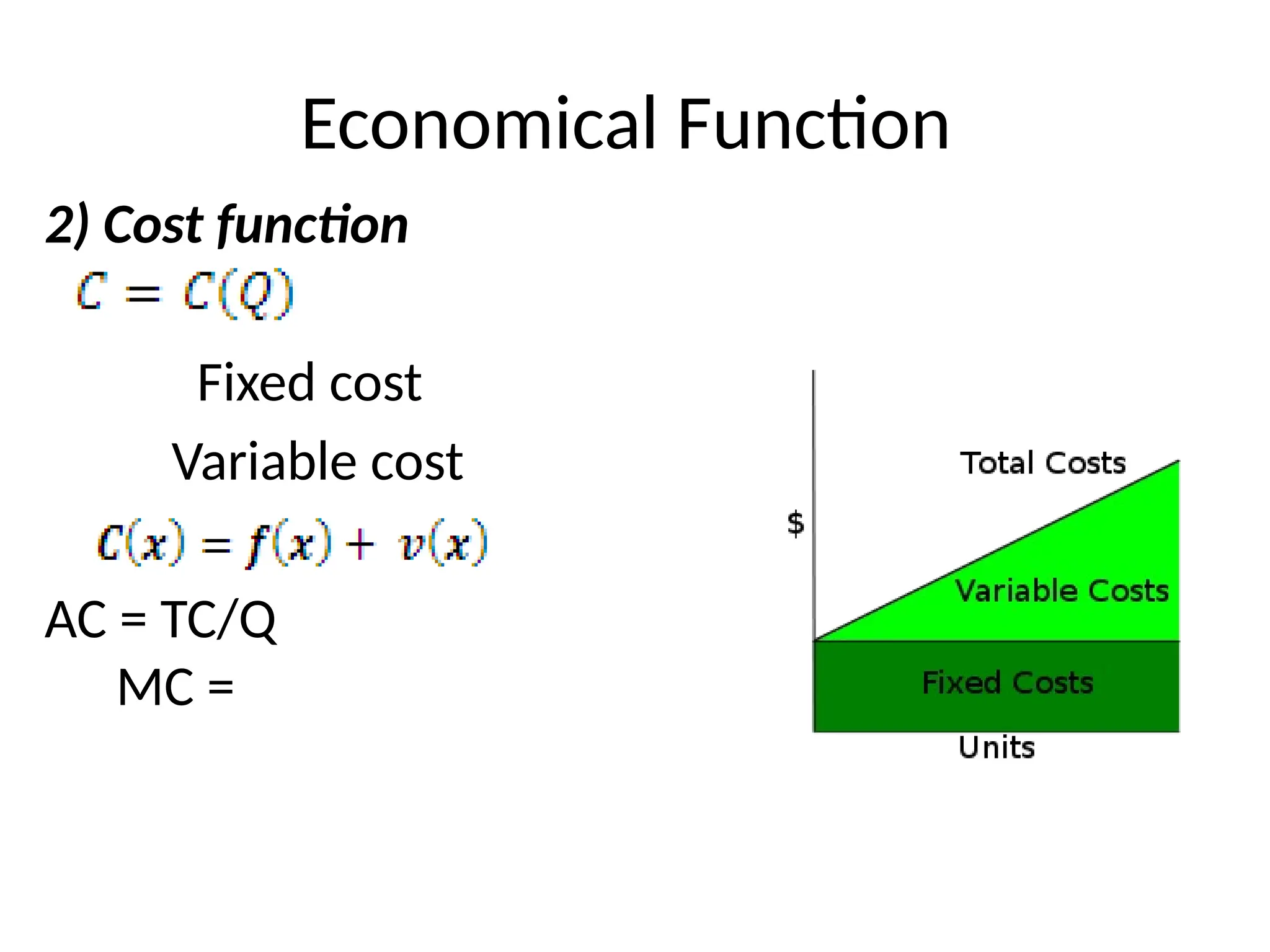
• A firmthat makes pencils plans on producing 500 pencils
a week, based on their production costs throughout the
years, they figure that it will cost them $1.00 to make
each pencil. There will also be a cost for running the
equipment for a week that they figure to be $350 for the
whole week, regardless of how many pencils they make.
A) What is their fixed cost?
B) What is their variable cost ?
C) What is their output (x)?
D) Write the total cost equation form
D) what is the total cost of producing 500 pencils?
41.
3) Total revenuefunction
Revenue is the total payment received from selling a
good, performing a service, etc
The revenue function, R(x), reflects the revenue
from selling “x” amount of output items at a price
of “p” per item.
The same pencil factory decides to sell its 500
pencils for $1.75 each.
What would the total revenue be?
• What is the price (p)?
• What is the output (x)?
42.
4) Profit function
Profitand revenue are not the same thing.
Revenue reflects how much we earn from selling
our product (gross proceeds) without reflecting
what the costs were.
Profit functions, however, takes into account the
costs of production and represents how much the
company really makes after deducting the costs
of production from the revenue. This is why
Profit is defined as:
• 𝑷𝒓𝒐𝒇𝒊𝒕= −
𝑹𝒆𝒗𝒆𝒏𝒖𝒆 𝑪𝒐𝒔𝒕
• 𝑃 = – or ( ) = ( ) – ( )
𝑅 𝐶 𝑃 𝑥 𝑅 𝑥 𝐶 𝑥
43.
Exercise
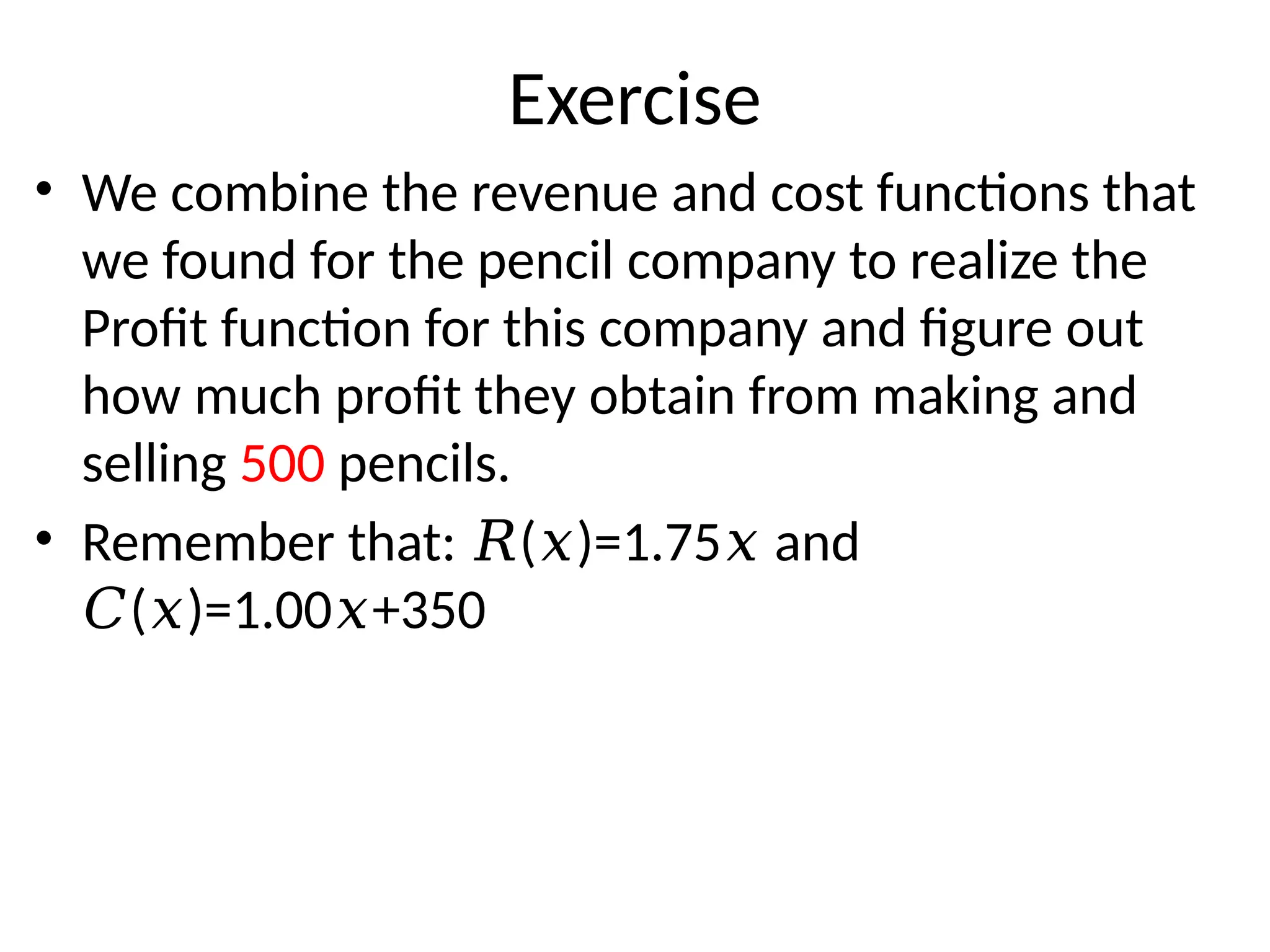
• We combinethe revenue and cost functions that
we found for the pencil company to realize the
Profit function for this company and figure out
how much profit they obtain from making and
selling 500 pencils.
• Remember that: ( )=1.75 and
𝑅 𝑥 𝑥
( )=1.00 +350
𝐶 𝑥 𝑥
44.
Break even analysis
Thereare three distinct possible in business.
business firm is earned profit, R(x) –TC>0
the business firm is loss profit, R(x) –TC<0
nether earning profit nor loss, R(x) –TC=0
Another important point of the Profit function is
the break-even point: where we neither make a
profit nor a loss [ ( )=0]. This occurs where
𝑃 𝑥
= , So using our equations to fill out:
𝑅 𝐶
( )= ( ) , We can determine the amount of
𝑅 𝑥 𝐶 𝑥
output that would lead to the company’s profits
breaking even by solving for x.
45.
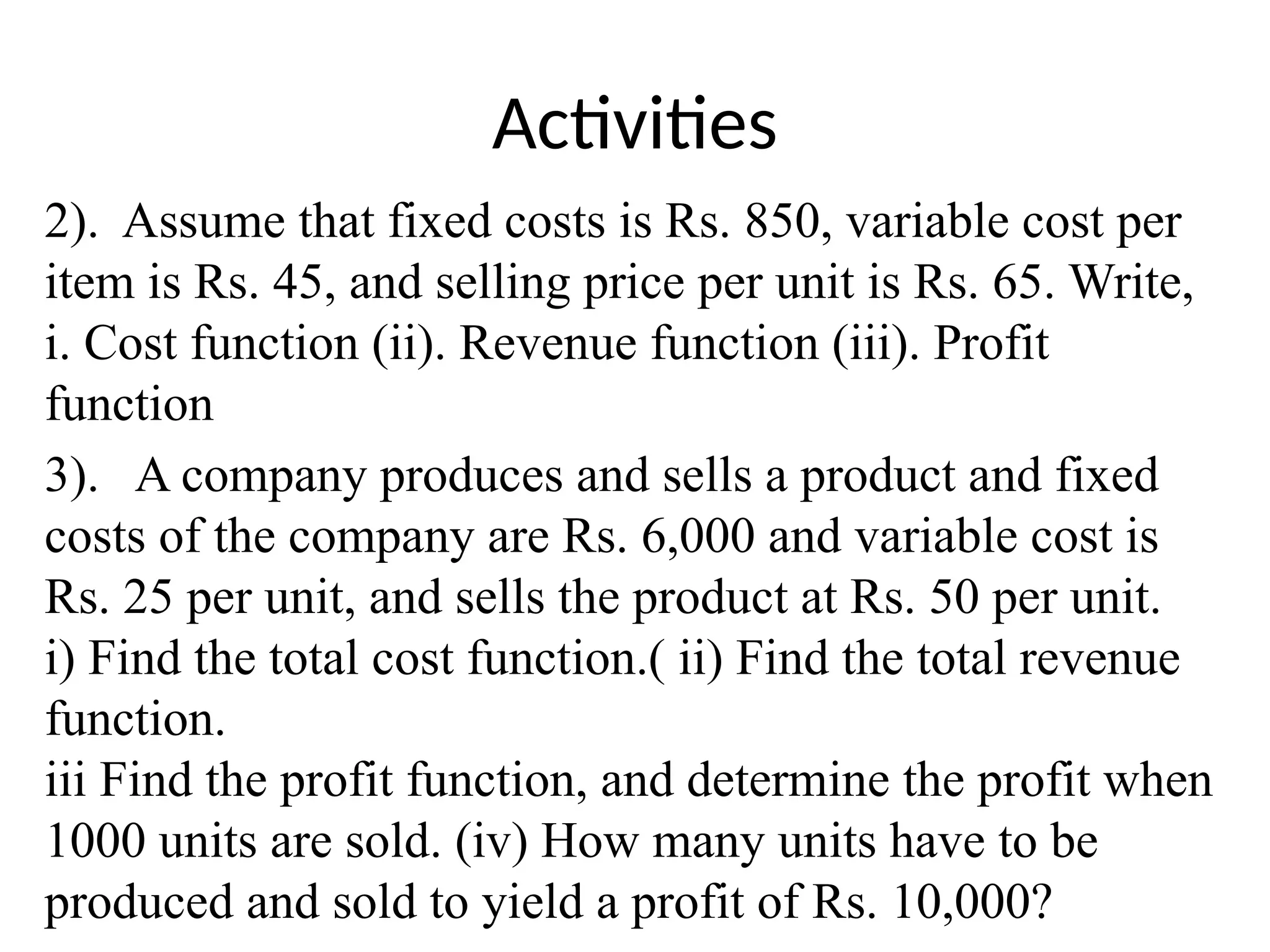
Activities
2). Assume thatfixed costs is Rs. 850, variable cost per
item is Rs. 45, and selling price per unit is Rs. 65. Write,
i. Cost function (ii). Revenue function (iii). Profit
function
3). A company produces and sells a product and fixed
costs of the company are Rs. 6,000 and variable cost is
Rs. 25 per unit, and sells the product at Rs. 50 per unit.
i) Find the total cost function.( ii) Find the total revenue
function.
iii Find the profit function, and determine the profit when
1000 units are sold. (iv) How many units have to be
produced and sold to yield a profit of Rs. 10,000?
46.
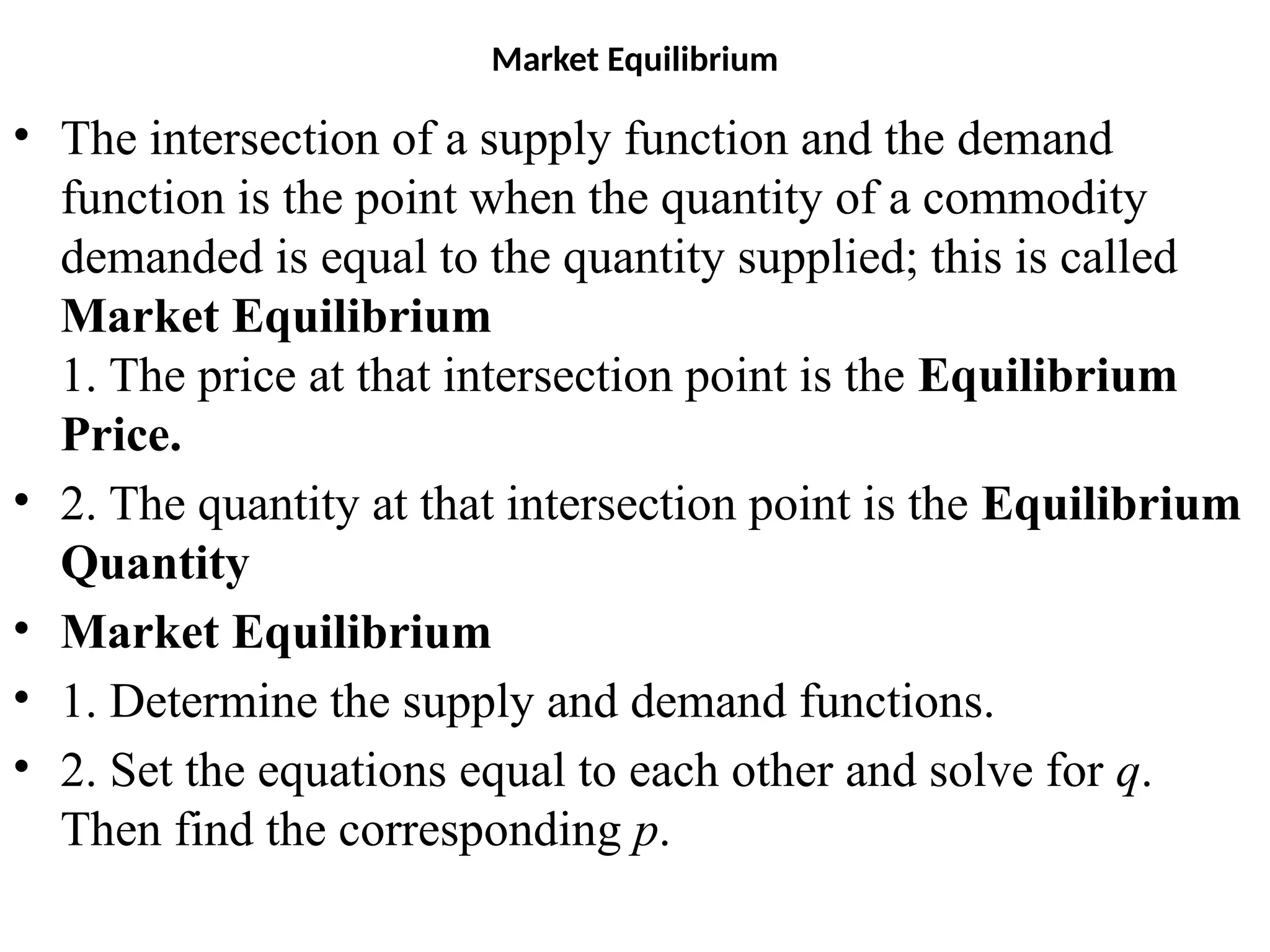
Market Equilibrium
• Theintersection of a supply function and the demand
function is the point when the quantity of a commodity
demanded is equal to the quantity supplied; this is called
Market Equilibrium
1. The price at that intersection point is the Equilibrium
Price.
• 2. The quantity at that intersection point is the Equilibrium
Quantity
• Market Equilibrium
• 1. Determine the supply and demand functions.
• 2. Set the equations equal to each other and solve for q.
Then find the corresponding p.
47.
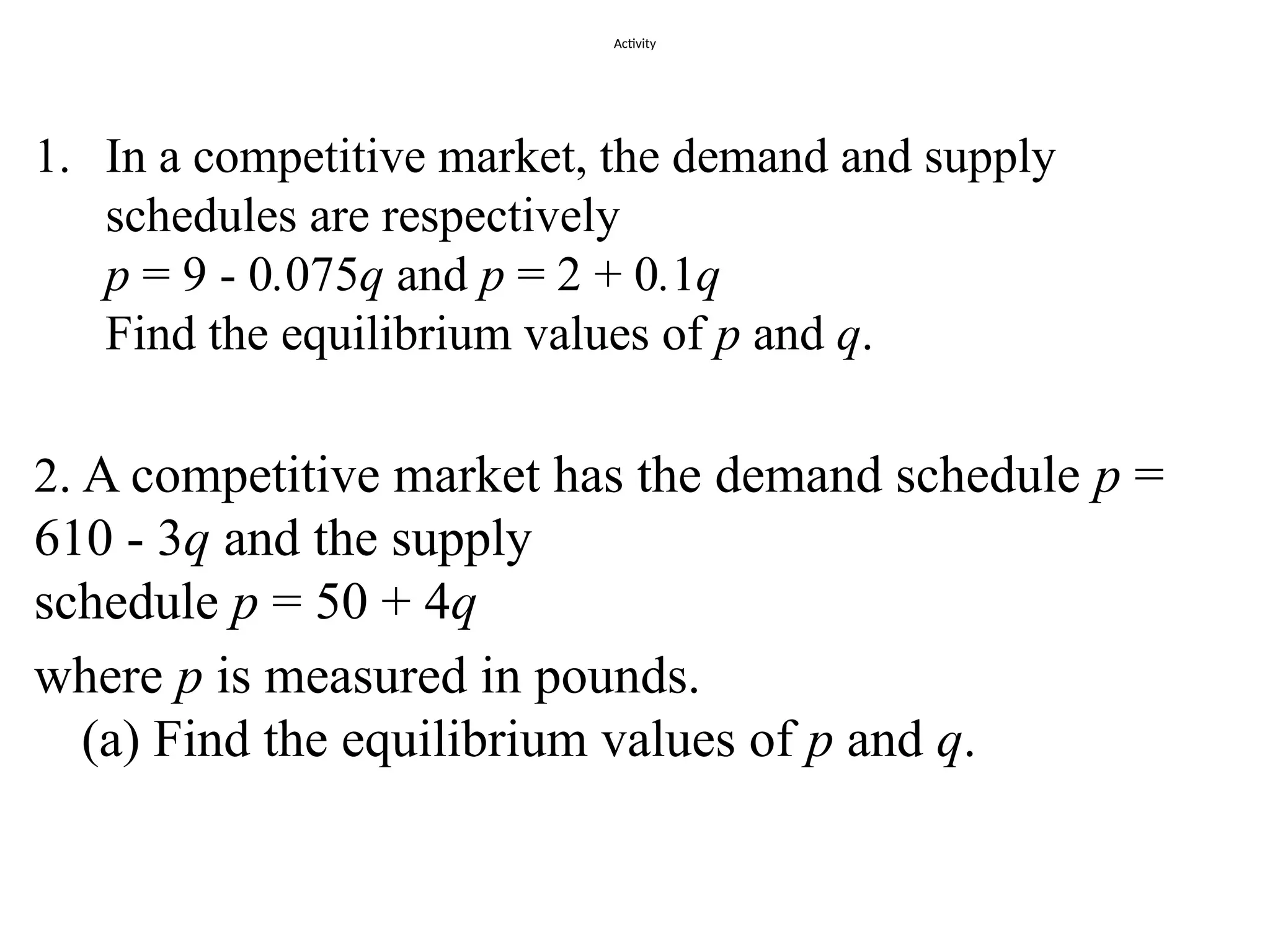
Activity
1. In acompetitive market, the demand and supply
schedules are respectively
p = 9 - 0.075q and p = 2 + 0.1q
Find the equilibrium values of p and q.
2. A competitive market has the demand schedule p =
610 - 3q and the supply
schedule p = 50 + 4q
where p is measured in pounds.
(a) Find the equilibrium values of p and q.
48.
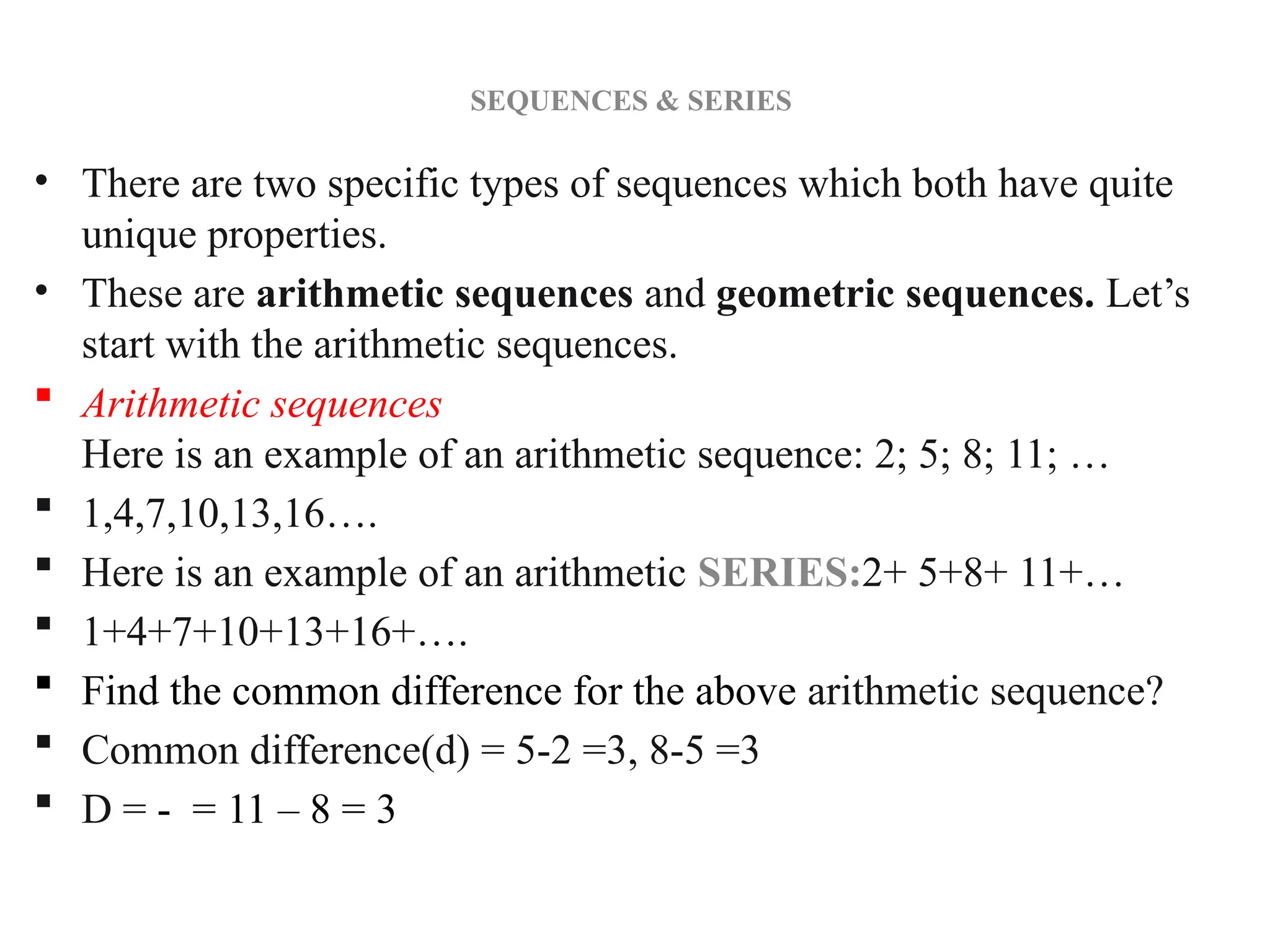
SEQUENCES & SERIES
•There are two specific types of sequences which both have quite
unique properties.
• These are arithmetic sequences and geometric sequences. Let’s
start with the arithmetic sequences.
Arithmetic sequences
Here is an example of an arithmetic sequence: 2; 5; 8; 11; …
1,4,7,10,13,16….
Here is an example of an arithmetic SERIES:2+ 5+8+ 11+…
1+4+7+10+13+16+….
Find the common difference for the above arithmetic sequence?
Common difference(d) = 5-2 =3, 8-5 =3
D = - = 11 – 8 = 3
49.
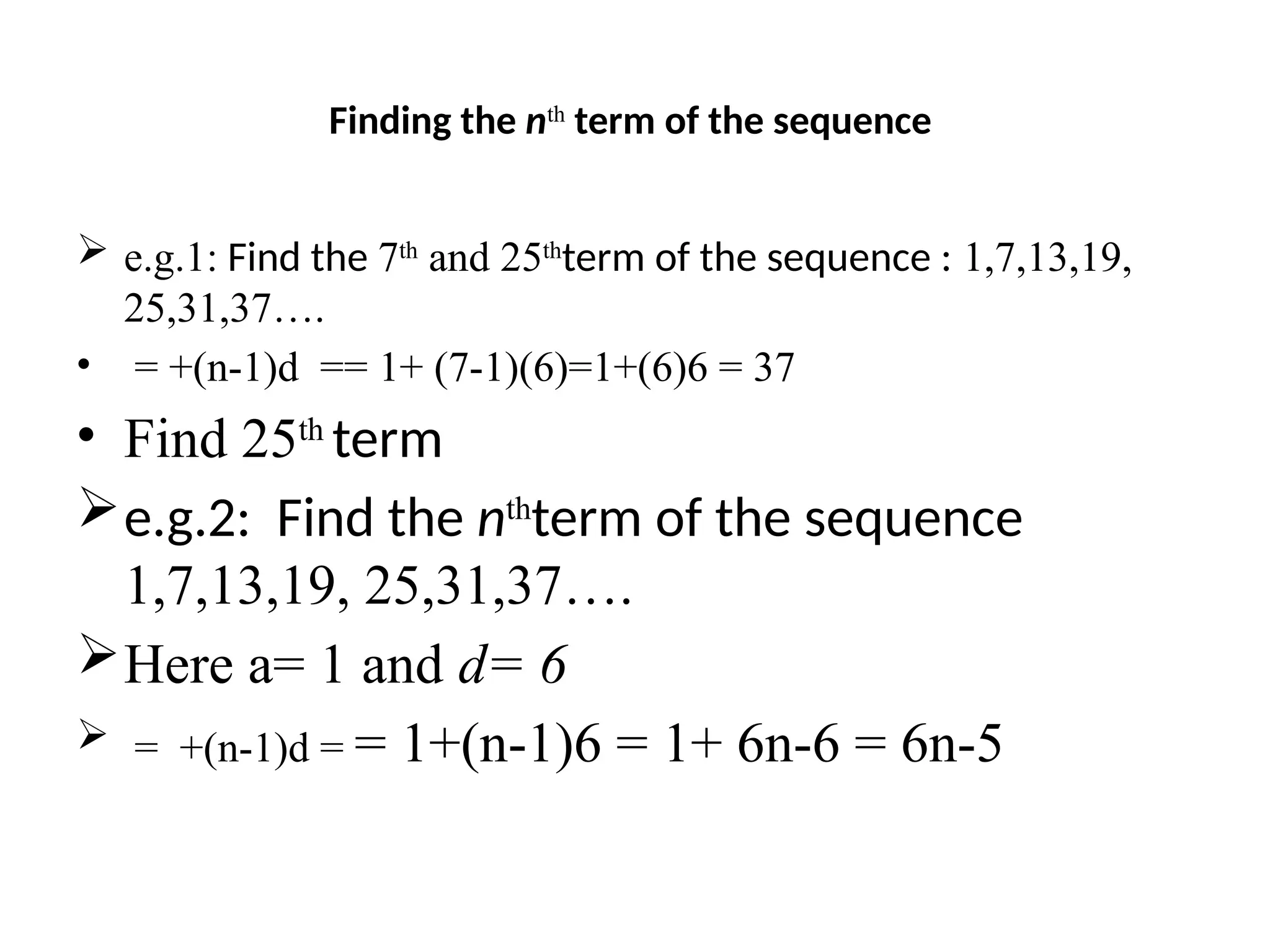
Finding the nth
termof the sequence
e.g.1: Find the 7th
and 25th
term of the sequence : 1,7,13,19,
25,31,37….
• = +(n-1)d == 1+ (7-1)(6)=1+(6)6 = 37
• Find 25th
term
e.g.2: Find the nth
term of the sequence
1,7,13,19, 25,31,37….
Here a= 1 and d= 6
= +(n-1)d = = 1+(n-1)6 = 1+ 6n-6 = 6n-5
50.
Activity
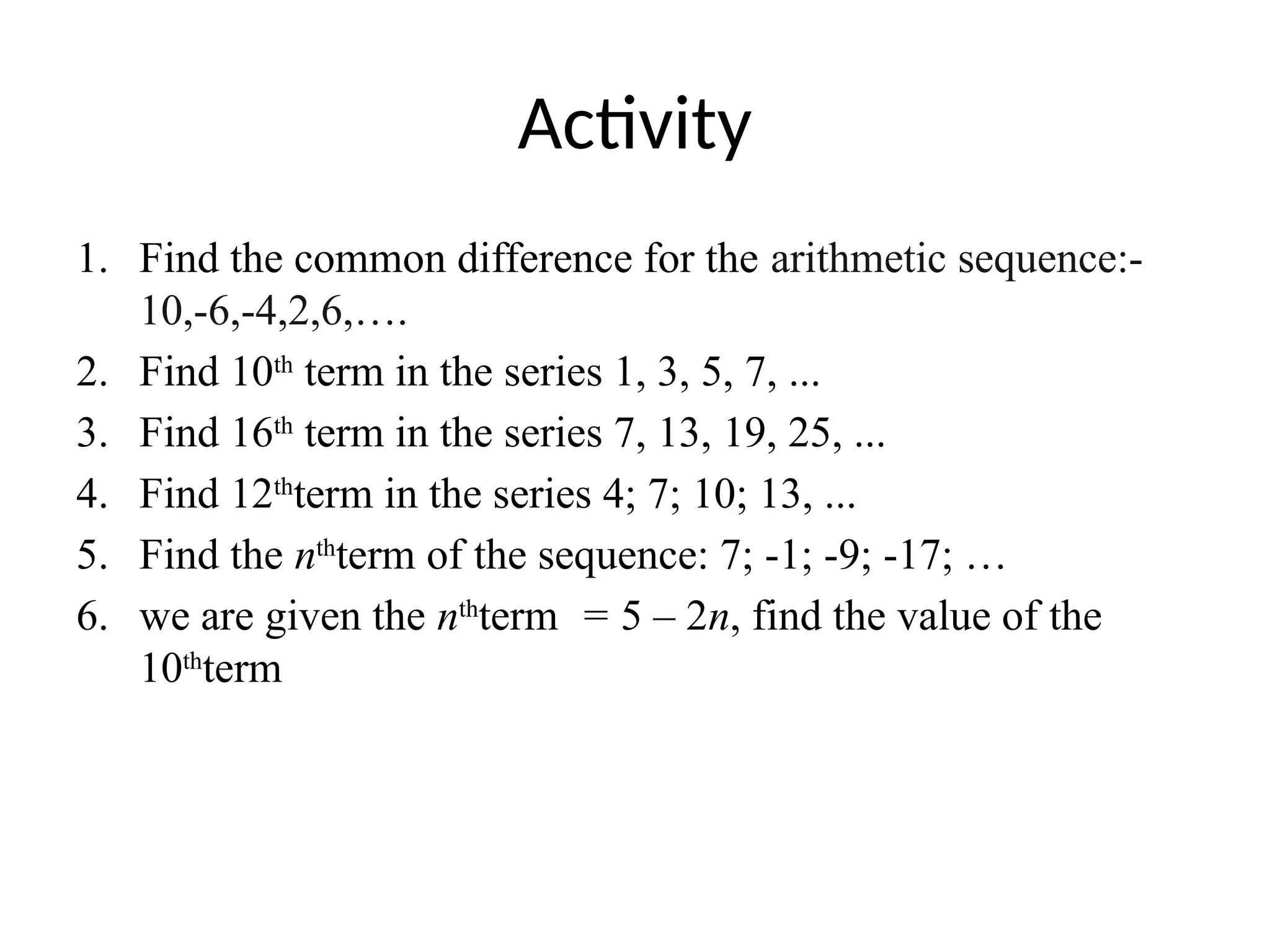
1. Find thecommon difference for the arithmetic sequence:-
10,-6,-4,2,6,….
2. Find 10th
term in the series 1, 3, 5, 7, ...
3. Find 16th
term in the series 7, 13, 19, 25, ...
4. Find 12th
term in the series 4; 7; 10; 13, ...
5. Find the nth
term of the sequence: 7; -1; -9; -17; …
6. we are given the nth
term = 5 – 2n, find the value of the
10th
term
51.
Arithmetic series
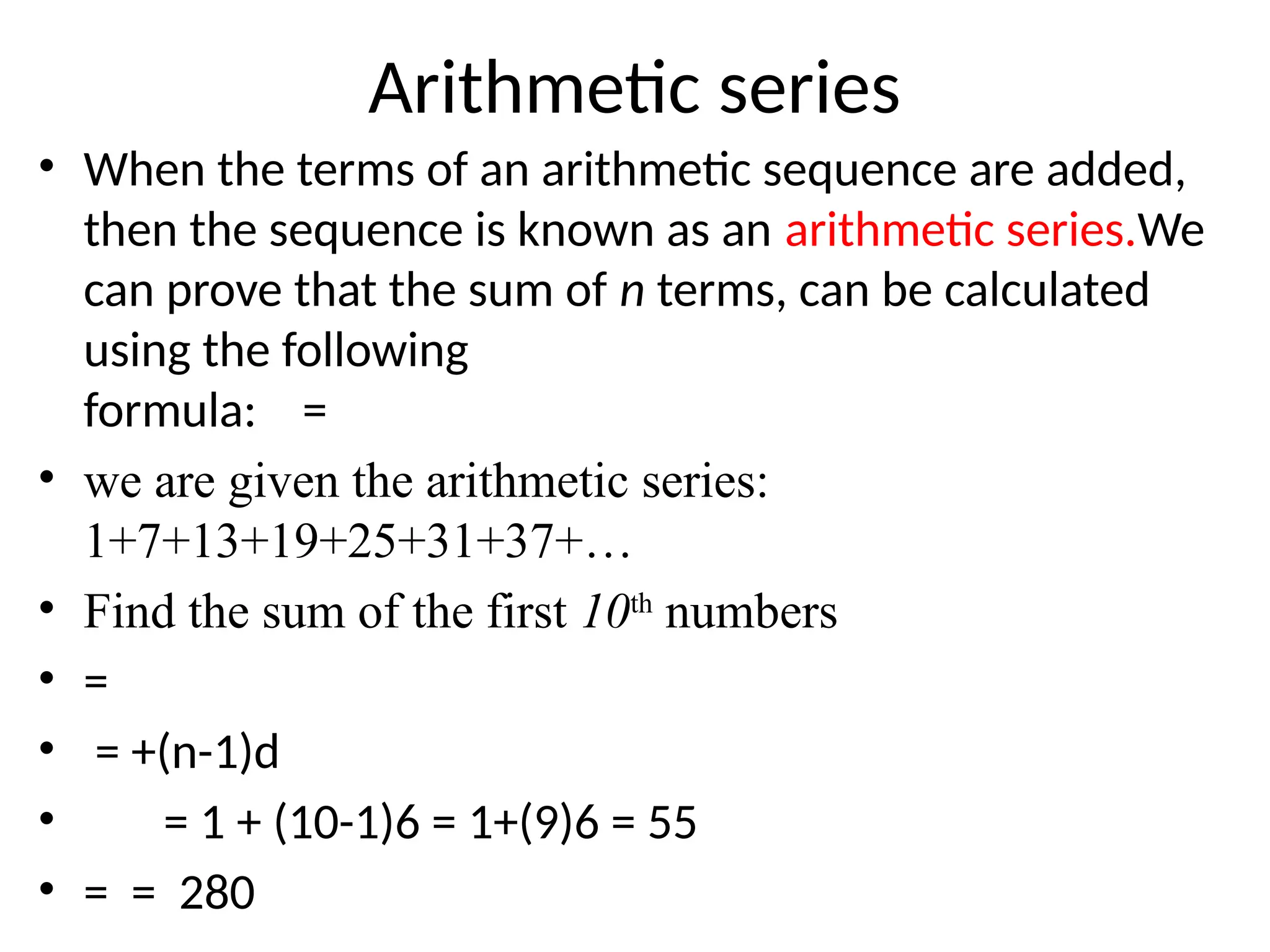
• Whenthe terms of an arithmetic sequence are added,
then the sequence is known as an arithmetic series.We
can prove that the sum of n terms, can be calculated
using the following
formula: =
• we are given the arithmetic series:
1+7+13+19+25+31+37+…
• Find the sum of the first 10th
numbers
• =
• = +(n-1)d
• = 1 + (10-1)6 = 1+(9)6 = 55
• = = 280
52.
Activity
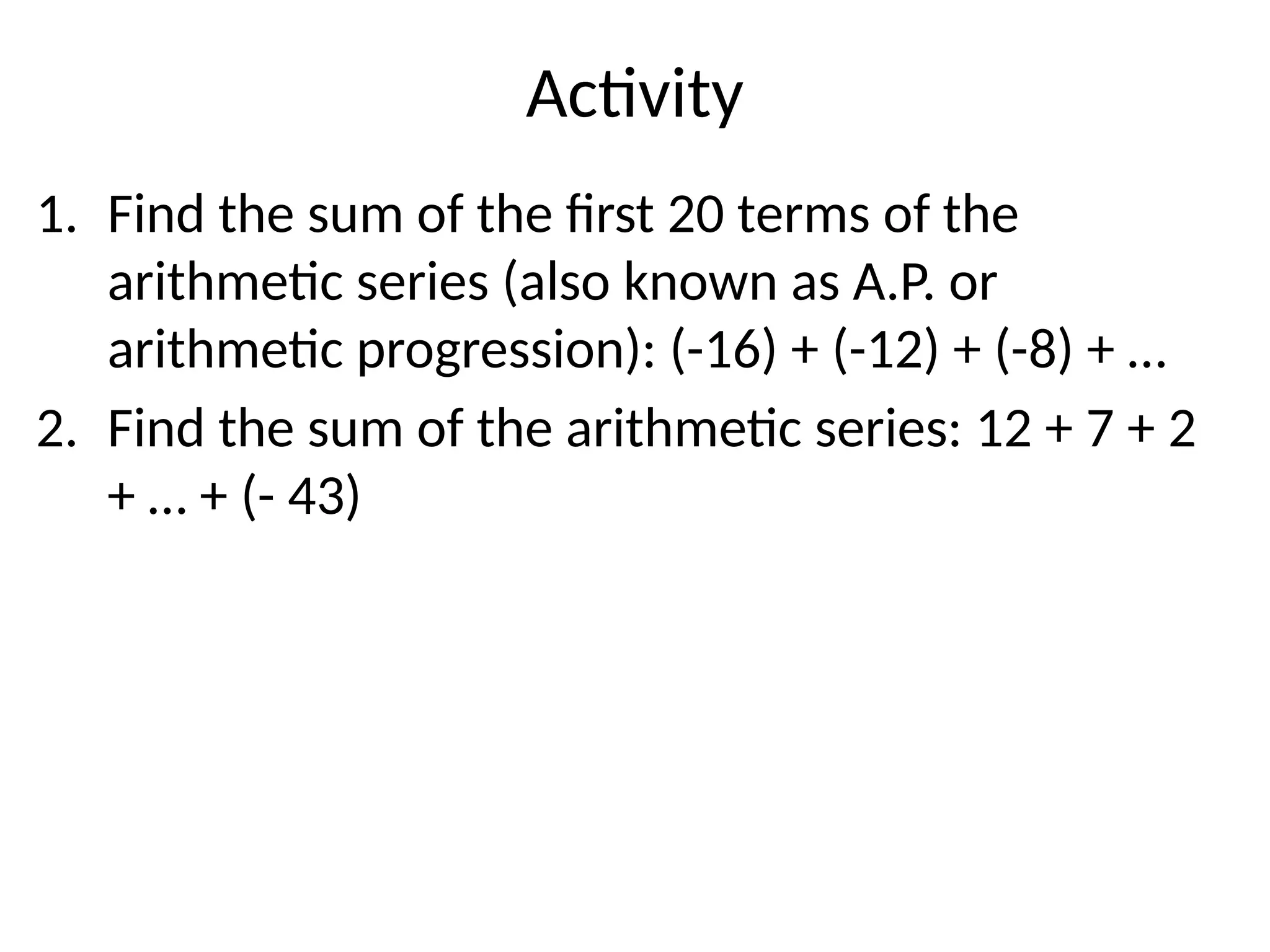
1. Find thesum of the first 20 terms of the
arithmetic series (also known as A.P. or
arithmetic progression): (-16) + (-12) + (-8) + …
2. Find the sum of the arithmetic series: 12 + 7 + 2
+ … + (- 43)
53.
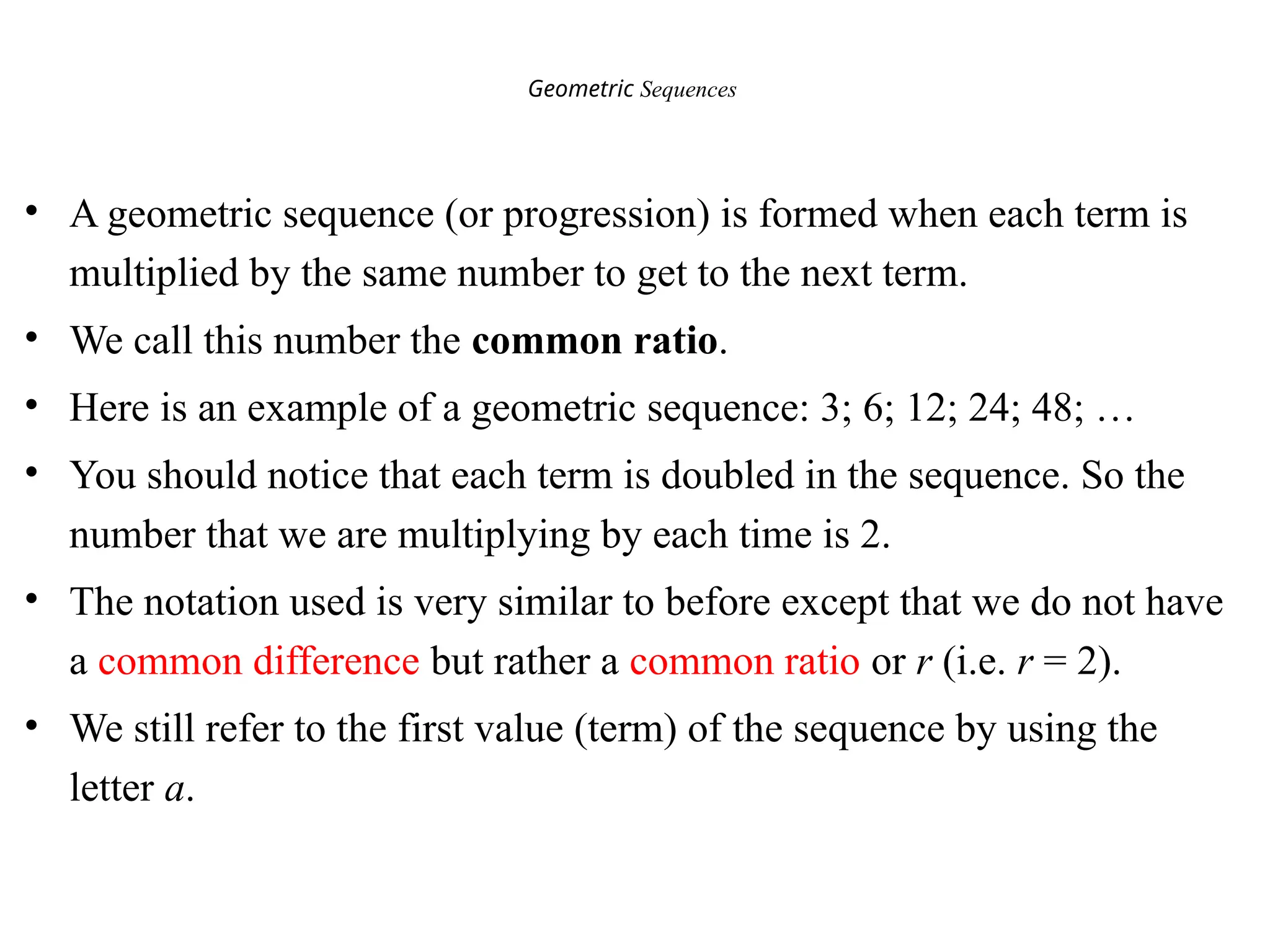
Geometric Sequences
• Ageometric sequence (or progression) is formed when each term is
multiplied by the same number to get to the next term.
• We call this number the common ratio.
• Here is an example of a geometric sequence: 3; 6; 12; 24; 48; …
• You should notice that each term is doubled in the sequence. So the
number that we are multiplying by each time is 2.
• The notation used is very similar to before except that we do not have
a common difference but rather a common ratio or r (i.e. r = 2).
• We still refer to the first value (term) of the sequence by using the
letter a.
54.
Cont…
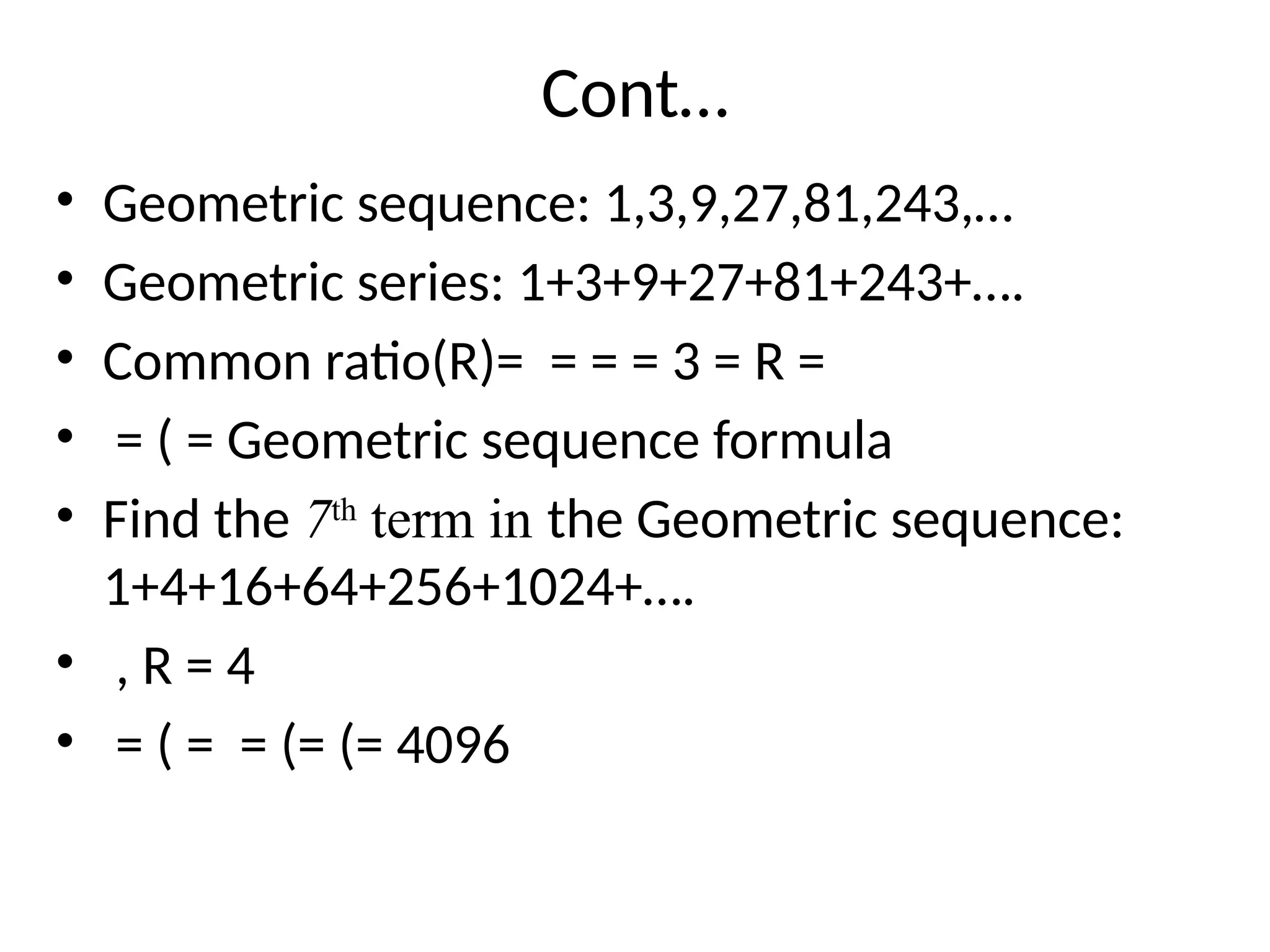
• Geometric sequence:1,3,9,27,81,243,…
• Geometric series: 1+3+9+27+81+243+….
• Common ratio(R)= = = = 3 = R =
• = ( = Geometric sequence formula
• Find the 7th
term in the Geometric sequence:
1+4+16+64+256+1024+….
• , R = 4
• = ( = = (= (= 4096
55.
Activity
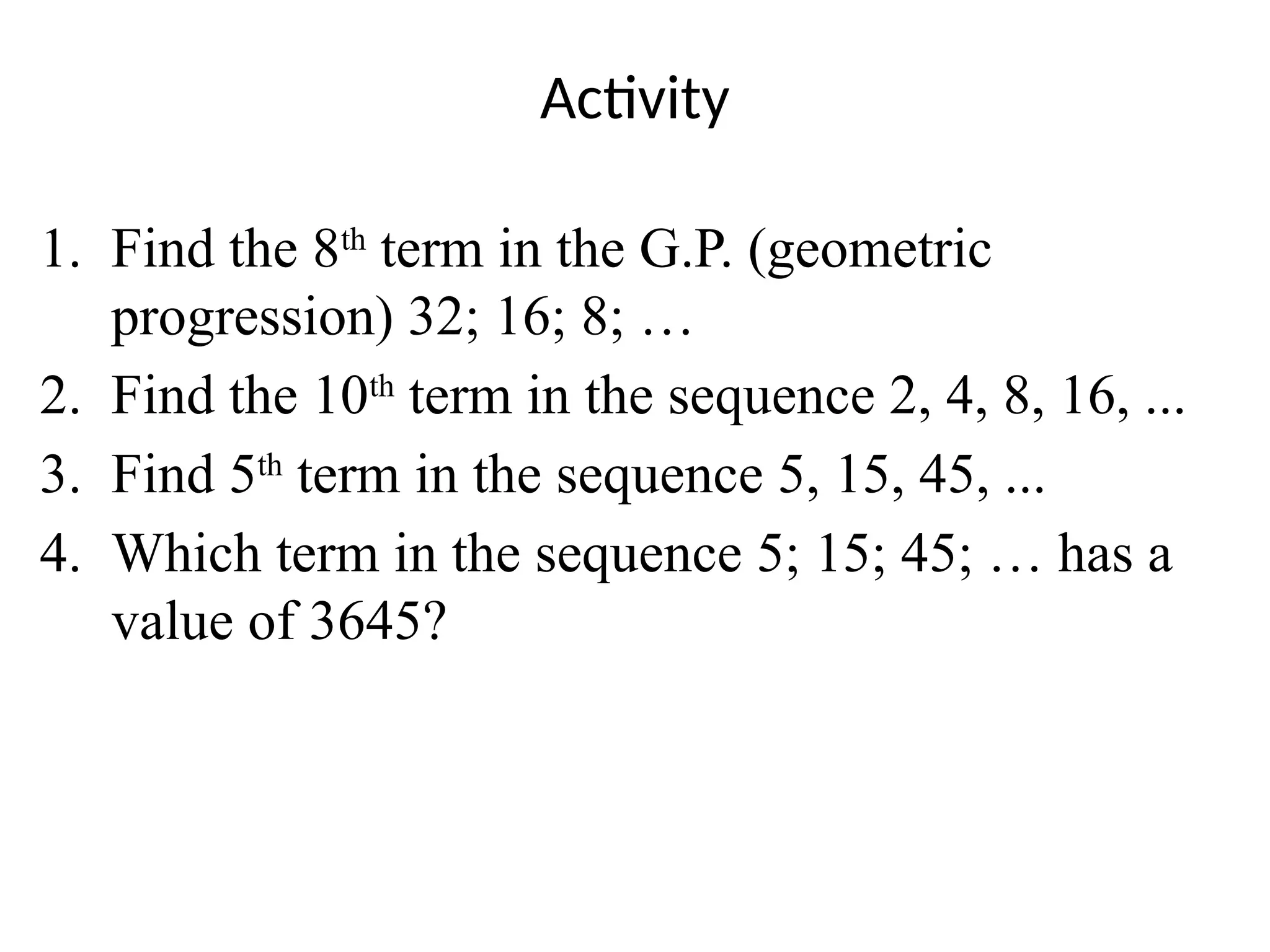
1. Find the8th
term in the G.P. (geometric
progression) 32; 16; 8; …
2. Find the 10th
term in the sequence 2, 4, 8, 16, ...
3. Find 5th
term in the sequence 5, 15, 45, ...
4. Which term in the sequence 5; 15; 45; … has a
value of 3645?
56.
Geometric series
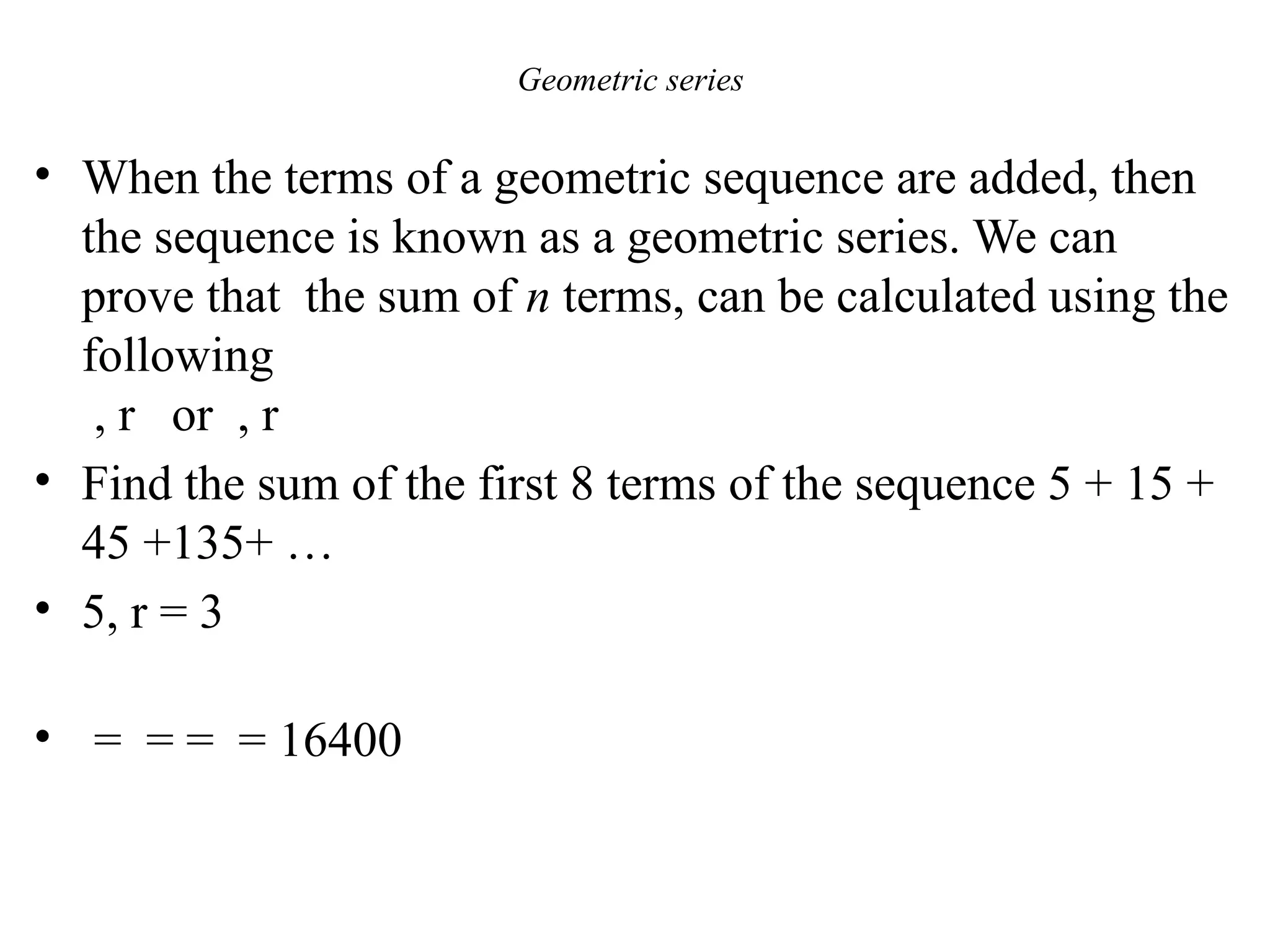
• Whenthe terms of a geometric sequence are added, then
the sequence is known as a geometric series. We can
prove that the sum of n terms, can be calculated using the
following
, r or , r
• Find the sum of the first 8 terms of the sequence 5 + 15 +
45 +135+ …
• 5, r = 3
• = = = = 16400
57.
Activity
1. Find thesum of the first 10 terms of the
sequence: 3 + (- 12) + 48 + …
58.
Finite Geometric sequence
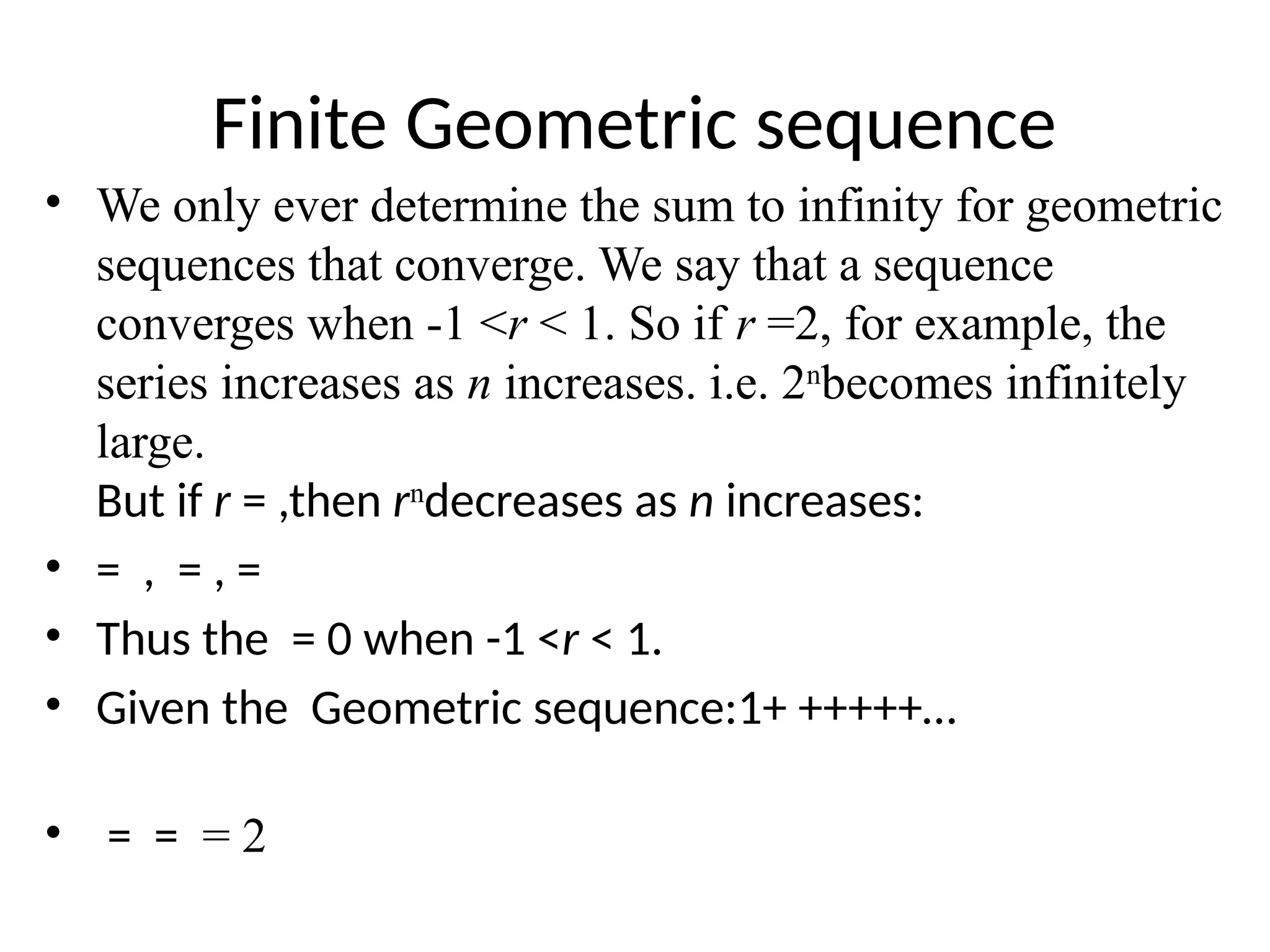
•We only ever determine the sum to infinity for geometric
sequences that converge. We say that a sequence
converges when -1 <r < 1. So if r =2, for example, the
series increases as n increases. i.e. 2n
becomes infinitely
large.
But if r = ,then rn
decreases as n increases:
• = , = , =
• Thus the = 0 when -1 <r < 1.
• Given the Geometric sequence:1+ +++++…
• = = = 2
59.
Simple and compoundinterest
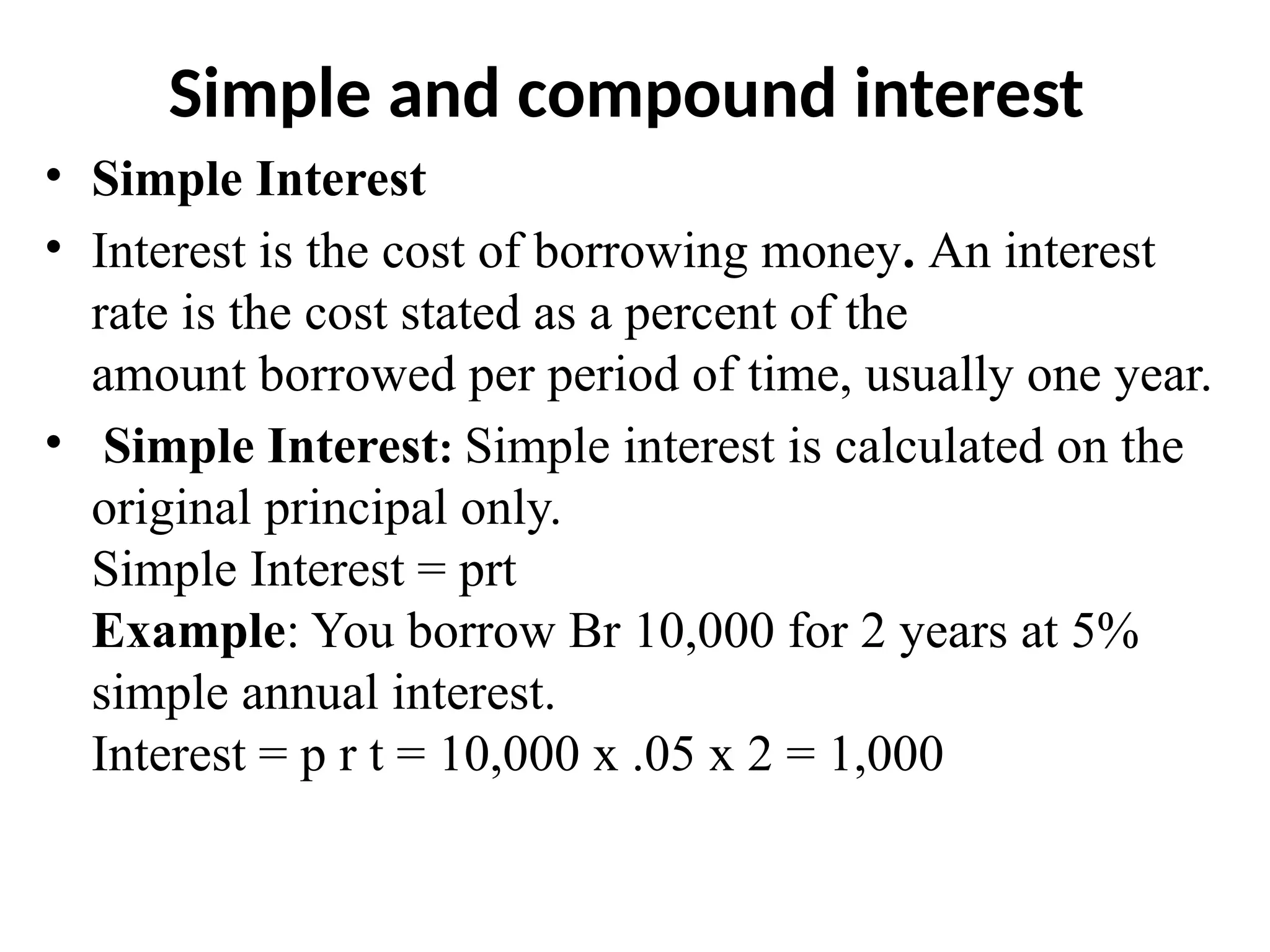
• Simple Interest
• Interest is the cost of borrowing money. An interest
rate is the cost stated as a percent of the
amount borrowed per period of time, usually one year.
• Simple Interest: Simple interest is calculated on the
original principal only.
Simple Interest = prt
Example: You borrow Br 10,000 for 2 years at 5%
simple annual interest.
Interest = p r t = 10,000 x .05 x 2 = 1,000
60.
Compound Interest
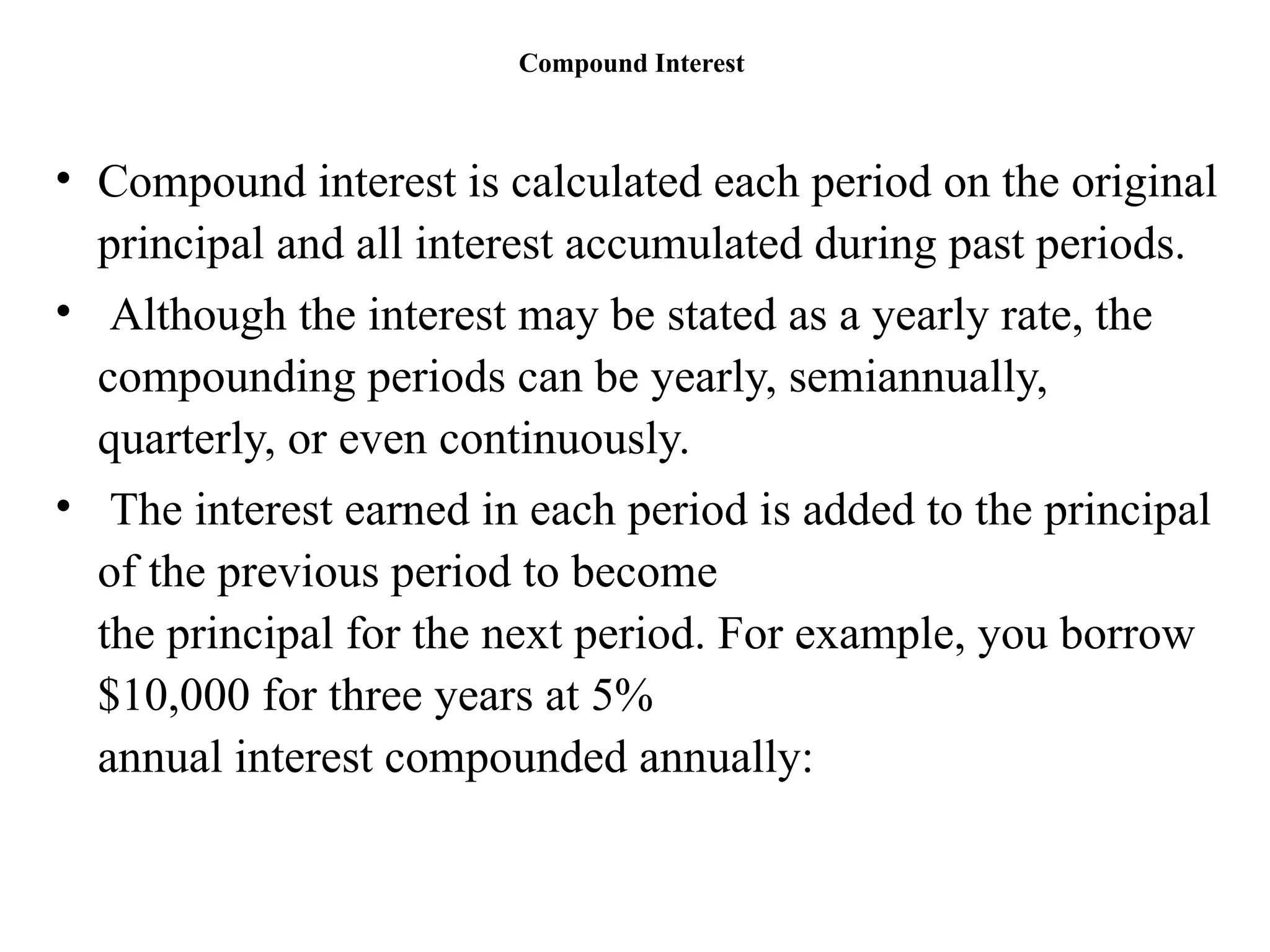
• Compoundinterest is calculated each period on the original
principal and all interest accumulated during past periods.
• Although the interest may be stated as a yearly rate, the
compounding periods can be yearly, semiannually,
quarterly, or even continuously.
• The interest earned in each period is added to the principal
of the previous period to become
the principal for the next period. For example, you borrow
$10,000 for three years at 5%
annual interest compounded annually:
61.
Cont…
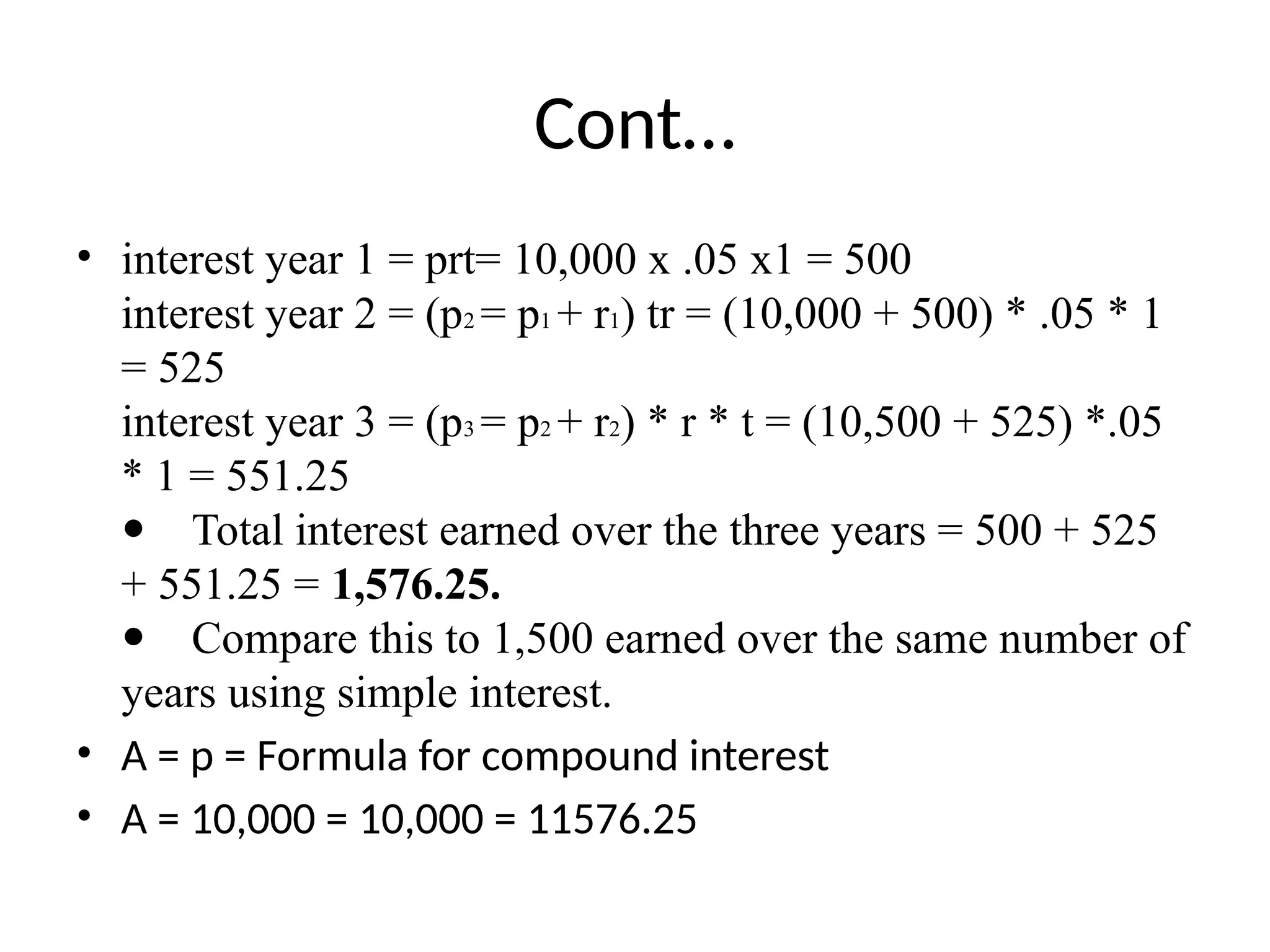
• interest year1 = prt= 10,000 x .05 x1 = 500
interest year 2 = (p2 = p1 + r1) tr = (10,000 + 500) * .05 * 1
= 525
interest year 3 = (p3 = p2 + r2) * r * t = (10,500 + 525) *.05
* 1 = 551.25
Total interest earned over the three years = 500 + 525
+ 551.25 = 1,576.25.
Compare this to 1,500 earned over the same number of
years using simple interest.
• A = p = Formula for compound interest
• A = 10,000 = 10,000 = 11576.25
![Break even analysis
There are three distinct possible in business.
business firm is earned profit, R(x) –TC>0
the business firm is loss profit, R(x) –TC<0
nether earning profit nor loss, R(x) –TC=0
Another important point of the Profit function is
the break-even point: where we neither make a
profit nor a loss [ ( )=0]. This occurs where
𝑃 𝑥
= , So using our equations to fill out:
𝑅 𝐶
( )= ( ) , We can determine the amount of
𝑅 𝑥 𝐶 𝑥
output that would lead to the company’s profits
breaking even by solving for x.](https://image.slidesharecdn.com/aau0dbzhtv2boopkrtgw-bussiness-mathematics-250806123453-c16f3112/75/Business-mathematics-to-record-and-manage-business-operations-CTraining-ppx-44-2048.jpg)