MAGDI AWAD SASI
MBBC, LMB, AMB, WHO
GENERAL
EXAMINATION
Kurtz S, Silverman J, Benson J, Draper J (2003) Marrying Content and Process in Clinical Method Teaching:
Enhancing the Calgary-Cambridge Guides. Academic Medicine;78(8):802-809
Providing
Structure
:
• Making
organisati
on overt
• Attendin
g to flow
Building the
relation ship:
• Using
appropriate
non-verbal
behaviour
• Developing
rapport
• Involving the
patient
Explanation and planning:
• Providing the correct amount and type of information
• Aiding accurate recall and understanding
• Achieving a shared understanding: incorporating the patient’s
illness framework
• Planning, shared decision making
Closing the session:
• Ensuring appropriate point of closure
• Forward planning
Physical Examination
Gathering Information:
• Exploration of the patient’s problem to discover the:
• Biomedical perspective
• Patient perspective
• Background information (context)
Initiating the Session:
• Preparation
• Establishing initial rapport
• Identifying reason for the consultation
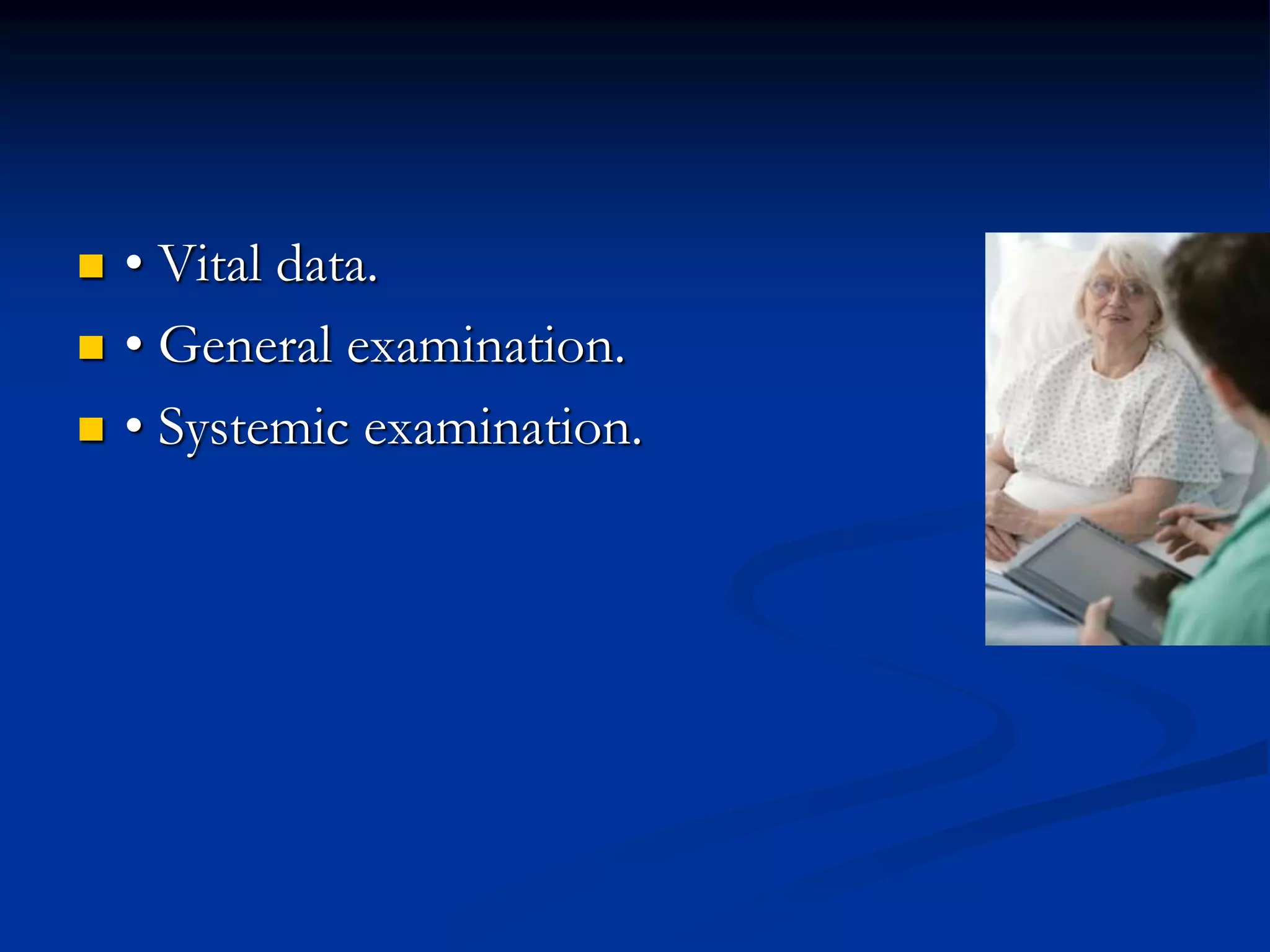
 • Vital data.
 • General examination.
 • Systemic examination.
 Name Of The Institution :
 Name Of The Doctor:
 Ward No:
 Cot No :
 Case No :
 Date:
 • Name Of The Patient :
 • Age :
 • Sex :
 • Married Or Single :
 • Children :
 • Occupation :
 • Income
 • Address
General Principles
 Let the patient tell their story
 Listen
 Develop a rapport, be friendly
 Be interested
 Use eye contact
 Use appropriate language and terms
General History
 The general history is organized into the following sections:
 • Identifying data (ID)
 • Chief complaint (CC)
 • History of the present illness (HPI)
 • Past medical history (PMHx)
 • Family history (FHx)
 • Medications (MEDS) and Allergies (ALL)
 • Social history (SHx)
 • Review of systems or functional inquiry (ROS/FI)
History taking
THE PATIENT IS THE MOST IMPORTANT
PERSON IN THE ROOM!
‘Always listen to the patient, they might be
telling you the diagnosis’
Sir William Osler
History of Present Illness
 Symptom characterization:
 • 0 =Onset and duration
 • P = Provoking and alleviating factors
 • Q = Quality of pain (e.g. sharp, dull, throbbing)
 • R = Does the pain radiate?
 • S = Severity of pain ("on a scale from 1 to 10, 10 being the
 most severe")
 • T =Timing and progression ("Is the pain constant or
 intermittent? Worse in the morning or at nighttime?")
 • U = "How does it affect 'U' in your daily life?“
 • V = Deja vu ("Has this happened before?")
 • W ='What do you think it is?
Instruments And Equipment :
 • Stethoscope
 • Sphygmomanometer
 • Thermometer
 • Torch
 • Wooden tongue depressors
 • Measuring tape
 • Note:-
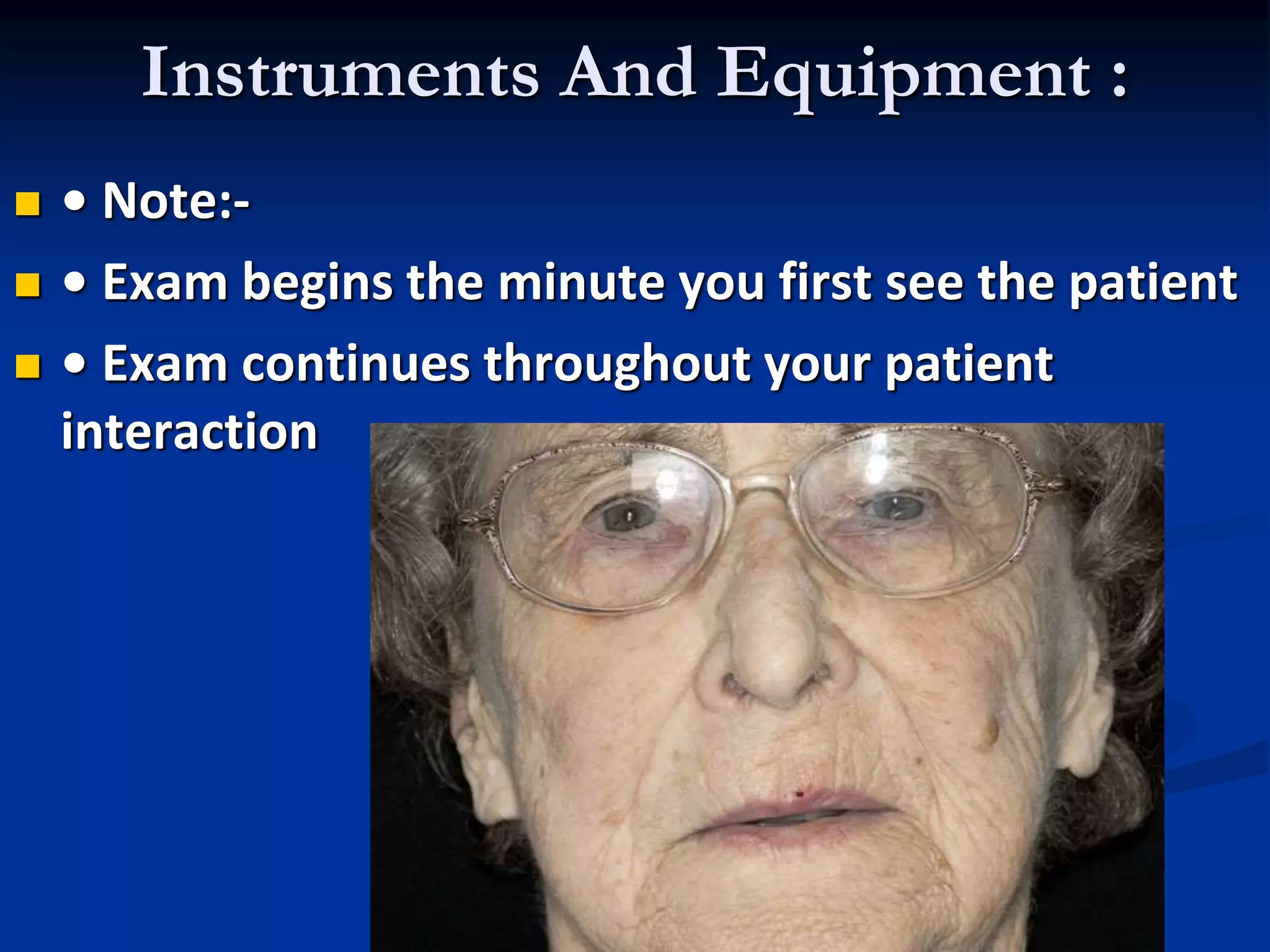
 • Exam begins the minute you first see the
patient
 • Exam continues throughout your patient
Instruments And Equipment :
 • Note:-
 • Exam begins the minute you first see the patient
 • Exam continues throughout your patient
interaction
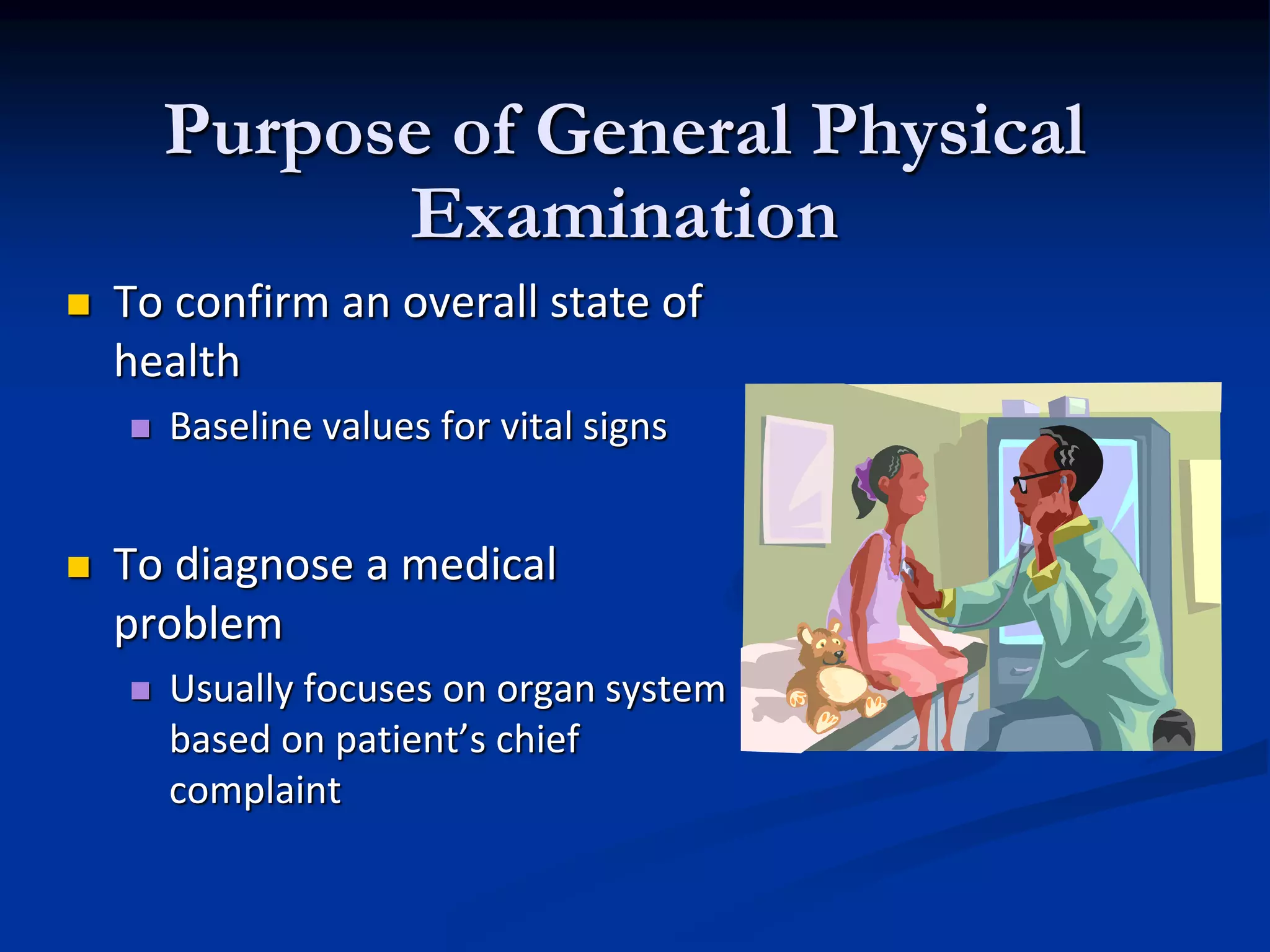
Purpose of General Physical
Examination
 To confirm an overall state of
health
 Baseline values for vital signs
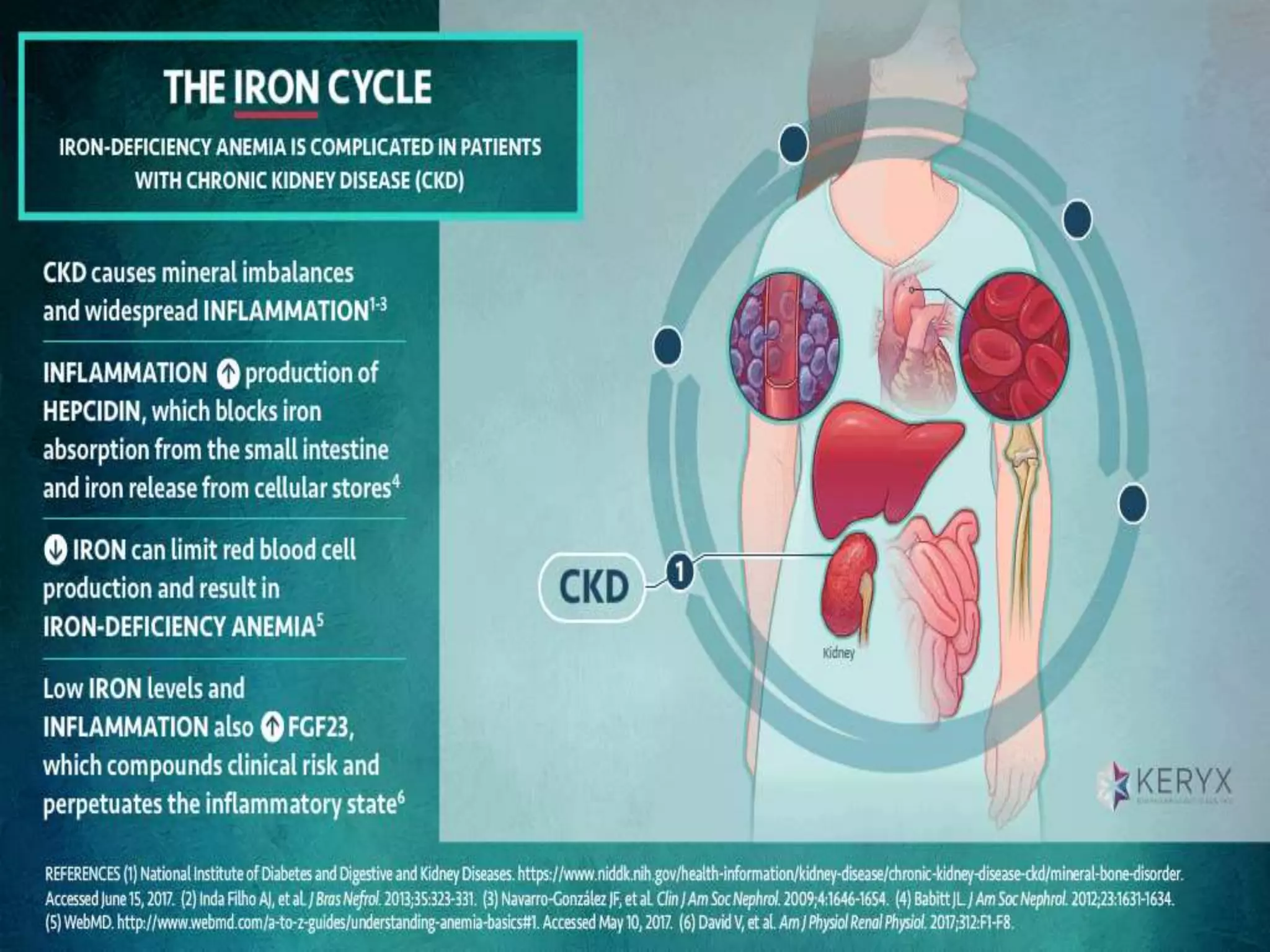
 To diagnose a medical
problem
 Usually focuses on organ system
based on patient’s chief
complaint
GE
 General examination is actually the first step and Key component
of diagnostic approach.
 • Inspection is the major method during general
examination, combining with palpation, auscultation,
and smelling.
 • Aims to
1. – Assess patient's general condition
2. – Detect manifestations of internal & systemic diseases
 • 3 components:
 – History taking – Clues are the symptoms
 – Physical exam - Clues are the signs
 – Investigations - Clues are test results
General Appearance
 General state of health: Healthy/ill/comfortable/Distressed
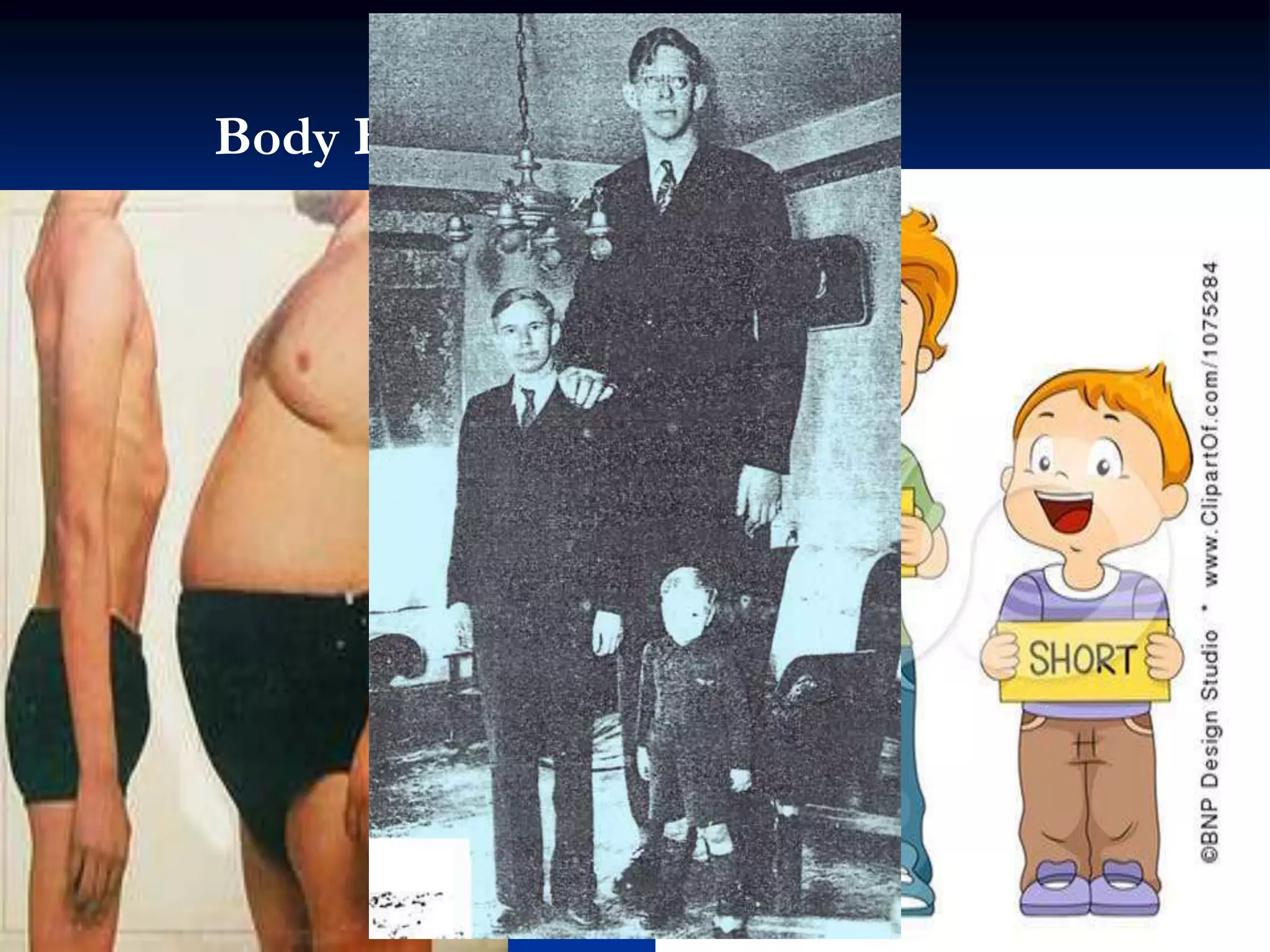
 • Body Built and Nutritional status
 Height, Weight, BMI, Obese/lean, Tall/short
 – Muscular/Asthenic/Cachexic
 State of awareness or level of consciousness
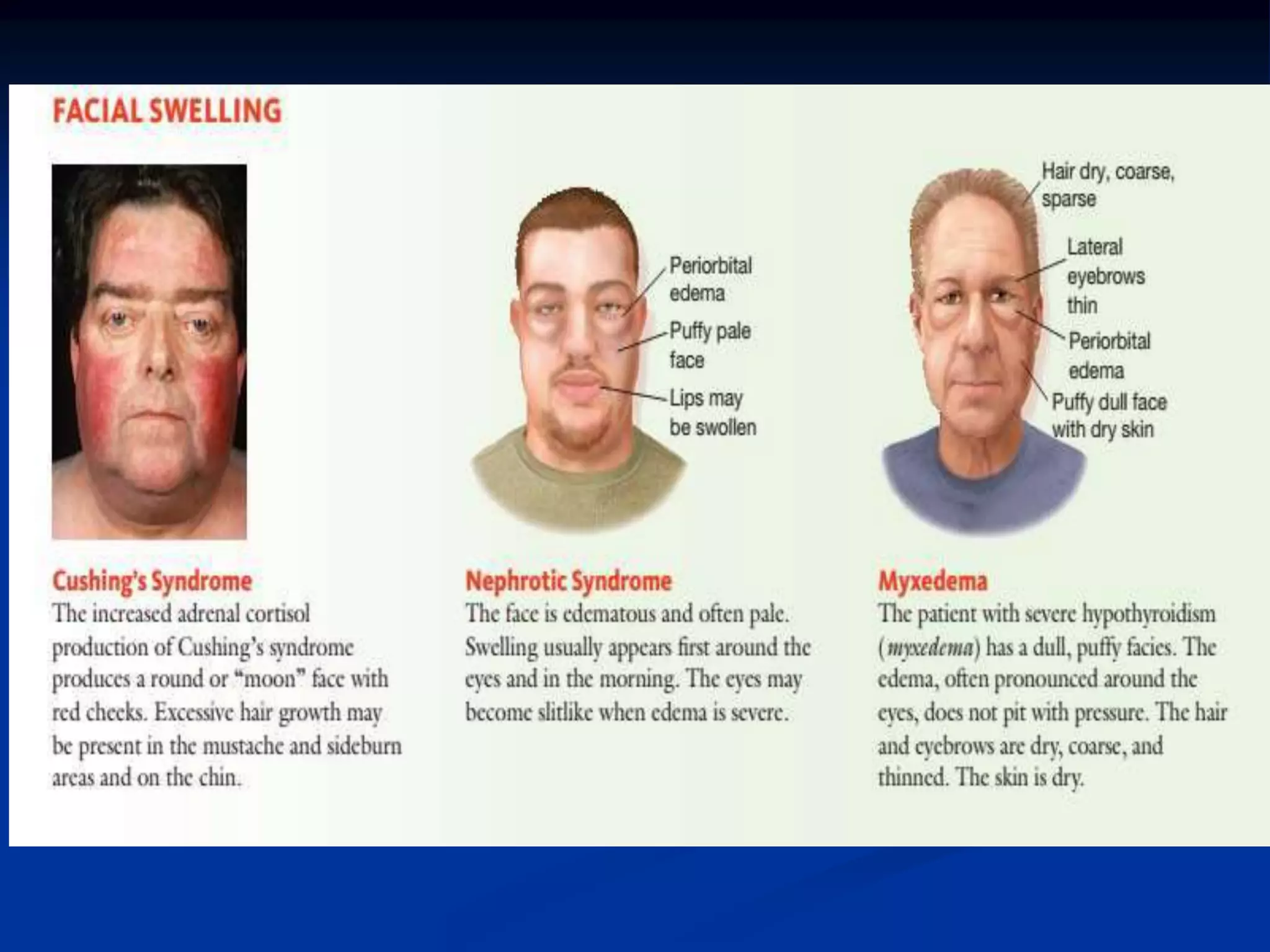
 Facial feature/expression/ Mood/Attitude
 Speech(tone/voice)
 Position/posture and Gait
 Personal Hygiene
 Breath/Odor
Body Built
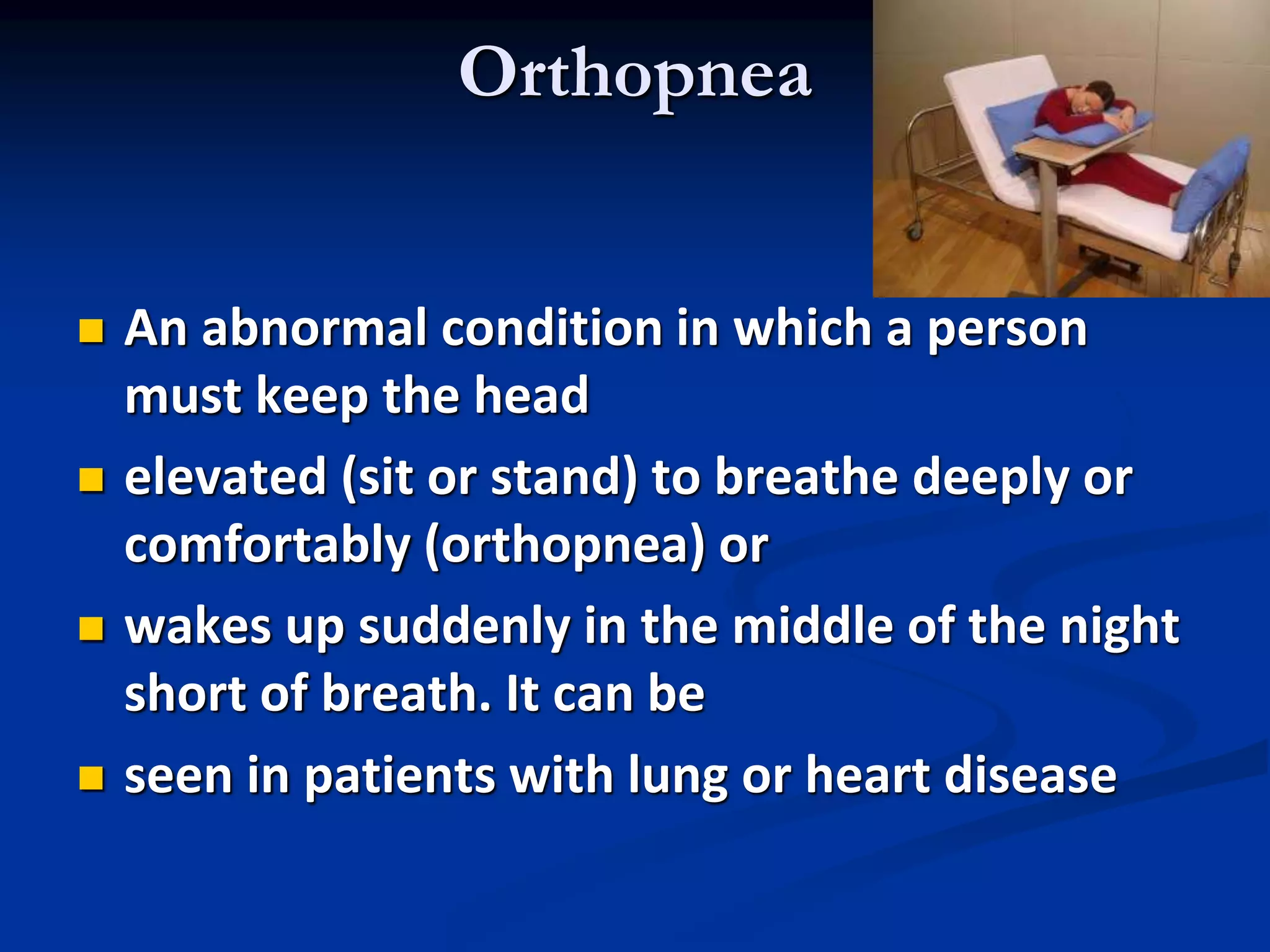
Orthopnea
 An abnormal condition in which a person
must keep the head
 elevated (sit or stand) to breathe deeply or
comfortably (orthopnea) or
 wakes up suddenly in the middle of the night
short of breath. It can be
 seen in patients with lung or heart disease
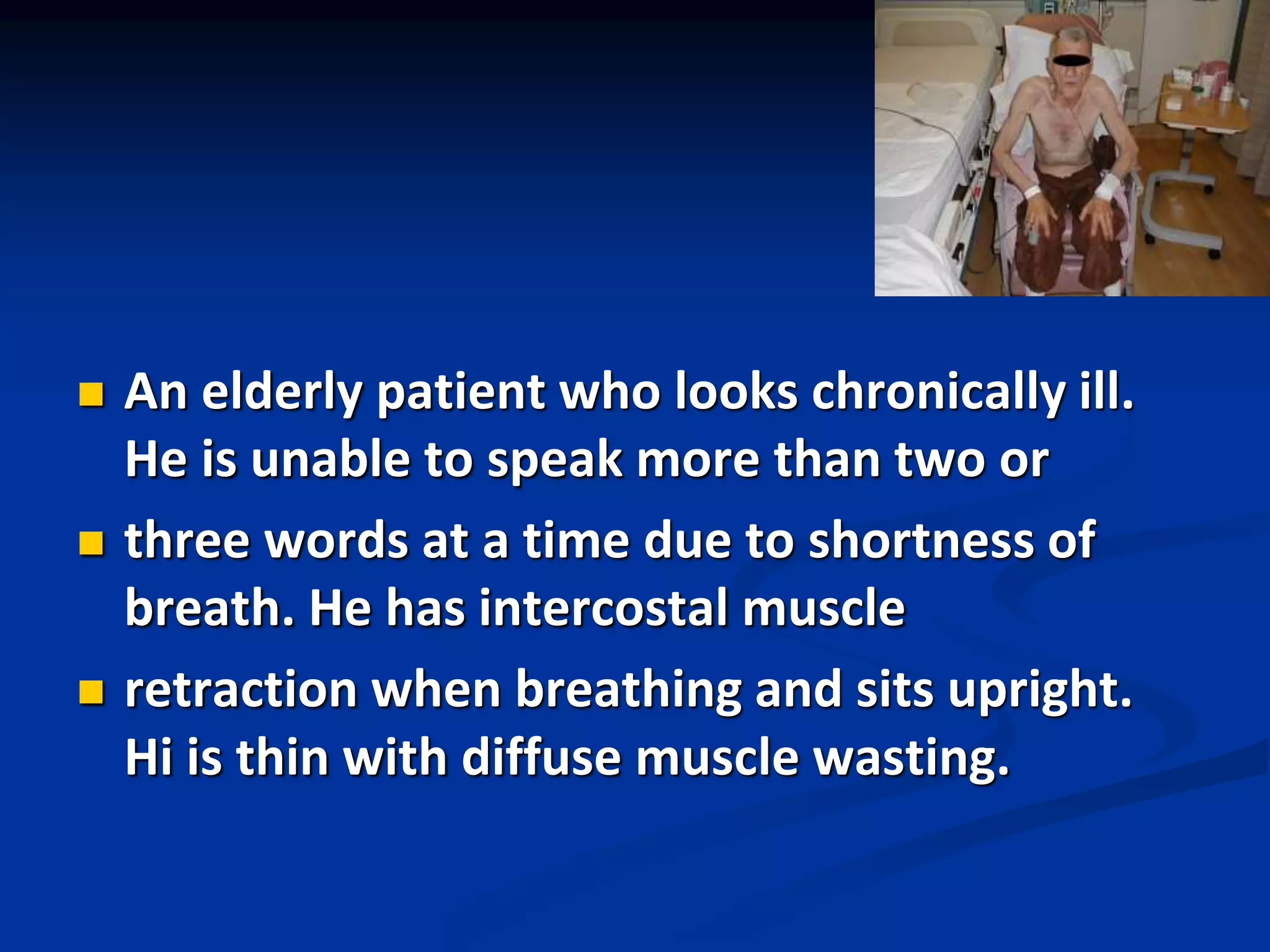
 An elderly patient who looks chronically ill.
He is unable to speak more than two or
 three words at a time due to shortness of
breath. He has intercostal muscle
 retraction when breathing and sits upright.
Hi is thin with diffuse muscle wasting.
EYES & FACE
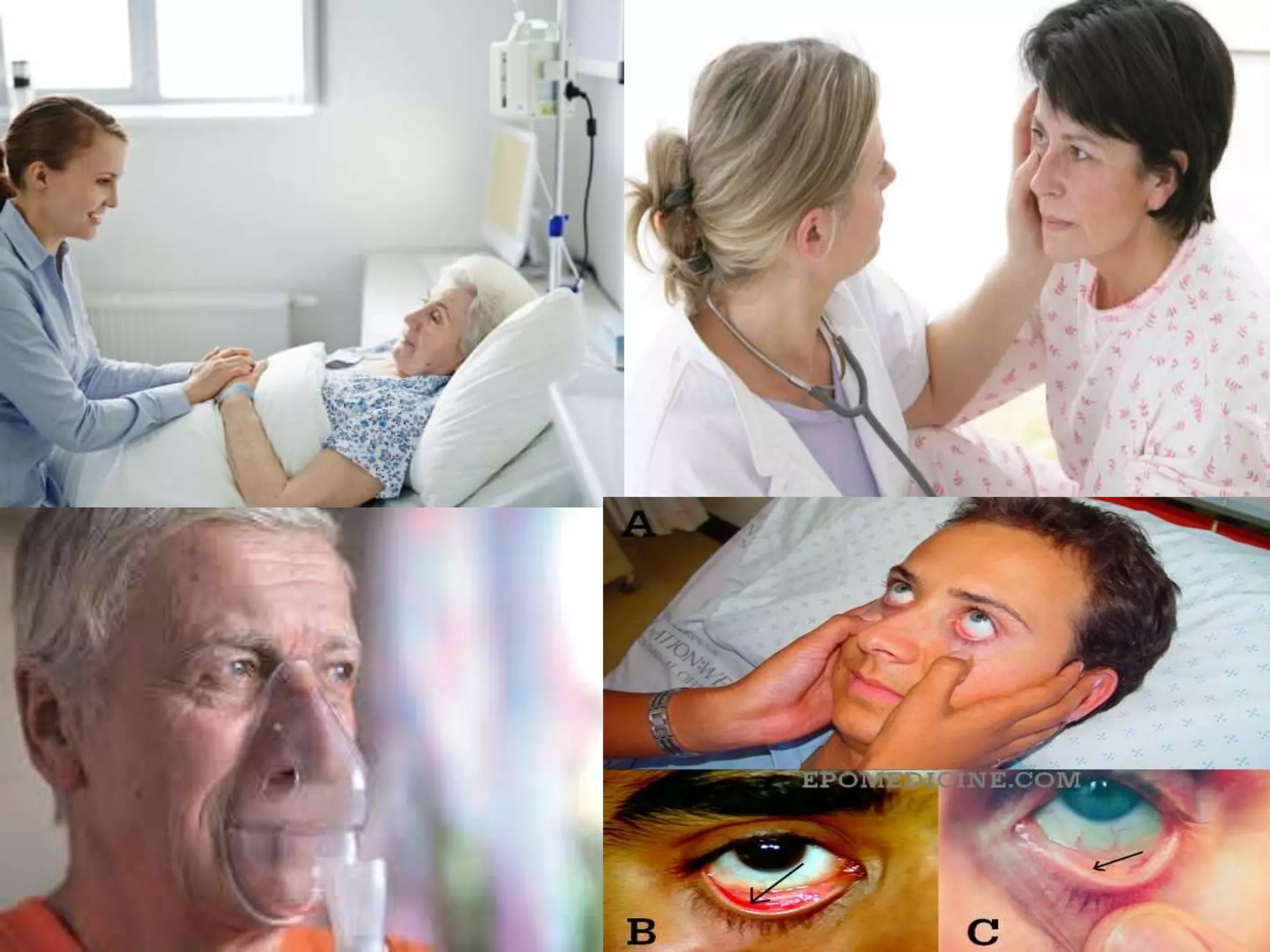
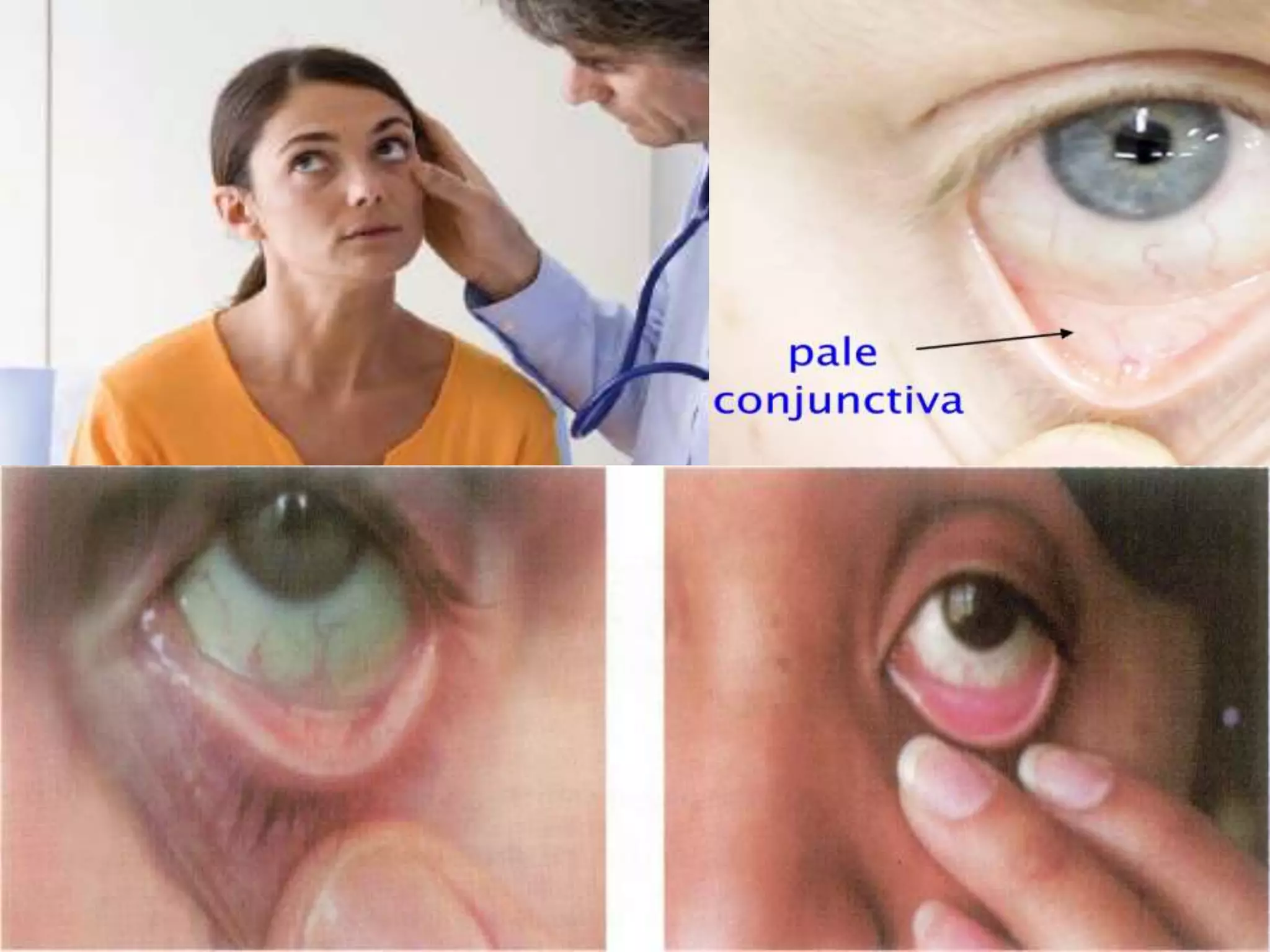
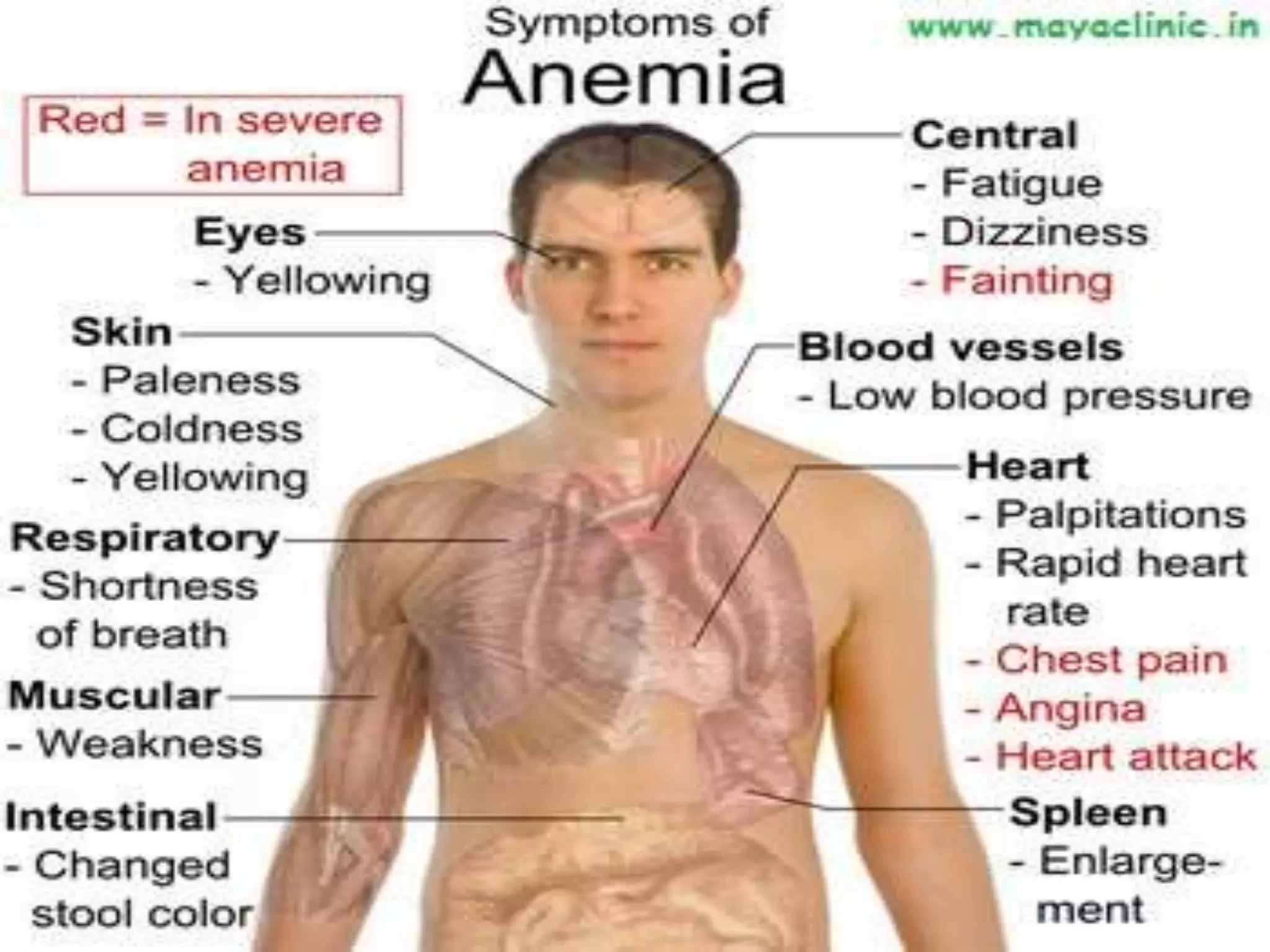
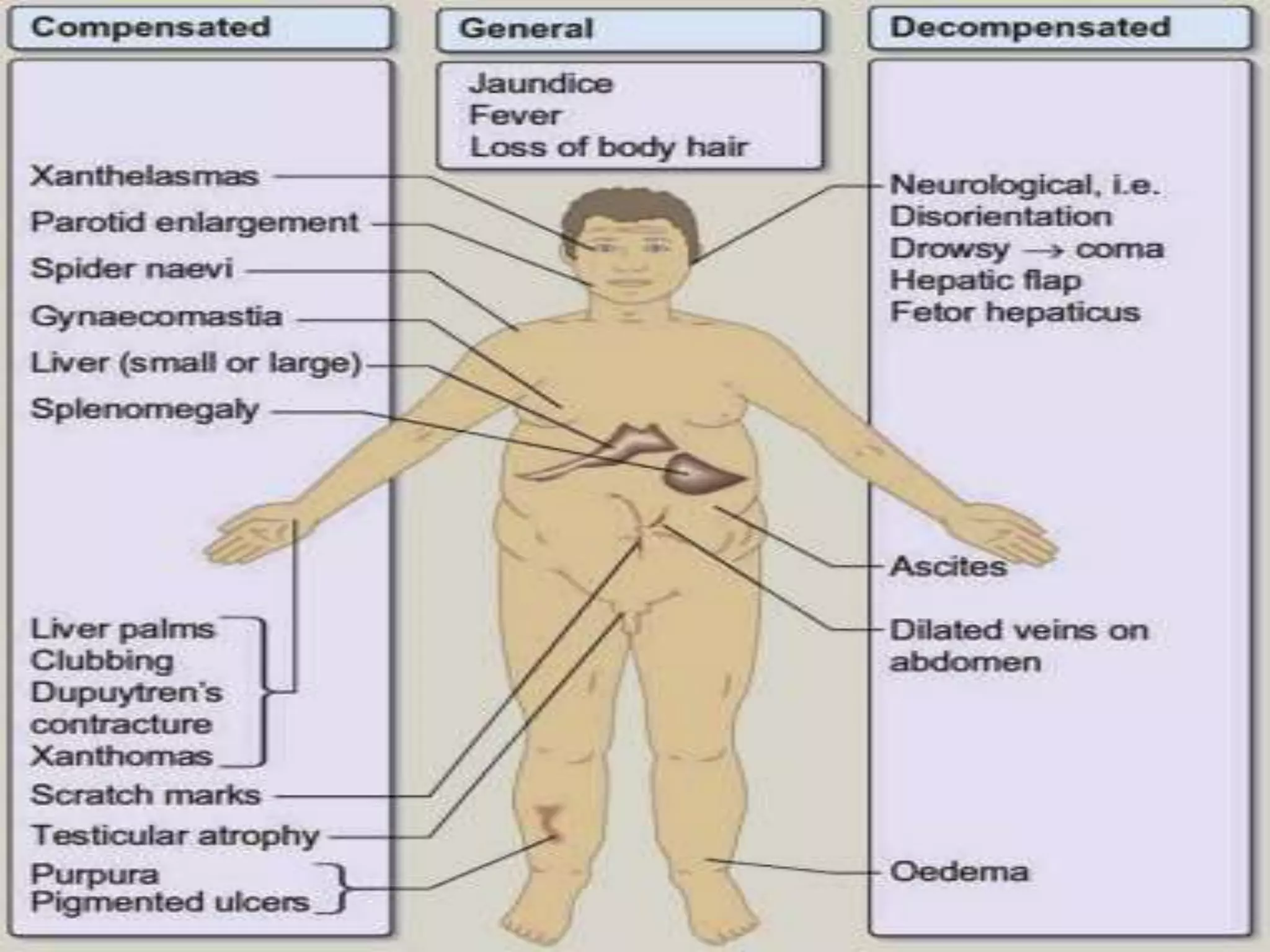
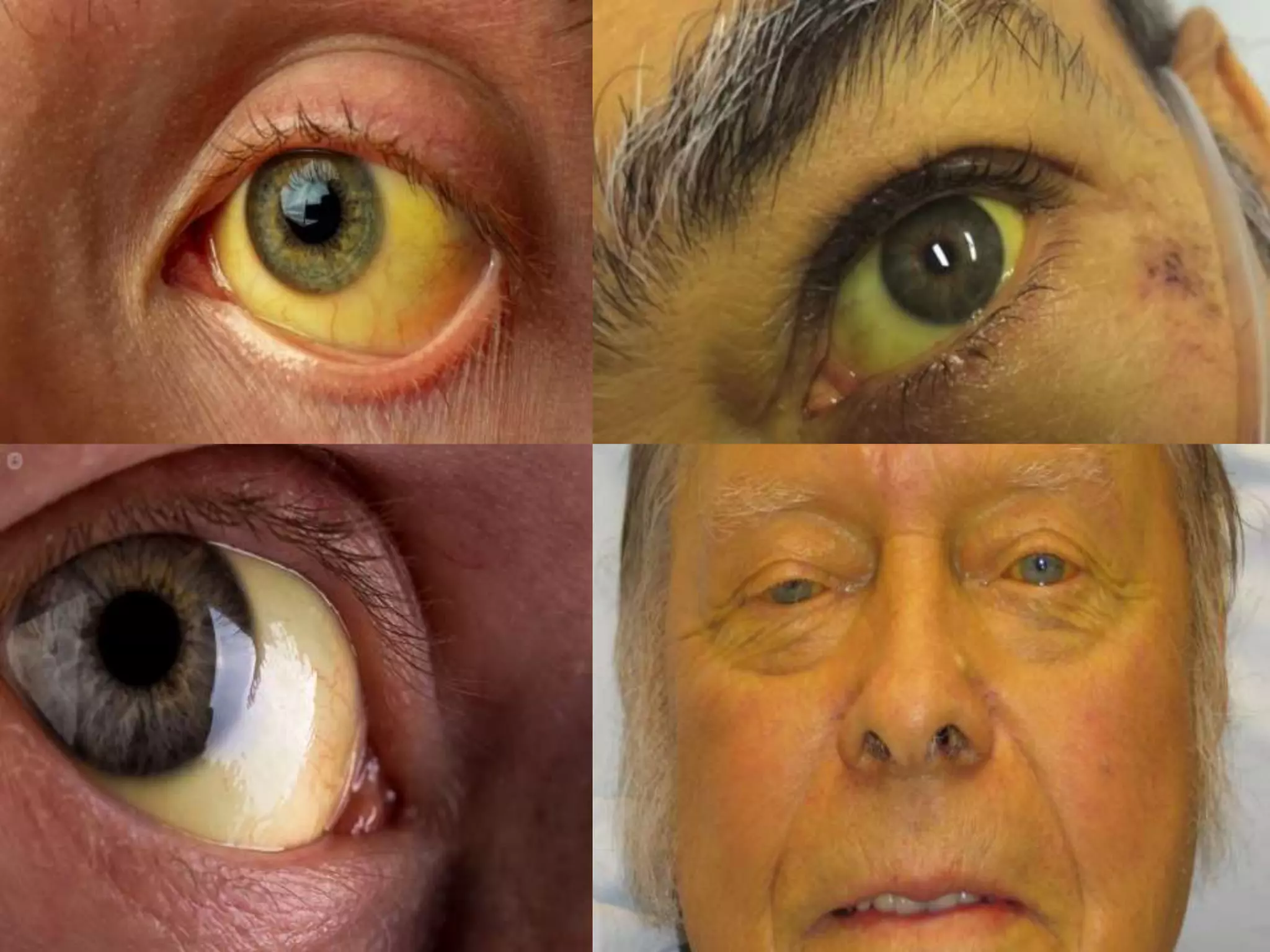
 • Conjuctival pallor (anaemia)
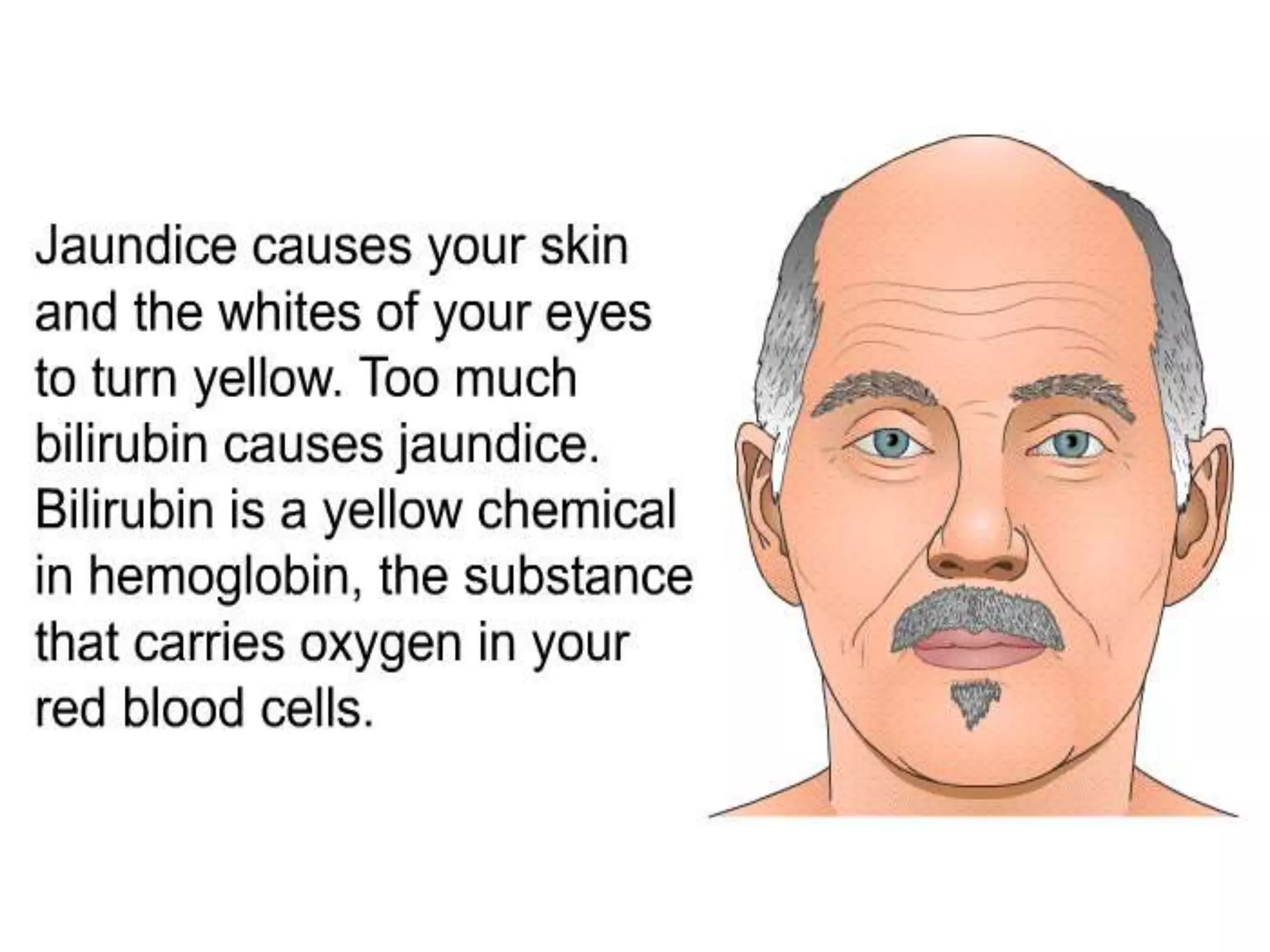
 • Sclera: jaundice, iritis
 • Cornea: Kaiser Fleischer’s rings (Wilson’s
disease)
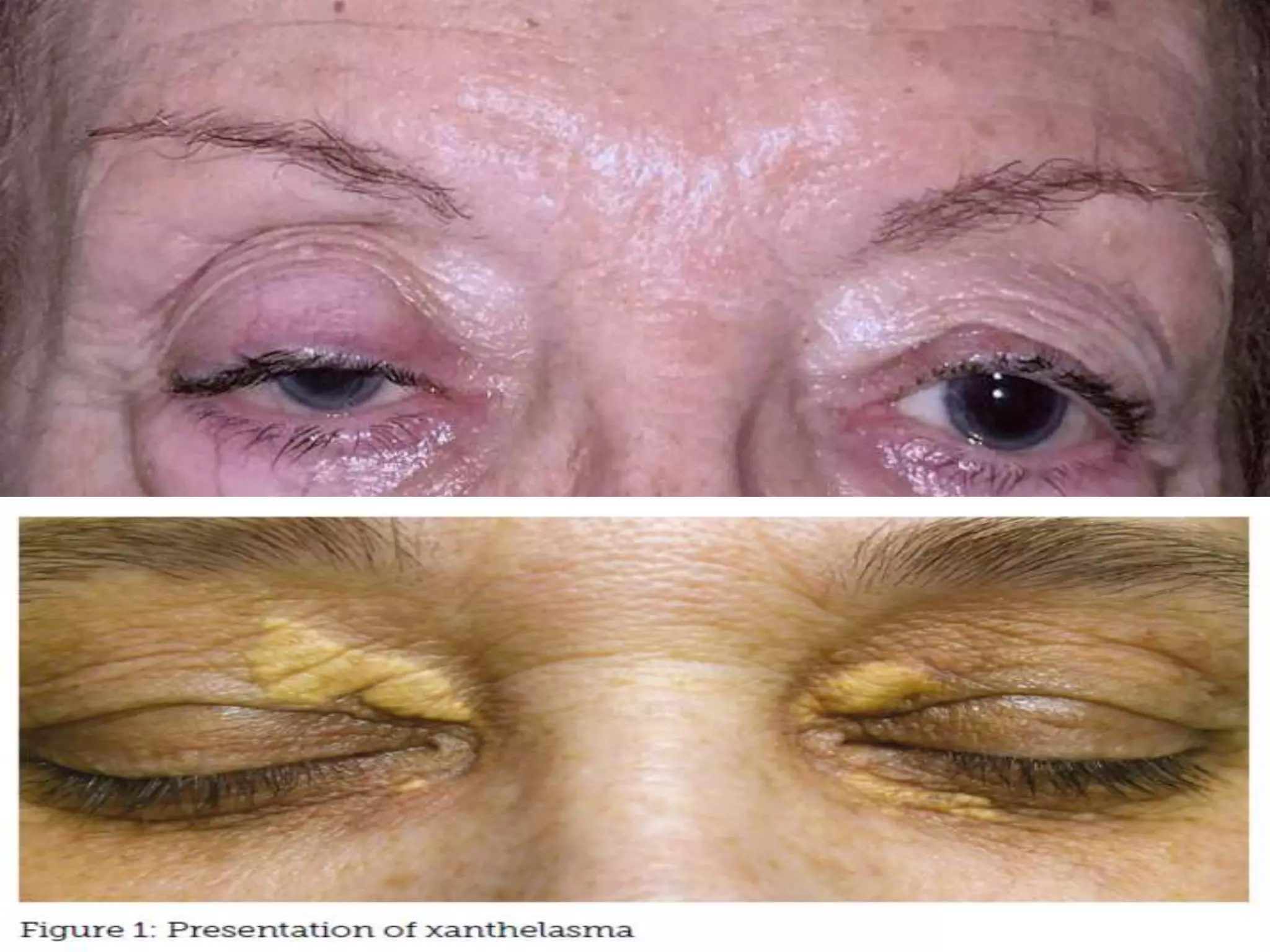
 • Xanthelasma (primary biliary cirrhosis)
 • Parotid enlargement (alcohol)
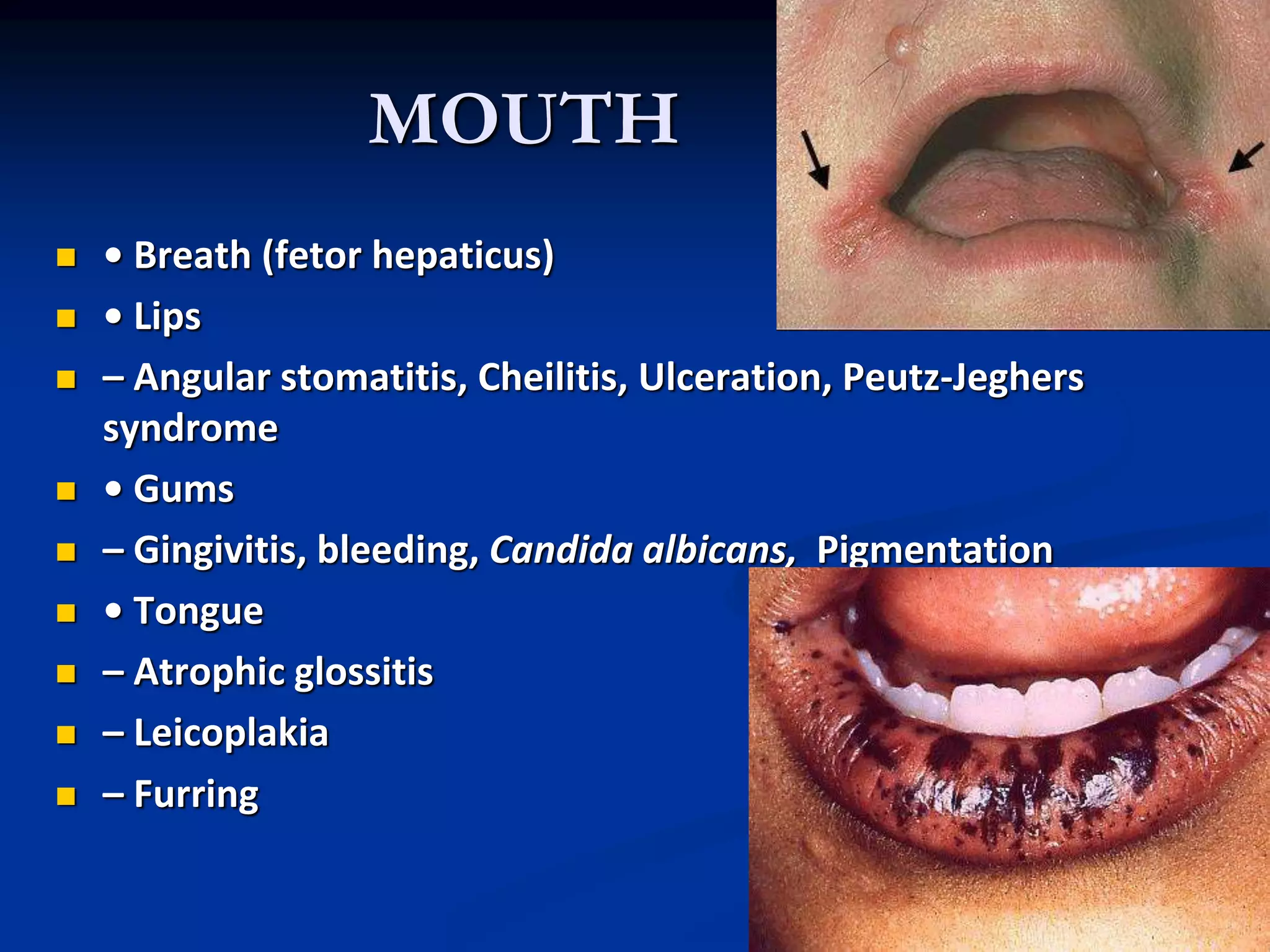
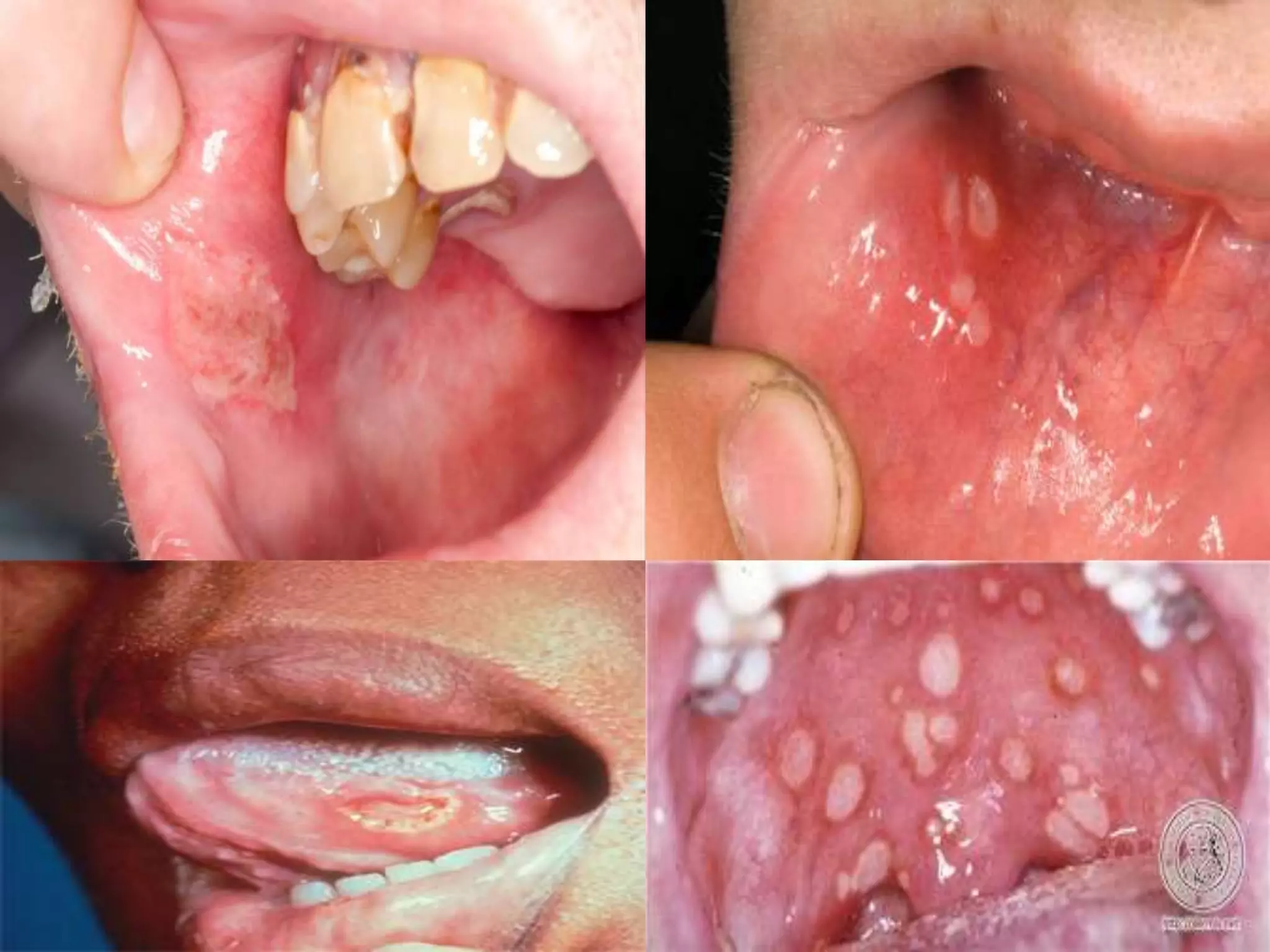
MOUTH
 • Breath (fetor hepaticus)
 • Lips
 – Angular stomatitis, Cheilitis, Ulceration, Peutz-Jeghers
syndrome
 • Gums
 – Gingivitis, bleeding, Candida albicans, Pigmentation
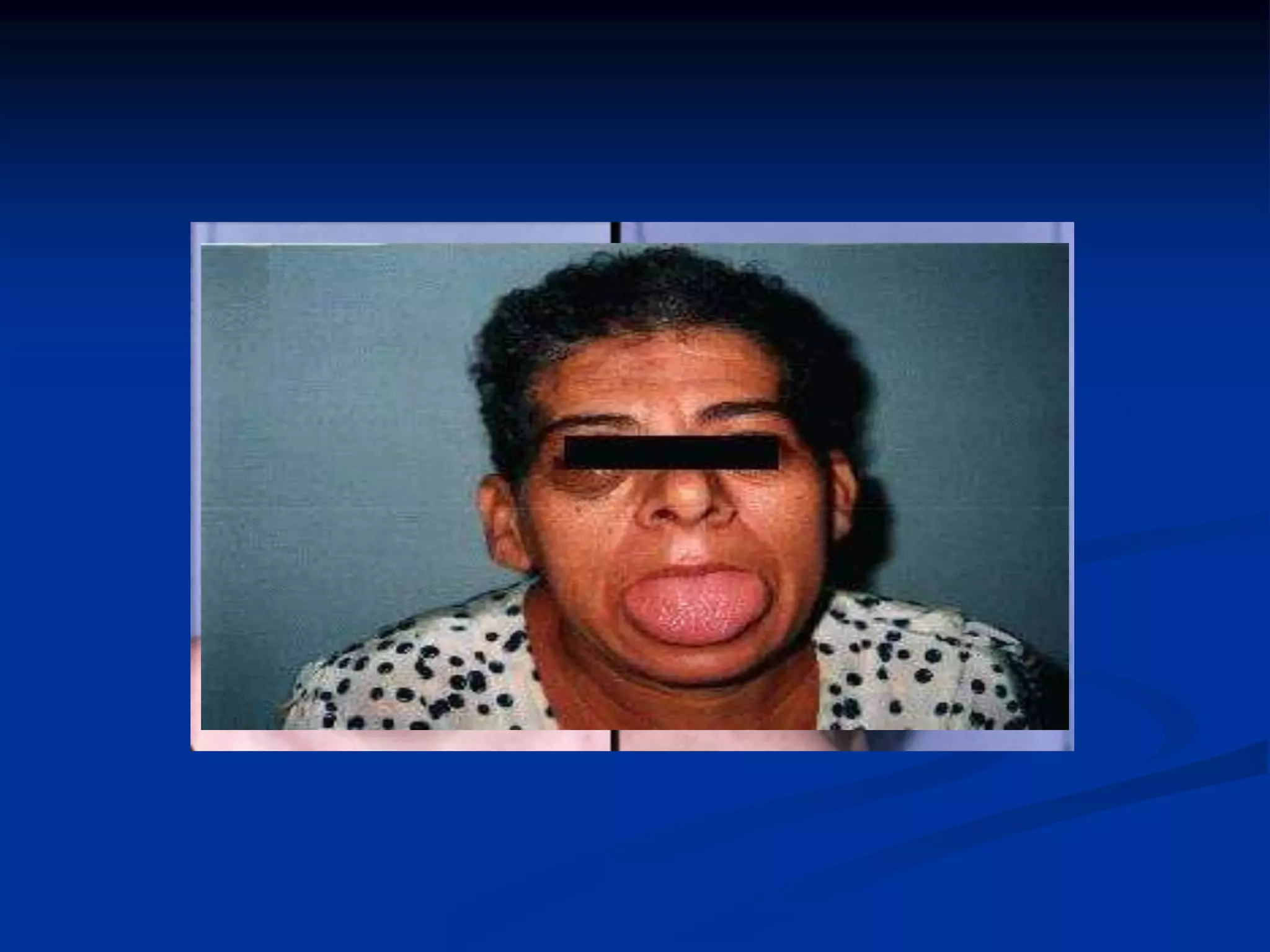
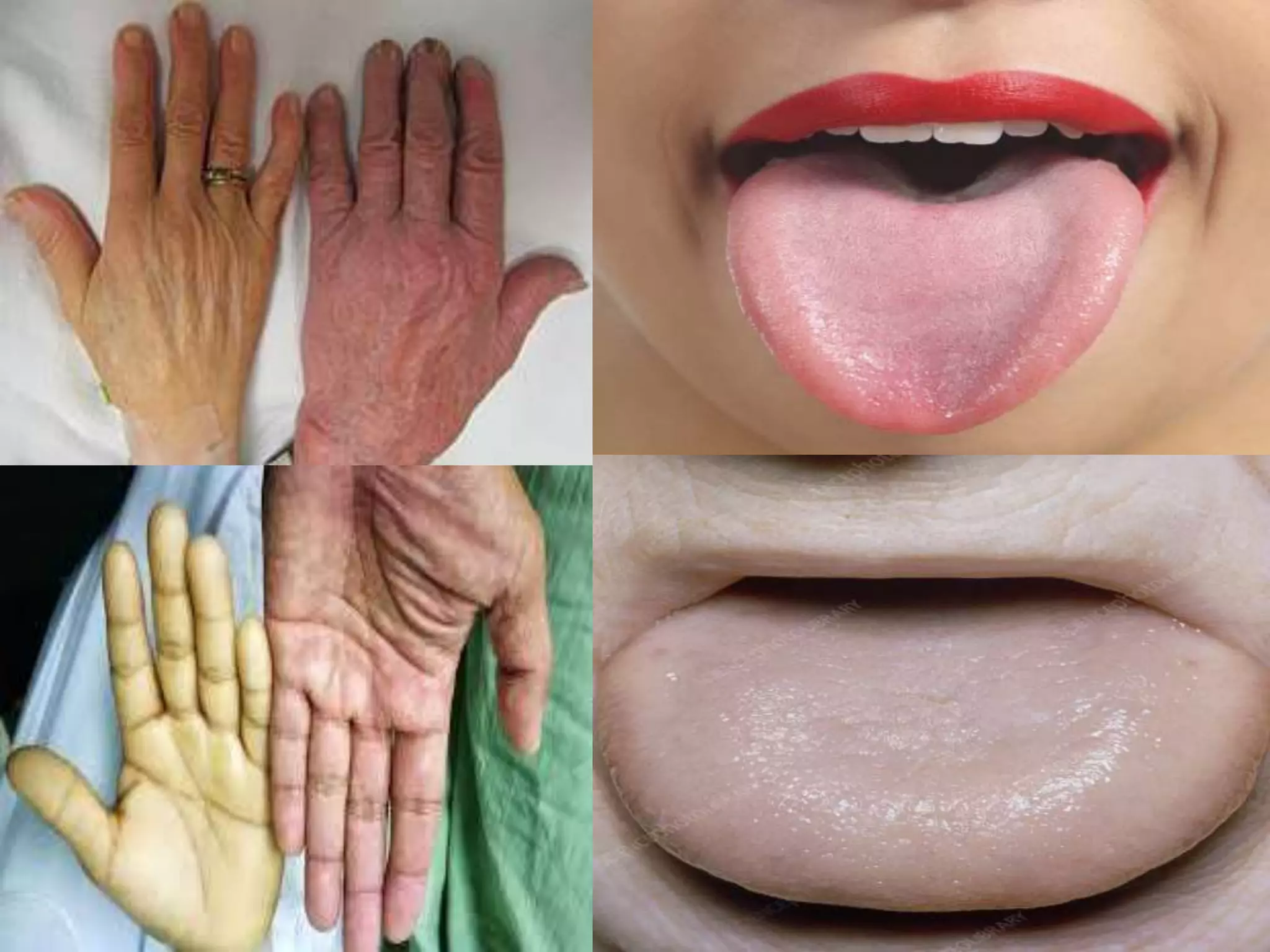
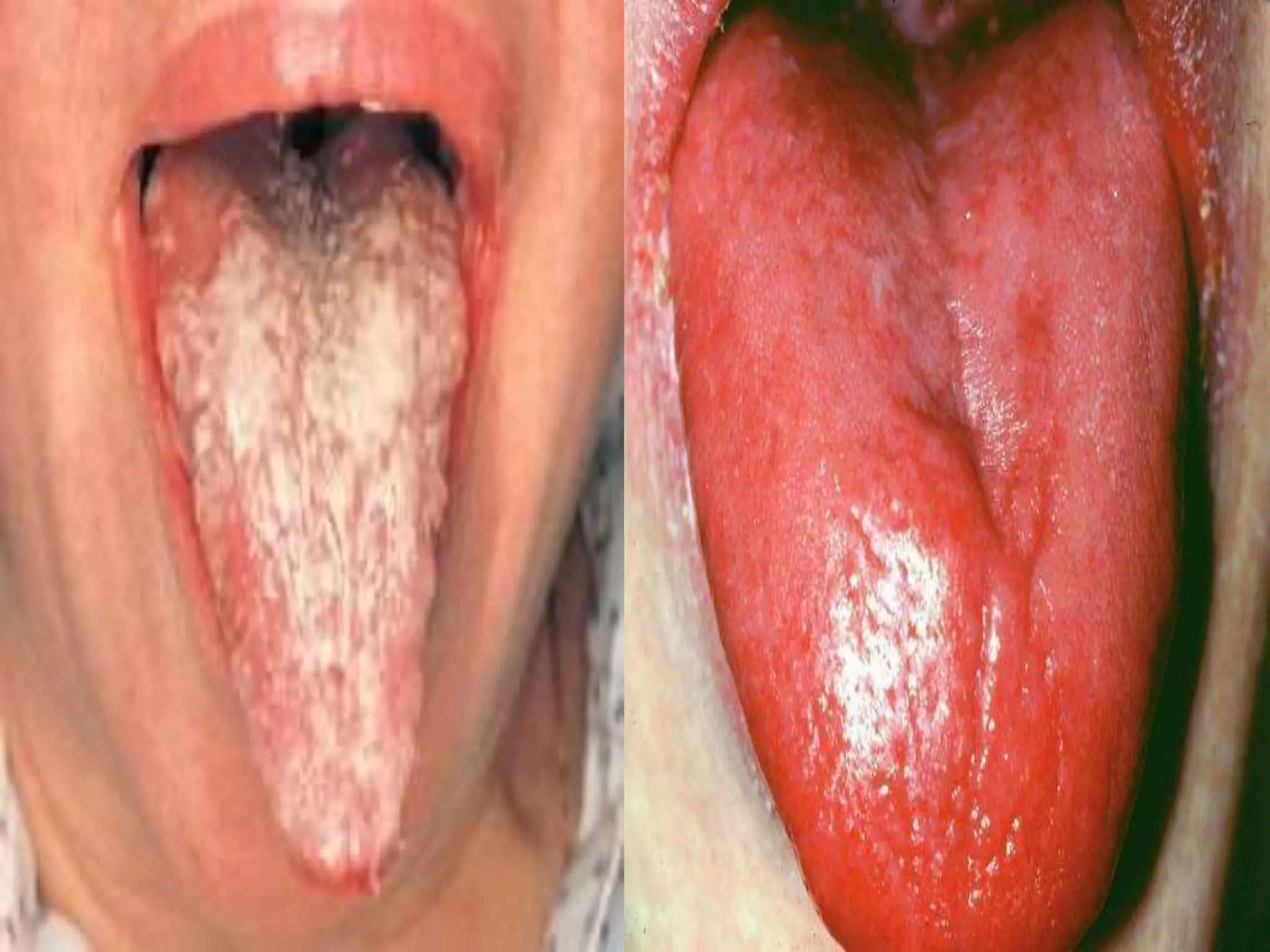
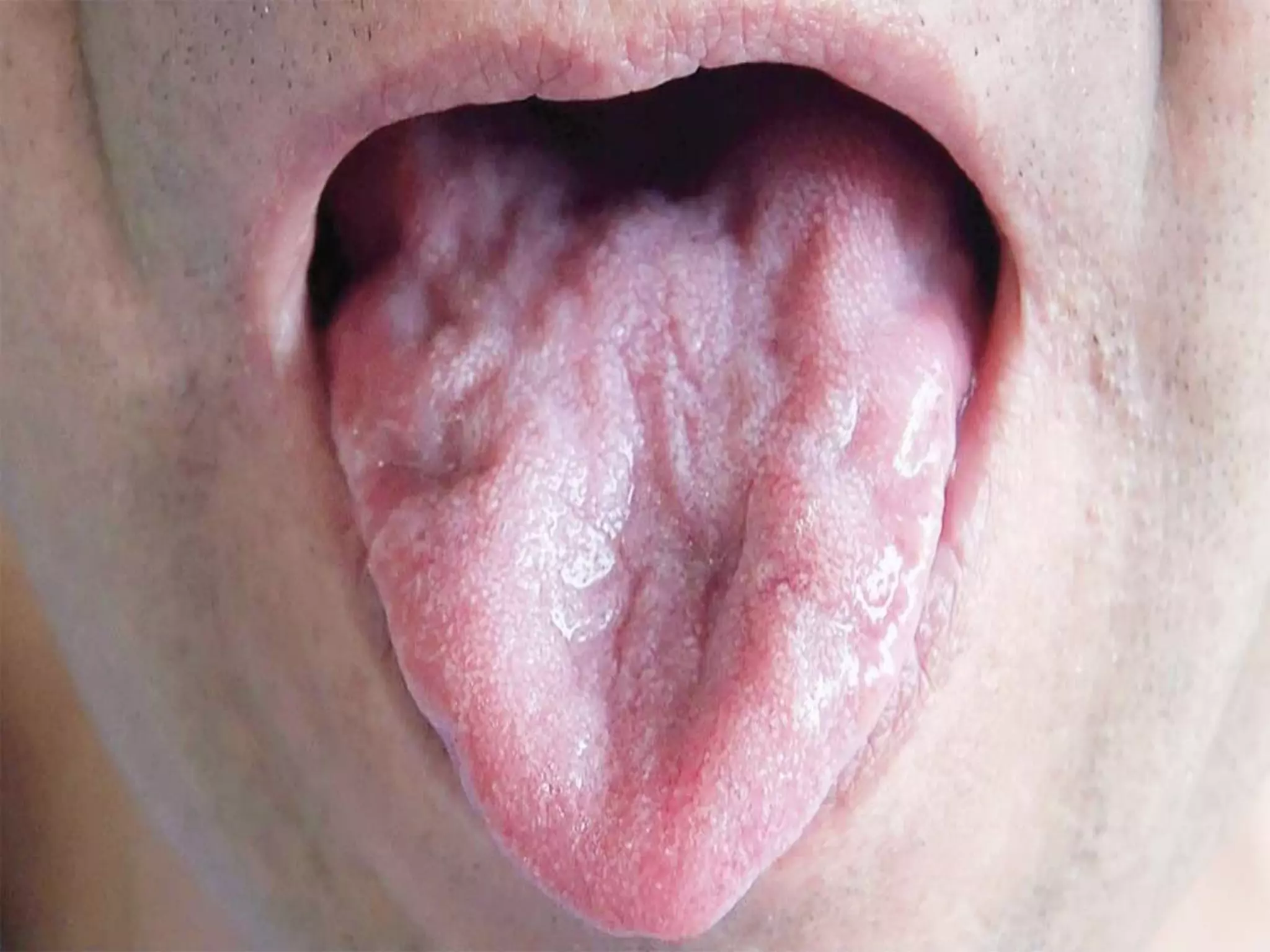
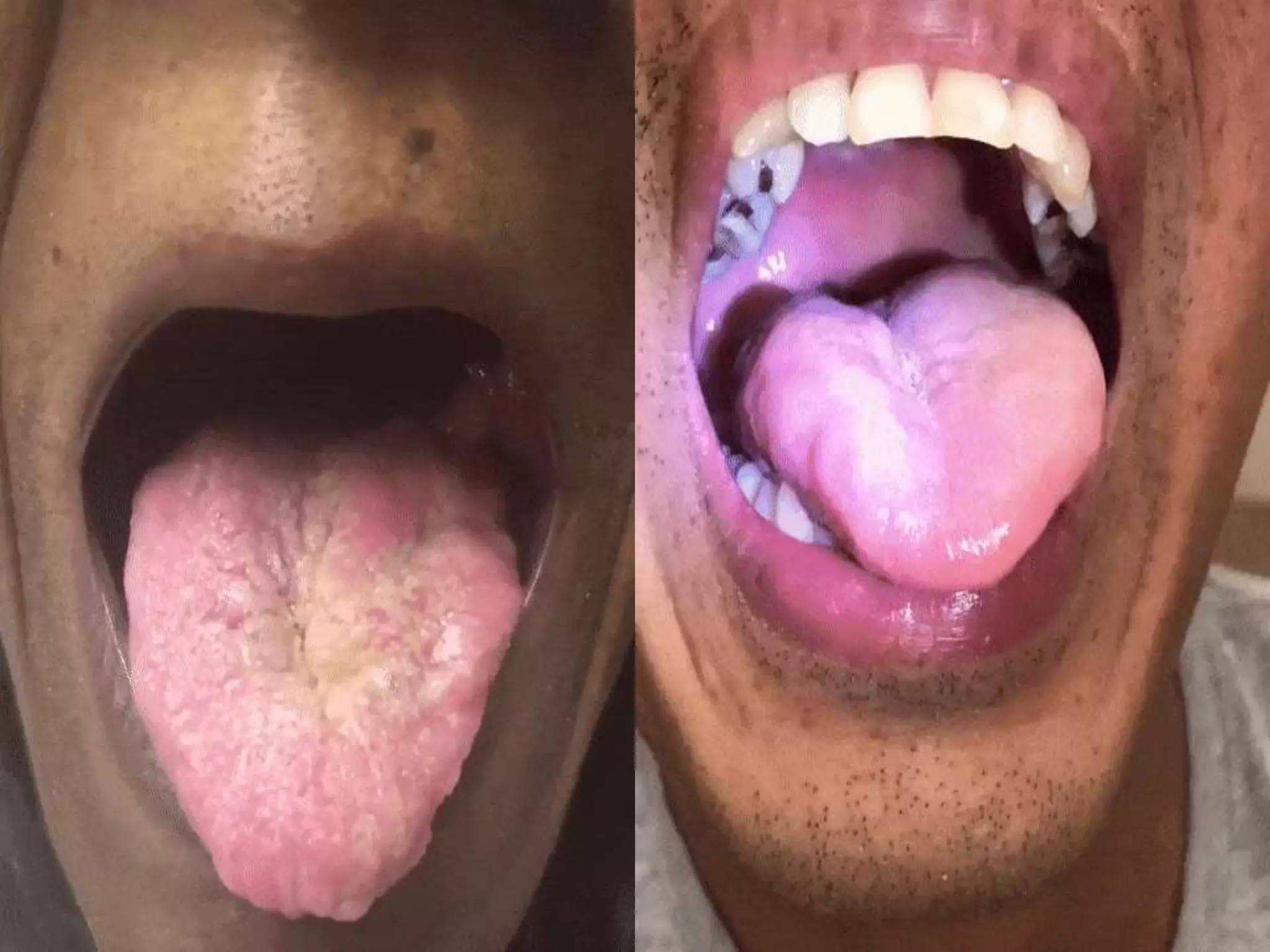
 • Tongue
 – Atrophic glossitis
 – Leicoplakia
 – Furring
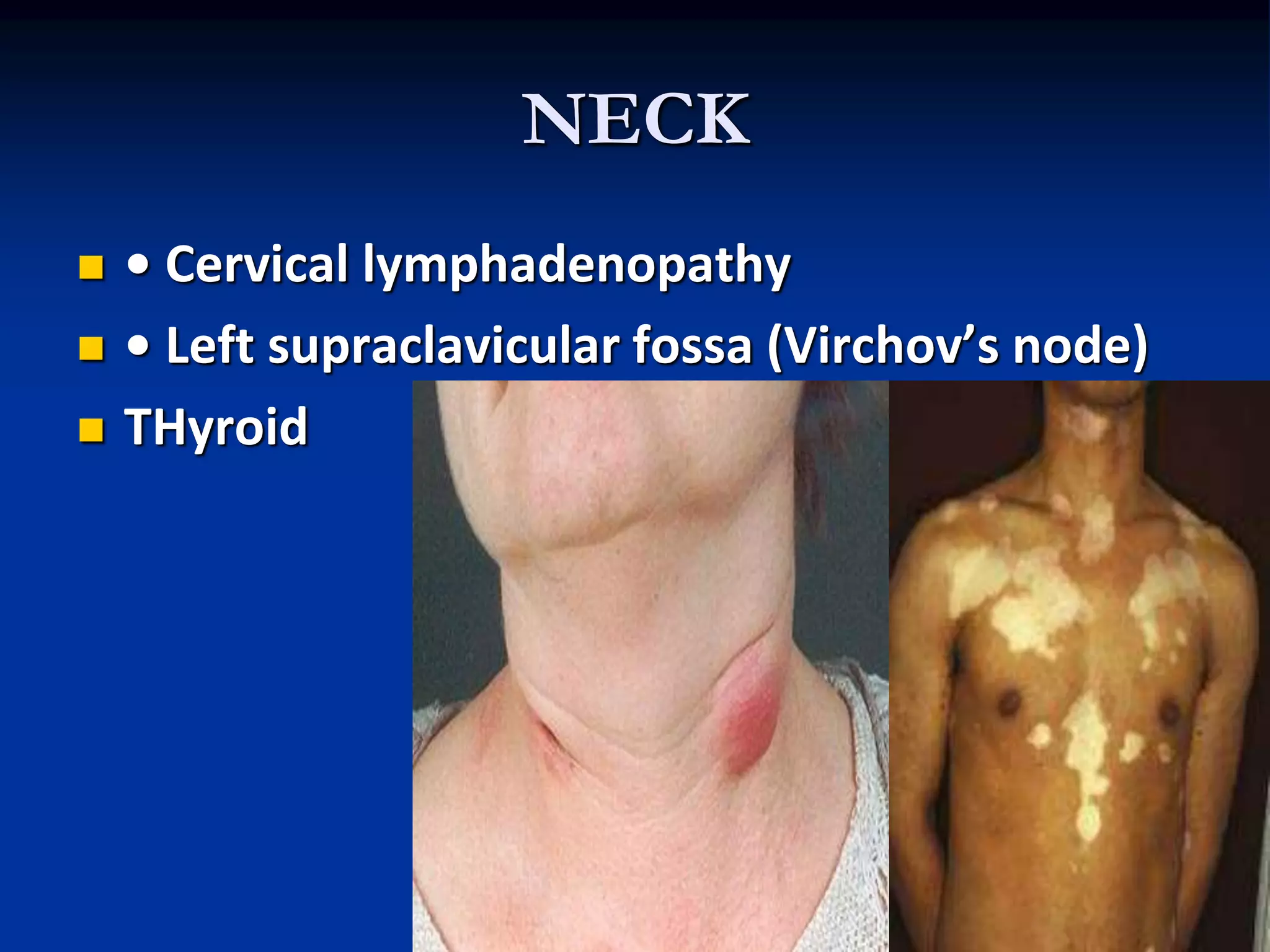
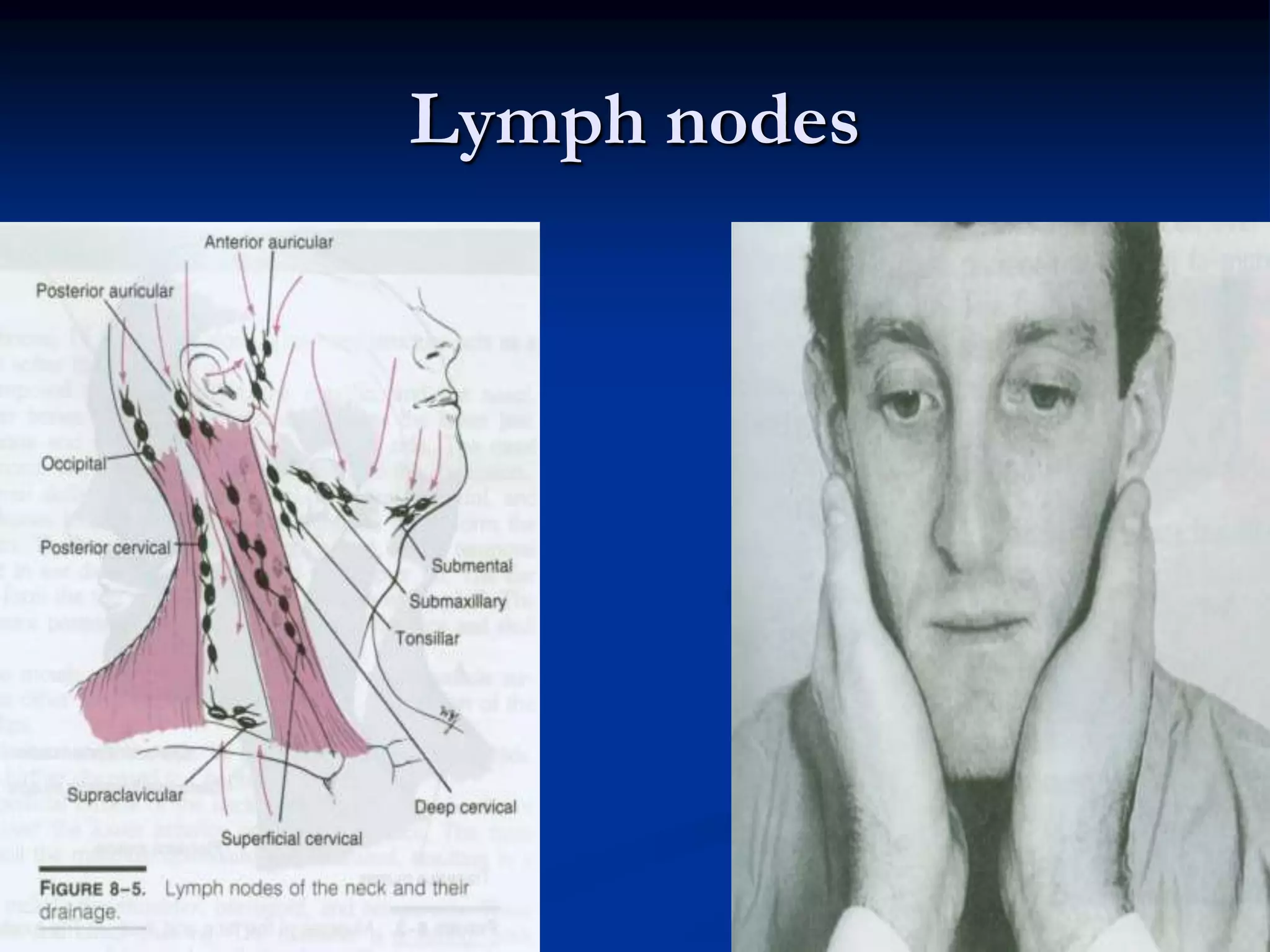
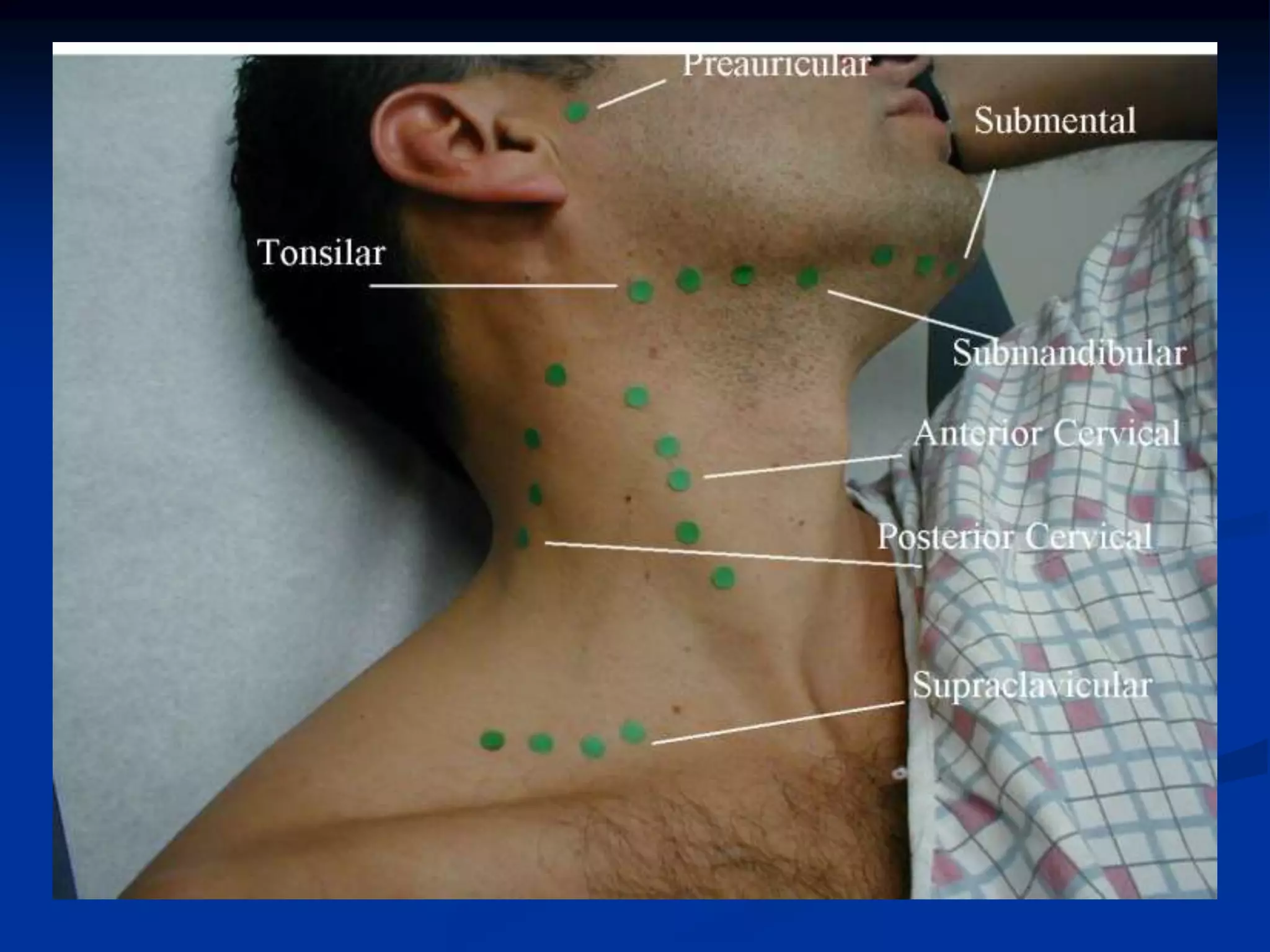
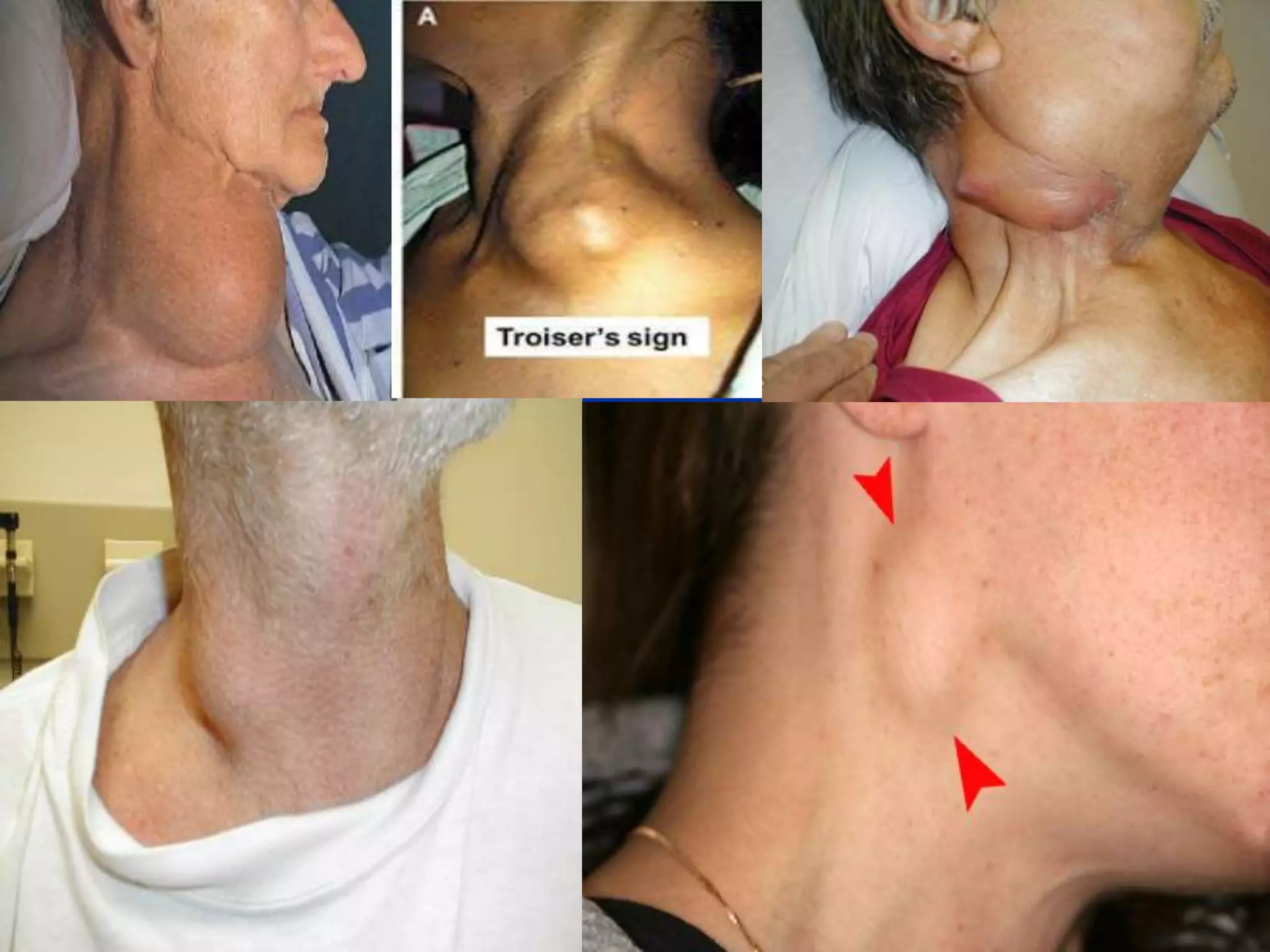
NECK
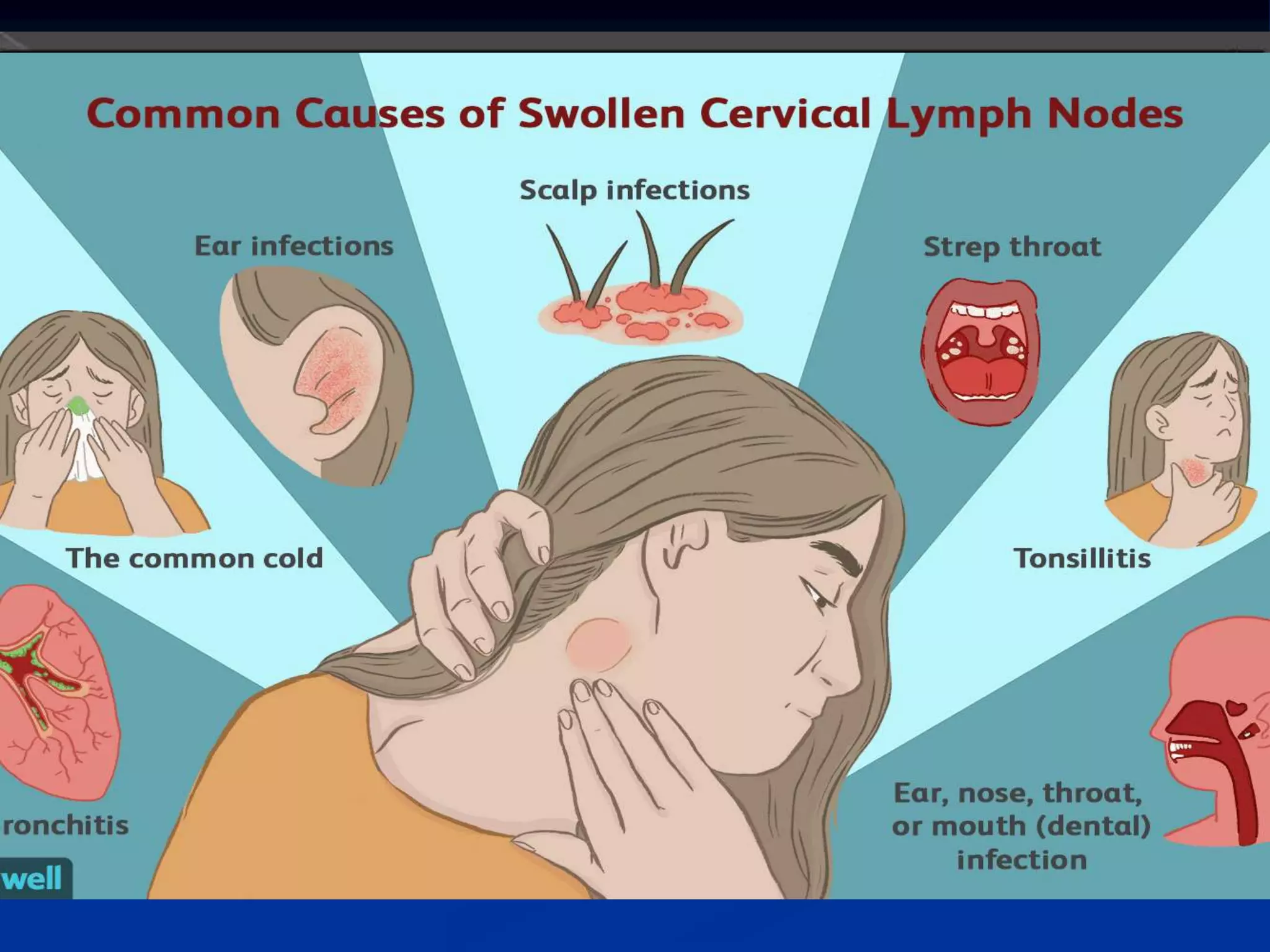
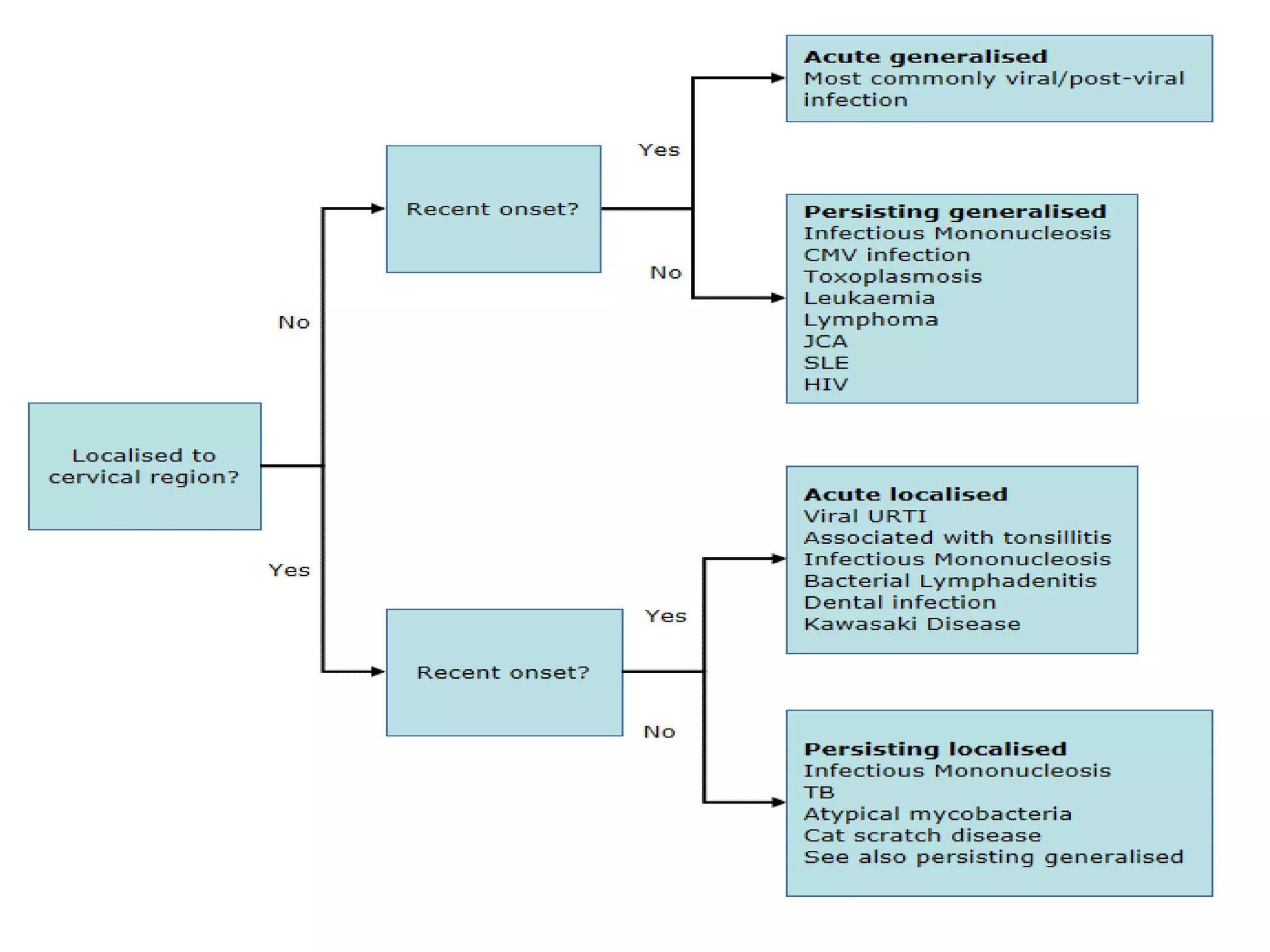
 • Cervical lymphadenopathy
 • Left supraclavicular fossa (Virchov’s node)
 THyroid
Lymph nodes
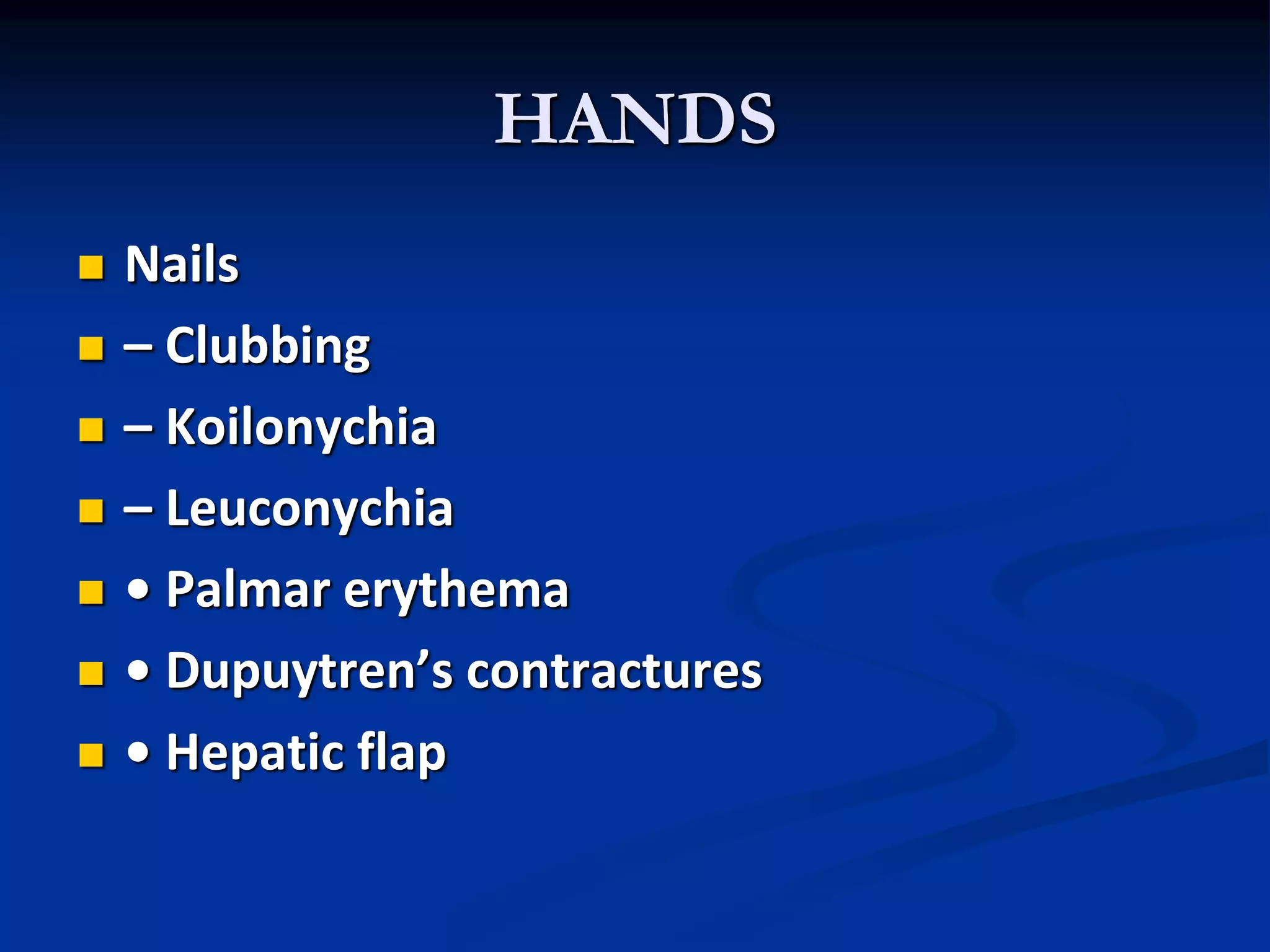
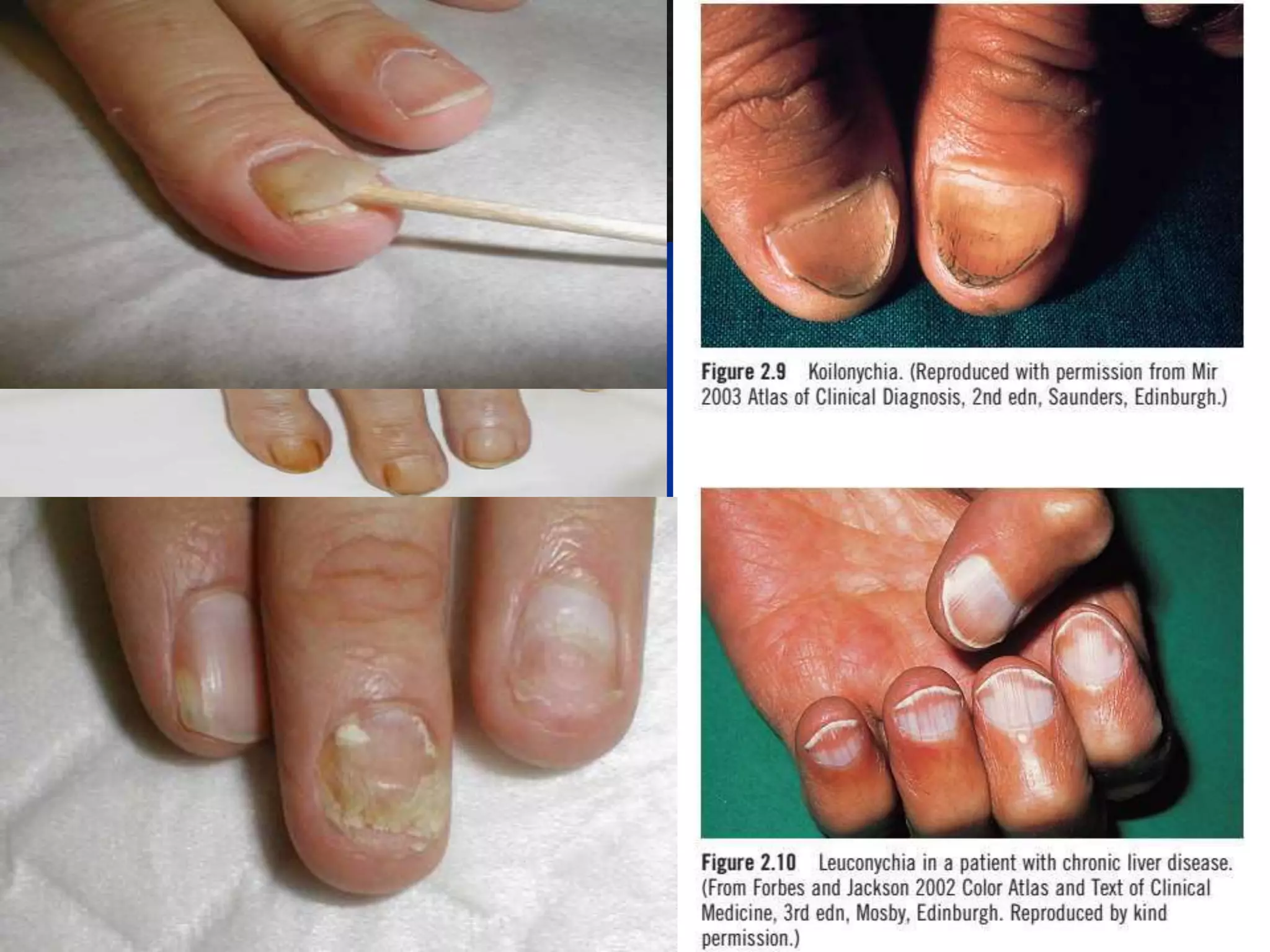
HANDS
 Nails
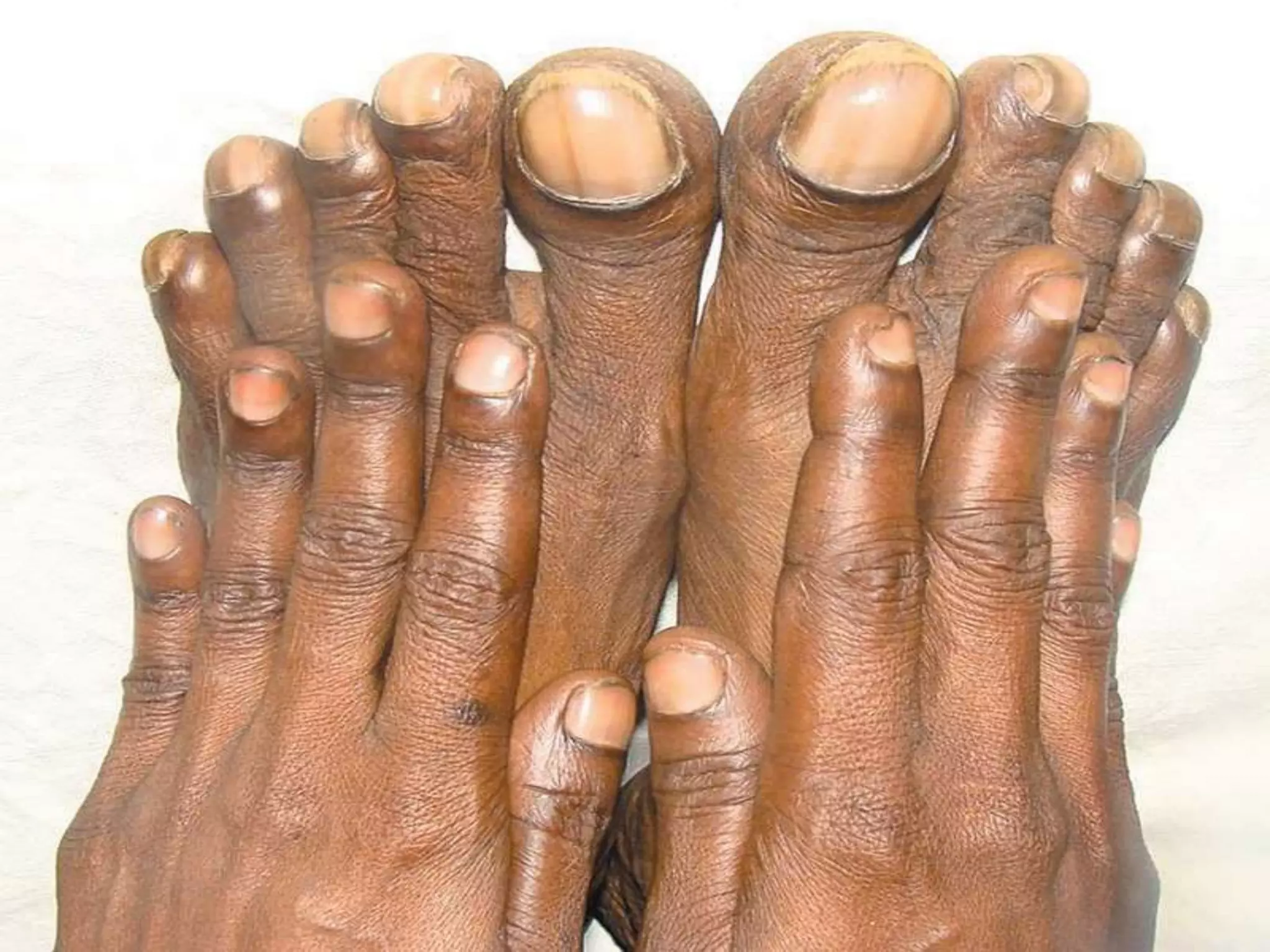
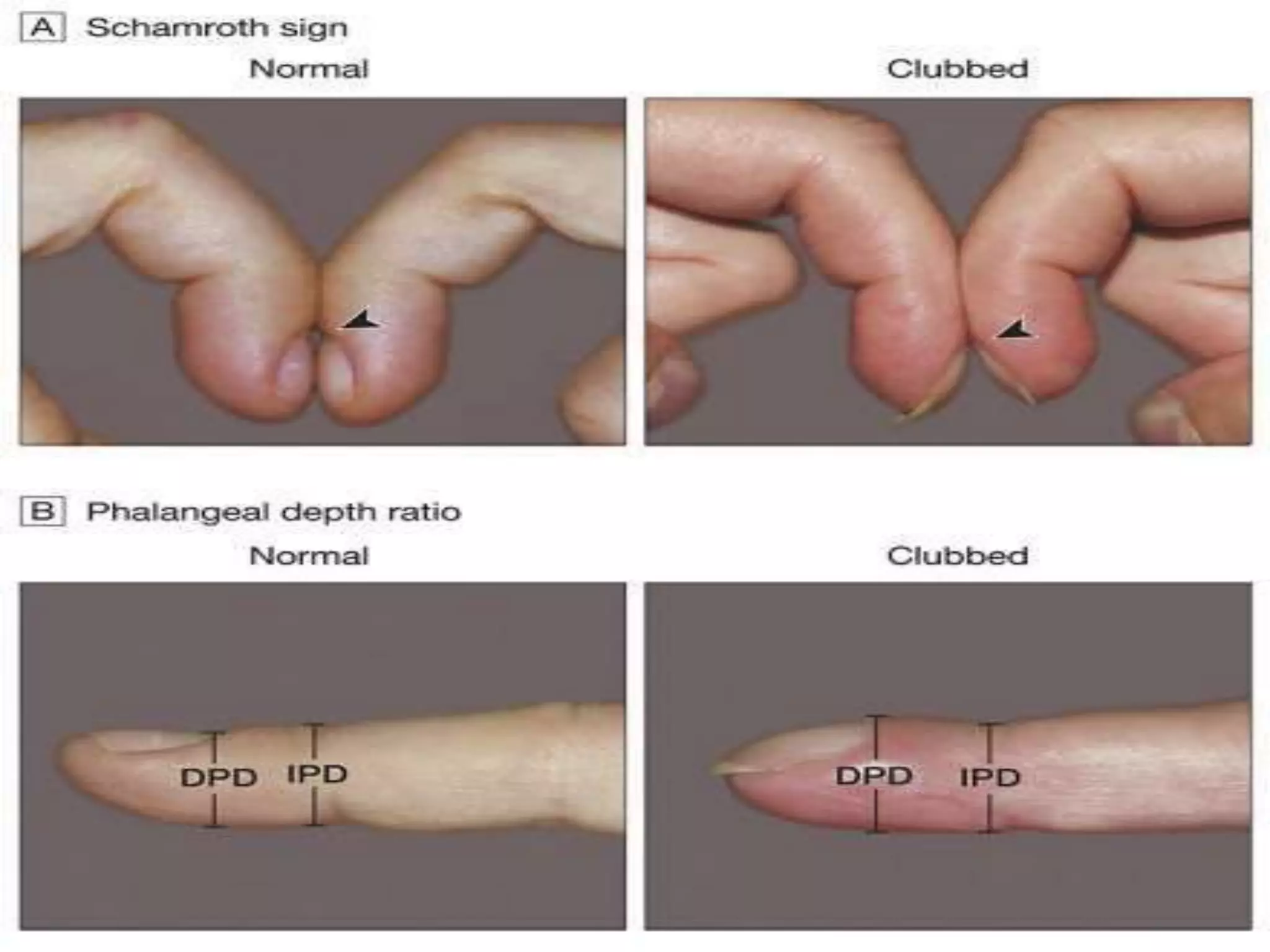
 – Clubbing
 – Koilonychia
 – Leuconychia
 • Palmar erythema
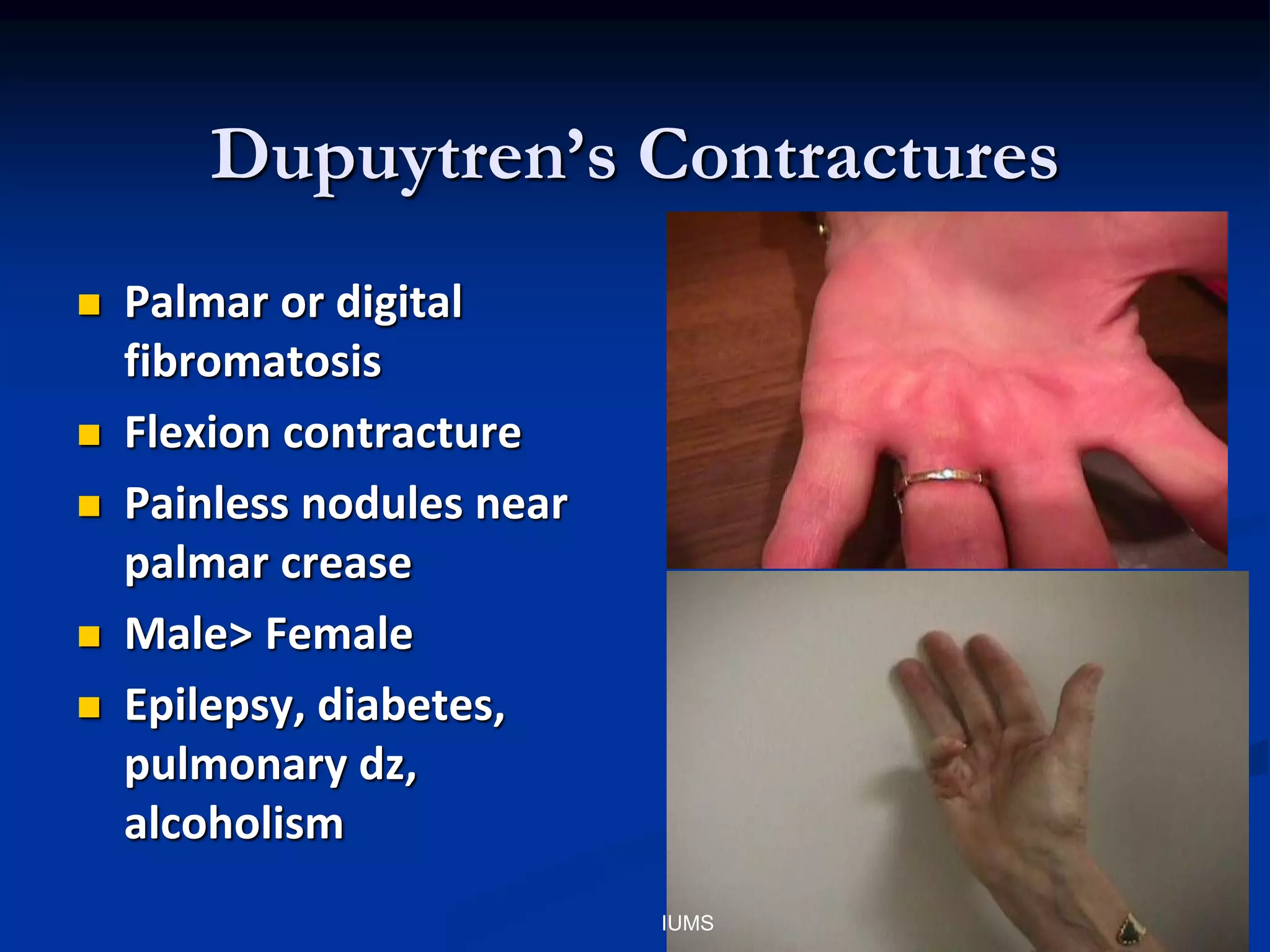
 • Dupuytren’s contractures
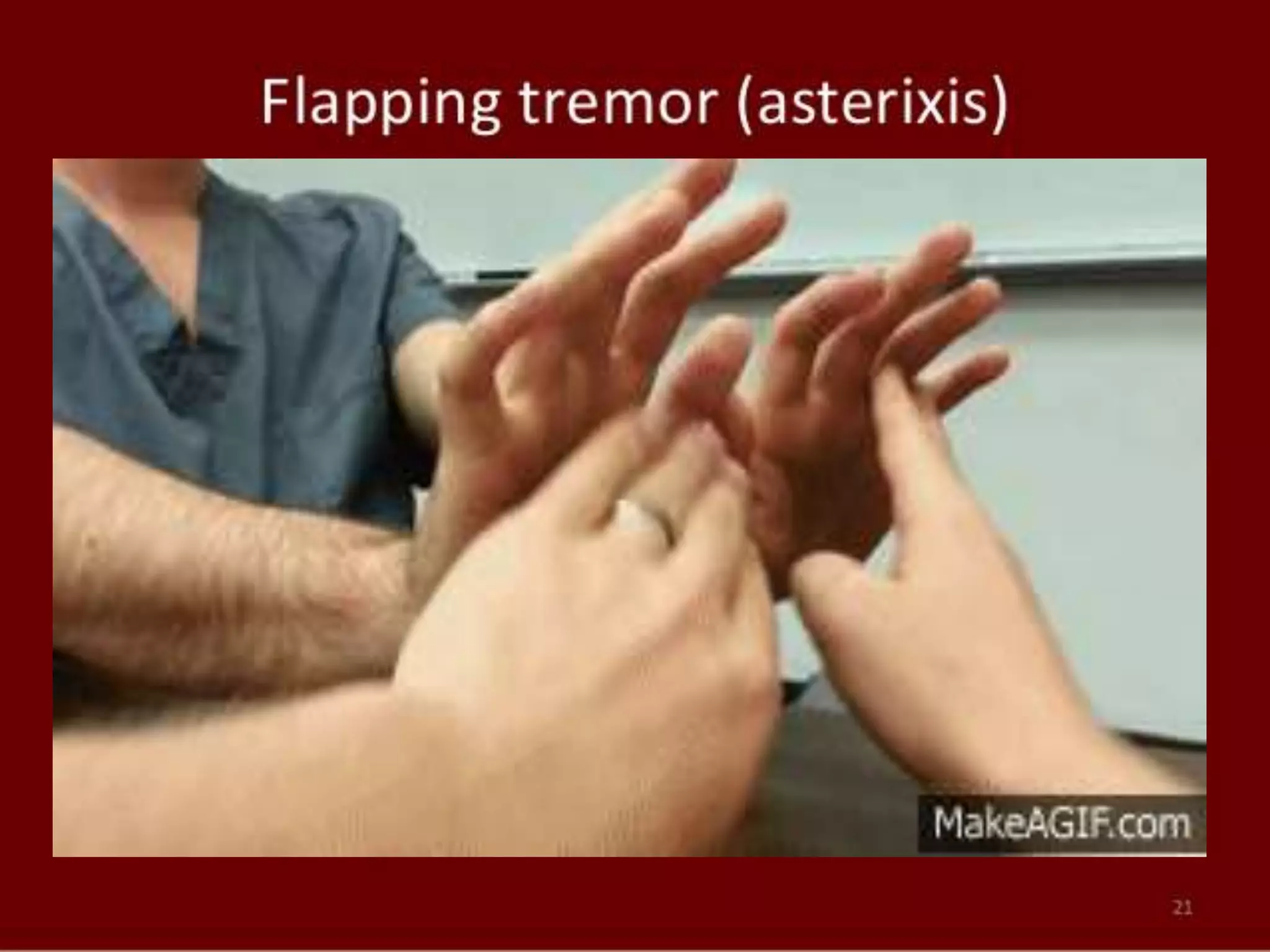
 • Hepatic flap
EDEMA
 • Excessive build up of fluid in the tissues
 • Either occurs throughout the body (generalized
swelling)
 or limited to a specific part of the body (localized
swelling)
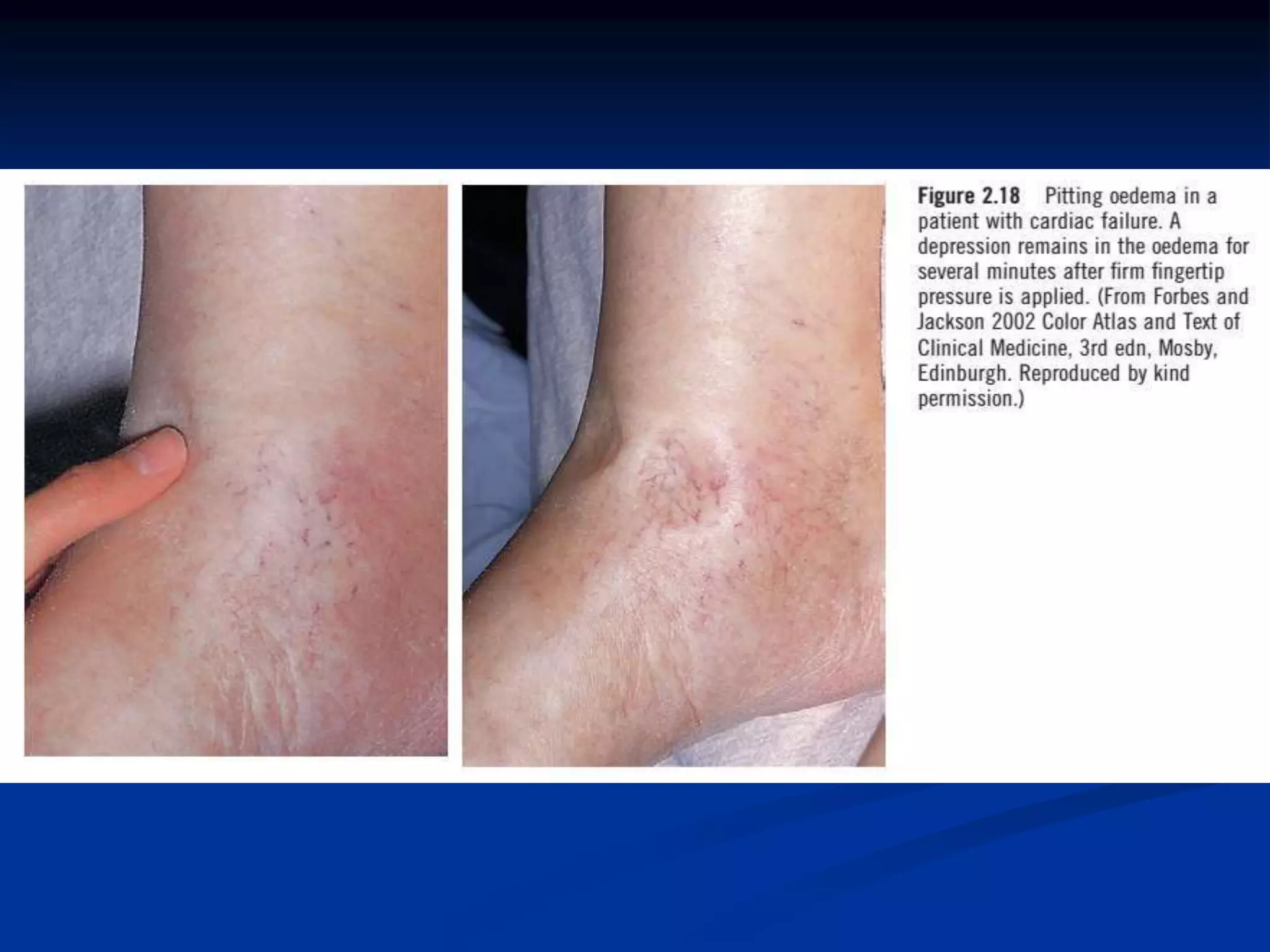
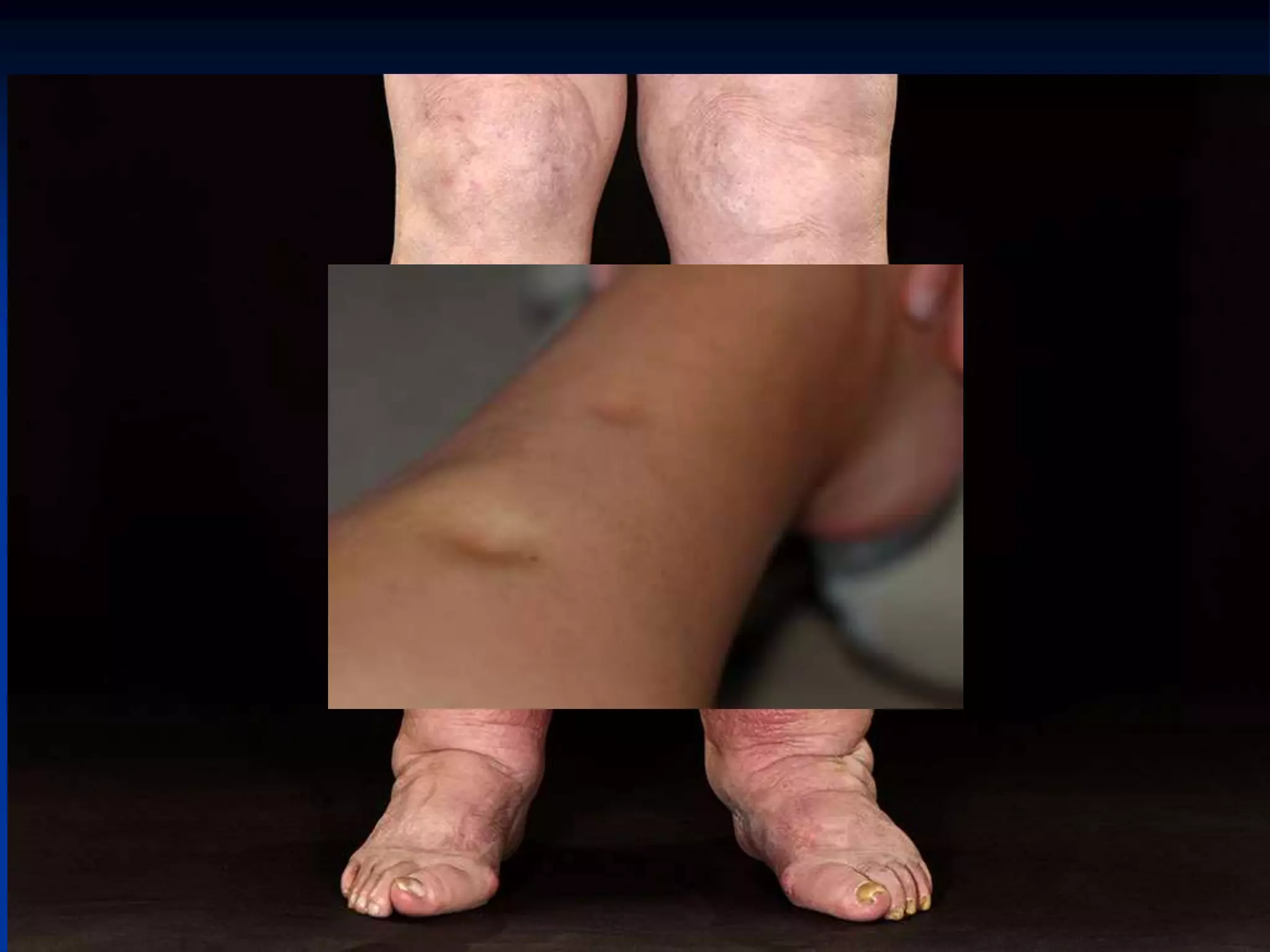
 • It can be either pitting edema or non-pitting
edema
 • Mild : facial edema, peripheral edema
 • Moderate: generalized edema
 • Severe: generalized severe edema
“If people see any redness, blistering or
swelling in the legs, especially if it is
getting worse, they definitely need to see
their doctor.” – Dr. Leslie Gilbert
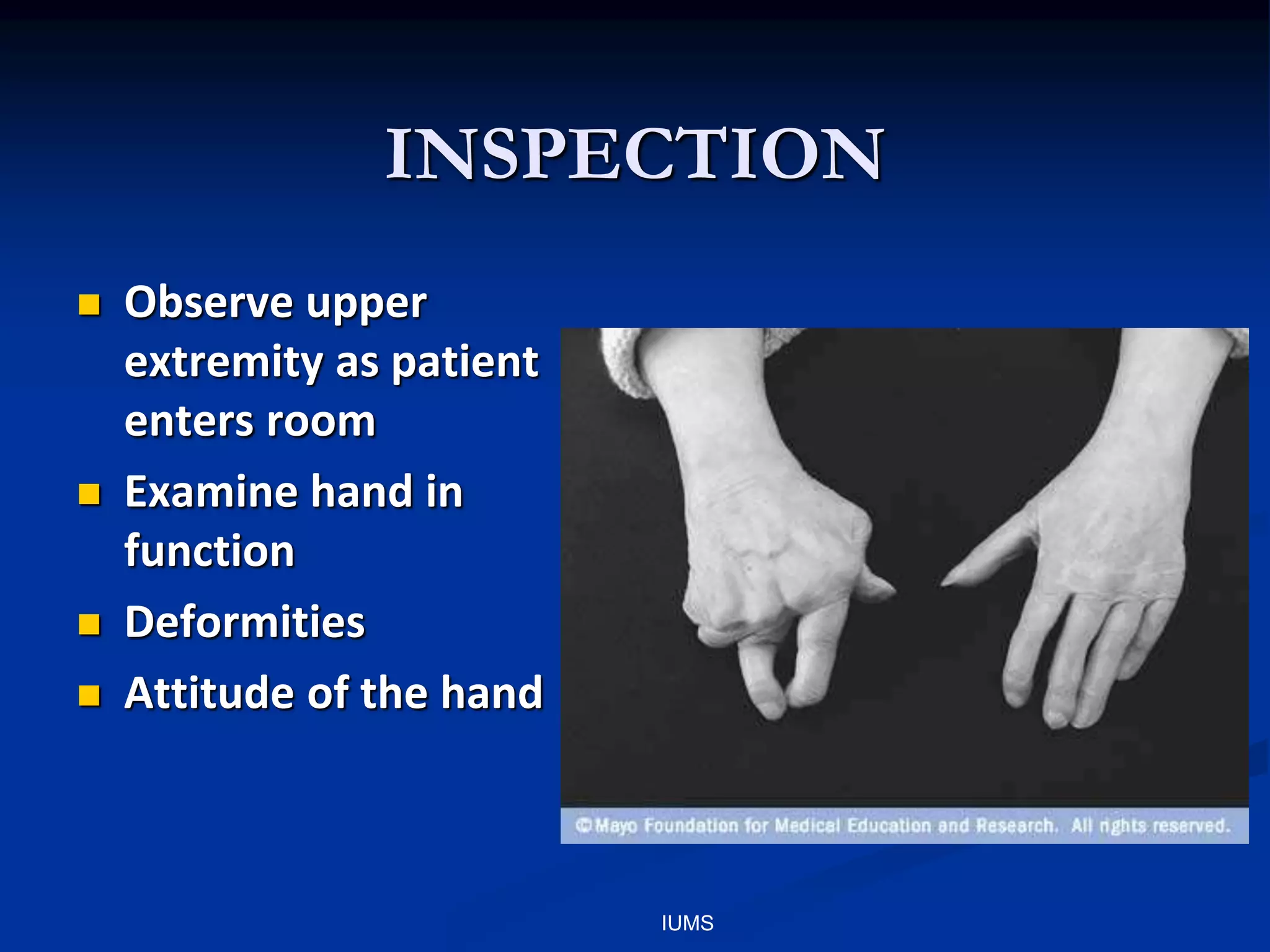
INSPECTION
 Observe upper
extremity as patient
enters room
 Examine hand in
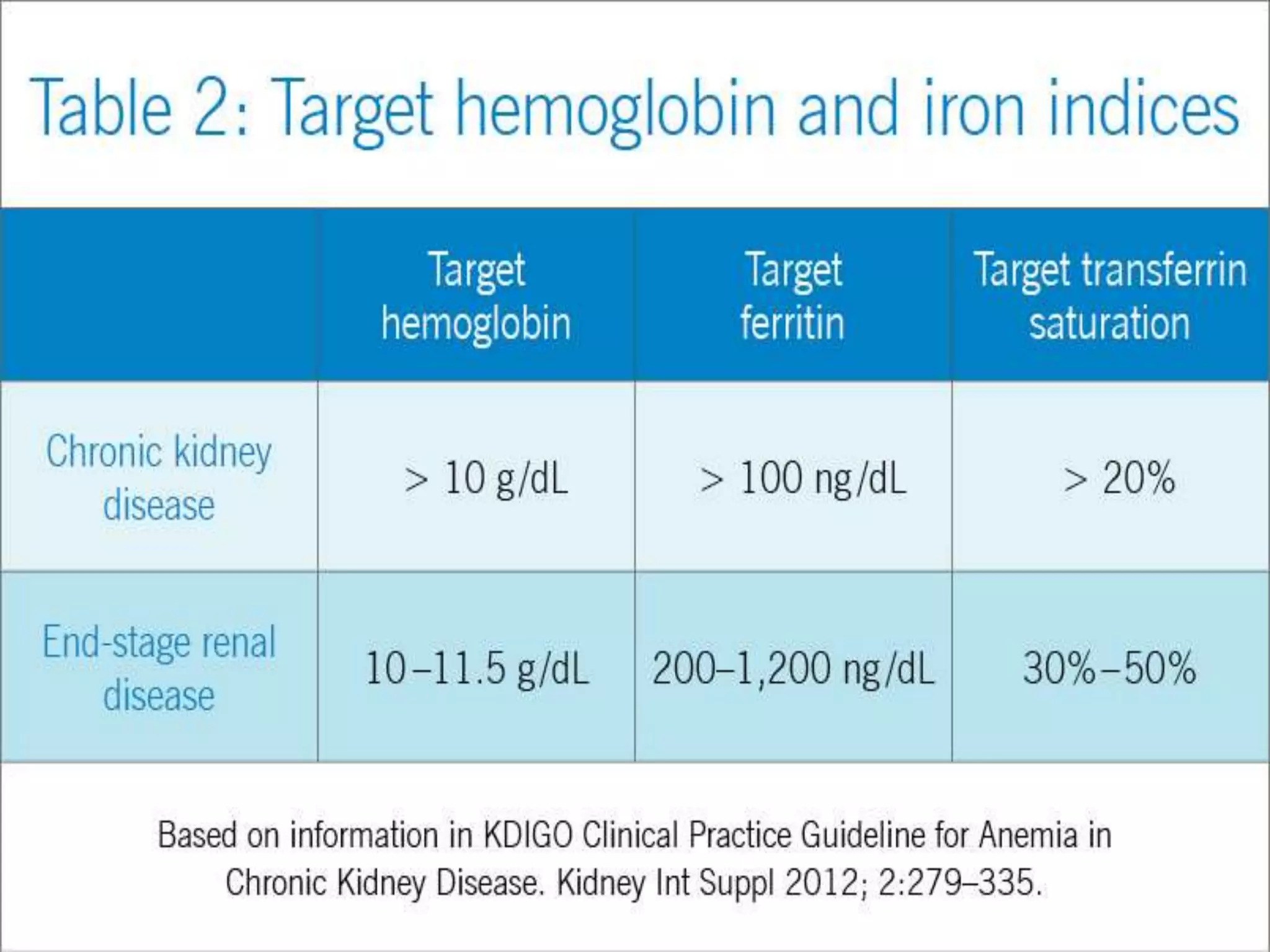
function
 Deformities
 Attitude of the hand
IUMS
INSPECTION
Palmar Surface
 Creases
 Thenar and
Hypothenar Eminence
 Arched Framework
 Hills and Valleys
 Web Spaces
IUMS
INSPECTION of Dorsal Hand
and Wrist SMJ
 Hills and Valleys
 Height of metacarpal heads
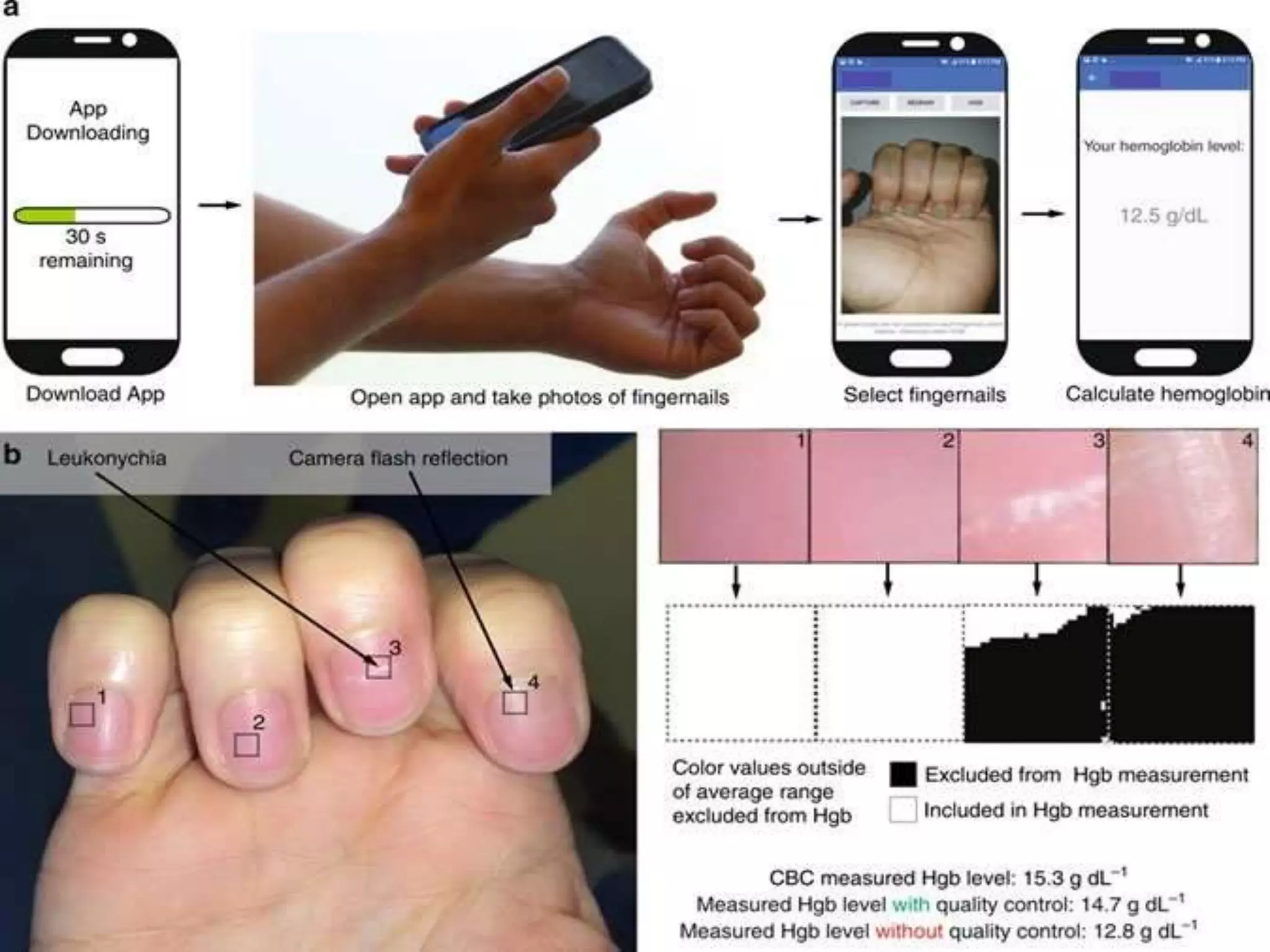
 Finger nails
 Pale or white=anemia or circulatory
 Spoon shaped=fungal infection
 Clubbed=respiratory or congenital heart
 Deformities
IUMS
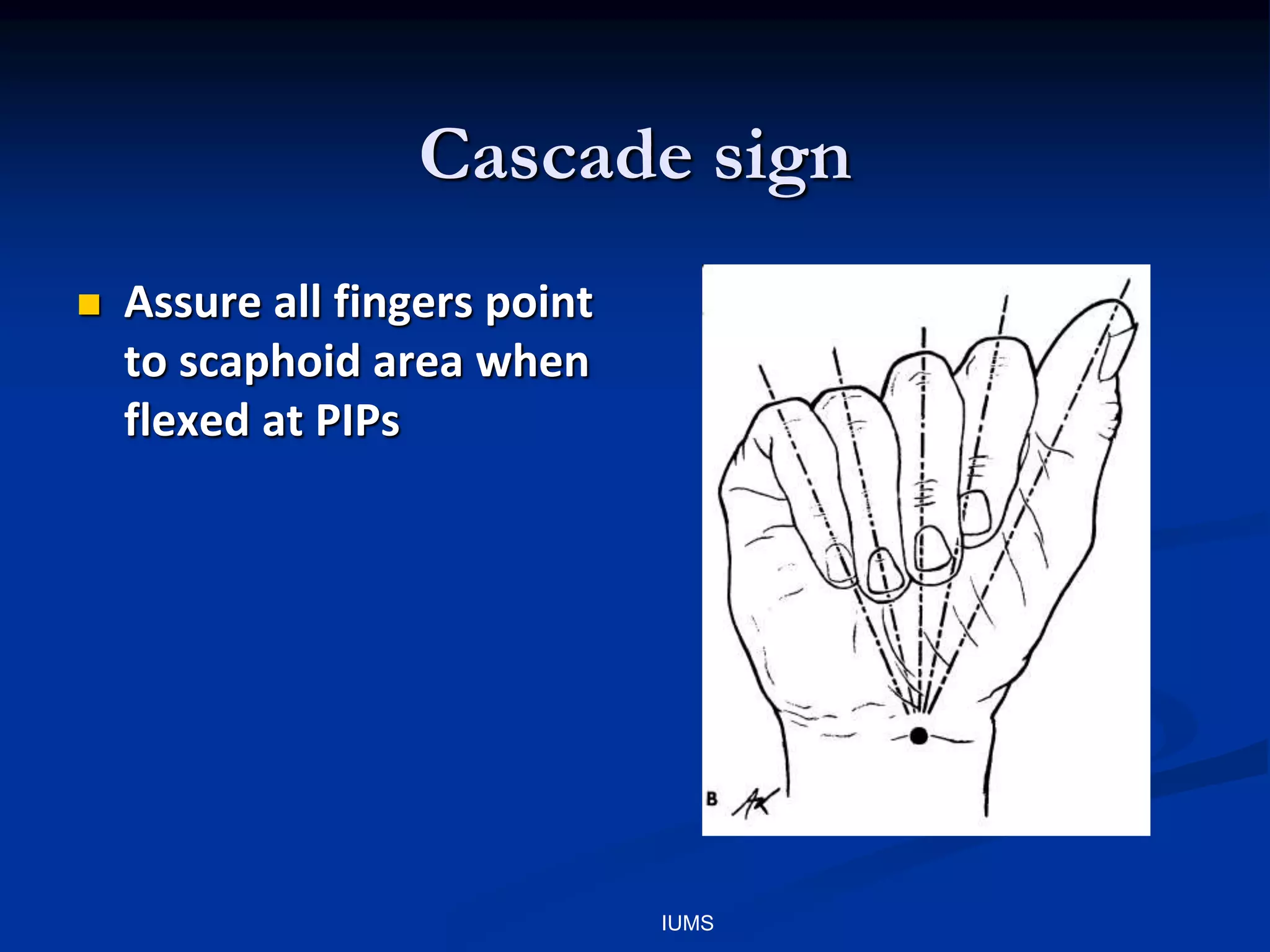
Cascade sign
 Assure all fingers point
to scaphoid area when
flexed at PIPs
IUMS
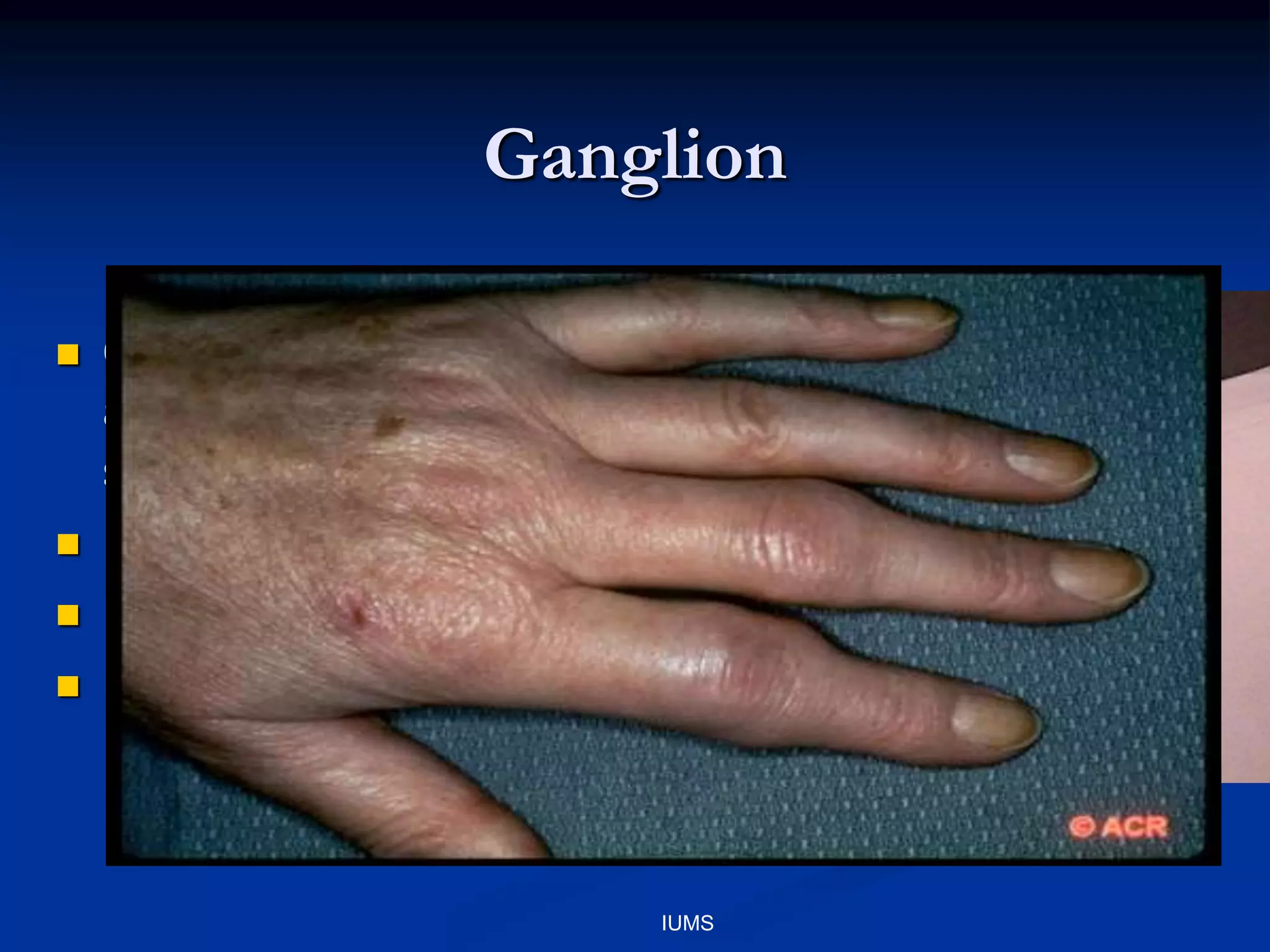
Ganglion
 Cystic structure that
arises from synovial
sheath
 Discrete mass
 Dull ache
 Dorsal or Volar aspect
IUMS
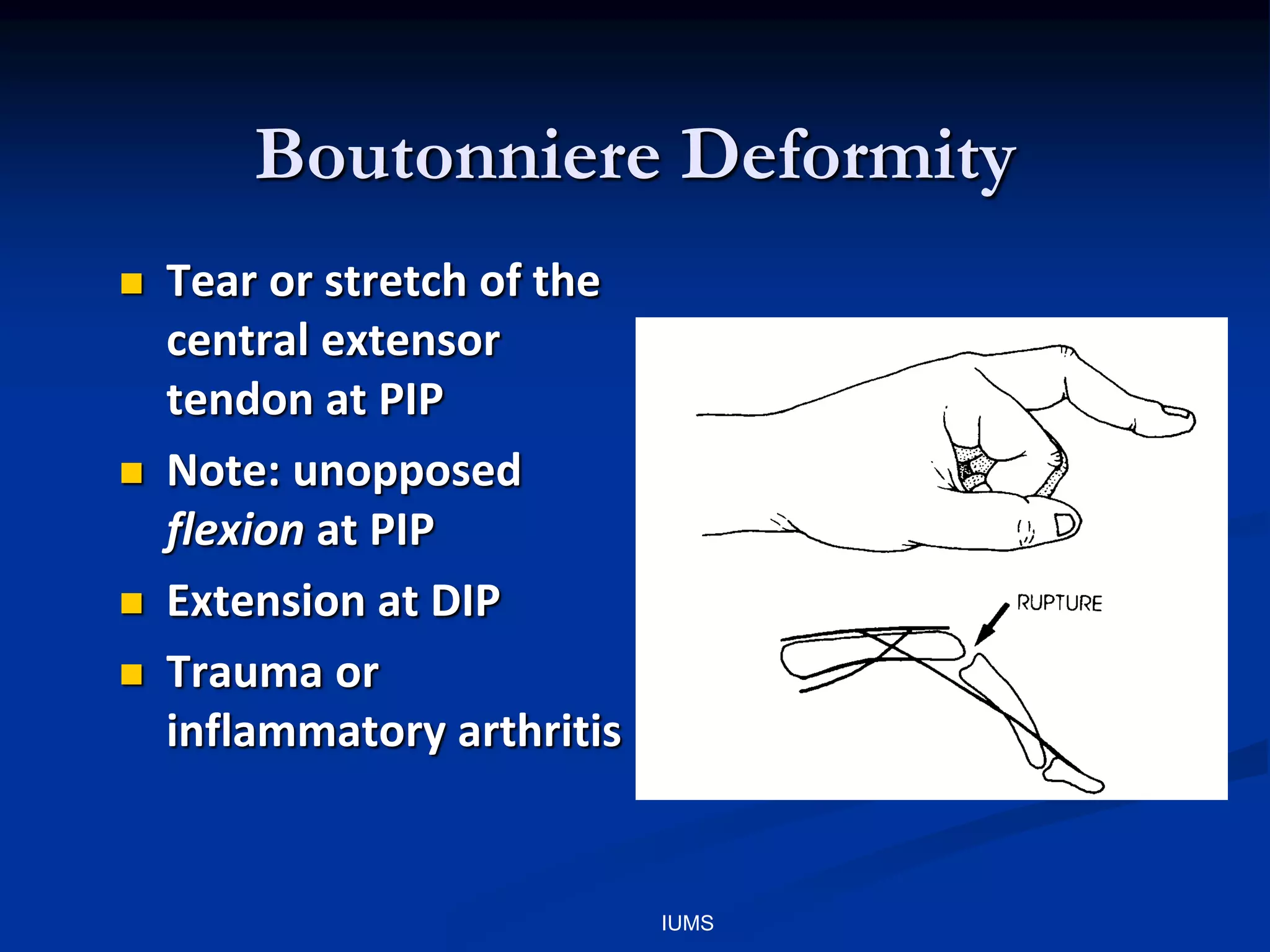
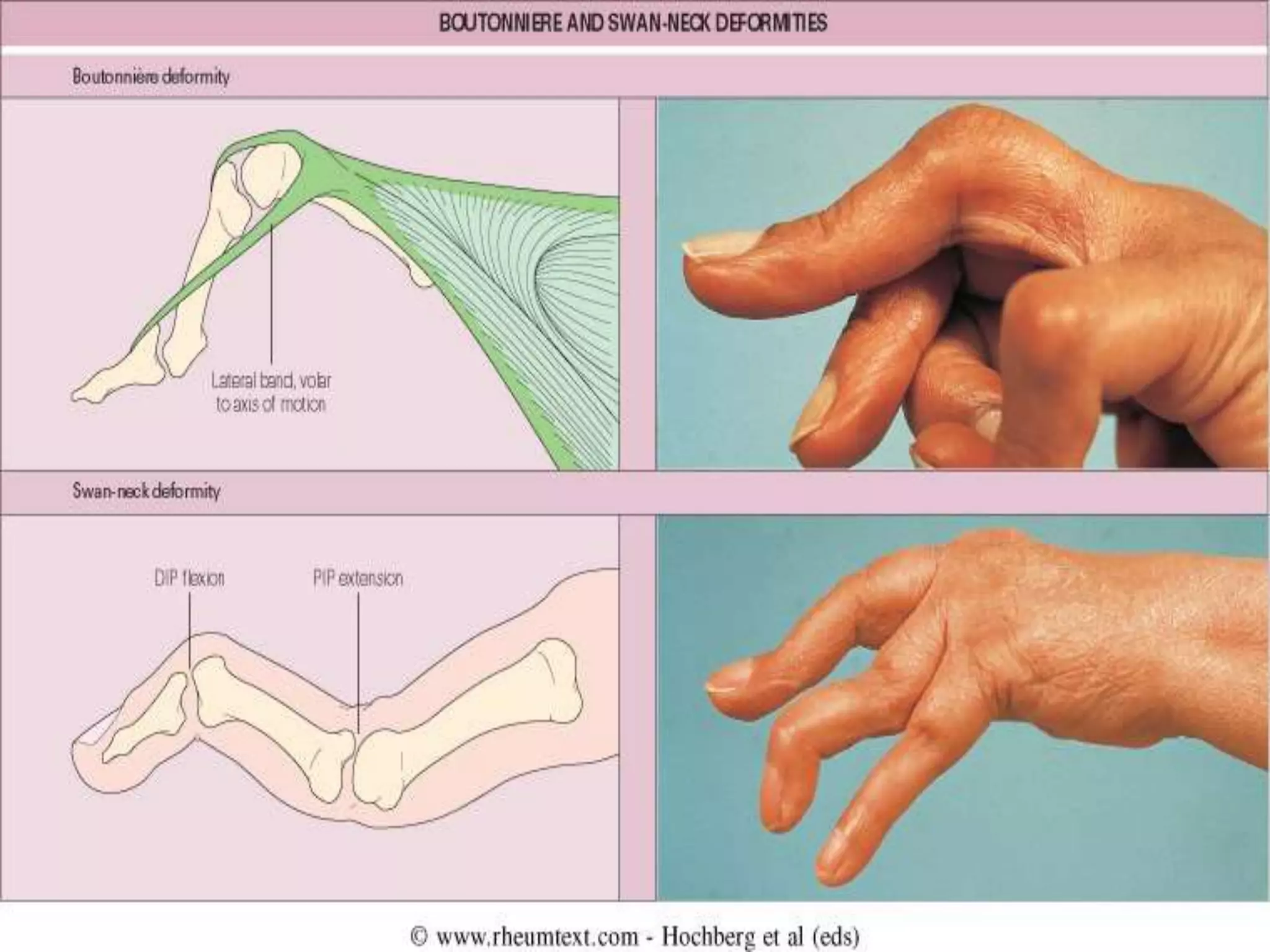
Boutonniere Deformity
 Tear or stretch of the
central extensor
tendon at PIP
 Note: unopposed
flexion at PIP
 Extension at DIP
 Trauma or
inflammatory arthritis
IUMS
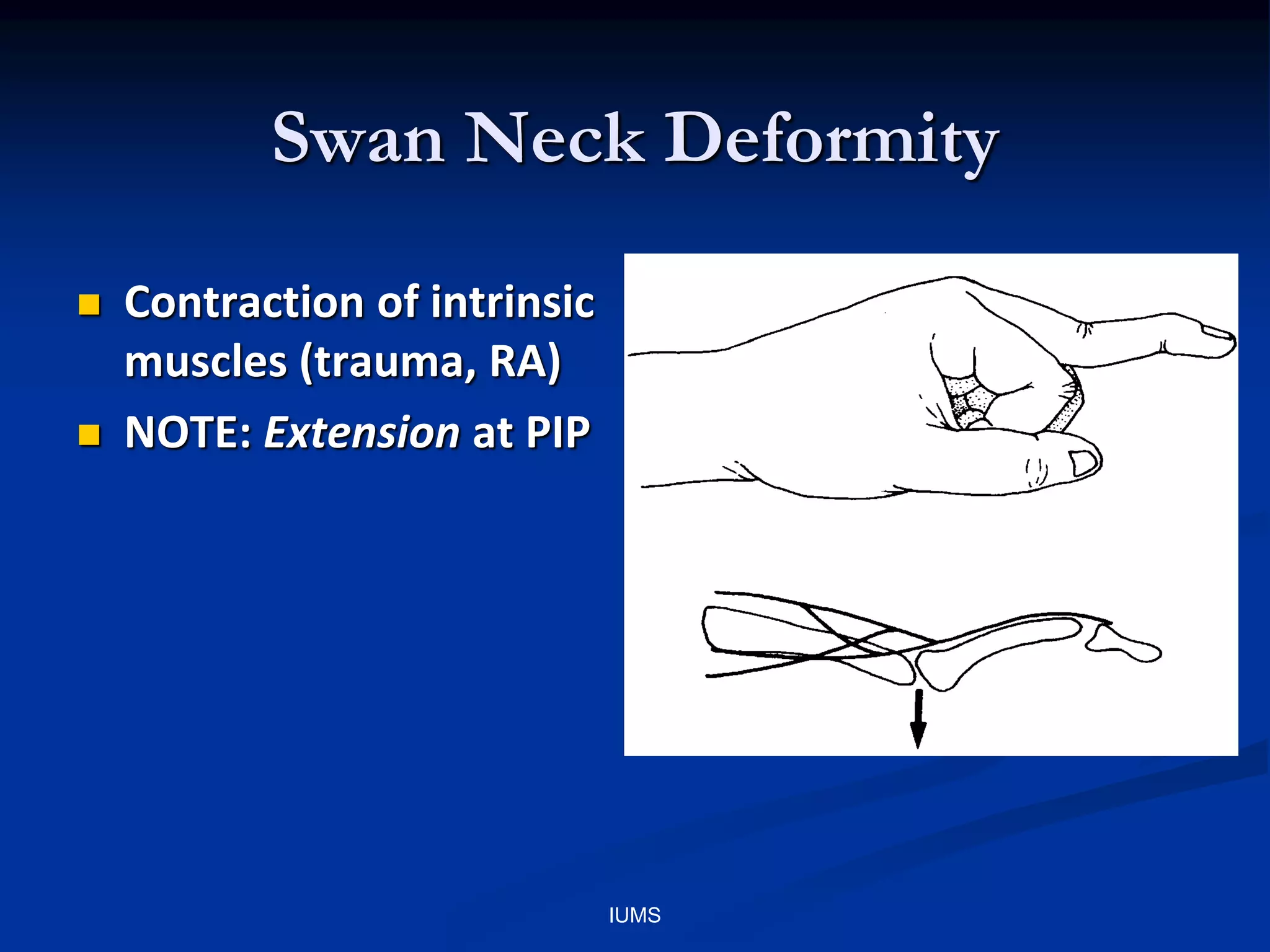
Swan Neck Deformity
 Contraction of intrinsic
muscles (trauma, RA)
 NOTE: Extension at PIP
IUMS
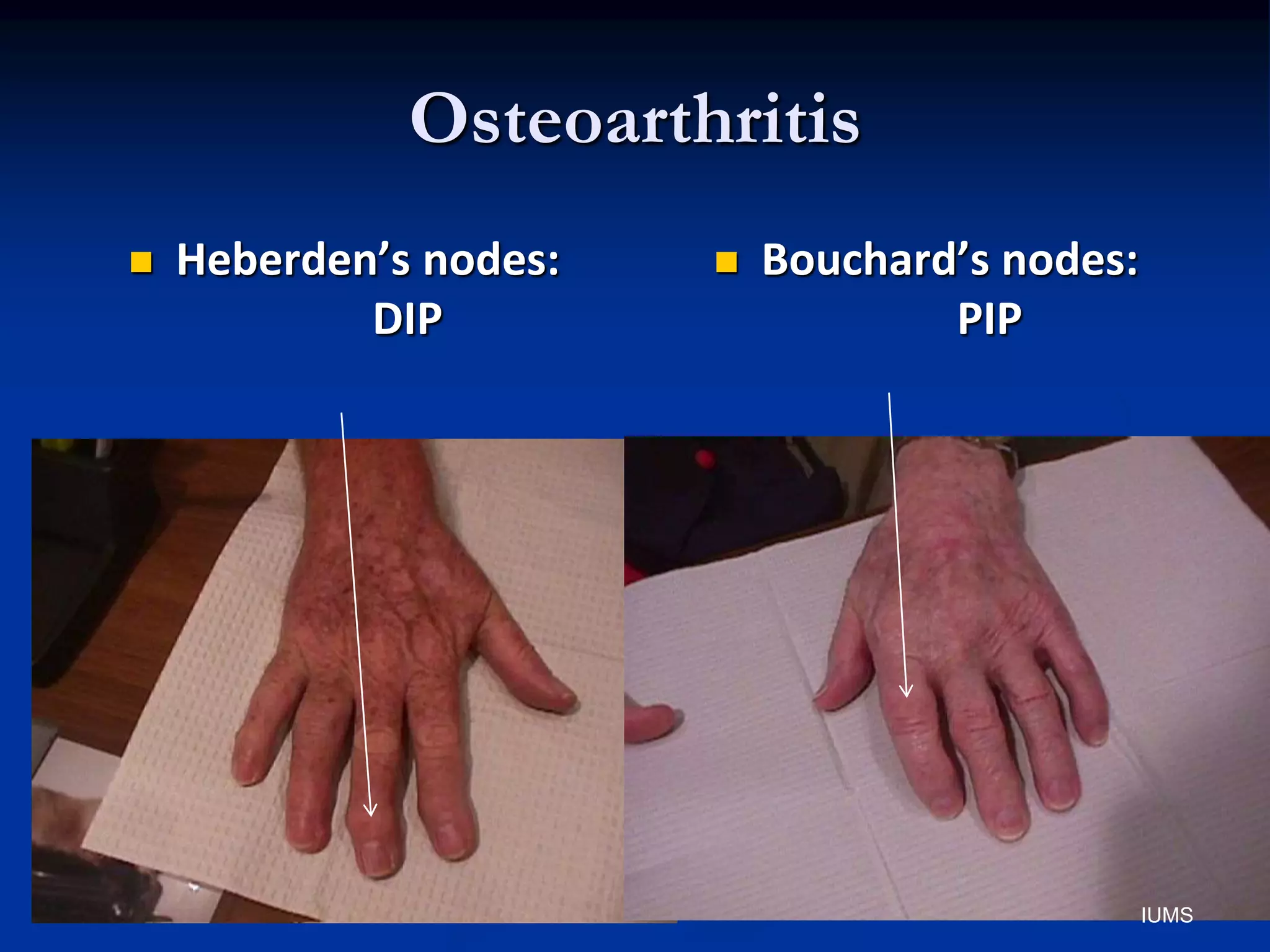
Osteoarthritis
 Heberden’s nodes:
DIP
 Bouchard’s nodes:
PIP
IUMS
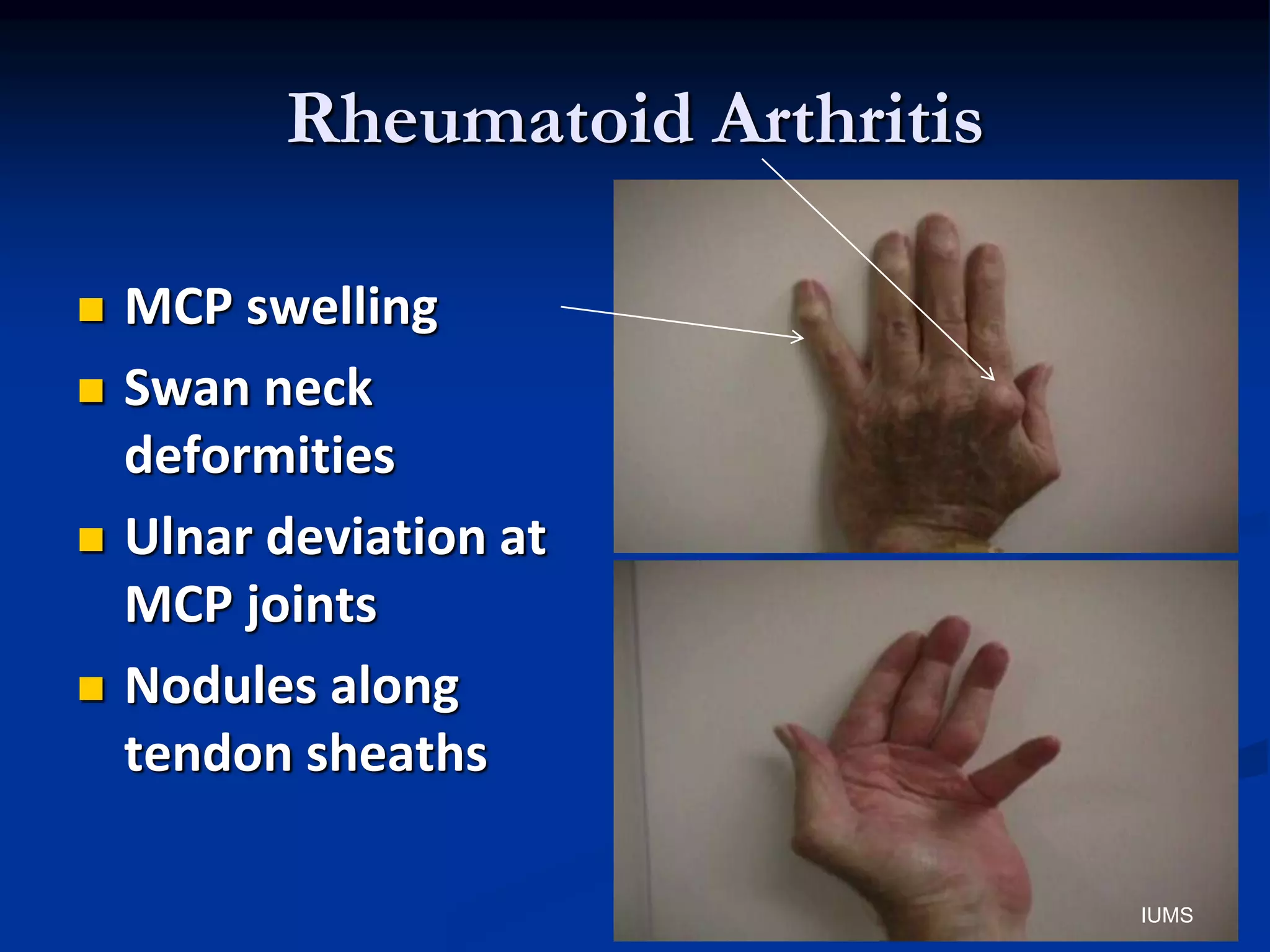
Rheumatoid Arthritis
 MCP swelling
 Swan neck
deformities
 Ulnar deviation at
MCP joints
 Nodules along
tendon sheaths
IUMS
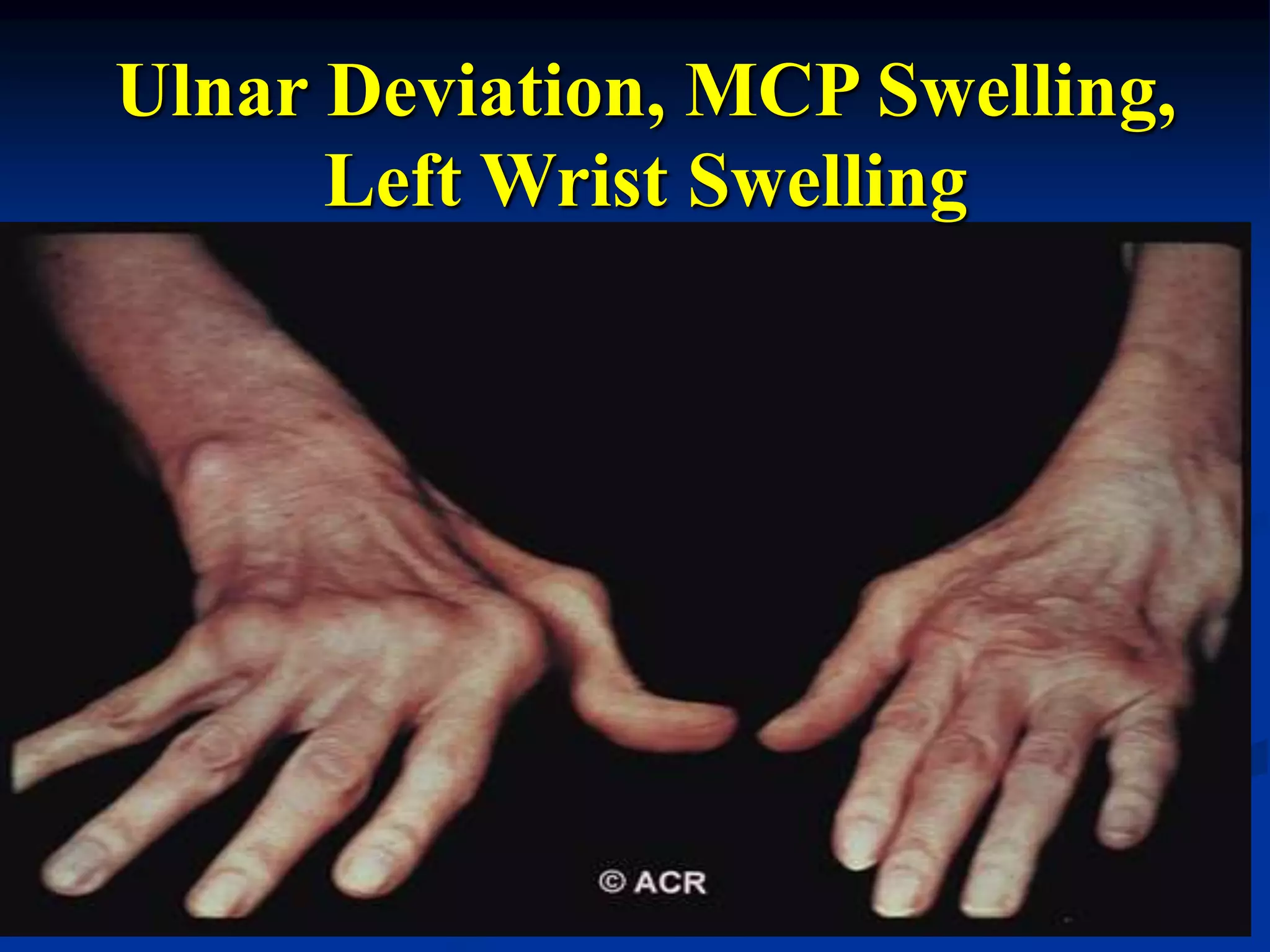
Ulnar Deviation, MCP Swelling,
Left Wrist Swelling
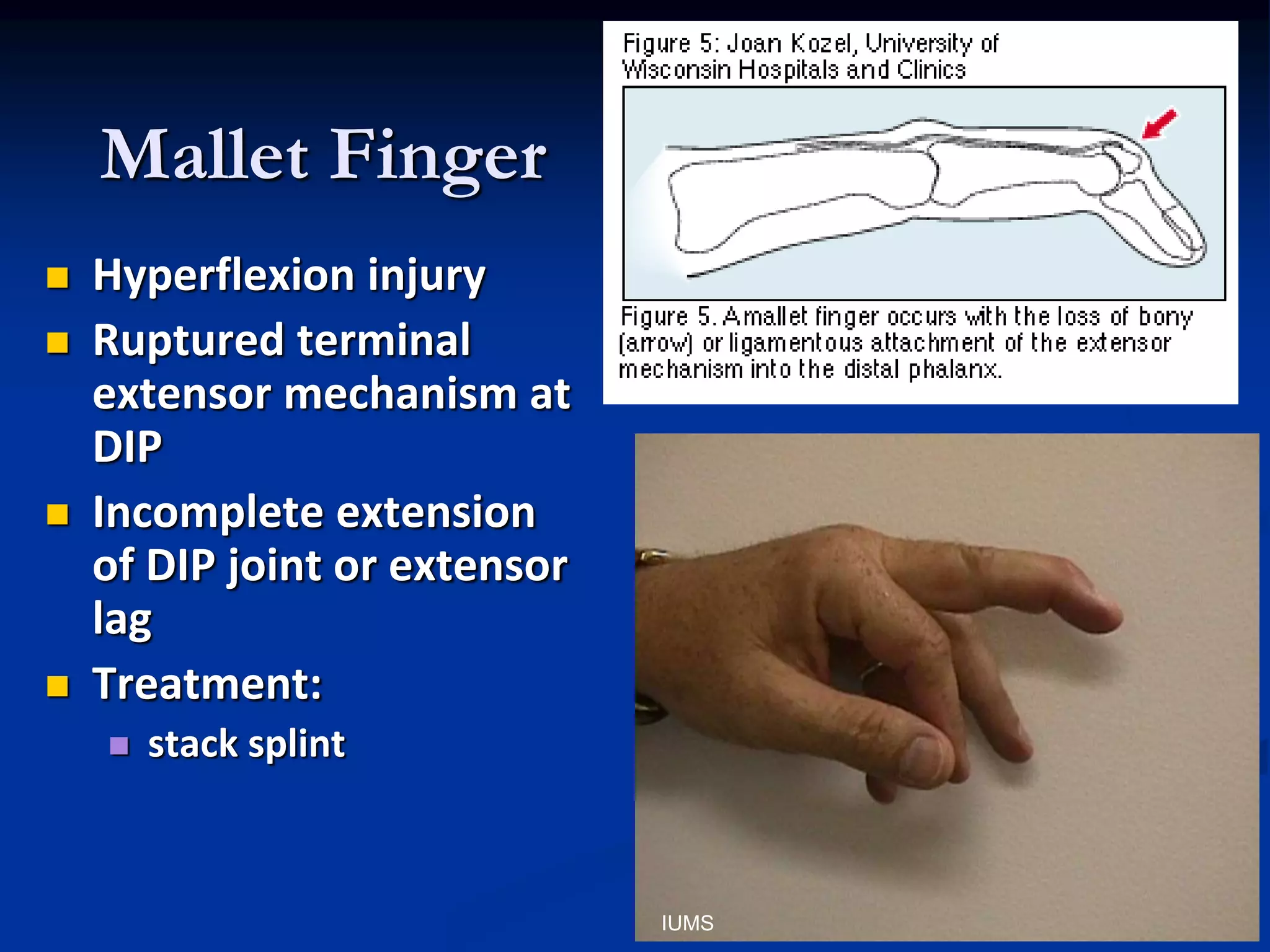
Mallet Finger
 Hyperflexion injury
 Ruptured terminal
extensor mechanism at
DIP
 Incomplete extension
of DIP joint or extensor
lag
 Treatment:
 stack splint
IUMS
Dupuytren’s Contractures
 Palmar or digital
fibromatosis
 Flexion contracture
 Painless nodules near
palmar crease
 Male> Female
 Epilepsy, diabetes,
pulmonary dz,
alcoholism
IUMS
RANGE OF MOTION
 Active range of motion
 Passive range of motion if unable to
actively move joint
 Bliateral comparison
 To determine degrees of restriction
IUMS
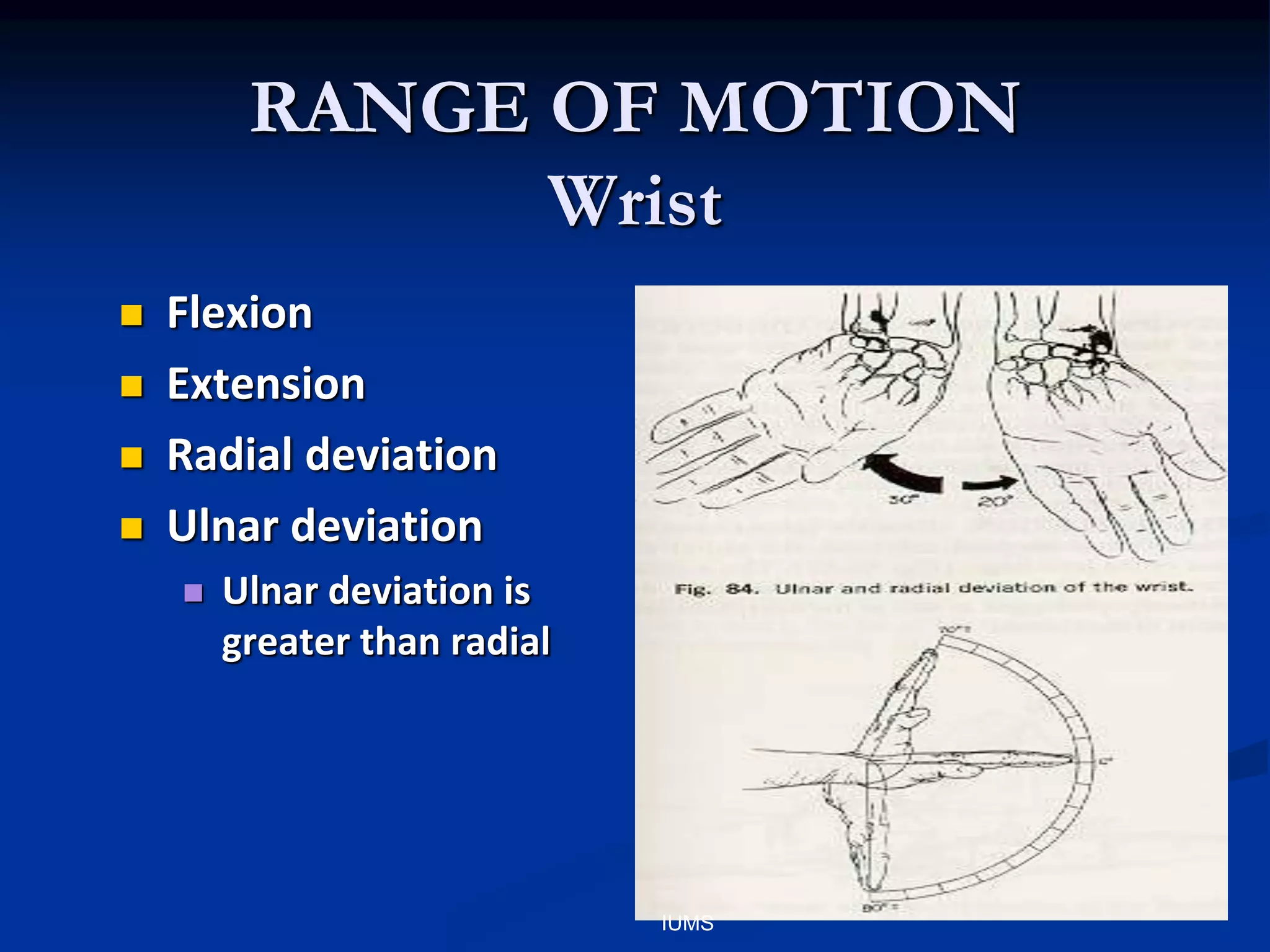
RANGE OF MOTION
Wrist
 Flexion
 Extension
 Radial deviation
 Ulnar deviation
 Ulnar deviation is
greater than radial
IUMS
Mobility :
(pronosupination)
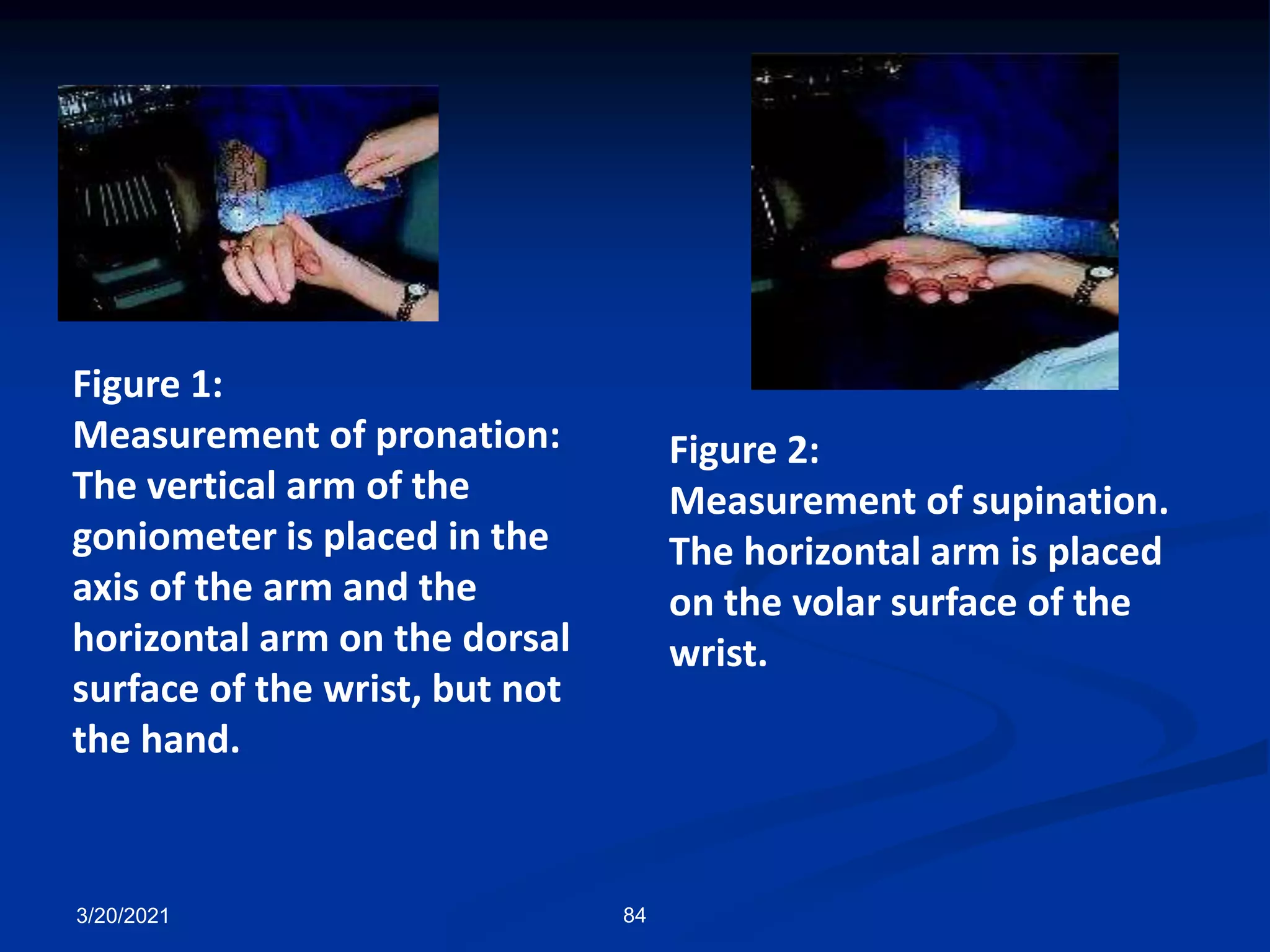
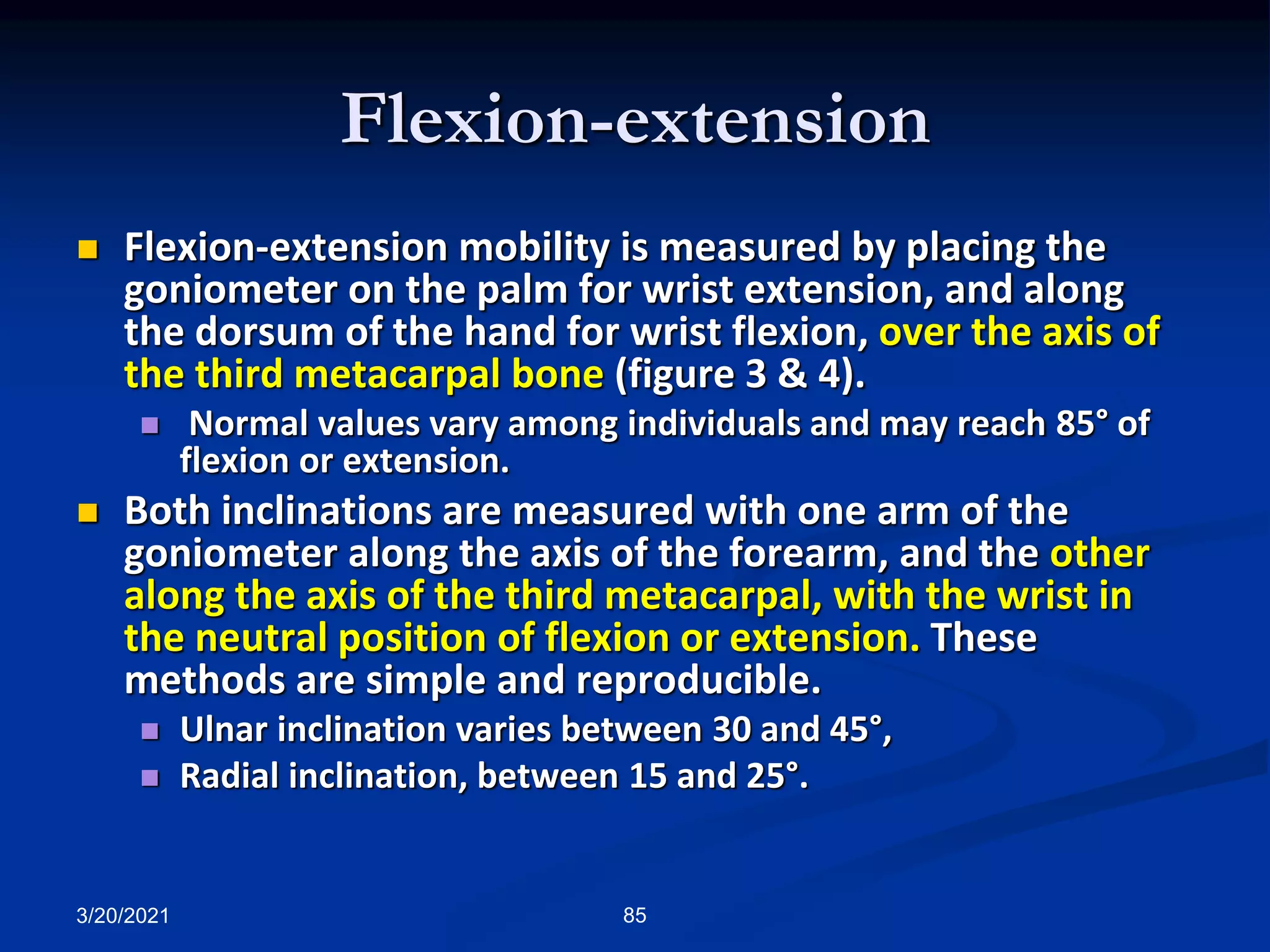
 To test pronosupination, the patient is asked to keep his or her elbows close
to the body and to turn the palm up and down alternatively. One arm of the
goniometer is placed parallel to the axis of the humerus, and the other
along the distal part of the forearm (Figure 1 & 2).
 One should avoid measuring pronosupination with a stick in the patient's
hands, as the pronosupination mobility is increased by the passive rotatory
mobility of the carpus, which may be as high as 40°.
 If the neutral prono-supination position is defined as zero (with the elbow
flexed and maintained against the chest, the thumb must be raised up):
 Normal pronation varies between 60 and 90°,
 Normal supination, between 45 and 80°.
3/20/2021 83
Figure 1:
Measurement of pronation:
The vertical arm of the
goniometer is placed in the
axis of the arm and the
horizontal arm on the dorsal
surface of the wrist, but not
the hand.
Figure 2:
Measurement of supination.
The horizontal arm is placed
on the volar surface of the
wrist.
3/20/2021 84
Flexion-extension
3/20/2021 85
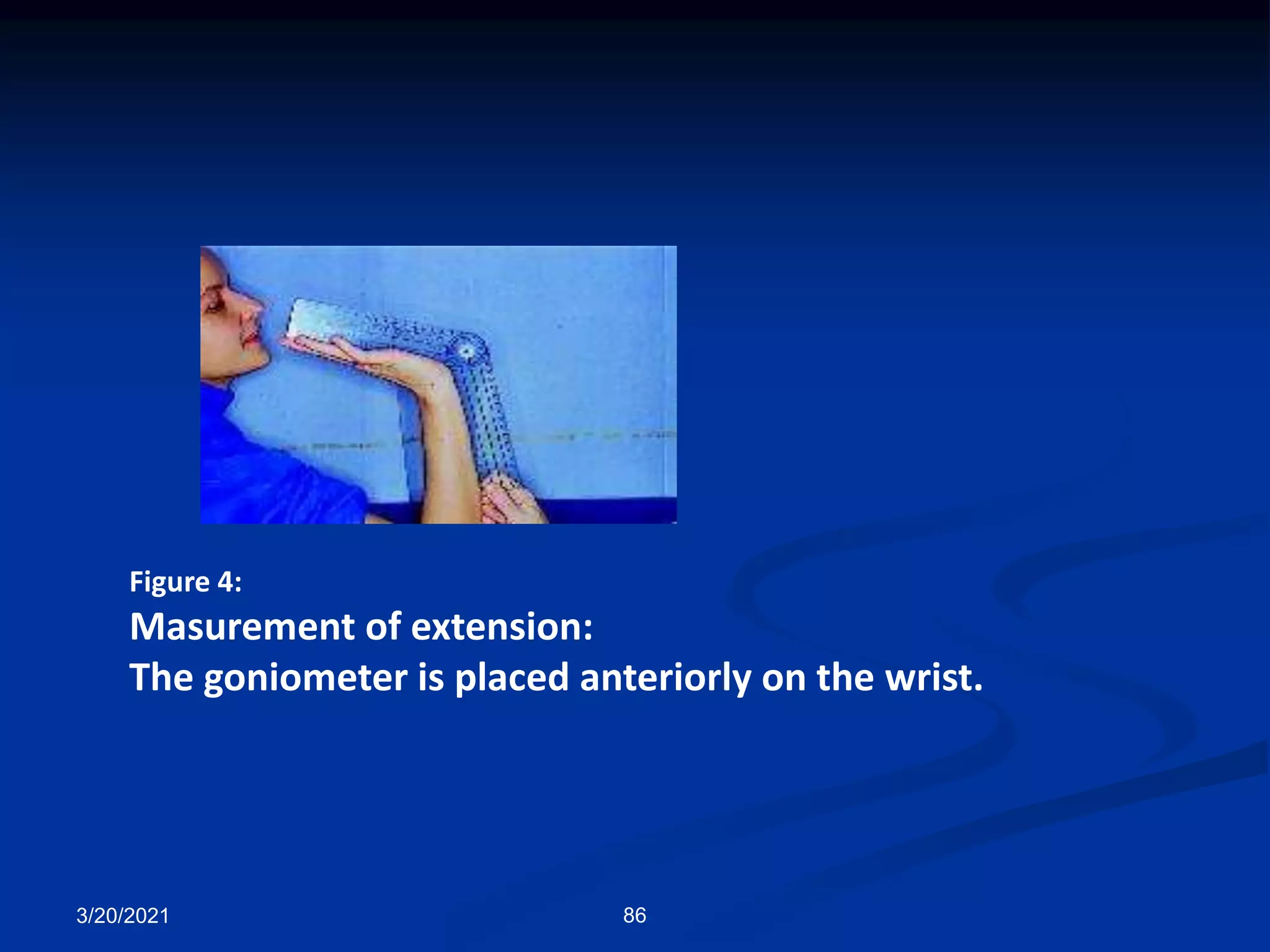
 Flexion-extension mobility is measured by placing the
goniometer on the palm for wrist extension, and along
the dorsum of the hand for wrist flexion, over the axis of
the third metacarpal bone (figure 3 & 4).
 Normal values vary among individuals and may reach 85° of
flexion or extension.
 Both inclinations are measured with one arm of the
goniometer along the axis of the forearm, and the other
along the axis of the third metacarpal, with the wrist in
the neutral position of flexion or extension. These
methods are simple and reproducible.
 Ulnar inclination varies between 30 and 45°,
 Radial inclination, between 15 and 25°.
3/20/2021 86
Figure 4:
Masurement of extension:
The goniometer is placed anteriorly on the wrist.
Measurement of strength
 This should be done with a Jamar dynamometer, which is
considered an international reference.
 Measurements should be done, either using each of the five
handle positions, which is time-consuming, or using only one
handle position, with three successive measurements.
 There are no standard values, and the contralateral hand
serves as reference.
 The mean of three different measurements with maximum
muscular contraction is noted.
 Usually, the curve for a single handle position is horizontal
or slightly descending. Rapid alternating measurements
changing from one hand to the other prevent patients from
controlling their contraction and may reveal the absence of
maximum contraction.
3/20/2021 88
RANGE OF MOTION
Fingers
 Flexion/extension at MCP, PIP, DIP
 Tight fist and open
 Do all fingers work in unison
 ABDuction/ADDuction at MCP
 Spread fingers apart and then back together
IUMS
CLINICAL EXAMINATION OF
THE WRIST
The normal wrist :
 The key to correct examination of the wrist is
precise location of the symptoms relating to the
underlying anatomical structures, i.e., bones,
articular spaces, ligaments or tendons.
 As in all clinical examinations, the most painful
area is examined last.
 Comparative wrist examination is the rule, as
there are no criteria of normality
3/20/2021 90
PALPATION of Skin
 Warmth?
 Dryness?
 Anhydrosis= nerve damage
 Scars
IUMS
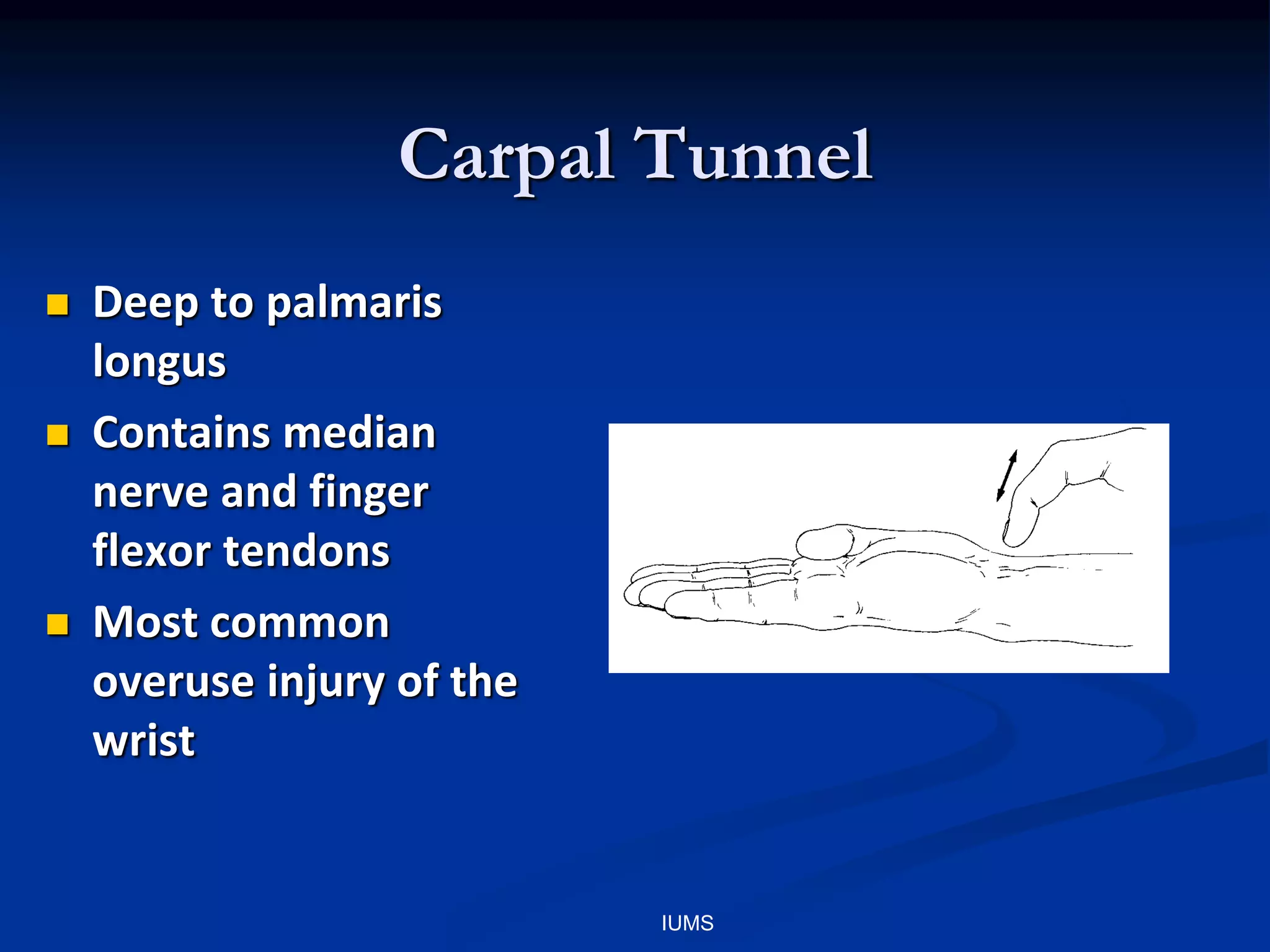
Carpal Tunnel
 Deep to palmaris
longus
 Contains median
nerve and finger
flexor tendons
 Most common
overuse injury of the
wrist
IUMS
Carpal Tunnel Syndrome
 Entrapment of the median nerve
 Phalen’s and Tinel’s Test
 2 point discrimination
 Symptoms
 Aching in hand and arm
 Nocturnal or AM paresthesias
 “Shaking” to obtain relief
IUMS
Carpal Tunnel Tests
 Neurologic exam
 Median nerve sensation
and motor
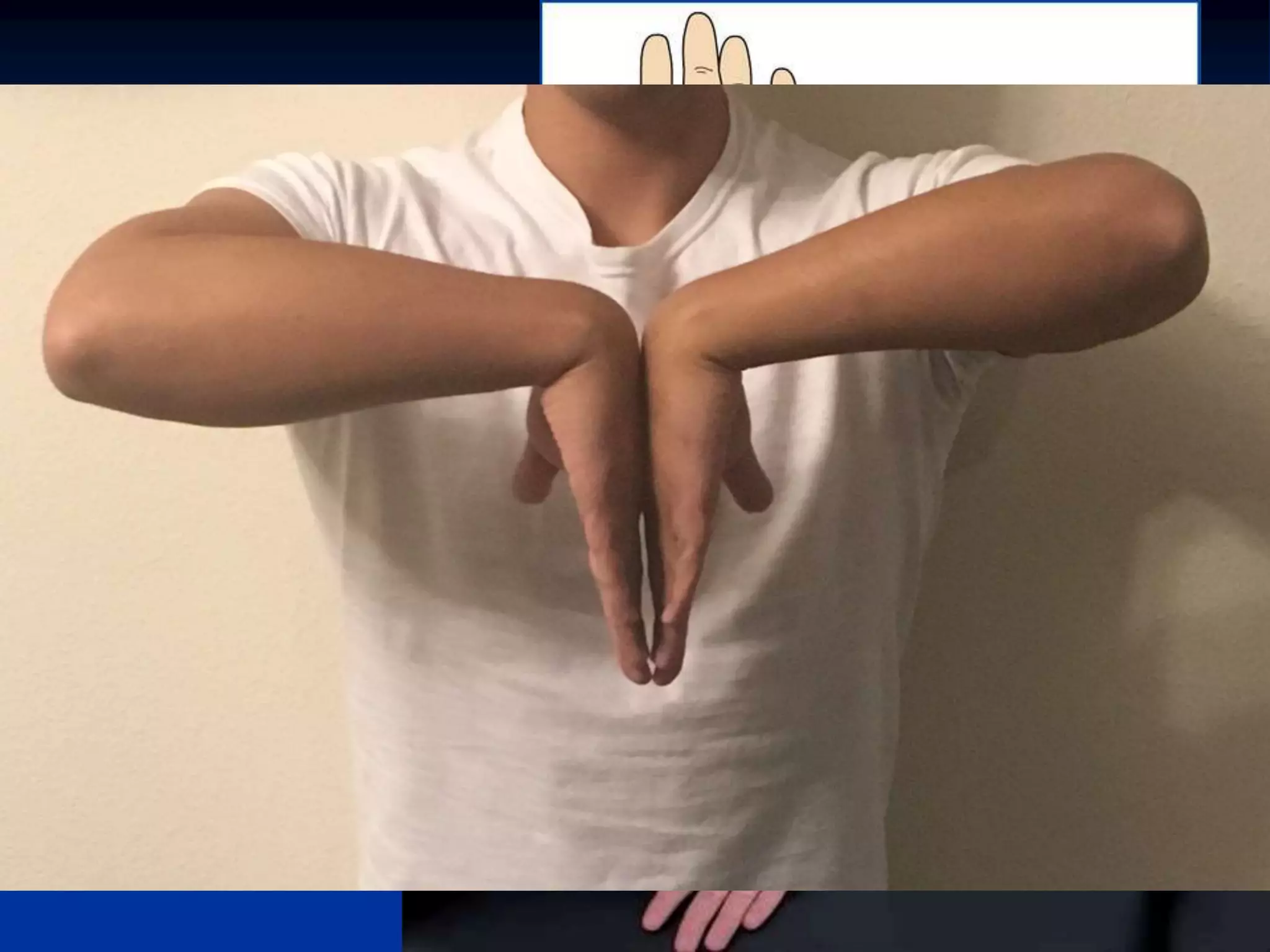
 Phalen’s Test:
both wrists maximally
flexed for 1 minute
 Tinel’s Test
IUMS
PALPATION
Palm of Hand
 Thenar Eminence
 3 muscles of thumb
 Atrophy seen in carpal tunnel syndrome
 Hypothenar Eminance
 3 muscles of little finger
 Atrophy with ulnar nerve compression
 Palmar Aponeurosis
 Dupuytren’s Contracture
IUMS
PALPATION of Fingers
 Finger Flexor Tendons
 Trigger Finger- sudden audible snapping
with movement of one of the fingers
 Extensor Tendons
 Tufts of Fingers
 Felon- local infection
 Paronychia- hangnail infection
IUMS
SPECIAL TESTS
Long Finger Flexor Test
 Flexor Digitorum Superficialis Test
 Flex finger at PIP
 The only functioning tendon at the PIP
 Flexor Digitorum Profundus Test
 Flex at DIP
 Inability to flex= tendon cut or denervated
IUMS
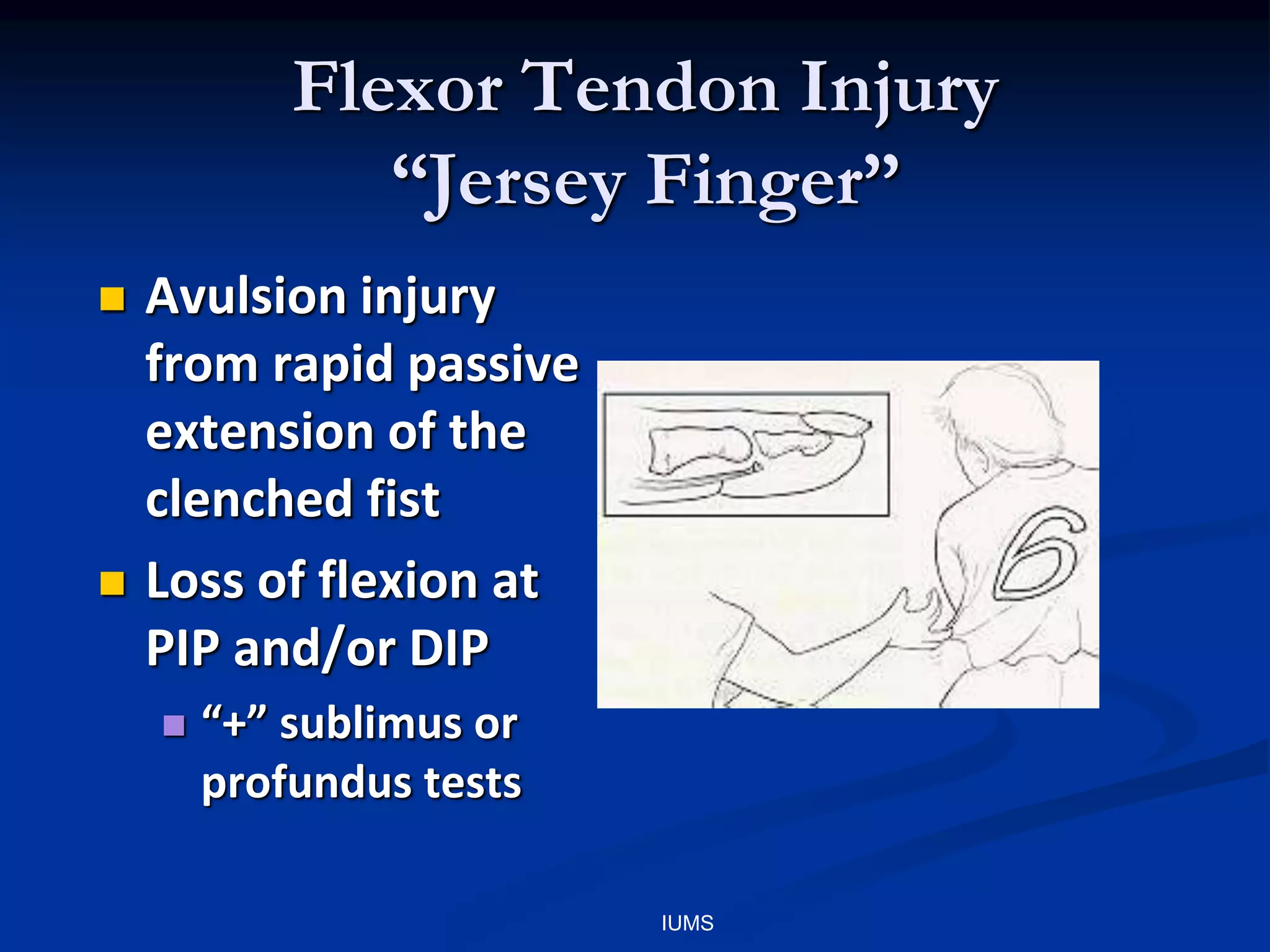
Flexor Tendon Injury
“Jersey Finger”
 Avulsion injury
from rapid passive
extension of the
clenched fist
 Loss of flexion at
PIP and/or DIP
 “+” sublimus or
profundus tests
IUMS
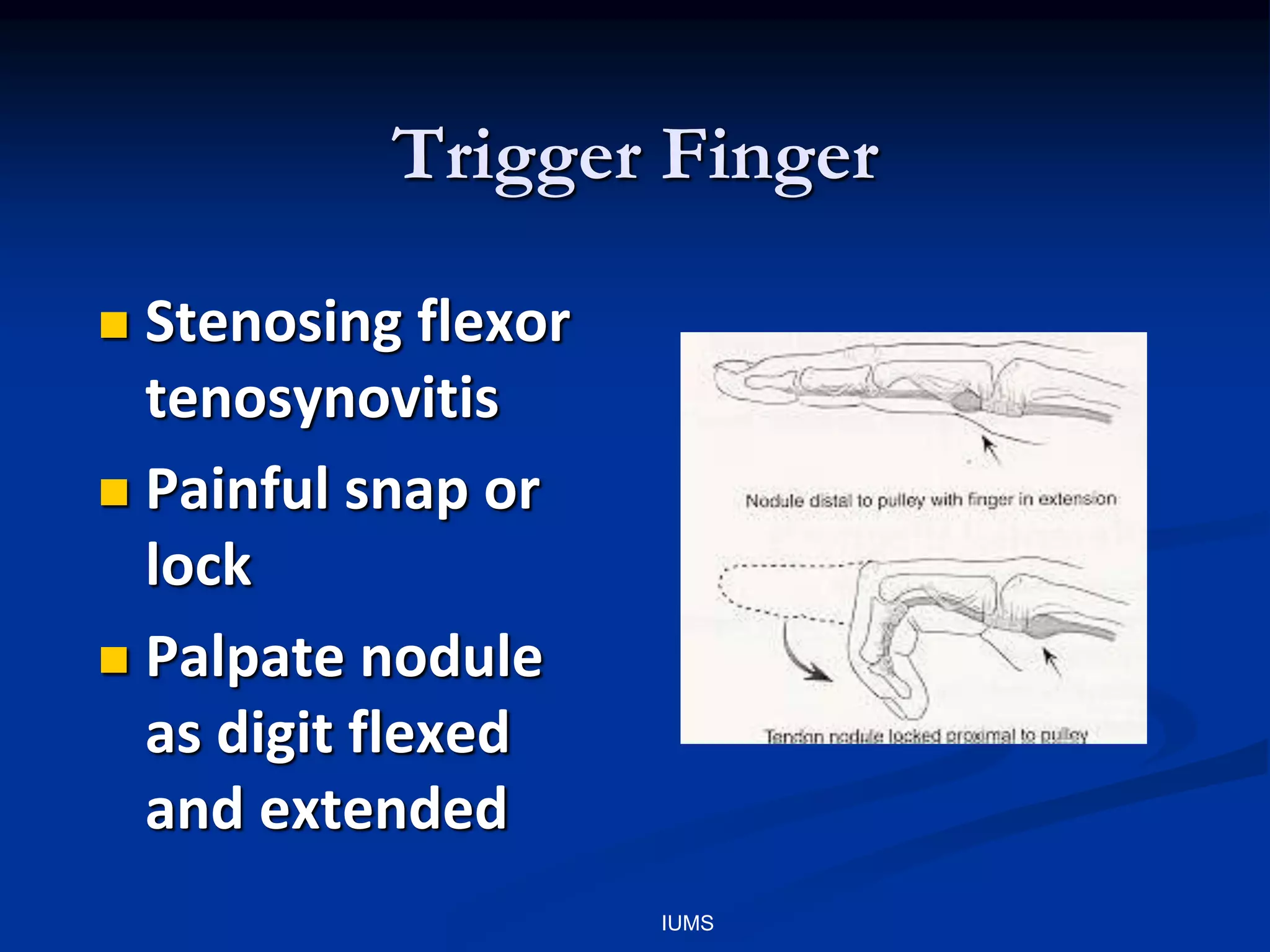
Trigger Finger
 Stenosing flexor
tenosynovitis
 Painful snap or
lock
 Palpate nodule
as digit flexed
and extended
IUMS
Flexor Tenosynovitis
 Tendon sheath infection
 Usually due to a puncture wound
 Bacterial skin flora
 Relative surgical emergency
IUMS
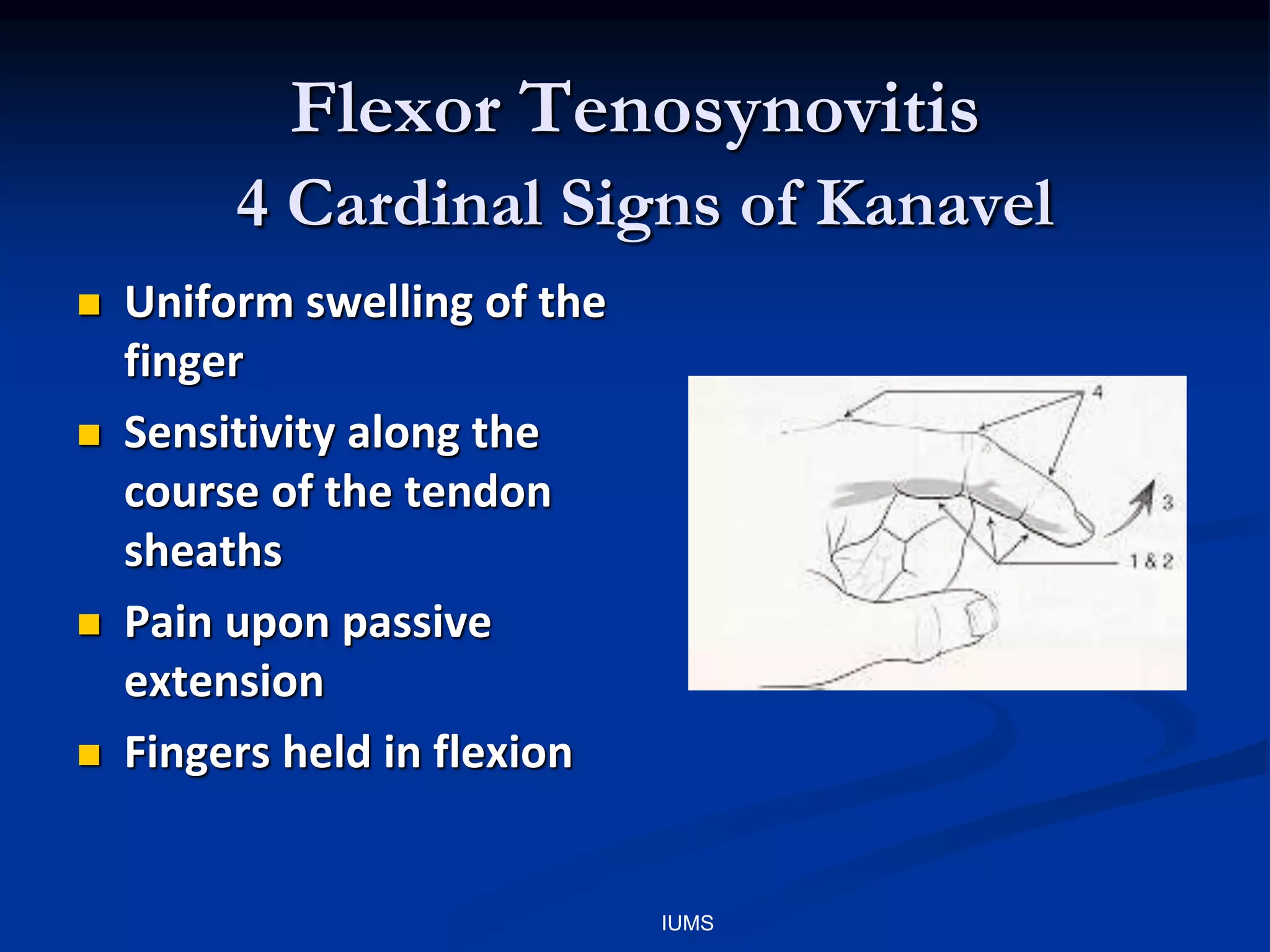
Flexor Tenosynovitis
4 Cardinal Signs of Kanavel
 Uniform swelling of the
finger
 Sensitivity along the
course of the tendon
sheaths
 Pain upon passive
extension
 Fingers held in flexion
IUMS
RANGE OF MOTION
Thumb
 Thumb flexion/extension at MCP and IP
 Touch pad at base of little finger
 Thumb ABD/ADD at carpometacarpal joint
 Opposition
 Touch tip of thumb to tip of each finger
IUMS
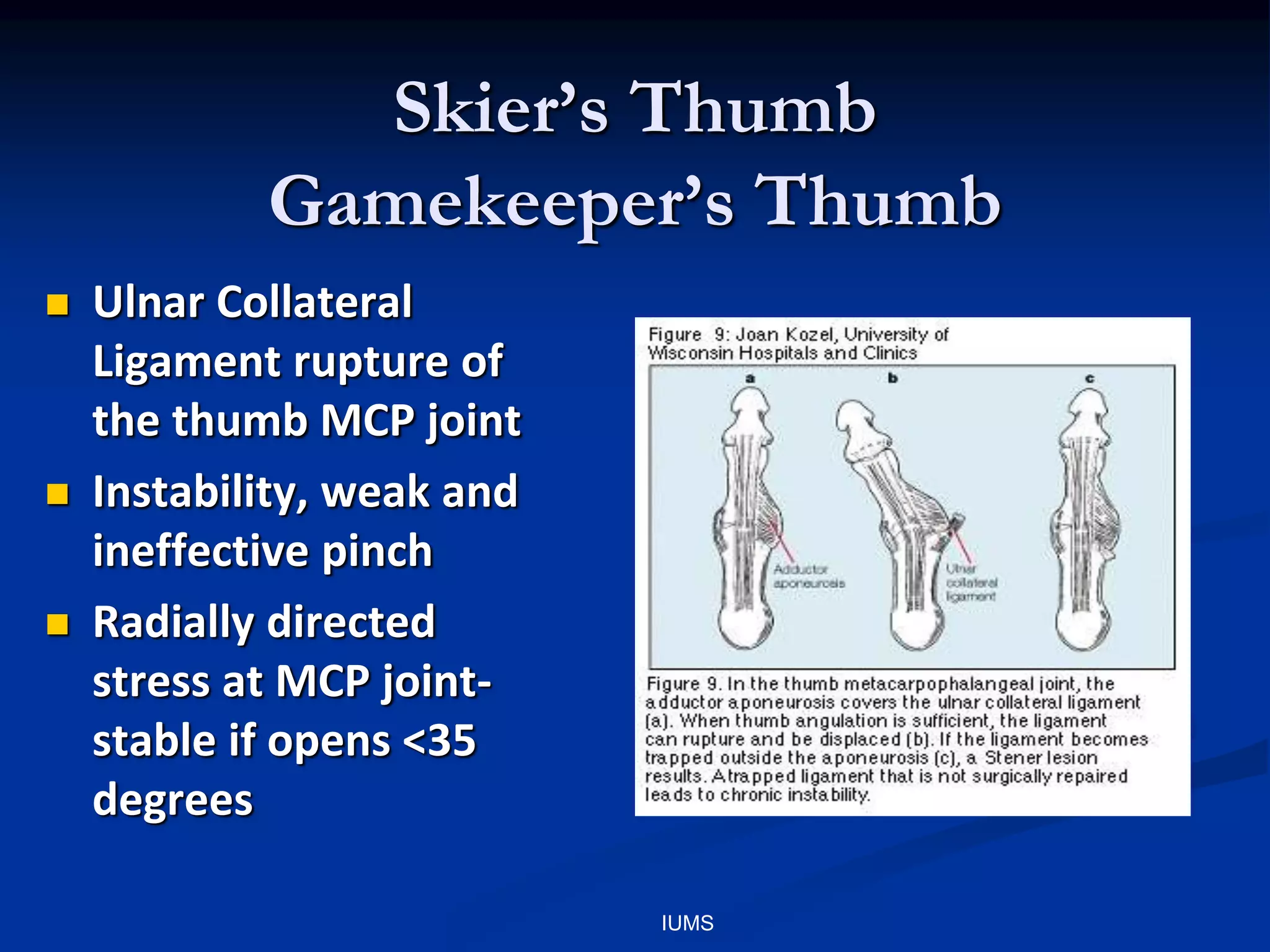
Skier’s Thumb
Gamekeeper’s Thumb
 Ulnar Collateral
Ligament rupture of
the thumb MCP joint
 Instability, weak and
ineffective pinch
 Radially directed
stress at MCP joint-
stable if opens <35
degrees
IUMS
NEUROLOGIC EXAM
 Muscular assessment using grading system
 Sensation testing
 Bilateral comparison
IUMS
NEUROLOGIC EXAM
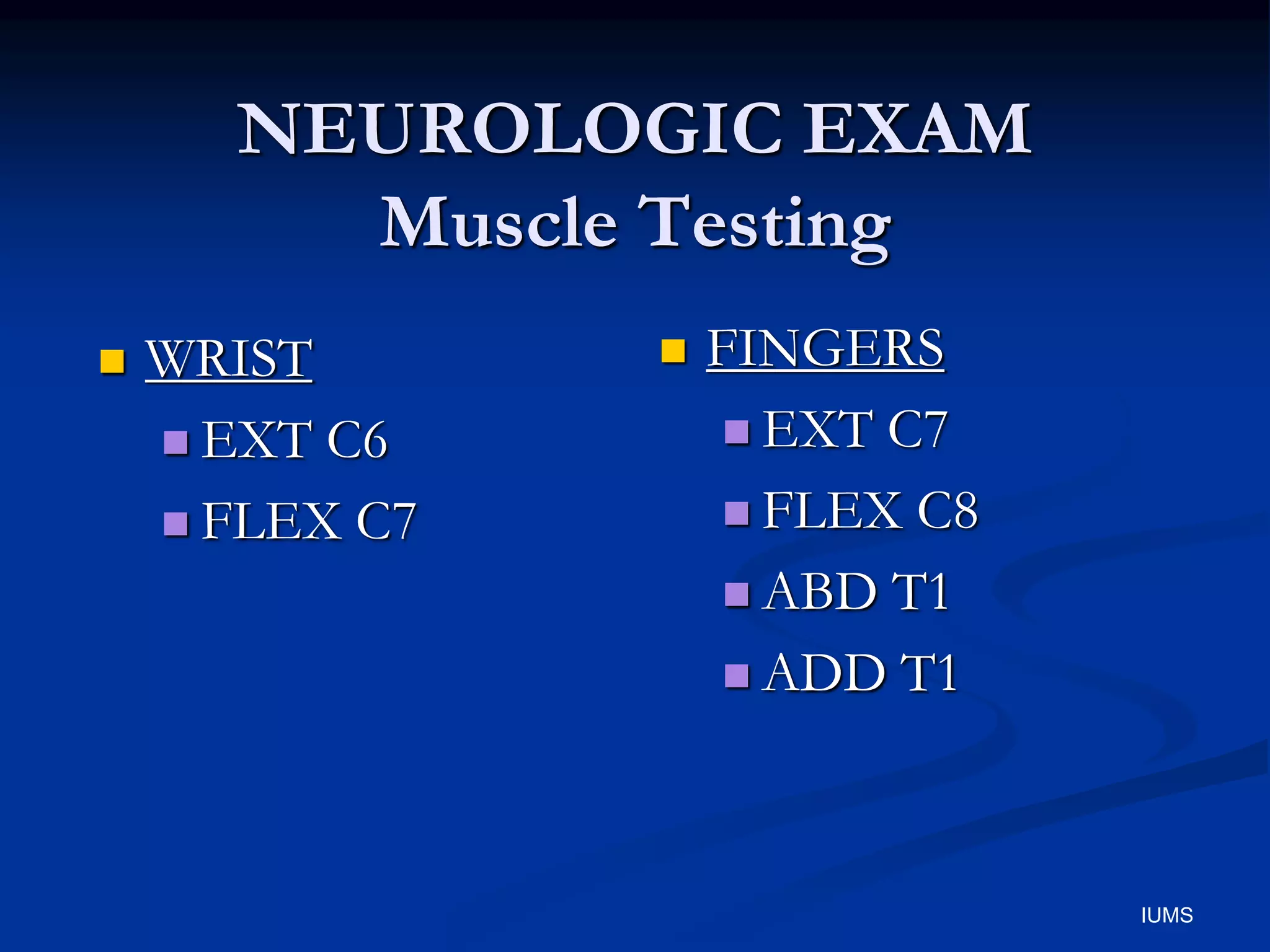
Muscle Testing
 WRIST
 EXT C6
 FLEX C7
 FINGERS
 EXT C7
 FLEX C8
 ABD T1
 ADD T1
IUMS
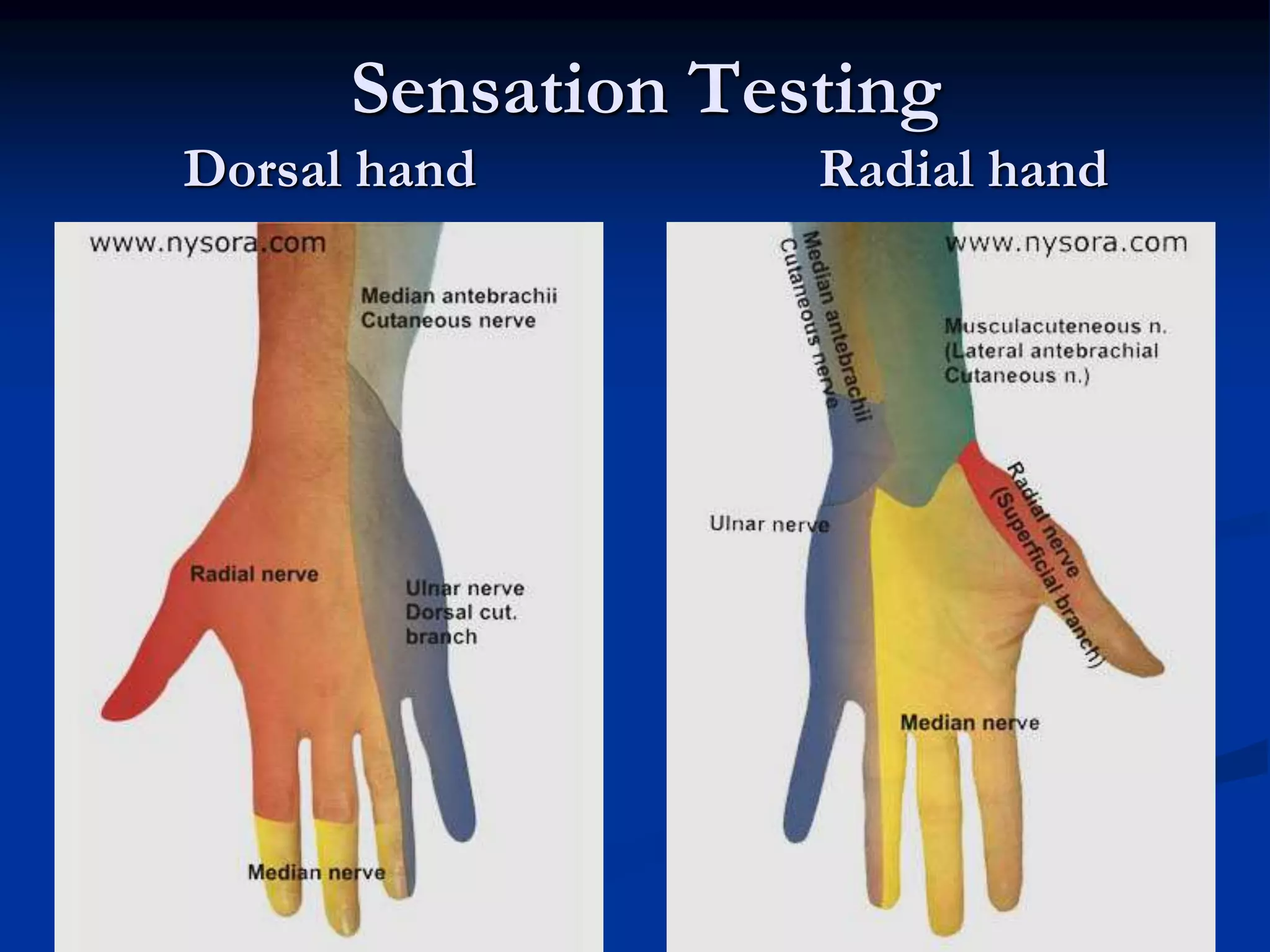
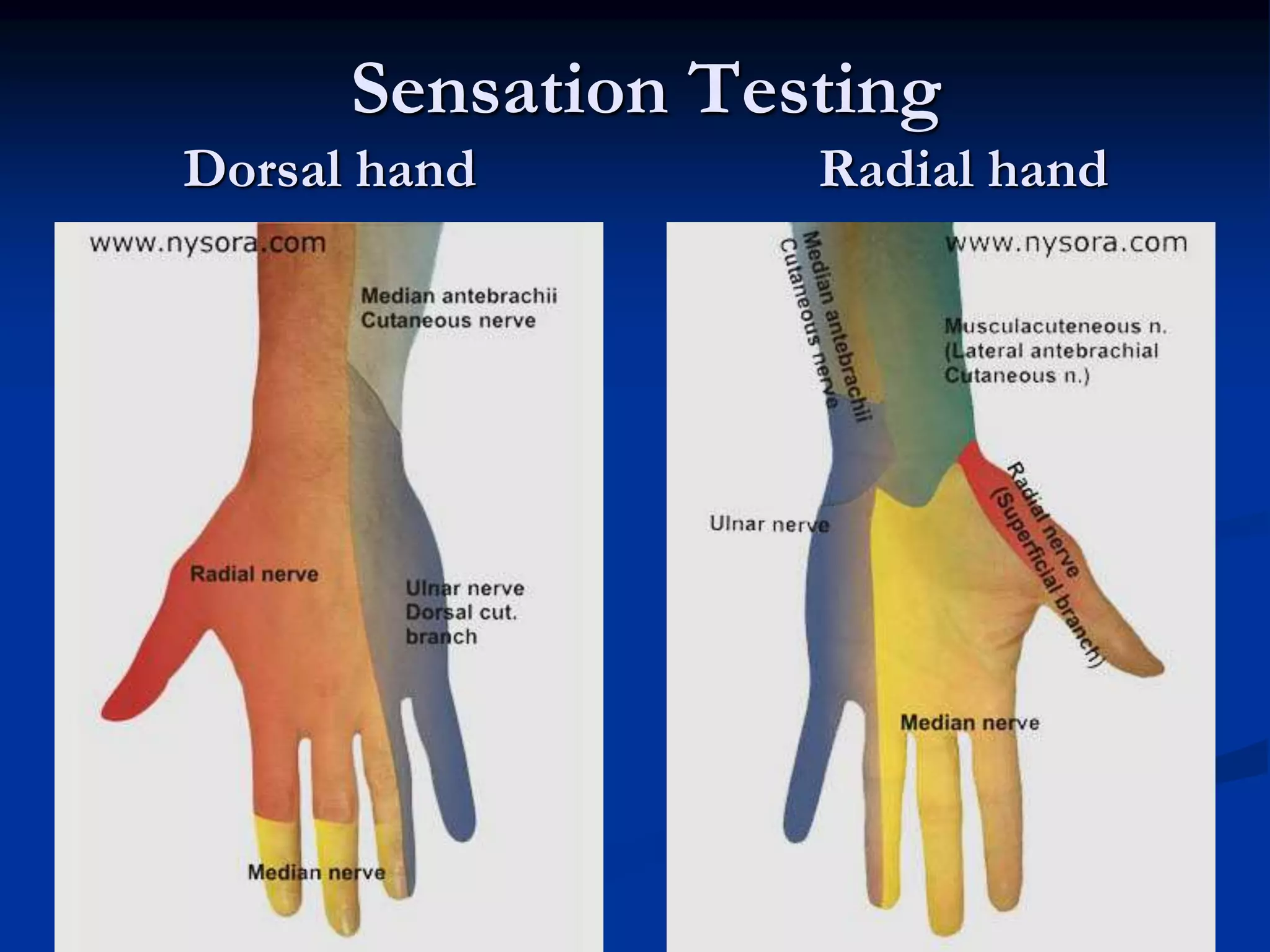
Sensation Testing
Dorsal hand Radial hand
Sensation Testing
Dorsal hand Radial hand
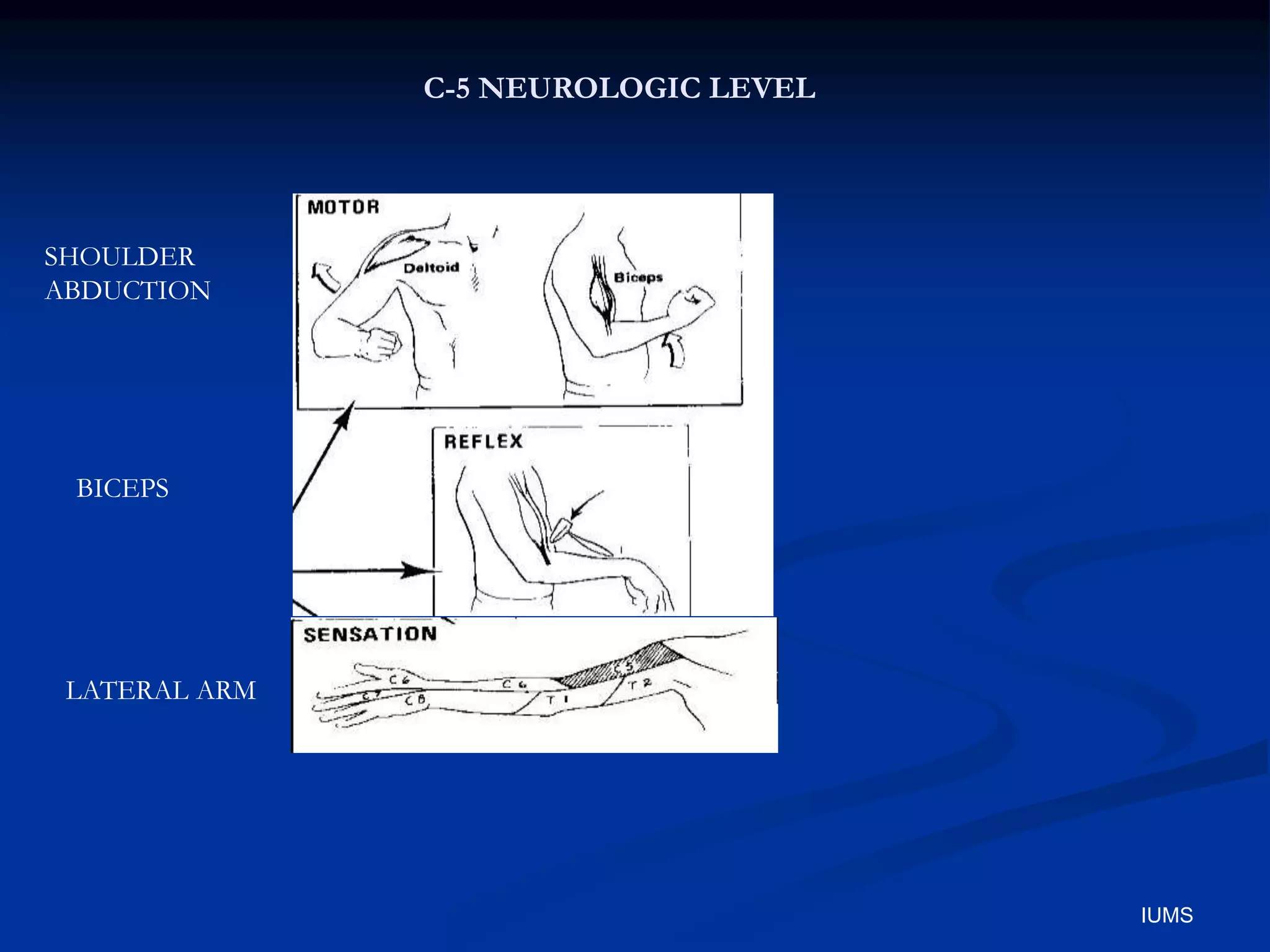
C-5 NEUROLOGIC LEVEL
SHOULDER
ABDUCTION
BICEPS
LATERAL ARM
IUMS
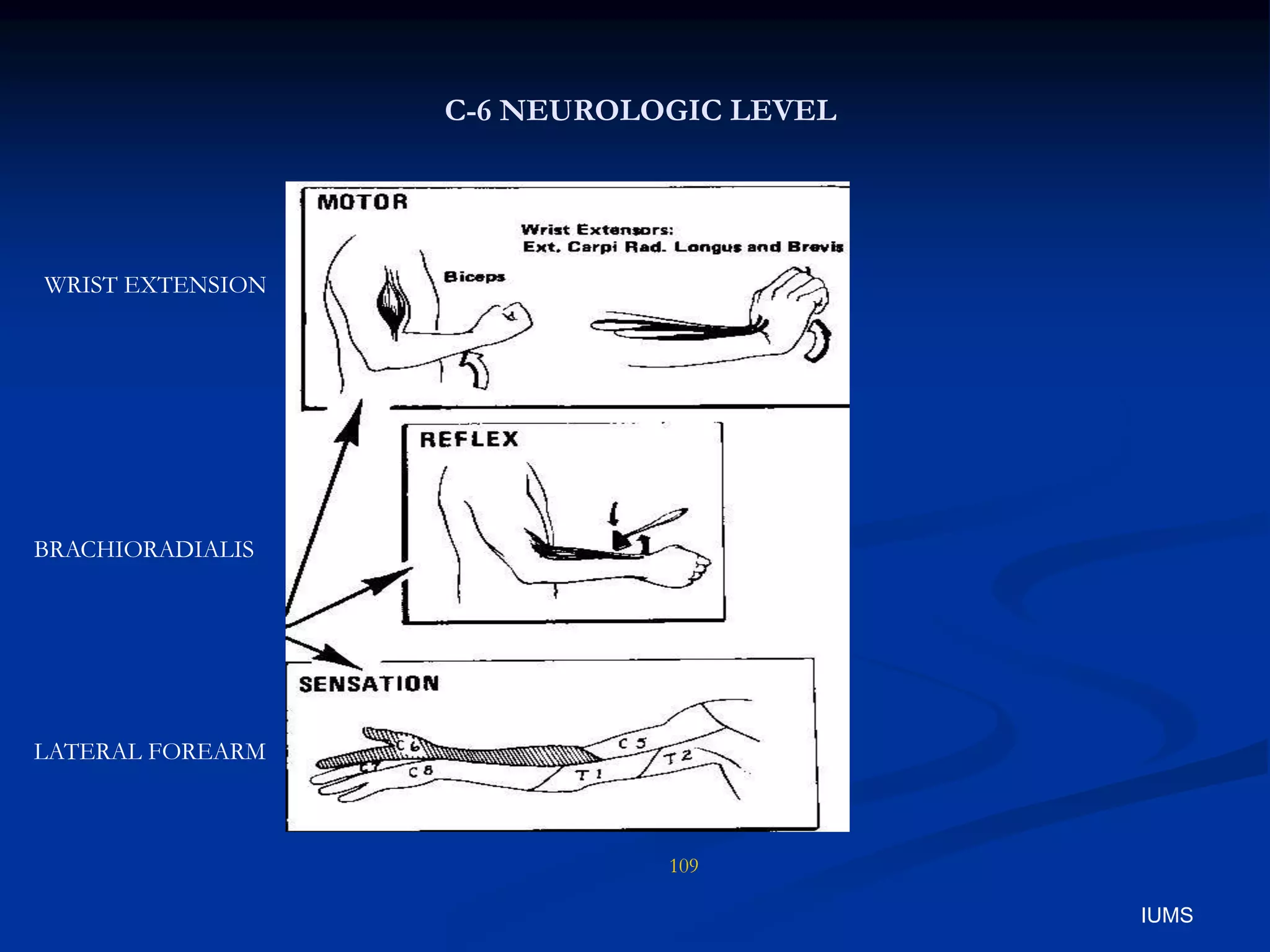
C-6 NEUROLOGIC LEVEL
WRIST EXTENSION
BRACHIORADIALIS
LATERAL FOREARM
109
IUMS
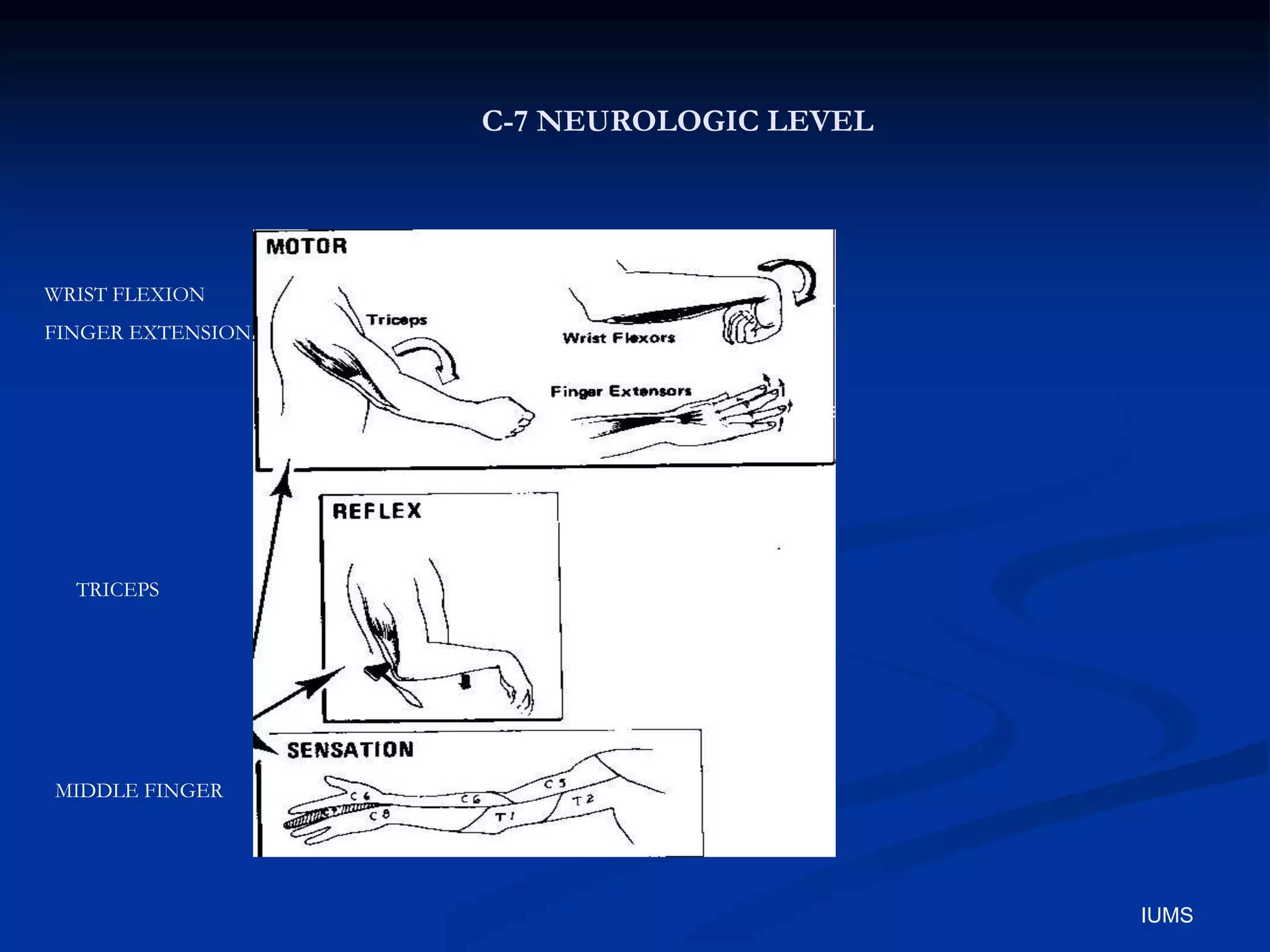
C-7 NEUROLOGIC LEVEL
WRIST FLEXION
FINGER EXTENSION
TRICEPS
MIDDLE FINGER
IUMS
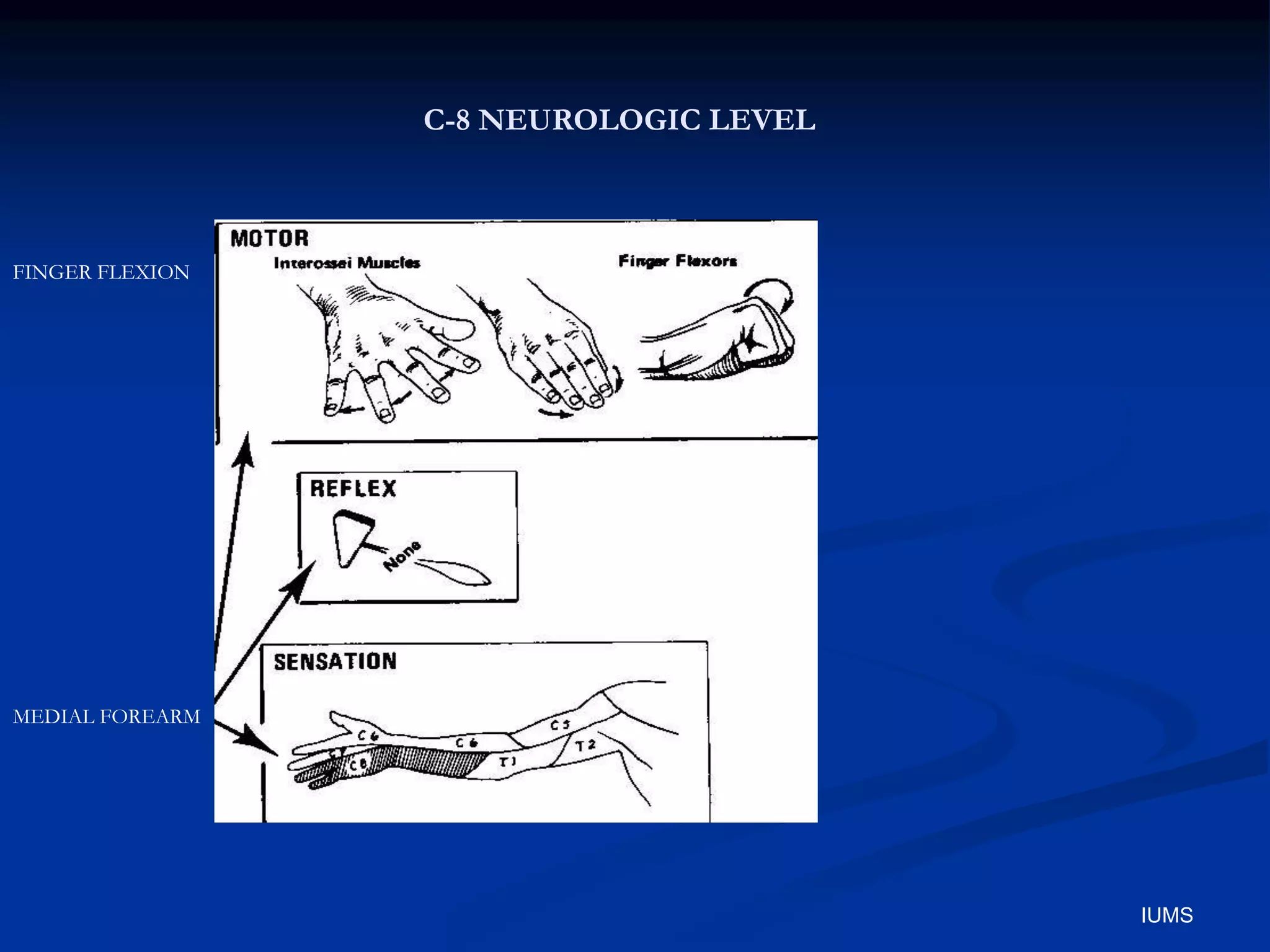
C-8 NEUROLOGIC LEVEL
FINGER FLEXION
MEDIAL FOREARM
IUMS
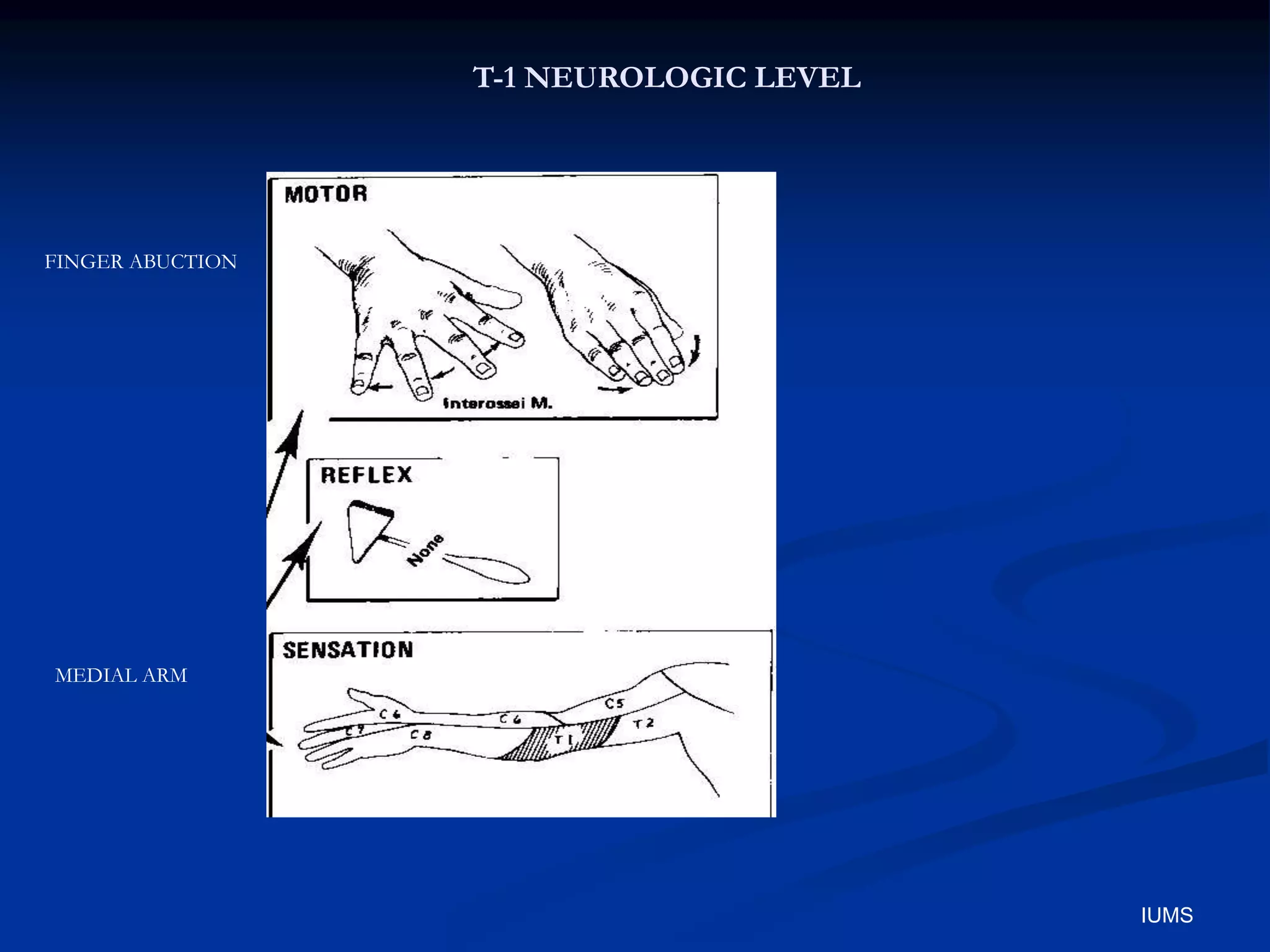
T-1 NEUROLOGIC LEVEL
FINGER ABUCTION
MEDIAL ARM
IUMS
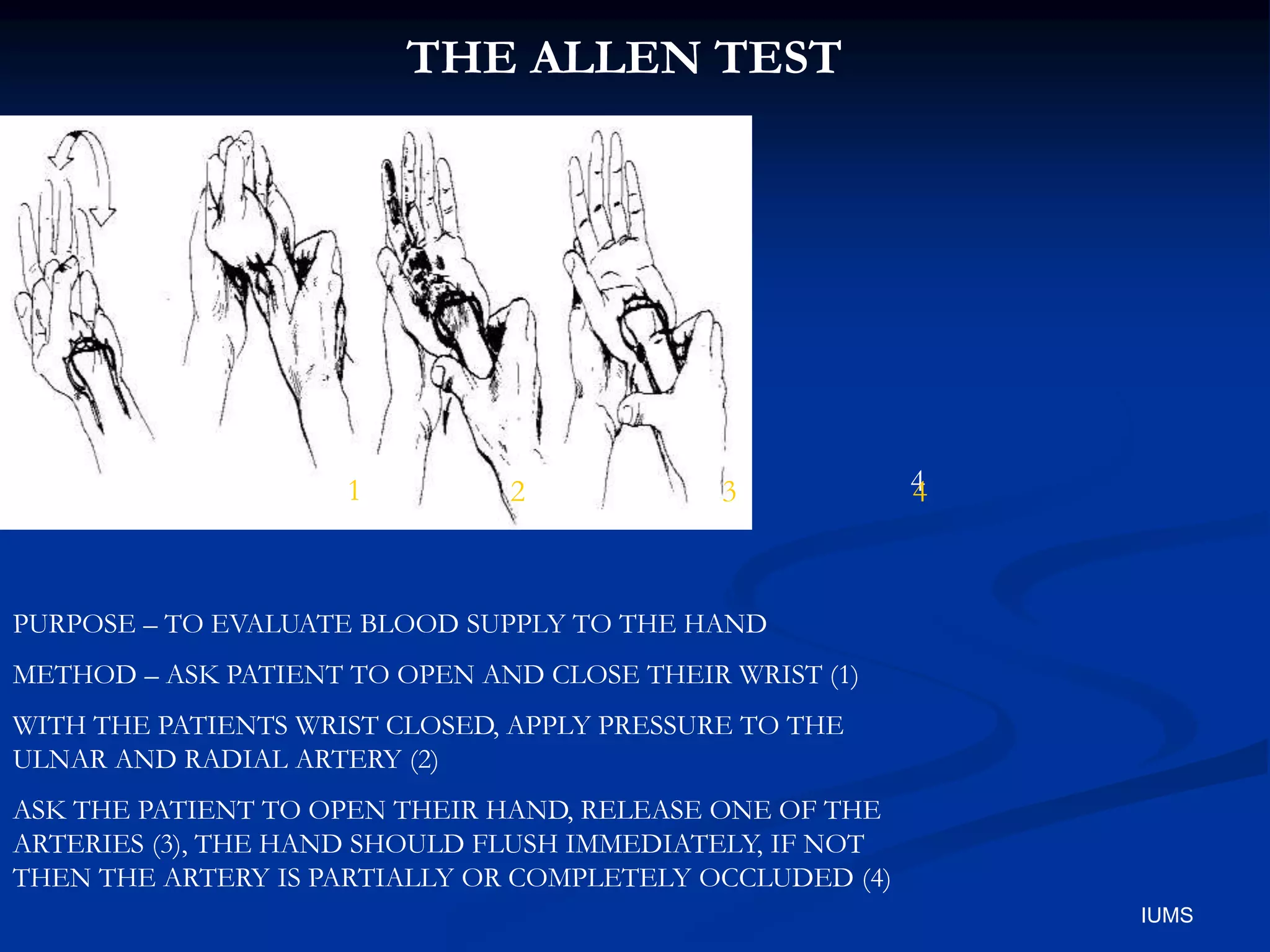
THE ALLEN TEST
PURPOSE – TO EVALUATE BLOOD SUPPLY TO THE HAND
METHOD – ASK PATIENT TO OPEN AND CLOSE THEIR WRIST (1)
WITH THE PATIENTS WRIST CLOSED, APPLY PRESSURE TO THE
ULNAR AND RADIAL ARTERY (2)
ASK THE PATIENT TO OPEN THEIR HAND, RELEASE ONE OF THE
ARTERIES (3), THE HAND SHOULD FLUSH IMMEDIATELY, IF NOT
THEN THE ARTERY IS PARTIALLY OR COMPLETELY OCCLUDED (4)
1 2 3 4
4
IUMS
RADIOLOGIC STUDIES
 AP and Lateral of hand
and wrist
 Consider Obliques and
special views if fracture
suspected but not seen
on AP and Lateral
IUMS
EXAMINATION OF RELATED
AREAS
 Referred pain can be due
to:
 Herniated cervical discs
 Osteoarthritis
 Brachial plexus outlet
syndrome
 Elbow and shoulder
entrapment syndrome
IUMS
Scapholunate instability:
 The mechanism of scapholunate injury includes a fall onto a hyperextended wrist with the
forearm in pronation and the impact point on the thenar eminence .
 Radial pain and progressive loss of strength are usual . Loss of mobility appears much later.
Patients may sometimes complain of a snapping wrist which usually occurs during the
passage from radial deviation to neutral with the wrist in flexion.
 In ulnar deviation, the snap represents the action of the scaphoid on the lunate bone and
the sudden correction of the proximal carpal row into dorsiflexion.
 With wrist flexion, a snap may represent penetration of the capitate into the scapholunate
interval (rare), or the dorsal subluxation of the scaphoid on the posterior margin of the
radius .
3/20/2021 135
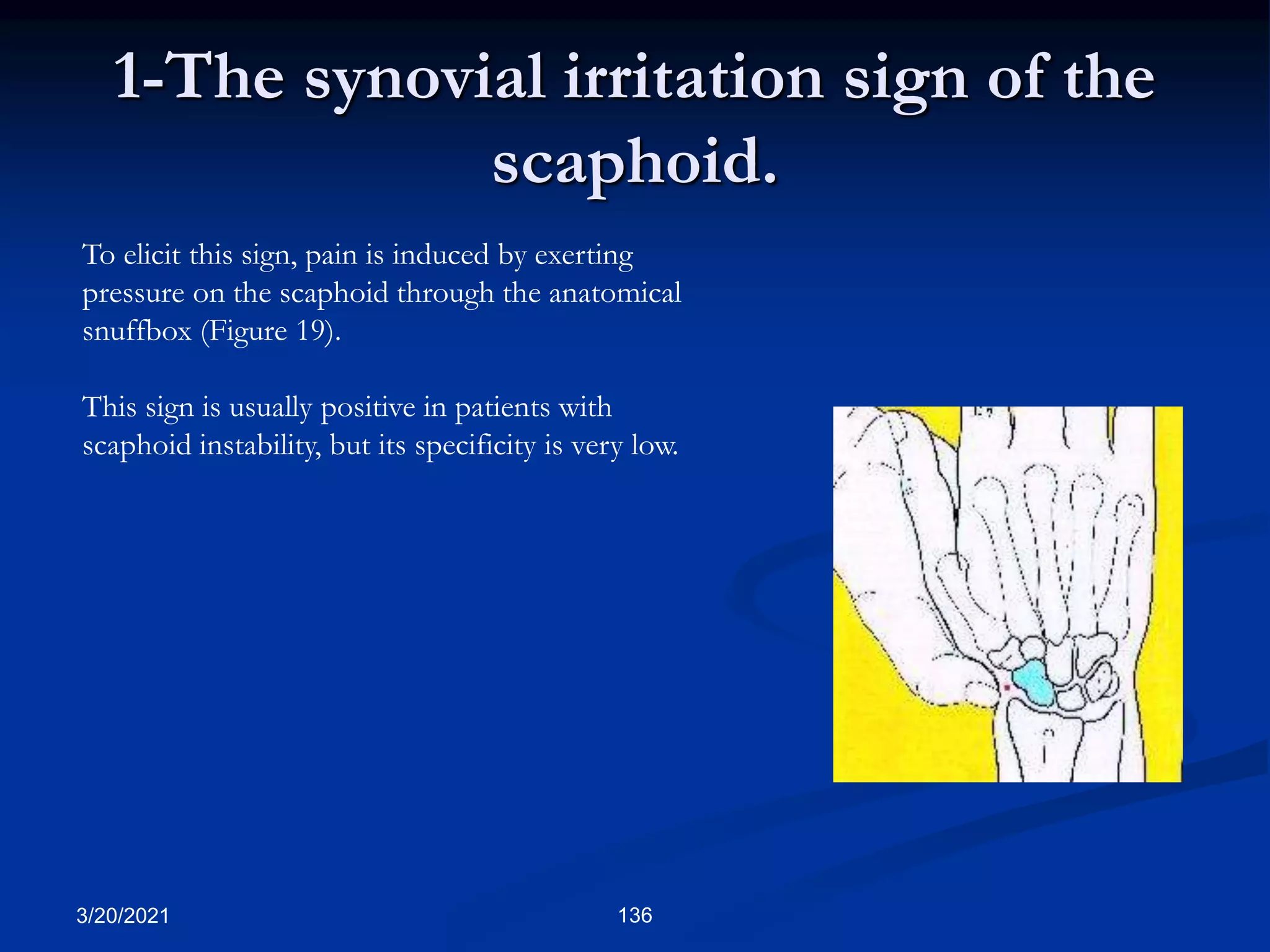
1-The synovial irritation sign of the
scaphoid.
To elicit this sign, pain is induced by exerting
pressure on the scaphoid through the anatomical
snuffbox (Figure 19).
This sign is usually positive in patients with
scaphoid instability, but its specificity is very low.
3/20/2021 136
(2) The scaphoid bell sign.
 This is performed by palpation of the scaphoid tuberosity anteriorly
through the radial groove while placing the index finger in the
anatomical snuffbox.
 With ulnar deviation of the wrist, the anterior protrusion of the distal
scaphoid tuberosity disappears and the proximal pole appears in the
snuffbox.
 With radial deviation, the proximal pole disappears in the snuffbox and
the protrusion of the distal scaphoid tuberosity reappears in the radial
groove.
 Any disruption of this normal mechanism is suggestive of instability,
but the sensitivity of this test seems very low .
3/20/2021 137
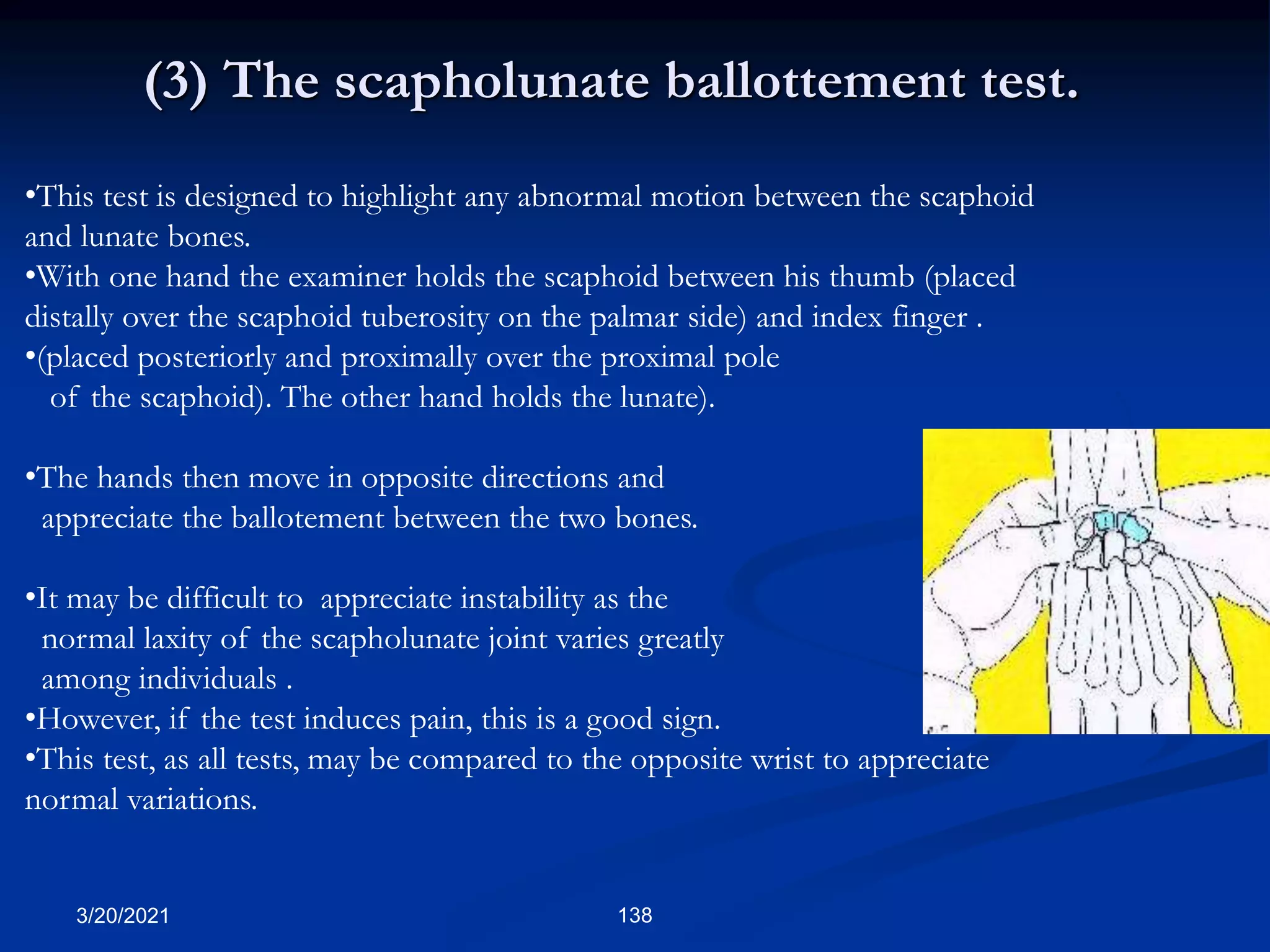
(3) The scapholunate ballottement test.
•This test is designed to highlight any abnormal motion between the scaphoid
and lunate bones.
•With one hand the examiner holds the scaphoid between his thumb (placed
distally over the scaphoid tuberosity on the palmar side) and index finger .
•(placed posteriorly and proximally over the proximal pole
of the scaphoid). The other hand holds the lunate).
•The hands then move in opposite directions and
appreciate the ballotement between the two bones.
•It may be difficult to appreciate instability as the
normal laxity of the scapholunate joint varies greatly
among individuals .
•However, if the test induces pain, this is a good sign.
•This test, as all tests, may be compared to the opposite wrist to appreciate
normal variations.
3/20/2021 138
3/20/2021 139
 Scapholunate ballottement is more marked when the wrist is in slight flexion,
and, in this position, dorsal protrusion of the second row is sometimes visible
.
 Flexing the wrist also brings the lunate more dorsal and distal to the dorsal
rim of the radius making it easier to palpate the lunate.
 Another technique to palpate the scapholunate interval is to place the index
finger on the dorsal and distal pole of the lunate and then move the index
finger radially while moving the wrist in flexion and extension.
 One can sometimes feel a groove corresponding to the scapholunate interval,
or more often a slight protrusion of the proximal pole of the scaphoid.
 The limitations of these tests are connected with the difficulty to hold the
lunate bone correctly.
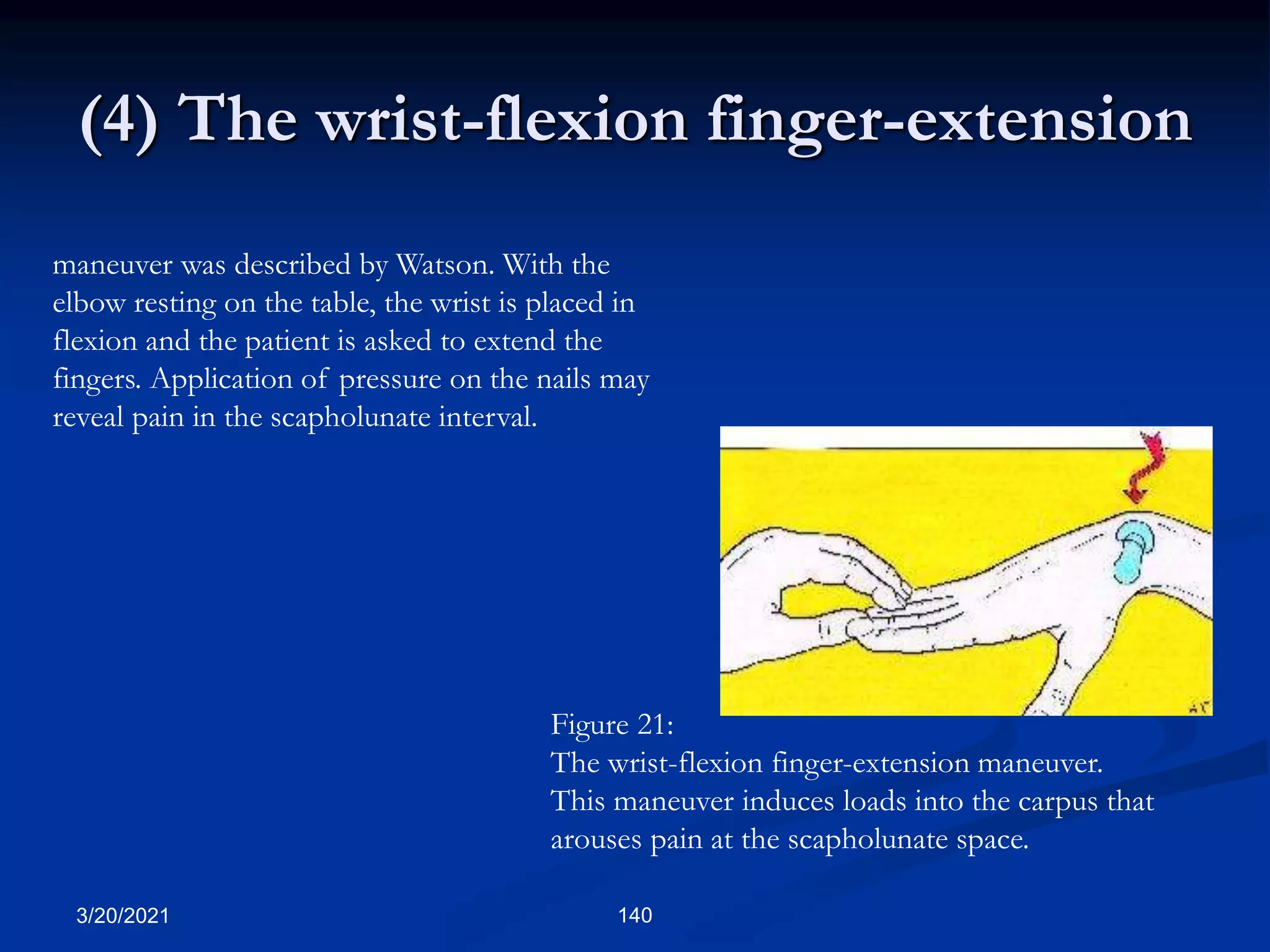
(4) The wrist-flexion finger-extension
maneuver was described by Watson. With the
elbow resting on the table, the wrist is placed in
flexion and the patient is asked to extend the
fingers. Application of pressure on the nails may
reveal pain in the scapholunate interval.
Figure 21:
The wrist-flexion finger-extension maneuver.
This maneuver induces loads into the carpus that
arouses pain at the scapholunate space.
3/20/2021 140
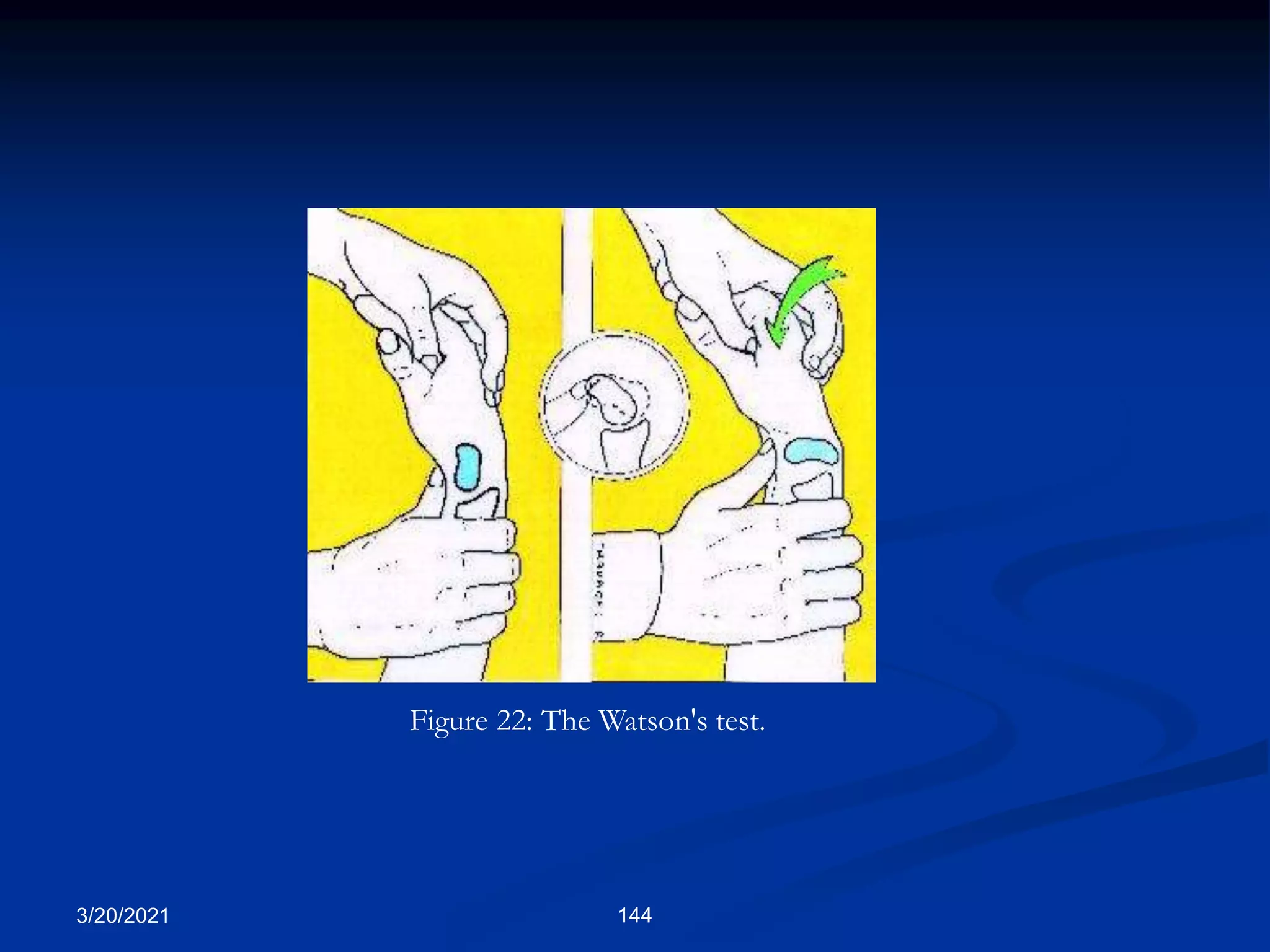
(5) Watson's test or the scaphoid
shear test
 The examiner and patient face each other as for arm wrestling.
 The examiner's fingers are placed dorsally on the distal radius,
while the thumb is placed on the palmar distal tuberosity of
the scaphoid.
 The other hand holds the metacarpals. Firm pressure is
applied to the palmar tuberosity of the scaphoid while the
wrist is moved in ulnar deviation which places the scaphoid in
extension.
 While the wrist is moved in radial deviation the scaphoid
cannot flex, as it is blocked from flexing by the examiner's
thumb.
3/20/2021 141
3/20/2021 142
 In case of scapholunate tear, or in lax wrist patients, the scaphoid will move
dorsally under the posterior margin of the radius and will reach the examiner's
index finger, thus inducing pain (Figure 22).
 Sometimes this test may only be painful, without any perception of dorsal
scaphoid displacement.
 When pressure on the scaphoid is removed, the scaphoid goes back into position
with what Watson described as a "thunk" (a clunk)
 In certain patients, the absence of normal mobility
compared to the uninjured wrist may be due to swelling
and/or synovitis.
 To avoid false-positive testing, the examiner should first
place his fingers on the posterior surface of the scaphoid to
detect spontaneous pain.
 Lane suggested modifying the Watson's test by moving the
scaphoid only from an anterior to a posterior position (he
called it the Scaphoid shift test).
 This modification would enhance the test's sensitivity by
using simple movements.
3/20/2021 143
Figure 22: The Watson's test.
3/20/2021 144
Lunotriquetral instability:
 Lunotriquetral instability may appear after a hyperpronation injury ,but
more often after a hyperextension injury with an impact on the ulnar
side.
 Ninety per cent of patients complain of ulnar pain, and lunotriquetral
joint palpation is usually painful .
 Active prono-supination movements against resistance are painful if
the resistance causes twisting of the carpus .
 A feeling of instability or loss of strength is present in rare cases. A
snap or clunk may be observed in half of the patients during ulnar
deviation or extension .
3/20/2021 145
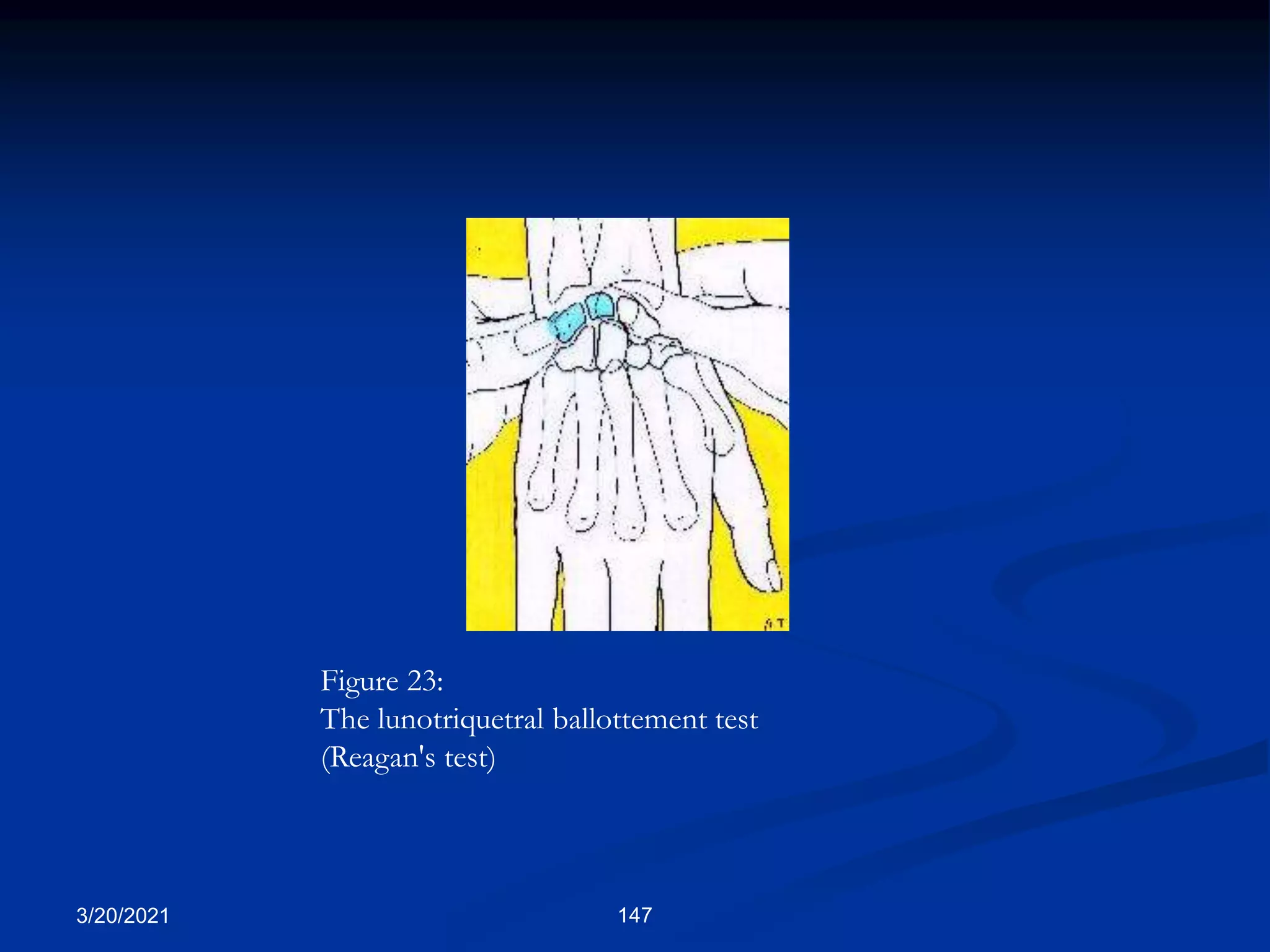
The lunotriquetral ballottement test or Reagan's test (also called
the Shuck or shear test, depending on the authors):
 as in the scapholunate ballottement test, the clinician holds the
lunate bone between his thumb and index finger with one hand,
and moves the triquetrum with the pisiform dorsal and palmar
(Figure 23). The aim is to appreciate instability (very difficult)
and above all the arousal of pain [30-32]. The sensitivity of this
test varies from 33 to 100%, depending on the authors, and its
specificity is still unknown.
3/20/2021 146
Figure 23:
The lunotriquetral ballottement test
(Reagan's test)
3/20/2021 147
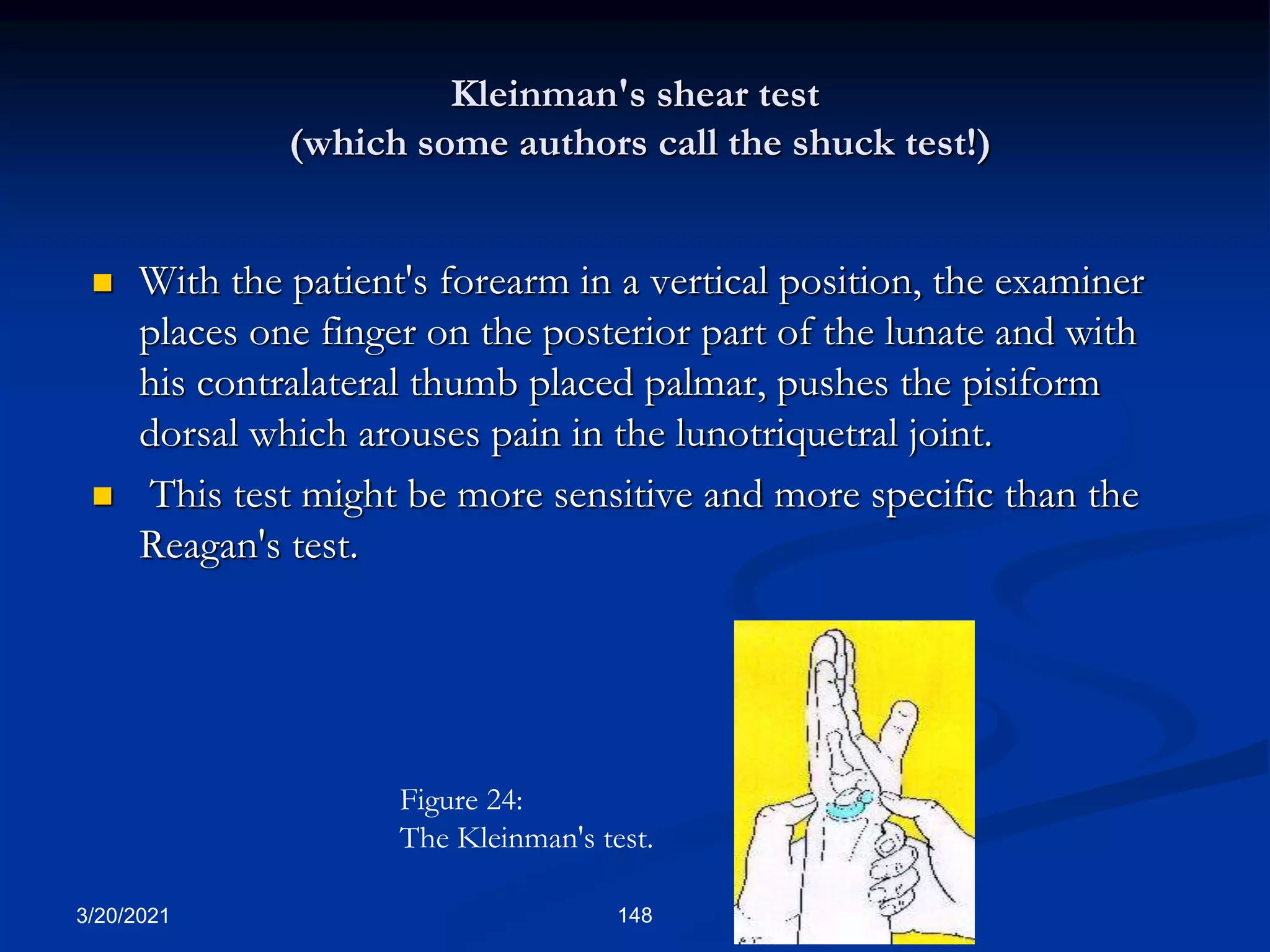
Kleinman's shear test
(which some authors call the shuck test!)
 With the patient's forearm in a vertical position, the examiner
places one finger on the posterior part of the lunate and with
his contralateral thumb placed palmar, pushes the pisiform
dorsal which arouses pain in the lunotriquetral joint.
 This test might be more sensitive and more specific than the
Reagan's test.
3/20/2021 148
Figure 24:
The Kleinman's test.
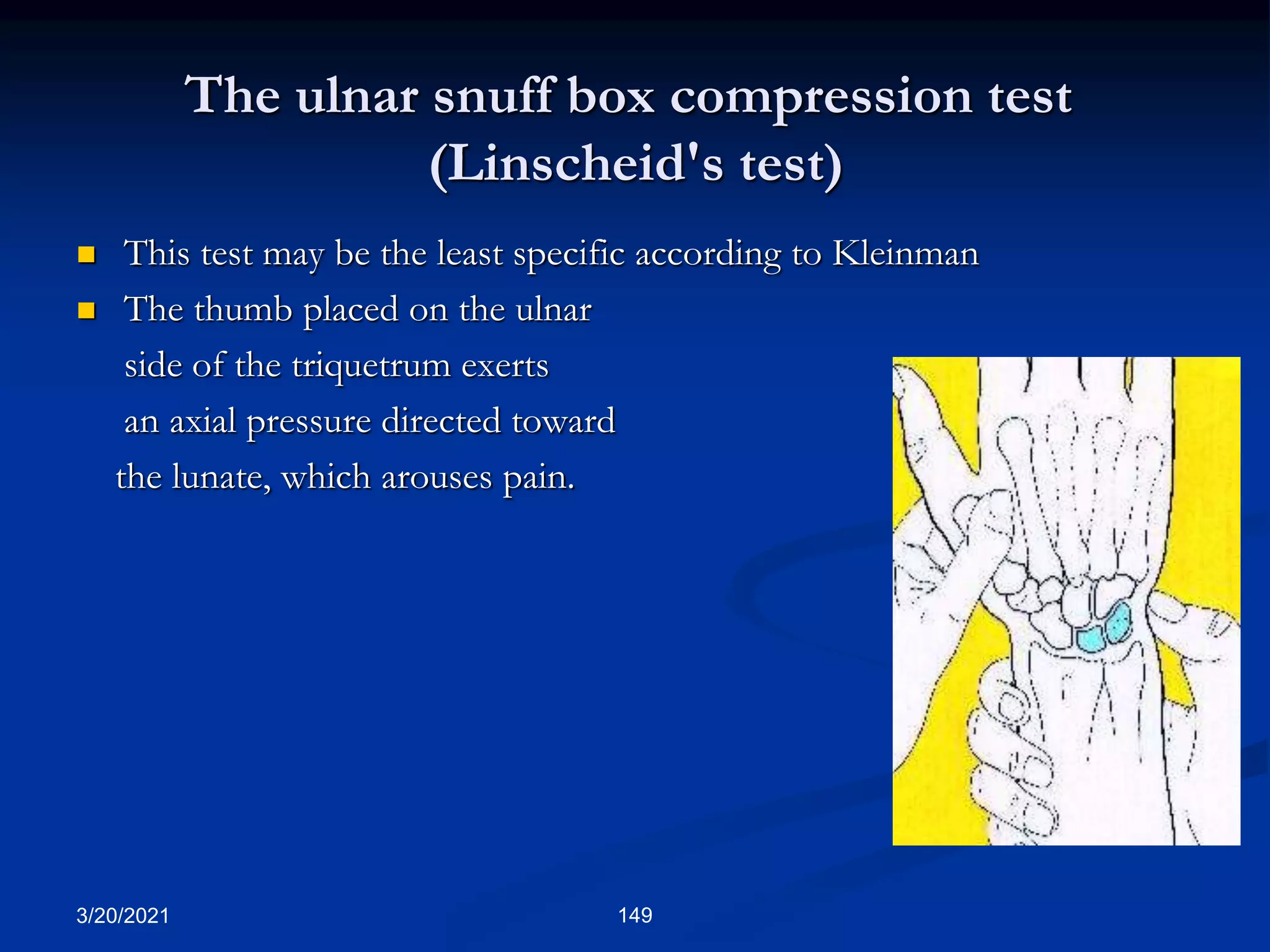
The ulnar snuff box compression test
(Linscheid's test)
 This test may be the least specific according to Kleinman
 The thumb placed on the ulnar
side of the triquetrum exerts
an axial pressure directed toward
the lunate, which arouses pain.
3/20/2021 149
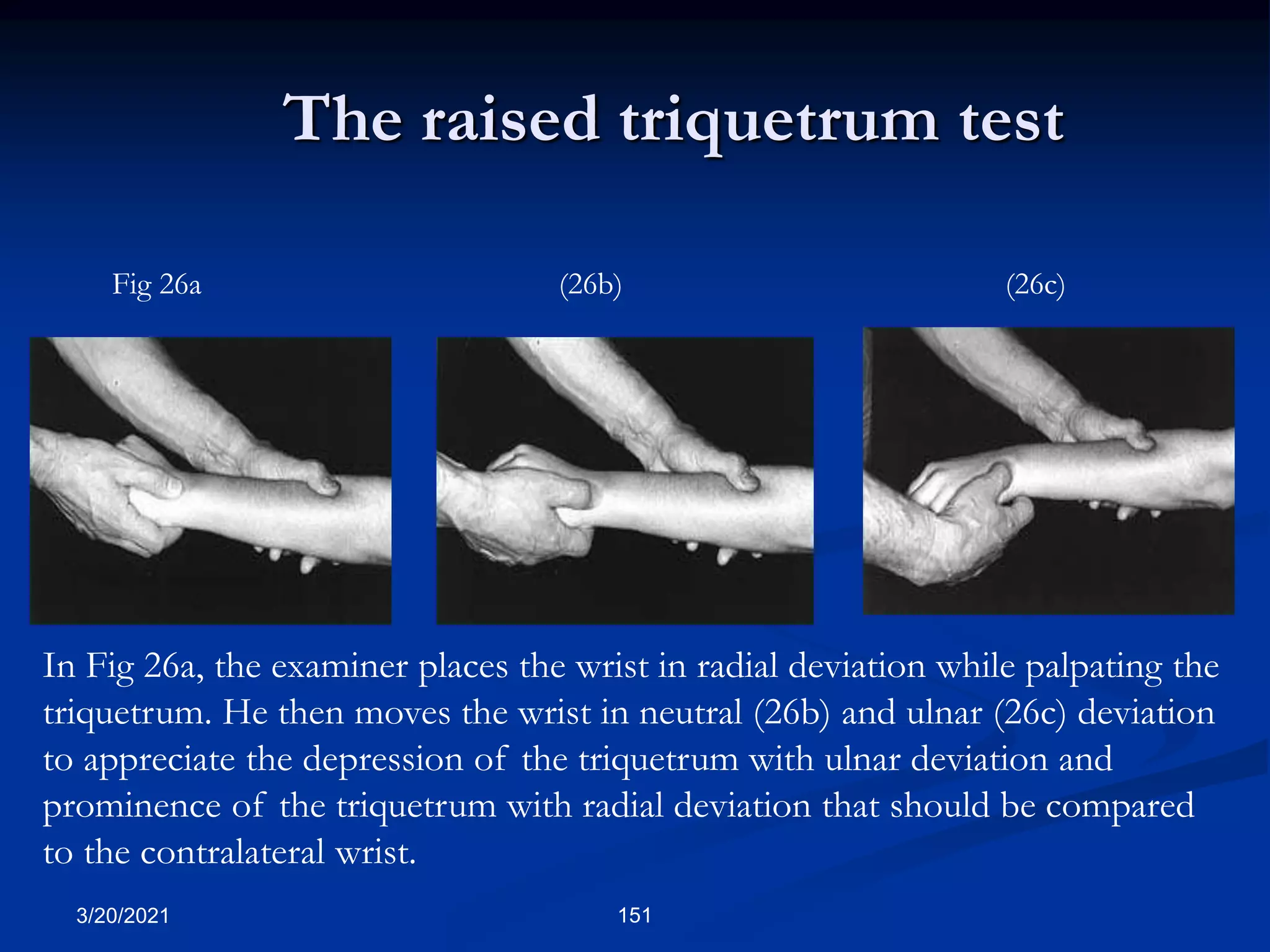
The raised triquetrum test
 was recently proposed by Zradkovic and Sennwald (personal communication).
 The examiner holds the patient's hand proximal to the wrist and places his thumb on
the triquetrum.
 From the neutral position, without flexion or extension, he performs radial and ulnar
deviation movements and appreciates the dorsal and palmar movements of the
triquetrum, which should be compared to those of the other wrist (Figures 26 a,b,c).
 The sensitivity and specificity of this test are still unknown, as are the anatomical
lesions which cause the test to be positive.
 As pointed out by Gilula, the triquetrum is very prominent or dorsal with radial
deviation, and moves palmarly and may even disapear with ulnar deviation.
 On plain radiographs, the triquetrum is located "onto" or proximal on the hamate with
radial deviation (superposed), and "lateral" or ulnar to it with ulnar deviation
(juxtaposed) [Laredo, personal communication].
3/20/2021 150
The raised triquetrum test
In Fig 26a, the examiner places the wrist in radial deviation while palpating the
triquetrum. He then moves the wrist in neutral (26b) and ulnar (26c) deviation
to appreciate the depression of the triquetrum with ulnar deviation and
prominence of the triquetrum with radial deviation that should be compared
to the contralateral wrist.
Fig 26a (26b) (26c)
3/20/2021 151
Distal radioulnar joint (DRUJ) instability :
 As the ulna is fixed, the radius is the dislocated bone, but we have kept the usual
convention which describes "dislocation of the ulna".
 A traumatic movement in supination is responsible for anterior DRUJ instability, while
posterior DRUJ instability follows a pronation injury.
 Dorsal ulnar dislocation is responsible for
 loss of supination and
 protrusion of the ulnar head.
 In case of dorsal ulna subluxation, the protrusion of the ulnar head may be clearly
visible when viewed laterally, and unlike what occurs in the normal wrist, does not
disappear if the injured wrist is flexed.
 Anterior ulnar dislocation
 makes the dorsal skin depress and
 limits pronation.
 In anterior subluxation, the usual protrusion of the ulnar head is reduced or
disappears.
3/20/2021 152
3/20/2021 153
 Pain secondary to DRUJ instability is located on the ulnar side of the wrist
and is intensified by pronation or supination.
 In such cases the examiner stabilizes the patient's forearm with one hand
while with the other hand, he grasps the patient's hand as if for a vigorous
handshake.
 When the patient resists forced passive rotation, or when there is active
rotation against resistance, pain usually is elicited.
 If the pain is caused by compressing the ulna against the radius, it is mostly
suggestive of chondromalacia .
 Patients may also complain of a snap which occurs during pronation or
supination and corresponds to either dislocation of the ulnar head or to its
reduction.
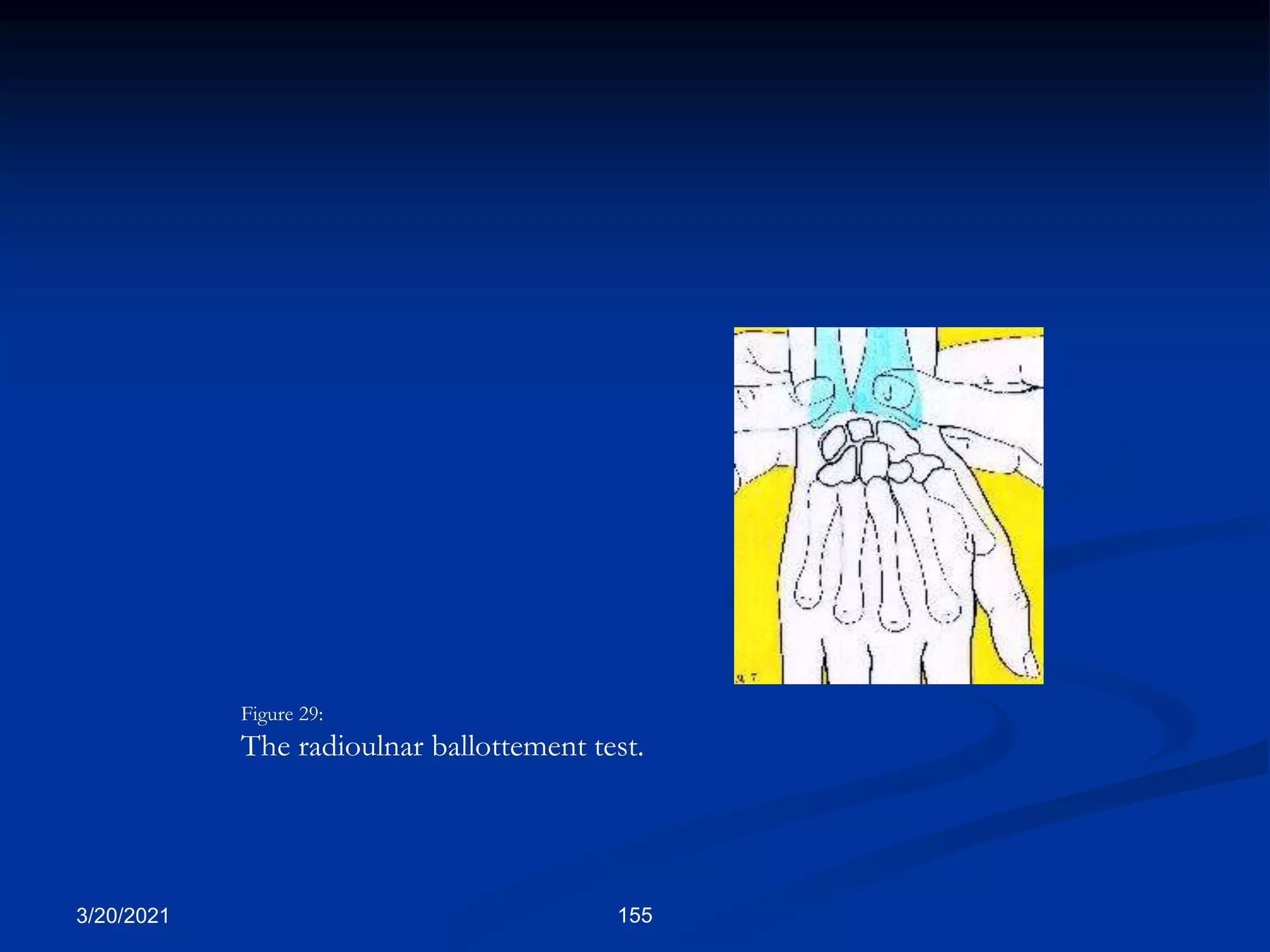
radioulnar ballottement test
3/20/2021 154
 Radioulnar instability is tested by the radioulnar ballottement test,
in which the patient's elbow is flexed, and the examiner uses his
thumb and index finger to stabilize the radius radially and the ulnar
head ulnarly (Figure 29).
 Normally, there is no mobility in the anterior or posterior
direction in maximum pronation or supination.
 Pain or mobility is very suggestive of radioulnar instability.
 The ballottement test must not only be done during extreme
motions of pronation and supination, but also in various
intermediate pronation and supination positions, because
instability may only appear in some of these positions.
3/20/2021 155
Figure 29:
The radioulnar ballottement test.
 TFCC lesions are usually of degenerative origin, but may also
constitute the first stage of radioulnar instability.
 Pain is always ulnar and is intensified by wrist movements but
not necessarily by pronation or supination.
 It is usually aggravated by ulnar inclination or rotational loads:
thus, in the screwdriver test, the examiner holds the patient's
hand while performing screwing and unscrewing movements.
3/20/2021 156
3/20/2021 157
 Extensor carpi ulnaris tendon dislocation is not a ligamentous injury but
occurs after combined hypersupination and ulnar inclination.
 Passive pronation and supination are usually painful and may be
accompanied by a visible and palpable snap which can be reproduced by
placing the wrist in flexion and supination.
Figure 30:
Displacement of the extensor carpi ulnaris is
more visible when the wrist is placed in
flexion and supination.
QUESTIONS
IUMS
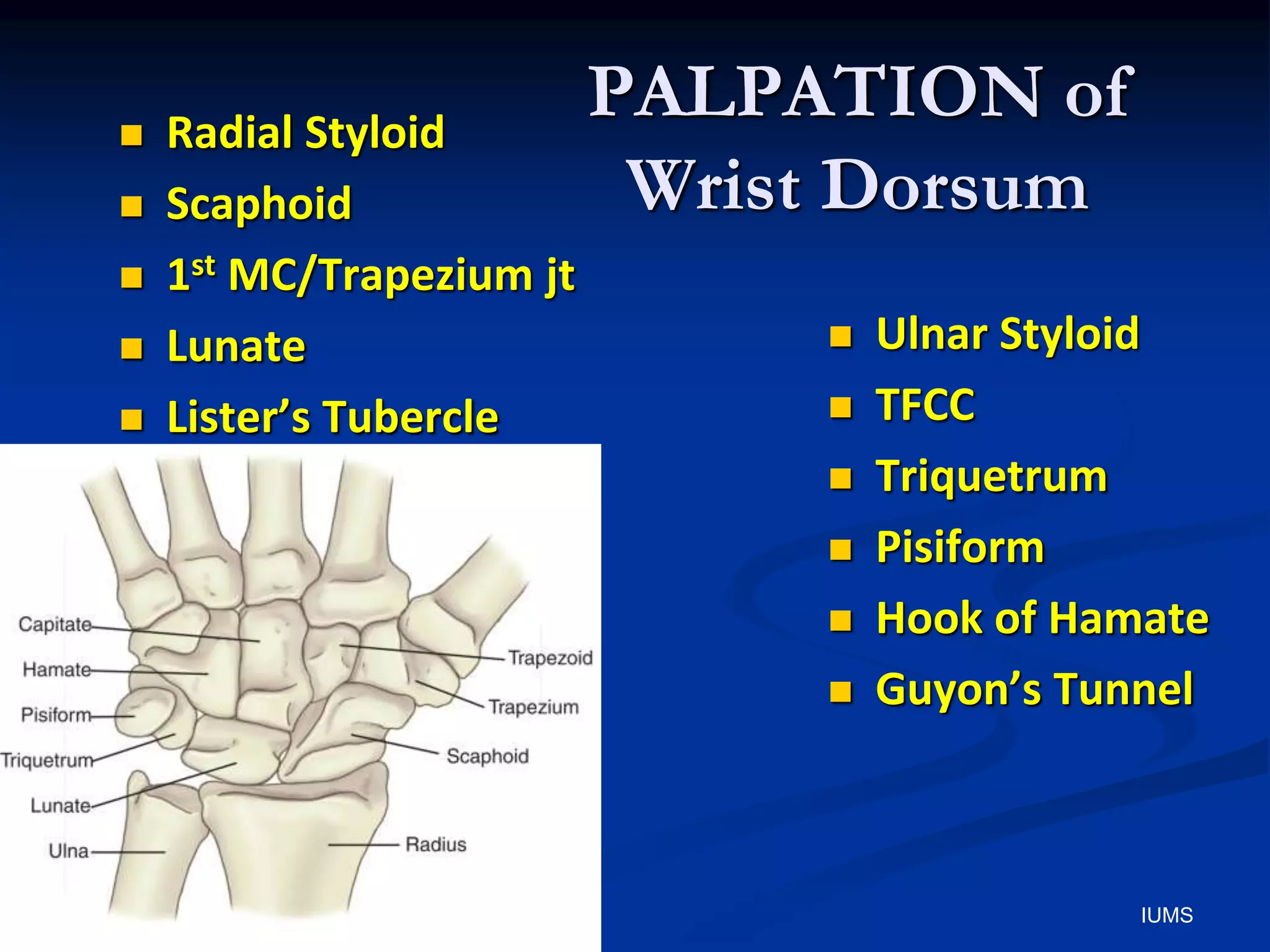
PALPATION of
Wrist Dorsum
 Radial Styloid
 Scaphoid
 1st MC/Trapezium jt
 Lunate
 Lister’s Tubercle
 Ulnar Styloid
 TFCC
 Triquetrum
 Pisiform
 Hook of Hamate
 Guyon’s Tunnel
IUMS
PALPATION of HAND
Bone
 Metacarpals - 5
 Phalanges - 14
 Palpate for swelling, tenderness
 Assess for symmetry
IUMS
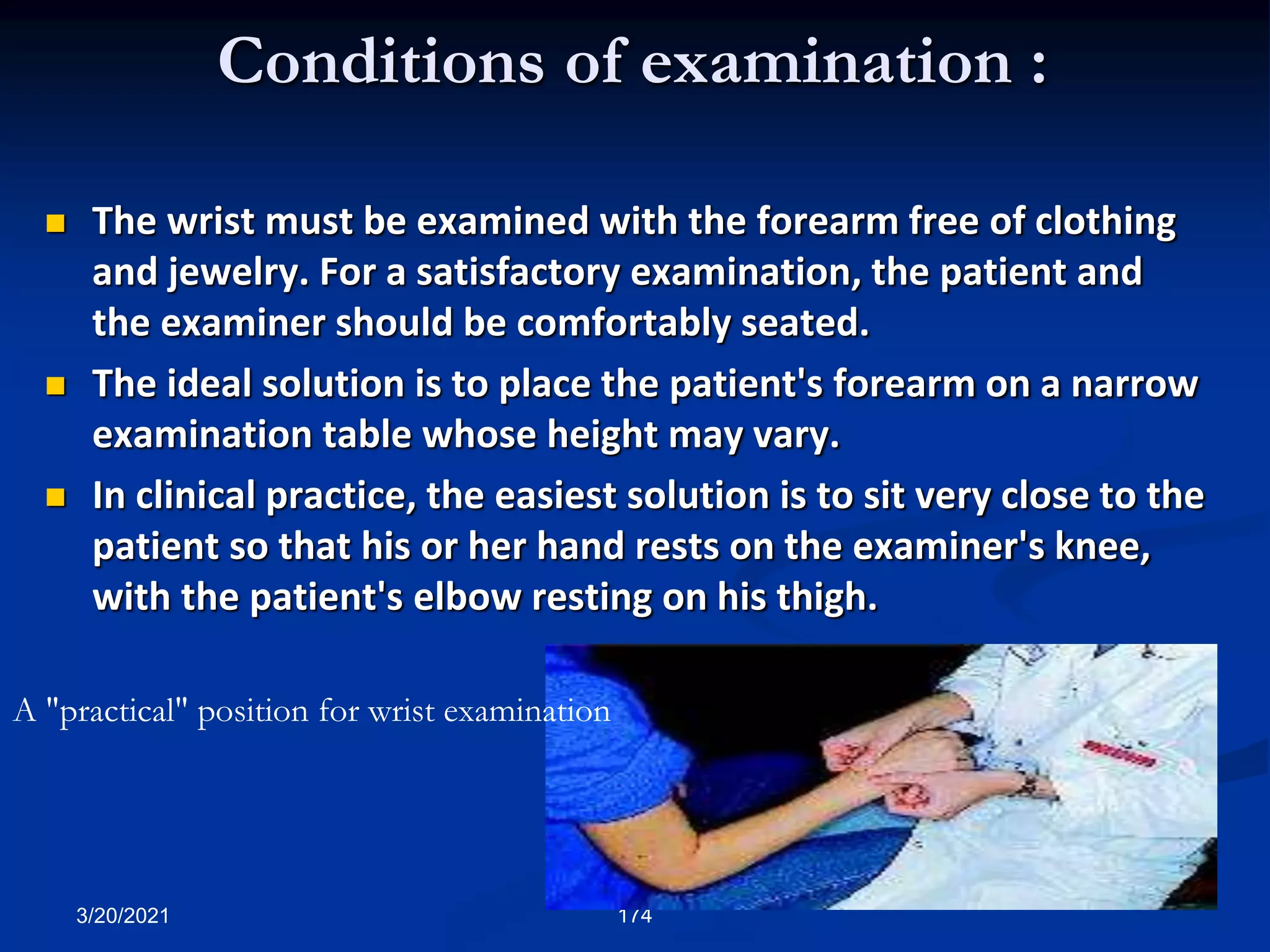
Conditions of examination :
 The wrist must be examined with the forearm free of clothing
and jewelry. For a satisfactory examination, the patient and
the examiner should be comfortably seated.
 The ideal solution is to place the patient's forearm on a narrow
examination table whose height may vary.
 In clinical practice, the easiest solution is to sit very close to the
patient so that his or her hand rests on the examiner's knee,
with the patient's elbow resting on his thigh.
3/20/2021 174
A "practical" position for wrist examination
 Physical examination usually begins on the dorsal
surface of the wrist, with pronation of the forearm and
wrist flexion, whereas the ulnar surface of the wrist is
examined during maximum elbow flexion.
 For palpation, the examiner stabilizes the wrist with
both hands and uses his (her) thumbs to palpate the
anatomical structures.
IUMS
Cutaneous projection of the anatomical
structures
 A beauty (the richness) of wrist examination is
due to the fact that almost all bony, articular,
tendinous or vascular structures may be
palpated through the skin that covers it.
 To be compete, the physical examination should be
methodical and whichever structure is examined
first, the examination should cover the entire wrist.
3/20/2021 176
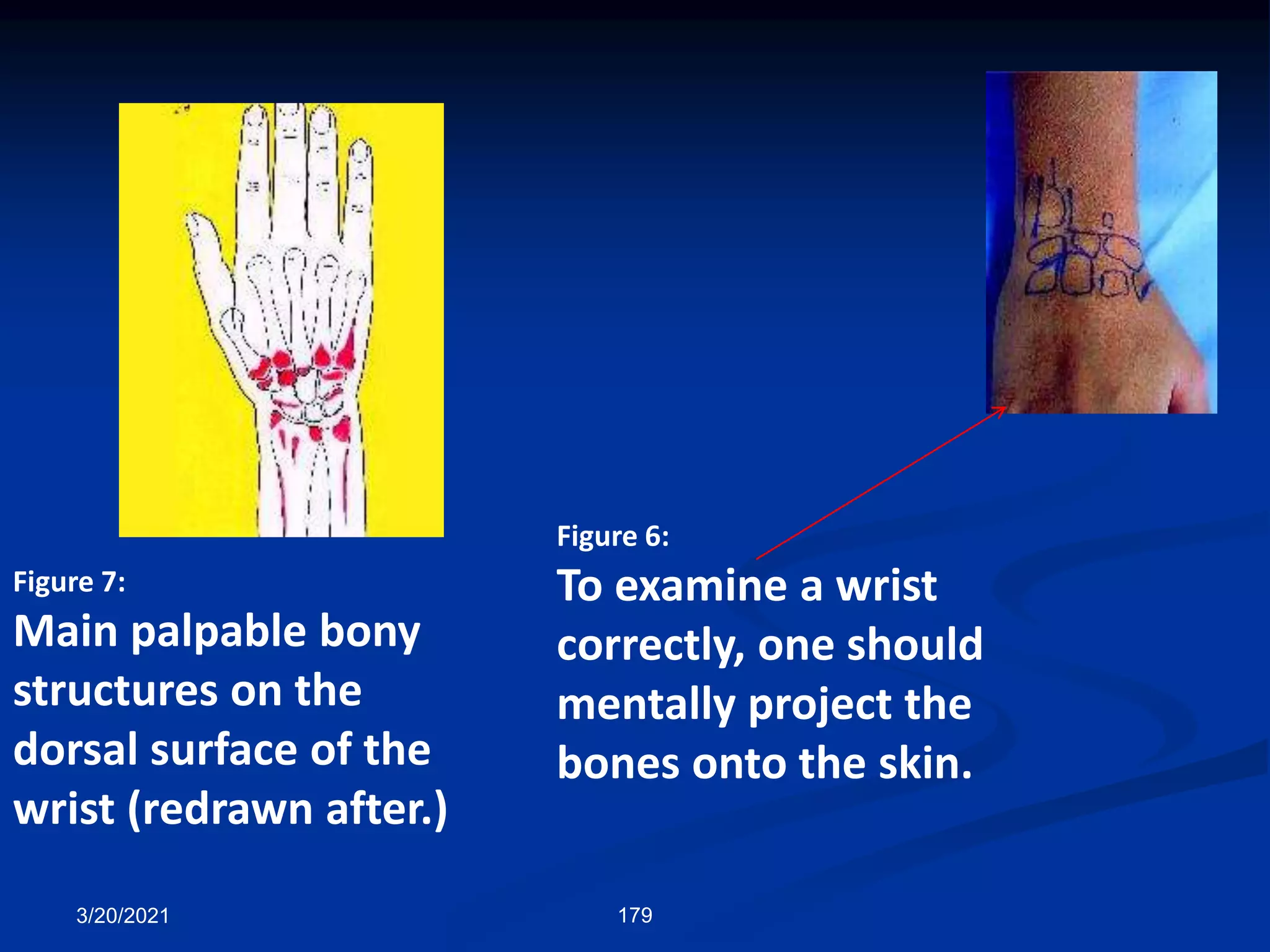
 Dorsal surface: Proximal to the wrist, proceding from the
radius to the ulna it is easy to identify the radial
styloid.
 One cm proximal you will palpate the sharp bony ridge
which limits the first extensor compartment.
 More ulnar is a dorsal bump on the distal radius which is
Lister's tubercle, around which passes ulnarly the
extensor pollicis longus tendon (figure 6 & 7).
 Closer to the ulna and ulnar to Lister`s tubercle, one can
feel the flat dorsal surface of the radius and the ulnar
head which protrudes in pronation.
 On the ulnar side of the wrist, the ulnar styloid can be
palpated dorsally in supination, at the ulnar and volar
surfaces in pronation and on the ulnar side of the wrist
in neutral rotation.
3/20/2021 177
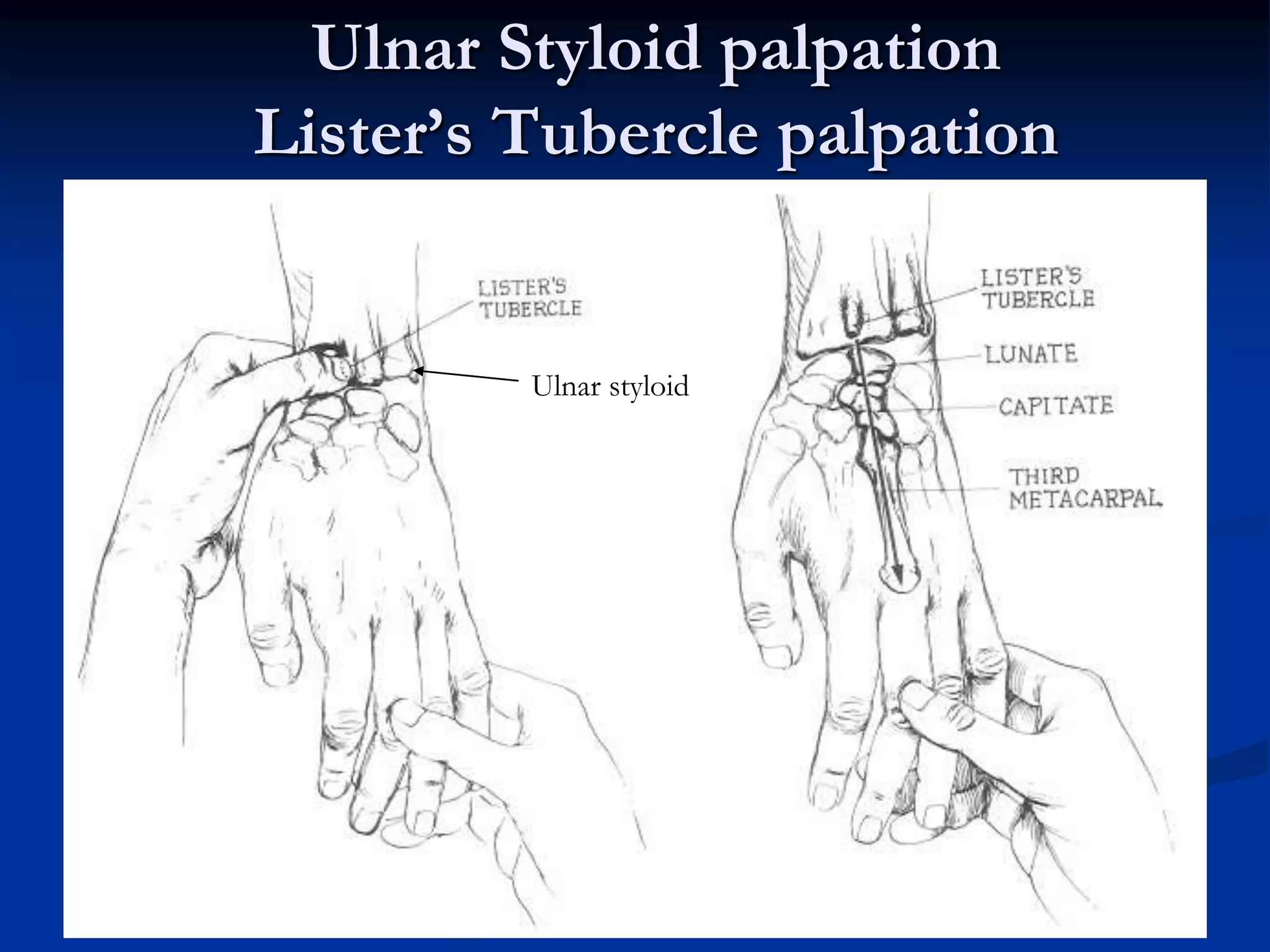
Ulnar Styloid palpation
Lister’s Tubercle palpation
Ulnar styloid
Figure 6:
To examine a wrist
correctly, one should
mentally project the
bones onto the skin.
Figure 7:
Main palpable bony
structures on the
dorsal surface of the
wrist (redrawn after.)
3/20/2021 179
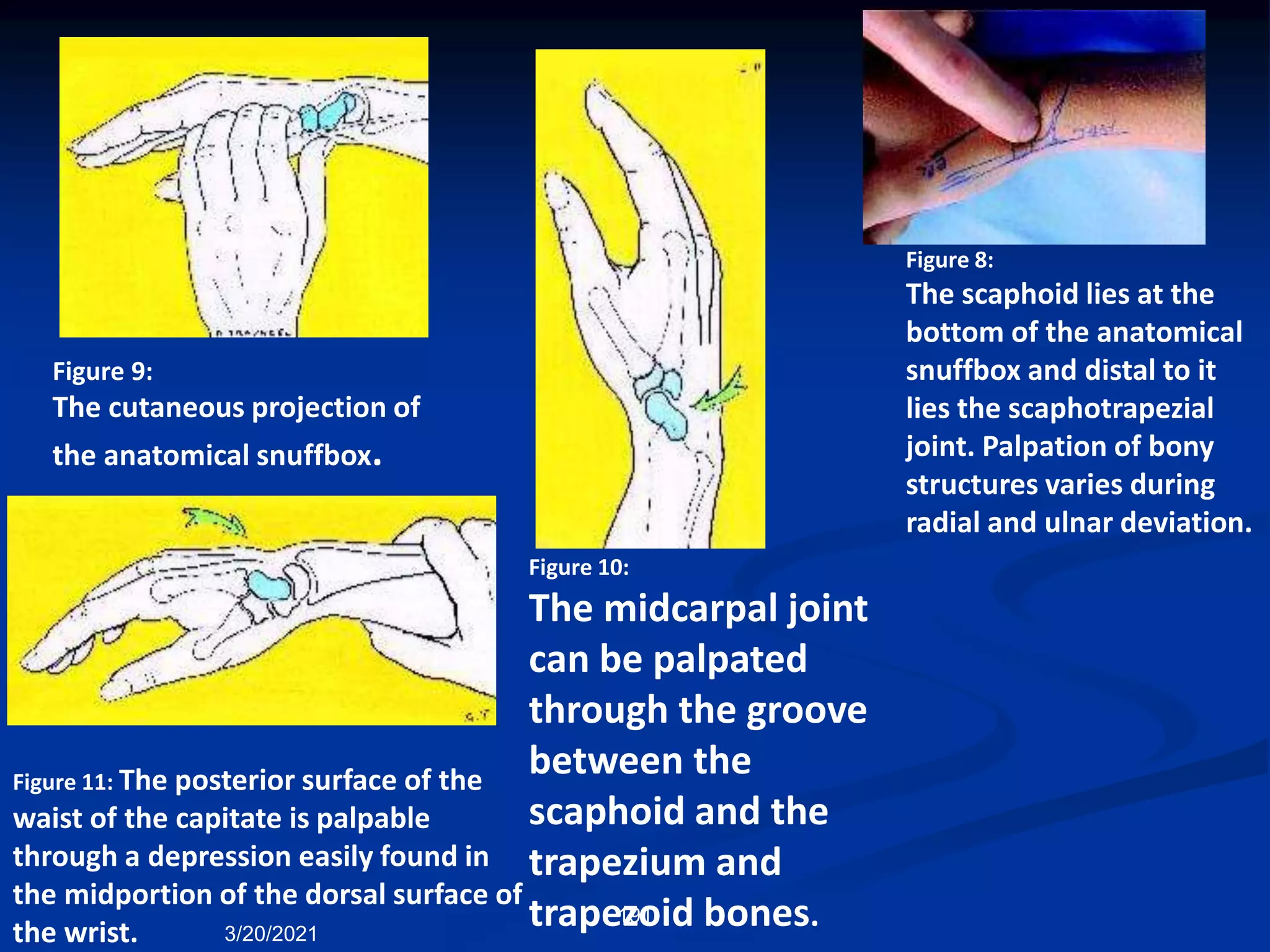
 At the level of the carpus, the anatomical
snuffbox is easy to locate radially: it is limited
 radially by the extensor pollicis brevis and the
abductor pollicis longus and
 ulnarly by the extensor pollicis longus.
 The scaphoid lies at the bottom of the
snuffbox, with the radial artery crossing over
it.
3/20/2021 180
3/20/2021 181
 In radial deviation the scaphoid disappears
dorsally and one can palpate the
scaphotrapezial joint palmarly (figures 8 & 9).
 Dorsally, at the distal end of the scaphoid there
is a groove in which the examiner can place an
index finger to palpate the trapezoid along the
axis of the second metacarpal, and the
trapezium along the axis of the first metacarpal .
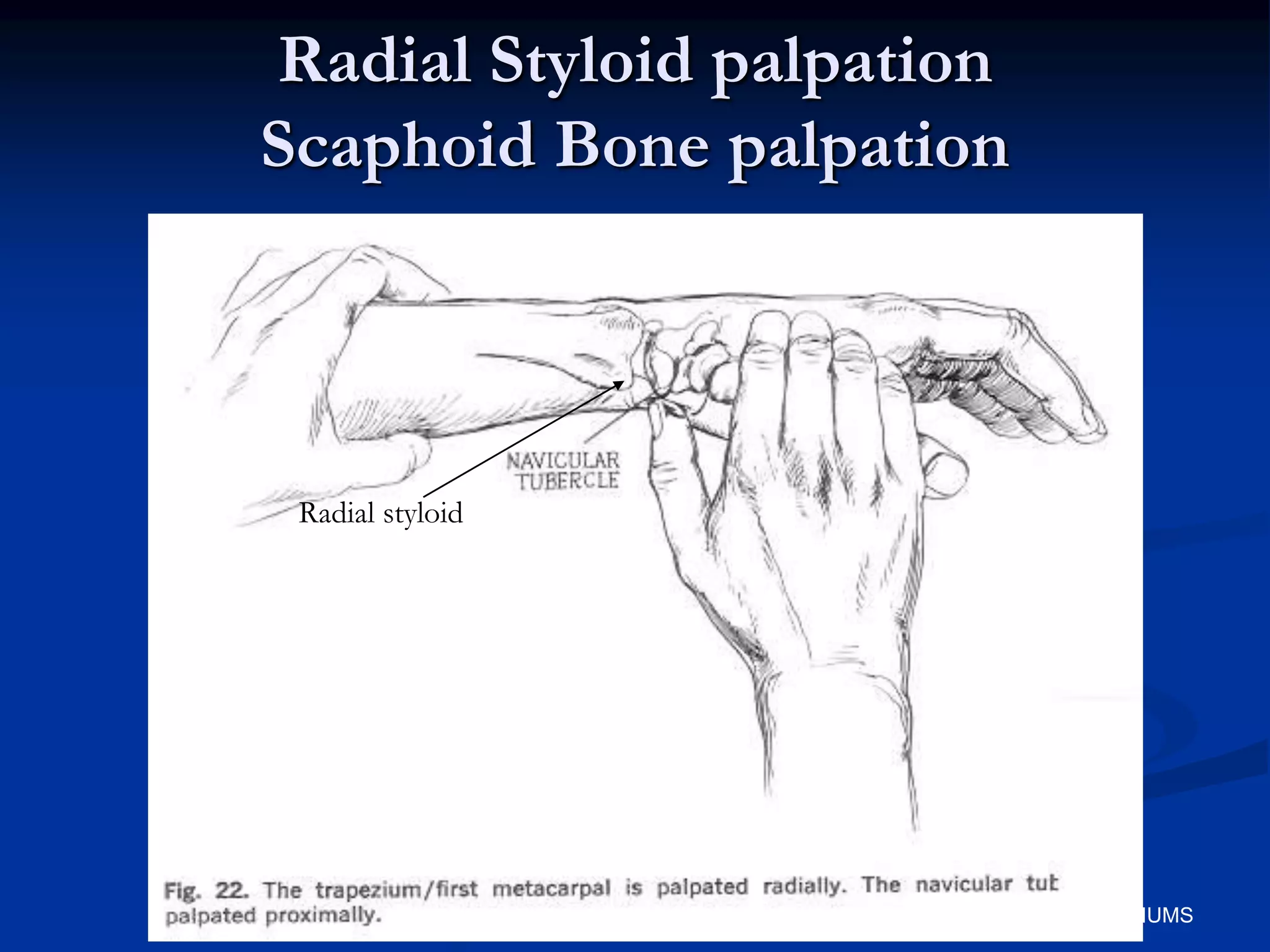
Radial Styloid palpation
Scaphoid Bone palpation
Radial styloid
IUMS
1st MC/Trapezium joint palpation
3/20/2021 183
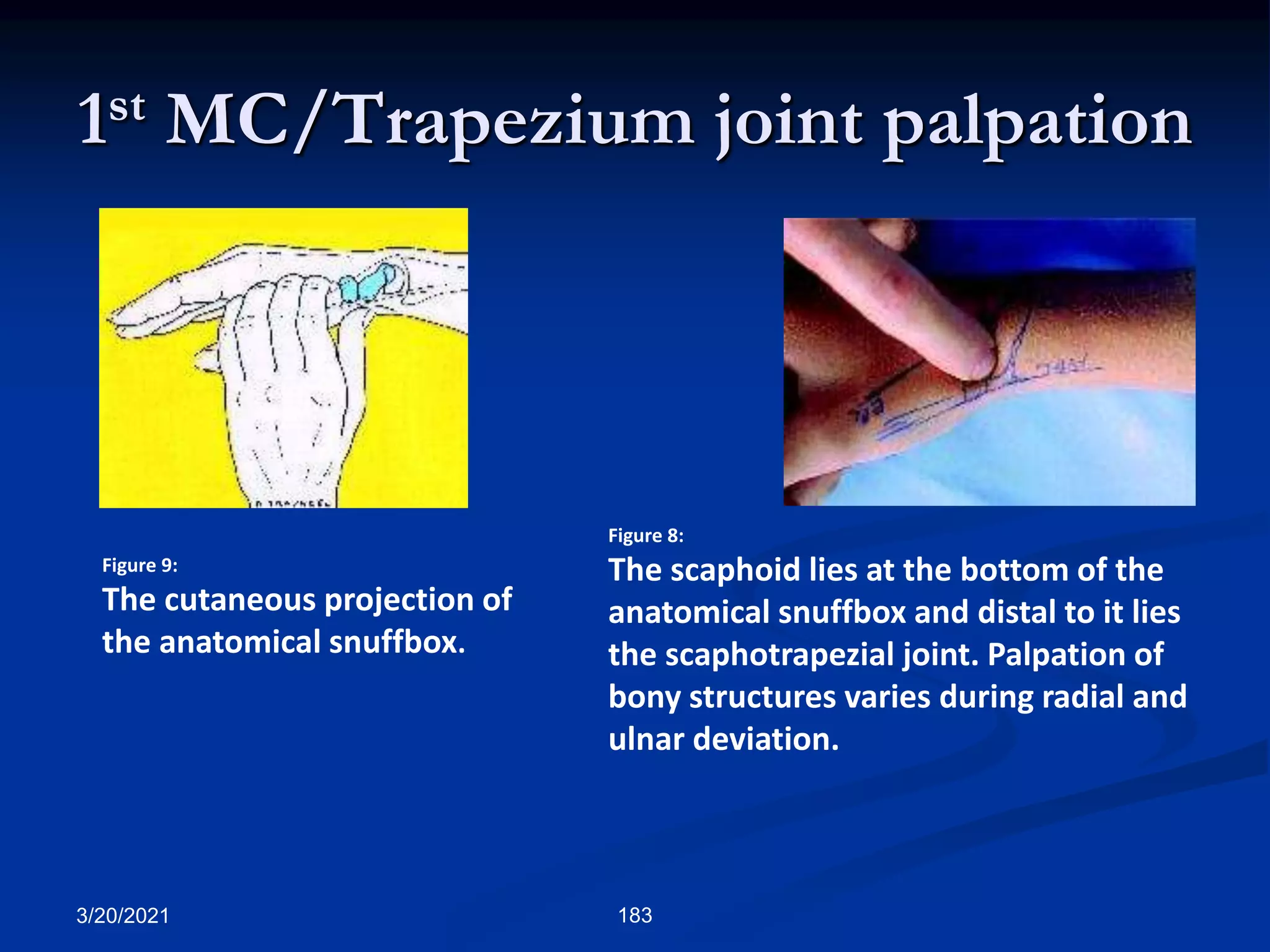
Figure 9:
The cutaneous projection of
the anatomical snuffbox.
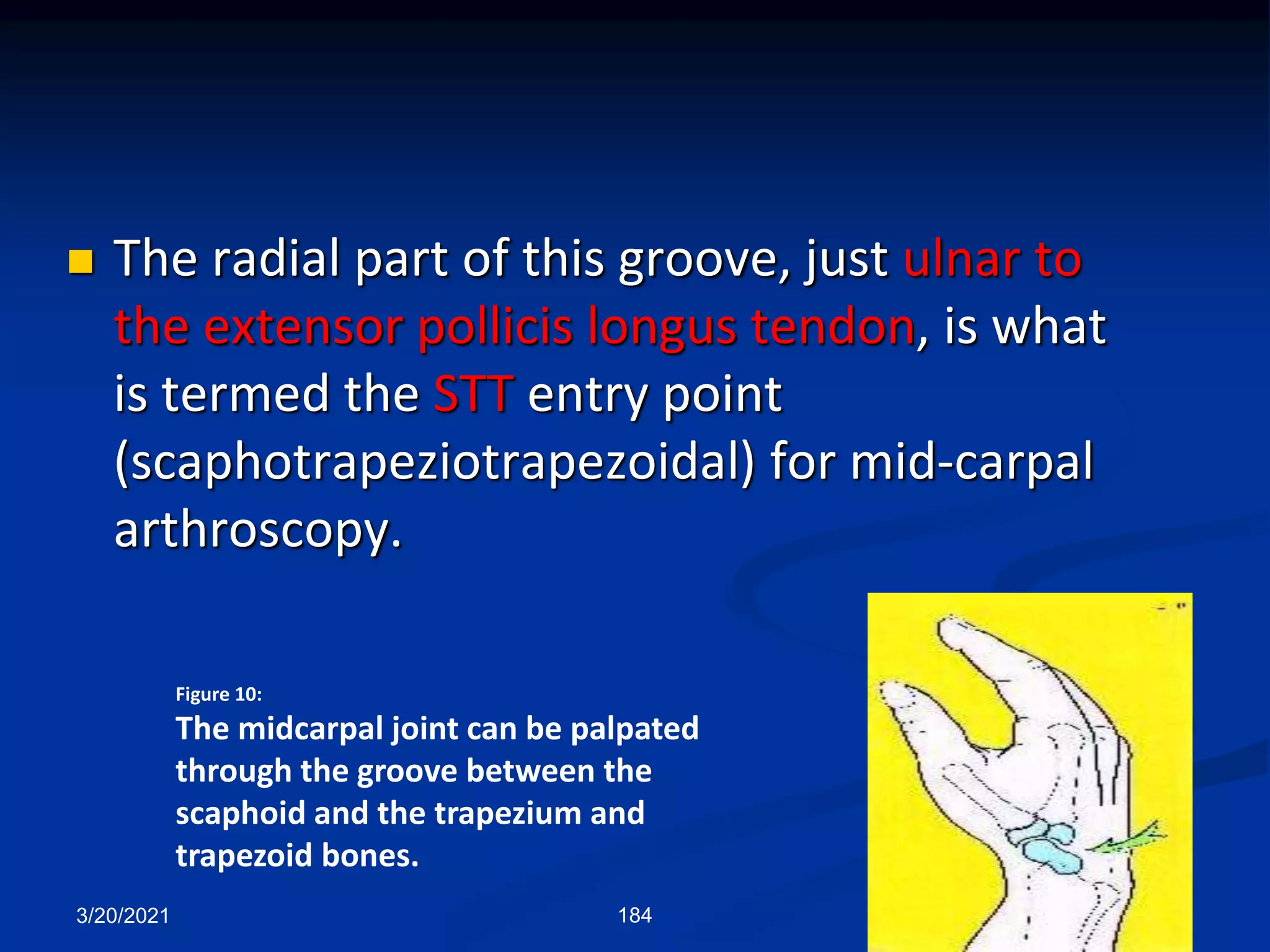
Figure 8:
The scaphoid lies at the bottom of the
anatomical snuffbox and distal to it lies
the scaphotrapezial joint. Palpation of
bony structures varies during radial and
ulnar deviation.
3/20/2021 184
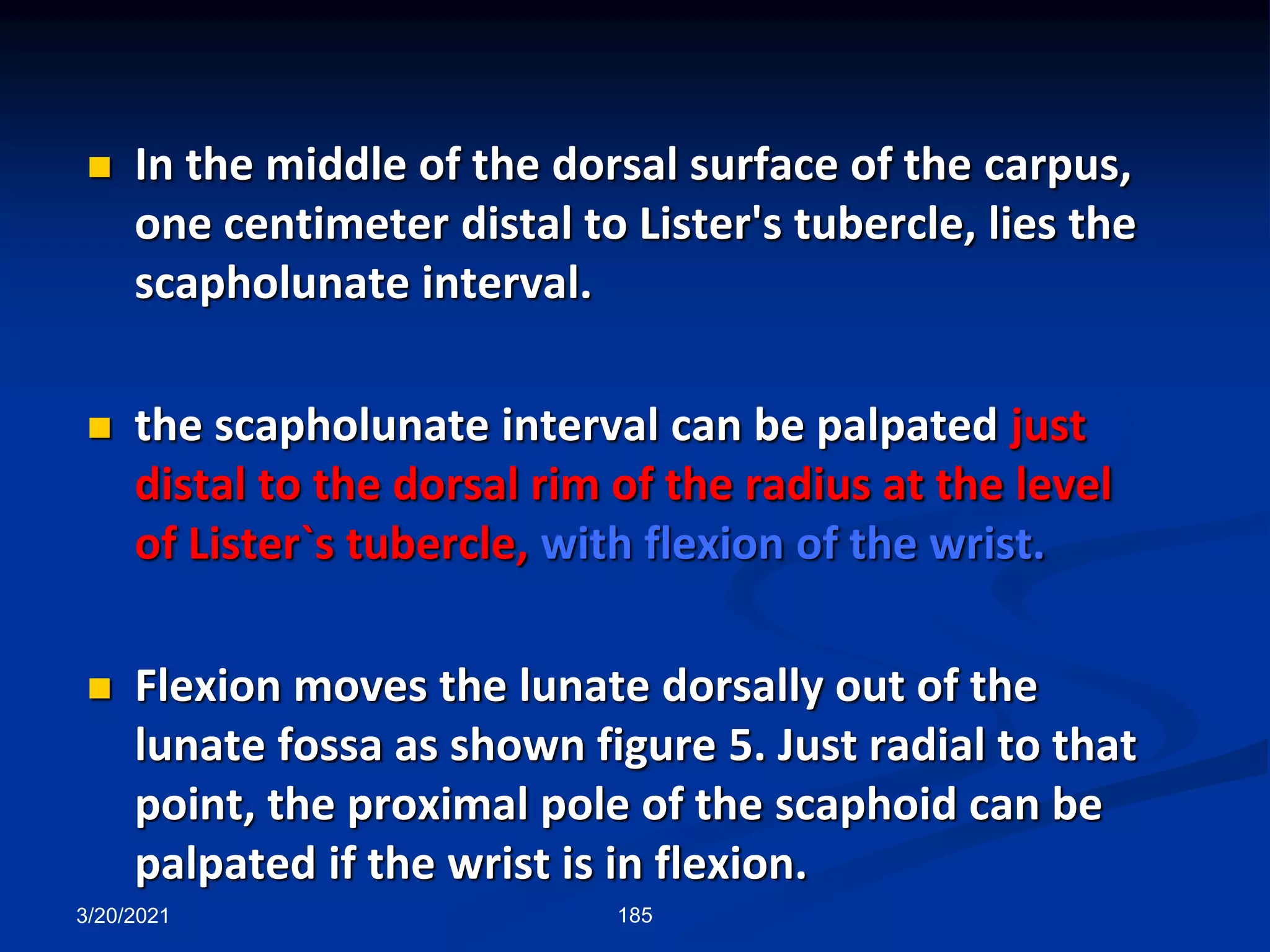
 The radial part of this groove, just ulnar to
the extensor pollicis longus tendon, is what
is termed the STT entry point
(scaphotrapeziotrapezoidal) for mid-carpal
arthroscopy.
Figure 10:
The midcarpal joint can be palpated
through the groove between the
scaphoid and the trapezium and
trapezoid bones.
3/20/2021 185
 In the middle of the dorsal surface of the carpus,
one centimeter distal to Lister's tubercle, lies the
scapholunate interval.
 the scapholunate interval can be palpated just
distal to the dorsal rim of the radius at the level
of Lister`s tubercle, with flexion of the wrist.
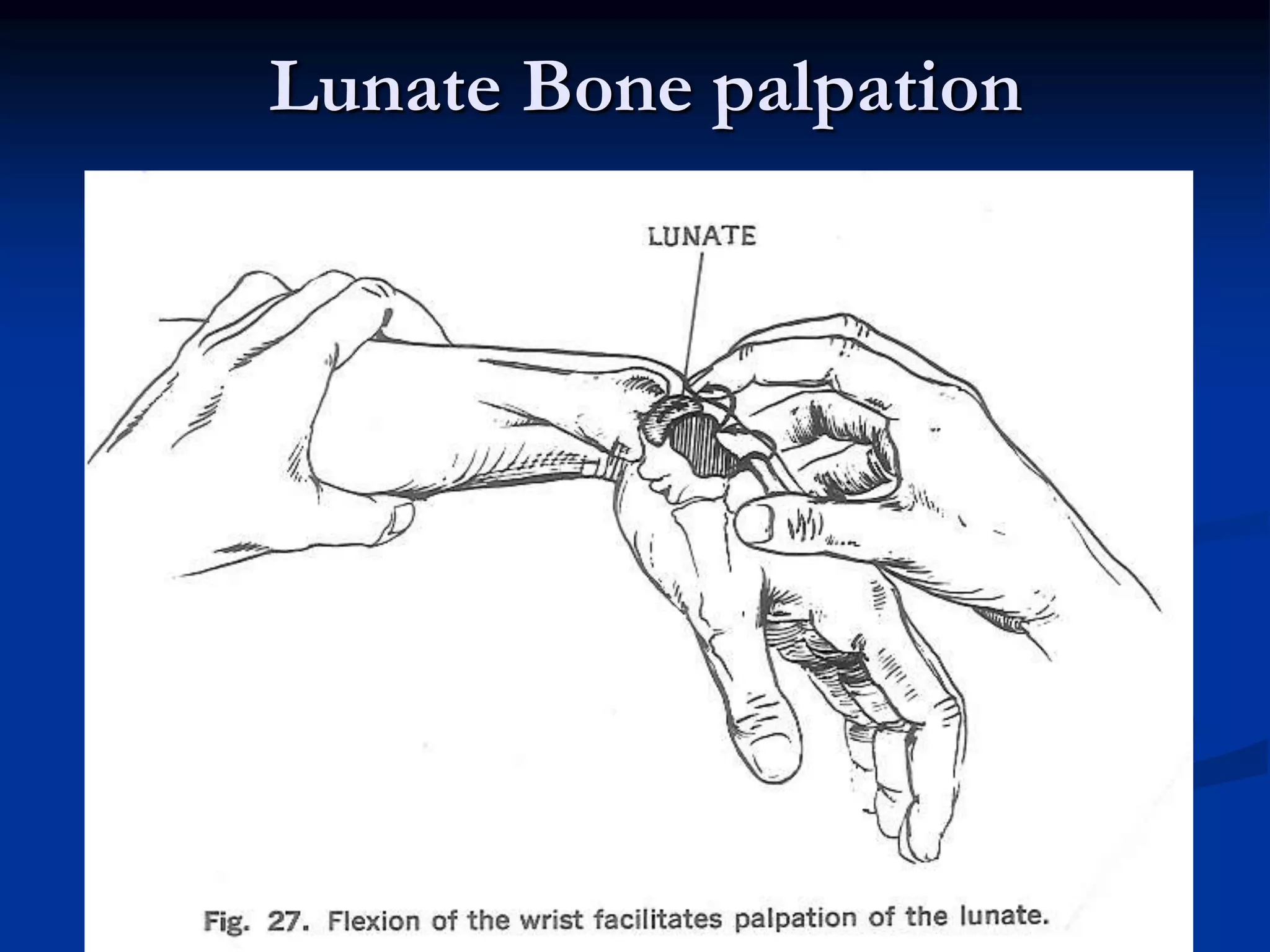
 Flexion moves the lunate dorsally out of the
lunate fossa as shown figure 5. Just radial to that
point, the proximal pole of the scaphoid can be
palpated if the wrist is in flexion.
Lunate Bone palpation
IUMS
3/20/2021 187
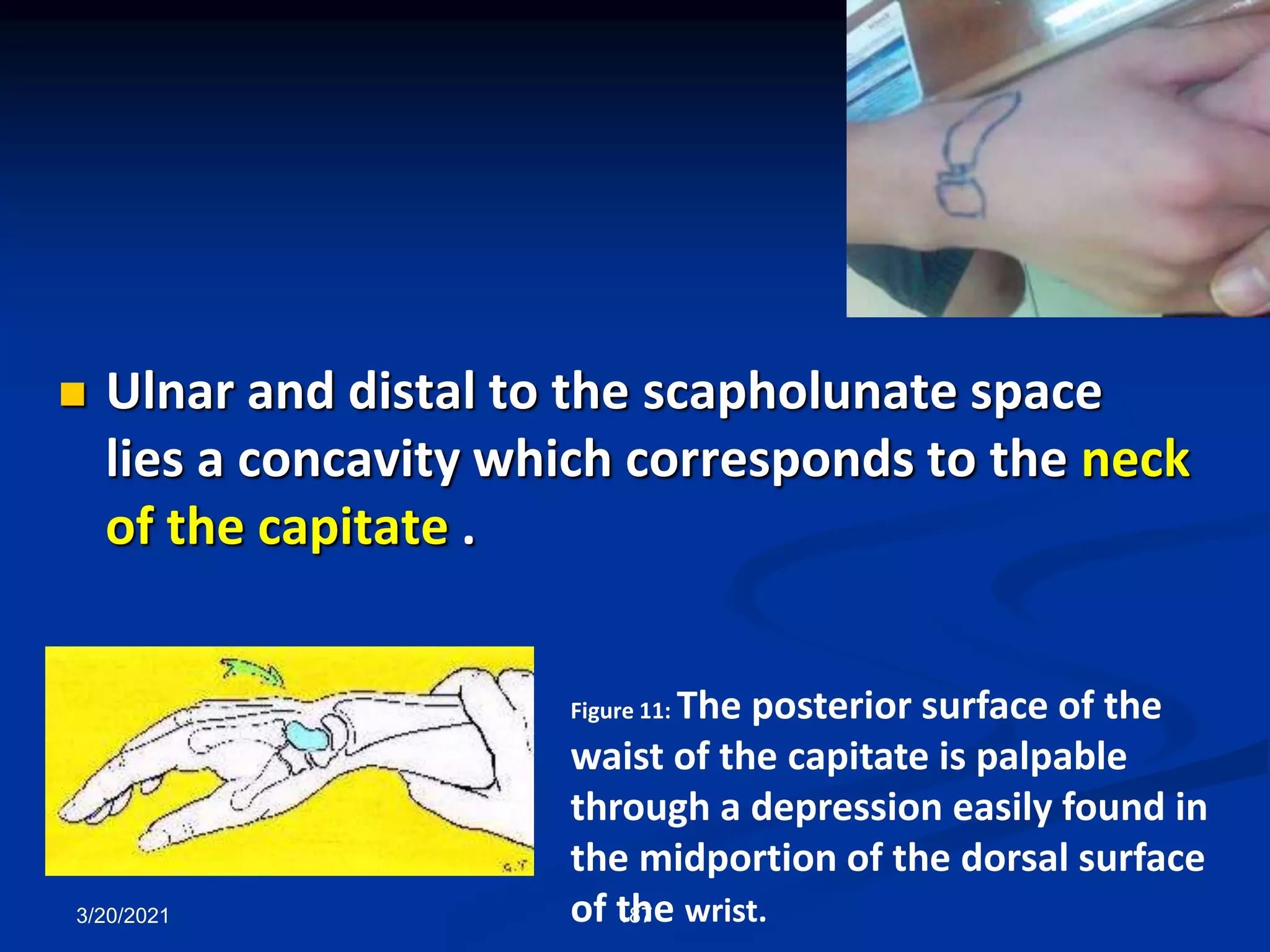
 Ulnar and distal to the scapholunate space
lies a concavity which corresponds to the neck
of the capitate .
Figure 11: The posterior surface of the
waist of the capitate is palpable
through a depression easily found in
the midportion of the dorsal surface
of the wrist.
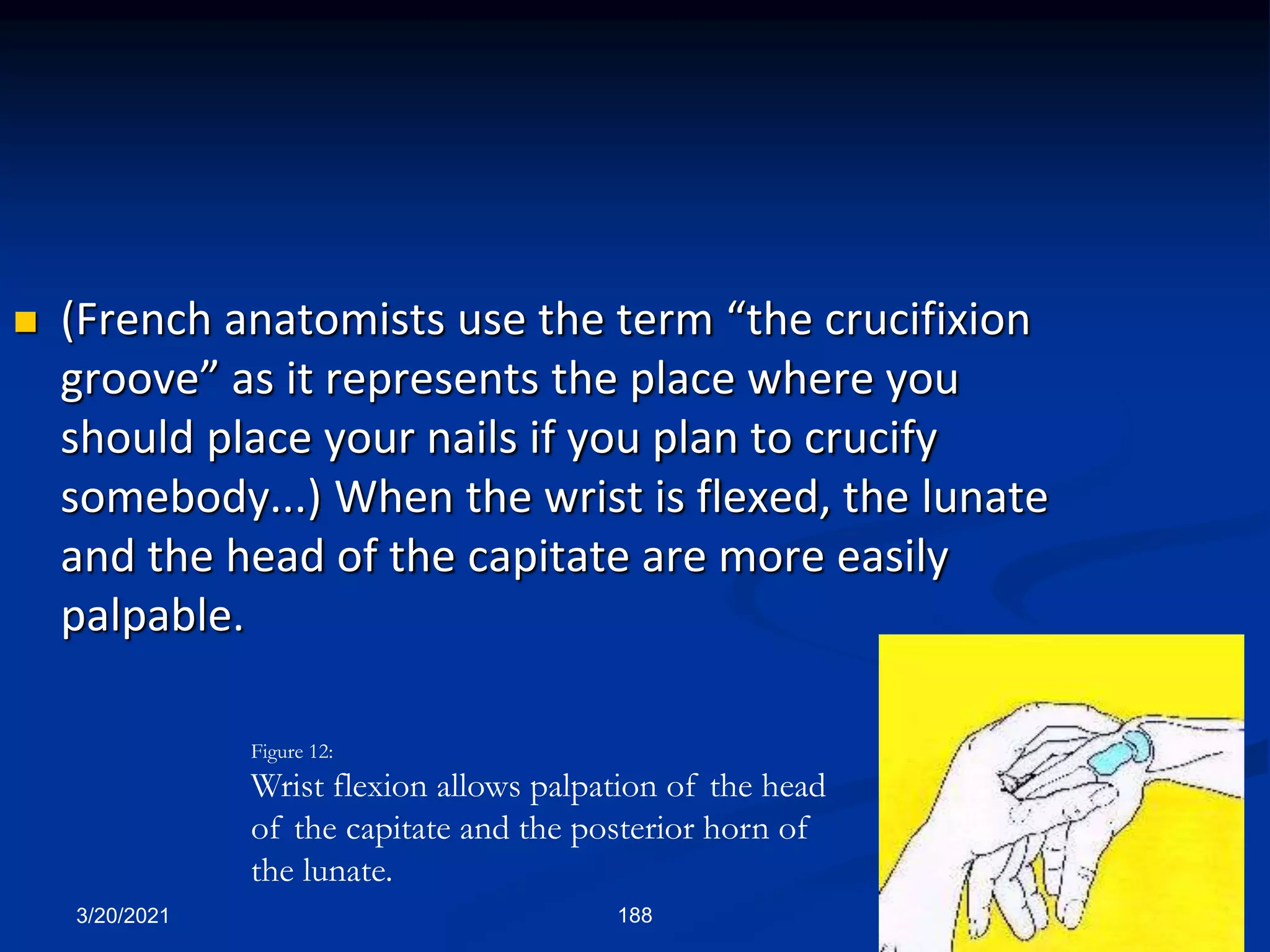
 (French anatomists use the term “the crucifixion
groove” as it represents the place where you
should place your nails if you plan to crucify
somebody...) When the wrist is flexed, the lunate
and the head of the capitate are more easily
palpable.
3/20/2021 188
Figure 12:
Wrist flexion allows palpation of the head
of the capitate and the posterior horn of
the lunate.
3/20/2021 189
 Slightly radial to the neck of the capitate and one
cm distal to the scapholunate interval is the radial
entry point of the midcarpal space.
 The prominence of the third metacarpal base, the
third metacarpal styloid, is located one to one and a
half cm distal to that point, between the capitate
and the trapezoid. It is more or less developed
depending on the individual and may sometimes be
hidden by the insertion of the extensor carpi radialis
brevis tendon.
3/20/2021 190
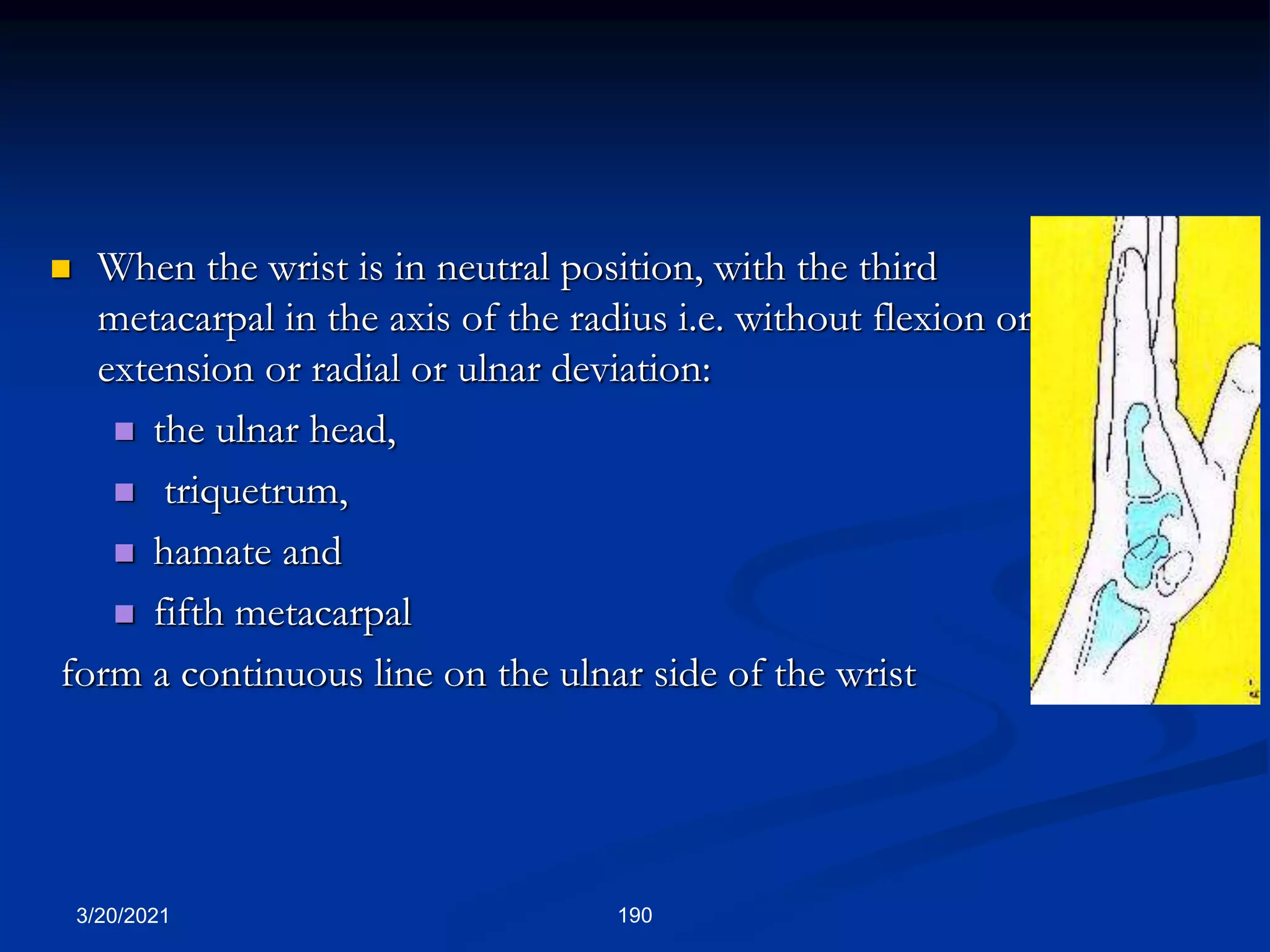
 When the wrist is in neutral position, with the third
metacarpal in the axis of the radius i.e. without flexion or
extension or radial or ulnar deviation:
 the ulnar head,
 triquetrum,
 hamate and
 fifth metacarpal
form a continuous line on the ulnar side of the wrist
Figure 8:
The scaphoid lies at the
bottom of the anatomical
snuffbox and distal to it
lies the scaphotrapezial
joint. Palpation of bony
structures varies during
radial and ulnar deviation.
Figure 9:
The cutaneous projection of
the anatomical snuffbox.
Figure 10:
The midcarpal joint
can be palpated
through the groove
between the
scaphoid and the
trapezium and
trapezoid bones.
Figure 11: The posterior surface of the
waist of the capitate is palpable
through a depression easily found in
the midportion of the dorsal surface of
the wrist. 3/20/2021
191
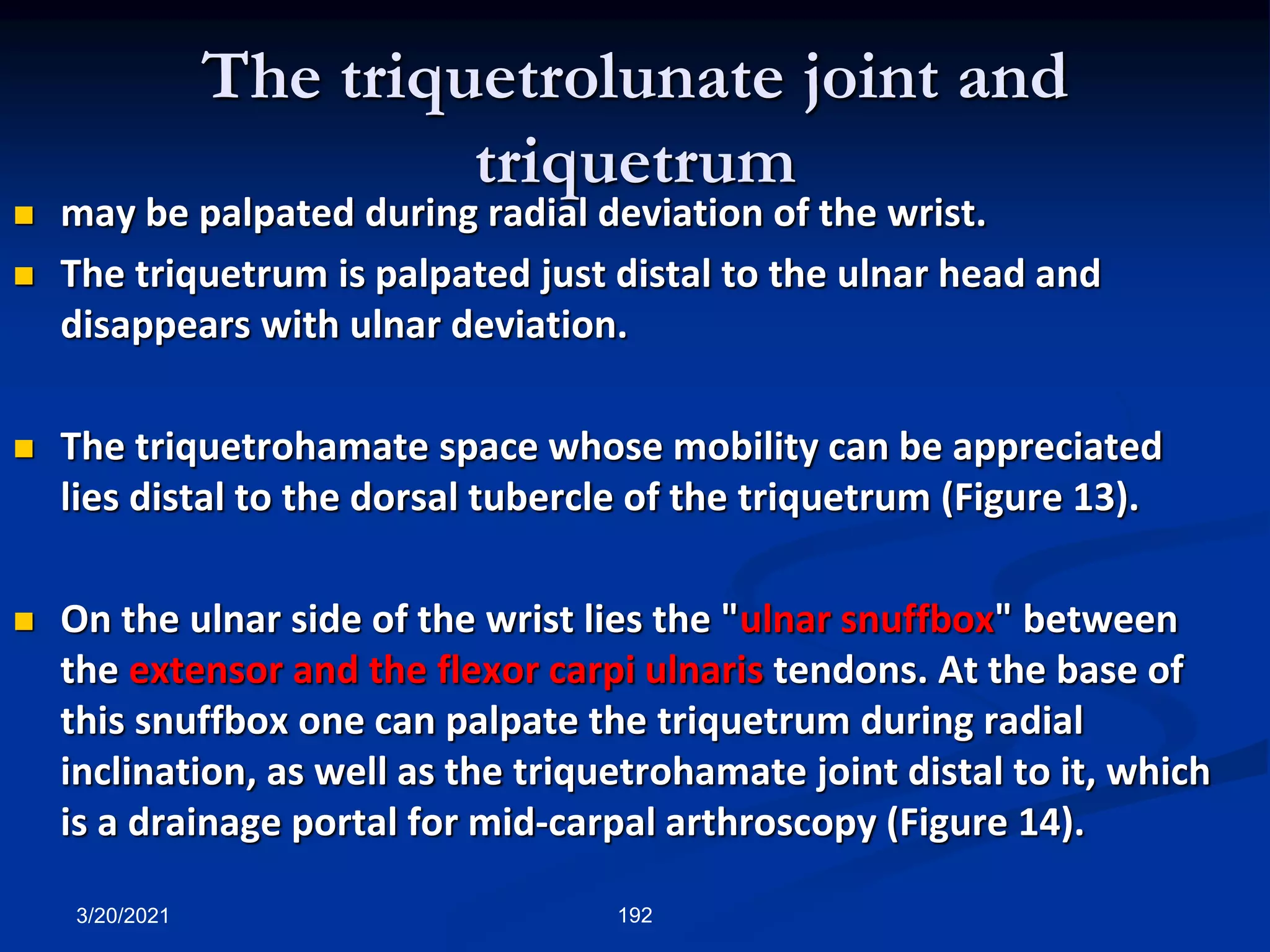
The triquetrolunate joint and
triquetrum
 may be palpated during radial deviation of the wrist.
 The triquetrum is palpated just distal to the ulnar head and
disappears with ulnar deviation.
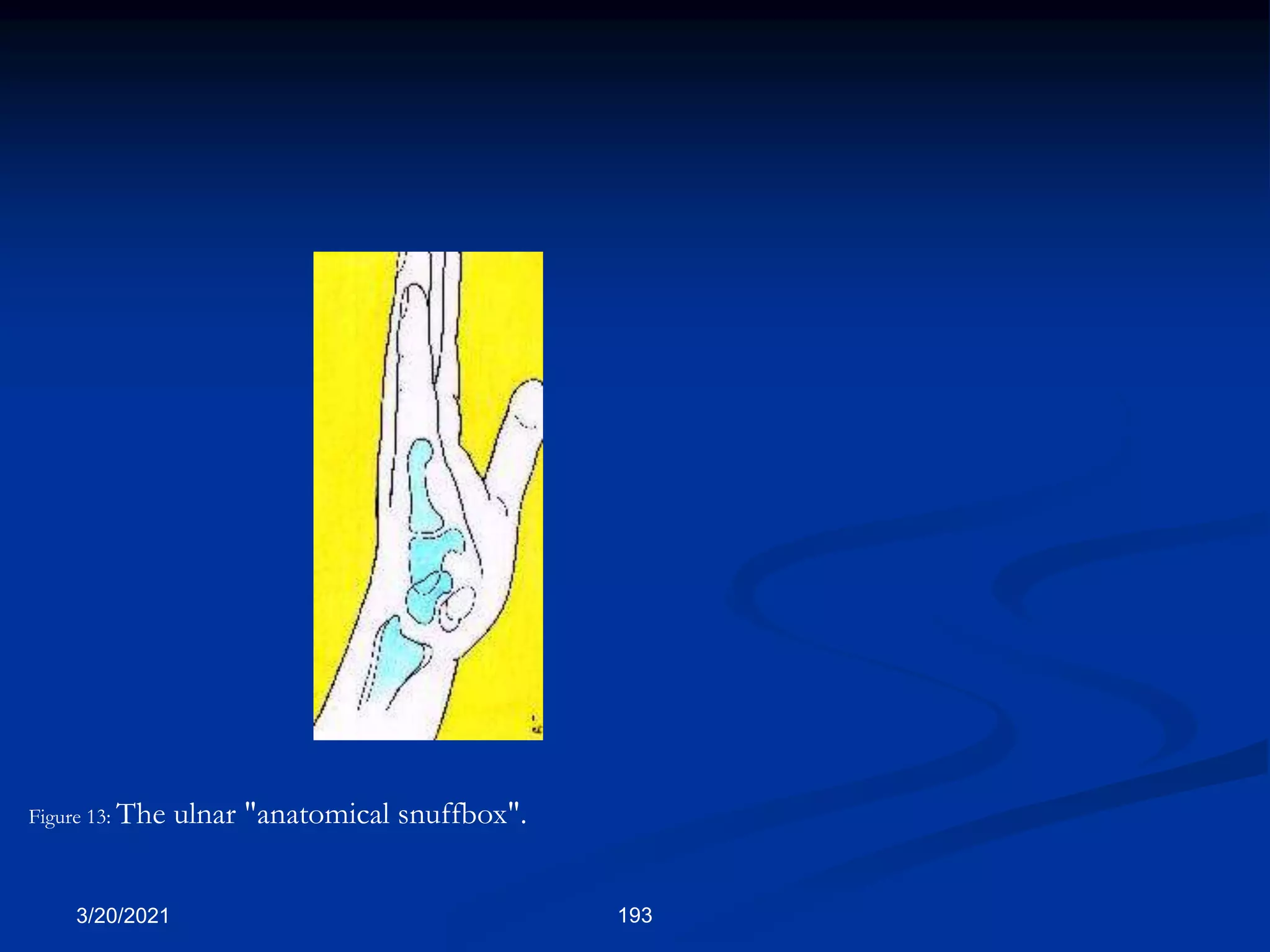
 The triquetrohamate space whose mobility can be appreciated
lies distal to the dorsal tubercle of the triquetrum (Figure 13).
 On the ulnar side of the wrist lies the "ulnar snuffbox" between
the extensor and the flexor carpi ulnaris tendons. At the base of
this snuffbox one can palpate the triquetrum during radial
inclination, as well as the triquetrohamate joint distal to it, which
is a drainage portal for mid-carpal arthroscopy (Figure 14).
3/20/2021 192
Figure 13: The ulnar "anatomical snuffbox".
3/20/2021 193
PALPATION
Palmar Aspect
 Pisiform and Hamate
 Tunnel of Guyon
 Ulnar Artery
 Carpal Tunnel
 Flexor Carpi Radialis
 Flexor Carpi Ulnaris
IUMS
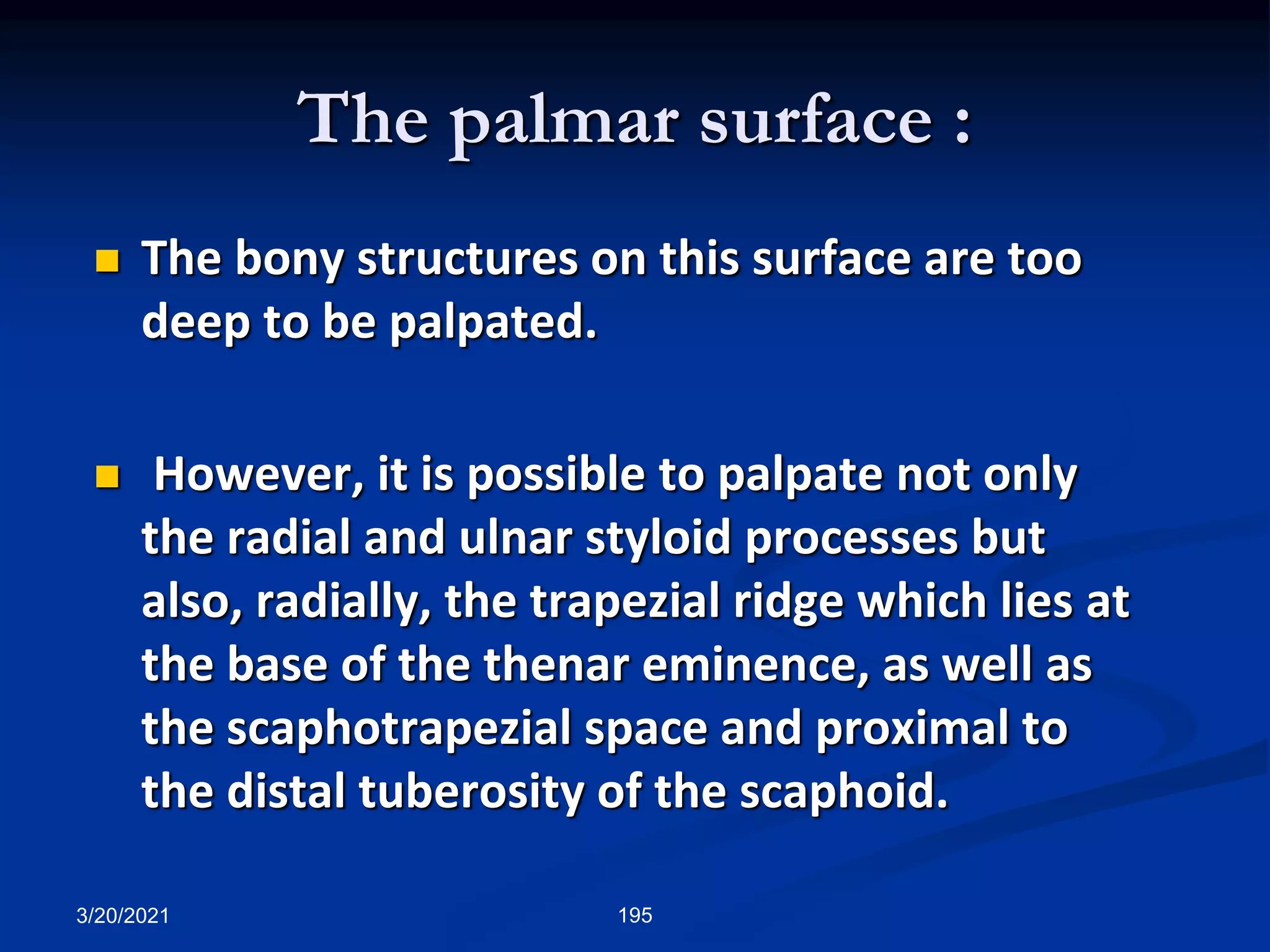
The palmar surface :
 The bony structures on this surface are too
deep to be palpated.
 However, it is possible to palpate not only
the radial and ulnar styloid processes but
also, radially, the trapezial ridge which lies at
the base of the thenar eminence, as well as
the scaphotrapezial space and proximal to
the distal tuberosity of the scaphoid.
3/20/2021 195
pisiform
3/20/2021 196
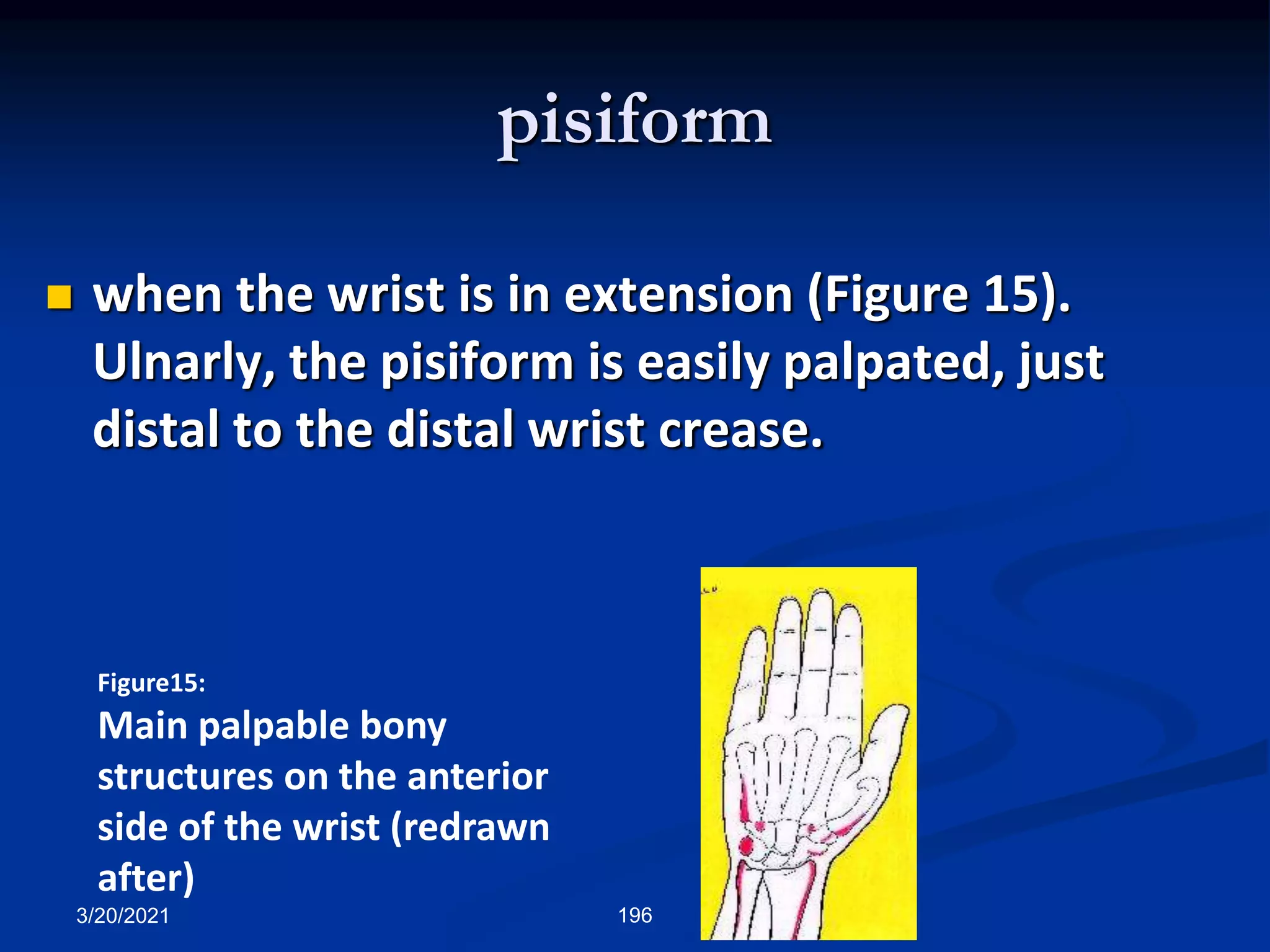
 when the wrist is in extension (Figure 15).
Ulnarly, the pisiform is easily palpated, just
distal to the distal wrist crease.
Figure15:
Main palpable bony
structures on the anterior
side of the wrist (redrawn
after)
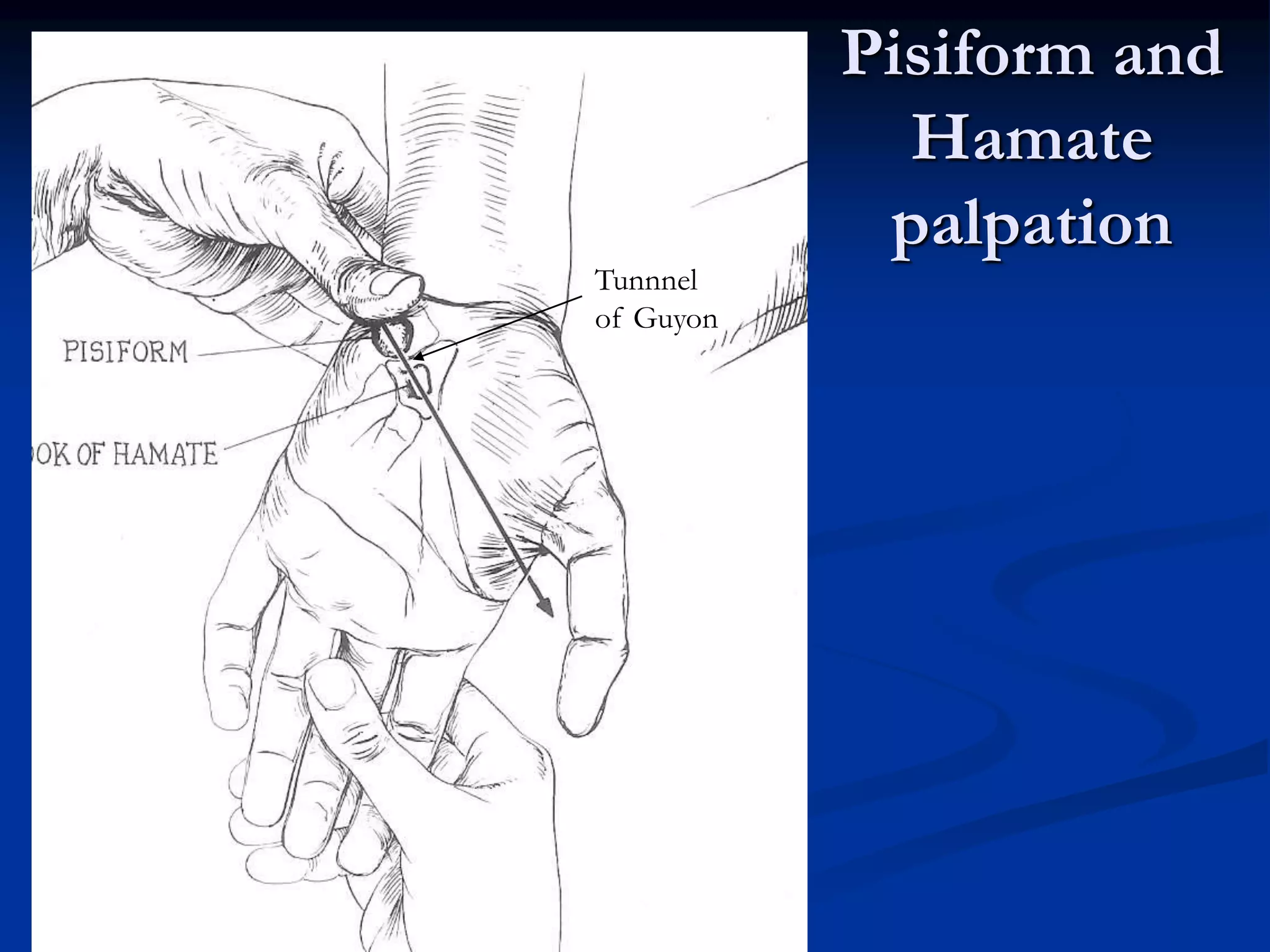
Pisiform and
Hamate
palpation
Tunnnel
of Guyon
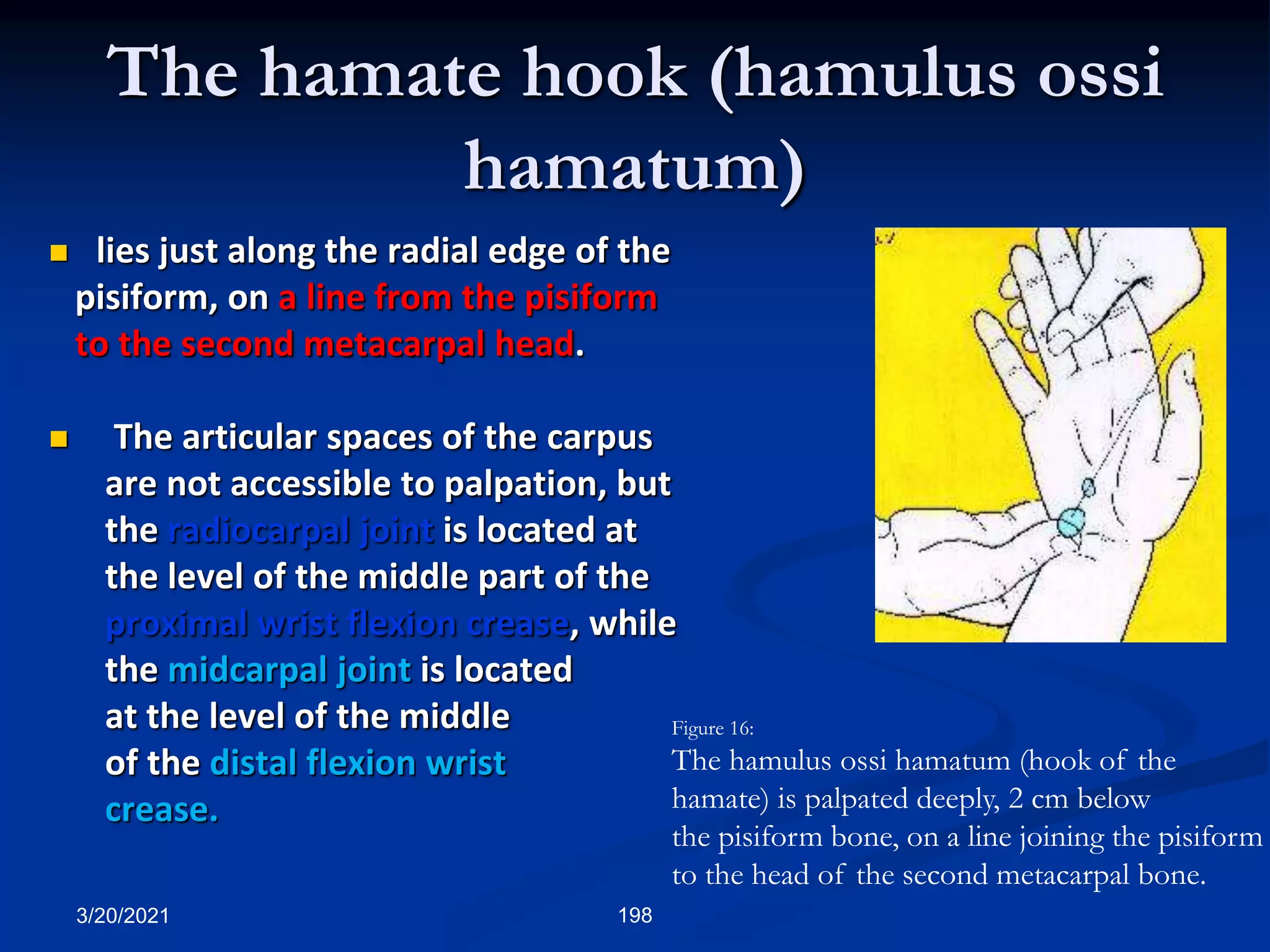
The hamate hook (hamulus ossi
hamatum)
Figure 16:
The hamulus ossi hamatum (hook of the
hamate) is palpated deeply, 2 cm below
the pisiform bone, on a line joining the pisiform
to the head of the second metacarpal bone.
3/20/2021 198
 lies just along the radial edge of the
pisiform, on a line from the pisiform
to the second metacarpal head.
 The articular spaces of the carpus
are not accessible to palpation, but
the radiocarpal joint is located at
the level of the middle part of the
proximal wrist flexion crease, while
the midcarpal joint is located
at the level of the middle
of the distal flexion wrist
crease.
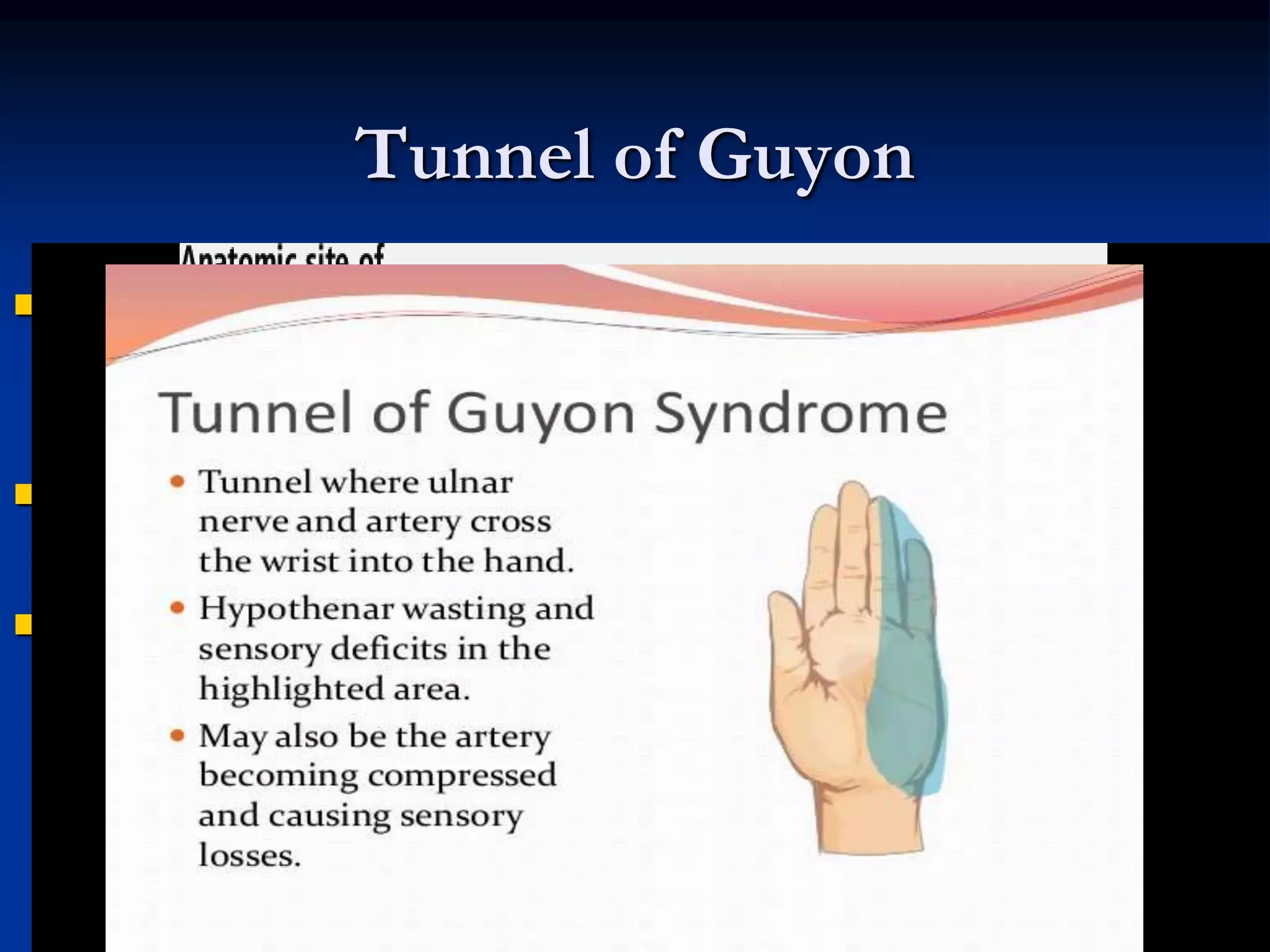
Tunnel of Guyon
 Depression between
pisiform and hook of
hamate
 Contains ulnar nerve
and artery
 Site of compression
injuries
 unusually tender if
pathology is present
IUMS
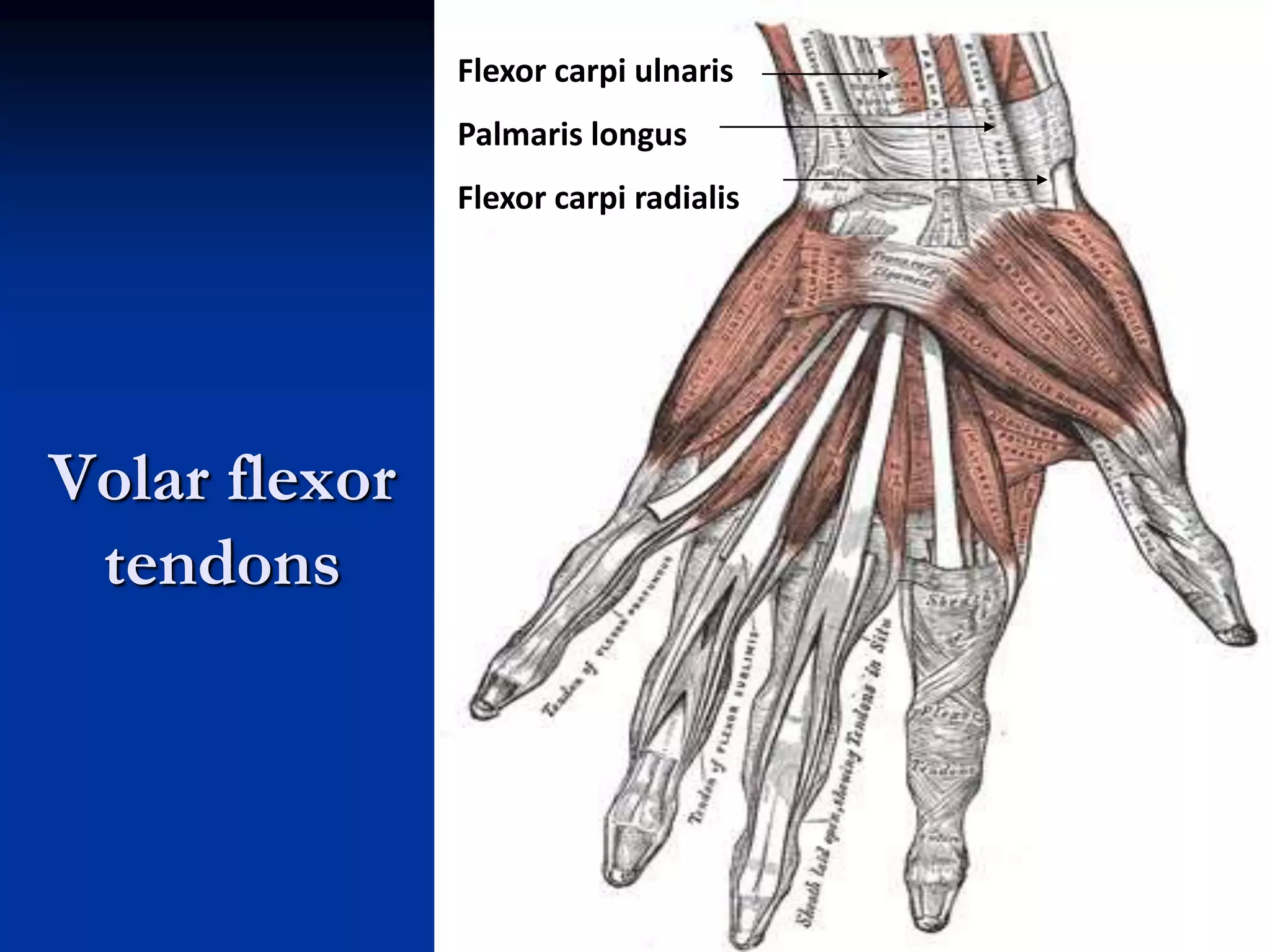
Volar flexor
tendons
Flexor carpi ulnaris
Palmaris longus
Flexor carpi radialis
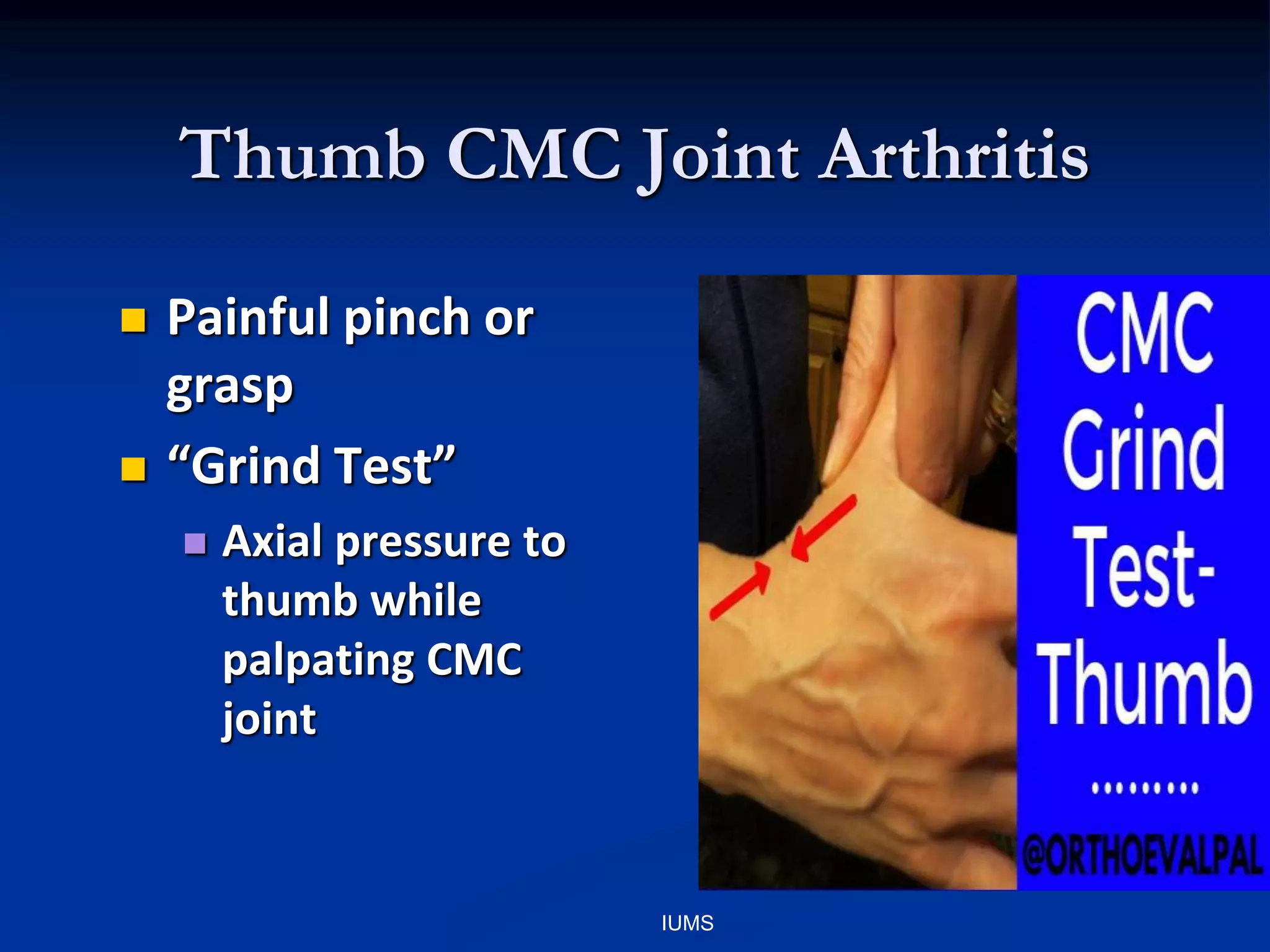
Thumb CMC Joint Arthritis
 Painful pinch or
grasp
 “Grind Test”
 Axial pressure to
thumb while
palpating CMC
joint
IUMS
Scapholunate Dissociation
 Diagnosis often missed
 Pain, swelling, and decreased ROM
 Pressure over scaphoid tuberosity elicits pain
 Greatest pain over dorsal scapholunate area,
accentuated with dorsiflexion
 X-ray shows widening of scapholunate joint
space by at least 3 mm
IUMS
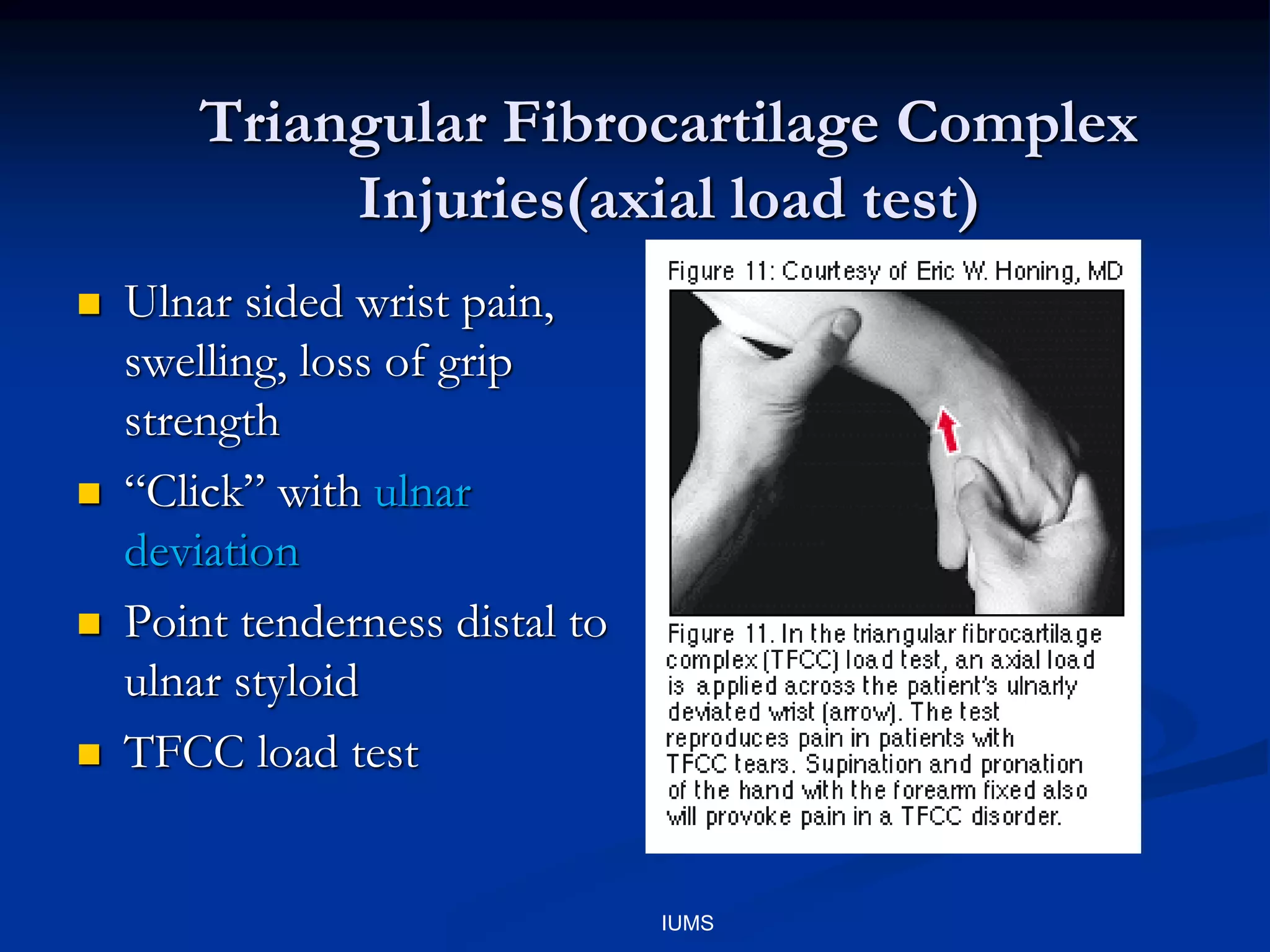
Triangular Fibrocartilage Complex
Injuries(axial load test)
 Ulnar sided wrist pain,
swelling, loss of grip
strength
 “Click” with ulnar
deviation
 Point tenderness distal to
ulnar styloid
 TFCC load test
IUMS
PALPATION of HAND
Bone
 Metacarpals - 5
 Phalanges - 14
 Palpate for swelling, tenderness
 Assess for symmetry
IUMS
PALPATION
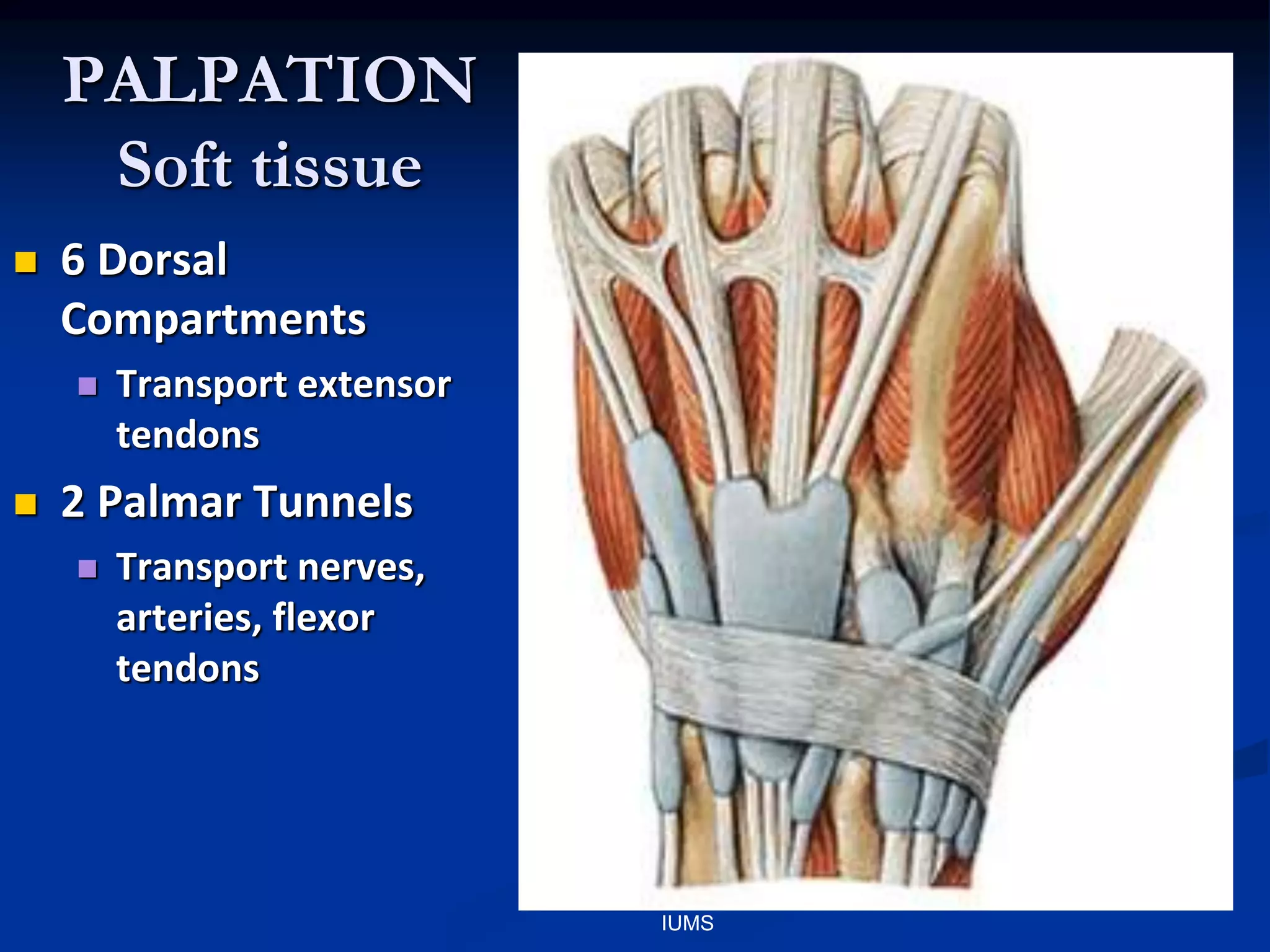
Soft tissue
 6 Dorsal
Compartments
 Transport extensor
tendons
 2 Palmar Tunnels
 Transport nerves,
arteries, flexor
tendons
IUMS
1st Dorsal Compartment
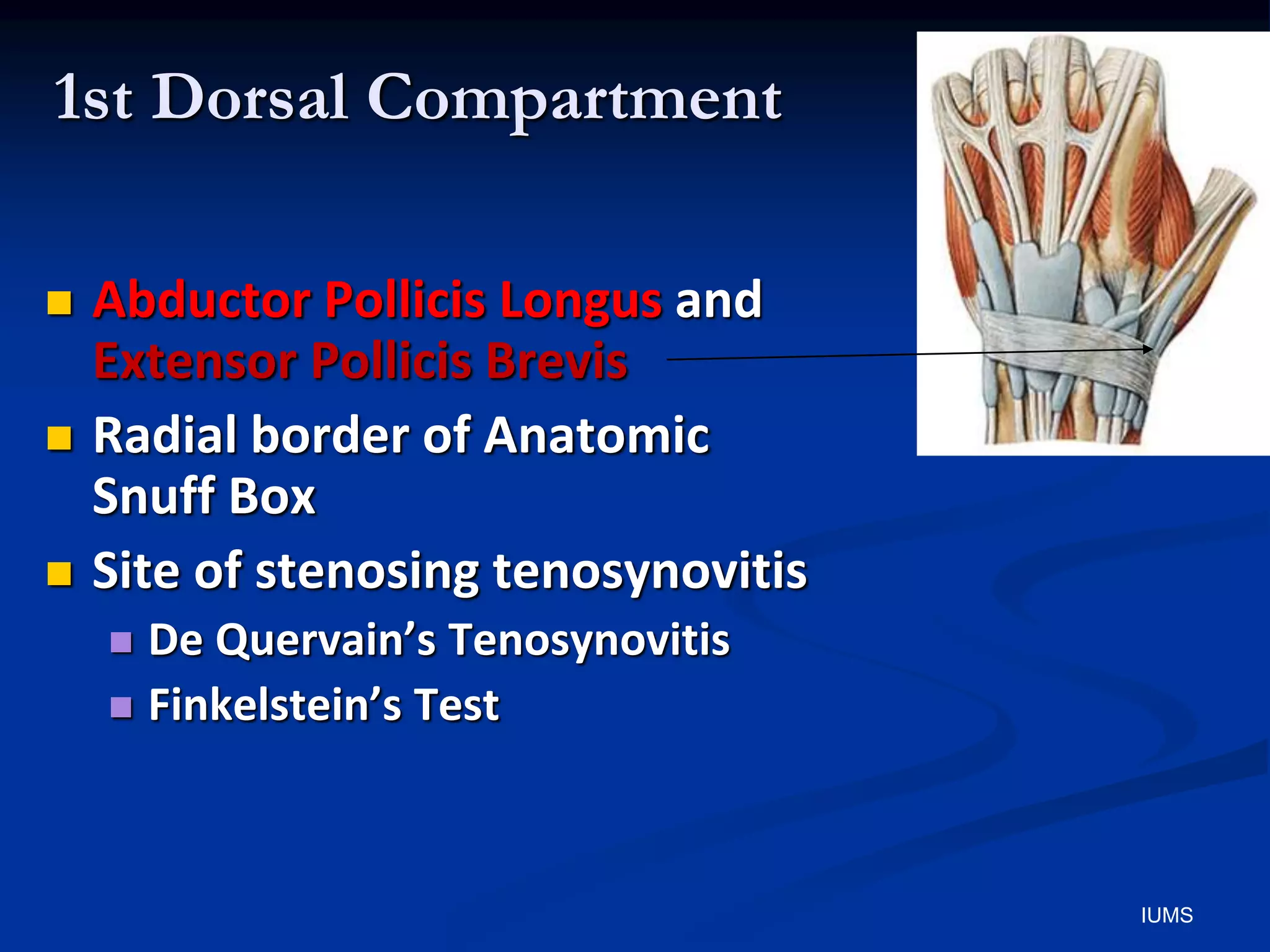
 Abductor Pollicis Longus and
Extensor Pollicis Brevis
 Radial border of Anatomic
Snuff Box
 Site of stenosing tenosynovitis
 De Quervain’s Tenosynovitis
 Finkelstein’s Test
IUMS
DeQuervain’s Tenosynovitis
 Inflammation of EXT
Pollicis Brevis and ABD
Pollicis Longus tendons
 Tenderness - 1st
Dorsal Compartment
 Finkelstein’s Test
IUMS
5 FINKELSTEINS TEST.mpg
2nd Dorsal Compartment
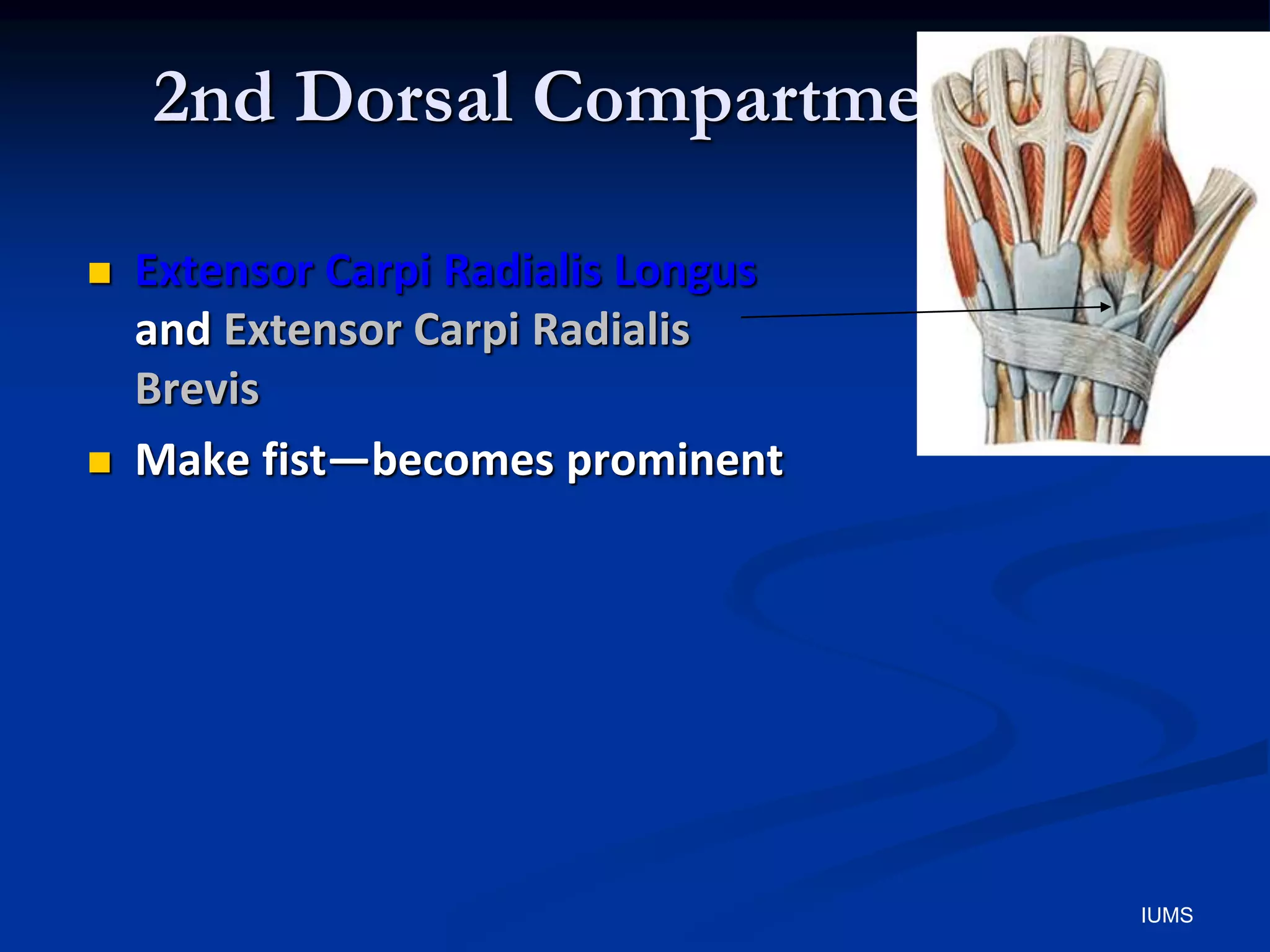
 Extensor Carpi Radialis Longus
and Extensor Carpi Radialis
Brevis
 Make fist—becomes prominent
IUMS
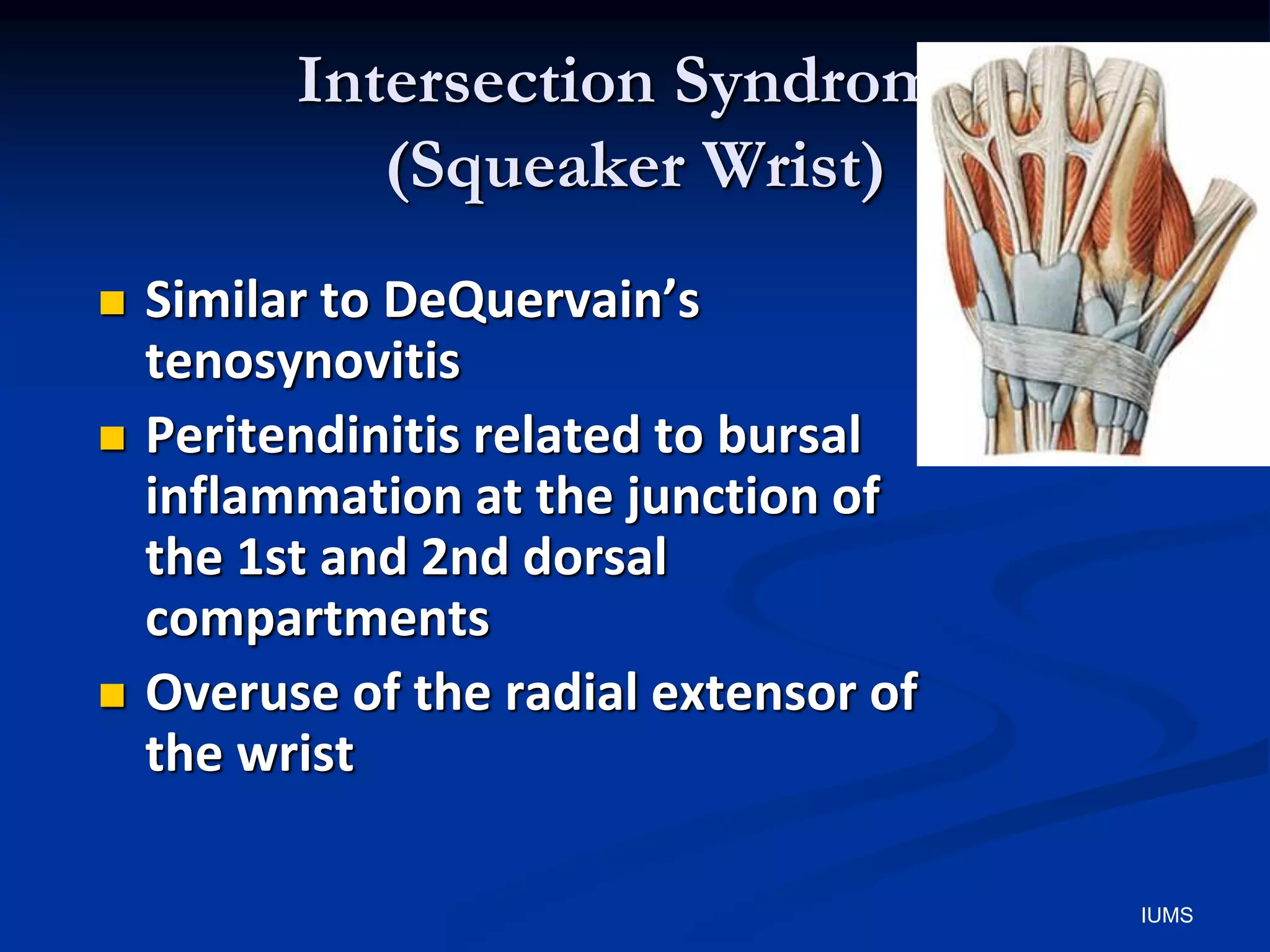
Intersection Syndrome
(Squeaker Wrist)
 Similar to DeQuervain’s
tenosynovitis
 Peritendinitis related to bursal
inflammation at the junction of
the 1st and 2nd dorsal
compartments
 Overuse of the radial extensor of
the wrist
IUMS
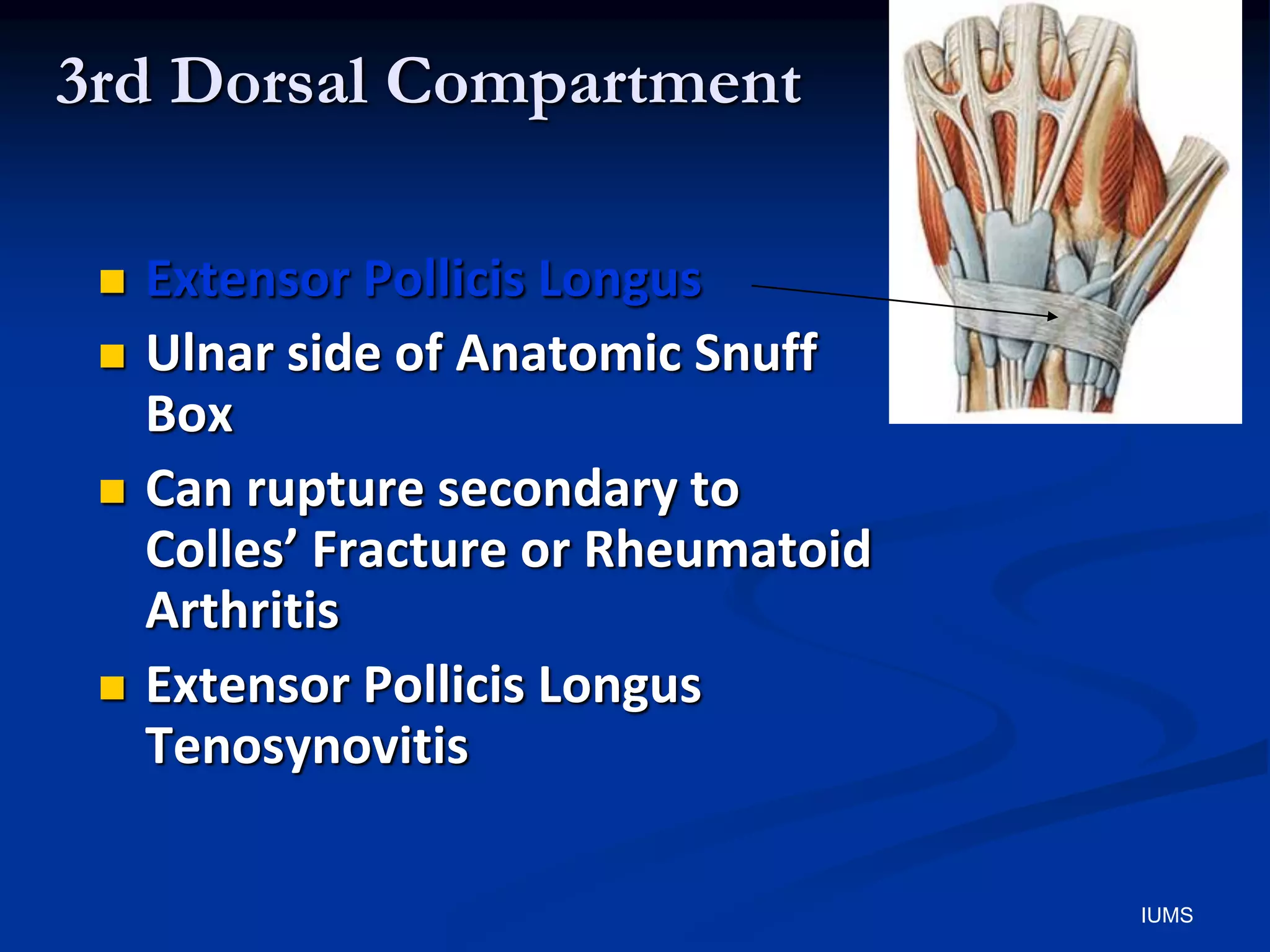
3rd Dorsal Compartment
 Extensor Pollicis Longus
 Ulnar side of Anatomic Snuff
Box
 Can rupture secondary to
Colles’ Fracture or Rheumatoid
Arthritis
 Extensor Pollicis Longus
Tenosynovitis
IUMS
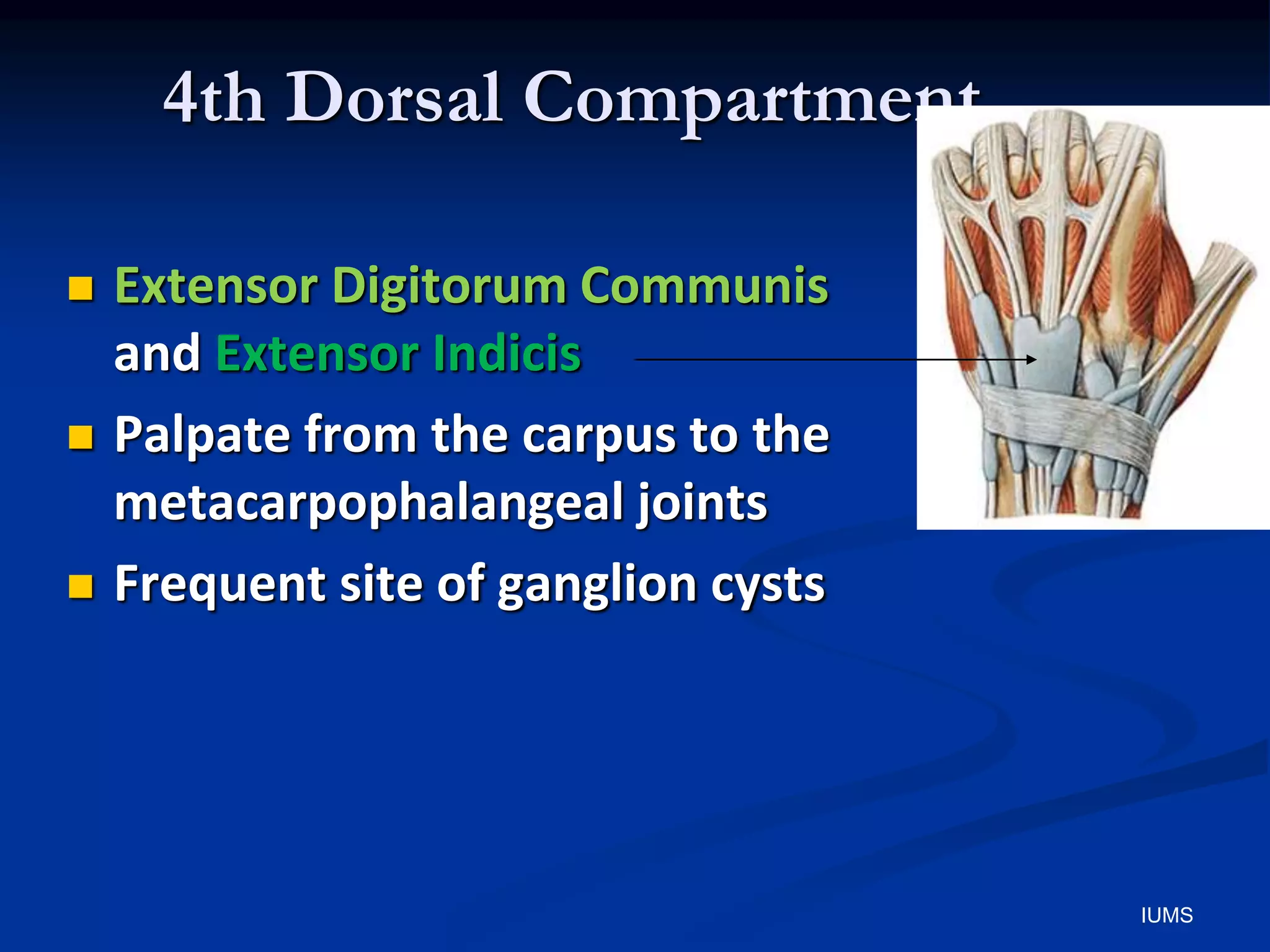
4th Dorsal Compartment
 Extensor Digitorum Communis
and Extensor Indicis
 Palpate from the carpus to the
metacarpophalangeal joints
 Frequent site of ganglion cysts
IUMS
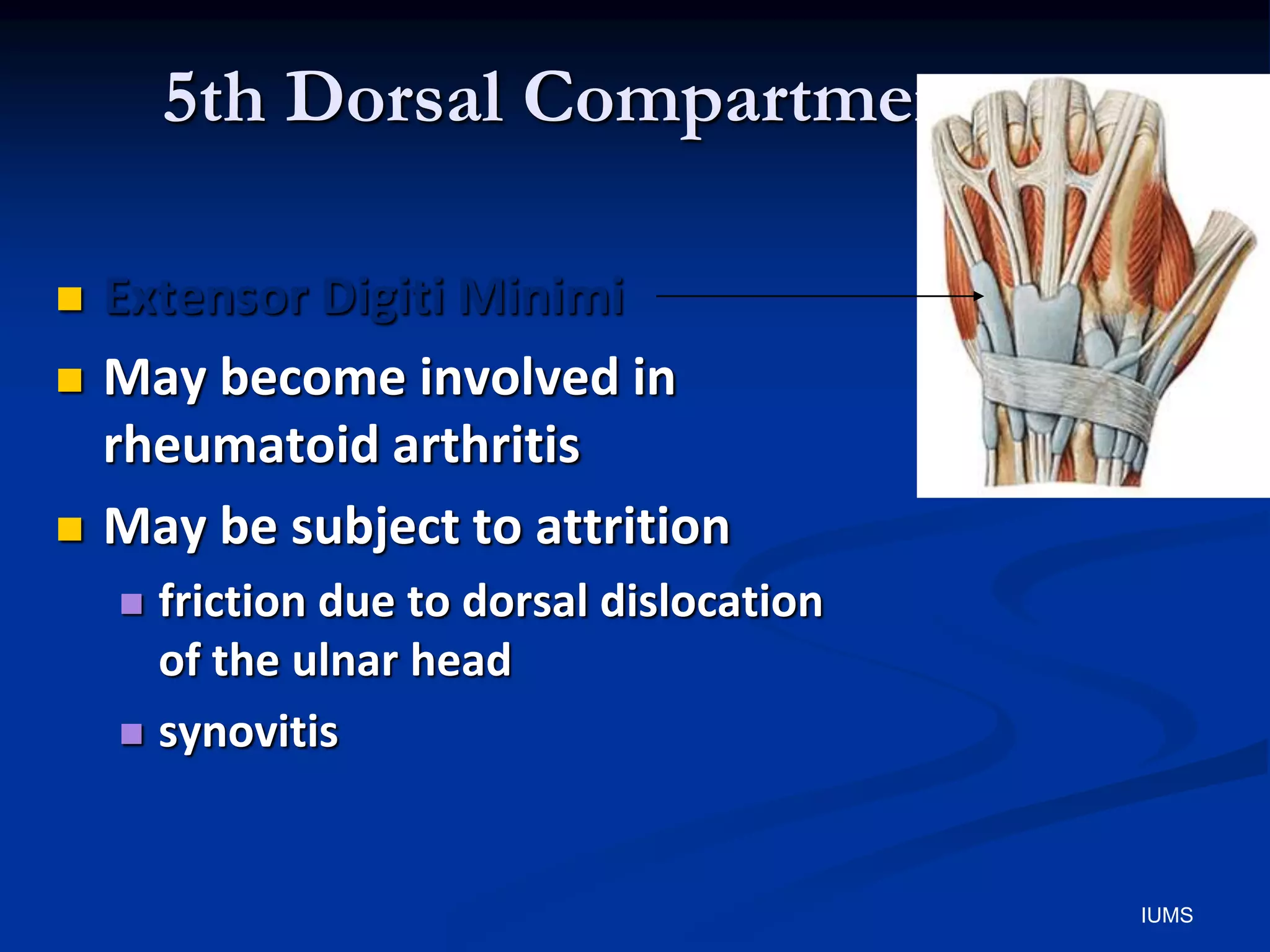
5th Dorsal Compartment
 Extensor Digiti Minimi
 May become involved in
rheumatoid arthritis
 May be subject to attrition
 friction due to dorsal dislocation
of the ulnar head
 synovitis
IUMS
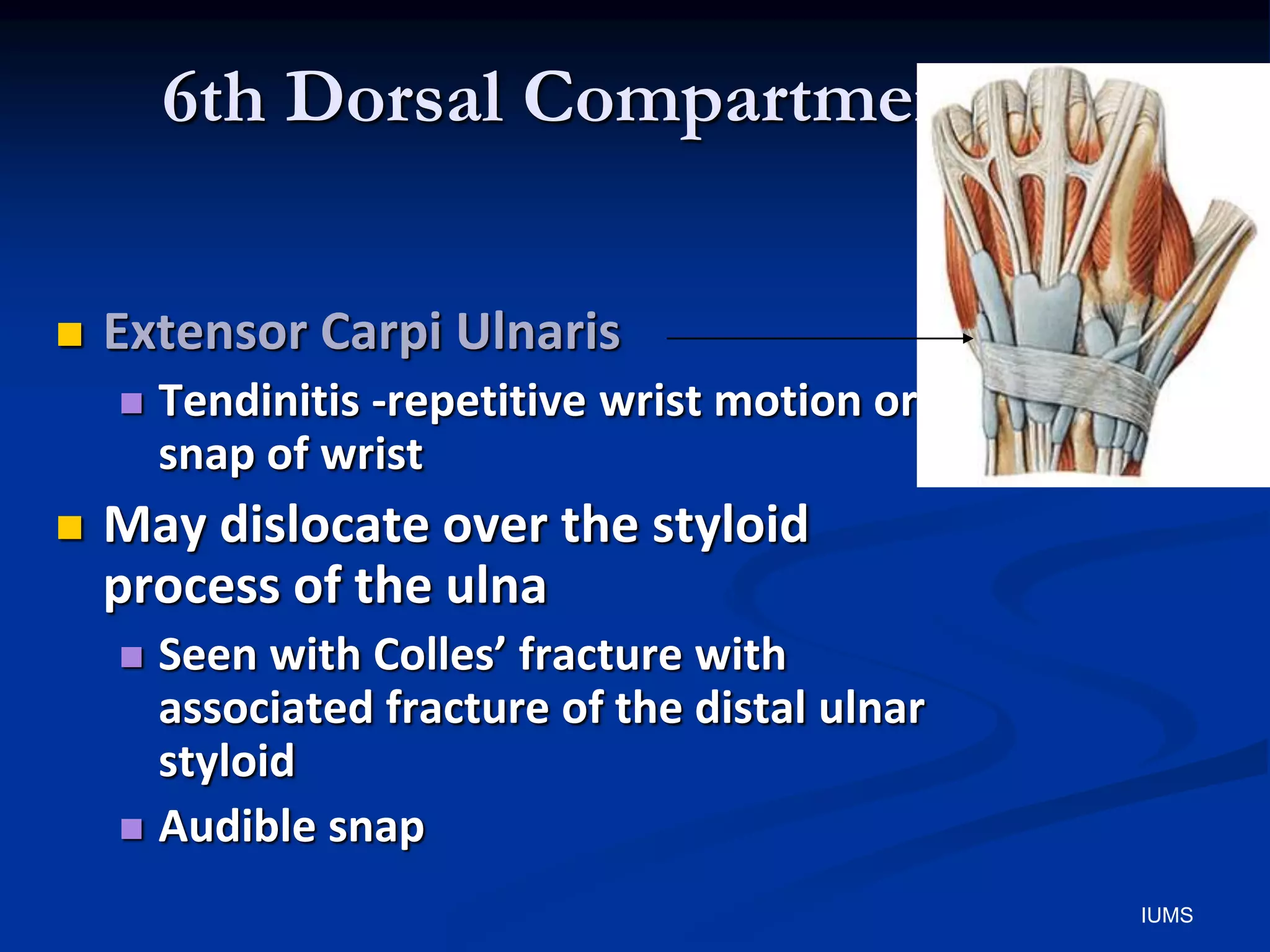
6th Dorsal Compartment
 Extensor Carpi Ulnaris
 Tendinitis -repetitive wrist motion or
snap of wrist
 May dislocate over the styloid
process of the ulna
 Seen with Colles’ fracture with
associated fracture of the distal ulnar
styloid
 Audible snap
IUMS
Thank
you.

General examination ms 2020

  • 1.
    MAGDI AWAD SASI MBBC,LMB, AMB, WHO GENERAL EXAMINATION
  • 2.
    Kurtz S, SilvermanJ, Benson J, Draper J (2003) Marrying Content and Process in Clinical Method Teaching: Enhancing the Calgary-Cambridge Guides. Academic Medicine;78(8):802-809 Providing Structure : • Making organisati on overt • Attendin g to flow Building the relation ship: • Using appropriate non-verbal behaviour • Developing rapport • Involving the patient Explanation and planning: • Providing the correct amount and type of information • Aiding accurate recall and understanding • Achieving a shared understanding: incorporating the patient’s illness framework • Planning, shared decision making Closing the session: • Ensuring appropriate point of closure • Forward planning Physical Examination Gathering Information: • Exploration of the patient’s problem to discover the: • Biomedical perspective • Patient perspective • Background information (context) Initiating the Session: • Preparation • Establishing initial rapport • Identifying reason for the consultation
  • 3.
     • Vitaldata.  • General examination.  • Systemic examination.
  • 4.
     Name OfThe Institution :  Name Of The Doctor:  Ward No:  Cot No :  Case No :  Date:  • Name Of The Patient :  • Age :  • Sex :  • Married Or Single :  • Children :  • Occupation :  • Income  • Address
  • 5.
    General Principles  Letthe patient tell their story  Listen  Develop a rapport, be friendly  Be interested  Use eye contact  Use appropriate language and terms
  • 6.
    General History  Thegeneral history is organized into the following sections:  • Identifying data (ID)  • Chief complaint (CC)  • History of the present illness (HPI)  • Past medical history (PMHx)  • Family history (FHx)  • Medications (MEDS) and Allergies (ALL)  • Social history (SHx)  • Review of systems or functional inquiry (ROS/FI)
  • 7.
    History taking THE PATIENTIS THE MOST IMPORTANT PERSON IN THE ROOM! ‘Always listen to the patient, they might be telling you the diagnosis’ Sir William Osler
  • 8.
    History of PresentIllness  Symptom characterization:  • 0 =Onset and duration  • P = Provoking and alleviating factors  • Q = Quality of pain (e.g. sharp, dull, throbbing)  • R = Does the pain radiate?  • S = Severity of pain ("on a scale from 1 to 10, 10 being the  most severe")  • T =Timing and progression ("Is the pain constant or  intermittent? Worse in the morning or at nighttime?")  • U = "How does it affect 'U' in your daily life?“  • V = Deja vu ("Has this happened before?")  • W ='What do you think it is?
  • 9.
    Instruments And Equipment:  • Stethoscope  • Sphygmomanometer  • Thermometer  • Torch  • Wooden tongue depressors  • Measuring tape  • Note:-  • Exam begins the minute you first see the patient  • Exam continues throughout your patient
  • 10.
    Instruments And Equipment:  • Note:-  • Exam begins the minute you first see the patient  • Exam continues throughout your patient interaction
  • 11.
    Purpose of GeneralPhysical Examination  To confirm an overall state of health  Baseline values for vital signs  To diagnose a medical problem  Usually focuses on organ system based on patient’s chief complaint
  • 12.
    GE  General examinationis actually the first step and Key component of diagnostic approach.  • Inspection is the major method during general examination, combining with palpation, auscultation, and smelling.  • Aims to 1. – Assess patient's general condition 2. – Detect manifestations of internal & systemic diseases  • 3 components:  – History taking – Clues are the symptoms  – Physical exam - Clues are the signs  – Investigations - Clues are test results
  • 13.
    General Appearance  Generalstate of health: Healthy/ill/comfortable/Distressed  • Body Built and Nutritional status  Height, Weight, BMI, Obese/lean, Tall/short  – Muscular/Asthenic/Cachexic  State of awareness or level of consciousness  Facial feature/expression/ Mood/Attitude  Speech(tone/voice)  Position/posture and Gait  Personal Hygiene  Breath/Odor
  • 14.
  • 19.
    Orthopnea  An abnormalcondition in which a person must keep the head  elevated (sit or stand) to breathe deeply or comfortably (orthopnea) or  wakes up suddenly in the middle of the night short of breath. It can be  seen in patients with lung or heart disease
  • 20.
     An elderlypatient who looks chronically ill. He is unable to speak more than two or  three words at a time due to shortness of breath. He has intercostal muscle  retraction when breathing and sits upright. Hi is thin with diffuse muscle wasting.
  • 22.
    EYES & FACE • Conjuctival pallor (anaemia)  • Sclera: jaundice, iritis  • Cornea: Kaiser Fleischer’s rings (Wilson’s disease)  • Xanthelasma (primary biliary cirrhosis)  • Parotid enlargement (alcohol)
  • 27.
    MOUTH  • Breath(fetor hepaticus)  • Lips  – Angular stomatitis, Cheilitis, Ulceration, Peutz-Jeghers syndrome  • Gums  – Gingivitis, bleeding, Candida albicans, Pigmentation  • Tongue  – Atrophic glossitis  – Leicoplakia  – Furring
  • 47.
    NECK  • Cervicallymphadenopathy  • Left supraclavicular fossa (Virchov’s node)  THyroid
  • 48.
  • 53.
    HANDS  Nails  –Clubbing  – Koilonychia  – Leuconychia  • Palmar erythema  • Dupuytren’s contractures  • Hepatic flap
  • 64.
    EDEMA  • Excessivebuild up of fluid in the tissues  • Either occurs throughout the body (generalized swelling)  or limited to a specific part of the body (localized swelling)  • It can be either pitting edema or non-pitting edema  • Mild : facial edema, peripheral edema  • Moderate: generalized edema  • Severe: generalized severe edema
  • 65.
    “If people seeany redness, blistering or swelling in the legs, especially if it is getting worse, they definitely need to see their doctor.” – Dr. Leslie Gilbert
  • 67.
    INSPECTION  Observe upper extremityas patient enters room  Examine hand in function  Deformities  Attitude of the hand IUMS
  • 68.
    INSPECTION Palmar Surface  Creases Thenar and Hypothenar Eminence  Arched Framework  Hills and Valleys  Web Spaces IUMS
  • 69.
    INSPECTION of DorsalHand and Wrist SMJ  Hills and Valleys  Height of metacarpal heads  Finger nails  Pale or white=anemia or circulatory  Spoon shaped=fungal infection  Clubbed=respiratory or congenital heart  Deformities IUMS
  • 70.
    Cascade sign  Assureall fingers point to scaphoid area when flexed at PIPs IUMS
  • 71.
    Ganglion  Cystic structurethat arises from synovial sheath  Discrete mass  Dull ache  Dorsal or Volar aspect IUMS
  • 72.
    Boutonniere Deformity  Tearor stretch of the central extensor tendon at PIP  Note: unopposed flexion at PIP  Extension at DIP  Trauma or inflammatory arthritis IUMS
  • 73.
    Swan Neck Deformity Contraction of intrinsic muscles (trauma, RA)  NOTE: Extension at PIP IUMS
  • 75.
  • 76.
    Rheumatoid Arthritis  MCPswelling  Swan neck deformities  Ulnar deviation at MCP joints  Nodules along tendon sheaths IUMS
  • 77.
    Ulnar Deviation, MCPSwelling, Left Wrist Swelling
  • 79.
    Mallet Finger  Hyperflexioninjury  Ruptured terminal extensor mechanism at DIP  Incomplete extension of DIP joint or extensor lag  Treatment:  stack splint IUMS
  • 80.
    Dupuytren’s Contractures  Palmaror digital fibromatosis  Flexion contracture  Painless nodules near palmar crease  Male> Female  Epilepsy, diabetes, pulmonary dz, alcoholism IUMS
  • 81.
    RANGE OF MOTION Active range of motion  Passive range of motion if unable to actively move joint  Bliateral comparison  To determine degrees of restriction IUMS
  • 82.
    RANGE OF MOTION Wrist Flexion  Extension  Radial deviation  Ulnar deviation  Ulnar deviation is greater than radial IUMS
  • 83.
    Mobility : (pronosupination)  Totest pronosupination, the patient is asked to keep his or her elbows close to the body and to turn the palm up and down alternatively. One arm of the goniometer is placed parallel to the axis of the humerus, and the other along the distal part of the forearm (Figure 1 & 2).  One should avoid measuring pronosupination with a stick in the patient's hands, as the pronosupination mobility is increased by the passive rotatory mobility of the carpus, which may be as high as 40°.  If the neutral prono-supination position is defined as zero (with the elbow flexed and maintained against the chest, the thumb must be raised up):  Normal pronation varies between 60 and 90°,  Normal supination, between 45 and 80°. 3/20/2021 83
  • 84.
    Figure 1: Measurement ofpronation: The vertical arm of the goniometer is placed in the axis of the arm and the horizontal arm on the dorsal surface of the wrist, but not the hand. Figure 2: Measurement of supination. The horizontal arm is placed on the volar surface of the wrist. 3/20/2021 84
  • 85.
    Flexion-extension 3/20/2021 85  Flexion-extensionmobility is measured by placing the goniometer on the palm for wrist extension, and along the dorsum of the hand for wrist flexion, over the axis of the third metacarpal bone (figure 3 & 4).  Normal values vary among individuals and may reach 85° of flexion or extension.  Both inclinations are measured with one arm of the goniometer along the axis of the forearm, and the other along the axis of the third metacarpal, with the wrist in the neutral position of flexion or extension. These methods are simple and reproducible.  Ulnar inclination varies between 30 and 45°,  Radial inclination, between 15 and 25°.
  • 86.
    3/20/2021 86 Figure 4: Masurementof extension: The goniometer is placed anteriorly on the wrist.
  • 88.
    Measurement of strength This should be done with a Jamar dynamometer, which is considered an international reference.  Measurements should be done, either using each of the five handle positions, which is time-consuming, or using only one handle position, with three successive measurements.  There are no standard values, and the contralateral hand serves as reference.  The mean of three different measurements with maximum muscular contraction is noted.  Usually, the curve for a single handle position is horizontal or slightly descending. Rapid alternating measurements changing from one hand to the other prevent patients from controlling their contraction and may reveal the absence of maximum contraction. 3/20/2021 88
  • 89.
    RANGE OF MOTION Fingers Flexion/extension at MCP, PIP, DIP  Tight fist and open  Do all fingers work in unison  ABDuction/ADDuction at MCP  Spread fingers apart and then back together IUMS
  • 90.
    CLINICAL EXAMINATION OF THEWRIST The normal wrist :  The key to correct examination of the wrist is precise location of the symptoms relating to the underlying anatomical structures, i.e., bones, articular spaces, ligaments or tendons.  As in all clinical examinations, the most painful area is examined last.  Comparative wrist examination is the rule, as there are no criteria of normality 3/20/2021 90
  • 91.
    PALPATION of Skin Warmth?  Dryness?  Anhydrosis= nerve damage  Scars IUMS
  • 92.
    Carpal Tunnel  Deepto palmaris longus  Contains median nerve and finger flexor tendons  Most common overuse injury of the wrist IUMS
  • 93.
    Carpal Tunnel Syndrome Entrapment of the median nerve  Phalen’s and Tinel’s Test  2 point discrimination  Symptoms  Aching in hand and arm  Nocturnal or AM paresthesias  “Shaking” to obtain relief IUMS
  • 94.
    Carpal Tunnel Tests Neurologic exam  Median nerve sensation and motor  Phalen’s Test: both wrists maximally flexed for 1 minute  Tinel’s Test IUMS
  • 95.
    PALPATION Palm of Hand Thenar Eminence  3 muscles of thumb  Atrophy seen in carpal tunnel syndrome  Hypothenar Eminance  3 muscles of little finger  Atrophy with ulnar nerve compression  Palmar Aponeurosis  Dupuytren’s Contracture IUMS
  • 96.
    PALPATION of Fingers Finger Flexor Tendons  Trigger Finger- sudden audible snapping with movement of one of the fingers  Extensor Tendons  Tufts of Fingers  Felon- local infection  Paronychia- hangnail infection IUMS
  • 97.
    SPECIAL TESTS Long FingerFlexor Test  Flexor Digitorum Superficialis Test  Flex finger at PIP  The only functioning tendon at the PIP  Flexor Digitorum Profundus Test  Flex at DIP  Inability to flex= tendon cut or denervated IUMS
  • 98.
    Flexor Tendon Injury “JerseyFinger”  Avulsion injury from rapid passive extension of the clenched fist  Loss of flexion at PIP and/or DIP  “+” sublimus or profundus tests IUMS
  • 99.
    Trigger Finger  Stenosingflexor tenosynovitis  Painful snap or lock  Palpate nodule as digit flexed and extended IUMS
  • 100.
    Flexor Tenosynovitis  Tendonsheath infection  Usually due to a puncture wound  Bacterial skin flora  Relative surgical emergency IUMS
  • 101.
    Flexor Tenosynovitis 4 CardinalSigns of Kanavel  Uniform swelling of the finger  Sensitivity along the course of the tendon sheaths  Pain upon passive extension  Fingers held in flexion IUMS
  • 102.
    RANGE OF MOTION Thumb Thumb flexion/extension at MCP and IP  Touch pad at base of little finger  Thumb ABD/ADD at carpometacarpal joint  Opposition  Touch tip of thumb to tip of each finger IUMS
  • 103.
    Skier’s Thumb Gamekeeper’s Thumb Ulnar Collateral Ligament rupture of the thumb MCP joint  Instability, weak and ineffective pinch  Radially directed stress at MCP joint- stable if opens <35 degrees IUMS
  • 104.
    NEUROLOGIC EXAM  Muscularassessment using grading system  Sensation testing  Bilateral comparison IUMS
  • 105.
    NEUROLOGIC EXAM Muscle Testing WRIST  EXT C6  FLEX C7  FINGERS  EXT C7  FLEX C8  ABD T1  ADD T1 IUMS
  • 106.
  • 107.
  • 108.
  • 109.
    C-6 NEUROLOGIC LEVEL WRISTEXTENSION BRACHIORADIALIS LATERAL FOREARM 109 IUMS
  • 110.
    C-7 NEUROLOGIC LEVEL WRISTFLEXION FINGER EXTENSION TRICEPS MIDDLE FINGER IUMS
  • 111.
    C-8 NEUROLOGIC LEVEL FINGERFLEXION MEDIAL FOREARM IUMS
  • 112.
    T-1 NEUROLOGIC LEVEL FINGERABUCTION MEDIAL ARM IUMS
  • 113.
    THE ALLEN TEST PURPOSE– TO EVALUATE BLOOD SUPPLY TO THE HAND METHOD – ASK PATIENT TO OPEN AND CLOSE THEIR WRIST (1) WITH THE PATIENTS WRIST CLOSED, APPLY PRESSURE TO THE ULNAR AND RADIAL ARTERY (2) ASK THE PATIENT TO OPEN THEIR HAND, RELEASE ONE OF THE ARTERIES (3), THE HAND SHOULD FLUSH IMMEDIATELY, IF NOT THEN THE ARTERY IS PARTIALLY OR COMPLETELY OCCLUDED (4) 1 2 3 4 4 IUMS
  • 114.
    RADIOLOGIC STUDIES  APand Lateral of hand and wrist  Consider Obliques and special views if fracture suspected but not seen on AP and Lateral IUMS
  • 115.
    EXAMINATION OF RELATED AREAS Referred pain can be due to:  Herniated cervical discs  Osteoarthritis  Brachial plexus outlet syndrome  Elbow and shoulder entrapment syndrome IUMS
  • 116.
    Scapholunate instability:  Themechanism of scapholunate injury includes a fall onto a hyperextended wrist with the forearm in pronation and the impact point on the thenar eminence .  Radial pain and progressive loss of strength are usual . Loss of mobility appears much later. Patients may sometimes complain of a snapping wrist which usually occurs during the passage from radial deviation to neutral with the wrist in flexion.  In ulnar deviation, the snap represents the action of the scaphoid on the lunate bone and the sudden correction of the proximal carpal row into dorsiflexion.  With wrist flexion, a snap may represent penetration of the capitate into the scapholunate interval (rare), or the dorsal subluxation of the scaphoid on the posterior margin of the radius . 3/20/2021 135
  • 117.
    1-The synovial irritationsign of the scaphoid. To elicit this sign, pain is induced by exerting pressure on the scaphoid through the anatomical snuffbox (Figure 19). This sign is usually positive in patients with scaphoid instability, but its specificity is very low. 3/20/2021 136
  • 118.
    (2) The scaphoidbell sign.  This is performed by palpation of the scaphoid tuberosity anteriorly through the radial groove while placing the index finger in the anatomical snuffbox.  With ulnar deviation of the wrist, the anterior protrusion of the distal scaphoid tuberosity disappears and the proximal pole appears in the snuffbox.  With radial deviation, the proximal pole disappears in the snuffbox and the protrusion of the distal scaphoid tuberosity reappears in the radial groove.  Any disruption of this normal mechanism is suggestive of instability, but the sensitivity of this test seems very low . 3/20/2021 137
  • 119.
    (3) The scapholunateballottement test. •This test is designed to highlight any abnormal motion between the scaphoid and lunate bones. •With one hand the examiner holds the scaphoid between his thumb (placed distally over the scaphoid tuberosity on the palmar side) and index finger . •(placed posteriorly and proximally over the proximal pole of the scaphoid). The other hand holds the lunate). •The hands then move in opposite directions and appreciate the ballotement between the two bones. •It may be difficult to appreciate instability as the normal laxity of the scapholunate joint varies greatly among individuals . •However, if the test induces pain, this is a good sign. •This test, as all tests, may be compared to the opposite wrist to appreciate normal variations. 3/20/2021 138
  • 120.
    3/20/2021 139  Scapholunateballottement is more marked when the wrist is in slight flexion, and, in this position, dorsal protrusion of the second row is sometimes visible .  Flexing the wrist also brings the lunate more dorsal and distal to the dorsal rim of the radius making it easier to palpate the lunate.  Another technique to palpate the scapholunate interval is to place the index finger on the dorsal and distal pole of the lunate and then move the index finger radially while moving the wrist in flexion and extension.  One can sometimes feel a groove corresponding to the scapholunate interval, or more often a slight protrusion of the proximal pole of the scaphoid.  The limitations of these tests are connected with the difficulty to hold the lunate bone correctly.
  • 121.
    (4) The wrist-flexionfinger-extension maneuver was described by Watson. With the elbow resting on the table, the wrist is placed in flexion and the patient is asked to extend the fingers. Application of pressure on the nails may reveal pain in the scapholunate interval. Figure 21: The wrist-flexion finger-extension maneuver. This maneuver induces loads into the carpus that arouses pain at the scapholunate space. 3/20/2021 140
  • 122.
    (5) Watson's testor the scaphoid shear test  The examiner and patient face each other as for arm wrestling.  The examiner's fingers are placed dorsally on the distal radius, while the thumb is placed on the palmar distal tuberosity of the scaphoid.  The other hand holds the metacarpals. Firm pressure is applied to the palmar tuberosity of the scaphoid while the wrist is moved in ulnar deviation which places the scaphoid in extension.  While the wrist is moved in radial deviation the scaphoid cannot flex, as it is blocked from flexing by the examiner's thumb. 3/20/2021 141
  • 123.
    3/20/2021 142  Incase of scapholunate tear, or in lax wrist patients, the scaphoid will move dorsally under the posterior margin of the radius and will reach the examiner's index finger, thus inducing pain (Figure 22).  Sometimes this test may only be painful, without any perception of dorsal scaphoid displacement.  When pressure on the scaphoid is removed, the scaphoid goes back into position with what Watson described as a "thunk" (a clunk)
  • 124.
     In certainpatients, the absence of normal mobility compared to the uninjured wrist may be due to swelling and/or synovitis.  To avoid false-positive testing, the examiner should first place his fingers on the posterior surface of the scaphoid to detect spontaneous pain.  Lane suggested modifying the Watson's test by moving the scaphoid only from an anterior to a posterior position (he called it the Scaphoid shift test).  This modification would enhance the test's sensitivity by using simple movements. 3/20/2021 143
  • 125.
    Figure 22: TheWatson's test. 3/20/2021 144
  • 126.
    Lunotriquetral instability:  Lunotriquetralinstability may appear after a hyperpronation injury ,but more often after a hyperextension injury with an impact on the ulnar side.  Ninety per cent of patients complain of ulnar pain, and lunotriquetral joint palpation is usually painful .  Active prono-supination movements against resistance are painful if the resistance causes twisting of the carpus .  A feeling of instability or loss of strength is present in rare cases. A snap or clunk may be observed in half of the patients during ulnar deviation or extension . 3/20/2021 145
  • 127.
    The lunotriquetral ballottementtest or Reagan's test (also called the Shuck or shear test, depending on the authors):  as in the scapholunate ballottement test, the clinician holds the lunate bone between his thumb and index finger with one hand, and moves the triquetrum with the pisiform dorsal and palmar (Figure 23). The aim is to appreciate instability (very difficult) and above all the arousal of pain [30-32]. The sensitivity of this test varies from 33 to 100%, depending on the authors, and its specificity is still unknown. 3/20/2021 146
  • 128.
    Figure 23: The lunotriquetralballottement test (Reagan's test) 3/20/2021 147
  • 129.
    Kleinman's shear test (whichsome authors call the shuck test!)  With the patient's forearm in a vertical position, the examiner places one finger on the posterior part of the lunate and with his contralateral thumb placed palmar, pushes the pisiform dorsal which arouses pain in the lunotriquetral joint.  This test might be more sensitive and more specific than the Reagan's test. 3/20/2021 148 Figure 24: The Kleinman's test.
  • 130.
    The ulnar snuffbox compression test (Linscheid's test)  This test may be the least specific according to Kleinman  The thumb placed on the ulnar side of the triquetrum exerts an axial pressure directed toward the lunate, which arouses pain. 3/20/2021 149
  • 131.
    The raised triquetrumtest  was recently proposed by Zradkovic and Sennwald (personal communication).  The examiner holds the patient's hand proximal to the wrist and places his thumb on the triquetrum.  From the neutral position, without flexion or extension, he performs radial and ulnar deviation movements and appreciates the dorsal and palmar movements of the triquetrum, which should be compared to those of the other wrist (Figures 26 a,b,c).  The sensitivity and specificity of this test are still unknown, as are the anatomical lesions which cause the test to be positive.  As pointed out by Gilula, the triquetrum is very prominent or dorsal with radial deviation, and moves palmarly and may even disapear with ulnar deviation.  On plain radiographs, the triquetrum is located "onto" or proximal on the hamate with radial deviation (superposed), and "lateral" or ulnar to it with ulnar deviation (juxtaposed) [Laredo, personal communication]. 3/20/2021 150
  • 132.
    The raised triquetrumtest In Fig 26a, the examiner places the wrist in radial deviation while palpating the triquetrum. He then moves the wrist in neutral (26b) and ulnar (26c) deviation to appreciate the depression of the triquetrum with ulnar deviation and prominence of the triquetrum with radial deviation that should be compared to the contralateral wrist. Fig 26a (26b) (26c) 3/20/2021 151
  • 133.
    Distal radioulnar joint(DRUJ) instability :  As the ulna is fixed, the radius is the dislocated bone, but we have kept the usual convention which describes "dislocation of the ulna".  A traumatic movement in supination is responsible for anterior DRUJ instability, while posterior DRUJ instability follows a pronation injury.  Dorsal ulnar dislocation is responsible for  loss of supination and  protrusion of the ulnar head.  In case of dorsal ulna subluxation, the protrusion of the ulnar head may be clearly visible when viewed laterally, and unlike what occurs in the normal wrist, does not disappear if the injured wrist is flexed.  Anterior ulnar dislocation  makes the dorsal skin depress and  limits pronation.  In anterior subluxation, the usual protrusion of the ulnar head is reduced or disappears. 3/20/2021 152
  • 134.
    3/20/2021 153  Painsecondary to DRUJ instability is located on the ulnar side of the wrist and is intensified by pronation or supination.  In such cases the examiner stabilizes the patient's forearm with one hand while with the other hand, he grasps the patient's hand as if for a vigorous handshake.  When the patient resists forced passive rotation, or when there is active rotation against resistance, pain usually is elicited.  If the pain is caused by compressing the ulna against the radius, it is mostly suggestive of chondromalacia .  Patients may also complain of a snap which occurs during pronation or supination and corresponds to either dislocation of the ulnar head or to its reduction.
  • 135.
    radioulnar ballottement test 3/20/2021154  Radioulnar instability is tested by the radioulnar ballottement test, in which the patient's elbow is flexed, and the examiner uses his thumb and index finger to stabilize the radius radially and the ulnar head ulnarly (Figure 29).  Normally, there is no mobility in the anterior or posterior direction in maximum pronation or supination.  Pain or mobility is very suggestive of radioulnar instability.  The ballottement test must not only be done during extreme motions of pronation and supination, but also in various intermediate pronation and supination positions, because instability may only appear in some of these positions.
  • 136.
    3/20/2021 155 Figure 29: Theradioulnar ballottement test.
  • 137.
     TFCC lesionsare usually of degenerative origin, but may also constitute the first stage of radioulnar instability.  Pain is always ulnar and is intensified by wrist movements but not necessarily by pronation or supination.  It is usually aggravated by ulnar inclination or rotational loads: thus, in the screwdriver test, the examiner holds the patient's hand while performing screwing and unscrewing movements. 3/20/2021 156
  • 138.
    3/20/2021 157  Extensorcarpi ulnaris tendon dislocation is not a ligamentous injury but occurs after combined hypersupination and ulnar inclination.  Passive pronation and supination are usually painful and may be accompanied by a visible and palpable snap which can be reproduced by placing the wrist in flexion and supination. Figure 30: Displacement of the extensor carpi ulnaris is more visible when the wrist is placed in flexion and supination.
  • 139.
  • 141.
    PALPATION of Wrist Dorsum Radial Styloid  Scaphoid  1st MC/Trapezium jt  Lunate  Lister’s Tubercle  Ulnar Styloid  TFCC  Triquetrum  Pisiform  Hook of Hamate  Guyon’s Tunnel IUMS
  • 142.
    PALPATION of HAND Bone Metacarpals - 5  Phalanges - 14  Palpate for swelling, tenderness  Assess for symmetry IUMS
  • 143.
    Conditions of examination:  The wrist must be examined with the forearm free of clothing and jewelry. For a satisfactory examination, the patient and the examiner should be comfortably seated.  The ideal solution is to place the patient's forearm on a narrow examination table whose height may vary.  In clinical practice, the easiest solution is to sit very close to the patient so that his or her hand rests on the examiner's knee, with the patient's elbow resting on his thigh. 3/20/2021 174 A "practical" position for wrist examination
  • 144.
     Physical examinationusually begins on the dorsal surface of the wrist, with pronation of the forearm and wrist flexion, whereas the ulnar surface of the wrist is examined during maximum elbow flexion.  For palpation, the examiner stabilizes the wrist with both hands and uses his (her) thumbs to palpate the anatomical structures. IUMS
  • 145.
    Cutaneous projection ofthe anatomical structures  A beauty (the richness) of wrist examination is due to the fact that almost all bony, articular, tendinous or vascular structures may be palpated through the skin that covers it.  To be compete, the physical examination should be methodical and whichever structure is examined first, the examination should cover the entire wrist. 3/20/2021 176
  • 146.
     Dorsal surface:Proximal to the wrist, proceding from the radius to the ulna it is easy to identify the radial styloid.  One cm proximal you will palpate the sharp bony ridge which limits the first extensor compartment.  More ulnar is a dorsal bump on the distal radius which is Lister's tubercle, around which passes ulnarly the extensor pollicis longus tendon (figure 6 & 7).  Closer to the ulna and ulnar to Lister`s tubercle, one can feel the flat dorsal surface of the radius and the ulnar head which protrudes in pronation.  On the ulnar side of the wrist, the ulnar styloid can be palpated dorsally in supination, at the ulnar and volar surfaces in pronation and on the ulnar side of the wrist in neutral rotation. 3/20/2021 177
  • 147.
    Ulnar Styloid palpation Lister’sTubercle palpation Ulnar styloid
  • 148.
    Figure 6: To examinea wrist correctly, one should mentally project the bones onto the skin. Figure 7: Main palpable bony structures on the dorsal surface of the wrist (redrawn after.) 3/20/2021 179
  • 149.
     At thelevel of the carpus, the anatomical snuffbox is easy to locate radially: it is limited  radially by the extensor pollicis brevis and the abductor pollicis longus and  ulnarly by the extensor pollicis longus.  The scaphoid lies at the bottom of the snuffbox, with the radial artery crossing over it. 3/20/2021 180
  • 150.
    3/20/2021 181  Inradial deviation the scaphoid disappears dorsally and one can palpate the scaphotrapezial joint palmarly (figures 8 & 9).  Dorsally, at the distal end of the scaphoid there is a groove in which the examiner can place an index finger to palpate the trapezoid along the axis of the second metacarpal, and the trapezium along the axis of the first metacarpal .
  • 151.
    Radial Styloid palpation ScaphoidBone palpation Radial styloid IUMS
  • 152.
    1st MC/Trapezium jointpalpation 3/20/2021 183 Figure 9: The cutaneous projection of the anatomical snuffbox. Figure 8: The scaphoid lies at the bottom of the anatomical snuffbox and distal to it lies the scaphotrapezial joint. Palpation of bony structures varies during radial and ulnar deviation.
  • 153.
    3/20/2021 184  Theradial part of this groove, just ulnar to the extensor pollicis longus tendon, is what is termed the STT entry point (scaphotrapeziotrapezoidal) for mid-carpal arthroscopy. Figure 10: The midcarpal joint can be palpated through the groove between the scaphoid and the trapezium and trapezoid bones.
  • 154.
    3/20/2021 185  Inthe middle of the dorsal surface of the carpus, one centimeter distal to Lister's tubercle, lies the scapholunate interval.  the scapholunate interval can be palpated just distal to the dorsal rim of the radius at the level of Lister`s tubercle, with flexion of the wrist.  Flexion moves the lunate dorsally out of the lunate fossa as shown figure 5. Just radial to that point, the proximal pole of the scaphoid can be palpated if the wrist is in flexion.
  • 155.
  • 156.
    3/20/2021 187  Ulnarand distal to the scapholunate space lies a concavity which corresponds to the neck of the capitate . Figure 11: The posterior surface of the waist of the capitate is palpable through a depression easily found in the midportion of the dorsal surface of the wrist.
  • 157.
     (French anatomistsuse the term “the crucifixion groove” as it represents the place where you should place your nails if you plan to crucify somebody...) When the wrist is flexed, the lunate and the head of the capitate are more easily palpable. 3/20/2021 188 Figure 12: Wrist flexion allows palpation of the head of the capitate and the posterior horn of the lunate.
  • 158.
    3/20/2021 189  Slightlyradial to the neck of the capitate and one cm distal to the scapholunate interval is the radial entry point of the midcarpal space.  The prominence of the third metacarpal base, the third metacarpal styloid, is located one to one and a half cm distal to that point, between the capitate and the trapezoid. It is more or less developed depending on the individual and may sometimes be hidden by the insertion of the extensor carpi radialis brevis tendon.
  • 159.
    3/20/2021 190  Whenthe wrist is in neutral position, with the third metacarpal in the axis of the radius i.e. without flexion or extension or radial or ulnar deviation:  the ulnar head,  triquetrum,  hamate and  fifth metacarpal form a continuous line on the ulnar side of the wrist
  • 160.
    Figure 8: The scaphoidlies at the bottom of the anatomical snuffbox and distal to it lies the scaphotrapezial joint. Palpation of bony structures varies during radial and ulnar deviation. Figure 9: The cutaneous projection of the anatomical snuffbox. Figure 10: The midcarpal joint can be palpated through the groove between the scaphoid and the trapezium and trapezoid bones. Figure 11: The posterior surface of the waist of the capitate is palpable through a depression easily found in the midportion of the dorsal surface of the wrist. 3/20/2021 191
  • 161.
    The triquetrolunate jointand triquetrum  may be palpated during radial deviation of the wrist.  The triquetrum is palpated just distal to the ulnar head and disappears with ulnar deviation.  The triquetrohamate space whose mobility can be appreciated lies distal to the dorsal tubercle of the triquetrum (Figure 13).  On the ulnar side of the wrist lies the "ulnar snuffbox" between the extensor and the flexor carpi ulnaris tendons. At the base of this snuffbox one can palpate the triquetrum during radial inclination, as well as the triquetrohamate joint distal to it, which is a drainage portal for mid-carpal arthroscopy (Figure 14). 3/20/2021 192
  • 162.
    Figure 13: Theulnar "anatomical snuffbox". 3/20/2021 193
  • 163.
    PALPATION Palmar Aspect  Pisiformand Hamate  Tunnel of Guyon  Ulnar Artery  Carpal Tunnel  Flexor Carpi Radialis  Flexor Carpi Ulnaris IUMS
  • 164.
    The palmar surface:  The bony structures on this surface are too deep to be palpated.  However, it is possible to palpate not only the radial and ulnar styloid processes but also, radially, the trapezial ridge which lies at the base of the thenar eminence, as well as the scaphotrapezial space and proximal to the distal tuberosity of the scaphoid. 3/20/2021 195
  • 165.
    pisiform 3/20/2021 196  whenthe wrist is in extension (Figure 15). Ulnarly, the pisiform is easily palpated, just distal to the distal wrist crease. Figure15: Main palpable bony structures on the anterior side of the wrist (redrawn after)
  • 166.
  • 167.
    The hamate hook(hamulus ossi hamatum) Figure 16: The hamulus ossi hamatum (hook of the hamate) is palpated deeply, 2 cm below the pisiform bone, on a line joining the pisiform to the head of the second metacarpal bone. 3/20/2021 198  lies just along the radial edge of the pisiform, on a line from the pisiform to the second metacarpal head.  The articular spaces of the carpus are not accessible to palpation, but the radiocarpal joint is located at the level of the middle part of the proximal wrist flexion crease, while the midcarpal joint is located at the level of the middle of the distal flexion wrist crease.
  • 168.
    Tunnel of Guyon Depression between pisiform and hook of hamate  Contains ulnar nerve and artery  Site of compression injuries  unusually tender if pathology is present IUMS
  • 169.
    Volar flexor tendons Flexor carpiulnaris Palmaris longus Flexor carpi radialis
  • 170.
    Thumb CMC JointArthritis  Painful pinch or grasp  “Grind Test”  Axial pressure to thumb while palpating CMC joint IUMS
  • 171.
    Scapholunate Dissociation  Diagnosisoften missed  Pain, swelling, and decreased ROM  Pressure over scaphoid tuberosity elicits pain  Greatest pain over dorsal scapholunate area, accentuated with dorsiflexion  X-ray shows widening of scapholunate joint space by at least 3 mm IUMS
  • 172.
    Triangular Fibrocartilage Complex Injuries(axialload test)  Ulnar sided wrist pain, swelling, loss of grip strength  “Click” with ulnar deviation  Point tenderness distal to ulnar styloid  TFCC load test IUMS
  • 173.
    PALPATION of HAND Bone Metacarpals - 5  Phalanges - 14  Palpate for swelling, tenderness  Assess for symmetry IUMS
  • 174.
    PALPATION Soft tissue  6Dorsal Compartments  Transport extensor tendons  2 Palmar Tunnels  Transport nerves, arteries, flexor tendons IUMS
  • 175.
    1st Dorsal Compartment Abductor Pollicis Longus and Extensor Pollicis Brevis  Radial border of Anatomic Snuff Box  Site of stenosing tenosynovitis  De Quervain’s Tenosynovitis  Finkelstein’s Test IUMS
  • 176.
    DeQuervain’s Tenosynovitis  Inflammationof EXT Pollicis Brevis and ABD Pollicis Longus tendons  Tenderness - 1st Dorsal Compartment  Finkelstein’s Test IUMS 5 FINKELSTEINS TEST.mpg
  • 177.
    2nd Dorsal Compartment Extensor Carpi Radialis Longus and Extensor Carpi Radialis Brevis  Make fist—becomes prominent IUMS
  • 178.
    Intersection Syndrome (Squeaker Wrist) Similar to DeQuervain’s tenosynovitis  Peritendinitis related to bursal inflammation at the junction of the 1st and 2nd dorsal compartments  Overuse of the radial extensor of the wrist IUMS
  • 179.
    3rd Dorsal Compartment Extensor Pollicis Longus  Ulnar side of Anatomic Snuff Box  Can rupture secondary to Colles’ Fracture or Rheumatoid Arthritis  Extensor Pollicis Longus Tenosynovitis IUMS
  • 180.
    4th Dorsal Compartment Extensor Digitorum Communis and Extensor Indicis  Palpate from the carpus to the metacarpophalangeal joints  Frequent site of ganglion cysts IUMS
  • 181.
    5th Dorsal Compartment Extensor Digiti Minimi  May become involved in rheumatoid arthritis  May be subject to attrition  friction due to dorsal dislocation of the ulnar head  synovitis IUMS
  • 182.
    6th Dorsal Compartment Extensor Carpi Ulnaris  Tendinitis -repetitive wrist motion or snap of wrist  May dislocate over the styloid process of the ulna  Seen with Colles’ fracture with associated fracture of the distal ulnar styloid  Audible snap IUMS
  • 183.