ANALBDOME
Examination:
MAGDI AWAD SASI
LMB LIMU WHO
7TH OCTOPER
HOSPITAL
Abdominal quadrants
Rt. hypochondrium
Rt.iliac fossa
Lt.hypochondrium
Lt.iliac fossa
LT.lumber
Rt.lumber
Look for:
Abdominal contour (distended ,scaphoid,
localized bulge & hernias)
Abdominal movement,peristalisis,pulsation
Surgical scars
dilated veins
Abnormal colours
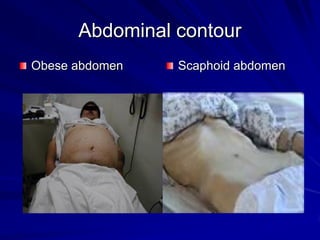
Abdominal contour
Obese abdomen Scaphoid abdomen
Abdominal swelling
Ascites Hepatomegaly
Technique
Kneel beside the patient right side
Ask the patient if he has pain at any site of his abdomen
Start palpation while looking to the patient face
Superficial palpation for tenderness, rigidity & guarding
Deep palpation for masses , hepatomegaly and
splenomegaly
Bimanual palpation and ballottement for kidneys
Palpate hernial orifices (cough impulse)
Palpate for inguinal LAP
Palpate from the back for renal angles
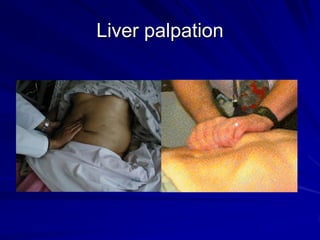
Palpation for hepatomegaly
Start from the right iliac fossa
Use finger tips or index finger side
Apply slow, steady pressure, pushing up
and in while the patient takes a deep
breath
Try to feel the lower edge of the liver
touching your fingers during inspiration
Liver palpation
Palpation for splenomegaly
Start from right iliac fossa
Use the tips of your fingers progress diagonally
up ward and to the left
Try to feel the lower border of the spleen
touching your fingers during inspiration
Try to localize the spleenic notch
Try to hook fingers below the left lower costal
margin
Repeat the exam with the patient turned onto
their right side
Palpation of the kidneys
Put left hand at the renal angle (costo-
vertebral angle) and the right hand parallel
to it on the flank and try to push and rock
to feel for an enlarged kidney (bimanual
palpation)
Then push the kidney up by the hand at
the renal angle and try to feel the kidney
hitting the other hand and goes back
(ballottement)
Percussion for liver dullness
Percussion for spleenic dullness
Percussion for shifting dullness
Check for fluid thrill
Percussion notes
Tympanitic (drum-like) sounds produced
by percussing over air filled structures
( stomach & bowels).
Dull sounds that occur over a solid
structure (e.g. liver) or fluid (e.g. ascites)
Percussion for liver dullness
Start just below the right breast at the
midclavicular line. Percussion in this area should
produce a relatively resonant note.
Move your hand down a few centimeters and
repeat. After doing this several times, you will be
over the liver, which will produce a duller
sounding tone.
Continue your march downward until the sound
changes once again. This may occur just as you
pass over the costal margin. At this point, you
will have reached the inferior margin of the liver.
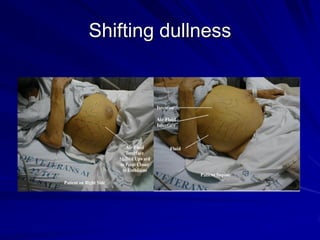
Shifting dullness
With the patient supine, begin percussion at the level of
the umbilicus and proceed down laterally. In the
presence of ascites, you will reach a point where the
sound changes from tympanitic to dull.
Mark this point on both the right and left sides of the
abdomen and then have the patient roll into a lateral
decubitus position (i.e. onto either their right or left
sides).
Repeat percussion, beginning at the top of the patient's
now up-turned side and moving down towards the
umbilicus. If there is ascites, fluid will flow to the most
dependent portion of the abdomen. The place at which
sound changes from tympanitic to dull will therefore have
shifted upwards
Shifting dullness
Fluid thrill
Ask the patient or an observer to place their hand so that
it is oriented longitudinally over the center of the
abdomen.
They should press firmly so that the subcutaneous tissue
and fat do not jiggle.
Place your right hand on the left side of the abdomen
and your left hand opposite
firmly tap on the abdomen with your right hand while
your left remains against the abdominal wall.
If there is large ascites, you may be able to feel a fluid
wave strike against the abdominal wall under your left
hand (fluid thrill)
listening for 15 or 20 seconds.
Listen for bowel sounds and bruits
Bowel sounds occur every 2 to 5 seconds.
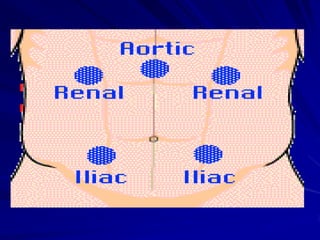
check for bruits over renal arteries, aortic
artery and common iliac arteries
Listen for sucction splash

Abdomen examination ms 2021

  • 1.
    ANALBDOME Examination: MAGDI AWAD SASI LMBLIMU WHO 7TH OCTOPER HOSPITAL
  • 4.
    Abdominal quadrants Rt. hypochondrium Rt.iliacfossa Lt.hypochondrium Lt.iliac fossa LT.lumber Rt.lumber
  • 5.
    Look for: Abdominal contour(distended ,scaphoid, localized bulge & hernias) Abdominal movement,peristalisis,pulsation Surgical scars dilated veins Abnormal colours
  • 6.
  • 7.
  • 9.
    Technique Kneel beside thepatient right side Ask the patient if he has pain at any site of his abdomen Start palpation while looking to the patient face Superficial palpation for tenderness, rigidity & guarding Deep palpation for masses , hepatomegaly and splenomegaly Bimanual palpation and ballottement for kidneys Palpate hernial orifices (cough impulse) Palpate for inguinal LAP Palpate from the back for renal angles
  • 10.
    Palpation for hepatomegaly Startfrom the right iliac fossa Use finger tips or index finger side Apply slow, steady pressure, pushing up and in while the patient takes a deep breath Try to feel the lower edge of the liver touching your fingers during inspiration
  • 11.
  • 12.
    Palpation for splenomegaly Startfrom right iliac fossa Use the tips of your fingers progress diagonally up ward and to the left Try to feel the lower border of the spleen touching your fingers during inspiration Try to localize the spleenic notch Try to hook fingers below the left lower costal margin Repeat the exam with the patient turned onto their right side
  • 13.
    Palpation of thekidneys Put left hand at the renal angle (costo- vertebral angle) and the right hand parallel to it on the flank and try to push and rock to feel for an enlarged kidney (bimanual palpation) Then push the kidney up by the hand at the renal angle and try to feel the kidney hitting the other hand and goes back (ballottement)
  • 14.
    Percussion for liverdullness Percussion for spleenic dullness Percussion for shifting dullness Check for fluid thrill
  • 15.
    Percussion notes Tympanitic (drum-like)sounds produced by percussing over air filled structures ( stomach & bowels). Dull sounds that occur over a solid structure (e.g. liver) or fluid (e.g. ascites)
  • 16.
    Percussion for liverdullness Start just below the right breast at the midclavicular line. Percussion in this area should produce a relatively resonant note. Move your hand down a few centimeters and repeat. After doing this several times, you will be over the liver, which will produce a duller sounding tone. Continue your march downward until the sound changes once again. This may occur just as you pass over the costal margin. At this point, you will have reached the inferior margin of the liver.
  • 17.
    Shifting dullness With thepatient supine, begin percussion at the level of the umbilicus and proceed down laterally. In the presence of ascites, you will reach a point where the sound changes from tympanitic to dull. Mark this point on both the right and left sides of the abdomen and then have the patient roll into a lateral decubitus position (i.e. onto either their right or left sides). Repeat percussion, beginning at the top of the patient's now up-turned side and moving down towards the umbilicus. If there is ascites, fluid will flow to the most dependent portion of the abdomen. The place at which sound changes from tympanitic to dull will therefore have shifted upwards
  • 18.
  • 19.
    Fluid thrill Ask thepatient or an observer to place their hand so that it is oriented longitudinally over the center of the abdomen. They should press firmly so that the subcutaneous tissue and fat do not jiggle. Place your right hand on the left side of the abdomen and your left hand opposite firmly tap on the abdomen with your right hand while your left remains against the abdominal wall. If there is large ascites, you may be able to feel a fluid wave strike against the abdominal wall under your left hand (fluid thrill)
  • 20.
    listening for 15or 20 seconds. Listen for bowel sounds and bruits Bowel sounds occur every 2 to 5 seconds. check for bruits over renal arteries, aortic artery and common iliac arteries Listen for sucction splash