Social Epidemiology:
Social and Behavioral
Concepts
Nicole Kunkel
Purpose
➔ Effectively communicate terminology used
in social epidemiology in a manner by
which the general population can
understand.
➔ Improve knowledge and awareness of the
general population regarding social
epidemiology concepts.
Social Epidemiology
➔ “Comprehensive study of health, well-being, social conditions or problems,
and diseases and their determinants”
➔ Use of epidemiology and behavioral/social science to improve and promote
health
◆ Epidemiology: branch of medicine dealing with incidence, distribution,
and possible control of disease and related health factors
➔ Used to develop interventions, programs, policies, and institutions that
promote public health
➔ Studies: social distribution and social determinants of different states of
health
➔ Understanding: social variables and conditions can determine which
factors affect illness and health
◆ Emphasis: social factors
Chronic Illness
➔ A persistent or long-lasting disease that progresses slowly and is usually
controlled, but cannot be cured
➔ Alternation between symptomatic periods and periods of remission or
stability
◆ Remission: periods of relative health with little to no symptoms in
between symptomatic periods or episodes
◆ Some chronic illnesses have acute episodes with abrupt symptom
changes in between remission periods
● Acute episode/occurrence: abrupt onset of intense symptoms,
usually within a short duration
➔ Usually applied when the course of the disease lasts longer than 3 months
➔ Ex: Cancer, Ulcerative Colitis, HIV/AIDS, Epilepsy, Sickle Cell Anemia
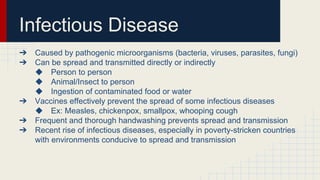
Infectious Disease
➔ Caused by pathogenic microorganisms (bacteria, viruses, parasites, fungi)
➔ Can be spread and transmitted directly or indirectly
◆ Person to person
◆ Animal/Insect to person
◆ Ingestion of contaminated food or water
➔ Vaccines effectively prevent the spread of some infectious diseases
◆ Ex: Measles, chickenpox, smallpox, whooping cough
➔ Frequent and thorough handwashing prevents spread and transmission
➔ Recent rise of infectious diseases, especially in poverty-stricken countries
with environments conducive to spread and transmission
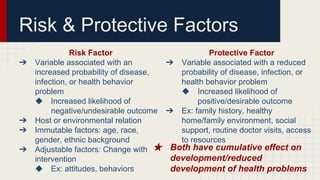
Risk & Protective Factors
Risk Factor
➔ Variable associated with an
increased probability of disease,
infection, or health behavior
problem
◆ Increased likelihood of
negative/undesirable outcome
➔ Host or environmental relation
➔ Immutable factors: age, race,
gender, ethnic background
➔ Adjustable factors: Change with
intervention
◆ Ex: attitudes, behaviors
Protective Factor
➔ Variable associated with a reduced
probability of disease, infection, or
health behavior problem
◆ Increased likelihood of
positive/desirable outcome
➔ Ex: family history, healthy
home/family environment, social
support, routine doctor visits, access
to resources
★ Both have cumulative effect on
development/reduced
development of health problems
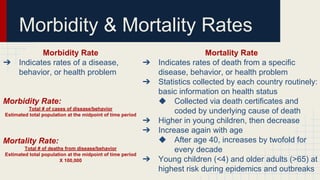
Morbidity Rate
➔ Indicates rates of a disease,
behavior, or health problem
Morbidity Rate:
Total # of cases of disease/behavior
Estimated total population at the midpoint of time period
Mortality Rate:
Total # of deaths from disease/behavior
Estimated total population at the midpoint of time period
X 100,000
Morbidity & Mortality Rates
Mortality Rate
➔ Indicates rates of death from a specific
disease, behavior, or health problem
➔ Statistics collected by each country routinely:
basic information on health status
◆ Collected via death certificates and
coded by underlying cause of death
➔ Higher in young children, then decrease
➔ Increase again with age
◆ After age 40, increases by twofold for
every decade
➔ Young children (<4) and older adults (>65) at
highest risk during epidemics and outbreaks
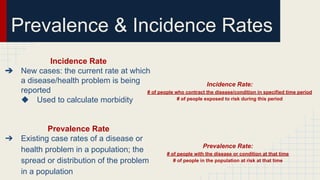
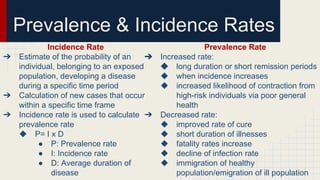
Prevalence & Incidence Rates
Incidence Rate
➔ New cases: the current rate at which
a disease/health problem is being
reported
◆ Used to calculate morbidity
Prevalence Rate
➔ Existing case rates of a disease or
health problem in a population; the
spread or distribution of the problem
in a population
Incidence Rate:
# of people who contract the disease/condition in specified time period
# of people exposed to risk during this period
Prevalence Rate:
# of people with the disease or condition at that time
# of people in the population at risk at that time
Prevalence Rate
➔ Increased rate:
◆ long duration or short remission periods
◆ when incidence increases
◆ increased likelihood of contraction from
high-risk individuals via poor general
health
➔ Decreased rate:
◆ improved rate of cure
◆ short duration of illnesses
◆ fatality rates increase
◆ decline of infection rate
◆ immigration of healthy
population/emigration of ill population
Incidence Rate
➔ Estimate of the probability of an
individual, belonging to an exposed
population, developing a disease
during a specific time period
➔ Calculation of new cases that occur
within a specific time frame
➔ Incidence rate is used to calculate
prevalence rate
◆ P= I x D
● P: Prevalence rate
● I: Incidence rate
● D: Average duration of
disease
Prevalence & Incidence Rates
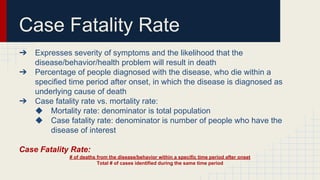
Case Fatality Rate
➔ Expresses severity of symptoms and the likelihood that the
disease/behavior/health problem will result in death
➔ Percentage of people diagnosed with the disease, who die within a
specified time period after onset, in which the disease is diagnosed as
underlying cause of death
➔ Case fatality rate vs. mortality rate:
◆ Mortality rate: denominator is total population
◆ Case fatality rate: denominator is number of people who have the
disease of interest
Case Fatality Rate:
# of deaths from the disease/behavior within a specific time period after onset
Total # of cases identified during the same time period
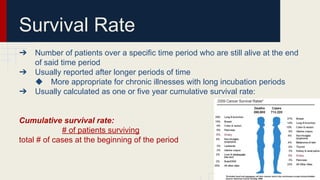
Survival Rate
➔ Number of patients over a specific time period who are still alive at the end
of said time period
➔ Usually reported after longer periods of time
◆ More appropriate for chronic illnesses with long incubation periods
➔ Usually calculated as one or five year cumulative survival rate:
Cumulative survival rate:
# of patients surviving
total # of cases at the beginning of the period
Self-Efficacy
➔ Key element in how people change
behavior that goes beyond the
mechanistic conditioning process of
change
◆ Gives individuals a role in their own
change
➔ A person’s belief in his or her ability to
take action and confidence to overcome
obstacles
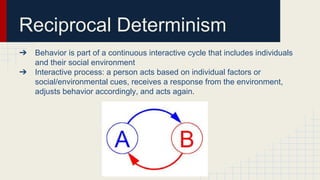
Reciprocal Determinism
➔ Behavior is part of a continuous interactive cycle that includes individuals
and their social environment
➔ Interactive process: a person acts based on individual factors or
social/environmental cues, receives a response from the environment,
adjusts behavior accordingly, and acts again.
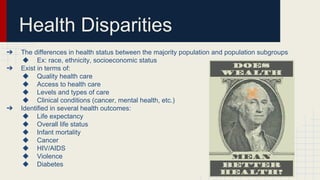
Health Disparities
➔ The differences in health status between the majority population and population subgroups
◆ Ex: race, ethnicity, socioeconomic status
➔ Exist in terms of:
◆ Quality health care
◆ Access to health care
◆ Levels and types of care
◆ Clinical conditions (cancer, mental health, etc.)
➔ Identified in several health outcomes:
◆ Life expectancy
◆ Overall life status
◆ Infant mortality
◆ Cancer
◆ HIV/AIDS
◆ Violence
◆ Diabetes
Health Disparities: Causes
➔ Causes of health disparities:
◆ Socioeconomic status
◆ Lack of access to resources
◆ High poverty levels
◆ Immigration
◆ Cultural beliefs/attitudes
◆ Lack of health care coverage
◆ Mistrust towards
government/physicians
◆ Discrimination
◆ Environmental risks
◆ Social exclusion
◆ Lack of cultural competence
◆ Housing segregation
◆ Neighborhood
characteristics and physical
environment
➔ Individual approach
◆ address individual knowledge and awareness among a specific population
◆ Use theories to structure education and intervention
➔ Social, community, and group approaches
◆ Community mobilization or advocacy
● Ex: improve access to healthcare, remove environmental risk affecting
a minority community
◆ Health communications strategies, social network, and cultural approaches
● Used to address shared norms, beliefs, and attitudes of a population
◆ Community mobilization with ecological approaches
● Used as part of a coordinated community strategy in order to reduce
socioeconomic disparities
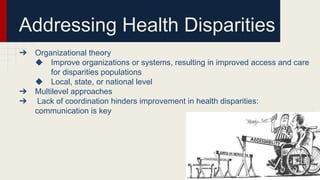
Addressing Health Disparities
➔ Organizational theory
◆ Improve organizations or systems, resulting in improved access and care
for disparities populations
◆ Local, state, or national level
➔ Multilevel approaches
➔ Lack of coordination hinders improvement in health disparities:
communication is key
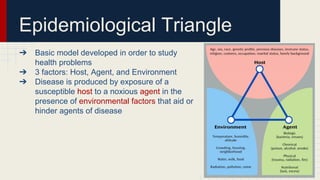
Epidemiological Triangle
➔ Basic model developed in order to study
health problems
➔ 3 factors: Host, Agent, and Environment
➔ Disease is produced by exposure of a
susceptible host to a noxious agent in the
presence of environmental factors that aid or
hinder agents of disease
Epidemiological Triangle
➔ Host: the person/animal harboring the infectious agent, acted upon by
noxious noninfectious agent, or has experienced event/behavior of interest
◆ the “who” of the triangle
➔ Agent: infectious microorganism, chemical, or vulnerable substance
◆ the “what” of the triangle
◆ Ex: lead, radiation, excess/deficiency of nutritional elements such as
calories, carbs, or iron
➔ Environmental Factors: external conditions that promote or hinder the
action of an agent on a susceptible host
◆ the “where” of the disease
◆ Ex: drought, high temperatures, rain
Impact Application
➔ Slideshare: upload of presentation to public presentation database
➔ Studyblue: upload of presentation to public study material site

Impact application project

  • 1.
    Social Epidemiology: Social andBehavioral Concepts Nicole Kunkel
  • 2.
    Purpose ➔ Effectively communicateterminology used in social epidemiology in a manner by which the general population can understand. ➔ Improve knowledge and awareness of the general population regarding social epidemiology concepts.
  • 3.
    Social Epidemiology ➔ “Comprehensivestudy of health, well-being, social conditions or problems, and diseases and their determinants” ➔ Use of epidemiology and behavioral/social science to improve and promote health ◆ Epidemiology: branch of medicine dealing with incidence, distribution, and possible control of disease and related health factors ➔ Used to develop interventions, programs, policies, and institutions that promote public health ➔ Studies: social distribution and social determinants of different states of health ➔ Understanding: social variables and conditions can determine which factors affect illness and health ◆ Emphasis: social factors
  • 4.
    Chronic Illness ➔ Apersistent or long-lasting disease that progresses slowly and is usually controlled, but cannot be cured ➔ Alternation between symptomatic periods and periods of remission or stability ◆ Remission: periods of relative health with little to no symptoms in between symptomatic periods or episodes ◆ Some chronic illnesses have acute episodes with abrupt symptom changes in between remission periods ● Acute episode/occurrence: abrupt onset of intense symptoms, usually within a short duration ➔ Usually applied when the course of the disease lasts longer than 3 months ➔ Ex: Cancer, Ulcerative Colitis, HIV/AIDS, Epilepsy, Sickle Cell Anemia
  • 5.
    Infectious Disease ➔ Causedby pathogenic microorganisms (bacteria, viruses, parasites, fungi) ➔ Can be spread and transmitted directly or indirectly ◆ Person to person ◆ Animal/Insect to person ◆ Ingestion of contaminated food or water ➔ Vaccines effectively prevent the spread of some infectious diseases ◆ Ex: Measles, chickenpox, smallpox, whooping cough ➔ Frequent and thorough handwashing prevents spread and transmission ➔ Recent rise of infectious diseases, especially in poverty-stricken countries with environments conducive to spread and transmission
  • 6.
    Risk & ProtectiveFactors Risk Factor ➔ Variable associated with an increased probability of disease, infection, or health behavior problem ◆ Increased likelihood of negative/undesirable outcome ➔ Host or environmental relation ➔ Immutable factors: age, race, gender, ethnic background ➔ Adjustable factors: Change with intervention ◆ Ex: attitudes, behaviors Protective Factor ➔ Variable associated with a reduced probability of disease, infection, or health behavior problem ◆ Increased likelihood of positive/desirable outcome ➔ Ex: family history, healthy home/family environment, social support, routine doctor visits, access to resources ★ Both have cumulative effect on development/reduced development of health problems
  • 7.
    Morbidity Rate ➔ Indicatesrates of a disease, behavior, or health problem Morbidity Rate: Total # of cases of disease/behavior Estimated total population at the midpoint of time period Mortality Rate: Total # of deaths from disease/behavior Estimated total population at the midpoint of time period X 100,000 Morbidity & Mortality Rates Mortality Rate ➔ Indicates rates of death from a specific disease, behavior, or health problem ➔ Statistics collected by each country routinely: basic information on health status ◆ Collected via death certificates and coded by underlying cause of death ➔ Higher in young children, then decrease ➔ Increase again with age ◆ After age 40, increases by twofold for every decade ➔ Young children (<4) and older adults (>65) at highest risk during epidemics and outbreaks
  • 8.
    Prevalence & IncidenceRates Incidence Rate ➔ New cases: the current rate at which a disease/health problem is being reported ◆ Used to calculate morbidity Prevalence Rate ➔ Existing case rates of a disease or health problem in a population; the spread or distribution of the problem in a population Incidence Rate: # of people who contract the disease/condition in specified time period # of people exposed to risk during this period Prevalence Rate: # of people with the disease or condition at that time # of people in the population at risk at that time
  • 9.
    Prevalence Rate ➔ Increasedrate: ◆ long duration or short remission periods ◆ when incidence increases ◆ increased likelihood of contraction from high-risk individuals via poor general health ➔ Decreased rate: ◆ improved rate of cure ◆ short duration of illnesses ◆ fatality rates increase ◆ decline of infection rate ◆ immigration of healthy population/emigration of ill population Incidence Rate ➔ Estimate of the probability of an individual, belonging to an exposed population, developing a disease during a specific time period ➔ Calculation of new cases that occur within a specific time frame ➔ Incidence rate is used to calculate prevalence rate ◆ P= I x D ● P: Prevalence rate ● I: Incidence rate ● D: Average duration of disease Prevalence & Incidence Rates
  • 10.
    Case Fatality Rate ➔Expresses severity of symptoms and the likelihood that the disease/behavior/health problem will result in death ➔ Percentage of people diagnosed with the disease, who die within a specified time period after onset, in which the disease is diagnosed as underlying cause of death ➔ Case fatality rate vs. mortality rate: ◆ Mortality rate: denominator is total population ◆ Case fatality rate: denominator is number of people who have the disease of interest Case Fatality Rate: # of deaths from the disease/behavior within a specific time period after onset Total # of cases identified during the same time period
  • 11.
    Survival Rate ➔ Numberof patients over a specific time period who are still alive at the end of said time period ➔ Usually reported after longer periods of time ◆ More appropriate for chronic illnesses with long incubation periods ➔ Usually calculated as one or five year cumulative survival rate: Cumulative survival rate: # of patients surviving total # of cases at the beginning of the period
  • 12.
    Self-Efficacy ➔ Key elementin how people change behavior that goes beyond the mechanistic conditioning process of change ◆ Gives individuals a role in their own change ➔ A person’s belief in his or her ability to take action and confidence to overcome obstacles
  • 13.
    Reciprocal Determinism ➔ Behavioris part of a continuous interactive cycle that includes individuals and their social environment ➔ Interactive process: a person acts based on individual factors or social/environmental cues, receives a response from the environment, adjusts behavior accordingly, and acts again.
  • 14.
    Health Disparities ➔ Thedifferences in health status between the majority population and population subgroups ◆ Ex: race, ethnicity, socioeconomic status ➔ Exist in terms of: ◆ Quality health care ◆ Access to health care ◆ Levels and types of care ◆ Clinical conditions (cancer, mental health, etc.) ➔ Identified in several health outcomes: ◆ Life expectancy ◆ Overall life status ◆ Infant mortality ◆ Cancer ◆ HIV/AIDS ◆ Violence ◆ Diabetes
  • 15.
    Health Disparities: Causes ➔Causes of health disparities: ◆ Socioeconomic status ◆ Lack of access to resources ◆ High poverty levels ◆ Immigration ◆ Cultural beliefs/attitudes ◆ Lack of health care coverage ◆ Mistrust towards government/physicians ◆ Discrimination ◆ Environmental risks ◆ Social exclusion ◆ Lack of cultural competence ◆ Housing segregation ◆ Neighborhood characteristics and physical environment
  • 16.
    ➔ Individual approach ◆address individual knowledge and awareness among a specific population ◆ Use theories to structure education and intervention ➔ Social, community, and group approaches ◆ Community mobilization or advocacy ● Ex: improve access to healthcare, remove environmental risk affecting a minority community ◆ Health communications strategies, social network, and cultural approaches ● Used to address shared norms, beliefs, and attitudes of a population ◆ Community mobilization with ecological approaches ● Used as part of a coordinated community strategy in order to reduce socioeconomic disparities Addressing Health Disparities
  • 17.
    Addressing Health Disparities ➔Organizational theory ◆ Improve organizations or systems, resulting in improved access and care for disparities populations ◆ Local, state, or national level ➔ Multilevel approaches ➔ Lack of coordination hinders improvement in health disparities: communication is key
  • 18.
    Epidemiological Triangle ➔ Basicmodel developed in order to study health problems ➔ 3 factors: Host, Agent, and Environment ➔ Disease is produced by exposure of a susceptible host to a noxious agent in the presence of environmental factors that aid or hinder agents of disease
  • 19.
    Epidemiological Triangle ➔ Host:the person/animal harboring the infectious agent, acted upon by noxious noninfectious agent, or has experienced event/behavior of interest ◆ the “who” of the triangle ➔ Agent: infectious microorganism, chemical, or vulnerable substance ◆ the “what” of the triangle ◆ Ex: lead, radiation, excess/deficiency of nutritional elements such as calories, carbs, or iron ➔ Environmental Factors: external conditions that promote or hinder the action of an agent on a susceptible host ◆ the “where” of the disease ◆ Ex: drought, high temperatures, rain
  • 20.
    Impact Application ➔ Slideshare:upload of presentation to public presentation database ➔ Studyblue: upload of presentation to public study material site