Anti Hypertensive Drugs 
Dr. Shamshuddin Patel Sr. 
Intern 2009-10 Batch 
Mandya Institute Of Medical Sciences
Introduction 
• CURRENT DEFINITION (W.H.O.) 
A level of systolic blood pressure of 140 mm Hg or above, or a level of 
diastolic blood pressure of 90mm Hg or above, by repeated 
measurements at periods of several weeks.
Classification of Hypertension
Regulation Of Blood Pressure 
• Baroreceptors & the sympathetic NS: for rapid moment to moment control 
• Renal responses: Renin Angiotensin – Aldosterone system, for long term control. 
• Others: Endothelin, Nitric oxide, Vasopressin
Normal Blood Pressure Regulation 
• Hydraulic equation: 
Blood Pressure = Cardiac output (CO) X Resistance to passage 
of blood through precapillary arterioles (PVR) 
• Physiologically CO and PVR is maintained minute to minute 
by – arterioles (1) postcapillary venules (2) and Heart (3) 
• Kidney is the fourth site – volume of intravascular fluid 
• Baroreflex, humoral mechanism and renin-angiotensin-aldosterone 
system regulates the above 4 sites 
• Local agents like Nitric oxide 
• In hypertensives – Baroreflex and renal blood-volume 
control system – set at higher level 
• All antihypertensives act via interfering with normal 
mechanisms
ROLE OF KIDNEYS IN BLOOD PRESSURE 
• As sympathetic stimulus decreases blood flow to the kidneys, renin is released 
activating the RAA (renin-angiotensin-aldosterone) system. 
• Renin activates angiotensinogen from the liver to convert to angiotensin I 
• Angiotensin Converting Enzyme (ACE) from the lungs changes angiotensin I to 
angiotensin II 
• Angiotensin II is a potent vasoconstrictor and activates release of Aldosterone 
from the adrenal cortex and anti-diuretic hormone (ADH) from the hypothalamus 
• Aldosterone retains sodium in the kidneys 
• ADH stimulates thirst and retains water in the kidneys tubules 
1-9
Classification Of AntiHypertensives 
1)Drugs acting centrally. 
2)Drugs acting on autonomic ganglia. 
3)Drugs acting on the postganglionic sympathetic nerve ending. 
4)Drugs acting on the adrenergic receptors. 
5)Drugs acting on the vascular smooth muscle. 
6)Potassium channel activators. 
7)Drugs which block renin-angiotensin-aldosterone axis. 
8)Diuretics.
• Drugs acting centrally:- 
Alpha2 adrenergic receptor stimulants:- 
e.g.:- Clonidine and methyldopa 
Selective imidazole receptor (I-receptor) Stimulant:- 
e.g.:- Moxonidine 
• Drugs acting on the autonomic ganglion:- 
Ganglion blocking agents 
e.g.:- Trimethaphan 
• Drugs acting on the postganglionic sympathetic nerve endings:- 
Adrenergic neuron blockers 
e.g.:- Guaenethidine, Bethanidine, Debrisoquine, Bretylium. 
Catecholamine depletors 
e.g.:- Reserpine 
• Drugs acting on adrenergic receptors :- 
Alpha-adrenergic blocking agents 
e.g.:- Phentolamine, Phenoxybenzamine, Prazosine, Indoramine. 
Beta-adrenergic blocking agents 
e.g.:- Propranolol, Atenolol, Metoprolol. 
Both alpha and beta adrenergic blocking drugs 
e.g.:- Labetalol
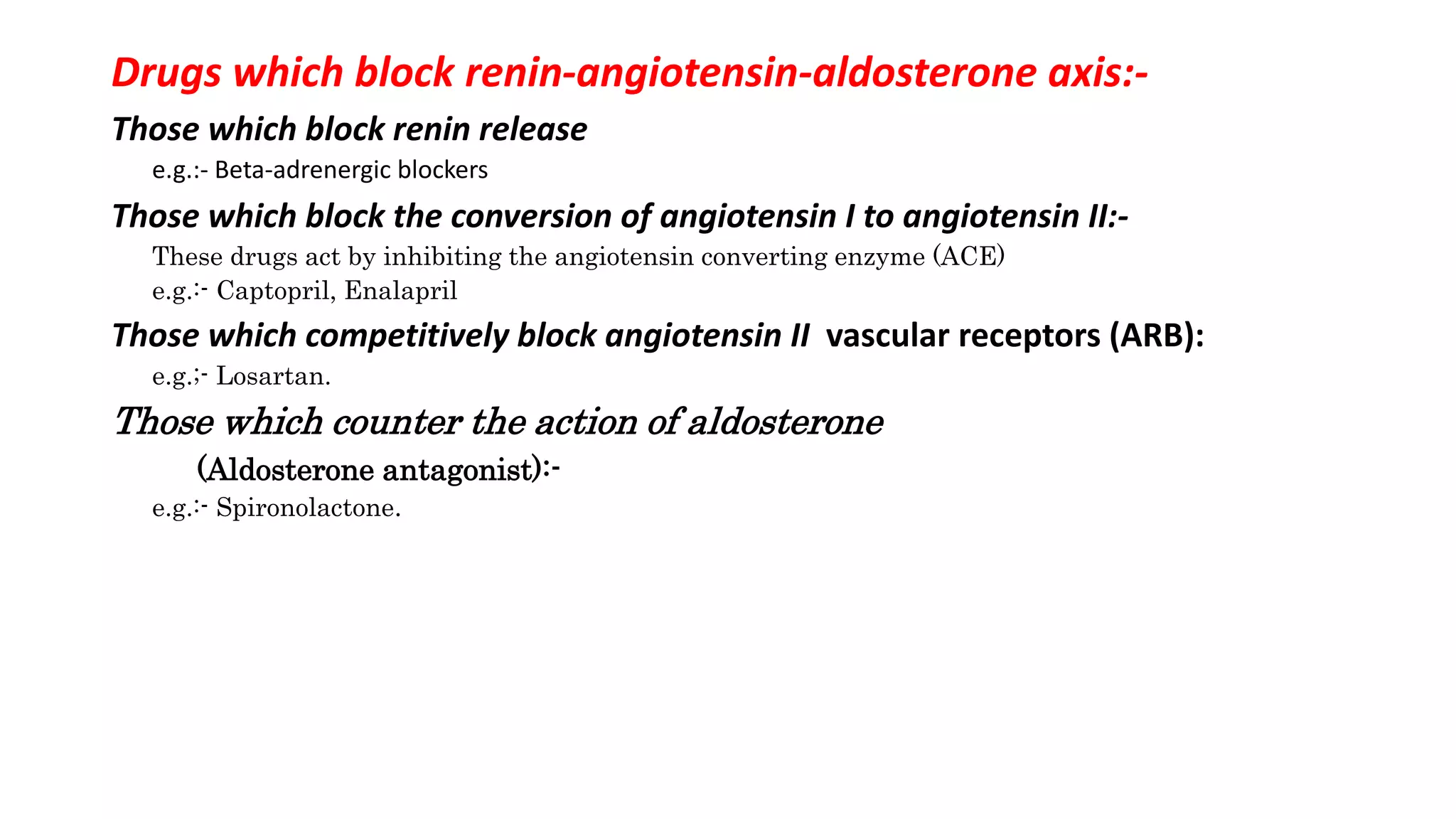
Drugs which block renin-angiotensin-aldosterone axis:- 
Those which block renin release 
e.g.:- Beta-adrenergic blockers 
Those which block the conversion of angiotensin I to angiotensin II:- 
These drugs act by inhibiting the angiotensin converting enzyme (ACE) 
e.g.:- Captopril, Enalapril 
Those which competitively block angiotensin II vascular receptors (ARB): 
e.g.;- Losartan. 
Those which counter the action of aldosterone 
(Aldosterone antagonist):- 
e.g.:- Spironolactone.
Drugs acting directly on the vascular smooth muscle:- 
Arteriolar vasodilators 
Calcium channel blockers, Hydralazine, Diazoxide, Minoxidil 
Arteriolar-venular vasodilators 
e.g.:-Sodium nitroprusside 
Potassium channel activators 
e.g.:-Diazoxide, Minoxidil, Pinacidil, Nicorandil 
Oral diuretics 
e.g.:-Thiazides
CENTRALLY ACTING SYMPATHOPLEGIC DRUGS 
• The drugs are: 
• Methyldopa 
• Clonidine 
• Guanabenz 
• Guanfacine 
• These drugs are central α 2 receptor agonists. 
• Reduce sympathetic out flow from vasomotor centers in the brain stem 
• Allow these centers to retain or even increase their sensitivity to baroreceptors. 
• Their effects are not dependent on posture 
• USES 
• As ANTIHYPERTENSIVE 
• Widely used in the past for mild to moderate hypertension along with a diuretic. 
• Now preferred drug in pregnancy, effective & safe for both mother & fetus. 
• Valuable in hypertensives with renal insufficiency , no dosage adjustment required. 
• In Hypertensive crisis; may be given IV.
CENTRALLY ACTING SYMPATHOPLEGIC DRUGS 
• ADVERSE EFFECTS OF METHYLDOPA 
• Sedation– the most common specially at onset of treatment. 
• On long term use: 
• Persistent lassitude & impaired mental concentration. 
• Mental Depression , Nightmares , vertigo. 
• Extrapyramidal symptoms-- Parkinsonian signs. 
• Hyperprolactinemia--- lactation in males & females. 
• Postural hypotension ; only in volume depleted patients 
• Positive Coombs test in 10-20 % cases treated for longer than12 months. 
• ADVERSE EFFECTS OF CLONIDINE 
• Sedation –centrally mediated & dose dependent. 
• Xerostomia (dry mouth) centrally mediated & dose dependent. 
• Depression--- withdraw the drug. C/I in patients at risk of depression 
• Hypertensive crisis on sudden withdrawal. Marked rise in blood pressure if drug is stopped abruptly.
DRUGS ACTING ON THE AUTONOMIC GANGLION 
• GANGLION-BLOCKING DRUGS -Trimethaphan 
• Prevent reflex changes in H.R elicited by vasoconstriction (α1) & vasodilation (β2). 
• Do not prevent changes in H.R elicited directly by the drug (β1 & M2). 
• Block the action of ACh and similar agonists at nicotinic receptors of both parasympathetic and 
sympathetic autonomic ganglia. 
• Ganglion-blocking drugs are important and used in pharmacologic and physiologic research because they 
can block all autonomic outflow. 
• Lack of selectivity confers such a broad range of undesirable effects that they have limited clinical use.
DRUGS ACTING ON THE POSTGANGLIONIC SYMPATHETIC 
NERVE ENDINGS 
• ADRENERGIC NEURON BLOCKERS 
• These are a group of drugs which act on adrenergic nerve terminals and block their function / effect on 
the neuroeffector organs by either inhibiting the synthesis of noradrenaline or its storage or release in 
the adrenergic nerve terminals. 
• INCLUDES 
• Drugs that Prevent Release of Noradrenaline 
• Guanethidine 
• Debrisoquine 
• Bethanidine 
• Guanoxan 
• Guanadrel 
• Drugs that Inhibit Storage of Noradrenaline 
• Reserpine 
• Deserpidine 
• Drugs that Interfere with Synthesis of Noradrenaline 
• Metyrosine ( Methyl tyrosine)
DRUGS ACTING ON ADRENERGIC RECEPTORS 
Alpha-adrenergic blocking agents 
• Reduction in t.p.r and mean BP – also reduction in venomotor tone and pooling of blood – 
reduction in CO 
• Non selective alpha blockers are not used in chronic essential hypertension 
(Phenoxybenzamine, Phentolamine), only used sometimes as in phaechromocytoma 
• Specific alpha-1 blockers like Prazosine, terazosin and doxazosine are used 
• PRAZOSIN is the prototype of the alpha-blockers 
• Does not produce tachycardia as presynaptic auto (alpha-2) receptors are not inhibited – auto 
regulation of NA release remains intact.
PRAZOSIN 
• Highly selective for α1 receptors , 1000 fold > α2 
• Marked postural hypotension with first dose---- first dose phenomenon; so first dose given 
low & at bed time 
• With selective α1 blockers , less reflex tachycardia as negative feed back on NE release via 
presynaptic α2 is not blocked. 
• Relax smooth muscles of both resistance & capacitance BV ↓ PVR & ↓ blood pressure . 
• Blood pressure is reduced more in upright than in supine position. 
• Retention of salt & water if used without a diuretic. 
• More effective in combination with β blocker & diuretic. 
• Relaxes smooth muscle in the prostate & bladder base useful in coexisting urinary obstruction 
, improves urinary low.
PRAZOSIN 
• ADVERSE EFFECTS: 
• Prazosine causes postural hypotension – start 0.5 mg at bed time with increasing dose and upto 10 mg 
daily 
• Fluid retention in monotherapy 
• Headache, dry mouth, weakness, dry mouth, blurred vision, rash, drowsiness and failure of ejaculation in 
males 
• CURRENT STATUS: 
• Several advantages – improvement of carbohydrate metabolism – diabetics, lowers LDL and increases 
HDL, symptomatic improvement in BHP 
• But not used as first line agent, used in addition with other conventional drugs which are failing – diuretic 
or beta blocker 
• DOSES: 
• Available as 0.5 mg, 1 mg, 2.5 mg, 5 mg etc. dose:1-4 mg thrice daily.
DRUGS ACTING ON ADRENERGIC RECEPTORS 
Beta-adrenergic blockers 
• Non selective: Propranolol (others: nadolol, timolol, pindolol, labetolol) 
• Cardio selective: Metoprolol (others: atenolol, esmolol, betaxolol) 
• All beta-blockers similar antihypertensive effects – irrespective of additional properties 
• Reduction in CO but no change in BP initially but slowly 
• Adaptation by resistance vessels to chronically reduced CO – antihypertensive action 
• Other mechanisms – decreased renin release from kidney (beta-1 mediated) 
• Reduced NA release and central sympathetic outflow reduction 
• Non-selective ones – reduction in g.f.r but not with selective ones 
• Drugs with intrinsic sympathomimetic activity may cause less reduction in HR and CO 
• USES 
• Mild to moderate hypertension 
• In severe hypertension - in combination therapy with direct vasodilators to prevent compensatory tachycardia. 
• In hypertensive emergencies (Labetalol , Esmolol) 
• Intraoperative & Postoperative hypertension (Esmolol) 
• Hypertension with chronic heart failure (Carvedilol , Metoprolol, Bisoprolol) 
• Hypertension with pheochromocytoma use β- blockers after α blocker.
Beta-adrenergic blockers 
• Advantages: 
• No postural hypotension 
• No salt and water retention 
• Low incidence of side effects 
• Low cost 
• Once a day regime 
• Preferred in young non-obese patients, prevention of sudden cardiac death in post infarction 
patients and progression of CHF 
• Drawbacks (side effects): 
• Fatigue, lethargy (low CO?) – decreased work capacity 
• Loss of libido – impotence 
• Cognitive defects – forgetfulness 
• Difficult to stop suddenly 
• Therefore cardio-selective drugs are preferred now
Beta-adrenergic blockers 
• Advantages of cardio-selective over non-selective: 
• In asthma 
• In diabetes mellitus 
• In peripheral vascular disease 
• Current status: 
• JNC 8 recommends - 1st line of antihypertensive along with diuretics and ACEIs 
• Preferred in young non-obese hypertensive 
• Angina pectoris and post angina patients 
• Post MI patients – useful in preventing mortality 
• In old persons, carvedilol – vasodilatory action can be given
DRUGS ACTING ON ADRENERGIC RECEPTORS 
Both alpha and beta adrenergic blocking drugs 
LABETOLOL 
• Non Selective beta blocker with selective alpha1 blocking action 
• Devoid of intrinsic sympathomimetic action 
• Given orally, behaves like propranolol 
• Also Includes, 
CARVEDILOL 
BISOPROLOL 
NEBIVOLOL
DRUGS WHICH BLOCK RENIN-ANGIOTENSIN-ALDOSTERONE AXIS 
RAS - Introduction 
• Renin is a proteolytic enzyme and also called angiotensinogenase 
• It is produced by juxtaglomerular cells of kidney 
• It is secreted in response to: 
• Decrease in arterial blood pressure 
• Decrease Na+ in macula densa 
• Increased sympathetic nervous activity 
• Renin acts on a plasma protein – Angiotensinogen (a glycoprotein synthesized and secreted into the 
bloodstream by the liver) and cleaves to produce a decapeptide Angiotensin-I 
• Angiotensin-I is rapidly converted to Angiotensin-II (octapeptide) by ACE (present in luminal surface of 
vascular endothelium) 
• Furthermore degradation of Angiotensin-II by peptidases produce Angiotensin-III 
• Both Angiotensin-II and Angiotensin-III stimulates Aldosterone secretion from Adrenal Cortex (equipotent) 
• AT-II has very short half life – 1 min
RAS - Physiology 
Vasoconstriction 
Na+ & water 
retention 
(Adrenal cortex) 
Kidney 
Increased 
Blood Vol. 
Rise in BP
RAS – Actions of Angiotensin-II 
1. Powerful vasoconstrictor particularly arteriolar – direct action and release of Adr/NA release 
• Promotes movement of fluid from vascular to extravascular 
• More potent vasopressor agent than NA – promotes Na+ and water reabsorption 
• It increases myocardial force of contraction (CA++ influx promotion) and increases heart rate by 
sympathetic activity, but reflex bradycardia occurs 
• Cardiac output is reduced and cardiac work increases 
2. Aldosterone secretion stimulation – retention of Na++ in body 
3. Vasoconstriction of renal arterioles – rise in IGP – glomerular damage 
4. Decreases NO release 
5. Decreases Fibrinolysis in blood 
6. Induces drinking behavior and ADH release by acting in CNS – increase thirst 
7. Mitogenic effect – cell proliferation
Angiotensin-II – Pathophysiological Roles 
1. Mineralocorticoid secretion 
2. Electrolyte, blood volume and pressure homeostasis: Renin is released when there is changes in blood 
volume or pressure or decreased Na+ content 
• Intrarenal baroreceptor pathway – reduce tension in the afferent glomerular arterioles by local production 
of Prostaglandin – Intrarenal regulator of blood flow and reabsorption 
• Low Na+ conc. in tubular fluid – macula densa pathway – COX-2 and nNOS are induced – release of PGE2 
and PGI2 – more renin release 
• Baroreceptor stimulation increases sympathetic impulse – via beta-1 pathway – renin release 
• Renin release – increased Angiotensin II production – vasoconstriction and increased Na+ and water 
reabsorption 
• Long term stabilization of BP is achieved – long-loop negative feedback and short-loop negative feedback 
mechanism 
3. Hypertension 
4. Secondary hyperaldosteronism
DRUGS WHICH BLOCK RENIN-ANGIOTENSIN-ALDOSTERONE AXIS
ACE inhibitors CAPTOPRIL 
• Sulfhydryl containing dipeptide and abolishes pressor action of Angiotensin-I and not Angiotensin-II and does 
not block AT receptors 
• Pharmacokinetics: 
• Available only orally, 70% - 75% is absorbed 
• Partly absorbed and partly excreted unchanged in urine 
• Food interferes with its absorption 
• Half life: 2 Hrs., but action stays for 6-12 Hrs. 
• In Normal 
• Depends on Na+ status – lowers BP marginally on single dose 
• When Na+ depletion – marked lowering of BP 
• In hypertensive 
• Lowers PVR and thereby mean, systolic and diastolic BP 
• RAS is overactive in 80% of hypertensive cases and contributes to the maintenance of vascular tone – inhibition causes 
lowering of BP 
• Initially correlates with renin-angiotensin status but chronic administration is independent of renin activity 
• Captopril decreases t.p.r on long term – arterioles dilate – fall in systolic and diastolic BP 
• No effect on Cardiac output 
• Postural hypotension is not a problem - reflex sympathetic stimulation does not occur 
• Renal blood flow is maintained – greater dilatation of vessels
Captopril – Adverse effects 
• Cough – persistent brassy cough in 20% cases – inhibition of bradykinin and substanceP 
breakdown in lungs 
• Hyperkalemia in renal failure patients with K+ sparing diuretics, NSAID and beta blockers (routine 
check of K+ level) 
• Hypotension – sharp fall may occur – 1st dose 
• Acute renal failure: CHF and bilateral renal artery stenosis 
• Angioedema: swelling of lips, mouth, nose etc. 
• Rashes, urticaria etc. 
• Dysgeusia: loss or alteration of taste 
• Foetopathic: hypoplasia of organs, growth retardation etc. 
• Neutropenia 
• Contraindications: Pregnancy, bilateral renal artery stenosis, hypersensitivity and hyperkalemia
Enalapril 
• It’s a prodrug – converted to enalaprilate 
• Advantages over captopril: 
• Longer half life – OD (5-20 mg OD) 
• Absorption not affected by food 
• Rash and loss of taste are less frequent 
• Longer onset of action 
• Less side effects
Ramipril (Cardace) 
• It’s a popular ACEI now 
• It is also a prodrug with long half life 
• Tissue specific – Protective of heart and kidney 
• Uses: Diabetes with hypertension, CHF, AMI and cardio protective in angina pectoris 
• Blacks in USA are resistant to Ramipril – addition of diuretics help 
• Dose: Start with low dose; 2.5 to 10 mg daily
Lisinopril (Lipril/Listril) 
• It’s a lysine derivative 
• Not a prodrug 
• Slow oral absorption – less chance of 1st dose phenomenon 
• Absorption not affected by food and not metabolized – excrete unchanged in urine 
• Long duration of action – single daily dose 
• Doses: available as 1.25, 2.5, 5, 10 1nd 20 mg tab – start with low dose
ACE INHIBITORS AND HYPERTENSION 
• 1st line of Drug: 
• No postural hypotension or electrolyte imbalance (no fatigue or weakness) 
• Safe in asthmatics and diabetics 
• Prevention of secondary hyperaldosteronism and K+ loss 
• Renal perfusion well maintained 
• Reverse the ventricular hypertrophy and increase in lumen size of vessel 
• No hyperuraecemia or deleterious effect on plasma lipid profile 
• No rebound hypertension 
• Minimal worsening of quality of life – general wellbeing, sleep and work performance 
etc.
ACE INHIBITORS – OTHER USES 
• Hypertension 
• Congestive Heart Failure 
• Myocardial Infarction 
• Prophylaxis of high CVS risk subjects 
• Diabetic Nephropathy 
• Scleroderma crisis
ANGIOTENSIN RECEPTOR BLOCKERS (ARBs) 
Angiotensin Receptors: 
• Specific angiotensin receptors have been discovered, grouped and abbreviated as – AT1 and AT2 
• They are present on the surface of the target cells 
• Most of the physiological actions of angiotensin are mediated via AT1 receptor 
• Transducer mechanisms of AT1 inhibitors: In different tissues show different mechanisms. For 
example - 
• PhospholipaseC-IP3/DAG-intracellular Ca++ release mechanism – vascular and visceral smooth 
muscle contraction 
• In myocardium and vascular smooth muscles AT1 receptor mediates long term effects by MAP 
kinase and others 
• Losartan is the specific AT1 blocker
ANGIOTENSIN RECEPTOR BLOCKERS 
(ARBs) - LOSARTAN 
• Competitive antagonist and inverse agonist of AT1 receptor 
• Does not interfere with other receptors except TXA2 
• Blocks all the actions of A-II - vasoconstriction, sympathetic stimulation, aldosterone release 
and renal actions of salt and water reabsorption 
• No inhibition of ACE
LOSARTAN 
• Theoretical superiority over ACEIs: 
• Cough is rare – no interference with bradykinin and other ACE substrates 
• Complete inhibition of AT1 – alternative remains with ACEs 
• Result in indirect activation of AT2 – vasodilatation (additional benefit) 
• Clinical benefit of ARBs over ACEIs – not known 
• However, losartan decreases BP in hypertensive which is for long period (24 Hrs.) 
• heart rate remains unchanged and cvs reflexes are not interfered 
• no significant effect in plasma lipid profile, insulin sensitivity and carbohydrate tolerance etc. 
• Mild uricosuric effect
LOSARTAN 
• Pharmacokinetic: 
• Absorption not affected by food but unlike ACEIs its bioavailability is low 
• High first pass metabolism 
• Carboxylated to active metabolite E3174 
• Highly bound to plasma protein 
• Do not enter brain 
• Adverse effects: 
• Foetopathic like ACEIs – not to be administered in pregnancy 
• Rare 1st dose effect hypotension 
• Low Dysgeusia and dry cough 
• Lower incidence of angioedema 
• Available as 25 and 50 mg tablets
DRUGS ACTING DIRECTLY ON THE VASCULAR SMOOTH MUSCLE 
Calcium Channel Blockers - Classification
Calcium Channel Blockers – Mechanism of action 
• Three types Ca+ channels in smooth muscles – Voltage sensitive, receptor operated and leak 
channel 
• Voltage sensitive are again 3 types – L-Type, T-Type and N-Type 
• Normally, L-Type of channels admit Ca+ and causes depolarization – excitation-contraction 
coupling through phosphorylation of myosin light chain – contraction of vascular smooth muscle – 
elevation of BP 
• CCBs block L-Type channel: 
• Smooth Muscle relaxation 
• Negative chronotropic, inotropic and chronotropic effects in heart 
• DHPs have highest smooth muscle relaxation and vasodilator action followed by verapamil and 
diltiazem 
• Other actions: DHPs have diuretic action
Differential effects of different CCBs on CV cells 
Dihydropyridines: Selective vasodilators Non -Dihydropyridines: equipotent for 
SN 
AV 
SN 
AV 
Potential reflex 
increase in 
HR, myocardial 
contractility 
and O2 demand 
Coronary 
VD 
cardiac tissue and vasculature 
Heart rate 
moderating 
Peripheral 
and coronary 
vasodilation 
Reduced 
inotropism 
Peripheral 
vasodilation
Calcium Channel Blockers 
• Advantages: 
• Unlike diuretics no adverse metabolic effects but mild adverse effects like – 
dizziness, fatigue etc. 
• Do not compromise hemodynamics – no impairment of work capacity 
• No sedation or CNS effect 
• Can be given to asthma, angina and PVD patients 
• No renal and male sexual function impairment 
• No adverse fetal effects and can be given in pregnancy 
• Minimal effect on quality of life
Calcium Channel Blockers 
Other Effects 
• Anti-platelet effect (interfere with platelet aggregation) 
• Effect on other smooth muscles (relaxation of bronchiolar, GIT and uterine sm. 
muscles) 
• Action on Skeletal muscles (no effect) 
• Decreased release of insulin - Verapamil 
• Decrease secretion of exocrine glands – less effect because of difference of Ca 
channels 
• Verapamil blocks reverse transporter p-170 glycoprotein
Calcium Channel Blockers 
THERAPEUTIC USES 
• Hypertension 
• Angina 
• Supraventricular arrhythmias 
• Hypertrophic cardiomyopathy 
• Prevent increase in infarct size 
• Migraine Prophylaxis 
• Raynaud’s phenomenon 
• Atherosclerosis 
• Subarachnoid hemorrhage (Nimodipine)
Calcium Channel Blockers – current status 
• As per JNC 8 CCBs are1st line of antihypertensives 
• its been used as 1st line by many because of excellent tolerability and high efficacy 
• Preferred in elderly and prevents stroke 
• CCBs are effective in low Renin hypertension 
• They are next to ACE inhibitors in inhibition of albuminuria and prevention of 
diabetic nephropathy 
• Immediate acting Nifedipine is not encouraged anymore
Calcium Channel Blockers 
• CONTRAINDICATIONS: 
• Unstable angina 
• Heart failure 
• Hypotension 
• Post infarct cases 
• Severe aortic stenosis 
• PREPARATION AND DOSAGE: 
• Amlodipine – 2.5, 5 and 10 mg tablets (5-10 mg OD) – Stamlo, Amlopres, 
Amlopin etc. 
• Nimodipine – 30 mg tab and 10 mg/50 ml injection – Vasotop, Nimodip, 
Nimotide etc.
VASODILATORS - HYDRALAZINE 
• Directly acting vasodilator 
• MOA: hydralazine molecules combine with receptors in the endothelium of arterioles – NO release – 
relaxation of vascular smooth muscle – fall in BP 
• Subsequently fall in BP – stimulation of adrenergic system leading to 
• Cardiac stimulation producing palpitation and rise in CO even in IHD and patients – anginal attack 
• Tachycardia 
• Increased Renin secretion – Na+ retention 
• These effects are countered by administration of beta blockers and diuretics 
• However many do not agree to this theory 
• Uses: 1) Moderate hypertension when 1st line fails – with beta-blockers and diuretics 2) Hypertension in 
Pregnancy, Dose 25-50 mg OD
HYDRALAZINE 
• Pharmacological Effects 
Arteriolar dilatation leads to decreased peripheral 
resistance & hence decreases blood pressure. 
Postural hypotension - uncommon. 
Hypotensive effect elicits compensatory responses 
• Therapeutic uses 
Anti-hypertensive – in pregnancy for short term Rx, in severe cases in combination 
In CCF – decrease after load 
• Toxicity 
• Headache, 
• Nausea, anorexia, sweating & flushing 
• Palpitation, Dizziness Angina / arrhythmias (in Pt. ē I.H.D) 
• Syndrome like Systemic Lupus Erythematosus in slow acetylators ( reversible) / in high doses 
• With high doses - Arthralgia, Myalgia, Skin rashes, Fever 
• Rare side effects: Peripheral Neuropathy, Drug fever.
DRUGS ACTING DIRECTLY ON THE VASCULAR SMOOTH MUSCLE 
Arteriolar-venular vasodilators – Sodium Nitroprusside 
• Rapidly and consistently acting vasodilator 
• Relaxes both resistance and capacitance vessels and reduces t.p.r and CO 
(decrease in venous return) 
• Unlike hydralazine it produces decrease in cardiac work and no reflex tachycardia. 
• Improves ventricular function in heart failure by reducing preload 
• MOA: RBCs convert nitroprusside to NO – relaxation also by non-enzymatically to 
NO by glutathione 
• Uses: Hypertensive Emergencies, 50 mg is added to 500 ml of saline/glucose and 
infused slowly with 0.02 mg/min initially and later on titrated with response (wrap 
with black paper) 
• Adverse effects: All are due release of cyanides (thiocyanate) – palpitation, pain 
abdomen, disorientation, psychosis, weakness and lactic acidosis.
POTASSIUM CHANNEL ACTIVATORS 
Diazoxide 
• Long Acting arteriolar vasodilator 
• MOA 
Prevents Vascular Smooth muscle contraction by opening ATPase sensitive K+ Channel 
 
Stabilization of Membrane Potential at RMP 
 
No Contraction  Relaxation 
 P.R  B.P 
• Pharmacological Effects 
dilates only Arterioles  P.R & Rapid  in B.P with  H.R   C.O (Compensatory 
Mechanism)
POTASSIUM CHANNEL ACTIVATORS 
Diazoxide 
• Adverse Effects 
• Excessive Hypotension – stroke & MI, the reflex sympathetic response can provoke angina 
• Salt & Water retention 
• Hyperglycemia - Secretion of insulin from -cells is inhibited 
• Therapeutic Uses 
• Hypertension – Severe along with Beta Blocker / Diuretics 
• In Insulinoma to treat Hypoglycemia
POTASSIUM CHANNEL ACTIVATORS 
Minoxidil 
• Powerful vasodilator, mainly 2 major uses – antihypertensive and alopecia 
• Prodrug and converted to an active metabolite which acts by hyperpolarization of smooth muscles 
and thereby relaxation of SM – leading to hydralazine like effects 
• Rarely indicated in hypertension especially in life threatening ones 
• More often in alopecia to promote hair growth 
• Orally not used any more 
• Topically as 2-5% lotion/gel and takes months to get effects 
• MOA of hair growth: 
• Enhanced microcirculation around hair follicles and also by direct stimulation of follicles 
• Alteration of androgen effect of hair follicles
POTASSIUM CHANNEL ACTIVATORS 
Minoxidil
FENOLDOPAM 
• Recently discovered peripheral arteriolar dilator 
• Racemic mixture, R isomer is Pharmacologically active. 
• MOA 
• Acts primarily as an agonist of dopamine D1 receptors, resulting in dilatation of peripheral arteries & natriuresis 
• Rapid metabolism by conjugation 
• Half-life: 10 min – given by continues IV infusion 
• Initiated at low dose (0.1 mcg/kg/min) 
• Titrated upward every 15-20 min to a max dose of 1.6 mcg/kg/min until the desired BP reduction is 
achieved 
• THERAPEUTIC USES 
• Used for hypertensive emergencies and postoperative hypertension - Given by intravenous infusion 
• ADVERSE EFFECTS 
• Major toxicities are reflex tachycardia, headache, flushing. & even hypokalemia may occur 
• Increase in IOP. --- C/I in glaucoma
DIURETICS 
• Drugs causing net loss of Na+ and water in urine 
• Mechanism of antihypertensive action: 
• Initially: diuresis – depletion of Na+ and body fluid volume – decrease in cardiac 
output 
• Subsequently after 4 - 6 weeks, Na+ balance and CO is regained by 95%, but BP 
remains low! 
• Q: Why? Answer: reduction in total peripheral resistance (TPR) due to deficit of little 
amount of Na+ and water (Na+ causes vascular stiffness) 
• Similar effect is seen with sodium restriction (low sodium diet)
Osmotic 
diuretics 
Proximal convoluted 
tubule 
Thiazide and 
thiazide like 
spironolactone 
Distal convoluted 
tubule 
descending 
loop of Henle 
Collecting 
duct 
Ascending loop of 
Henle 
Loop diuretics 
CA inhibitors
DIURETIC AGENTS 
• Loop diuretics 
• Thiazide and thiazide-like diuretics 
• Potassium-sparing diuretics 
• Osmotic diuretics
LOOP DIURETICS 
• furosemide (Lasix) 
• bumetanide (Bumex) 
• ethacrynic acid (Edecrin)
LOOP DIURETICS: Mechanism Of Action 
• Act directly on the ascending limb of the 
loop of Henle to inhibit sodium and chloride resorption. 
• Increase renal prostaglandins, resulting in the dilation of blood 
vessels and reduced peripheral vascular resistance.
LOOP DIURETICS: Drug Effects 
• Potent diuresis and subsequent loss of fluid 
• Decreased fluid volume causes: 
• Reduced BP 
• Reduced pulmonary vascular resistance 
• Reduced systemic vascular resistance 
• Reduced central venous pressure 
• Reduced left ventricular end-diastolic pressure 
• Potassium depletion
LOOP DIURETICS: Therapeutic Uses 
• Edema associated with CHF or hepatic 
or renal disease 
• Control of hypertension
LOOP DIURETICS: Side Effects 
Body System Effect 
CNS Dizziness, headache, tinnitus, blurred vision 
GI Nausea, vomiting, diarrhea
LOOP DIURETICS: Side Effects 
Body System Effect 
Hematologic Agranulocytosis, neutropenia, 
thrombocytopenia 
Metabolic Hypokalemia, hyperglycemia, 
hyperuraecemia
POTASSIUM-SPARING DIURETICS 
• amiloride 
• Spironolactone 
• triamterene
POTASSIUM-SPARING DIURETICS: Mechanism of Action 
• Work in collecting ducts and distal convoluted tubules 
• Interfere with sodium-potassium exchange 
• Competitively bind to aldosterone receptors 
• Block the resorption of sodium and water usually induced by aldosterone
POTASSIUM-SPARING DIURETICS: Drug Effects 
• Prevent potassium from being pumped into the tubule, thus preventing its secretion 
• Competitively block the aldosterone receptors and inhibit its action 
• The excretion of sodium and water is promoted
POTASSIUM-SPARING DIURETICS: Therapeutic Uses 
spironolactone and triamterene 
• Hyperaldosteronism 
• Hypertension 
•Reversing the potassium loss caused by 
potassium-losing drugs 
amiloride 
• Treatment of CHF
POTASSIUM-SPARING DIURETICS: Side Effects 
Body System Effect 
CNS Dizziness, headache 
GI Cramps, nausea, vomiting, diarrhea 
Other Urinary frequency, generalized body weakness 
spironolactone 
• gynecomastia, amenorrhea, irregular menses
THIAZIDE AND THIAZIDE-LIKE DIURETICS 
THIAZIDES: 
• hydrochlorothiazide 
• chlorothiazide 
• trichlormethiazide 
THIAZIDE-LIKE: 
• chlorthalidone 
• metolazone
THIAZIDE AND THIAZIDE-LIKE DIURETICS: 
Mechanism of Action 
• Inhibit tubular resorption of sodium and chloride ions 
• Action primarily in the ascending loop of Henle and 
early distal tubule 
• Result: water, sodium, and chloride are excreted 
• Potassium is also excreted to a lesser extent 
• Dilate the arterioles by direct relaxation
THIAZIDE AND THIAZIDE-LIKE DIURETICS: Drug Effects 
• Depletion of sodium and water 
• Lowered peripheral vascular resistance
THIAZIDE AND THIAZIDE-LIKE DIURETICS: Therapeutic Uses 
• Hypertension 
(one of the most prescribed group of agents for this) 
• Edematous states 
• Idiopathic hypercalciuria 
• Diabetes insipidus 
• Adjunct agents in treatment of CHF, hepatic cirrhosis
THIAZIDE AND THIAZIDE-LIKE DIURETICS: Side Effects 
Body System Effect 
CNS Dizziness, headache, blurred vision, paresthesia, decreased libido 
GI Anorexia, nausea, vomiting, diarrhea 
GU Impotence 
Integumentary Urticaria, photosensitivity 
Metabolic Hypokalemia, glycosuria, hyperglycemia
THIAZIDE DIURETICS – ADVERSE EFFECTS 
• Adverse Effects: 
• Hypokalemia – muscle pain and fatigue 
• Hyperglycemia: Inhibition of insulin release due to K+ depletion (proinsulin to insulin) 
– precipitation of diabetes 
• Hyperlipidemia: rise in total LDL level – risk of stroke 
• Hyperuraecemia: inhibition of urate excretion 
• Sudden cardiac death – tosades de pointes (hypokalemia) 
• All the above metabolic side effects – higher doses (50 – 100 mg per day) 
• But, its observed that these adverse effects are minimal with low doses (12.5 to 25 
mg) - Average fall in BP is 10 mm of Hg
THIAZIDE DIURETICS – CURRENT STATUS 
• Effects of low dose: 
• No significant hypokalemia 
• Low incidence of arrhythmia 
• Lower incidence of hyperglycemia, hyperlipidemia and hyperuraecemia 
• Reduction in MI incidence 
• Reduction in mortality and morbidity 
• JNC 8 recommendation: 
• JNC recommends low dose of thiazide therapy (12.5 – 25 mg per day) in essential hypertension 
• Preferably should be used with a potassium sparing diuretic as first choice in elderly 
• If therapy fails – another antihypertensive but do not increase the thiazide dose 
• Loop diuretics are to be given when there is severe hypertension with retention of body fluids
DIURETICS 
• K+ sparing diuretics: 
• Thiazide and K sparing diuretics are combined therapeutically – DITIDE (triamterene + 
benzthiazide) is popular one 
• Modified thiazide: indapamide 
• Indole derivative and long duration of action (18 Hrs.) – orally 2.5 mg dose 
• It is a lipid neutral i.e. does not alter blood lipid concentration, but other adverse 
effects may remain 
• Loop diuretics: 
• Na+ deficient state is temporary, not maintained round –the-clock and t.p.r not 
reduced 
• Used only in complicated cases – CRF, CHF marked fluid retention cases
TREATMENT PROTOCOL OF HYPERTENSION 
U Hv Got 
HTN !!
JOINT NATIONAL COMMITTEE 8 RECOMMENDATIONS 
Recommendation 1 
In the general population aged 60 years, initiate pharmacologic 
treatment to lower blood pressure (BP) at systolic blood pressure 
(SBP)150mmHg or diastolic blood pressure (DBP)90mmHg and 
treat to a goal SBP <150 mm Hg and goal DBP <90 mm Hg. 
Corollary Recommendation 
In the general population aged 60years, if pharmacologic treatment 
for high BP results in lower achieved SBP (e.g., <140mmHg) and 
treatment is well tolerated and without adverse effects on health or 
quality of life, treatment does not need to be adjusted.
JOINT NATIONAL COMMITTEE 8 RECOMMENDATIONS 
Recommendation 2 
In the general population <60 years, initiate pharmacologic treatment to Lower BP at DBP 
90mmHg and treat to a goal DBP<90mmHg. 
Recommendation 3 
In the general population <60 years, initiate pharmacologic treatment to lowerBPatSBP140mmHg 
and treat to a goal SBP <140mmHg. 
Recommendation 4 
In the population aged 18 years with chronic kidney disease (CKD), initiate pharmacologic 
treatment to lower BP at SBP140mmHg or DBP 90mmHg and treat to goal 
SBP<140mmHgandgoalDBP<90mmHg.
JOINT NATIONAL COMMITTEE 8 RECOMMENDATIONS 
Recommendation 5 
In the population aged18years with diabetes, initiate pharmacologic treatment to lower BP at SBP 
140mmHg or DBP 90mmHg and treat to a goal SBP <140mmHg and goal DBP <90mmHg. 
Recommendation 6 
In the general nonblack population, including those with diabetes, initial antihypertensive treatment 
should include a thiazide-type diuretic, calcium channel blocker (CCB), angiotensin-converting enzyme 
inhibitor (ACEI), or angiotensin receptor blocker (ARB). 
Recommendation 7 
In the general black population, including those with diabetes, initial antihypertensive treatment should 
include a thiazide-type diuretic or CCB.
JOINT NATIONAL COMMITTEE 8 RECOMMENDATIONS 
Recommendation 8 
In the population aged18 years with CKD, initial (or add-on) antihypertensive treatment should 
include an ACEI or ARB to improve kidney outcomes. This applies to all CKD patients with 
hypertension regardless of race or diabetes status. 
Recommendation 9 
The main objective of hypertension treatment is to attain and maintain goal BP. If goal BP is not 
reached within a month of treatment, increase the dose of the initial drug or add a second drug 
from one of the classes in recommendation 6(thiazide-type diuretic, CCB,ACEI, or ARB).The 
clinician should continue to assess BP and adjust the treatment regimen until goal BP is reached. 
If goal BP cannot be reached with 2 drugs, add and titrate a third drug from the list provided. Do 
not use an ACEI and an ARB together in the same patient. If goal BP cannot be reached using 
only the drugs in recommendation 6 because of a contraindication or the need to use more than 3 
drugs to reach goal BP, antihypertensive drugs from other classes can be used. Referral to a 
hypertension specialist may be indicated for patients in whom goal BP cannot be attained using 
the above strategy or for the management of complicated patients for whom additional clinical 
consultation is needed.
JOINT NATIONAL COMMITTEE 8 RECOMMENDATIONS
Thank you

Anti Hypertensive Drugs

  • 1.
    Anti Hypertensive Drugs Dr. Shamshuddin Patel Sr. Intern 2009-10 Batch Mandya Institute Of Medical Sciences
  • 2.
    Introduction • CURRENTDEFINITION (W.H.O.) A level of systolic blood pressure of 140 mm Hg or above, or a level of diastolic blood pressure of 90mm Hg or above, by repeated measurements at periods of several weeks.
  • 4.
  • 5.
    Regulation Of BloodPressure • Baroreceptors & the sympathetic NS: for rapid moment to moment control • Renal responses: Renin Angiotensin – Aldosterone system, for long term control. • Others: Endothelin, Nitric oxide, Vasopressin
  • 6.
    Normal Blood PressureRegulation • Hydraulic equation: Blood Pressure = Cardiac output (CO) X Resistance to passage of blood through precapillary arterioles (PVR) • Physiologically CO and PVR is maintained minute to minute by – arterioles (1) postcapillary venules (2) and Heart (3) • Kidney is the fourth site – volume of intravascular fluid • Baroreflex, humoral mechanism and renin-angiotensin-aldosterone system regulates the above 4 sites • Local agents like Nitric oxide • In hypertensives – Baroreflex and renal blood-volume control system – set at higher level • All antihypertensives act via interfering with normal mechanisms
  • 9.
    ROLE OF KIDNEYSIN BLOOD PRESSURE • As sympathetic stimulus decreases blood flow to the kidneys, renin is released activating the RAA (renin-angiotensin-aldosterone) system. • Renin activates angiotensinogen from the liver to convert to angiotensin I • Angiotensin Converting Enzyme (ACE) from the lungs changes angiotensin I to angiotensin II • Angiotensin II is a potent vasoconstrictor and activates release of Aldosterone from the adrenal cortex and anti-diuretic hormone (ADH) from the hypothalamus • Aldosterone retains sodium in the kidneys • ADH stimulates thirst and retains water in the kidneys tubules 1-9
  • 11.
    Classification Of AntiHypertensives 1)Drugs acting centrally. 2)Drugs acting on autonomic ganglia. 3)Drugs acting on the postganglionic sympathetic nerve ending. 4)Drugs acting on the adrenergic receptors. 5)Drugs acting on the vascular smooth muscle. 6)Potassium channel activators. 7)Drugs which block renin-angiotensin-aldosterone axis. 8)Diuretics.
  • 12.
    • Drugs actingcentrally:- Alpha2 adrenergic receptor stimulants:- e.g.:- Clonidine and methyldopa Selective imidazole receptor (I-receptor) Stimulant:- e.g.:- Moxonidine • Drugs acting on the autonomic ganglion:- Ganglion blocking agents e.g.:- Trimethaphan • Drugs acting on the postganglionic sympathetic nerve endings:- Adrenergic neuron blockers e.g.:- Guaenethidine, Bethanidine, Debrisoquine, Bretylium. Catecholamine depletors e.g.:- Reserpine • Drugs acting on adrenergic receptors :- Alpha-adrenergic blocking agents e.g.:- Phentolamine, Phenoxybenzamine, Prazosine, Indoramine. Beta-adrenergic blocking agents e.g.:- Propranolol, Atenolol, Metoprolol. Both alpha and beta adrenergic blocking drugs e.g.:- Labetalol
  • 13.
    Drugs which blockrenin-angiotensin-aldosterone axis:- Those which block renin release e.g.:- Beta-adrenergic blockers Those which block the conversion of angiotensin I to angiotensin II:- These drugs act by inhibiting the angiotensin converting enzyme (ACE) e.g.:- Captopril, Enalapril Those which competitively block angiotensin II vascular receptors (ARB): e.g.;- Losartan. Those which counter the action of aldosterone (Aldosterone antagonist):- e.g.:- Spironolactone.
  • 14.
    Drugs acting directlyon the vascular smooth muscle:- Arteriolar vasodilators Calcium channel blockers, Hydralazine, Diazoxide, Minoxidil Arteriolar-venular vasodilators e.g.:-Sodium nitroprusside Potassium channel activators e.g.:-Diazoxide, Minoxidil, Pinacidil, Nicorandil Oral diuretics e.g.:-Thiazides
  • 16.
    CENTRALLY ACTING SYMPATHOPLEGICDRUGS • The drugs are: • Methyldopa • Clonidine • Guanabenz • Guanfacine • These drugs are central α 2 receptor agonists. • Reduce sympathetic out flow from vasomotor centers in the brain stem • Allow these centers to retain or even increase their sensitivity to baroreceptors. • Their effects are not dependent on posture • USES • As ANTIHYPERTENSIVE • Widely used in the past for mild to moderate hypertension along with a diuretic. • Now preferred drug in pregnancy, effective & safe for both mother & fetus. • Valuable in hypertensives with renal insufficiency , no dosage adjustment required. • In Hypertensive crisis; may be given IV.
  • 17.
    CENTRALLY ACTING SYMPATHOPLEGICDRUGS • ADVERSE EFFECTS OF METHYLDOPA • Sedation– the most common specially at onset of treatment. • On long term use: • Persistent lassitude & impaired mental concentration. • Mental Depression , Nightmares , vertigo. • Extrapyramidal symptoms-- Parkinsonian signs. • Hyperprolactinemia--- lactation in males & females. • Postural hypotension ; only in volume depleted patients • Positive Coombs test in 10-20 % cases treated for longer than12 months. • ADVERSE EFFECTS OF CLONIDINE • Sedation –centrally mediated & dose dependent. • Xerostomia (dry mouth) centrally mediated & dose dependent. • Depression--- withdraw the drug. C/I in patients at risk of depression • Hypertensive crisis on sudden withdrawal. Marked rise in blood pressure if drug is stopped abruptly.
  • 18.
    DRUGS ACTING ONTHE AUTONOMIC GANGLION • GANGLION-BLOCKING DRUGS -Trimethaphan • Prevent reflex changes in H.R elicited by vasoconstriction (α1) & vasodilation (β2). • Do not prevent changes in H.R elicited directly by the drug (β1 & M2). • Block the action of ACh and similar agonists at nicotinic receptors of both parasympathetic and sympathetic autonomic ganglia. • Ganglion-blocking drugs are important and used in pharmacologic and physiologic research because they can block all autonomic outflow. • Lack of selectivity confers such a broad range of undesirable effects that they have limited clinical use.
  • 20.
    DRUGS ACTING ONTHE POSTGANGLIONIC SYMPATHETIC NERVE ENDINGS • ADRENERGIC NEURON BLOCKERS • These are a group of drugs which act on adrenergic nerve terminals and block their function / effect on the neuroeffector organs by either inhibiting the synthesis of noradrenaline or its storage or release in the adrenergic nerve terminals. • INCLUDES • Drugs that Prevent Release of Noradrenaline • Guanethidine • Debrisoquine • Bethanidine • Guanoxan • Guanadrel • Drugs that Inhibit Storage of Noradrenaline • Reserpine • Deserpidine • Drugs that Interfere with Synthesis of Noradrenaline • Metyrosine ( Methyl tyrosine)
  • 21.
    DRUGS ACTING ONADRENERGIC RECEPTORS Alpha-adrenergic blocking agents • Reduction in t.p.r and mean BP – also reduction in venomotor tone and pooling of blood – reduction in CO • Non selective alpha blockers are not used in chronic essential hypertension (Phenoxybenzamine, Phentolamine), only used sometimes as in phaechromocytoma • Specific alpha-1 blockers like Prazosine, terazosin and doxazosine are used • PRAZOSIN is the prototype of the alpha-blockers • Does not produce tachycardia as presynaptic auto (alpha-2) receptors are not inhibited – auto regulation of NA release remains intact.
  • 22.
    PRAZOSIN • Highlyselective for α1 receptors , 1000 fold > α2 • Marked postural hypotension with first dose---- first dose phenomenon; so first dose given low & at bed time • With selective α1 blockers , less reflex tachycardia as negative feed back on NE release via presynaptic α2 is not blocked. • Relax smooth muscles of both resistance & capacitance BV ↓ PVR & ↓ blood pressure . • Blood pressure is reduced more in upright than in supine position. • Retention of salt & water if used without a diuretic. • More effective in combination with β blocker & diuretic. • Relaxes smooth muscle in the prostate & bladder base useful in coexisting urinary obstruction , improves urinary low.
  • 23.
    PRAZOSIN • ADVERSEEFFECTS: • Prazosine causes postural hypotension – start 0.5 mg at bed time with increasing dose and upto 10 mg daily • Fluid retention in monotherapy • Headache, dry mouth, weakness, dry mouth, blurred vision, rash, drowsiness and failure of ejaculation in males • CURRENT STATUS: • Several advantages – improvement of carbohydrate metabolism – diabetics, lowers LDL and increases HDL, symptomatic improvement in BHP • But not used as first line agent, used in addition with other conventional drugs which are failing – diuretic or beta blocker • DOSES: • Available as 0.5 mg, 1 mg, 2.5 mg, 5 mg etc. dose:1-4 mg thrice daily.
  • 24.
    DRUGS ACTING ONADRENERGIC RECEPTORS Beta-adrenergic blockers • Non selective: Propranolol (others: nadolol, timolol, pindolol, labetolol) • Cardio selective: Metoprolol (others: atenolol, esmolol, betaxolol) • All beta-blockers similar antihypertensive effects – irrespective of additional properties • Reduction in CO but no change in BP initially but slowly • Adaptation by resistance vessels to chronically reduced CO – antihypertensive action • Other mechanisms – decreased renin release from kidney (beta-1 mediated) • Reduced NA release and central sympathetic outflow reduction • Non-selective ones – reduction in g.f.r but not with selective ones • Drugs with intrinsic sympathomimetic activity may cause less reduction in HR and CO • USES • Mild to moderate hypertension • In severe hypertension - in combination therapy with direct vasodilators to prevent compensatory tachycardia. • In hypertensive emergencies (Labetalol , Esmolol) • Intraoperative & Postoperative hypertension (Esmolol) • Hypertension with chronic heart failure (Carvedilol , Metoprolol, Bisoprolol) • Hypertension with pheochromocytoma use β- blockers after α blocker.
  • 25.
    Beta-adrenergic blockers •Advantages: • No postural hypotension • No salt and water retention • Low incidence of side effects • Low cost • Once a day regime • Preferred in young non-obese patients, prevention of sudden cardiac death in post infarction patients and progression of CHF • Drawbacks (side effects): • Fatigue, lethargy (low CO?) – decreased work capacity • Loss of libido – impotence • Cognitive defects – forgetfulness • Difficult to stop suddenly • Therefore cardio-selective drugs are preferred now
  • 27.
    Beta-adrenergic blockers •Advantages of cardio-selective over non-selective: • In asthma • In diabetes mellitus • In peripheral vascular disease • Current status: • JNC 8 recommends - 1st line of antihypertensive along with diuretics and ACEIs • Preferred in young non-obese hypertensive • Angina pectoris and post angina patients • Post MI patients – useful in preventing mortality • In old persons, carvedilol – vasodilatory action can be given
  • 28.
    DRUGS ACTING ONADRENERGIC RECEPTORS Both alpha and beta adrenergic blocking drugs LABETOLOL • Non Selective beta blocker with selective alpha1 blocking action • Devoid of intrinsic sympathomimetic action • Given orally, behaves like propranolol • Also Includes, CARVEDILOL BISOPROLOL NEBIVOLOL
  • 29.
    DRUGS WHICH BLOCKRENIN-ANGIOTENSIN-ALDOSTERONE AXIS RAS - Introduction • Renin is a proteolytic enzyme and also called angiotensinogenase • It is produced by juxtaglomerular cells of kidney • It is secreted in response to: • Decrease in arterial blood pressure • Decrease Na+ in macula densa • Increased sympathetic nervous activity • Renin acts on a plasma protein – Angiotensinogen (a glycoprotein synthesized and secreted into the bloodstream by the liver) and cleaves to produce a decapeptide Angiotensin-I • Angiotensin-I is rapidly converted to Angiotensin-II (octapeptide) by ACE (present in luminal surface of vascular endothelium) • Furthermore degradation of Angiotensin-II by peptidases produce Angiotensin-III • Both Angiotensin-II and Angiotensin-III stimulates Aldosterone secretion from Adrenal Cortex (equipotent) • AT-II has very short half life – 1 min
  • 30.
    RAS - Physiology Vasoconstriction Na+ & water retention (Adrenal cortex) Kidney Increased Blood Vol. Rise in BP
  • 31.
    RAS – Actionsof Angiotensin-II 1. Powerful vasoconstrictor particularly arteriolar – direct action and release of Adr/NA release • Promotes movement of fluid from vascular to extravascular • More potent vasopressor agent than NA – promotes Na+ and water reabsorption • It increases myocardial force of contraction (CA++ influx promotion) and increases heart rate by sympathetic activity, but reflex bradycardia occurs • Cardiac output is reduced and cardiac work increases 2. Aldosterone secretion stimulation – retention of Na++ in body 3. Vasoconstriction of renal arterioles – rise in IGP – glomerular damage 4. Decreases NO release 5. Decreases Fibrinolysis in blood 6. Induces drinking behavior and ADH release by acting in CNS – increase thirst 7. Mitogenic effect – cell proliferation
  • 32.
    Angiotensin-II – PathophysiologicalRoles 1. Mineralocorticoid secretion 2. Electrolyte, blood volume and pressure homeostasis: Renin is released when there is changes in blood volume or pressure or decreased Na+ content • Intrarenal baroreceptor pathway – reduce tension in the afferent glomerular arterioles by local production of Prostaglandin – Intrarenal regulator of blood flow and reabsorption • Low Na+ conc. in tubular fluid – macula densa pathway – COX-2 and nNOS are induced – release of PGE2 and PGI2 – more renin release • Baroreceptor stimulation increases sympathetic impulse – via beta-1 pathway – renin release • Renin release – increased Angiotensin II production – vasoconstriction and increased Na+ and water reabsorption • Long term stabilization of BP is achieved – long-loop negative feedback and short-loop negative feedback mechanism 3. Hypertension 4. Secondary hyperaldosteronism
  • 33.
    DRUGS WHICH BLOCKRENIN-ANGIOTENSIN-ALDOSTERONE AXIS
  • 34.
    ACE inhibitors CAPTOPRIL • Sulfhydryl containing dipeptide and abolishes pressor action of Angiotensin-I and not Angiotensin-II and does not block AT receptors • Pharmacokinetics: • Available only orally, 70% - 75% is absorbed • Partly absorbed and partly excreted unchanged in urine • Food interferes with its absorption • Half life: 2 Hrs., but action stays for 6-12 Hrs. • In Normal • Depends on Na+ status – lowers BP marginally on single dose • When Na+ depletion – marked lowering of BP • In hypertensive • Lowers PVR and thereby mean, systolic and diastolic BP • RAS is overactive in 80% of hypertensive cases and contributes to the maintenance of vascular tone – inhibition causes lowering of BP • Initially correlates with renin-angiotensin status but chronic administration is independent of renin activity • Captopril decreases t.p.r on long term – arterioles dilate – fall in systolic and diastolic BP • No effect on Cardiac output • Postural hypotension is not a problem - reflex sympathetic stimulation does not occur • Renal blood flow is maintained – greater dilatation of vessels
  • 35.
    Captopril – Adverseeffects • Cough – persistent brassy cough in 20% cases – inhibition of bradykinin and substanceP breakdown in lungs • Hyperkalemia in renal failure patients with K+ sparing diuretics, NSAID and beta blockers (routine check of K+ level) • Hypotension – sharp fall may occur – 1st dose • Acute renal failure: CHF and bilateral renal artery stenosis • Angioedema: swelling of lips, mouth, nose etc. • Rashes, urticaria etc. • Dysgeusia: loss or alteration of taste • Foetopathic: hypoplasia of organs, growth retardation etc. • Neutropenia • Contraindications: Pregnancy, bilateral renal artery stenosis, hypersensitivity and hyperkalemia
  • 36.
    Enalapril • It’sa prodrug – converted to enalaprilate • Advantages over captopril: • Longer half life – OD (5-20 mg OD) • Absorption not affected by food • Rash and loss of taste are less frequent • Longer onset of action • Less side effects
  • 37.
    Ramipril (Cardace) •It’s a popular ACEI now • It is also a prodrug with long half life • Tissue specific – Protective of heart and kidney • Uses: Diabetes with hypertension, CHF, AMI and cardio protective in angina pectoris • Blacks in USA are resistant to Ramipril – addition of diuretics help • Dose: Start with low dose; 2.5 to 10 mg daily
  • 38.
    Lisinopril (Lipril/Listril) •It’s a lysine derivative • Not a prodrug • Slow oral absorption – less chance of 1st dose phenomenon • Absorption not affected by food and not metabolized – excrete unchanged in urine • Long duration of action – single daily dose • Doses: available as 1.25, 2.5, 5, 10 1nd 20 mg tab – start with low dose
  • 39.
    ACE INHIBITORS ANDHYPERTENSION • 1st line of Drug: • No postural hypotension or electrolyte imbalance (no fatigue or weakness) • Safe in asthmatics and diabetics • Prevention of secondary hyperaldosteronism and K+ loss • Renal perfusion well maintained • Reverse the ventricular hypertrophy and increase in lumen size of vessel • No hyperuraecemia or deleterious effect on plasma lipid profile • No rebound hypertension • Minimal worsening of quality of life – general wellbeing, sleep and work performance etc.
  • 40.
    ACE INHIBITORS –OTHER USES • Hypertension • Congestive Heart Failure • Myocardial Infarction • Prophylaxis of high CVS risk subjects • Diabetic Nephropathy • Scleroderma crisis
  • 41.
    ANGIOTENSIN RECEPTOR BLOCKERS(ARBs) Angiotensin Receptors: • Specific angiotensin receptors have been discovered, grouped and abbreviated as – AT1 and AT2 • They are present on the surface of the target cells • Most of the physiological actions of angiotensin are mediated via AT1 receptor • Transducer mechanisms of AT1 inhibitors: In different tissues show different mechanisms. For example - • PhospholipaseC-IP3/DAG-intracellular Ca++ release mechanism – vascular and visceral smooth muscle contraction • In myocardium and vascular smooth muscles AT1 receptor mediates long term effects by MAP kinase and others • Losartan is the specific AT1 blocker
  • 42.
    ANGIOTENSIN RECEPTOR BLOCKERS (ARBs) - LOSARTAN • Competitive antagonist and inverse agonist of AT1 receptor • Does not interfere with other receptors except TXA2 • Blocks all the actions of A-II - vasoconstriction, sympathetic stimulation, aldosterone release and renal actions of salt and water reabsorption • No inhibition of ACE
  • 43.
    LOSARTAN • Theoreticalsuperiority over ACEIs: • Cough is rare – no interference with bradykinin and other ACE substrates • Complete inhibition of AT1 – alternative remains with ACEs • Result in indirect activation of AT2 – vasodilatation (additional benefit) • Clinical benefit of ARBs over ACEIs – not known • However, losartan decreases BP in hypertensive which is for long period (24 Hrs.) • heart rate remains unchanged and cvs reflexes are not interfered • no significant effect in plasma lipid profile, insulin sensitivity and carbohydrate tolerance etc. • Mild uricosuric effect
  • 44.
    LOSARTAN • Pharmacokinetic: • Absorption not affected by food but unlike ACEIs its bioavailability is low • High first pass metabolism • Carboxylated to active metabolite E3174 • Highly bound to plasma protein • Do not enter brain • Adverse effects: • Foetopathic like ACEIs – not to be administered in pregnancy • Rare 1st dose effect hypotension • Low Dysgeusia and dry cough • Lower incidence of angioedema • Available as 25 and 50 mg tablets
  • 45.
    DRUGS ACTING DIRECTLYON THE VASCULAR SMOOTH MUSCLE Calcium Channel Blockers - Classification
  • 46.
    Calcium Channel Blockers– Mechanism of action • Three types Ca+ channels in smooth muscles – Voltage sensitive, receptor operated and leak channel • Voltage sensitive are again 3 types – L-Type, T-Type and N-Type • Normally, L-Type of channels admit Ca+ and causes depolarization – excitation-contraction coupling through phosphorylation of myosin light chain – contraction of vascular smooth muscle – elevation of BP • CCBs block L-Type channel: • Smooth Muscle relaxation • Negative chronotropic, inotropic and chronotropic effects in heart • DHPs have highest smooth muscle relaxation and vasodilator action followed by verapamil and diltiazem • Other actions: DHPs have diuretic action
  • 47.
    Differential effects ofdifferent CCBs on CV cells Dihydropyridines: Selective vasodilators Non -Dihydropyridines: equipotent for SN AV SN AV Potential reflex increase in HR, myocardial contractility and O2 demand Coronary VD cardiac tissue and vasculature Heart rate moderating Peripheral and coronary vasodilation Reduced inotropism Peripheral vasodilation
  • 48.
    Calcium Channel Blockers • Advantages: • Unlike diuretics no adverse metabolic effects but mild adverse effects like – dizziness, fatigue etc. • Do not compromise hemodynamics – no impairment of work capacity • No sedation or CNS effect • Can be given to asthma, angina and PVD patients • No renal and male sexual function impairment • No adverse fetal effects and can be given in pregnancy • Minimal effect on quality of life
  • 49.
    Calcium Channel Blockers Other Effects • Anti-platelet effect (interfere with platelet aggregation) • Effect on other smooth muscles (relaxation of bronchiolar, GIT and uterine sm. muscles) • Action on Skeletal muscles (no effect) • Decreased release of insulin - Verapamil • Decrease secretion of exocrine glands – less effect because of difference of Ca channels • Verapamil blocks reverse transporter p-170 glycoprotein
  • 50.
    Calcium Channel Blockers THERAPEUTIC USES • Hypertension • Angina • Supraventricular arrhythmias • Hypertrophic cardiomyopathy • Prevent increase in infarct size • Migraine Prophylaxis • Raynaud’s phenomenon • Atherosclerosis • Subarachnoid hemorrhage (Nimodipine)
  • 51.
    Calcium Channel Blockers– current status • As per JNC 8 CCBs are1st line of antihypertensives • its been used as 1st line by many because of excellent tolerability and high efficacy • Preferred in elderly and prevents stroke • CCBs are effective in low Renin hypertension • They are next to ACE inhibitors in inhibition of albuminuria and prevention of diabetic nephropathy • Immediate acting Nifedipine is not encouraged anymore
  • 52.
    Calcium Channel Blockers • CONTRAINDICATIONS: • Unstable angina • Heart failure • Hypotension • Post infarct cases • Severe aortic stenosis • PREPARATION AND DOSAGE: • Amlodipine – 2.5, 5 and 10 mg tablets (5-10 mg OD) – Stamlo, Amlopres, Amlopin etc. • Nimodipine – 30 mg tab and 10 mg/50 ml injection – Vasotop, Nimodip, Nimotide etc.
  • 53.
    VASODILATORS - HYDRALAZINE • Directly acting vasodilator • MOA: hydralazine molecules combine with receptors in the endothelium of arterioles – NO release – relaxation of vascular smooth muscle – fall in BP • Subsequently fall in BP – stimulation of adrenergic system leading to • Cardiac stimulation producing palpitation and rise in CO even in IHD and patients – anginal attack • Tachycardia • Increased Renin secretion – Na+ retention • These effects are countered by administration of beta blockers and diuretics • However many do not agree to this theory • Uses: 1) Moderate hypertension when 1st line fails – with beta-blockers and diuretics 2) Hypertension in Pregnancy, Dose 25-50 mg OD
  • 55.
    HYDRALAZINE • PharmacologicalEffects Arteriolar dilatation leads to decreased peripheral resistance & hence decreases blood pressure. Postural hypotension - uncommon. Hypotensive effect elicits compensatory responses • Therapeutic uses Anti-hypertensive – in pregnancy for short term Rx, in severe cases in combination In CCF – decrease after load • Toxicity • Headache, • Nausea, anorexia, sweating & flushing • Palpitation, Dizziness Angina / arrhythmias (in Pt. ē I.H.D) • Syndrome like Systemic Lupus Erythematosus in slow acetylators ( reversible) / in high doses • With high doses - Arthralgia, Myalgia, Skin rashes, Fever • Rare side effects: Peripheral Neuropathy, Drug fever.
  • 56.
    DRUGS ACTING DIRECTLYON THE VASCULAR SMOOTH MUSCLE Arteriolar-venular vasodilators – Sodium Nitroprusside • Rapidly and consistently acting vasodilator • Relaxes both resistance and capacitance vessels and reduces t.p.r and CO (decrease in venous return) • Unlike hydralazine it produces decrease in cardiac work and no reflex tachycardia. • Improves ventricular function in heart failure by reducing preload • MOA: RBCs convert nitroprusside to NO – relaxation also by non-enzymatically to NO by glutathione • Uses: Hypertensive Emergencies, 50 mg is added to 500 ml of saline/glucose and infused slowly with 0.02 mg/min initially and later on titrated with response (wrap with black paper) • Adverse effects: All are due release of cyanides (thiocyanate) – palpitation, pain abdomen, disorientation, psychosis, weakness and lactic acidosis.
  • 57.
    POTASSIUM CHANNEL ACTIVATORS Diazoxide • Long Acting arteriolar vasodilator • MOA Prevents Vascular Smooth muscle contraction by opening ATPase sensitive K+ Channel  Stabilization of Membrane Potential at RMP  No Contraction  Relaxation  P.R  B.P • Pharmacological Effects dilates only Arterioles  P.R & Rapid  in B.P with  H.R   C.O (Compensatory Mechanism)
  • 58.
    POTASSIUM CHANNEL ACTIVATORS Diazoxide • Adverse Effects • Excessive Hypotension – stroke & MI, the reflex sympathetic response can provoke angina • Salt & Water retention • Hyperglycemia - Secretion of insulin from -cells is inhibited • Therapeutic Uses • Hypertension – Severe along with Beta Blocker / Diuretics • In Insulinoma to treat Hypoglycemia
  • 59.
    POTASSIUM CHANNEL ACTIVATORS Minoxidil • Powerful vasodilator, mainly 2 major uses – antihypertensive and alopecia • Prodrug and converted to an active metabolite which acts by hyperpolarization of smooth muscles and thereby relaxation of SM – leading to hydralazine like effects • Rarely indicated in hypertension especially in life threatening ones • More often in alopecia to promote hair growth • Orally not used any more • Topically as 2-5% lotion/gel and takes months to get effects • MOA of hair growth: • Enhanced microcirculation around hair follicles and also by direct stimulation of follicles • Alteration of androgen effect of hair follicles
  • 60.
  • 61.
    FENOLDOPAM • Recentlydiscovered peripheral arteriolar dilator • Racemic mixture, R isomer is Pharmacologically active. • MOA • Acts primarily as an agonist of dopamine D1 receptors, resulting in dilatation of peripheral arteries & natriuresis • Rapid metabolism by conjugation • Half-life: 10 min – given by continues IV infusion • Initiated at low dose (0.1 mcg/kg/min) • Titrated upward every 15-20 min to a max dose of 1.6 mcg/kg/min until the desired BP reduction is achieved • THERAPEUTIC USES • Used for hypertensive emergencies and postoperative hypertension - Given by intravenous infusion • ADVERSE EFFECTS • Major toxicities are reflex tachycardia, headache, flushing. & even hypokalemia may occur • Increase in IOP. --- C/I in glaucoma
  • 62.
    DIURETICS • Drugscausing net loss of Na+ and water in urine • Mechanism of antihypertensive action: • Initially: diuresis – depletion of Na+ and body fluid volume – decrease in cardiac output • Subsequently after 4 - 6 weeks, Na+ balance and CO is regained by 95%, but BP remains low! • Q: Why? Answer: reduction in total peripheral resistance (TPR) due to deficit of little amount of Na+ and water (Na+ causes vascular stiffness) • Similar effect is seen with sodium restriction (low sodium diet)
  • 63.
    Osmotic diuretics Proximalconvoluted tubule Thiazide and thiazide like spironolactone Distal convoluted tubule descending loop of Henle Collecting duct Ascending loop of Henle Loop diuretics CA inhibitors
  • 64.
    DIURETIC AGENTS •Loop diuretics • Thiazide and thiazide-like diuretics • Potassium-sparing diuretics • Osmotic diuretics
  • 65.
    LOOP DIURETICS •furosemide (Lasix) • bumetanide (Bumex) • ethacrynic acid (Edecrin)
  • 66.
    LOOP DIURETICS: MechanismOf Action • Act directly on the ascending limb of the loop of Henle to inhibit sodium and chloride resorption. • Increase renal prostaglandins, resulting in the dilation of blood vessels and reduced peripheral vascular resistance.
  • 67.
    LOOP DIURETICS: DrugEffects • Potent diuresis and subsequent loss of fluid • Decreased fluid volume causes: • Reduced BP • Reduced pulmonary vascular resistance • Reduced systemic vascular resistance • Reduced central venous pressure • Reduced left ventricular end-diastolic pressure • Potassium depletion
  • 68.
    LOOP DIURETICS: TherapeuticUses • Edema associated with CHF or hepatic or renal disease • Control of hypertension
  • 69.
    LOOP DIURETICS: SideEffects Body System Effect CNS Dizziness, headache, tinnitus, blurred vision GI Nausea, vomiting, diarrhea
  • 70.
    LOOP DIURETICS: SideEffects Body System Effect Hematologic Agranulocytosis, neutropenia, thrombocytopenia Metabolic Hypokalemia, hyperglycemia, hyperuraecemia
  • 71.
    POTASSIUM-SPARING DIURETICS •amiloride • Spironolactone • triamterene
  • 72.
    POTASSIUM-SPARING DIURETICS: Mechanismof Action • Work in collecting ducts and distal convoluted tubules • Interfere with sodium-potassium exchange • Competitively bind to aldosterone receptors • Block the resorption of sodium and water usually induced by aldosterone
  • 74.
    POTASSIUM-SPARING DIURETICS: DrugEffects • Prevent potassium from being pumped into the tubule, thus preventing its secretion • Competitively block the aldosterone receptors and inhibit its action • The excretion of sodium and water is promoted
  • 75.
    POTASSIUM-SPARING DIURETICS: TherapeuticUses spironolactone and triamterene • Hyperaldosteronism • Hypertension •Reversing the potassium loss caused by potassium-losing drugs amiloride • Treatment of CHF
  • 76.
    POTASSIUM-SPARING DIURETICS: SideEffects Body System Effect CNS Dizziness, headache GI Cramps, nausea, vomiting, diarrhea Other Urinary frequency, generalized body weakness spironolactone • gynecomastia, amenorrhea, irregular menses
  • 77.
    THIAZIDE AND THIAZIDE-LIKEDIURETICS THIAZIDES: • hydrochlorothiazide • chlorothiazide • trichlormethiazide THIAZIDE-LIKE: • chlorthalidone • metolazone
  • 78.
    THIAZIDE AND THIAZIDE-LIKEDIURETICS: Mechanism of Action • Inhibit tubular resorption of sodium and chloride ions • Action primarily in the ascending loop of Henle and early distal tubule • Result: water, sodium, and chloride are excreted • Potassium is also excreted to a lesser extent • Dilate the arterioles by direct relaxation
  • 80.
    THIAZIDE AND THIAZIDE-LIKEDIURETICS: Drug Effects • Depletion of sodium and water • Lowered peripheral vascular resistance
  • 81.
    THIAZIDE AND THIAZIDE-LIKEDIURETICS: Therapeutic Uses • Hypertension (one of the most prescribed group of agents for this) • Edematous states • Idiopathic hypercalciuria • Diabetes insipidus • Adjunct agents in treatment of CHF, hepatic cirrhosis
  • 82.
    THIAZIDE AND THIAZIDE-LIKEDIURETICS: Side Effects Body System Effect CNS Dizziness, headache, blurred vision, paresthesia, decreased libido GI Anorexia, nausea, vomiting, diarrhea GU Impotence Integumentary Urticaria, photosensitivity Metabolic Hypokalemia, glycosuria, hyperglycemia
  • 83.
    THIAZIDE DIURETICS –ADVERSE EFFECTS • Adverse Effects: • Hypokalemia – muscle pain and fatigue • Hyperglycemia: Inhibition of insulin release due to K+ depletion (proinsulin to insulin) – precipitation of diabetes • Hyperlipidemia: rise in total LDL level – risk of stroke • Hyperuraecemia: inhibition of urate excretion • Sudden cardiac death – tosades de pointes (hypokalemia) • All the above metabolic side effects – higher doses (50 – 100 mg per day) • But, its observed that these adverse effects are minimal with low doses (12.5 to 25 mg) - Average fall in BP is 10 mm of Hg
  • 84.
    THIAZIDE DIURETICS –CURRENT STATUS • Effects of low dose: • No significant hypokalemia • Low incidence of arrhythmia • Lower incidence of hyperglycemia, hyperlipidemia and hyperuraecemia • Reduction in MI incidence • Reduction in mortality and morbidity • JNC 8 recommendation: • JNC recommends low dose of thiazide therapy (12.5 – 25 mg per day) in essential hypertension • Preferably should be used with a potassium sparing diuretic as first choice in elderly • If therapy fails – another antihypertensive but do not increase the thiazide dose • Loop diuretics are to be given when there is severe hypertension with retention of body fluids
  • 85.
    DIURETICS • K+sparing diuretics: • Thiazide and K sparing diuretics are combined therapeutically – DITIDE (triamterene + benzthiazide) is popular one • Modified thiazide: indapamide • Indole derivative and long duration of action (18 Hrs.) – orally 2.5 mg dose • It is a lipid neutral i.e. does not alter blood lipid concentration, but other adverse effects may remain • Loop diuretics: • Na+ deficient state is temporary, not maintained round –the-clock and t.p.r not reduced • Used only in complicated cases – CRF, CHF marked fluid retention cases
  • 86.
    TREATMENT PROTOCOL OFHYPERTENSION U Hv Got HTN !!
  • 87.
    JOINT NATIONAL COMMITTEE8 RECOMMENDATIONS Recommendation 1 In the general population aged 60 years, initiate pharmacologic treatment to lower blood pressure (BP) at systolic blood pressure (SBP)150mmHg or diastolic blood pressure (DBP)90mmHg and treat to a goal SBP <150 mm Hg and goal DBP <90 mm Hg. Corollary Recommendation In the general population aged 60years, if pharmacologic treatment for high BP results in lower achieved SBP (e.g., <140mmHg) and treatment is well tolerated and without adverse effects on health or quality of life, treatment does not need to be adjusted.
  • 88.
    JOINT NATIONAL COMMITTEE8 RECOMMENDATIONS Recommendation 2 In the general population <60 years, initiate pharmacologic treatment to Lower BP at DBP 90mmHg and treat to a goal DBP<90mmHg. Recommendation 3 In the general population <60 years, initiate pharmacologic treatment to lowerBPatSBP140mmHg and treat to a goal SBP <140mmHg. Recommendation 4 In the population aged 18 years with chronic kidney disease (CKD), initiate pharmacologic treatment to lower BP at SBP140mmHg or DBP 90mmHg and treat to goal SBP<140mmHgandgoalDBP<90mmHg.
  • 89.
    JOINT NATIONAL COMMITTEE8 RECOMMENDATIONS Recommendation 5 In the population aged18years with diabetes, initiate pharmacologic treatment to lower BP at SBP 140mmHg or DBP 90mmHg and treat to a goal SBP <140mmHg and goal DBP <90mmHg. Recommendation 6 In the general nonblack population, including those with diabetes, initial antihypertensive treatment should include a thiazide-type diuretic, calcium channel blocker (CCB), angiotensin-converting enzyme inhibitor (ACEI), or angiotensin receptor blocker (ARB). Recommendation 7 In the general black population, including those with diabetes, initial antihypertensive treatment should include a thiazide-type diuretic or CCB.
  • 90.
    JOINT NATIONAL COMMITTEE8 RECOMMENDATIONS Recommendation 8 In the population aged18 years with CKD, initial (or add-on) antihypertensive treatment should include an ACEI or ARB to improve kidney outcomes. This applies to all CKD patients with hypertension regardless of race or diabetes status. Recommendation 9 The main objective of hypertension treatment is to attain and maintain goal BP. If goal BP is not reached within a month of treatment, increase the dose of the initial drug or add a second drug from one of the classes in recommendation 6(thiazide-type diuretic, CCB,ACEI, or ARB).The clinician should continue to assess BP and adjust the treatment regimen until goal BP is reached. If goal BP cannot be reached with 2 drugs, add and titrate a third drug from the list provided. Do not use an ACEI and an ARB together in the same patient. If goal BP cannot be reached using only the drugs in recommendation 6 because of a contraindication or the need to use more than 3 drugs to reach goal BP, antihypertensive drugs from other classes can be used. Referral to a hypertension specialist may be indicated for patients in whom goal BP cannot be attained using the above strategy or for the management of complicated patients for whom additional clinical consultation is needed.
  • 91.
    JOINT NATIONAL COMMITTEE8 RECOMMENDATIONS
  • 92.
    JOINT NATIONAL COMMITTEE8 RECOMMENDATIONS
  • 93.