GENE
STRUCTURE
AND
GENETIC
CODE
BY :
NOOR ARSHIA
4TH SEMESTER B.Sc
( MICROBIOLOGY)
• Unit of function
• Recombination
• Mutation
Gene is considered to control
the inheritance of one character
Concept Of Gene
 A gene is a specific sequence of DNA
containing genetic information required
to make a specific protein
 Prokaryotic gene is uninterrupted.
 In Eukaryotic gene the coding
sequences (exon)are seprated by non-
coding sequences called introns.
 In complex eukaryotes, introns account
for more than 10 times as much DNA as
exons.
RECON - It is the smallest unit of DNA
capable of undergoing
Crossing Over and
Recombination.
MUTON - It is the smallest unit of DNA
which can undergo Mutation.
CISTRON - It is the unit of Function. It is
the Gene in real sense
capable of synthesizing a
Polypeptide chain of an
Enzyme.
COMPLON - It is the unit of
Complementation.
PROKARYOTIC GENE
STRUCTURAL FEATURES:
 Simple gene structure.
 Small genomes(0.5 to 10 million bp).
 Prokaryotic genes are collinear with
their proteins.
a. CODING REGION
b. PROMOTER ELEMENTS
c. TERMINAL REGION OR TERMINATOR.
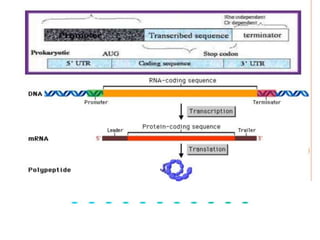
Coding region-
 Starts with an initiator
codon and ends with
termination codon
 No introns
(uninterrupted).
 Collinear to its mRNA.
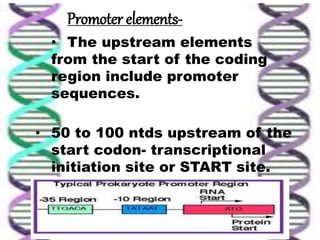
Promoter elements-
• The upstream elements
from the start of the coding
region include promoter
sequences.
• 50 to 100 ntds upstream of the
start codon- transcriptional
initiation site or START site.
• (any nucleotide present
on the left is denoted by
(-)symbol and the region
is called upstream
element. E.g. -10,-20,-35
etc.
• Start site symbolized by
+1. Any sequence to the
right of the start is
downstream elements
and numbered as
+10,+35 etc.)
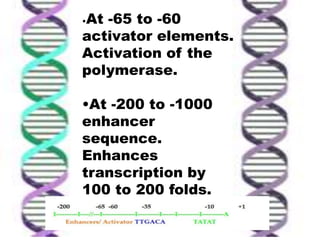
•At -65 to -60
activator elements.
Activation of the
polymerase.
•At -200 to -1000
enhancer
sequence.
Enhances
transcription by
100 to 200 folds.
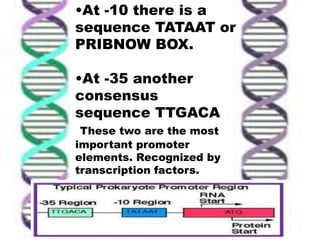
•At -10 there is a
sequence TATAAT or
PRIBNOW BOX.
•At -35 another
consensus
sequence TTGACA
These two are the most
important promoter
elements. Recognized by
transcription factors.
Terminal region
Terminal region of
the gene- Sequences
for the termination of
transcription.
It takes place by Rho
dependent mode or
Rho independent
mode.
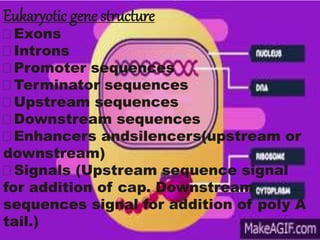
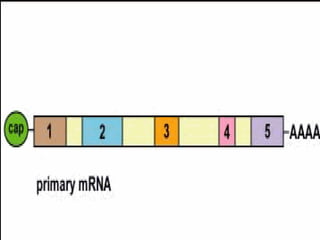
Eukaryotic gene structure
Exons
Introns
Promoter sequences
Terminator sequences
Upstream sequences
Downstream sequences
Enhancers andsilencers(upstream or
downstream)
Signals (Upstream sequence signal
for addition of cap. Downstream
sequences signal for addition of poly A
tail.)
Genetic Code
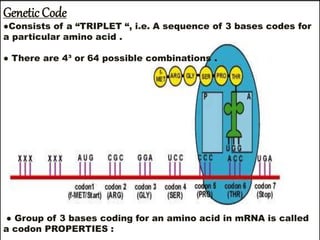
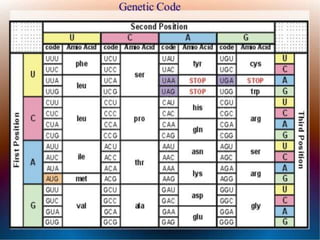
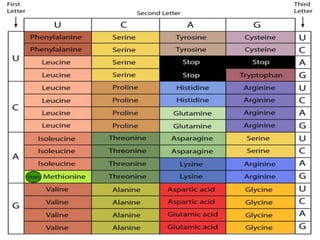
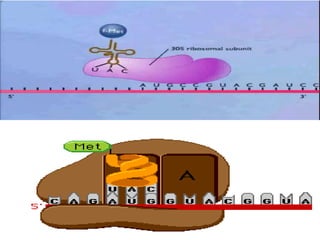
●Consists of a “TRIPLET “, i.e. A sequence of 3 bases codes for
a particular amino acid .
● There are 4³ or 64 possible combinations .
● Group of 3 bases coding for an amino acid in mRNA is called
a codon PROPERTIES :
● Degenerate : An amino acid can be coded for by more than one
codon.
Anti codon shows Wobble hypothesis .
● Unambiguous : Each codon indicates a single , specific amino acid .
● Non-overlapping : When translated , the reading frame is advanced 3
bases at a time .
Gene structure and genetic code

Gene structure and genetic code

  • 1.
  • 2.
    • Unit offunction • Recombination • Mutation Gene is considered to control the inheritance of one character Concept Of Gene
  • 3.
     A geneis a specific sequence of DNA containing genetic information required to make a specific protein  Prokaryotic gene is uninterrupted.  In Eukaryotic gene the coding sequences (exon)are seprated by non- coding sequences called introns.  In complex eukaryotes, introns account for more than 10 times as much DNA as exons.
  • 5.
    RECON - Itis the smallest unit of DNA capable of undergoing Crossing Over and Recombination. MUTON - It is the smallest unit of DNA which can undergo Mutation. CISTRON - It is the unit of Function. It is the Gene in real sense capable of synthesizing a Polypeptide chain of an Enzyme. COMPLON - It is the unit of Complementation.
  • 6.
    PROKARYOTIC GENE STRUCTURAL FEATURES: Simple gene structure.  Small genomes(0.5 to 10 million bp).  Prokaryotic genes are collinear with their proteins. a. CODING REGION b. PROMOTER ELEMENTS c. TERMINAL REGION OR TERMINATOR.
  • 7.
    Coding region-  Startswith an initiator codon and ends with termination codon  No introns (uninterrupted).  Collinear to its mRNA.
  • 9.
    Promoter elements- • Theupstream elements from the start of the coding region include promoter sequences. • 50 to 100 ntds upstream of the start codon- transcriptional initiation site or START site.
  • 10.
    • (any nucleotidepresent on the left is denoted by (-)symbol and the region is called upstream element. E.g. -10,-20,-35 etc. • Start site symbolized by +1. Any sequence to the right of the start is downstream elements and numbered as +10,+35 etc.)
  • 11.
    •At -65 to-60 activator elements. Activation of the polymerase. •At -200 to -1000 enhancer sequence. Enhances transcription by 100 to 200 folds.
  • 12.
    •At -10 thereis a sequence TATAAT or PRIBNOW BOX. •At -35 another consensus sequence TTGACA These two are the most important promoter elements. Recognized by transcription factors.
  • 13.
    Terminal region Terminal regionof the gene- Sequences for the termination of transcription. It takes place by Rho dependent mode or Rho independent mode.
  • 14.
    Eukaryotic gene structure Exons Introns Promotersequences Terminator sequences Upstream sequences Downstream sequences Enhancers andsilencers(upstream or downstream) Signals (Upstream sequence signal for addition of cap. Downstream sequences signal for addition of poly A tail.)
  • 17.
    Genetic Code ●Consists ofa “TRIPLET “, i.e. A sequence of 3 bases codes for a particular amino acid . ● There are 4³ or 64 possible combinations . ● Group of 3 bases coding for an amino acid in mRNA is called a codon PROPERTIES :
  • 18.
    ● Degenerate :An amino acid can be coded for by more than one codon. Anti codon shows Wobble hypothesis . ● Unambiguous : Each codon indicates a single , specific amino acid . ● Non-overlapping : When translated , the reading frame is advanced 3 bases at a time .