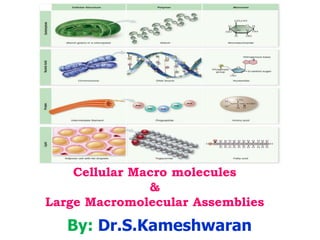
Cellular Macro molecules
&
Large Macromolecular Assemblies
By: Dr.S.Kameshwaran
Molecule Two or more atoms joined by
chemical bonds
Macromolecule Large polymer made of
repeating monomer units
Four types of organic macromolecules
are important in living systems.
Macromolecules
Macromolecules
“Polymers Made of Repeating Monomers”
Macromolecule Monomer Unit
Carbohydrates Sugars
Lipids Fatty acids
Proteins Amino acids
Nucleic Acids Nucleotides
Carbohydrates
Simple Carbohydrates :
Monosaccharides:
Glucose , Galactose, Fructose
Disaccharides :
Sucrose, Lactose, Maltose
Complex Carbohydrates:
Polysaccharides
Starch, Glycogen, Cellulose, Chitin
Carbohydrates
Types : Simple & Complex CHs
• Simple CH - Structure
– Monosaccharides= one sugar unit
Glucose = blood sugar
All cells use glucose for energy
• Simple Carbohydrates
Disaccharides = two sugar units
• Sucrose (table sugar) = glucose + fructose
Lactose (milk sugar)= glucose + galactose
Maltose (seed sugar) = glucose + glucose
• Complex Carbohydrates
– Polysaccharides= many sugar units
• Starch -- storage in plants
• Glycogen -- storage in animals
• Cellulose -- plant cell walls, indigestible
• Chitin -- exoskeletons of insects,
fungal cell walls
Carbohydrates: Functions
• Energy source
• Structural component
• Cell-cell communication
Macromolecule II : Lipids
Lipids (fats, oils, waxes) formed from Fatty
acids monomer units
Structure
• Triglyceride—predominant form in diet
– One molecule of glycerol
– Three fatty acids
– C:H:O ratio- 1:2:very few
Types of Fatty Acids
– Saturated – 2H per internal carbon
– Unsaturated -- <2H per internal carbon
one or more double bonds
• Monounsaturated – one double bond
Polyunsaturated – more than one double bond
H H
C
H
C
H
OH
C
H
OH
OH
C O
C
C
C
H
H
H
H
H
H
H
C
C
H
H
H
H
H
H
H
C
C O C O
C
C
C
H
H
H
H
H
H
H
Triglyceride
Triglyceride Formation
C
OH
C
C
C
O
H
H
H
H
H
H
H
Add 3
Fatty
Acids
Glycerol
HOH HOH HOH
3 Waters
C
OH
C
C
C
O
H
H
H
H
H
H
H
C
OH
C
C
C
O
H
H
H
H
H
H
H
O
C
H
C
H
C
H
O O
H H
Remove
These
Waters
C O
C
C
C
H
H
H
H
H
H
H
C
C
H
H
H
H
H
H
H
C
C O C O
C
C
C
H
H
H
H
H
H
H
Polar
Head
Glycerol Fatty Acid Tails
Hydrophobic
Hydrophilic
•Phospholipid—component of cell membranes
• Steroids
– Linked carbon rings
– Natural body components
• Hormones
• Cholesterol
Steroids
Cholesterol Estradiol
Testosterone
Lipids: Functions
• Concentrated energy source
• Structural components of cell membranes
– Phospholipids
– Cholesterol
• Communication
– Steroid Hormones
• Protection from water
– Waxes
Cholesterol
Phospholipids
Macromolecules: Polymers Made of
Repeating Monomers
Macromolecule Monomer Unit
Protein Amino acids
Four Levels of Protein Structure
Primary
(Sequence)
Secondary
(Coiling by
Hydrogen Bonding)
Tertiary
(Folding by
R-group
interactions)
Quaternary
(Two or more chains
associating)
Primary Structure
Sequence of amino acids in chain
Found in most proteins Found in silk
Secondary Structure
Folded structure due to hydrogen bonds between the amino
and acid groups of amino acids
Tertiary Structure:
Three dimensional folded structure due to
attractions and repulsions between R groups
Can involve
covalent bonding
hydrogen bonding
ionic interactions
hydrophilic and hydrophobic interactions
Tertiary Structure:
Three dimensional folded structure due to attractions and
repulsions between R groups
Can involve
covalent bonding
hydrogen bonding
ionic interactions
hydrophilic and hydrophobic interactions
Hair Curling
|
S
|
S
|
|
S
|
S
|
|
S
|
S
|
|
S
|
S
|
|
S
|
S
|
Straight
Hair
Naturally
Curly
Hair
Quaternary Structure:
Association of two or more protein chains
eg. Hemoglobin is composed
of 4 protein chains
2 are called alpha
hemoglobin
2 are called beta
hemoglobin
Proteins: Functions
• Structural Component of Cells
• Control of Metabolic Reactions: enzymes
• Growth and Repair
• Communication
– Protein Hormones
– Cell Receptors
• Energy source
• C:H:O ratio –no reliable ratio
• For proteins
Protein
Protein
Nucleic Acids
• Nucleic acids store, transmit, and help
express hereditary information
• The amino acid sequence of a polypeptide is
programmed by a unit of inheritance called a
gene
• Genes are made of DNA, a nucleic acid
made of monomers called nucleotides
25
Two Types of Nucleic Acids
• There are two types of nucleic
acids
– Deoxyribonucleic acid
(DNA)
– Ribonucleic acid (RNA)
• DNA provides directions for its
own replication
• DNA directs synthesis of
messenger RNA (mRNA) and,
through mRNA, controls protein
synthesis
• Protein synthesis occurs on
ribosomes
26
Figure 5.25-1
Synthesis of
mRNA
mRNA
DNA
NUCLEUS
CYTOPLASM
1
Figure 5.25-2
Synthesis of
mRNA
mRNA
DNA
NUCLEUS
CYTOPLASM
mRNA
Movement of
mRNA into
cytoplasm
1
2
The Components of Nucleic Acids
• Each nucleic acid is made of monomers called
nucleotides
• Each nucleotide consists of a nitrogenous base,
a pentose sugar, and one or more phosphate
groups
• C:H:O ratio: No reliable ratio for nucleic acids
29
Figure 5.26c
Nitrogenous bases
Cytosine
(C)
Thymine
(T, in DNA)
Uracil
(U, in RNA)
Adenine (A) Guanine (G)
Sugars
Deoxyribose
(in DNA)
Ribose
(in RNA)
(c) Nucleoside components
Pyrimidines
Purines
The Devil is in the Details
• There are two families of nitrogenous bases
– Pyrimidines (cytosine, thymine, and uracil)
have a single six-membered ring
– Purines (adenine and guanine) have a six-
membered ring fused to a five-membered ring
• In DNA, the sugar is deoxyribose; in RNA, the
sugar is ribose
31
The Devil is in the Details
• The nitrogenous bases in DNA pair up and form
hydrogen bonds: adenine (A) always with
thymine (T), and guanine (G) always with
cytosine (C)
• Called complementary base pairing
• Complementary pairing can also occur between
two RNA molecules or between parts of the
same molecule
• In RNA, thymine is replaced by uracil (U) so A
and U pair
32
Sugar-phosphate
backbones
Hydrogen bonds
Base pair joined
by hydrogen bonding
Base pair joined
by hydrogen
bonding
(b) Transfer RNA
(a) DNA
5 3
5
3
Large macromolecular assemblies
Protein Complexes & Nucleoproteins
• Protein Complexes
Nucleoprotein,
• It is a conjugated protein - Protein linked to a nucleic acid --
DNA or RNA.
• The protein combined with DNA is commonly either histone or
protamine; those nucleoproteins are found in chromosomes.
• Typical nucleoproteins include
ribosomes,
nucleosomes
viral nucleocapsid proteins.
Deoxyribonucleoproteins
- a complex of DNA and protein
- Participate in regulating DNA replication and transcription
Ribonucleoproteins
- a complex of ribonucleic acid and RNA-binding protein
- Involves in transcription, translation and regulating gene expression
& regulating metabolism of RNA

III Pharm.D - Macromolecules & LMA.ppt

  • 1.
    Cellular Macro molecules & LargeMacromolecular Assemblies By: Dr.S.Kameshwaran
  • 2.
    Molecule Two ormore atoms joined by chemical bonds Macromolecule Large polymer made of repeating monomer units Four types of organic macromolecules are important in living systems. Macromolecules
  • 3.
    Macromolecules “Polymers Made ofRepeating Monomers” Macromolecule Monomer Unit Carbohydrates Sugars Lipids Fatty acids Proteins Amino acids Nucleic Acids Nucleotides
  • 4.
    Carbohydrates Simple Carbohydrates : Monosaccharides: Glucose, Galactose, Fructose Disaccharides : Sucrose, Lactose, Maltose Complex Carbohydrates: Polysaccharides Starch, Glycogen, Cellulose, Chitin
  • 5.
    Carbohydrates Types : Simple& Complex CHs • Simple CH - Structure – Monosaccharides= one sugar unit Glucose = blood sugar All cells use glucose for energy
  • 6.
    • Simple Carbohydrates Disaccharides= two sugar units • Sucrose (table sugar) = glucose + fructose Lactose (milk sugar)= glucose + galactose Maltose (seed sugar) = glucose + glucose
  • 7.
    • Complex Carbohydrates –Polysaccharides= many sugar units • Starch -- storage in plants • Glycogen -- storage in animals • Cellulose -- plant cell walls, indigestible • Chitin -- exoskeletons of insects, fungal cell walls
  • 8.
    Carbohydrates: Functions • Energysource • Structural component • Cell-cell communication
  • 9.
    Macromolecule II :Lipids Lipids (fats, oils, waxes) formed from Fatty acids monomer units Structure • Triglyceride—predominant form in diet – One molecule of glycerol – Three fatty acids – C:H:O ratio- 1:2:very few
  • 10.
    Types of FattyAcids – Saturated – 2H per internal carbon – Unsaturated -- <2H per internal carbon one or more double bonds • Monounsaturated – one double bond Polyunsaturated – more than one double bond
  • 11.
    H H C H C H OH C H OH OH C O C C C H H H H H H H C C H H H H H H H C CO C O C C C H H H H H H H Triglyceride Triglyceride Formation C OH C C C O H H H H H H H Add 3 Fatty Acids Glycerol HOH HOH HOH 3 Waters C OH C C C O H H H H H H H C OH C C C O H H H H H H H O C H C H C H O O H H Remove These Waters C O C C C H H H H H H H C C H H H H H H H C C O C O C C C H H H H H H H
  • 12.
    Polar Head Glycerol Fatty AcidTails Hydrophobic Hydrophilic •Phospholipid—component of cell membranes
  • 13.
    • Steroids – Linkedcarbon rings – Natural body components • Hormones • Cholesterol
  • 14.
  • 15.
    Lipids: Functions • Concentratedenergy source • Structural components of cell membranes – Phospholipids – Cholesterol • Communication – Steroid Hormones • Protection from water – Waxes Cholesterol Phospholipids
  • 16.
    Macromolecules: Polymers Madeof Repeating Monomers Macromolecule Monomer Unit Protein Amino acids
  • 17.
    Four Levels ofProtein Structure Primary (Sequence) Secondary (Coiling by Hydrogen Bonding) Tertiary (Folding by R-group interactions) Quaternary (Two or more chains associating)
  • 18.
    Primary Structure Sequence ofamino acids in chain
  • 19.
    Found in mostproteins Found in silk Secondary Structure Folded structure due to hydrogen bonds between the amino and acid groups of amino acids
  • 20.
    Tertiary Structure: Three dimensionalfolded structure due to attractions and repulsions between R groups Can involve covalent bonding hydrogen bonding ionic interactions hydrophilic and hydrophobic interactions
  • 21.
    Tertiary Structure: Three dimensionalfolded structure due to attractions and repulsions between R groups Can involve covalent bonding hydrogen bonding ionic interactions hydrophilic and hydrophobic interactions
  • 22.
  • 23.
    Quaternary Structure: Association oftwo or more protein chains eg. Hemoglobin is composed of 4 protein chains 2 are called alpha hemoglobin 2 are called beta hemoglobin
  • 24.
    Proteins: Functions • StructuralComponent of Cells • Control of Metabolic Reactions: enzymes • Growth and Repair • Communication – Protein Hormones – Cell Receptors • Energy source • C:H:O ratio –no reliable ratio • For proteins Protein Protein
  • 25.
    Nucleic Acids • Nucleicacids store, transmit, and help express hereditary information • The amino acid sequence of a polypeptide is programmed by a unit of inheritance called a gene • Genes are made of DNA, a nucleic acid made of monomers called nucleotides 25
  • 26.
    Two Types ofNucleic Acids • There are two types of nucleic acids – Deoxyribonucleic acid (DNA) – Ribonucleic acid (RNA) • DNA provides directions for its own replication • DNA directs synthesis of messenger RNA (mRNA) and, through mRNA, controls protein synthesis • Protein synthesis occurs on ribosomes 26
  • 27.
  • 28.
  • 29.
    The Components ofNucleic Acids • Each nucleic acid is made of monomers called nucleotides • Each nucleotide consists of a nitrogenous base, a pentose sugar, and one or more phosphate groups • C:H:O ratio: No reliable ratio for nucleic acids 29
  • 30.
    Figure 5.26c Nitrogenous bases Cytosine (C) Thymine (T,in DNA) Uracil (U, in RNA) Adenine (A) Guanine (G) Sugars Deoxyribose (in DNA) Ribose (in RNA) (c) Nucleoside components Pyrimidines Purines
  • 31.
    The Devil isin the Details • There are two families of nitrogenous bases – Pyrimidines (cytosine, thymine, and uracil) have a single six-membered ring – Purines (adenine and guanine) have a six- membered ring fused to a five-membered ring • In DNA, the sugar is deoxyribose; in RNA, the sugar is ribose 31
  • 32.
    The Devil isin the Details • The nitrogenous bases in DNA pair up and form hydrogen bonds: adenine (A) always with thymine (T), and guanine (G) always with cytosine (C) • Called complementary base pairing • Complementary pairing can also occur between two RNA molecules or between parts of the same molecule • In RNA, thymine is replaced by uracil (U) so A and U pair 32
  • 33.
    Sugar-phosphate backbones Hydrogen bonds Base pairjoined by hydrogen bonding Base pair joined by hydrogen bonding (b) Transfer RNA (a) DNA 5 3 5 3
  • 35.
    Large macromolecular assemblies ProteinComplexes & Nucleoproteins • Protein Complexes
  • 36.
    Nucleoprotein, • It isa conjugated protein - Protein linked to a nucleic acid -- DNA or RNA. • The protein combined with DNA is commonly either histone or protamine; those nucleoproteins are found in chromosomes. • Typical nucleoproteins include ribosomes, nucleosomes viral nucleocapsid proteins. Deoxyribonucleoproteins - a complex of DNA and protein - Participate in regulating DNA replication and transcription Ribonucleoproteins - a complex of ribonucleic acid and RNA-binding protein - Involves in transcription, translation and regulating gene expression & regulating metabolism of RNA