MOHAMMAD BILAL KAKAR
MOLECULAR BIOLOGY
DEPARTMENT OF MICROBIOLOGY
UNIVERSITY OF BALOCHISTAN QUETTA
THE STRUCTURE & FUNCTION
OF GENES
TABLE OF CONTENT
1 . G E N O M E & G E N E
2 . H I S TO RY O F G E N E
3 . C L A S S I C A L C O N C E P T O F G E N E
4 . M O D E R N C O N C E P T O F G E N E
5 . S T R U C T U R E O F G E N E
6 . T Y P E S O F G E N E S
8 . F U N C T I O N O F E U K A RY O T I C A N D P R O K A RY O T I C
G E N E
GENOME
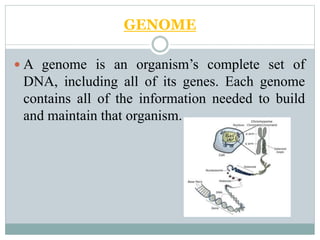
 A genome is an organism’s complete set of
DNA, including all of its genes. Each genome
contains all of the information needed to build
and maintain that organism.
GENE
Genes are segments of DNA located
on chromosomes that contain the instructions for
protein production.
 A single human chromosome contains 100 to
thousands of genes.
 A gene is the segment of DNA which contains
complete information about production.
 A gene is the functional unit of Heredity.
 Each gene is a segment of DNA that give rise to a
protein product or RNA.
HISTORY OF GENE
 1:- GREGOR MENDLE (THE FATHER OF
GENETICS)
 Gregor Mendel, through his work on pea plants,
discovered the fundamental laws of inheritance. He
deduced that genes come in pairs and are inherited as
distinct units, one from each parent.
 The Mendel work was rediscovered in 1900.
 2:- WILHELM JOHANNSEN
 He coined the term gene in 1909.
 3:- WILLIAM BATESON
 He coined the term Genetics in 1905.
T.M MORGAN THEORY OF GENE
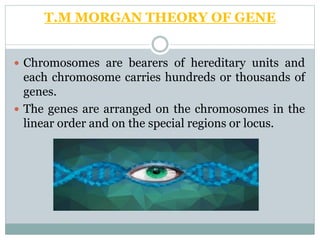
 Chromosomes are bearers of hereditary units and
each chromosome carries hundreds or thousands of
genes.
 The genes are arranged on the chromosomes in the
linear order and on the special regions or locus.
CLASSICAL CONCEPT OF GENE
Introduced by Sutton (1902) and was elaborated by
Morgan (1913). Bidge (1923), Muller (1927) and
others which outlined as follows:
 Genes are discrete particles inherited in mendelian
fashion that occupies a definite locus in the
chromosome and responsible for expression of
specific phenotypic character.
 Number of genes in each organism is more than
the number of chromosomes; hence several genes
are located on each chromosome
CLASSICAL CONCEPT OF GENE
 The genes are arranged in a single linear order like beads
on a string.
 Each gene occupies specific position called locus.
 If the position of gene changes, character changes.
 Genes can be transmitted from parent to off springs.
 Genes may exist in several alternate formed called alleles.
 Genes are capable of combined together or can be
replicated during a cell division.
 Genes may under for sudden changes in position and
composition called mutation.
 Genes are capable of self-duplication producing their own
exact copies.
MODERN CONCEPT OF GENE
S. Benzer (1957) coined different terms for different
nature of gene and genetic material in relation to the
chromosome on the basis of genetic phenomena to
which they involve.
 • Genes as unit of transmission or cistron.
 • Genes as unit of recombination or recon
 • Gene as unit of mutation or muton.
 Genes as unit of transmission or cistron
 The part of DNA specifying a single polypeptide
chain is termed as cistron.
MODERN CONCEPT OF GENE
 A cistron can have 100 nucleotide pairs in length to
30,000nucleotide pairs.
 It transmits characters from one generation to other
as unit of transmission.
 Genes as unit of recombination or recon
 The smallest segment of DNA capable of being
separated and exchange with other chromosome is
called recon.
 A recon consists of not more than two pairs of
nucleotides.
STRUCTURE OF GENE
On the basis of structure the gene are classified into to
types
 THE EUKARYOTIC GENE
 THE PROKARYOTIC GENE
PROKARYOTIC GENE STRUCTURE
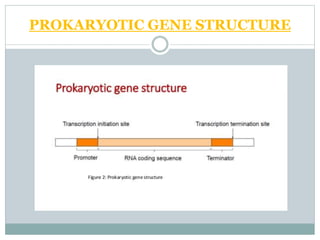
Prokaryotic gene is composed of three regions:
 Promoter region
 RNA coding Sequence
 Terminator region
 Prokaryotic gene is continues and uninterested
where there is no introns presents.
 The region 5’ of the promoter sequence is called
upstream sequence and region 3’ of the terminator
sequence is called downstream Sequence.
PROKARYOTIC GENE STRUCTURE
PROMOTER REGION:
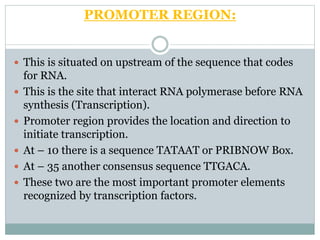
 This is situated on upstream of the sequence that codes
for RNA.
 This is the site that interact RNA polymerase before RNA
synthesis (Transcription).
 Promoter region provides the location and direction to
initiate transcription.
 At – 10 there is a sequence TATAAT or PRIBNOW Box.
 At – 35 another consensus sequence TTGACA.
 These two are the most important promoter elements
recognized by transcription factors.
RNA CODING SEQUENCE
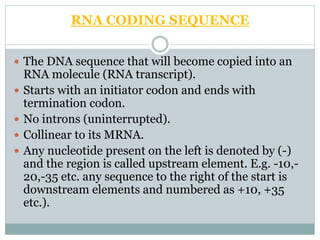
 The DNA sequence that will become copied into an
RNA molecule (RNA transcript).
 Starts with an initiator codon and ends with
termination codon.
 No introns (uninterrupted).
 Collinear to its MRNA.
 Any nucleotide present on the left is denoted by (-)
and the region is called upstream element. E.g. -10,-
20,-35 etc. any sequence to the right of the start is
downstream elements and numbered as +10, +35
etc.).
TERMINATOR REGION
 The region that signal the RNA polymerase to stop
transcription from DNA template.
 Transcription termination occurs through Rho
dependent or Rho independent manner.
EUKARYOTIC GENE STRUCTURE:
Eukaryotic gene are complex structure compared that
prokaryotic gene.
They are composed of following regions.
 EXONS
 INTRONS
 PROMOTER SEQUENCE
 TERMINATOR SEQUENCES
 UPSTREAM SEQUENCE
 DOWNSTREAM SEQUENCE
 ENHANCERS AND SILENCERS (upstream or downstream)
 SIGNALS (upstream sequence signal for addition of cap.
downstream sequences signal for addition of poly a tail)
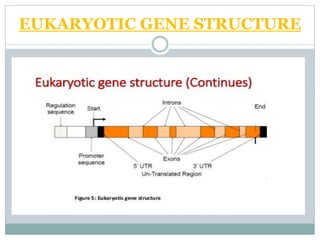
EUKARYOTIC GENE STRUCTURE
EXONS
 Coding sequence transcribed and translated.
 Coding for amino acids in the polypeptide chain.
 Vary in number, sequence and length. A gene starts
and ends with exons. (5’ to 3’).
 Some exon includes translated (UTR) Region.
INTRONS
 Coding sequence is separated by noncoding
sequences called introns.
 They are removed when the primary transcript is
processed to give the mature RNA.
 All introns share the base sequence GT in the 5’ end
and AG in the 3’ end.
SIGNIFICANCE OF INTRONS:
 Introns don’t specify the synthesis of protein but have
other important cellular activities.
 Many introns encode RNA’s that are major regulators of
gene expression.
 Contain regulatory sequences that control transcription
and MRNA processing.
 Introns allow exons to be joined in different
combinations (alternative Splicing) resulting in the
synthesis of different proteins from the same gene.
 Important role in evolution by facilitating recombination
between exons of different genes (exon shuffling).
 PROMOTERS
 A promoter is regulatory region of DNA located upstream controlling gene
expression.
 Core promoter: - transcription start site (-34) Binding site for RNA
polymerase and it is a general transcription factor binding sites.
 Proximal promoter: - contain primary regulatory element.
 These together are responsible for binding of RNA polymerase II which is
responsible for the transcription.
 UPSTREAM (5’END)
 5’ UTR serve several functions including MRNA transport and initiation of
translation.
 Signal for addition of cap (7 methyl 1 guanisine) to 5’ end of the MRNA.
 The cap facilitates the initiation of translation.
 Stabilization of MRNA.
 DOWNSTREAM (3’END)
 3’ UTR serve to add MRNA.
 Stability and attachment site for poly A-tail
 The translation termination codon TAA.
 AATAA sequence signal for addition of poly A tail
 TERMINATOR:
 Recognized by RNA polymerase as a signal to stop
transcription.
 ENHANCER
 Enhances the transcription of a gene upto few thousand bp
upstream
 SILENCERS
 Reduce or shut down the expression of a nearby gene.
TYPES OF GENES
On the basis of behavior the genes are categorized into the
following types.
 BASIC GENES
 These are the fundamental genes that bring about expression
of particular character.
 LETHAL GENES
 These bring about the death their possessor.
 MULTIPLE GENE
 When two or more pairs of independent genes act together to
produce a single phenotypic trait.
 CUMULATIVE GENE
 Some genes have additive effects on the action of other genes.
These are called cumulative genes.
TYPES OF GENES
 PLEIOTROPIC GENES
 The genes which produce changes in more than one
character is called pleiotropic gene.
 MODIFYING GENE
 The gene which can’t produce a character by itself
but interacts with other to produce modified effects
is called modifier gene.
 INHIBITORY GENE
 The gene which suppresses or inhibits the expression
of another gene is called inhibitory gene.
FUNCTION OF GENES
 Genes control the functions of DNA and RNA.
 Proteins are the most important materials in the
human body which not only help by being the
building blocks for muscles, connecting tissue and
skin but also take care of the enzymes production.
 These enzymes play an important role in conducting
various chemical processes and reactions within the
body. Therefore, protein synthesis is responsible for
all activities carried on by the body and are mainly
controlled by the genes.
FUNCTION OF GENES
 Genes consist of a particular set of instructions or
specific functions. For example, globin gene was
instructed to produce hemoglobin. Hemoglobin is a
protein that helps to carry oxygen in the blood.
 Genes decide almost everything about a living being.
One or more genes can affect a specific trait. Genes
may interact with an individual's environment too
and change what the gene makes.

The structure & function of genes

  • 1.
    MOHAMMAD BILAL KAKAR MOLECULARBIOLOGY DEPARTMENT OF MICROBIOLOGY UNIVERSITY OF BALOCHISTAN QUETTA THE STRUCTURE & FUNCTION OF GENES
  • 2.
    TABLE OF CONTENT 1. G E N O M E & G E N E 2 . H I S TO RY O F G E N E 3 . C L A S S I C A L C O N C E P T O F G E N E 4 . M O D E R N C O N C E P T O F G E N E 5 . S T R U C T U R E O F G E N E 6 . T Y P E S O F G E N E S 8 . F U N C T I O N O F E U K A RY O T I C A N D P R O K A RY O T I C G E N E
  • 3.
    GENOME  A genomeis an organism’s complete set of DNA, including all of its genes. Each genome contains all of the information needed to build and maintain that organism.
  • 4.
    GENE Genes are segmentsof DNA located on chromosomes that contain the instructions for protein production.  A single human chromosome contains 100 to thousands of genes.  A gene is the segment of DNA which contains complete information about production.  A gene is the functional unit of Heredity.  Each gene is a segment of DNA that give rise to a protein product or RNA.
  • 5.
    HISTORY OF GENE 1:- GREGOR MENDLE (THE FATHER OF GENETICS)  Gregor Mendel, through his work on pea plants, discovered the fundamental laws of inheritance. He deduced that genes come in pairs and are inherited as distinct units, one from each parent.  The Mendel work was rediscovered in 1900.  2:- WILHELM JOHANNSEN  He coined the term gene in 1909.  3:- WILLIAM BATESON  He coined the term Genetics in 1905.
  • 6.
    T.M MORGAN THEORYOF GENE  Chromosomes are bearers of hereditary units and each chromosome carries hundreds or thousands of genes.  The genes are arranged on the chromosomes in the linear order and on the special regions or locus.
  • 7.
    CLASSICAL CONCEPT OFGENE Introduced by Sutton (1902) and was elaborated by Morgan (1913). Bidge (1923), Muller (1927) and others which outlined as follows:  Genes are discrete particles inherited in mendelian fashion that occupies a definite locus in the chromosome and responsible for expression of specific phenotypic character.  Number of genes in each organism is more than the number of chromosomes; hence several genes are located on each chromosome
  • 8.
    CLASSICAL CONCEPT OFGENE  The genes are arranged in a single linear order like beads on a string.  Each gene occupies specific position called locus.  If the position of gene changes, character changes.  Genes can be transmitted from parent to off springs.  Genes may exist in several alternate formed called alleles.  Genes are capable of combined together or can be replicated during a cell division.  Genes may under for sudden changes in position and composition called mutation.  Genes are capable of self-duplication producing their own exact copies.
  • 9.
    MODERN CONCEPT OFGENE S. Benzer (1957) coined different terms for different nature of gene and genetic material in relation to the chromosome on the basis of genetic phenomena to which they involve.  • Genes as unit of transmission or cistron.  • Genes as unit of recombination or recon  • Gene as unit of mutation or muton.  Genes as unit of transmission or cistron  The part of DNA specifying a single polypeptide chain is termed as cistron.
  • 10.
    MODERN CONCEPT OFGENE  A cistron can have 100 nucleotide pairs in length to 30,000nucleotide pairs.  It transmits characters from one generation to other as unit of transmission.  Genes as unit of recombination or recon  The smallest segment of DNA capable of being separated and exchange with other chromosome is called recon.  A recon consists of not more than two pairs of nucleotides.
  • 11.
    STRUCTURE OF GENE Onthe basis of structure the gene are classified into to types  THE EUKARYOTIC GENE  THE PROKARYOTIC GENE
  • 12.
    PROKARYOTIC GENE STRUCTURE Prokaryoticgene is composed of three regions:  Promoter region  RNA coding Sequence  Terminator region  Prokaryotic gene is continues and uninterested where there is no introns presents.  The region 5’ of the promoter sequence is called upstream sequence and region 3’ of the terminator sequence is called downstream Sequence.
  • 13.
  • 14.
    PROMOTER REGION:  Thisis situated on upstream of the sequence that codes for RNA.  This is the site that interact RNA polymerase before RNA synthesis (Transcription).  Promoter region provides the location and direction to initiate transcription.  At – 10 there is a sequence TATAAT or PRIBNOW Box.  At – 35 another consensus sequence TTGACA.  These two are the most important promoter elements recognized by transcription factors.
  • 15.
    RNA CODING SEQUENCE The DNA sequence that will become copied into an RNA molecule (RNA transcript).  Starts with an initiator codon and ends with termination codon.  No introns (uninterrupted).  Collinear to its MRNA.  Any nucleotide present on the left is denoted by (-) and the region is called upstream element. E.g. -10,- 20,-35 etc. any sequence to the right of the start is downstream elements and numbered as +10, +35 etc.).
  • 16.
    TERMINATOR REGION  Theregion that signal the RNA polymerase to stop transcription from DNA template.  Transcription termination occurs through Rho dependent or Rho independent manner.
  • 17.
    EUKARYOTIC GENE STRUCTURE: Eukaryoticgene are complex structure compared that prokaryotic gene. They are composed of following regions.  EXONS  INTRONS  PROMOTER SEQUENCE  TERMINATOR SEQUENCES  UPSTREAM SEQUENCE  DOWNSTREAM SEQUENCE  ENHANCERS AND SILENCERS (upstream or downstream)  SIGNALS (upstream sequence signal for addition of cap. downstream sequences signal for addition of poly a tail)
  • 18.
  • 19.
    EXONS  Coding sequencetranscribed and translated.  Coding for amino acids in the polypeptide chain.  Vary in number, sequence and length. A gene starts and ends with exons. (5’ to 3’).  Some exon includes translated (UTR) Region.
  • 20.
    INTRONS  Coding sequenceis separated by noncoding sequences called introns.  They are removed when the primary transcript is processed to give the mature RNA.  All introns share the base sequence GT in the 5’ end and AG in the 3’ end.
  • 21.
    SIGNIFICANCE OF INTRONS: Introns don’t specify the synthesis of protein but have other important cellular activities.  Many introns encode RNA’s that are major regulators of gene expression.  Contain regulatory sequences that control transcription and MRNA processing.  Introns allow exons to be joined in different combinations (alternative Splicing) resulting in the synthesis of different proteins from the same gene.  Important role in evolution by facilitating recombination between exons of different genes (exon shuffling).
  • 22.
     PROMOTERS  Apromoter is regulatory region of DNA located upstream controlling gene expression.  Core promoter: - transcription start site (-34) Binding site for RNA polymerase and it is a general transcription factor binding sites.  Proximal promoter: - contain primary regulatory element.  These together are responsible for binding of RNA polymerase II which is responsible for the transcription.  UPSTREAM (5’END)  5’ UTR serve several functions including MRNA transport and initiation of translation.  Signal for addition of cap (7 methyl 1 guanisine) to 5’ end of the MRNA.  The cap facilitates the initiation of translation.  Stabilization of MRNA.
  • 23.
     DOWNSTREAM (3’END) 3’ UTR serve to add MRNA.  Stability and attachment site for poly A-tail  The translation termination codon TAA.  AATAA sequence signal for addition of poly A tail  TERMINATOR:  Recognized by RNA polymerase as a signal to stop transcription.  ENHANCER  Enhances the transcription of a gene upto few thousand bp upstream  SILENCERS  Reduce or shut down the expression of a nearby gene.
  • 24.
    TYPES OF GENES Onthe basis of behavior the genes are categorized into the following types.  BASIC GENES  These are the fundamental genes that bring about expression of particular character.  LETHAL GENES  These bring about the death their possessor.  MULTIPLE GENE  When two or more pairs of independent genes act together to produce a single phenotypic trait.  CUMULATIVE GENE  Some genes have additive effects on the action of other genes. These are called cumulative genes.
  • 25.
    TYPES OF GENES PLEIOTROPIC GENES  The genes which produce changes in more than one character is called pleiotropic gene.  MODIFYING GENE  The gene which can’t produce a character by itself but interacts with other to produce modified effects is called modifier gene.  INHIBITORY GENE  The gene which suppresses or inhibits the expression of another gene is called inhibitory gene.
  • 26.
    FUNCTION OF GENES Genes control the functions of DNA and RNA.  Proteins are the most important materials in the human body which not only help by being the building blocks for muscles, connecting tissue and skin but also take care of the enzymes production.  These enzymes play an important role in conducting various chemical processes and reactions within the body. Therefore, protein synthesis is responsible for all activities carried on by the body and are mainly controlled by the genes.
  • 27.
    FUNCTION OF GENES Genes consist of a particular set of instructions or specific functions. For example, globin gene was instructed to produce hemoglobin. Hemoglobin is a protein that helps to carry oxygen in the blood.  Genes decide almost everything about a living being. One or more genes can affect a specific trait. Genes may interact with an individual's environment too and change what the gene makes.