GENERAL EDUCATION HUMANITIESGEHU 211: ART APPRECIATION
POST TESTWHAT IS BEAUTY?WHY ARE HUMANITIES INCLUDED IN THE SCHOOL CURRICULUM?LIST DOWN AT LEAST 5 AREAS OF HUMANITIES?IN YOUR OWN WORDS, DEFINE THE FOLLOWING BRIEFLY:ARTSCULPTUREPAINTING
HUMANITIES- IT IS A SET OF DISCIPLINE THAT INCLUDES GRAMMAR, PHILOSOPHY, LITERATURE, HISTORY AND MUSIC.AS THE WORD SUGGESTS, MAN IS THE CENTER OF HUMANITIES.THE TERM IS DERIVED FROM THE LATIN WORD HUMANUS, WHICH MEANS HUMAN.THIS CONCERNS HUMANITY
IT RECORDS OR INTERPRETS MAN’S THINKING, FEELING, REGRETS, ASPIRATIONS, FAILURES AND WHAT HE SUPPOSED NOT TO DO IN THE WORLD.ART THAT IS THE BY-PRODUCT OF HUMANITIES IS LOOKING AT THINGS BEYOND MATTERS.IN ARTS, MAN HAS FOUND A SIMPLE RELIEF FROM THE DISCOMFORT BROUGHT ABOUT BY THE WORLD OF SO MUCH UNFAIRNESS.
hu·man·i·ty noun1. human race: the human race considered as a whole 2. qualities of human being: the qualities or characteristics considered as a whole to be characteristic of human beings
WHY STUDY HUMANITIES?TO EQUIP STUDENTS  WITH A CULTURE THAT IS NECESSARY TO COMPLETE HIS BEING.
THIS IS THE CULTURE THAT FREES MAN FROM STICKING INTO THE MANDATES OF THE WORLD.
MAN IS HIGHLY CULTURED IF HE COULD LIVE HAPPILY BEYOND THE THINGS THAT SATISFY ONLY THE PRACTICALITIES OF LIFE. ST. THOMAS AQUINAS SAID: ART IS OPPOSITE TO THE PRACTICAL. ART IS NOT CONCERNED WHETHER MAN HAS FINE DRESSES, DELICIOUS FOOD OR IF HE HAS MONEYART IS CONCERNED ON SOMETHING THAT LIVES BEYOND MATTERS.NOVELISTS WRITE WITHOUT THINKING OF ANY MONETARY RETURN.TOTAL HUMAN DEVELOPMENT. AS THE MEANING OF EDUCATION DOES NOT MEAN TO FINISH A DEGREE, FIND A JOB AND GATHER WEALTH TO A HEAP. LIKE THE ARTISTS, MEN SHOULD LABOR BEYOND THE VALUE OF MONEY.
BRANCHES OF HUMANITIESA. FINE ARTSPAINTING – MAIN PROCESS IS APPLYING COLOR OR PIGMENT TO A SURFACELITERATURE – MAIN MEDIUM ARE THE WRITTEN WORD.B. PERFORMING ARTSDANCE-COMBINES MOVEMENTS OF FEET, HANDS AND BODY IN RHYTHM
SINGING/MUSIC- PUTTING TOGETHER THE SOUNDS IN ORDER.CINEMA-MOTION PICTURE THAT BLENDS TOGETHER THE FUNDAMENTAL AND VITAL ELEMENTS OF MUSIC, PAINTING, LITERATURE  AND MUSIC.C. PRACTICAL ARTS:SCULPTURE- REFERS TO THE BREAKING AND OR PIECING TOGETHER HARD STONE OR OTHER SHAPEABLE MATERIALS TO REPRESENT SOMETHING IMAGINED OR REAL.ARCHITECTURE- AN ART OF DESIGNING AND CONSTRUCTING A BUILDING OR OTHER TYPE OF STRUCTURE.
ARTArtis defined as  follows "Art is created when an artist creates a beautiful object, or produces a stimulating experience that is considered by his audience to have artistic merit.“
art is the process that leads to a product (the artwork or piece of art), which is then examined and analyzed by experts in the field of the arts or simply enjoyed by those who appreciate the arts.
Art is a global activity which encompasses a host of disciplines, as evidenced by the range of words and phrases which have been invented to describe its various forms. Examples of such include: Fine Arts, Liberal Arts, Visual Arts, Decorative Arts, Applied Arts, Design, Crafts, Performing Arts, and so on.
  VISUAL ELEMENTS  OF ARTS  Most basic elements of visual arts:Lines FormsColors
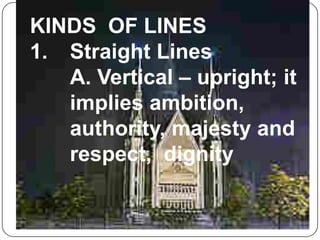
KINDS  OF LINESStraight Lines	A. Vertical – upright; it implies ambition, authority, majesty and respect,  dignity
B. Horizontal – a line in parallel to the horizon.  Lines of repose and serenity,    reclining person and landscape of bodies of water .
C. Diagonal- slanting direction. Implies actions and movements, a running man, a bull fighting and other actions. 
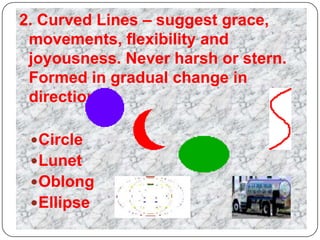
2. Curved Lines – suggest grace, movements, flexibility and joyousness. Never harsh or stern. Formed in gradual change in direction.Circle LunetOblong			Ellipse
lu·nette [loonét](plurallu·nettes) noun1. crescent-shaped object: any object that has a crescent shape 2. window in domed ceiling: an arch-shaped window at the height of a domed ceiling 3. semicircular panel: a semicircular panel on a wall, containing a window, painting, or frieze 4. vehicle's towing ring: a metal ring on a vehicle to which a rope can be attached for towingMicrosoft® Encarta® 2008. © 1993-2007 Microsoft Corporation. All rights reserved.
FORMS – COMBINATION OF DIFFERENT LINES WOULD RESULT TO  A  CERTAIN FORM. 
COLORSBlack is not a color.Color is aproperty of light so if there is no light there is no color.Line and forms give structure to a work of art while colors give life to it.
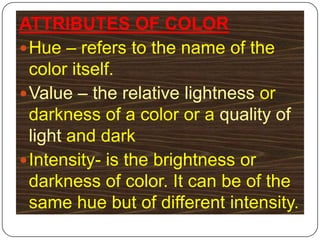
ATTRIBUTES OF COLORHue – refers to the name of the color itself.Value – the relative lightness or darkness of a color or a quality of light and darkIntensity- is the brightness or darkness of color. It can be of the same hue but of different intensity.
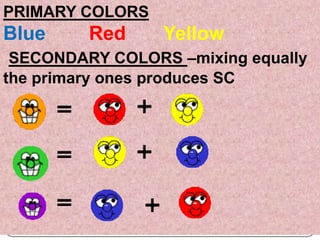
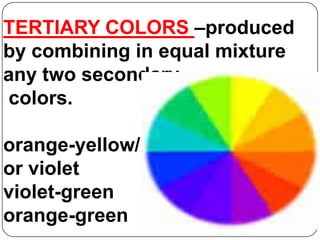
PRIMARY COLORSBlue	    Red		Yellow SECONDARY COLORS –mixing equally the primary ones produces SC 
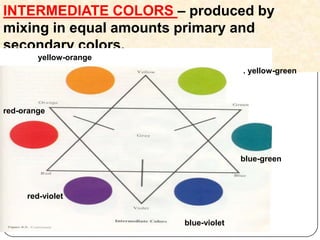
INTERMEDIATE COLORS – produced by mixing in equal amounts primary and secondary colors.  yellow-orange	. yellow-greenred-orange	blue-greenred-violetblue-violet
TERTIARY COLORS –produced by combining in equal mixture any two secondarycolors.orange-yellow/or violetviolet-greenorange-green
Meaning of Colors:Black– darkest and dullest, it suggests despair, gloom, death and mourning.Blue-color of the sky and of the deep. Vastness and Infinity. Symbol of tranquility, calmness and peace.Gray-combination of black and white or the primary colors. It gives the impression of weight, solidity, neutrality
Green- color of still water and vegetation. Symbol of growth, freshness and hope.Orange – Symbolizes deliciousness and sweetness.Pink- is a combination of red and white, symbolizes LoveRed – typifies fire, blood, danger, festivity, bravery, war, passion, energy and warmth.
Violet- suggests shadows, mourning, penance, royalty and power.White- symbolizes simplicity, clarity, purity and peace. Lightest of all colors.Yellow– color of light. Symbolizes life, joy, sunshine, cheerfulness\, warmth, splendor and hospitality. 
Yellow-green-this color symbolizes  jealousy and hatred. Hurting to the eyes and which makes one appear darker. Appropriate for  those with fair complexion.Brown- mixture of red and little        green. Suggests humility and       confidence.
Warm colors –Red, Orange and Yellow. They associate with the source of heat such as sun, light and fire. Imply cheerfulness, joys, actions, life and happinessCool Colors – Blue, blue-green, blue-violet. Suggests distance, calm, sober restful and inconspicuous.
COLOR HARMONIES – groupings of hues.color harmonies – correct combination and arrangement of colors appear pleasing to the eyes; combination of several tones of one hue like orange, tan, brown and others from the orange family.-MONOCHROMATIC HARMONY.contrasted color harmonies – refers to the disagreement or opposition of hues.
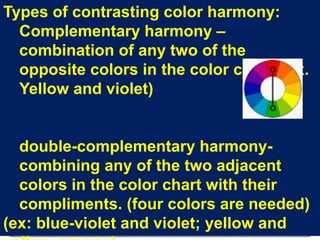
Types of contrasting color harmony:Complementary harmony – combination of any two of the opposite colors in the color chart. (ex.  Yellow and violet) double-complementary harmony- combining any of the two adjacent colors in the color chart with their compliments. (four colors are needed)(ex: blue-violet and violet; yellow and yellow-orange)
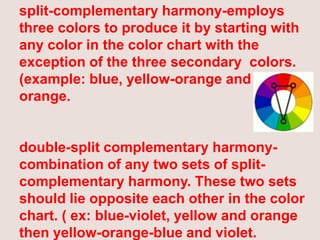
split-complementary harmony-employs three colors to produce it by starting with any color in the color chart with the exception of the three secondary  colors. (example: blue, yellow-orange and red-orange. double-split complementary harmony-combination of any two sets of split-complementary harmony. These two sets should lie opposite each other in the color chart. ( ex: blue-violet, yellow and orange then yellow-orange-blue and violet.
Other elements of Visual Arts are:  Value–the relative lightness and darkness of a color or a quality of light and dark. It is a quality which depends on the amount of light and dark in color.Intensity-is the brightness or darkness of color. It gives color strength. Intensity differences may be described as full intensity, two-thirds intensity, two thirds neutral and neutral. Two colors may be both blue but one is more intense than the other. When the hue  is in vivid form, it is said to be in full intensity. When it is dulled, it is said to be partly neutralized. The more black or white is added, the weaker is the intensity.
Texture-the element that deals more directly with the sense of touch. It has to do with the characteristic of surfaces which can be rough, smooth, fine or coarse, shiny or dull, plain or irregular. Texture is best appreciated when an object is felt with the hands.Perspective-deals with the effect of distance upon the appearance of objects, by means of which the eye judges spatial relationships. It enables us to perceive distance and to see the position of objects in space.
There are two kinds of perspectives:1.Linear Perspective- representation of an appearance of distance by means of converging lines. The tracks of a railroad appear to the viewer as seeming to rise and meet in the distance. Linear has to do with the direction of lines and with the size of objects.2.Aerial Perspective- the representation of relative distances of objects by gradations of tone and color.  Objects become fainter in the distance due to the effect to the atmosphere. Objects appear to be lighter in color and the outline more vague as they recede into the distance or into the atmosphere. 
Chiaroscuro or light and shadow. The word is taken from the two Italian word chiaro which means light and oscuro means dark. This is a pictorial representation using light and shade without the use of colors.  
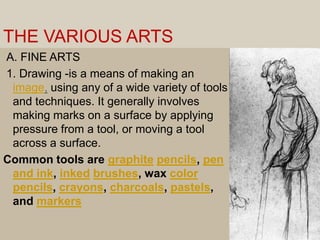
THE VARIOUS ARTS A. FINE ARTS 1. Drawing -is a means of making an image, using any of a wide variety of tools and techniques. It generally involves making marks on a surface by applying pressure from a tool, or moving a tool across a surface.Common tools are graphitepencils, pen and ink, inkedbrushes, wax color pencils, crayons, charcoals, pastels, and markers
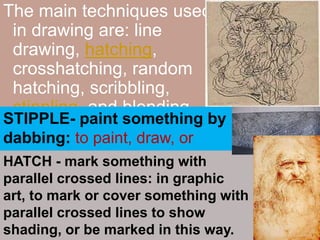
The main techniques used in drawing are: line drawing, hatching, crosshatching, random hatching, scribbling, stippling, and blending.STIPPLE- paint something by dabbing: to paint, draw, or engrave something using dots or short dabbingHATCH - mark something with parallel crossed lines: in graphic art, to mark or cover something with parallel crossed lines to show shading, or be marked in this way.
An artist who excels in drawing is referred to as a draftswoman or draughtsman.
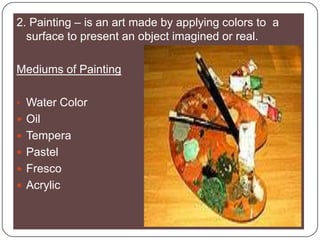
2. Painting – is an art made by applying colors to  a surface to present an object imagined or real.Mediums of PaintingWater Color OilTemperaPastelFrescoAcrylic
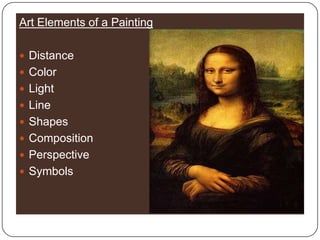
Art Elements of a PaintingDistanceColorLightLineShapesCompositionPerspectiveSymbols
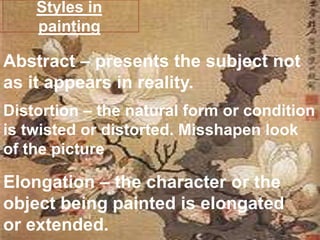
Styles in paintingAbstract – presents the subject not as it appears in reality.Distortion – the natural form or condition is twisted or distorted. Misshapen look of the picture Elongation – the character or the object being painted is elongated or extended.
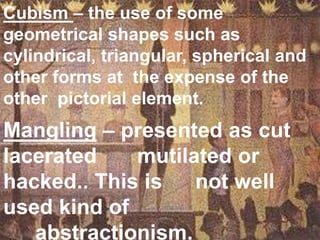
Cubism – the use of some  geometrical shapes such as  cylindrical, triangular, spherical and other forms at  the expense of the other  pictorial element.Mangling – presented as cut lacerated 	 mutilated or hacked.. This is 	not well used kind of 				abstractionism.
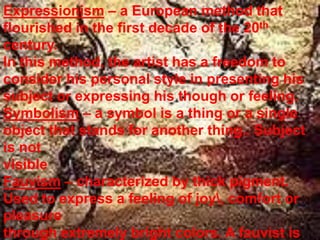
Expressionism – a European method that flourished in the first decade of the 20th century.In this method, the artist has a freedom to consider his personal style in presenting his subject or expressing his though or feeling.Symbolism – a symbol is a thing or a single object that stands for another thing.. Subject is not visibleFauvism – characterized by thick pigment.  Used to express a feeling of joy\, comfort or pleasure through extremely bright colors. A fauvist is too much concerned on the brightness of the colors.  
Dadaism – “dada” a French word meaning “boby horse” It is a protest movement against the traditional outworn arts and evils in society. Dadaist artist tries to start outrage to undermine faith and dependence to an established institution.Surrealism – presenting art by fantastic or incongruous imagery produced by unnatural combinations. Surreal means intense irrationality or beyond natural. In other words, pictures out image in a form of a dream.
Futurism – star wars, time machine, terminator and others picture something in the future. It exalts success in technology. Anything that relates the importance of modernization.  
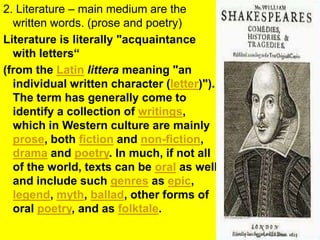
2. Literature – main medium are the written words. (prose and poetry)Literature is literally "acquaintance with letters“ (from the Latinlittera meaning "an individual written character (letter)"). The term has generally come to identify a collection of writings, which in Western culture are mainly prose, both fiction and non-fiction, drama and poetry. In much, if not all of the world, texts can be oral as well, and include such genres as epic, legend, myth, ballad, other forms of oral poetry, and as folktale.
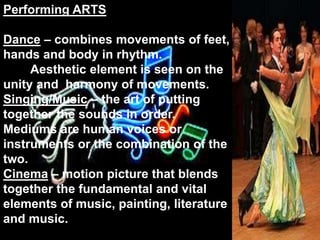
Performing ARTS Dance – combines movements of feet, hands and body in rhythm.         Aesthetic element is seen on the unity and  harmony of movements.Singing/Music – the art of putting together the sounds in order. Mediums are human voices or instruments or the combination of the two.Cinema – motion picture that blends together the fundamental and vital elements of music, painting, literature and music.
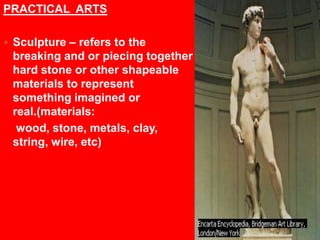
PRACTICAL  ARTSSculpture – refers to the breaking and or piecing together hard stone or other shapeable materials to represent something imagined or real.(materials:   wood, stone, metals, clay, string, wire, etc)
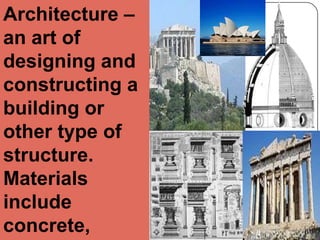
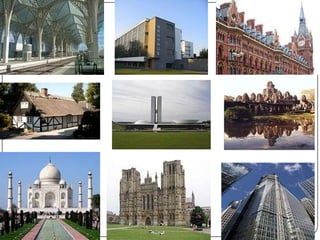
Architecture – an art of designing and constructing a building or other type of structure. Materials include concrete, brick, wood, steel glass, and plaster.
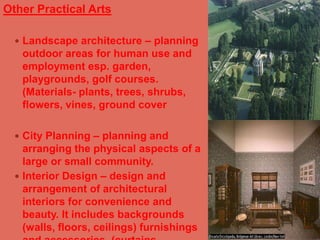
Other Practical ArtsLandscape architecture – planning outdoor areas for human use and employment esp. garden, playgrounds, golf courses. (Materials- plants, trees, shrubs, flowers, vines, ground coverCity Planning – planning and arranging the physical aspects of a large or small community.Interior Design – design and arrangement of architectural interiors for convenience and beauty. It includes backgrounds (walls, floors, ceilings) furnishings and accessories. (curtains, furniture, upholstery and others)
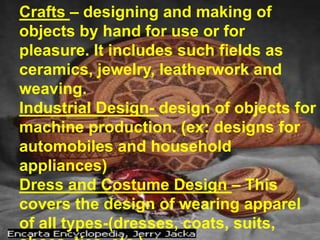
Crafts – designing and making of objects by hand for use or for pleasure. It includes such fields as ceramics, jewelry, leatherwork and weaving. Industrial Design- design of objects for machine production. (ex: designs for automobiles and household appliances)Dress and Costume Design – This covers the design of wearing apparel of all types-(dresses, coats, suits, shoes, ties, etc.)Theatre Design – design of settings for dramatic productions.
Exercises: *Make you own color wheel. Make sure you make your own mixture.*Bring to class at least three pictures illustrating any of the three styles of painting. *Write your explanation on the margin of the picture.*Start making your own painting.

Gehu 211 Art Appreciation

  • 1.
  • 2.
    POST TESTWHAT ISBEAUTY?WHY ARE HUMANITIES INCLUDED IN THE SCHOOL CURRICULUM?LIST DOWN AT LEAST 5 AREAS OF HUMANITIES?IN YOUR OWN WORDS, DEFINE THE FOLLOWING BRIEFLY:ARTSCULPTUREPAINTING
  • 3.
    HUMANITIES- IT ISA SET OF DISCIPLINE THAT INCLUDES GRAMMAR, PHILOSOPHY, LITERATURE, HISTORY AND MUSIC.AS THE WORD SUGGESTS, MAN IS THE CENTER OF HUMANITIES.THE TERM IS DERIVED FROM THE LATIN WORD HUMANUS, WHICH MEANS HUMAN.THIS CONCERNS HUMANITY
  • 4.
    IT RECORDS ORINTERPRETS MAN’S THINKING, FEELING, REGRETS, ASPIRATIONS, FAILURES AND WHAT HE SUPPOSED NOT TO DO IN THE WORLD.ART THAT IS THE BY-PRODUCT OF HUMANITIES IS LOOKING AT THINGS BEYOND MATTERS.IN ARTS, MAN HAS FOUND A SIMPLE RELIEF FROM THE DISCOMFORT BROUGHT ABOUT BY THE WORLD OF SO MUCH UNFAIRNESS.
  • 5.
    hu·man·i·ty noun1. human race:the human race considered as a whole 2. qualities of human being: the qualities or characteristics considered as a whole to be characteristic of human beings
  • 6.
    WHY STUDY HUMANITIES?TOEQUIP STUDENTS WITH A CULTURE THAT IS NECESSARY TO COMPLETE HIS BEING.
  • 7.
    THIS IS THECULTURE THAT FREES MAN FROM STICKING INTO THE MANDATES OF THE WORLD.
  • 8.
    MAN IS HIGHLYCULTURED IF HE COULD LIVE HAPPILY BEYOND THE THINGS THAT SATISFY ONLY THE PRACTICALITIES OF LIFE. ST. THOMAS AQUINAS SAID: ART IS OPPOSITE TO THE PRACTICAL. ART IS NOT CONCERNED WHETHER MAN HAS FINE DRESSES, DELICIOUS FOOD OR IF HE HAS MONEYART IS CONCERNED ON SOMETHING THAT LIVES BEYOND MATTERS.NOVELISTS WRITE WITHOUT THINKING OF ANY MONETARY RETURN.TOTAL HUMAN DEVELOPMENT. AS THE MEANING OF EDUCATION DOES NOT MEAN TO FINISH A DEGREE, FIND A JOB AND GATHER WEALTH TO A HEAP. LIKE THE ARTISTS, MEN SHOULD LABOR BEYOND THE VALUE OF MONEY.
  • 9.
    BRANCHES OF HUMANITIESA.FINE ARTSPAINTING – MAIN PROCESS IS APPLYING COLOR OR PIGMENT TO A SURFACELITERATURE – MAIN MEDIUM ARE THE WRITTEN WORD.B. PERFORMING ARTSDANCE-COMBINES MOVEMENTS OF FEET, HANDS AND BODY IN RHYTHM
  • 10.
    SINGING/MUSIC- PUTTING TOGETHERTHE SOUNDS IN ORDER.CINEMA-MOTION PICTURE THAT BLENDS TOGETHER THE FUNDAMENTAL AND VITAL ELEMENTS OF MUSIC, PAINTING, LITERATURE AND MUSIC.C. PRACTICAL ARTS:SCULPTURE- REFERS TO THE BREAKING AND OR PIECING TOGETHER HARD STONE OR OTHER SHAPEABLE MATERIALS TO REPRESENT SOMETHING IMAGINED OR REAL.ARCHITECTURE- AN ART OF DESIGNING AND CONSTRUCTING A BUILDING OR OTHER TYPE OF STRUCTURE.
  • 12.
    ARTArtis defined as follows "Art is created when an artist creates a beautiful object, or produces a stimulating experience that is considered by his audience to have artistic merit.“
  • 13.
    art is theprocess that leads to a product (the artwork or piece of art), which is then examined and analyzed by experts in the field of the arts or simply enjoyed by those who appreciate the arts.
  • 14.
    Art is aglobal activity which encompasses a host of disciplines, as evidenced by the range of words and phrases which have been invented to describe its various forms. Examples of such include: Fine Arts, Liberal Arts, Visual Arts, Decorative Arts, Applied Arts, Design, Crafts, Performing Arts, and so on.
  • 15.
      VISUAL ELEMENTS OF ARTS  Most basic elements of visual arts:Lines FormsColors
  • 16.
    KINDS OFLINESStraight Lines A. Vertical – upright; it implies ambition, authority, majesty and respect, dignity
  • 17.
    B. Horizontal –a line in parallel to the horizon. Lines of repose and serenity, reclining person and landscape of bodies of water .
  • 18.
    C. Diagonal- slantingdirection. Implies actions and movements, a running man, a bull fighting and other actions. 
  • 19.
    2. Curved Lines– suggest grace, movements, flexibility and joyousness. Never harsh or stern. Formed in gradual change in direction.Circle LunetOblong Ellipse
  • 20.
    lu·nette [loonét](plurallu·nettes) noun1. crescent-shapedobject: any object that has a crescent shape 2. window in domed ceiling: an arch-shaped window at the height of a domed ceiling 3. semicircular panel: a semicircular panel on a wall, containing a window, painting, or frieze 4. vehicle's towing ring: a metal ring on a vehicle to which a rope can be attached for towingMicrosoft® Encarta® 2008. © 1993-2007 Microsoft Corporation. All rights reserved.
  • 21.
    FORMS – COMBINATIONOF DIFFERENT LINES WOULD RESULT TO A CERTAIN FORM. 
  • 22.
    COLORSBlack is nota color.Color is aproperty of light so if there is no light there is no color.Line and forms give structure to a work of art while colors give life to it.
  • 23.
    ATTRIBUTES OF COLORHue– refers to the name of the color itself.Value – the relative lightness or darkness of a color or a quality of light and darkIntensity- is the brightness or darkness of color. It can be of the same hue but of different intensity.
  • 24.
    PRIMARY COLORSBlue Red Yellow SECONDARY COLORS –mixing equally the primary ones produces SC 
  • 25.
    INTERMEDIATE COLORS –produced by mixing in equal amounts primary and secondary colors. yellow-orange . yellow-greenred-orange blue-greenred-violetblue-violet
  • 26.
    TERTIARY COLORS –producedby combining in equal mixture any two secondarycolors.orange-yellow/or violetviolet-greenorange-green
  • 27.
    Meaning of Colors:Black–darkest and dullest, it suggests despair, gloom, death and mourning.Blue-color of the sky and of the deep. Vastness and Infinity. Symbol of tranquility, calmness and peace.Gray-combination of black and white or the primary colors. It gives the impression of weight, solidity, neutrality
  • 28.
    Green- color ofstill water and vegetation. Symbol of growth, freshness and hope.Orange – Symbolizes deliciousness and sweetness.Pink- is a combination of red and white, symbolizes LoveRed – typifies fire, blood, danger, festivity, bravery, war, passion, energy and warmth.
  • 29.
    Violet- suggests shadows,mourning, penance, royalty and power.White- symbolizes simplicity, clarity, purity and peace. Lightest of all colors.Yellow– color of light. Symbolizes life, joy, sunshine, cheerfulness\, warmth, splendor and hospitality. 
  • 30.
    Yellow-green-this color symbolizes jealousy and hatred. Hurting to the eyes and which makes one appear darker. Appropriate for those with fair complexion.Brown- mixture of red and little green. Suggests humility and confidence.
  • 31.
    Warm colors –Red,Orange and Yellow. They associate with the source of heat such as sun, light and fire. Imply cheerfulness, joys, actions, life and happinessCool Colors – Blue, blue-green, blue-violet. Suggests distance, calm, sober restful and inconspicuous.
  • 32.
    COLOR HARMONIES –groupings of hues.color harmonies – correct combination and arrangement of colors appear pleasing to the eyes; combination of several tones of one hue like orange, tan, brown and others from the orange family.-MONOCHROMATIC HARMONY.contrasted color harmonies – refers to the disagreement or opposition of hues.
  • 33.
    Types of contrastingcolor harmony:Complementary harmony – combination of any two of the opposite colors in the color chart. (ex. Yellow and violet) double-complementary harmony- combining any of the two adjacent colors in the color chart with their compliments. (four colors are needed)(ex: blue-violet and violet; yellow and yellow-orange)
  • 34.
    split-complementary harmony-employs threecolors to produce it by starting with any color in the color chart with the exception of the three secondary colors. (example: blue, yellow-orange and red-orange. double-split complementary harmony-combination of any two sets of split-complementary harmony. These two sets should lie opposite each other in the color chart. ( ex: blue-violet, yellow and orange then yellow-orange-blue and violet.
  • 35.
    Other elements ofVisual Arts are:  Value–the relative lightness and darkness of a color or a quality of light and dark. It is a quality which depends on the amount of light and dark in color.Intensity-is the brightness or darkness of color. It gives color strength. Intensity differences may be described as full intensity, two-thirds intensity, two thirds neutral and neutral. Two colors may be both blue but one is more intense than the other. When the hue is in vivid form, it is said to be in full intensity. When it is dulled, it is said to be partly neutralized. The more black or white is added, the weaker is the intensity.
  • 36.
    Texture-the element thatdeals more directly with the sense of touch. It has to do with the characteristic of surfaces which can be rough, smooth, fine or coarse, shiny or dull, plain or irregular. Texture is best appreciated when an object is felt with the hands.Perspective-deals with the effect of distance upon the appearance of objects, by means of which the eye judges spatial relationships. It enables us to perceive distance and to see the position of objects in space.
  • 37.
    There are twokinds of perspectives:1.Linear Perspective- representation of an appearance of distance by means of converging lines. The tracks of a railroad appear to the viewer as seeming to rise and meet in the distance. Linear has to do with the direction of lines and with the size of objects.2.Aerial Perspective- the representation of relative distances of objects by gradations of tone and color. Objects become fainter in the distance due to the effect to the atmosphere. Objects appear to be lighter in color and the outline more vague as they recede into the distance or into the atmosphere. 
  • 38.
    Chiaroscuro or lightand shadow. The word is taken from the two Italian word chiaro which means light and oscuro means dark. This is a pictorial representation using light and shade without the use of colors.  
  • 39.
    THE VARIOUS ARTS A.FINE ARTS 1. Drawing -is a means of making an image, using any of a wide variety of tools and techniques. It generally involves making marks on a surface by applying pressure from a tool, or moving a tool across a surface.Common tools are graphitepencils, pen and ink, inkedbrushes, wax color pencils, crayons, charcoals, pastels, and markers
  • 40.
    The main techniquesused in drawing are: line drawing, hatching, crosshatching, random hatching, scribbling, stippling, and blending.STIPPLE- paint something by dabbing: to paint, draw, or engrave something using dots or short dabbingHATCH - mark something with parallel crossed lines: in graphic art, to mark or cover something with parallel crossed lines to show shading, or be marked in this way.
  • 41.
    An artist whoexcels in drawing is referred to as a draftswoman or draughtsman.
  • 42.
    2. Painting –is an art made by applying colors to a surface to present an object imagined or real.Mediums of PaintingWater Color OilTemperaPastelFrescoAcrylic
  • 43.
    Art Elements ofa PaintingDistanceColorLightLineShapesCompositionPerspectiveSymbols
  • 44.
    Styles in paintingAbstract– presents the subject not as it appears in reality.Distortion – the natural form or condition is twisted or distorted. Misshapen look of the picture Elongation – the character or the object being painted is elongated or extended.
  • 45.
    Cubism – theuse of some geometrical shapes such as cylindrical, triangular, spherical and other forms at the expense of the other pictorial element.Mangling – presented as cut lacerated mutilated or hacked.. This is not well used kind of abstractionism.
  • 46.
    Expressionism – aEuropean method that flourished in the first decade of the 20th century.In this method, the artist has a freedom to consider his personal style in presenting his subject or expressing his though or feeling.Symbolism – a symbol is a thing or a single object that stands for another thing.. Subject is not visibleFauvism – characterized by thick pigment. Used to express a feeling of joy\, comfort or pleasure through extremely bright colors. A fauvist is too much concerned on the brightness of the colors.  
  • 47.
    Dadaism – “dada”a French word meaning “boby horse” It is a protest movement against the traditional outworn arts and evils in society. Dadaist artist tries to start outrage to undermine faith and dependence to an established institution.Surrealism – presenting art by fantastic or incongruous imagery produced by unnatural combinations. Surreal means intense irrationality or beyond natural. In other words, pictures out image in a form of a dream.
  • 48.
    Futurism – starwars, time machine, terminator and others picture something in the future. It exalts success in technology. Anything that relates the importance of modernization.  
  • 49.
    2. Literature –main medium are the written words. (prose and poetry)Literature is literally "acquaintance with letters“ (from the Latinlittera meaning "an individual written character (letter)"). The term has generally come to identify a collection of writings, which in Western culture are mainly prose, both fiction and non-fiction, drama and poetry. In much, if not all of the world, texts can be oral as well, and include such genres as epic, legend, myth, ballad, other forms of oral poetry, and as folktale.
  • 50.
    Performing ARTS Dance –combines movements of feet, hands and body in rhythm. Aesthetic element is seen on the unity and harmony of movements.Singing/Music – the art of putting together the sounds in order. Mediums are human voices or instruments or the combination of the two.Cinema – motion picture that blends together the fundamental and vital elements of music, painting, literature and music.
  • 51.
    PRACTICAL ARTSSculpture– refers to the breaking and or piecing together hard stone or other shapeable materials to represent something imagined or real.(materials: wood, stone, metals, clay, string, wire, etc)
  • 52.
    Architecture – anart of designing and constructing a building or other type of structure. Materials include concrete, brick, wood, steel glass, and plaster.
  • 54.
    Other Practical ArtsLandscapearchitecture – planning outdoor areas for human use and employment esp. garden, playgrounds, golf courses. (Materials- plants, trees, shrubs, flowers, vines, ground coverCity Planning – planning and arranging the physical aspects of a large or small community.Interior Design – design and arrangement of architectural interiors for convenience and beauty. It includes backgrounds (walls, floors, ceilings) furnishings and accessories. (curtains, furniture, upholstery and others)
  • 55.
    Crafts – designingand making of objects by hand for use or for pleasure. It includes such fields as ceramics, jewelry, leatherwork and weaving. Industrial Design- design of objects for machine production. (ex: designs for automobiles and household appliances)Dress and Costume Design – This covers the design of wearing apparel of all types-(dresses, coats, suits, shoes, ties, etc.)Theatre Design – design of settings for dramatic productions.
  • 56.
    Exercises: *Make youown color wheel. Make sure you make your own mixture.*Bring to class at least three pictures illustrating any of the three styles of painting. *Write your explanation on the margin of the picture.*Start making your own painting.