Elements and
Principles of the
Visual Arts
Elements of the Visual Arts
1. Line
2. Color
3. Texture
4. Perspective
5. Space
6. Form
7. Volume
Line
- An important element at the disposal of any
artist; through lines, the artist can make us
know what the work is all about.
- Always have direction; always moving
- Can either be straight or curved
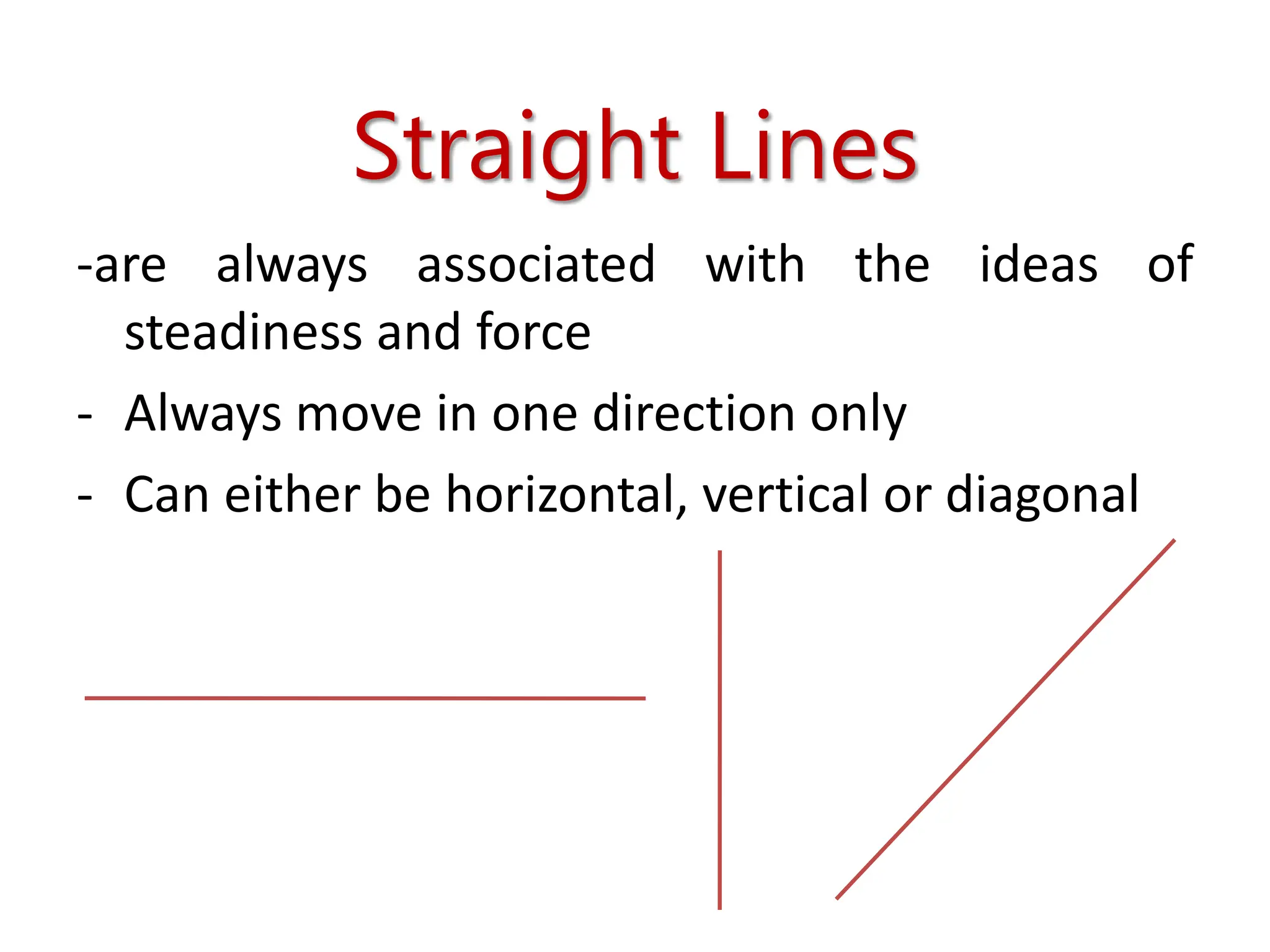
Straight Lines
-are always associated with the ideas of
steadiness and force
- Always move in one direction only
- Can either be horizontal, vertical or diagonal
Three Types of Straight Lines
1. Horizontal Lines – lines of repose and
serenity
-they express ideas of calmness and quiescence
-can be found in landscapes, calm bodies of
water and in the distant meeting of the earth
and sky in what is commonly called the
horizon
Three Types of Straight Lines
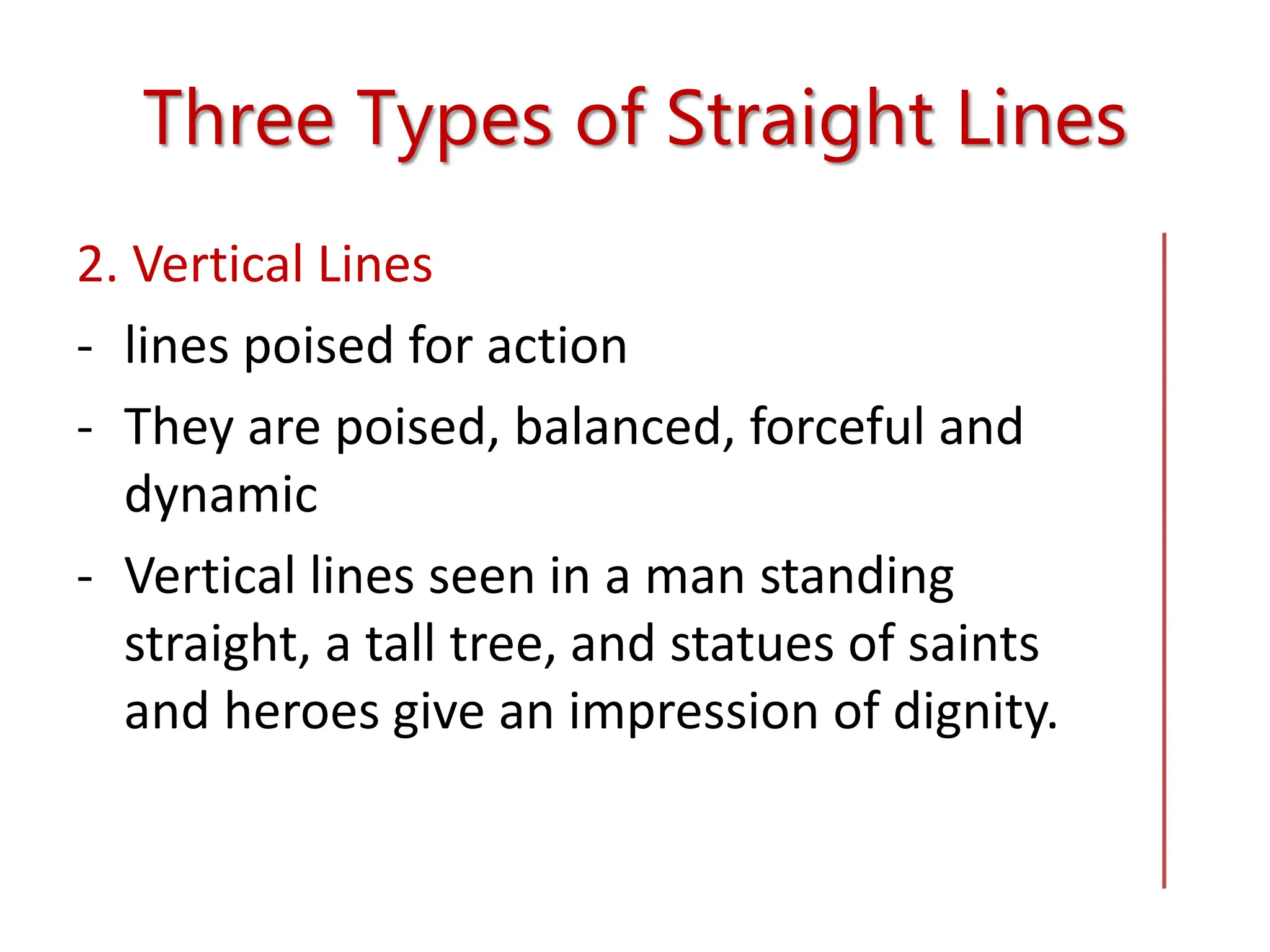
2. Vertical Lines
- lines poised for action
- They are poised, balanced, forceful and
dynamic
- Vertical lines seen in a man standing
straight, a tall tree, and statues of saints
and heroes give an impression of dignity.
Three Types of Straight Lines
3. Diagonal Lines
- Lines that suggest action and movement
- They give animation to any composition
in which they appear
- A running person makes a diagonal line
with his body and legs. The degree of
action is shown by the angle of the
diagonal line.
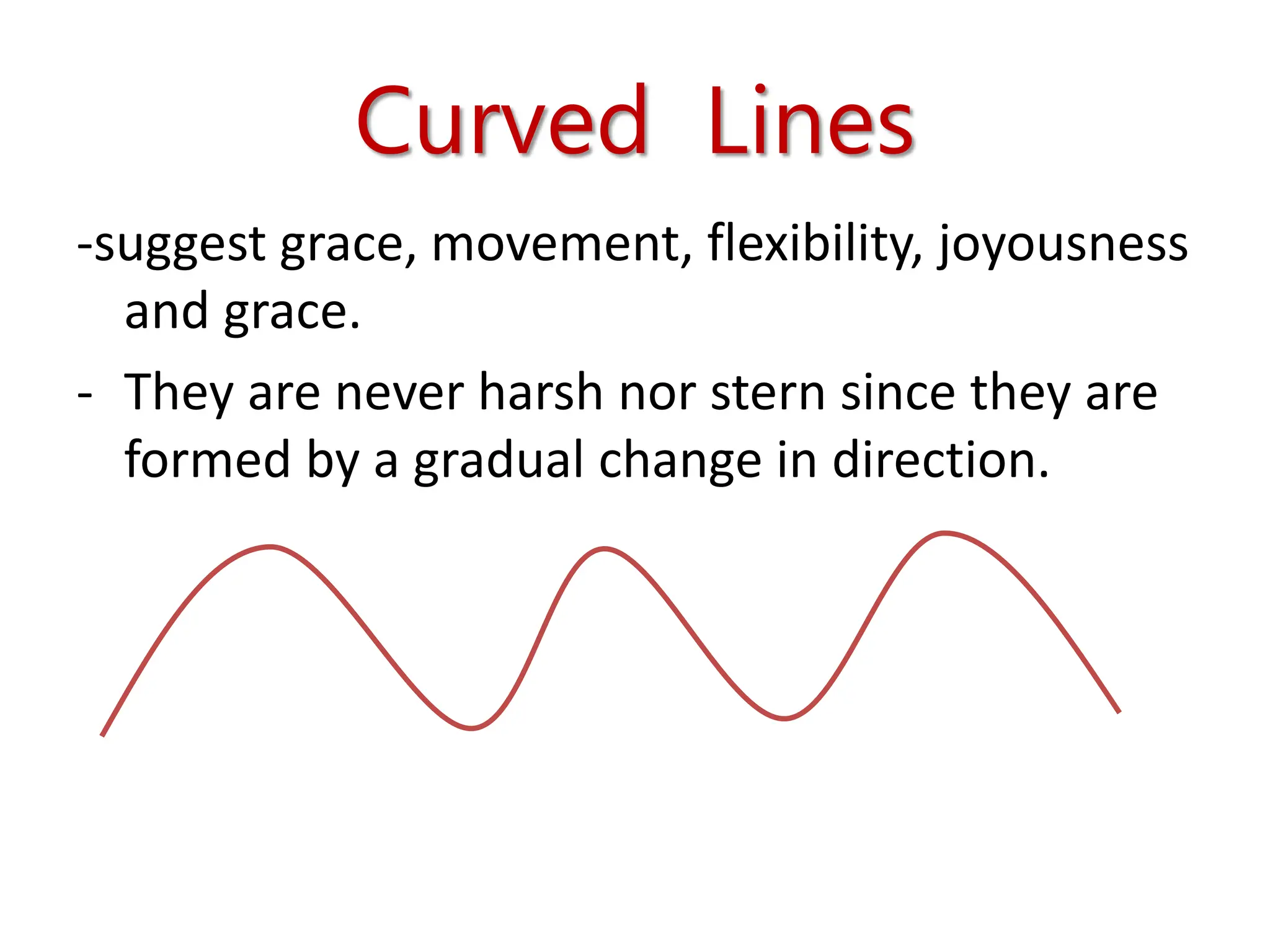
Curved Lines
-suggest grace, movement, flexibility, joyousness
and grace.
- They are never harsh nor stern since they are
formed by a gradual change in direction.
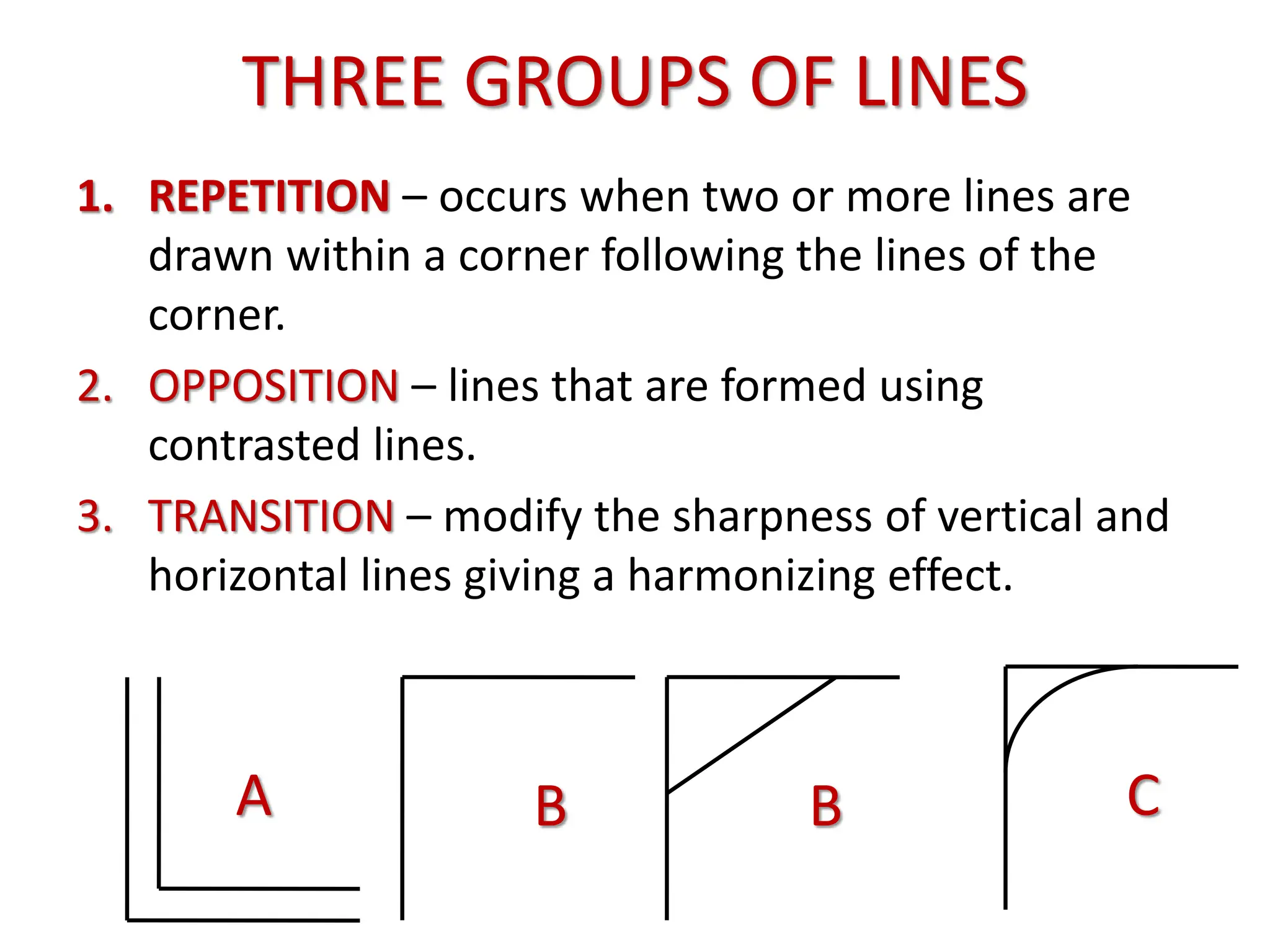
THREE GROUPS OF LINES
1. REPETITION – occurs when two or more lines are
drawn within a corner following the lines of the
corner.
2. OPPOSITION – lines that are formed using
contrasted lines.
3. TRANSITION – modify the sharpness of vertical and
horizontal lines giving a harmonizing effect.
A B C
B
Color
• A property of light
• When light goes out, color goes with it.
• When a beam of light passes through a
prism, the different rays of color are
separated so that we are able to see and
identify them.
TWO DIMENSIONS
OF COLOR
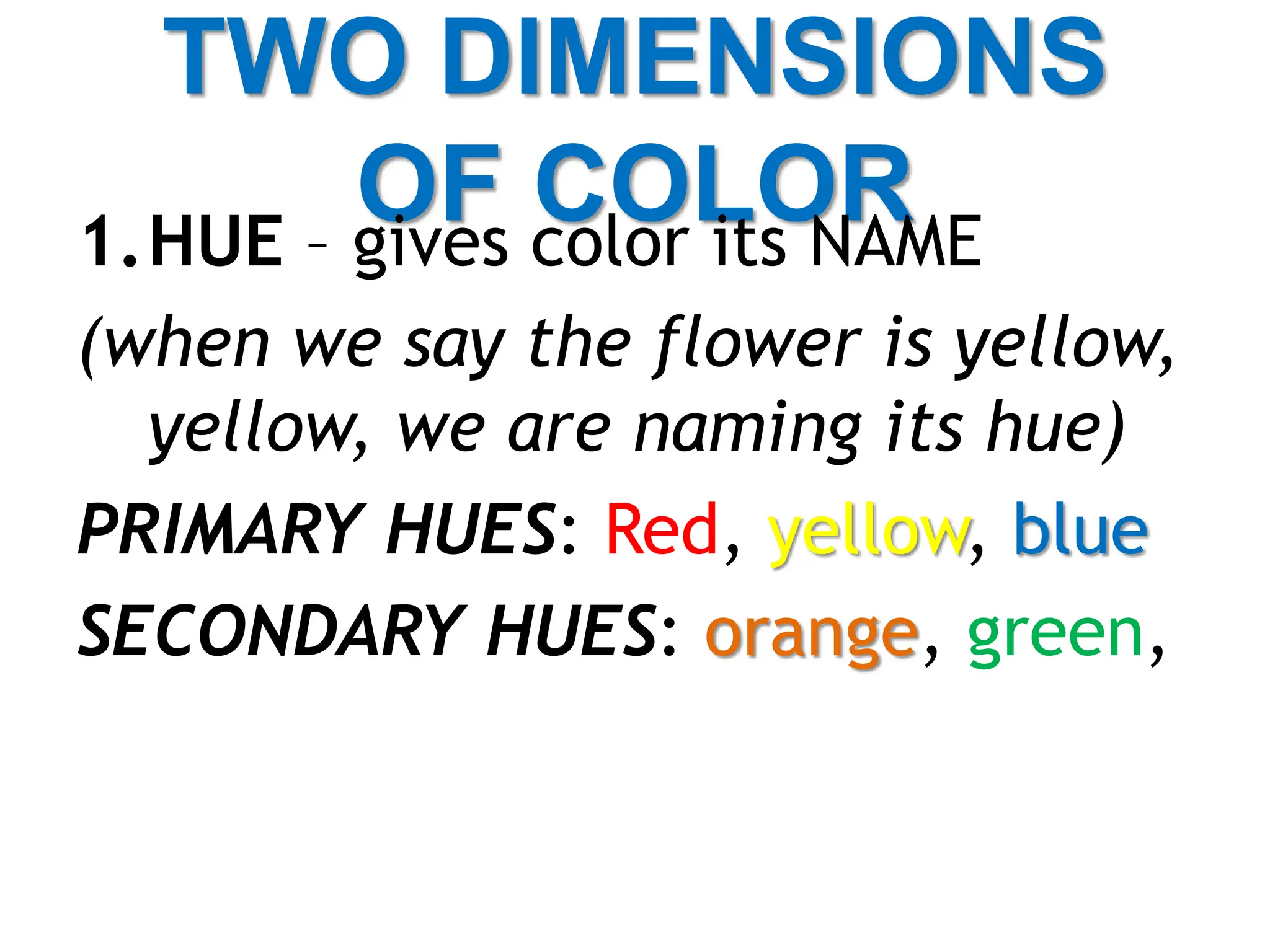
1.HUE – gives color its NAME
(when we say the flower is yellow,
yellow, we are naming its hue)
PRIMARY HUES: Red, yellow, blue
SECONDARY HUES: orange, green,
TWO DIMENSIONS
OF COLOR
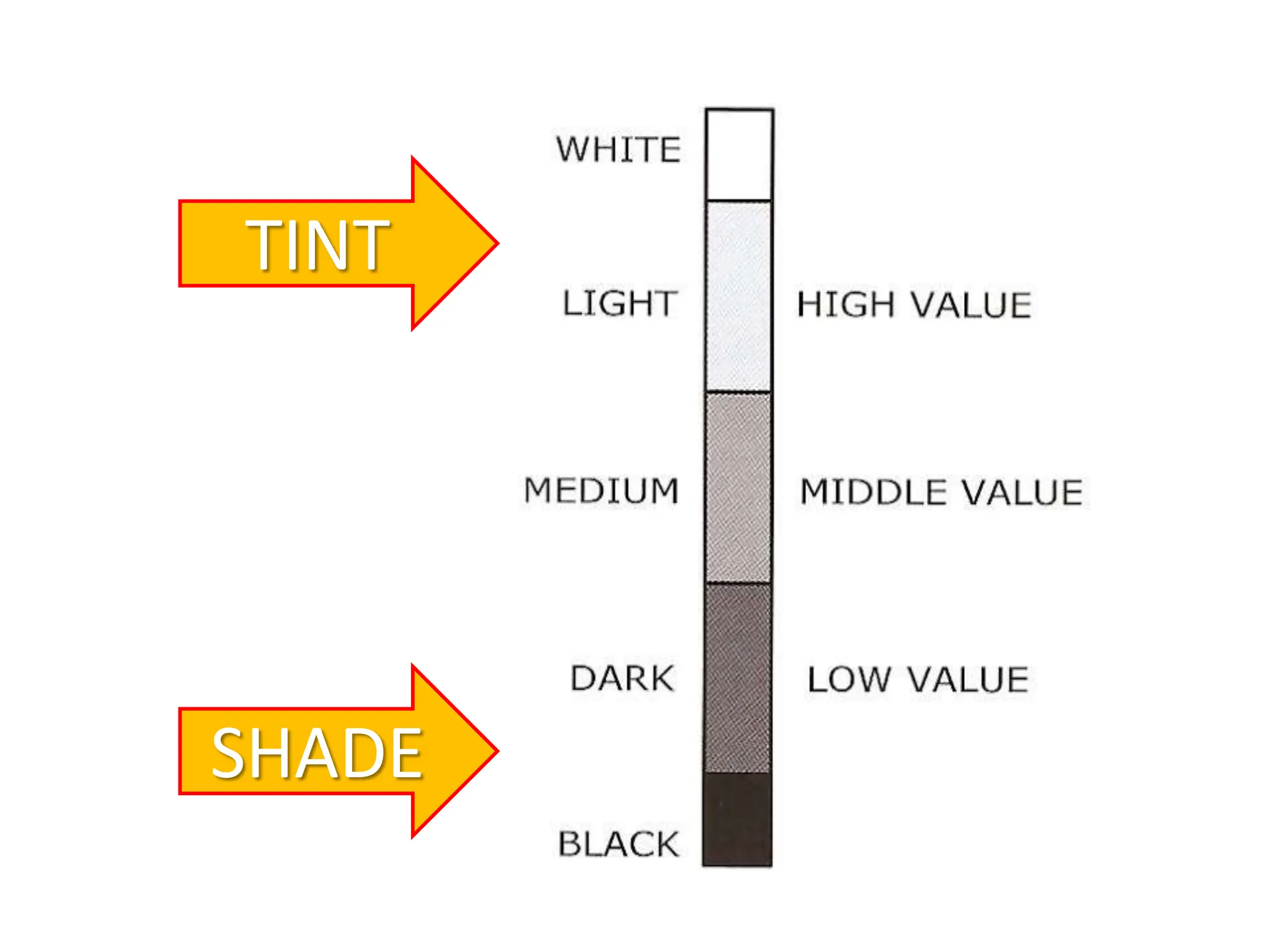
2. VALUE – refer to the lightness or
darkness of color
- It is a quality which depends on the
amount of light and dark in color
Two types of VALUE:
a. TINTS – values above the normal
b. SHADES – values below the normal
*the value of a hue can be changed by
adding or reducing the light it can
TINT
SHADE
Warm and Cool Colors
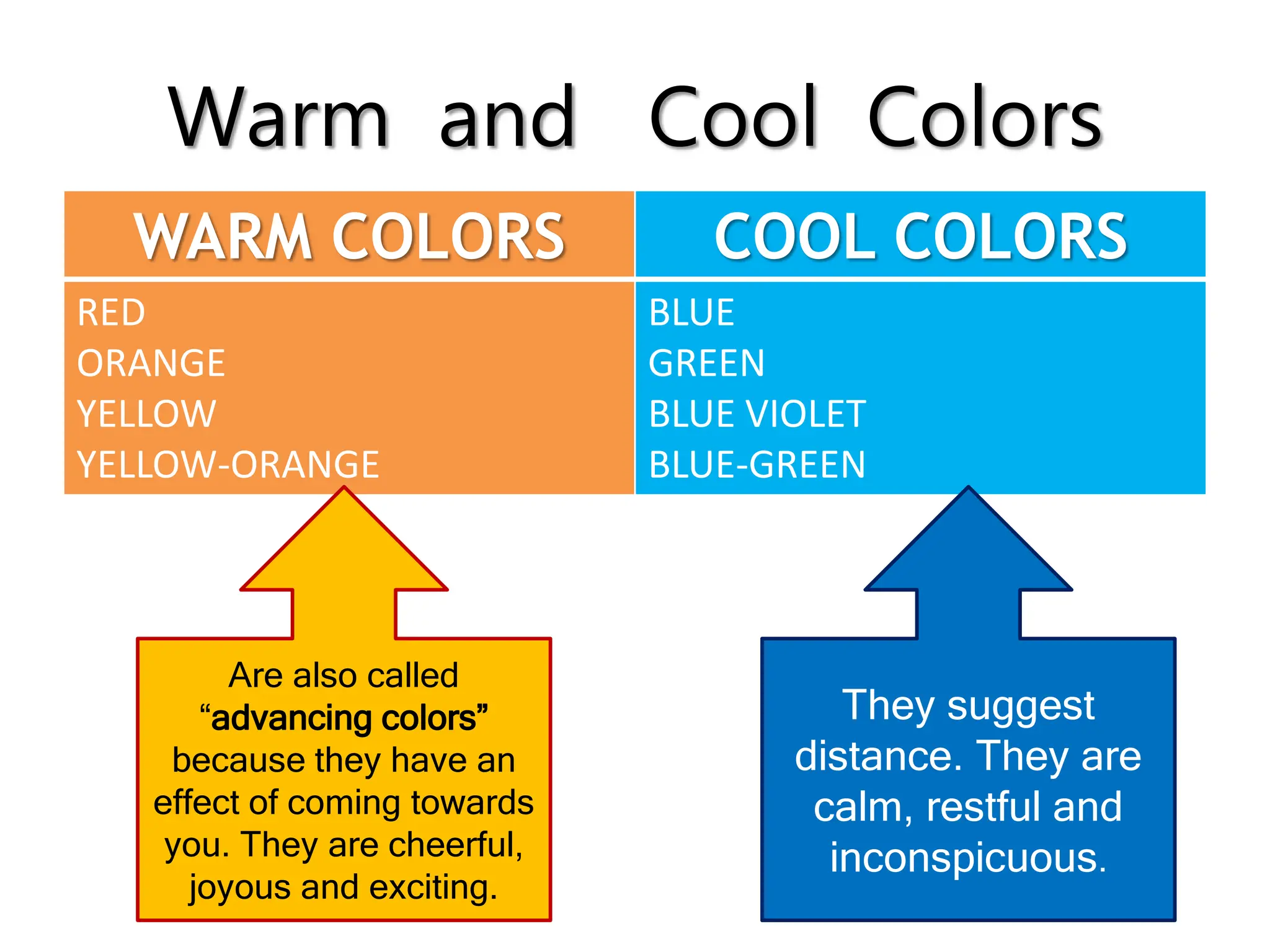
WARM COLORS COOL COLORS
RED
ORANGE
YELLOW
YELLOW-ORANGE
BLUE
GREEN
BLUE VIOLET
BLUE-GREEN
Are also called
“advancing colors”
because they have an
effect of coming towards
you. They are cheerful,
joyous and exciting.
They suggest
distance. They are
calm, restful and
inconspicuous.
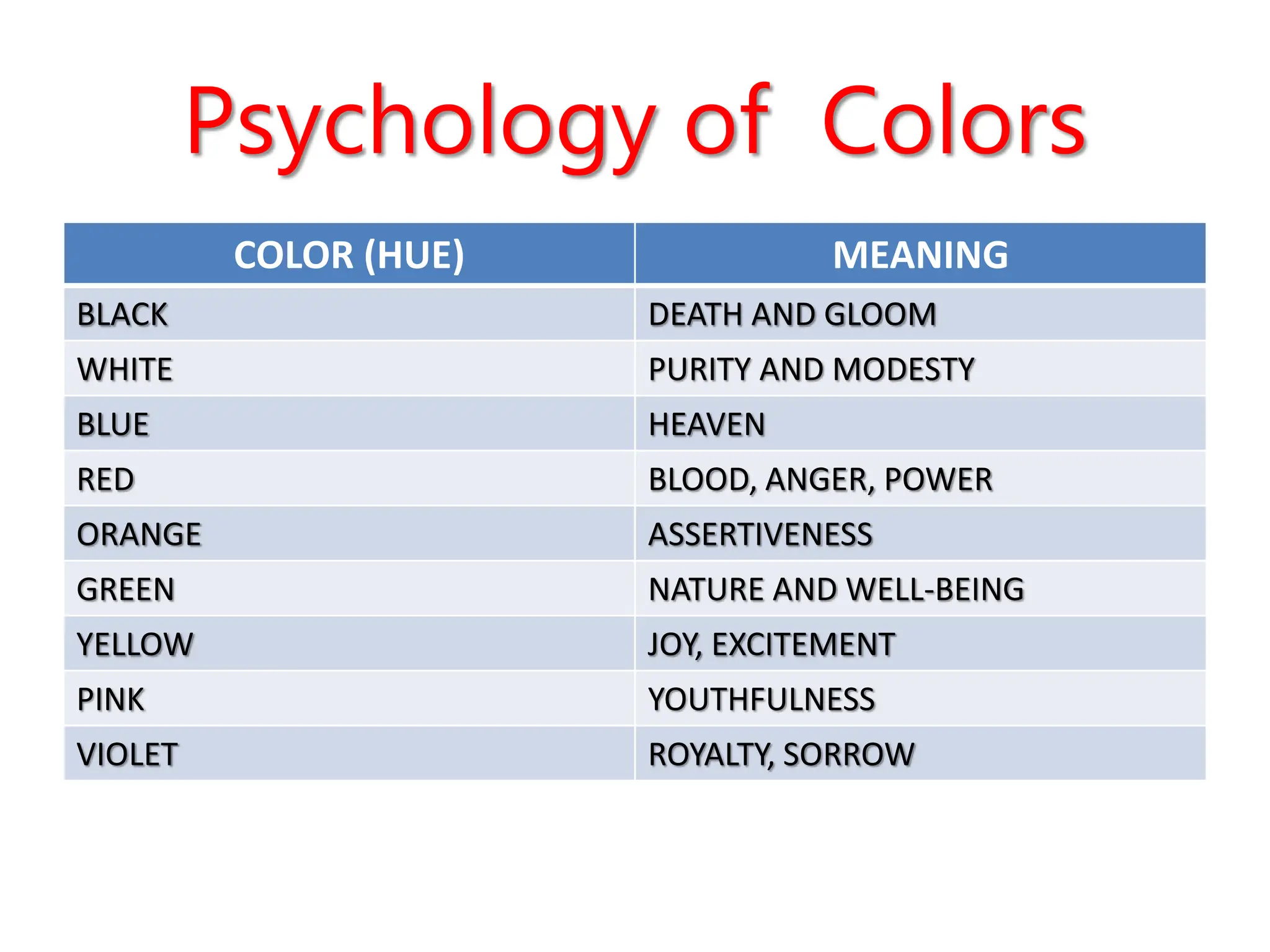
Psychology of Colors
COLOR (HUE) MEANING
BLACK DEATH AND GLOOM
WHITE PURITY AND MODESTY
BLUE HEAVEN
RED BLOOD, ANGER, POWER
ORANGE ASSERTIVENESS
GREEN NATURE AND WELL-BEING
YELLOW JOY, EXCITEMENT
PINK YOUTHFULNESS
VIOLET ROYALTY, SORROW
Texture
- the element that deals directly with the
sense of touch
- it has to do with the characteristics of
surfaces which can be rough or smooth,
fine or coarse, shiny or dull, plain or
irregular.
- Gives a surface unevenness which causes
the color of the surface to be broken into
gradations of light and shade (flat colors
are never beautiful).
Perspective
-deals with the effect of distance upon the
appearance of objects, by means of which the
eye judges spatial relationships.
- It enables us to perceive distance and to see
the position of objects in space.
2 KINDS:
1. LINEAR PERSPECTIVE
2. AERIAL PERSPECTIVE
TWO TYPES OF
PERSPECTIVE:
1. LINEAR PERSPECTIVE
- representation of the appearance of objects
by means of converging lines.
TWO TYPES OF PERSPECTIVE:
2. AERIAL PERSPECTIVE
- representation of relative distances of objects by
gradations of tone and color. Objects become fainter
in the distance due to the effect of the atmosphere.
Objects appear to be lighter in color as they recede
into the distance.
Space
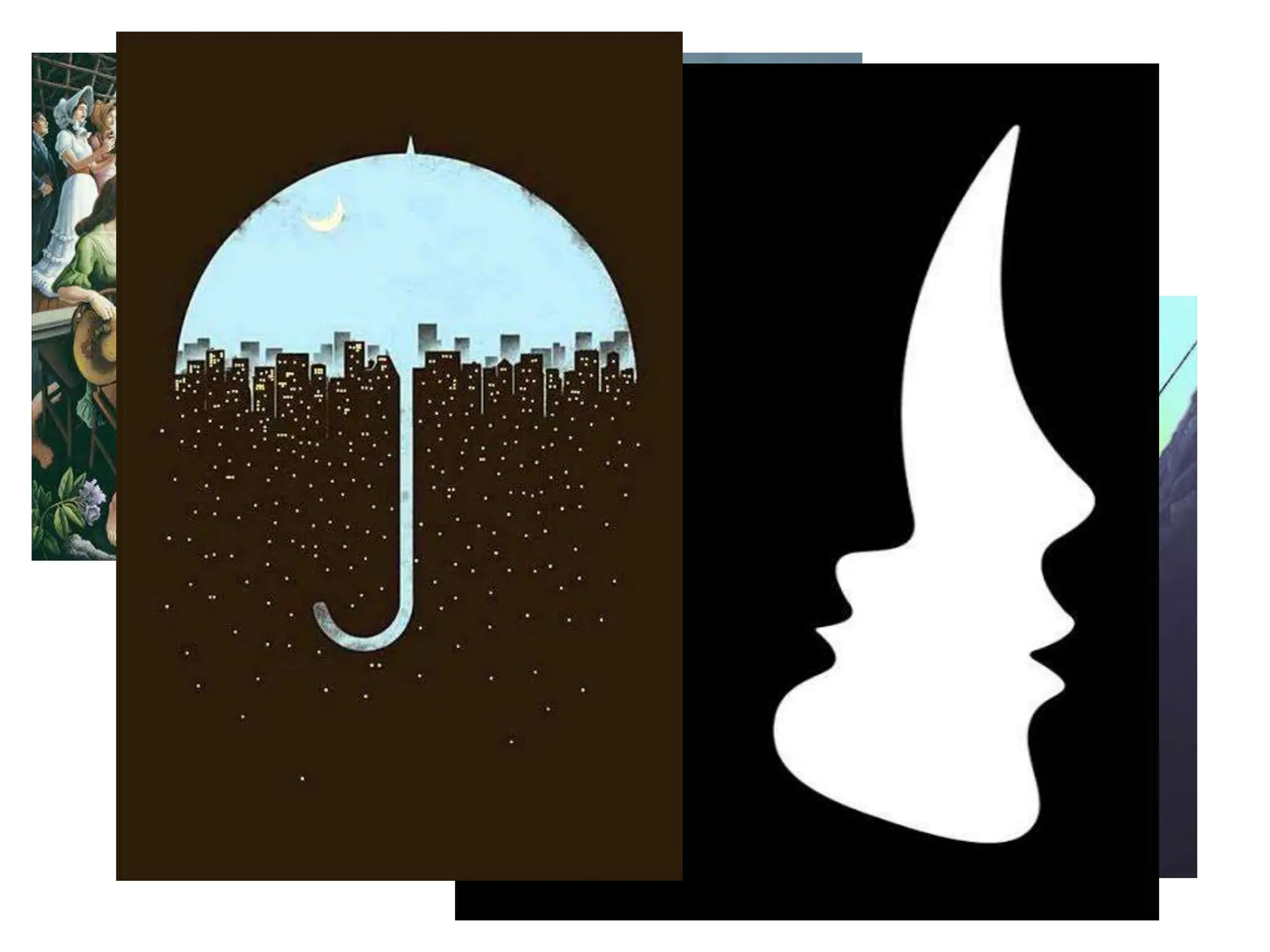
• Space is one of the basic elements of art.
It refers to the distance between or the
area around and within shapes, forms,
colors and lines. Space can be positive or
negative. It includes the background,
foreground and middle ground.
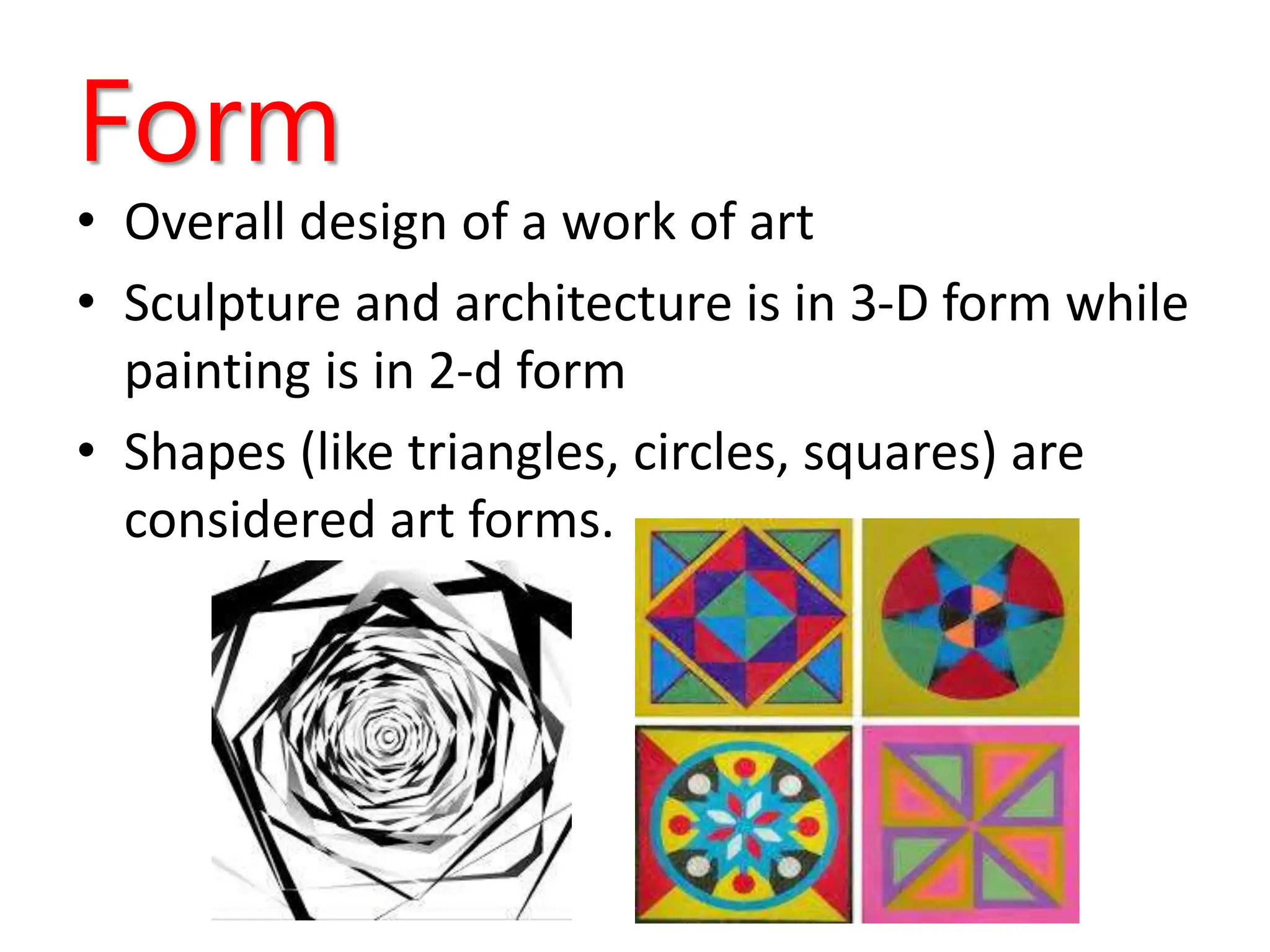
Form
• Overall design of a work of art
• Sculpture and architecture is in 3-D form while
painting is in 2-d form
• Shapes (like triangles, circles, squares) are
considered art forms.
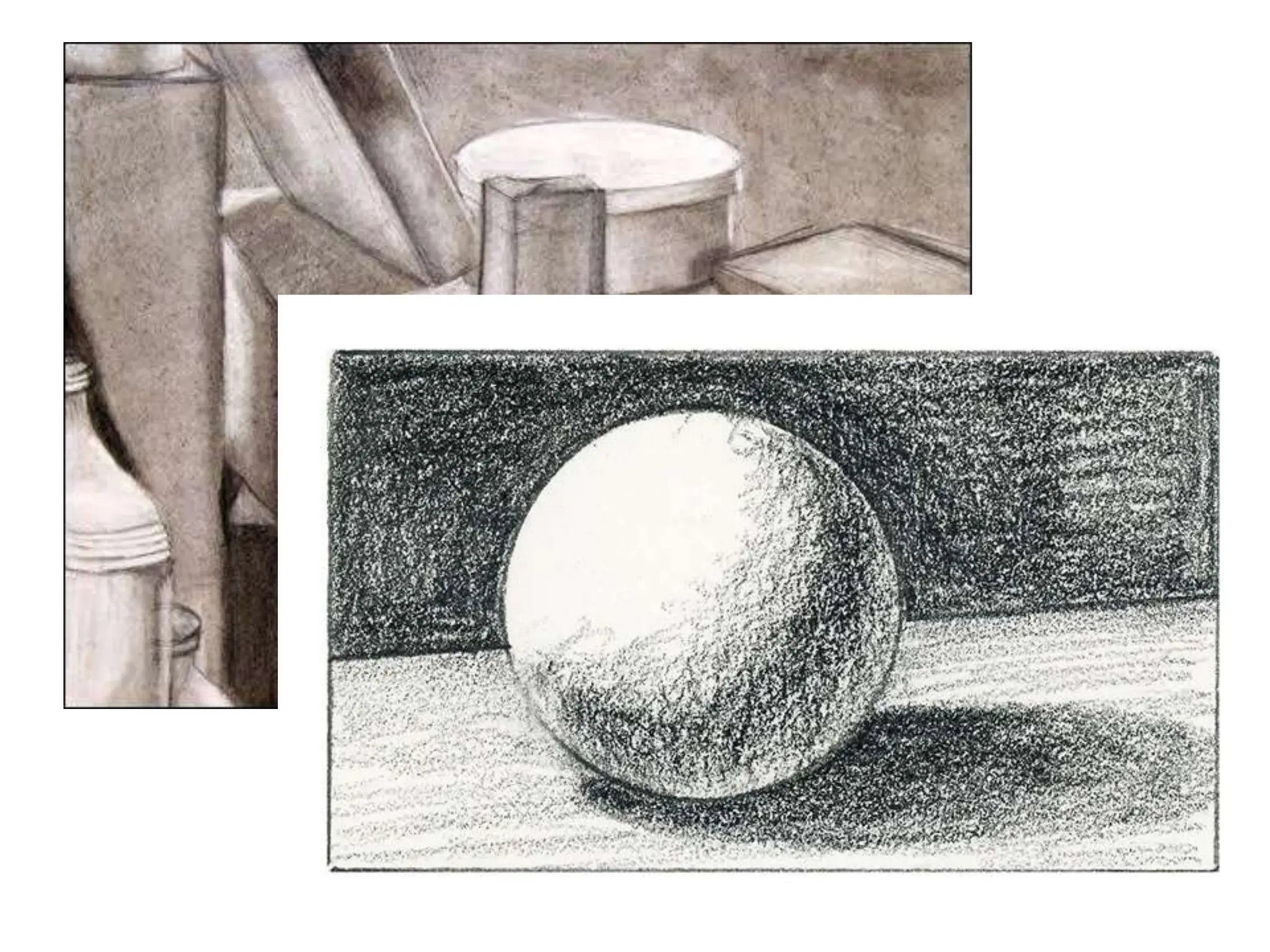
Volume
- The amount of space occupied in three
dimensions.
- It refers to solidity or thickness
- It can be perceived in two ways: by contour
lines or outlines of objects or by surface lights
and shadows.
- In painting, volume is an illusion because the
surface of the canvas is flat.
Principles of Arts
1. Proportion
2. Harmony
3. Variety
4. Movement
5. Rhythm
6. Balance
7. Emphasis
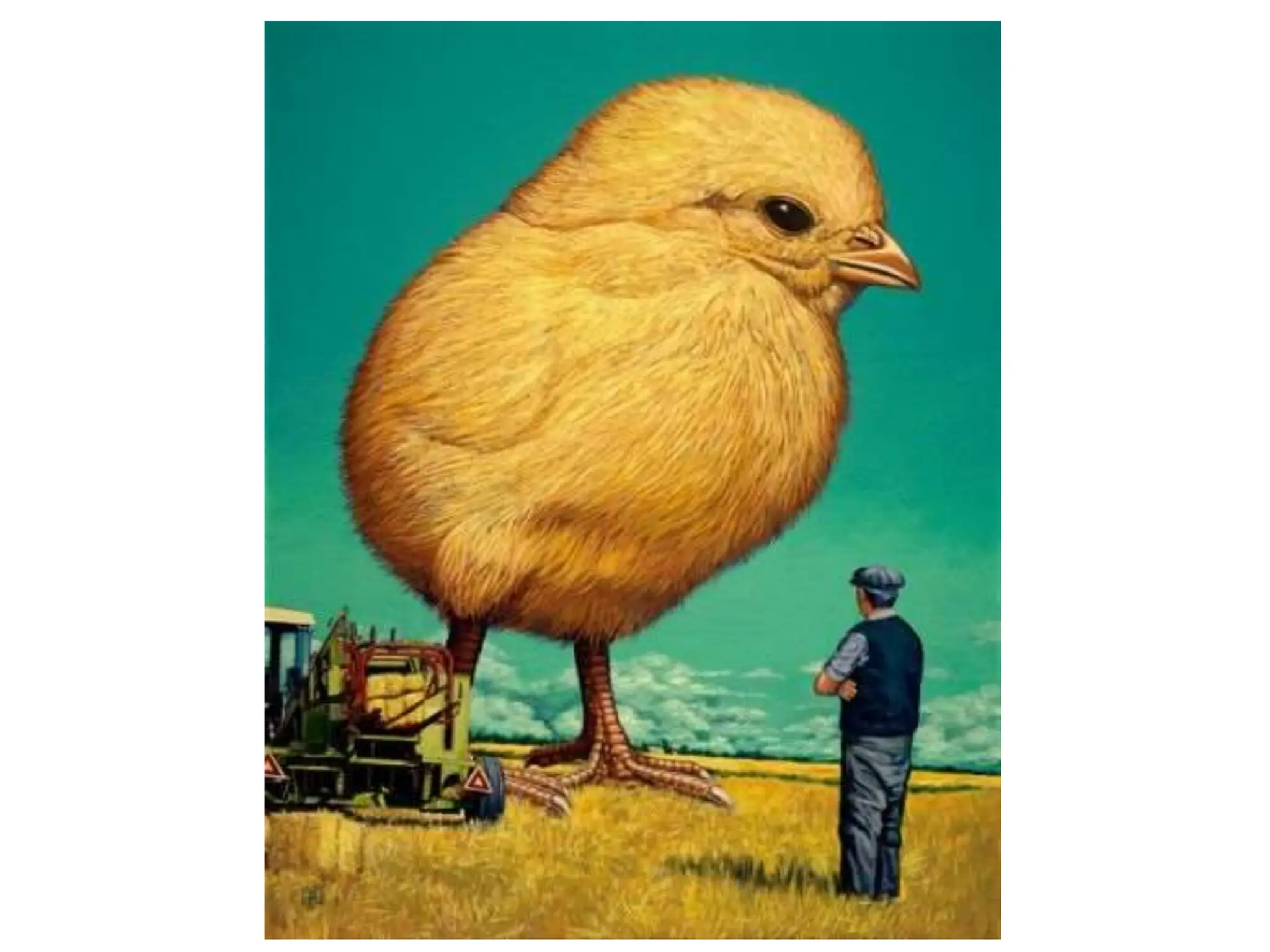
Proportion
- refers to the relationship of the size
of elements in a body of art. For
example, when drawing a human
standing beside a house, it is
important to ensure that the size of
the human is proportional to the size
of the house.
Harmony
- in visual arts, harmony is
the unity of the artwork,
specifically about the
arrangement of teh related
elements.
Variety
- also called as “diversity” in
arts
-this means adding mutiple,
different elements to break
the monotony of an artwork
and make it more interesting
Movement
- it is the illuson of motion in
a painting, sculpture design,
or in a piece of art
Rhythm
- refers to the repetition of
certain elements to produce a
pattern. in visual arts, repeated
design elements may create a
certain flow and may lead the
viewer’s eyes.
Balance
- refers to the even and
equal distribution of
elements
- can either be symmetric or
asymmetric
SYMMETRIC BALANCE
Symmetrical balance (or
Symmetry) means that the work of
art is the same on one side as the
other, a mirror image of itself,
onboth sides of a center line.
ASYMMETRIC BALANCE
Asymmetrical balance (or
Asymmetry) means that the two
halves of the work of art are
different, however, try to create
balance.
Emphasis
- a principle whihc may refer
to the greater impact given
on a certain element
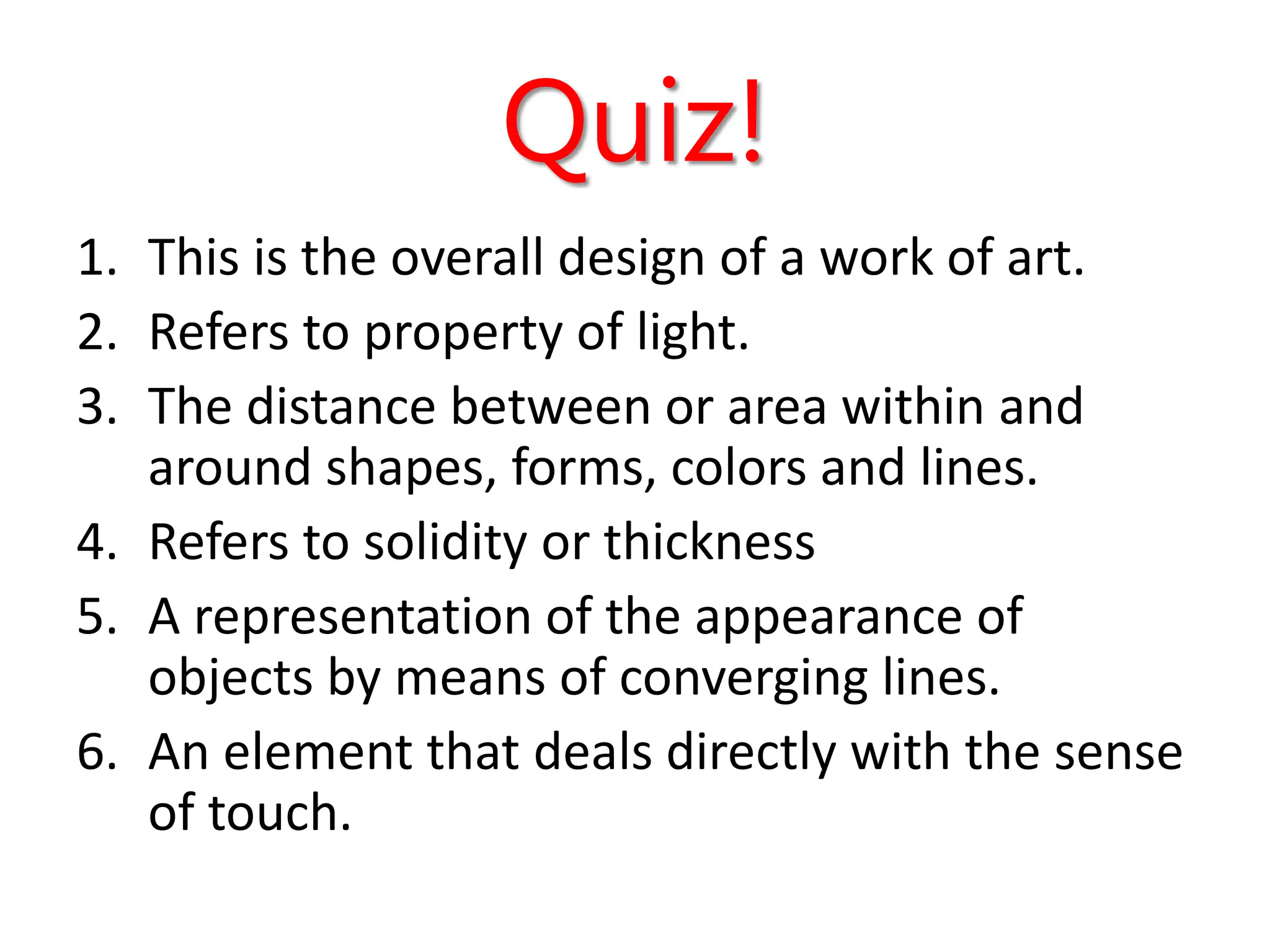
Quiz!
1. This is the overall design of a work of art.
2. Refers to property of light.
3. The distance between or area within and
around shapes, forms, colors and lines.
4. Refers to solidity or thickness
5. A representation of the appearance of
objects by means of converging lines.
6. An element that deals directly with the sense
of touch.
7. Also called “advancing colors”
8. Refers to the lightness or darkness of color
9. Gives color its name
10. Lines that suggest grace, movement, flexibility,
joyousness and grace.
11. Lines poised for action
12. A group of line which is formed using contrasted
lines.
13. Lines that are calm, suggest tranquility,
quiescence and rest
14. Can either be horizontal, vertical or diagonal.
15. Value above normal.

Elements-of-the-Visual-Arts - contemporary Philippine arts from the region

  • 1.
  • 2.
    Elements of theVisual Arts 1. Line 2. Color 3. Texture 4. Perspective 5. Space 6. Form 7. Volume
  • 3.
    Line - An importantelement at the disposal of any artist; through lines, the artist can make us know what the work is all about. - Always have direction; always moving - Can either be straight or curved
  • 4.
    Straight Lines -are alwaysassociated with the ideas of steadiness and force - Always move in one direction only - Can either be horizontal, vertical or diagonal
  • 5.
    Three Types ofStraight Lines 1. Horizontal Lines – lines of repose and serenity -they express ideas of calmness and quiescence -can be found in landscapes, calm bodies of water and in the distant meeting of the earth and sky in what is commonly called the horizon
  • 6.
    Three Types ofStraight Lines 2. Vertical Lines - lines poised for action - They are poised, balanced, forceful and dynamic - Vertical lines seen in a man standing straight, a tall tree, and statues of saints and heroes give an impression of dignity.
  • 7.
    Three Types ofStraight Lines 3. Diagonal Lines - Lines that suggest action and movement - They give animation to any composition in which they appear - A running person makes a diagonal line with his body and legs. The degree of action is shown by the angle of the diagonal line.
  • 8.
    Curved Lines -suggest grace,movement, flexibility, joyousness and grace. - They are never harsh nor stern since they are formed by a gradual change in direction.
  • 9.
    THREE GROUPS OFLINES 1. REPETITION – occurs when two or more lines are drawn within a corner following the lines of the corner. 2. OPPOSITION – lines that are formed using contrasted lines. 3. TRANSITION – modify the sharpness of vertical and horizontal lines giving a harmonizing effect. A B C B
  • 10.
    Color • A propertyof light • When light goes out, color goes with it. • When a beam of light passes through a prism, the different rays of color are separated so that we are able to see and identify them.
  • 11.
    TWO DIMENSIONS OF COLOR 1.HUE– gives color its NAME (when we say the flower is yellow, yellow, we are naming its hue) PRIMARY HUES: Red, yellow, blue SECONDARY HUES: orange, green,
  • 12.
    TWO DIMENSIONS OF COLOR 2.VALUE – refer to the lightness or darkness of color - It is a quality which depends on the amount of light and dark in color Two types of VALUE: a. TINTS – values above the normal b. SHADES – values below the normal *the value of a hue can be changed by adding or reducing the light it can
  • 13.
  • 14.
    Warm and CoolColors WARM COLORS COOL COLORS RED ORANGE YELLOW YELLOW-ORANGE BLUE GREEN BLUE VIOLET BLUE-GREEN Are also called “advancing colors” because they have an effect of coming towards you. They are cheerful, joyous and exciting. They suggest distance. They are calm, restful and inconspicuous.
  • 15.
    Psychology of Colors COLOR(HUE) MEANING BLACK DEATH AND GLOOM WHITE PURITY AND MODESTY BLUE HEAVEN RED BLOOD, ANGER, POWER ORANGE ASSERTIVENESS GREEN NATURE AND WELL-BEING YELLOW JOY, EXCITEMENT PINK YOUTHFULNESS VIOLET ROYALTY, SORROW
  • 16.
    Texture - the elementthat deals directly with the sense of touch - it has to do with the characteristics of surfaces which can be rough or smooth, fine or coarse, shiny or dull, plain or irregular. - Gives a surface unevenness which causes the color of the surface to be broken into gradations of light and shade (flat colors are never beautiful).
  • 18.
    Perspective -deals with theeffect of distance upon the appearance of objects, by means of which the eye judges spatial relationships. - It enables us to perceive distance and to see the position of objects in space. 2 KINDS: 1. LINEAR PERSPECTIVE 2. AERIAL PERSPECTIVE
  • 19.
    TWO TYPES OF PERSPECTIVE: 1.LINEAR PERSPECTIVE - representation of the appearance of objects by means of converging lines.
  • 21.
    TWO TYPES OFPERSPECTIVE: 2. AERIAL PERSPECTIVE - representation of relative distances of objects by gradations of tone and color. Objects become fainter in the distance due to the effect of the atmosphere. Objects appear to be lighter in color as they recede into the distance.
  • 23.
    Space • Space isone of the basic elements of art. It refers to the distance between or the area around and within shapes, forms, colors and lines. Space can be positive or negative. It includes the background, foreground and middle ground.
  • 25.
    Form • Overall designof a work of art • Sculpture and architecture is in 3-D form while painting is in 2-d form • Shapes (like triangles, circles, squares) are considered art forms.
  • 26.
    Volume - The amountof space occupied in three dimensions. - It refers to solidity or thickness - It can be perceived in two ways: by contour lines or outlines of objects or by surface lights and shadows. - In painting, volume is an illusion because the surface of the canvas is flat.
  • 28.
    Principles of Arts 1.Proportion 2. Harmony 3. Variety 4. Movement 5. Rhythm 6. Balance 7. Emphasis
  • 29.
    Proportion - refers tothe relationship of the size of elements in a body of art. For example, when drawing a human standing beside a house, it is important to ensure that the size of the human is proportional to the size of the house.
  • 32.
    Harmony - in visualarts, harmony is the unity of the artwork, specifically about the arrangement of teh related elements.
  • 35.
    Variety - also calledas “diversity” in arts -this means adding mutiple, different elements to break the monotony of an artwork and make it more interesting
  • 38.
    Movement - it isthe illuson of motion in a painting, sculpture design, or in a piece of art
  • 43.
    Rhythm - refers tothe repetition of certain elements to produce a pattern. in visual arts, repeated design elements may create a certain flow and may lead the viewer’s eyes.
  • 48.
    Balance - refers tothe even and equal distribution of elements - can either be symmetric or asymmetric
  • 50.
    SYMMETRIC BALANCE Symmetrical balance(or Symmetry) means that the work of art is the same on one side as the other, a mirror image of itself, onboth sides of a center line.
  • 53.
    ASYMMETRIC BALANCE Asymmetrical balance(or Asymmetry) means that the two halves of the work of art are different, however, try to create balance.
  • 57.
    Emphasis - a principlewhihc may refer to the greater impact given on a certain element
  • 63.
    Quiz! 1. This isthe overall design of a work of art. 2. Refers to property of light. 3. The distance between or area within and around shapes, forms, colors and lines. 4. Refers to solidity or thickness 5. A representation of the appearance of objects by means of converging lines. 6. An element that deals directly with the sense of touch.
  • 64.
    7. Also called“advancing colors” 8. Refers to the lightness or darkness of color 9. Gives color its name 10. Lines that suggest grace, movement, flexibility, joyousness and grace. 11. Lines poised for action 12. A group of line which is formed using contrasted lines. 13. Lines that are calm, suggest tranquility, quiescence and rest 14. Can either be horizontal, vertical or diagonal. 15. Value above normal.