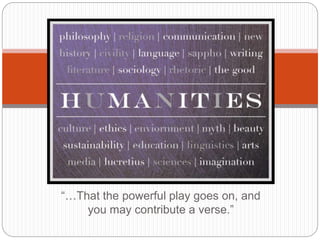
“…That the powerful play goes on, and
you may contribute a verse.”
What are the humanities?
 The humanities are academic disciplines that study
the human condition.
 They complement the natural sciences.
Adaptedfrom:UniversityofSouthFlorida,
CollegeofArtsandSciences
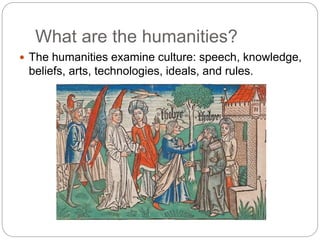
What are the humanities?
 The humanities examine culture: speech, knowledge,
beliefs, arts, technologies, ideals, and rules.
Why study the humanities?
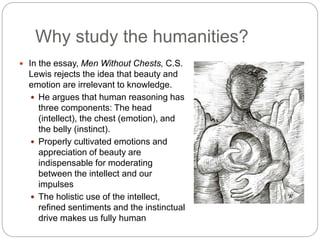
 In Men Without Chests, C.S. Lewis
rejects the idea that beauty and
emotion are irrelevant to knowledge:
 Human reasoning has three
components: The head (intellect), the
chest (emotion), and the belly
(instinct).
 Cultivated emotions and appreciation
of beauty are indispensable. They
referee the battle between intellect
and impulses.
 The holistic use of the intellect,
refined sentiments, and the
instinctual drive makes us fully
human.
Why study the humanities?
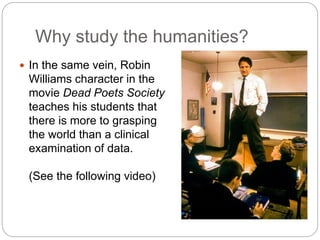
 In the same vein, Robin
Williams’ character in the
movie Dead Poets Society
teaches his students that
there is more to grasping
the world than a clinical
examination of data.
(See the following video)
Why study the humanities?
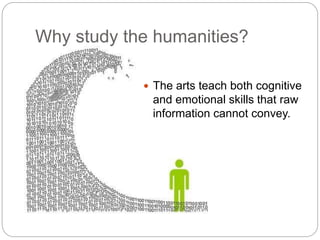
 The arts teach both cognitive
and emotional skills that raw
information cannot convey.
Why study the humanities?
 “Those who argue that we can learn from art generally
argue that our engagement with art arouses certain
emotions or activities that are able to facilitate or produce
knowledge.
Art is thus seen as a source of insight and awareness that
cannot be put into propositional language; but it can help
us to see the world in a new or different way.”
- Sarah E. Worth, “Art and Epistemology,” Internet
Encyclopedia of Philosophy (www.iep.utm.edu/art-ep/)
What are the humanities?
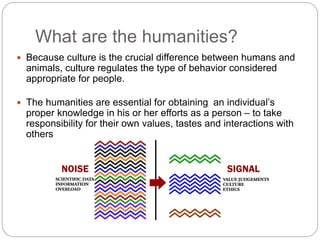
 Culture is the crucial difference between humans
and animals. The humanities are essential for
obtaining proper knowledge of our efforts as people.
It helps us take responsibility for our own values,
tastes and interactions with others.
Why Study the Humanities?
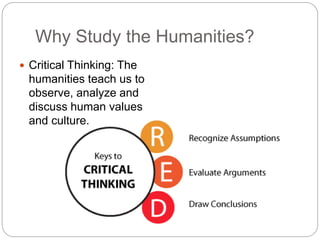
 The humanities teach us
to observe, analyze and
discuss human values
and culture.
Why Study the Humanities?
 Innovation: Critical Thinking cultivates creativity
and imagination, which leads to new ideas.
Why Study the Humanities?
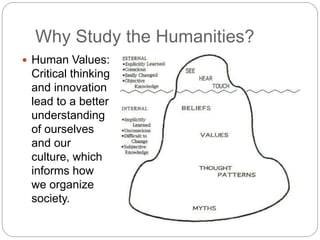
 Human Values:
Critical thinking
and innovation
lead to a better
understanding
of ourselves
and our
culture.
 This informs
how we
construct our
society.
Why Study the Humanities?
 Critical thinking
and innovation
also lead to
greater advances
in both the arts
and the sciences
Objectives
 Effective reading and writing skills: Vital to any job
requiring a college degree.
Objectives
 Critical analysis skills: Crucial to the decision-making
process.)
Objectives
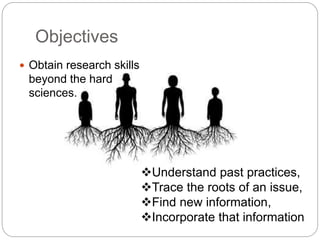
 Research skills beyond the hard sciences.
Understand past practices,
Trace the roots of an issue,
Find new information,
Incorporate that information
Objectives
 Interdisciplinary
thinking:
 Think about a problem
in a multitude of ways
 Analyze it using
multiple tools
 Provide solutions
drawing from different
traditions of thought
Objectives
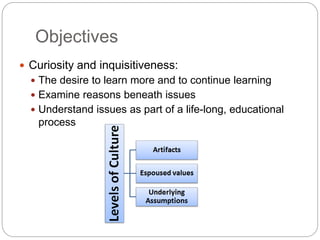
 Curiosity and inquisitiveness:
 The desire to learn more and to continue learning
 Examine the reasoning beneath the issues
 Understand issues as part of a life-long, educational
process
Words of wisdom(?)
“The universe is a cruel,
uncaring void. The key to
being happy isn’t the
search for meaning. It’s to
just keep yourself busy
with unimportant
nonsense and eventually,
you’ll be dead.”
— Mr. Peanut Butter
(Bojack Horseman:
Episode 12)
Or…
Words of wisdom
O ME! O life!... of the questions of these recurring;
Of the endless trains of the faithless—of cities fill’d
with the foolish;
Of myself forever reproaching myself, (for who
more foolish than I, and who more faithless?)
Of eyes that vainly crave the light—of the objects
mean—of the struggle ever renew’d;
Of the poor results of all—of the plodding and sordid crowds I see around me;
Of the empty and useless years of the rest—with the rest me intertwined
The question, O me! so sad, recurring—What good amid these, O me, O life?
Answer.
That you are here—that life exists, and identity;
That the powerful play goes on, and you will contribute a verse.
WaltWhitman
What will your verse be?

Why study the humanities?

  • 1.
    “…That the powerfulplay goes on, and you may contribute a verse.”
  • 2.
    What are thehumanities?  The humanities are academic disciplines that study the human condition.  They complement the natural sciences. Adaptedfrom:UniversityofSouthFlorida, CollegeofArtsandSciences
  • 3.
    What are thehumanities?  The humanities examine culture: speech, knowledge, beliefs, arts, technologies, ideals, and rules.
  • 4.
    Why study thehumanities?  In Men Without Chests, C.S. Lewis rejects the idea that beauty and emotion are irrelevant to knowledge:  Human reasoning has three components: The head (intellect), the chest (emotion), and the belly (instinct).  Cultivated emotions and appreciation of beauty are indispensable. They referee the battle between intellect and impulses.  The holistic use of the intellect, refined sentiments, and the instinctual drive makes us fully human.
  • 5.
    Why study thehumanities?  In the same vein, Robin Williams’ character in the movie Dead Poets Society teaches his students that there is more to grasping the world than a clinical examination of data. (See the following video)
  • 6.
    Why study thehumanities?  The arts teach both cognitive and emotional skills that raw information cannot convey.
  • 7.
    Why study thehumanities?  “Those who argue that we can learn from art generally argue that our engagement with art arouses certain emotions or activities that are able to facilitate or produce knowledge. Art is thus seen as a source of insight and awareness that cannot be put into propositional language; but it can help us to see the world in a new or different way.” - Sarah E. Worth, “Art and Epistemology,” Internet Encyclopedia of Philosophy (www.iep.utm.edu/art-ep/)
  • 8.
    What are thehumanities?  Culture is the crucial difference between humans and animals. The humanities are essential for obtaining proper knowledge of our efforts as people. It helps us take responsibility for our own values, tastes and interactions with others.
  • 9.
    Why Study theHumanities?  The humanities teach us to observe, analyze and discuss human values and culture.
  • 10.
    Why Study theHumanities?  Innovation: Critical Thinking cultivates creativity and imagination, which leads to new ideas.
  • 11.
    Why Study theHumanities?  Human Values: Critical thinking and innovation lead to a better understanding of ourselves and our culture.  This informs how we construct our society.
  • 12.
    Why Study theHumanities?  Critical thinking and innovation also lead to greater advances in both the arts and the sciences
  • 13.
    Objectives  Effective readingand writing skills: Vital to any job requiring a college degree.
  • 14.
    Objectives  Critical analysisskills: Crucial to the decision-making process.)
  • 15.
    Objectives  Research skillsbeyond the hard sciences. Understand past practices, Trace the roots of an issue, Find new information, Incorporate that information
  • 16.
    Objectives  Interdisciplinary thinking:  Thinkabout a problem in a multitude of ways  Analyze it using multiple tools  Provide solutions drawing from different traditions of thought
  • 17.
    Objectives  Curiosity andinquisitiveness:  The desire to learn more and to continue learning  Examine the reasoning beneath the issues  Understand issues as part of a life-long, educational process
  • 18.
    Words of wisdom(?) “Theuniverse is a cruel, uncaring void. The key to being happy isn’t the search for meaning. It’s to just keep yourself busy with unimportant nonsense and eventually, you’ll be dead.” — Mr. Peanut Butter (Bojack Horseman: Episode 12) Or…
  • 19.
    Words of wisdom OME! O life!... of the questions of these recurring; Of the endless trains of the faithless—of cities fill’d with the foolish; Of myself forever reproaching myself, (for who more foolish than I, and who more faithless?) Of eyes that vainly crave the light—of the objects mean—of the struggle ever renew’d; Of the poor results of all—of the plodding and sordid crowds I see around me; Of the empty and useless years of the rest—with the rest me intertwined The question, O me! so sad, recurring—What good amid these, O me, O life? Answer. That you are here—that life exists, and identity; That the powerful play goes on, and you will contribute a verse. WaltWhitman
  • 20.
    What will yourverse be?