Produce creative works that demonstrate
innovation in concepts, formal language
and/or materials.
Describe, analyze, interpret created
artwork and
recognize elements of design in works of
art
Providing visual, tactile and sensory
experiences and a special way of
understanding and responding to the
world. It
Filipino Art Edition
Most contemporary visual artists
in the Philippines produce works
that fall into the fine arts
category. The majority of the
contemporary art produced in the
Philippines are paintings,
sculptures, and drawings.
Courirer Express by Japs
Antido
This may be defined as a two-
dimensional form of art that showcases
artistic expression created on a flat
surface. Images are made by applying
pigment on a prepared surface using
typically one or a combination of the
following tools: brush, palette knife,
spray, finger, etc.
Religious themes were the primary
subject for the artworks during the
Spanish colonial times. In the
present, many religious-themed
paintings can be seen in the murals
of many churches and in paintings
with social commentaries.
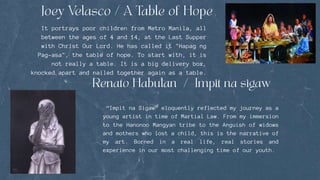
It portrays poor children from Metro Manila, all
between the ages of 4 and 14, at the Last Supper
with Christ Our Lord. He has called it "Hapag ng
Pag-asa", the table of hope. To start with, it is
not really a table. It is a big delivery box,
knocked apart and nailed together again as a table.
“Impit na Sigaw” eloquently reflected my journey as a
young artist in time of Martial Law. From my immersion
to the Hanonoo Mangyan tribe to the Anguish of widows
and mothers who lost a child, this is the narrative of
my art. Borned in a real life, real stories and
experience in our most challenging time of our youth.
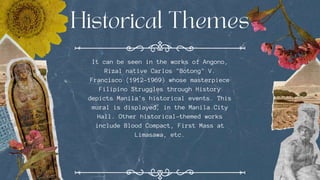
It can be seen in the works of Angono,
Rizal native Carlos "Botong" V.
Francisco (1912-1969) whose masterpiece
Filipino Struggles through History
depicts Manila's historical events. This
mural is displayed, in the Manila City
Hall. Other historical-themed works
include Blood Compact, First Mass at
Limasawa, etc.
Bayanihan is one of the artworks
made by Carlos Francisco. The
artwork entitled Bayanihan
literally means, being a bayan,
and has been used to refer to a
spirit of communal unity and cooperation.
Portraiture paintings are used to
commemorate personalities option and
are seen in many formal institutions
such as government offices. It started

with the rise of the lustrados during
the Spanish colonial times. It was and
has been a symbolism of one's rise to
power and wealth.
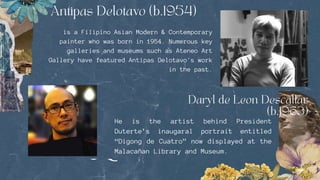
is a Filipino Asian Modern & Contemporary
painter who was born in 1954. Numerous key
galleries and museums such as Ateneo Art
Gallery have featured Antipas Delotavo's work
in the past.
He is the artist behind President
Duterte’s inaugaral portrait entitled
“Digong de Cuatro” now displayed at the
Malacañan Library and Museum.
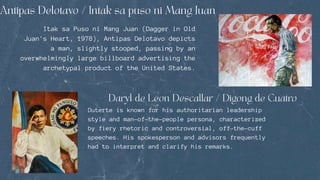
Itak sa Puso ni Mang Juan (Dagger in Old
Juan's Heart, 1978), Antipas Delotavo depicts
a man, slightly stooped, passing by an
overwhelmingly large billboard advertising the
archetypal product of the United States.
Duterte is known for his authoritarian leadership
style and man-of-the-people persona, characterized
by fiery rhetoric and controversial, off-the-cuff
speeches. His spokesperson and advisors frequently
had to interpret and clarify his remarks.
Paterno made oil paintings on canvas. In
1884, she created Still Life. It is a
romantic artwork that shows a rich cluster
of fruits that are found in the Philippine
islands.
was a renowned Filipino Expressionist whose
colorful and striking paintings portrayed a
variety of cubist-like figures such as a
mother embracing her infant, grisly
crucifixions, tables holding an array of fish
and fruit, stray dogs, and screaming subjects.
Still life is a work of art
that portrays inanimate
objects. It was traditionally
composed of a basket or bowl
of fruits and flowers in vases
on a table.
These two are the earliest known existing
artwork of a woman visual artist in the
Philippines. In 1885, she painted Fruits
and Flowers, River Scene with Banca, and
River Scene with Steamboat.
The depiction of the fishermen as they collect
their haul from the ocean may be a reference
to the artist's personal journey, and
spiritual awakening. In the painting men and
fish are locked in an eternal conflict between
ignorance and enlightenment, with the fish
representing the latter.
Landscapes depict the beauty of
the outdoors. It can be that of
the natural environment such as
the countryside and other rural
scenery, including seascapes that
focus on the imagery of bodies of
water.
Fernando Amorsolo painted and sketched more
than ten thousand pieces over his lifetime
using natural and backlighting techniques.
His most known works are of the dalagang
Filipina, landscapes of his Filipino
homeland, portraits and WWII war scenes.
The Dalagang Bukid was Amorsolo's muse of
ideal Filipina beauty. She is illustrated
as a smiling and cheerful lady wearing the
baro't saya, with her hair firmly pulled
back by a flowing bandana to protect her
from the glare of the afternoon sun.
His career started as a painter when he
translated the beauty of his hometown,
Paete, Laguna, with pen and ink. His mural
work "Paete I" won the grand prize at the
Art Association of the Philippines Art
Competition and Exhibition in 1972.
New York City, 14 November 2019 – An art
exhibit organized by the Philippine Center
entitled “Luzviminda” featuring the works of
world-renowned artist Manuel Baldemor will
have its opening at the Lobby Gallery of the
Philippine Center New York on 15 November
2019. Ambassdor Jose Manuel G. Romualdez and
Consul General Claro S. Cristobal will lead
the cutting of the ribbon.
Nude, as a subject of painting
in the Philippines, was rare
before the twentieth century
but has since been an accepted
and popular subject in
Philippine contemporary visual
arts.
Benedicto Cabrera, better known as
BenCab, is a figurative painter from
the Philippines. He is recognised as
a pioneer of Philippine art. BenCab's
paintings often depict figures
wrapped in flowing fabrics in muted
tones and earthy colour palettes.
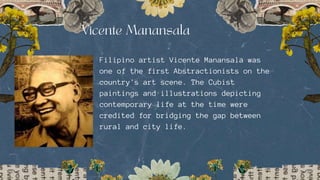
Filipino artist Vicente Manansala was
one of the first Abstractionists on the
country's art scene. The Cubist
paintings and illustrations depicting
contemporary life at the time were
credited for bridging the gap between
rural and city life.
Genres are paintings whose themes
showcase people doing everyday
activities and chores. Earliest examples
of this type in Philippine history is
the Boxer Codex (1590), which
illustrates the different social classes
and attires of the different inhabitants
of the country at the time.
His works as cartoonist, illustrator,
and painter have garnered praises here
and abroad and have inspired many to
enter the art industry. However, his
recognition as a National Artist has
been long overdue
The mother-child duo has been a
favorite theme in art, featured in
paintings ranging from the Renaissance
to Abstract art. The mother-child
relationship symbolizes several themes
about fertility, humanity, redemption,
love, nurture, and duty.
The Multi Awardee Mario Parial was born
on August 13, 1944, in Nueva Ecija.
are artworks that are three-
dimensional. The
classifications of sculptures
are traditionally divided into
two, namely, free-standing
and relief.
also known as in the round,
are sculptures that are raised
independently in their given
space. It can be often
observed from all points of
view.
Reliefs are sculptures that are
raised from a background.
Depending on the figure's
distance from the background,
it can be also classified into
bas-relief and high relief.
are reliefs that are slightly protruding
from their background, while high
reliefs are reliefs that are prominently
raised against their background,
giving the sculpture more
dimensionality.
Sculptures are made by either adding
or subtracting materials. Subtraction
is used in carving, while addition is
seen in sculpting techniques like
molding, casting, and welding.
Contemporary art forms that are
related to sculptures, like mobiles, and
three-dimensional light manipulations,
such as holograms, are not easily
classified between free-standing and
reliefs. Hence they are classified as
contemporary art forms.
Examples of precolonial sculptural
artworks include the panolongs of
the Torogan, the Maranao Royal
house, the sunduk or the grave
markers of the Badjao, and the many
interpretations of the Ifugao rice
god, the bulul.
Wood carving is found throughout
the different regions and
communities of the country. It is
used to create and decorate the
items used in one's daily life such as
furniture, utensils, shelter, and
transportation.
This art form has existed throughout
the history of the Philippines and is
still alive in many cultural hubs in the
country such as Pate, Laguna and
Betis, Pampanga.
During the Spanish colonization, the
most notable sculptural pieces were
the santos, which are sculptural
representations of Christ and the
Christian saints. Many of these
religious iconographies can be seen
in Spanish colonial churches in the
Philippines.
Many of these santos are venerated,
and grand religious events are
centered around them. This is
especially true with, the Black
Nazarene in Quiapo, the Santo Niño
in Cebu, and Our Lady of Peñafrancia
in Naga.
Contemporary sculpture in the
Philippines can also depict the
different themes used in paintings
and drawings.
It can also be classified into two styles:
the academic/classical and modern.
Classical style follows the aesthetics of the
ancient Greeks and Romans as taught by
the European art academies, while the
modern style is often abstracted and is not
as particular about the realistic portrayal or
representation of figures compared to the
classical style.
During the American colonial period,
classical sculptures portrayed prominent
people of society and politics. This was led
by the Bulacan native Guillermo Tolentino
(1890-1976) whose sculptural
masterpieces include the Bonifacio
Monument and the Oblation in UP Diliman.
Tolentino was a professor at the said
university and mentored other classical
style sculptors such as Anastacio Caedo
(1907-1990) and Froilan Madriñan (1941-
2008).
Caedo was a Batangeño whose most
recognizable work is the memorial at the
MacArthur landing site in Leyte. Froilan
Madriñan was a Pate artist who was a
master in wood carving.
He was a great influence to many aspiring
artists of Pate, mentoring contemporary
sculptors like Luisito Ac-ac (b. 1952) who
is famous for his lifelike wooden sculptures
and Mário Dayo (b. 1948) who is known
Sculptural bust by Anastacio Caedo for his
Baroque style relief murals.
One of Guillermo Tolentino's most well-
known students was Napoleon Abueva (b.
1930). Abueva was born in Tagbilaran,
Bohol.
He is credited to be the pioneer of modern
sculpture in the Philippines and is
sometimes referred to as the "Father of
Modern Sculpture" in the Philippines.
Abueva's sculptures often gave a feel of
playfulness, fluidity, and movement. He has
worked with various materials such as
stone, metal, and concrete but still prefers
wood, particularly 'molave and narra. His
masterpiece Allegorical Harpoon (molave,
1964) is considered to be one of his best
abstract sculptural works.
A relief by Napoleon Abueva
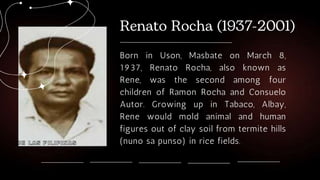
Born in Uson, Masbate on March 8,
1937, Renato Rocha, also known as
Rene, was the second among four
children of Ramon Rocha and Consuelo
Autor. Growing up in Tabaco, Albay,
Rene would mold animal and human
figures out of clay soil from termite hills
(nuno sa punso) in rice fields.
Napoleon Isabelo Veloso-Abueva (born January
26, 1930), more popularly known as Napoleon
Abueva, is a Filipino artist. He is a sculptor
given the distinction as the Philippines National
Artist for Sculpture. He is also entitled as the
“Father of Modern Philippine Sculpture”. He is
the first and only Boholano given the
distinction as National Artist of the Philippines
in the field of Visual Arts.
Born in Uson, Masbate on March 8,
1937, Renato Rocha, also known as
Rene, was the second among four
children of Ramon Rocha and Consuelo
Autor. Growing up in Tabaco, Albay,
Rene would mold animal and human
figures out of clay soil from termite hills
(nuno sa punso) in rice fields.
Born in Uson, Masbate on March 8,
1937, Renato Rocha, also known as
Rene, was the second among four
children of Ramon Rocha and Consuelo
Autor. Growing up in Tabaco, Albay,
Rene would mold animal and human
figures out of clay soil from termite hills
(nuno sa punso) in rice fields.
Ros Arcilla was a Filipino Asian Modern &
Contemporary artist who was born in 1938. Ros
Arcilla's work has been offered at auction multiple
times, with realized prices ranging from 432 USD to
2,319 USD, depending on the size and medium of the
artwork. Since 2015 the record price for this artist at
auction is 2,319 USD for Untitled, sold at León Gallery,
Makati in 2021. The artist died in 2006.
who was born in ligan City, Lanao del
Norte. Her early works were terra-
cotta sculptural portraits of family and
friends, which further developed to her
trademark expressive depiction of
women. Another expressionist
contemporary sculptor is Quezon City
artist.
Arellano's dramatic sculptures
of cast and modeled plaster
and synthetic marble she calls
inscapes focus on the essential
meaning of a figure rather
than just its surface
appearance.
whose sculptural work is
evocative of indigenous
tribal art, making use of
woodcuts and other
found materials.
who is well known for his
bronze sculptural that make
use of welded pieces, giving
them a rough impression, and
for his series of sculptures
entitled Tikbalang.
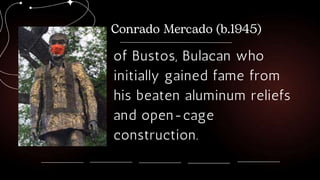
of Bustos, Bulacan who
initially gained fame from
his beaten aluminum reliefs
and open-cage
construction.
The contemporary sculptural arts
mentioned is but a drop in the river of
talented and unique sculptors the
country has to offer. Every day, new
talents are emerging and discovered.
Contemporary Visual Arts.pptx

Contemporary Visual Arts.pptx

  • 2.
    Produce creative worksthat demonstrate innovation in concepts, formal language and/or materials. Describe, analyze, interpret created artwork and recognize elements of design in works of art Providing visual, tactile and sensory experiences and a special way of understanding and responding to the world. It
  • 3.
  • 4.
    Most contemporary visualartists in the Philippines produce works that fall into the fine arts category. The majority of the contemporary art produced in the Philippines are paintings, sculptures, and drawings.
  • 5.
  • 6.
    This may bedefined as a two- dimensional form of art that showcases artistic expression created on a flat surface. Images are made by applying pigment on a prepared surface using typically one or a combination of the following tools: brush, palette knife, spray, finger, etc.
  • 8.
    Religious themes werethe primary subject for the artworks during the Spanish colonial times. In the present, many religious-themed paintings can be seen in the murals of many churches and in paintings with social commentaries.
  • 9.
    It portrays poorchildren from Metro Manila, all between the ages of 4 and 14, at the Last Supper with Christ Our Lord. He has called it "Hapag ng Pag-asa", the table of hope. To start with, it is not really a table. It is a big delivery box, knocked apart and nailed together again as a table. “Impit na Sigaw” eloquently reflected my journey as a young artist in time of Martial Law. From my immersion to the Hanonoo Mangyan tribe to the Anguish of widows and mothers who lost a child, this is the narrative of my art. Borned in a real life, real stories and experience in our most challenging time of our youth.
  • 10.
    It can beseen in the works of Angono, Rizal native Carlos "Botong" V. Francisco (1912-1969) whose masterpiece Filipino Struggles through History depicts Manila's historical events. This mural is displayed, in the Manila City Hall. Other historical-themed works include Blood Compact, First Mass at Limasawa, etc.
  • 11.
    Bayanihan is oneof the artworks made by Carlos Francisco. The artwork entitled Bayanihan literally means, being a bayan, and has been used to refer to a spirit of communal unity and cooperation.
  • 12.
    Portraiture paintings areused to commemorate personalities option and are seen in many formal institutions such as government offices. It started with the rise of the lustrados during the Spanish colonial times. It was and has been a symbolism of one's rise to power and wealth.
  • 13.
    is a FilipinoAsian Modern & Contemporary painter who was born in 1954. Numerous key galleries and museums such as Ateneo Art Gallery have featured Antipas Delotavo's work in the past. He is the artist behind President Duterte’s inaugaral portrait entitled “Digong de Cuatro” now displayed at the Malacañan Library and Museum.
  • 14.
    Itak sa Pusoni Mang Juan (Dagger in Old Juan's Heart, 1978), Antipas Delotavo depicts a man, slightly stooped, passing by an overwhelmingly large billboard advertising the archetypal product of the United States. Duterte is known for his authoritarian leadership style and man-of-the-people persona, characterized by fiery rhetoric and controversial, off-the-cuff speeches. His spokesperson and advisors frequently had to interpret and clarify his remarks.
  • 15.
    Paterno made oilpaintings on canvas. In 1884, she created Still Life. It is a romantic artwork that shows a rich cluster of fruits that are found in the Philippine islands. was a renowned Filipino Expressionist whose colorful and striking paintings portrayed a variety of cubist-like figures such as a mother embracing her infant, grisly crucifixions, tables holding an array of fish and fruit, stray dogs, and screaming subjects.
  • 16.
    Still life isa work of art that portrays inanimate objects. It was traditionally composed of a basket or bowl of fruits and flowers in vases on a table.
  • 17.
    These two arethe earliest known existing artwork of a woman visual artist in the Philippines. In 1885, she painted Fruits and Flowers, River Scene with Banca, and River Scene with Steamboat. The depiction of the fishermen as they collect their haul from the ocean may be a reference to the artist's personal journey, and spiritual awakening. In the painting men and fish are locked in an eternal conflict between ignorance and enlightenment, with the fish representing the latter.
  • 18.
    Landscapes depict thebeauty of the outdoors. It can be that of the natural environment such as the countryside and other rural scenery, including seascapes that focus on the imagery of bodies of water.
  • 19.
    Fernando Amorsolo paintedand sketched more than ten thousand pieces over his lifetime using natural and backlighting techniques. His most known works are of the dalagang Filipina, landscapes of his Filipino homeland, portraits and WWII war scenes.
  • 20.
    The Dalagang Bukidwas Amorsolo's muse of ideal Filipina beauty. She is illustrated as a smiling and cheerful lady wearing the baro't saya, with her hair firmly pulled back by a flowing bandana to protect her from the glare of the afternoon sun.
  • 21.
    His career startedas a painter when he translated the beauty of his hometown, Paete, Laguna, with pen and ink. His mural work "Paete I" won the grand prize at the Art Association of the Philippines Art Competition and Exhibition in 1972.
  • 22.
    New York City,14 November 2019 – An art exhibit organized by the Philippine Center entitled “Luzviminda” featuring the works of world-renowned artist Manuel Baldemor will have its opening at the Lobby Gallery of the Philippine Center New York on 15 November 2019. Ambassdor Jose Manuel G. Romualdez and Consul General Claro S. Cristobal will lead the cutting of the ribbon.
  • 23.
    Nude, as asubject of painting in the Philippines, was rare before the twentieth century but has since been an accepted and popular subject in Philippine contemporary visual arts.
  • 24.
    Benedicto Cabrera, betterknown as BenCab, is a figurative painter from the Philippines. He is recognised as a pioneer of Philippine art. BenCab's paintings often depict figures wrapped in flowing fabrics in muted tones and earthy colour palettes.
  • 26.
    Filipino artist VicenteManansala was one of the first Abstractionists on the country's art scene. The Cubist paintings and illustrations depicting contemporary life at the time were credited for bridging the gap between rural and city life.
  • 28.
    Genres are paintingswhose themes showcase people doing everyday activities and chores. Earliest examples of this type in Philippine history is the Boxer Codex (1590), which illustrates the different social classes and attires of the different inhabitants of the country at the time.
  • 29.
    His works ascartoonist, illustrator, and painter have garnered praises here and abroad and have inspired many to enter the art industry. However, his recognition as a National Artist has been long overdue
  • 30.
    The mother-child duohas been a favorite theme in art, featured in paintings ranging from the Renaissance to Abstract art. The mother-child relationship symbolizes several themes about fertility, humanity, redemption, love, nurture, and duty.
  • 31.
    The Multi AwardeeMario Parial was born on August 13, 1944, in Nueva Ecija.
  • 34.
    are artworks thatare three- dimensional. The classifications of sculptures are traditionally divided into two, namely, free-standing and relief.
  • 35.
    also known asin the round, are sculptures that are raised independently in their given space. It can be often observed from all points of view.
  • 36.
    Reliefs are sculpturesthat are raised from a background. Depending on the figure's distance from the background, it can be also classified into bas-relief and high relief.
  • 37.
    are reliefs thatare slightly protruding from their background, while high reliefs are reliefs that are prominently raised against their background, giving the sculpture more dimensionality.
  • 38.
    Sculptures are madeby either adding or subtracting materials. Subtraction is used in carving, while addition is seen in sculpting techniques like molding, casting, and welding.
  • 39.
    Contemporary art formsthat are related to sculptures, like mobiles, and three-dimensional light manipulations, such as holograms, are not easily classified between free-standing and reliefs. Hence they are classified as contemporary art forms.
  • 40.
    Examples of precolonialsculptural artworks include the panolongs of the Torogan, the Maranao Royal house, the sunduk or the grave markers of the Badjao, and the many interpretations of the Ifugao rice god, the bulul.
  • 41.
    Wood carving isfound throughout the different regions and communities of the country. It is used to create and decorate the items used in one's daily life such as furniture, utensils, shelter, and transportation.
  • 42.
    This art formhas existed throughout the history of the Philippines and is still alive in many cultural hubs in the country such as Pate, Laguna and Betis, Pampanga.
  • 43.
    During the Spanishcolonization, the most notable sculptural pieces were the santos, which are sculptural representations of Christ and the Christian saints. Many of these religious iconographies can be seen in Spanish colonial churches in the Philippines.
  • 44.
    Many of thesesantos are venerated, and grand religious events are centered around them. This is especially true with, the Black Nazarene in Quiapo, the Santo Niño in Cebu, and Our Lady of Peñafrancia in Naga.
  • 45.
    Contemporary sculpture inthe Philippines can also depict the different themes used in paintings and drawings.
  • 46.
    It can alsobe classified into two styles: the academic/classical and modern. Classical style follows the aesthetics of the ancient Greeks and Romans as taught by the European art academies, while the modern style is often abstracted and is not as particular about the realistic portrayal or representation of figures compared to the classical style.
  • 47.
    During the Americancolonial period, classical sculptures portrayed prominent people of society and politics. This was led by the Bulacan native Guillermo Tolentino (1890-1976) whose sculptural masterpieces include the Bonifacio Monument and the Oblation in UP Diliman.
  • 48.
    Tolentino was aprofessor at the said university and mentored other classical style sculptors such as Anastacio Caedo (1907-1990) and Froilan Madriñan (1941- 2008).
  • 49.
    Caedo was aBatangeño whose most recognizable work is the memorial at the MacArthur landing site in Leyte. Froilan Madriñan was a Pate artist who was a master in wood carving.
  • 50.
    He was agreat influence to many aspiring artists of Pate, mentoring contemporary sculptors like Luisito Ac-ac (b. 1952) who is famous for his lifelike wooden sculptures and Mário Dayo (b. 1948) who is known Sculptural bust by Anastacio Caedo for his Baroque style relief murals.
  • 51.
    One of GuillermoTolentino's most well- known students was Napoleon Abueva (b. 1930). Abueva was born in Tagbilaran, Bohol.
  • 52.
    He is creditedto be the pioneer of modern sculpture in the Philippines and is sometimes referred to as the "Father of Modern Sculpture" in the Philippines.
  • 53.
    Abueva's sculptures oftengave a feel of playfulness, fluidity, and movement. He has worked with various materials such as stone, metal, and concrete but still prefers wood, particularly 'molave and narra. His masterpiece Allegorical Harpoon (molave, 1964) is considered to be one of his best abstract sculptural works.
  • 55.
    A relief byNapoleon Abueva
  • 56.
    Born in Uson,Masbate on March 8, 1937, Renato Rocha, also known as Rene, was the second among four children of Ramon Rocha and Consuelo Autor. Growing up in Tabaco, Albay, Rene would mold animal and human figures out of clay soil from termite hills (nuno sa punso) in rice fields.
  • 57.
    Napoleon Isabelo Veloso-Abueva(born January 26, 1930), more popularly known as Napoleon Abueva, is a Filipino artist. He is a sculptor given the distinction as the Philippines National Artist for Sculpture. He is also entitled as the “Father of Modern Philippine Sculpture”. He is the first and only Boholano given the distinction as National Artist of the Philippines in the field of Visual Arts.
  • 58.
    Born in Uson,Masbate on March 8, 1937, Renato Rocha, also known as Rene, was the second among four children of Ramon Rocha and Consuelo Autor. Growing up in Tabaco, Albay, Rene would mold animal and human figures out of clay soil from termite hills (nuno sa punso) in rice fields.
  • 59.
    Born in Uson,Masbate on March 8, 1937, Renato Rocha, also known as Rene, was the second among four children of Ramon Rocha and Consuelo Autor. Growing up in Tabaco, Albay, Rene would mold animal and human figures out of clay soil from termite hills (nuno sa punso) in rice fields.
  • 60.
    Ros Arcilla wasa Filipino Asian Modern & Contemporary artist who was born in 1938. Ros Arcilla's work has been offered at auction multiple times, with realized prices ranging from 432 USD to 2,319 USD, depending on the size and medium of the artwork. Since 2015 the record price for this artist at auction is 2,319 USD for Untitled, sold at León Gallery, Makati in 2021. The artist died in 2006.
  • 61.
    who was bornin ligan City, Lanao del Norte. Her early works were terra- cotta sculptural portraits of family and friends, which further developed to her trademark expressive depiction of women. Another expressionist contemporary sculptor is Quezon City artist.
  • 62.
    Arellano's dramatic sculptures ofcast and modeled plaster and synthetic marble she calls inscapes focus on the essential meaning of a figure rather than just its surface appearance.
  • 63.
    whose sculptural workis evocative of indigenous tribal art, making use of woodcuts and other found materials.
  • 64.
    who is wellknown for his bronze sculptural that make use of welded pieces, giving them a rough impression, and for his series of sculptures entitled Tikbalang.
  • 65.
    of Bustos, Bulacanwho initially gained fame from his beaten aluminum reliefs and open-cage construction.
  • 66.
    The contemporary sculpturalarts mentioned is but a drop in the river of talented and unique sculptors the country has to offer. Every day, new talents are emerging and discovered.