1
Multi-armed bandits
• At each time t pick arm i;
• get independent payoff ft with mean ui
• Classic model for exploration – exploitation tradeoff
• Extensively studied (Robbins ’52, Gittins ’79)
• Typically assume each arm is tried multiple times
• Goal: minimize regret
…
u1 u2 u3 uK
1
[ ]
t
T opt t
i
T E f
R 

  
2
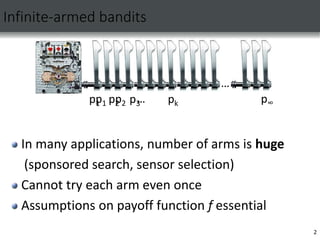
Infinite-armed bandits
…
p1 p2 p3 pk
… p∞
p1 p2
…
In many applications, number of arms is huge
(sponsored search, sensor selection)
Cannot try each arm even once
Assumptions on payoff function f essential
Optimizing Noisy, Unknown Functions
• Given: Set of possible inputs D;
black-box access to unknown function f
• Want: Adaptive choice of inputs
from D maximizing
• Many applications: robotic control [Lizotte
et al. ’07], sponsored search [Pande &
Olston, ’07], clinical trials, …
• Sampling is expensive
• Algorithms evaluated using regret
Goal: minimize
Running example: Noisy Search
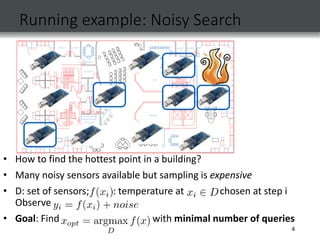
• How to find the hottest point in a building?
• Many noisy sensors available but sampling is expensive
• D: set of sensors; : temperature at chosen at step i
Observe
• Goal: Find with minimal number of queries
4
Relating to us: Active learning for PMF
A bandit setting for movie recommendation
Task: recommend movies for a new user
M-armed Bandit
Movie item as arm of bandit
For a new user i
At each round t, pick a movie j
Observe a rating Xij
Goal: maximize cumulative reward
sum of the ratings of all recommended movies
Model: PMF
X=UV+E, where
U: N*K matrix, V: K*M matrix, E: N*M matrix, zero-mean normal distributed
Assume movie feature V is fully observed. User feature Ui is unknown at first
Xi(j) = Ui Vj + ε (regard the ith row vector of X as a function Xi)
Xi(.): random linear function
5
Key insight: Exploit correlation
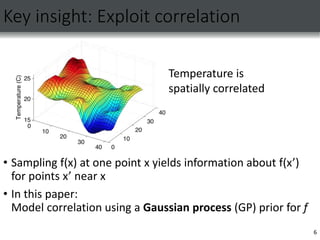
• Sampling f(x) at one point x yields information about f(x’)
for points x’ near x
• In this paper:
Model correlation using a Gaussian process (GP) prior for f
6
Temperature is
spatially correlated
Gaussian Processes to model payoff f
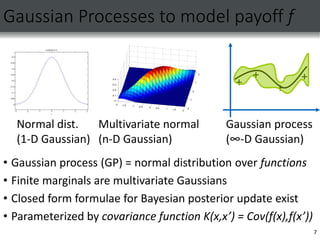
• Gaussian process (GP) = normal distribution over functions
• Finite marginals are multivariate Gaussians
• Closed form formulae for Bayesian posterior update exist
• Parameterized by covariance function K(x,x’) = Cov(f(x),f(x’))
7
Normal dist.
(1-D Gaussian)
-2 -1.5 -1 -0.5 0 0.5 1 1.5 2
-2
-1
0
1
2
0
0.1
0.2
0.3
0.4
Multivariate normal
(n-D Gaussian)
+
+
+
+
Gaussian process
(∞-D Gaussian)
8
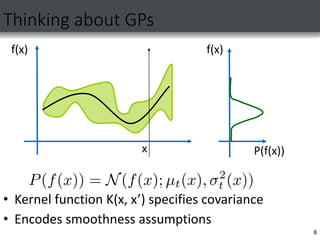
Thinking about GPs
• Kernel function K(x, x’) specifies covariance
• Encodes smoothness assumptions
x
f(x)
P(f(x))
f(x)
9
Example of GPs
• Squared exponential kernel
K(x,x’) = exp(-(x-x’)2/h2)
0 0.2 0.4 0.6 0.8 1
-4
-3
-2
-1
0
1
2
Bandwidth h=.1
0 100 200 300 400 500 600 700
0
0.1
0.2
0.3
0.4
0.5
0.6
0.7
0.8
0.9
1
Distance |x-x’|
0 0.2 0.4 0.6 0.8 1
-2
-1.5
-1
-0.5
0
0.5
1
1.5
2
2.5
3
Bandwidth h=.3
Samples from P(f)
-3 -2 -1 0 1 2 3
Gaussian process optimization
[e.g., Jones et al ’98]
10
x
f(x)
Goal: Adaptively pick
inputs such that
Key question: how should we pick samples?
So far, only heuristics:
Expected Improvement [Močkus et al. ‘78]
Most Probable Improvement [Močkus ‘89]
Used successfully in machine learning [Ginsbourger et al. ‘08,
Jones ‘01, Lizotte et al. ’07]
No theoretical guarantees on their regret!
11
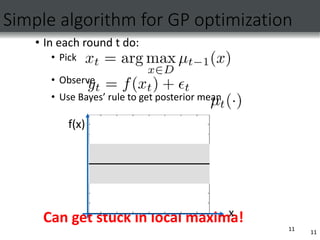
Simple algorithm for GP optimization
• In each round t do:
• Pick
• Observe
• Use Bayes’ rule to get posterior mean
Can get stuck in local maxima!
11
x
f(x)
12
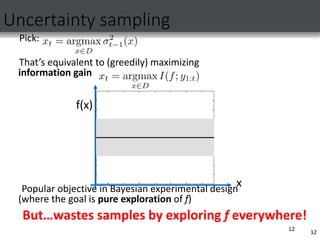
Uncertainty sampling
Pick:
That’s equivalent to (greedily) maximizing
information gain
Popular objective in Bayesian experimental design
(where the goal is pure exploration of f)
But…wastes samples by exploring f everywhere!
12
x
f(x)
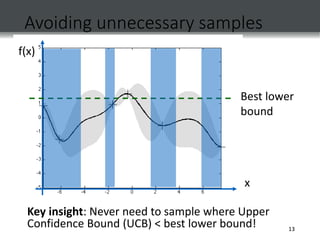
Avoiding unnecessary samples
Key insight: Never need to sample where Upper
Confidence Bound (UCB) < best lower bound! 13
x
f(x)
Best lower
bound
14
Upper Confidence Bound (UCB) Algorithm
Naturally trades off explore and exploit; no samples wasted
Regret bounds: classic [Auer ’02] & linear f [Dani et al. ‘07]
But none in the GP optimization setting! (popular heuristic)
x
f(x)
Pick input that maximizes Upper Confidence Bound (UCB):
How should
we choose ¯t?
Need theory!
15
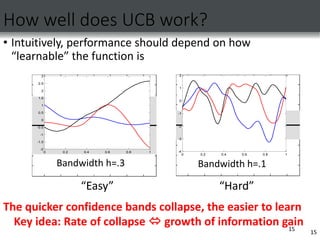
How well does UCB work?
• Intuitively, performance should depend on how
“learnable” the function is
15
“Easy” “Hard”
The quicker confidence bands collapse, the easier to learn
Key idea: Rate of collapse  growth of information gain
0 0.2 0.4 0.6 0.8 1
-2
-1.5
-1
-0.5
0
0.5
1
1.5
2
2.5
3
Bandwidth h=.3
0 0.2 0.4 0.6 0.8 1
-4
-3
-2
-1
0
1
2
Bandwidth h=.1
Learnability and information gain
• We show that regret bounds depend on how quickly we can
gain information
• Mathematically:
• Establishes a novel connection between GP optimization
and Bayesian experimental design
16
T
17
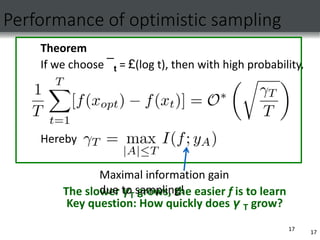
Performance of optimistic sampling
Theorem
If we choose ¯t = £(log t), then with high probability,
Hereby
The slower γT grows, the easier f is to learn
Key question: How quickly does γ T grow?
17
Maximal information gain
due to sampling!
Learnability and information gain
• Information gain exhibits diminishing returns (submodularity)
[Krause & Guestrin ’05]
• Our bounds depend on “rate” of diminishment
18
Little diminishing returns
Returns diminish fast
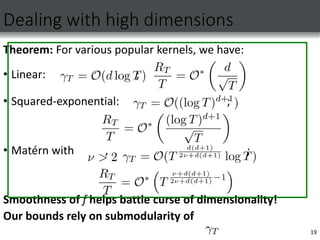
Dealing with high dimensions
Theorem: For various popular kernels, we have:
• Linear: ;
• Squared-exponential: ;
• Matérn with , ;
Smoothness of f helps battle curse of dimensionality!
Our bounds rely on submodularity of
19
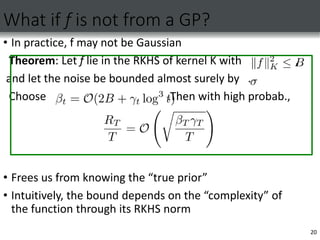
What if f is not from a GP?
• In practice, f may not be Gaussian
Theorem: Let f lie in the RKHS of kernel K with ,
and let the noise be bounded almost surely by .
Choose .Then with high probab.,
• Frees us from knowing the “true prior”
• Intuitively, the bound depends on the “complexity” of
the function through its RKHS norm
20
Experiments: UCB vs. heuristics
• Temperature data
• 46 sensors deployed at Intel Research, Berkeley
• Collected data for 5 days (1 sample/minute)
• Want to adaptively find highest temperature as quickly as
possible
• Traffic data
• Speed data from 357 sensors deployed along highway I-880
South
• Collected during 6am-11am, for one month
• Want to find most congested (lowest speed) area as quickly as
possible
21
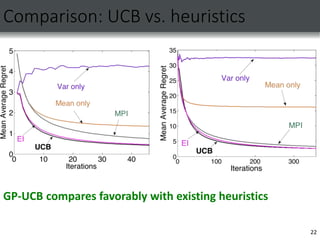
Comparison: UCB vs. heuristics
22
GP-UCB compares favorably with existing heuristics
23
Assumptions on f
Linear?
[Dani et al, ’07]
Lipschitz-continuous
(bounded slope)
[Kleinberg ‘08]
Fast convergence;
But strong assumption
Very flexible, but
Conclusions
• First theoretical guarantees and convergence rates
for GP optimization
• Both true prior and agnostic case covered
• Performance depends on “learnability”, captured by
maximal information gain
• Connects GP Bandit Optimization & Experimental Design!
• Performance on real data comparable to other heuristics
24

GAUSSIAN PRESENTATION.ppt

  • 1.
    1 Multi-armed bandits • Ateach time t pick arm i; • get independent payoff ft with mean ui • Classic model for exploration – exploitation tradeoff • Extensively studied (Robbins ’52, Gittins ’79) • Typically assume each arm is tried multiple times • Goal: minimize regret … u1 u2 u3 uK 1 [ ] t T opt t i T E f R     
  • 2.
    2 Infinite-armed bandits … p1 p2p3 pk … p∞ p1 p2 … In many applications, number of arms is huge (sponsored search, sensor selection) Cannot try each arm even once Assumptions on payoff function f essential
  • 3.
    Optimizing Noisy, UnknownFunctions • Given: Set of possible inputs D; black-box access to unknown function f • Want: Adaptive choice of inputs from D maximizing • Many applications: robotic control [Lizotte et al. ’07], sponsored search [Pande & Olston, ’07], clinical trials, … • Sampling is expensive • Algorithms evaluated using regret Goal: minimize
  • 4.
    Running example: NoisySearch • How to find the hottest point in a building? • Many noisy sensors available but sampling is expensive • D: set of sensors; : temperature at chosen at step i Observe • Goal: Find with minimal number of queries 4
  • 5.
    Relating to us:Active learning for PMF A bandit setting for movie recommendation Task: recommend movies for a new user M-armed Bandit Movie item as arm of bandit For a new user i At each round t, pick a movie j Observe a rating Xij Goal: maximize cumulative reward sum of the ratings of all recommended movies Model: PMF X=UV+E, where U: N*K matrix, V: K*M matrix, E: N*M matrix, zero-mean normal distributed Assume movie feature V is fully observed. User feature Ui is unknown at first Xi(j) = Ui Vj + ε (regard the ith row vector of X as a function Xi) Xi(.): random linear function 5
  • 6.
    Key insight: Exploitcorrelation • Sampling f(x) at one point x yields information about f(x’) for points x’ near x • In this paper: Model correlation using a Gaussian process (GP) prior for f 6 Temperature is spatially correlated
  • 7.
    Gaussian Processes tomodel payoff f • Gaussian process (GP) = normal distribution over functions • Finite marginals are multivariate Gaussians • Closed form formulae for Bayesian posterior update exist • Parameterized by covariance function K(x,x’) = Cov(f(x),f(x’)) 7 Normal dist. (1-D Gaussian) -2 -1.5 -1 -0.5 0 0.5 1 1.5 2 -2 -1 0 1 2 0 0.1 0.2 0.3 0.4 Multivariate normal (n-D Gaussian) + + + + Gaussian process (∞-D Gaussian)
  • 8.
    8 Thinking about GPs •Kernel function K(x, x’) specifies covariance • Encodes smoothness assumptions x f(x) P(f(x)) f(x)
  • 9.
    9 Example of GPs •Squared exponential kernel K(x,x’) = exp(-(x-x’)2/h2) 0 0.2 0.4 0.6 0.8 1 -4 -3 -2 -1 0 1 2 Bandwidth h=.1 0 100 200 300 400 500 600 700 0 0.1 0.2 0.3 0.4 0.5 0.6 0.7 0.8 0.9 1 Distance |x-x’| 0 0.2 0.4 0.6 0.8 1 -2 -1.5 -1 -0.5 0 0.5 1 1.5 2 2.5 3 Bandwidth h=.3 Samples from P(f) -3 -2 -1 0 1 2 3
  • 10.
    Gaussian process optimization [e.g.,Jones et al ’98] 10 x f(x) Goal: Adaptively pick inputs such that Key question: how should we pick samples? So far, only heuristics: Expected Improvement [Močkus et al. ‘78] Most Probable Improvement [Močkus ‘89] Used successfully in machine learning [Ginsbourger et al. ‘08, Jones ‘01, Lizotte et al. ’07] No theoretical guarantees on their regret!
  • 11.
    11 Simple algorithm forGP optimization • In each round t do: • Pick • Observe • Use Bayes’ rule to get posterior mean Can get stuck in local maxima! 11 x f(x)
  • 12.
    12 Uncertainty sampling Pick: That’s equivalentto (greedily) maximizing information gain Popular objective in Bayesian experimental design (where the goal is pure exploration of f) But…wastes samples by exploring f everywhere! 12 x f(x)
  • 13.
    Avoiding unnecessary samples Keyinsight: Never need to sample where Upper Confidence Bound (UCB) < best lower bound! 13 x f(x) Best lower bound
  • 14.
    14 Upper Confidence Bound(UCB) Algorithm Naturally trades off explore and exploit; no samples wasted Regret bounds: classic [Auer ’02] & linear f [Dani et al. ‘07] But none in the GP optimization setting! (popular heuristic) x f(x) Pick input that maximizes Upper Confidence Bound (UCB): How should we choose ¯t? Need theory!
  • 15.
    15 How well doesUCB work? • Intuitively, performance should depend on how “learnable” the function is 15 “Easy” “Hard” The quicker confidence bands collapse, the easier to learn Key idea: Rate of collapse  growth of information gain 0 0.2 0.4 0.6 0.8 1 -2 -1.5 -1 -0.5 0 0.5 1 1.5 2 2.5 3 Bandwidth h=.3 0 0.2 0.4 0.6 0.8 1 -4 -3 -2 -1 0 1 2 Bandwidth h=.1
  • 16.
    Learnability and informationgain • We show that regret bounds depend on how quickly we can gain information • Mathematically: • Establishes a novel connection between GP optimization and Bayesian experimental design 16 T
  • 17.
    17 Performance of optimisticsampling Theorem If we choose ¯t = £(log t), then with high probability, Hereby The slower γT grows, the easier f is to learn Key question: How quickly does γ T grow? 17 Maximal information gain due to sampling!
  • 18.
    Learnability and informationgain • Information gain exhibits diminishing returns (submodularity) [Krause & Guestrin ’05] • Our bounds depend on “rate” of diminishment 18 Little diminishing returns Returns diminish fast
  • 19.
    Dealing with highdimensions Theorem: For various popular kernels, we have: • Linear: ; • Squared-exponential: ; • Matérn with , ; Smoothness of f helps battle curse of dimensionality! Our bounds rely on submodularity of 19
  • 20.
    What if fis not from a GP? • In practice, f may not be Gaussian Theorem: Let f lie in the RKHS of kernel K with , and let the noise be bounded almost surely by . Choose .Then with high probab., • Frees us from knowing the “true prior” • Intuitively, the bound depends on the “complexity” of the function through its RKHS norm 20
  • 21.
    Experiments: UCB vs.heuristics • Temperature data • 46 sensors deployed at Intel Research, Berkeley • Collected data for 5 days (1 sample/minute) • Want to adaptively find highest temperature as quickly as possible • Traffic data • Speed data from 357 sensors deployed along highway I-880 South • Collected during 6am-11am, for one month • Want to find most congested (lowest speed) area as quickly as possible 21
  • 22.
    Comparison: UCB vs.heuristics 22 GP-UCB compares favorably with existing heuristics
  • 23.
    23 Assumptions on f Linear? [Daniet al, ’07] Lipschitz-continuous (bounded slope) [Kleinberg ‘08] Fast convergence; But strong assumption Very flexible, but
  • 24.
    Conclusions • First theoreticalguarantees and convergence rates for GP optimization • Both true prior and agnostic case covered • Performance depends on “learnability”, captured by maximal information gain • Connects GP Bandit Optimization & Experimental Design! • Performance on real data comparable to other heuristics 24

Editor's Notes

  • #2 Explanation of k-armed bandit ! 
  • #4 Repeat what f is – give an example !
  • #5 Floorplan looks funny (pixelated)
  • #6 Floorplan looks funny (pixelated)
  • #17 Add cartoon plot for \gamma_T; need axes, etc.